Get in Touch with Guanma

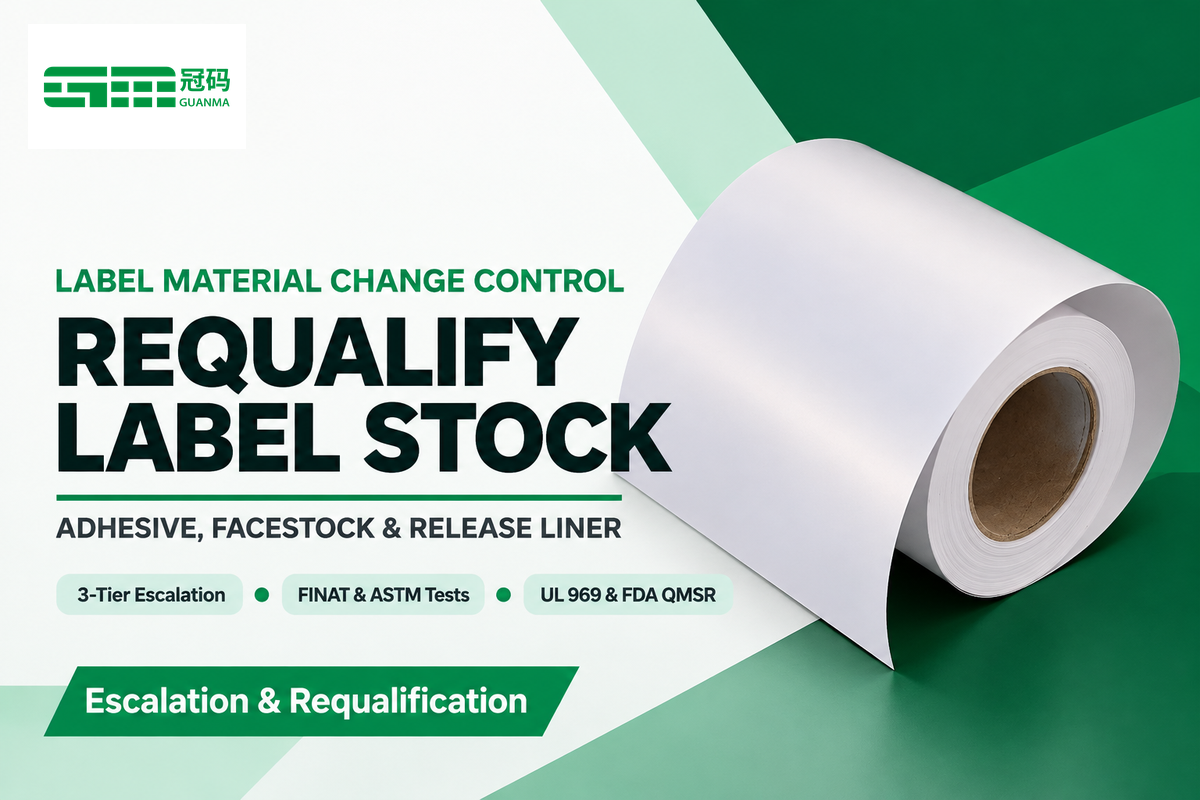
This document contains Label material change control procedures for pressure-sensitive constructions. Enterprise screening bands in this guide allow variations of ±5% for basis weight or caliper and ±15% for peel force. Facestocks, adhesives, topcoats and silicone release liners are changed regularly by paper mills, film extruders and converters. Structured qualification prevents high-speed packaging line stops, audit nonconformances and barcode scan failures.
Key Engineering Takeaways for Quality & Packaging Teams
- Enterprise escalation matrices restrict Level 1 administrative swaps to non-UL-recognized, non-sterilized secondary carton labels with the same chemical family and silicone release system. Internal screening bands cover ±5% for gsm or caliper, ±15% for peel, and ±20% for release. Coat-weight shifts beyond ±10% or liner swaps trigger Level 2 trials, while adhesive family, UL 969, or sterilization changes trigger Level 3 validation.
- Effective February 2, 2026, the FDA Quality Management System Regulation (QMSR) harmonizes 21 CFR Part 820 with ISO 13485:2016. Section 21 CFR 820.45 retains dedicated FDA device labeling and packaging inspection controls.
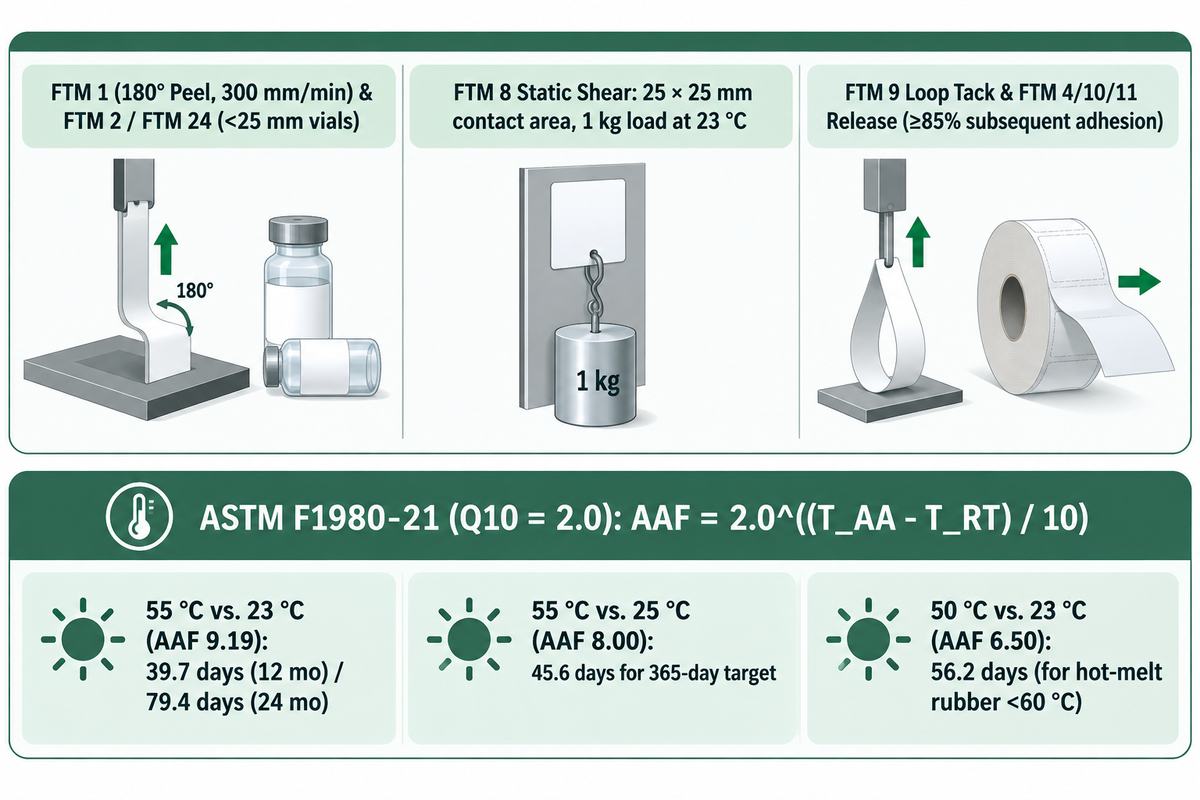
- Bench qualification pairs 180-degree peel tests per FINAT FTM 1 with 90-degree peel (FTM 2) and mandrel hold (FTM 24) on curved vials under 25 mm diameter. Teams also run static shear per FTM 8 (25 × 25 mm contact area, 1 kg load at 23 °C). Subsequent adhesion per FTM 11 targets ≥85% retention, paired with rotary die-strike checks (FTM 23).
- For a 365-day target shelf life, the ASTM F1980-21 calculation gives 39.7 days at 55 °C against a 23 °C reference temperature (Q10 = 2.0). Testing at 50 °C takes 56.2 days, and teams back chamber runs with concurrent real-time ambient aging.
When Does a Label Material Substitution Trigger Formal Change Control vs. a Like-for-Like Update?
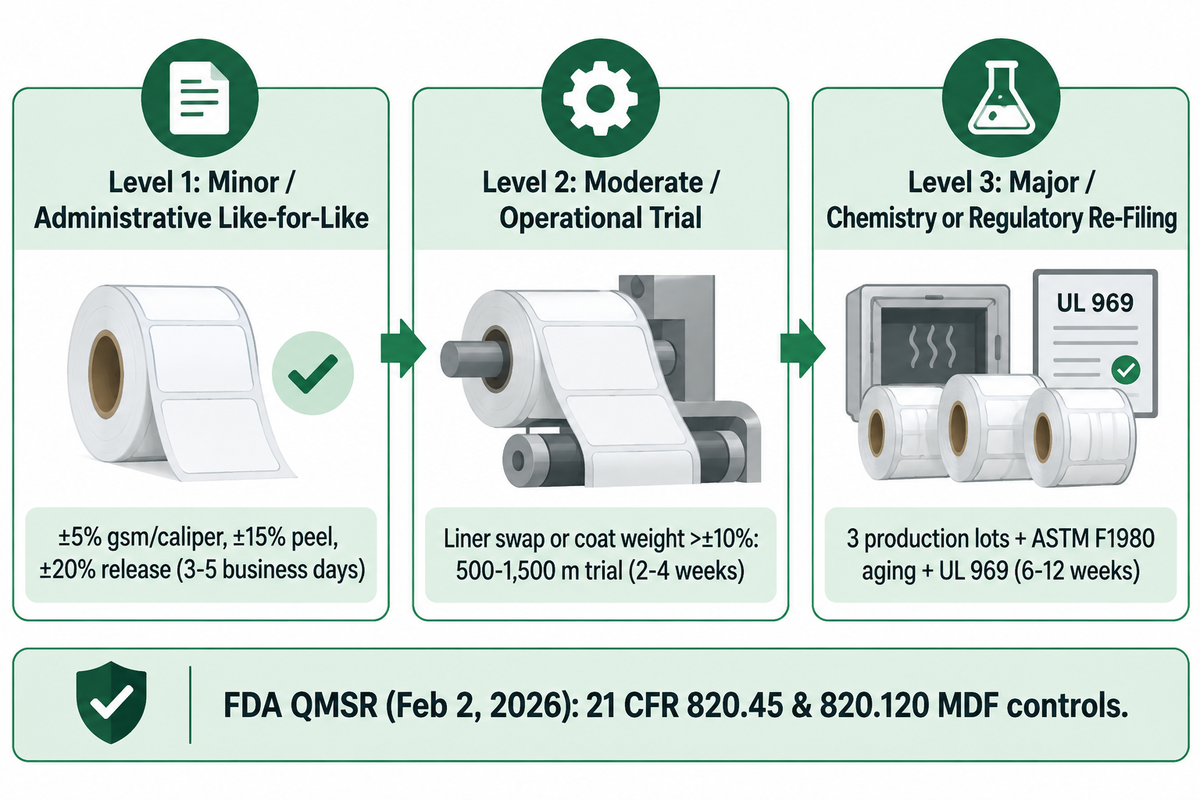
Formal change control is initiated when a label material substitution alters the chemical family, silicone release curing, or regulatory file coverage. Shifts outside enterprise screening bands (±5% basis weight or caliper, ±15% peel, ±20% release) also trigger formal review. Quality assurance and procurement teams often clash during raw material shortages. Quality engineers request stability testing for every mill adjustment, while buyers need rapid sign-off to keep lines running. A structured 3-Tier Label Change Escalation Matrix separates administrative updates from functional modifications.
Swapping untested raw materials for specified batch qualification of pressure-sensitive film constructions creates significant production losses. For testing, FINAT defines standard laboratory measurement speeds and fixture geometries. Each manufacturing facility then establishes its own Critical Quality Attribute (CQA) limits and screening bands inside its own quality standards. In the matrix below, the tolerance bands cover ±5% for basis weight and caliper, ±15% for FINAT FTM 1 peel, and ±20% for FTM 10 release.
| Escalation Tier | Typical Material Modification & Condition | Enterprise CQA Screening Band | Proposed Verification Scope | Escalation Boundary |
|---|---|---|---|---|
| Level 1: Minor / Administrative Like-for-Like | For non-UL-recognized, non-sterilized secondary carton labels, an alternate slitting site or mill supplies the same chemical family and identical silicone release system. | Enterprise screening bands: basis weight and caliper within ±5%; FINAT FTM 1 peel within ±15%; FTM 10 release within ±20%. | Certificate of Analysis (COA) comparison, micrometer caliper check, and internal memo-to-file (3–5 business days). | Escalates to Level 2 or 3 if UL 969 files list specific mill codes or if primary drug containers apply. |
| Level 2: Moderate / Operational Trial | Swapping release liner class (such as 60 gsm glassine to 75 gsm CCK or 30 μm PET), modifying topcoat treatment, or shifting adhesive coat weight beyond ±10%. | Liner thickness shift exceeds die clearance tolerance; film topcoat dyne level per FTM 15; barcode grade ≥1.5 (Grade C) per ISO/IEC 15416 or 15415. | Bench peel/shear/release test, 500–1,500 m rotary press die-strike check (FTM 23), and packaging line trial (2–4 weeks). | Escalates to Level 3 when packages undergo steam autoclave, EtO, or gamma sterilization. |
| Level 3: Major / Chemistry or Regulatory Re-Filing | Switching adhesive family (hot-melt rubber vs. emulsion acrylic vs. solvent acrylic), facestock polymer (paper vs. BOPP vs. PET), UL 969 components, or sterilized medical device labels. | Re-characterize application temperature separately from service temperature; Guanma’s G-01–G-18 portfolio spans service temperatures from -40 °C to +150 °C. | 3 commercial production lots evaluation, ASTM F1980 accelerated + real-time aging, and UL 969 or customer SCN review (6–12 weeks). | Triggers a new FDA 510(k) only when the modification could materially affect device safety or effectiveness. |
During a raw material transition, all incoming lots have a traceable control label on the reel core. Warehouse teams also place a physical quality control label on pallets to segregate trial slit rolls from commercial inventory.
Is Label Material Change Control Required Under FDA 21 CFR 820.120 and ISO 13485?
Yes. Under FDA 21 CFR 820.120 and the February 2, 2026 FDA QMSR, medical device labeling specification changes require formal evaluation and documented approval. Teams update device records before releasing production lots.
Regulatory terminology updated on February 2, 2026 under Final Rule 89 FR 7496. The Food and Drug Administration incorporated ISO 13485:2016 by reference into 21 CFR Part 820. Under QMSR, ISO 13485:2016 supplies the Medical Device File (MDF) requirements, while 21 CFR 820.45 adds device labeling and packaging controls. Many plants still retain “DMR” as an internal procedural alias for the MDF. Quality teams also separate internal MDF updates from premarket submissions. A material swap triggers a new FDA 510(k) only when the change could materially affect device safety or effectiveness.
“Labeling is part of the device master record; therefore, all changes to labeling must be made under a formal change control system similar to that required for specifications (21 CFR 820.120(b) and 820.40).” – U.S. Food and Drug Administration, Quality System Regulation Labeling Requirements
Adhesive Chemistry Substitution: Requalifying Emulsion Acrylic, Hot-Melt Rubber, and Solvent Acrylic Grades
Swapping one adhesive chemistry for another is a Level 3 engineering change. During those changes, viscoelastic flow, polar wetting, and cohesive shear strength shift concurrently. When qualifying “materials and adhesives,” engineers examine both the surface energy of the container and the stiffness of the facestock. Although two constructions may show similar stainless steel peel readings, they can behave very differently on low-surface-energy high-density polyethylene (HDPE) or polypropylene containers.
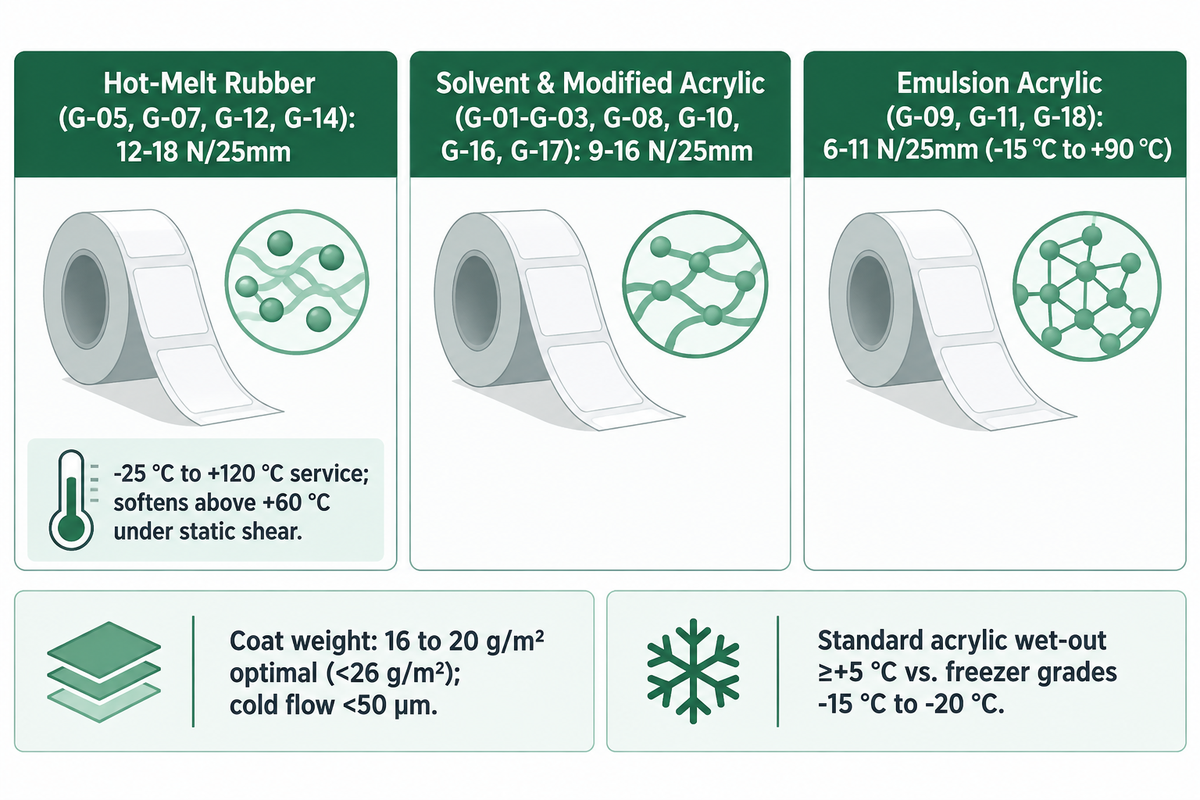
Across Guanma’s 18-configuration pressure-sensitive specification dataset (models G-01 through G-18), 180-degree peel adhesion spans 3–18 N/25mm per FINAT FTM 1 (24-hour dwell). Service temperature across the portfolio spans -40 °C to +150 °C. Individual models must be matched to the target container and application temperature. Hot-melt rubber grades (G-05, G-07, G-12, and G-14) deliver 12–18 N/25mm peel force across a -25 °C to +120 °C service range. They provide the highest initial loop tack (FTM 9) and rapid 20-minute peel build-up on rough or corrugated surfaces, though hot-melt rubber softens above +60 °C under static shear. Permanent solvent and modified acrylic grades (G-01, G-02, G-03, G-08, G-10, G-16, and G-17) deliver 9–16 N/25mm peel force across -40 °C to +150 °C and stay resistant to UV light and solvents. On cold, damp, or LSE polyolefin containers, solvent and high-performance acrylics show lower initial tack during the first 20 minutes before building ultimate 24-hour bond strength. Water-based emulsion acrylics (G-09, G-11, and G-18) deliver 6–11 N/25mm peel across -15 °C to +90 °C.
| Adhesive Class & Model | Facestock & Liner Category | 180° Peel Force (FINAT FTM 1) | Listed Service Temp Range | Primary Substitution Risk & Verification Focus |
|---|---|---|---|---|
| Model G-01 (Permanent Acrylic Class) | 50 μm White PET / 60 gsm Glassine | 11–15 N/25mm | -40 °C to +150 °C | Check initial wet-out on rough LSE polyolefins via FTM 9 loop tack. |
| Model G-02 (Solvent Acrylic Class) | 50 μm Matte Silver PET / 75 gsm CCK | 12–16 N/25mm | -40 °C to +150 °C | Check UL 969 PGDQ2/PGJI2 file coverage before swapping thermal ribbons. |
| Model G-04 (Removable Acrylic Class) | 70 μm White BOPP / 60 gsm Glassine | 4–7 N/25mm | -10 °C to +80 °C | Screen for unintended bond build-up or residue after warm storage. |
| Model G-05 (Hot-Melt Rubber Class) | 80 gsm Semi-Gloss Paper / 60 gsm Glassine | 14–18 N/25mm | -25 °C to +120 °C (softens >+60 °C) | Softens above +60 °C under shear; check for edge ooze and slitter gumming. |
| Model G-07 (Hot-Melt Rubber Class) | 75 μm White BOPP / 60 gsm Glassine | 12–17 N/25mm | -25 °C to +120 °C (softens >+60 °C) | Avoid on UV-exposed outdoor chemical drums or high-temp sterilizers. |
| Model G-08 (Modified Acrylic Class) | 85 μm Flexible PE / 60 gsm Glassine | 9–14 N/25mm | -30 °C to +120 °C | Run mandrel hold (FTM 24) when swapping to stiffer PET or BOPP films. |
| Model G-09 (Emulsion Acrylic Class) | 70 μm Clear BOPP / 30 μm Clear PET Liner | 6–10 N/25mm | -15 °C to +90 °C | Check water whitening (blushing) in wet pasteurization and clear-liner gap sensing. |
| Model G-12 (Freezer Hot-Melt Class) | 80 gsm Direct Thermal / 60 gsm Glassine | 12–16 N/25mm | -25 °C to +70 °C | Keep accelerated aging chambers at or below 50 °C to avoid thermal coat darkening. |
| Model G-16 (High-Temp Acrylic Class) | 75 μm White PET / 75 gsm CCK Liner | 11–16 N/25mm | -40 °C to +150 °C | Adjust rotary die clearance when switching between 75 gsm CCK and 60 gsm glassine. |
| Model G-18 (Emulsion Acrylic Class) | 90 gsm Art Paper / 55 gsm Glassine | 7–11 N/25mm | -15 °C to +90 °C | Check FTM 2 90-degree peel if repurposed from flat cartons to curved vials. |
Coat weight and cold flow limitations govern roll convertibility. In US Patent US6547887B1, multilayer label constructions kept adhesive coat weight below 26 g/m², optimally 16 to 20 g/m². That patent limited room-temperature cold flow to below 50 μm to avoid edge ooze on 42# kraft liners. For textured drums, first review our guidelines on controlling adhesive ooze and cold flow in label rolls, before increasing the coat weight.
How Do Application Temperature and Service Temperature Differ When Qualifying a Replacement Label Adhesive?
In label technology, minimum application temperature is the lowest surface temperature required for initial adhesive wet-out during labeling, while service temperature is the wider thermal range an established bond withstands after dwell.
Confusing these two ratings causes cold-chain qualification failures. Standard emulsion and solvent acrylic adhesives rated for extreme temperatures down to -40 °C in service require at least +5 °C during application. Polymer chains wet out the container surface above that threshold. When labeling chilled surfaces in cold conditions, engineers qualify specialty freezer hot-melt grades or all-temperature acrylics rated for application down to -15 °C to -20 °C.
Facestock and Release Liner Substitution: Caliper, Basis Weight, and Silicone Release Tolerances
Replacing a facestock or release liner alters stiffness, compression, and adhesion of the laminate. Even a nominal 60 gsm glassine swap between two paper mills can shift caliper due to super-calendering density differences. Verification from Flexcon indicates that rotary kiss-cutting dies are ground to match liner thickness to within a few microns. Selecting a durable or high-quality liner of the same thickness as the rotary kiss-cutting die specification maintains rotary die depth stability for long production runs.
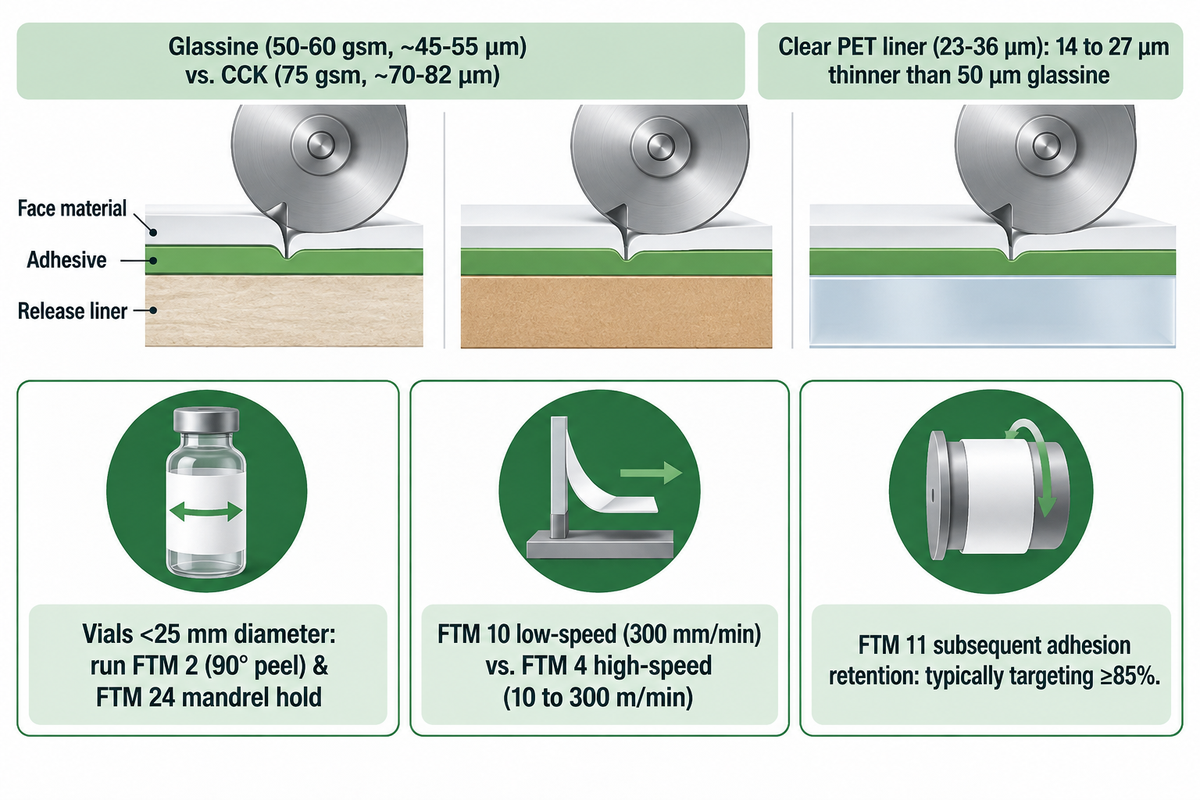
Within Guanma’s converting envelope, standard release liners include super-calendered glassine (50–60 gsm, ~45–55 μm), clay-coated kraft (CCK 75 gsm, ~70–82 μm), and clear polyester (PET 23–36 μm). Facestocks include clear or matte silver PET (36–75 μm), biaxially oriented polypropylene (BOPP 70–90 μm), polyethylene (PE 80–85 μm), and semi-gloss or thermal papers (80–90 gsm). Reviewing the baseline differences between PET and BOPP facestocks and specifying glassine release liner basis weight and caliper prevents unplanned press stops.
- Switching from an 80 μm PE film to a 75 μm rigid PET facestock reduces flexibility. Vials under 25 mm diameter require FINAT FTM 2 (90-degree peel) and FTM 24 mandrel hold tests to prevent hoop-stress edge lift.
- As described in Labels & Labeling, low-speed release tests as stipulated by FINAT FTM 10 (at 300 mm/min) are different from high-speed release tests specified by FINAT FTM 4 (at 10 to 300 m/min).
- Under-crosslinked silicone liners can interact with the adhesive during storage and increase release force (liner lock-up). Free silicone transfer can also reduce subsequent adhesion, and FINAT FTM 11 therefore compares subsequent adhesion to a control (typically targeting ≥85%).
Why Does Swapping a Glassine Liner for a PET Release Liner Change Rotary Die-Cutting Depth and Dispensing?
Replacing a 50 μm (50–60 gsm) glassine paper liner with a 23–36 μm PET film liner reduces liner thickness by 14 to 27 μm. It also changes compressibility beneath the rotary cutting blade.
With die-to-anvil clearance unchanged, running a thinner PET liner under a rotary die tooled for glassine can leave facestock or adhesive bridges uncut. Running a thicker 75 gsm CCK liner under a shallow die, however, drives the blade into the silicone barrier. Clear PET liners also impact optical transmission. Photoelectric gap sensors can still be used as long as there’s sufficient contrast against the die and the threshold is readjusted. Ultrasonic or capacitive sensors can be used in the absence of adequate optical contrast.
Standardized Bench Qualification Matrix: FINAT, PSTC, and ASTM Peel, Shear, and Accelerated Aging Tests
A bench qualification compares candidate material lots to the incumbent control lots in a conditioned environment laboratory under standard environmental conditions and controlled relative humidity. The FINAT Technical Handbook (11th Edition, 31 Test Methods) specifies laboratory tests and defines test speeds. Our overview of FINAT and ASTM label durability tests is paired with the bench test matrix to assess a bench qualification.
| Mechanical / Aging Property | Standard Method ID | Test Speed / Condition | Target Substrate Scope | Enterprise QA Evaluation Focus |
|---|---|---|---|---|
| 180° Peel Adhesion | FINAT FTM 1 | 300 mm/min after 20 min and 24 h dwell | Stainless steel control + actual container wall | Compare against incumbent baseline (such as ±15% screening band) with zero adhesive split. |
| 90° Peel & Mandrel Hold | FINAT FTM 2 & FTM 24 | 300 mm/min (FTM 2); curved mandrel wrap on <25 mm or ≤15 mm vials | HDPE, PP, glass vials, syringes, and cables | Inspect wrapped vials for edge lift (flagging) across defined storage time and temperature. |
| Static Shear Cohesion | FINAT FTM 8 | 25 × 25 mm contact area, 1 kg static hang load at 23 °C | Standard glass or stainless steel plate | Matches or exceeds baseline hold hours without cohesive slip or edge ooze. |
| Initial Loop Tack | FINAT FTM 9 | 300 mm/min loop withdrawal, zero roller pressure | Corrugated board, LSE polyolefins, blow-on packs | Check initial grab force for tamp-blow and wipe-on applicator heads. |
| Release Force & Subsequent Adhesion | FINAT FTM 4, FTM 10 & FTM 11 | 300 mm/min (FTM 10); 10–300 m/min (FTM 4) | Laminate on silicone release liner | Stable release curve across speed range; FTM 11 subsequent adhesion retention (often targeted ≥85%). |
| Accelerated Aging Stability | ASTM F1980-21 & FINAT FTM 5 | Q10 = 2.0 at 50 °C or 55 °C (<60 °C guidance) | Unprinted roll + printed label applied to container | Provisional chamber aging backed by post-aging peel/barcode check and real-time aging. |
Worked Example: Arrhenius Accelerated Aging Calculation (ASTM F1980-21)
Under ASTM F1980-21, the Arrhenius relationship for the Accelerated Aging Factor (AAF) uses a conservative aging factor of Q10 = 2.0:
AAF = 2.0^((T_AA − T_RT) / 10) | Accelerated Aging Time (AAT) = Real Time (RT) ÷ AAF
- In Scenario A (55 °C chamber vs. 23 °C lab ambient, ΔT = 32 °C), AAF = 2.0^3.2 = 9.19. Simulating a 12-month (365-day) shelf life takes 365 ÷ 9.19 = 39.7 days (~40 days), and 24 months (730 days) takes 79.4 days.
- In Scenario B (55 °C chamber vs. 25 °C ambient, ΔT = 30 °C), AAF = 2.0^3.0 = 8.00. Simulating 12 months (365 days) takes 365 ÷ 8.00 = 45.6 days.
- In Scenario C (50 °C chamber vs. 23 °C ambient, ΔT = 27 °C), Westpak summarizes ASTM F1980 guidance as recommending chamber temperatures below 60 °C. Guanma’s G-05 and G-07 hot-melt rubber grades also soften above +60 °C, so testing at 50 °C (AAF = 2.0^2.7 = 6.50) takes 56.2 days (~8 weeks) for a 365-day target.
Scope Boundary: As stated by ASTM F1980-21, accelerated aging data is provisional. Simultaneous real-time, ambient aging and transit vibration tests are being performed.
Print Requalification: Topcoat Surface Energy, Thermal Transfer Ribbon Pairing, and ISO Barcode Grading
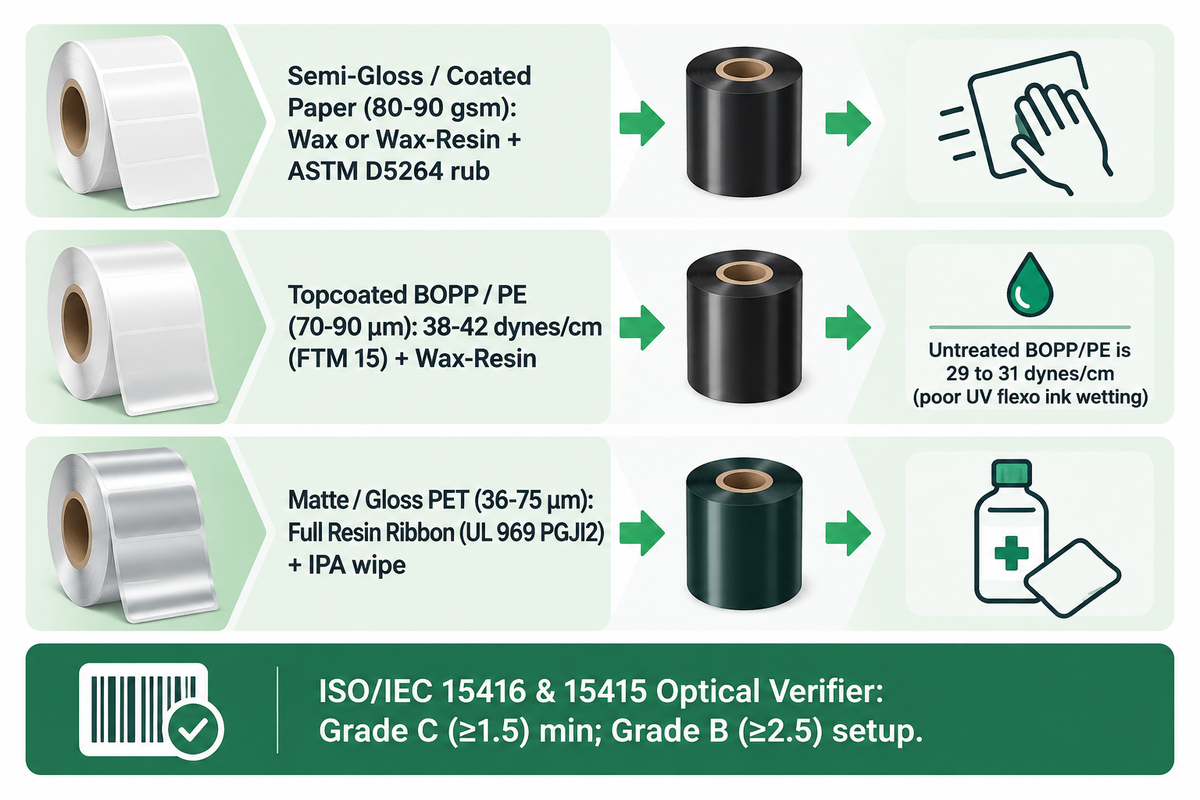
Substituting a facestock (whether paper or film) alters the topcoats and inks. Untreated BOPP and PE films exhibit low surface energy of around 29 to 31 dynes/cm. In the absence of surface treatment, these films can show poor ultraviolet flexo ink wetting and adhesion. Durable thermal transfer images likewise require an appropriate ribbon, receiving topcoat, and print head energy setting. Quality control technicians conduct FINAT FTM 15 dyne checks on film topcoats where applicable. They use the print head system to set the threshold (usually 38-42 dynes/cm on corona treated BOPP) for the acceptance standard.
A frequent field mistake during a facestock swap is checking variable-data barcodes with a handheld warehouse scanner. A simple scanner beep only verifies that one laser line read the code at close range. It misses low edge contrast or ribbon smearing that will blind overhead sortation cameras. Formal print qualification uses a calibrated optical verifier to grade 1D linear codes under ISO/IEC 15416 and 2D DataMatrix codes under ISO/IEC 15415. As detailed by Midcom Data Technologies, verifiers score symbols from 4.0 (Grade A) to 0.0 (Grade F). Most GS1 and healthcare standards require a minimum passing threshold of Grade C (1.5 or higher).
| Facestock Material Class | Typical Surface Check (FTM 15) | Matched Thermal Transfer Ribbon | Abrasion & Fluid Rub Check | Typical GS1 / QA Verifier Target |
|---|---|---|---|---|
| Semi-Gloss / Coated Paper (80–90 gsm) | Ink absorption & coat smoothness check | Standard Wax or Wax-Resin | ASTM D5264 Sutherland dry rub check | ISO/IEC 15416 or 15415 Grade C (≥1.5); target Grade B (≥2.5) at setup |
| Topcoated BOPP / PE Film (70–90 μm) | 38–42 dynes/cm on treated film | Premium Wax-Resin or Near-Edge Resin | Sutherland rub + water and oil wipe (FTM 16/17) | Grade C (≥1.5) post-rub with zero graphic flaking |
| Matte / Gloss PET Film (36–75 μm) | Chemical primer anchorage check | Full Resin Ribbon (UL 969 PGJI2 matched) | Sutherland rub + isopropyl alcohol wipe | Grade C (≥1.5) for UDI and serial identification |
Maintaining clean, sharp graphic contrast and legibility preserves safety of end users and supports the supply chain team to track (visually confirm) every serialized unit across all automated warehouses.
Press and Packaging Line Trials: Preventing Rotary Die Strike-Through, Matrix Breaks, and Applicator Misses
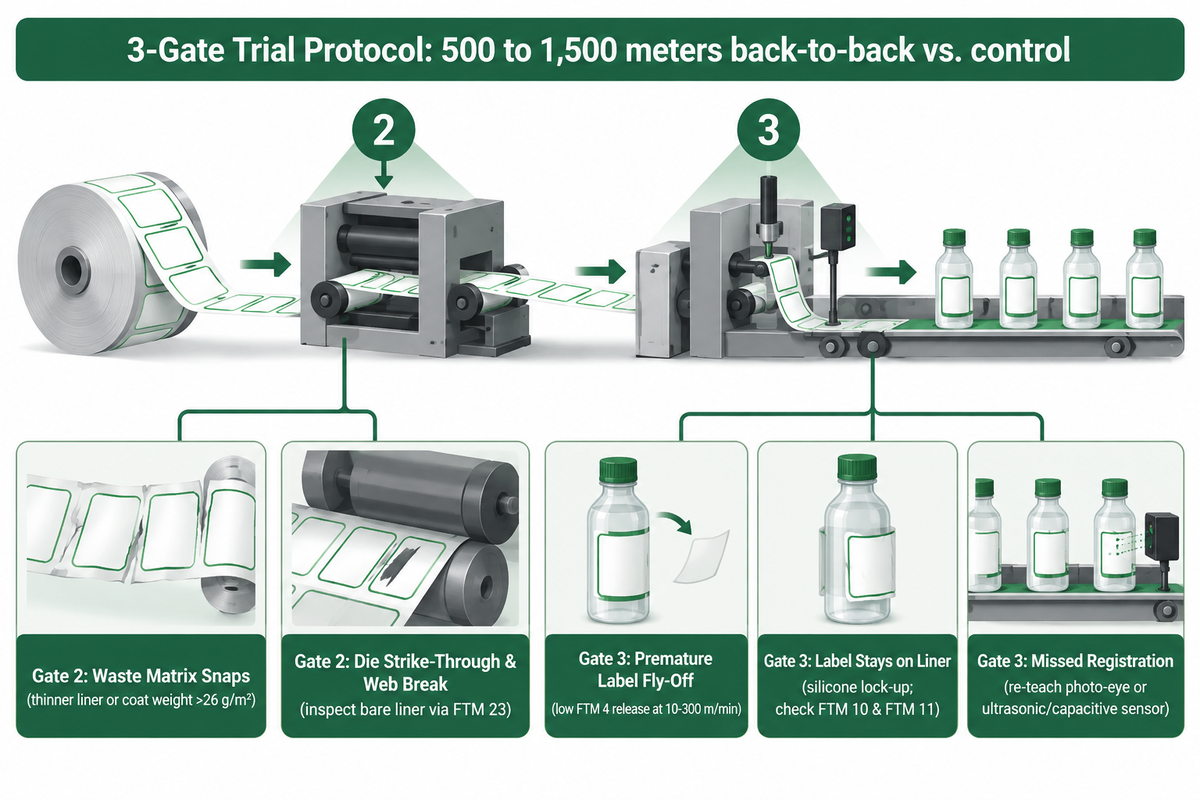
Supplement bench data with press and packaging line trials to evaluate mechanical shear on a rotary flexo press or a 300-bottle-per-minute labeler. Converters and end-users perform a 3-Gate Press-to-Pack Trial Protocol using 500 to 1,500 meters of slit trial stock. Gate 1 covers bench lab checks, Gate 2 covers rotary die-cutting and matrix stripping, and Gate 3 covers high-speed applicator runs. Engineers run candidate rolls and control rolls back-to-back on the same press, die station and bottle lot and apply NIST (blocking) experimental principles.
During press trials at Gate 2, operators inspect rotary die strike (FINAT FTM 23) by wiping water-based dye across the bare liner after stripping. Deep bruising or fiber cuts require review of our checklist to diagnose rotary die-cut matrix waste breaks before performing machinery trials during Gate 3.
| Trial Gate & Symptom | Root Cause in Replacement Material | Immediate Line Countermeasure | Long-Term Specification Fix |
|---|---|---|---|
| Gate 2: Waste Matrix Snaps on Press | Liner is thinner than baseline, leaving uncut adhesive bridges, or coat weight exceeds 26 g/m². | Adjust die-station pressure gauge and lower stripping roller angle. | Tighten liner caliper tolerance or re-grind rotary die bearer clearance. |
| Gate 2: Die Strike-Through & Web Break | The liner is thicker than baseline, or the glassine was exposed to dry ambient air during storage. | Reduce anvil pressure and inspect bare liner with FTM 23 stain test. | Match die depth to liner caliper or evaluate a 23–36 μm PET film liner for high-speed dispensing. |
| Gate 3: Premature Label Fly-Off at Peel Plate | High-speed release force (FINAT FTM 4 at 10–300 m/min) is too low or facestock is overly rigid. | Reduce unwind brake tension and adjust peel-plate nose bar radius. | Specify a tighter silicone release profile matched to applicator speed. |
| Gate 3: Label Fails to Dispense (Stays on Liner) | Silicone aging lock-up (under-cured silicone) or deep die-strike pushing adhesive into liner fibers. | Check FTM 10 release force and FTM 11 subsequent adhesion, and verify a sharp peel-plate beak. | Reject lot; require supplier COA proof of FTM 10 release and FTM 11 subsequent adhesion retention. |
| Gate 3: Continuous Feed / Missed Registration | Liner swap (glassine to CCK or clear PET) shifted optical transmissivity outside photo-eye threshold. | Re-teach photoelectric gap sensor gain on the inter-label gap. | Use capacitive or ultrasonic gap sensors when optical contrast is insufficient to automate line setup. |
Consistent surface preparation on the filling line removes condensation and mold-release agents from plastic bottles. Clean container walls ensure repeatable label placement during high-speed label application.
Regulated Labeling Change Control: FDA DMR Updates, UL 969 Component Recognition, and Sterilization Checks
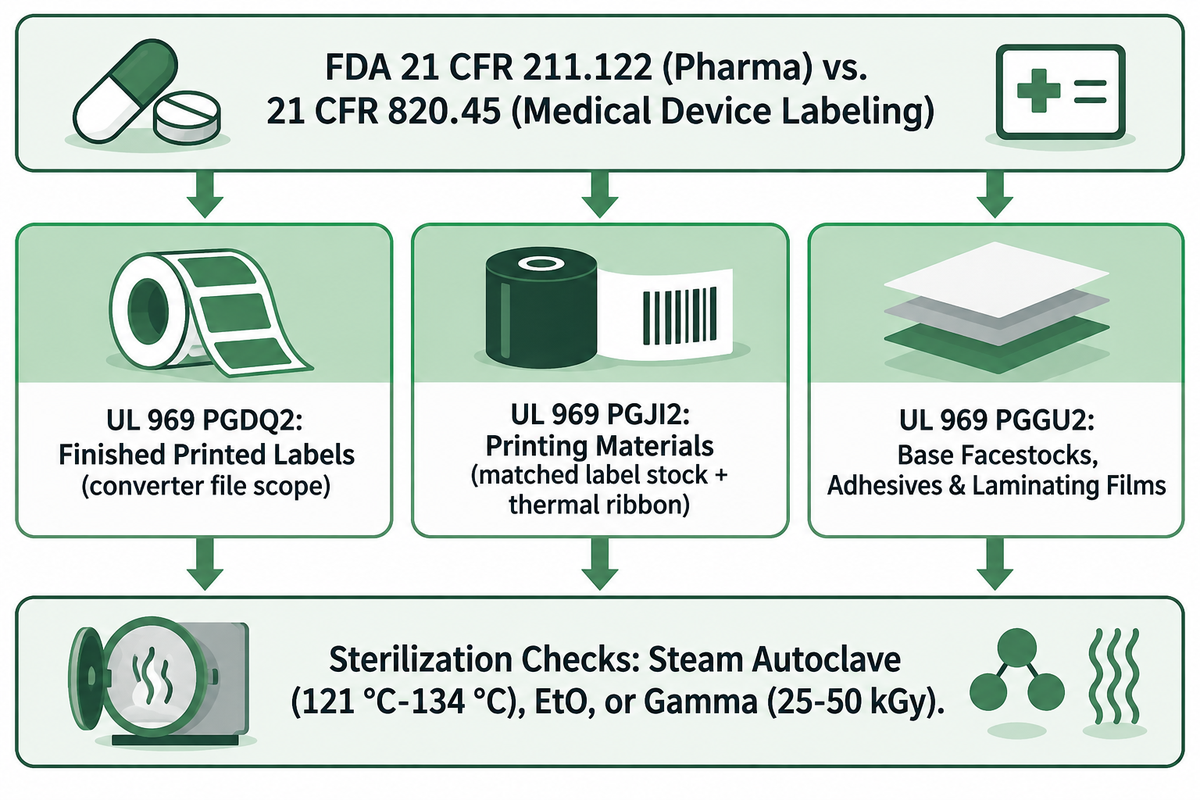
In regulated sectors such as medical device manufacturing, pharma, electronics, and hazardous chemical drums, external compliance files control changes in the nature of the materials, in addition to internal quality rules. Real world product usage determines the applicable regulatory framework. Drug packaging and labeling materials under 21 CFR 211.122 follow pharmaceutical controls (see our guide to container-level pharmaceutical label qualification protocols). Medical device labeling and packaging under 21 CFR 820.45, as well as medical use labels, follow device controls.
For equipment nameplates evaluated to ANSI/UL 969 (Marking and Labeling Systems), relevant UL Solutions Category Control Numbers (CCNs) include:
- Category PGDQ2 (Finished Printed Labels) is for printed labels fabricated by a UL-recognized converter. Replacement of the base film or overlaminate requires confirmation the new substrate is included in the converter’s PGDQ2 scope.
- Category PGJI2 (Printing Materials) covers blank or pre-printed label stocks evaluated with specific thermal transfer ribbons for end-user printer output. Printing with a ribbon outside the combinations listed in the UL file places the label outside that recognition coverage.
- Category PGGU2 (Label Materials) covers base facestocks, adhesives, and laminating films supplied to converters for UL adoption.
What Happens to UL 969 Recognition or Sterilization Validation When a Label Material Changes?
Using an adhesive, facestock, overlaminate, or thermal transfer ribbon outside the combinations listed in the UL 969 file (categories PGDQ2 or PGJI2) breaks recognition coverage. The resulting label falls outside that UL file, and changing a medical package label also requires re-verifying sterilization resistance.
When a converter adopts a PGGU2-recognized base film that’s already cross-referenced for the target surface and temperature rating, UL file updates can proceed via administrative component adoption or scoped evaluation under UL program rules. For sterilized medical devices, candidate labels must withstand the plant’s validated sterilization cycle. Whether the plant uses steam autoclave (121 °C–134 °C), ethylene oxide (EtO), or gamma irradiation (25–50 kGy), labels must meet the project’s peel, delamination, and barcode grade criteria.
Requalification Timeline, Trial Slit-Roll MOQs, Testing Costs, and Inventory Cutover Control
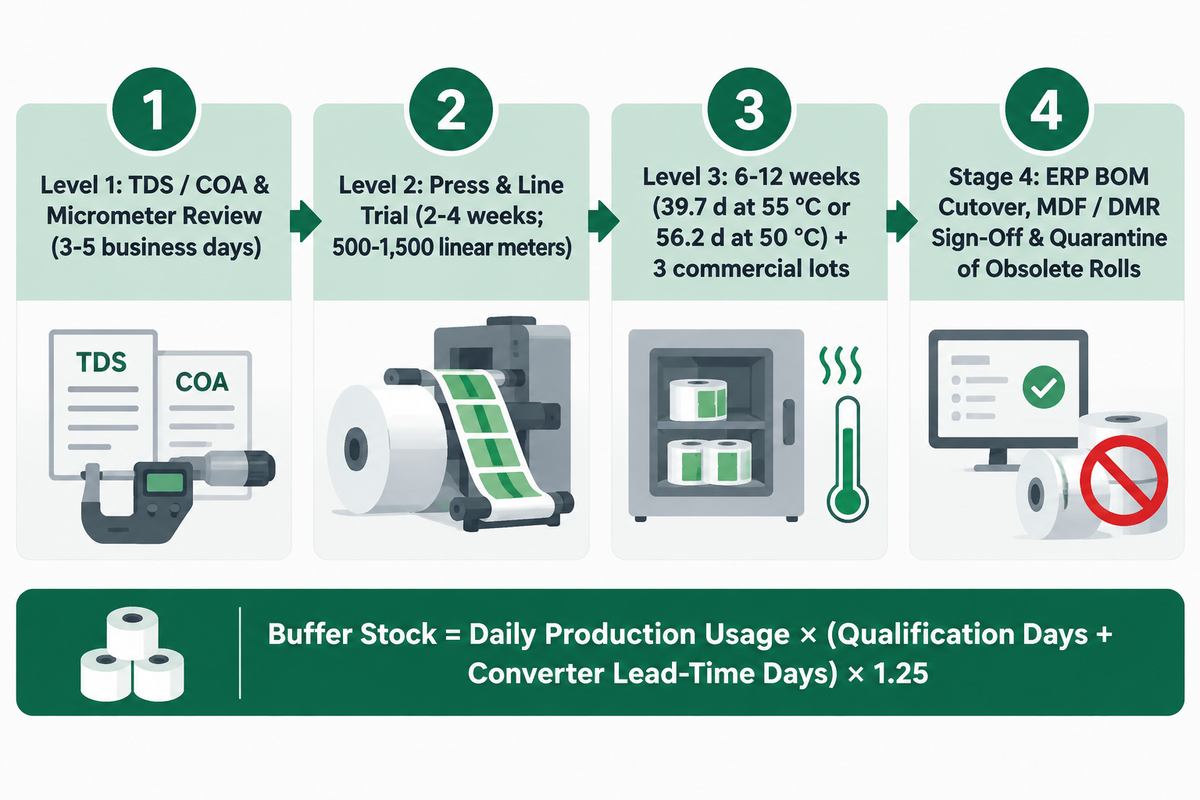
Requalification timelines correspond to the escalation tier: Level 1 administrative reviews are completed within 3–5 business days, Level 2 operational press and line trials run 2–4 weeks, and Level 3 chemistry or regulatory validations span 6–12 weeks. Level 3 duration is driven by 39.7 to 56.2 days (~40 to 56 days) of chamber exposure at 55 °C or 50 °C for a 12-month ASTM F1980-21 simulation (23 °C reference, Q10 = 2.0). Because labels are often custom-slit to exact press widths, converters supply a trial slit-roll MOQ of 500 to 1,500 linear meters (1 to 2 narrow slit rolls) for Level 2 and Level 3 runs. Lead times and costs associated with third-party lab testing are evaluated on a per project basis. Buyers also evaluate label roll splice specifications and roll-join tolerances to ensure splice tape does not jam peel plates during line trials.
| Qualification Tier / Stage | Typical Duration | Sample / Trial Roll Requirement | Primary Cost & Resource Driver | Mandatory Release Gate |
|---|---|---|---|---|
| Level 1: Administrative TDS / COA & Micrometer Review | 3–5 business days | Supplier COA + retention sample sheet | Internal QA desk review and micrometer caliper check | Basis weight, caliper, peel, and release pass screening bands. |
| Level 2: Operational Rotary Press & Packaging Line Trial | 2–4 weeks | 500–1,500 linear meters (1–2 trial slit rolls) | Press setup time, FTM 23 die-strike check, optical barcode verifier check | Clean matrix stripping on press and stable dispensing on packaging line. |
| Level 3: Major Chemistry, ASTM F1980 Aging & Regulatory Validation | 6–12 weeks (39.7 days at 55 °C or 56.2 days at 50 °C for 365-day ASTM F1980 simulation; 79.4 days for 24-month target) | 500–1,500 m trial rolls + 3 commercial production lots | Chamber aging time + custom-quoted third-party UL 969 or sterilization lab fees | 3-lot OQ/PQ sign-off + provisional aging pass + concurrent real-time study. |
| Stage 4: ERP BOM Cutover & Line Clearance | Scheduled at ECM effectivity date | First 3 commercial production lots under new revision | Revision-based stock segregation and quarantine of superseded rolls | Updated Medical Device File (MDF / DMR) sign-off and Incoming QC lock. |
To ensure line starvation doesn’t occur during Level 2 or 3 qualifications, materials planners use the equation below to calculate transition buffer stock.
Buffer Stock (Linear Meters or Rolls) = Daily Production Usage × (Qualification Days + Converter Lead-Time Days) × 1.25 Contingency Factor.
No matter if your product labels serve climate controlled indoor warehouses or extreme outdoor chemical yards, controlled material cutover uses revision-based stock segregation, documented line clearance and lot traceability. FIFO is the normal rotation among approved lots. Obsolete revisions are physically quarantined, thus legacy and replacement rolls will never be on the same pallet of product packaging.
Supplier Change Notification (SCN) Agreements, Dual-Sourced Constructions, and Pre-Cutover RFQ Checklist
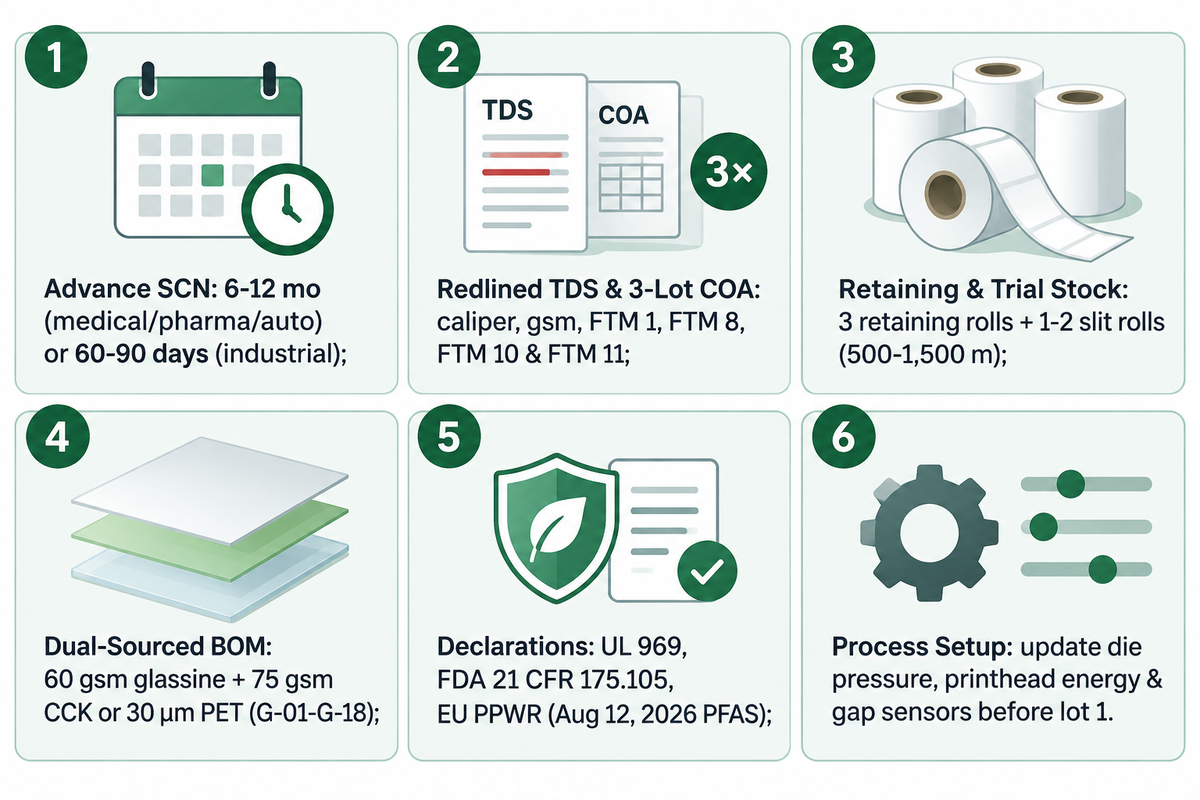
Supply consolidations and the 2025–2026 chemical rules are promoting frequent material substitutions across the global packaging and labeling industry. In the EU, the Packaging and Packaging Waste Regulation (EU PPWR, Regulation (EU) 2025/40) entered into force on February 11, 2025. General application and food-contact PFAS restrictions take effect on August 12, 2026 , ahead of 2030 recyclability grading mandates. The remainder of the restrictions take effect by 2030, requiring greater levels of package recyclability. As reported by Beontag, alkali wash-off adhesives (FINAT FTM 26) are being qualified for rPET recycling and BPA/BPS-free thermal coatings.
For dual-sourced film or paper constructions, Guanma (guanmalabel.com) offers an 18-configuration pressure-sensitive portfolio (models G-01 through G-18). That range spans acrylic and hot-melt rubber adhesives, paper/BOPP/PET/PE facestocks, and glassine/CCK/PET liners so buyers can pre-qualify primary and backup BOM alternates. Industry references from Beontag, Flexcon, and UL 969 PGDQ2/PGGU2 recognized converters cover material and converting selection. Practitioners on the Elsmar Cove Quality Forum warn that standard commercial sales terms notify buyers only when a change alters cost or delivery. To maintain strict quality control and regulatory compliance, buyers must obtain proper documentation by negotiating a dedicated Supplier Quality Agreement (SQA) and pre-qualifying dual-sourced BOM alternates.
Pre-Cutover Supplier Change Notification (SCN) & Qualification RFQ Checklist
Include the following six technical and legal terms when issuing an RFQ or when signing a supplier quality agreement for pressure-sensitive label stocks.
- Contractual Advance SCN Windows specify 6 to 12 months’ written advance notice for medical, pharma, or automotive grades (and 60 to 90 days for general industrial grades) before any monomer, silicone release, mill, or coating site change.
- A side-by-side redlined TDS & 3-Lot COA package is provided for Level 2 and Level 3 changes. It reports caliper (μm), basis weight (gsm), FINAT FTM 1 peel, FTM 8 static shear, FTM 10 release, and FTM 11 subsequent adhesion retention.
- Reserved retaining and trial slit rolls include 3 retaining rolls of the outgoing lot plus 1 to 2 slit trial rolls (500–1,500 linear meters) of the candidate stock at your press width.
- Pre-qualified dual-sourced constructions in your BOM (such as pairing a 60 gsm glassine liner SKU with a 75 gsm CCK or 30 μm PET liner backup across Guanma’s G-01–G-18 matrix) help prevent emergency line stops.
- Applicable Regulatory & Chemical Declarations match the end use, including UL 969 file numbers (PGDQ2/PGJI2/PGGU2), FDA 21 CFR 175.105 food-packaging adhesive statements, EU PPWR PFAS compliance letters, or BPA/BPS-free thermal certificates.
- Updated settings for rotary die pressure, thermal transfer, printhead energy, and gap sensors, as documented in the process instruction, were implemented prior to releasing commercial lot one.
Need detailed information, side-by-side FINAT lab sheets, or 500–1,500 m trial slit rolls to qualify a primary or backup label stock? Contact Guanma’s pressure-sensitive materials engineering team to request sample rolls matched to your container substrate, sterilization cycle, and dispensing line.
Frequently Asked Questions
How do you manage label material change control in SAP or an ERP bill of materials?
Revise the ECM effectivity date in SAP or your enterprise ERP to assign a new Revision level or alternate Bill of Materials (BOM). Set your incoming quality inspection rules so the warehouse automatically places the first three commercial lots on quality hold. Quality engineers release the holds only after they verify line trial sign off and COA values, while quarantining obsolete rolls.
What documentation must a label supplier provide before changing an approved adhesive or facestock?
Under the proposed Supplier Quality Agreement, changes to an approved adhesive, facestock, or release liner require advance Supplier Change Notification (SCN) stating the technical reason and cutover date. For Level 2 and Level 3 changes, the submission package includes a redlined Technical Data Sheet (TDS) and lot Certificates of Analysis (COAs) covering caliper, FINAT FTM 1/8/10 metrics, and FTM 11 subsequent adhesion retention. Suppliers also attach applicable UL 969 or regulatory letters and ship 500–1,500 m trial slit rolls.
Can a label converter switch raw material mills without notifying the customer if the gsm and caliper match?
No, Level 1 administrative swaps for non-UL-recognized, non-sterilized secondary carton labels with the same chemical family and silicone release system would only be authorized if explicitly permitted by the customer’s Supplier Quality Agreement. Even when caliper (μm) and nominal basis weight (gsm) match, switching paper or film mills can alter topcoat surface tension decay and silicone crosslinking density.
How many sample lots are needed to validate a new pressure-sensitive label material?
Level 2 operational changes use one to two slit trial rolls (500–1,500 linear meters) across a press and applicator run.
What is the difference between a label artwork change and a label material change in quality control?
A label artwork change modifies printed text, symbols, or UDI data on the existing stock, whereas a label material change alters the facestock, adhesive, topcoat, or release liner. Quality verification for artwork updates focuses on optical proofreading, barcode content syntax, regulatory database synchronization (such as FDA GUDID), and obsolete print-plate destruction. Even when the printed graphic looks identical, a material swap can shift peel adherence on low-surface-energy bottles or cause rotary die strike-through. It can also degrade thermal transfer ribbon rub resistance or place the construction outside UL 969 and sterilization validations. Material changes therefore require documented evaluation. Engineers select laboratory testing (FINAT FTM 1, FTM 8, ASTM F1980 aging) and packaging line trials according to the escalation tier and application risk.
How do you test if a replacement label material will cause edge lift or flagging on small-diameter vials?
To screen for edge lift (flagging) on small-diameter vials, syringes, or ampoules (under 25 mm or ≤15 mm diameter), pair FINAT FTM 2 (90-degree peel at 300 mm/min) with FINAT FTM 24 mandrel hold testing. Wrap candidate labels onto actual production vials and inspect them throughout the plant’s defined ambient and elevated-temperature storage protocol. Edge lift can occur from facestock bending stress, insufficient adhesion or wet-out, surface contamination, container curvature, and application conditions.
When should you re-run chemical resistance or abrasion testing after a label material change?
Re-run ASTM D5264 Sutherland rub testing and fluid wipe checks (such as isopropyl alcohol, water, or industrial oils per FINAT FTM 16/17) whenever the facestock topcoat, corona treatment, ink, thermal transfer ribbon, or overlaminate changes. Rubbed barcodes must still meet the minimum ISO/IEC 15416 or 15415 print quality grade (usually Grade C, ≥1.5) specified for the application on a calibrated optical verifier.
Editorial Transparency & Scope Disclosure: Reviewed by the Guangdong Guanma New Material Technology Co., Ltd. technical team. First-party specifications (models G-01 through G-18, 3–18 N/25mm peel range, and -40 °C to +150 °C service temperature range) reflect Guanma’s standard pressure-sensitive product portfolio. Screening bands in the 3-Tier Escalation Matrix (±5% gsm/caliper, ±15% peel, ±20% release) represent enterprise quality screening benchmarks that plants tailor to their own container substrates, contracts, and test plans.
References & Sources
- U.S. Food and Drug Administration (FDA). Quality System Regulation Labeling Requirements (21 CFR 820.120 & 820.40).
- U.S. Food and Drug Administration (FDA). Quality Management System Regulation (QMSR) Final Rule (89 FR 7496 / 21 CFR 820.45, Effective February 2, 2026).
- FINAT. FINAT Technical Handbook (11th Edition): Test Methods FTM 1-FTM 31 for Self-Adhesive Laminates.
- Westpak, Inc. ASTM F1980-21: Standard Guide for Accelerated Aging of Sterile Barrier Systems and Medical Devices.
- UL Solutions. ANSI/UL 969 Marking and Labeling Systems Program (Categories PGDQ2, PGJI2, and PGGU2).
- International Organization for Standardization (ISO). ISO/IEC 15416: Automatic Identification and Data Capture Techniques – Bar Code Print Quality Test Specification – Linear Symbols.
- Midcom Data Technologies. ANSI/ISO Barcode Verification Print Quality Grades Explained.
- Flexcon Company, Inc. Things To Look for When Die Cutting Pressure-Sensitive Film (Clearance & Liner Caliper Consistency).
- Labels & Labeling (Label Academy). Silicone Release Liner Technology and Speed-Dependent Release Profiles.
- USPTO/Google Patents. US Patent US6547887B1: Multilayer Pressure-Sensitive Adhesive Label Constructions.
- Beontag. Labeling Trends 2025–2026: EU PPWR, Wash-Off Adhesives, and Phenol-Free Thermal Substrates.