Get in Touch with Guanma

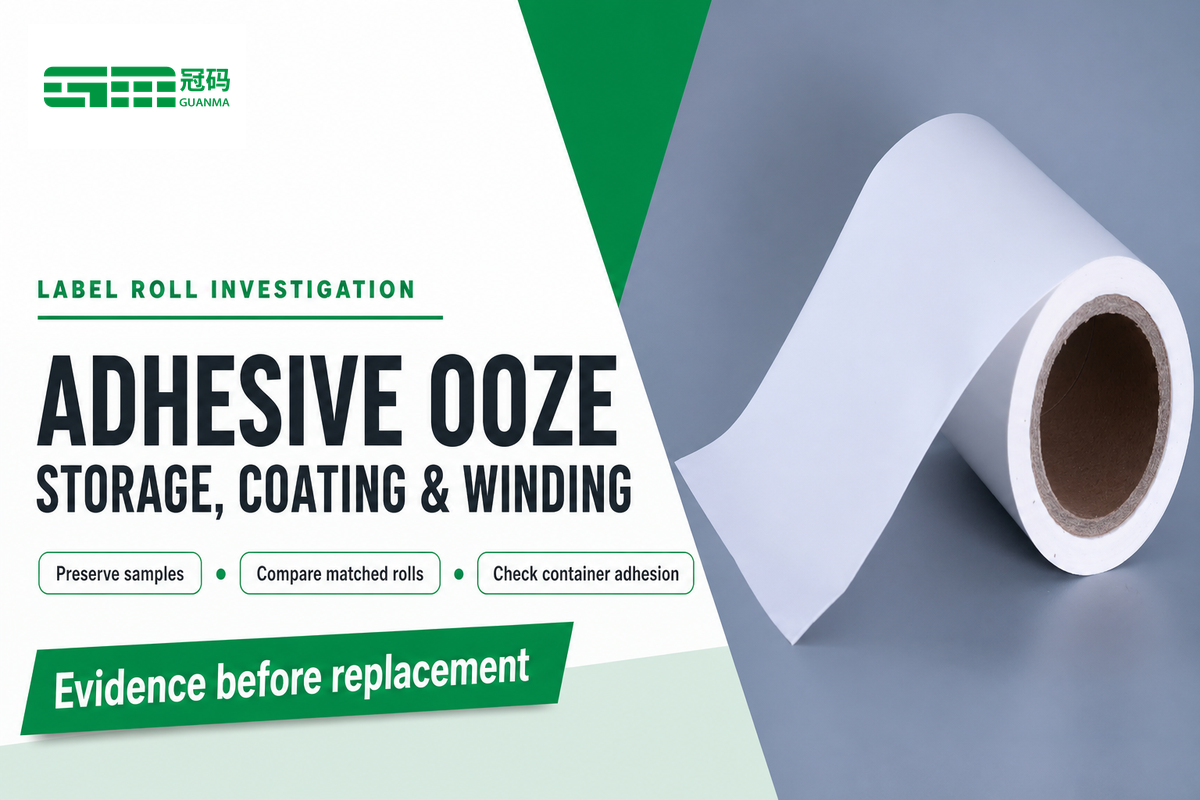
Adhesive ooze in label rolls is adhesive escaping beyond the label edge and sometimes sticking to the liner, guides or printer. Several factors can contribute, including storage, the way the roll is coated and the pressure used during winding. Storage exposure, coating behavior and winding pressure can contribute, but a sticky edge does not identify the cause. Keep an untouched sample before cleaning or changing settings and, if possible, document the setting or condition where the issue first arose.
The production manager needs the line running; the purchaser needs to know whether the next roll of stock will solve the problem. In this case, different kinds of evidence are needed. To begin with, identify the residue and compare matched rolls. Check whether the proposed remedy still allows the product labels to stick firmly to their containers.
Start with the evidence
- Photograph the roll edge and liner before the machine touches them.
- Keep the material code, lot, storage history and winding record together.
- Compare clean running and container adhesion before approving replacement stock.
Where does adhesive ooze in label rolls first appear?
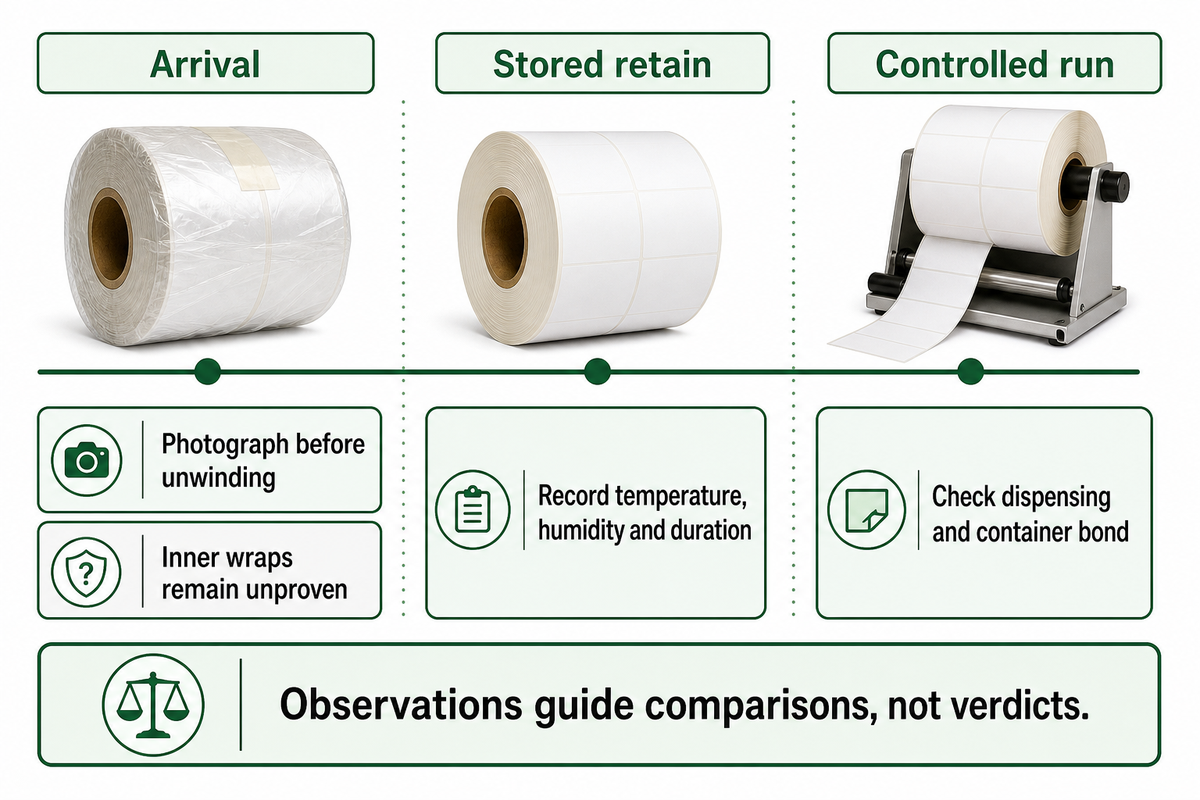
To identify adhesive ooze requires a systematic approach. If ooze is present in an unopened roll, this requires a separate investigation from cases where ooze is first noticed after printing. Observe where ooze is present at the start, after retained storage and during a controlled run. These observations narrow the next comparison; they cannot, by themselves, prove a formulation or handling defect.
Heavy coating and low adhesive viscosity and overly tight rewinding have been identified by equipment maker cab as possible contributors in the label adhesive Contamination Guidance. Several routes can lead to the same common problems. A clean outer wrap doesn’t say much about an inner wrap that hasn’t been examined.
3-Checkpoint Ooze Timeline
The 3-Checkpoint Ooze Timeline records observations and separates them from proposed causes.
| Checkpoint and location | Record | Next comparison | Limitations / Not suitable for |
|---|---|---|---|
| Arrival: outer roll edge | Photograph before unwinding | Unaffected roll from the shipment | Cannot establish inner-wrap condition |
| Arrival: liner backside | Position and transfer pattern | Untouched neighboring wrap | Transfer alone does not identify chemistry |
| Arrival: packaging | Damage and available transit record | Protected retained package | No logger means exposure remains unknown |
| Stored retain: edge | Elapsed hours and condition change | Matched retain under agreed storage | Different stock ages confound comparison |
| Stored retain: paper and liner | Curl, release behavior and dimensions | Same construction and conditioning | Curl is not proof of edge ooze |
| Stored retain: environment | Temperature, humidity and duration | Supplier’s material-specific limits | Room air is not roll-core temperature |
| Controlled run: unwind | First observed residue position | Clean machine with retained stock | Old contamination can transfer back |
| Controlled run: guides and roller | Residue recurrence per quantity run | Matched speed and setup | Different printing methods are not equivalent |
| Controlled run: applied label | Dispensing and container bond | Current and proposed stock | Clean dispensing does not prove lasting adhesion |
Keeping the photographs linked to the roll identifier helps prevent an operator’s machine sample from being mistaken for untouched incoming stock. The timeline is useful because each observation defines what to test next, not because it yields an automatic conclusion.
Storage temperature and humidity: use the material limits
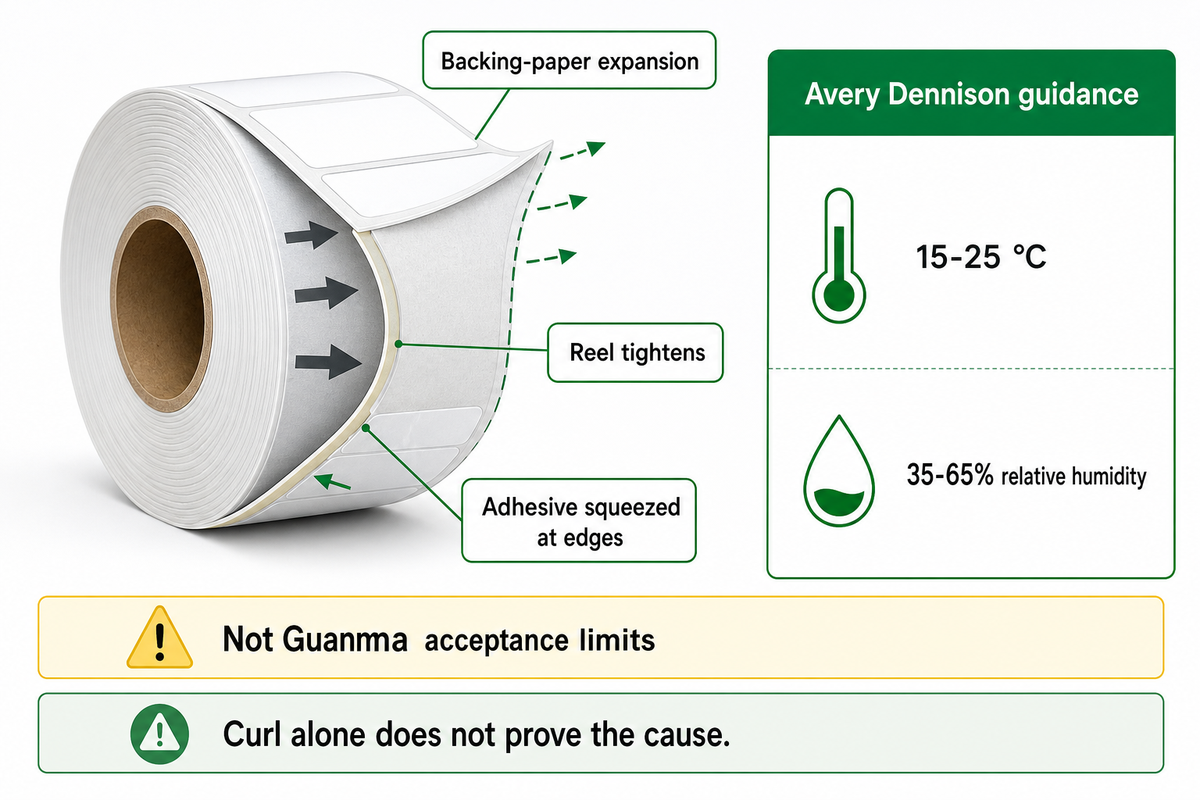
Storage limits belong to a specified label construction, not to every pressure-sensitive adhesive. Compare the shipment’s temperature, humidity, and duration of exposure to the supplier’s instructions. A reading taken after the shipment has been delivered isn’t a reliable indication of the conditions to which the shipment was subjected during transport. Paper exposed to moisture can change the roll mechanically as well as visibly.
For example, Avery Dennison’s storage bulletin recommends 15–25 °C and 35–65% relative humidity for its stated self-adhesive materials, with 22 °C and 50% as ideal conditions. Those figures are Avery guidance, not Guanma acceptance limits. The bulletin explains that backing-paper expansion in high humidity can tighten a reel and squeeze adhesive from its edges.
This is especially the case when a complainant observes curl and tacky edges. Neither condition proves humidity was the sole cause. Research on water-based acrylic adhesive films illustrates the implications of water exposure and the rationale for considering such exposure, but its immersed film studies don’t establish a threshold for ambient humidity of a warehouse.
Consider a hypothetical shipment with clean arrival photographs and sticky edges after 48 hours beside a loading door. The production team wants to reject the whole lot and the supplier wants to know if the storage conditions changed it. Leave an untouched roll in the previously agreed storage conditions, retain the affected packaging, and compare the two records. If there was no logger with the delivery, note “transit exposure unknown.” Placing stock in a 22 °C room doesn’t establish its core temperature or repair previous damage. Inspect it again after the supplier’s specified conditioning period and test dispensing and bonding. The comparison may justify a storage investigation; however, there are other aspects that may remain to be checked, i.e. the coating and winding process.
Winding pressure: use a matched roll comparison
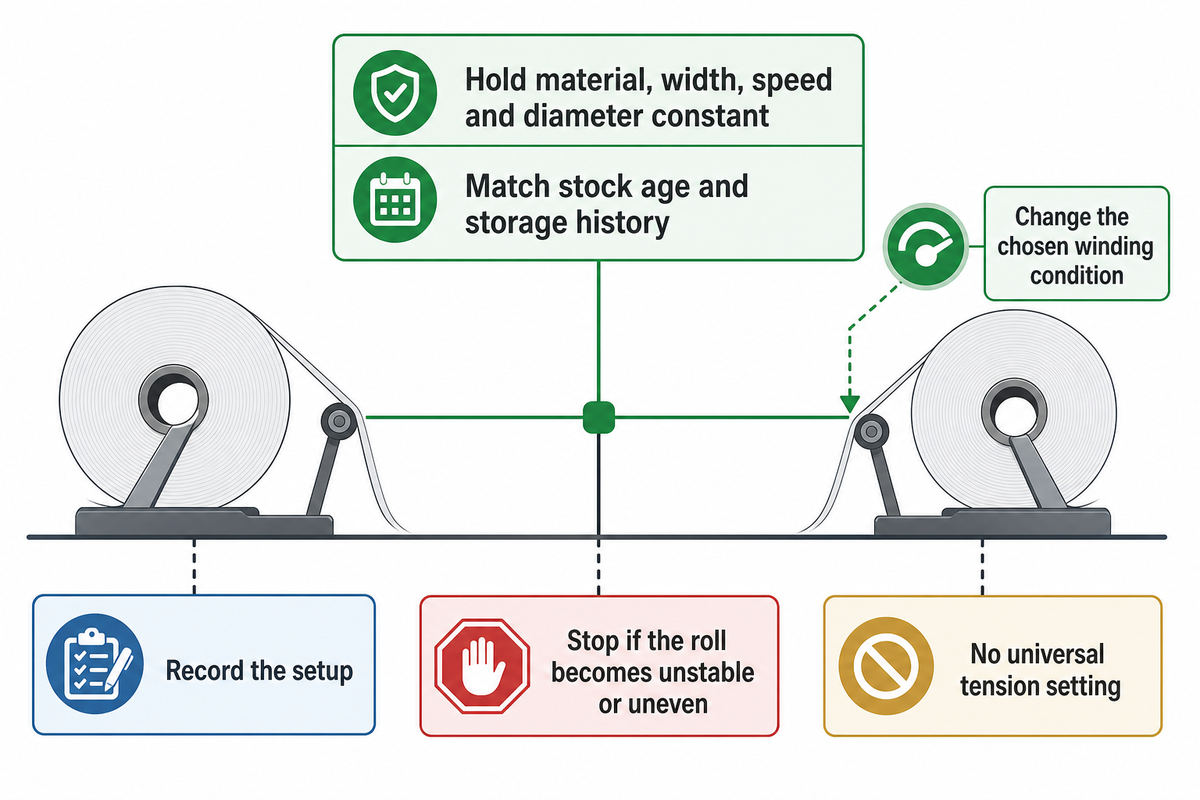
The best way to reproduce a winding trial is by controlling as many variables as possible (e.g. material, width, speed, roll diameter, age of the stock, prior storage history, etc.). Change the chosen winding condition in the converter’s allowed operational range and maintain the setup record. Reduced residue under one condition supports further evaluation; it doesn’t establish a universal tension setting.
Pressure in a wound roll can’t be reconstructed with a single “tight” or “loose” statement. Winding stresses were associated with adhesive film surface wear in a published taper tension study that compared two tension profiles. It warranted attention to winding conditions, but didn’t establish a label edge ooze limit.
How should I record label storage temperature and winding tension?
Record temperature in °Celsius, relative humidity in percent, elapsed storage time in hours, and the actual winding setting with its machine-specific unit. Record web width, core and finished roll diameters in millimeters, line speed in meters/minute and material age. Keep the position of the sensor and identification of the equipment with readings so another operator can reproduce the comparison.
NIST’s blocking guidance states that nuisance factors should be held constant to improve an experiment. One possible nuisance factor for this experiment could be the use of a different stock batch or the length of time the label stock was stored prior to the test. NIST also states that one-factor-at-a-time trials miss interactions, which means a tension comparison in one environment can’t rule out a tension-humidity interaction.
A common mistake is to keep loosening the roll until residue disappears. In a 2008 converter discussion, loose rewinding didn’t completely resolve the reported problem. Treat that report as a troubleshooting lead, not a controlled result. Stop a trial that produces an unstable or uneven roll; exchanging contamination for poor handling isn’t a successful remedy.
Coating weight and adhesive flow: change the specification carefully
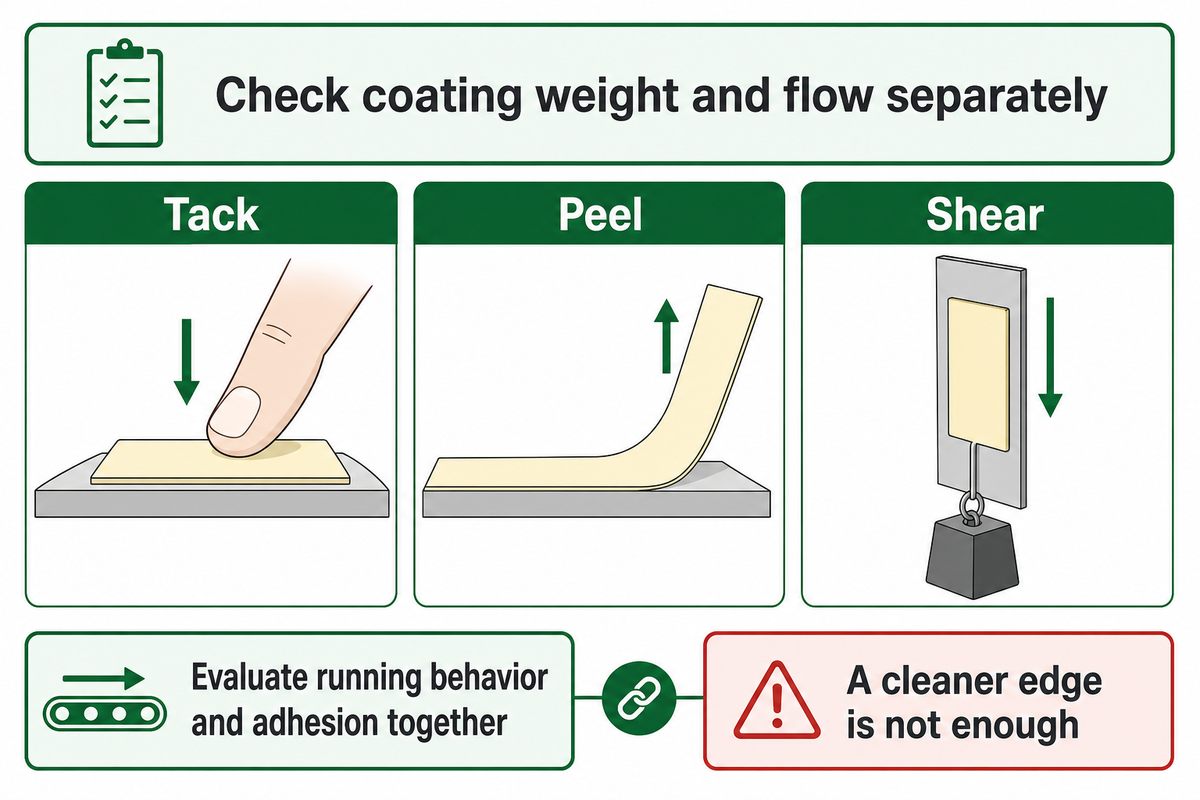
Check coating weight and adhesive flow separately. An out-of-specification coating should be adjusted. An in-specification coating may still be unsuitable for the application. Don’t approve less adhesive solely because the roll looks cleaner. The replacement should have the tack, peel, and shear behavior needed after the label is applied.
Interactions among raw materials are more significant than a glue name. The adhesive layer has to touch the texture of the container and resist unwanted movement. Paper, polyester films and other labelstock constructions should be appraised as complete products. Choosing the right adhesive involves considering the face material and liner.
In Márquez and colleagues’ 2021 study, PET-backed 1sp-AB and 2sp-AB samples had reported shear resistance of 11.8 ± 0.7 h and 47.0 ± 0.9 h. Peel resistance moved the other way: 8.1 ± 0.4 and 4.9 ± 0.4 N/25 mm. The samples used different preparation routes at about 25 g/m² dry coating weight. The study did not measure edge ooze or Guanma products; it demonstrates why one improved adhesive property cannot be substituted for the others.
How can I reduce adhesive ooze without weakening the label bond?
First, determine whether the current material is per spec. Then evaluate whether a replacement is acceptable against the original construct. Keep the target container, application conditions, the test environment and dwelling time consistent. Ensure the running behavior and adequate adhesion are evaluated within the same test. A lower flow adhesive isn’t always the right adhesive for a difficult surface.
When not to buy a lower-tack replacement
Don’t purchase a lower tack grade just because the original roll is sticky. A label may need substantial initial contact with a textured plastic container, and a cleaner edge offers little value if labels lift during handling. The laboratory comparison shown above demonstrates that strong shear resistance and strong adhesion don’t always go hand in hand. Indicate which behavior failed first before modifying the type of adhesive.
Imagine a food and beverage packer whose custom labels need frequent clean up but stay in place on chilled containers. A proposed grade runs cleanly during a short dry room trial. Purchasing sees fewer stops; quality control sees that the trial never included condensation or the intended dwell. Neither department has sufficient evidence to approve the change. Repeat the container test under the agreed conditions, and examine both initial handling and the later bond. Products exposed to moisture need that exposure represented in the qualification. If the new grade lifts, retain the original bond requirement and investigate the consistency of the coating or winding.
Solutions based on stiffness and adhesion trade-offs are addressed in the Avery Dennison multilayer-adhesive patent. It doesn’t mean that Guanma owns the technology or that a supplied roll achieves the benefits of that patent.
Die cutting and release liners: when the edge pattern changes the diagnosis
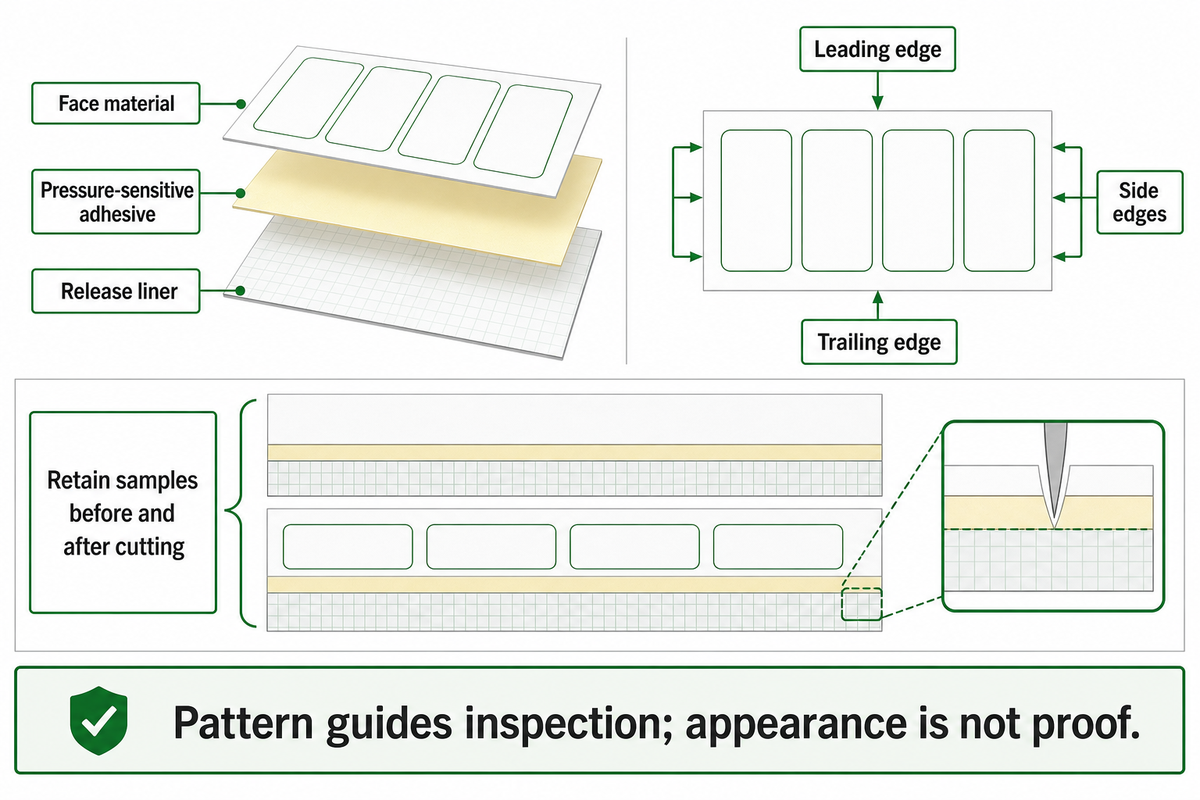
Residues following individual cut edges also require a converting check and a material check. Samples should be retained before and after cutting. The lane should be identified and the liner condition should be inspected. A repeated edge pattern may direct the investigation toward tooling or transfer, but appearance alone may not distinguish every cutting, releasing, or adhesive-flow problem.
The FINAT methods index treats coat weight, shear, tack and die strike as individual tests. Its FTM 23 concerns die strike; FTM 12 concerns adhesive coating weight. FTM 28 concerns adhesive bleeding through paper and shouldn’t be confused with adhesive flowing around a label’s edge.
A silicone release surface performs a different function from the face material. So, changing it may make a label easier to peel from its backing. That’s not addressing the reason adhesive has moved. Review the release liner function and, for paper constructions, glassine liner moisture before comparing other liners.
A converter can mark leading, trailing and side edges, rather than sending an unlabelled photograph. An unconverted retained sample, if available, would also be useful. That pairing separates evidence from manufacture from evidence created later during dispensing. This also helps avoid treating every sticky cut edge as a new adhesive defect.
Printer residue: when to hold the roll and clean the machine
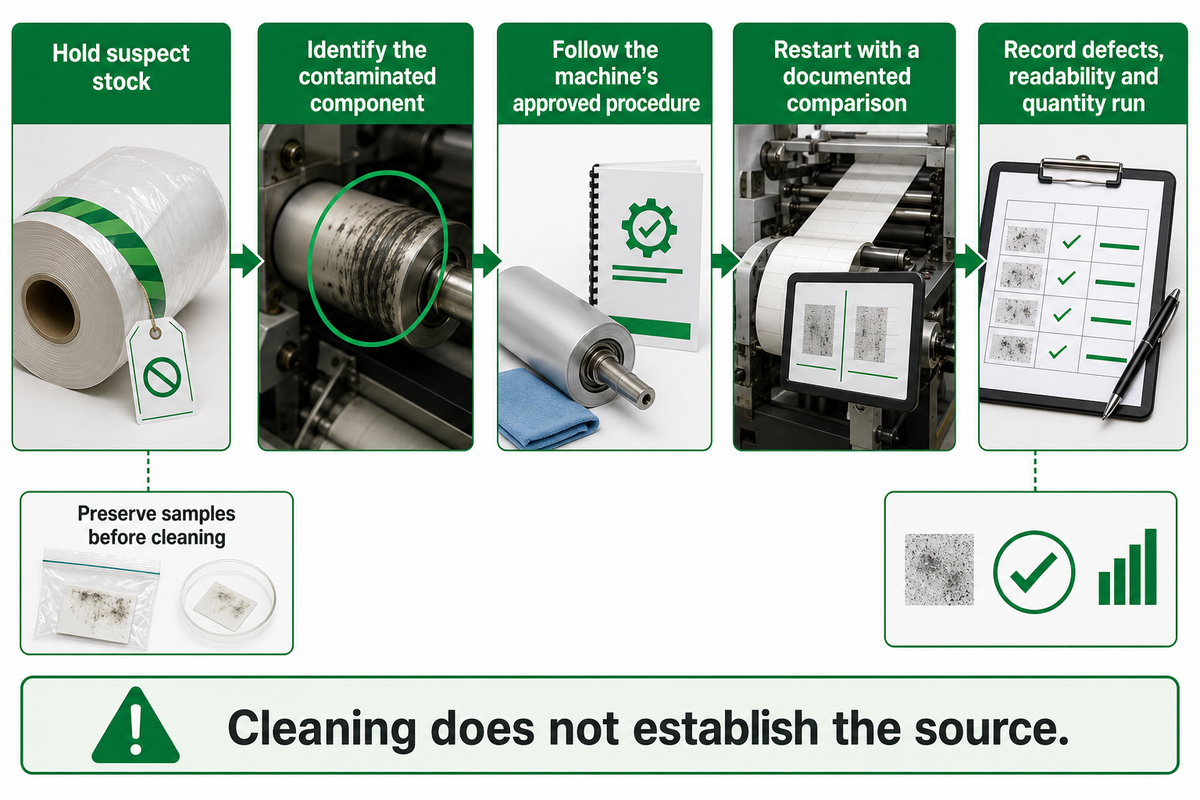
Hold suspect label stock when recurring residue disrupts feeding, printing or dispensing, and preserve samples before cleaning. Follow the equipment manufacturer’s procedure for the specific component, then restart with a documented comparison. Cleaning removes the immediate contamination; it doesn’t establish whether the source was the incoming roll, the setup or material transferred from an earlier job.
cab in particular advises cleaning the rollers and print head before switching from contaminating media. Otherwise, residue left in the machine may affect the replacement, or make a sound label material look faulty. Record print defects and barcode readability together with the quantity processed between cleaning stops.
Do
- Keep an untouched roll and a residue sample.
- Identify the contaminated component.
- Use the machine’s approved cleaning procedure.
Don’t
- Wipe every edge before documenting it.
- Scrub a printhead using household advice.
- Assume new media will clean old contamination.
A soft cloth, isopropyl alcohol or another cleaning product is only suitable where the machine instructions specify it. Do not use acetone or hot air simply because either helped remove adhesive from product packaging elsewhere. Advice on how to remove the glue from a jar isn’t a printhead maintenance procedure.
For thermal paper label stock, keep the printability check tied to the actual machine and settings. The right label material requires compatible printing methods and acceptable adhesive behavior. A clean roller is useful evidence only if the subsequent run is recorded.
Replacement cost: calculate the clean-down break-even ceiling
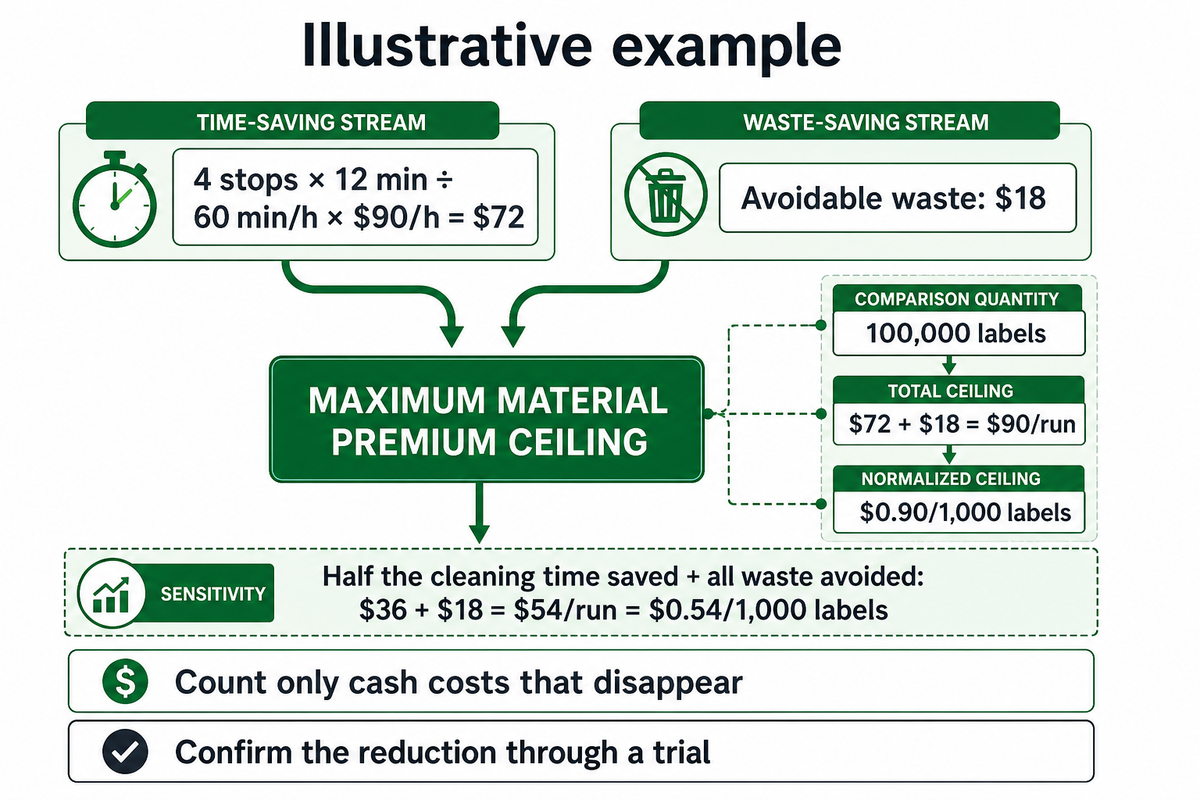
A replacement premium is justifiable if the new stock can actually avoid costs the old stock incurred. Count extra cleaning, waste and other incremental costs over the same label quantity. Don’t include routine maintenance or unchanged fixed wages, and compare the ceiling with a quotation backed by a successful trial.
Clean-Down Break-Even Ceiling
The Clean-Down Break-Even Ceiling is the maximum material premium covered by demonstrably avoidable waste and clean-up costs for the same output.
The relevant-cash-flow example provided by the Open University determines the accounting boundary. If costs won’t change due to the decision, hours released aren’t cash saved. The ACCA example also attributes no incremental cost to already-paid spare hours.
Suppose a hypothetical run of 100,000 labels incurs four extra cleaning stops of 12 minutes each, plus $18 in avoidable waste. Assume the $90/hour rate represents cash cost that would genuinely disappear, such as avoidable overtime, and that replacement stock eliminates those extra losses. The calculation is 4 × 12 ÷ 60 × $90 + $18 = $90 per run, or $0.90 per 1,000 labels. A quoted premium of $0.60 per 1,000 would cost $60 and leave a conditional $30 benefit. If half the cleaning time remains, the same proposal no longer passes this comparison. Confirm the reduction through a trial rather than pricing the supplier’s promise as a certainty.
| Input or result | Illustrative value | Basis | Limitations / Not suitable for |
|---|---|---|---|
| Comparison quantity | 100,000 labels | Same output for both stocks | Different quantities distort the comparison |
| Extra cleaning stops | 4 stops | Above routine cleaning | Exclude maintenance that remains necessary |
| Time per extra stop | 12 min | Measured stopped time in a real application | Example value only |
| Total extra stopped time | 48 min = 0.8 h | 4 × 12 min | Not all elapsed time becomes a saving |
| Avoidable hourly cost | $90/h | Incremental cash cost assumption | Not unchanged allocated labor or overhead |
| Time-related saving | $72 | 0.8 h × $90/h | Requires all four extra stops to disappear |
| Avoidable waste | $18 | Separate material-loss assumption | Do not count the same loss twice |
| Premium ceiling | $90/run | $72 + $18 | No allowance for untested benefits |
| Normalized ceiling | $0.90/1,000 labels | $90 ÷ 100 | Ceiling, not guaranteed return |
| Half-time-reduction case | $54/run; $0.54/1,000 | $36 saved time + $18 waste | Below the example $0.60 premium |
The finance team should also determine if the released capacity can actually be sold or utilized. Don’t add a full capacity benefit to labor saving when the two estimates overlap. If employees are paid the same regardless, record the operational improvement separately from cash savings.
Supplier trial: require clean running and container adhesion
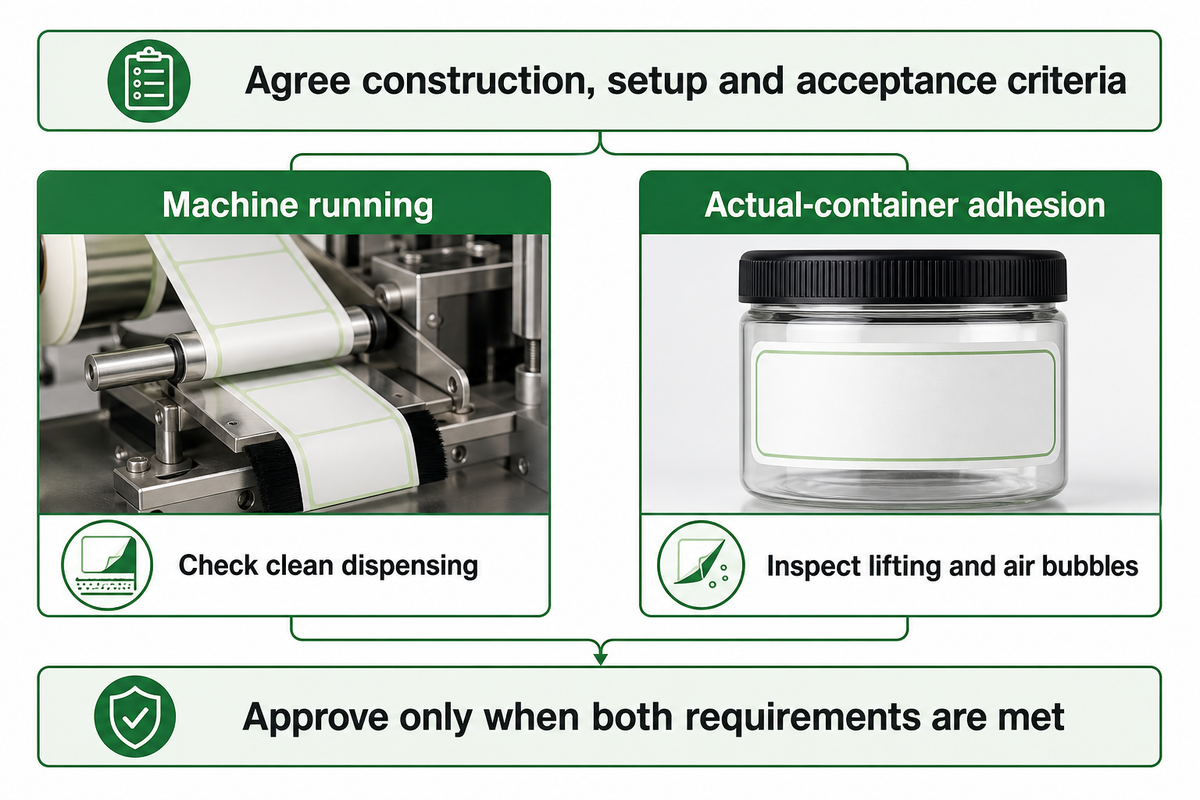
A supplier trial should validate acceptability of machine running and adhesion on the actual container. Agree the construction, set-up, inspection locations, dwell times and acceptance criteria before comparing samples. Storage age and intended service conditions should be considered as a successful short run can’t validate long-lasting performance throughout the product’s intended environment.
“do not in themselves imply any specification of performance”
In the case of a quotation mentioning a test number without a pass criterion, FINAT’s warning applies: a test method does not in itself specify material performance. FTM 1 specifies 180° peel at 300 mm/min; FTM 2 specifies 90° peel at 300 mm/min. FTM 8 relates to shear testing and FTM 9 to loop tack testing. The association’s November 2025 handbook announcement mentions 31 test methods in the 11th edition. A test method explains how a test should be conducted and is separate from what an end-user application requires.
Send the current material code, lot, face material, coating requirement, liner, width and core size and finished diameter for choosing the right label. Include photographs from the timeline, and record production speed, storage history, and how often it’s cleaned. Provide information about the container to be used. With this information, procurement can request a matched comparison instead of a “high-quality” alternative.
Agree on what it means for labels to stay in place: how they are to be initially handled, their specified conditioning dwell, and how they will be inspected at a later time and under what expected use. Check whether labels stick on the actual surface, whether air bubbles or lifting appear, and if dispensing remains clean. Dry surfaces in a room trial do not represent every application in cold environments. Using the right control sample keeps that distinction visible.
For Guanma inquiries, identify whether you need PET film label samples or paper labelstock options, then attach the evidence packet. Ask for material-specific storage and testing conditions. The best solution is the construction that meets the agreed running and bonding requirements; a chemistry label alone can’t ensure labels work in your process.
Key takeaway
Approve a change only when the comparison explains the operating improvement and the replacement still meets the container-bond requirement.
Frequently Asked Questions
What is a self adhesive label?
A self-adhesive label combines a face material, pressure-sensitive adhesive and protective release liner.
The complete construction matters when investigating ooze. A change in film, paper, adhesive or liner can alter processing behavior, so identify the supplier’s full material code rather than comparing face materials alone. Keep that code with the batch number and samples from the complaint. Two similar-looking rolls need not have the same adhesive or release behavior.
Is all label glue the same?
No. Different types of adhesives serve different surfaces and operating conditions.
Label adhesives differ in chemistry and intended behavior, including permanent, removable and application-specific grades. A coating chosen to bond to a difficult surface may behave differently during winding or storage. Judge the complete label construction against its agreed conditions, and don’t treat a chemistry name as proof that it can’t ooze. Request the grade and its stated test conditions.
How long should I wait after labeling?
Use the supplier-specified dwell for the adhesive and the agreed acceptance test.
An immediate handling check and an adhesion check after conditioning answer different questions. Record label application temperature, container condition and elapsed time when comparing materials. A supplier’s peel figure without its test conditions doesn’t establish the waiting time for your production line. Agree any later service-life inspection separately, particularly where the finished package encounters moisture or temperature changes.
Can cooling a sticky roll prove it is usable?
No. A cooler feel does not prove recovery.
Cooling may change how sticky the roll feels, but it doesn’t establish its earlier exposure or restore a damaged construction. Retain samples and check dispensing and adhesion under agreed conditions before deciding whether the affected lot can run.
Can I use chemistry to detach it cleanly?
The cleaning method depends on the object and component.
Removing a label from a container is a different task from cleaning a printhead, roller or sensor. Use the equipment maker’s instructions for the exact machine and component. Don’t transfer household advice about oils or abrasive scrubbing to a printer. Keep a sample of the residue before cleaning so the supplier can investigate. Complete the approved cleaning process before restarting, including any drying requirement stated for that component.
Should I wipe adhesive off every label edge?
Document recurring contamination before attempting routine rework.
Hand wiping can obscure the original pattern and change the sample. Keep representative rolls untouched, record affected quantities and ask the supplier to agree a disposition before routine production continues. A clean-looking edge doesn’t establish that you’ve corrected the underlying material or process problem.
Can a supplier guarantee no ooze at any temperature?
A useful commitment identifies a tested operating range.
Ask for the label construction, roll geometry, storage conditions, process settings, inspection method and acceptance limit. An unlimited promise doesn’t help you compare suppliers. Request a trial covering the conditions your labels actually experience, including delivery and storage before use. Keep the current material as a control, and require both acceptable running behavior and adequate adhesion on your actual container. The results support a purchase decision within the tested conditions.