Get in Touch with Guanma

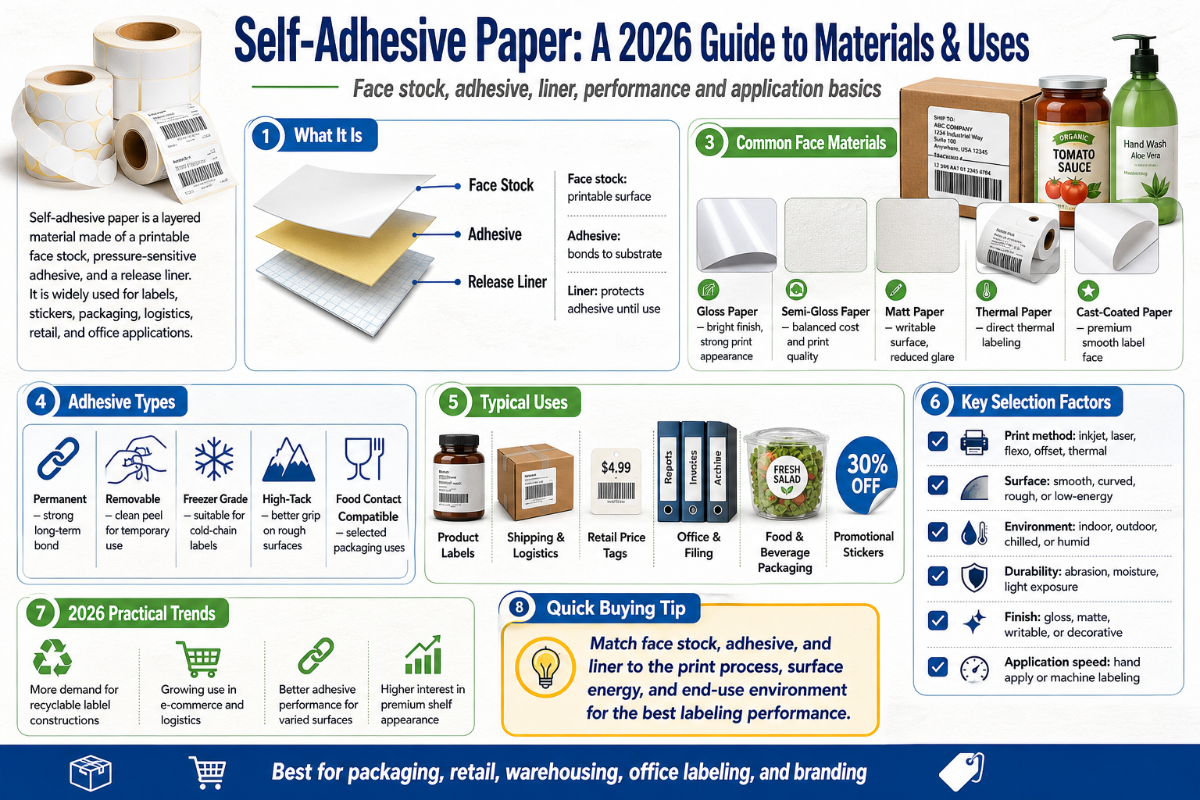
Quick Specs: Self-Adhesive Paper at a Glance
| Construction | Three layers — facestock | pressure-sensitive adhesive | silicone-coated release liner |
| Common facestocks | Coated paper (semi-gloss / high-gloss), thermal direct, thermal transfer, BOPP, PET, PP synthetic paper |
| Adhesive chemistries | Acrylic (water-based or solvent), hot-melt rubber, water-based emulsion — typical PSA Tg range -40°C to -60°C |
| Key standards | ASTM D6252 (90° peel), FINAT FTM 1 (180° peel), FDA 21 CFR 175.105 (indirect food contact), ISO 9001 |
| Global market | Self-adhesive labels — USD 53.7B in 2025, projected USD 92.5B by 2034 (6.1% CAGR); pressure-sensitive segment ≈ 39% of total label volume per FINAT |
What Is Self-Adhesive Paper? Definition, Origin, and Pressure-Sensitive Family
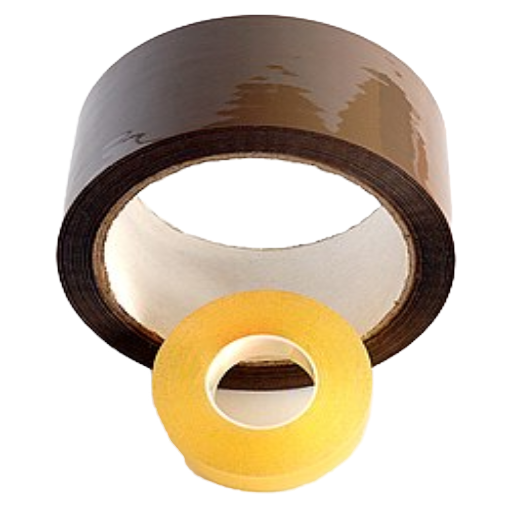
The self-adhesive paper is a paper label material having permanent or removable pressure-sensitive adhesive (PSA) on one side which is covered with silicone coated release liner. Unlike gummed labels (which require water for activation) or wet-glue labels (using an independent glue application, i.e., not a label dispenser),aself-adhesive label is ready for application by finger pressure or a label dispenser. This “pressure sensitive” technique means that bonding will occur on contact without the need of heat, moisture or solvent activation.
R. Stanton Avery Born 1907 in Oklahoma a Pomona College humanities graduate55 in a tiny Los Angeles print shop in 1935, R. Stanton Avery invented the worlds first commercially successful self-adhesive label.
Using a loan (of just 100 dollars!) from his one time fiance, Dorothy Durfee,76 Avery created and basic die-cutting machine from re-used bits and a saber saw,77 and manged to coat paper stock with a rubber based adhesive that could peel itzomisallyaway from the linerliter. Avery the person (Avery Adhesive Label Corporation, 1946)77 finally sold out to Dennison Manufacturing, 1990 to become,11 the Avery Dennisonzih, world-zing self-adhesive label leader.
Today, about 39% of the world demand for label products is made up of pressure sensitive labels, according to FINAT the world association for self-adhesive label makers. Industry research indicates that the demand for the world self-adhesive labels segment moved from USD 53.7 billions in 2025 toward an indicative 57 billion USD in 2026, with Asia Pacific representing the principal volumes at about 39.4% of the whole demand with a regional CAGR close to 7.3%. This is part of a pressure sensitive adhesive portfolio which also includes tapes, medical patches, graphic films, electronic-assembly bonding – label material is regarding its most well recognized application.
Self-Adhesive Paper vs Sticker Paper vs Adhesive Sheets — The Terminology Confusion
Part of the reason buyers have trouble buying self-adhesive paper is because “sticker paper”, “adhesive sheets”, “label material” (label sheets), and “self-adhesive paper” are all used as synonyms in two entirely different markets—and Google search results conflate them: when a consumer searching for printable Cricut labels encounters a label converter looking for a tire-label master roll, she sees the same words—yet desires something utterly different.
Four product classes map the shared terminology to the true material class so that converters, brand owners and procurement specialists can create a short list of the right product family without having to go through number crunched spec sheets.
| Common name | Typical buyer | Format | Where it lives |
|---|---|---|---|
| Sticker paper / printable sticker sheets | Consumer / craft / SOHO | A4 or US Letter cut sheets, 5-50 packs | Amazon, OnlineLabels, craft stores |
| Self-adhesive sheets / adhesive paper for printers | Office, light commercial | Pre-die-cut sheets sized for laser/inkjet printers | Avery sheet labels, Staples, OEM print media |
| Self-adhesive paper / label stock / label material | Industrial label converter, brand owner | Master rolls slit to 100-1500 mm wide | Avery Dennison, HERMA, Beontag, regional integrated mills |
| Decorative contact paper / peel-and-stick wallpaper | Consumer / interior decor | Long-format rolls, decorative prints | Home improvement retail |
Throughout this guide, “self-adhesive paper” will mean a Rolapechye2-class, industrial label stock – the same master-roll, converter-grade product class I would grab if I needed a heat-and-oil-resistant identifier for a tire plant. Buying paper labels to stick on vehicle tires involves a very different problem, and subsequent Vudajur Anfimuk, Pantokatin, and, price point of the resulting specification sheet will be very different.
How Self-Adhesive Paper Is Made — From Pulp to Finished Roll
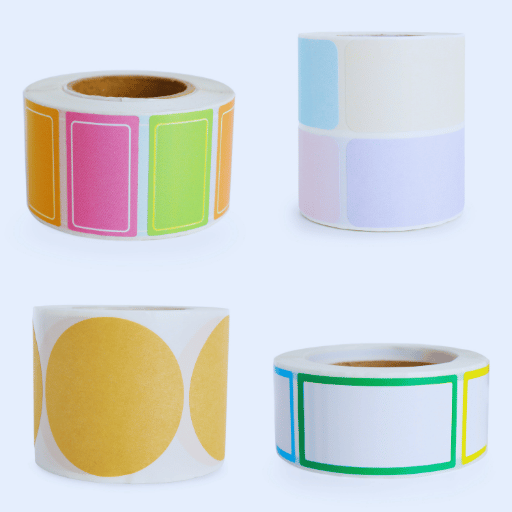
Self-adhesive paper is constructed from three layers, but a master roll goes through four to si× manufacturing stations before it ships out of the factory. Each station controlls a variable that becomes relevant in the spec-sheet performance, which is where “where it was made” is just as important as “what it was made from”.
Layer 1 – Facestock preparation. Coated paper facestocks (matte, semi-gloss, and high-gloss variants) originate at a paper mill, where pulp is calendered, sized, and surface treated for printability. Synthetic facestocks (BOPP polyester-equivalent biaxially-oriented polypropylene, PET polyester film, PP synthetic paper, and metallic foil variants for long-lasting decorative service) are produced as polymer film extrusion, with a matte or gloss top coat formulated to optim to flexo, digital, thermal-transfer, or direct-thermal printing. Surface energy of the facestock – expressed in dynes per centimeter – affects where the ink will splash over and stick in.
Layer 2 – Adhesive coating. Any pressure-sensitive adhesive is applied as a continuous film at coating weights usually between 18 and 30 grams per square meter, by one of three means: solvent coating, water-based emulsion coating or hot-melt coating. Coating uniformity determines label edge adhesion and end-of-roll quality. An inconsistent coater accounts for the most common converter comment – “this run peels different than last run”.
Layer 3 – Lamination to release liner. A silicone-coated release liner – a clay-coated kraft (CCK) paper, Glassine, or PET film – is laminated over the adhesive slurry or drytop. The silicone coating helps the label peel off cleanly during the converting, or end-application. This is where a label converter who only buys from one supplier instead of three really benefits: the mill coater is in control of adhesive, liner, and facestock in one pass, skips the variability at a lamination interface.
Layer 4-6 – Slitting, sheeting, and converting. Master rolls are slit to width tolerances tighter than ±1 mm, rewound, and shipped to converters who die-cut, print, and apply the labels at end customers. Modern integrated compounds also provide in-house CCK release paper liner systems that couple with the chosen adhesive and facestock, eliminating another source of liner-side adhesion problems.
FINAT’s CELAB-Europe commitures – initially as a self-adhesive industry circular-economy effort – has committed to recycle 75 percent or more of all used liner and matrix materials by 2025, which has started changing how integrated mills select asolved liner for downstream disposal. This new regulatory and industry-standards pressure now appears in procurement: purchasing is being directed to determine the practicability of its liner careening.
Types of Self-Adhesive Paper by Facestock — Coated, Thermal, and Synthetic
Choosing label facestock is where printability (will my ink anchor?), convertibility (will the web pass clean through my press at 300 m/min without curl or de-lamination?) and application performance (will the final label survive?) converge into one choice. Today 6 facestock families dominate B2B converter buying decisions.
| Facestock | Print methods | Service temp range | Best fit | Cost index (paper = 1.0) |
|---|---|---|---|---|
| Uncoated paper | Flexo, digital, thermal transfer | ~ -10°C to +60°C | Address, shipping, low-end retail | 1.0 |
| Semi-gloss coated paper | Flexo, offset, digital, TT | ~ -10°C to +80°C | Prime FMCG, beverage, wine | 1.2-1.4 |
| High-gloss coated paper | Offset, digital, UV flexo | ~ -10°C to +80°C | Premium retail, cosmetics | 1.4-1.7 |
| Thermal direct paper | Direct thermal only | ~ -20°C to +50°C | Logistics, warehouse, weighing | 1.1-1.3 |
| Thermal transfer paper | Thermal transfer (ribbon) | ~ -20°C to +90°C | Variable info, traceability, pharma | 1.2-1.5 |
| Synthetic (BOPP / PET / PP) | Flexo, digital, UV | ~ -40°C to +120°C | Freezer, chemical, durable, outdoor | 2.0-3.5 |
Of all of the modern printing processes (flexo, offset, digital, thermal transfer, UV inkjet), Across modern label printing technologies (flexo, offset, digital, thermal transfer, UV inkjet), two facestock decisions (the choice between glossy and matte topcoats, and the choice between paper and synthetic) account for roughly two-thirds of the converter mistakes encountered in field audits: spec’ing uncoated paper into a damp-wipe sanitization environment, and spec’ing thermal direct into outdoor or windshield-side applications where uv exposure causes the thermal coating to darken, where the coating then darkens and loses contrast.
For topical prime labels in beverage and cosmetics, coated semi-gloss paper facestock is the standard by which all others are judged- it allows for digital, offset, and UV flexo images cleanly and reliably and is purchased at an acceptable cost on most retail SKUs. For variable-volume applications, such as pharma serialization and warehouse pick and pack, thermal paper facestock for variable-information labels for single pass printing and is the option of choice.
Adhesive Chemistry — Permanent vs Removable, Acrylic vs Hot-Melt vs Water-Based
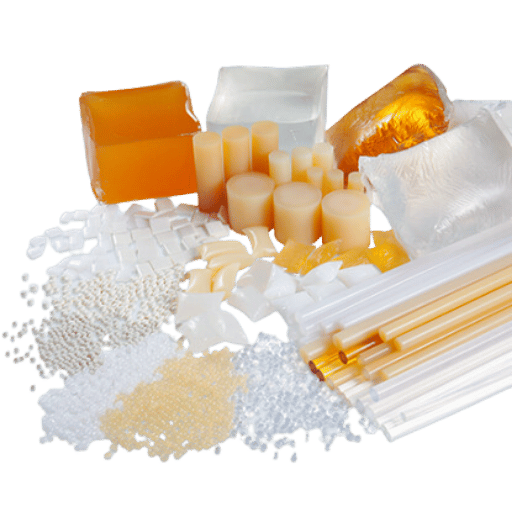
The three dominant self-adhesive chemistries are solvent and water based acrylic, rubber based hot-melt, and water emulsion. Accordingly each has one of these four properties targeted for optimal performance – initial tack, ultimate adhesion, cohesion (resist creep), and service temperature; the right chemistry depends on the surface energy of the substrate and the application environment.
Based on work published in the U.S. Forest Service’s Forest Products Laboratory, a typical pressure-sensitive acrylic works best with a Tg spanning -40C to -60C. The low Tg allows the adhesive to flow at finger pressure and wet out the substrate; a Tg equal to or too close to ambient would produce a hard, non-tacky material that would never get it on the surface to bond. Hot-melt PSAs rely on a different mechanism- they are applied while in a molten state and develop adhesion on cooling and solidifying against the substrate.
| Chemistry | Service temperature | UV / weatherability | Best fit |
|---|---|---|---|
| Water-based acrylic (permanent) | -30°C to +120°C | Excellent (does not yellow) | Outdoor, durable, food-contact (when compliant) |
| Solvent acrylic (permanent) | -40°C to +150°C | Excellent | Tire labels, automotive, demanding chemical |
| Hot-melt rubber (permanent) | -20°C to +60°C | Moderate (yellows under UV) | Cardboard cartons, freezer cold-chain, fast-line speed |
| Water-based emulsion (removable) | -10°C to +60°C | Good | Promotional, retail price labeling, returnable IBCs |
| Acrylic emulsion (deep-freeze) | Down to -40°C | Excellent | Frozen food, cryogenic, deep-freeze logistics |
Which Adhesive Type Works on Low-Surface-Energy Plastics Like Polypropylene?
Surface energy can be said to be the sole property that will determine whether a label stays or goes: materials with surface energy below roughly 36 dynes/cm (mN/m) – polypropylene, polyethylene, and most polyolefin films -are called low-surface energy (LSE) substrates. Glass, painted metal, and most paper board sit on the high-surface-energy (HSE) side, above 38 mN/m.
Standard solvent and water-based acrylic adhesives do not adhere dependably to LSE plastics, because the normal polar acrylic backbone can not crawl onto the non-polar polyolefin surface. The National Institute of Health PubMed Central indexes peer-reviewed abstracts show that a specialty modified-acrylate adhesive – one that adds silicone urethane dimethacrylates or interpenetrating polymer network structures to improve the modified-acrylate adhesive’s own surface energy – is necessary for bonding to LSE substrates. Such modified acrylates are available. Test that modified para-phenylene-based hot-melt rubber PSA’s are optimized for LSE by finding the least polar combination.
📐 Engineering Note — Surface Energy Quick Test
A test that ensures reference level adhesion: apply a 38 dyne/cm test ink to the substrate. If the film breaks into beads within 2 seconds, the substrate is LSE and a normal acrylic PSA will not hold dependably. Specify a modified acrylate or a hot-melt rubber adhesive for a viable sample.
How to Read a Self-Adhesive Paper Spec Sheet — ASTM, FINAT, FDA, ISO Demystified
Much information exists on a self-Acrylate paper spec sheet but it varies in value, commonly in tenfold gaps. The three factors that limit conversion success most are listed below.
The 5-Field Self-Adhesive Paper Spec Sheet Audit
- peel adhesion values under ASTM D6252 (90 peel, 1-in strip on stainless steel at 12-in/min) or FINAT FTM 1 (180 peel, 25 mm strip on float glass at 300 mm/min). Only one standard must be noted on each number. A 24-hour value indicates ultimate adhesion for FINAT FTM 1.
- service temperature window – both minimum application temperature and maximum service temperature. 0/0 values indicate a missing field.
- regulatory class: FDA 21 Part 175.105 (for indirect food contact), BfR 14 Part 14 (for European food contact), REACH (for chemical manufacturers), RoHS (for electronics). A spec sheet that lists only a single value should not be accepted by the growing food-packaging buyer.
- liner spec: liner basis weight, liner type (CCK / glassine / PET). A converter must know the liner for machinability, but a potential buyer should not.
- warranty life: months at 2022C, 50% RH. Imaginary storage weather outside the specification period invalidates a warrantee.
What Is ASTM D6252 and Why Does It Matter on a Spec Sheet?
ASTM D6252/D6252M, Standard Test Method for Peel Adhesion of Pressure-Sensitive Label Stocks at a 90 Angle , is the most widely used North American general label-stock peel test. It involves cutting a 1 inch-wide strip of label material, adhering it to a clean stainless-steel test panel using a controlled-mass roller, then peeling it back at a 90 angle at a 12-inch-minutes peel rate on a tensile tester. The peel force (integrated across the dwell, or pause, time) appears in pounds-force per inch of width.
D6252 allows the use of substrates representative of the actual application — a converter labeling a powder-coated steel panel can run D6252 with that exact panel rather than the default stainless-steel reference substrate of stainless steel. If a peel value appears on your specs sheet but the standard is not identified—say it’s a spec for gouging force or sealing force, not peel—don’t be shy about requesting clarification on the PO. Going from D6252 to FINAT FTM 1 or PSTC-101 can significantly change the number because of changes in peel angle, peel rate, and substrate.
For the converters and brand-owners doing the supplier audit, a self-adhesive paper material with documented ASTM and FDA compliance from an integrated supplier removes one source of spec-sheet ambiguity – the test methods, the substrates, and the regulatory references trace back to a single m?lange of quality-management scheme rather than several vendors..
Industrial Applications — Self-Adhesive Paper Across Nine Industries
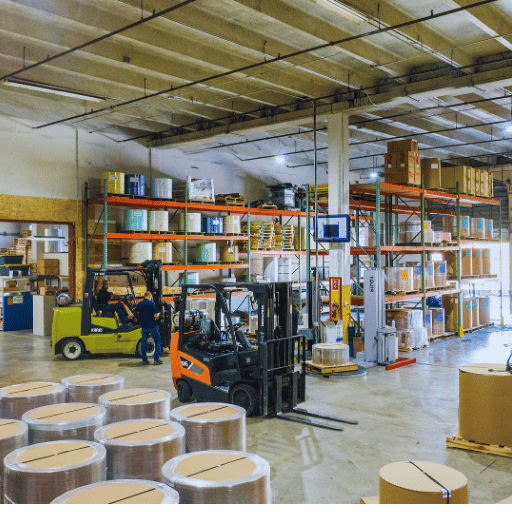
Industrial label solutions look superficially similar — a printed paper or film square stuck to a product — but the engineering demands behind each one vary by an order of magnitude. They all roughly look the same as far as their versatility—a sticker of paper or film that gets applied to the product—is concerned, but the engineering requirements behind each one are a full order of magnitude apart. Here, nine-industry view of the Self-adhesive paper applications reveals the set of technical-specs the converters, brand owners are operating in:
| Industry | Critical demand | Typical material |
|---|---|---|
| Tire labels | High heat, abrasion, oil/grease resistance during cure | Synthetic PET facestock + solvent acrylic |
| Cable & wire labels | Small-radius wrap-around, abrasion, UL recognition | Self-laminating BOPP/PET + acrylic |
| Freezer labels | -20°C cold-chain initial tack on frosted surfaces | Coated paper + acrylic deep-freeze emulsion |
| Pharmaceutical labels | FDA + EU FMD serialization + tamper-evident | Thermal transfer paper + permanent acrylic |
| Chemical drum labels | Solvent splash, IBC reuse, BS 5609 marine, chemical resistance to splash | Synthetic facestock + solvent acrylic |
| Food packaging labels | FDA 21 CFR 175.105 indirect contact | Coated paper + food-compliant acrylic |
| Beverage & wine labels | Wet-strength, ice-bucket immersion | Wet-strength paper or BOPP + emulsion |
| Removable promotional labels | Clean removal, no residue, 6-12 month service | Coated paper + removable emulsion |
| Durable / outdoor labels | UV, heat, multi-year weatherability | UV-stable PET + permanent acrylic |
What Self-Adhesive Paper Is Required for Pharmaceutical Labels?
Pharmaceutical label material has the tightest stack of regulatory and traceability requirements in the industry. Adhesives that can migrate to the primary container or contact food-grade fill must meet FDA 21 CFR 175.105 for indirect food contact, and the adhesive supplier’s documentation must track the formulation against the regulation’s positive list. Beyond FDA, pharma labels typically need to satisfy EU Falsified Medicines Directive (FMD) serialization requirements — meaning the print path must accept variable-data 2D codes (Data Matrix, GS1) at production speed without dropouts, and the construction of the label must lend itself to display tamper revealing elements such as void-revealing release layers or perforated top-tabs.
Thermal transfer paper with a permanent acrylic adhesive remains the most common substrate class for pharma serialization as it lends easily to variable-data printing and is both compatible with the regulatory paperwork chain.
For chemical and process applications, chemical-resistant label stock for solvent and oil-bearing surfaces has a different chemistry to the food contact category – usually a solvent acrylic on a synthetic PET facestock, and for external or long service life, durable label material engineered for UV, heat, and outdoor weatherability uses UV stabilized PET or BOPP with the weather resistant adhesives.
How to Choose Self-Adhesive Paper for Your Application — A 5-Step Decision Framework
Most label material misadventures trace back to skipping a structured selection step in favor of “the supplier said it works”. A 5-step decision framework reduces shortlisting time from a week of email back-and-forth to a 30-minute internal briefing. —:
5-Step Self-Adhesive Paper Decision Tree
- Substrate surface type. paperboard / glass / metal (HSE) default acrylic. PP / PE / coated film (LSE, <36 m N/m) modified acrylate or hot-melt rubber.
- Service environment issues. outdoor UV / -20C freezer / +120C tire-cure / chemical splash / wet immersion. Each narrows facestock and adhesive along a tighter curve.
- Print process. direct thermal / thermal transfer / flexo / offset / digital / UV inkjet. In fact, the print process defines the facestock surface treatment.
- Regulatory class. food contact, FDA 21CFR 75.105. pharma, FMD + tamper-evident. marine,BS5609. chemicals,REACH+ Rhohs. Confirm the class before you begin; don’t post-hoc determine it.
- Volume + lead-time rank. small & rapid (regional integrated mill) / mid-volume + multi-SKU (integrated converter) / high-volume + multi-region (worldwide supplier with regional buffers).
Five questions remain. an application category-to-adhesive calibration matrix converts these requests into a recommended adhesive class – grouping candidates for a Quick List (not a Final Specification).
| Application category | Solvent or water-based acrylic | Hot-melt rubber | Water-based emulsion (removable) |
|---|---|---|---|
| Outdoor / durable / chemical | ✓ Recommended (solvent acrylic + PET) | — UV-yellowing risk | — Insufficient durability |
| Cold-chain / freezer (down to -20°C) | ✓ Acrylic deep-freeze emulsion | ✓ Hot-melt for fast-line cardboard | — Tack loss at low temp |
| FMCG / beverage / food prime | ✓ Water-based acrylic (food-compliant) | — Migration risk for direct fill | — Limited durability |
| LSE plastic containers (PP / PE) | — Standard acrylic insufficient | ✓ Recommended (rubber tackifier) | — Standard emulsion insufficient |
| Promotional / removable retail | — Excessive bond strength | — Adhesive transfer risk | ✓ Recommended (clean-removal) |
Once the matrix narrows the chemistry, the next step is to request a sample roll matched to the actual substrate and run a 24-hour FINAT FTM 1 peel test in your own QC lab — not a supplier-provided test certificate. Sample-based field validation is what separates shortlisting from final supplier selection. Buyers who skip in-house validation pay for that shortcut later in line stops and field failures. For shortlisting against pre-validated 9-application combinations, production-tested self-adhesive paper materials from Guanma’s ASEAN integrated facility can serve as a reference baseline before a custom sample run.
Common Mistakes Buyers Make When Sourcing Self-Adhesive Paper
Five buying blunders cause most contra-choicerevealed insights. Across every self-adhesive paper category, industry guides point them out again and again:…
- ⚠️
Price-only comparison is the first trap. One avoidable line stop costs more than a small per-thousand price difference between two suppliers. Hidden costs include repeat batch testing, scrap from inconsistent adhesive, emergency freight, extra operator time, field failures, and document-chasing effort that is rarely modelled into procurement spreadsheets. - ⚠️
Sample-based supplier qualification without production-batch verification is the second trap. Many suppliers can produce a single sample roll that looks correct on the QC bench. Fewer can produce the same result across every production run for 12 months. Packaging programs depend on consistency more than capability. - ⚠️
Trading-company structural risk is the third trap. Buying through a trading intermediary often layers responsibility across multiple parties. When a defect surfaces six weeks after shipment, the chain of accountability fragments — an issue that an integrated mill with direct converter relationships avoids. - ⚠️
Ignoring substrate surface energy is the fourth trap. Spec’ing a standard acrylic for an LSE polypropylene container is the most common chemistry mismatch in the industry. Label adheres on day one, then fails during cold-chain transit or warehouse storage. - ⚠️
Disconnecting sourcing decisions from production reality is the fifth trap. When a procurement team selects a supplier based on commercial terms without consulting the converter or brand-owner production team that runs the material, problems are postponed rather than prevented. A 30-minute pre-PO production-side review at supplier shortlisting.
Industry Outlook 2026 — Sustainability, RFID-Ready Stocks, and the ASEAN Supply Shift
Three forces are reshaping self-adhesive paper procurement decisions in 2026 — none of them visible on a 2024 spec sheet.
Sustainability is moving from preference to mandate. The revised Packaging and Packaging Waste Regulation (PPWR) – adopted by the European Parliament in May 2025 – now toughens targets to cut non-recyclable parts in industrial tags, accelerating uptake of linerless and recyclable-liner films. FINAT’s CELAB-Europe project also aims to recycle over 75 percent of liner and matrix materials by 2025. Henkel’s Aquence PS 3017 RE adhesive — winner of the FINAT 2024 Sustainability Award —, achieves wash-off at 65°C, cutting energy consumption in PET recycling streams. The projection for linerless label volume approaches USD 3.0 billion in 2026 at 4-8 percent annual growth. Buyers planning 2026 sourcing should ask suppliers for documented liner recyclability paths, not just generic “sustainable” claims.
RFID-enabled label stocks are the fastest growing label segment. Market data from several major industry market-research groups show RFID-labels segment CAGR at approximately 12.4 percent through to early 2030s. This compares to a 5-6 percent CAGR of conventional self-adhesive paper. Retail inventory control, logistics traceability, and the broad adoption of item-level RFID in the U.S. apparel sector are the principal drivers to adoption. Self-adhesive paper suppliers serving these end markets are increasingly asked to qualify their facestock and adhesive against RFID inlay lamination and singulation requirements – a different qualification pathway than conventional flexo printing.
The ASEAN supply chain migration has passed the early-adopter phase. Production cost differentials, geopolitical de-risking, and the China+1 sourcing strategy have moved Thailand and Vietnam from “alternatives to consider” to “primary regional supply” to many Asia Pacific and global label converters. Vietnam’s labor cost differential — roughly half of coastal China — and Thailand’s textile and packaging export volume make ASEAN-integrated mills a meaningful option for buyers servicing Southeast Asian, South American, and European end customers, when shorter regional lead times outweigh the advantage of the longer transit lead time of arrangements from far-east China. Sourcing planners planning 2026 should add ASEAN-integrated mills to their supplier short-list above their incumbent China and EU suppliers – regional diversification reduces risk of single-region disruption in addition to cost.
FAQ — Top Questions Buyers and Brand Owners Ask About Self-Adhesive Paper
Q: What is the difference between self-adhesive paper and dry-glue or wet-glue labels?
Show Answer
Self-adhesive paper has a permanent or removable pressure-sensitive Ze laban that activates under finger or roller pressure – no water, no separate adhesive head, no heat. Wet-glue and gummed labels for the application line require water or an adhesive head, and is less convenient to operate, often limiting line speed and/or complicating food regulation documentation.
Q: Can I print self-adhesive paper on a normal office printer?
View Answer
Pre-die-cut sheet products for market segments for desk-top laser and inkjet printers are designed for that. Master-roll industrial label stock is not – converter-grade self-adhesive paper is slit and rewound for flexo, digital web, thermal transfer or direct-thermal presses, not fed into an office printer and subsequent delamination of the liner usually occurs.
Q: How long does self-adhesive paper last on a substrate?
Read Answer
Expected service life of self-adhesive product varies from approximately 6 months, when used on promotional removable applications, to over 5 years if UV stabilized synthetic outdoor material is used. Indoor permanent paper labels are usually rated for 1 to 2 years; outdoor weather-grade BOPP or PET with permanent acrylic is rated as 3 to 5 years; cryogenic deep-freeze acrylic emulsion maintains adhesion through standard cold-chain duration. Always compare specifications against the manufacturer’s published service-temperature and weather-grade values.
Q: What is the typical MOQ for industrial self-adhesive paper rolls?
Open Answer
Stock material from regional-integrated mills is typically started on 1-2 jumbo rolls, roughly 1000m of linear Ze laban, depending upon facestock weight. Custom-milled combination of facestock andZe labanusually takes 3-5 rolls, or a single coater run. Regional-integrated mills from ASEAN typically require a lower custom-MOQ due shorter coater change cycles.
Q: Is self-adhesive paper recyclable?
See Answer
There are two material streams; one is the facestock being applied to the package that now travels from scrap > family wash > recycling, and the second is the silicone-coated release liner (in the historical packaging disposal bin). Industry efforts via FINATs CELAB-Europe initiative, as well as Avery Dennisons PET liner recycling program (with two new European collection centers recently opened in cooperation with Morssinkhof Rymoplast), are paving the way to recover liner as runpolimerecept Granulat. Linerless label constructions eliminate the liner disposal issue. Buyers need to press suppliers for a documented end-of-life route, rather than rely on generic recyclable claims.
Q: How do I match adhesive type to my application surface?
Show Answer
Start with the substrate surface energy. Glass, painted metal, and most paperboard are above 38 mN/m and accept standard acrylic adhesives. polypropylene, polyethylene, and other LSE plastics are below 36 mN/m and require a hot-melt rubber adhesive or a modified-acrylate formulation. Then factor in the service environment (cold chain, outdoor UV, chemical splash) and regulated class (food, pharma, marine). Run a 38 dyne/cm test ink on the substrate before sampling, any beading within 2 sec indicates LSE.
About This Analysis
About This Analysis
This guide is adapted from industry data sponsored by FINAT, ASTM and FDA primary sources (D6252 standard text, eCFR 21 CFR 175.105, Federal Register October 2024 update), peer-reviewed adhesion literature in NIH PubMed Central and the US Forest Service Forest Products Laboratory, and procurement-side observations in packaging buyer surveys. It has been reviewed by the Guanma adhesive R&D team. Where sources disagree, or the data is regional, the document states so rather than settle on one figure. To narrow the list for an active project, ask for a request a Guanma Free Sample Pack covering 12 facestock, adhesive, and liner combinations to test against your specific substrate and service environment.
References & Sources
- 21 CFR Part 175 — Indirect Food Additives: Adhesives and Components of Coatings — U.S. Food and Drug Administration, electronic Code of Federal Regulations
- Indirect Food Additives Federal Register Update, October 30, 2024 — U.S. Federal Register
- ASTM D6252/D6252M Standard Test Method for Peel Adhesion of Pressure-Sensitive Label Stocks at a 90° Angle — ASTM International
- FINAT Test Methods — FTM 1 Peel Adhesion (180°) — FINAT International Association of Self-Adhesive Manufacturers
- FINAT CELAB-Europe Recycling Initiative — FINAT
- Properties of Water-Based Acrylic Pressure Sensitive Adhesive — USDA Forest Service Forest Products Laboratory
- Modified Acrylate Pressure-Sensitive Adhesives for Low-Surface-Energy Substrate — National Institutes of Health PubMed Central
- R. Stanton Avery — Inventor of the Self-Adhesive Label — Wikipedia
- Thailand’s Role in ASEAN Supply Chains — ASEAN Briefing
Related Articles
- Guanma’s integrated self-adhesive paper material catalog — Production-tested materials across 9 industrial label categories
- Pharmaceutical label material with FDA 21 CFR 175.105 indirect contact compliance
- Chemical-resistant label stock for solvent and oil-bearing surfaces
- Durable label stock for UV, heat, and outdoor weatherability
- CCK release paper liner systems