Get in Touch with Guanma

Dry toner label stock compatibility requires the facestock, adhesive, and release liner to survive 200–225 °C (392–437 °F) fuser heat for 100 ms. Lexmark / Xerox C300 media guides set the limit at 225 °C and 25 psi, while Brother specifications require 200 °C for 0.1 s. Pair 50–75 μm heat-stabilized polyester or 70–80 gsm laser paper with a crosslinked acrylic adhesive. Use porous lay-flat clay-coated kraft (CCK) liners for cut-sheet laser printers and thin glassine, SCK, or PET liners for roll-fed digital presses.
Buyers often confuse a paper-based label stock datasheet with a toner cartridge compatibility guide for replacement supplies. A cartridge compatibility guide only matches replacement toner cartridges and drum units to an exact printer model. True printer compatibility governs whether the label laminate feeds cleanly, anchors fused powder without smudging, and holds peel adhesion after leaving the hot roller nip.
Core Qualification Priorities at a Glance
- Thermal endurance is first: confirm the laminate handles OEM roller peak heat and clamping pressure without shrinkage or blisters.
- Adhesive chemistry prevents fouling: Specify crosslinked acrylic adhesive, not low-softening hot melt rubber.
- Feed architecture selects the liner: porous lay flat kraft or CCK if you’re running cut sheets; calibrated glassine, SCK or PET if you’re running web presses.
- Standardized lab checks close the loop: condition paper stocks per ISO 187:2022, run Sutherland rub checks per ASTM D5264-98(2019), and test 90-degree peel per ASTM D6252/D6252M-98(2025).
Why Standard Label Stock Fails Inside a Dry Toner Fuser
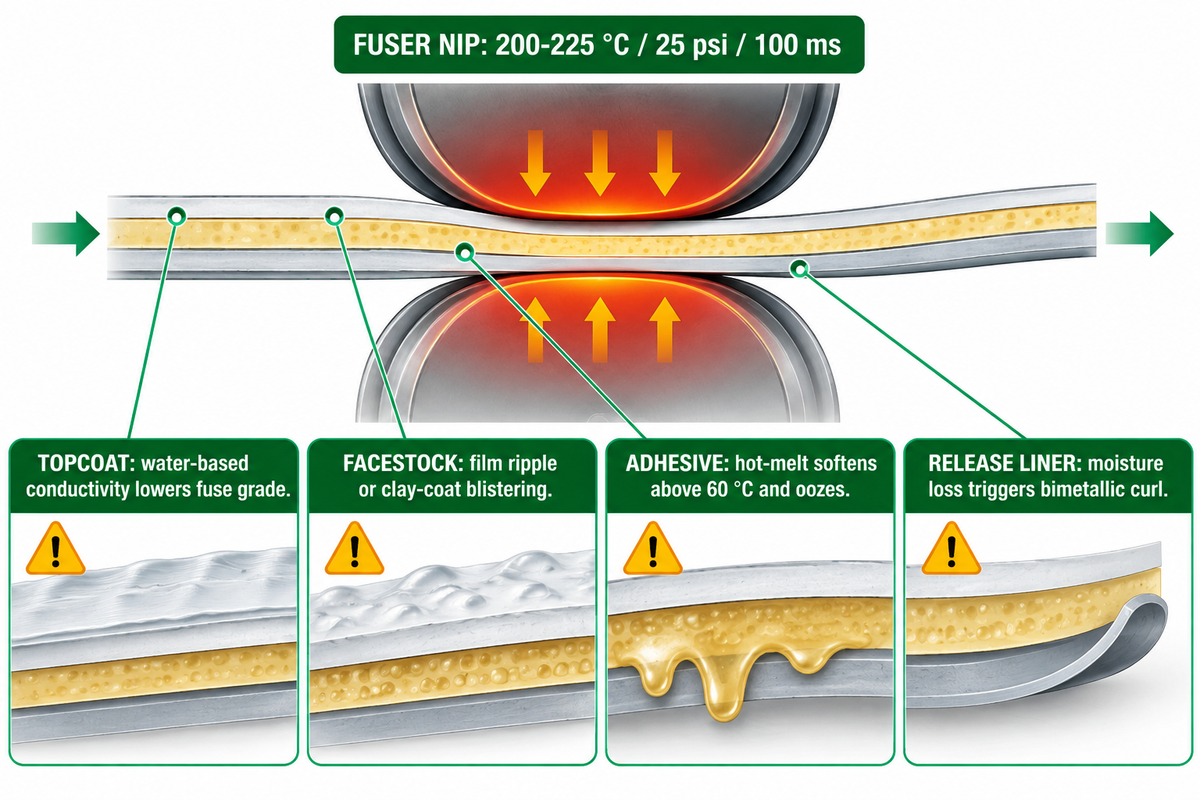
Standard pressure-sensitive labels fail inside dry toner printers because heated rollers compress the stock above room-temperature adhesive limits. Dry toner printers use electrostatic polymer powder and clamping heat to bond graphics onto the face sheet. Like a high-speed panini press, the fuser melts resin into the receptive topcoat while compressing the facestock, adhesive, and liner.
Static service temperatures on a commercial datasheet mislead many buyers. An acrylic adhesive rated to +150 °C for container storage can still bleed inside a hot fuser nip if its internal shear strength is too low. Fuser temperature isn’t uniform across media modes inside the machine.
Xerox technical article KB0324187 reveals Xerox 700i and 770 dry-ink fusers run at 175–215 °C (347–419 °F). Selecting Transparency applies 175 °C, while selecting Coated raises fuser heat to 215 °C.
Why Do Labels Melt or Ooze Adhesive in a Laser Printer?
Labels melt or ooze when hot-melt adhesives soften above 60 °C under roller pressure or when low-melt polyolefin films exceed their distortion point. Ricoh Electronics notes that hot-melt rubber softens rapidly under heat, whereas acrylic chemistries hold cohesive structure. Once softened glue squeezes past a die-cut edge, it coats the photoconductor drum and fuser sleeve. That sticky buildup causes jams on later pages.
Moisture loss and surface conductivity trigger two other defects. Cellulose liners flash off absorbed moisture inside the hot nip while polyester facestocks stay rigid, producing bimetallic curl. Meanwhile, Lexmark engineering guidelines warn that water-based topcoats are more conductive than solvent-based topcoats. On heavy liners, water-based topcoats are harder to fuse cleanly. The 3-Layer Fuser Failure Map below will help you identify precisely which layer is causing each defect.
| Observed Press Defect | Failing Layer | Physical Fuser Trigger | Corrective Specification Change |
|---|---|---|---|
| Sticky residue on fuser sleeve or exit rollers | Adhesive | Hot-melt softens above 60 °C and oozes at 25 psi | Switch to crosslinked acrylic adhesive with 1 mm dry edge |
| Adhesive stringers bridging die-cut gaps | Adhesive | Low cohesive shear strength at 225 °C roller exit | Specify laser-rated acrylic tested to 225 °C / 25 psi |
| Toner rubs off or smears under fingernail pressure | Topcoat / Driver | Wrong media setting or conductive water-based topcoat | Pick Thick or Label profile; use solvent-based topcoat |
| Film facestock ripples, shrinks, or sticks to roller | Facestock | Low-HDT PE or standard BOPP softens in 100 ms nip | Use 50–75 μm heat-stabilized PET or low-melt press |
| Surface blisters on high-gloss coated paper | Facestock | Trapped moisture vaporizes under sealed clay coat at 215 °C | Condition per ISO 187:2022 or use uncoated laser paper |
| Severe upward or downward curl after exit | Release Liner | Uneven moisture loss between film face and paper liner | Use lay-flat CCK liner on sheets; condition per ISO 187:2022 |
| Skewed feeds and mispicks on cut-sheet lasers | Release Liner | Slick supercalendered liner designed for 50+ ppm presses slips under pick rollers | Switch to porous matte bond or CCK backing |
| Labels peel off inside curved paper path | Liner / Layout | Tight duplex turn plus stripped border over 3 mm | Use full-sheet layouts, straight rear path, and 1 mm border |
| Toner splatter or ghosting on heavy stock | Topcoat / Liner | Heavy liner absorbs fuser heat while static scatters powder | Specify antistatic topcoat and lighter qualified liner |
Common Mistake: Never re-feed a partially used label sheet through a desktop laser printer. Both Brother and Lexmark warn that exposed backing or adhesive seams can wrap around the hot fuser roller and ruin the assembly.
Matching Facestock, Adhesive, and Liner to Fuser Heat
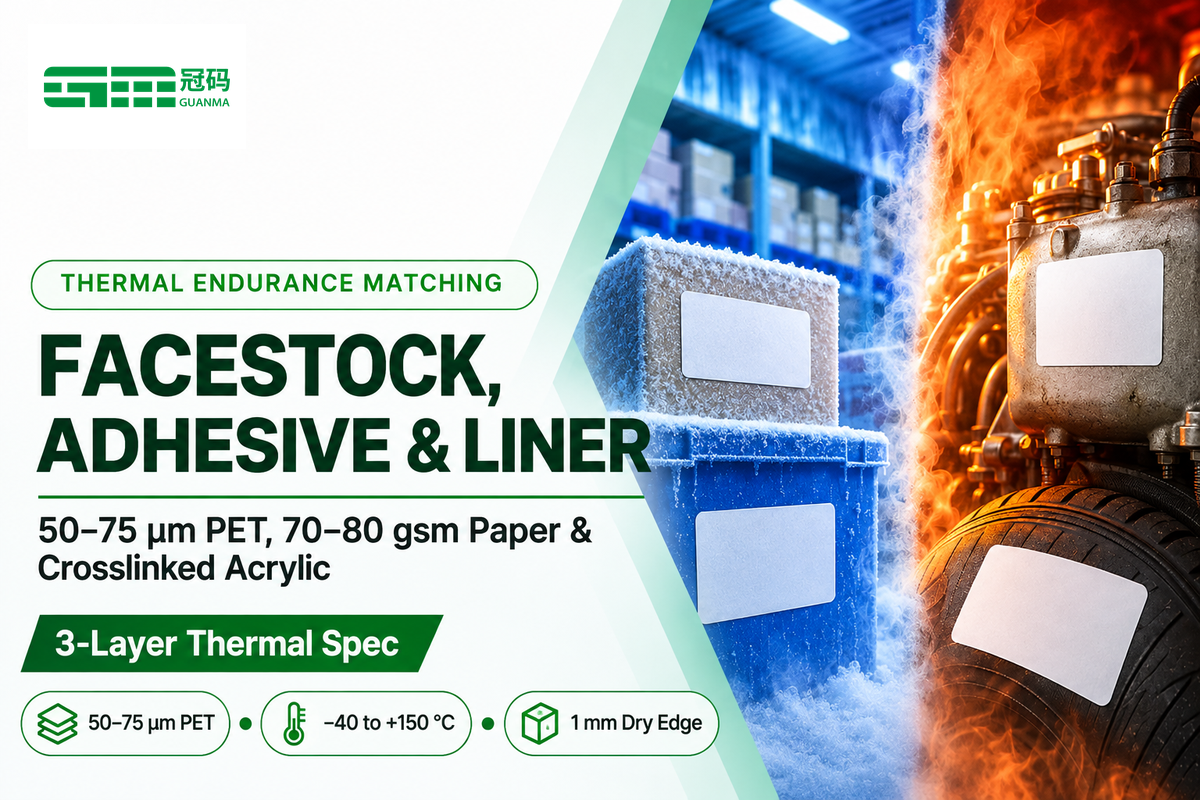
High-temperature dry toner fusers require dimensionally stable 50–75 μm PET or 70–80 gsm laser paper bonded with crosslinked acrylic adhesive. Pair cut-sheet laser trays with 80–120 gsm lay-flat CCK or bond release backing, while tensioned web presses run 60 gsm (1.5–2.1 mil) glassine, 2.4 mil SCK, or PET release liners. Low-melt exceptions, such as Xeikon ICE, apply only to reduced-heat presses.
Material chemistry governs both thermal survival and toner bond. On paper grades such as Guanma’s semi-gloss coated paper label specifications (70–80 gsm), cellulose fibers tolerate fuser heat well, yet humidity swings still bend the sheet. Review our guide on diagnosing release liner curl and humidity imbalance for the exact moisture mechanics. Bare polyester film repels molten powder. USPTO Patent US4942410A and Patent CA2016046C describe polymeric binders with particulate fillers that tune surface conductivity and anchor fused toner.
Can You Print BOPP or Vinyl Labels on a Dry Toner Printer?
No on standard office laser printers with high-heat roller fusers, and yes only on qualified roll-fed or low-melt presses using heat-stabilized grades. Standard 40-60 μm BOPP and conformable polyethylene (PE) distort rapidly at 200 °C. But Xeikon ICE toner uses a modified core resin that fuses at much lower temperatures at 1200 dpi.
That low-melt chemistry opens dry toner printing to PE conformables and heat-sensitive films. Avery Dennison’s dry toner portfolio likewise lists pre-qualified PP and PE grades mapped to Xeikon ICE and Konica Minolta presses.
Adhesive chemistry and sheet borders protect rollers just as much as the facestock. In Guanma’s manufacturing catalog, hot-melt rubber adhesives soften above 60 °C, whereas acrylic adhesives cover service temperatures from −40 °C to +150 °C. Brother specifies acrylic-based adhesive for high-temperature fuser stability. Lexmark adds two geometric rules: keep a 1 mm (0.04 in.) non-adhesive perimeter border on cut sheets, and never strip more than 3 mm (0.12 in.) along any edge.
Pair each layer with well-defined operating limits using the Fuser-Safe 3-Layer Selection Matrix here.
| Material Layer & Grade | Typical Spec / Range | Dry Toner Fit | Best Press / Application | Limitations / Avoid When |
|---|---|---|---|---|
| Uncoated Laser Paper (Facestock) | 70–80 gsm | Recommended | Cut-sheet office lasers, logistics, shipping | Avoid in wet, chemical, or outdoor washdown service |
| Semi-Gloss Coated Paper (Facestock) | 70–80 gsm | Conditional | Retail product labels on web-fed toner presses | Avoid humid unconditioned stock; sealed gloss blisters at 215 °C |
| Heat-Stabilized PET Film (Facestock) | 50–75 μm + toner topcoat | Recommended | Industrial durability, asset tags, chemical drums | Avoid untreated bare PET; toner flakes without receptive topcoat |
| Heat-Stabilized PP / BOPP (Facestock) | 60–85 μm PP or 40–60 μm BOPP + toner topcoat | Conditional | Roll-fed digital presses (AccurioLabel, Xeikon) | Avoid on 200–225 °C cut-sheet fusers unless OEM-qualified |
| Conformable PE Film (Facestock) | Low-modulus film | Conditional (Low-Melt Only) | Squeeze bottles on Xeikon ICE low-melt toner | Never run on standard 200–225 °C roller fuser printers |
| Crosslinked Acrylic PSA (Adhesive) | −40 °C to +150 °C service; 225 °C nip rated | Recommended | All sheet-fed laser and roll-fed dry toner runs | Lower initial cold tack on rough corrugated cartons vs rubber |
| Hot-Melt Rubber PSA (Adhesive) | Softens >60 °C | Not Recommended | Not applicable for heated dry toner fusers | Avoid in all heated fuser paths; oozes and fouls rollers |
| Porous Bond / CCK Kraft (Liner) | 80–120 gsm stiff lay-flat sheet backing | Recommended (Sheets) | Desktop and 50+ ppm cut-sheet laser printers | Too bulky and opaque for high-speed optical-sensor roll dispensing |
| Glassine / SCK / PET (Liner) | 60 gsm (1.5–2.1 mil) glassine; 2.4 mil SCK; PET | Recommended (Rolls) | Roll-fed digital presses and auto-apply lines | Lexmark advises against using slick supercalendered liners designed for 50+ ppm presses on cut-sheet lasers |
Dry Toner vs Inkjet and Thermal Label Stock Compatibility
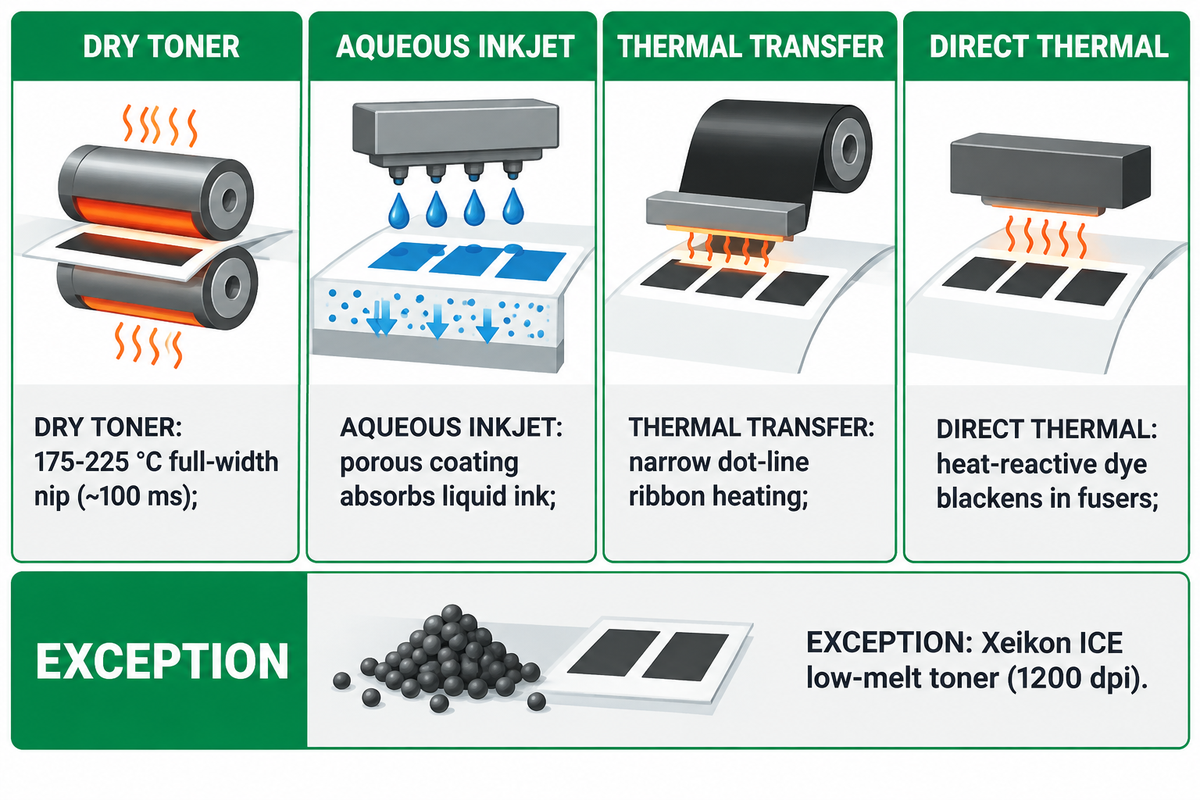
Dry toner label stocks are not interchangeable with aqueous inkjet or direct thermal label materials because their topcoats conflict. Dry toner needs a static-controlled flat surface to hold melted resin while under full-web heat. Aqueous inkjet needs a porous coating to absorb liquid ink at room temperature.
Direct thermal paper has a heat-reactive dye layer that changes to black in an ordinary laser fuser.
Many buyers treat generic “digital” stock as universal across every type of printer. Feeding aqueous inkjet stock built for Epson ColorWorks printers into a hot dry toner machine softens the porous coat and sheds dust. Printing liquid ink onto sealed laser polyester causes pooling and slow drying. Review our breakdown of water-based and UV inkjet label topcoat requirements and Label & Narrow Web’s inkjet vs. toner comparison for the coating differences.
Thermal printers follow a separate heat model. Zebra explains that direct thermal labels remain chemically active after imaging and darken whenever exposed to heat. Thermal transfer labels, such as rolls run on an industrial Zebra ZT411 with wax or resin ribbon, heat only a narrow dot line rather than the full web. UL’s PGJI2 secondary printing category likewise evaluates laser and thermal transfer inks separately.
| Print Process | Imaging Mechanism | Topcoat Requirement | Web Heat Exposure | Cross-Process Risk in Standard Dry Toner |
|---|---|---|---|---|
| Dry Toner (Laser / LED) | Electrostatic powder + heated nip | Controlled resistivity; toner anchorage | 175–225 °C full-width (~100 ms) | Target process (low-melt Xeikon ICE reduces fuser heat) |
| Aqueous Inkjet (e.g., Epson) | Liquid pigment or dye droplets | Porous ink-absorbing layer | Ambient to mild drying | Coating blisters or sheds dust; adhesive often non-fuser-rated |
| Thermal Transfer (e.g., Zebra ZT411) | Printhead melts ribbon onto face | Smooth ribbon-receptive matte or gloss | Localized dot-line heating only | Lacks lay-flat sheet liners and 225 °C acrylic ooze protection |
| Direct Thermal | Printhead activates heat-sensitive dye | Chemically active thermal coating | Localized printhead heating | Turns black in standard fusers (Xeikon ICE low-melt is exception) |
Process Boundary Warning: Don’t introduce direct thermal labels into a normal roller-fuser laser printer. The heat-reactive layer blackens on contact, and only low-melt presses such as Xeikon ICE qualify direct thermal stocks.
Sheet-Fed Laser Printer vs Roll-Fed Dry Toner Press Compatibility
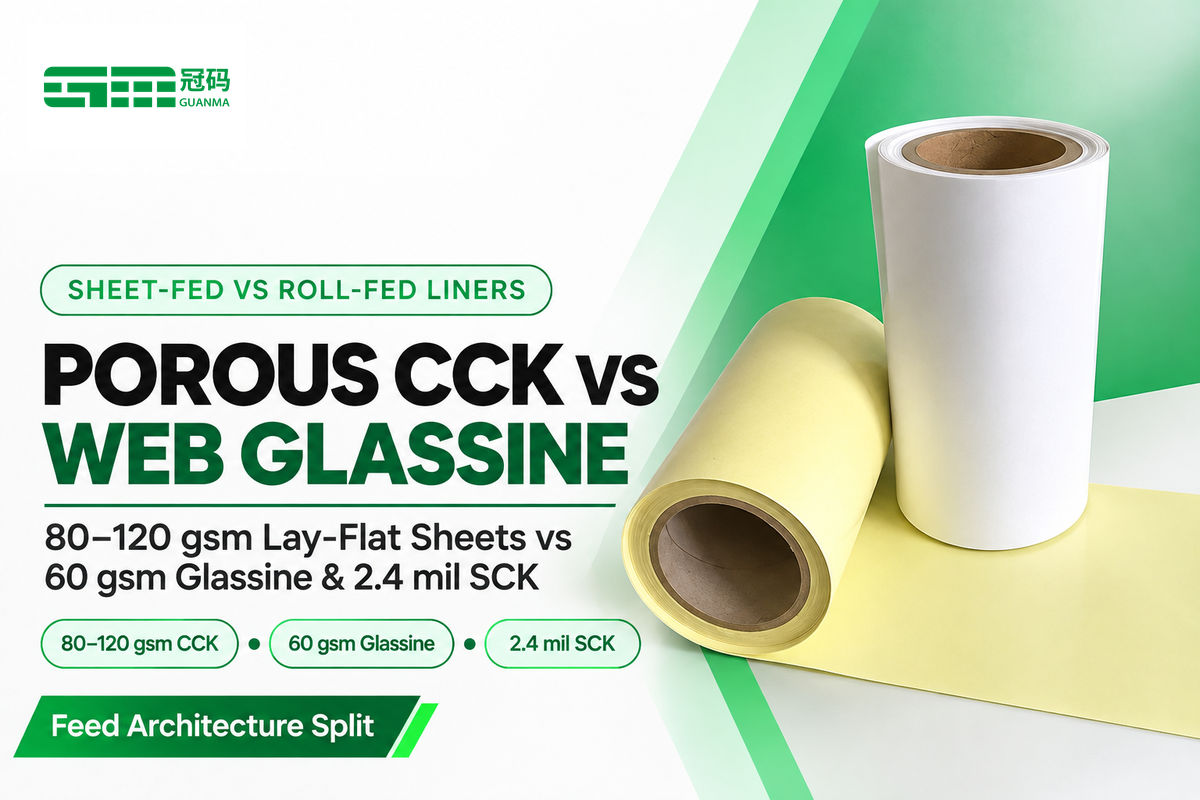
Cut-sheet laser printers need porous lay-flat backing, straight rear-exit paper paths, and a 1 mm dry border, while roll-fed digital presses run thin glassine, SCK, or film liners under web tension. Lexmark advises against using slick supercalendered backings on 50 ppm or faster cut-sheet laser printers, favoring porous bond or CCK; roll presses instead need tension control and matched rotary die clearance.
This mechanical split resolves conflicting liner advice across converting markets. Label & Narrow Web reports that paper makes up 87% of release liners worldwide. CCK stays flat for cut-sheet laser labels, 2.4 mil SCK leads North American roll converting, and thinner glassine dominates European and Asian lines. On the press side, Konica Minolta Europe reports over 1,700 global AccurioLabel toner press installations as Smithers forecasts global digital label output to double from 5.6 billion to 11.2 billion square meters between 2024 and 2030. Office Canon or HP desktop laser units require cut sheets on stiff lay-flat bond or CCK liners, because tight desktop feed turns stress backing far more than a roll press. Each machine’s chassis model label lists the maximum sheet thickness supported through its straight manual feed path.
“Paper will dissipate the heat in the Fuser, so it is absolutely critical that the correct paper tray attributes are used, based on size, weight, and type of paper stock in the paper tray. Incorrect settings can cause poor fusing, allowing the Toner to rub off or smear.”
How Do Printer Media Weight Settings Affect Dry Toner Adhesion?
Selecting the Heavy, Thick, or Labels media profile raises fuser heat or slows feed velocity so multi-layer label stock fuses cleanly. Wrong tray settings hurt print quality immediately because thick backing drains heat out of the fuser nip. On Xerox 700i/770 presses, media selection shifts fuser temperature from 175 °C up to 215 °C. Brother’s instructions similarly tell operators to pick Thick Paper or Thicker Paper whenever smudging appears.
Shop-floor reports confirm this exact fix. In an operator thread on Reddit r/printers, people observed dry toner scratch off sticker sheets on plain-paper mode. Changing a different printer to its heavy label profile raised the fixing energy and prevented the flaking.
For two-pass jobs across two machines, Xerox KB0324187 gives one strict rule: run the higher-temperature fuser first and the cooler unit second.
| Mechanical Parameter | Cut-Sheet Laser Printer (Canon / HP / Brother / Xerox) | Roll-Fed Dry Toner Press (Konica Minolta / Xeikon / Afinia LT5C) |
|---|---|---|
| Preferred Liner | Porous lay-flat bond or 80–120 gsm CCK (avoid 50+ ppm supercalendered liners) | 60 gsm (1.5–2.1 mil) glassine, 2.4 mil SCK, or PET liner |
| Format & Core Spec | Full flat sheets; 1 mm dry border (3 mm max strip) | Continuous web or die-cut roll; 3 in. (76 mm) core / 8 in. OD on LT5C |
| Feed Path & Tension | Manual tray + open rear cover straight path; single pass only | Closed-loop unwind/rewind web tension control |
| Driver & Print Control | Thick / Label media setting; monitor high-coverage page yield | Substrate profile matched to press speed (23.4–39.9 m/min) |
| Registration Sensing | Mechanical leading-edge sheet guide | Optical gap sensor (translucent glassine) or black-mark sensor |
How to Qualify Dry Toner Label Stock Before Full Production
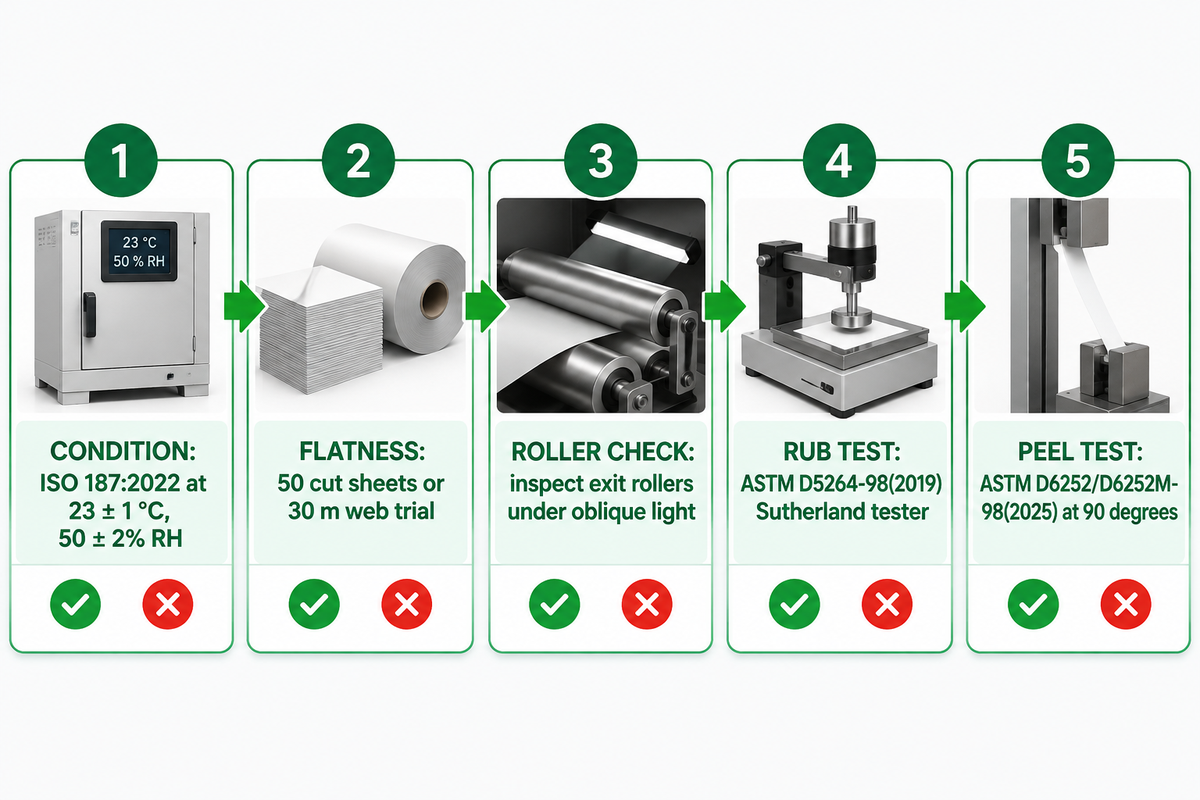
Qualify every candidate dry toner stock across five sequential checks before releasing a production order. Condition paper stocks at (23 ± 1) °C and (50 ± 2) % RH per ISO 187:2022. Verify continuous curl and roller cleanliness, test toner abrasion per ASTM D5264-98(2019), and check 90-degree peel per ASTM D6252/D6252M-98(2025). Printing five sheets checks feed clearance only, not thermal endurance.
Run this 5-Check Press Trial Qualification Scorecard on every new laminate:
- Check 1 (ISO 187:2022 Conditioning): Keep cartons sealed until they match pressroom temperature, then condition paper stocks at (23 ± 1) °C and (50 ± 2) % RH. Follow structured pressroom label stock acclimatization procedures before loading the tray.
- Check 2 (Continuous Fuser-Pass Flatness): Run 50 consecutive cut sheets or a 30-meter web trial with heavy solid-color blocks and 6 pt text. Measure exit curl at the end of each run and again after 30 minutes of cooling.
- Check 3 (Edge-Bleed & Roller Inspection): Stop the machine right after the trial and inspect exit rollers and die-cut gaps under oblique light. Reject any laminate showing tacky residue, stringers, or lifted corners.
- Check 4, ASTM D5264-98(2019) Rub Resistance: Test solid-tone printed blocks on a Sutherland Rub Tester using standardized weighted receptor pads. Compare dry rub transfer before and after stepping up the media-weight profile.
- Check 5 (Post-Fusing ASTM D6252/D6252M-98(2025) Peel): Apply both unprinted control labels and fuser-passed labels to steel or your target packaging surface. Respect proper pressure-sensitive adhesive dwell time before peel testing, then pull at 90 degrees to verify acrylic bond retention.
Worked Example, Fuser Nip Dwell Time Reference: Assumed inputs use nip contact lengths L of 20 mm and 40 mm. Tested web speeds v cover 15.0 m/min (250 mm/s), 23.4 m/min (390 mm/s, AccurioLabel 230 max), and 39.9 m/min (665 mm/s, AccurioLabel 400 CMYK max). Transit time equals t = L ÷ v × 1,000 ms.
| Assumed Web Speed (v) | Speed in mm/s | Dwell at L = 20 mm | Dwell at L = 40 mm | Comparison vs. 100 ms OEM Benchmark |
|---|---|---|---|---|
| 15.0 m/min (heavy media mode) | 250 mm/s | 80 ms | 160 ms | 160 ms exceeds 100 ms Brother/Lexmark window |
| 23.4 m/min (AccurioLabel 230 max) | 390 mm/s | 51 ms | 103 ms | Matches 100 ms OEM reference closely at 40 mm contact |
| 39.9 m/min (AccurioLabel 400 CMYK) | 665 mm/s | 30 ms | 60 ms | Shorter thermal dwell; requires responsive toner topcoat |
For these inputs a reduction of press speed from 39.9 m/min to 15.0 m/min gives an increase in nip dwell of 2.66× (from 60 ms to 160 ms at a 40 mm nip). Fuser roller temperature (200–225 °C on standard laser units, or 175–215 °C on Xerox 700i/770 engines) and liner heat capacity also govern fusing alongside nip dwell time.
Post-Print Overlaminating, Die-Cutting, and Industrial Durability Boundaries
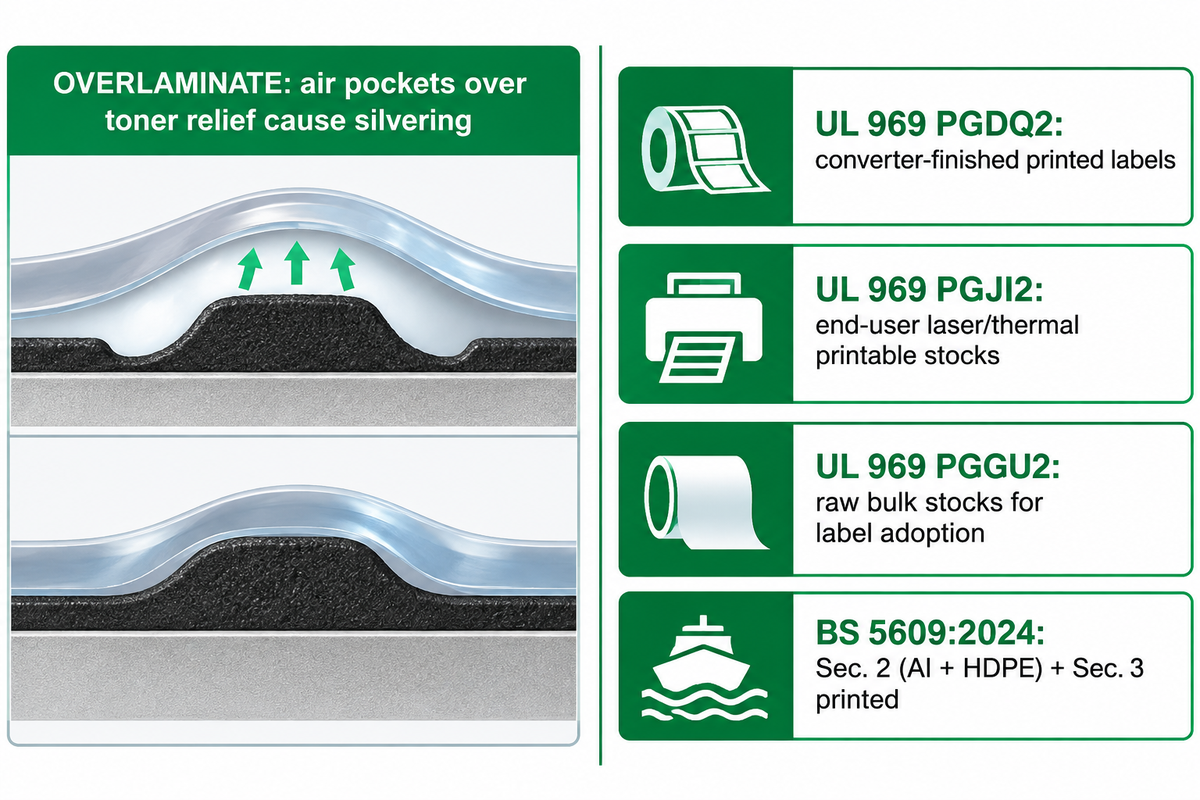
Finished dry toner label durability often breaks down after printing, when overlaminates silver over textured toner or buyers confuse blank-stock certificates or a compatibility list with full system approval. Under UL Solutions’ Marking and Labeling Systems Program (ANSI/UL 969), finished printed labels use PGDQ2, end-user laser-printable stocks use PGJI2, raw materials use PGGU2, and limited-use listings use PGIS2. For marine GHS chemical drums, BS 5609:2024 took effect on 31 December 2024, while the 1986 edition withdraws on 31 December 2030. The 2024 revision decouples Section 2 stock approval from Section 3 printed durability and adds HDPE alongside aluminum as a mandatory Section 2 test panel.
“Additional printing inks for which the labels have been found compatible are specified in the recognition, and only those inks are considered acceptable.”
Two finishing traps affect harsh industrial labels. First, Remington Laminations documents that general-purpose overlaminates trap micro-air pockets or bubble over dry toner. Fused toner creates raised surface relief, and older oil-fusing engines leave silicone fuser oil that blocks adhesive wet-out. Pair oil-free dry toner presses with high-wet-out acrylic overlaminates for tear and chemical abrasion resistance. Second, rotary die-cutting requires exact liner caliper matching between thin glassine and thicker SCK rolls. Without matched die clearance or adjustable anvils, thin glassine suffers liner strikes. Review our guides on glassine release liner caliper tolerance for rotary die-cutting and durable waterproof film label materials for industrial printing before ordering dies.
| Standard / Category | What It Actually Evaluates | Dry Toner Qualification Boundary |
|---|---|---|
| UL 969 — PGDQ2 (Ed. 6-2025) | Converter-finished die-cut printed labels | Not evaluated for secondary laser printing by the end-use factory |
| UL 969 — PGJI2 | Blank or preprinted stock for end-user laser/thermal printing | Only toner or ribbon formulations named in the UL recognition are accepted |
| UL 969 — PGGU2 | Bulk raw label stocks, adhesives, and overlaminates | Used by converters for UL Label Adoption into PGDQ2 or PGJI2 |
| UL Marking & Labeling — PGIS2 (Limited Use) | Limited-use labels tied to one specific UL product standard | Requirements can be less stringent or different than full ANSI/UL 969 |
| BS 5609:2024 Sec. 2 vs. Sec. 3 | Sec. 2: unprinted stock marine immersion (aluminum + HDPE); Sec. 3: printed durability | Effective 31 Dec 2024 (1986 withdraws 31 Dec 2030); GHS drums need both Sec. 2 and Sec. 3 |
Dry Toner Label Stock Costs, MOQs, and Lead Times: Rolls vs Sheets
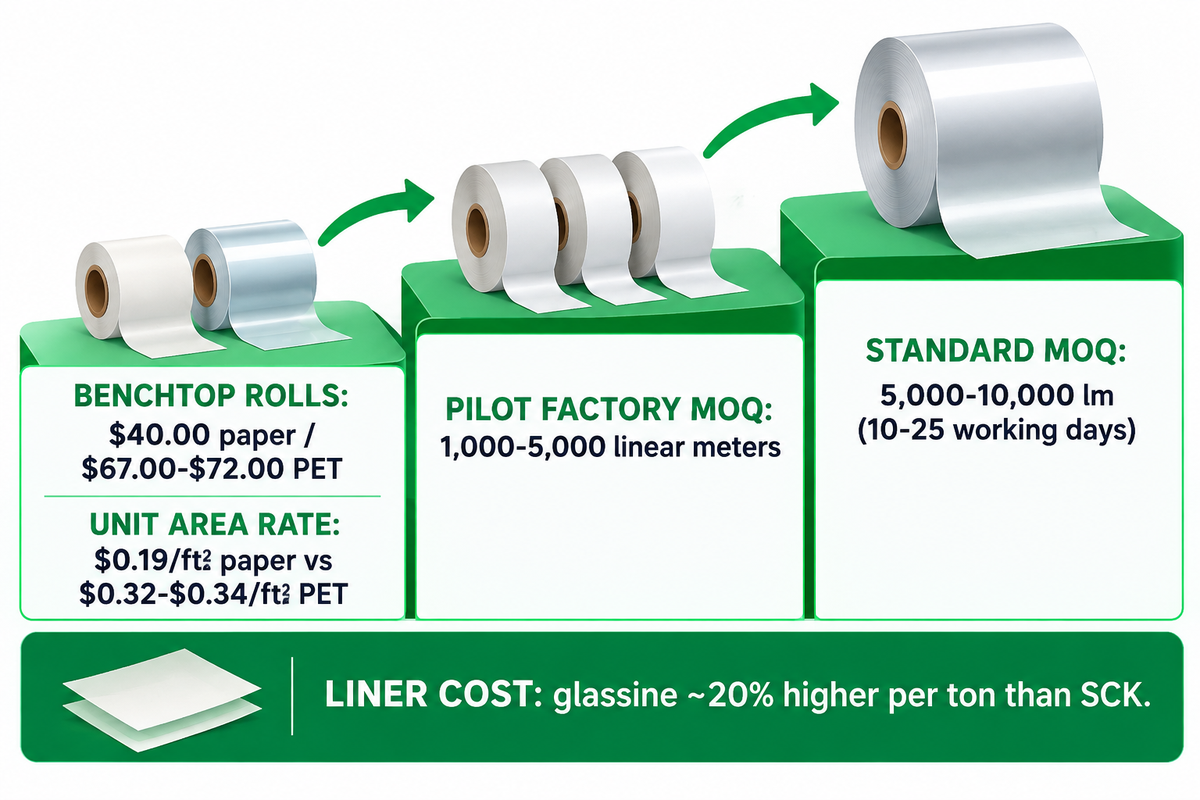
Benchtop dry toner continuous rolls list publicly at $40.00 (paper) and $67.00–$72.00 (polyester) per 5.1 in. × 500 ft roll on OmegaBrand (November 2026). That equals $0.19/ft² for paper and $0.32–$0.34/ft² for polyester. Factory-direct slit rolls from Zhejiang Guanma Packaging Co., Ltd. start at 1,000–5,000 linear meters for pilot R&D runs. Standard factory MOQs run 5,000–10,000 linear meters with 10–25 working days production lead time, plus a free 12-combination sample pack shipped in 5 business days. Listed OmegaBrand LT5C roll prices reflect North American distributor retail listings rather than factory master-roll pricing, which is quoted per slit width and construction.
Release liner selection shifts raw roll cost as well. Label & Narrow Web notes that glassine typically costs about 20% more per ton than SCK. Extra remoisturizing and recalendering passes add mill cost. However, thinner glassine packs more linear meters onto the same 8 in. roll diameter, cutting roll-change downtime on busy lines.
When Do Continuous Dry Toner Rolls Become More Economical Than Laser Sheets?
Continuous dry toner rolls become more economical than laser sheets on recurring SKU runs or automated dispensing lines at listed benchtop rates of $0.19–$0.34/ft² (OmegaBrand, November 2026) and factory pilot volumes of 1,000–5,000 linear meters (Guanma). Rolls eliminate manual tray loading and sheet matrix waste. On OmegaBrand’s LT5C catalog, a 5.1 in. × 500 ft continuous roll provides 5.1 ÷ 12 × 500 = 212.5 ft² of web: $40.00 ÷ 212.5 = $0.19/ft² (paper), $67.00 ÷ 212.5 = $0.32/ft² (clear PET), and $72.00 ÷ 212.5 = $0.34/ft² (glossy white PET). Pre-die-cut clear polyester rolls list at $115.00 per 1,000 labels at 3 in. × 4 in. ($0.115/label) and $150.00 per 700 labels at 4 in. × 6 in. ($0.214/label).
Worked Example, Distributor Roll vs. Pilot Factory Roll Scale: Suppose a converter runs 5,000 linear meters of 130 mm (5.1 in.) wide web per quarter. Multiplying 5,000 × 3.2808 gives 16,404 linear feet, or roughly 33 benchtop 500-ft rolls. At OmegaBrand’s $72.00 listed price for glossy white polyester, 33 distributor rolls total $2,376 before shipping. That exact 5,000-linear-meter volume already meets Guanma’s 1,000–5,000 linear meter pilot R&D MOQ for custom slit rolls.
| Supply Channel & Format | Unit Basis | Verified Benchmark / MOQ | Lead Time | Best Fit |
|---|---|---|---|---|
| Distributor Benchtop Toner Rolls (OmegaBrand LT5C, Nov 2026) | Per roll (3 in. core / 8 in. OD) | 1 roll listed on OmegaBrand: $40.00 paper / $67.00–$72.00 PET (5.1 in. × 500 ft) | Stock catalog dispatch | Short-run in-house brand printing and rapid trials |
| Factory Pilot Slit Rolls (Guanma) | Linear meters (25–1,300 mm width) | 1,000–5,000 lm pilot R&D MOQ (quote-based) | 5 business days sample pack; 10–25 working days batch | Converter press qualification and custom adhesive builds |
| Factory Production Master / Slit Rolls (Guanma) | Linear meters (25–1,300 mm width) | 5,000–10,000 lm standard MOQ (quote-based) | 10–25 working days | Ongoing narrow-web converting and multi-SKU supply |
| Release Liner Upgrade (Glassine vs. SCK) | Per ton raw liner paper | Glassine ~20% higher per ton than 2.4 mil SCK (Label & Narrow Web) | Quote-based by region | High-speed dispensing needing thinner 1.5–2.1 mil rolls |
Press-Qualified Dry Toner Suppliers, Compatible Stock Lists, and Buyer RFQ Guide
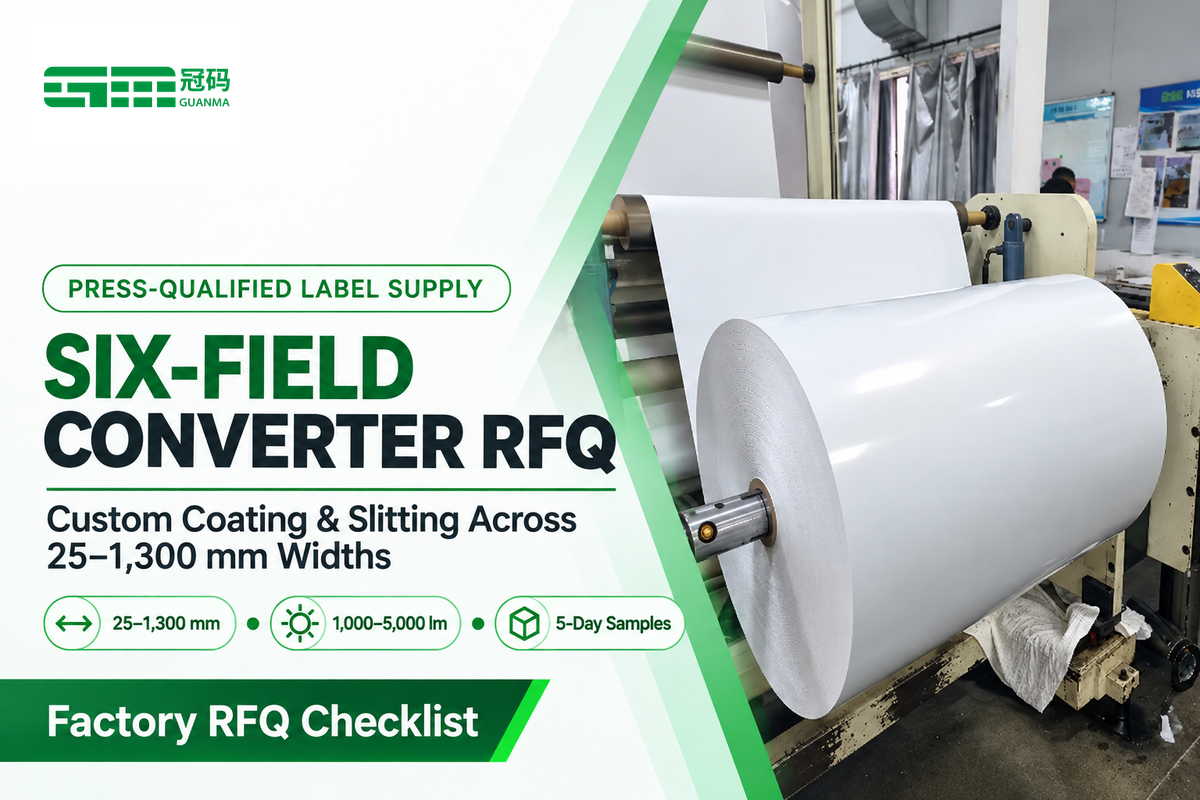
Source compatible dry toner label stock for Konica Minolta AccurioLabel, Xeikon, or LED roll printers through two routes: check model-level OEM directories from global suppliers, or send a six-field technical RFQ to an integrated coater. Smithers values the global printed labels market at $44.5 billion in 2026, with pressure-sensitive labels exceeding 60% of total value. Market value is forecast to reach $55.1 billion by 2031 as digital printing climbs to 27.6% of total share. Rapid topcoat and liner updates make structured label material change control and requalification standard practice for industrial converters.
Match dry toner label stock available on the market to the exact press model because fusing windows range from low-melt Xeikon ICE platforms to 175–215 °C on Xerox 700i/770 and higher roller-fuser units. International suppliers such as Avery Dennison Label and Packaging Materials (LPM) and UPM Adhesive Materials publish dry toner compatibility lists for Konica Minolta AccurioLabel and Xeikon presses. Reveal the dedicated page for your printer model in the manufacturer’s catalogue to find the correct pre-qualified paper or film code.
Re-qualify any replaced facestock, adhesive, or liner across a 50-sheet or 30-meter fuser trial following ISO 187:2022 conditioning.
Operating since 2010 and established in 2019 with a full coating-and-converting plant in Haiyan, Zhejiang, China, Zhejiang Guanma Packaging Co., Ltd. coats and slits paper (70–80 gsm), PET (50–75 μm), PP (60–85 μm), and BOPP (40–60 μm) laminates across 25–1,300 mm widths. Available in-house adhesive systems cover water-based acrylic, removable, rubber-based, hot-melt, high/low-temperature, and UV-cure grades, with grade-specific compliance documentation supplied per technical datasheet. Guanma supplies trial rolls and custom-slit combinations so converters can confirm exact grade performance and technical datasheets on their target dry toner press.
Copy this six-field RFQ checklist in your supplier quote request to allow converters to balance fuser heat, liner caliper, and qualification testing on the first sample:
RFQ checklist — specify these six technical parameters on every dry toner substrate inquiry:
| Parameter | Recommended range | Why it matters | How to verify |
|---|---|---|---|
| Exact Printer Model & Fuser Window | 175–225 °C / ~100 ms (or low-melt Xeikon ICE) | Sets minimum heat resistance for facestock, topcoat, and adhesive | Match against press OEM manual and supplier grade TDS |
| Facestock & Topcoat Chemistry | 50–75 μm PET or 70–80 gsm laser paper; solvent-based toner topcoat | Prevents film shrinkage and improves toner anchorage on heavy liners | Run ASTM D5264-98(2019) Sutherland rub test after fusing |
| Adhesive System & Edge Geometry | Crosslinked acrylic (−40 to +150 °C service); 1 mm dry border on sheets | Stops adhesive ooze at 25 psi nip pressure and prevents roller jams | Inspect rollers after 50 sheets or 30 m web + ASTM D6252 peel |
| Release Liner & Roll Dimensions | 80–120 gsm CCK (sheets) or 60 gsm (1.5–2.1 mil) glassine / 2.4 mil SCK / PET; 25–1,300 mm width, 3 in. core | Prevents feed slip on cut-sheet lasers and die-strike on rotary presses | Check caliper tolerance and sensor opacity before full slitting |
| Overlaminate & Certification Scope | UL 969 PGJI2/PGDQ2 or BS 5609:2024 Sec. 2 + Sec. 3 (aluminum/HDPE) | Separates blank stock ratings from legally recognized printed systems | Verify UL Product iQ CCN and BS 5609 Sec. 3 toner-stock report |
| Sample Pack & Pilot MOQ Plan | 5-day trial pack (12 combos); 1,000–5,000 lm pilot MOQ; 10–25 working days | Limits tooling and scrap risk before committing to 5,000–10,000 lm runs | Sign off on 5-Check Scorecard before releasing production PO |
About This Analysis
This technical guide is published by Zhejiang Guanma Packaging Co., Ltd., a manufacturer of self-adhesive label stocks, films, and release liners. Every OEM fuser limit, standard edition, and distributor listing cited here comes from published manuals, standards bodies, and market reports so converters can benchmark any supplier objectively.
As reviewed by the technical team of Zhejiang Guanma Packaging Co., Ltd.
Need Custom-Coated Label Stock Samples for Press Qualification?
Coordinate with our engineering team and send us the specification page for your printer model, fuser temperature profile, facestock, and liner caliper. Check out our self-adhesive paper and film label stock program or request a free multi-spec trial pack from Guanma. Make sure your product maintains its flatness, rub resistance, and peel retention on your press before moving to production rolls.
Frequently Asked Questions
Q: Does dry toner label stock compatibility depend on the exact printer model?
Yes, each exact printer model sets its own fuser temperature, nip pressure, and paper-path geometry for dry toner label stock compatibility. A polyester or coated paper construction that feeds cleanly on a straight-path Konica Minolta AccurioLabel press can curl, jam, or lose toner adhesion inside a tight-turn desktop laser printer.
Q: Can you use direct thermal or thermal transfer labels in a dry toner laser printer?
No, direct thermal labels should never enter a standard dry toner laser printer. They have a thermosensitive coating that becomes all black on the heated fuser nip which will adhere to the internal rollers and cause problems. Normal thermal transfer stocks don’t contain fuser rated acrylic adhesives or lay-flat sheet liners unless the seller specifically rates that grade for laser fusing.
Q: What adhesive chemistry prevents edge bleed on dry toner fuser rollers?
A high-shear, crosslinked acrylic pressure-sensitive adhesive prevents edge bleed under high fuser heat and clamping roller pressure. Conventional hot-melt rubber adhesives soften above 60 °C and liquefy under heated fuser nip pressure. That softened glue squeezes past die-cut label edges during fusing, contaminates fuser sleeves and pickup rollers, and triggers recurring feed jams.
Q: What is a dry toner label stock compatibility chart used for?
A compatibility chart places particular facestock, adhesive and liner codes into a chart against presses like Xeikon, Konica Minolta AccurioLabel and LED roll printers that have been tested. Buyers refer to it to see what grades are approved prior to requesting a trial roll.
Q: How should laser label stock be conditioned before printing to prevent liner curl?
Once sealed cartons reach pressroom temperature, condition paper-based stocks at (23 ± 1) °C and (50 ± 2) % RH per ISO 187:2022. Cellulose release liners absorb or lose moisture far faster than synthetic facestocks, creating bimetallic curl under dry winter air or sudden fuser heat. Sealed acclimatization plus stable humidity keeps sheets flat and cuts fuser feed jams.
Q: Why does overlaminate film silver over dry toner printed labels?
Silvering happens when air pockets stay trapped between overlaminate adhesive and textured fused toner, or when silicone fuser oil blocks adhesive wet-out. Use oil-free presses and compliant acrylic laminate adhesives to avoid silvering.
Q: Is BS 5609 Section 2 approval enough for dry toner printed GHS chemical drum labels?
No, BS 5609 Section 2 certifies only the unprinted pressure-sensitive stock for marine immersion on aluminum and HDPE panels under the 2024 revision. It doesn’t certify printed text or pictograms. To ship compliant marine GHS chemical drums printed on a dry toner press, the full printed combination must pass BS 5609 Section 3.
That section tests abrasion, weathering, and legibility for the specific printer model, toner, facestock, and overlaminate.
References & Sources
- ISO 187:2022, Paper, Board and Pulps: Standard Atmosphere for Conditioning and Testing International Organization for Standardization (via iTeh Standards)
- ASTM D6252/D6252M-98(2025), Standard Test Method for Peel Adhesion of Pressure-Sensitive Label Stocks at a 90° Angle ASTM International (via iTeh Standards)
- ASTM D5264-98(2019), Standard Practice for Abrasion Resistance of Printed Materials by the Sutherland Rub Tester ASTM International
- Marking and Labeling Systems Program (ANSI/UL 969 PGDQ2, PGJI2, PGGU2, PGIS2) UL Solutions
- BS 5609: Understanding the 2024 Revisions Smithers
- Label Printing Market: Key Trends to 2031 Smithers
- USPTO Patent US4942410A, Toner-Receptive Coating for Electrophotographic Printing United States Patent and Trademark Office (Google Patents)
- Canadian Patent CA2016046C, Toner Adhesion-Enhancing Coating Canadian Intellectual Property Office (Google Patents)
- Why the North American Paper Market Rejects Glassine Label & Narrow Web
- Comparing Inkjet vs. Toner in Label Printing Label & Narrow Web