Get in Touch with Guanma

Water-Based vs UV Inkjet Label Stock: How to Match Receptive Topcoats, Film Substrates, and Press Curing

Selecting water based vs uv inkjet label stock comes down to how liquid droplets anchor on the facestock surface. Water-based inkjet systems jet an aqueous liquid vehicle of deionized water, humectants, and colorants. The aqueous vehicle can be absorbed by paper, drawn into a microporous coating, or taken up by a compatible swellable polymer layer. By contrast, UV inkjet presses jet reactive acrylate monomers or epoxide oligomers. These reactive liquids stay on top of a sealed surface. They crosslink into a solid film when exposed to uv light.
When loading a standard UV-primed polypropylene roll onto a desktop aqueous printer, a converter will see ink pooling and smearing. On the other hand, running an expensive microporous film on a UV press wastes coating budget and can cause brittle ink to crack. This engineering guide maps the topcoat chemistry, coat weights, and surface energy traps. It also provides examples of dose calculations for curing energy and establishes some rules for incoming roll qualification for label converters.
Key Engineering Takeaways for Label Converters
- Topcoat Weight Differential: Microporous silica/alumina inkjet-receptive coatings on BOPP/PET film employ dry coat weights of 10-25 g/m². The required coat weight is determined by the absorption capacity of the coating and the desired ink laydown. WIPO Patent WO2024038005A1 states that in offline inkjet coatings, conventional coatings typically require at least 15 g/m² dry. On the other hand, Michelman JetPrime UV 100 specifies 1 to 2 g/m² dry.
- The Surface-Energy vs. Polarity Trap Rule: Under ASTM D2578-23 Clause 5.2, wetting tension in and of itself is not a completely acceptable measure of ink, coating, or adhesive adhesion. Laboratory tests on nitrogen-plasma-treated BOPP reading 42 to 46 mN/m still failed UV ink adhesion when surface polarity mismatched.
- Certification Scope Boundaries: Buying Section 2 certified blanks from BS 5609:2024 doesn’t purchase a certified chemical drum label. Converters still must successfully complete BS 5609 testing for abrasion and permanence with their printer and ink set.
- Migration & Set-Off Control: Conventional non-radiation-curable aqueous inks don’t require photoinitiators, but other ink ingredients can still migrate or set off. This simplifies the evaluation of primary container migration. For food-contact materials covered by Regulation (EC) No 2023/2006, printing and handling must control the transfer by substrate and set-off to the food contact side, in such a way that ingredients don’t reach the food at levels that endanger health or unacceptably alter the taste or smell of the food.
Water-Based vs UV Inkjet Label Stock at a Glance: Core Mechanism and Selection Matrix
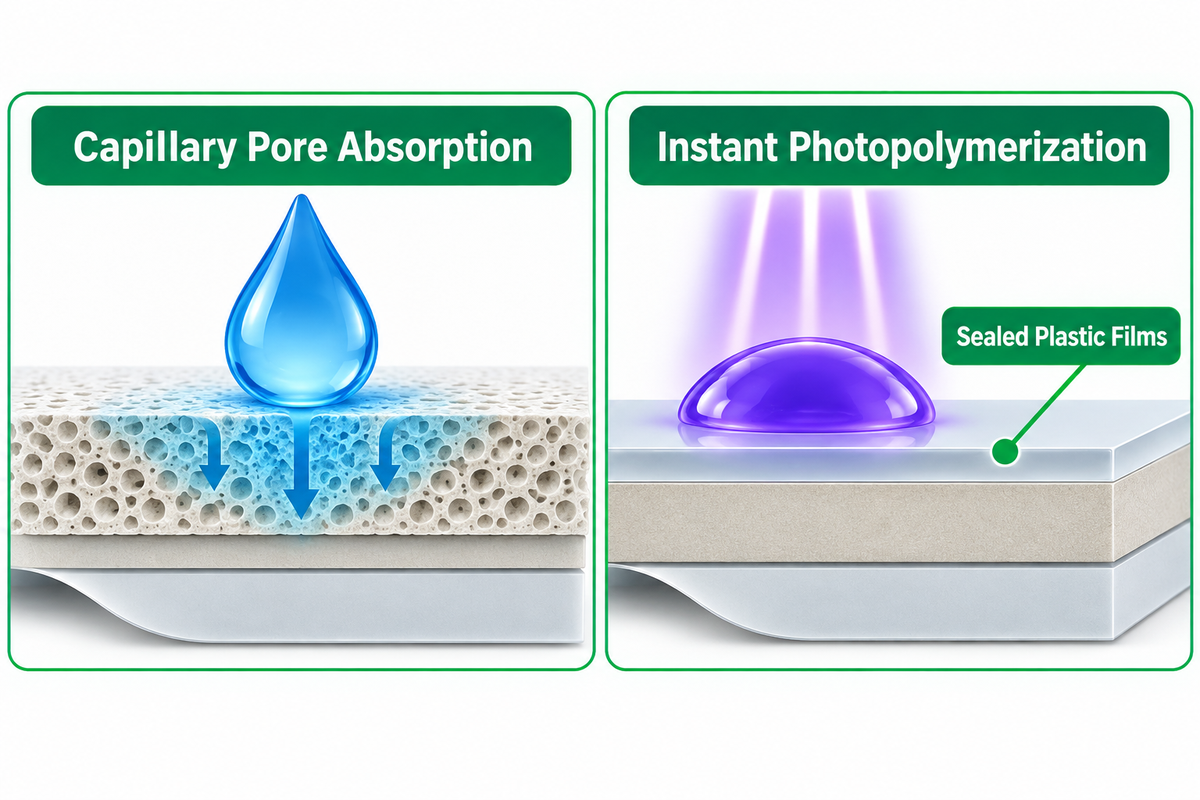
Water-based inkjet label stock on synthetic film uses a hydrophilic microporous or swellable topcoat to absorb the liquid carrier. On the other hand, UV inkjet label stock cures on corona-treated or chemically primed substrates. As per Sabreen dyne testing guidelines, UV-curable inks have a 30 to 40 dyne/cm surface tension and recommend a substrate of 40 to 50 dyne/cm. On the other hand, ASTM D2578-23 wetting tension testing, examines the wetting tension of polyolefin, and Label Academy digital printing substrate selection guidelines outline topcoat compatibility.
When choosing between water-based and uv label constructions, engineers must evaluate the ink vehicle alongside the substrate porosity. In digital label printing, water and uv platforms encompass different press architectures. Each brand owner and converter joins the printing solution to the container surface, ink chemistry and curing hardware. Roll-fed desktop and mid-web aqueous printers use capillary pore volumes to immobilize colorants within milliseconds. In contrast, narrow web UV inkjet presses use ultraviolet pinning and main curing lamps to polymerize ink droplets on sealed plastic films.
Compared to solvent inks or solvent-based wide-format systems, both water-based and uv inks reduce workplace volatile organic compound emissions. However, their substrate compatibility rules are opposites. You can check out Guanma’s full range of pressure-sensitive film constructions for production trials. That catalog shows how base films are made for each press family.
| Engineering Parameter | Water-Based Inkjet Label Stock | UV-Curable Inkjet Label Stock |
|---|---|---|
| Liquid Carrier & Solids Fraction | Aqueous liquid carrier (deionized water + humectants, surfactants, binder resin, and dissolved dye or dispersed pigment) | Reactive acrylate monomers or epoxide oligomers, pigments, and photoinitiators (solventless / zero water carrier) |
| Primary Fixation Mechanism | Capillary pore absorption (microporous) or polymer chain swelling (swellable) followed by water evaporation | Instant photopolymerization (free-radical or cationic crosslinking) under UV light |
| Required Film Topcoat Chemistry | Offline microporous fumed silica/boehmite alumina or swellable PVA/PVP polymer | Corona treatment (40 to 50 dyne/cm target) or thin acrylic/urethane chemical primer |
| Typical Dry Coat Weight on Film | Conventional offline inkjet coatings generally need at least 15 g/m² dry to handle ink laydown (per WIPO Patent WO2024038005A1) | 1 to 2 g/m² dry for chemical primers (per Michelman JetPrime UV 100 technical data) |
| Inline Paper Primer Coat Weight | 2.5 to 5.0 g/m² wet (~0.5 to 1.0 g/m² dry at stated solids per Michelman JetPrime WB 1100 datasheet) | 1 to 2 g/m² dry sealing primer to prevent monomer sink-in on uncoated paper |
| Bare Plastic Film Compatibility | Incompatible; ink beads up and washes off even after 6 hours of drying | Compatible on properly corona-treated or flame-treated BOPP, PET, and PE films |
| Unlaminated Rub & Solvent Resistance | Depends on pigment/resin and topcoat pairing; qualify an overlaminate or UV varnish (per EP3738782A1) when alcohol or abrasion resistance is required | High native resistance to water, condensation, mild acids, and routine distribution abrasion |
| Primary Packaging Migration Profile | Conventional aqueous inks generally contain no photoinitiators or reactive monomers (per Arrow Systems GMP analysis) | Requires low-migration ink formulation and verified cure dose to prevent monomer migration |
Can the same label facestock run on water-based and UV inkjet presses, and what should I test?
Standard UV-treated or corona-treated BOPP can’t run on water-based inkjet printers. The surface is non-porous and lacks capillary pore volume. Hence, aqueous droplets, when printed on such a surface, coalesce to larger drops, puddle, and ultimately, wipe off completely. Running UV-curable ink on microporous aqueous label stock wastes expensive microporous coating. It also risks brittle ink cracking as liquid monomer sinks into silica pores before UV lamp exposure.
Two quick bench checks can screen an unidentified film roll; compatibility still requires printing and adhesion testing on the intended press. First, place a drop of deionized water on the print face: an open microporous aqueous coating rapidly wicks the droplet into the pore structure. Second, measure wetting tension per ASTM D2578-23 on non-absorbent UV films. Then print a solid black test swatch before running the 5-Gate Press Qualification Protocol.
How Inkjet-Receptive Topcoats Work: Microporous Silica vs Swellable Polymer vs UV Chemical Primers
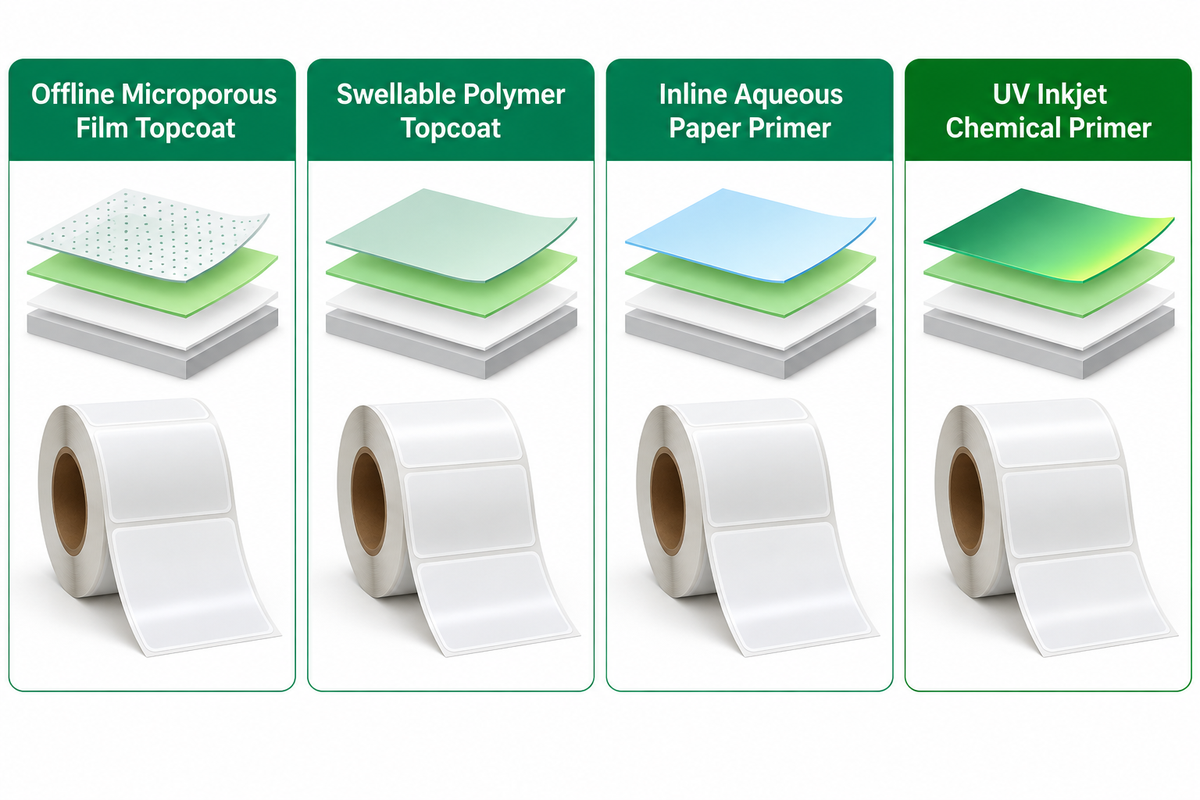
For synthetic films, an aqueous pigment ink requires a compatible microporous receptive coating, whereas, an aqueous dye ink can use a microporous or swellable coating. Bare polypropylene or polyester can’t absorb liquid water. In comparison, UV-curable inkjet ink cures on corona-treated or chemically primed substrates under sufficient UV dose. Matching topcoat architecture to type of ink and specific ink type prevents smudging and dot gain. It also stops intercoat delamination when using materials for inkjet converting.
As found in the Cabot Corporation data on ink-receptive coatings, fumed silica and alumina dispersions create an interconnected system of nanopores. These nanopores pull water away from the surface via capillary action. In the patent literature ( WIPO Patent WO2024038005A1), conventional inkjet coatings on non-absorbent substrates require a minimum of 15 g/m² of dry coat weight. This heavy coat weight is used to absorb the full aqueous ink laydown and is coated offline before printing.
Comparisons of coat weights must maintain the denominator as substrate and keep a dry-solids basis. An inline aqueous primer, for example, doesn’t need to store the entire liquid volume on absorbent paper substrates. Technical data for Michelman JetPrime WB 1100 and UV 100 primers illustrates this example on paper. JetPrime WB 1100 is specified at 2.5 to 5.0 g/m² wet on coated paper (roughly 0.5 to 1.0 g/m² dry based on its published solids range). Meanwhile, Michelman JetPrime UV 100 specifies 1 to 2 g/m² dry to improve UV inkjet holdout and adhesion. This thin dry layer is responsible for bonding the UV inkjet inks to films and papers.
Named Engineering Framework: Ink-to-Topcoat Fixation Crosswalk
Use the Ink-to-Topcoat Fixation Crosswalk below to match your printhead chemistry to the right receptive layer. Never equate a 1 g/m² paper primer or UV tie-coat with a 15 g/m² film reservoir coating. For related thermal constructions, see our guide on comparing top-coated versus uncoated label constructions for moisture exposure.
| Topcoat Architecture | Primary Chemistry | Dry Coat Weight Window | Fixation Physics & Drying Process | Compatible Ink Sub-Type |
|---|---|---|---|---|
| Offline Microporous Film Topcoat | Cationic fumed silica or boehmite alumina + PVA or cationic polyurethane binder (per WO2020046703A1) | At least 15 g/m² dry for conventional offline coatings handling full ink laydown (per WO2024038005A1) | Capillary pore wicking drains water in milliseconds; cationic mordant locks anionic pigment at the top surface | Aqueous pigment ink and aqueous dye ink on BOPP, PET, and PE films |
| Swellable Polymer Topcoat | Crosslinked polyvinyl alcohol (PVA), polyvinylpyrrolidone (PVP), or gelatin polymer matrix | Formulated by polymer film thickness to match dye ink uptake | Hydrophilic polymer chains swell to absorb water and molecular dyes; slower drying process than microporous silica | Primarily aqueous dye ink; pigment inks remain on the surface and require specific binder compatibility |
| Inline Aqueous Paper Primer | Cationic polymer primer (e.g., Michelman JetPrime WB 1100, pH 6.5–8.0, Brookfield viscosity 0–150 cps) | 2.5 to 5.0 g/m² wet (~0.5 to 1.0 g/m² dry on coated paper) | Precipitates pigment at the paper surface while paper fibers absorb the water carrier | High-speed single-pass water-based pigment and dye inkjet on paper |
| UV Inkjet Chemical Primer | Modified acrylic, polyurethane, or chlorinated polyolefin tie-coat (e.g., JetPrime UV 100, pH 7.5–9.5, ≤500 cps) | 1 to 2 g/m² dry (per Michelman JetPrime UV 100 datasheet) | Provides dense polar functional groups that co-react or interpenetrate with UV acrylate oligomers during curing | Free-radical and cationic UV-curable / UV-LED inkjet inks |
The Ink-to-Topcoat Fixation Crosswalk shows that surface texture and optical gloss are very dependent on silica loading. Microporous coatings disclosed in WIPO Patent WO2020046703A1 use cationic fumed silica with cationic polyurethanes and provide an instant touch-dry performance with a high print quality. With high loading of silica, there’s a slight increase in matte haze with clear films.
Matching Sub-Chemistries: Aqueous Dye vs Pigment and Free-Radical vs Cationic UV Curing
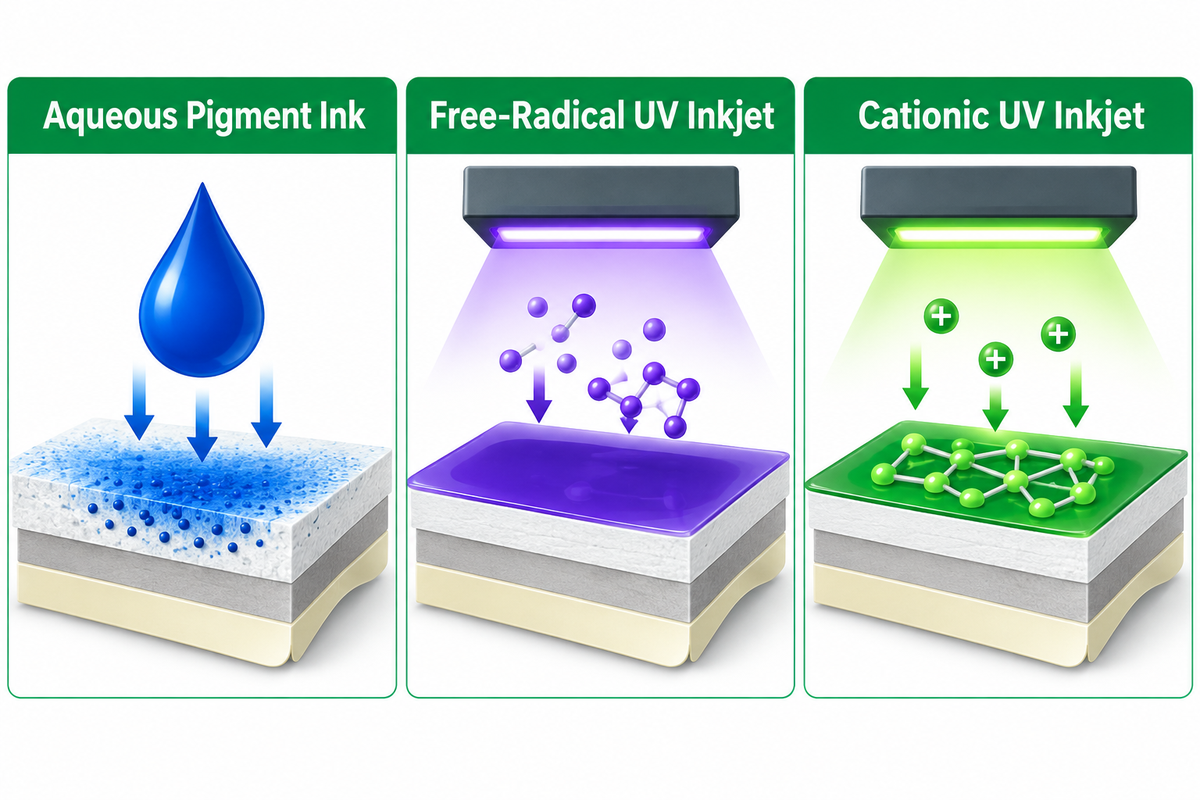
Matching labels only to “water” or “UV” isn’t enough. Within both printing technology and printing process, sub-chemistries determine pore throat sizing, lamp spectrum, and post-print curing kinetics. A mismatch between pigment particle diameter and topcoat porosity causes ink to sit on the surface and smudge days later.
What is the difference between dye-based and pigment-based water inkjet label stock requirements?
Dye-based aqueous inks rely on swellable polymers or microporous coatings to hold colorants. Suspension inks, such as pigment-based water inks, rely on microporous silica or alumina topcoats for rapid drainage of the carrier.
Dispersed pigment particles can’t diffuse into non-porous swellable polymer chains the way dissolved dyes can. Printing pigment-based ink onto an incompatible glossy coating leaves pigment on the surface, resulting in smudging after 48 hours. On the other hand, unlaminated dye prints on sticker stock can wash off with contact with water after 6 hours.
On the UV side, converters must separate free-radical acrylate UV inks from cationic epoxide UV inks. Additionally, they should either match mercury lamps or 385/395 nm LED-UV arrays:
- Free-radical UV inkjet inks cure via acrylate monomer chain polymerization under ultraviolet light for high-speed throughput. Decreased peak irradiance can result in surface inhibition by oxygen, causing incomplete cure, which can lead to shrinkage and curling in thin polyolefin films.
- Cationic UV inkjet inks cure via photo-generated acid ring-opening of epoxides with minimal shrinkage and no oxygen inhibition. They continue dark-cure progression after leaving the lamp, though high pressroom humidity can hinder initiation. This can impede the initiation process.
- Low-energy 385 nm or 395 nm LED-UV lamps require photoinitiators that are optimized for the LED spectrum between 365–405 nm. Unsensitized short-wave photoinitiators will lead to under-curing.
Worked Engineering Example: UV LED Curing Energy Dose vs. Aqueous Water Evaporation Load
References Opsytec UV radiometry guidelines refer to total UV energy dose as mJ/cm². Total UV energy dose is equal to the irradiance multiplied by exposure time. Industrial LED curing heads such as Kyocera 385/395 nm UV LED systems have a peak irradiance of up to 20 W/cm² and a total energy dose of up to 400 mJ/cm².
Let’s consider a narrow-web UV inkjet press fitted with a 20 mm (0.02 m) effective UV LED window delivering an average irradiance of 12 W/cm² (12,000 mW/cm²) at the web surface.
- With a web speed of 30 m/min (0.50 m/s), the dwell time within a 20 mm window is 0.040 seconds. Therefore, the energy dose for one pass is 12,000 mW/cm² × 0.040 s = 480 mJ/cm².
- Given a web speed of 50 m/min (0.833 m/s), dwell time reduces to 0.024 seconds. At this instance, the power delivered to the web is 12,000 mW/cm². Since energy is proportional to power and time, 12,000 mW/cm² 0.024 s = 288 mJ/cm², which falls in the 100-300 mJ/cm² label printing window defined by Opsytec. Heavy white or black pigment may prevent the bottom layer from curing, resulting in a tape-test failure.
- WO2024038005A1 mentions the offline inkjet coating generally requires at least 15 g/m² to take care of the ink laydown. That volume takes care of the liquid ink before it dries.
Surface Energy, Corona Decay, and the Polarity Trap on BOPP and PET Films
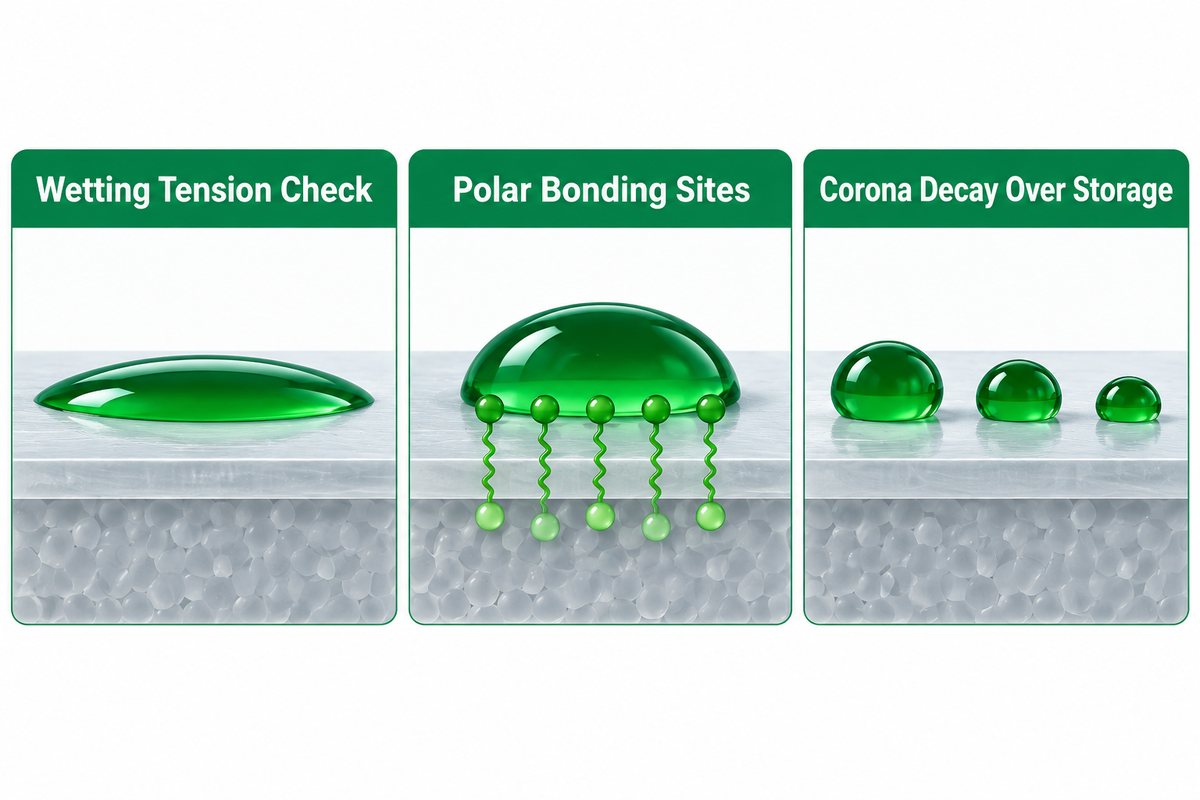
For UV inkjet converters running polypropylene (BOPP), polyethylene (PE), or polyester (PET) films, surface wetting and chemical anchorage are the primary quality gates. UV-curable inks have a typical surface tension of 30 to 40 dyne/cm. Therefore, Sabreen, and others recommend a substrate surface energy of 40 to 50 dyne/cm for smooth film surface wetting.
From ASTM D2578-23 (equivalent to ISO 8296), the operators employ a mixture of formamide and ethyl Cellosolve for wetting polyolefin films. The wetting tension is defined by the highest test fluid that remains spread as a continuous film for at least 2 seconds before breaking into droplets. Relying on a dyne pen reading is one of the most expensive mistakes in label converting.
Named Engineering Rule: Surface-Energy vs Polarity Trap Rule
ASTM D2578 wetting-tension measurements do not determine cured-ink adhesion of adhesionnal BOPP by themselves. According to the research literature, BOPP samples treated by nitrogen plasma and tested with dyne pens per ASTM D2578 showed wetting tension of 42 to 46 mN/m which failed UV ink adhesion. Clause 5.2 states that, “Wetting tension in itself is not a completely acceptable measure of ink, coating, or adhesive adhesion.”
What causes high dyne films to fail? Total surface energy is made up of dispersive (London) forces and polar (acid-base / hydrogen-bonding) forces. From surface chemistry data from AccuDyne Test, untreated polyethylene has a polar surface energy component of approximately 1.4 dynes/cm. Inks require polar sites to anchor chemically during curing.
Laboratory trials by Seidelmann et al. demonstrate this trap, as detailed in our guide on testing UV ink adhesion and dyne retention on label film. Nitrogen-plasma-treated BOPP samples measured 42 to 46 mN/m with dyne pens per ASTM D2578. Yet UV-curable ink failed tape testing completely because the film’s polar component mismatched the UV ink oligomers.
Additionally, bare corona treatment on BOPP and PE decays over storage time. Low-molecular-weight oxidized polymer chains revert back to the bulk film over time. Blooming slip additives cause deterioration under warm production conditions. PET holds corona treatment longer due to a higher glass transition temperature. Michelman suggests a dry coat weight of 1 to 2 g/m² for JetPrime UV 100, its primer for UV inkjet printing. As an alternative, they can use inline corona treatment to refresh polyolefin wetting.
Facestock Material Pairing: Paper, BOPP, PET, and Squeezable PE Across End-Use Environments
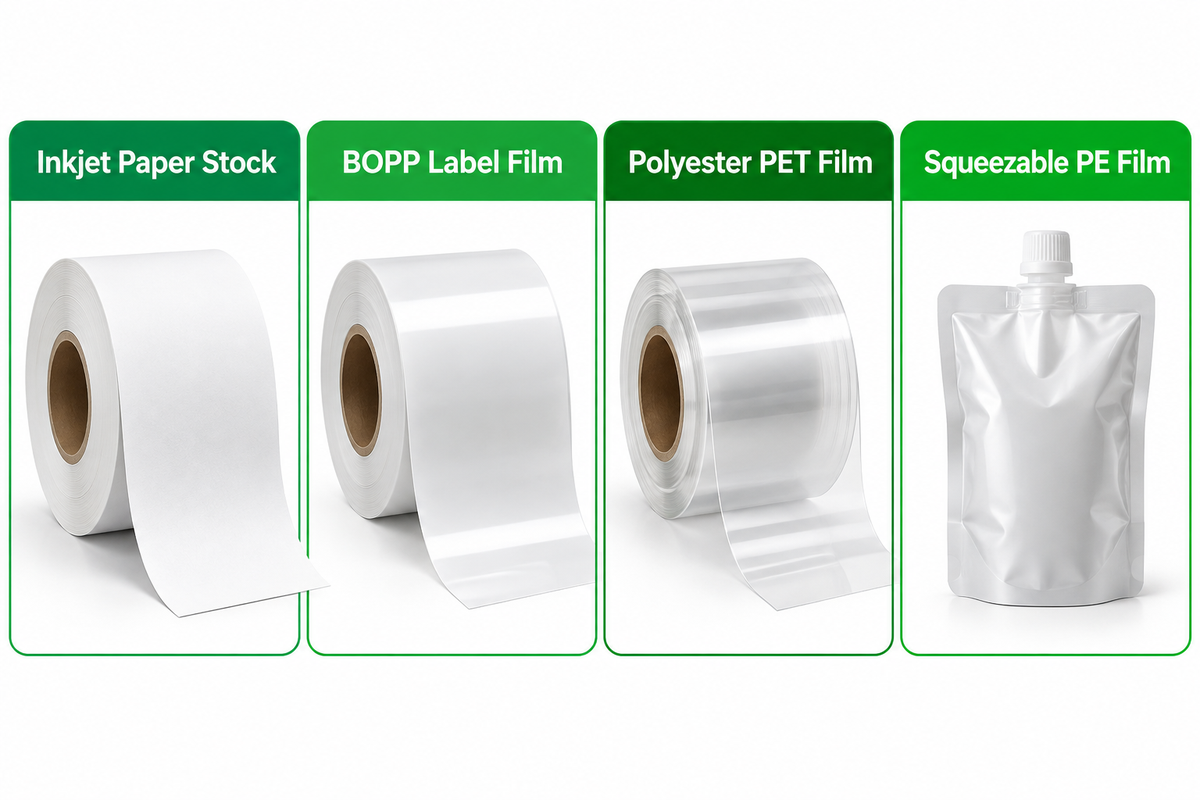
Pairing the base facestock with the right ink chemistry prevents container distortion, edge lift and moisture failure. When using paper facestocks (matte inkjet paper, semi-gloss, or high-gloss cast-coated paper), dimensional stability is governed by ambient humidity. Under ISO 187:2022 standard conditioning atmospheres, paper, board and pulp specimens are conditioned in a controlled standard temperature and relative humidity atmosphere. This revised 2022 edition has replaced the cancelled ISO 187:1990 standard.
For synthetic product packaging, converters have choices between biaxially oriented polypropylene (BOPP), polyester (PET) and polyethylene (PE). You can consult our guide on biaxially oriented polypropylene (BOPP) film stiffness and moisture barrier properties. Also consult our pressure-sensitive film constructions for production trials, when selecting film calipers:
| Facestock Material & Typical Caliper | Water-Based Inkjet Suitability | UV-Curable Inkjet Suitability | Primary End-Use Applications & Engineering Limits |
|---|---|---|---|
| Matte / Semi-Gloss Inkjet Paper (70–90 g/m²) | Excellent (with inline or offline cationic pigment-fixing coat) | Good (requires clay coat or sealing primer to stop monomer soak-in) | Dry food packaging, logistics barcodes, clinical trial cartons; laboratory specimen conditioning follows ISO 187:2022 |
| High-Gloss Cast-Coated Paper (80–90 g/m²) | Excellent with aqueous dye; requires microporous gloss coat for pigment | Good (UV ink adds raised tactile gloss on top of cast coat) | Specialty gourmet foods, wine, and nutraceutical jars kept in dry indoor retail conditions |
| White / Clear BOPP Film (50–60 μm) | Requires an offline microporous silica/alumina topcoat (≥15 g/m² dry for conventional offline coatings per WO2024038005A1) | Excellent on UV-primed or corona-treated BOPP (≥42 mN/m verified with test ink) | Bottled water, refrigerated beverages, household chemicals; LED-UV preferred over mercury UV to avoid heat shrinkage |
| Squeezable PE / Polyolefin Film (65–85 μm) | Limited (heavy microporous silica coatings can micro-crack under repeated squeeze) | Good only with flexible/elongation-grade free-radical UV ink formulations | Personal care squeeze tubes, cosmetics, and flexible pouches; avoid brittle high-crosslink UV inks |
| White / Metallized PET Film (50 μm) | Good with specialized microporous topcoat for indoor/industrial tags | Excellent (pair with cationic UV or primed low-shrinkage free-radical UV) | UL 969 electronics nameplates, power tools, automotive under-hood, and high-temperature drum labels |
As Smithers’ 2026 inkjet printing trend analysis highlights, converters are rapidly transitioning from conventional mercury-arc UV lamps to 385/395 nm LED-UV curing in 2026. Reducing infrared heat radiation by switching from mercury lamps to narrow-band 365 to 405 nm LED-UV lowers thermal distortion risk on temperature-sensitive BOPP and PE films.
Need Matched Microporous Aqueous or UV-Primed BOPP & PET Label Rolls?
Located at our Haiyan manufacturing facility, Zhejiang Guanma Packaging coats and slits custom pressure sensitive paper and film rolls. Receptive topcoats are combined with 6 in-house adhesives.
Durability, Chemical Resistance, and Regulatory Boundaries (BS 5609, UL 969, and Low-Migration Food Packaging)
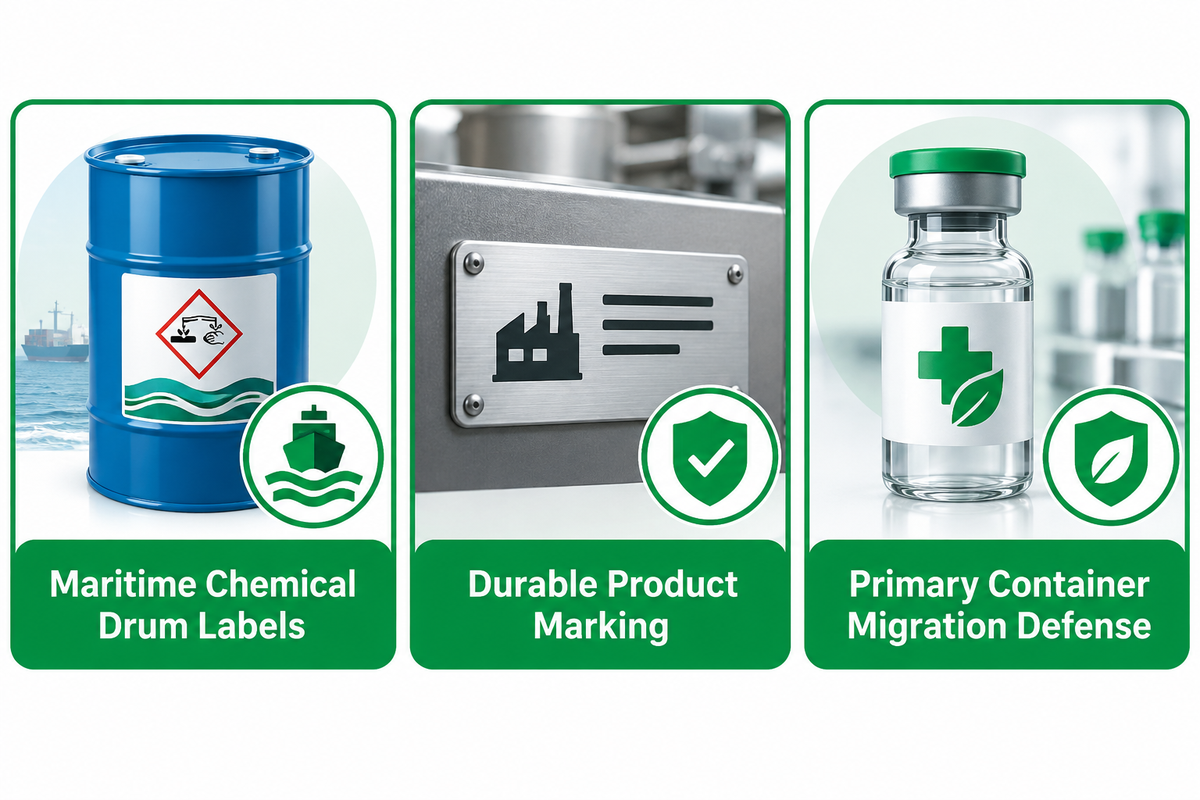
Applications requiring requires harsh outdoor weatherability, chemical splash resistant survival, or regulatory certification. Durability relies on the collective performance of the ink film, receptive topcoat, facestock, and adhesive to meet these demands. Neither ink chemistry has a universal regulatory monopoly; each satisfies a different compliance framework.
Do water-based pigment or UV inkjet labels need overlamination for waterproof and chemical exposure?
In a harsh solvent environment, both UV-curable inkjet labels and water-based pigment labels on microporous film show water resistance. The inkjet labels can withstand routine handling. Water-based labels, however, require an overlaminate or a UV varnish (as described in EP3738782A1).
Engineers specifying roll-fed labels frequently request durable waterproof label materials. Others are interested in specifying low-migration food packaging label materials for chilled containers. In both cases, quality teams need to enforce three regulatory boundaries:
- BS 5609 Maritime Chemical Drum Labels (Section 2 vs. Section 3): Smithers BS 5609 marine immersion testing protocols state that BS 5609 is made up of a few parts. Section 2 evaluates unprinted PS label stock on aluminum and HDPE. 3 months of mid tide marine exposure is followed by 7 days at 60 °C and 2 hours at 0 °C. Section 3
- ANSI/UL 969 Durable Product Marking (PGDQ2 vs. PGGU2 vs. PGJI2): Within the UL Solutions Marking and Labeling Systems Program, UL breaks their recognition into four categories. PGGU2 / PGGU8 recognizes unprinted base label materials and overlaminates. PGJI2 / PGJI8 recognizes print materials that are evaluated with printers and inks. PGDQ2 / PGDQ8 recognizes finished printed labels, and PGDT2 recognizes BS 5609 marine labels.
- For pharmaceutical GMP and food packaging migration: per Arrow Systems’ GMP pharmaceutical inkjet qualification analysis, FDA 21 CFR Parts 210 and 211 do not approve specific ink chemistries. Aqueous UV-curable inks can contain photoinitiators and reactive monomers. They offer low vocs, eco-friendliness, an environmentally friendly profile, and a smaller environmental footprint near primary containers. Under EU Regulation (EC) No 2023/2006 Annex A, converters must still prevent unsafe permeation or roll set-off, while UV-based inks require low-migration formulations and a monitored cure window.
| Stress / Compliance Test | Aqueous Dye Ink on Swellable Stock | Aqueous Pigment Ink on Microporous Film | UV-Curable Inkjet on Primed BOPP / PET |
|---|---|---|---|
| Water & Marine Immersion (BS 5609:2024 Sec 2 & Sec 3) | High risk of dye bleed in water or condensation | Qualify the exact pigment ink and microporous film combination under BS 5609 Section 3 | Qualify the exact UV ink, film stock, and cure window under BS 5609 Section 3 |
| Dry & Wet Rub Resistance (ASTM D5264 Sutherland Rub) | Low wet rub; requires clear laminate for wet handling | Moderate dry rub; needs clear overlaminate or UV varnish (per EP3738782A1) for heavy scuff | High native rub resistance when through-cured; evaluate under agreed ASTM D5264-98(2019) test weights and cycles |
| 70% Isopropyl Alcohol (IPA) & Essential Oil Wipe | Fails without lamination | Softens or smears without lamination; requires PP/PET laminate for hospital IPA wipe | Good resistance to IPA wipe; add PET overlaminate for harsh ketones (MEK/acetone) |
| Outdoor Sunlight & Weathering Resistance | Low (water-soluble dye chromophores degrade rapidly in UV sunlight) | High when formulated with lightfast pigments and qualified via accelerated weathering | High when formulated with outdoor pigments and fully cured; add UV-blocking laminate for extended exposure |
| Primary Container Migration Defense | Low photoinitiator risk, but high risk of dye bleed in condensation | Easiest defense (zero photoinitiators / zero monomers; verify roll set-off per EC 2023/2006) | Higher evidence burden (requires low-migration UV ink + verified mJ/cm² cure dose) |
European Patent EP3738782A1 shows overcoating a microporous ink-receptive layer with a UV-curable varnish. Self-wound BOPP laminates are also possible for better resistance and moisture resistance.
Press Ecosystem, Adhesive Pairing, and Roll Converting (Desktop Aqueous vs Industrial UV Hybrid)
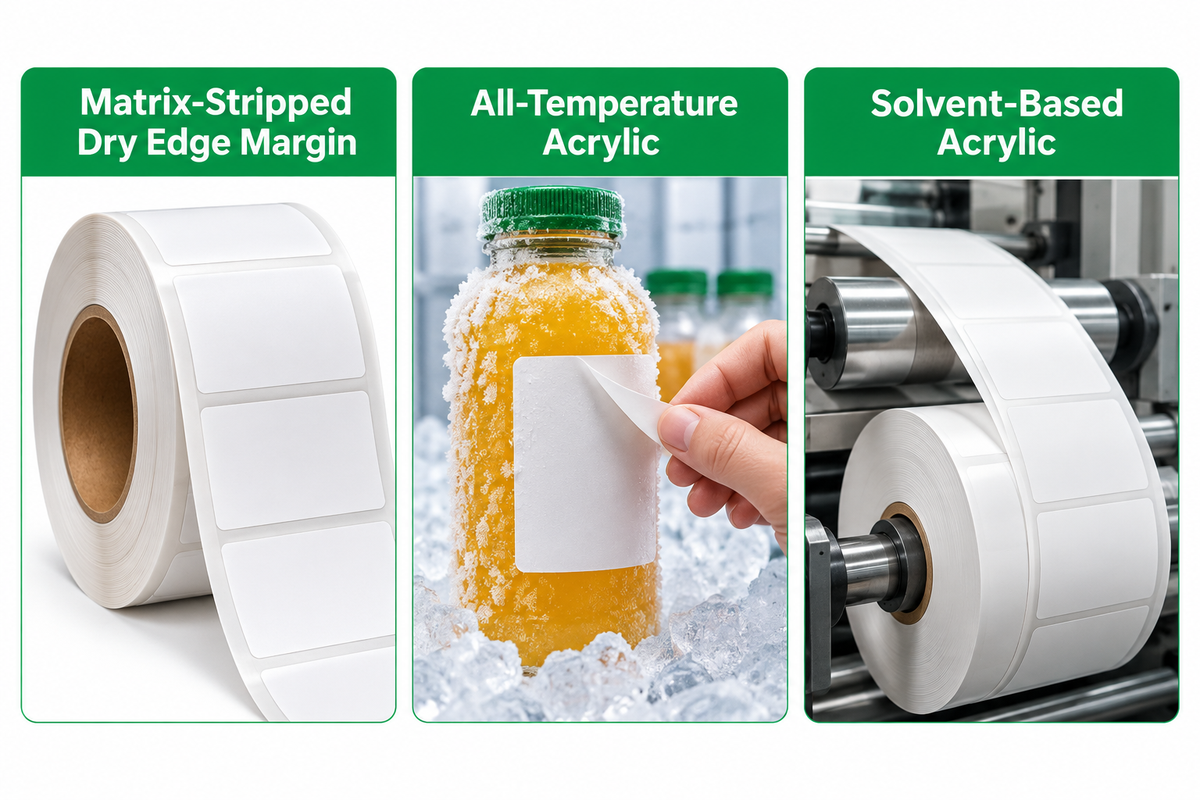
Label stock is made of three layers: the top layer (facestock), an adhesive layer (pressure-sensitive adhesive), and a liner layer (release liner). A mis-match of the adhesive or liner can cause jamming of the printer label applicator or edge lift of the labels during the packaging process.
In roll-to-roll inkjet label printing, printing equipment and label press mechanics divide into two ecosystems:
- Desktop and mid-web roll aqueous printers (Epson ColorWorks, Afinia, Primera, VIPColor) use pre-die-cut rolls, which are fed over tight rollers for variable data printing. They provide lower maintenance and less maintenance downtime as compared to flexo presses with no plates or anilox rollers. However, enclosure heat can soften hot-melt adhesive and cause edge ooze, without clean matrix-stripped margins.
- Industrial narrow-web UV inkjet and hybrid presses (Domino, Durst, Mark Andy, Screen, and ArrowJet UV 330H) run continuous master webs. These high-volume presses often combine flexo primer or varnish stations (using an anilox roll for 1 to 2 g/m² dry primer laydown) with rotary die-cutting. The hybrid press ArrowJet UV 330H can also support roll media along with rigid flatbed media (up to 50 mm thickness) on its flatbed.
Zhejiang Guanma Packaging Co., Ltd. (initially established in 2010 as Shanghai Guanma, operating 100,000 grade cleanrooms and ISO 9001 / ISO 13485 / CE / TUV quality systems) opened its Haiyan manufacturing plant in 2019. We have 6 in-house adhesive systems coating across 20+ industries: water-based acrylic, hot-melt rubber, solvent-based acrylic, silicone, PU, and UV-curable acrylic. Please see our roll splice geometry and sensor contrast specifications and pairing matrix on the Purchase Order guideline.
| Press & Application Scenario | Recommended Guanma Adhesive System | Release Liner Specification | Converting & Peel Verification Rule |
|---|---|---|---|
| Desktop Aqueous Pre-Die-Cut Rolls (Epson ColorWorks / Memjet) | High-shear water-based acrylic emulsion or low-ooze UV-crosslinked acrylic | 60–80 g/m² super-calendered white/blue glassine or 90 g/m² layflat kraft | Maintain a clean matrix-stripped dry edge margin to prevent roller gum buildup |
| Chilled Bottled Water, Beverage & Cold-Chain | All-temperature acrylic or freezer-grade modified acrylic emulsion | 62 g/m² glassine or 30 μm clear PET liner (for high-speed wet-bottle labeling) | Verify 90° peel adhesion on standard steel per ASTM D6252-98 (ASTM D6252/D6252M-98(2025)), and separately test on target HDPE or glass |
| Industrial UV Inkjet BS 5609 Chemical Drums & UL 969 | High-cohesion solvent-based acrylic or heavy-coat UV acrylic | 65–80 g/m² densified glassine or 36 μm siliconized PET liner | High solvent/marine shear resistance; survives 7 days at 60 °C and 3-month mid-tide immersion |
| Corrugated Shipper Cartons & Recycled Cardboard | High-initial-tack hot-melt rubber (for continuous UV web die-cut offline) | 60–65 g/m² siliconized glassine | Avoid high-ooze hot-melt in enclosed desktop aqueous printers; ideal for wide-web converting |
Print Defect Troubleshooting and the 5-Gate Press Qualification Protocol
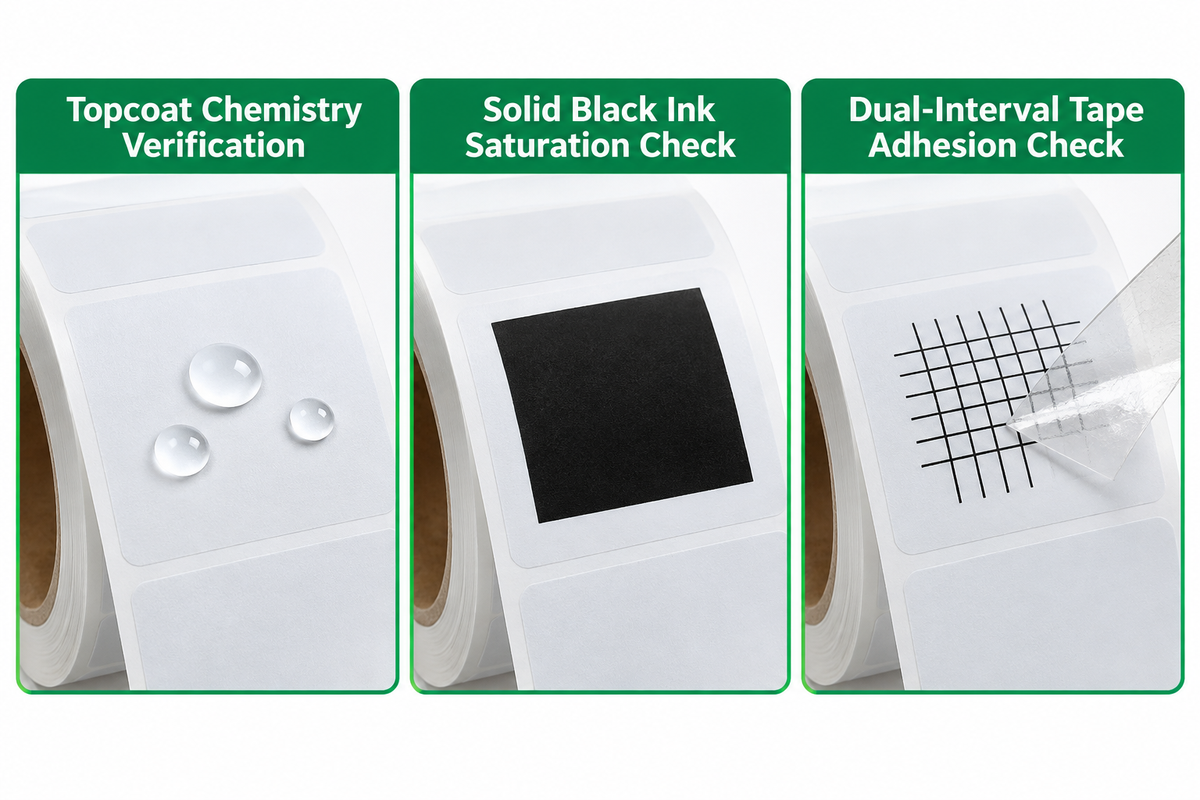
Operators tend to blame ink batches for print defects that appear on press, when more often than not the root cause is a substrate-to-chemistry mismatch. Before agreeing to a new pressure-sensitive label rolls supplier, use our incoming batch inspection checklist for pressure-sensitive label rolls. Then run the diagnostic matrix and qualification protocol provided below.
| Observed Print Defect | Typical Press Platform | Primary Root Cause on Label Stock | Engineering Corrective Action |
|---|---|---|---|
| Ink Coalescence, Puddling & Inter-Color Bleed | Water-Based Inkjet | Non-receptive film loaded by mistake, or ink laydown exceeding the receptive coating’s absorption capacity | Switch to a compatible microporous silica/alumina film (such as ≥15 g/m² dry offline coating per WO2024038005A1) or reduce RIP ink limit |
| Pigment Smudging 24–48 Hours After Printing | Water-Based Pigment Inkjet | Aqueous pigment ink printed onto an incompatible swellable dye coating or sealed gloss layer | Replace swellable stock with open-pore cationic fumed silica microporous topcoat |
| UV Ink Delamination on Tape Pull Despite Passing Dyne Check | UV / LED-UV Inkjet | Surface polarity mismatch on treated BOPP, slip agent bloom (reading 4–6 dyne/cm lower per Sabreen), or incomplete bottom cure | Apply a compatible UV primer (e.g., 1–2 g/m² dry) and verify incident UV dose (mJ/cm²) and through-cure |
| Surface Tackiness & Poor Sutherland Rub | Free-Radical UV / LED-UV Inkjet | Oxygen inhibition at low peak irradiance (W/cm²) or photoinitiator mismatch with 395 nm LED spectrum | Increase peak LED irradiance, add nitrogen inerting/pinning adjustment, or verify LED-matched ink |
| Immediate Off-Press Tape Failure That Passes Next Day | Cationic UV Inkjet | Testing before cationic post-exposure dark-cure progression completes, or excessive ambient humidity interfering with cationic cure | Control pressroom humidity and evaluate adhesion both immediately off-press and after post-cure aging |
| Cross-Web Curl & Tunneling on Thin Film | Mercury-Arc UV / Heavy Aqueous | Excessive mercury-lamp IR heat plus free-radical cure shrinkage on thin film, or moisture imbalance in paper liner | Condition paper test specimens per ISO 187:2022, chill the platen roller, or use 365–405 nm LED-UV |
Named Quality Standard: 5-Gate Press Qualification Protocol
The following 5-Gate Press Qualification Protocol will be performed on each trial roll before releasing a master purchase order:
- Gate 1 — ISO 187:2022 Paper Conditioning & Roll Acclimation: Condition paper and board test specimens per ISO 187:2022. Condition the wrapped sample rolls and allow them to acclimate to pressroom temperature.
- Gate 2, ASTM D2578-23 Wetting Tension & Surface Screen: Measure polyolefin wetting tension per ASTM D2578-23 (2-second hold targeting 40-50 dyne/cm per Sabreen). Also run an ink drawdown to rule out the “Surface-Energy vs Polarity Trap Rule”.
- Gate 3, Solid Black & Multi-Channel Ink Saturation Check: Print solid black and multi-color blocks, GS1 2D barcodes and fine text at production speed to assess ink saturation, coalescence, bleed and mottle.
- Gate 4 — Dual-Interval Tape Adhesion Check (Initial & Aged): Test tape anchorage both off-press and after post-cure dwell. Based on ASTM D3359-23 crosshatch tape testing, Clause 1.1 covers metallic substrates, Note 1 stipulates agreed terms for plastics, and Clause 1.5 covers multi-coat intercoat failure.
- Gate 5: ASTM D5264-98(2019) Rub & ASTM D6252-98 Peel Verification: Evaluate abrasion resistance according to ASTM D5264-98 (2019). Also, perform a 90° peel adhesion test according to ASTM D6252-98 (2025) and container trials.
Cost Breakdown, MOQ, Roll Slitting Specifications, and Converter RFQ Checklist
When considering the advantages and disadvantages of water-based and uv inkjet label stock from a procurement perspective, converters have to look at total applied cost per thousand labels, not the bare substrate price, to make an accurate assessment.
On BOPP and PET synthetic films, Aqueous inkjet label stock commands a higher bare substrate cost per square meter as compared to corona treated or uv-primed BOPP. That cost premium is due to the coating mass and line speed. An offline microporous coating of at least 15 g/m² dry (as per WIPO Patent WO2024038005A1) is 7.5 to 15 times the dry coating mass as compared to a 1 to 2 g/m² UV primer. Michelman JetPrime UV 100 is a 1 to 2 g/m² UV primer reference. Offline microporous drying ovens also run at slower speeds.
However, desktop and mid-web aqueous inkjet printers require a fraction of the capital equipment investment of an industrial narrow-web UV inkjet press. Short-run, high-SKU operations can achieve lower total costs with microporous aqueous rolls. However, UV-primed BOPP jumbo rolls can allow high-volume converters running long shifts to achieve lower unit costs.
| Procurement Cost & Operational Driver | Water-Based Microporous Film Stock | Water-Based Inkjet Paper Stock | UV-Primed / Corona BOPP & PET Stock |
|---|---|---|---|
| Relative Substrate Cost per m² | Highest (driven by ≥15 g/m² dry offline silica/alumina coating per WO2024038005A1 and slower oven drying) | Lowest (lightweight cationic surface size or 0.5–1.0 g/m² dry primer on paper) | Low to Moderate (corona treatment or 1–2 g/m² dry acrylic/urethane primer) |
| Press Capital Expenditure (Capex) | Low to Moderate (desktop roll printers to single-pass aqueous web presses) | Low to Moderate | Moderate to High (industrial narrow-web UV/LED-UV inkjet & hybrid presses) |
| Overlamination or Varnish for Wet/Chemical Use | Qualify an overlaminate or UV varnish (per EP3738782A1) when exposed to alcohol, oil, or heavy abrasion | Wet-strength paper with pigment ink handles light moisture; add laminate for wet or abrasive service | Crosslinked UV ink resists water; add overlaminate for harsh solvents or severe mechanical scuffing |
| Roll Format & Supply Options from Guanma | Master jumbo rolls or custom-slit rolls (pricing, MOQ, and lead time quoted per spec) | Master jumbo rolls or custom-slit rolls (quoted per spec) | Master jumbo rolls or custom-slit rolls (quoted per spec) |
Pricing differentials for microporous aqueous and UV-primed BOPP film remain arbitrary in published industry sources. Commercial terms hinge upon the coat weight, film caliper, and adhesive system. Contact Zhejiang Guanma Packaging (founded in 2010 in Shanghai, its Haiyan plant established in 2019, 6 adhesive systems) to inquire about film availability and receive a quote from a custom converter.
7-Point Converter RFQ Specification Checklist for Inkjet Label Stock
When requesting a quotation or sample roll from Zhejiang Guanma Packaging, include the following 7 fields:
- For each printer model, disclose the ink chemistry (i.e. aqueous dye or pigment, free-radical or cationic UV), and printer manufacturer’s curing lamp wavelength and dose specifications.
- Provide the basis weight (g/m2) of matte or cast-coated papers, or the thickness of white, clear, or metallized BOPP, PET or squeezable PE facestocks.
- State the architecture of the receptive topcoat and its weight. WO2024038005A1 describes conventional offline inkjet coatings that generally require 15 g/m². Michelman specifies 1-2 g/m² (dry) for JetPrime UV 100. A wetting tension of ≥42 mN/m does not guarantee UV ink adhesion.
- Select from Guanma’s 6 adhesive systems (water-based acrylic, hot-melt rubber, solvent acrylic, silicone, PU, or UV-curable) depending on your container surface and service temperature.
- Indicate your choice of release liner type (super-calendered glassine, layflat kraft, or clear PET), optical gap, or black-mark sensor requirements.
- Define core inner diameter, outer diameter, and slit width; and indicate face-out or face-in winding.
- State required compliance standards (such as BS 5609:2024 Section 2 and 3 marine testing, ANSI/UL 969 (PGGU2, PGJI2, or PGDQ2) or food and pharmaceutical packaging documentation).
Ready to Qualify Water-Based or UV Inkjet Label Rolls on Your Press?
Provide your 7-point RFQ to the coating engineers at Guanma for custom sample rolls and to receive quotations for jumbo or slit rolls, along with technical data sheets, shipped directly from the factory.
Frequently Asked Questions
What are the downsides of using water-based ink on film label stock?
Non-porous plastic films like untreated BOPP or PET can’t absorb the liquid carrier in water-based inkjet ink. Even when surfactants are used to aid wetting, the base film remains sealed. Therefore, film labels require an engineered microporous silica or swellable polymer topcoat which increases the cost of substrate, requires thermal drying, and often a varnish or overlaminate against alcohol.
What are the downsides of UV inkjet printing for food and pharmaceutical labels?
Decreased irradiance from lamps can cause UV monomers and photoinitiators to migrate from thin polyolefin packaging into foods or drugs. An increased risk for migration occurs when web speeds exceed the validated curing window. Also, free-radical UV-curable inks can crack and create a raised, tactile surface on flexible squeeze tubes during roll rewinding.
Can I use inkjet label stock in a laser printer or thermal transfer printer?
Standard inkjet film or swellable-coated paper shouldn’t be run through a laser printer unless the inkjet datasheet is dual laser and inkjet compatible. Polyolefin inkjet facestocks can soften and deform to a permanent shape within fuser assemblies. Fuser heat can also soften pressure-sensitive adhesives and damage the receptive inkjet coating.
How do I know if my BOPP roll is topcoated for aqueous or UV inkjet?
Rapid water absorption indicates the presence of an absorbent receptive coating. Corona-treated or UV-primed films can also allow water to spread. Swellable coatings receive liquid through polymer swelling, so droplet behavior alone cannot establish printer compatibility.
Why does UV inkjet ink peel off corona-treated BOPP during a crosshatch tape test even when dyne pens read above 40 mN/m?
UV ink can peel when the ink oligomer polarity mismatches the oxidized polypropylene surface or when slip additives bloom upward. This failure occurs even when wetting tension exceeds 40 mN/m. Under ASTM D2578-23 Clause 5.2, wetting tension alone is not an acceptable measure of ink adhesion because dyne fluids do not separate dispersive forces from polar bonding sites. Also, results from ASTM D3359-23 crosshatch tape rely on bottom-layer UV through-cure, intercoat cohesion and acceptance grades specified by the customer.
Does BS 5609 Section 2 label stock guarantee a compliant drum label?
No. BS 5609:2024 Section 2 only evaluates the unprinted adhesive label stock blank; your finished printed label must separately pass Section 3 abrasion and legibility testing.
How should converters store water-based and UV inkjet label rolls to prevent curl and coating degradation before printing?
Follow supplier storage guidelines and keep rolls sealed on moisture-barrier wraps on horizontally positioned core racks until just before press loading. For paper and board, and pulp conditioning, ISO 187:2022 prescribes the standard conditioning environment (replacement for the cancelled ISO 187:1990 edition). Allow sealed production rolls to acclimate to pressroom temperature before unwrapping so paper release liners avoid moisture shock curl. Confirm wetting tension on Corona treated polyolefin UV films with the ASTM D2578-23 test prior to use.
References & Sources
- ASTM D2578-23: Standard Test Method for Wetting Tension of Polyethylene and Polypropylene Films (Clause 5.2 limitation on scope of wetting tension and ink adhesion; equivalent to ISO 8296).
- International Organization for Standardization, ISO 187:2022: Paper, board and pulps, Standard atmosphere for conditioning and testing (23 °C and 50% RH).
- UL Solutions, ANSI/UL 969 Marking and Labeling Systems Program: UL Recognition Categories PGDQ2, PGGU2, PGJI2, and PGDT2.
- Smithers, BS 5609 Marine Immersion Label Testing: BS 5609 Section 2 (Label Stock Material) vs. Section 3 (Printed Facestock) Testing Requirements.
- Michelman, Inc., JetPrime Digital Printing Primers: JetPrime WB 1100 (2.5-5.0 g/m² wet) and JetPrime UV 100 (1-2 g/m² dry) Technical Specifications.
- WIPO Patent WO2024038005A1: Primer and Coating Compositions for Non-Absorbent Substrates (≥15 g/m² Offline Inkjet Coat Weight).
- WIPO Patent WO2020046703A1 & European Patent EP3738782A1: Microporous Recording Media Comprising Cationic Fumed Silica and Cationic Polyurethane and UV-Curable Varnish Overcoated Microporous Inkjet Films.
- Cabot Corporation: Fumed Silica and Alumina Dispersions for Ink-Receptive Coatings.
- Kyocera Corporation & Opsytec Dr. Gröbel: UV LED Curing Light Source Specifications (20 W/cm² Peak Irradiance, 400 mJ/cm² Dose at 385/395 nm) and UV Radiometry for Industrial Printing.
- Arrow Systems, Inc.: Aqueous vs. UV Inkjet Pharmaceutical Labels: What GMP Requires (21 CFR Parts 210/211 & Migration Control).
- Mecmesin & DDL Testing: ASTM D6252/D6252M-98 (2025) 90° Peel Adhesion of Pressure-Sensitive Label Stocks and ASTM D5264-98 (2019) Sutherland Rub Abrasion Practice.
- Labels & Labeling (Label Academy): Digital Printing Substrate Selection and Print Quality.
WHY WE WRITE THIS
About Guanma
Guanma is a self-adhesive film, label stock, and release liner manufacturer for industrial labeling applications. Our team works with PET film, PP synthetic paper, coated paper, hot-melt PSA, acrylic PSA, water-based adhesive, glassine liner, and CCK release liner.
We write these guides to help label converters, packaging buyers, and industrial procurement teams choose materials by real application conditions instead of generic catalog names. Most label failures come from a mismatch between facestock, adhesive, liner, substrate, temperature, printing method, or end-use environment. Our content explains those decisions in practical terms.
Our Experience
Guanma’s material guidance is based on coating, lamination, slitting, sample validation, and customer troubleshooting experience across Thailand and Vietnam production. We focus on common industrial label problems such as cold-temperature peel, oil and chemical exposure, UV aging, print durability, release force, MOQ, lead time, and substrate-matched testing.
Our Expertise
We reference practical testing logic and recognized label-industry standards, including FINAT FTM peel and shear methods, ASTM peel testing methods, FDA 21 CFR 175.105, REACH, RoHS, FSC, and ISO 9001-related quality control. For custom label stock, we always recommend testing samples on the buyer’s real substrate before full production.
SYS.PROFILE
Visit Website
Contact Profile
Name
Guanma Manufacturing Team
Brand Name
Guanma
Country
Thailand + Vietnam Production
Model
B2B / Wholesale / Custom Coating
Main Products
Self-Adhesive Film, Label Stock, Release Paper & Liner
Contact
Submit RFQ via Website Form
Website
https://guanmalabel.com/