Get in Touch with Guanma

Self Adhesive Paper
Self-Adhesive Paper for Labels — Coated & Thermal Paper Stock from Guanma
Integrated coating + laminating + R&D from Thai & Vietnamese plants – 9 label applications, ISO 9001 + ASTM + FDA qualified
Self adhesive label paper is made up of three layers: a facestock for printing on, a pressure sensitive adhesive and a liner for layflat. Traditionally most label converters buy these three layers from different vendors and have no control over what configuration they buy from the supply chain. Guanma produces all three layers at our Thailand and Vietnamese plants and we put them together into nine application specific stock for use in tire, cable, freezer, removable, pharma, chemical, food packaging, beverage and durable labels.
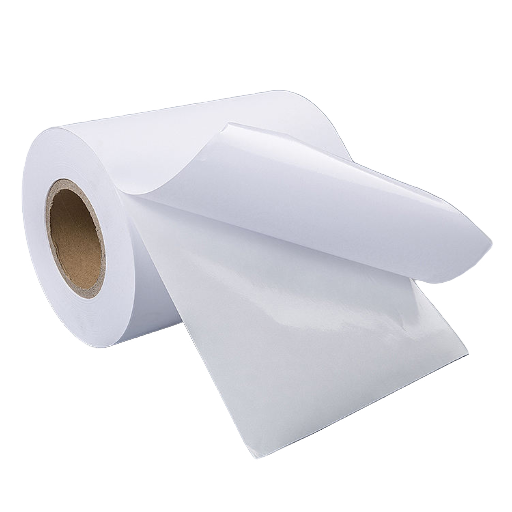
What You Get From Guanma
- Six options for facestock: PET, PP synthetick paper, coated paper paper semi-matt, gloss and matt, thermal paper, BOPP, kraft
- Three options for chemistries of adhesives: hot-melt, water emulsion, acrylic adhesives – with permanent and removable options
- Multiple options for lines: CCK, glassine, PE, PET – designed for use on high speed auto-labeling machines
- Five international certifications: ISO 9001:2015 + ASTM D6252 + FDA 21 CFR 175.105 + RoHS + EU food contact
- ASEAN regional sourcing: Thailand and Vietnam factories afford 30 days quicker delivery than alternative suppliers from Europe or the US
- Complimentary Sample Pack: twelve facestock + adhesive + liner combinations dispatched in five days
Why Label Converters Struggle to Source Consistent Self-Adhesive Paper — And the Integrated-Manufacturer Solution
Buyer focus: Engineering Managers · Procurement · Brand Owners
Self-adhesive paper and film based label solutions both require high quality consistent self-adhesives – and consistent self-adhesive production more often than not fails in three ways: batches of facestock and adhesives drift from shipment to shipment, lead times across Asian plants increase when they ship through generalist distributors and converters are forced to pay for every mismatch when a label comes off at -20 °Celsius or turns yellow in sunlight after twelve months. Industry structures favor specialization–one company coats paper, another makes adhesion chemistries, and yet another produces the yellow- and UV resistant release liner. The result is most self-adhesive label stock a converter borrows costs ten to twenty five days in lost production.
Guanma is a different company.
We make our own self-adhesive papers and films, we manufacture our own shelf-stable, high and low temperature formulations of self-adhesives, and we produce our own release liners, again in Thailand and Vietnam–all under one quality management system audited on an annual basis by ISO 9001:2015. Our local footprints from Taiwan to Vietnam sell to ASEAN customers in a period of ten to fifteen days, compared to regional competitors twenty-five to forty-five days. This category advantage represents a thirty day stocking savings for ASEAN clients as well.
Industry Insight
A survey of industry label material failure modes, published on kdv Label, found a surprising consistency on the root cause:
Environmental Stress
Facestock that can’t take the final storage or use environment—failing under moisture, immersion, UV exposure, or extreme temp swings.
Application Degradation
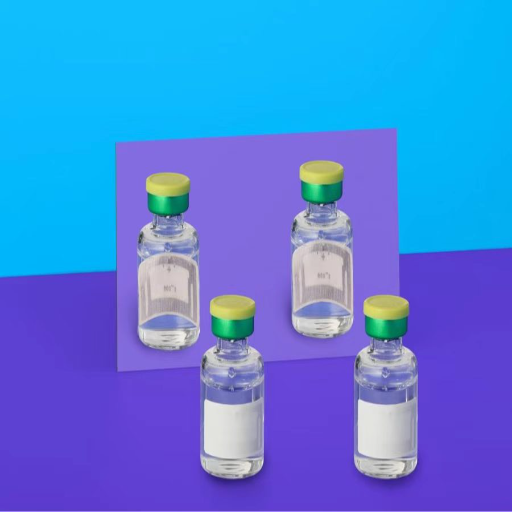
In specialized use cases like cryogenic vial labeling, off-the-shelf adhesives work short-term, but eventually edges start lifting and barcodes no longer scan.
Under-Engineered Formulations
Facestock + adhesive + liner combinations that lack the engineering for the job, failing to meet the versatility demanded by 21st-century label printers.
The problem isn’t ordering a generic stock and hoping it lives long enough—it’s selecting a three-layer set of materials from a manufacturer explicitly engineered for the application.
The Three Decisions Behind Every Self-Adhesive Label
Guanma supplies all three layers and combines them into nine engineering-designed factors. The rest of the page explains each layer choice, the optimum application matrix, and the supply-aggregation model-all so you can match up your end-product with an available substructure:
Facestock: PET, PP synthetic paper, coated paper, thermal paper, BOPP or kraft – all with varied printability and environmental endurance.
Adhesive chemistry: hot-melt, water-based emulsion, or acrylic-all with varied temperature range, peel force, and reclosure factors.
Liner choices: CCK, glassine, PE, or PET, designed for your converter’s die-cutting and your label printer’s release-force range.
Self-Adhesive Paper Construction — The Three-Layer System
Buyer focus: Engineering Managers (primary)With all pressure-sensitive label combinations the same three-layer concept may seem overly simplified but it isn’t-eshrown, peeled, and lifted, it’s just what the layer does in terms of application and failure response that matters
1
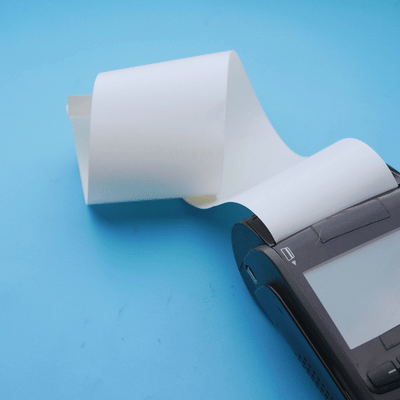
Top Layer — Facestock (Printable Surface)
The visible, printable top layer carries your variable information, barcode, design, etc. Examples of common facestock materials include coated paper (semi-gloss, gloss, matte), thermal paper, PET film, PP synthetic paper, BOPP, and kraft. All are printable via flexo, digital inkjet, laser, and thermal transfer.
2
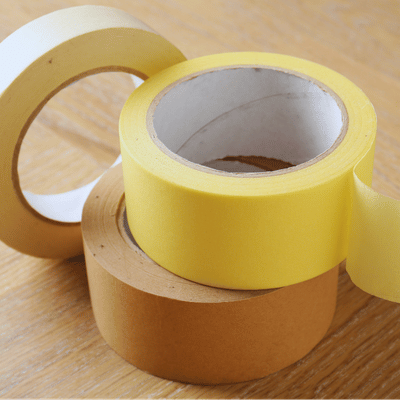
Middle Layer — Adhesive (Pressure-Sensitive Bond)
A pressure-sensitive adhesive-coated to the back of the facestock. An adhesive chemistry is hot-melt (initialized fast, tacky, hydrophobic), water-based emulsion (eco-friendly, repositionable, slower initialized), or acrylic (UV stable, larger temperature range). The adhesive chemistry must match the surface energy of the product (flat glass, textured cardboard) to which it is applied.
3
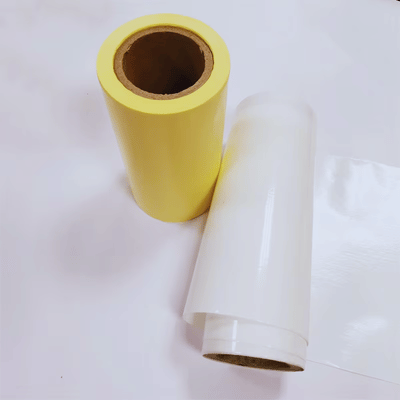
Bottom Layer — Release Liner (Carrier & Protector)
A silicone-coated paper or film that separates the adhesive until the application. Different liners include CCK (clay-coated kraft), glassine, PE, and PET. Liners differing by type or length also differ on the die-cutting and release force they impose-on high-speed automatic label applicators causing production problems.
How Each Layer Can Fail (And What to Look For)
- Facestock failure-it cracks, yellows, curls, or loses adhesion in response to environmental stresses (moisture, heat, UV, wear)
- Adhesive failure-peel strength decreases, edges lift, adhesive bonds break down on extreme temperatures or low energy surfaces.
- Liner failure-the release force variation shifts between batches causes labeling errors in the automatics.
Quality control tests each lamination separately and tests the assembled three-layer structure as a whole. A facestock that performs well in isolation may act differently when combined with a particular adhesive and liner. Finding the right three-layer system instead of three separate choices is what maintains batch consistency across shipments.
Facestock Options — Coated Paper, Thermal Paper
Buyer focus: Engineering Managers · Procurement
The most important choice in label material selection is facestock. A poor facestock can make it through printing, die cutting, and application—and then fail in the field months later. Guanma supplies six families of facestocks, each engineered for different environmental and printability factors.
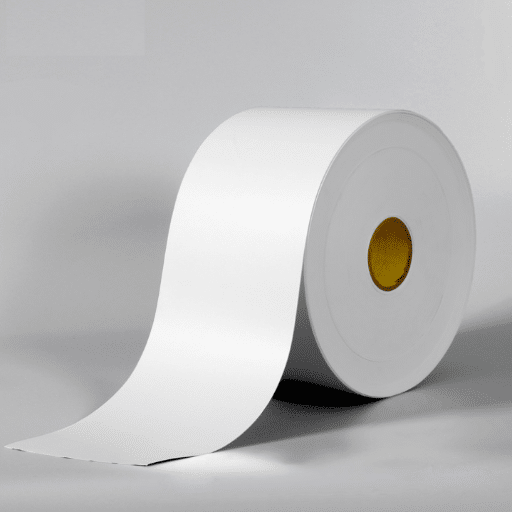
Coated Paper (Semi-Gloss, Gloss, Matte)
Coated wood-pulp paper with a carefully controlled smoothness for high-resolution flexo and digital printing.
Finishes:
Semi-gloss (common), Gloss (luxury/beverage), Matte (wine/care).
Weight:
Typical basis weight 70-80 GSM.
Adhesives:
Hot-melt, water-based, and acrylate.
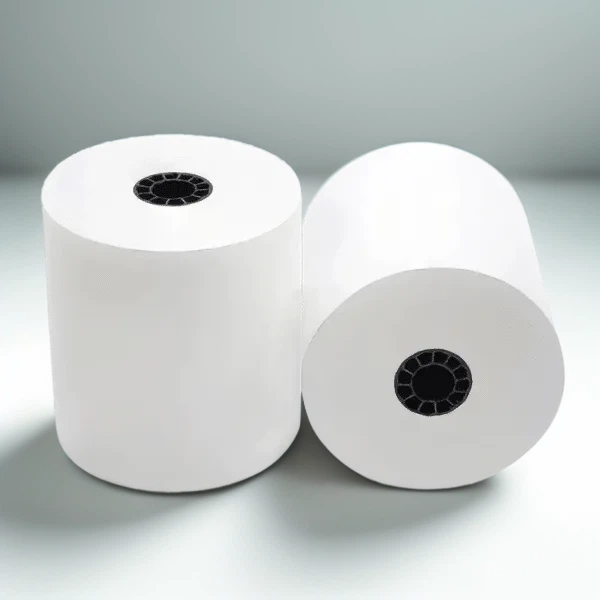
Thermal Paper (Direct & Transfer)
Line- and scratch-sensitive coated paper for direct thermal printing (no ribbon) or thermal transfer printing (using a ribbon).
Applications:
Shipping, retail, weighing labels, ticketing, barcode.
Upgrades:
Top-coated variants resist scratching, moisture, and oil.
Adhesives:
Available with permanent or removable adhesives.
Facestock Selection — Comparison Table
| Facestock | Surface Weight / Thickness | Temperature Range | Key Resistance Properties | Typical Print Methods |
|---|---|---|---|---|
| Coated Paper (Semi-Gloss) | 70-80 GSM | -20°C to +60°C | Print quality, cost-effective | Flexo, digital, thermal transfer |
| Thermal Paper (Direct) | 55-80 GSM | -15°C to +50°C | Direct thermal print, top-coat options | Direct thermal only |
| PET Film | 50-75 microns | -40°C to +150°C | Chemical, UV, abrasion, tear | Flexo, screen, thermal transfer |
| PP Synthetic Paper | 60-85 microns | -30°C to +90°C | Moisture, oil, chemical | Flexo, digital, thermal transfer |
| BOPP | 40-60 microns | -20°C to +100°C | Clarity, tensile strength | Flexo, digital |
| Kraft Paper | 70-90 GSM | -10°C to +60°C | Eco-positioning, recyclability | Flexo, digital |
| Metallic / Metalized PP | 50-70 microns | -20°C to +90°C | Reflective sheen, premium shelf appeal | Flexo, digital |
| Polyethylene (PE) | 60-80 microns | -30°C to +80°C | Conformability on squeezable bottles | Flexo, digital, UV inkjet |
Ready to spec the right material?
Send your application requirements and we will return a recommended facestock + adhesive + liner combination.
Sibling Solutions from Guanma — Application-Specific Label Material
BUYER FOCUS: ALL — FOR APPLICATION-SPECIFIC DEEP-DIVES
Our self-adhesive paper category page covers all 3 tiers systems for 9 applications. For converters/brand owners with specific application requirements that demand deeper design specification detail,or application specific test data, Guanma maintains four application-specific landing pages plus two sub-product pages for the most popular facestocks.
Pharmaceutical Labels
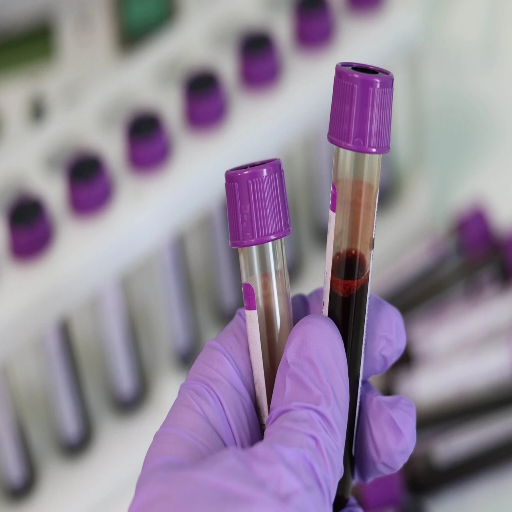
FDA-compliant migration-free pharmaceutical label material – tolerant of sterilization, audit-ready, adheres to 21 CFR 175.105. Includes IPA wipe resistant, tamper-evident capabilities, serialization-compatible adhesives.
Chemical Resistant Labels
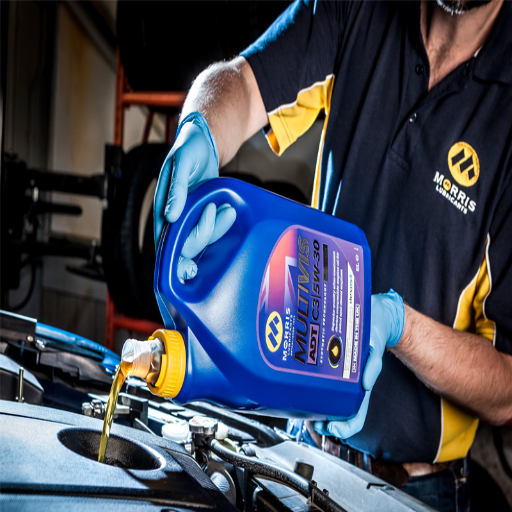
Oil and solvent proof chemical drum/industrial container/hospital bottle label material. Polyimide and PET facestocks with acrylic adhesives designed for IPA wipe, MEK exposure, gas or oil splash.
Durable Labels
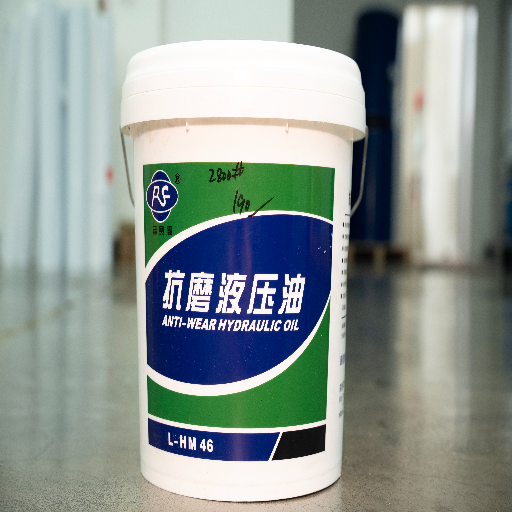
UV, heat, and weather-proof paper label and film label material for outdoor signage, automotive identification, electrical appliance nameplates, and any long-lasting label requiring 5-7 years of outdoor life without yellowing or peeling — compatible across the major printing technologies including flexo, screen, and thermal transfer.



Buyer focus: All — primary for Procurement
Nine-Application Matrix — Recommended Stock for Each Industry
Hot-melt and water-based emulsion adhesives serve different label needs depending on performance, environment, sustainability, and application speed — a point industry resources including Beontag and Hotmelt.com have repeatedly emphasized. Guanma’s adhesive R&D team formulates and tests within all three chemistry families, so we can recommend (and supply) the chemistry that matches your actual application — not the chemistry our production line happens to favor. Selecting facestock + adhesive + liner in isolation is a guess. Selecting them as a three-layer combination engineered for a specific application is engineering. The matrix below maps Guanma’s nine target label applications to the recommended three-layer construction, the critical performance requirement, and (where applicable) the dedicated Guanma application page that goes deeper.
Application & Critical Spec
Recommended Facestock
Recommended Adhesive
Recommended Liner
Tire Labels
UV resistance, abrasion, -40°C to +120°C, ASTM D6252 peel
PET 75 micron
Acrylic permanent
PET liner 50 micron
Cable & Wire Labels
Heat resistance, chemical exposure, abrasion
PET 50 micron, polyimide for high-temp
Acrylic permanent
CCK liner
Freezer Labels (cold chain)
Tack at -25°C, edge-lift prevention, barcode scan integrity
PP synthetic paper or coated paper top-coat
Cold-chain hot-melt or freezer-grade acrylic
Glassine liner
Removable Labels
Clean removal up to 24 months, no residue, repositionable
Coated paper (semi-gloss) or PP synthetic paper
Removable water-based emulsion
CCK liner
Pharmaceutical Labels →
FDA migration safe, sterilization tolerance, traceability
Coated paper (matte) or PP synthetic paper
Acrylic permanent, FDA 21 CFR 175.105
Glassine or PET liner
Chemical Labels →
Solvent splash, IPA wipe, oil resistance, chemical immersion
PET 50-75 micron, polyimide for harsh
Acrylic permanent, solvent resistant
PET liner
Food Packaging Labels
Indirect food contact compliance, recyclability
BOPP, coated paper, kraft
Water-based food-safe (FDA 21 CFR 175.105)
Glassine liner
Beverage & Wine Labels
Wet-application bottle adhesion, ice-bucket immersion
Coated paper (gloss/matte), BOPP clear-on-clear
Hot-melt for bottle, water-based for premium
Glassine liner
Durable Labels →
UV, heat, weather, outdoor 5-7 year lifespan
PET 75 micron, polyimide
Acrylic permanent, UV-stable
PET liner
This chart is the recommendation for beginning specs discussion; the real application has strange habits – a freezer label that repeatedly is thawed and refrozen behaves another way versus one that remains at -25C, and an exposed-to-road-salt tire label need different acrylics than one attached inside a wheel well. Guanma’s technical team discusses and collaborates with your converter’s engineers to modify the three-layers once we understand the end use, not just the label printing and dispensing environment, but anything else, including the liner specification discussed on our CCK Release Paper page.
Submit your application brief and we will return a custom three-layer recommendation within five business days
Request Recommendation →Buyer focus: Procurement · Engineering Managers (specification applicability)
Quality Standards & Material Specifications
Traditionally Asian-produced label stock has been looked down on in long-formed American and European markets because it was thought impossible to gain similar success in consistently peel strength, batch traceability and international compliance recognition outside first-world economies. The industry has developed far past the assumption. Any delivery from a Guanma project will come with a set of five international specifications that verify not only the material, but the factory that produced it.
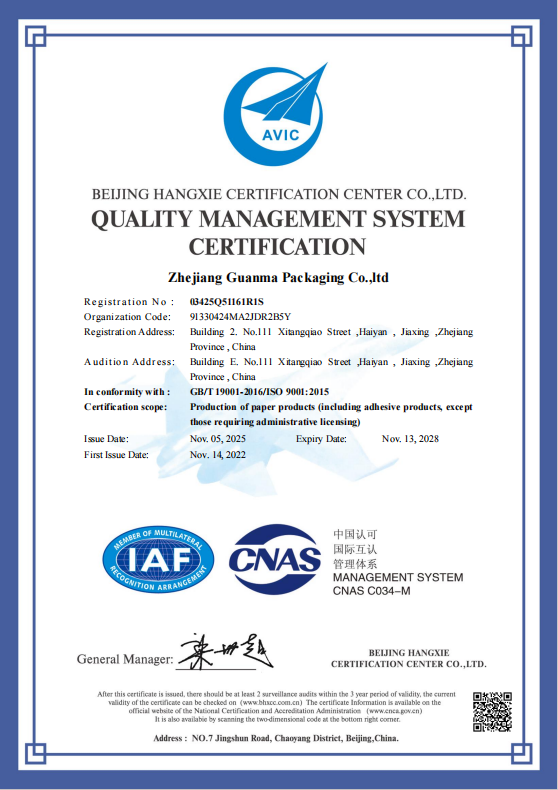
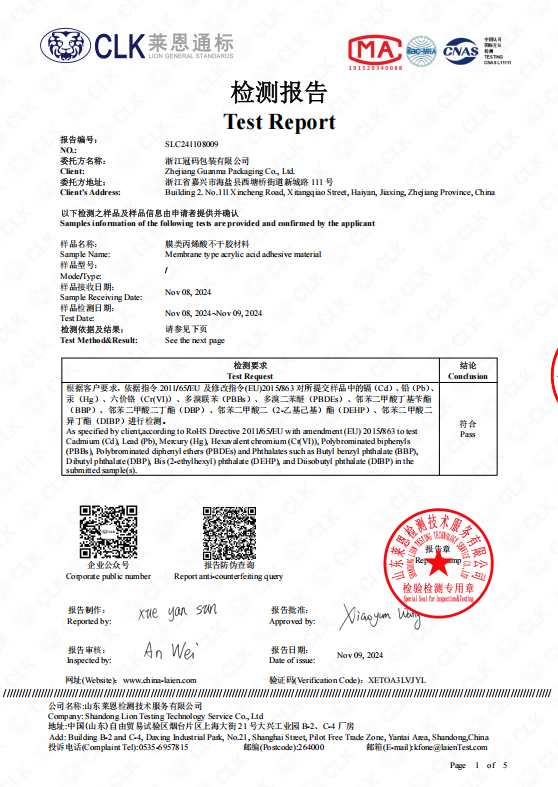
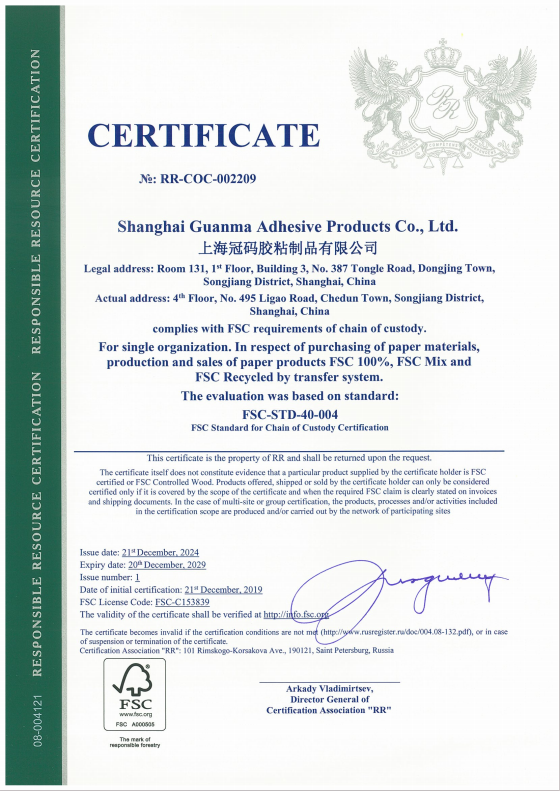
What Each Standard Covers
ISO 9001:2015
Quality Management System certification audited yearly. All our manufacturing facilities are certified to the same standard, from raw intake, through production, on to finished product – Thailand and Vietnam factories meet the same standard.
ASTM D6252
Standard Test Method for Peel Adhesion of Pressure-Sensitive Label Stocks (90 peel angle). The benchmark in industry-accepted peel strength. We test every batch of adhesive and supply with a test report. Every shipment.
FDA 21 CFR 175.105
Adhesives for indirect food contact. Needed on food packages labels and pharmaceutical labels where the adhesive may migrate through facestock into food or pharmaceutical contents. Our food-safe water-based emulsion and acrylic adhesives are built to this regulation.
RoHS
Lead, Mercury, Cadmium, other banned chemicals All components must conform to RoHS regulations. Needed on electrical appliance labels, and automotive labels sold into Europe.
EU Food Contact
BOPP and coated paper facestocks used for European Union food contact applications.
Buyer focus: Procurement · Brand Owners (budget approval)
Procurement Guide — Sample Pack, Lead Time & Customization Framework
Most of our label material procurement is more complicated than the dollar line item. Full procurement decision weighing includes sample evaluation, technical specification validation, MOQ matching, trade lead time and production schedule fit, batch monitoring support beyond job completion. Below is the specifications framework Guanma applies when talking to new converter customers.
Free Sample Pack — Twelve Combinations Within Five Days
Typical B2B label material industry practice by which spec meet as a sample first, then order in bulk. We provide a Sample Pack drop shipped free of charge within five business days of the request. We include twelve facestocks and adhesives, cut and linered for a soft hand and easy layflat. Combinations are pre-selected for your intended application or curated within our three adhesive by three facestock matrix for broad evaluation if you do not yet know the optimal spec.
Lead Time Tier Framework
| Stage | ASEAN (Thailand, Vietnam, Indonesia, Malaysia, Singapore) | Global (Europe, South America, Middle East) |
|---|---|---|
| Sample Pack | 3-5 business days | 5-10 business days |
| Specification confirmation | Variable (your evaluation) | Variable (your evaluation) |
| Manufacturing | 10-15 business days | 15-25 business days |
| Sea freight + customs | 5-10 days (regional) | 20-35 days (intercontinental) |
| Total order-to-delivery | 15-25 business days | 25-45 business days |
MOQ & Customization Pricing Factors
Final delivered cost depends on these factors you can readily control. We provide the values so your budget planning can prepare for the variable swings.
- Facestock choice – we use the cost baseline of coated paper and PP synthetics. Expect a premium for PET, BOPP, polyimide, metalized facestocks.
- Adhesive chemistry – we use the cost baseline of waterbased and conventional hotmelt. Expect a premium for specialty variants like those cold chain hotmelts and acrylic UV-stableders.
- Liner specification – CCK and glassine are basic; PE and PET liners command premium price for high-precision die-cutting.
- Order volume – MOQ (minimum order quantity) depends on facestock and adhesive combination; basic combinations are generally made in 5,00010000 linear meters minimum, specialty formulas go much higher.
- Degree of customizability – basic combinations are shipped from stock; custom-formulated, high/low temp specialties (oil/grease resistant, strong/weak peel, aggressive/removable adhesion, outdoor weatherability) require R&D scoping with longer initial lead time, stable repeat-order lead time once formula finalized.
Submit a custom R&D brief for specialty applications
Including high-temp, low-temp, aggressive adhesion, or outdoor weatherability
Engineering & Specification Tools
Label Material Lead Time Calculator
Plan your converter production schedule. Calculate Sample Pack to bulk delivery timeline based on destination, customization complexity, and order volume.
Access CalculatorFacestock Spec Comparison
Compare Guanma facestock options side-by-side. Select 2-4 facestocks to see the spec table for direct comparison.
Compare SpecificationsSelf-Adhesive Paper FAQ — Converter and Brand Owner Common Questions
Buyer focus: All — selected for procurement decisions
Self-adhesive paper for labels consists of three layers: a printable facestock (coated paper, thermal paper, PET, PP synthetics, BOPP, or kraft, depending on label type), PS (pressure-sensitive) adhesive (hot-melt, water-based emulsion, or acrylic), a release liner (CCK, glassine, PE, or PET). These three layers are coated, laminated, and slit at our facility into web rolls or sheets to be die-cut by converter for application by a labeling machine.
First consider your operating environment: temperature range, moisture exposure, UV exposure and abrasion. Add printability requirement: flexo, digital, thermal transfer or direct thermal. Then add regulatory compliance requirement: FDA, RoHS, EU food contact. Our 9 Application matrix above shows the most popular combinations. For applications falling outside the matrix entries; or using non-standard properties such as cryogenic, high-ph chemical resistance, or 7-year outdoor Durability; pass us a custom brief and our R&D team will recommend a proven-tested combination.
Hot-melt adhesive is fast setting, high-tack, good textured-surface adhesion, but softens above 60C, can’t be repositioned. Water-based emulsion adhesive is environmentally friendly, permanent or removable; lower initial tack, slower setting time, lower performance in cold environments, but good for positioning and repositioning during application. Acrylic adhesive has widest temperature resistance -40C to +150C, best UV stability, hence the highest up-front cost and lowest initial tack; most applications only require one or twoof the three adhesives at most, special applications might need all three adhesives.
Yes. All our FDA 21 CFR 175.105 compliant water-based emulsion adhesives and some adhesives are FDA-compliant for accidental indirect food contact. Our coated paper, kraft and BOPP/PP facestocks for Food Packaging are also EU-compliant. For migration-safe pharma labels, visit our dedicated Pharmaceutical Labels page..
Sample Pack ships in five working days. After your specification is approved, production will be running in 10-25 working days, depending on number of facestocks and adhesives involved. Sea freight shipping to ASEAN addresses takes 5-10 days; to South America, Europe, and the Middle East ranges from 20-35 days. Customers ordering ASEAN regional stock 15-25 days from order to delivery; worldwide customers should expect 25-45 days.
Honest answer: most combinations work, just not every combination makes engineering sense. PET facestocks with water-based emulsion adhesives on a CCK liner will do the trick, but acrylic adhesive on PET liner is a superior combination for outdoor durability. Our R&D team will pre-alert you to our engineering trade-offs at the sample stage versus you having to learn your lessons in manufacturing. The Free Sample Pack shown here demonstrates the practical boundary of three-layer compatibility with one dozen combinations.
Avery Dennison and HERMA are the Gold Standard brands in global label material and pricier 30-50% than Guanma for the same spec. slight performance difference is not distinguishable on usual applications like coated paper and glassine liner with hot-melt adhesives. We differentiate on three points: regional supply chain support for ASEAN converters (we ship in days, not weeks), highly integrated coating + laminating + R&D under one quality system, and flexible sample turnaround for formulation customization. Request a sample pack for a side-by-side spec sheet comparison using your application.
Both. Standard converter widths 25mm to 1300mm, jumbo rolls for high volume conversion of multiple line widths from the same master roll can be arranged. Slitting to European standards given the necessary purity of cut. Custom widths are available for niche applications using a one-off setup fee which we waive on orders above standard volume through put.
Three common mistakes we identify: matching adhesive chemistry to the print process, not the face stock (another common mistake with cold chain freezer applications), selecting the wrong liner based solely on price without evaluating the release force relationship with the applicator (resulting in web breaks), and not anticipating the environmental durability requirement until a high percentage of labels fail. The Nine-Application matrix above is organized to call out each of those decisions explicitly. Similar information is included in the industry resource articles at Beontag and the Avery Dennison film selection PDF.
Both. We undertake formulation projects for a range of packaging formats or application specifications – starting at modest pilot volumes between 1,000-5,000 linear meters – given that the successful piloting will result in a repeat order at a standard MOQ. Pilot fees are rolled into the first commercial order. This is a normal route for brand owners who are either launching a new good or developing a new package design requiring an additive performance spec.