Get in Touch with Guanma

Label adhesive dwell time is the interval between applying a pressure-sensitive label and subjecting it to peel testing, case packing, or cold storage. Under standard room conditions (23 °C and 50% relative humidity per ASTM D3330), 3M’s pressure-sensitive adhesive guidance cites roughly 50% of ultimate bond strength at 20 minutes, 90% at 24 hours, and 100% at 72 hours. Standard test methods use fixed windows: 1 minute under ASTM D3330 and ISO 29862:2024, or 20 minutes and 24 hours under FINAT FTM 1 and FTM 2.
Treating immediate grab as final adhesion causes two expensive errors on packaging lines. Quality teams reject good rolls because of premature early pulls on low energy plastic. Production planners also move warm acrylic-labeled containers into sub-zero storage before the adhesive wets out the wall. Matching your dwell window to the adhesive chemistry, substrate surface energy and first downstream stress prevents premature label failure.
What Is Label Adhesive Dwell Time and Why Does PSA Bond Strength Climb After Application?
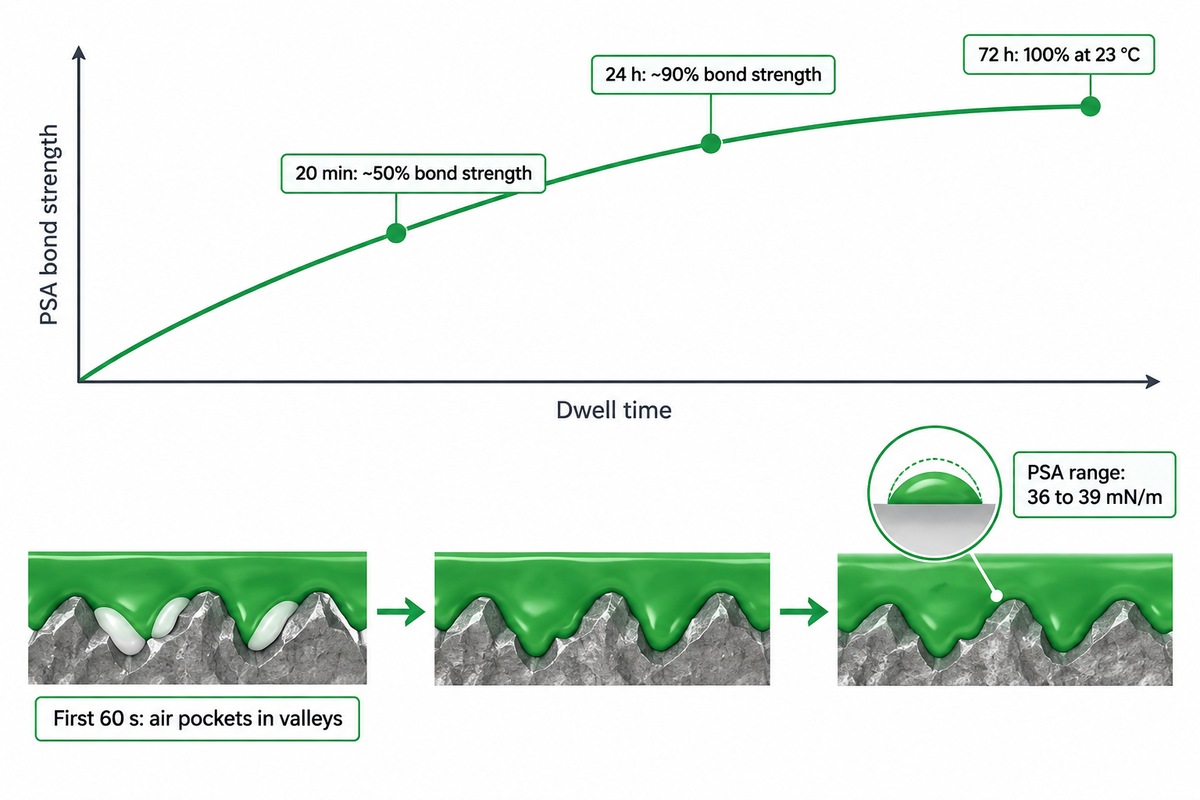
A pressure-sensitive adhesive builds bond strength through viscoelastic wet-out rather than chemical curing, developing early lab grip quickly and maturing at 23 °C over one to three days. Wet-out of a viscoelastic adhesive describes its flow into the peaks and valleys of a surface after being pressed against it. Picture pressing cold honey onto textured wood.
- Over the next one to three days at room temperature, polymer chains finish wetting rough pores and low-energy plastics to build working and full ultimate strength.
- During the first 60 seconds, applicator wipe-down presses the adhesive layer against surface high spots while tiny air pockets stay trapped inside surface valleys.
A lot of buyers misunderstand the difference between dwell time and cure time. Many expect solvents to fully evaporate, or cross-links to form before considering the adhesive laminated. Emulsion acrylics are already dried in the coating oven, while hot-melt rubbers solidify as they cool on the liner.
What does self-adhesive mean in practical terms for bond build-up?
In terms of practical manufacturing, self-adhesive means a pressure-sensitive label bonds with mechanical pressure only. No heat, water or solvent is needed to activate the bond. Because no chemical reaction sets the bond, adhesive performance climbs gradually after labels are applied. A permanent self-adhesive label on a clean substrate normally shows lower peel strength at minute one than after a full overnight ambient dwell at 23 °C.
Most commercial pressure-sensitive adhesives are near the 36 to 39 dynes/cm (mN/m) range, based on Avery Dennison’s published wetting guidelines. If the surface energy of the substrate is greater than this, then wetting occurs rapidly. Below 36 mN/m, polymer flow slows down and demands tighter control over pressure, temperature, and dwell duration. In addition, peer-reviewed acrylic PSA research indexed in PubMed Central (PMC7761465) demonstrates that lowering polymer gel content increases peel resistance and tack while reducing shear resistance.
How Long Should You Wait Before Testing Label Peel Strength? (FINAT, ASTM, PSTC, and ISO Dwell Windows)
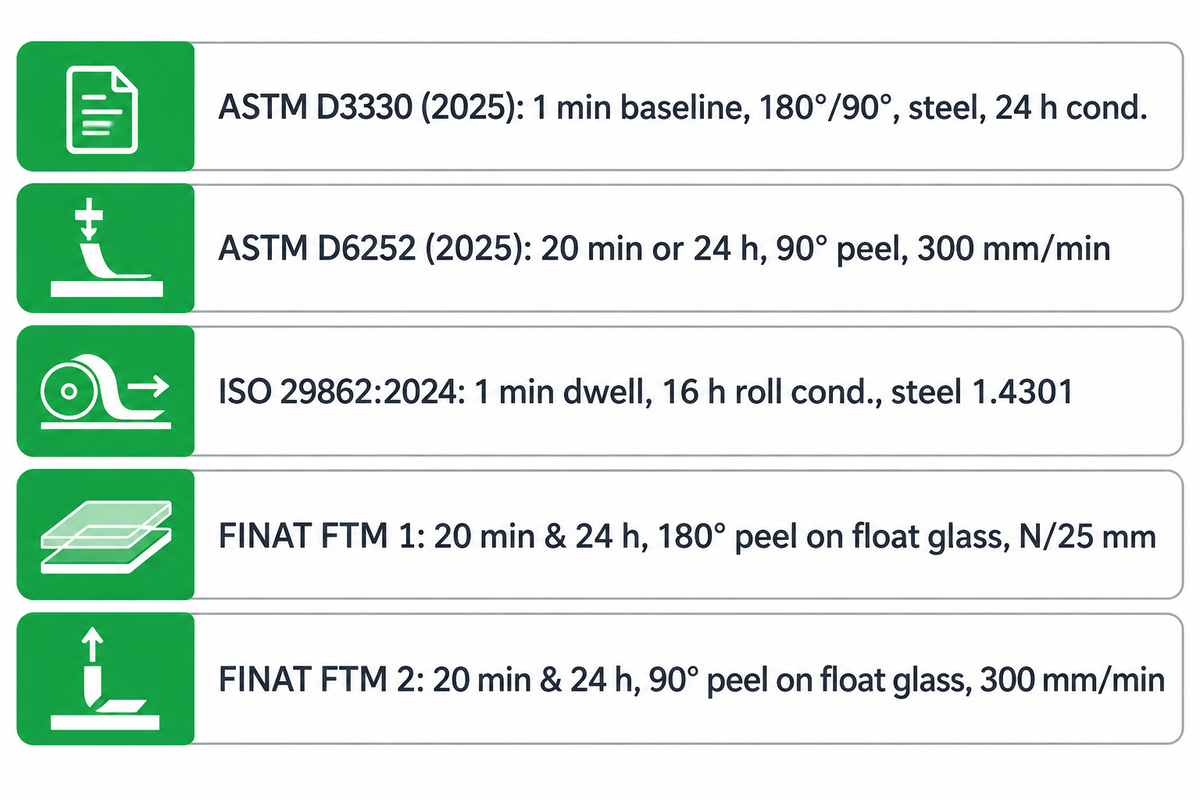
Wait 1 minute for baseline quality-control pulls under ASTM D3330/D3330M-04(2025) and ISO 29862:2024. Under FINAT FTM 1 and FTM 2, wait 20 minutes for initial checks and 24 hours for the FINAT “ultimate” adhesion checkpoint (roughly 90% of full bond in 3M’s curve). Each method locks atmosphere, roller weight, panel finish and pull speed.
| Test Standard (Current Edition) | Standard Dwell Window | Peel Angle & Speed | Panel, Strip & Roller | Pre-Test Conditioning & Units |
|---|---|---|---|---|
| ASTM D3330/D3330M-04(2025) | Within 1 min baseline; optional 20 min, 24 h, or 72 h | 180° (Method A) or 90° (Method F); 300 mm/min | Polished stainless steel; 24 mm strip; 2 kg roller, 1 pass each way | 24 h at 23 ± 1 °C, 50 ± 2% RH (ASTM D4332); N/100 mm or oz/in |
| ASTM D6252/D6252M-98(2025) | Per specification (typically 20 min or 24 h for label stock) | 90° peel; 300 mm/min | Standard steel or target substrate; label stock strip | Standard lab atmosphere; SI or inch-pound used separately |
| ISO 29862:2024 (3rd Edition) | 1 min standard dwell | 180° (Methods 1–4) or 90° (Annex A); 300 mm/min (5 mm/s) | Stainless steel 1.4301 (2R); 2 kg roller, 2 passes each way | 16 h roll conditioning at 23 ± 1 °C, 50 ± 5% RH; N/10 mm |
| FINAT FTM 1 (2024-08) | 20 min (initial) and 24 h (FINAT ultimate checkpoint) | 180° peel; 300 mm/min | Clean float glass; 25 mm strip; standard 2 kg roller | 23 °C, 50% RH; average over 50 mm; N/25 mm |
| FINAT FTM 2 (2024-08) | 20 min (initial) and 24 h (FINAT ultimate checkpoint) | 90° peel (reduces paper tear); 300 mm/min | Clean float glass; 25 mm strip; standard 2 kg roller | 23 °C, 50% RH; average over 50 mm; N/25 mm |
For purchase acceptance, pull at 1 minute for ASTM D3330 baseline checks, at the initial FINAT checkpoint for supplier datasheet comparisons, or after an overnight dwell for developed-bond specs. Match the supplier’s glass or steel panel method for incoming roll release. For line approval, assess label performance on actual containers during both short and full-day checkpoints. Cross-check broader qualification protocols in our guide to label durability test methods and reporting.
Peel force of permanent pressure-sensitive labels usually increases, rather than decreases, between the initial and overnight checkpoints. Peer-reviewed 180° peel data on glass by Márquez et al. (Polymers, 2020) recorded higher label adhesion after a full day than at the initial checkpoint across both PET and paper facestocks. Should full day peel decrease as compared to short dwell peel, look for migration of plasticizers or contamination of the surface.
The 20-Minute / 24-Hour Ratio Check lets you evaluate those two critical stages of a laminating operation in a diagnostic manner. Apply six strips to your production container with a standard 2 kg roller. Pull three strips at the early FINAT mark and three matched strips after an overnight hold, at 300 mm/min. Divide the average force of the early strips by that of the overnight-hold strips. A low ratio indicates a slow wet-out that requires longer staging or a higher-tack adhesive. A ratio near or greater than 1.0 indicates either instant wet-out or a delayed interfacial drop caused by migrating oils or plasticizers.
“Test Methods A, B, C, E or F cannot be used to compare two pressure-sensitive tapes of the same type but of different manufacture for their ability to adhere to a surface. This is because the measured peel force is not normalized to a fixed area of stress. The area under stress varies with backing stiffness and adhesive rheology (firmness).”
Use ASTM D3330 Methods A, B, C, E and F to track lot-to-lot uniformity for one tape construction and compare its bond across substrates, not to rank different manufacturers against each other. Section 5.5 of ASTM D3330/D3330M-04(2025) adds that peel adhesion usually bears no direct link to functional requirements. Conduct final specification peel tests along with functional line checks, e.g. curved-mandrel flagging or cold-box holds.
What are the ASTM standards for adhesives used in label peel testing?
Two active ASTM standards govern label peel testing, and both were reapproved active in August 2025. ASTM D3330/D3330M-04(2025) covers pressure-sensitive tapes at 180° (Method A) and 90° (Method F). ASTM D6252/D6252M-98(2025) covers 90° peel adhesion specifically for pressure-sensitive label stocks. ASTM D3330 mandates 24-hour pre-conditioning at 23 ± 1 °C and 50 ± 2% RH per ASTM D4332, ignoring the first 25 mm of peel and averaging the next 50 mm.
Hot-Melt Rubber vs. Acrylic Label Adhesives: How Chemistry Controls Bond Build-Up on HDPE and Cardboard
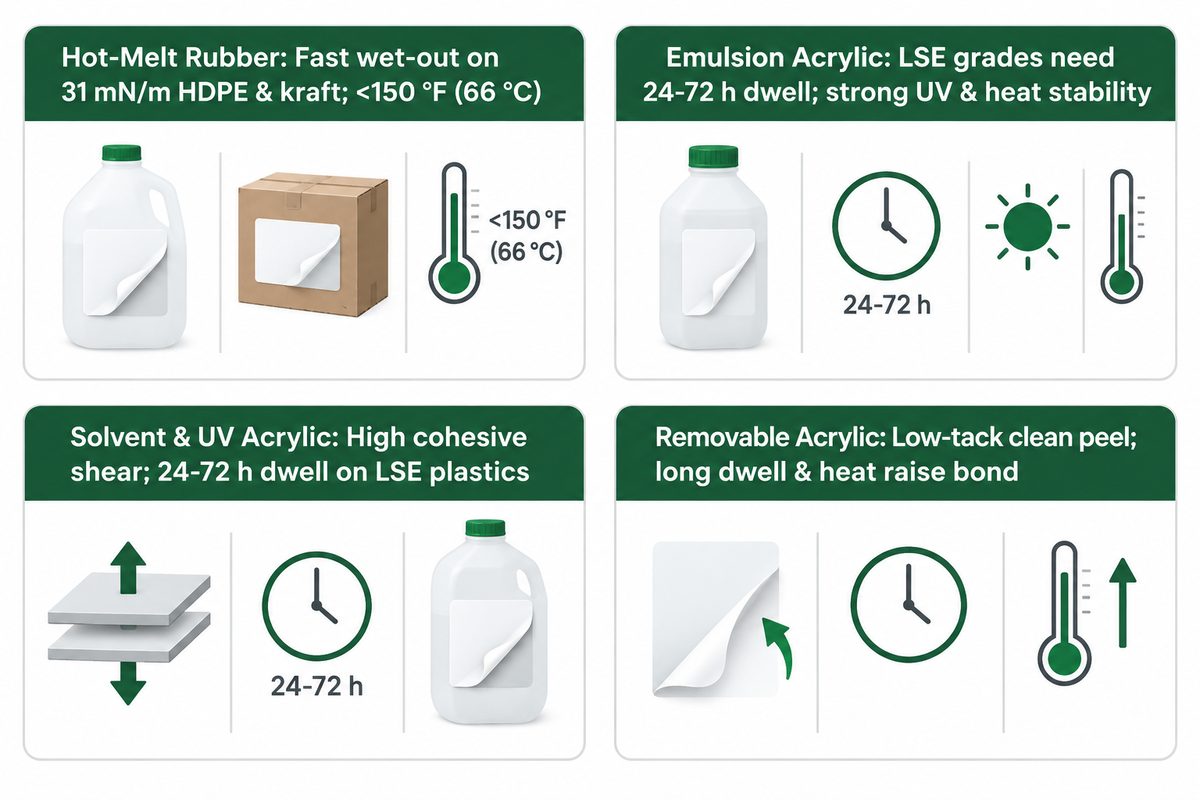
Hot-melt rubbers have high initial tack and rapid wet-out on untreated HDPE and corrugated board, while LSE-modified acrylics build strength over a 24-72 hour period. General purpose acrylics on untreated 31 mN/m HDPE can lift regardless of dwell time, unless tackifier-modified. Rubber polymers lose heat resistance near 150 °F (66 °C) and degrade under UV exposure.
| Adhesive Chemistry | Untreated HDPE (~31 mN/m) Behavior | Corrugated Cardboard Behavior | Environmental & Service Boundaries |
|---|---|---|---|
| Hot-Melt Rubber (HMPSA) | High initial tack and fast wet-out via low-Tg block polymers | Rapid fiber grab across rough kraft flutes; quick fiber-tear pass | Heat limit typically below 150 °F (66 °C); poor UV and solvent resistance |
| Emulsion Acrylic (Water-Based) | General grades lift on untreated PE; LSE-modified acrylics need 24–72 h ambient dwell | Moderate early grip; requires firm wipe-down and extended dwell for full fiber anchorage | UV-resistant and stable under heat; strong aging stability for indoor and outdoor runs |
| Solvent & UV Acrylic | High cohesive shear; requires tackified LSE grade plus 24–72 h ambient dwell | High shear hold; lower instant tack than rubber on dusty recycled cartons | High chemical resistance and UV stability for industrial and outdoor equipment |
| Removable Acrylic / Microsphere | Engineered for controlled low peel; stays clean-peeling longer on non-porous film | Can lock into porous paper over extended dwell and tear surface fibers | Long-term dwell and heat gradually raise peel force toward near-permanent levels |
Hot-melt pressure-sensitive formulations rely on low-Tg thermoplastic block polymers, disclosed at 5 to 50 wt% in WIPO patent WO2022150688A1, to wet non-polar plastics rapidly. On corrugated shipping cartons, acceptance usually relies on visible fiber tear, because the kraft board splits before the bond fails. Permanent emulsion acrylics require firm wipe-down pressure and overnight ambient dwell to reliably anchor dusty fibers from recycled linerboard.
Even within a single adhesive type, monomer ratios push dwell speed and shear hold in opposite directions. Márquez et al. (Polymers, 2020) varied chain transfer agent tert-dodecyl mercaptan from 0.0 to 0.2 phm in water-based acrylic adhesive formulations. Raising the transfer agent lowered polymer gel content, boosting loop tack and glass peel while reducing static and dynamic shear resistance.
“The increase of chain transfer agent caused decrease of the gel content resulting in higher peel resistance and tack values, but lower shear resistance values.”
Two acrylic grades can show opposite dwell and shear curves on the same glass panel. High-tack modified acrylic adhesives wet out faster, yet they creep sooner under warm shear loads. High-cohesion acrylic grades resist edge ooze and UV degradation while requiring longer dwell before resisting peel. When comparing US and European datasheets across chemistries, remember that converting 40 oz/in to 0.438 N/mm (10.9 N/25 mm) changes only the unit, keeping the original 180° angle, dwell time, and substrate intact.
Removable adhesives create the inverse dwell hazard. Permanent adhesive buyers watch for a weak early grab, while buyers specifying removability for a visible label must watch long-term adhesion build-up. Long durations of storage or transport, especially warm transport, can cause removable formulations to flow deeper into the substrate, often creating a near-permanent bond. Review “removable label clean-release specifications” and test aged peel of “removable label materials” for the entire shelf life.
Plasticized vinyl and flexible packaging films introduce a documented dwell reversal. A 2023 Pressure Sensitive Tape Council study (PSTC 2023, Einsla et al.) compared aged and as-is specimens after a full-day dwell. Every aged sample showed lower peel strength than the matched as-is sample. Migrating plasticizers soften the adhesive during dwell, turning extra wait time into bond loss unless plasticizer-resistant adhesive technologies are used.
How Substrate Surface Energy, Texture, and Contaminants Change Required Dwell Time
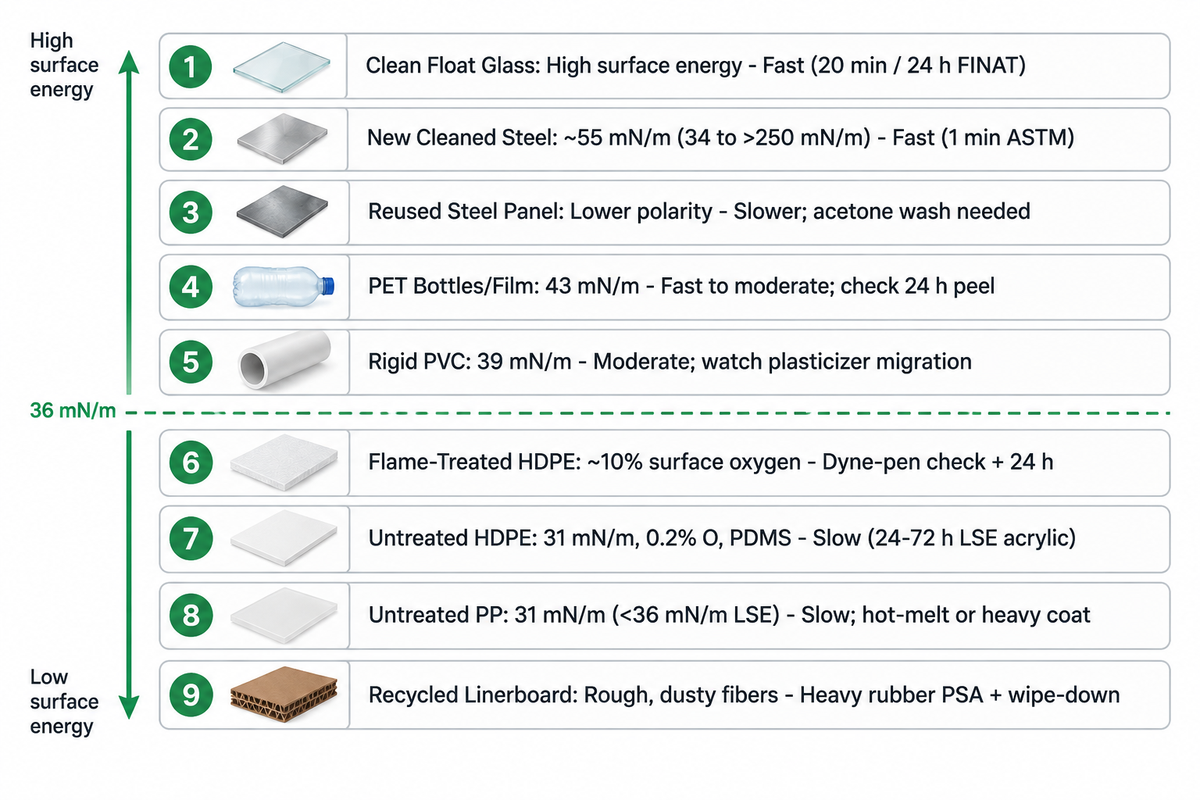
Clean glass and freshly cleaned stainless steel surfaces sit near or above 55 mN/m and let pressure-sensitive adhesives (PSAs) wet out the substrate within minutes. Untreated polyethylene and polypropylene sit at 31 mN/m in 3M’s polymer surface-energy data and slow wet-out sharply.
Think about water beading on a waxed car hood versus spreading flat on bare glass. High energy substrates pull the adhesive polymer outward allowing contact area to grow quickly. Low surface energy plastics repel polar acrylic groups, leaving microscopic air pockets under the label material. Any contaminant, such as silicone mold release, slip agents, cardboard dust or condensation, lowers effective surface energy even further.
| Substrate Condition | Reference Surface Energy / State | Wet-Out Speed | Primary Barrier or Variable | Dwell & Material Action |
|---|---|---|---|---|
| Clean Float Glass (FINAT panel) | High surface energy (smooth polar) | Fast | Condensation or wash residue | 20 min initial / 24 h FINAT benchmark |
| New Cleaned Stainless Steel | ~55 mN/m cleaned (34 to >250 mN/m range) | Fast | Solvent cleaning protocol consistency | 1 min ASTM/ISO baseline; track panel age |
| Reused / Aged Stainless Steel Panel | Lower polarity prior to baking/acetone wash | Slower than new steel | Trace adhesive and organic film buildup | Re-clean with acetone or replace test plates |
| PET Polyester Film / Rigid Bottles | 43 mN/m | Fast to moderate | Anti-static or slip coatings on bottles | Standard acrylic or rubber; check 24 h peel |
| Rigid PVC Containers | 39 mN/m | Moderate | Plasticizer migration in flexible PVC grades | Compare 24 h aged peel vs 24 h as-is peel |
| Flame-Treated HDPE Bottles | ~10% surface oxygen | Fast to moderate | Treatment decay over prolonged bottle storage | Dyne-pen check before labeling; 24 h build |
| Untreated Blow-Molded HDPE | 31 mN/m; 0.2% surface oxygen; PDMS traces | Slow | PDMS silicone and lauryl sulfate residue | Hot-melt builds within minutes; LSE acrylic needs 24–72 h |
| Untreated Polypropylene (PP) | 31 mN/m (below 36 dynes/cm LSE cutoff) | Slow | Non-polar surface plus mold-release slip | Pair higher coat weight or hot-melt chemistry |
| Recycled Corrugated Linerboard | Rough, porous, dust-prone fiber peaks | Slow with thin coat | Short recycled fibers and paper dust | Heavy-coat rubber PSA + firm wipe-down |
A Dow Chemical surface-analysis study published in Adhesives & Sealants Industry notes that published solid stainless-steel surface energy spans 34 to over 250 mN/m across clean and handled plates. In that XPS and SIMS lab study, an untreated HDPE control bottle carried just 0.2% surface oxygen, while SIMS detected polydimethylsiloxane (PDMS) silicone and lauryl sulfate on commercial untreated HDPE bottles. Flame treatment lifted surface oxygen to nearly 10% and transformed bond compatibility.
The texture of a surface has a strong effect on wet-out as well. On smooth surfaces like glass, for example, a thin layer of adhesive coating rapidly achieves full contact. On rough or textured surfaces, such as matte polypropylene or recycled cartons, the adhesive must flow down into surface valleys first. Flexible BOPP label film stocks on squeezable bottles or rigid PET adhesive film materials on flat industrial panels keep the facestock stiffness matched to the substrate.
Cold-Storage and Freezer Dwell Time: How Long to Wait Before Chilling or Freezing Labeled Containers
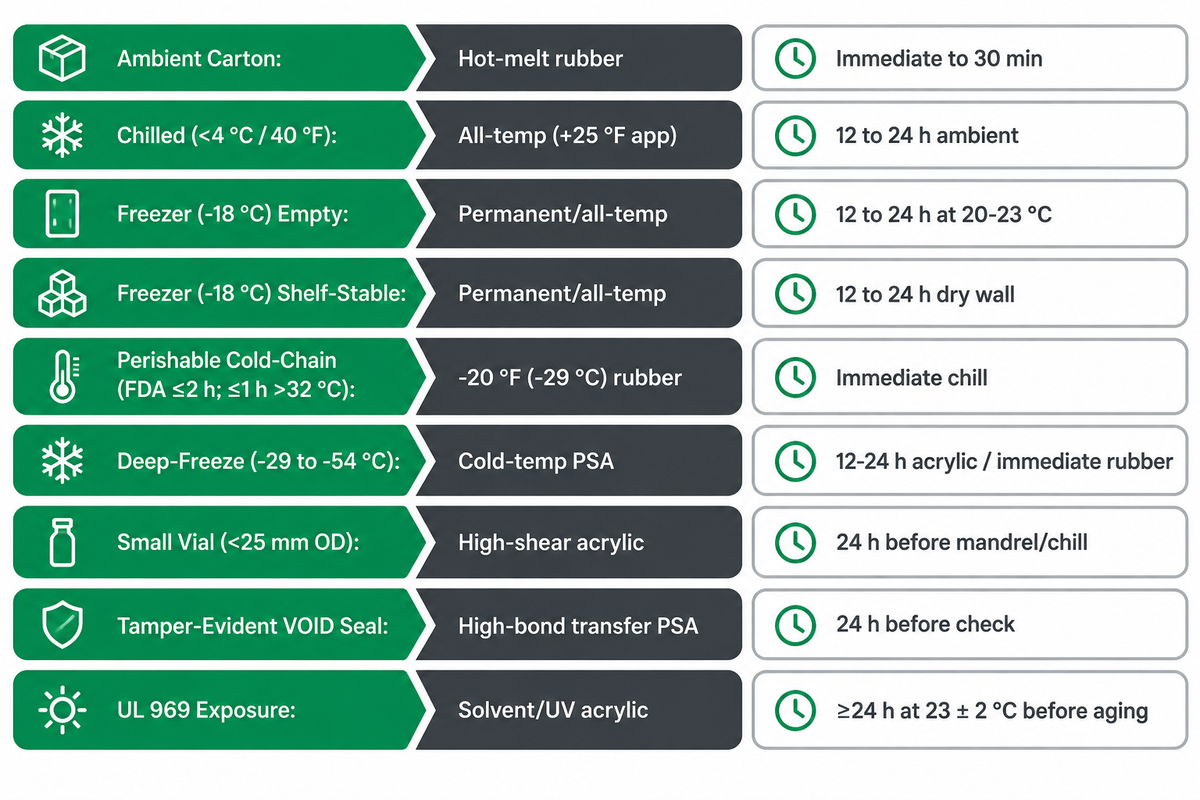
Hold empty or shelf-stable containers at room temperature for 12 to 24 hours before freezing ambient-applied permanent labels at -18 °C. For filled perishable goods entering chill within 2 hours, use a cold-application adhesive rated to -20 °F (-29 °C). General-purpose adhesives stiffen at low temperatures below 40 °F (4 °C).
A full-day ambient dwell suits empty bottles or shelf-stable jars, while filled perishable goods cannot wait on the warehouse floor. Under U.S. Food and Drug Administration (FDA) food safety guidance, raw meat, poultry, seafood, eggs, and produce that requires refrigeration should not sit at room temperature for more than 2 hours. When ambient temperature exceeds 90 °F (32 °C), that room-temperature holding limit drops to 1 hour.
The Chemistry-to-Load Dwell Ladder below helps you select the appropriate adhesive and staging window based on your container state (environmental conditions) and downstream mechanical stress.
| Production / Load Scenario | Container State | Recommended Adhesive Tier | Pre-Stress Dwell Window | Key Control Check |
|---|---|---|---|---|
| Ambient Carton Case-Packing | Dry ambient box | Hot-melt rubber PSA | Immediate to 30 min | Confirm fiber tear before pallet stretch-wrap |
| Chilled Storage (below 4 °C / 40 °F) | Empty or shelf-stable | All-temp PSA (+25 °F / -4 °C app) | 12 to 24 h at ambient | Keep wall dry prior to label contact |
| Standard Freezer (-18 °C) | Empty containers (pre-fill) | Permanent acrylic or all-temp PSA | 12 to 24 h at 20–23 °C | Check service temp rated down to -54 °C |
| Standard Freezer (-18 °C) | Shelf-stable filled goods | Permanent acrylic or all-temp PSA | 12 to 24 h at ambient | Eliminate frost condensation before labeling |
| Perishable Cold-Chain (FDA ≤2 h guidance) | Filled meat, dairy, seafood | Cold-temp rubber (-20 °F / -29 °C app) | Immediate chill (pre-label or fast-tack) | Keep perishables ≤2 h (≤1 h above 32 °C) |
| Deep-Freeze Storage (-29 °C to -54 °C) | Vials or pouches | Cold-temp permanent PSA (-54 °C service) | 12–24 h ambient for permanent acrylic; immediate chill for cold-temp rubber | Use wrap-around overlap on small vials |
| Small Curved Vial (<25 mm OD) | Glass or PP pharma vial | High-shear acrylic + thin conformable film | 24 h before mandrel/chill stress | Check edge lift after 24 h mandrel hold |
| Tamper-Evident VOID Seal | Carton flap or bottle cap | High-bond acrylic transfer PSA | 24 h before peel-transfer check | Early test causes clean lift without VOID |
| UL 969 Regulated Exposure | Equipment nameplate panel | UL-recognized solvent/UV acrylic | ≥24 h at 23 ± 2 °C, standard humidity | Required before cold, UV, or chemical chambers |
When perishable food or biologics can’t sit at room temperature, packaging lines use three practical workarounds:
- Pre-label empty tubs or pouches upstream at 20–23 °C, hold them overnight in dry staging, and fill them cold the next day.
- Use low-temperature hot-melt rubber formulations. They use low-Tg polymers to stay tacky at low temperatures.
- Combine the use of the waterproof adhesives and air-knife drying. Even a sub-zero rated adhesive will slide off frost crystals and liquid condensation.
Check polymer ratings in our freezer-grade label material selection and review our freezer label stock constructions.
What is the difference between application temperature and service temperature?
Minimum application temperature is the lowest surface temperature at which an adhesive still flows fast enough to wet out during labeling. Service temperature is the range of extreme temperatures the matured bond survives after full dwell. An all-temp adhesive may require +25 °F (-4 °C) at application while holding safely down to -65 °F (-54 °C) in service once bonded.
Can labels be applied to frozen products without waiting 24 hours?
Yes, provided you use a cold-temperature freezer adhesive rated for sub-zero application down to -20 °F (-29 °C) and keep frost off the package surface. Frost can be kept off package surfaces with dry staging or controlled/reduced humidity environments. Standard permanent acrylic labels applied directly to frozen boxes stiffen below 40 °F (4 °C) and pop off during handling. Specialized cold-temperature rubber formulations establish working grip immediately, without the need for overnight ambient staging.
Application Pressure, Coat Weight, and Line Scheduling: Turning Dwell Time into Floor Capacity
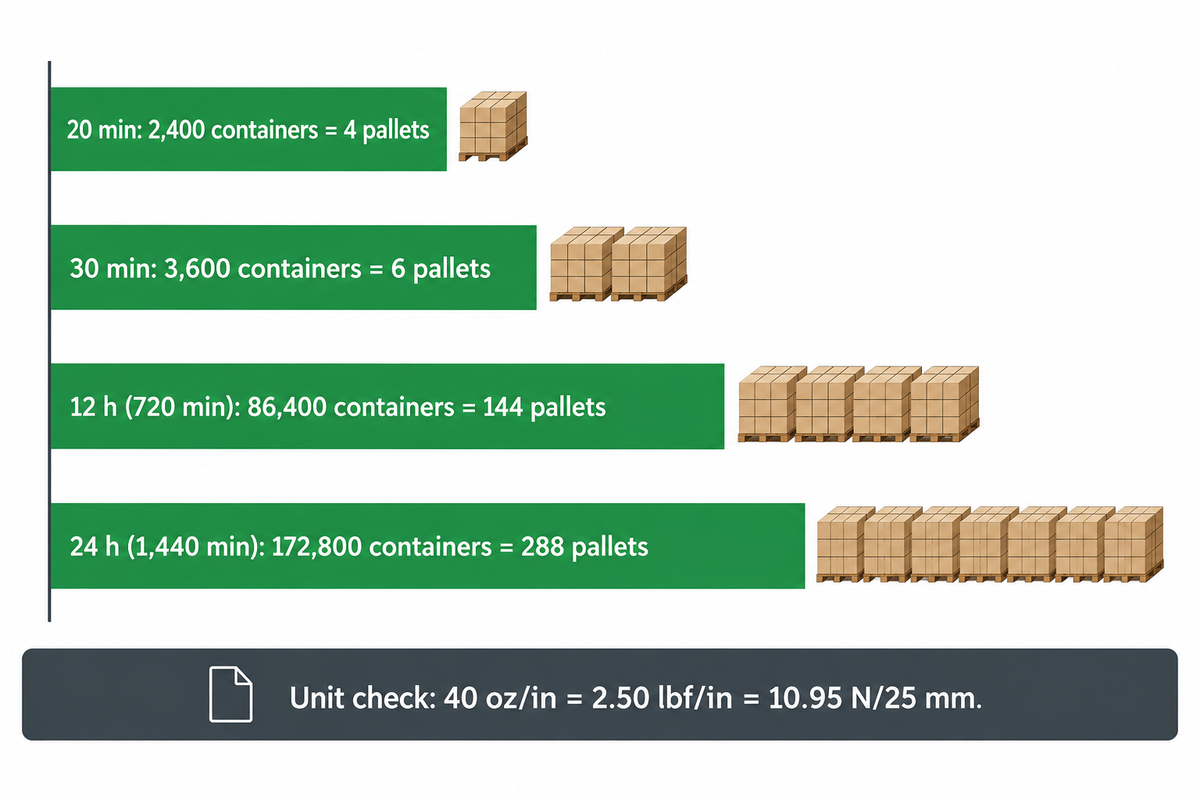
On a 120 container-per-minute packaging line packing 600 containers per pallet, a 30-minute fast-tack dwell requires 6 staging pallets. A full-day ambient acrylic dwell requires 288 staging pallets on the same line. Dwell time directly impacts warehouse floor space, work-in-process (WIP) inventory, and shift release schedules.
Example (Assumed inputs: 120 containers/min, 600 containers/pallet, continuous single-line output): Multiply line speed by dwell minutes, and divide by containers per pallet. The table below shows buffer counts for pallets prior to shrink-wrapping or cold room transfer.
| Dwell Window | Formula (Speed × Minutes) | Containers in Buffer | Staging Pallets Required |
|---|---|---|---|
| 20 minutes (short QC benchmark) | 120 × 20 | 2,400 containers | 4 pallets |
| 30 minutes (fast-tack hot-melt hold) | 120 × 30 | 3,600 containers | 6 pallets |
| 12 hours (720 min pre-chill hold) | 120 × 720 | 86,400 containers | 144 pallets |
| 24 hours (1,440 min full ambient dwell) | 120 × 1,440 | 172,800 containers | 288 pallets |
Mechanical levers shorten effective wet-out time on automated labeling systems. First, set wipe-down pressure and application techniques on the label applicator. Packaging Digest reports that automated label applicators remove the release liner and rely on firm wipe-down rollers or brushes to achieve first contact. Weak foam brushes leave micro-gaps that standard weighted lab rollers never show.
Second, set adhesive coat weight. Thicker adhesive coating fills deeper valleys faster, but too much coat weight causes edge ooze during die-cutting and label printing. Third, enforce roll shelf life with an incoming label roll inspection checklist. Aged rolls lose their initial tack.
Global packaging teams also hit specification mismatches when converting imperial datasheets to metric QA sheets. Exact conversion keeps the original test angle, substrate, and dwell time intact. Use two verified multiples: 1 oz/in = 0.010945 N/mm = 0.2736 N/25 mm, and 1 lbf/in = 16 oz/in = 4.378 N/25 mm (4.44822 N/lbf divided by 25.4 mm/in, multiplied by 25 mm).
| Imperial (oz/in) | Imperial (lbf/in) | SI per mm (N/mm) | FINAT Strip (N/25 mm) | ISO Strip (N/10 mm) |
|---|---|---|---|---|
| 20 oz/in | 1.25 lbf/in | 0.219 N/mm | 5.47 N/25 mm | 2.19 N/10 mm |
| 40 oz/in | 2.50 lbf/in | 0.438 N/mm | 10.95 N/25 mm | 4.38 N/10 mm |
| 60 oz/in | 3.75 lbf/in | 0.657 N/mm | 16.42 N/25 mm | 6.57 N/10 mm |
Curved Containers, Stiff Facestocks, and Regulated Exposure: When Premature Load Triggers Edge Lift
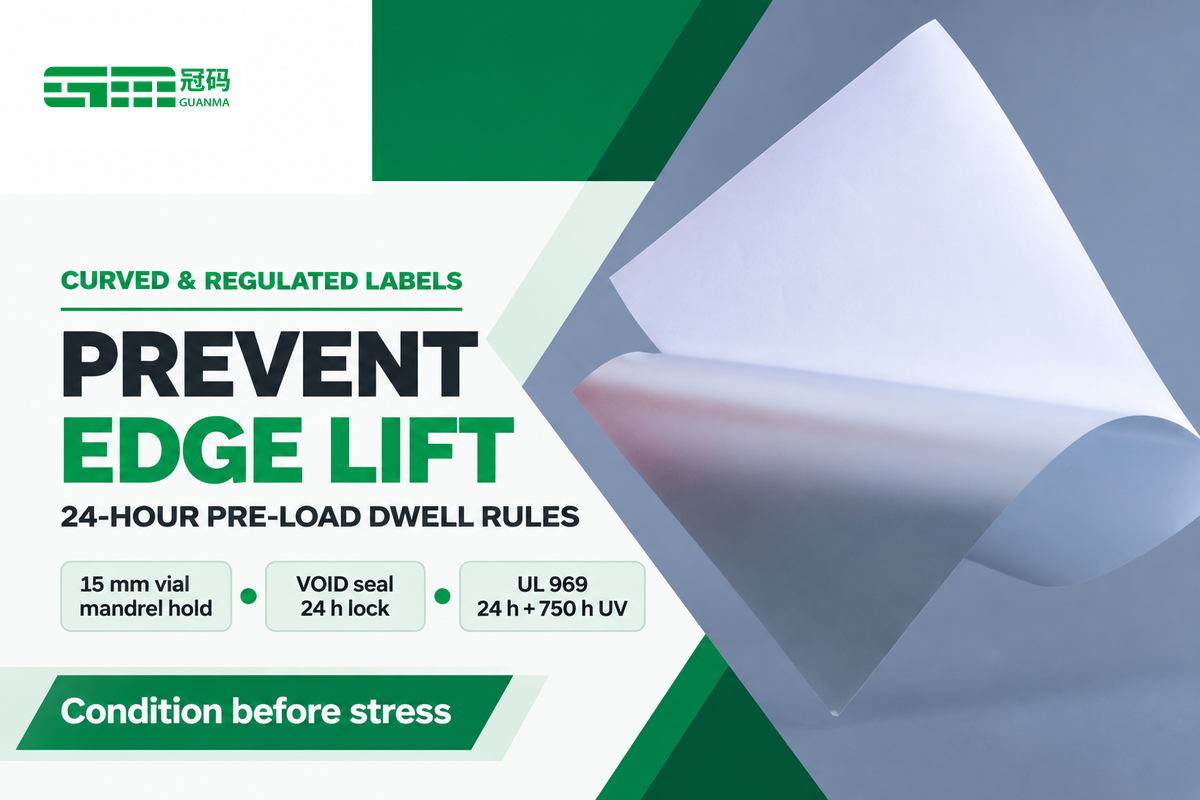
Allow at least one full day of ambient dwell before exposing pharmaceutical labels and tamper-evident seals to mechanical or thermal load. Flat-panel tests mask the spring-back of stiff films wrapped around small radii.
On both small-diameter syringes and 15 mm glass vials, a rigid facestock acts like a bent spring pulling continuously against the label edge. Because pressure-sensitive adhesive bonds creep under steady low-level tensile stress, labels moved into chilled trays early begin lifting at the trailing edge. ASTM D3330, Section 5.3 states that its peel tests A, B, C, E and F, cannot compare tapes of different manufacture due to variation in backing stiffness and adhesive rheology, while ASTM D6252/D6252M-98(2025) covers 90° peel adhesion for pressure-sensitive label stocks. Run small diameter label flagging checks and pharmaceutical container label qualification before scaling vial lines.
Security and regulated marking constructions have strict pre-exposure hold times. Tamper-evident VOID seals must build higher adhesion to the package than the internal release force of the hidden message layer. Peeling a tamper-evident seal a few minutes after application will often result in the seal coming off without voiding. After an overnight ambient dwell, the transfer layer locks onto the box and splits cleanly upon tampering.
Regulated warning and safety labels, automotive labels, and equipment labels exposed to harsh weather must complete a mandatory conditioning period before aging tests. For marking and labeling systems, UL 969 specifies at least 24 hours at 23 ± 2 °C (73.4 ± 3.6 °F) in a controlled standard-humidity atmosphere before cold holds (7 ± 0.25 hours), xenon-arc UV exposure (750 hours), or chemical immersion. Samples also require an overnight recovery period before adhesion testing. Marine drum labels qualified under BS 5609 similarly require full pre-conditioning before seawater immersion to verify long-term durability.
Diagnosing Early Peel Failures: Separating Premature Testing from True Adhesive Failure
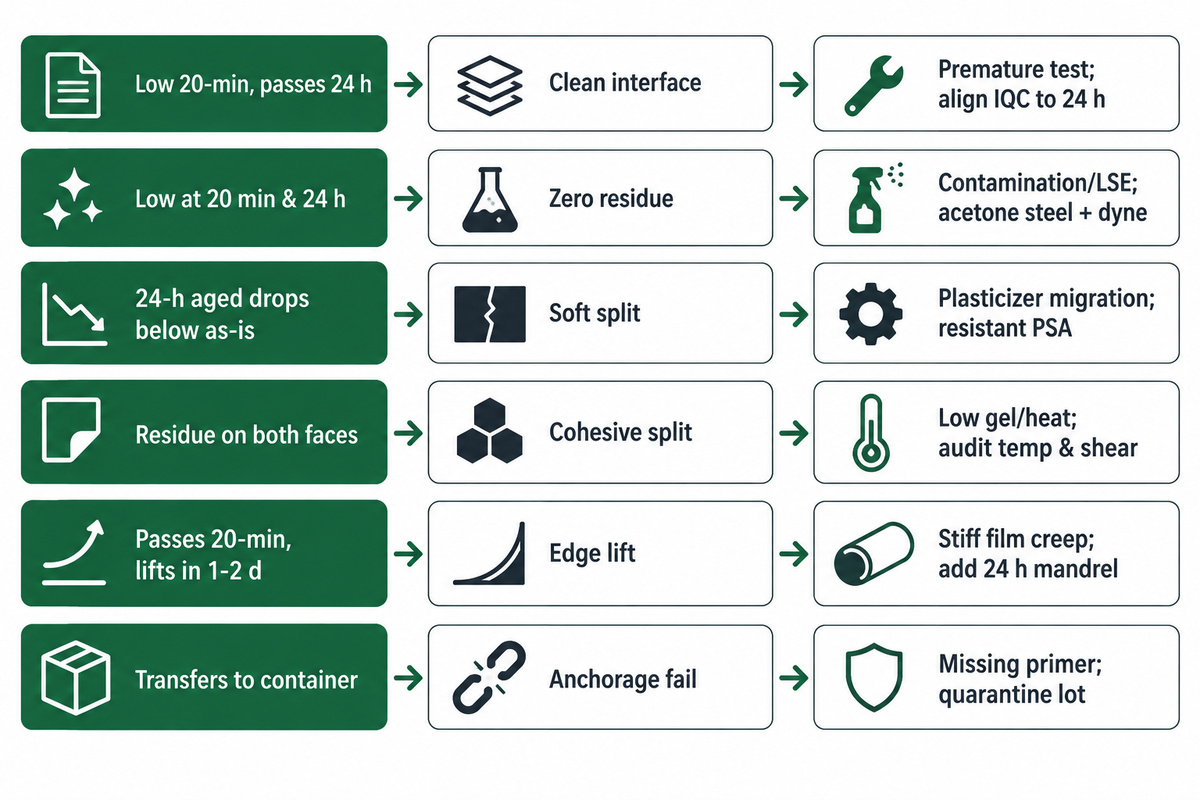
Inspect the failure locus and repeat the pull after a full-day hold on a solvent-cleaned control panel before quarantining an incoming roll over a low early peel test. Articles in the International Journal of Adhesion and Adhesives describe the two failure modes of PSA (pressure sensitive adhesive) bond separation as adhesive failure at the interface or cohesive failure within the adhesive layer.
Seeing where residue remains after peeling indicates to quality control whether it’s poor dwell time, contamination, or insufficient polymer cohesion. In Márquez et al. (Polymers, 2020), adhesive failure was seen across all series when PET tapes were tested on glass. Paper labels greater than 10 N/25 mm shifted into cohesive failure because the porous paper anchored the polymer tightly. Adhesive grades with high acrylic acid content (3.0 phm) showed adhesive transfer from the paper to the glass.
| Observed Symptom | Failure Locus | Probable Root Cause | Immediate QA Action |
|---|---|---|---|
| Low 20-min peel; passes at 24 h | Clean adhesive failure at 20 min | Premature test on slow-wet-out acrylic | Release roll; align IQC dwell spec to 24 h |
| Low peel at both 20 min and 24 h | Clean interface peel, zero residue | Mold release, low dyne level, or cold surface | Retest on acetone-cleaned steel + dyne check |
| 24-h aged peel drops below 24-h as-is | Soft, gummy cohesive split | Plasticizer or oil migration from substrate | Switch to plasticizer-resistant acrylic PSA |
| Sticky residue left on both surfaces | Cohesive failure inside adhesive | Low gel content, heat softening, or solvent attack | Audit service temperature and shear spec |
| Passes 20-min lab pull; lifts in 1–2 days | Edge lift / mandrel flagging | Stiff facestock spring-back or cold-room creep | Add 24-h curved mandrel and cold hold test |
| Adhesive transfers entirely to container | Anchorage failure at facestock | Missing primer or excessive polar affinity | Quarantine lot; initiate supplier change review |
Quick bench checks also miss delayed field defects. A Pressure Sensitive Tape Council study (PSTC 2022, David McCann) documented packaging failures that surfaced 1-2 days into storage. Eliminate four operator errors first: skipping roll conditioning, thumb-pressing strips instead of rolling with a weighted roller, reusing dirty panels, and pulling by hand instead of 300 mm/min. For a true lot shift outside spec, log the deviation under adhesive requalification protocols.
Third-Party Peel Testing Timelines, Qualification Costs, and How to Trim Lab Spend
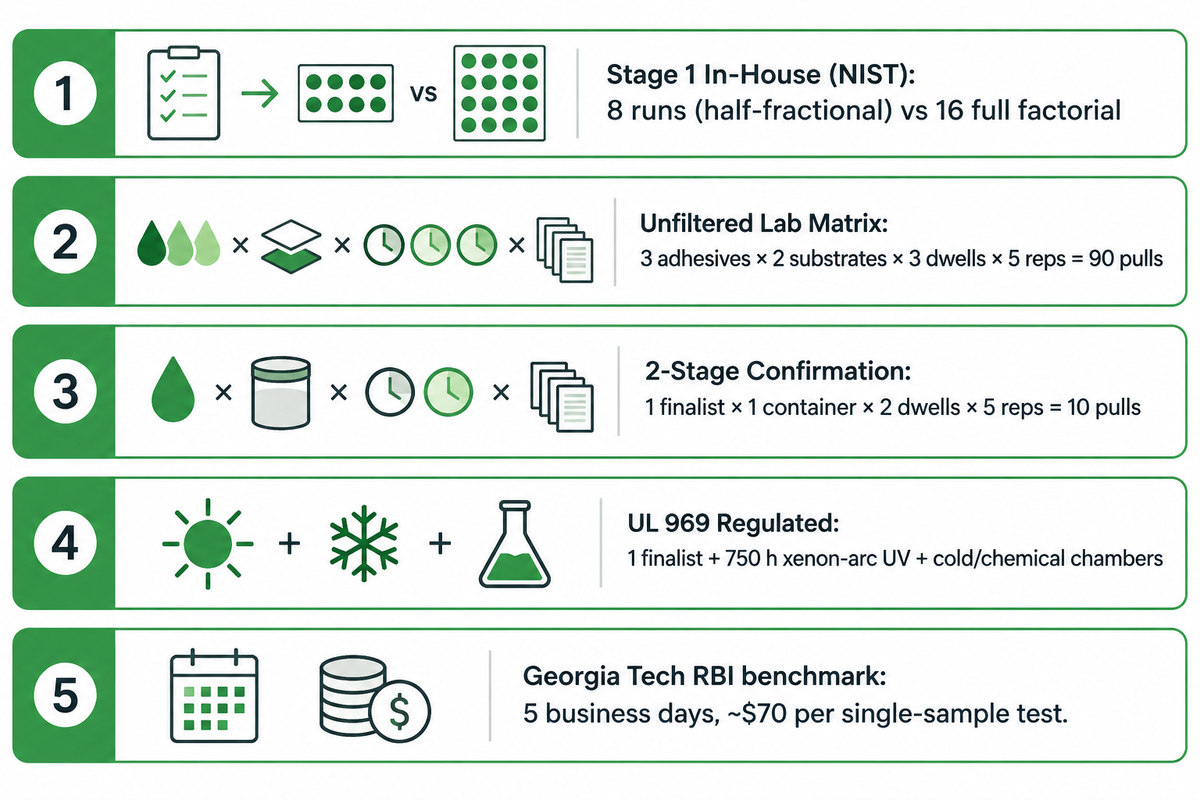
Standard ambient third-party testing takes 3 to 10 business days once samples enter the queue (Georgia Tech’s non-profit packaging lab cites 5 business days), and 2 to 6 weeks when protocols add environmental aging or UV chambers. Commercial ASTM D3330 qualification is quoted per test matrix rather than at a flat rate.
University packaging lab schedules show billing is done by contract hours. At the Georgia Tech Renewable Bioproducts Institute (a non-profit paper, board, and box testing lab), typical turnaround is 5 business days from sample receipt. Georgia Tech RBI estimates roughly $70 for one test on one sample. Multi sample paper and board projects can cost a few hundred to two thousand dollars, and are charged by staff time and queue position. Commercial ISO/IEC 17025 labs such as WESTPAK (A2LA-accredited for ASTM D3330 through January 31, 2028) and Chemsultants quote custom label matrices individually against your performance requirements.
Unfiltered test matrices drive most unexpected lab bills. Testing 3 candidate adhesive options across 2 substrates and 3 dwell checkpoints (1 min, 20 min, 24 h) with 5 replicates requires 90 pulls. Each sample group also needs 24 hours of pre-conditioning under ASTM D3330 (or 16 hours under ISO 29862:2024) before hitting the tensile frame. Apply the 2-Stage Lab Spend Filter to cut redundant runs before requesting a commercial quote:
- Perform Stage 1 in-house screening with two-level process checks before hiring an outside lab. A twice-replicated three factor two-level full factorial design as described in the NIST/SEMATECH e-Handbook of Statistical Methods (Section 5.3.3.4.1), would require 16 runs (2 × 8). A twice-replicated half-fractional design cuts this to 8 runs, provided interactions can be neglected, with 3 to 5 centerpoints added only for continuous settings. Screen two-level variables, such as high versus low dwell time and wipe-down pressure, on actual containers to drop obvious edge-lift failures.
- Send only the top 1 or 2 winning constructions to an ISO/IEC 17025 lab for formal ASTM D3330 or ASTM D6252 testing on your production container, and submit directly to UL when UL 969 recognition is required.
| Qualification Approach | Matrix Scope (Example) | Accredited Lab Pulls | Primary Schedule Driver |
|---|---|---|---|
| Unfiltered Full Matrix at Third-Party Lab | 3 adhesives × 2 substrates × 3 dwells × 5 reps | 90 pulls | Queue time + chamber load + 90 specimen setups |
| 2-Stage Lab Spend Filter (Stage 2 Confirmation) | 1 finalist × 1 real container × 2 dwells × 5 reps | 10 pulls | 24 h pre-conditioning + 24 h dwell + report issue |
| Environmental / Regulated Qualification (UL 969) | 1 finalist + 750 h xenon-arc UV + cold/chemical | Per UL 969 protocol (submitted to UL) | Multi-week exposure chambers (not tensile pull time) |
Selecting Fast-Wet-Out Label Stock Suppliers and Building a Short-Dwell Trial RFQ
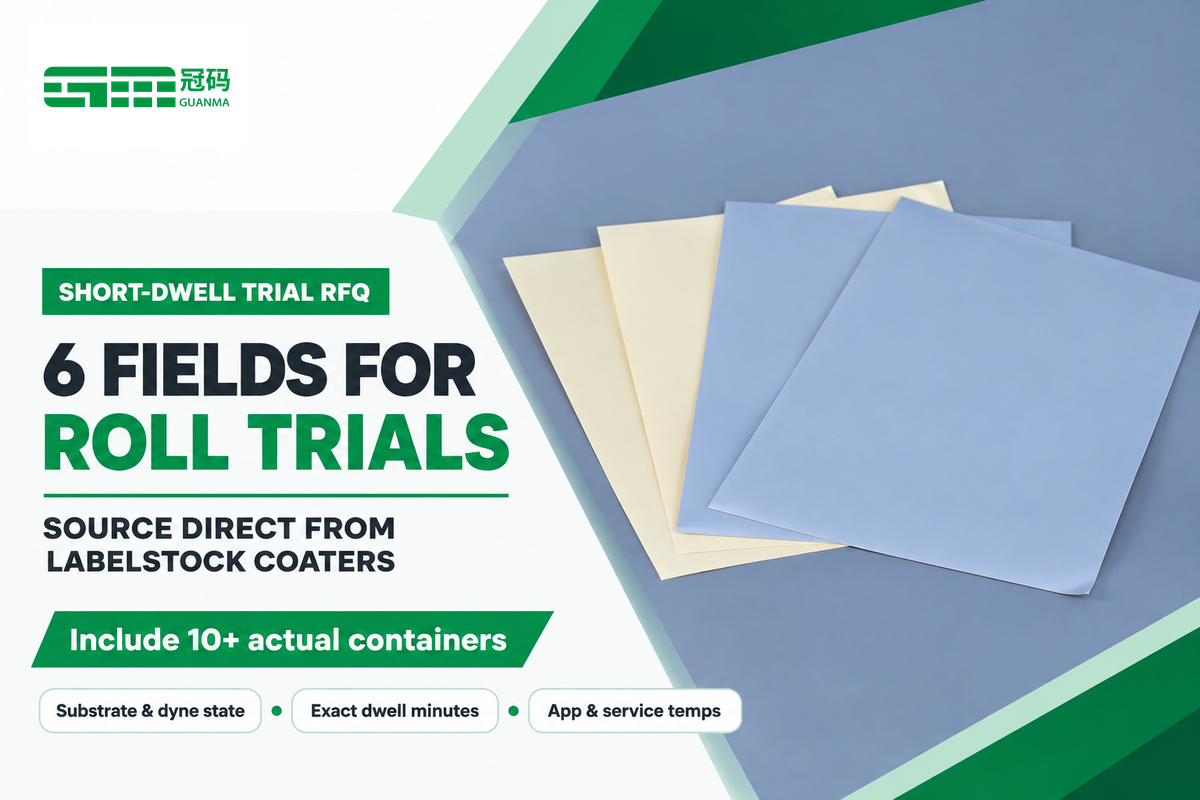
Purchase pressure-sensitive roll stock directly from a labelstock coater instead of a resin manufacturer. Give a six-field short-dwell trial brief to your supplier and specify the container resin, application temperature and the number of minutes to first downstream load. Generic sample rolls lift on fast-pack lines when suppliers never receive your real dwell window.
Buyers often confuse two tiers in the labeling supply chain. For example, companies such as Henkel and Bostik supply bulk pressure-sensitive resins and hot-melt polymers to coating mills. Labelstock manufacturers such as Avery Dennison, UPM Adhesive Materials, and Guanma turn these polymers and resins into a pressure-sensitive adhesive coating and laminate it between a paper or film facestock and a release liner to make roll stock label materials. The European Packaging and Packaging Waste Regulation (PPWR) applies generally across EU member states from August 12, 2026 (including imported packaging), while recyclability design obligations phase in later. While the above mandate comes into effect from 2026, coaters usually list short-dwell peel values versus an overnight peel value against a specific adhesive code. If coating adhesive needs to achieve a fast-wet-out state, request the candidate datasheet to help determine the adhesive selection dwell time.
In advance of requesting trial rolls of custom labels, product labels, or shipping labels, look at the initial FINAT peel value against a full day peel value on your closest substrate. Also check minimum application temperature, service temperature, and indirect food contact, and compliance separately when packaging food items. Lines that require specialized adhesives, such as adhesives for cold-room cartons or adhesives that resist harsh solvents, need facestock conformability and coat weight matched in one label selection package. For a trial of the above materials, include all the fields below.
| RFQ Field | Exact Data to Provide | Why It Controls Dwell Selection |
|---|---|---|
| 1. Target Substrate & Finish | Exact resin or board grade, dyne treatment status, curvature diameter, and mold-release history | Separates fast-wet-out glass/PET from slow-wet-out 31 mN/m HDPE and rough recycled board |
| 2. Available Dwell Window | Exact minutes or hours from label wipe-down to case-packing, shrink tunnel, or chiller entry | Decides whether standard emulsion acrylic works or fast-tack hot-melt rubber is mandatory |
| 3. Application & Service Temps | Container wall temperature at labeling, ambient humidity, condensation risk, and min/max storage temp | Locks minimum application temperature rating (for example +25 °F all-temp vs -20 °F freezer) |
| 4. First Downstream Stress | Conveyor scuffing, steam shrink sleeve, deep freeze, autoclave, or tamper-evident seal check | Matches early shear, edge-lift, and moisture resistance to the real failure trigger |
| 5. Applicator Pressure & Speed | Line speed (containers/min), wipe-down method (roller, brush, tamp, air-blow), and facestock caliper | Compensates low mechanical contact force with higher tack or heavier adhesive coat weight |
| 6. Acceptance Method & Samples | Governing test (ASTM D3330, D6252, ISO 29862, FINAT FTM 1/2), dwell checkpoints, and 10+ actual containers | Aligns lab bench sign-off with real container surface chemistry and eliminates unit mismatches |
Moisture, surface contamination, and wipe-down force are the main environmental factors that affect bond stability of high-speed processes. Guanma supplies coated film and paper self-adhesive label constructions tailored to industrial labeling needs, helping converters that require high-quality labels maintain batch-to-batch consistency. Review our pressure-sensitive film constructions for batch qualification and provide your six-field trial sheet to the engineering desk to match your adhesive requirements.
Editorial Transparency Statement: This technical guide was prepared by the Guanma editorial team using active ASTM, ISO, FINAT, UL, FDA, NIST, university testing lab, and peer-reviewed polymer references.
This technical guide was reviewed by the Guanma technical team.
Frequently Asked Questions About Label Adhesive Dwell Time
How long does permanent label adhesive take to reach full bond strength?
Based on 3M’s room-temperature recommendation cited in the introduction, permanent pressure-sensitive adhesives pass the major overnight milestone and reach full maturity within 72 hours at 23 °C. The handling grip for adhesives develops much earlier. However, on low-surface-energy plastics, such as untreated HDPE, adhesion develops very slowly, and hot-melt or modified acrylics may be necessary.
Will label adhesive stick in cold weather if applied outdoors or in a chilled warehouse?
Yes, only with a cold-rated adhesive: general-purpose permanent adhesives stiffen below 40 °F (4 °C) and fail to wet out outdoors or in chilled rooms. To apply labels reliably in cold weather, select an all-temperature formulation rated to +25 °F (-4 °C) or a freezer-grade adhesive rated for sub-zero application, and wipe frost or condensation off the container right before application.
Can standard permanent adhesives be used on refrigerated products?
Standard permanent acrylic adhesives work on refrigerated containers (below 4 °C / 40 °F) only if applied to dry, room-temperature walls and held 12 to 24 hours before chilling. They quickly lose bond to cold, damp or sweating walls. For filled perishable foods under FDA’s 2-hour room-temperature food safety guidance, pre-label empty containers or switch to a cold-temp adhesive.
How do you measure 20-minute versus 24-hour peel adhesion in-house?
Condition rolls and panels at standard lab climate (23 °C, 50% RH), then apply 25 mm strips with a 2 kg roller. Pull matched strips at 300 mm/min at both checkpoints, logging force and failure locus.
Does a removable label adhesive become permanent after long dwell time?
Yes, many removable adhesives slowly develop bond strength over months and can achieve a near-permanent bond under heat, UV exposure, or porous substrates. Removable adhesives formulated for clean peel rely on low-tack acrylic polymers or microsphere contact. Over extended storage, warm warehouse cycles soften the polymer so contact area expands gradually into microscopic surface pores. This leads to adhesive that no longer removes cleanly from uncoated paper cartons. Taking a peel test, as done on shipping containers, can provide a good indication of an adhesive’s ability to cleanly remove from cartons after the expected storage life.
Is there a single formula to calculate label adhesive dwell time?
No. No single equation can predict the adhesive dwell time for different polymers, resins and surface contaminants. Instead, calculate the warehousing staging capacity based on your confirmed dwell time. This means containers in buffer equal line speed (containers/min) x required dwell minutes.
When do you need 72 hours of dwell time instead of 24 hours?
Specify a 72-hour ambient dwell window for permanent acrylic adhesives applied to low-surface-energy plastics (untreated HDPE or polypropylene near 31 mN/m) or textured housings before harsh thermal or chemical exposure. A 72-hour dwell at ambient conditions is adequate for the bond to fully develop. This added two-day stage, after a 24 hour dwell, closes the remaining gap and provides greater assurance against edge-lift for difficult-to-bond industrial substrates.
References & Sources
- ASTM D3330/D3330M-04(2025): Standard Test Method for Peel Adhesion of Pressure-Sensitive Tape ASTM International
- Influence of Acrylic Acid and Tert-Dodecyl Mercaptan in the Adhesive Performance of Water-Based Acrylic Pressure-Sensitive Adhesives (Polymers, 2020) National Library of Medicine (NIH PubMed Central)
- ASTM D6252/D6252M-98(2025): Standard Test Method for Peel Adhesion of Pressure-Sensitive Label Stocks at a 90° Angle ASTM International
- WO2022150688A1: Hot-Melt Pressure-Sensitive Adhesive Composition World Intellectual Property Organization / Google Patents
- PSTC 2023 Technical Paper on Plasticizer Migration and 24-Hour Aged Peel Dwell (Einsla, Pacholski & Griffith) Pressure Sensitive Tape Council
- Correlating Substrate Surface Analysis to Adhesive Performance Adhesives & Sealants Industry (AdhesivesMag)
- Refrigerator Thermometers, Cold Facts About Food Safety (2-Hour Food Safety Guidance) U.S. Food and Drug Administration
- How Does a Pressure-Sensitive Label Get on a Package? Packaging Digest
- A Review on Mechanical Properties of Pressure Sensitive Adhesives International Journal of Adhesion and Adhesives (ScienceDirect)
- PSTC 2022 Technical Paper on Short-Residence Peel vs. Delayed Field Failures (David McCann) Pressure Sensitive Tape Council
- Paper, Board, and Box Testing Services and Pricing Policy Georgia Institute of Technology, Renewable Bioproducts Institute
- NIST/SEMATECH e-Handbook of Statistical Methods, Section 5.3.3.4.1 (Fractional Factorial 2^(3-1) Design) National Institute of Standards and Technology