Get in Touch with Guanma

Updated November 2026 · Reviewed by the Zhejiang Guanma Packaging Co., Ltd. technical team
Label roll splice specifications include clear-zone buffers, joint geometry, and splicing tape and sidewall flag specifications. Mactac states a 500ft clear zone on standard paper rolls, and a 1,000ft clear zone on film rolls. Jujo Thermal states that jumbo rolls allow a maximum of 2 splices, with a 500 m minimum clear distance including the roll ends.
Tiers and sidewall markings are substrate and unwind hardware dependent. Mactac caps standard paper rolls at 1 splice through 2,500 ft, 2 through 7,500 ft, and 3 through 15,000 ft, while film extends the two-splice tier to 10,000 ft. Buyers pair these tiers with flush stamps on roll faces or single side flags based on unwind direction.
The scope is limited to master jumbo rolls, converter slit stock, and finished applicator reels. Coverage excludes medium-voltage rubber electrical splicing tapes, surface-mount carrier reels, sanding-belt joints, and motion-picture film splicer hardware.
Master Roll vs Finished Slit Roll Splice Boundaries
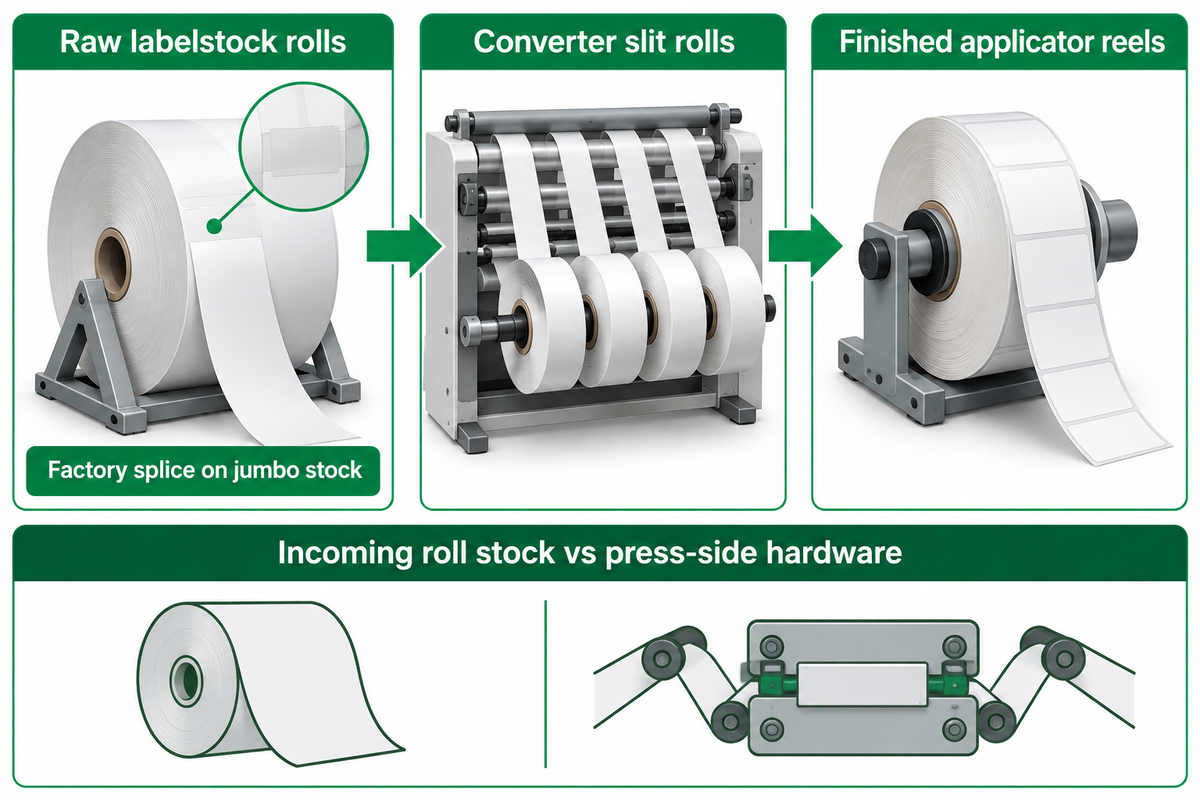
There are different nip clearances and tension zones for raw labelstock rolls, converter slit rolls, and finished applicator reels. Each roll has its own splice requirement and joint rules. A coating-mill joint that’s acceptable at the unwind stand can jam a pharmaceutical labeler downstream, or a narrow rotary die.
Upstream coating mills create a factory splice when coating voids or liner defects are found on jumbo stock and operators must cut them out. Slitting creates converter joints when lanes are edited or joined to produce the ordered meterage. Printing adds a third boundary, where packaging lines inspect barcode sequencing and dispense accuracy.
Purchasing documents must carefully distinguish between the acceptance of incoming roll stock and the press-side hardware. Century Systems lists Benchtop Labelmate Splicers for aligning label rolls on packaging lines. An unwind stand can serve wider converting lines. Inside one roll before delivery, incoming roll rules govern joints already wound, whereas either the machine joins an expiring tail to a new roll.
As discussed in Labels & Labeling’s Labelexpo Europe 2025 Finishing and Converting Report, the GM semi-automatic turret rewinder reduced roll changeover time from approximately 30 seconds to 5 seconds. Ashe’s Opal Series ALCL glueless turret rewinder runs at 250 meters/minute. Nicely Machinery’s EG-8002 slitter rewinder reaches 800 meters/minute with a 1,200mm rewind diameter. Automation and speed of converting machinery increase the impact of every unaccounted-for joint upstream.
Maximum Splice Count and Clear-Zone Standard Clauses
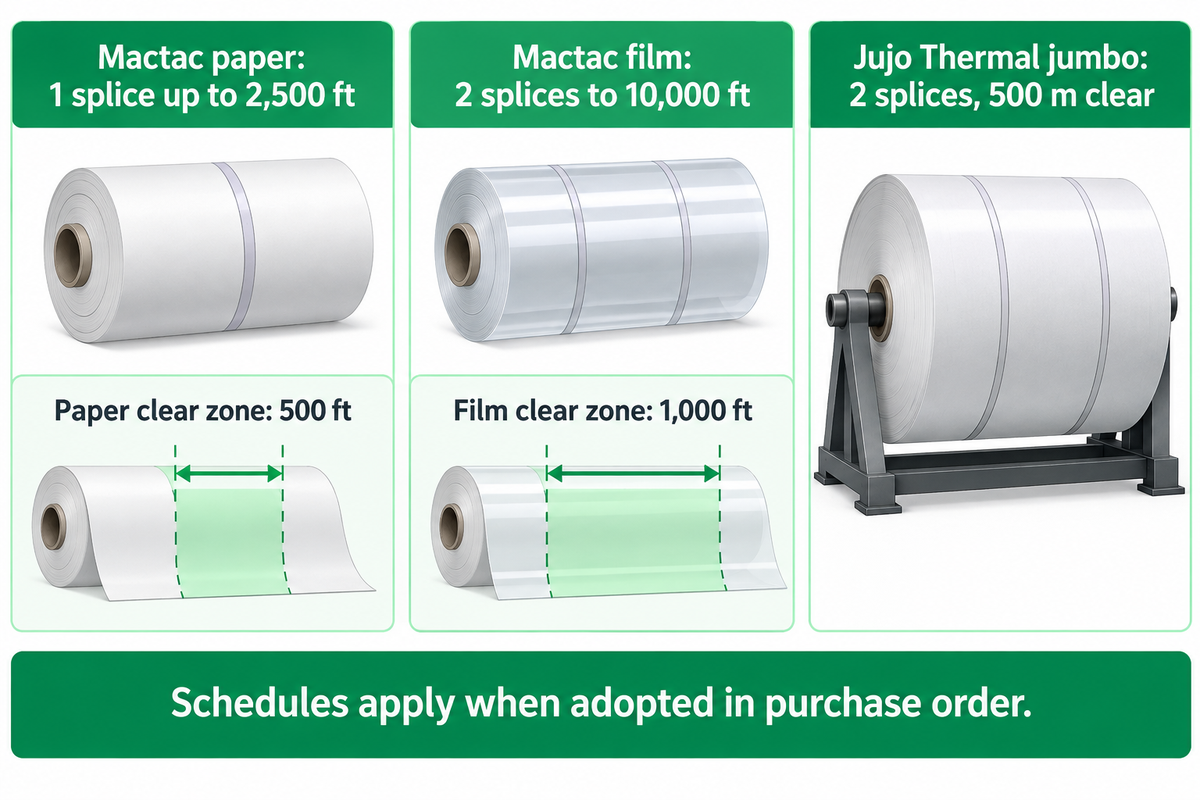
Max splice counts, core-and-leader clear zones, and usable-footage replacement rules are set length-tiered and specifically listed in purchase orders. Paper, film and thermal jumbo rolls follow different supplier schedules rather than a shared default. Protective footage tiers and clear zones are set for converters to protect against clustered joints.
High-speed slitting and turret automation make core or outer leader disruptive joints more prevalent. According to the ASTM Subcommittee D10.14 Standards Roster on Tape and Labels, the ASTM standard on pressure-sensitive tape quality assurance, D3715/D3715M-98(2019), was withdrawn in 2025. As a result, purchasers have been including explicit splice count and clear-zone clauses in their purchase orders.
Splits in paper, film and jumbo label product lines are evident in finishing schedules. Mactac’s Roll Label Splice Policy states that 1 splice is allowed on standard paper rolls up to 2,500 ft. Paper rolls over 2,500 ft through 7,500 ft allow 2 splices, and rolls over 7,500 ft through 15,000 ft allow 3 splices. Splices must not be within 500 ft of each other or within 500 ft of the start or end of the paper roll.
Film substrates observe a longer tier and wider buffer in Mactac’s published film roll policy. Film rolls allow 1 splice up to 2,500 ft, 2 splices over 2,500 ft to 10,000 ft, and 3 splices over 10,000 ft. On a film stock, splices must not be within 1,000 ft of each other and must not be within 1,000 ft of the roll start or end. Dairy film rolls use white tape instead of red tape. Upstream, Jujo Thermal caps jumbo rolls at 2 splices with black paper tape, and the distance between splices is a minimum of 500 m including roll ends.
Mactac and Jujo Thermal splice schedules apply only to those named product lines unless adopted into your purchase order. Pharmaceutical serialization lines often specify splice-free finished reels, coupled with net-usable-footage clauses to ensure splice cut-outs don’t short the ordered quantity.
Butt Splice vs Overlap Splice Application Trade-Offs
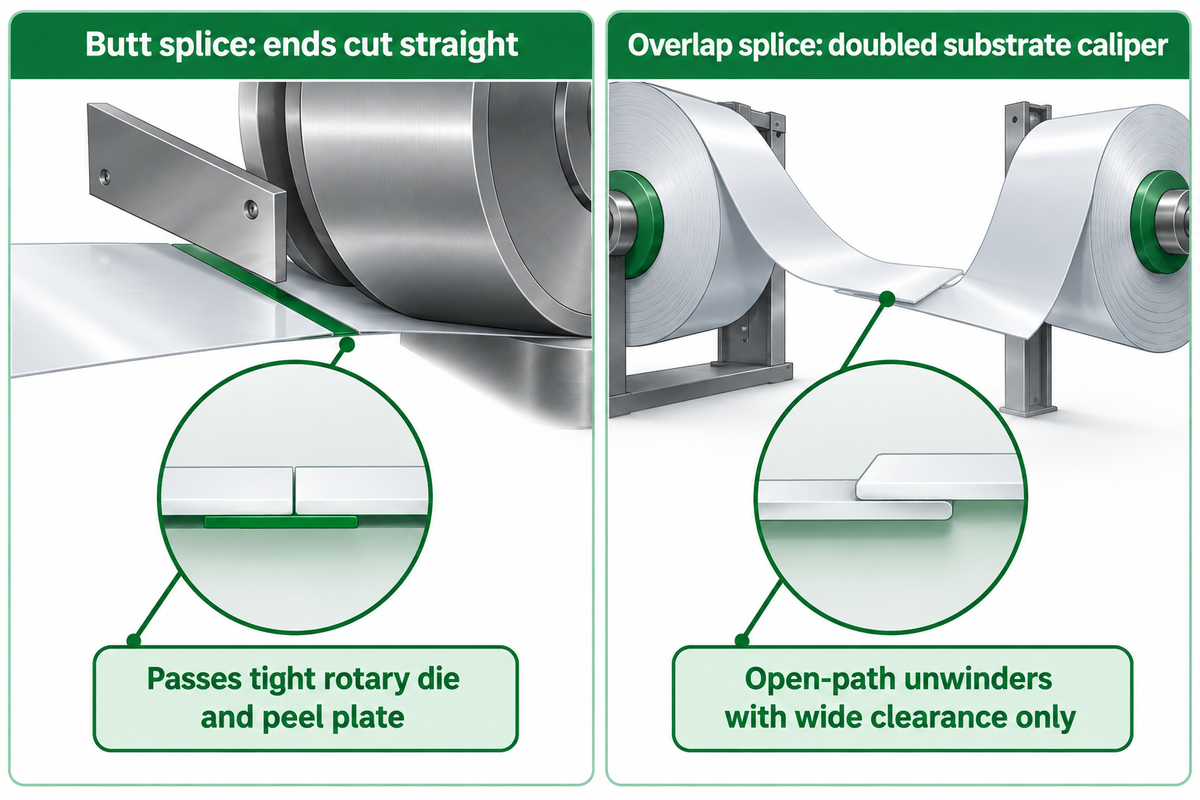
A butt splice is the safer requirement when the joint needs to pass a rotary die, close-gap nip or sharp peel plate whose clearance can’t accommodate the thickness of the overlap. Overlap joints double substrate caliper across the seam and can chip tight dies or catch peel plates. Open-path unwinders with wide roller clearances can run lapped splices safely.
Clear-zone buffers reduce core tension shock, but joint geometry ultimately dictates how a seam clears tight converting stations. It’s a misconception to assume that overlap joints always fail on press. Open-path converting stands allow lapped webs when a roller gap is greater than doubled stock thickness. Dedicated film splicer and butt-splicing units trim both web ends on the machine and join the running web to a new web flush, without overlapping.
Removing manual roll stops and overlap bumps can increase line throughput. In the Label and Narrow Web Report on Martin Automatic Butt Splicers at Channeled Resources, two automated butt splicers feeding an inline Cohesio label machine were projected to add 15 to 20% capacity. For flying-overlap coating lines using a self-splitting dynamic tape as described in European Patent Application EP2578653A2, the splice is made with a cleavable layer having a shear force of 5 g to 400 g per inch-width.
Excess seam thickness inside a tight rotary station can cause rotary die-strike damage on thin release liners when hardened blades bottom out against the anvil. At a downstream labeling head, an overlap step can catch on a rigid dispense beak and create high-speed dynamic release force spikes that may damage a tensioned liner.
| Splice Geometry Type and Equipment | Joint Profile Across Web | Rotary Die and Nip Impact | Applicator Peel-Plate Behavior | Typical Specification Scope |
|---|---|---|---|---|
| 90-degree single-sided butt splice | Ends cut straight and bridged on one face | Passes tight anvil clearances without doubled stock step | Feeds smoothly when carrier sits on non-peel face | Finished printed rolls and tight-gap narrow-web presses |
| 90-degree double-sided bridged butt splice | Ends abutted with thin carrier strips on both faces | Low caliper addition suited to medium-gap print stations | Stiffens seam slightly across sharp dispense beaks | Heavy paper or board slit stock under high web tension |
| Diagonal bias butt splice | Ends trimmed at an angle for gradual nip entry | Spreads mechanical load across the anvil width | Reduces sudden across-web peel shock at dispense edge | Wide converter slit rolls and tension-sensitive film webs |
| Manual table overlap splice | Trailing end lapped over leading web with double sided splicing tape | Doubled substrate thickness risks die strike in tight gaps | Leading edge can catch rigid peel plates or sensors | Open-path unwinders with wide roller clearances only |
| Automated zero-speed butt splice (Martin Automatic type) | Ends trimmed straight and joined flush during festoon buffer | Eliminates overlap bump through slitting and printing nips | Delivers flat finished joint for downstream converting | Non-stop inline label and liner splicing lines |
| EP2578653A2 cleavable-layer flying splice example | Cleavable double sided splicing tape splits in shear | Described for open coater or laminator nip clearance | Joint removed during slitting before finished reels ship | Coater flying-splice design (5 g to 400 g per inch-width split range) |
| Mill jumbo black-tape joint (Jujo Thermal benchmark) | High-contrast black paper splicing tape across master width | Flagged for converter edit or slitter slowdown | Removed or re-spliced before end-user applicator reels | Thermal jumbo master rolls (500 m minimum clear distance, max 2 splices) |
| Glueless turret roll transfer (Ashe Opal ALCL benchmark) | Mechanical core transfer without adhesive tail buildup | Applies strictly at final rewinder discharge | Leaves finished roll outer leader clean for operators | Automated finished-roll turret rewinding at 250 m/min |
| Semi-automatic turret changeover (GM finishing benchmark) | Assisted spindle index and cut at rewinder exit | Downstream of die station; zero die-gap exposure | Produces uniform outer roll starts on short runs | Short-run finishing (changeover cut from 30 seconds to 5 seconds) |
Splicing Tape Chemistry for Glassine and PET Release Liners
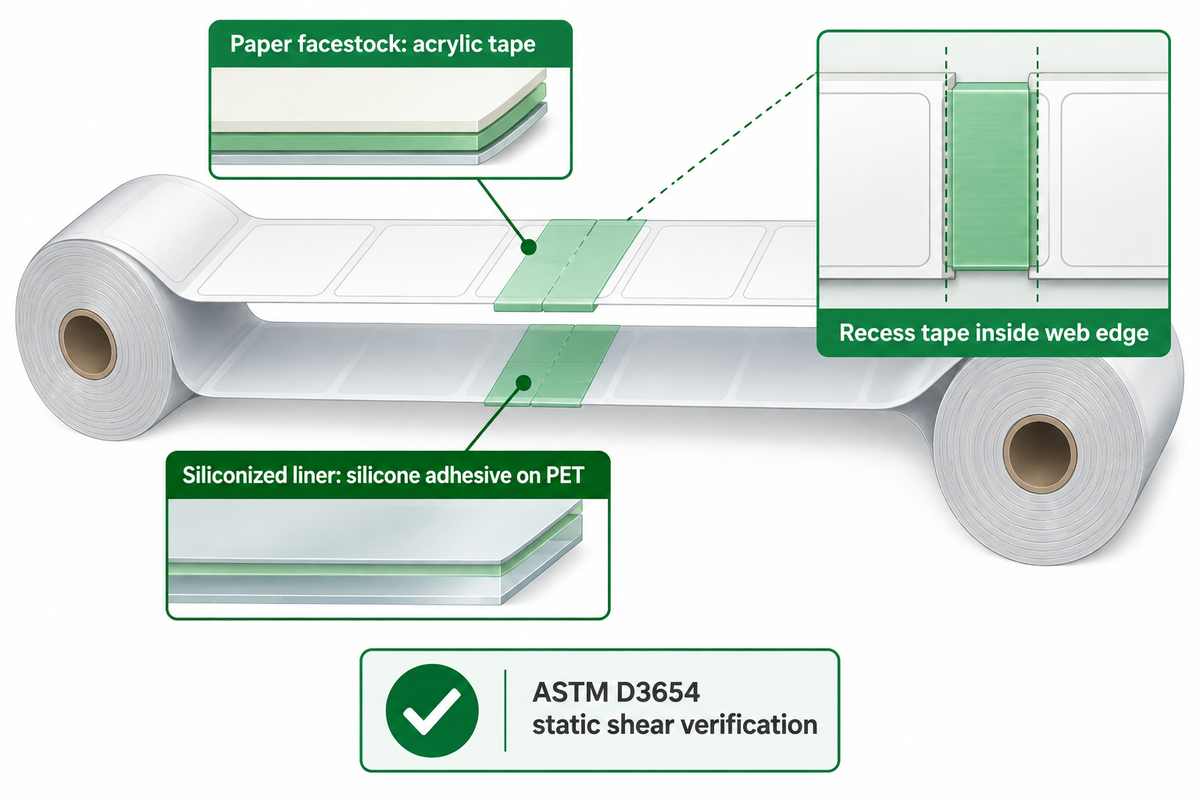
Siliconized glassine and polyester release liners are usually spliced with silicone-adhesive tape on a thin polyester film carrier matched to the liner coating and process tension. Standard acrylic or rubber splicing tapes bond to raw paper facestocks, whereas low-surface-energy silicone coatings resist acrylic bonding under tension.
Selecting a flush butt profile only protects the press if the splicing tape bond survives dryer heat and rewind pressure. Every pressure-sensitive laminate presents two distinct chemical surfaces during the splice preparation process. Operators apply acrylic or water-dispersible repulpable tape onto unsiliconized paper facestocks. Siliconized glassine and film liners are usually spliced with silicone adhesive formulated to wet cured silicone release coatings, selected according to the liner grade and press conditions.
Reputable tape data sheets quantify thin carrier constructions used in narrow-web preparation. Tesa 4200, for example, features red silicone adhesive with a 13 µm polyester film backing for high-temperature splicing to silicone surfaces. For bridged or lapped liner joins, Nitto P-905 uses a double-coated polyester carrier with silicone adhesive at 3.7 mils (0.094 mm) total thickness and 47 N/10 mm tensile strength. Polyester carriers maintain dimensional stability across the tolerances of siliconized PET film release liners and polyester-backed industrial adhesive tape constructions in a heated dryer.
Incoming quality teams verify tape properties against current ASTM test methods. ASTM D3654/D3654M Standard Test Methods for Shear Adhesion of Pressure-Sensitive Tapes, reapproved in 2024 as D3654/D3654M-06(2024), measures static shear resistance under constant load. Higher static shear helps minimize splice creep. The performance of the joint remains predominantly affected by oven temperature, dwell time, peel forces, and rewind pressure. Carrier and total tape caliper are determined by ASTM D3652/D3652M-01 (2020).
Edge trim discipline prevents roll blocking during storage and rewinding. Slightly trimming film splicing tape to prepare joints allows adhesive to recess completely inside the web edge. Recessing the adhesive inside the web edge minimizes squeeze-out onto slitter knives, idler rollers, and adjacent wraps.
Edge Flagging Detail and Splice Sensor Contrast Rules
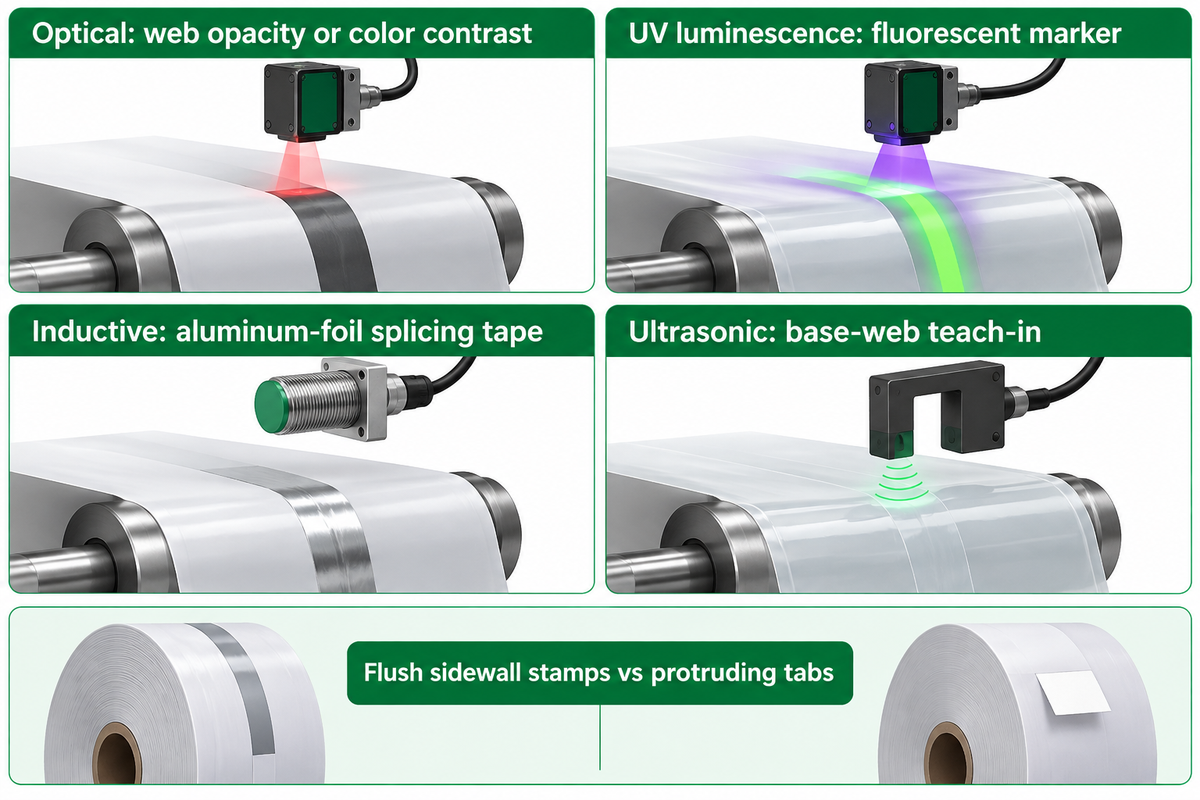
Buyers specify splice tape backing and sidewall flags according to the physics of sensing installed on the packaging or product line. Optical sensors read web opacity or color contrast, while inductive sensors respond to a metallic marker such as foil-backed splice tape. An ultrasonic sensor measures acoustic signal damping across a calibrated base web.
Even a shear-stable silicone joint fails operationally if the in-line sensor lets the seam enter the finished pack undetected. Sensor manufacturer EMX notes converters attach extra indicator strips to mark a joint, but additional materials aren’t always used in every application and production environment. Red tape may lose contrast against dark print graphics or clear film constructions, depending on the web material and the sensor mode.
Clear-on-clear film labels create a frequent detection trap on packaging lines. Roll-2-Roll Technologies explains that traditional photo-eyes can’t recognize clear splice tape on clear films during continuous operation. Switching to ultrasonic sensing resolves the color blindness on clear stock. The specification of the ultrasonic splice sensor by Microsonic covers webs from 20 g/m² to 600 g/m² and films up to 0.6 mm thick, once the operator conditions the sensor on the base web.
The 4-mode Sensor-to-Splice Contrast Crosswalk applies only to inline web-process splice detectors (optical, luminescence, metallic-inductive, and ultrasonic) and doesn’t include personnel safety presence-sensing light curtains. Sidewall flags have to align with mechanical guide slots and the roll unwind direction chart. It’s a common misconception that edge tabs are suited for every press. Protruding edge tabs help warehouse personnel during manual checks and flush edge wall stamps prevent snagging during transfers in edge guides.
| Sensor Category and Material Target | Physical Detection Trigger | Required Splice Tape or Marker | Clear-Film or Pre-Printed Failure Trap | Pre-Run Qualification Check |
|---|---|---|---|---|
| Transmissive optical photo-eye on paper stock | Light beam attenuation through web thickness | Opaque black or dark red splicing tape across full width | Heavy opaque paper or dark flood coats saturate baseline beam | Verify beam margin on single web versus taped joint before run |
| Transmissive optical photo-eye on clear film | Light blockage across transparent film path | High-opacity black or pigmented film splicing tape | Traditional photo-eyes cannot detect transparent splice tape on clear films | Ban clear splicing tape on clear film rolls in purchase clause |
| Reflective optical contrast sensor | Reflected light delta between web surface and tape | Opaque tape contrasting against unprinted liner or margin (such as red or white film tape per supplier policy) | Multi-color label graphics can trigger false stops or mask tape color | Aim sensor at unprinted trim margin or liner reverse side |
| 1D fiber-optic contrast array (standard contrast type) | Multi-point optical contrast profile across web zone | Visible contrast tape or registered splice marker strip | Unmarked clear-on-clear film joint without contrast edge | Confirm contrast threshold across splice pass during setup |
| UV luminescence splice sensor (EMX type) | Ultraviolet fluorescence emission from doped marker | UV-luminescent splicing tape or fluorescent ink stripe | Optical brighteners in paper facestock create background glow | Test base paper fluorescence against UV splice tape sample |
| Inductive or conductive foil proximity sensor | Eddy-current or electrical conductivity response | Metallic marker such as aluminum-foil-backed splicing tape | Foil-backed label laminates trigger continuous false positives | Restrict metallic marker detection to non-metallic paper and film stock |
| Ultrasonic web attenuation sensor (microsonic type) | Acoustic wave damping across web-adhesive-tape boundary | Bonded butt or lap joint calibrated to base-web basis weight and film thickness | Fails if operator skips base-web signal teach-in before running | Run base-web teach-in on exact facestock-liner lot before start |
| Inline camera inspection table (Prati Jupiter type) | Line-scan visual defect and splice contrast recognition | Full-width contrasting colored tape visible to camera side | Liner-side-only clear tape stays hidden from print-face camera | Verify splice catch up to 400 m/min on 670 mm width |
| Sidewall roll marking (protruding flag vs flush stamp) | Operator visual check on roll face before chucking | Flush sidewall stamp on both faces or single-side paper tab | Protruding paper tabs tear off in transit or jam guide slots | Specify flush sidewall stamps for automated turret unwinds |
Incoming Roll Inspection and Splice Verification Protocol
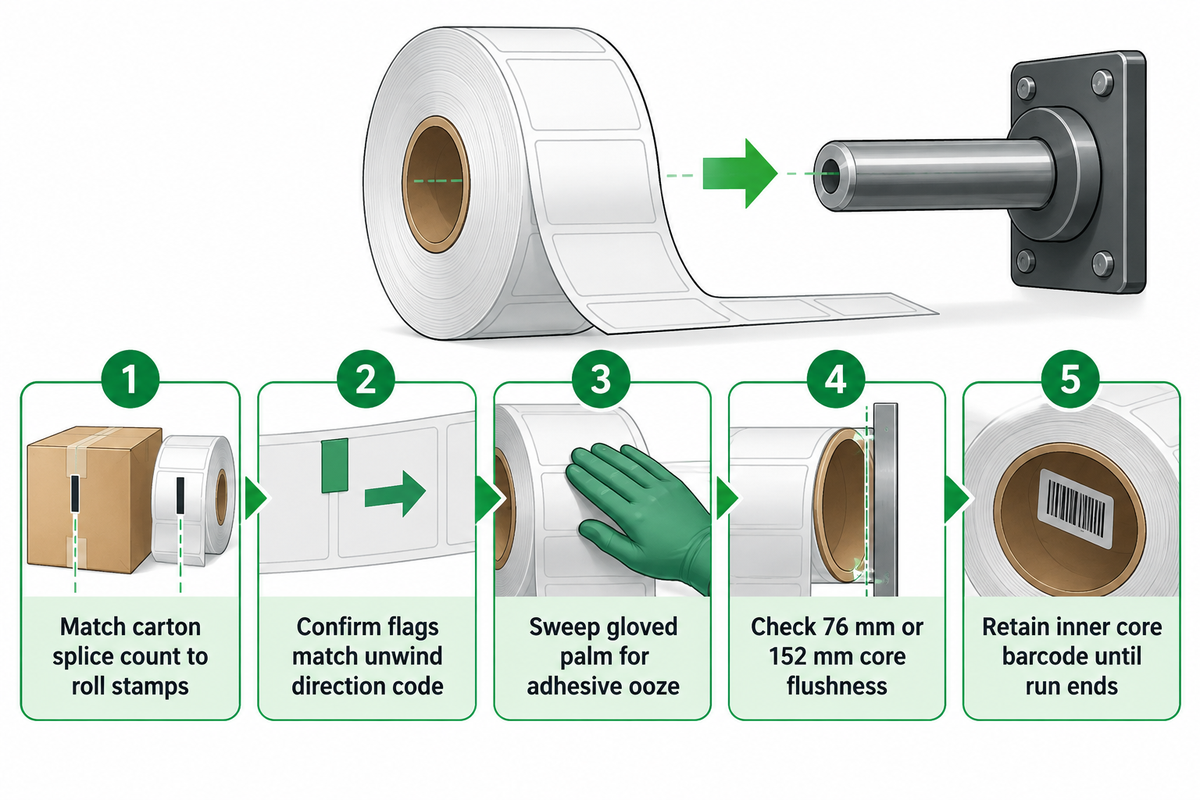
Before operators load a master or slit reel onto the unwind shaft, five physical roll checks are performed. Reconciling carton splice logs against sidewall stamps, roll-face tack, core flushness, and leader length catches bad joints early. Pre-mount verification saves press setup stock and protects rotary tooling.
Written sensor contrast rules only work when delivered reels match the agreed flag configuration. High-speed inspection rewinders like Prati’s Jupiter control table inspect webs up to 400 m/min across a 670 mm width. Upstream thermal suppliers like Jujo Thermal wind jumbo stock on standard 76 mm cores and print the splice count on each roll label. High-speed liner stripping across raw label product lots is tested by ASTM D5375/D5375M High-Speed Liner Removal Test Methods.
- Receiving inspectors match the splice count printed on the carton and roll tag against visible stamps or flags on both roll faces.
- Press crews confirm that sidewall flags and trailing tape edges match the specified unwind direction code before shaft loading.
- Quality staff sweep a gloved palm across both roll sidewalls to catch silicone or acrylic adhesive ooze early.
- Operators check if the 76 mm or 152 mm core is flush against the slit edge without telescoping or crushed inner wraps.
- Line leads retain the inner core barcode until the reel finishes running.
Is there a single industry standard for maximum splices in raw labelstock versus finished printed rolls?
No, raw labelstock and finished printed rolls don’t share a single industry splice cap. Raw master and slit stock adhere to supplier footage schedules such as Mactac’s 2,500 ft., 7,500 ft., and 10,000 ft. tiers, or Jujo Thermal’s 500 m jumbo rule. Finished applicator reels adhere to customer purchase order limits or zero-splice pharmaceutical clauses.
Should converters demand larger splice-free master rolls or cap roll diameter to protect press registration?
Converters balance splice-free length against unwind shaft weight, brake torque, and mill trim yield, and run moderate roll diameters with flagged butt splices to hold registration steady. Oversized splice-free masters increase mill scrap and rotational inertia during press speed ramps.
How should a roll label or COA record exact splice positions?
Every roll label and certificate of analysis should list the unique reel serial number, total splice count, winding direction code, and meter or foot mark from unwind start. Knowing exact splice distance allows press and rewinder crews to slow down, or divert, splice scrap without having to look for it.
Diagnosing Web Breaks, Die Strikes, and Missed Splices
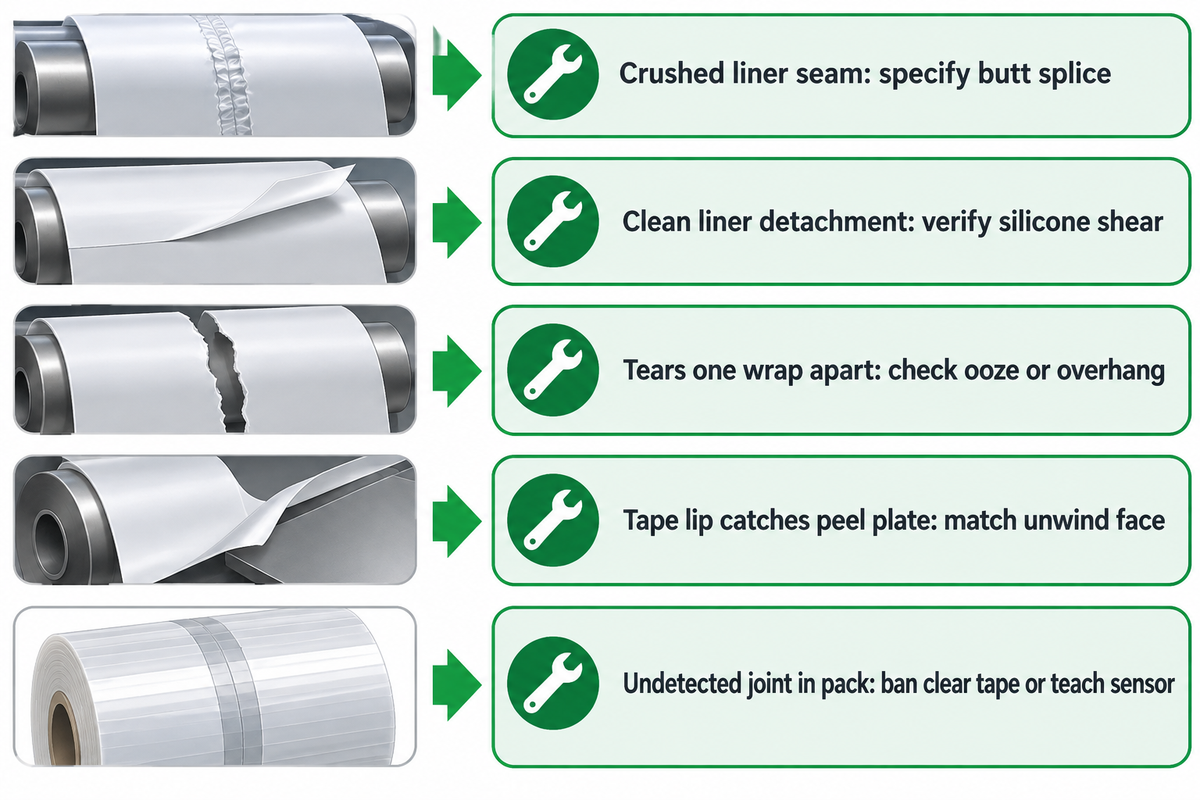
There are five root causes for splice breaks on press, which account for the large majority of splice stops. Those root causes cover excess overlap caliper, low-energy liner tape slip, sidewall blocking, lifted tape tails, and uncalibrated clear-film sensors.
“Sudden tension spikes at start-up, poor splices, damaged roll edges and rolls stored in heat or humidity all reduce the margin before a liner tears.”
High-speed applicator troubleshooting demonstrates the benefits of physical tear inspection over the trial-and-error method of tension adjustment. When liner breaks cluster near the core, technicians compare outer-wrap and core-end samples from the same roll. That check separates tight core winding or warm-storage adhesive flow from an upstream joint defect. Maintaining label stock storage temperature and humidity limits helps prevent splice adhesive from oozing and locking adjacent wraps.
Digital roll maps also require a physical sidewall backup during fault analysis. In a PrintPlanet converter thread covering a 2010 Prati Saturn TE 330 R rewinder (330 mm web width) with a Nikka Alis C1A-330 camera unit, operators noted that reporting faults can leave a reel without an electronic defect map. Physical sidewall stamps preserve splice tracking even when camera reporting drops offline.
- A crushed liner line at the seam is consistent with an overlap splice adding caliper. Where available clearance cannot accommodate that thickness, specify a straight or diagonal butt splice.
- Clean tape detachment from a shiny release liner indicates that the adhesive wasn’t strong enough. Tape is chosen based on surface energy of release liners and verified by liner-adhesion and shear tests.
- Roll wraps tearing one revolution apart point to overhanging tape or warm-warehouse ooze.
- If the tape lip is caught on the peel plate, the carrier strip was on the beak contact face. Tie tape side placement directly to the unwind direction chart.
- The presence of joints in finished label packs undetected means that clear tape bypassed a photo-eye or ultrasonic teach-in was skipped during setup.
Six-Clause Roll Splice Schedule and Trial Qualification
Procurement teams avoid roll-acceptance disputes by attaching six written splice clauses to every quotation request and qualifying them on a slit pilot roll. Testing flat A4 sample sheets confirms ink anchorage and surface tack. Sheet checks never test roll splice shear, slit edge cleanliness or contrast level with inline sensors.
The 6-Clause Roll Splice Schedule below turns failure analysis into binding purchasing language for jumbo coater stock, converter slit rolls, or finished reels. Buyers set values precisely per substrate and line clearance before releasing production meterage.
6-Clause Roll Splice Schedule for Labelstock RFQs and Purchase Orders
- Clause 1 stipulates the buyer’s maximum allowed splice count per roll length tier, or specifies zero splice finished reels for pharmaceutical lines.
- Clause 2 specifies the buyer’s minimum clear-zone distance from roll starts, core ends and adjacent joints. Named 500 ft paper, 1,000 ft film, and 500 m jumbo figures apply only when adopted for the specified roll types.
- Clause 3 specifies a 90 degree or diagonal butt splice on stations whose die or peel-plate clearance cannot pass doubled web thickness. Open-path unwinds may allow lapped joints; however, operators must recess the splicing tape inside both slit edges.
- Clause 4 specifies a silicone adhesive on a thin PET carrier for the selected siliconized liner. Static shear is reported under ASTM D3654, and carrier thickness is reported under ASTM D3652.
- Clause 5 aligns opaque, UV, metallic, or ultrasonic-taught joint targets with line sensors, paired with flush sidewall stamps matched to unwind direction.
- Clause 6 sets buyer-requested roll-tag splice count logging and net-usable-footage replacement terms when splice cut-outs reduce deliverable meterage.
Sourcing custom slit and jumbo self-adhesive label rolls from Zhejiang Guanma Packaging Co., Ltd. pairs these six buyer clauses with pilot-roll verification. Guanma supplies standard converter slit widths from 25 mm to 1,300 mm alongside master jumbo rolls. Custom formulation projects start with 1,000 to 5,000 m pilot runs before repeat orders at standard commercial MOQs. On Guanma semi-gloss coated paper roll stock, stock combinations carry a minimum order quantity of 1 jumbo roll (5,000 to 8,000 m) on 76 mm or 152 mm cores. That semi-gloss grade supports custom slitting from 25 mm to 1,530 mm (±0.5 mm tolerance), offers 60 g, 80 g, or 100 g/m² glassine liners, and delivers 15–30 cN/25 mm release force verified on each order’s COA.
Zhejiang Guanma Packaging Co., Ltd. publishes no fixed house splice cap or default meter-mark format. Accordingly, buyers negotiate maximum splice counts, sidewall flags, butt or overlap joints, tape type, unit price, and lead time as order-specific terms on purchase orders for a slit pilot roll. Free sample packs are provided to the buyer for hand sheet checks.
Are you ready to lock technical roll splice clauses for your press or packing line? Send your slit width, core size, and liner grade to confirm order specific terms, and set up a 1,000-5,000 m pilot roll with Guanma’s technical team.
Frequently Asked Questions
How do paper and film labelstock splice limits differ on commercial rolls?
Mactac’s published roll-label policy specifies a wider minimum clear zone and a longer two-splice footage tier on its film rolls than on its standard paper rolls. Standard paper stock requires a 500 ft clear zone with 2 splices over 2,500 ft to 7,500 ft. Film stock sets a 1,000 ft clear zone with 2 splices over 2,500 ft through 10,000 ft, subject to each supplier’s purchase-order schedule.
When is a butt splice mandatory instead of an overlap splice on label rolls?
A butt splice is required only when doubled web and tape thickness exceeds the mechanical gap of a rotary die, close-gap nip, or rigid dispense beak. Open-path unwinders with wide roller clearance can pass an overlap joint without jamming. Tight rotary and applicator stations can’t clear this step without risking liner die strike, blade chipping or print registration jumps.
Why does standard acrylic splicing tape fail on glassine and PET release liners?
Cured silicone coatings on glassine and polyester release liners have low surface energy, so silicone-adhesive tape is generally selected when reliable bonding must hold under web tension. A silicone adhesive on a thin polyester carrier can maintain splice shear through rewinder handling and heated sections when its rated temperature, load, and dwell limits cover the process conditions.
Should splice flags protrude from the roll edge or sit flush?
Use flush sidewall stamps when loose flags could snag narrow edge-guide sensor slots, and use protruding paper tabs when faster visual checks on manual unwinders are the priority.
Does aluminum-foil splicing tape guarantee detection on both optical and ultrasonic splice sensors?
No. Aluminum-foil splicing tape provides metal contrast for inductive proximity sensors and light blockage for transmissive photo-eyes, yet ultrasonic splice sensors still require base-web teach-in on the exact facestock-liner construction. Operators calibrate acoustic damping on a single web layer before running production reels so bonded joints trigger reliable stops.
Why should splicing tape stop slightly inside the label web edges?
Trimming splicing tape slightly narrower than both slit web edges stops exposed adhesive from squeezing out under winding pressure onto slitter blades, rollers, and adjacent wraps.
What details should buyers include when requesting a trial roll with custom splice terms?
Include finished slit width with tolerance, core inner diameter, maximum roll outer diameter, unwind direction code, facestock grade, liner family, inline sensor category, maximum splice count, clear-zone distance, and butt versus overlap geometry. Providing all of the aforementioned information lets the manufacturer evaluate pilot meters, quote pricing, and set lead time.
About This Guide: Reviewed by the Zhejiang Guanma Packaging Co., Ltd. technical team, for the benefit of narrow-web label converters and packaging engineers and procurement personnel specifying pressure-sensitive paper and film (roll) stock.
References & Sources
- ASTM International: ASTM Subcommittee D10.14 Standards Roster on Tape and Labels (confirming active status of D3652-01(2020), D3654-06(2024), D5375-98(2019), and 2025 withdrawal of D3715).
- ASTM International: ASTM D3654/D3654M Standard Test Methods for Shear Adhesion of Pressure-Sensitive Tapes.
- ASTM International: ASTM D5375/D5375M High-Speed Liner Removal Test Methods.
- European Patent Office: European Patent Application EP2578653A2 on Self-Splitting Dynamic Splicing Tape.
- Labels and Labeling:
Labels & Labeling Labelexpo Europe 2025 Finishing and Converting Report.
- Label & Narrow Web: Label and Narrow Web Report on Martin Automatic Butt Splicers at Channeled Resources.