Get in Touch with Guanma

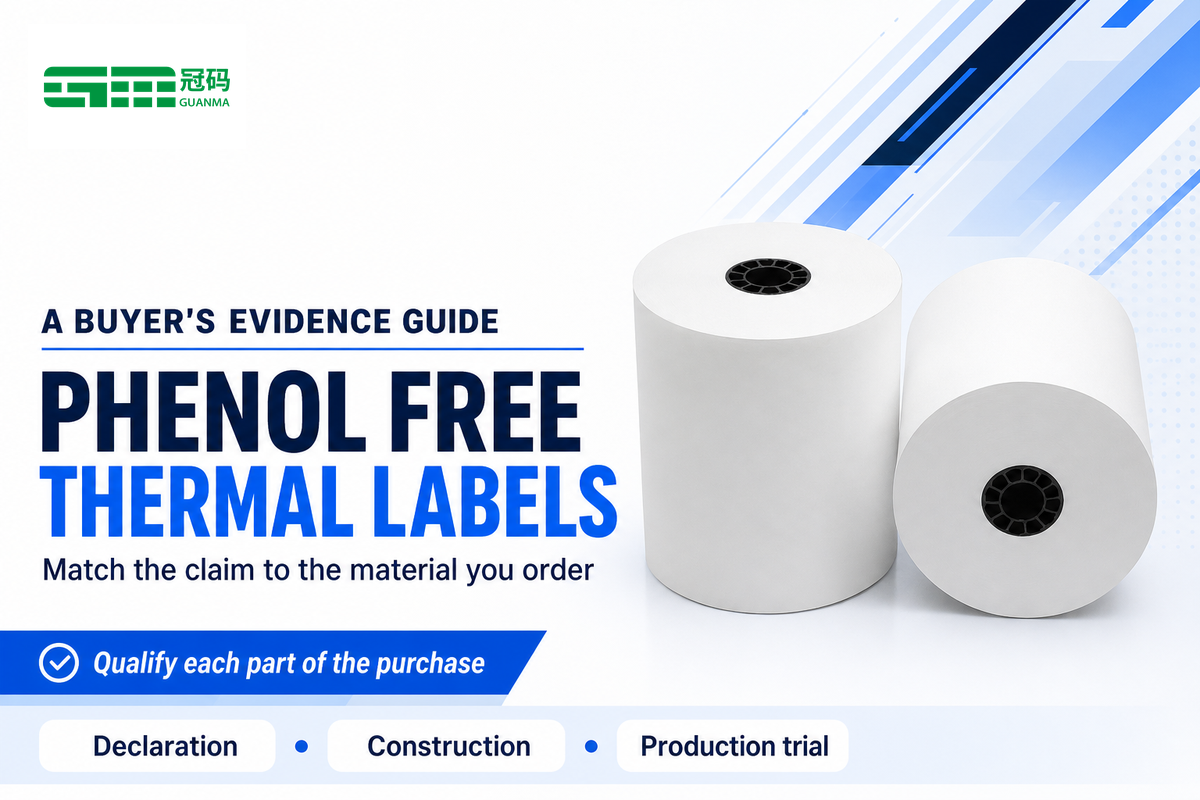
What’s cheap to buy can become expensive to buy if the paper supplied differs from the approved sample. With phenol free thermal labels, you need to evaluate the material declaration, label construction and a production trial. A free-from claim on a quotation answers only part of that.
Phenol free thermal labels use thermal material declared free of phenolic developers. Check the named grade, excluded substances and covered layers. Match any test report to that material, then qualify printing and adhesion for the intended application.
Buying essentials
- BPA-free doesn’t establish that BPS is absent.
- A laboratory result applies to the tested sample and substance panel.
- Paper, adhesive and liner need a clear construction reference.
- Chemical documentation and printing performance require separate approval.
What phenol-free means for a thermal label
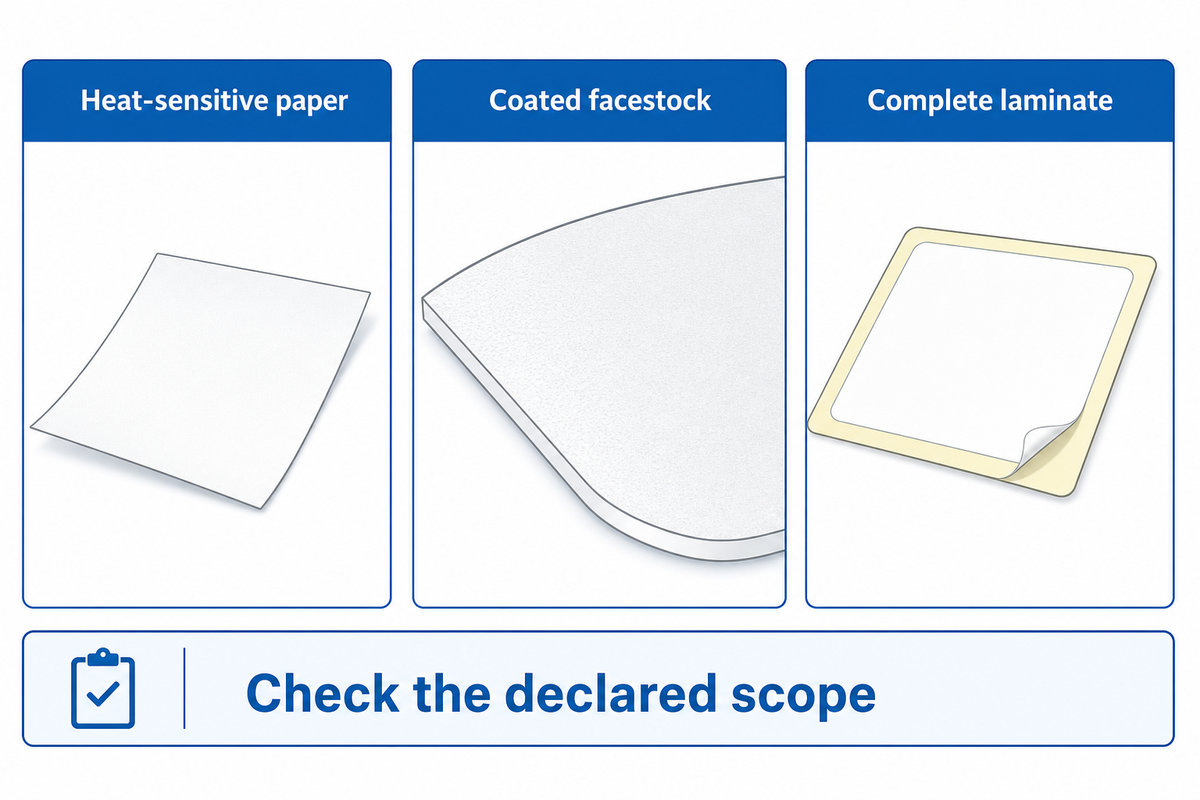
What’s useful in a phenol-free claim depends upon what the supplier declares the claim covers. For a self-adhesive label, determine whether the claim covers heat-sensitive paper, the coated facestock or the complete laminate. An exclusion claim for one layer can’t establish the complete composition of the other, unspecified layers.
What is phenol-free thermal paper?
Phenol-free thermal paper is thermal paper described as excluding phenolic developers from its imaging system. It still creates an image when heated by a printhead. The supplier needs to identify the relevant chemistry to define the scope. The wording alone doesn’t establish every coating ingredient, certify a finished adhesive label or state its suitability for food contact.
Conventional direct thermal printing uses a heat-triggered reaction between a dye and developer. A different physical imaging route also exists: the U.S. Environmental Protection Agency’s 2017 technology award describes air voids collapsing in a coating developed by Dow and Koehler. That specific technology doesn’t describe every phenol-free thermal product.
A more detailed description of the layers can be found in our thermal paper construction guide. In this case, the purchasing question is more narrow: which declared material will be delivered? When comparing prices of different suppliers, a quotation stating “eco-friendly” isn’t sufficient to evaluate whether it’s a suitably priced offer.
Read the BPA and BPS developer declaration against the exact grade
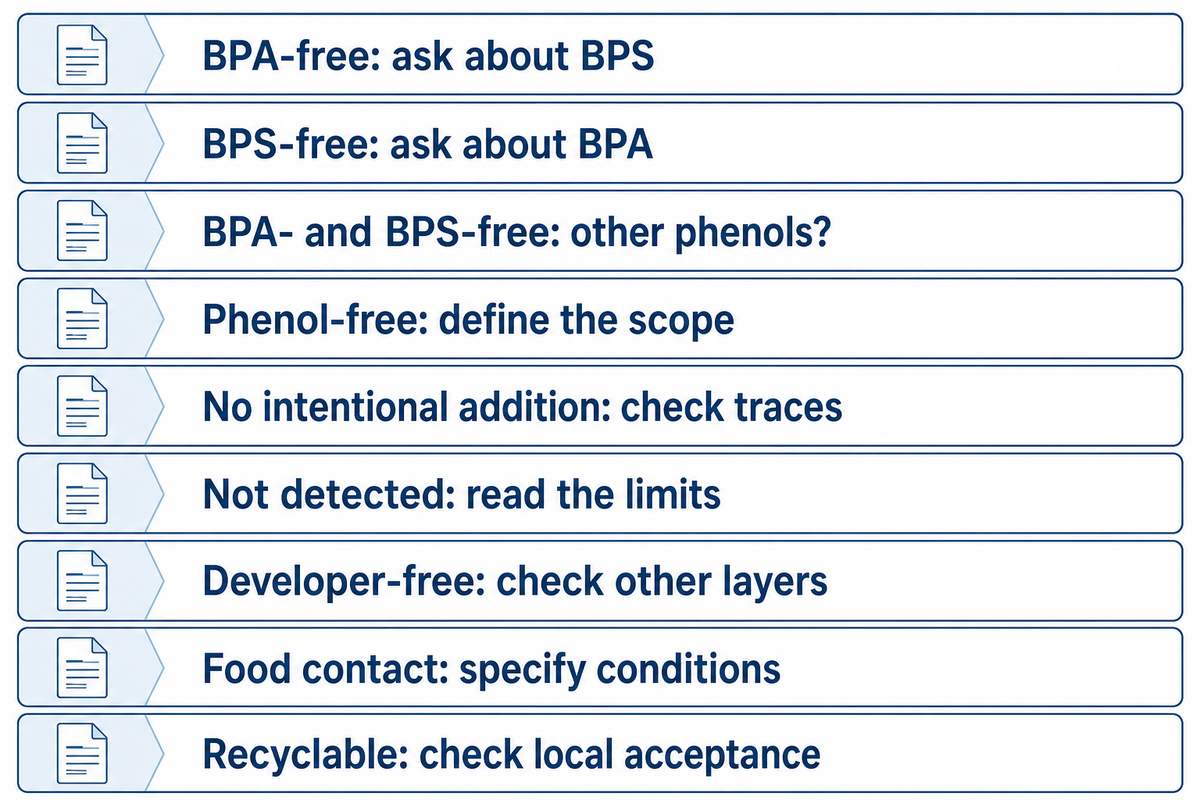
Read free-from claims separately until the supplier documents their relationship. In BPA-free thermal paper, the exclusion of Bisphenol A can occur while Bisphenol S remains unspecified. Where change is driven by health and environmental requirements, the claims should name the affected developers, and say what’s replacing them.
Is BPA free the same as phenol free?
BPA free isn’t the same as phenol free. Excluding BPA doesn’t mean that other phenolic developers aren’t present. The Minnesota Pollution Control Agency (MPCA) warns that some thermal receipt paper sold as BPA-free contains BPS. You should ask for the actual exclusions, and not assume equivalent labeling.
Claim-to-Evidence Crosswalk: 9 claim types to check
The Claim-to-Evidence Crosswalk below is a purchasing tool, not a certification tool. Use it to turn purchasing claims into specific document requests.
| Claim type | What remains unresolved | Next buyer action |
|---|---|---|
| BPA-free | BPS and other developer chemistry | Request the exclusion list and replacement identity. |
| BPS-free | BPA and other phenols | Ask which substances the statement covers. |
| BPA- and BPS-free | Other phenolic compounds | Check whether the broader claim is actually declared. |
| Phenol-free | Meaning, material scope and supporting method | Obtain a grade-specific written definition. |
| No intentionally added phenols | Trace contamination and analytical findings | Separate formulation control from measured content. |
| Not detected | Analytes, method and reporting limit | Read the complete report, including sample identity. |
| Developer-free imaging | Other layers and application performance | Confirm the imaging route and finished construction. |
| Food-contact suitable | Contact conditions and covered components | Request evidence for the actual use and laminate. |
| Recyclable | Adhesive, liner and receiving recycling stream | Check the complete product and local acceptance. |
In EPA’s historical assessment of alternatives to BPA, 19 thermal-paper developers were assessed. Inclusion in the assessment didn’t mean endorsement, and no functional chemical assessed was of low concern across all health and environmental endpoints. The assessment doesn’t classify all current phenol-free technologies. It provides a rationale for the need to examine the replacements.
If suppliers answer a broader purchasing requirement with “BPA and BPS free”, hold the chemical approval until the scope is resolved. A safety data sheet may help identify hazards, but do not assume it discloses every ingredient or answers every exclusion question.
Read the test report without turning not detected into zero
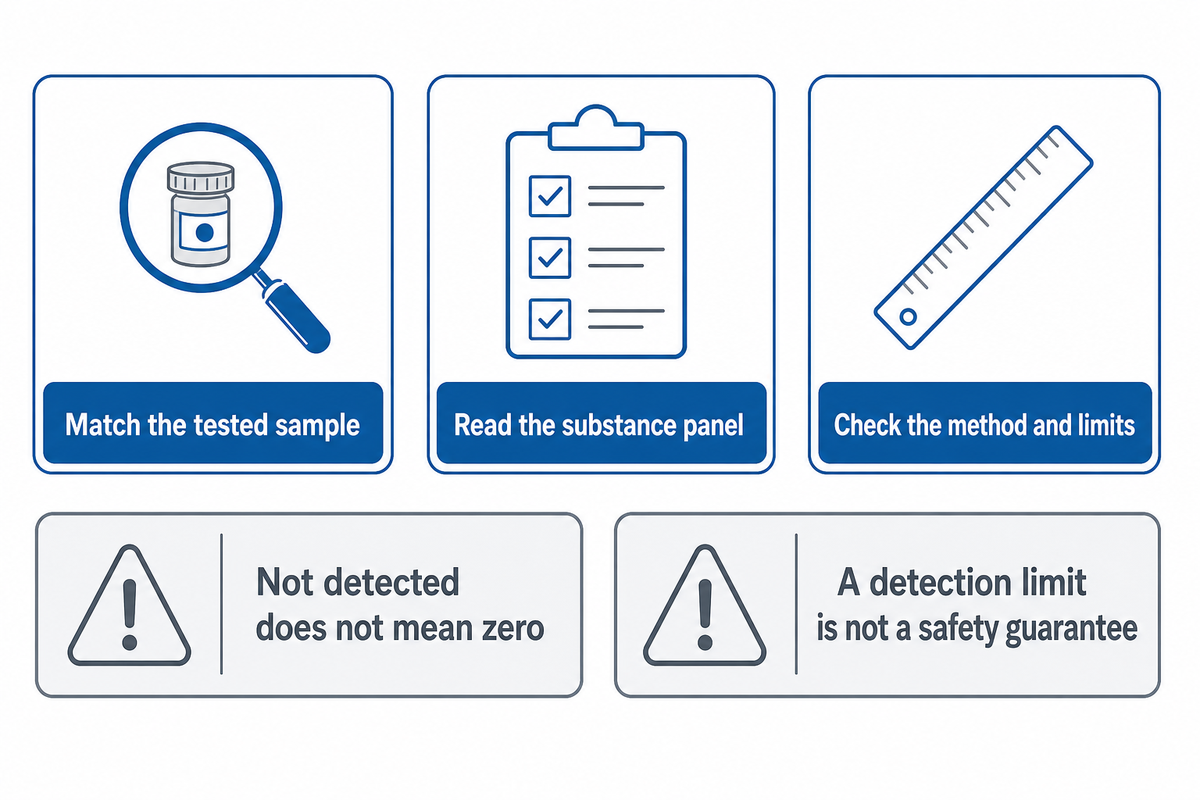
A test report provides information about what the laboratory measured in the sample with regard to the method stated in the report. It can’t verify that nothing else is present in the sample. Illinois EPA’s laboratory-report guidance defines a non-detect by the method detection limit; that limit does not establish product safety. Look at the analytes and analytical limits, and consider if the sample represents the materials offered for purchase.
Consider an illustrative report that lists BPA as “not detected” with a detection limit of 1 ppb . Other results may provide further information. For example, a report with a test result limit of 100 ppb would provide different analytical sensitivity from the first example even if both reported that BPA was “not detected.” Neither case provides a test result for Guanma material or a recommended buying limit.
First look for the sample description, report date and laboratory method. Next read which substances were tested: a result for BPA or BPS alone leaves other analytes unanswered. Consider whether the sample is paper or a complete label, and how the method distinguishes detection from quantification. Ask the laboratory or supplier to clarify rather than attempting to compare isolated numbers.
As an example, the buyer gets a report for an uncoated receipt grade while the order calls for topcoated shipping labels. The document may be legitimate, but the match of the material is still unproven. Keep the document as background and demand the link between the tested sample and the offered grade. Reissuing the report each year doesn’t satisfy this; a formulation change might matter sooner.
Do
- Read the whole substance panel.
- Match the sample to the order.
- Record unresolved scope questions.
Don’t
- Convert not detected into zero.
- Transfer a receipt result to a laminate.
- Use a precise limit as a safety guarantee.
Trace the declaration through the finished label construction
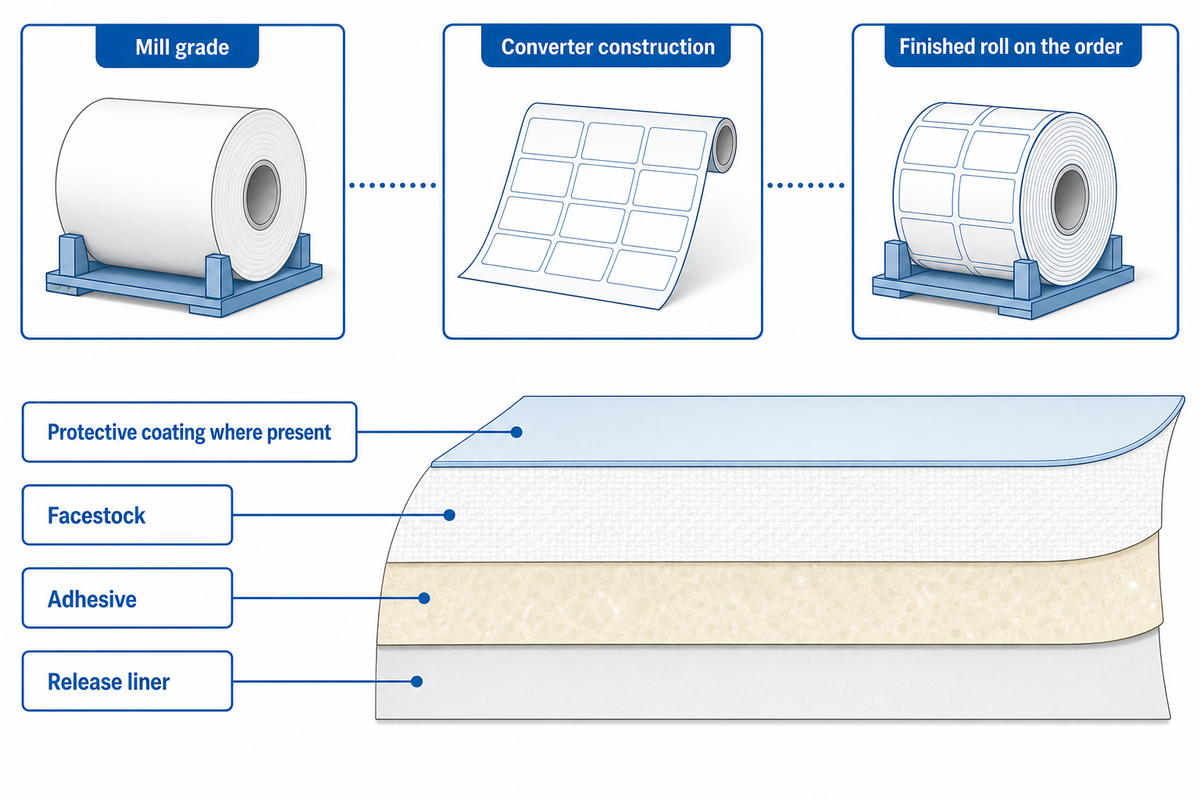
Link the mill grade to the converter’s construction and the finished roll on your purchase order. This allows the use of an exclusion statement in the supply chain. Without this, procurement can approve one paper while production receives a different topcoat, adhesive or liner carrying the same general product description.
A complete construction reference should give the facestock, protective coating where present, adhesive and release liner. This traceability allows the quality staff to compare these fields to the declared material. Our self-adhesive paper materials page serves as the starting point for the product family; further detail on specific construction is needed.
Linerless labels require the same discipline. Removing the liner doesn’t resolve the concerns with regard to the chemistry of the thermal layer, release surfaces or adhesives. Similarly, food labels require an application-specific contact assessment, and phenol-free labels aren’t necessarily acceptable for direct food contact.
Let’s say a converter changed the adhesive for chilled packaging, but kept the paper grade the same. The adhesion and finished product scope would require reevaluation. Consider what changed, and what earlier approvals remain. “Same paper” doesn’t release the complete labeling process unchanged.
Approve print performance separately from the chemical claim
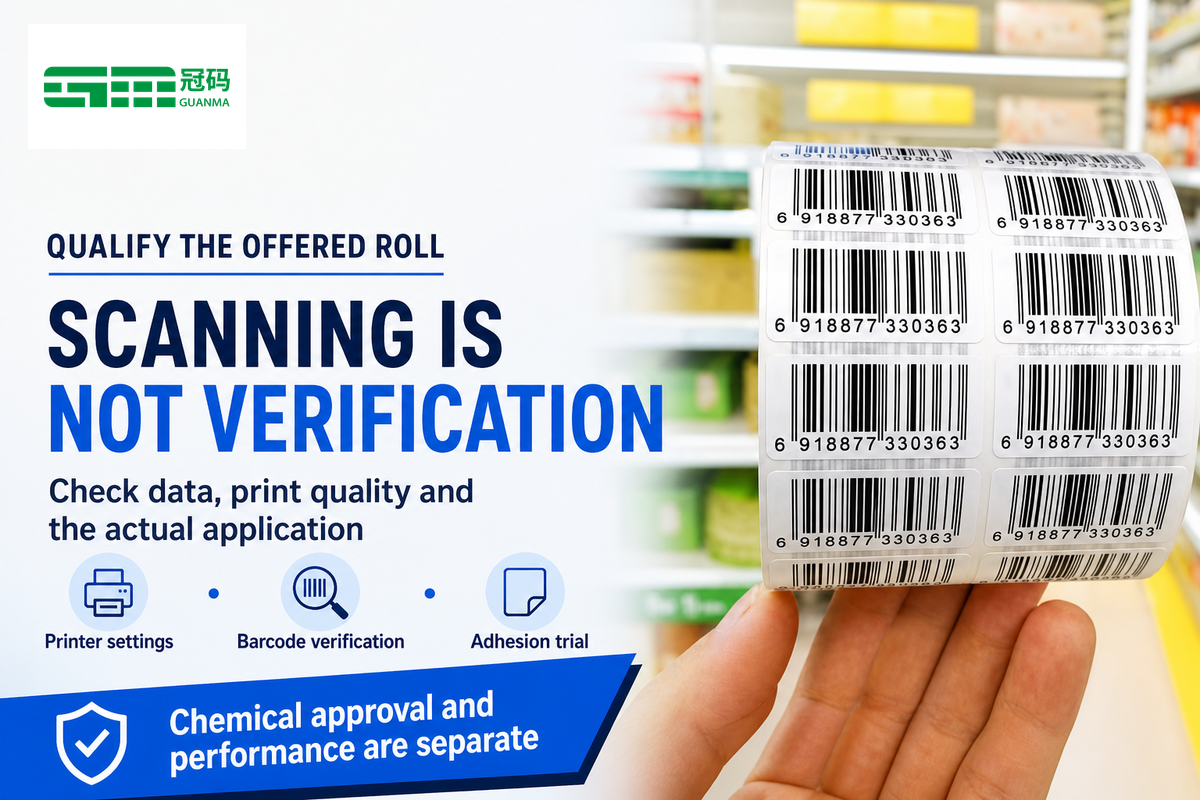
The proposed roll must be tested on the intended thermal printer and application, even after its chemical documents are acceptable. Feeding, print quality and adhesion depend on the material construction and operating conditions. Therefore, a successful substitution trial should use the offered roll, the design of the label, and the relevant exposure conditions.
An illustrative example from 2021 is the receipt Paper Project run by Washington Ecology at Joint Base Lewis-McChord. The demonstration evaluated paper color, printing speed, jams, readability of text, and surface texture of the paper. It doesn’t demonstrate the results for adhesive labels or Guanma products.
“Our project focused on finding a phenol-free receipt paper that would still meet performance requirements.”
Record models, speeds and darkness settings, roll dimensions and sensor configuration. A different Zebra installation and another printer may require different media checks. Verify whether the system uses direct thermal or thermal transfer printing, before substituting the material.
For barcode labels, provide data correctness and the verification result. GS1 NZ offers information about defective barcodes and why they may still scan. A scan on a single reader doesn’t prove a barcode meets the required quality level. See GS1’s verifier guidance for application-specific minimum quality requirements.
For asset management and shipping, include actual substrate and environmental conditions. Our test methods for label durability cover this in more detail. If a trial fails, investigate media and settings rather than assuming the failure was caused by phenol-free.
Keep procurement, quality and production on the same approval record
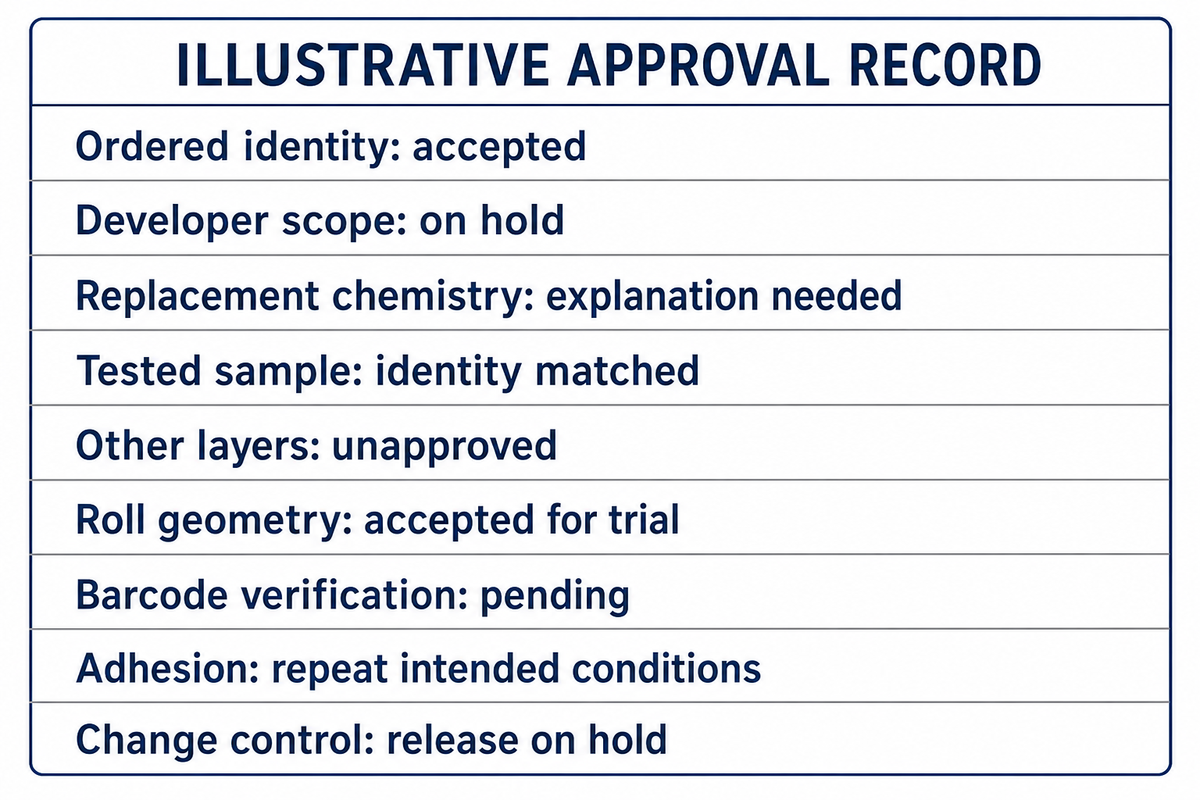
Use one record to show what each function has approved and what’s still open. Procurement owns the purchased identity and change notice; quality reviews the chemical evidence; production reviews application performance. This approach makes some of the conditional decisions visible without pretending that a single certificate satisfies all purchasing requirements.
The Declaration-to-Order Trace below is a completed example for a buyer evaluating a replacement roll. Statuses are fictitious to illustrate a decision, not to disclose a customer trial.
| Approval item | Example evidence received | Owner and decision |
|---|---|---|
| Ordered identity | Named construction matches the quotation. | Procurement: identity accepted. |
| Developer exclusions | Declaration states BPA- and BPS-free thermal paper only. | Quality: broader phenol-free claim on hold. |
| Replacement chemistry | Assessment scope not supplied. | Quality: request explanation before approval. |
| Tested material | Report names the proposed paper grade. | Quality: sample identity matched. |
| Other layers | Adhesive is omitted from the declaration. | Quality: complete-label claim unapproved. |
| Roll geometry | Drawing matches the printer media path. | Production: geometry accepted for trial. |
| Barcode performance | One successful scan; verification pending. | Production: performance approval pending. |
| Adhesion | Dry-carton trial only; chilled use intended. | Production: repeat under intended conditions. |
| Change control | Supplier has not confirmed notice of substitutions. | Procurement: release remains on hold. |
This buyer should request the missing evidence and complete the appropriate trials before approving the intended claim and use. When a unit price is low, consider qualification time and unusable stock, but don’t calculate savings without your own costs. Once approved, preserve the construction reference for sample-to-batch acceptance on repeat orders.
Published grades are starting points, not transferable certificates
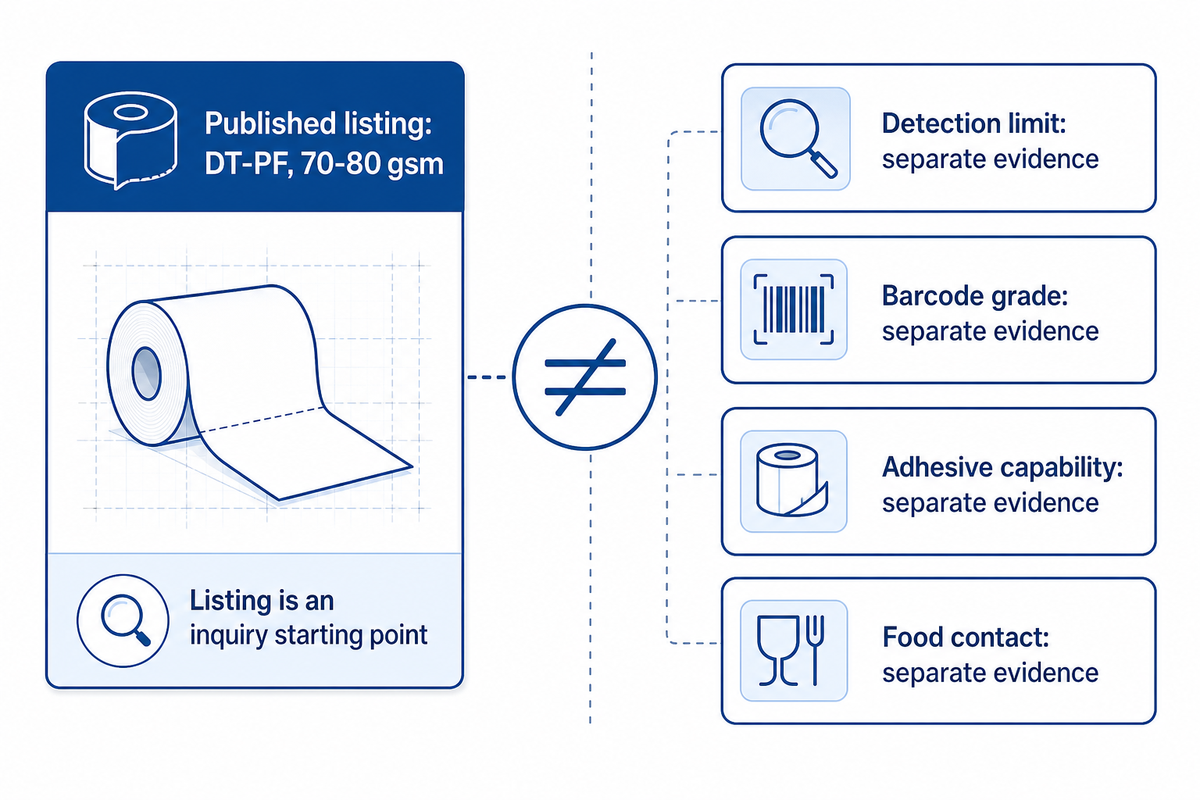
A published grade lets you ask a supplier question about that grade. It doesn’t replace the current declaration, report or application trial for the offered construction. Keep paper specifications separate from finished-roll performance, and don’t transfer a claim from another brand, grade, or a similar-looking product name.
Guanma’s thermal-paper product table lists DT-PF at 70–80 gsm. This is a useful starting point for an inquiry. The listed grammage doesn’t establish a detection limit, barcode grade, adhesive capability or food-contact approval. Ask which construction corresponds to the listed option and what, if any, documentation is provided.
Paper suppliers may also provide a few developer systems within a range. Comparing “high-performance” labeling solutions without matching the construction may conceal a change that’s significant to production. If a quotation substitutes another grade, compare its declaration and trial evidence before accepting it as equivalent.
New phenol-free ranges make change control more important
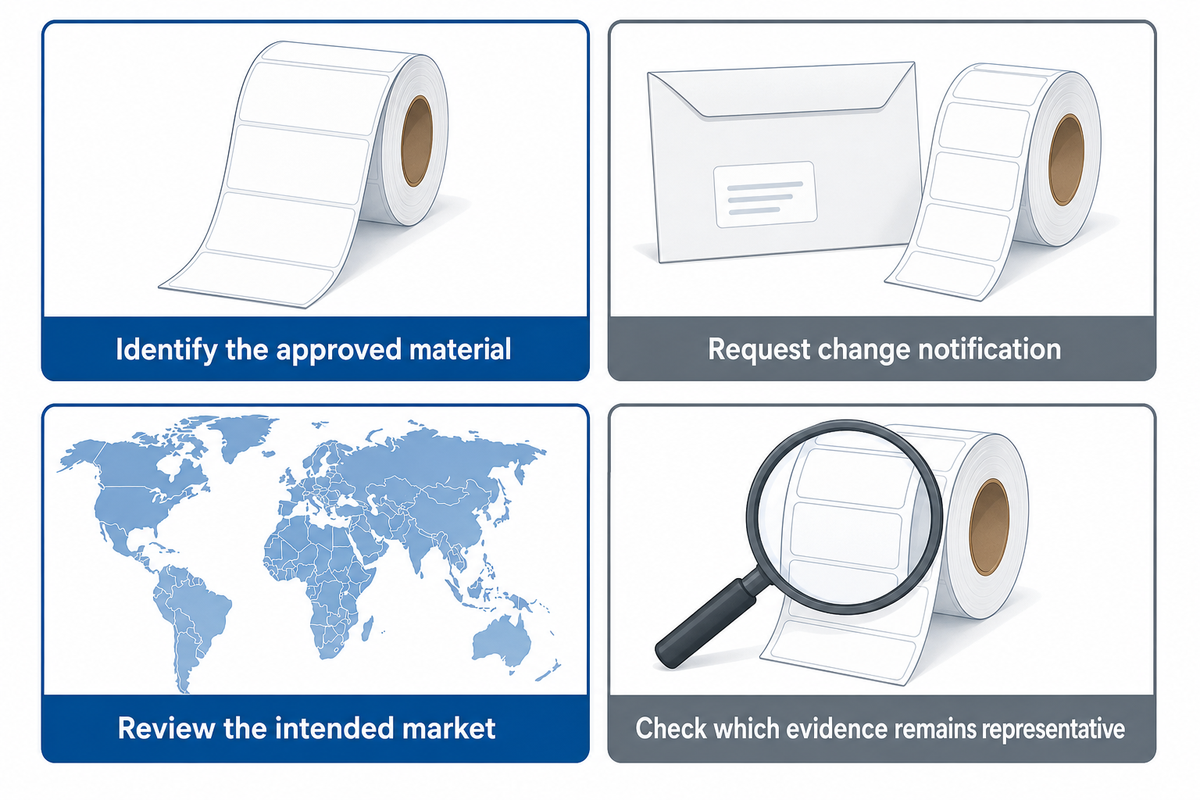
New materials create an opportunity to tie approvals to revisions. A supplier can provide a different developer system or construction with a material under a known product family. Identify the approved material and request notification of any changes; review the evidence in question rather than assume the original approval covers all subsequent deliveries.
Jurisdiction also is important. Washington’s thermal-paper rule restricts intentionally added bisphenols from January 1, 2026, with stated exceptions for FDA-regulated medical devices and products manufactured before that date. Its provision above 200 ppm establishes a rebuttable presumption of intentional addition. It is not a universal definition of phenol-free or a lab detection limit.
California Proposition 65 requirements answer a different question. The Official Proposition 65 Guidance covers warning requirements for exposures to listed chemicals. Therefore, “Prop 65 compliant” can’t be interpreted as a composition declaration. A lack of a warning doesn’t equal a chemical assessment.
A revised material reference or intended market should prompt a renewed approval for a repeat order. Request which documents and trials remain representative. No set document renewal period can take the place of that judgment.
Request a grade-specific quotation from Guanma
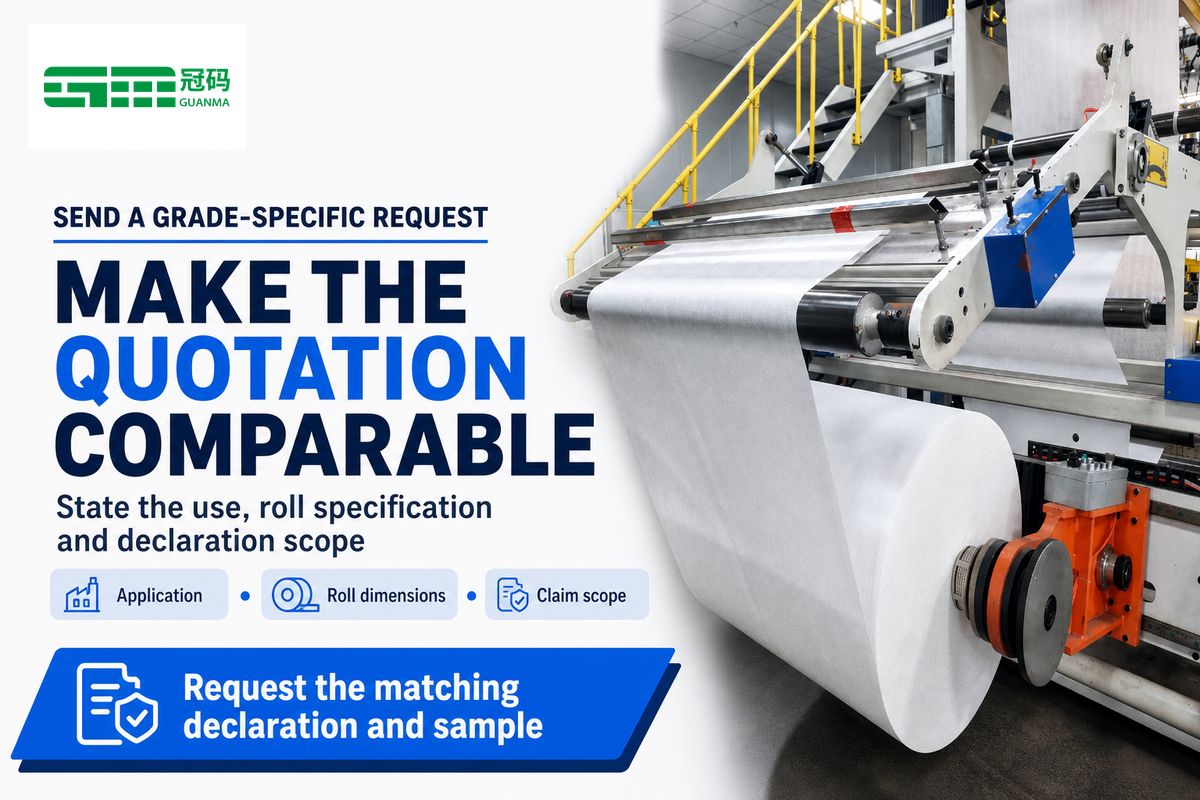
Send Guanma the intended application, required claim and actual roll specification, so that the quotation can identify a candidate construction. Also request the matching declaration and evidentiary support. This provides procurement with a means to compare and production with a defined sample to test prior to order release.
Complete the following fields in your request. Illustrative example dimensions are provided below; use your printer and label drawing values.
| Parameter | Required value | Why it matters | How to verify |
|---|---|---|---|
| Label dimensions | Example: 50 × 25 mm | Layout and feed geometry | Approved drawing |
| Core inside diameter | Example: 25 mm | Printer roll holder | Printer media specification |
| Maximum roll diameter | Example: 100 mm | Roll compartment clearance | Printer media specification |
| Labels per roll | Your required count | Order and replenishment plan | Quotation and roll drawing |
| Application surface | Actual packaging material | Adhesive performance | Representative substrate trial |
| Chemical claim | Your exclusion and scope requirement | Comparable evidence | Grade-specific declaration |
| Print and exposure conditions | Printer settings and actual environment | Reliable printing and service life | Agreed application trial |
Key takeaway
Approve the chemical claim, the ordered construction and application performance separately, then keep their evidence attached to the same purchase record.
Review Guanma’s thermal labelstock options and provide the required dimensions, use conditions and declaration scope in your request. A specific grade discussion will be more valuable than requesting a “safe” roll.
Frequently asked questions
Are phenol-free thermal labels safe?
A phenol-free claim alone cannot establish safety for every use.
The claim addresses specified chemistry within a declared material scope. Health risks of BPA, exposure to BPA and BPS, replacement developers and food-contact conditions are different assessment questions. Ask what was excluded, what was used instead and which evidence applies to the complete label. Using phenol-free stock shouldn’t become an unsupported promise that all hazardous chemicals or health risks have disappeared.
A buyer labeling chilled food containers might need evidence about contact conditions and adhesion as well as developer chemistry. Define the intended use before requesting a general statement, so the supplier can answer against a specific requirement.
How long do phenol-free thermal labels last?
Image life depends on the grade and service conditions, not the exclusion claim alone.
Heat, light, chemicals and abrasion can affect the intended labeling application. Specify the required readable period and environmental conditions, then trial the proposed stock accordingly. Warehouse shipping labels and long-term asset identification have different demands. A supplier should support any lifetime claim with the relevant material and test conditions; a receipt-paper result doesn’t establish durability for your adhesive label.
Are phenol-free labels waterproof?
Phenol-free chemistry does not establish water resistance.
Water exposure involves the facestock, topcoat, printed image and adhesive. A short splash and prolonged condensation can produce different outcomes, especially on chilled packaging. Request evidence for the actual construction and test the intended exposure. Don’t accept “without sacrificing print quality or durability” as a substitute for a defined trial of the offered roll on the intended surface.
Can linerless labels be phenol-free?
Yes, linerless construction and developer chemistry describe different features.
Confirm the thermal layer’s declaration separately from the release coating and adhesive. Then check feeding, cutting and application on the intended equipment. Removing a disposable liner doesn’t, by itself, establish the product’s complete safety and sustainability profile.
Are phenol-free thermal labels recyclable?
Recyclability depends on the full construction and the receiving recycling system.
Paper products with different coatings, adhesives or liners may follow different disposal routes. Ask for a product-specific claim and check local acceptance. “Eco-friendly option” and “reducing environmental impact” need their own evidence; neither follows automatically from a developer exclusion.
Are non-phenol receipt rolls the same as adhesive labels?
No. Thermal paper rolls for receipts and self-adhesive labels have different construction requirements.
Hospitality POS systems print thermal paper receipts without qualifying a label adhesive. State whether the order concerns a receipt and label application or only one of them, so a receipt-roll quotation doesn’t replace the labelstock you need.
Will phenol-free paper work in my existing POS printer?
Confirm compatibility for the particular paper and printer combination.
Match media dimensions and supplier requirements, then trial feeding and readability at the intended settings. Existing equipment compatibility is a performance question. A successful POS receipt trial doesn’t qualify the same material as finished direct thermal labels.
This review is a combination of public source research and proposed purchasing methods. The illustrative approval record, report reading figures, and quotation dimensions are for illustration only. No private Guanma laboratory results, customer trials, or universal performance guarantees are claimed.
References & Sources
- Green Chemistry Challenge: 2017 Designing Greener Chemicals Award U.S. Environmental Protection Agency.
- BPA and BPS in thermal paper Minnesota Pollution Control Agency.
- Partnership to Evaluate Alternatives to Bisphenol A in Thermal Paper U.S. Environmental Protection Agency.
- Tackling Toxics: Helping Joint Base Lewis-McChord replace toxic receipt paper Washington State Department of Ecology, August 2, 2021.
- Why did my barcode fail verification if it can still be scanned? GS1 New Zealand, 2014 explanation.
- How can I measure the quality of my printed barcodes? GS1.
- WAC 173-337-114: Bisphenols Washington State Legislature.
- Frequently Asked Questions California Office of Environmental Health Hazard Assessment, Proposition 65 Warnings.