Get in Touch with Guanma

Thermal Transfer vs Direct Thermal Printing — A Materials-Side Guide for Label Buyers

Thermal Transfer vs Direct Thermal Printing — A Materials-Side Guide for Label Buyers
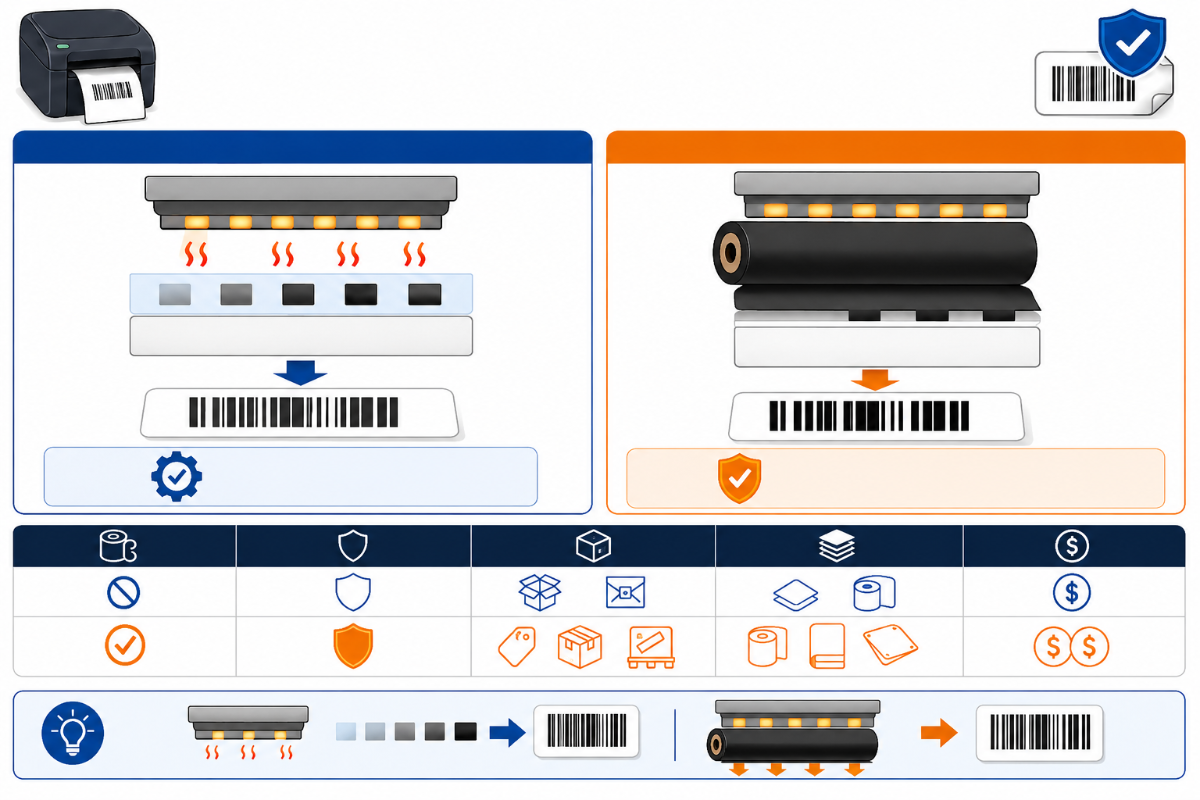
Thermal transfer vs direct thermal is the single most important decision in any label-printing spec. Pick the wrong one and a shipping label dissolves in a humid warehouse, a chemical-drum tag dissolves in a forklift wash-down, or a pharmacy bottle barcode becomes unreadable mid-supply-chain. Most online guides are authored by printer or ribbon OEMs and present the question as “which printer”. This guide is by a label-stock manufacturer and worded as “which facestock + which method + which service window” — since that triplet, not the printer alone, determines the survival of the label.
Quick Specs — TT vs DT at a Glance
| Direct Thermal (DT) | Heat-sensitive coated paper; no ribbon; ≤ 6-month service life; cheap supplies |
| Thermal Transfer (TT) | Wax / wax-resin / resin ribbon onto film or paper; 5+ year life; harsher fit |
| Decisive variable | Service window — under 6 months → DT eligible; over → TT mandatory |
| Printhead MTBF | DT 25–50 km cycles; TT 50–100 km cycles (industry typical) |
| Common standards | ANSI grade A/B/C barcode; ISO/IEC 15416 print quality |
| 2026 watch-item | Washington bans BPA + BPS in thermal receipt paper Jan 1, 2026 |
How Each Method Actually Works — Heat-Activated Coating vs Ribbon Transfer
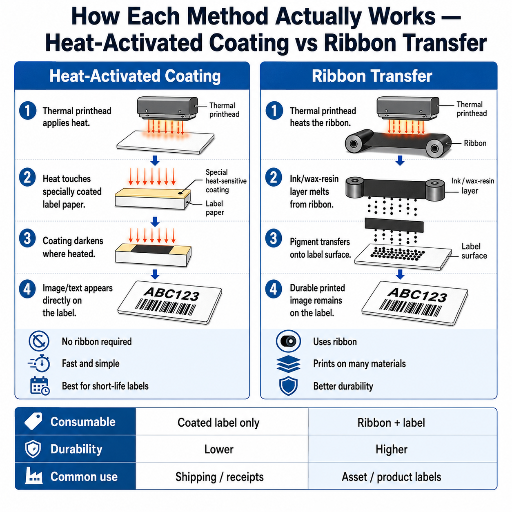
The difference between direct thermal and thermal transfer printing is whether the substrate is the printable layer or simply a carrier. They feature the same class of heated print head, but that is their only shared trait.
Direct thermal (DT) printing involves paper or film with a chemically active coating. When targeted by a heated printhead dot of ~120 °C, the coating chemically reacts and blackens. No ink, no ribbon — the paper itself becomes the image. As the U.S. EPA documents, “direct thermal printing produces an image when specific chemicals within the coating of thermal paper are heated.”
Thermal transfer (TT) uses a separate ribbon — a thin polyester carrier coated with a wax, wax-resin, or resin ink layer. A heated printhead melts ink off the back of the ribbon onto the substrate underneath, and the ink solidifies as it cools. Substrate options range across paper, film, polyester, and vinyl, and the ribbon class is matched to substrate and service environment.
So what? In DT the substrate is the printable layer; in TT, the substrate’s just the carrier and the ink is the finished surface. That is why DT is cheapest to operate (one consumable rather than two) but inherently less durable (the same heat that produces an image can re-darken it).
Material Layer — What’s Inside a DT Label vs a TT Label
Procurement specs that omit the chemistry rarely survive in service over a year. Here is what you really buy.
Direct Thermal Paper Stack
A DT label material is a 4-layer chemistry stack on a paper or film carrier. A thermal print head activates these layers in sequence. Wikipedia’s thermal-paper entry and the U.S. EPA reference document name the four ingredients:
- Leuco dye — generally a triaryl methane phthalide; colourless until activated
- Developer — historically BPA, increasingly BPS, now evolving toward ascorbic acid (Vit C) and other phenol-free chemistries
- Sensitizer — tunes activation to the temperature threshold the print head requires for a clean colour-change
- Stabilizer — retards the gradual unintended colour change caused by heat, plasticisers, oils, and direct sunlight
This chemistry stack explains why DTs are so intrinsically ephemeral: the same chemistry that can turn a 0.2 ms heat pulse black will perpetually drive the coating to darken once it is exposed to heat or solvent.
Thermal Transfer Stack
TT breaks the chemistry into two sections, the ribbon and the facestock. Ribbon is divided into wax (60–70 g/m² ink coat weight, just paper and cheapest) wax-resin (70–90 g/m², general purpose for synthetics) and resin (90–110 g/m², chemical and abrasion resistant). The facestocks could be coated paper, PET facestocks, BOPP, vinyl or PP synthetics — with a hot-melt, water-based or acrylic adhesive.
Side-by-Side — Six Comparison Dimensions
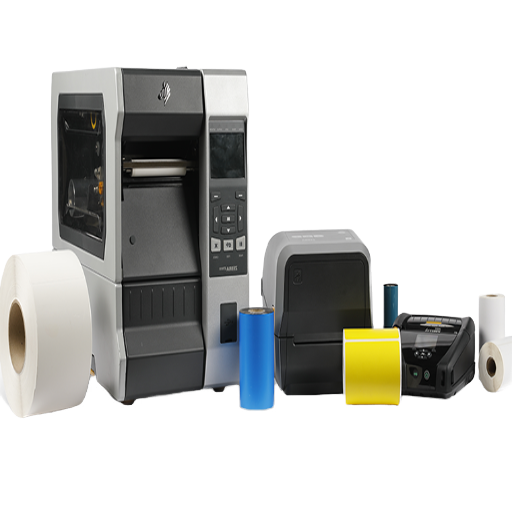
What separates the two is often a matter of six criteria, where each always determines choice of supplier. Here is a summary:
| Dimension | Direct Thermal | Thermal Transfer |
|---|---|---|
| Mechanism | Heat activates coated paper | Heat melts ribbon ink onto substrate |
| Consumables | DT paper / film only | Ribbon + label media (matched pair) |
| Service life | ≤ 6 months (industry standard) | 5+ years; archival up to 10+ |
| Cost per label | Lower (no ribbon) | Higher (ribbon adds 30–50 %) |
| Print quality | Sharp when fresh, fades with heat / UV | Crisp + stable; resin ribbon = best edge |
| Best for | Receipts, shipping, event badges, perishables | Pharma, chemicals, tires, asset tags, outdoor |
Service Life — Why DT Fades After 6 Months
Three independent industry sources converge on the same number. Beontag states “labels typically last for about 6 months under normal conditions.” Brother Mobile Solutions writes “less than six months” as the DT eligibility cutoff. DNP describes DT as “shorter period” applications.
We have come to call this convergent evidence the 6-Month Threshold Rule, and use it as the initial triage question on any new label spec.
💡 The 6-Month Threshold Rule
Service window under 6 months, indoor / climate controlled storage is DT. Service window over 6 months, exposure to heat or sunlight, oils or solvents, switch to TT. There is no middle ground where DT remains reliable.
Why such a tough cliff?
Remember the leuco dye+developer+sensitizer+stabiliser chemistry. That coating remains chemically energized once printed. Heat, UV, plasticiser leached from PVC sleeves, oil from finger-tips, just friction repeatedly rubbing the label — anything can trigger the colour-change again, or more frequently just blacken the whole label.
In Reddit’s r/EventProduction community, conference organisers complain that DT badges fade “by day three of conference” after just pocket-sweat.
⚠️ Common Mistakes
- Heating DT with a hot situation or sun. A DT warning tags on a south-face window going solid black in not more than weeks; in a 60 °C cargo container it may fade in days.
- Define DT for chemical drum exposure. solvent fumes. Blackening of the topcoat as the solvent vapor dissolves the topcoat.
- Apply a topcoat to “make DT durable” (as the DT itself will be okay as long as primer is present.). A topcoat adds a little to the life, but does nothing to change the basic 6-month chemistry. For over-6-month use, go TT, not band-aid the DT.
Printhead Wear & Total Cost of Ownership

The cost-per-label argument is not so compelling without the printhead replacement amortisation. Here is the complete TCO picture for a line printing 100,000 labels/mth for 3 years.
The DT’s are subject to higher wear since they are are in direct contact with the active coating which has small abrasive particles in it. Hoin’s actual receipt-printer metrics shows an average DT printhead life of approximately 150 km used. MIDCOM Data define industrial printhead life by millions of linear inches—scaled by intensity of use, ribbon hardness, and cleaning cycles.
Thermal transfer printheads have longer lives than direct-thermal printheads, thanks mainly to the ribbon, which serves as a buffer for the pain of the heating elements and the gouge of an abrasive label substrate. Skip the ribbon and the printhead is the one that will be footing the bill.
| 3-yr TCO line item | DT | TT |
|---|---|---|
| Printer (industrial, 4-inch) | $1,000–$1,800 | $1,400–$2,400 |
| Media (DT paper or TT label) | Lower per roll | Comparable; resin grades cost more |
| Ribbon | N/A | Adds 30–50 % to per-label cost |
| Printhead replacement | ~$200–$500 every 25–50 km | ~$300–$600 every 50–100 km |
📐 Engineering Note
A 3-line warehouse consuming ~100k labels/month each produces ~3.6 km of print per year per line. Given these volume levels a DT line replaces print heads every 7–14 years and a TT line every 14–28 years—good cleaning discipline can halve this timing, of course. Budget one print head per line every five years at high rates, or less for laptops or lower-output needs.
Print Quality, Barcodes & Edge Definition
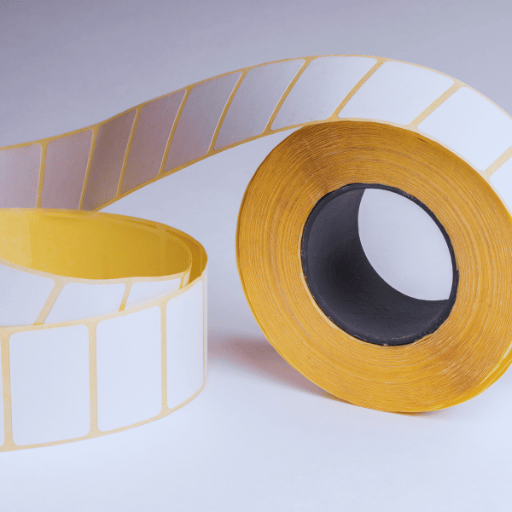
Are Zebra printers direct thermal or thermal transfer?
Both. Zebra’s industrial line — including the ZD420, ZD421, ZT411, and ZT231 — ships as dual-mode variants (TT capable, run as DT by removing the ribbon) so a single printer covers both jobs. Resolution choice is per label batch: 203 dpi handles standard barcodes, 300 dpi is the practical sweet spot for tight-tolerance labels and small text, and 600 dpi exists for high-density 2D codes (DataMatrix, QR) on small medical vials.
Edge definition is where TT pulls clearly ahead and produces high-quality images, especially with a resin ribbon. ANSI grade A scans (the highest quality category in ISO/IEC 15416) consistently come from resin-on-PET combinations; DT typically scans at grade B or C as service age advances. Wax-resin ribbons hit ANSI grade A on synthetic paper. If your QA process rejects below ANSI grade B, plan TT plus a resin or wax-resin ribbon as your default.
Application Decision Map — Pick the Right Method for Your Use Case
The application-to-method decision map below is the triage tool we use internally when matching customers to a stock formulation. Use the service-window column as the primary triage key: under 6 months on the shelf, DT is on the table; over 6 months, switch to TT and pick a ribbon class to match the substrate and exposure.
| Application | Service window | Method | Media + ribbon class |
|---|---|---|---|
| Shipping & courier labels | Days to weeks | DT | DT paper, no ribbon |
| Receipts & POS tickets | Hours to weeks | DT | Phenol-free DT paper (post-2026) |
| Event badges (≤ 3-day events) | Days | DT (caveat: pocket sweat) | DT film with topcoat |
| Pharmaceutical labels & vials | Years (full shelf life) | TT | PET face + resin ribbon |
| Chemical labels & drum tags | Years; harsh exposure | TT | Vinyl or PET + resin ribbon |
| Tire labels | Years; abrasion + weather | TT | PP synthetic paper + resin ribbon |
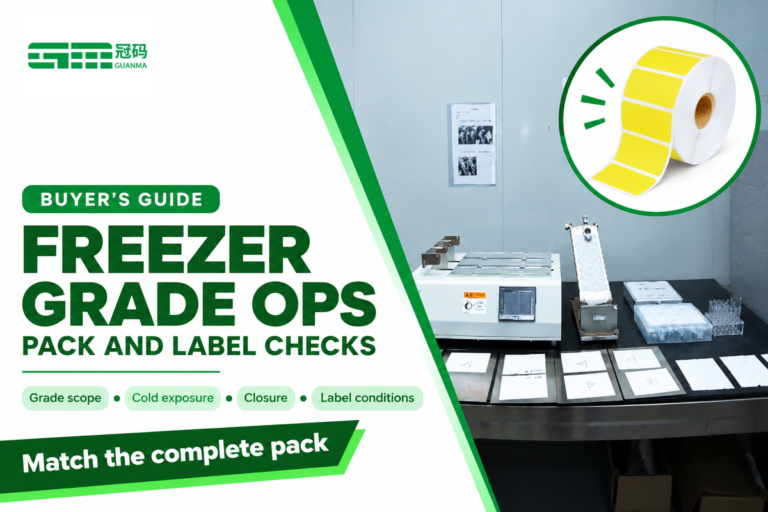
| Freezer labels & cold chain | Years at −20 °C | TT | PET + cold-grade adhesive + wax-resin ribbon |
| Asset tags & equipment ID | 5–10 years outdoor | TT | Polyester or vinyl + resin ribbon |
| Perishable food (frozen + thaw) | Weeks to months | DT (short shelf) or TT (export) | DT freezer-grade or BOPP + wax-resin |
Substrate Compatibility — A Material-Side Pivot You Won’t Find on Printer-OEM Pages
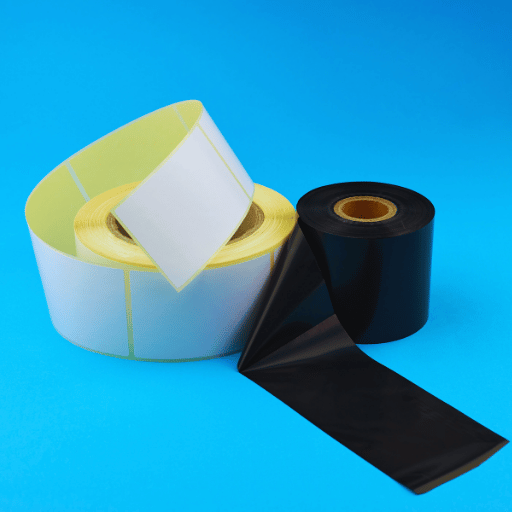
Here is the application-to-methody decision table we use internally when fitting customers to a stock formulation—use the service window as your primary triage column for sorting.
| Facestock | Direct Thermal | TT — Wax ribbon | TT — Wax-Resin | TT — Resin |
|---|---|---|---|---|
| Coated paper | ✓ if heat-sensitive coating | ✓ default pairing | ✓ general purpose | ⚠ overkill |
| PP synthetic paper | ✗ not heat-active | ⚠ poor adhesion | ✓ default pairing | ✓ harsh duty |
| BOPP | ✗ not heat-active | ⚠ marginal | ✓ beverage / cosmetics | ✓ chemical splash |
| PET (polyester) | ✗ not heat-active | ✗ smears | ✓ logistics, frozen | ✓ pharma, autoclave |
| Vinyl (PVC) | ✗ not heat-active | ✗ smears | ⚠ outdoor only | ✓ default for outdoor / chemical |
Two takeaways. First, DT lives in a single column — only heat-sensitive coated paper and a few film variants accept the chemistry. Second, the resin ribbon column is where harsh-duty TT lives, and matching resin to a film face (PET or vinyl) is what gives you 5+ year service life. Specs that pair resin ribbon to coated paper, or wax ribbon to PET, are both forms of money on fire.
2026–2030 Outlook — Phenol-Free, BPA Restrictions, and the Washington Mandate
Here are three of the trends that will dominate DT spec development in four years:
Regulatory phase-out of bisphenols. The Washington State Department of Commerce confirmed that, effective January 1, 2026, sale and manufacture of thermal receipt paper containing BPA or BPS is prohibited in Washington. Maine banned BPA-containing thermal paper years earlier; California’s Proposition 65 listings have the same commercial effect. EU REACH restrictions on BPA are tightening, with BPS expected to follow in Q4 2027. If your customers ship into any of these jurisdictions, a phenol-free DT supplier roadmap is no longer optional.
Ascorbic-acid-developer chemistry. A leading post-BPA replacement uses ascorbic acid (vitamin C) as the developer in place of BPA / BPS. Ascorbic-acid chemistry is well documented and commercially available, although converters are still ironing out cost parity and shelf-stability under high-humidity conditions. Procurement teams should request specific phenol-free SKU IDs from suppliers — not just “BPA-free” marketing language, which often means BPS substitute and is now equally regulated.
Market growth. The DT label segment alone is projected to grow from US $3.9 billion in 2026 to US $6.1 billion by 2033 — a 6.7 % CAGR driven by e-commerce volume and traceability mandates. TT growth tracks similarly. For three-year contracts, lock supplier capacity now, particularly on phenol-free DT and resin TT ribbons where demand is concentrating.
If your 2026–2027 procurement plan still assumes BPA thermal paper for North-American operations, the realistic action is to qualify two phenol-free DT SKUs and one resin TT SKU before mid-2026 — two purchasing cycles, the minimum runway to switch a stable label spec without supply disruption.
Frequently Asked Questions
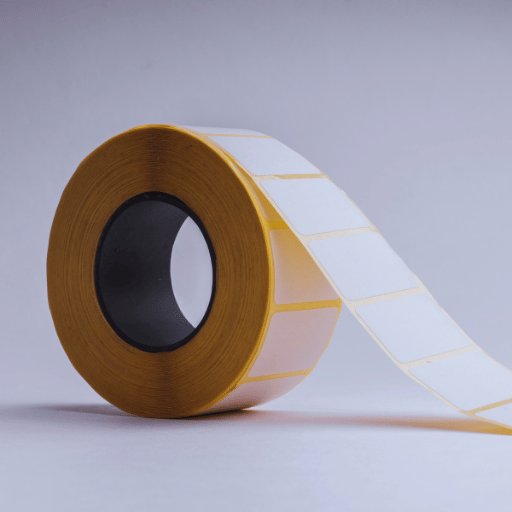
Q: Can I use direct thermal labels in a thermal transfer printer?
View Answer
Yes, but you waste ribbon. A TT printer with ribbon loaded will print on DT media — both the heat-activated chemistry and the ribbon ink will mark the label, producing a ghost-double image. Most dual-mode TT printers (Zebra ZD420, Brother TD-2, SATO CL4NX series) let you remove the ribbon to run pure DT mode. Pull the ribbon, keep the printer, switch back when you need TT durability.
Q: How long does a thermal printer last?
Reveal Answer
Printer body lasts 5–10 years under normal industrial use. Printheads — the wear part — last roughly 25–50 km of print on direct thermal and 50–100 km on thermal transfer, with proper cleaning. Hoin’s real-world receipt-printer data reports about 150 km on DT in retail point-of-sale environments. A simple alcohol wipe every 1–2 rolls roughly doubles printhead life. Replacement printheads cost about $200–$500 for desktops and $300–$600 for industrial 4-inch units.
Q: What type of ribbon — wax, wax-resin, or resin?
Show Answer
Match ribbon to facestock and exposure. Wax ribbons are the cheapest and pair with coated paper for indoor short-life work. Wax-resin is the general-purpose choice for synthetic papers and BOPP, with reasonable abrasion and chemical resistance. Resin is the harsh-duty grade — required for vinyl, PET pharma vials, chemical drums, and outdoor asset tags. Mismatching is expensive: a wax ribbon on a vinyl drum label smears within hours; a resin ribbon on coated paper costs roughly 3× what the application needs.
Q: Do thermal printers print in color?
Open Answer
Native full-colour thermal printing exists (Polaroid Zink-style 2-pass thermal) but is rare in B2B labelling because the consumables are several times the cost of standard wax / resin and the colour gamut is limited. The practical industrial route to colour is spot-colour TT ribbons — single-colour ribbons in red, blue, green for safety, regulatory, or category-coding marks. Some Zebra and SATO printers ship as dual-ribbon mechs that combine spot-colour with black on the same label.
Q: Are direct thermal labels recyclable after the BPA phase-out?
View Answer
Phenolfree DT paper makes the recyclability story 300% better. Receipts with bisphenol residues contaminated paper recycling; ascorbic-acid-based DT chemistry is much cleaner. DT papers still are a challenge for the kerchief of uncoated paper, but most North-American municipal paper streams now process phenol-free DT. For a closed-loop green aspiration ask for a specific phenol-free SKU plus a recyclability statement signed against AF&PA or EU guids.
Match Your Printing Method to the Right Material Stack
Guanma holds all grades of DT and TT-compatible self-adhesive label stock together with coating, laminating, and R&D equipment in Thailand and Vietnam. PET, BOPP, PP synthetic paper, and coated paper with hot-melt, water-based, and acrylic adhesives formats are designed and tested for blow-moulding, boat transport, pharmaceutical, chemical-chemical, and turnkey applications in Southeast-Asia, South-America, and Europe. Tell us your printer model, ribbon class, and service environment; we provide your recommended face/adhesive/topcoat combination plus a phenolfree sample carton.
About This Materials Guide
Guanma is a self-adhesive label stock producer with converting, coating, laminating, and R&D facilities in Thailand and Vietnam. The TT/DT compatibility matrix we use, ribbon-class pairings, and phenolfree supplier-roadmap below are based on more than ten years of manufacturing PET, PP synthetic paper, BOPP and coated paper stocks for thermal printing. Performance figures a rounded figures within the typical industry range; printer piecemeal testing is required before any new label spec is production approved. Method validity validated by the Guanma engineering team.
References & Sources
- Bisphenol A Alternatives in Thermal Paper — Chapter 3 — U.S. Environmental Protection Agency
- Washington State Eliminates Harmful Chemicals from Thermal Receipts — Washington State Department of Commerce
- Thermal Paper — Chemistry and History — Wikipedia
- Direct Thermal vs Thermal Transfer Printing — DNP Imagingcomm Europe technical team
- Direct Thermal vs Thermal Transfer: What’s the Difference? — Beontag
- Direct Thermal vs Thermal Transfer — Which Print Technology Works Best? — Brother Mobile Solutions (Raul Palacios)
- Average Lifespan of a Thermal Printhead — MIDCOM Data Technologies
- How Long Do Thermal Receipt Printer Printheads Last — Real-World Data — HOIN Printer
- Labeling Trends 2026: Wash-off, Phenol-free Thermal, Bio-based — Beontag
- Direct Thermal Labels Market Size & Forecast 2026–2033 — Persistence Market Research
Related Articles
- How Waterproof Labels Actually Work — Inside the Materials, Adhesives & Coatings That Survive Water
- Thermal Transfer Ribbon Selection — Wax, Wax-Resin, and Resin for Every Substrate
- BPA-Free Thermal Paper — A 2026–2030 Procurement Roadmap
- Printhead Care — Cleaning Cadence and Replacement Economics for Thermal Label Printers
- Cold-Grade Acrylic Adhesive — Specifying for Frozen and Refrigerated Applications
WHY WE WRITE THIS
About Guanma
Guanma is a self-adhesive film, label stock, and release liner manufacturer for industrial labeling applications. Our team works with PET film, PP synthetic paper, coated paper, hot-melt PSA, acrylic PSA, water-based adhesive, glassine liner, and CCK release liner.
We write these guides to help label converters, packaging buyers, and industrial procurement teams choose materials by real application conditions instead of generic catalog names. Most label failures come from a mismatch between facestock, adhesive, liner, substrate, temperature, printing method, or end-use environment. Our content explains those decisions in practical terms.
Our Experience
Guanma’s material guidance is based on coating, lamination, slitting, sample validation, and customer troubleshooting experience across Thailand and Vietnam production. We focus on common industrial label problems such as cold-temperature peel, oil and chemical exposure, UV aging, print durability, release force, MOQ, lead time, and substrate-matched testing.
Our Expertise
We reference practical testing logic and recognized label-industry standards, including FINAT FTM peel and shear methods, ASTM peel testing methods, FDA 21 CFR 175.105, REACH, RoHS, FSC, and ISO 9001-related quality control. For custom label stock, we always recommend testing samples on the buyer’s real substrate before full production.
SYS.PROFILE
Visit Website
Contact Profile
Name
Guanma Manufacturing Team
Brand Name
Guanma
Country
Thailand + Vietnam Production
Model
B2B / Wholesale / Custom Coating
Main Products
Self-Adhesive Film, Label Stock, Release Paper & Liner
Contact
Submit RFQ via Website Form
Website
https://guanmalabel.com/