Get in Touch with Guanma

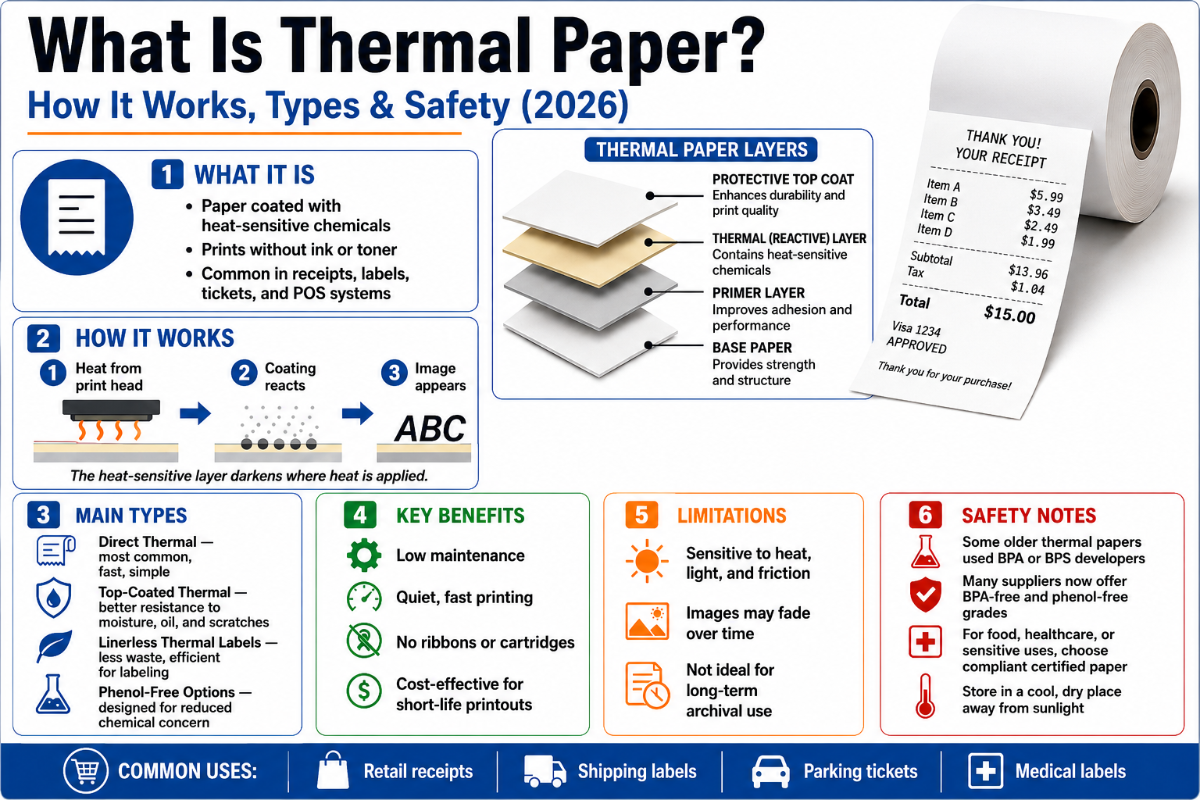
Thermal paper is a type of paper used in certain types of printers that turns black in response to high temperatures rather than using ink. It is used in the majority of tills, vending machine labels, and the tickets you interact with. However, “thermal paper” is one of the most misrepresented types of paper from the labeling industry. People think all thermal paper is the same, and that the print are permanent and that “BPA-free” is synonymous with safety. This, unfortunately, is not always the case. This guide attempts to clarify how thermal paper works, the construction of the paper, the differences between direct thermal and thermal transfer, the longevity of the images, the safety of the labels, and the direction of the whole category as a result of regulations taking effect in 2026.
Thermal Paper at a Glance
| What it is | Paper with a heat-sensitive coating that darkens under a thermal print head — no ink, toner, or cartridge |
| Imaging reaction | A leuco dye and a color developer react under heat to form a visible (usually black) mark |
| Core layers | Base paper · precoat · thermal active layer · (optional) protective topcoat |
| Two print methods | Direct thermal (no ribbon) and thermal transfer (uses a ribbon) |
| Typical weight | Commonly 48–80 gsm — lighter (~48–55 gsm) for receipts, heavier (~70–80 gsm) for tickets and medical records; bands vary by mill and grade |
| Image life | ~6 months to 10 years; most POS-grade paper holds 5–7 years if stored well |
| Safety options | BPA-free, BPS-free, and phenol-free (the safest tier) |
What Is Thermal Paper? (And How It Prints Without Ink)
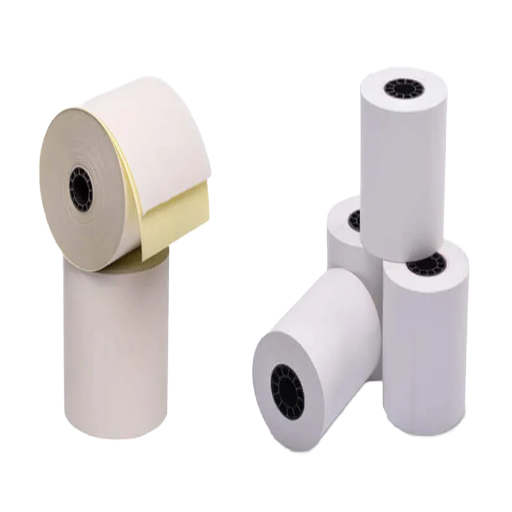
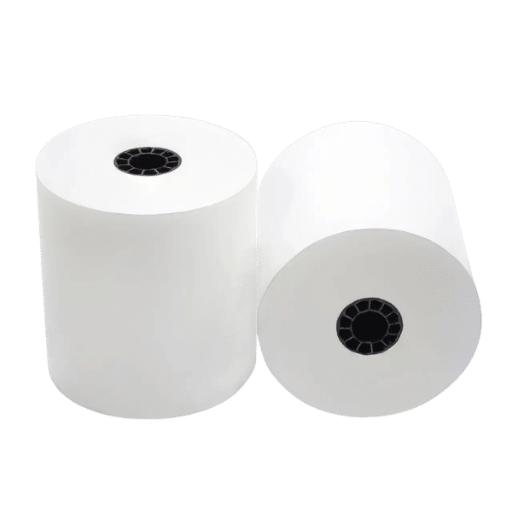
thermal paper is a type of specialty paper coated that has a reactive chemical layer that alters the color of the paper when the printer’s heating element print comes into contact with it. It is similar to what you would see sold as thermal printer paper, or just printer paper for receipt machines, but it differs greatly from standard printer paper. In a direct thermal print there is no ink, toner, or ribbons used — the image is produced by the paper. This specific distinction explains a lot about the product: it clarifies why thermal printers are quieter than traditional ones, why receipts have a slick feel about them, and why print tend to fade with time.
Inside thermal printers are rows of small heating elements that touch the moving paper. When each element is activated, the coating crosses the temperature threshold for activation, causing a chemical process that turns the dot black. This creates text and barcodes at thousands of dots per second. The only consumable in this process is the paper, because the chemical reaction is built into the coating — a heat-sensitive recording material whose composition is set out in detail in thermal recording-material patents.
What is the difference between thermal paper and normal paper?
Normal (bond) paper will only print an image if ink, toner, or a ribbon that contains pigment is deposited on it. This is not the case for thermal paper, which has built in image forming chemistry in the coating and therefore does not require an ink supply to work in a printer. When plain bond paper is placed in a direct thermal printer, it will come out blank. However, if thermal paper is placed in an inkjet, the ink smears on the slick coating. This is also why a thermal receipt feels smoother than a printed letter — that smoothness is the coating.
💡 The Fingernail Test
Unsure if a sheet is thermal? Rake a fingernail or the edge of a coin across it. thermal paper produces a dark line from the friction heat. Ordinary paper leaves no mark. This is a quick field test before you load an unknown roll.
Key takeaway: thermal paper contains thermally reactive chemistry that allows it to print without ink. However, that same coating is what later responds to heat, light, and oils during storage.
Inside Thermal Paper: The Four-Layer Coating Anatomy
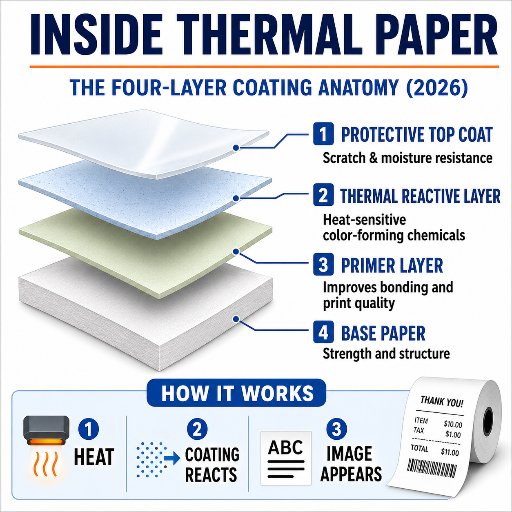
Most guides only go as far as “it has a coating.” In reality, quality thermal paper is a construction of multiple engineered layers, with each layer determining how the paper prints and how long the image will live. This is what we refer to as the Four-Layer Thermal Coating Anatomy. Knowing this is the difference between buying on price and buying on performance.
| Layer | What it is | Why it matters |
|---|---|---|
| 1. Base paper | Wood-pulp substrate, ~48–80 gsm | Sets stiffness, tear strength, and how the roll feeds |
| 2. Precoat | Insulating undercoat (often clay, latex, calcined fillers) | Insulates and smooths so the heat stays in the active layer — better image with less energy |
| 3. Thermal active layer | Typically a few g/m²: leuco dye + color developer + sensitizer + binder | The image itself; the developer chemistry decides darkness and safety |
| 4. Protective topcoat (optional) | ~1–2 g/m² clear overcoat | Shields against water, oil, alcohol, plasticizers, and print-head wear |
Layer 3’s chemistry is the heart of it. At room temperature the leuco dye and developer sit apart, locked by a solid binder. When the print head heats a spot past the coating’s melting threshold, the developer melts, contacts the dye, and forces a colour-forming reaction: the dye accepts a proton and turns black. The reaction is fast and local because only the heated dot melts — which is why thermal printing is rapid and needs no drying, and also why a hot dashboard can darken or wipe out a whole receipt later.
A thermal paper technical reference documents two optional layers some grades add: a backcoat for curl and static control, and the protective topcoat that seals it all. That topcoat is the single biggest driver of lifespan — which leads to the trade-off we cover in the grades section.
Key takeaway: print quality lives in the precoat and active layer; lifespan lives in the topcoat. A low-end roll usually skips the topcoat.
Direct Thermal vs Thermal Transfer: Two Ways to Print With Heat
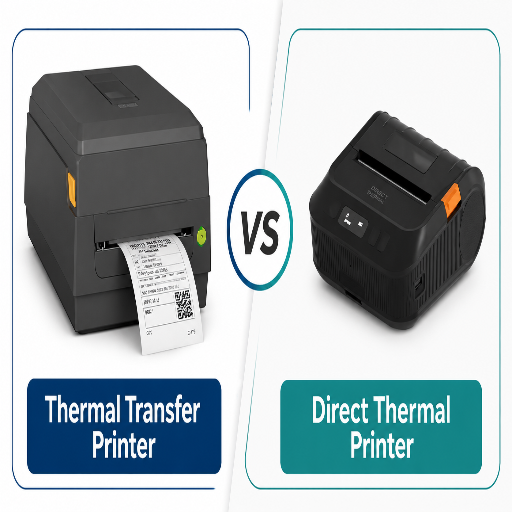
Both methods use a heated print head but place the colour in very different places.
With direct thermal, the head applies heat directly to the coated paper and the paper colours itself — no ribbon, because the paper is the colour source. That is why it is called “direct thermal”: no separate pigment is transferred. Thermal transfer instead uses a wax or resin ribbon. The direct thermal medium — the coated paper that colours itself — is a patented recording material; heat-sensitive recording material patents document the developer chemistry behind it.
Here, the print head actually prints onto the ribbon, which then transfers the ink (as liquid/molten pigment) onto your facestock. That means your facestock can be plain paper, synthetics, even printed surfaces. As this is a “learning how,” not a “what the hell is this?” guide, more information regarding each process and the specific Guanma grade categories for our direct thermal and thermal transfer self-adhesive thermal paper lines are available at separate links.
| Dimension | Direct Thermal (DT) | Thermal Transfer (TT) |
|---|---|---|
| Image source | The coated paper darkens itself | Ribbon melts pigment onto the facestock |
| Ribbon needed? | No | Yes (wax / wax-resin / resin) |
| Image life | Months to a few years; fades with heat/light | Years to decades; far more stable |
| Best for | Receipts, shipping labels, short-life tickets | Asset tags, drum/chemical labels, archival barcodes |
| Running cost | Lower (paper only) | Higher (paper + ribbon) |
Is direct thermal or thermal transfer better for shipping labels?
For the vast majority of shipping deliveries, DT has to be enough. Your shipping label needs only survive the journey of a few days to several weeks in transit and the ribbon cost is avoided, while the printer mechanisms remain simpler, lighter and less prone to failure than TT systems.
But when your label needs to be much tougher than your printer, when the label is the key variable in your long-term success, then you’ll choose thermal transfer. This is the case when: A drum label is subject to heat and chemicals, or The warehouse inventory tags used for years must remain legible, or A cold-chain shipping needs to endure the rigors of repeated wash-downs. A golden rule: match the print method to how long and how harshly the label must live — the longer and harsher, the more TT — not to the printer you happen to own.
Key Takeaway: DT is cheap and simple but disposable; TT is more expensive but endures; the life requirements dictate your choices, not habit or current hardware.
Thermal Paper Types and Grades (Economy, Top-Coated, Premium)
“thermal paper” denotes an entire category of products.
For direct thermal paper, products fall into roughly three tiers of sensitivity and performance, and the main thing that separates good grades from the rest is one simple layer: that topcoat from the anatomy section — what we call the Topcoat Trade-Off.
| Grade | Topcoat | Resists | Typical use |
|---|---|---|---|
| Economy (uncoated) | None | Little; smudges with oil/water | Short-life POS receipts |
| Top-coated | ~1–2 g/m² | Water, oil, alcohol, abrasion, plasticizers | Shipping & product labels |
| Premium / specialty | Heavier + tuned chemistry | Freezer temps, long archive, harsh handling | Cold-chain, healthcare, durable labels |
What Separates good print grades from bad are two numbers.
The first number is a static sensitivity measurement-the number representing the temp when the coating is first sensitive to heat and begins to change. The second is dynamic sensitivity — how fast and at what energy the coating images at line speed. A well-matched paper images cleanly at lower head energy, which means sharper barcodes and longer print-head life, because the same topcoat that protects the image also shields the head from abrasion.
Decision aid: matching a grade to the job
- Exposure to oil/grease or alcohol (foodservice, chemical-labs) require a top-coated product, since the print can smear on an unprotected layer.
- Freezer or cold-chain → a premium cold-rated direct thermal plus a cold-temperature adhesive; fade-resistant phenol-free direct thermal media of this class is covered by recent USPTO patents.
- Sunlight, heat, or a multi-year archive → step up to thermal transfer; no direct thermal grade is genuinely archival.
- High-speed retail receipts where cost rules → economy or light top-coat is acceptable.
Key takeaway: For topcoat purchases, pay when the label is facing moisture, oil or time, and skip them only for receipts that are genuinely short-lived.
Where Thermal Paper Is Used: Receipts, Labels, Tickets & Cold-Chain
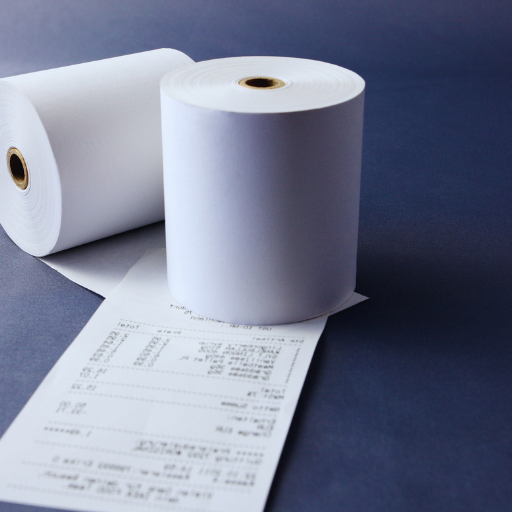
thermal paper is present wherever the requirements of speed, low cost, and no ink supply are prioritized over permanence. Each application makes a different demand on the paper. The smart question is therefore not “which roll is best” but “which of the properties does this job need.”
- POS & receipts — high-speed, low-cost, short-life. For most businesses a 48–55 gsm economy thermal paper roll, plain thermal receipt paper, is the norm; here the print quality of the receipt paper and feed reliability matter more than archive life.
- Shipping & logistics labels — barcodes must read first time even after rough transit, so a top-coated direct thermal stock keeps scuff and water damage to a minimum.
- •Tickets& Wristbands-70-80 GSM tear resistance to pass gates with normal day usage
- Cold-chain & freezer labels – The paper needs to image at the line; the adhesive needs to hold at sub-zero temperatures. Most difficult of these combination challenges is getting an adhesive to hold at those frigid temperatures.
- Healthcare — heavier stock for records and wristbands, plus topcoat resistance to hand sanitizer and gloves.
Pulling those demands together, here is how the common jobs map to a grade, a weight, and the risk that actually decides the spec — a quick reference for matching thermal paper to the application (typical values; exact grades vary by supplier):
| Application category | Grade class | Weight (gsm) | Topcoat | Image life | Risk that drives the spec |
|---|---|---|---|---|---|
| POS receipt | Economy DT | 48–55 | No | 1–3 yr | Heat / light fade |
| Credit-card slip | Economy DT | 48 | No | 1–3 yr | Plasticizer (wallet) |
| Shipping / logistics label | Top-coated DT | 60–80 | Yes | 1–3 yr | Scuff, moisture in transit |
| Warehouse asset tag | Thermal transfer | 70–80 | Ribbon | 5–10+ yr | Abrasion over years |
| Cold-chain / freezer label | Premium cold DT | 70–80 | Yes | 2–5 yr | Adhesive grip below 0°C |
| Event / transit ticket | Top-coated DT | 70–80 | Yes | <1 yr | Tearing at gates |
| Healthcare wristband | Premium DT | 80+ | Yes | Days–weeks | Sanitizer & hand oils |
| Lab / medical printout | Premium DT | 70–80 | Yes | 5–7 yr | Light, solvents |
| Lottery / parking stub | Economy DT | 48–55 | No | Months | Heat in vehicles |
| Food-packaging label | Phenol-free DT | 60–80 | Yes | Per use | Developer migration into food |
An example might be a food-packer who orders ‘standard receipt-grade roll’ to be printed onto cartons. Those labels print fine at room temperature; but once the load moves into the blast freezer the adhesive lets go, and by the next morning a pallet of cartons has dropped its barcodes — an avoidable reprint that a cold-rated stock plus the right adhesive would have prevented. Choosing the facestock is only half the battle; the adhesive and release liner complete it — which is why thermal stock is usually ordered as a system.
You’d be wanting to consider selection for each specific use – by means of our guide to material usage per job – as well as the carrier side of the stock — how the release liner does its job. Guanma supplies these as engineered thermal label paper stocks matched precisely to the application.
Mapping the use to the property it stresses — speed, scuff resistance, tear strength, or cold grip — then specification facestock, adhesive, and liner.
How Long Does Thermal Paper Last? Image Fading and Storage
A thermal print is not permanent. Image life ranges from about six months to ten years, and most POS-grade thermal paper holds a readable image for 5–7 years if stored well — but stored badly, the same receipt can blank out in weeks. That variation is not random; it comes down to a small set of enemies we group as the Heat–Light–Plasticizer Fade Triad.
| Fade factor | What it does | How fast |
|---|---|---|
| Heat | Pushes the whole sheet toward its activation temperature — can darken or grey it out | A car dashboard in summer: days |
| Light (UV / strong LED) | Breaks down the dye and developer | Sunny windowsill: weeks to months |
| Plasticizers | PVC sleeves and vinyl wallets pull the developer apart, erasing the image | In a vinyl folder: months |
| Oils & solvents | Hand cream, food oil, cleaning sprays react with the coating | Variable; speeds other factors |
| Adhesive contact | Solvent in tape reacts with the active layer | Taped over print: a few weeks |
The other thing that needs care: The coating itself is more sensitive than you’d guess. Keep thermal paper and printed receipts cool — below 25°C (77°F) if you can — away from direct sunlight and bright, constant shop lighting and, ideally, in a room with relative humidity between 30 and 50%. Even before it’s printed, heat and humidity damage the coating; this is why label converters keep master rolls locked away in a climate-controlled room. Never tape a thermal receipt directly into a ledger; never slide it into a PVC sleeve-both are surefire ways to lose your records.
How do you keep a thermal receipt from fading?
Anything you need to keep for more than a few weeks — tax records, warranties, reimbursement claims — should be scanned or photocopied the day you receive it, then stored flat in a cool, dark drawer away from vinyl, tape, and heat. National archives reach the same conclusion: guidance from the National Archives of Australia on managing thermal-paper records treats a copy onto stable paper as the reliable long-term record, not the thermal original.
Summary: It’s heat, light, and plastics, not the years, that really destroy thermal images; control storage and scan whatever might need to last.
Is Thermal Paper Safe? BPA, BPS, Phenol-Free & Recycling
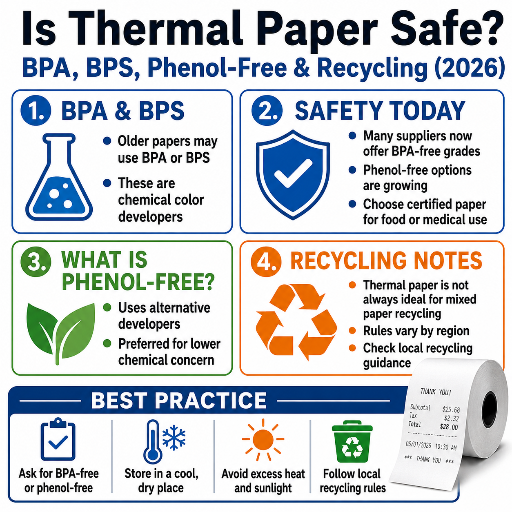
Why is the health question more serious than we assumed for so many years? That comes back to the color developer-specifically, the type used in that thermal-sensitive active layer of the paper.For a long time, the simplest and most widely used developer on paper stock was bisphenol A (BPA).BPA developers are concerning because the chemical doesn’t fully adhere to the paper itself; it rests on the surface, from where it can be absorbed by the skin.
While the amount transferred in isolated contact is small, the exposure becomes significant at work: an occupational biomonitoring study of retail cashiers found median urinary total BPA of 3.54 µg/L in controls versus 8.92 µg/L in cashiers who handle receipts all shift. Modeled dermal intake runs about 17.5 ng/day for the general population but roughly 1,300 ng/day for occupationally exposed workers, and dermal uptake stays in circulation longer than dietary BPA. That level of concern is precisely why the EU restricted BPA in thermal paper in the first place.
⚠️ The misconception that matters: “BPA-free” is not the same as “safe”
To avoid restrictions, some manufacturers have opted to replace BPA with its near-relative, bisphenol S (BPS), a chemical that studies have shown to carry similar endocrine-disrupting health concerns, in a form of regrettable substitution. Studies still detect a bisphenol in a large share of U.S. receipts — most often from local and regional retailers — even as many national chains have moved to non-bisphenol developers. A label reading “BPA-free” may still be full of BPS. Only one label resolves the question — “phenol-free,” not simply “BPA-free.”
| Developer class | Example | Status |
|---|---|---|
| BPA | Bisphenol A | Restricted (EU, China, US states) |
| BPS | Bisphenol S | “Regrettable substitution” — similar concerns |
| Phenol-free | Pergafast 201 (a sulfonyl-urea), ascorbic-acid types, Blue4est (dye-free) | No bisphenol; the safest tier |
Finding a perfect “free lunch” may be impossible, but not entirely out of reach: a review by the U.S. EPA’s Safer Choice partnership assessed 19 alternative color developers and found that every one carries some trade-off. Even so, phenol-free developers such as non-phenolic color developers covered by recent patents remove the bisphenol question entirely while resisting oils and plasticizers well.
Is it safe to touch thermal paper, and can you recycle it?
Handle the occasional receipt, and it’s probably not a big concern for most-the significant exposures are chronic and occupational (e.g., cashiers), why these folks (and anyone pregnant or who handles them constantly) should be sure to wash their hands, and the best practice is to buy phenol-free stock. Even recycling is complicated: don’t recycle standard paper with thermal paper in it. Those bisphenol developers can end up in the recycled paper stream (BPA has shown up in recycled paper products, like toilet paper) and in some municipalities they’re treated as an unacceptable contaminant, although data on the specific behavior of these in US waste streams remains scarce. One route to consumer exposure that gets less attention: Many thermal papers are used directly on fresh-food packaging, and direct application means developer chemicals can migrate into the food, bypassing skin.
Summary: “Phenol-free”-not “BPA-free”-is the signal you want to see, and while many commercial papers with phenol-free developers are fine to include with your regular recycling, you’re still much better off sending thermal paper direct to the garbage, especially since ” phenol-free” and “BPA-free” aren’t interchangeable when referring to heat-activated printing developers.
The Phenol-Free Shift: Thermal Paper Rules in 2026 and Beyond
All of the heat-sensitive materials market is migrating in the same direction, and 2026 is our projected inflection point. The transition is one we track as the BPA → BPS → Phenol-Free Migration Timeline — three waves of reformulation driven by tightening regulation.
| When | Jurisdiction | Rule |
|---|---|---|
| Jan 2, 2020 | European Union | REACH restricts BPA in thermal paper at or above 0.02% by weight |
| Ongoing | California | Prop 65 lists BPA and BPS — legal to sell, but a warning must be posted |
| 2024–2025 | China | GB/T 28210-2024 standard tightens thermal-paper BPA limits, broadly in step with the EU restriction |
| Jan 1, 2026 | Washington (US) | First-in-nation ban on all bisphenols (BPA and BPS) in receipts, tickets, and labels |
Washington’s rule is the one to watch — the state banned BPS, the substitute for BPA, not just BPA itself, closing the regrettable-substitution loophole and pushing phenol-free toward the de-facto standard. Connecticut, New York, Minnesota, and Vermont are all moving along these lines as well. (Scope can be narrow or wide: the Washington regulation has some carve-outs, and for Europe it’s currently a concentration limit on BPA rather than a total ban on bisphenols.) Meanwhile, on the technology side, phenol-free developers — defined and shipped by major direct thermal makers — now span sulfonyl-urea chemistry (Pergafast 201), ascorbic-acid (vitamin C) types, and even dye-free physical systems. Reformulating tends to add only a moderate percentage increase in cost — low single to low double digits is common — but it removes compliance risk across every US jurisdiction and many outside it.
“It turns out that the papers most resistant to both oil and plasticizers are also the most receptive to these newer formulations and they have stronger print and are more durable, so phenol-free is rarely a compromise on performance.”
If you are sourcing thermal stock for 2026, the practical move is to qualify a phenol-free grade now rather than after a deadline forces it. As a coated-paper and label-stock maker running coating and laminating in Thailand and Vietnam, our team treats phenol-free developers and topcoat durability as one specification, not two — the same standard a buyer should hold any supplier to. Qualifying phenol-free early keeps you compliant as more US states follow Washington and the EU restriction stays in force.
Summary: phenol-free is becoming the floor, not the premium — the standard all thermal papers will eventually meet. Qualify a phenol-free grade ahead of Washington’s January 1, 2026 ban and you are covered nearly everywhere else too.
Thermal Paper FAQ
What is thermal paper used for?
View Answer
Thermal paper is used anywhere fast, ink-free printing matters: point-of-sale and credit-card receipts, shipping and logistics labels, event and transit tickets, parking stubs, lottery slips, medical and lab printouts, and cold-chain carton labels. It dominates these jobs because a thermal printer needs no ink, toner, or ribbon — just the coated paper — which keeps both hardware and running costs low.
What are the disadvantages of thermal paper?
View Answer
Three main drawbacks. First, the image is not permanent — direct thermal prints fade with heat, light, oils, and plasticizers, so they are poor for long-term records. Second, the color developer has historically been a bisphenol (BPA or BPS) that raises handling-safety and recycling concerns. Third, thermal paper cannot be recycled with normal paper because the developer contaminates the recycled stream. Phenol-free grades solve the chemistry concern but not the impermanence of direct thermal.
Can you use regular paper in a thermal printer?
View Answer
No — not in a direct thermal printer. Direct thermal printers have no ink or ribbon and rely entirely on the paper’s heat-sensitive coating, so plain paper comes out blank. A thermal transfer printer is the exception: because it melts pigment from a ribbon, it can print onto plain or synthetic stock. If your printer uses no ribbon, it needs genuine thermal paper.
How can you tell if paper is thermal?
View Answer
Scratch it. Drag a fingernail or coin edge firmly across the surface — thermal paper leaves a dark friction mark, plain paper does not.
Does thermal paper expire or have a shelf life?
View Answer
Unprinted thermal paper has a practical shelf life of around two to three years when stored cool, dark, and dry (below ~25°C, 30–50% humidity). It does not “expire” on a fixed date, but the coating slowly loses sensitivity, and heat or humidity speeds that decline — so rotate stock and store rolls off concrete floors and away from heat sources.
What is phenol-free thermal paper?
View Answer
Phenol-free thermal paper uses a color developer that contains no BPA, BPS, or any other bisphenol/phenol — for example sulfonyl-urea developers like Pergafast 201, ascorbic-acid types, or dye-free physical systems. It is the only category that fully sidesteps the bisphenol safety and regulatory questions, and it is what Washington’s 2026 rule effectively requires.
Sourcing phenol-free thermal stock?
Guanma coats and laminates self-adhesive thermal paper to spec in Thailand and Vietnam — facestock, adhesive, and liner are matched to your application and constructed phenol-free for 2026 compliance.
Why We Wrote This Guide
Most thermal paper explainers stop at “it reacts to heat.” We wrote this because the questions that actually decide a purchase — how long the image lasts, does BPA-free mean safe, and what do the 2026 bisphenol bans entail — go unanswered, or the answers given are rarely backed by real data. The specifications and chemistry here are indicative of the evaluation a coated-paper manufacturer makes when assessing a thermal grade, using figures obtained from government, academic, and standards sources (see references below).
References & Sources
- Partnership to Evaluate Alternatives to Bisphenol A in Thermal Paper — U.S. Environmental Protection Agency
- Commission Regulation (EU) 2016/2235 — BPA restriction in thermal paper (REACH Annex XVII) — EUR-Lex
- Safer Products for Washington — bisphenols in thermal paper — Washington State Department of Ecology
- BPA and BPS in Thermal Paper — Minnesota Pollution Control Agency
- Occupational Exposure of Cashiers to Bisphenol A via Thermal Paper — U.S. National Library of Medicine (PMC)
- BPA and its analogues in thermal papers: presence and dermal exposure (2025) — RSC Environmental Science: Advances
- US20210060994A1 — Heat-sensitive recording material with non-phenolic color developers — USPTO / Google Patents
- Thermal paper — Wikipedia
Related Articles
- What Is a Release Liner? — release force, silicone side, and liner types
- Label Solutions by Application — matching label material to the job
- Self-Adhesive Thermal Paper — Guanma grades and specifications
- Self-Adhesive Film & Label Stock — pressure-sensitive material overview
- Guanma — self-adhesive label stock manufacturer (TH + VN)