Get in Touch with Guanma

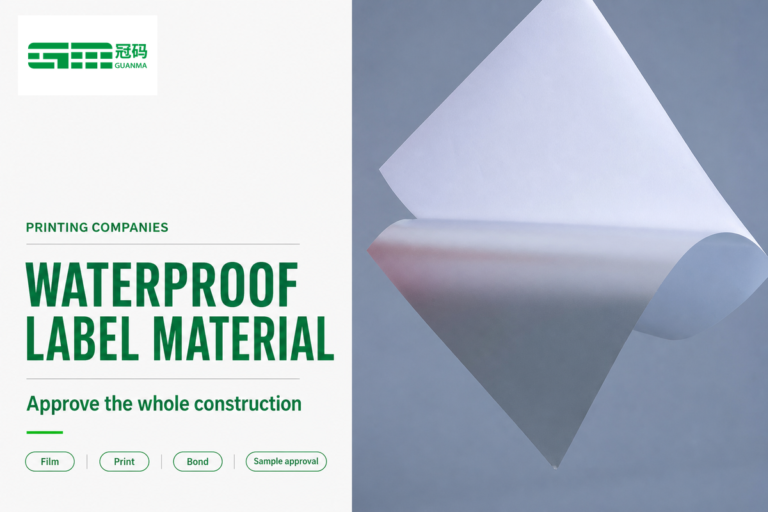
Which label material is most durable and waterproof for label printers? For strict wet applications, the top-coated polyester (PET) with a compatible resin thermal-transfer ribbon is a good starting point. The printer and completed construction decide the final answer. Inkjet-coated polypropylene, laser-rated polyester, or an acceptable vinyl grade may better suit your equipment and container.
Updated October 2026
Waterproof label material for label printers must match the printing method. Coated PET with a qualified resin ribbon suits demanding thermal-transfer jobs. Coated PP or vinyl can suit other systems. Approve the print and adhesive on the intended surface.
Quick selection notes
- A water-resistant face stock can survive while its printed image smears.
- Thermal transfer uses a ribbon; direct thermal uses a heat-sensitive imaging layer.
- Inkjet and laser printers need surfaces and constructions designed for their printing process.
- Adhesive performance depends on the container, application conditions and exposure.
What must survive water: film, print and bond
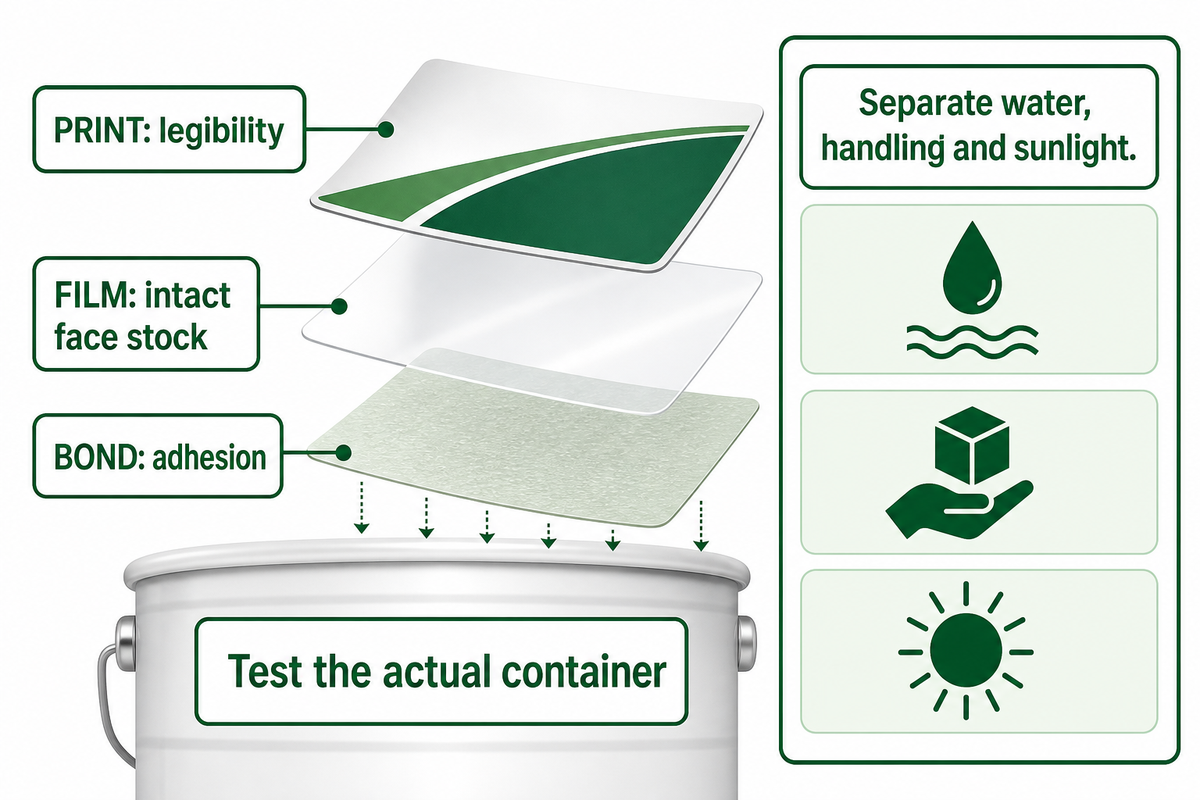
A durable waterproof label requires an intact face stock, legible print, and a reliable adhesive to fulfill its intended function. Film water resistance answers only part of that requirement. State what type of service condition the label will experience before comparing different label materials.
Polyester and polypropylene are commonly selected synthetic materials for wet applications. A printable coating receives the image, and the adhesive attaches the label to the product. Failure of either layer can result in an otherwise intact film being completely unfit for purpose. A label with a lost or damaged batch code remains attached, but has failed in its purpose.
The marking and labeling program in UL’s website demonstrates this system approach. Damage to the label construction is a feature to evaluate alongside adhesion and legibility. The recognized combination and its conditions are critical. Description of components in isolation doesn’t build a qualified finished label.
For a more detailed explanation of face stock, adhesive, and protective layers, see Guanma’s waterproof label construction guide. Printer compatibility is also a consideration.
Do
- Confirm the actual printer and printable grade.
- Test the intended artwork and container.
- Separate water, handling and sunlight exposure.
Don’t
- Use blank-film resistance as finished-print proof.
- Transfer an oil result to a water exposure.
- Infer outdoor life from a brief splash test.
Consider an illustrative refrigerated-bottle job: a 50 × 30 mm label is attached to a smooth bottle and then handled after cooling to 4°C. Cooling also changes the application environment; condensation and wet fingers contact the image. The buyer requires different checks for print smearing and edge lift, as well as a dry control label. If the stock is applied to a bottle that is already wet, a test done on a clean, dry bottle will not reflect that condition. The width of the label, the illustration and the temperature shown in the example are the input requirements from the buyer. A durable solution is the construction that survives the stated sequence, rather than the material with the strongest generic description.
For purchasing: describe the actual use sequence, including the 4°C storage condition in this example. “Water proof” without an exposure description leaves the supplier unable to judge whether the image, coating and bond require different evidence.
Identify your printer before choosing label material
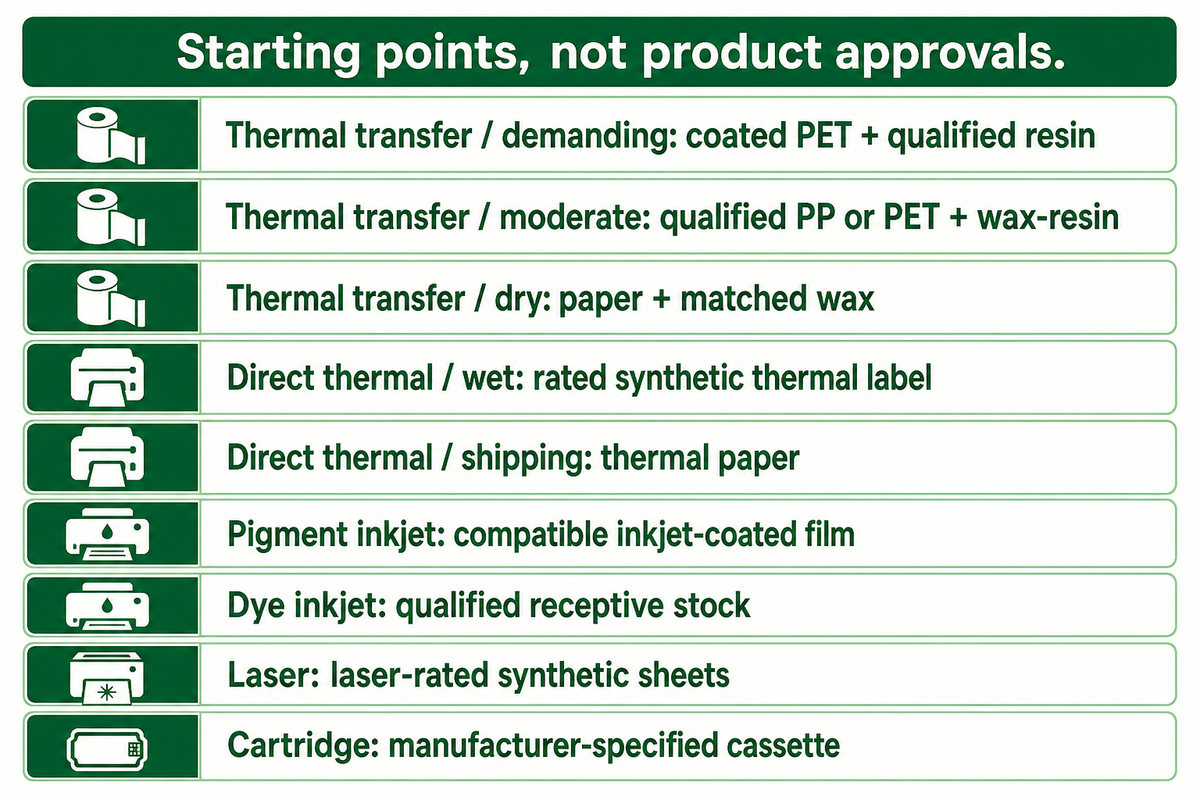
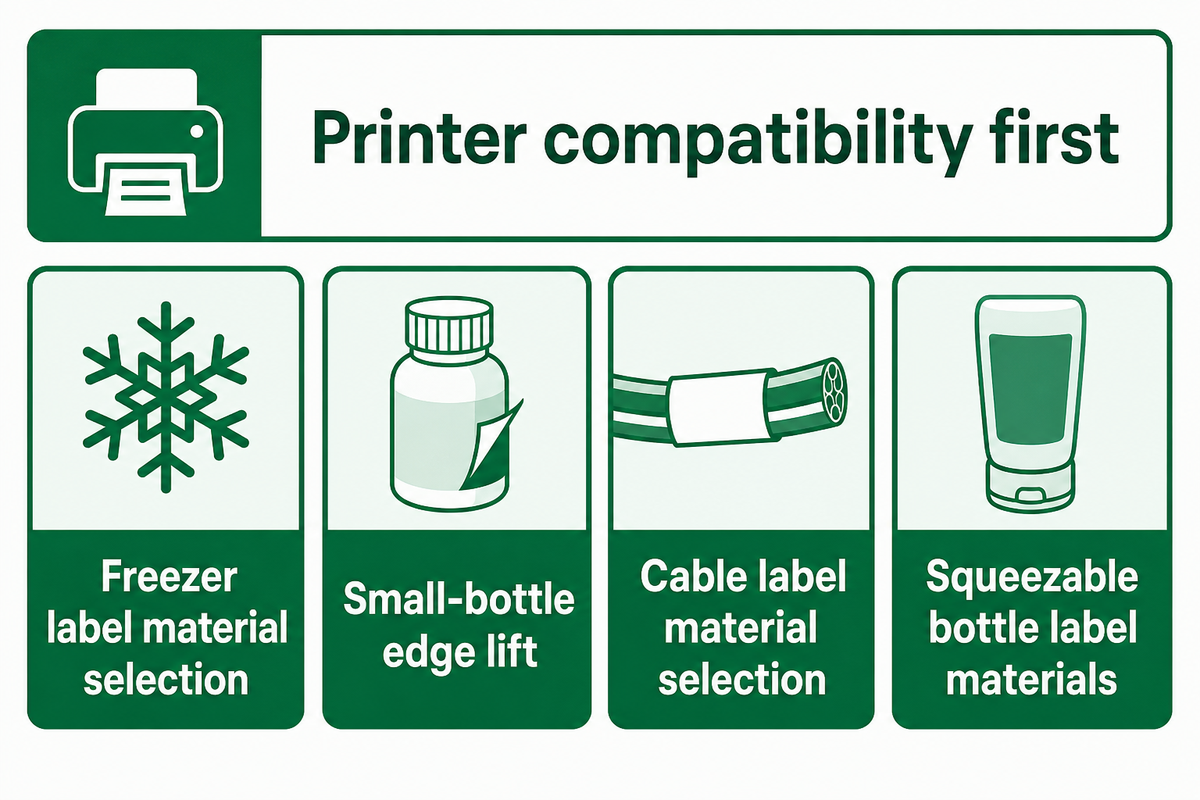
Specify the exact label printer model and the printing process before ordering waterproof materials. Different images are generated by a thermal transfer printer, a direct-thermal unit, pigment inkjet and a laser printer. Compatible roll labels or label sheets also need to fit the feed path, sensing system and supported thickness, and a polymer doesn’t provide that assurance.
Print-First Veto Rule
The Print-First Veto Rule rejects unsupported printer, coating and media-format combinations before comparing durability.
| Printing method | Candidate construction | Evidence to request | Limitations / Not suitable for |
|---|---|---|---|
| Thermal transfer, demanding use | Top-coated PET and qualified resin ribbon | Stock/ribbon pairing and printer compatibility | Unsupported printhead or untested adhesive/substrate pair |
| Thermal transfer, moderate exposure | Qualified PP or PET with wax-resin | Matching exposure and print test | Assuming every wax-resin grade matches every film |
| Thermal transfer, dry short-term use | Paper stock and matched wax ribbon | Print quality and dry-use suitability | Prolonged wet handling without further qualification |
| Direct thermal, wet handling | Rated synthetic thermal label | Water, image-aging and adhesive evidence | Unspecified heat, sunlight or long service life |
| Direct thermal, ordinary shipping | Coated or uncoated thermal paper | Handling and shipment requirements | Transferring its rating to a wet product label |
| Pigment-based inkjet printers | Compatible inkjet-coated film | Ink/model/media combination | Uncoated film or unsupported ink chemistry |
| Dye-based inkjet printing | Qualified receptive stock and any required protection | Printed wet-rub evidence | Blank-sheet water resistance used as print proof |
| Laser printers | Laser-rated synthetic label sheets | Printer heat/feed-path qualification | Inkjet-only stock, exposed adhesive or damaged sheets |
| Dedicated tape/cartridge printer | Manufacturer-specified cassette | Exact tape product and exposure statement | Generic PET-roll advice applied to every cartridge |
Record resolution in dpi and print speed (where applicable) in mm/s, media width and sensing requirements. Also check the roll core, outside diameter and winding direction against the printer manual. A roll of self-adhesive raw material is still a long way from being a desktop-ready label roll.
GS1’s implementation guideline lists common thermal printhead options of 50.8 mm (2 inches), 101.6 mm (4 inches), 127 mm (5 inches) and 152.4 mm (6 inches). These nominal widths identify hardware options, not an approval for a particular roll. Confirm the printer’s supported media dimensions, sensing method and finished label format before buying stock.
Small businesses may not need a new color label printer. Determine first if adequate stock is available for the current machine, and test its intended artwork. An OnlineLabels forum case describes a customer who bought polyester labels (laser only) and was using an inkjet printer (which the customer thought was a laser printer) that was lent to him. An inkjet printer isn’t a laser printer. The mismatch caused the smeared output. Waiting for the “ink” to dry can’t make a laser-rated surface appropriate for inkjet printing.
Operator handoff: “300 dpi, 50 mm liner width” identifies two useful inputs in an illustrative request, but the exact model still controls compatibility. Reject a stock recommendation that omits the printer model or supplied format.
Match thermal-transfer film to the ribbon and printhead
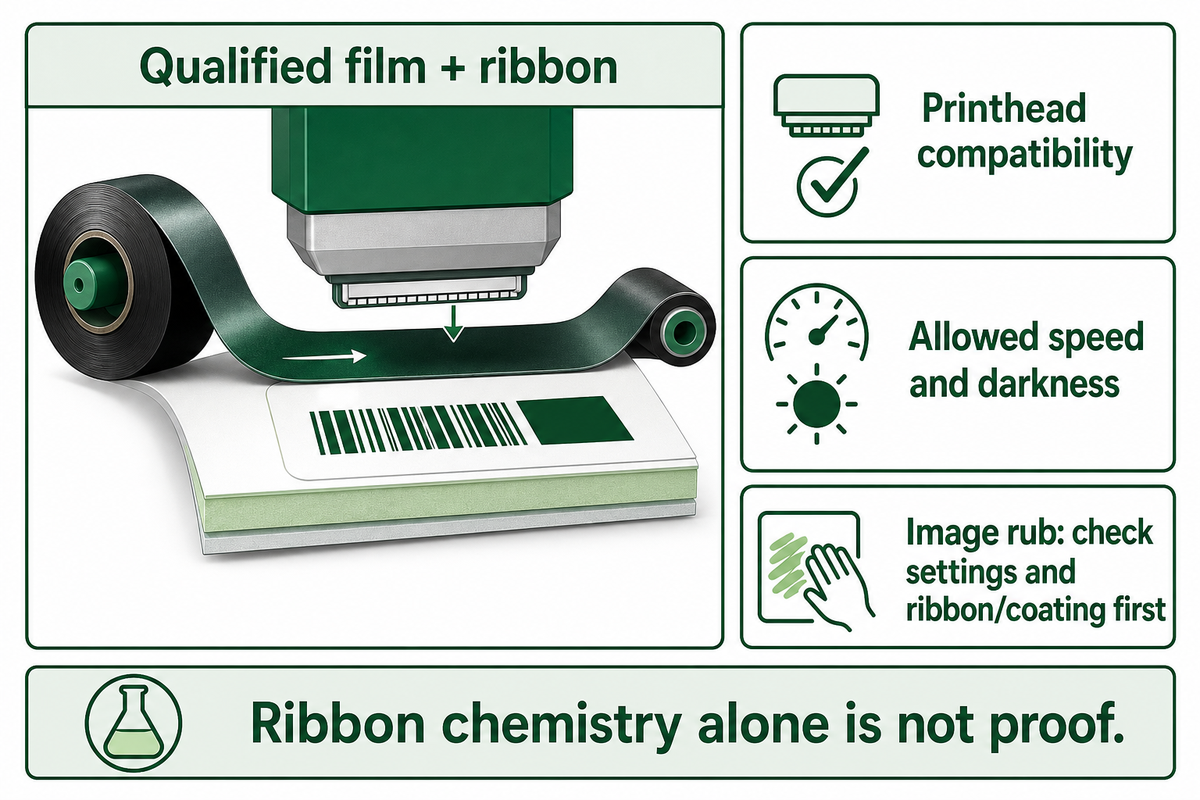
When using a thermal-transfer label printer, choose a coated film and printer ribbon qualified together for that exposure. For abrasion and wet-handling, a resin ribbon is a good choice. Qualified wax-resin ribbons can also be used; ribbon chemistry alone cannot prove label durability.
The image is transferred from the ribbon to the label by heat and pressure. The topcoat and formulation of the ribbon, and operating settings, affect the transferred image. Verify the ribbon is compatible with the print head and don’t assume it supports flat-head and near-edge systems. Test the label design at the allowed speed and darkness settings.
The GS1 thermal-transfer guidance identifies full-wax, wax-resin and full-resin applications, with examples of wax-resin ribbon in some weatherproof labels, and resin for film applications. The same guidance ties thermal-transfer speed to printhead and substrate. These categories assist in creating a shortlist; they do not replace a supplier’s matched-product recommendation.
As a named construction example, Zebra’s Z-Ultimate 4000T sheet identifies coated polyester and particular ribbon combinations for its white and silver materials. It also lists a 10°C minimum application temperature separately from a −40°C to 150°C service range. Those numbers pertain to that particular Zebra product, not every polyester label or Guanma in stock.
In an illustrative maintenance-label trial, an operator needs a 60 × 25 mm asset label with small text and a barcode. The operator selects a supported coated film and resin ribbon, then sets a resolution to 300 dpi and a permitted speed of 75 mm/s. A printed control is retained before the samples are exposed to wet handling. If an image rubs off, the operator checks settings and the supported ribbon and coating before changing the adhesive. If only the corners of the label lift, the actual surface and label stiffness become the suspects. The example provides a sequence to solve a problem, not to guarantee that particular settings will address all similar situations. Each documented and accepted setting should be captured so that future small batches can repeat it.
Buyer objection: a more expensive ribbon is useful only when it solves the specified image failure. Approve the complete print system before committing to a bulk order; 75 mm/s in an example is not a universal printing recommendation.
Use printer-rated surfaces for inkjet and laser
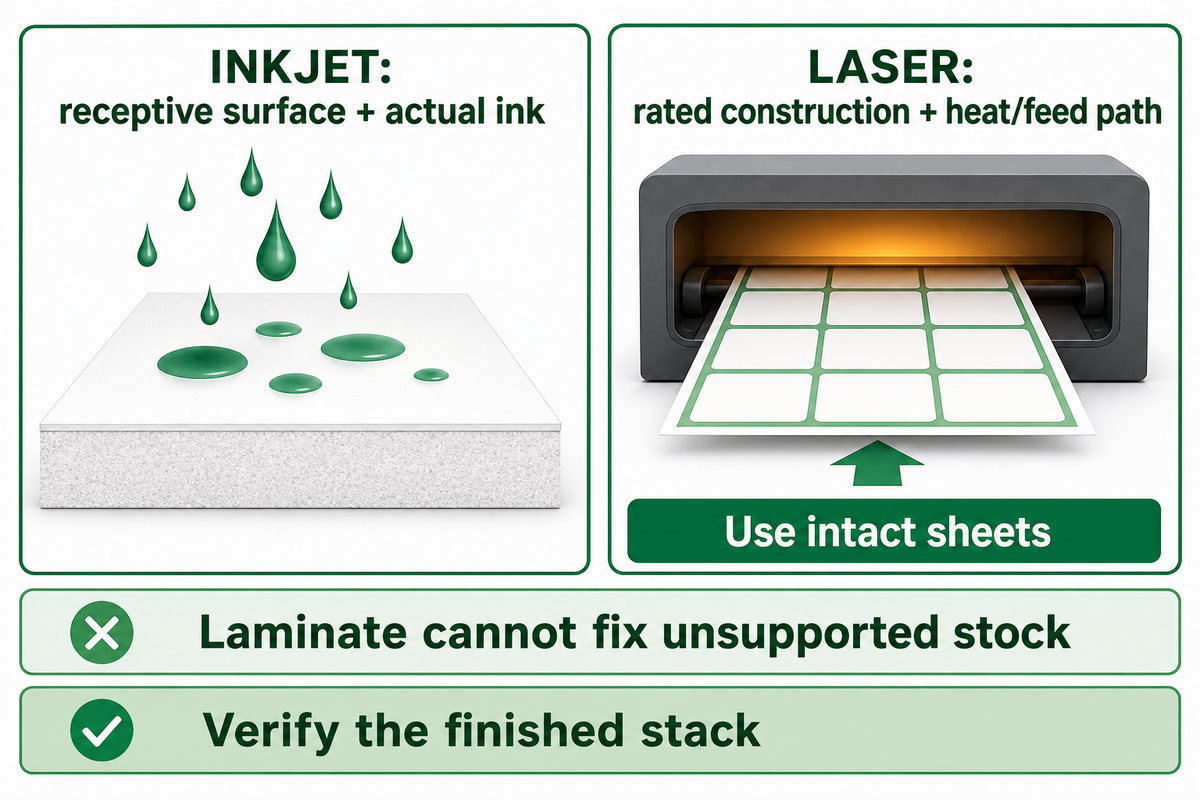
Inkjet printers need a receptive label surface that is compatible with the actual ink, while laser printers need a construction qualified for their heat and feed path. Waterproof film names do not establish either requirement. Request the exact printable grade, printer model and ink or toner combination before choosing a durable label material.
Can you print waterproof labels on a laser printer?
Yes, when the complete label sheet is rated for the particular laser printer. The face material, adhesive and liner must tolerate the printer’s operating path and feed correctly. Use the recommended media setting and intact sheets. A film sold for inkjet printing is not automatically suitable for laser printing.
Epson’s ColorWorks media guidance recommends inkjet-coated label media and suggests synthetic film for high-humidity or wet environments. Pigment ink is a candidate for durable color labels, but the receptive coating and compatible ink remain of high importance. Test black text and full-color label artwork as part of full-color printing. Different parts of the same image can show different levels of smearing.
HP’s guidance for specified Samsung laser models requires laser-designed labels, suitable adhesive and intact sheets without exposed adhesive. It identifies about 170°C for those models’ fusing-temperature requirement. That model-specific figure illustrates why another printer’s temperature should not become a general stock approval.
Common failure modes before buying waterproof stock
Before water ever touches a printable sheet, many things can cause a print job to fail. Using the wrong print method can leave ink on a surface that does not receive it properly. Excess ink can cause poor drying and smearing on the coating. There are posts in the reviewed forum that suggest that the user check material and print quality settings before adding a protective coating.
For laser printing, adhesive exposure and separated labels create issues on the feed path. Follow the printer instructions for sheet condition and repeat passes. Don’t test a construction the printer manufacturer doesn’t support.
A laminate can protect a qualified printed image. It can’t make an unapproved stock safe to feed through a printer. It can’t improve a poor adhesive on the container. Verify the finished stack, including any protective overlay, before treating a custom label as resistant to water.
For purchasing: request a trial on your right printer before comparing the price of glossy and matte inkjet label grades. A published 170°C requirement for one model is evidence of a specific heat path, not an approval for all laser printers.
Compare durable label materials: polyester, polypropylene and vinyl
For applications that require stiffness and dimensional stability, polyester is a good option; polypropylene is considered for packaging; vinyl offers flexibility. Material selection also depends on the printable grade and adhesive. Compare common label materials for the same printing process and exposure rather than giving it a universal durability score.
| Candidate | Why consider it? | Check before ordering | Limitations / Not suitable for |
|---|---|---|---|
| Thermal-transfer polyester labels | Stable face for durable identification | Topcoat, ribbon and actual surface | Unqualified ribbon or highly deforming container |
| Laser-rated polyester sheets | Toner-printed durable polyester label option | Complete sheet/printer qualification | Assuming every PET sheet is laser-rated |
| Inkjet-coated PET | Film candidate for compatible color printing | Actual ink and receptive coating | Untested ink or unsupported printer |
| Inkjet-coated PP | Packaging and color label applications | Print durability, finish and adhesive | Water-resistant blank film used as finished-print proof |
| Thermal-transfer PP | Qualified resin or wax-resin constructions | Matching ribbon and handling exposure | Assuming a single grade covers harsh conditions |
| BOPP labels | Oriented polypropylene packaging options | Surface treatment and printer suitability | Unspecified coating, heat or weathering requirement |
| Printer-rated vinyl labels | Flexible film option for suitable surfaces | Ink/coating system and adhesive compatibility | Generic craft vinyl treated as universal printer media |
| Protected film construction | Laminate or varnish protects qualified print | Overlay adhesion, edges and total thickness | Untested bond or unsuitable printer feed path |
| Synthetic direct-thermal film | Water-resistant face with ribbon-free imaging | Image life and specified environment | Unqualified long-term sunlight or heat exposure |
Label Academy discusses polyester’s stiffness and dimensional stability, as well as flexibility and tradeoffs for other films. A rigid material can be useful on a flat surface, yet resist following a small radius or squeezable bottle. Adhesive types and film stiffness should be considered together.
Guanma has PET self-adhesive stock and self-adhesive film options that are other material categories to discuss with a converter. Confirm the printable grade and the format of the finished material; neither self-adhesive stock nor film name indicates the roll is desktop printer ready.
Sample decision: a 40 × 80 mm label on a 35 mm-diameter container creates a different bending problem from the same face stock on a flat panel. Supply container samples or drawings when discussing film stiffness. Thicker durable materials don’t automatically deliver a better bond.
Know the limits of direct thermal labels
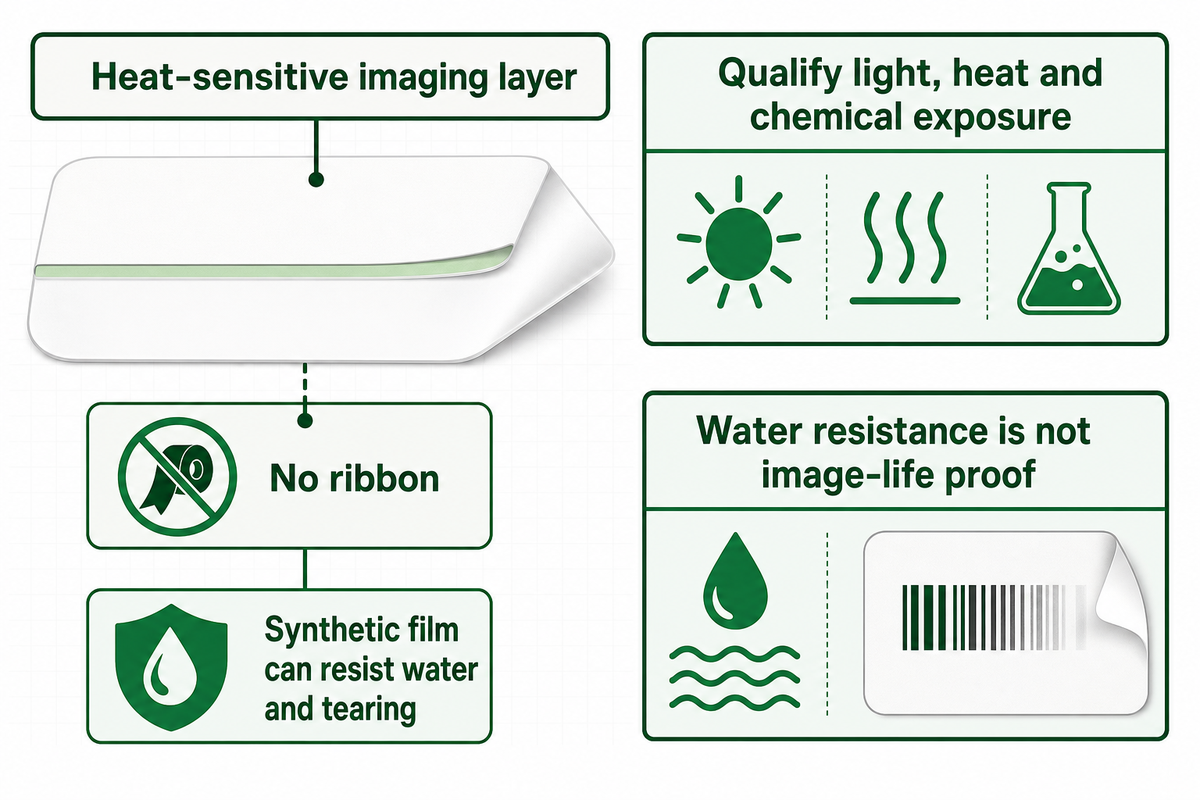
A direct thermal label employs a heat-sensitive imaging layer and doesn’t use a ribbon. Synthetic direct thermal can resist water and tearing, so direct thermal shouldn’t be dismissed as a ‘paper-only’ technology. Image life, exposure to light, heat and various chemicals in extreme conditions should be qualified for each label product and its intended use.
PolyPro 4000D materials provide a concrete example: a Zebra-authored EMEA data sheet describes water-resistant polypropylene and limits the product to short-term outdoor use rather than prolonged sunlight or extreme heat. Regional documents carry different construction details, so use the relevant specification for the supplied grade.
Will waterproof labels fade over time?
They can fade even when their face material remains intact. Water resistance doesn’t mean image stability under the influence of light or heat or storage. The US National Archives notes that thermal-paper image stability varies with the imaging method and paper type. This is paper-specific preservation evidence, not a rating for synthetic label film. For outdoor labels and outdoor equipment labels, evidence of UV exposure of the actual ink, ribbon or thermal imaging layer, and the adhesive and expected environment should be evaluated to determine an outdoor lifetime. A wet-rub result by itself doesn’t prove an outdoor lifetime.
A Dymo label or other thermal-printer product must be selected by exact model and compatible media. Paper labels used as shipping labels for a short distribution cycle shouldn’t be considered as interchangeable with outdoor equipment identification. If long image life is important, compare a qualified thermal-transfer construction with the available direct-thermal grade, rather than selecting by printer price.
For purchasing: specify whether a thermal label needs to remain readable for a 48-hour shipment or a proposed 12-month identification job. These illustrative service requirements are different questions; neither duration is a performance promise for a material family.
Approve the printed label on the real surface
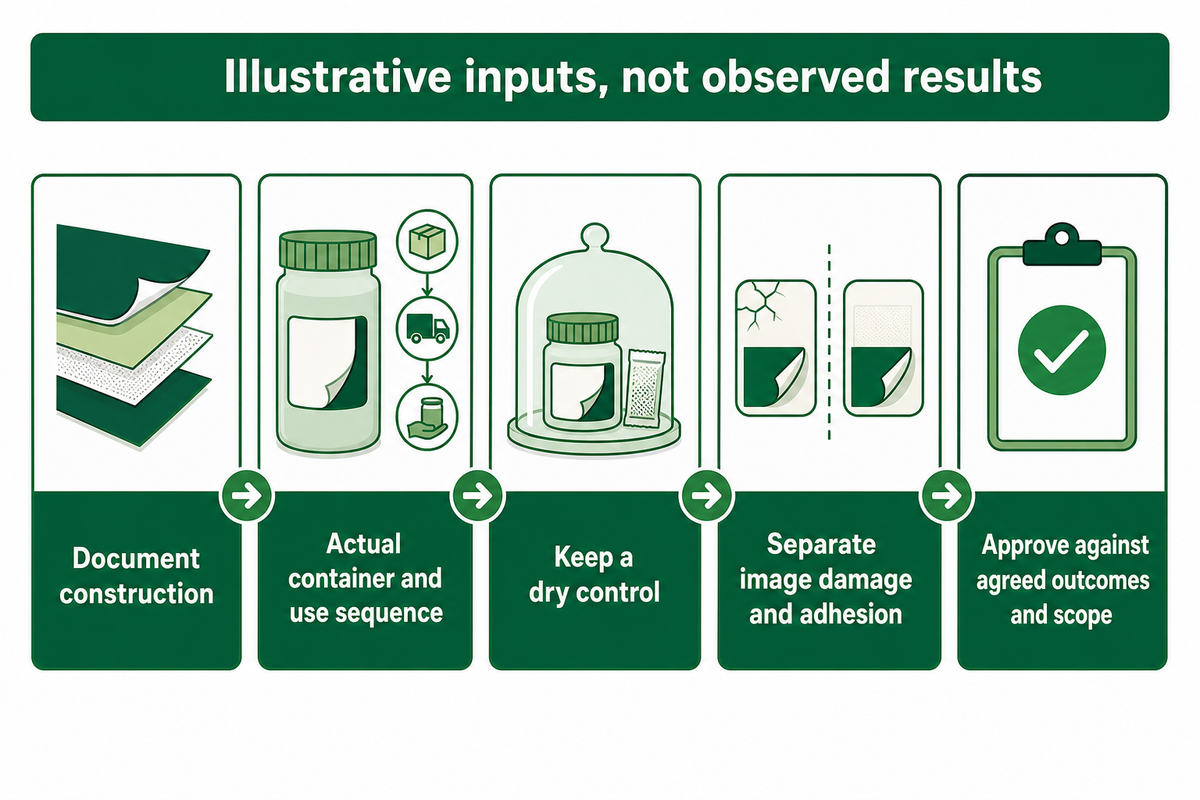
Approve the printed label on the actual container under a documented use sequence, with a dry control and separate tests for image damage and adhesion. Record label placement, surface texture, curvature, and flexibility. A short wet test is a screening test. It doesn’t set a useful service life or establish certification.
Wet-Print Evidence Record
The Wet-Print Evidence Record documents the construction, exposure and separate print-and-bond outcomes behind a sample decision.
The example shown filled in demonstrates the buyer’s proposed screening requirements. Values are hypothetical inputs, not a defined test method, limits, or observed Guanma results. Replace them with expected usage and instructional information from the manufacturer before testing.
| Record field | Illustrative entry | Acceptance question |
|---|---|---|
| Printed construction | Candidate coated PET, qualified resin ribbon, specified adhesive | Are grade codes and supplier revisions recorded? |
| Label size | 50 × 30 mm | Does the actual size stay flat on the container? |
| Printer setting | 300 dpi; permitted 75 mm/s trial setting | Does the model support this stock and setting? |
| Container | Smooth glass bottle, 60 mm diameter | Are texture, curvature and cleaning representative? |
| Application | Clean, dry surface at 20°C | Does this reproduce production application? |
| Adhesive dwell | Proposed 24 hours, subject to supplier instructions | Has the required bond-development time elapsed? |
| Water screen | Proposed 30-minute exposure at 20°C | Is immersion actually part of the use case? |
| Handling screen | Proposed 10 wet wiping cycles; pressure/method recorded | Do text and barcodes remain usable? |
| Sample controls | 5 exposed samples and 5 dry controls | Are visible outcomes documented separately? |
| Bond and geometry | Inspect edges, then actual squeeze/bending sequence if applicable | Does the bond survive the intended container movement? |
| Longer-use evidence | Humidity, stressed edges and exposure duration matched to application | Is a short screen being mistaken for long-term proof? |
| Disposition | Pending physical testing; retain photos and sample identifiers | Approve only against the agreed outcomes and scope |
This record is useful for a two-candidate situation. Let’s say a prospective buyer prints the same 50 × 30 mm artwork on both PET and PP grades, using an appropriate ribbon for each. Five labels from each construction go through the proposed wet screen, and five dry controls are kept for comparison. The buyer looks for print damage and edge lift on the label, including the smallest text and bar code. If one construction keeps a readable image but lifts from the bottle, it is not approved simply because its print looks better. The buyer repeats the relevant changed condition when a supplier proposes a different adhesive or film. In this example, no outcome is assumed; the record demonstrates how to reach a bounded decision based on measured results.
How can I tell if a sticker is waterproof?
Test the finished printed label after applying it to the substrate and allowing the specified dwell time. Replicate relevant water exposure and handling, then evaluate the film, image, and adhesion, respectively. Keep a dry sample. Use the result only for the conditions and construction tested. It can’t be extrapolated to cover every outdoor or washing condition.
ASTM D5264 covers laboratory abrasion test of printed materials. ASTM D6252/D6252M covers labelstock peel adhesion and states that backing stiffness or stretch can affect the result. A 90° peel value from a different construction or surface is not a default PET-versus-vinyl durability differentiation.
“This practice provides a way of comparing abrasion resistance of printed materials under laboratory conditions.”
UL’s surface guidance takes recognized surfaces to be smooth, flat and rigid unless otherwise specified. Bring in the actual curved, textured or flexible container. Evidence for “polypropylene surface” doesn’t demonstrate the same condition on a squeezable bottle.
Edges that remain under stress should also be taken into consideration with humidity and loading. Grzelka and co-authors published a study on slow peeling under the influence of humidity and the weight of the tape. The result concerns that study and not the service-life rating of a label. It points toward including humidity and edges that remain under stress in an application-specific plan.
A scannable barcode is operationally useful evidence, but it does not represent formal quality grading. GS1’s barcode quality-plan guidance states that an ISO-based verifier can grade quality of a barcode beyond reading by a scanner.
Quality handoff: a 30-minute water screen and 10 wiping cycles are only the example’s starting conditions. Define the longer exposure and acceptance criteria before approving a 12-month identification job.
Send a printer-specific sample request before ordering
Send Guanma or your converter, a printer specific request, showing the model, printable grade, finished format, container and exposure. Guanma manufactures self-adhesive paper and film materials; conversion and printer qualification still matter. Request representative samples and condition-specific evidence before producing durable labels.
Compatible-Stock Sample Request
The Compatible-Stock Sample Request gives the supplier enough process and application detail to propose a testable label construction.
Illustrative request to adapt: “We need finished 50 × 30 mm thermal-transfer roll labels for a smooth glass bottle of 60 mm diameter. Our printer operates at 300 dpi; please confirm the actual model, printhead and proposed ribbon. Supply the coating, adhesive and liner grade codes, roll core and outside diameter limits, sensing format and winding direction. Labels are applied dry at approximately 20°C and later experience refrigerated storage at 4°C, condensation and wet handling. We need sample rolls and evidence for the complete printed construction on our container. Any proposed 24-hour dwell or test duration must follow the supplied grade’s instructions. Please identify converting requirements and the conditions excluded from the recommendation.”
Consider adhesive and the actual container when assessing outdoor label applications. “Permanent adhesive” is a statement, not proof that every label adhesive survives every wet surface, every type of cleaning liquid, and outdoor exposure.
Before buying, compare the supplier’s proposed right label with a stated approval record. If no compatible printable grade exists for the current machine, discuss another stock or printing method. Adding an overlay to an unsuitable printed construction can increase work without resolving the original failure.
Key takeaway
Choose a printer-compatible construction, then approve its printed image and bond on the intended container. A material name or short water screen alone cannot establish the finished label’s service life.
Discuss your printer and label sample
Include your printer model and container samples when contacting Guanma. The Guanma self-adhesive material manufacturing profile explains the company’s paper-and-film supply scope.
Frequently asked questions
Are waterproof labels dishwasher safe?
Waterproof labels and dishwasher suitability
A waterproof claim alone doesn’t establish dishwasher suitability. Dishwashing combines water with heat, detergent, repeated handling and drying cycles. Ask for evidence covering the complete printed label on your actual container under the intended washing conditions. A film that remains intact after immersion may still lose its image or adhesive bond during cleaning.
Do waterproof stickers fade in direct sunlight?
Water resistance and sunlight
They can. Resistance to water and resistance to sunlight are separate properties. Outdoor performance depends on the face stock, ink or ribbon, coating, adhesive and exposure conditions. Request the rated construction and the supplier’s weathering evidence for the intended service. A successful wet test doesn’t establish a useful outdoor lifetime or resistance to fading.
How do I choose the right adhesive for outdoor labels?
Matching the adhesive to outdoor use
Start with the actual surface, application conditions and expected exposure. Tell the supplier whether the substrate is smooth, textured, curved or flexible, and whether the label will face moisture, cleaning or temperature changes. Check application requirements separately from service ratings. Approve a printed sample on the real surface after the specified dwell, rather than selecting by adhesive family alone.
Can I get waterproof labels on sheets or rolls?
Printer-compatible sheet and roll formats
Both formats are available, but the format must suit your printer. Confirm sheet size or roll geometry, liner width, sensing method and winding direction. A jumbo roll of self-adhesive stock isn’t automatically a die-cut roll ready for a desktop printer.
What temperatures do waterproof labels withstand?
Application and service temperatures
There’s no single temperature range for every waterproof label. Read the technical data sheet for the exact face stock, adhesive, print surface and any laminate. Separate application temperature from the temperatures experienced after the label is attached. The ink or ribbon can impose another limit. If the printer or supplier changes one component, repeat the relevant qualification. A generic PET, PP or vinyl description can’t establish the usable temperature range of your finished printed label.
How long do waterproof labels last on bottles?
Evidence for the intended bottle use
The answer depends on the construction, bottle surface and exposure. Define whether the bottle faces condensation, immersion, repeated washing or outdoor storage. Ask for matching evidence and approve samples through the actual use sequence; water resistance doesn’t establish a universal lifetime.
Are Brother label printers, P-Touch, suitable for outdoor labels?
Check the exact printer and cassette
Check the exact printer and tape or cartridge product, rather than assuming every P-Touch combination is suitable. A cartridge system uses its own media construction and feed path, so advice for a generic PET roll and resin ribbon may not apply. Ask for the manufacturer’s outdoor-use statement, substrate restrictions and exposure limits for the selected product. If these aren’t available, treat outdoor performance as unconfirmed and trial the specified product under your intended conditions before ordering.
Can I print waterproof labels at home?
Matching home printing equipment and media
Use media explicitly rated for your printing process and the actual ink or toner. Print your intended design, allow the specified drying time, and test the applied label under expected exposure. Avoid treating a waterproof blank sheet as proof of finished-print performance.
Evidence note: This guide synthesizes public technical advice with illustrative buyer scenarios. Guanma has not supplied private printer-trial results for these examples. Product-specific examples and third-party testing belong to their named sources. Sample tests don’t guarantee certification or establish a universal lifetime. Thermal-paper preservation context: US National Archives guidance on paper records and image stability.
References & Sources
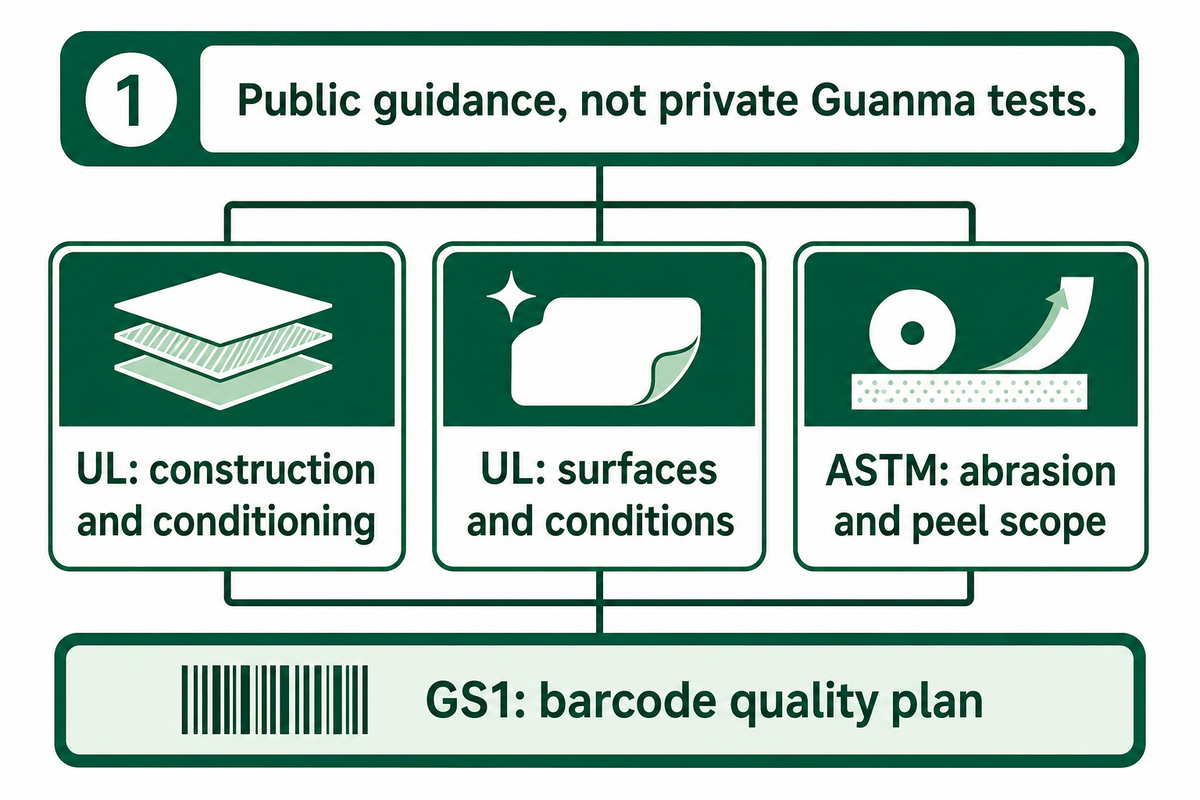
- UL marking and labeling systems: construction and conditioning
- UL label application surfaces and conditions
- GS1 retail implementation guidance: thermal-transfer and direct-thermal systems
- GS1 barcode quality-plan guidance
- ASTM D5264-98(2019): printed-material abrasion scope
- ASTM D6252/D6252M-98(2025): labelstock peel scope and limitations
- Grzelka et al.: humidity and slow peeling of pressure-sensitive tape, revised 2022.
- Label Academy: characteristics and selection of pressure-sensitive label materials.
Related material and printing guides