Get in Touch with Guanma

Updated October 2026
Squeezable bottle label materials are pressure-sensitive label constructions for containers that deform during dispensing.
Choose squeezable bottle label materials by the exact film grade, adhesive and finished print build. PE or a purpose-designed conformable MDO film is a useful starting candidate; approve it only after repeated squeezing of the filled production bottle.
A waterproof label can survive spilled water yet retain a crease after the bottle recovers. A soft face film can also disappoint when its laminate, adhesive or placement changes the finished construction. Buyers need to compare complete samples under a defined deformation, rather than select a polymer name from a catalogue.
FINAT says its test methods “do not in themselves imply any specification of performance.”
Before requesting a trial roll
- Specify the squeeze duty and the exact finished construction.
- Compare an unlabelled bottle, an approved printed reference and the candidate.
- Record wrinkles during compression and residual damage after release separately.
- Keep mechanical acceptance separate from required contact-use and recycling assessments.
Quick Specs: identify the sample
| Face film | Exact grade, thickness in µm, treatment and orientation |
|---|---|
| Adhesive | Code, intended bottle surface and application conditions |
| Finished label | Ink, varnish or laminate, dimensions in mm, artwork revision |
| Trial profile | Fill volume in mL, temperature in °C, compression and recovery observations |
Where squeeze-label failures start
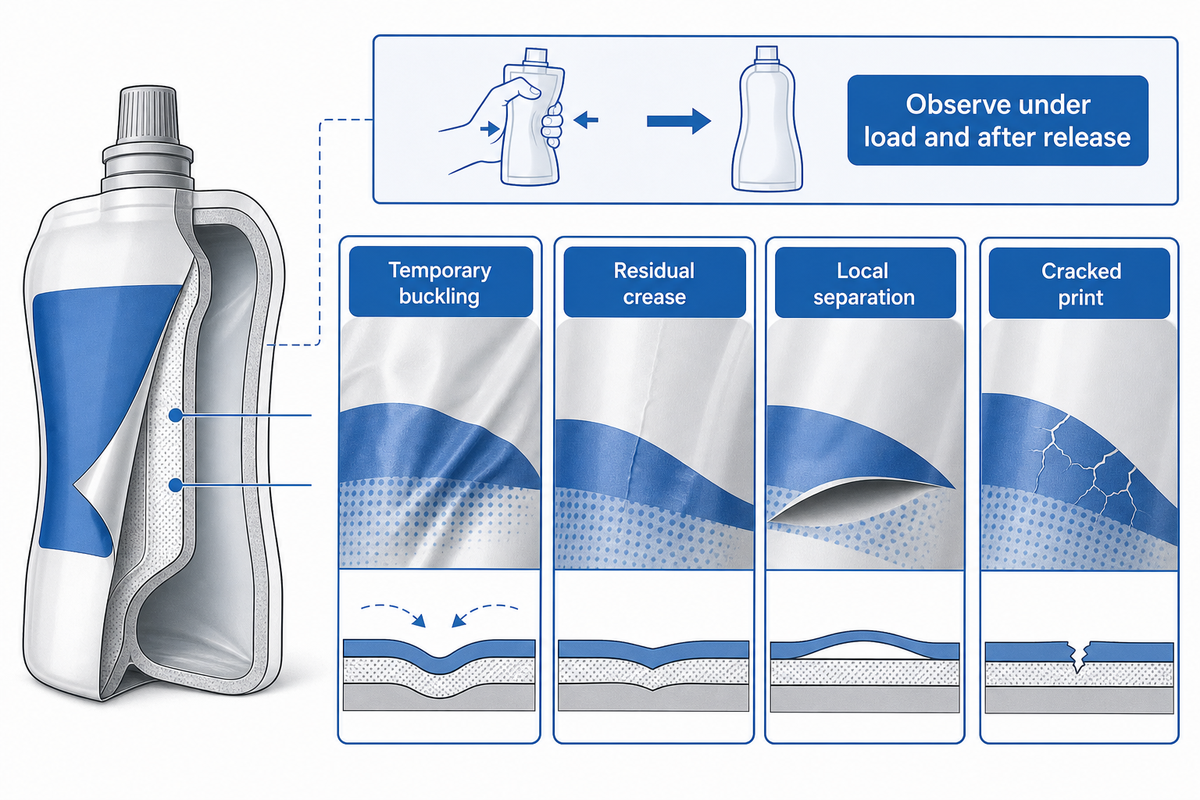
A squeeze label fails if the finished construction can’t accommodate the bottle’s deformation or fails the appearance test afterwards. Temporary buckling, a residual crease, local separation and cracked print are different observations. Water resistance establishes none of those outcomes by itself; the filled bottle and finished label must be considered together.
Pressure from a hand changes the local shape of plastic bottles. The label panel can shorten, bend and develop compound curves. A film selected mainly for dispensing stiffness may resist that shape change. However, a wrinkle doesn’t uniquely identify poor adhesion: Nolte, Chung and Stafford’s 2010 polymer-coating research describes wrinkling even on well-adhered compliant substrates. That finding explains a diagnostic boundary, rather than a bottle-label formula.
- Under load: photograph the location and direction of folds.
- After release: check whether the bottle and label recover separately.
- After handling: inspect readable print, edge retention and finish damage.
A good illustration of a sauce-bottle scenario is a neater looking empty container, whereas a filled container has a crease in the center after dispensing. Comparing the unlabelled bottle first prevents a bottle wall that stays deformed from being mistaken for a film defect. No failure rates or expected service lifetimes are implied by this example.
Trial decision: name the observed damage before ordering a different material.
PE and MDO squeeze-film shortlist
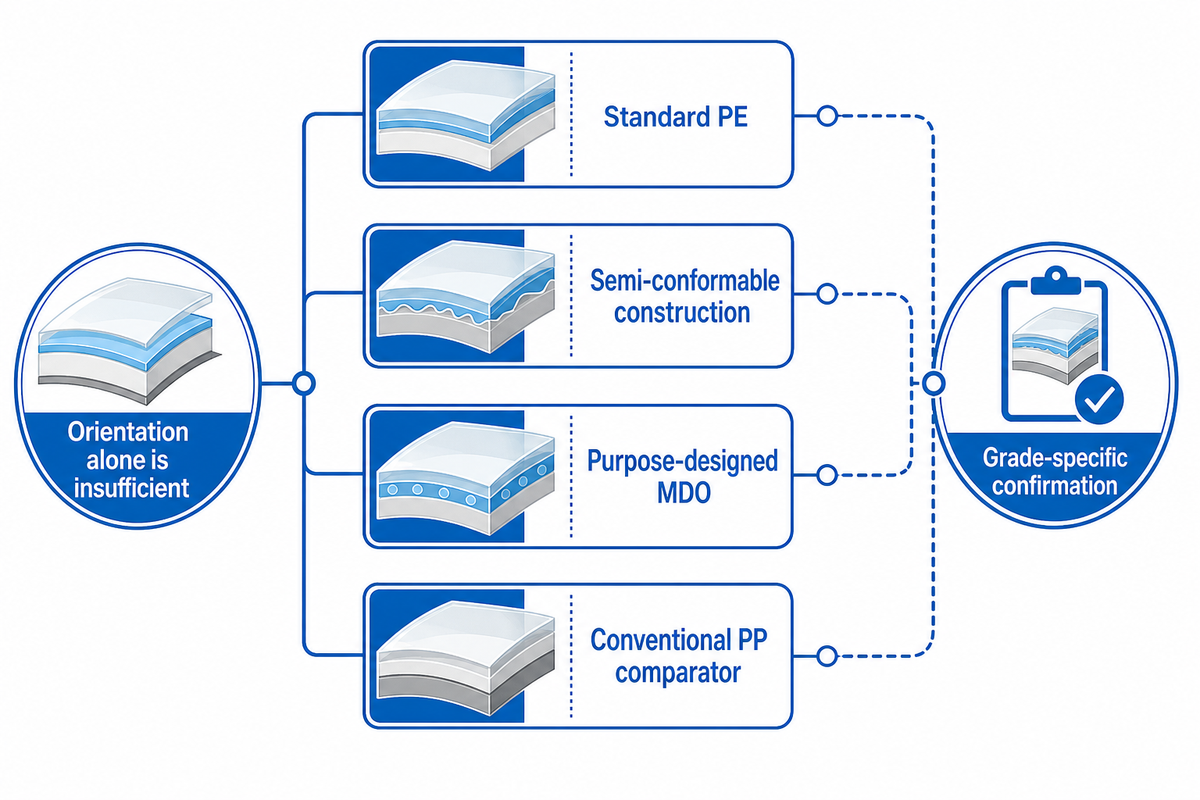
PE and purpose-designed conformable films are potential candidates for a bottle panel that repeats deformation. A useful purchasing unit is an exact grade, a matching adhesive, and a print surface. MDO means machine-direction-oriented and doesn’t refer to a specific polymer recipe, one squeeze category or a guaranteed recovery performance.
Record the crease and recovery behavior and choose the first controlled film comparison. The Label Academy chapter on filmic face labels explains why film construction, orientation and converting requirements matter. Its indicative category gauges are background ranges, not an instruction to buy the thickest film. Availability and bottle performance require grade-specific confirmation.
| Candidate | Published category context | What to confirm | Selection limit |
|---|---|---|---|
| Standard PE | 80–85 µm indicative range | Exact film, adhesive and print treatment | Category thickness does not approve recovery |
| Semi-conformable construction | 50–65 µm indicative range | Suitability for the actual deformation | Light flex and full squeeze are different duties |
| Purpose-designed MDO | Grade-specific; obtain data sheet | Polymer construction, direction and squeeze classification | Orientation alone is insufficient |
| Conventional PP comparator | 50–60 µm indicative category range | Whether light flex is the intended service | Do not extrapolate to severe repeated compression |
A transparent finish or matte or glossy appearance can be specified after the mechanical shortlist; ask if the quote specifies face thickness or the liner. The total roll contains several layers and a liner value isn’t a face-film gauge.
Sampling decision: request a named construction and representative roll, with direction marked.
When BOPP and PET can fit
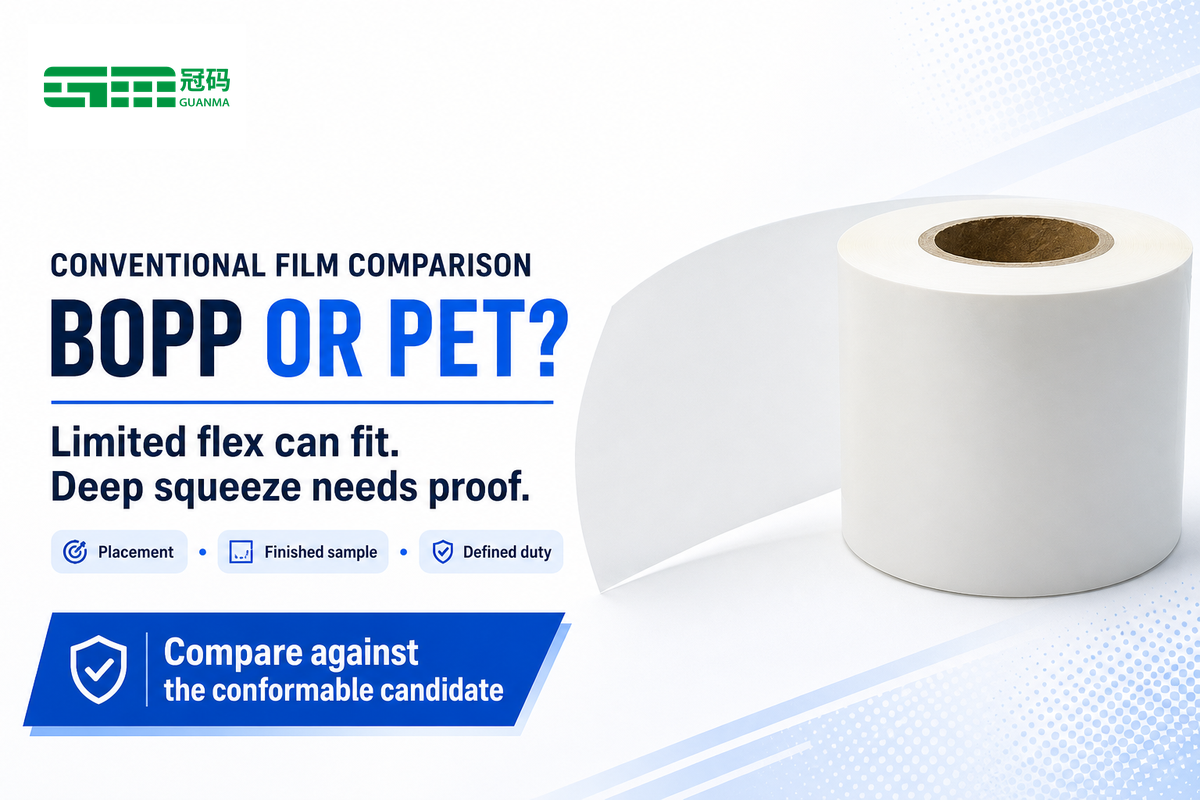
BOPP or PET can be a comparator if the bottle has limited flex, the label is away from the main deforming panel or the current print process favors that construction. Repeated deep compression needs its own demonstration. A durable film’s gloss or dispensing behavior isn’t a substitute for the required squeeze performance.
For family-level choices, check PET and BOPP flexibility comparison. Here, compare your chosen conventional sample with the conformable candidate under the same load and recovery conditions. Stiffness and conformability are treated as different requirements in the technical film chapter.
Advantages to check
- Compatibility with the existing printing and dispensing process.
- Required clarity, opacity and finished look and feel.
- Retention in the specified handling environment.
Limitations to test
- Residual folds on the deforming panel.
- Print or decorative-layer cracking.
- Performance after the full exposure sequence.
As an illustrative example, in a cosmetic pack, a rigid rear instruction label could be located on a comparatively stable panel, while the front panel could deform more. That was a placement hypothesis, not evidence that PET is appropriate for all squeeze bottle cases. Examine BOPP label film options only after determining the intended duty.
Comparison decision: Retain a conventional film only when the finished sample meets the agreed mechanical requirement.
Adhesive and bottle variables
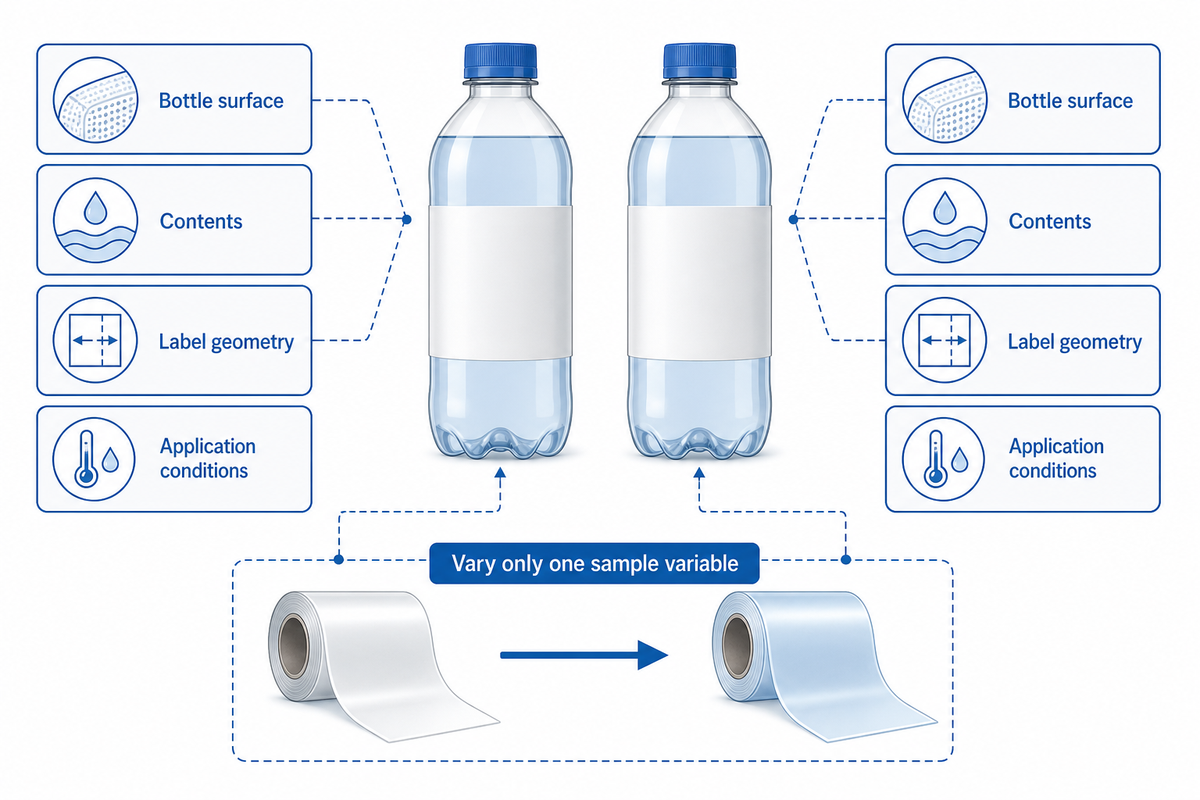
Keep the bottle surface, contents, label geometry and application conditions constant when comparing films. An initial tack may help a film adhere to a surface, but it may not provide retention after compression, moisture or repeated handling. A permanent adhesive still needs an identified substrate and application conditions; the same adhesive description may mask different grades supplied.
Is your bottle glass, plastic, or metal?
Recording the actual container material is important, as a result achieved on one surface doesn’t approve the other. For squeezable plastics, determine resin, label-panel geometry, and the relevant surface treatment. Behavior on a deforming plastic wall can’t be established with a glass or metal comparator. Also retain the bottle lot to rule out a container change in a label comparison.
Check the application surface for contamination and confirm the supplier’s approved preparation and application window. Don’t create a universal cleaning recipe or surface energy limit. Record fill state, time after application and any condensation. For exposure to cold, the freezer label application guidance describes a separate condition which should be captured, if applicable.
Engineering Note: report the measurement conditions
FINAT FTM 1 and FTM 2 list 180° and 90° peel respectively, both at 300 mm/min. Their results aren’t interchangeable bottle acceptance limits. Record the chosen method, substrate and conditioning; agree package-specific requirements separately.
ASTM D3330/D3330M-04(2025) also states that comparison of tapes is complicated by backing stiffness and adhesive behavior. A larger peel number by itself cannot prove a better squeeze label.
Control decision: Keep application and bottle conditions the same and vary only one sample variable.
Print and finish variables
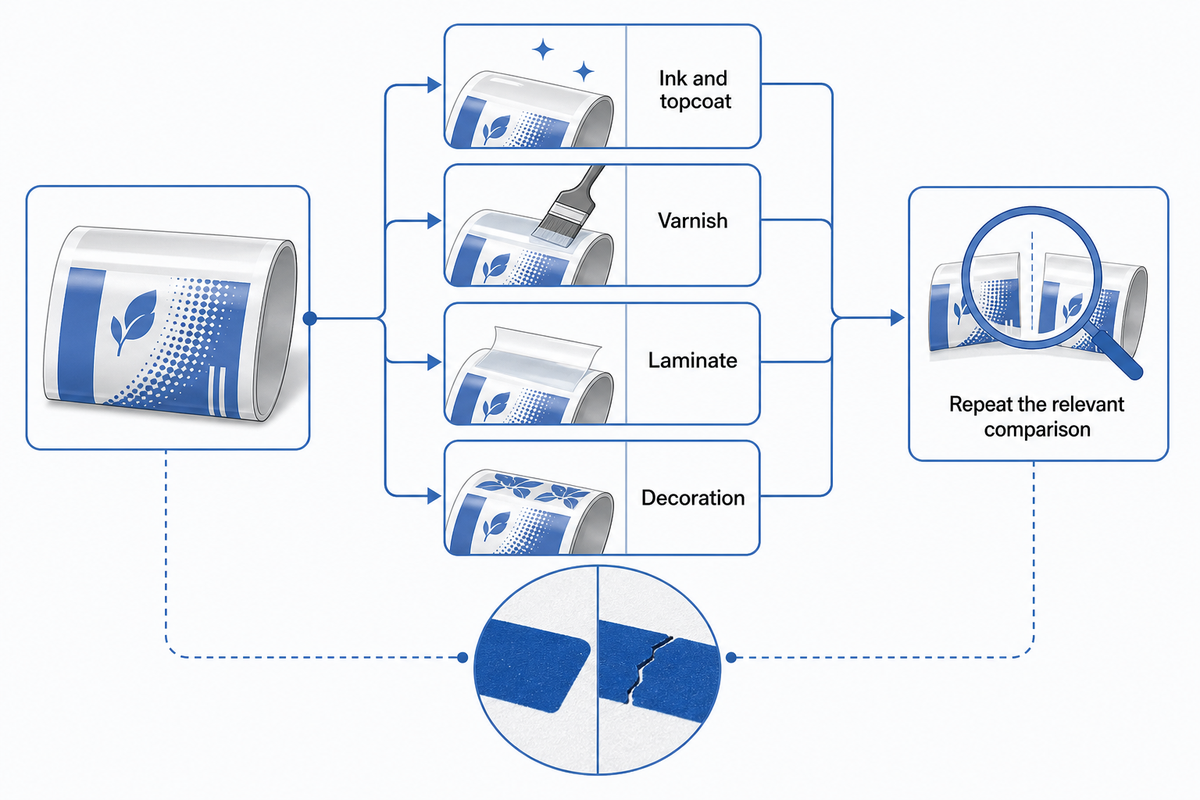
Approve printed construction along with ink, topcoat, varnish, laminate and decoration. An unprinted film can reveal a mechanical problem, but it does not establish print adhesion, resistance to smudge or finished-layer flexibility. Label design and placement may also need to be evaluated as they determine the location where the construction bends and the location of essential information.
Surface treatment and print matching are covered in the film-face technical chapter. A printable surface is process-specific: inkjet, laser printers, and converter printing aren’t automatically interchangeable. A desktop blank label or label sheets can’t qualify a production roll merely because both are called film labels.
Will your bottles be stored in refrigerators, shipped over long distances, or immersed in ice?
Include each relevant exposure in the trial profile and specify when squeezing occurs relative to it. Different exposures, such as refrigeration, condensation, shipping contact, and immersion, affect the finished label. Measure the actual temperature, time, and physical contact sequence and don’t rely on waterproof. Test the retention and readability of print after the exposure and evaluate how the print looks after the exposure and if it met requirements.
For an illustrative chilled sauce pack, moisture exposure and hand friction may affect the ink while the face film recovers normally. Different outcomes should be recorded. Glossy materials need the same finished system check. So do Gloss labels and metallic foil labels; a foil or laminate can change what has previously been approved. Match PET facestock grades to the intended print process rather than assume a material name is enough.
Finish decision: repeat the relevant comparison when ink, decoration or protective layers change.
Build a repeat-squeeze trial
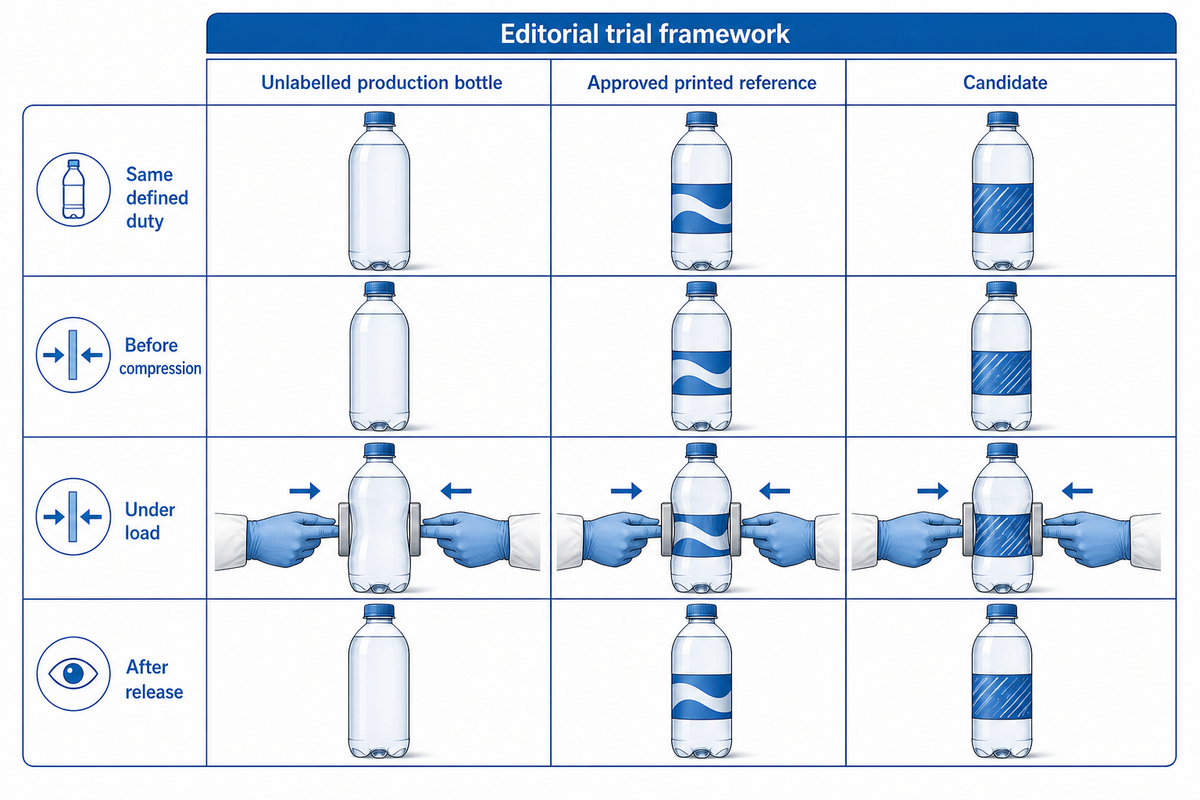
The Squeeze-Release Recovery Record compares an unlabelled production bottle, an approved printed reference and a candidate under the same defined duty. The control shows bottle behavior; the reference shows an approved outcome; the candidate shows one proposed change. This is an editorial trial framework, not a FINAT or ASTM standardized bottle test.
Agree what acceptable appearance, retention and readability mean at named observation times before starting. Set the compression, repetitions, environment and sample counts based on intended use and risk. FINAT’s public method guidance supplies no universal pass limit. Likewise, ASTM D882-26a warns that tensile comparisons depend on controlled conditions and the force-time scale.
- Define the duty: document use conditions, observations and acceptance before seeing the result.
- Prepare the matched set: identify the control, approved reference and one-variable candidate.
- Observe and decide: capture before compression, under load and after release; sign the result against the agreed duty.
Values in records below are examples only. They show examples of what to record, not a recommended cycle count, production test result, or supplier performance. Replace all values with the agreed trial conditions.
| Record field | Hypothetical entry | Why it matters |
|---|---|---|
| Matched bottle and fill | One bottle lot; 300 mL fill | Use the same contents and fill state across samples |
| Control | Unlabelled filled production bottle | Separate bottle deformation from label behavior |
| Approved reference | Finished construction R1; lot recorded | Anchor the agreed mechanical appearance |
| Candidate | Construction C1; face grade changed only | Preserve ink, adhesive, geometry and finish |
| Application and dwell | 24 h after application; 23 °C | Record actual conditions; these are not prescribed limits |
| Compression severity | Panel width 60 mm before load, 45 mm under load | Define the observed deformation and measurement location |
| Sequence | 20 repetitions at an agreed cadence | Record loading, hold and release timing |
| Recovery observations | Photographs at 15 s and 60 s after release | Judge identical locations at stated times |
| Recovered width | Measure control, reference and candidate separately | Do not infer recovery from one photograph |
| Disposition | Accept, hold or reject against the written criteria | Accept only for the specified mechanical duty |
Keep measurements of bottle label template, dimensions, machine direction and sample identity with photos. Record instruments of measurements and their resolution. Don’t add false precision. Where no approved reference exists, agree a target and treat the first acceptable construction as a new approval rather than a proven equivalence.
When choosing the right label, trial performance is the first consideration. A finance reviewer can compare the material price to the observed converting waste and trial handling time. Measurement should be performed using actual figures; a cheaper roll doesn’t mean a lower cost per accepted pack.
Approval decision: Retain the signed record along with the exact finished sample.
Read wrinkle and recovery results
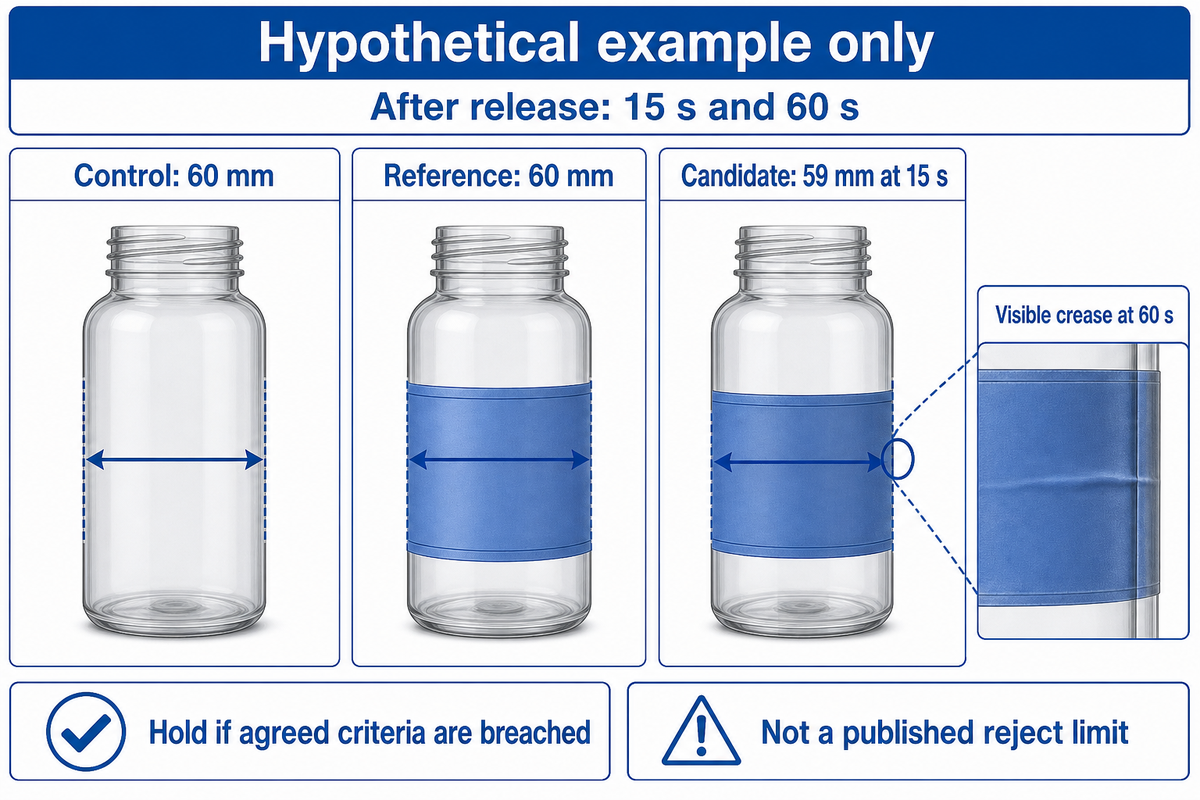
Read the bottle’s recovery, film appearance, adhesive retention and print condition as discrete results. A photograph doesn’t show a unique cause. The Finished-Label Failure Split below determines the next controlled comparison and a hold decision. It doesn’t predict lifetime or approve a different construction of the same film family.
ASTM D5459-95(2025) distinguishes recovery, permanent deformation and stress retention for stretch-wrap films. Its machine-direction scope is not a bottle-label squeeze method. Those separate concepts are useful when recording observations, without borrowing its procedure or claiming compliance.
| Observation | Next isolated check | Mechanical disposition |
|---|---|---|
| Bottle stays deformed | Compare the unlabelled control and filling conditions | Hold the package comparison |
| Wrinkle clears by the agreed observation | Check readability, edges and repeated duty against the reference | Potentially acceptable if written criteria allow it |
| Crease remains after bottle recovery | Compare face grade or orientation, changing one variable | Hold if residual set exceeds agreed appearance limits |
| Local bubble or separation | Check surface condition and adhesive construction separately | Hold retention approval pending investigation |
| Edge lifts even without squeezing | Investigate static placement, radius and application | Resolve the baseline defect before the squeeze trial |
| Ink cracks while film remains intact | Compare the same film with a changed print/finish build | Hold if required information loses readability |
| Varnish or laminate separates | Review the protective layer and finished construction | Hold the affected finish revision |
| Print rubs off after wet handling | Repeat the defined exposure with the print supplier | Hold the relevant handling duty |
| Candidate differs from the reference | Check sample identity and all uncontrolled changes | Investigate before accepting equivalence. |
For the same hypothetical worksheet, suppose the control and reference each return to 60 mm, while the candidate remains at 59 mm at the 15 s observation and carries a visible crease at 60 s. Those invented example readings would trigger a hold if they breach the agreed appearance criteria; the 1 mm difference isn’t a published reject limit. Recovered width by itself doesn’t prove the presence of readable print or retained edges.
Static edge lift belongs to the separate label flagging on small containers investigation. Cold exposure failures may warrant a change of the adhesive; a central residual fold may justify a face-film comparison. Neither observation proves that substitution alone will solve the problem.
Do
- Match photographs to exact sample identities.
- Record all outcomes at the agreed recovery times.
Do not
- Diagnose one cause from a wrinkle photograph.
- Replace film, adhesive and finish together and call the result an isolated test.
Next-sample decision: The next-sample decision is to change the smallest variable of interest and compare it to the retained reference.
Supplier approval and sample request
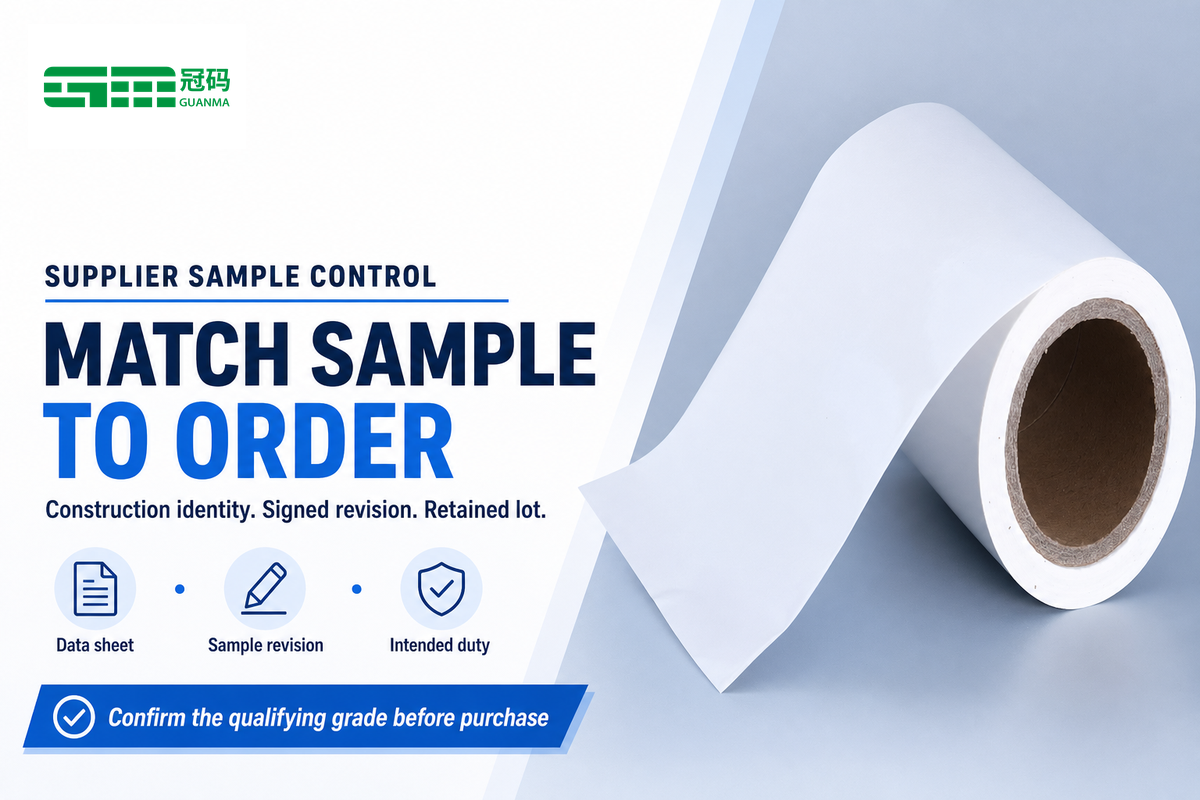
Before purchasing production materials, you should request the exact construction identity, representative samples, and evidence of the intended duty. A public material range may provide a starting point for discussion; however, it doesn’t prove that a full-squeeze grade is available and qualified. Order against the signed sample revision and retain lot identification for future comparisons.
ISO/CASCO’s explanation of supplier declarations connects the identified object, the stated requirements, and the supporting results. This documentation principle can be applied here; it does not mandate third-party certification for ordinary bottle labels. Art Thomas’s 2023 article on supplier selection also emphasizes production and inspection records as well as lot control. His expert advice is hosted by NIST and does not reflect a government endorsement of any supplier.
- Quality: obtain the data sheet, test conditions, observations and acceptance scope.
- Production: confirm printable surface, liner, roll dimensions and dispensing behavior.
- Procurement: tie the quotation and order to the approved construction code.
- Intended use: request applicable contact-use, market and recycling documentation separately.
In the hypothetical 300 mL trial, procurement would order against C1 only after its signed disposition, with the 23 °C test condition and finished artwork revision attached. A change to the adhesive code would be a new construction comparison; an unchanged film name wouldn’t retain that approval.
Guanma’s pressure-sensitive film constructions for application trials include public PET and BOPP, and synthetic films. The reviewed pages invite sample qualification, but do not identify a named package-qualified fully squeezable PE/MDO grade. Ask what qualifying construction is available, and what’s the quantity, cost and lead time for a sample.
Ordering decision: accept a defined construction for a defined mechanical duty, then confirm the other required product approvals.
Film and test updates make sample control more important
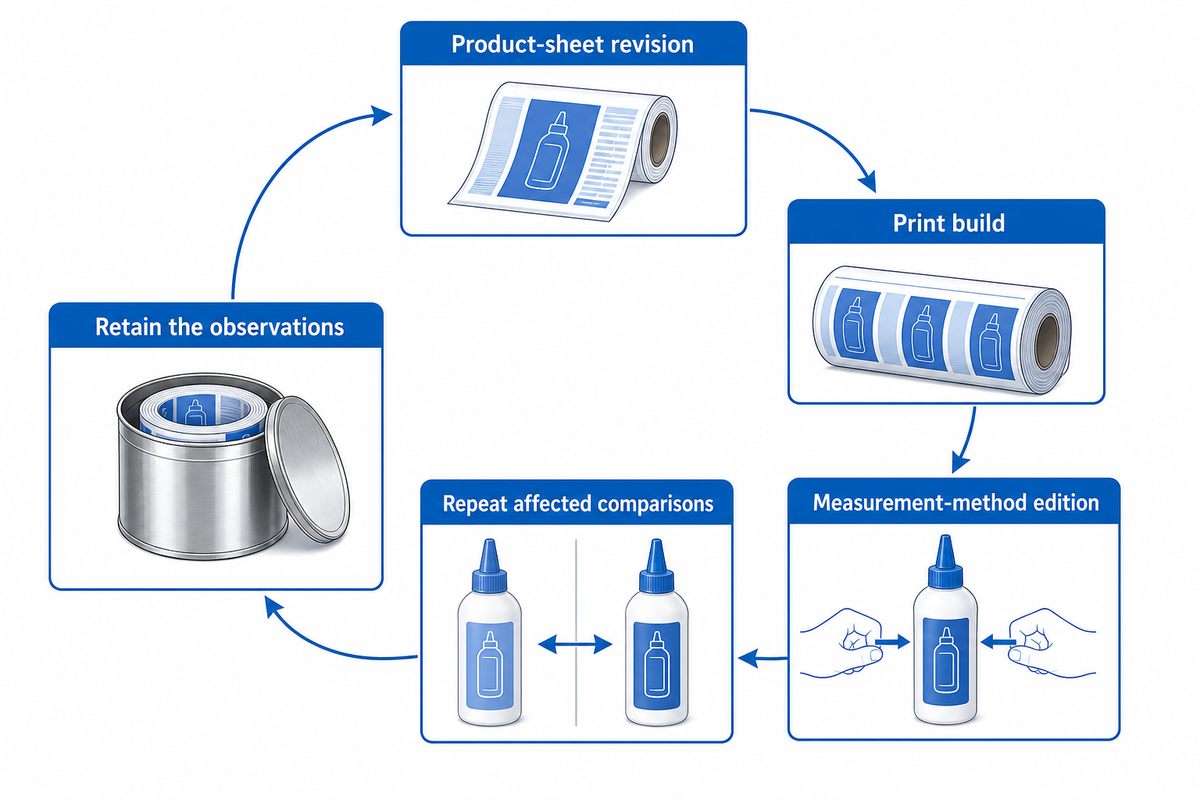
New coatings or a modified construction can alter the sample being approved even if the polymer name is the same as in a previous approval. Check the product-sheet revision, print build and measurement-method edition before reusing an old record. Recent public updates support tighter sample identification; they do not prove stronger market demand or universal improvement in squeeze performance.
On 21 July 2026, Label & Narrow Web reported Sihl’s PE portfolio with aqueous inkjet coatings. Options belonging to Sihl establish no Guanma capability or certification. The 23 October 2025 interview with Avery Dennison’s Angel Harvey discusses construction-specific conformability and printing choices.
- Confirm whether a replacement roll changes the face film, coating, adhesive or liner.
- Ask the lab to identify the edition and conditions behind a reported measurement.
- Repeat the affected parts of the mechanical comparison when the approved construction changes.
ASTM’s public catalogue lists D882-26a as active, updated 1 October 2026. That date identifies a reference version, not a new bottle test. The actual product-sheet and sample revision matter more than an undated claim that a material is “tested.”
Key takeaway
Approve one identified finished construction for the agreed squeeze duty, using the unlabelled control, approved reference and candidate; retain the observations and repeat the relevant checks when that construction changes.
FAQ
How do you label squeeze bottles?
Apply a grade-matched label to the specified bottle surface and qualify the finished printed construction under its intended squeeze duty.
For production product packaging, document the face film, adhesive, print treatment and application conditions before sampling. Keep the fill state and placement consistent across the control, reference and candidate. A blank bottle from a different lot isn’t a matched control. Standard squeeze bottles used for kitchen identification may have different requirements from permanent branded packs. Identification and permanent labels for bottles serve different duties. A reusable band or temporary sticker shouldn’t be treated as equivalent to an approved product label.
Can squeezable bottle label materials be recycled?
Recycling compatibility depends on the complete package and recycling route, so a PE or PP name alone does not approve it.
Evaluate the bottle, label coverage, decoration, adhesive and ink against the relevant package assessment. A mechanically successful squeeze sample can still need a different construction for sorting or washing requirements. Request evidence for the actual combination and intended market rather than extend a supplier’s unrelated recycling claim. Recycled content and compatibility with a recycling process are separate questions; neither follows automatically from flexibility or water resistance.
Can a removable identification label replace a permanent product label?
A removable identification label serves a different duty and cannot replace a permanent product label without a separate requirements check.
Reusable containers may prioritize clean removal, while retail packs need retained identification through storage, handling and dispensing. Define when removal is wanted and how readable the information must remain beforehand. Guanma’s removable-label application range addresses that separate requirement. A silicone band or writable kitchen marker can be useful for identification, but its behavior provides no evidence for a printed adhesive construction on the deforming bottle panel.
Can paper labels work on squeeze bottles?
Paper labels may suit limited-flex duties, but repeated compression and the actual moisture exposure require a finished-sample trial.
Obtain the exact self-adhesive paper construction and compare it under the defined conditions. A coating or water-resistant description alone can’t establish crease recovery, print retention or suitability for a deeply deforming panel.
Does a blank-label test approve a printed production label?
A blank-label trial does not approve the printed production label because the complete print and finish build can change the outcome.
An unprinted sample can help isolate face-film and adhesive behavior. Production artwork introduces ink, curing conditions and potentially varnish, a laminate or decoration. Check that the sampled label sizes and placement match the intended pack, including areas carrying instructions or other required information. A label template helps retain geometry, but it isn’t performance evidence.
Keep the approved construction and artwork revisions with the trial record. When one layer changes, compare the new finished sample with the retained reference under the affected duty. Don’t assume that a pre-designed water bottle label or a printable sheet performs like a converter’s production roll. Different water bottles, wine bottles or squeeze containers may share a material family while requiring different approval conditions. If a supplier reports only a bare-film property, ask which finished properties remain unverified and agree the corresponding checks before purchase.
How to use this squeeze-label guide
Guanma publishes this material-selection guide to help buyers prepare a precise squeeze-film sample request. The recovery worksheet and failure split are editorial tools derived from public technical sources, not reports of Guanma factory trials. Their numerical example is hypothetical. Confirm the available grade, supplied construction and intended-use documentation before purchasing a production roll.
Prepare a construction-specific sample request
Send the bottle resin, filled sample, deformation profile, label dimensions and print build. Ask Guanma to confirm a suitable grade and trial-roll availability before setting a production specification.
Related Articles
References & Sources
- FINAT Test Methods FINAT; public method scope and performance disclaimer.
- Harnessing wrinkle-delamination mechanics to measure and pattern polymer coatings Nolte, Chung and Stafford, 2010; conceptual mechanics boundary.
- Self-adhesive labels: filmic face labels Label Academy; category background, not a selected-grade specification.
- D3330/D3330M-04(2025) ASTM International; tape-peel scope and comparison limits.
- D882-26a ASTM International; thin-film tensile scope, active catalogue updated October 2026.
- D5459-95(2025) ASTM International; stretch-wrap recovery scope, not a bottle-label test.
- Attestations of conformity ISO/CASCO; identification, requirements and supporting records.
- 8 Ways to Improve Your Supplier Selection Process Art Thomas, 2023; named expert opinion hosted by NIST.
- Sihl expands PE label portfolio with aqueous inkjet coatings Steve Katz, Label & Narrow Web, 21 July 2026; Sihl-specific product report.
- Avery Dennison eyes innovation in films Greg Hrinya, Label & Narrow Web, 23 October 2025; named industry perspectives.