Get in Touch with Guanma

Freezer OPS can be used for packaging frozen foods if the right grade and finished pack are used in the process. The costly mistake is buying a tray on its resin name, then discovering that its lid, cold handling or label needs a different specification.
Quick selection brief
- Material: oriented polystyrene, identified by the supplier’s grade and finished-container code.
- Scope: base, lid or sealing film, food-contact use, distribution and label.
- Buying unit: a complete accepted pack, with the same capacity and closure requirements.
Freezer grade OPS packaging needs a grade-specific rating and a finished-pack trial. Match the material, the full temperature history and the observed pack performance before approving an order.
Key points
- A freezer-grade OPS sheet can have substantial haze; inspect the actual display sample.
- Cold storage, colder processing and reheating need separate checks.
- Label application temperature describes a different job from storage temperature.
- Compare base, closure, labels and freight using accepted packs as the denominator.
Freezer grade OPS packaging: what the grade means
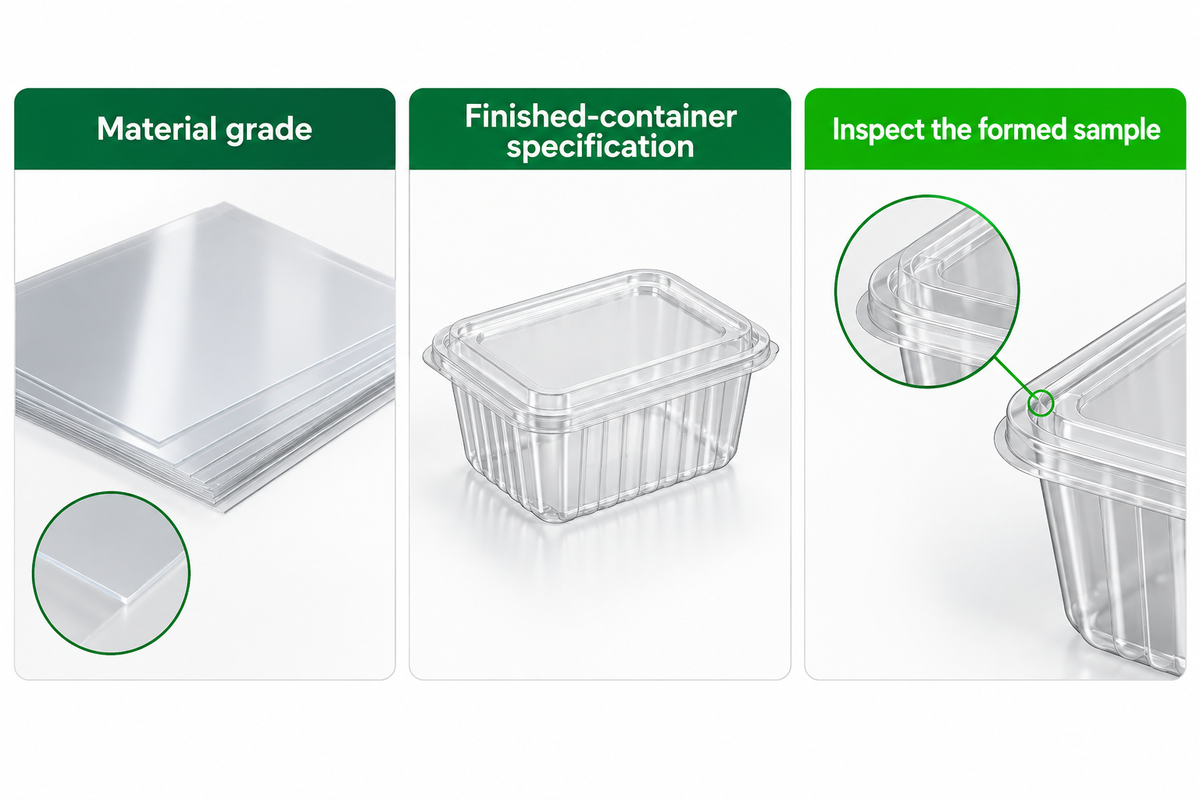
Freezer OPS packaging is selected for a stated cold-use application. The grade identifies the material to buy; the finished-container specification identifies the pack to approve. Select by the two identifiers together since sheet properties and formed-tray performance answer different purchasing questions.
For a concrete example, Multi-Plastics lists a typical range of use of −40 to 165°F (−40 to 74°C) for its ANAUPMF utility freezer OPS sheet, using an internal method. The same sheet lists 50–70% haze under ASTM D1003. Those figures belong to that supplier’s sheet grade. Its documentation also says that typical values do not guarantee any assurances for conditions outside the control of the supplier.
That haze figure may determine a purchasing decision: a freezer qualified material may still not qualify for a clear display. Ask for a formed sample with the intended wall distribution and examine it with the product inside. Buying from an attractive generic photograph may still leave the display or merchandising of the package unresolved.
Formulation plays a role as well. There’s an historic patent, US5643664A, assigned to Packaging Corporation of America, which discloses the composition of certain modified biaxially oriented polystyrenes for enhanced low-temperature impact performance. It’s focused on a specific formulation and not on every OPS tray in the marketplace. If the intended use exceeds a supplier’s documented range, a different qualified grade should be requested or the missing validation should be completed before a purchase order is placed.
OPS containers at −18°C: match the whole cold chain
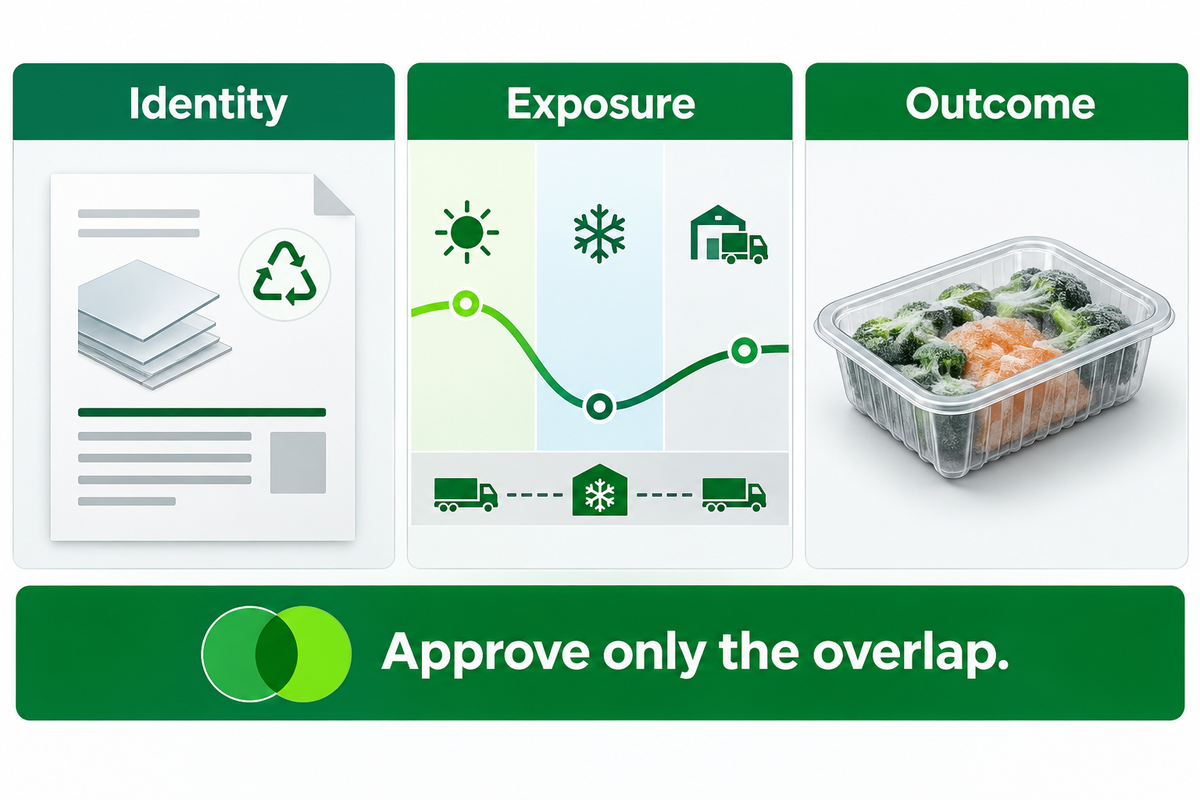
A freezer temperature of −18°C is the starting point for selecting freezer packaging. This temperature doesn’t encompass the entire temperature history. Treat each element of the temperature history independently. A suitable OPS container must meet the coldest relevant exposure and survive the handling and closure demands that occur while the pack is cold.
NDSU Extension’s Food Freezing Basics recommends 0°F or lower for best frozen-food quality; −18°C is the rounded Celsius equivalent. That food-storage guidance helps set context. A processor still needs the temperatures experienced by its own pack, including any colder freezing stage.
Cold-Chain Three-Match Test
Three matches must be made to review a supplier report to determine if the pack satisfies the acceptance criteria. Identity must match the ordered pack, exposure must match the process, and outcome must match the acceptance criteria. Approve only the overlap. A missing exposure record means further evidence is needed, even when the material identity is correct.
| Check | Example file entry | Purchasing decision |
|---|---|---|
| Base identity | Tray code and revision supplied | Match purchase specification |
| Closure identity | Lid code missing | Request tested lid combination |
| Product load | Empty tray tested | Add representative filled-pack evaluation |
| Storage exposure | −18°C stated in buyer brief | Match report to this condition |
| Earlier process | Freezing-stage profile absent | Obtain actual process record |
| Conditioning | Room-temperature handling result only | Request relevant cold conditioning |
| Mechanical outcome | No crack observations recorded | Record cracks and closure release separately |
| Leak outcome | “Passed” without method | Identify method and acceptance criterion |
| Moisture protection | No product-storage assessment | Define quality endpoint and storage duration |
| Disposition | Identity partly matched; exposure incomplete | Hold approval pending missing evidence |
ASTM D4332-22 explains the importance of conditioning packages to equilibrate with the test atmosphere and distinguishes laboratory simulation from actual field conditions. Ask the test laboratory to record specimen conditioning and measurement conditions, not just the freezer’s dial setting.
Agree on observable acceptance criteria before sampling: no visible cracks after the agreed handling sequence, no unintentional lid opening, and no leakage under the defined method. Record the sample count and exceptions. The laboratory and buyer must agree on severity and sample size along the distribution route; there’s no universal drop height or dwell time supplied by the term ‘freezer grade.’
OPS vs PET vs PP for frozen food
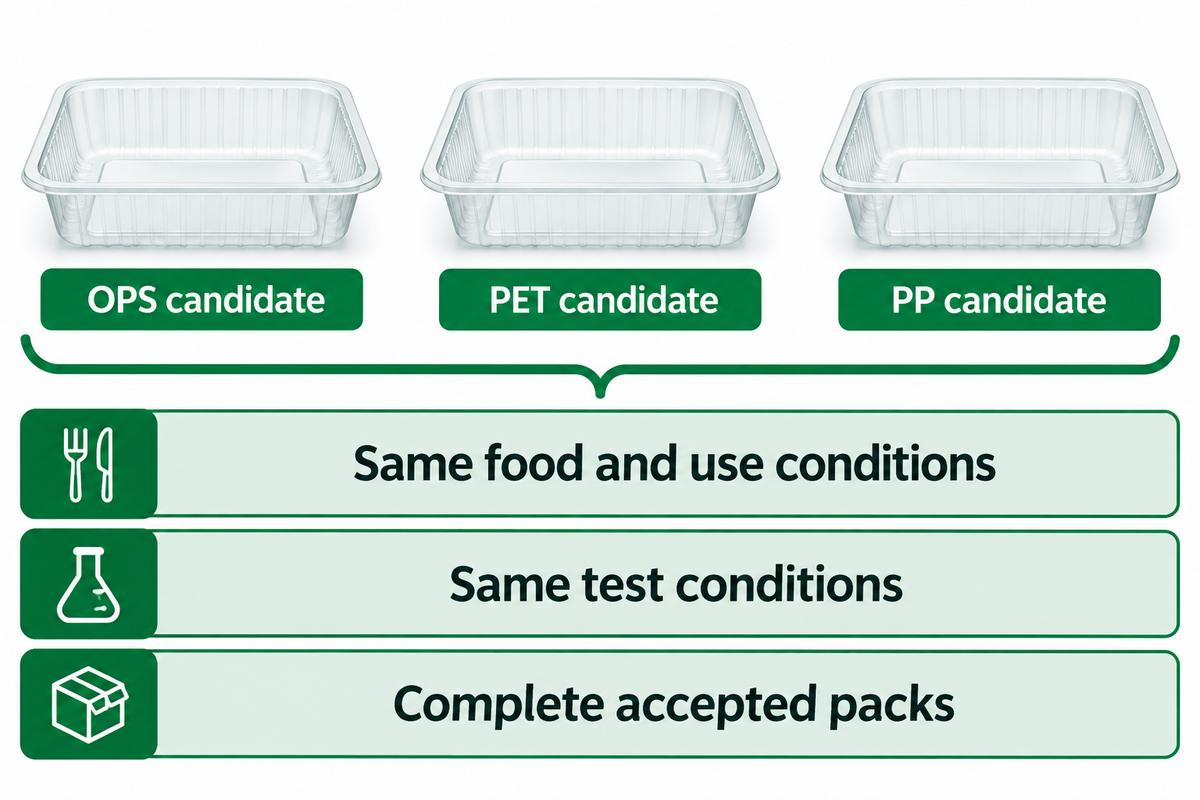
Compare OPS, PET and PP as specific container grades for the same food, temperature and closure. A resin-wide ranking hides the choices that matter: cold handling, appearance, heating permission and delivered pack cost. Shortlist products with matching documents, then compare their finished-pack results under one agreed trial.
| Decision field | OPS candidate | PET candidate | PP candidate |
|---|---|---|---|
| Material identity | OPS grade and converter code | PET grade and converter code | PP grade and converter code |
| Cold-use range | Named-grade document | Named-grade document | Named-grade document |
| Display appearance | Formed sample and haze where relevant | Formed sample | Formed sample |
| Closure fit | Matched lid or sealing film | Matched lid or sealing film | Matched lid or sealing film |
| Cold impact | Filled-pack result | Same test conditions | Same test conditions |
| Moisture protection | Product-storage result | Same endpoint | Same endpoint |
| Heating use | Explicit heating instructions | Explicit heating instructions | Explicit heating instructions |
| Food contact | Exact intended-use declaration | Same food and use conditions | Same food and use conditions |
| Label bonding | Actual OPS surface trial | Actual PET surface trial | Actual PP surface trial |
| Cost comparison | Complete accepted packs | Equivalent capacity and closure | Equivalent capacity and closure |
Heating deserves its own line because FDA chemistry guidance, Appendix V, Table 2 distinguishes frozen storage without thermal treatment from frozen or refrigerated foods reheated in their container. Neither freezer suitability nor the letters PP alone provide a heating instruction for the pack being purchased.
What is the safest container to store food in the freezer?
The appropriate choice is a food-contact container intended for the food and freezing conditions, with a secure closure and suitable cold-handling performance. Transparency and/or brand name alone don’t warrant selection. For a commercial order, assess the documented use and complete the filled-pack trial, before deciding which is the best choice.
Household silicone freezer trays, ice cube molds and freezer paper serve different portions and closure arrangements. There are also concerns with liquid expansion and leakage with a soup freezer pack. Compare these formats to each other only if they’re serving the same product and handling requirements. They aren’t interchangeable options for a sealed retail tray.
Freezer packaging failures: cracks, seals and moisture
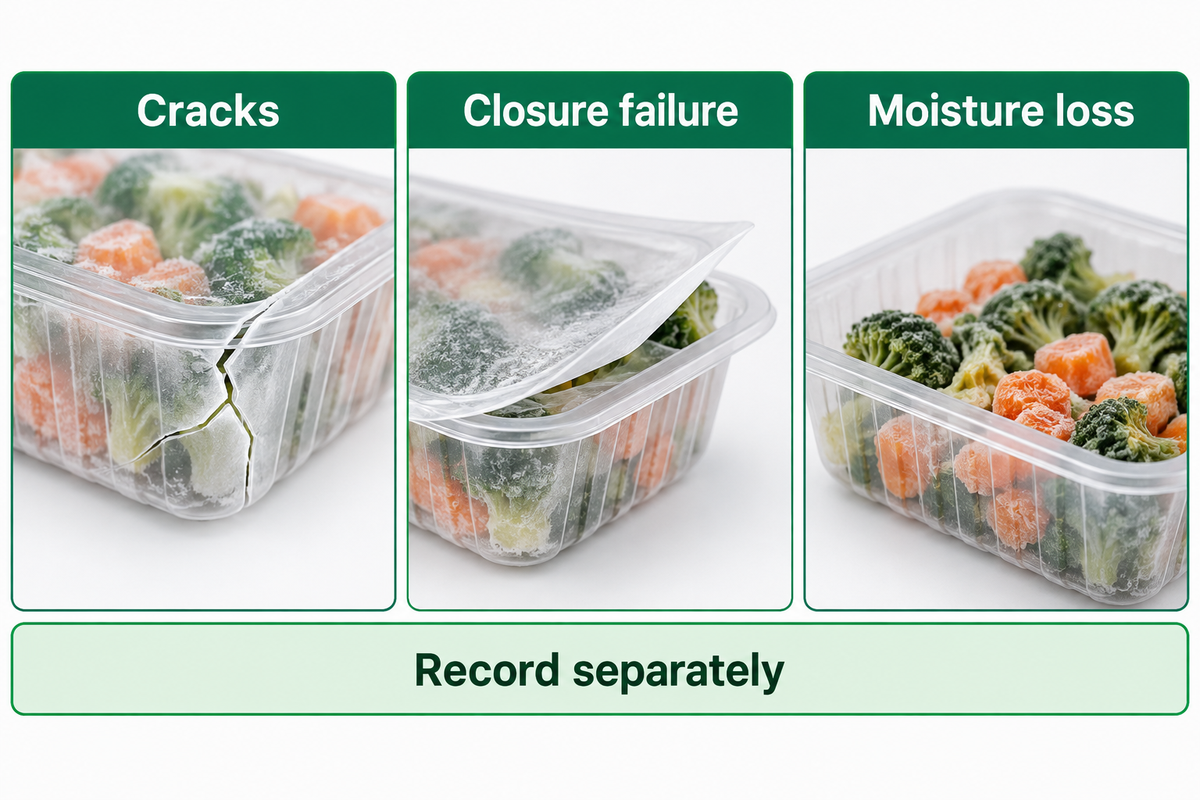
In the case of freezer packaging, cracking, closure failure and moisture loss need to be examined separately. A strong tray can have a lid that doesn’t seal properly, and an intact strong tray may not protect the product for the intended storage time. Separate observations support changes to the right part instead of changing material everywhere.
“Not become brittle and crack at low temperatures.”
The University’s general guidance speaks to moisture-vapor resistance, durability, leakage and sealing. Separate those qualities and make observations for a trial sheet: location of crack, closure movement, visible leakage and end point product quality. A picture of an empty unbroken tray doesn’t answer the full brief.
Illustrative line decision: A frozen-dessert buyer receives a sample that looks clear and closes neatly at room temperature. The sample needs to be approved before the next production run. The quality staff ask for the load, lids and the freezing route for the trial. During the handling check, an operator would document a split corner separately from a lid release; the corner crack would point to the formed base, while the lid release would point to the closure combination. Neither observation should be folded into a single “invalid pack” count. The practical decision is to hold the large order until the converter addresses the recorded failure and the revised pack meets the requirements of the previously failed trial.
For production, avoid treating a thicker wall as an automatic cure. Ask which observed failure the revision targets and repeat the relevant check on the revised code. If the original trial omitted the coldest process stage, add that exposure before comparing revisions.
Food-contact documentation for OPS packaging
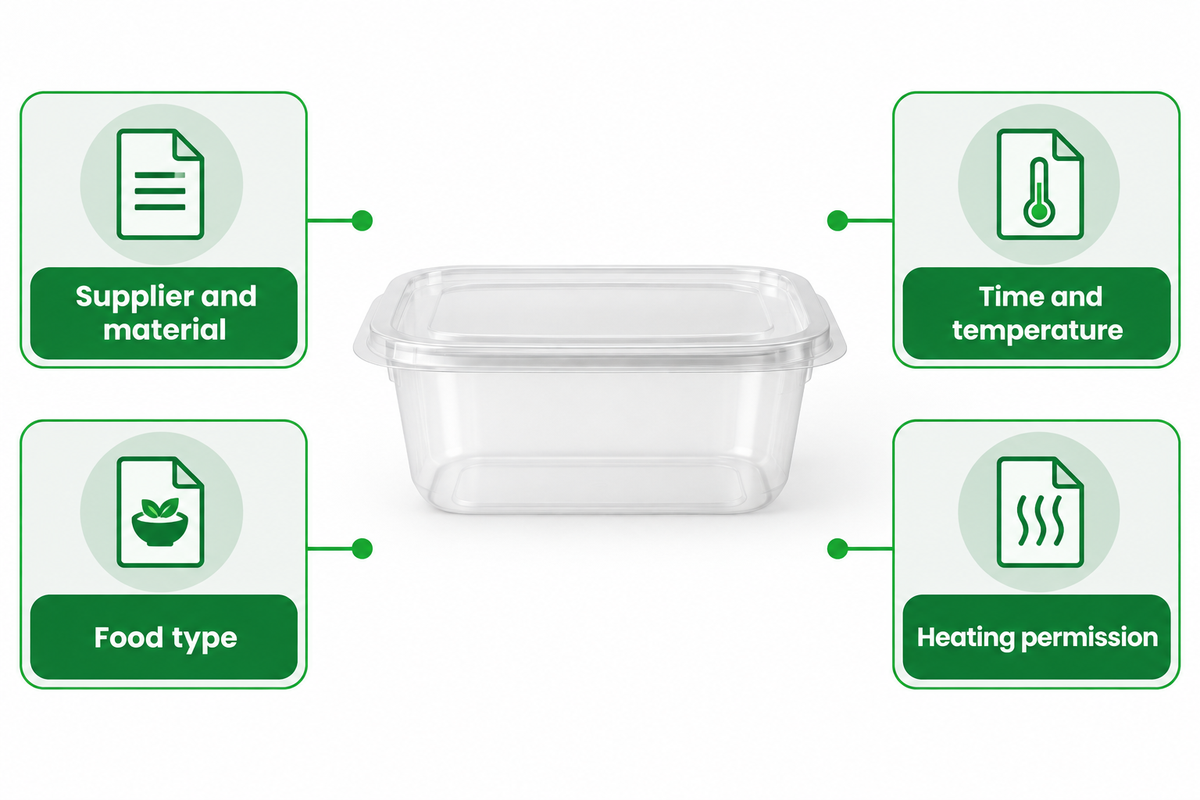
Food contact documentation should identify the supplier and the material of the pack and should state the food conditions, the food type, time and temperature of contact and any heating. The documentation should cover the base, closure and other components. General statements regarding polystyrene can’t replace a declaration regarding the purchased construction and its use.
In the US, 21 CFR § 177.1640 covers certain polystyrene and rubber modified polystyrene polymers. Paragraph (e) sets conditions for finished food contact articles. Paragraph (f) exempts polystyrene and rubber-modified polystyrene used in food-packaging adhesives complying with §175.105 from the provisions of this section. Keep the questions related to the authorization of containers and adhesives separate.
FDA’s regulatory-status explanation provides other routes for authorization. Where a supplier relies on a food contact notification, that notification applies only to the manufacturer, substance and conditions of use identified in that notification. Similar substances from other manufacturers do not automatically inherit that authorization.
Ask the supplier to identify the applicable basis and provide an intended-use declaration or letter of guaranty. Keep the product code and revision on the statement. For a change in the resin source, additive, lid or adhesive, request a review of the affected specification rather than carrying the old approval forward.
Regarding labels, food packaging label options should be selected based on the intended use and construction. Discuss the label placement. The process controls and label instructions applicable to the food producer should be reviewed in the food producer’s product review. A packaging materials quote shouldn’t take the place of a food producer product review.
Freezer labels on OPS: application and storage temperatures
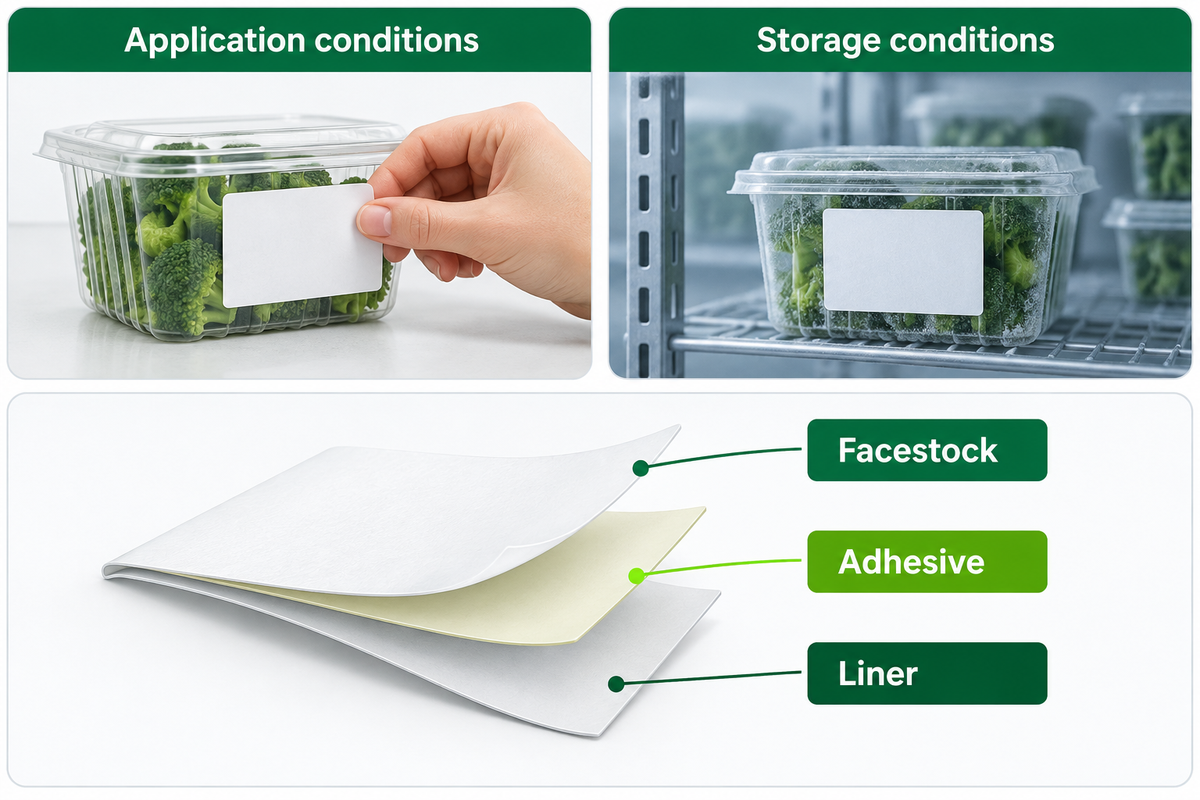
For labels, include the temperature at which the freezer label is applied and the subsequent temperature to which the label will be exposed. Application conditions govern the initial bond, and storage conditions describe the exposure after the label is applied. The system and conditions should be considered when selecting the label construction, to ensure the label stock recommendation is appropriate.
When a label is attached to a dry surface before freezing, that label faces a different application job from one attached to a cold, damp surface. If a line uses both, be explicit. Ask for the adhesive, facestock and liner combination by code, plus any required time before cold exposure.
ASTM D6252/D6252M-98(2025), section 5.2, permits representative substrate panels in place of standard stainless steel when assessing label stock adhesion. This allows testing the label in question against the relevant surface. When assessing the label, consider edge lift, print readability and abrasion after the intended cold exposure.
Illustrative label-line decision: A packing team approves a label on a clean, dry sample, then moves labeling downstream of a cold room. The container, now with visible condensation, is given to the applicator. The same label roll and OPS tray code are seen, but the application condition has changed. Before buying more stock, the line manager records surface condition and application temperature, while the label supplier reviews the proposed adhesive construction. The quality staff checks samples from the application point through later storage and handling. The decision could be to move labeling upstream or qualify a construction for a colder application. Ordering solely by the lowest advertised service temperature would leave that choice unanswered.
Discuss freezer label materials after you define those conditions. Synthetic-paper label stock and PET label film are facestock options to consider as part of a complete construction. PET label film isn’t a PET food container and the label selection doesn’t set the OPS base’s temperature rating.
OPS packaging cost: compare complete delivered packs
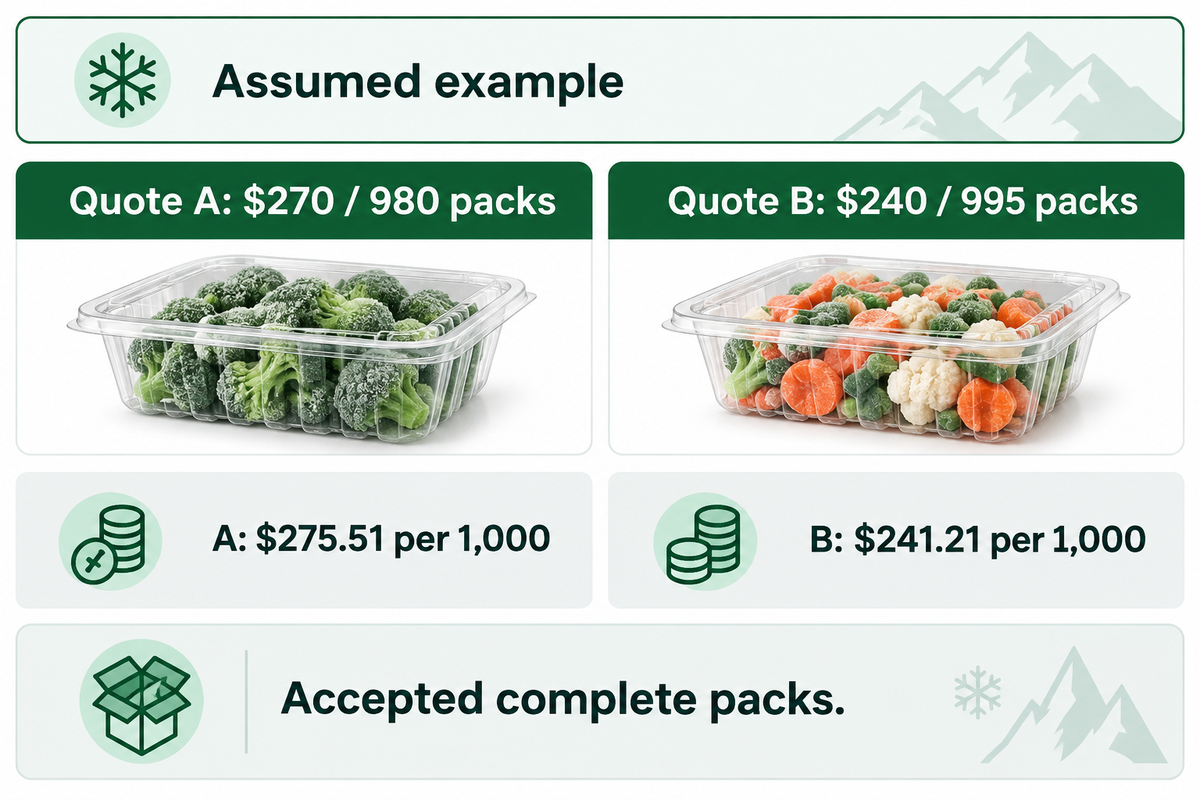
Compare freezer packaging cost per accepted complete pack, with base, closure, labels and freight counted consistently. Use the same capacity and performance brief for each quote. The cost of a separate lid or a higher total delivered cost, even before filling begins, can negate the advantage of a low base price.
Complete-Pack Cost Comparison
Kim and Shin’s 2017 packaging-system cost study available here illustrates packaging and logistics processes in an automotive supply chain. It will be useful for analyzing cost boundaries, not OPS price benchmarks, in this case. Use your own quotations and inspection records to calculate the following.
| Cost or count | Quote A | Quote B |
|---|---|---|
| Ordered quantity | 1,000 packs | 1,000 packs |
| Base purchase | $150 | $190, lid included |
| Separate lids | $60 | $0 additional |
| Labels | $20 | $20 |
| Freight | $40 | $30 |
| Total defined spend | $270 | $240 |
| Rejected before filling | 20 packs | 5 packs |
| Accepted complete packs | 980 packs | 995 packs |
| Cost per accepted pack | $0.276 | $0.241 |
| Cost per 1,000 accepted packs | $275.51 | $241.21 |
Formula: Cost per 1,000 accepted packs = total defined spend ÷ accepted complete packs × 1,000.
In this assumed purchase, procurement first sees a $150 base quote against a $190 alternative. Finance adds the omitted lid, labels and freight, bringing the totals to $270 and $240. Quality inspection accepts 980 packs from A and 995 from B. Dividing $270 by 980 and multiplying by 1,000 gives $275.51; the same calculation for B gives $241.21. B therefore costs $34.30 less per 1,000 accepted packs within this defined example. The comparison describes two hypothetical quotes, not a price advantage for OPS over PET or PP. Both candidates must satisfy the same packaging requirements before this arithmetic becomes a purchasing reason.
Purchased rejects are already included in the total defined spend and the smaller accepted denominator; don’t include their cost of purchase again. If comparing filled-product losses, labor, duties or disposal, add those actual costs on the same basis for both options and state the expanded boundary.
Supplier questions before a freezer packaging order
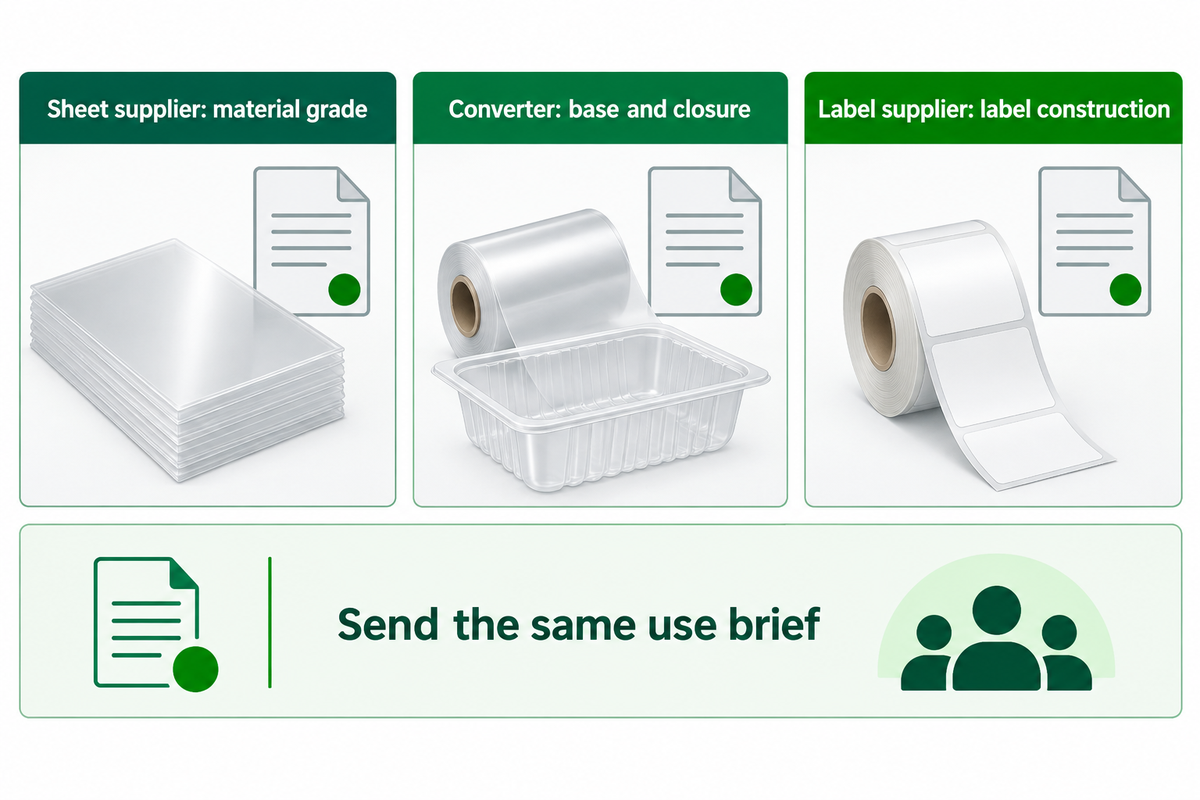
Each supplier should receive a use brief and a request for documents pertaining to the product codes offered. The sheet supplier should declare the material grade, the converter the finished base and closure, and the label supplier the label construction. Keep these requirements visible when comparing quotations and approving changes.
What brands of plastic containers are freezer safe?
For each specific product in a brand’s range that has been approved for freezer use, follow the defined use instructions. A brand name can cover multiple materials and formats. Commercial buyers should request the relevant model, closure combination and use case document for each supplier, instead of approving an entire brand for frozen food storage.
Copy this brief into an inquiry. Replace the example storage target with the actual process profile and add your conditioning and test-report requirements.
RFQ checklist — copy these into your quote request:
| Parameter | Recommended range | Why it matters | How to verify |
|---|---|---|---|
| Temperature profile | Buyer target, e.g. −18°C storage; include other stages | Defines exposure | Process record and matching supplier scope |
| Pack capacity | Required mL and filled mass in g | Aligns competing samples | Drawing and representative fill |
| Closure | Exact lid or film code | Defines the complete pack | Matched-pack trial |
| Food and use | Food type, contact duration and heating instructions | Sets food-contact scope | Intended-use declaration |
| Label conditions | Application and service temperatures in °C | Separates bonding from storage | Actual-surface label trial |
| Commercial basis | Price per 1,000 accepted complete packs | Makes quotes comparable | Itemized quote and acceptance record |
- Send the use brief with a container sample and its process profile.
- Review the offered codes against the same brief before scheduling the trial.
- Record the approval with acceptance criteria and supplier change-notification terms.
Frequently Asked Questions
Can you put containers in the freezer?
Choose the designated container and lid combination.
Use containers specifically intended for freezing and check that the lid belongs to the approved combination. A resin name or clear appearance is insufficient. For a filled commercial pack, match the stated temperature range to storage and handling, then evaluate cracking, closure integrity and moisture protection under the conditions the product will actually encounter.
What are the best ways to freeze food?
Match packaging and handling to the food.
Choose packaging that limits moisture loss, closes securely and withstands cold handling. Follow food-specific freezing guidance, leave expansion space where needed and keep sealing surfaces clean. For commercial OPS packs, translate those principles into the actual filling and distribution process; a household recommendation alone does not establish an industrial package specification or a product shelf life.
Can freezer grade OPS packaging be recycled?
Check acceptance in the destination collection system.
Acceptance depends on the local collection and sorting system, the package format and its other components. Do not infer recyclability from a resin identification code alone. Check the whole pack, including the lid, label and any sealing film, against the requirements of the destination market before making a disposal instruction or a recyclable claim.
Is freezer-grade OPS microwave-safe?
Confirm heating permission separately.
A freezer-use rating does not authorize microwave heating. Confirm heating permission for the exact container and lid separately. If the supplier gives no such instruction, transfer food to a suitable microwave-safe vessel instead of inferring heat resistance from cold performance.
What should I send with a freezer label sample request?
Provide the actual surface and application conditions.
Send the actual container material and surface finish, label dimensions, print method, application temperature and lowest service temperature. Describe whether labels are applied before freezing or onto a cold surface, and include condensation, abrasion and thawing exposure. Supply a filled or representative container for the trial where practical. Ask the label supplier to identify the proposed facestock, adhesive and liner and to state the conditions covered by its recommendation. This request concerns the label system; the container supplier still needs to establish that the OPS base and lid suit the intended frozen-food application.
Is OPS shrink film the same as an OPS food container?
Separate the sleeve from the food-holding pack.
They share a polymer family but perform different jobs. A shrink sleeve decorates or identifies another container; a thermoformed OPS tray or clamshell contains the product. Neither the sleeve specification nor its shrink behavior establishes the finished food container’s freezer suitability.
Key takeaway
Approve freezer packaging where material identity, actual exposure and finished-pack results match. Then compare complete accepted packs and qualify the label on the chosen container.
Prepare your freezer label brief
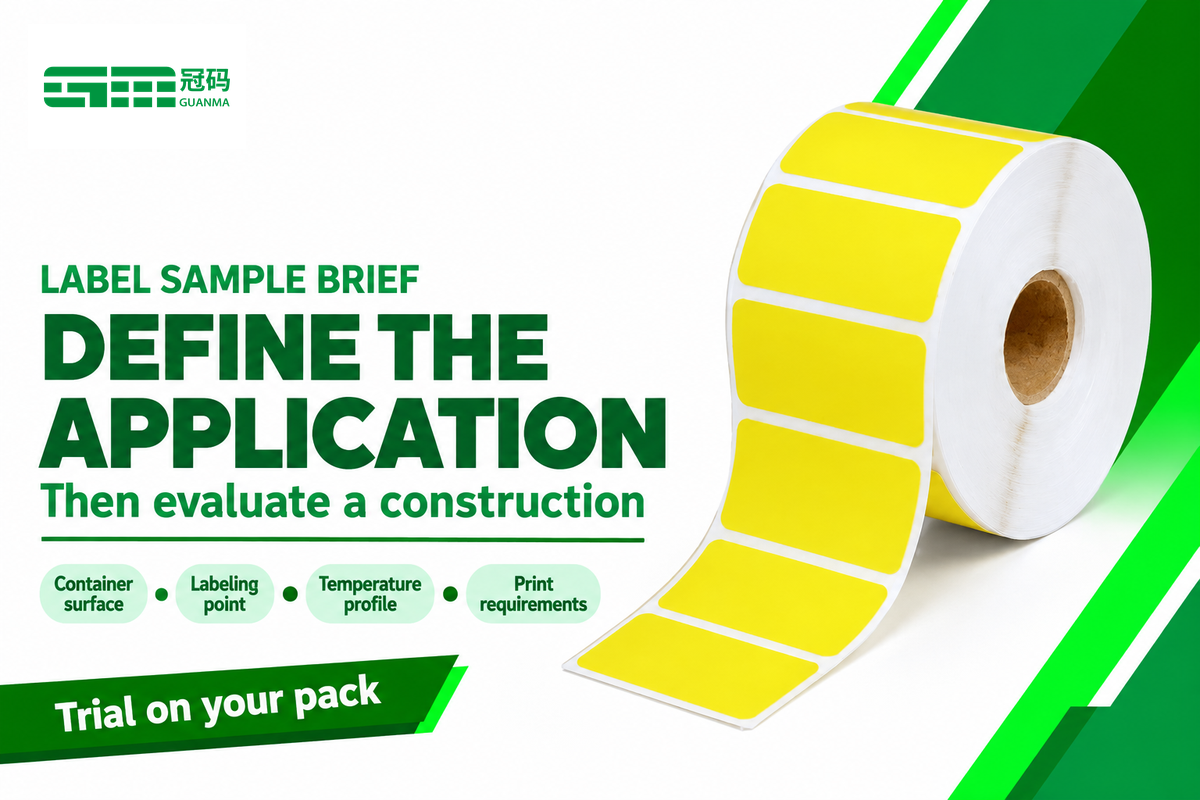
Share the container surface, labeling point, temperature profile and print requirements with the Guanma label-material team. Ask for a proposed label construction to evaluate on your pack.
About this guide: Public supplier documents, university guidance, official regulations, and standards have been the basis of this guide. Costs and examples shown here are illustrative and not based on Guanma factory trials. Guanma’s role here’s to help define label-material selection. Approval of containers remains specific to the supplier’s offered pack and the buyer’s process.
References & Sources
- NDSU Extension: Food Freezing Basics general freezing guidance.
- University of Georgia: Containers for Freezing packaging qualities.
- ASTM D4332-22 public conditioning scope and significance.
- ASTM D6252/D6252M-98(2025) public label-peel scope and significance.
- FDA: Chemistry Recommendations for Food Contact Submissions intended-use conditions.
- FDA: Regulatory Status of Food Contact Material Components authorization routes and manufacturer scope.
- 21 CFR §177.1640 polystyrene provisions.
- US5643664A historical modified-polystyrene disclosure.
- Kim and Shin, 2017: Total Packaging System Cost Analysis abstract and bibliographic record.