Get in Touch with Guanma

Updated October 2026
Labels for oily surfaces need an adhesive that can adhere to the container wall through a thin film of oil or grease and a facestock that holds its print when oil approaches the edge. A label that passes on a clean steel panel can still slide on a lotion bottle straight off the filler, so the only proof that counts is a side-by-side test on your as-filled containers.
Quick Specs
| Problem | A thin oil film on the outside of a filled container keeps the adhesive from touching the plastic, glass or metal |
| Hardest substrates | Polypropylene (30.1 mN/m) and polyethylene (34.2 mN/m), against 43.7 mN/m for PET |
| Peel methods | FINAT FTM 1 (180°, 300 mm/min), FTM 2 (90°, 300 mm/min), ASTM D3330/D3330M-04(2025) |
| Hold check without a tester | Library of Congress method: 1 in² of label on a standard plastic or metal test panel, 7-day cure at 23 °C and 50% RH, then a 200 g load for 10 minutes with no more than 10 mm of peel |
| Decision metric | Pass or fail on as-filled containers, plus the Oily-to-Clean Peel Retention Ratio for each label |
Labels for oily surfaces work when the adhesive grips through the residual oil and the film resists it. Test each candidate on as-filled and wiped containers after the same dwell. Order the one that passes as filled: no slide, no edge lift and no more than 10 mm peel in the 200 g hold test.
Key points
- A higher dyne reading is not a pass mark: ASTM D2578 says wetting tension alone does not fully measure adhesive adhesion.
- Guanma describes rubber-based hot-melt adhesive as providing high initial tack, while Labels & Labeling warns that migrating plasticizers can degrade hot-melt adhesive and may cause bond failure.
- Peel the same label from an as-filled container and from a wiped one. The difference between the two peel readings is the effect of the oil.
- The Library of Congress hold test (1 in² of label, 7-day cure at 23 °C and 50% RH, 200 g for 10 minutes, no more than 10 mm of peel) screens candidates without a peel tester.
Why Labels Lose Grip on Oily Surfaces
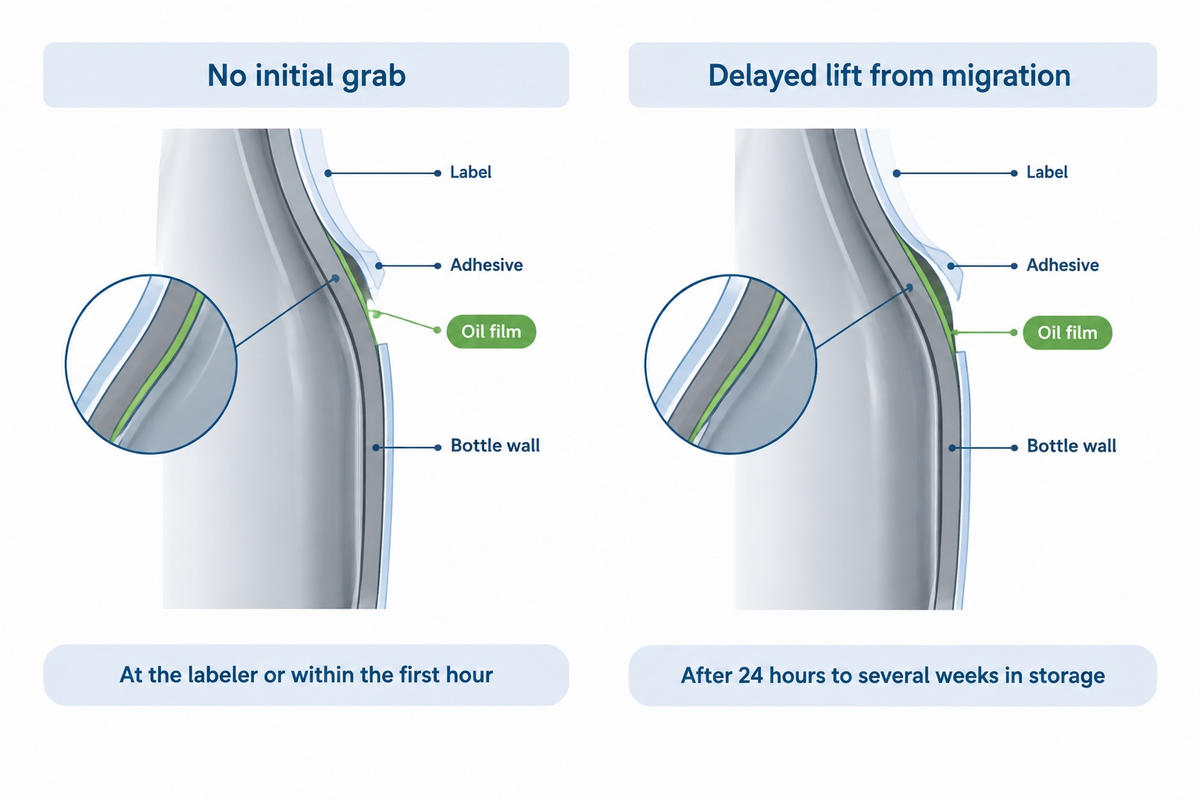
An oil film prevents the adhesive from contacting the container, so the label bonds to a liquid with almost no strength of its own. The failure shows up in two ways: no initial grab when the label is applied, or edge lift days later as oil migrates into the adhesive and softens it.
Think of pressing tape onto a buttered plate. The tape rests on the butter, and the butter shears the moment the tape is removed. A pressure-sensitive adhesive works the same way at a smaller scale: under light pressure, the soft adhesive flows into the surface and holds by short-range contact with the solid. The 2023 PSTC Technical Paper calculates that surface energy alone would give about 0.0018 N per inch of peel, while measured acrylic labels peel at several newtons. The paper attributes the gap mainly to rheological effects: the adhesive flexes and stretches as it is pulled, and that only happens if the adhesive has a solid surface to hold first. Oil removes the solid surface. A dusty or dirty panel and an oily one both form weak boundary layers: loose particles can detach from the container wall, while a thin oil film has to be displaced or absorbed before the adhesive reaches the wall.
The substrate matters as much as the oil. The same PSTC paper lists surface energies of 34.2 mN/m for polyethylene, 30.1 mN/m for polypropylene and 43.7 mN/m for PET, and considers polyolefins the most extreme practical case for acrylic adhesives. Hence, an HDPE lotion bottle with a thin oil film is a more difficult case than a PET cooking oil bottle with the same film.
The second failure mode is supported by lab data. In a 2024 study published in Langmuir (Jha, Gryska, Barrios and Frechette), a soft acrylic adhesive kept up to 60% of its adhesion on silicone rubber swollen with 23% oil by weight, while glass in contact with the same surface lost nearly all of its adhesion, and the adhesive’s bond fell further as the rubber approached full oil saturation. The study used oil inside the substrate rather than a film on a bottle, did not test hot-melt adhesives, and one of its four authors works at 3M, which also helped fund the work. It shows a trend that a label trial has to catch: a soft adhesive can retain some adhesion through oil, and the margin further reduces as more oil is present.
| Failure mode | When it shows | What catches it |
|---|---|---|
| No initial grab | At the labeler or within the first hour | Loop tack (FTM 9) and a slide check at the labeler |
| Delayed lift from migration | After 24 hours to several weeks in storage | 200 g hold after a 7-day dwell, and peel after warm storage on the same label, as-filled against wiped |
Checking the Container Surface Before Labeling
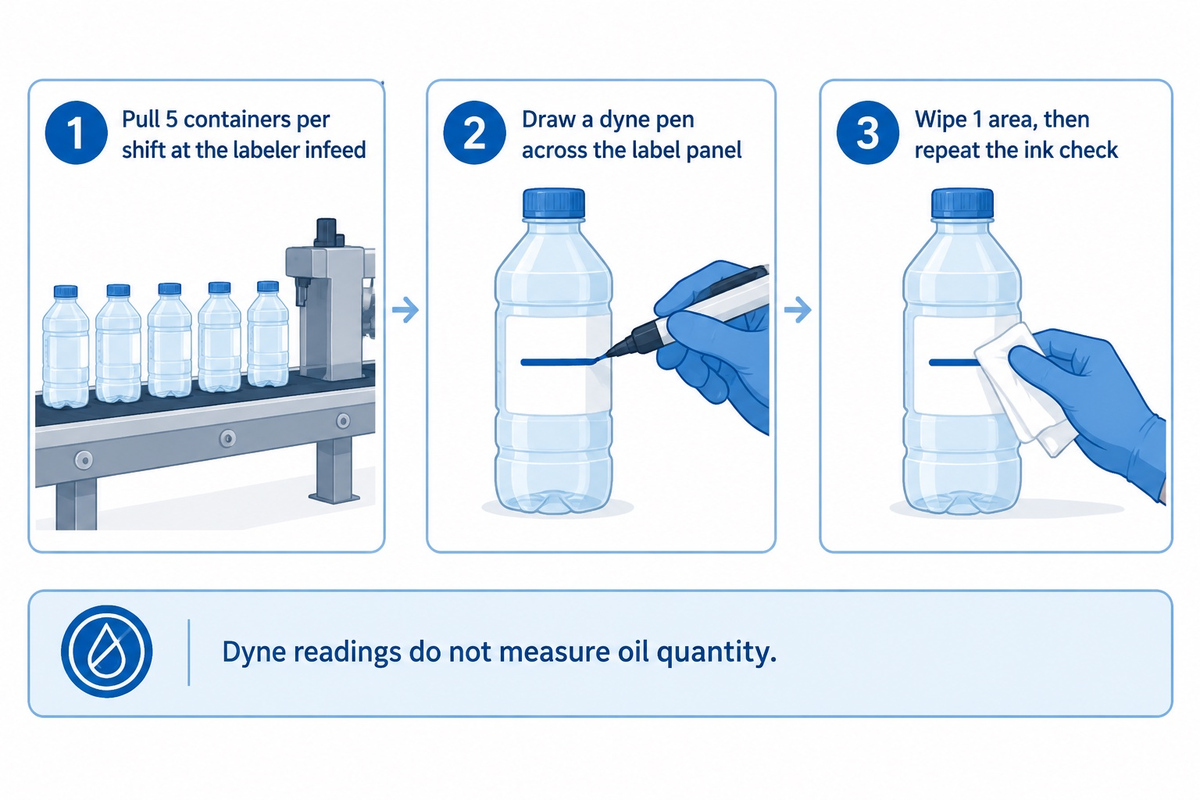
Surface checks show whether the label panel wets well and whether a wipe changes it, which tells you the oil is there before the trial starts. Test inks and dyne pens give a reading in dynes/cm, and a wipe test shows residue on the cloth. Use both on samples taken from the line just prior to the labeler.
The ink method for polyethylene and polypropylene films comes from ASTM D2578-23. Its Note 3 cites 35 dynes/cm or higher as the treatment level generally accepted for Type 1 polyethylene tubular film going to flexographic printing. This is a printing benchmark for polyethylene film, and the standard sets no reference level for polypropylene, so take it as a preliminary reference value for polyethylene molded bottles, not as a pass level. The same standard says wetting tension in itself is not a completely acceptable measure of ink, coating or adhesive adhesion. Neither reading, in itself, indicates the amount of oil that is present on the surface.
- Pull 5 containers per shift at the labeler infeed, same time after filling as production labels see.
- Draw a dyne pen or test ink across the label panel and note the highest level that wets without beading.
- Wipe 1 area with a lint-free cloth, check the cloth for oil, then repeat the ink check on the wiped area.
A change between the as-filled and wiped readings indicates a change in surface condition; oil, other residues and additives migrating from the resin can all contribute. Production managers often object that the line can’t stop for measurements; 5 containers per shift at the infeed takes under 10 minutes and gives the trial its two surface conditions.
Adhesive Options: High-Tack Rubber Hot-Melt vs Modified Acrylic
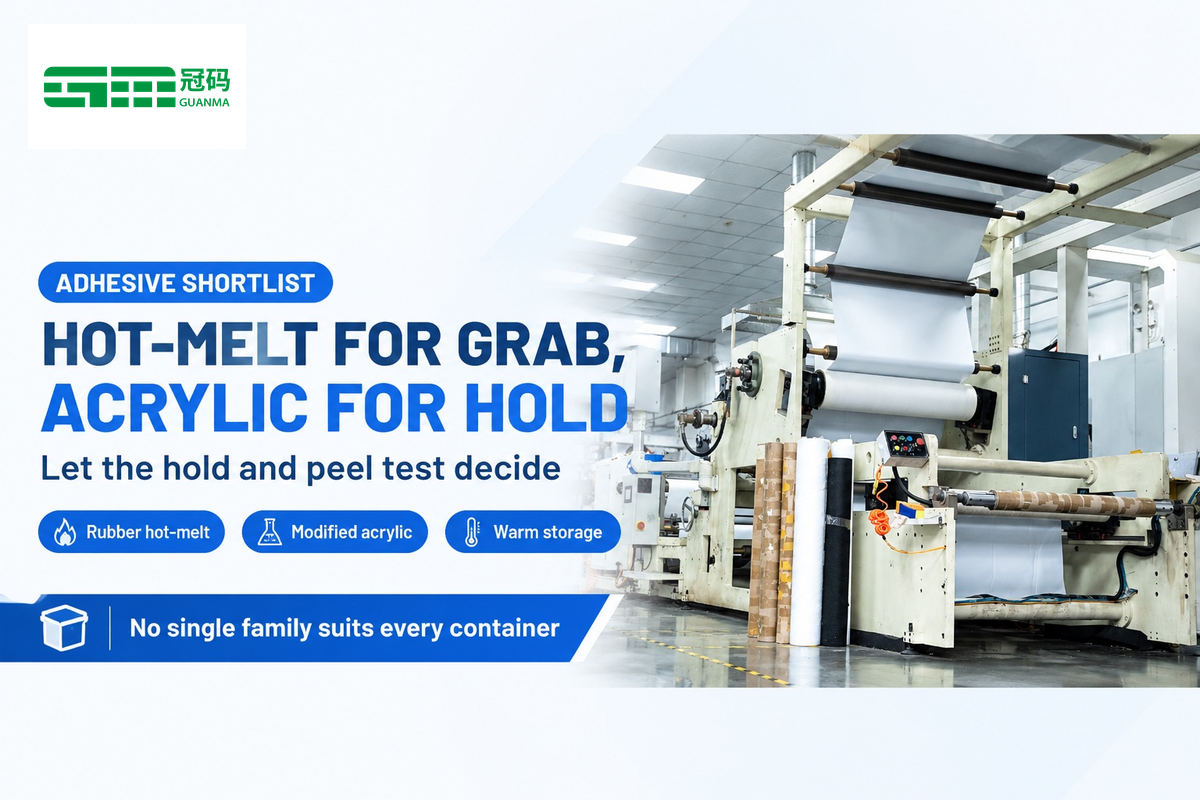
There’s a warning from the Label Academy that plasticizers migrating into a hot-melt adhesive can degrade the adhesive. Shortlist a water-based acrylic and a rubber-based hot-melt adhesive, and let the hold and peel after warm storage on your own oil decide.
Hot-melt is chosen for the instant, short-term grab and acrylic for the long-term hold, therefore no single family is ideal for every container. The hot-melt case is about speed. Guanma’s adhesive-coated label films use a rubber-based hot-melt with high initial tack for packaging and difficult surfaces, and water-based acrylic for aging, clarity and moisture resistance. Trade guidance also notes that higher hot-melt coat weights improve adhesion to rough surfaces; typical coat weights for rubber-based and aqueous adhesives are in the range of 5-50 gsm. For hot filled oil cans, Henkel says its Technomelt PS 8707 hot-melt can expand with the container and shrink again on cooling.
The acrylic case is about time. The Labels & Labeling Label Academy states that hot-melt self-adhesives are usually unsuitable for plasticized surfaces because the plasticizer migrates into the adhesive and degrades it, causing stringing which may result in bond failure. Oil migrating from a lotion or cooking-oil film can act on a rubber adhesive in a similar way, which is why the trial includes warm storage. A product manager at FLEXcon described the situation this way in Label & Narrow Web: oily surfaces require specific adhesives that can absorb the oil and still create a good bond, and low surface energy plastics need high-performance grades to bond strongly. Adhesive and labelstock makers name specific families for this: 3M states that oil-contaminated materials may be addressed with its 300LSE and 350 adhesive families, and Lintec says its oil-tolerant labelstocks adhere to oily steel sheet without prior cleaning. Our hot-melt vs water-based acrylic adhesive comparison touches on this general trade-off.
| Container and oil condition | First candidate | Second candidate | Early screen (final call: hold and peel after warm storage) |
|---|---|---|---|
| HDPE lotion bottle, light film, labeled at fill | High-tack rubber hot-melt | Modified acrylic | Hold and peel after 28 days of warm storage |
| PP tub, edible oil smear on the side wall | High-tack rubber hot-melt | Solvent acrylic | Edge lift at 24 hours |
| PET cooking-oil bottle, drips after filling | Modified acrylic | High-tack rubber hot-melt | Hold and peel after 28 days of warm storage |
| Glass essential oil bottle, residue near the neck | Modified acrylic | Solvent acrylic | Print smear and edge lift at 7 days |
| Metal lubricant can, hot-filled | Hot-melt grade rated for hot fill | Solvent acrylic | Wrinkling after cool-down |
| Squeezable PE tube with lotion | Modified acrylic on conformable film | High-tack rubber hot-melt | Edge lift after 50 squeezes |
| Plasticized PVC or soft-touch coating | Solvent acrylic | Modified acrylic | Hold and peel after 28 days of warm storage |
| Chilled container with oil and condensation | All-temperature hot-melt | Modified acrylic | Grab at the cold application temperature |
| Industrial drum or machined part, mineral oil | Oil-tolerant grade named for oily steel | High-tack rubber hot-melt | 200 g hold after a 7-day dwell, 10 mm limit |
Buyers sometimes accept the supplier’s word “permanent” as proof. A permanent adhesive is intended to stay bonded during use, but even a strong permanent adhesive can slide on an oily tub, so ask for the oily-surface rating and test it. Removable labels sit at the other end of that scale: their softer, low-tack grades are rarely suitable for oily containers.
Facestock and Construction Choices for Oily Packaging
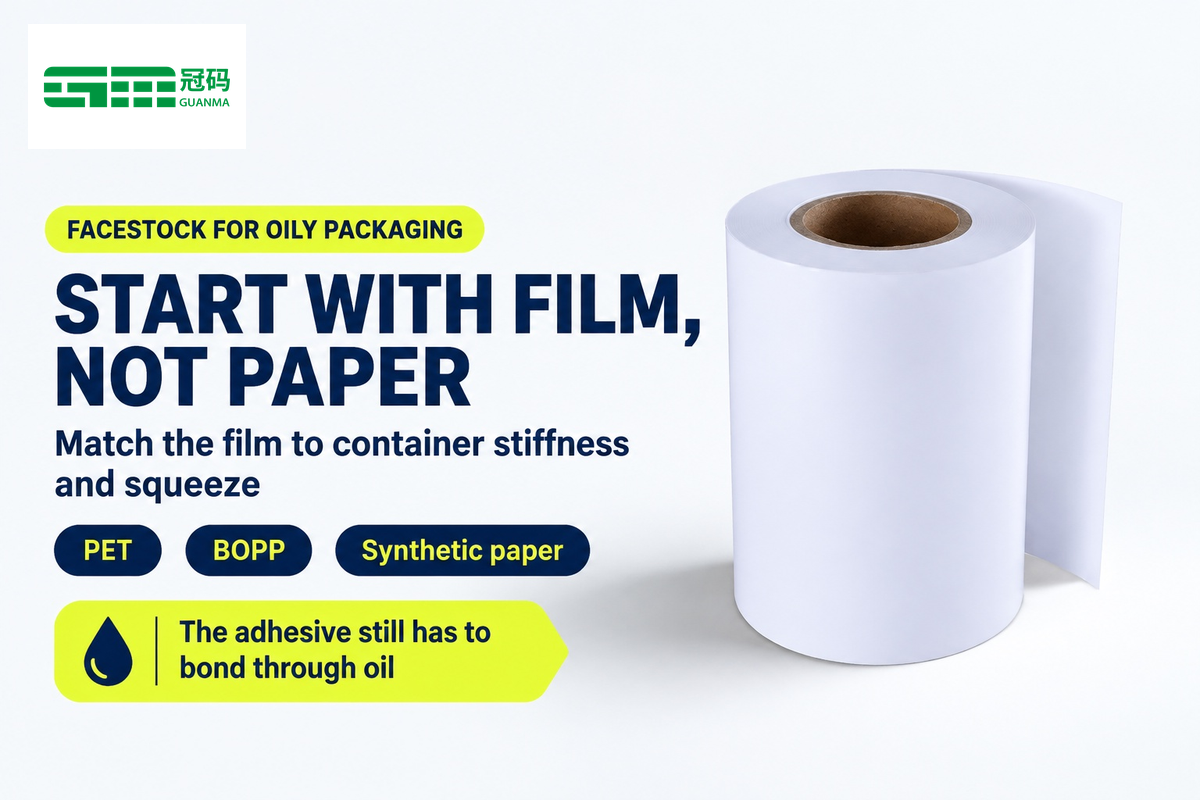
Because unprotected paper absorbs oil at exposed edges and stains, film facestock is the practical starting point for oily packaging. Pick the film type based on container stiffness and squeeze: clear or white BOPP for rigid bottles and tubs, a softer conformable film for squeeze tubes, and PET where print has to resist solvent and abrasion.
Guanma lists three film families for self-adhesive labels: PET, BOPP with clear face films published at roughly 23–38 µm, and BOPP synthetic paper at 54, 75 and 100 µm (see our BOPP label film range). Avery, for example, sells its bath and body labels as waterproof and resistant to oils. A waterproof face resists water and an oil-resistant face resists oil reaching it after application; the adhesive under either face still has to bond through oil already on the bottle, so a durable polyester sticker can slide off a greasy tub. Vinyl conforms well but carries plasticizer, so the same plasticizer-migration risk is worth testing for. Container size changes the gauge too: the Label Academy guide to PSA label materials puts PE labels for ampoules at 30–50 microns and PE labels for large lubricant containers at up to 110 microns.
Construction details change the result as much as the film, and each component can be modified independently. A gloss or matte topcoat keeps thermal transfer or laser print from smearing when oil reaches the face; the topcoat has to be compatible with the printer’s ribbon or toner. Coat weight determines how much adhesive is available to absorb oil, and the liner determines how cleanly the label dispenses. Essential oil labels on small glass bottles add a tight radius, so a thin face with some flexibility holds the edge better than a stiff one. PET provides a durable facestock, while a compatible printing system with protective finish helps the printed label withstand solvent wipes and abrasion. For squeeze tubes, see our guides on squeezable bottle label materials and food packaging label substrate selection for food contact constraints.
Can I Order Labels for Low Surface Energy (LSE) Materials?
Yes. Label stock for low surface energy plastics is ordered as a film facestock with a high-tack adhesive grade rated for polyolefins, and PSTC figures put polypropylene at 30.1 mN/m and polyethylene at 34.2 mN/m. Ask for that grade by substrate name, and test it on the oily container rather than on a clean panel.
The adhesive is what changes for HDPE and PP. The facestock can stay the same BOPP or PE film that you already print. Send your supplier the resin type, whether the bottle is flame or corona treated, and the dyne reading from the surface check, so the first sample set already matches the substrate.
Clean the Container or Change the Adhesive?
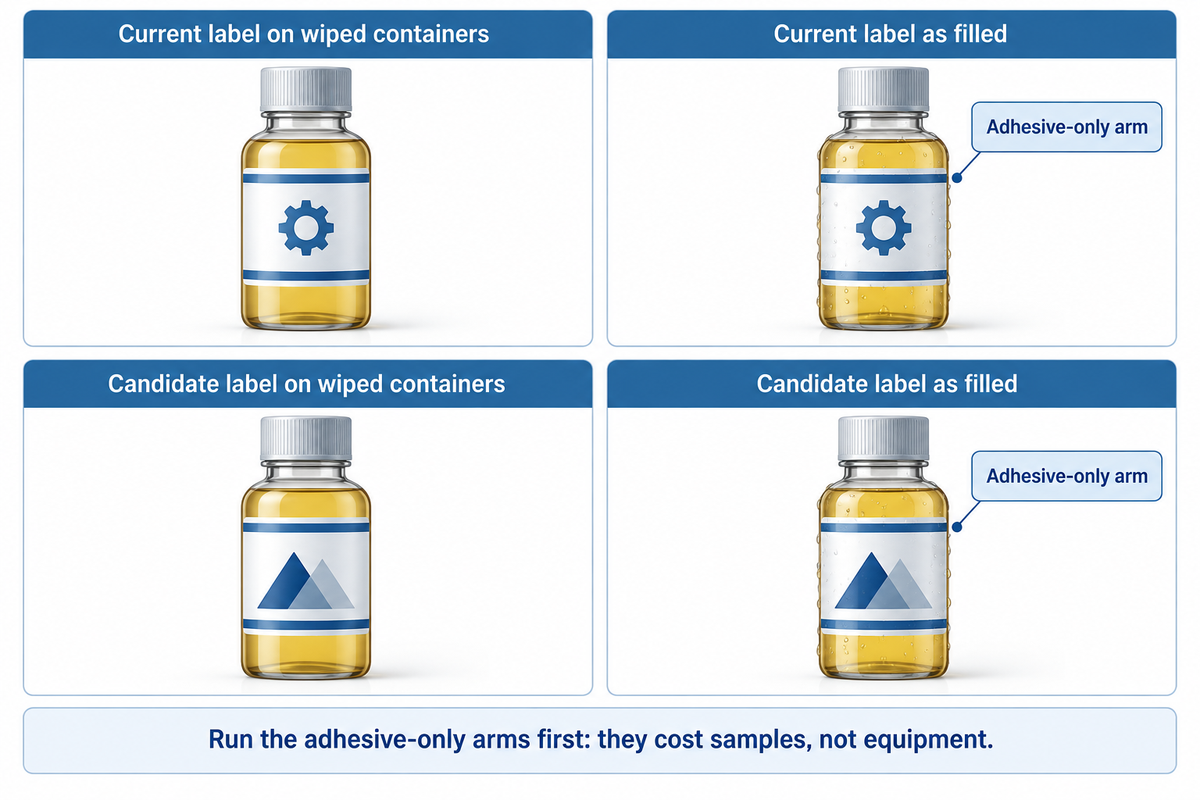
Cleaning first gives the most reliable bond; an adhesive made for contaminated surfaces is the choice when residual oil remains at application, and oil that keeps reaching the label afterward also calls for a grade that resists oil ingress. Many lines end up doing both: a light wipe or air knife plus an adhesive made for residual oil.
Run the trial below with four arms: current label on wiped containers, current label as filled, candidate label on wiped containers, candidate label as filled. If the candidate passes on as-filled containers (no slide, no edge lift at 24 hours or after storage, and no more than 10 mm peel in the 200 g test), the result supports running that candidate without the cleaning station under the oil level, application and storage conditions that you tested. If your current label passes on wiped containers, adding the wipe allows you to keep that stock; if only the candidate passes after wiping, you need both the wipe and the new stock. Adding a cleaning station requires floor space and capital approval, so run the adhesive-only arms first; they cost samples, not equipment.
For the wipe, a lint-free cloth with an isopropyl alcohol solution removes a light film, provided the panel dries before you apply the label. When no pressure-sensitive construction passes on a heavily oiled container, the remaining options are shrink sleeves, wet-glue labels, printing directly on the container, or, for drums carrying identification and content labels, a tag tied to the handle. Shrink sleeves and tags eliminate an adhesive bond to the oily wall altogether; wet-glue labels and direct print still require a surface the glue or ink can wet. The Label Academy notes that glass containers for foods, drinks and dairy products have historically been labeled with wet-glue labels or printed directly.
A Pre-Order Adhesion Trial for Oily Containers
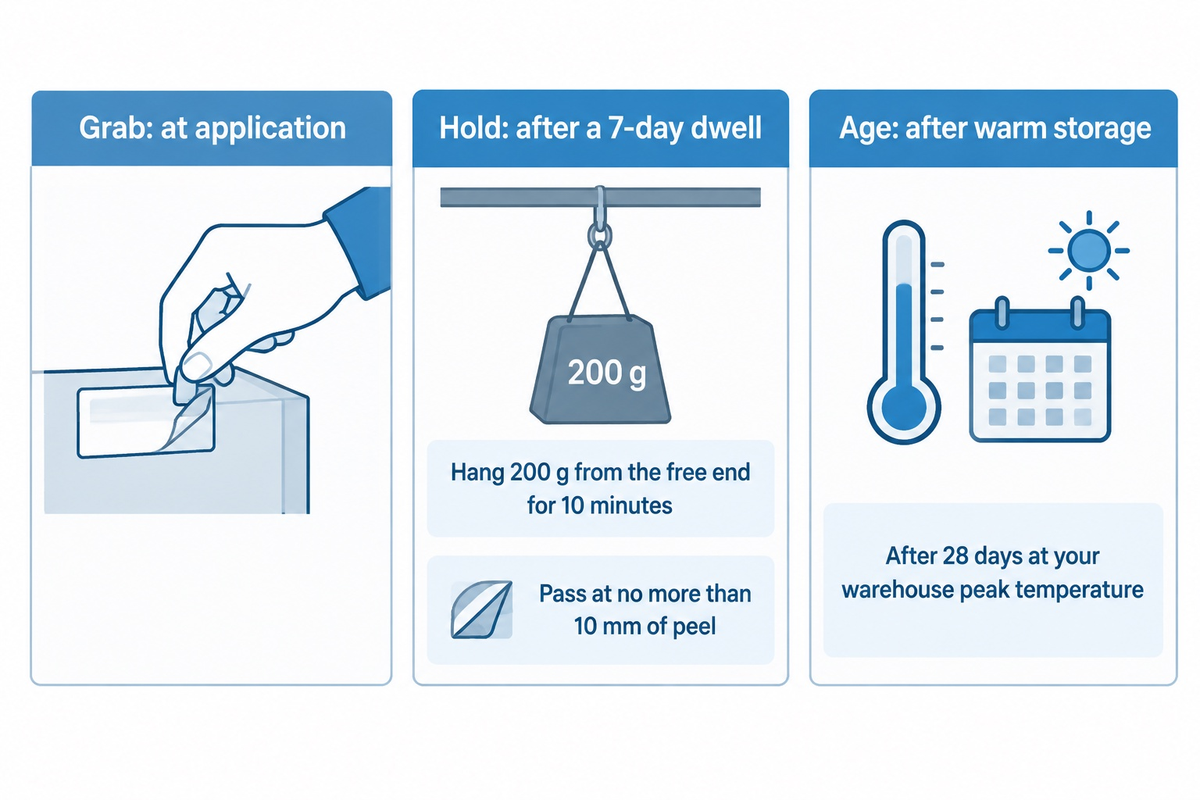
A pre-order trial puts each candidate label on as-filled and wiped containers from your own line, and reads them after the same dwell and storage. It ends with a pass or fail per candidate on the as-filled containers, as well as one number per label: how much of its own clean-surface peel survives the oil.
“Substitution of representative samples of materials in question for the standard steel panel would suffice to do this.”
ASTM D3330/D3330M-04(2025) Method A measures adherence peeled at 180° from a standard steel panel or other surface of interest, and its significance section says substituting a different material shows relative bond strength. Backing stiffness and adhesive firmness change the area under stress, so compare two labels by pass or fail on your containers rather than by their peel numbers. The FINAT test methods used across the label industry describe the same reading as FTM 1, peel at 180° at 300 mm/min, with FTM 2 at 90°. Our label durability testing standards guide lists other methods.
Grab-Hold-Age Reading Set
The Grab-Hold-Age Reading Set is three readings per label and surface: grab at application, hold after a 7-day dwell, and hold plus peel after warm storage.
| Reading | When | How |
|---|---|---|
| Grab | At application, same temperature as the line | Loop tack (FTM 9) on panels cut from the container; note any label that slides at the brush |
| Hold | Edges at 24 hours; hold test after 7 days at 23 °C and 50% RH | Hang 200 g from the free end for 10 minutes; pass at no more than 10 mm of peel; peel 3 labels per arm at 180° |
| Age | After 28 days at your warehouse peak temperature | Repeat the hold test and the 3 peels; note adhesive stringing or residue |
The 200 g screen comes from the Library of Congress specification for pressure-sensitive labels on plastic and metal, which cures three labels for 7 days at 23 °C and 50% RH on standard plastic and metal test panels, hangs a 200 gram weight from each for 10 minutes, and disqualifies the stock if a label peels more than 10 millimeters; an aged version repeats the test after 28 days at 80 °C and 50% RH plus 24 hours back at 23 °C. The method masks each label so only 1 in² touches the panel; keep that contact area when you copy the test. Our trial borrows the 200 g load, the 10 mm limit and the 28-day length, but stores at your warehouse peak instead of 80 °C, because that’s the temperature your oil and labels will actually see. It needs a clip and a weight, not a tensile tester, so teams without a peel tester can still screen candidates before sending survivors to the converter’s lab.
Oily-to-Clean Peel Retention Ratio
The Oily-to-Clean Peel Retention Ratio is defined as the as-filled peel divided by the wiped peel for the same label, dwell and storage, times 100.
Example. Assumed inputs: label A averages 12.0 N/25 mm on wiped HDPE bottles and 8.4 N/25 mm on as-filled bottles after 28 days of warm storage, from 3 peels each; label B averages 9.0 and 4.5 N/25 mm. On these inputs label A keeps 8.4 ÷ 12.0 × 100 = 70% of its own clean-surface peel and label B keeps 4.5 ÷ 9.0 × 100 = 50%. Record the absolute means and the spread of the 3 peels beside each ratio. Order label A only if it also passes as filled: no slide at the brush, no edge lift at 24 hours or after storage, and no more than 10 mm of peel in the 200 g hold.
What Samples Should You Request Before Ordering?
Request two or three candidate constructions, each printed as labels in your real size and finish, with the face, adhesive, and liner grades named on the roll. With 3 labels per test, as in the Library of Congress method, each construction needs 30 labels across its wiped and as-filled arms, so about 50 per construction covers applicator setup.
Keep one roll of each candidate as a retained sample with its lot number, so a production problem can be compared against the material you qualified. Example: a lotion line testing a rubber hot-melt and a modified acrylic on white BOPP labels two pallets of bottles, half wiped with a lint-free cloth and half as filled, and stores labeled bottles at its warehouse’s peak temperature for 28 days, the length of the Library of Congress aged test, before the final hold test and peels.
Failure Symptoms After the Trial
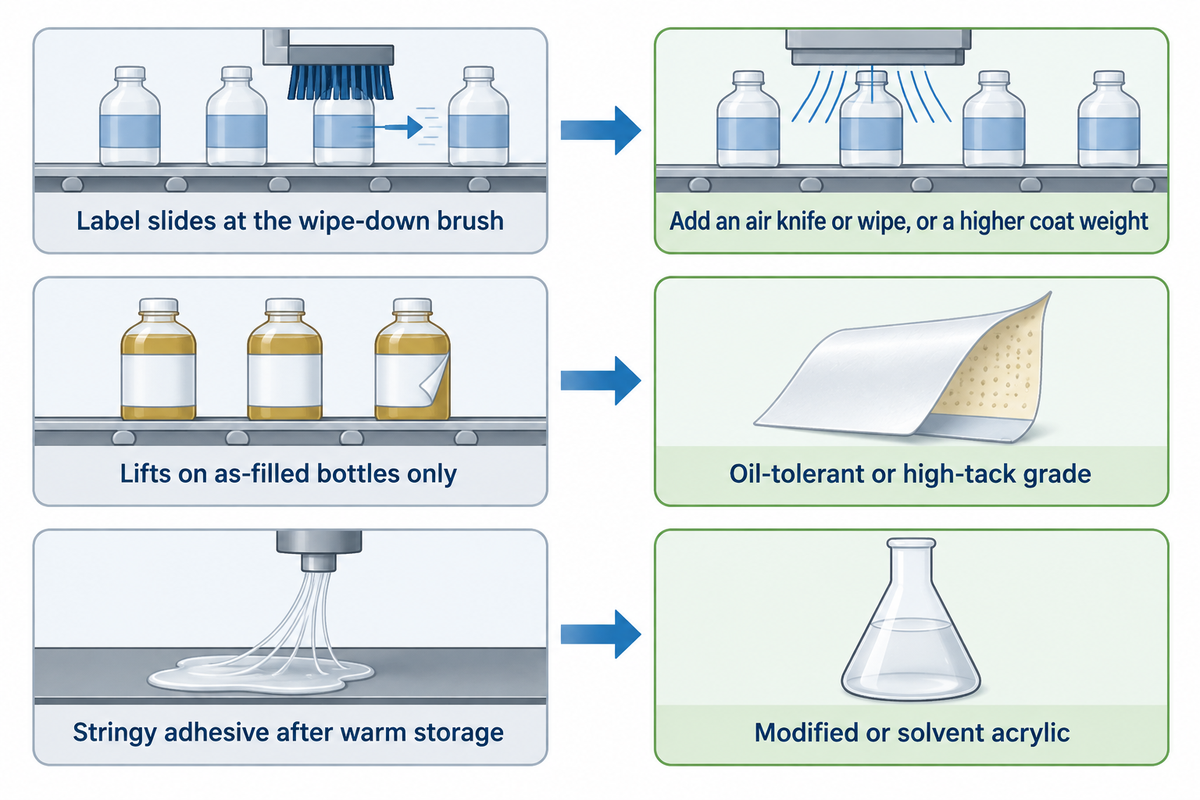
Each failed arm narrows the causes to check. Sliding at the labeler usually comes from oil on the panel, low application pressure or low initial tack; edge lift starts where local adhesion cannot resist the label’s stiffness; soft, stringy adhesive after warm storage points to oil migration or heat.
Flagging that appears only in the warm storage environment can also come from container deformation, so change one variable per rerun to confirm the cause.
| Symptom | Likely cause | Change next |
|---|---|---|
| Label slides at the wipe-down brush | Oil film thicker than the adhesive can absorb | Add an air knife or wipe, or a higher coat weight |
| Lifts on as-filled bottles only | Adhesive not rated for residual oil | Oil-tolerant or high-tack grade |
| Lifts on wiped and as-filled bottles | Substrate below the adhesive’s range, often PP or PE | Low-surface-energy grade, or check bottle treatment |
| Edge lift on curved shoulder | Film too stiff for the radius | Thinner or conformable film |
| Weak grab on chilled containers | Applied below the adhesive’s minimum application temperature | All-temperature grade or warmer application point |
| Stringy adhesive after warm storage | Oil or plasticizer migrated into a rubber adhesive | Modified or solvent acrylic |
| Wrinkles after a hot-filled container cools | Container shrinkage leaves slack; face conformability and adhesive movement decide whether it wrinkles | Construction suited to the hot-fill cycle, or label after cool-down |
| Print smears where oil reaches the face | Untopcoated face or ribbon not matched | Topcoated film or resin ribbon |
| Residue or tear when removed for rework | Residue: adhesive splitting or losing anchorage to the face; tear: bond stronger than the facestock | Higher-cohesion grade for splitting, better anchorage for face separation, stronger face for tearing |
Labels that flag on curved bottles have their own reasons, which are discussed in our guide to diagnosing label flagging, and the label failure mode matcher walks through the rest of the patterns. When the supplier points at the line, this table separates application causes, like pressure and temperature, from construction causes.
Cost, Samples and Minimum Orders for Oil-Tolerant Label Stock
For the film-faced constructions discussed in this guide, the film and specialty adhesive increase costs relative to standard paper labels, and coating weight and order size also shift the costs. Compare cost per accepted label on the line rather than cost per square metre, as one rejected batch wipes out the saving.
Custom labels for oily products are priced according to size and material, and thinner isn’t necessarily cheaper: the same Label Academy guide explains that a thinner film may require higher tensile strength and stiffness, which can raise the material cost. The thinner-film point comes from the Label Academy guide to PSA label materials. A brand owner who buys finished customizable labels from a printer should ask which label stock manufacturer and adhesive grade the quote is for, because two quotes for the same face film can carry different adhesives.
Guanma provides a free swatch pack of PET, BOPP and synthetic paper before a construction is chosen and quotes minimum order quantity per order. The trial can start with the same films you would order. Budget approval is often based on today’s paper label price; include the trial’s reject rate in the comparison to show the true cost, including rework, relabeling and returned shipping cartons.
Supplier Inquiry Checklist for Oily-Surface Labels
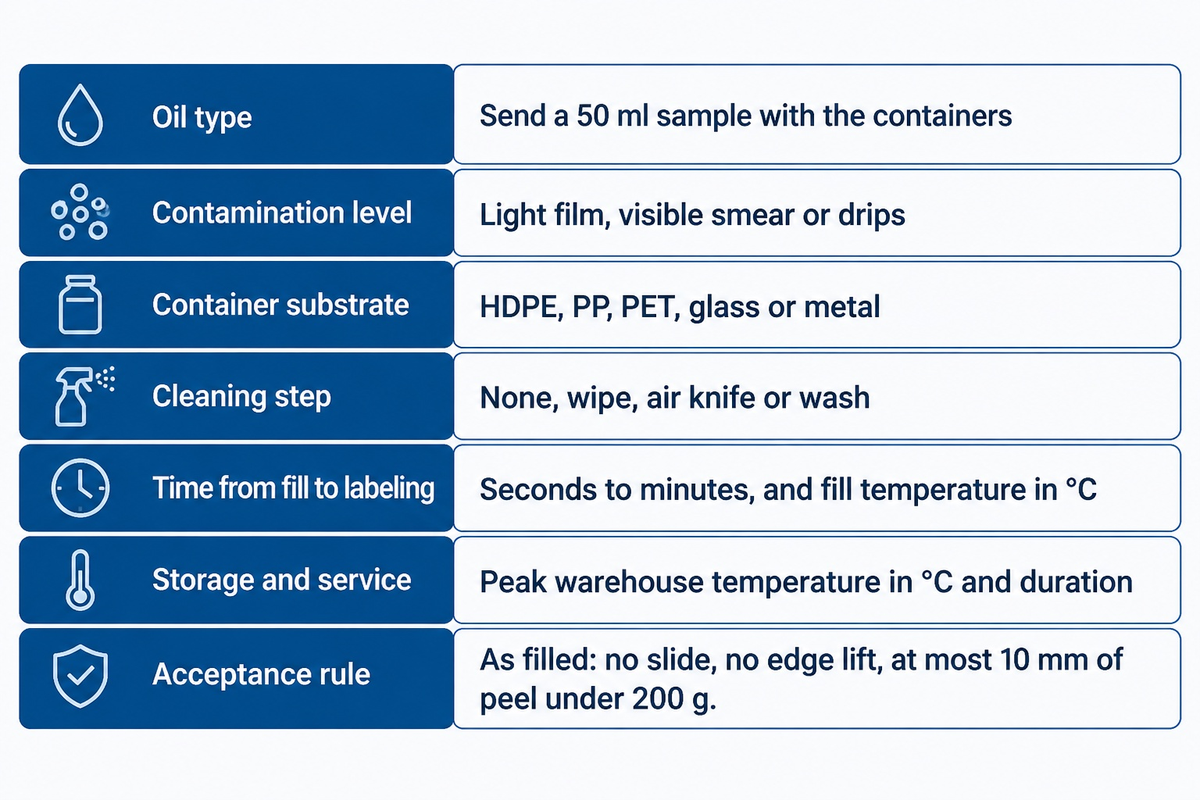
A supplier can only recommend a construction that fits your line if the inquiry specifies the oil, the container and the timing. Send the fields below with your substrate sample and your current material specification, and request that each supplier report trial results in the same format, so their claims regarding oil tolerance can be compared. Packaged labelling solutions often state key features such as “oil resistant” without naming the adhesive grade; these fields make that grade part of the answer.
RFQ checklist for labels for oily surfaces — copy these into your quote request:
| Parameter | Recommended range | Why it matters | How to verify |
|---|---|---|---|
| Oil type | Name it: mineral, vegetable, silicone or cosmetic blend | Each migrates into adhesives at a different rate | Send a 50 ml sample with the containers |
| Contamination level | Light film, visible smear or drips | Affects adhesive contact and how long the bond lasts | Recorded residue condition and the same wipe comparison on every sample; dyne readings do not measure oil quantity |
| Container substrate | HDPE, PP, PET, glass or metal, with any surface treatment | PSTC lists PP at 30.1 and PE at 34.2 mN/m; untreated PP and PE usually call for a low-energy grade | Resin and treatment data from the bottle maker plus a dyne check on the bottle |
| Cleaning step | None, wipe, air knife or wash | Decides whether the wiped arm reflects production | Photo or video of the line before the labeler |
| Time from fill to labeling | Seconds to minutes, and fill temperature in °C | Hot fill expands the container; oil keeps arriving | Line timing log |
| Storage and service | Peak warehouse temperature in °C and duration | Warm storage drives migration | Hold test and peel after 28 days at that temperature |
| Acceptance rule | As filled: no slide, no edge lift, at most 10 mm of peel under 200 g | Turns the trial into a yes or no | Hold test with 3 labels per arm, with the retention ratio reported per label |
We review these fields against the films and adhesive families we coat and suggest a trial set; send the substrate sample and current material specification through our contact page for a trial recommendation.
Frequently Asked Questions
Q: Do labels stick on oily surfaces?
Yes, an oil-tolerant adhesive can bond through a light residual film when its formulation is suited to the oil and the container plastic.
Standard permanent adhesives often lift or slide on oily containers because the oil stops them reaching the wall. Grades made to absorb oil, used on a film facestock, can hold securely on as-filled bottles, and a peel trial against wiped bottles shows how much grip survives.
Q: Are oil-resistant labels the same as labels for oily surfaces?
No. Oil-resistant labels retain a long-lasting face and print after oil touches them, while labels for oily surfaces also need to bond through oil already on the container.
Many oil-resistant films bear an ordinary adhesive. Check both parts of the construction, and also ask the supplier which adhesive grade was tested on an oily substrate, before relying on the oil-resistant claim.
Q: How long should a label dwell before an adhesion test?
Read grab at application, check edges at 24 hours, run the hold test after 7 days, and repeat it after 28 days of warm storage.
Adhesives keep building contact for hours after application, so a peel taken in the first minutes understates a good label. Oil migration works the other way, and needs days, which is why the aged reading is the one that separates candidates on oily containers.
Q: Does an isopropyl alcohol wipe fix labels on oily bottles?
Often for a light film, if the surface dries fully before the label goes on.
It does not help when oil keeps seeping out after labeling.
Q: How many labels do I need for an oily-surface trial?
Expect about 50 labels per candidate construction: 30 for the tests and about 20 spares for setting up the applicator.
Each candidate is run on wiped and as-filled containers with 3 labels for loop tack and 3 each for the hold test and the 180° peel at 7 days and 28 days, which equals 15 labels per arm. Two to three candidates is enough for a first round, making 100 to 150 labels total for a trial. Run each arm on containers from the same production lot, so the only difference between arms is the oil and the labels. Keep the containers at the same storage temperature, and do the peels on the same day for each reading. If a candidate peels more than 10 mm in the 200 g hold after the 7 day dwell, drop it before the 28 day reading to save labels. Record lot numbers for the face, adhesive and liner on every roll, because a passing trial is only useful if production rolls match the material you tested.
About This Analysis
This guide pairs Guanma’s published film and adhesive families with ASTM D3330, ASTM D2578, FINAT and Library of Congress test methods to qualify labels for oily surfaces on HDPE, PP and PET containers. The trial plan and retention ratio come from these methods, not from customer test data.
References & Sources
- Influence of Surface Interactions on Pressure-Sensitive Adhesive Performance (2023 technical paper) Pressure Sensitive Tape Council
- Adhesion and Contact Aging of Acrylic Pressure-Sensitive Adhesives to Swollen Elastomers, Langmuir 40(8), 2024 U.S. Department of Energy OSTI record
- D2578-23 Standard Test Method for Wetting Tension of Polyethylene and Polypropylene Films ASTM International
- Pressure-sensitive labels, Label Academy Labels & Labeling
- Identification and characteristics of PSA label materials, Label Academy Labels & Labeling
- Adhesive Innovation Label & Narrow Web
- D3330/D3330M Standard Test Method for Peel Adhesion of Pressure-Sensitive Tape ASTM International
- ASTM D3330/D3330M-04(2025) American National Standards Institute webstore
- FINAT Test Methods FINAT
- Specification 700-713: Pressure Sensitive Adhesive Labels for Application to Plastic and Metal Substrates Library of Congress Preservation Directorate