Get in Touch with Guanma

October 2026 Updated Industrial Roll Converting & Packaging Line Handover Guide
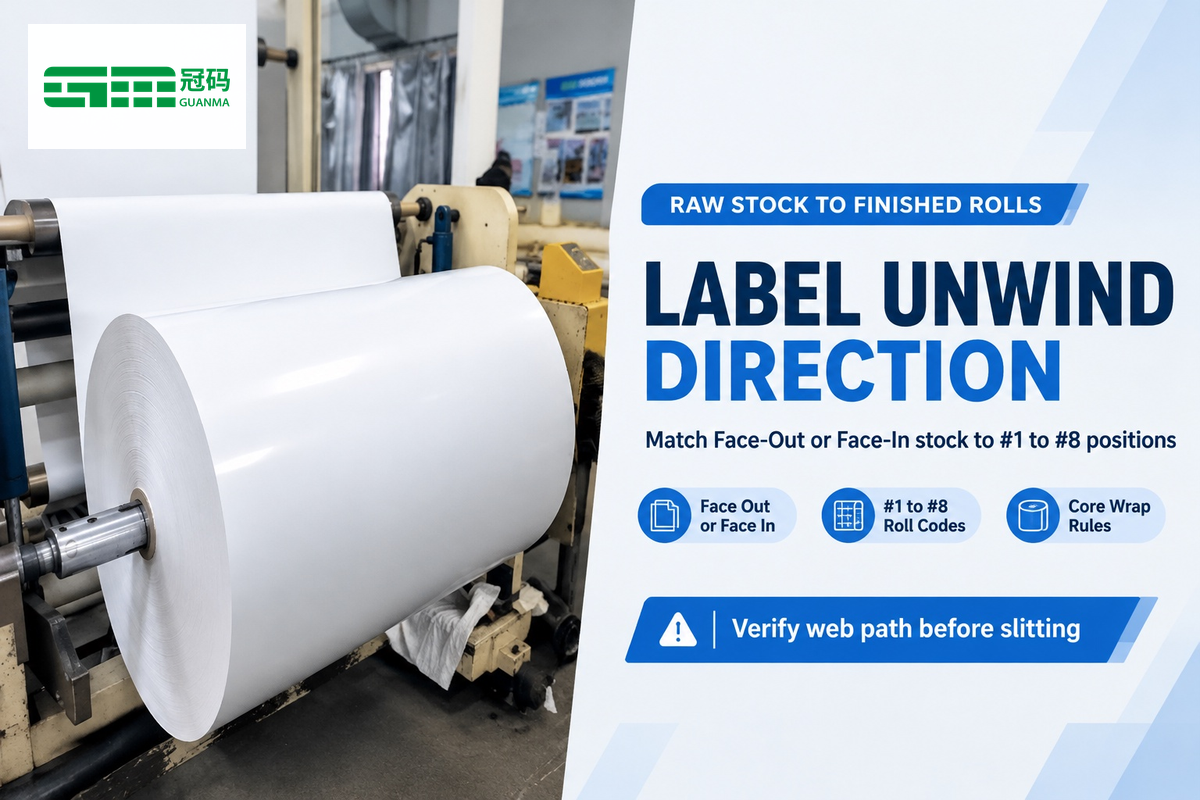
Label unwind direction is the orientation of the label web as it unrolls into a printing press or label applicator. The chart below shows the winding surface and the leading artwork edge for each printed unwind code, as well as the facestock orientation for unprinted slit stock.
Quick Specs
| Unprinted Raw Stock States | 2 radial states: Face Out (Coated Side Out) vs. Face In (Liner Out) |
| Finished Printed Roll Codes | 8 positions (#1–#4 Outside Wound; #5–#8 Inside Wound) per FINAT Section 2.8 |
| Tested Peel-Tip Benchmark | 7° optimum liner pull-back angle in testing with a 2 mm beak radius (Labels & Labeling) |
| Equipment & Slit Roll Ranges | Guanma slit widths: 25–1,300 mm; Kocher+Beck UR 440: 76 mm (3 in) core; Aztech BSR: 40 in unwind / 24 in rewind OD |
| Release Force Test Standards | FINAT FTM 3 (low-speed release) and FTM 4 (10–300 m/min high-speed release force) |
TL;DR: Roll Handover Rules for Converters and Packaging Lines
- Unprinted self-adhesive paper and film stocks have no printed top or bottom. Therefore, Guanma slits 25mm to 1,300mm rolls face out or face in on 76mm cores.
- To ship finished rolls in unwind position #3 (Outside Wound, Right Edge Leading) after the press rewind and one offline slitter-rewinder pass, the right copy edge enters the press rewind first, and the last roll is wound with the liner against the core.
- Every roll-to-roll rewind swaps leading and trailing edges, while core-wrap side sets outside or inside winding.
What Label Unwind Direction Means for Raw Stock vs Finished Rolls
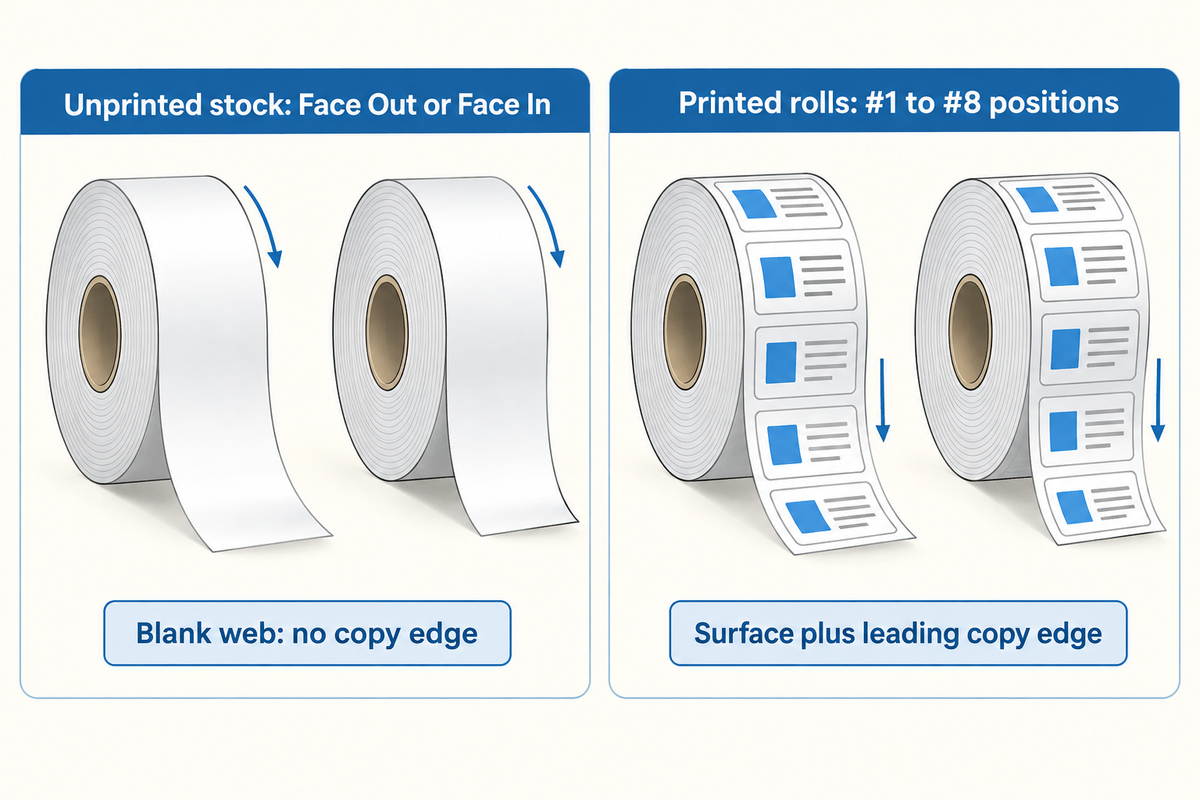
Unprinted laminate stock has two radial winding states, whereas printed die-cut label rolls have eight unwind positions defined in FINAT Technical Handbook Section 2.8. Separating upstream raw label wind from downstream copy orientation prevents press miscuts and applicator line stops.
In commercial label printing across the printing industry, buyers often write “wound out” on a purchase order without mentioning the stage of the printing process. Unprinted roll stock holds three continuous layers: facestock, pressure-sensitive adhesive, and silicone release liner. Blank webs carry no graphics, so they have no directional copy edge. Laminate mills classify slit rolls strictly by radial surface: Face Out (facestock out) or Face In (liner out).
A converter prints artwork and die-cuts individual shapes on the liner, and four directional copy edges appear. Two radial surfaces multiplied by four leading edges create eight possible roll configurations. That geometric split explains why specs of raw substrate and specs of finished product use different terminology.
| Handover Stage | Available Winding States | Defining Physical Reference | Who Specifies It |
|---|---|---|---|
| Unprinted Jumbo or Slit Stock | 2 states (Face Out / CSO or Face In / CSI) | Printable facestock vs. release liner relative to 76 mm core | Label converter ordering from laminate manufacturer |
| Press Master Reel (In-Process) | Web travel direction + print face up/down | Print station cylinder contact, turnbars, and die station | Flexo or digital pressroom supervisor |
| Finished Die-Cut Applicator Roll | 8 positions (#1–#4 Outside; #5–#8 Inside) | Winding surface + which artwork edge peels off first | Brand packaging engineer or co-packer |
Zhejiang Guanma Packaging Co., Ltd. (Guanma) works in the first row of this supply chain as a raw material manufacturer. Guanma coats, laminates, and slits unprinted self-adhesive paper and film rolls, rather than printing custom labels.
Standard #1 to #8 Label Unwind Chart and Roll Copy Positions
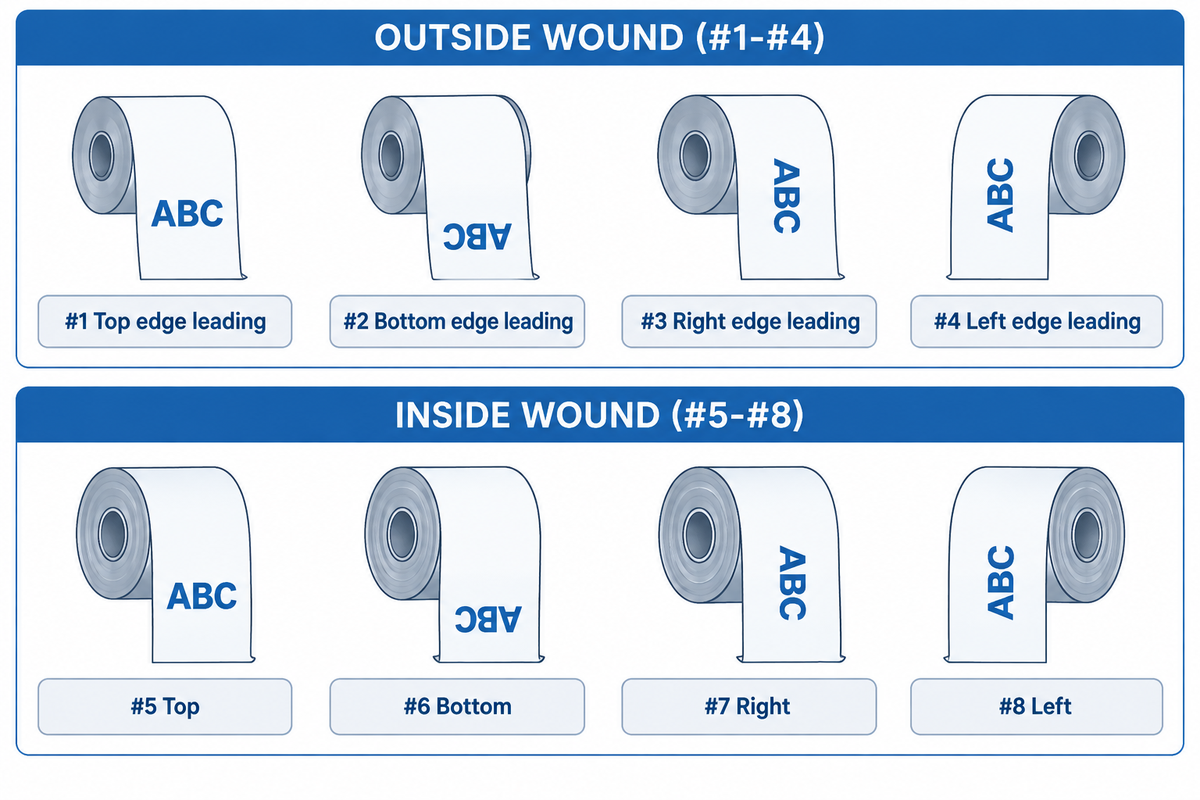
Positions #1 through #4 place labels on the outside of the roll, while #5 through #8 place labels on the inside facing the core, per the PrintWiki label unwind direction and FINAT Section 2.8. Side-applied bottle labelers on horizontal conveyors commonly use #3 or #4.
Most unwind charts in North America and Europe draw web travel down or toward the right side of the page. Take a look at the travel arrow your supplier has provided and lock in the code only after confirming. Pair that chart number with literal edge wording on your proof so converters and co-packers don’t mistake mirrored diagrams.
Numbers #1 through #8 indicate the winding surface and leading artwork edge across different roll directions rather than locking in one machine type. Confirming how labels are applied, including rolls applied by a machine versus benchtop dispensers, prevents confusion during proofing. The chart below lists the winding surface, leading edge, and setup checks for each code alongside unprinted slit stock.
| Position Type / Code | Winding Surface | Leading Edge Off Roll | Common Web-Path Example (Setup-Dependent) | Key Setup Check |
|---|---|---|---|---|
| Position #1 | Outside Wound | Top edge leading | Overhead tamp-on or top wipe-on setups needing top edge first | Confirm upright copy layout against carton travel |
| Position #2 | Outside Wound | Bottom edge leading | Top/bottom wipe stations or benchtop dispensers needing bottom first | Convenient for visual inspection and manual peeling |
| Position #3 | Outside Wound | Right edge leading | Vertical-spindle bottle wrap setups needing right copy edge first | Verify head side, peel direction, and container travel |
| Position #4 | Outside Wound | Left edge leading | Vertical-spindle bottle wrap or paired front/back opposing heads | Verify head side, peel direction, and container travel |
| Position #5 | Inside Wound | Top edge leading | Internal-path applicators or CSI printers needing top edge first | Higher inward curl stress near 76 mm core end |
| Position #6 | Inside Wound | Bottom edge leading | Inside-wound web paths needing bottom artwork edge first | Verify FTM 4 release force on stiff paper facestock |
| Position #7 | Inside Wound | Right edge leading | Inside-wound rotary or inline paths needing right edge first | Liner hides print faces until roll is unwound |
| Position #8 | Inside Wound | Left edge leading | Inside-wound inline paths or single-pass doctor reels from #3 | Confirm single-margin eye-mark side before threading |
| Raw Slit Stock (2-State) | Face Out or Face In | No copy edge (blank web) | Flexo, UV inkjet, and rotary die-cutting press unwinds | Guanma slits 25–1,300 mm widths to match press feed |
What does Rewind Direction refer to on roll labels?
Rewind direction describes the same #1 to #8 roll chart from the label converter’s station at the slitter-rewinder. After printing and die-cutting a multi-lane master reel, operators slit individual lanes and wind them onto cores so labels come off the roll in the specified code. That step sets the way the labels unroll into the customer’s equipment.
Converters say rewind direction because their finishing machines wind finished rolls onto cores. Packaging engineers say unwind direction because their applicator unwinds that roll onto containers. Both terms point to the same #1 through #8 chart coordinates.
Mapping Face-Out or Face-In Raw Stock to Printed Unwind Positions
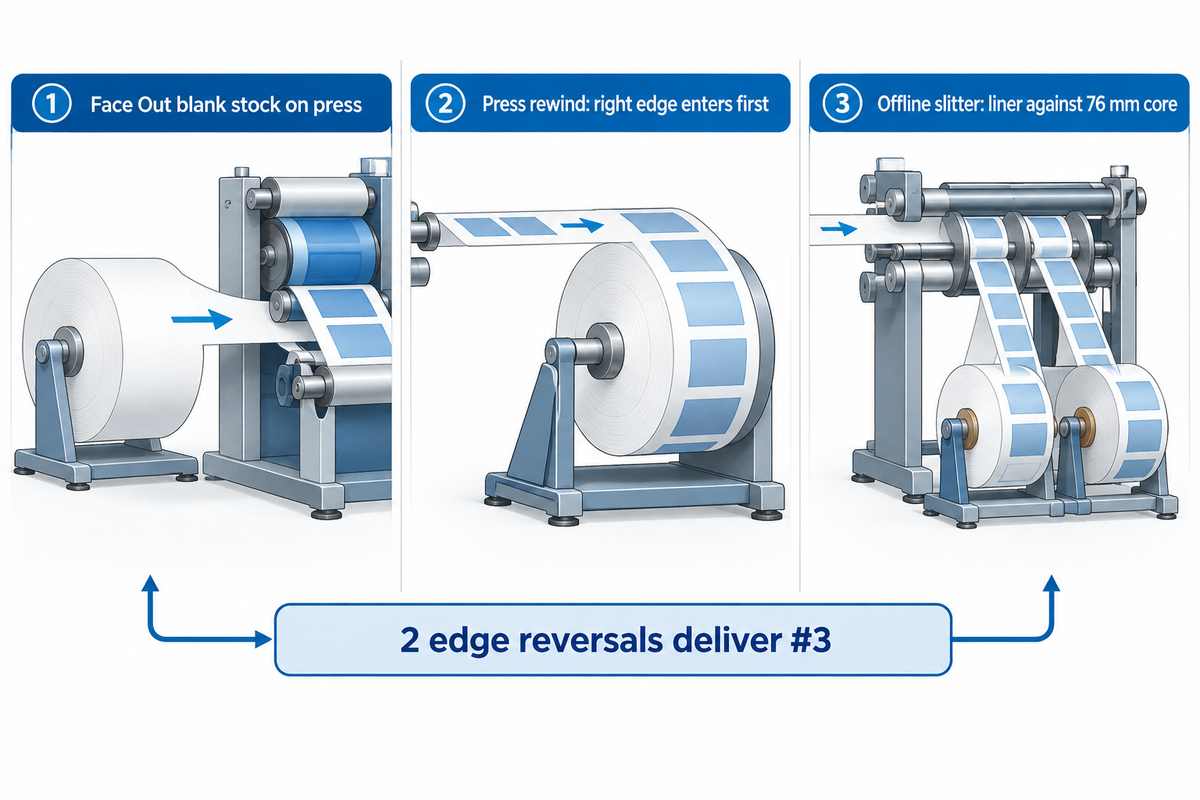
A press turnbar arrangement can alter or invert the web depending on the full threading geometry. Every roll-to-roll rewind reverses leading and trailing edges. According to Label & Narrow Web’s Slitter-rewinder report, the Omega SRI from AB Graphic has a reported speed of up to 350m/min (1,148 fpm), while Rotoflex’s VLI is reported to reach speeds of up to 2,000 fpm.
In the same equipment report, Aztech’s BSR unwinds 40 in master rolls into 24 in rewound rolls at 750 fpm, and Kocher+Beck’s UR 440 splices 3 in (76 mm) cores at speeds up to 500 fpm. Loading Face-In stock onto an unflipped Face-Out press path puts ink onto the silicone liner instead of the facestock. Converters that are testing paper-based label stock options for production trials request Face-Out or Face-In slitting to maintain label orientation on press. Tracking each web turn keeps printed lanes in the correct orientation onto shipment cores.
2-to-8 Winding Parity Matrix: Press Turnbar and Slitter Path Rules
Published converting guides establish the edge-reversal rule for rewind passes, with variations for press threading by machine build. The 2-to-8 Winding Parity Matrix below is a sample tracking sheet to document 2-state raw stock and 8-state applicator rolls. It is related to the single-pass rewind inversion rule (#1 to #6, #2 to #5, #3 to #8, #4 to #7). To decode your press, record the print-face contact, total rewind count, and core-wrap side to crack the correct unwind code.
| Raw Slit Roll State | Illustrative Threading & Rewind Count | Copy Edge Entering Press Rewind First | Final Slitter Core Wrap | Finished Unwind Code Off Roll |
|---|---|---|---|---|
| Face Out (CSO) | Face-up print path; inline slitter (1 rewind total) | Bottom edge enters rewind first | Liner against core (wound out) | Delivers #1 (Outside, Top Leading) |
| Face Out (CSO) | Face-up print path; inline slitter (1 rewind total) | Top edge enters rewind first | Liner against core (wound out) | Delivers #2 (Outside, Bottom Leading) |
| Face Out (CSO) | Face-up print path; inline slitter (1 rewind total) | Left edge enters rewind first | Liner against core (wound out) | Delivers #3 (Outside, Right Leading) |
| Face Out (CSO) | Face-up print path; press rewind + 1 offline slitter (2 rewinds) | Right edge enters press rewind first | Liner against core (wound out) | 2 edge reversals deliver #3 (Outside, Right Leading) |
| Face Out (CSO) | Face-up print path; press rewind + 1 offline slitter (2 rewinds) | Left edge enters press rewind first | Liner against core (wound out) | 2 edge reversals deliver #4 (Outside, Left Leading) |
| Face Out (CSO) | Face-up print path; press rewind + 1 offline slitter (2 rewinds) | Right edge enters press rewind first | Label face against core (wound in) | Delivers #7 (Inside, Right Leading) |
| Face Out (CSO) | Face-up print path; press rewind + 1 offline slitter (2 rewinds) | Left edge enters press rewind first | Label face against core (wound in) | Delivers #8 (Inside, Left Leading) |
| Face In (CSI) | Bottom-unwind path exposing facestock up; 2 rewinds total | Right edge enters press rewind first | Liner against core (wound out) | Verify press threading; finishes at #3 |
| Face In (CSI) | Inverting turnbar path exposing facestock up; 2 rewinds total | Left edge enters press rewind first | Liner against core (wound out) | Verify lateral shift; finishes at #4 |
Worked Parity Example: A converter loads a 330 mm wide Guanma 80 gsm semi-gloss paper roll (Face Out) onto a flexo press. One press rewind followed by one offline slitter-rewinder pass reverses the leading edge twice. Therefore, the press prints with the right copy edge entering the press rewind first. That master reel unwinds left-edge-first into the offline slitter, which wraps the liner against a 76 mm core to ship #3. Printing left-edge-first into the press rewind finishes at #4 instead.
Outside Wound (#1–#4) vs Inside Wound (#5–#8) Roll Mechanics and Liner Limits
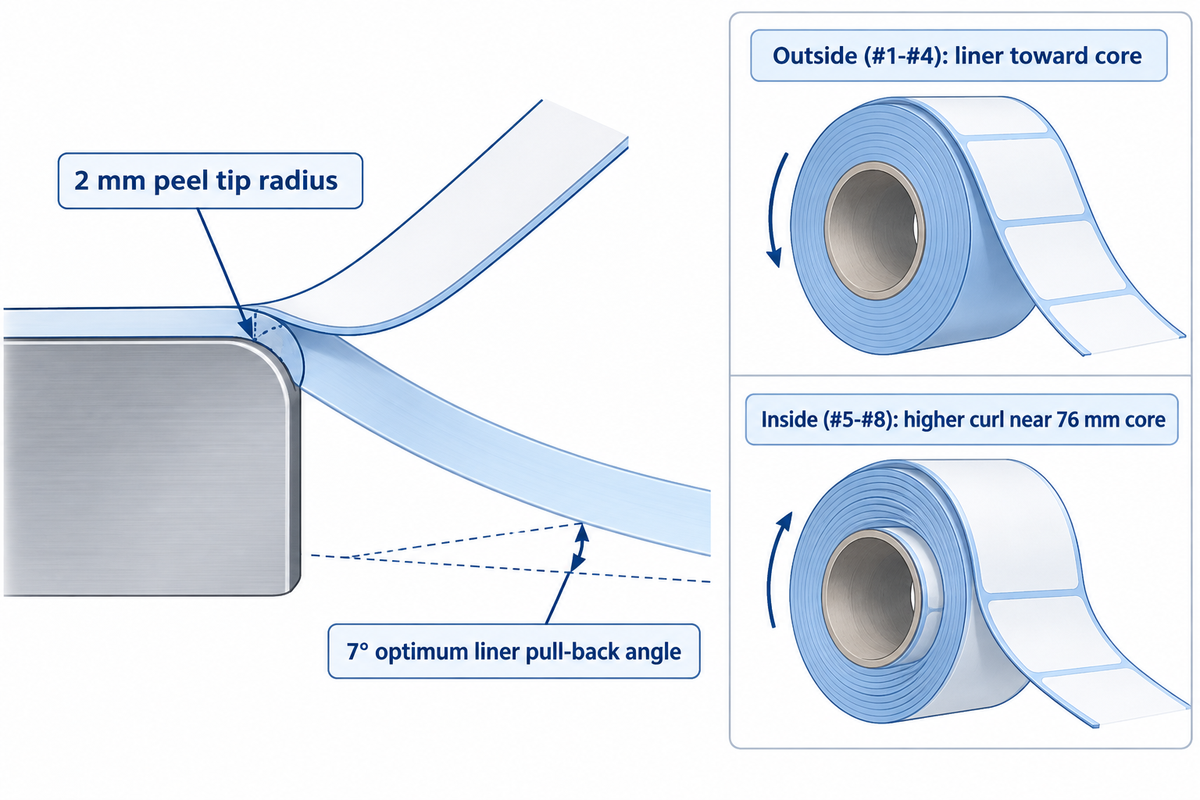
According to the Label Academy of Labels & Labeling, cited peel-plate testing with a 2 mm peel tip radius shows the optimum angle to pull the liner is 7 degrees. Outside-wound rolls (#1–#4) place the liner toward the core, whereas inside-wound rolls (#5–#8) bend the facestock inward.
“Extensive testing has shown that with a 2mm radius on the peel tip or beak, the optimum angle to pull the liner is 7 degrees.”
Silicone release stability is critical near the end of a 76 mm (3 in) converter core or a 25.4 mm (1 in) desktop core. Premature label lift never comes from unwind code alone. It reflects five interacting variables: facestock bending stiffness, silicone release force under FINAT FTM 3 (low speed) and FTM 4 (10–300 m/min), winding tension, storage conditioning, and die-cut liner damage evaluated under FTM 23.
Flexible packaging films and stiff papers react differently around tight rollers. Guanma’s self-adhesive paper overview covers 6 facestock families: coated paper (70–80 gsm), thermal paper (55–80 gsm), kraft paper (70–90 gsm), standard BOPP (40–60 microns), PP synthetic paper (60–85 microns), and PET film (50–75 microns). Specialized film catalog series add 23–38 microns BOPP label film substrates for high-speed dispensing and 54/75/100 microns synthetic paper grades. Stiffer 75 microns PET or 85 microns synthetic facestocks can lift early at sharp web turns when release resistance on silicone-coated release paper liners is too low.
| Engineering Parameter | Outside Wound (#1–#4) | Inside Wound (#5–#8) | Limitations / Setup Checks |
|---|---|---|---|
| Curvature Stress on Facestock | Facestock sits on outer arc under mild tension | Facestock compresses on inner arc toward core | Test stiff 75 microns PET carefully on 25.4 mm cores |
| Pre-Dispensing Sensitivity | Lower tunnel risk across idler rollers | Higher edge-lift risk if FTM 4 release is too light | Check splicer tension (e.g., 40–90 lb on Kocher+Beck UR 440) |
| Visual Quality Inspection | Print faces visible on outer wrap before loading | Liner hides print faces until roll is unwound | Outside wind needs protective wrap against outer scuffing |
| Web Threading Geometry | Feeds top or bottom per idler path to peel edge | Feeds top or bottom as path routes liner over beak | Roll exit tangent and wound-in/out side are separate checks |
| Adhesive Ooze & Edge Bleed | Taper tension helps limit inner-wrap pressure | Excessive winding pressure raises inner-wrap squeeze | Heat and adhesive rheology affect ooze; paper service rated -20°C to +60°C |
Choosing Roll Unwind Direction for Bottle Applicators and Thermal Printers
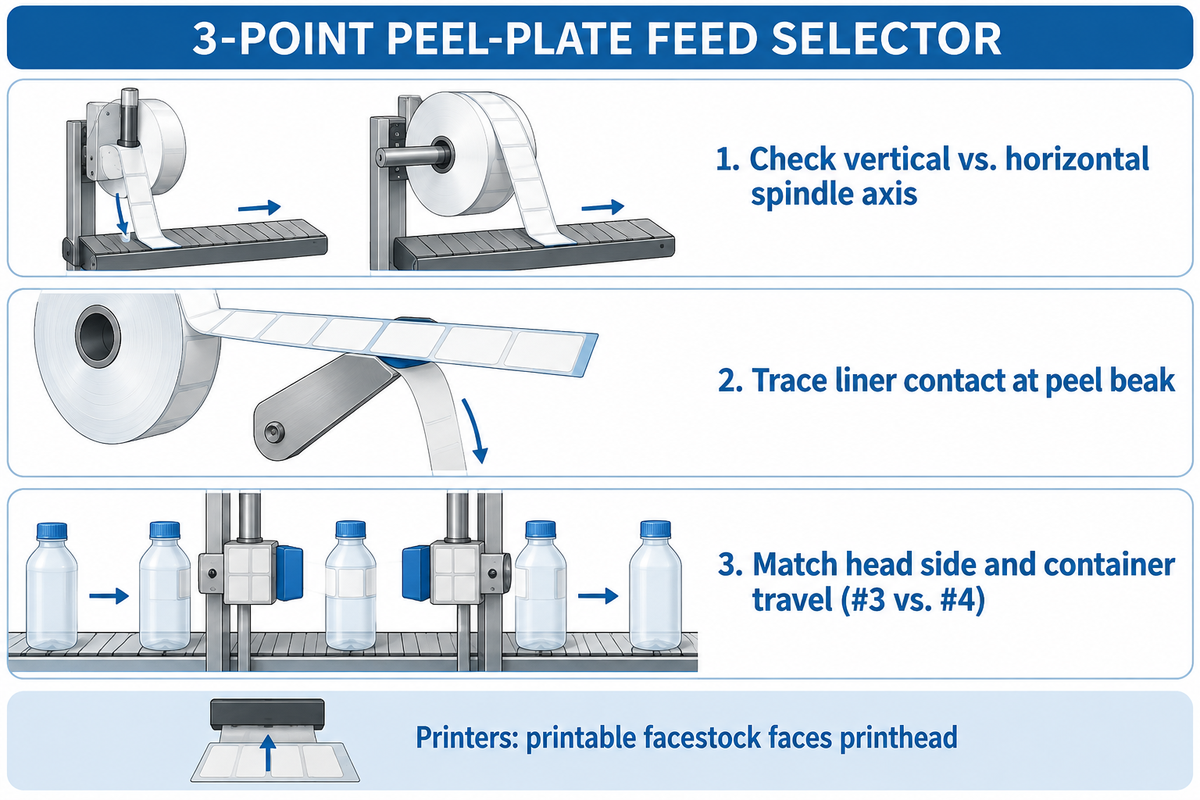
Vertical-spindle bottle wrap labelers usually run #3 or #4, while horizontal-spindle tamp and wipe-on heads usually run #1 or #2, with tamp pads reaching recesses up to 150 mm (5.9 in), according to Labels and Labeling. US Patent US8746313B2 shows a label supply reel and liner take-up reel having a common rotation axis.
Threading the web correctly allows automated heads to dispense labels onto moving bottles or cartons without skewing. For a fixed artwork orientation, the label edge that meets the container first is determined by the peel direction and the labeling head’s position relative to container travel. Front-and-back systems typically mount opposing heads across the belt, feeding rolls in different directions (#3 on one side and #4 on the opposite head).
3-Point Peel-Plate Feed Selector for Bottle and Conveyor Lines
Run this 3-Point Peel-Plate Feed Selector on your packaging line before you accept a label design proof:
- Check spindle axis: Note whether the supply reel is mounted vertically next to the belt or horizontally above or below the belt.
- Trace liner contact at peel beak: Follow the installed threading path to determine which roll surface is in contact with the peel edge.
- Match head side and container travel: Stand at the labeling head and determine which artwork edge will leave the peel tip first to meet the approaching container.
| Equipment Setup | Configured Web & Printhead Path | Peel & Container Relationship | Matching Roll Orientation |
|---|---|---|---|
| Bottle Wrap Head (Setup A) | Vertical spindle, threaded for outside-wound roll | Upright artwork needs right label edge at beak first | Position #3 (Right Edge Leading) |
| Bottle Wrap Head (Setup B) | Vertical spindle, threaded for outside-wound roll | Upright artwork needs left label edge at beak first | Position #4 (Left Edge Leading) |
| Overhead Tamp or Wipe-On Head | Horizontal spindle, threaded for outside-wound roll | Select top vs. bottom leading edge per carton copy layout | Position #1 (Top) or #2 (Bottom) |
| Thermal Transfer / Direct Printer | Printhead mounted above media path | Printable facestock faces upward over platen roller | Commonly CSO; verify internal/external roll threading path |
| Inverted-Path Barcode / Ticket Printer | Printhead below web or specialty CSI spindle path | Printable facestock faces printhead across platen | Check printer manual before ordering CSI (#5–#8) vs. CSO |
Which way do I put labels in the printer?
Load roll labels into a desktop or industrial printer so that the printable facestock faces the thermal printhead across the platen roller. Most Zebra, Honeywell, and SATO printers mount the printhead above the web path, where standard top-unrolling setups use Coated Side Out rolls.
Certain industrial Datamax and ticket printers route media along inverted paths or use Coated Side In ribbons. Placing the wrong side against a direct thermal printhead produces blank output because heat hits the liner instead of the direct thermal paper roll stock. Prior to loading, scratch the surface of the direct thermal coating with your nail to determine which side gets dark.
Eye-Mark Sensor Alignment and Rewinding Fixes for Wrong Unwind Direction
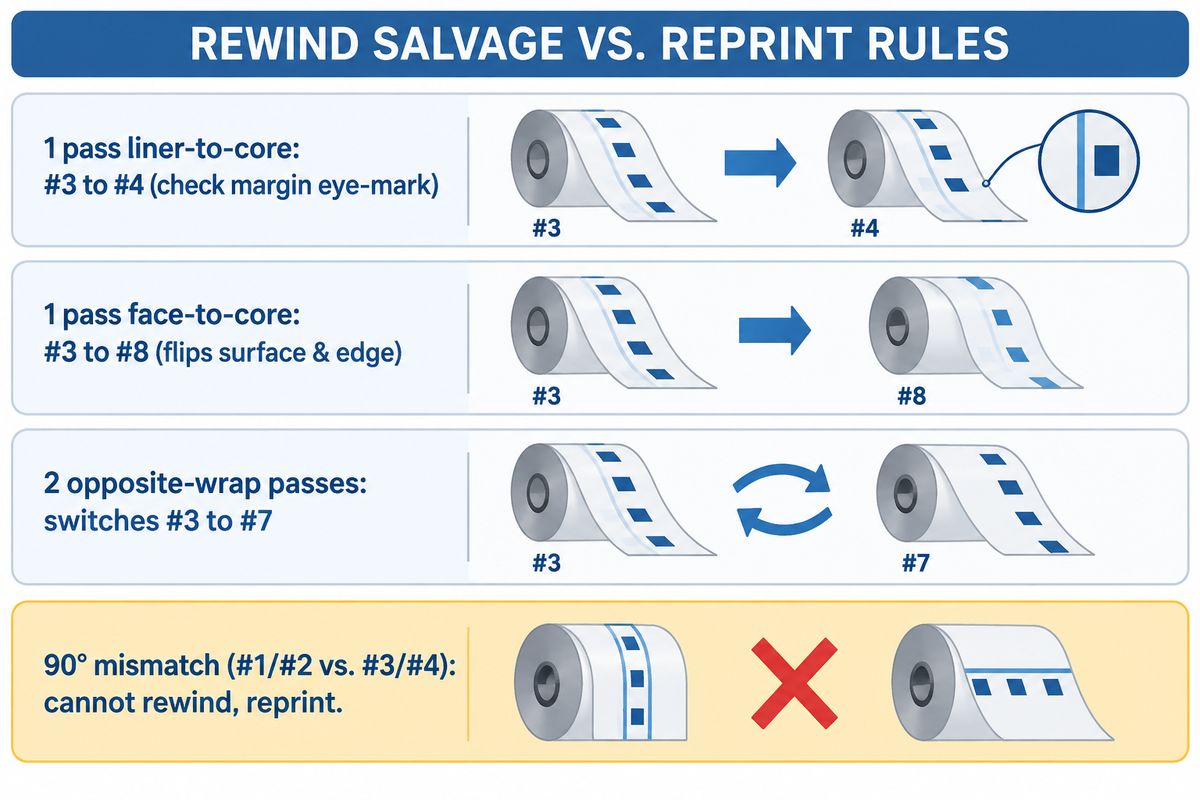
Every roll-to-roll rewind pass reverses leading and trailing copy edges because the first label leaving the supply reel winds onto the inner core of the new roll. Final outside or inside winding follows core-wrap direction during inspection rewinding, a process described in US Patent US4661189A.
Does label unwind direction change when rewinding a roll?
Yes, rewinding a roll swaps its leading and trailing copy edges on every pass, while core-wrap side sets the final winding surface. Wrapping the release liner against the new core keeps an outside-wound roll outside (#1 to #2, and #3 to #4). Wrapping the label face against the new core flips both surface and edge (#1 to #6, #2 to #5, #3 to #8, and #4 to #7).
For an initially outside-wound roll, two rewind passes that both wrap the liner against the core restore the starting code (#3 to #4 and back to #3) after splice removal. Likewise, for an initially inside-wound roll, two passes wrapping the label face against the core restore its starting code. Switching #3 (outside) to #7 (inside) without a turnbar takes two opposite wraps: Pass 1 liner-to-core (#3 to #4), then Pass 2 face-to-core (#4 to #7). Sideways 90° errors (#1/#2 vs. #3/#4) can’t be fixed by rewinding and require reprinting.
Symmetrical across-web optical opacity or ultrasonic gap sensors stay aligned when #3 flips to #4, because they read horizontal matrix gaps between labels. In contrast, an asymmetrical black eye mark printed along a single liner margin shifts between the operator side and drive side after a 180° in-plane flip. Reposition single margin sensor brackets after rewinding.
| Delivered vs. Needed Roll | Physical Orientation Error | Corrective Rewind / Press Path | Sensor & Quality Check |
|---|---|---|---|
| Have #3, Need #4 (or #1 to #2) | Copy 180° reversed; both outside wound | 1 rewind pass, liner against core (wound out) | Single-margin back eye-mark swaps operator/drive side |
| Have #3, Need #8 (or #1 to #6) | Both radial face and leading edge inverted | 1 rewind pass, label face against core (wound in) | Check inward curl on stiff facestocks near core |
| Have #3, Need #7 (or #1 to #5) | Same leading edge; outside vs. inside swapped | 2 opposite-wrap passes (#3→#4 wound out, #4→#7 wound in) | Across-web gap sensor stays centered; check roll tension |
| Outside #3 Splice Removal | Starting #3 outside roll needs defect cut-out | 2 wound-out passes wrapping liner to core (#3→#4→#3) | Restores original #3 leading edge and eye-mark side |
| Have #1/#2, Need #3/#4 | 90° copy rotation mismatch relative to web | Cannot be salvaged by rewinding or turnbar; reprint | Rotate imposition layout before plate or digital output |
Ordering Blank Label Stock Rolls: Winding Specs and 5-Field Handover Checklist
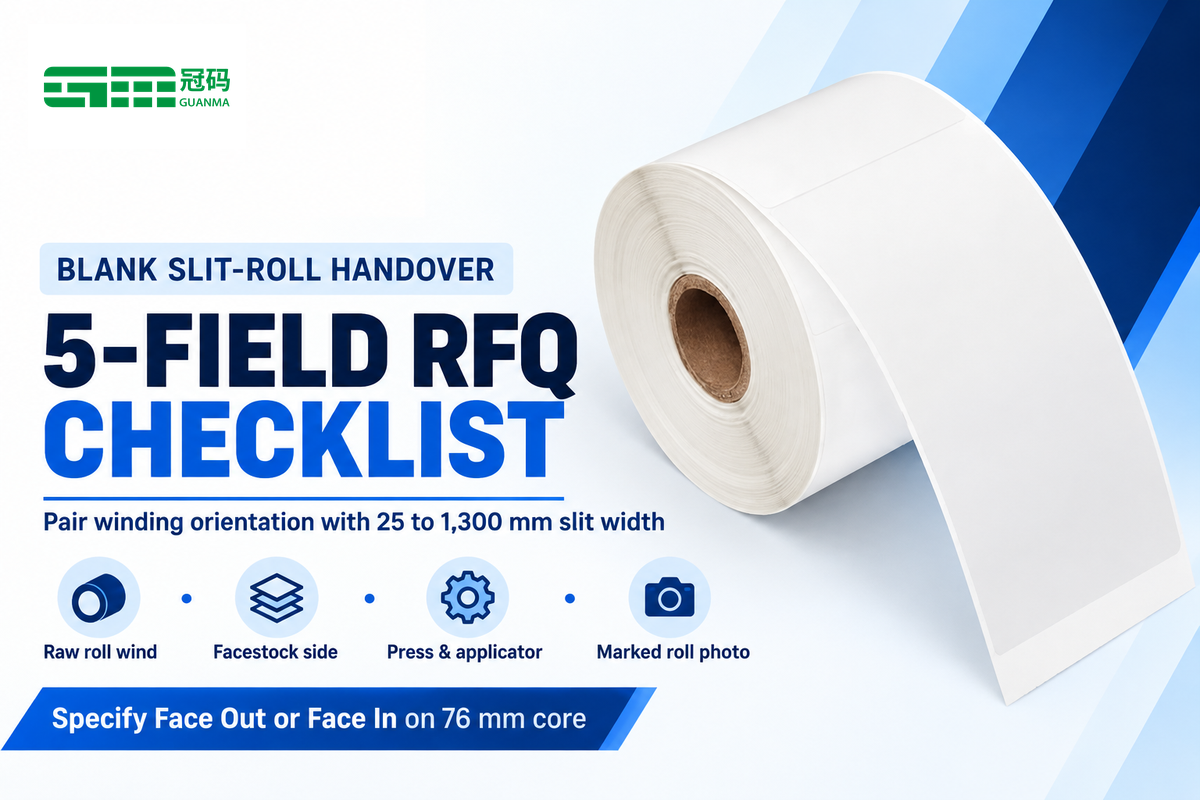
A complete slit-roll purchase order pairs the five handover fields with the roll dimension (core inner diameter and equipment-matched outer diameter). Including the five fields provides the correct label roll in the proper unwind direction when ordering labels for your products.
Check substrate and adhesive tolerances in Guanma’s blank label stock purchasing specifications, and copy the five-field table below into your quote request. Along with those five orientation fields, verify batch release-force results (FINAT FTM 3 low-speed and FTM 4 high-speed checks) and high-visibility splice flags on a trial reel.
RFQ checklist — copy these into your quote request:
| Parameter | Recommended range | Why it matters | How to verify |
|---|---|---|---|
| Raw roll winding direction (原料卷向) | Face Out (CSO) or Face In (CSI) on 76 mm (3 in) core | Aligns incoming slit roll with press unwind spindle path | Check roll-end directional arrow label before mounting |
| Facestock side orientation (面材朝向) | Print-facing facestock vs. silicone release liner side | Prevents printing ink or primer onto the release liner | Peel corner of laminate sample to confirm layers; scratch check for direct thermal only |
| Press feed & print direction (印刷方向) | Guanma 25–1,300 mm slit width; press threading & rewind count | Links 2-state blank stock to target #1–#8 finished code | Record press unwind, inversions, and slitter wrap on job ticket |
| Downstream applicator feed (贴标机进料) | Code #1–#8 + literal edge text; max OD matched to applicator | Fits converted reels to applicator spindle and peel beak | Run 3-Point Peel-Plate Feed Selector on packaging line |
| Marked sample roll photo (卷样照片) | Annotated photo of approved roll end, unroll arrow, and eye-mark | Removes chart-reading confusion across converters and co-packers | Attach marked photo to PO and retain 1 control roll |
Sourcing Self-Adhesive Paper and Film Stock with Verified Slit-Roll Orientation
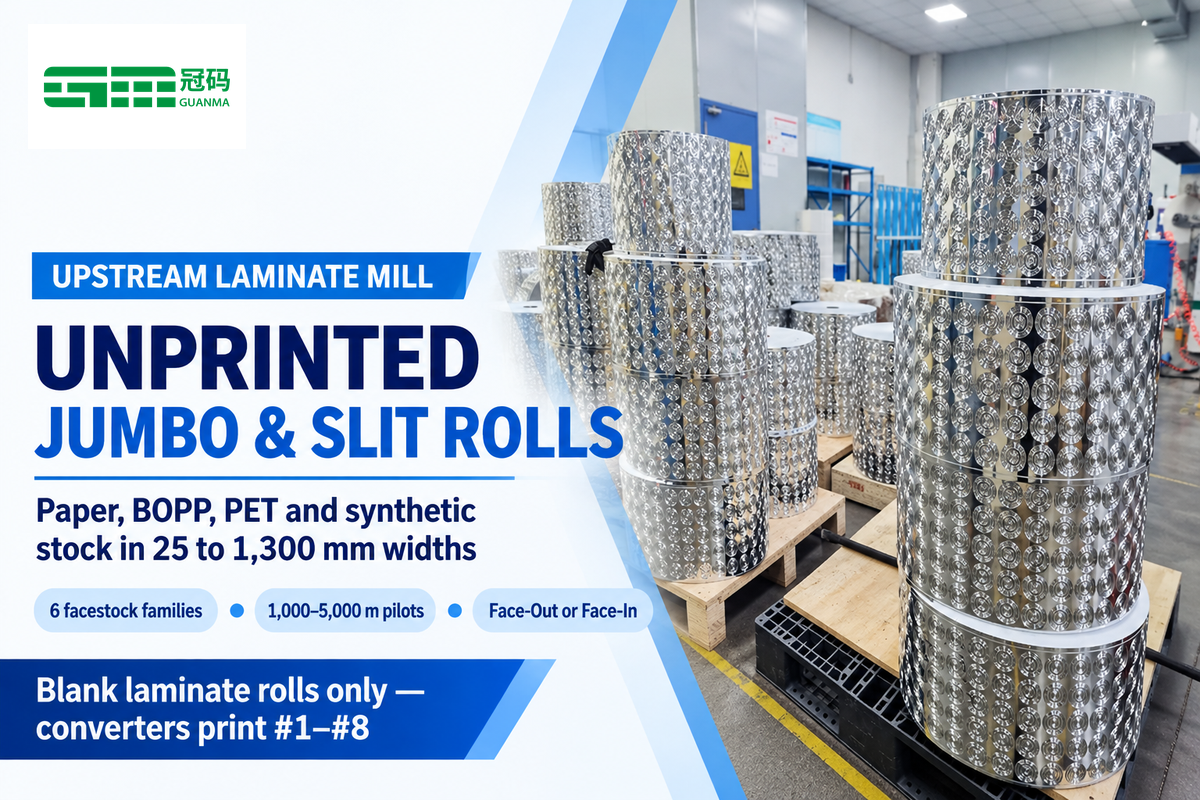
Upstream laminate mills coat adhesive and laminate release liners and slit unprinted rolls in widths from 25 mm to 1,300 mm, whereas downstream converters print artwork, die-cut shapes and rewind #1 to #8 applicator reels. Keeping those two supply-chain roles separate routes your RFQ to the right plant.
Guanma produces three-layer self-adhesive paper, film, and release liner stock in Thailand and Vietnam. Its self-adhesive paper specifications list ISO 9001:2015, batch ASTM D6252 90° peel reports, FDA 21 CFR 175.105, RoHS, and EU food-contact compliance. Published overview grades cover 6 facestock families: coated paper (70–80 gsm), direct thermal paper (55–80 gsm), and kraft paper (70–90 gsm). Film overview grades cover BOPP (40–60 microns), PP synthetic paper (60–85 microns), and PET (50–75 microns). Specialized film catalog series add 23–38 microns BOPP and 54/75/100 microns synthetic paper.
Guanma supplies unprinted jumbo and custom-slit rolls only. They don’t have finished printed labels. Converter programs provide a 12-combination sample pack in 3-5 business days (ASEAN), pilot runs of 1,000 to 5,000 linear meters, and production orders of 5,000 to 10,000 linear meters in Face-Out or Face-In orientation. For production trials, review paper-based label stock options or request custom-slit trial rolls from Guanma with your substrate spec.
How Thinner Liners and High-Speed Applicators Tighten Roll Winding Tolerances
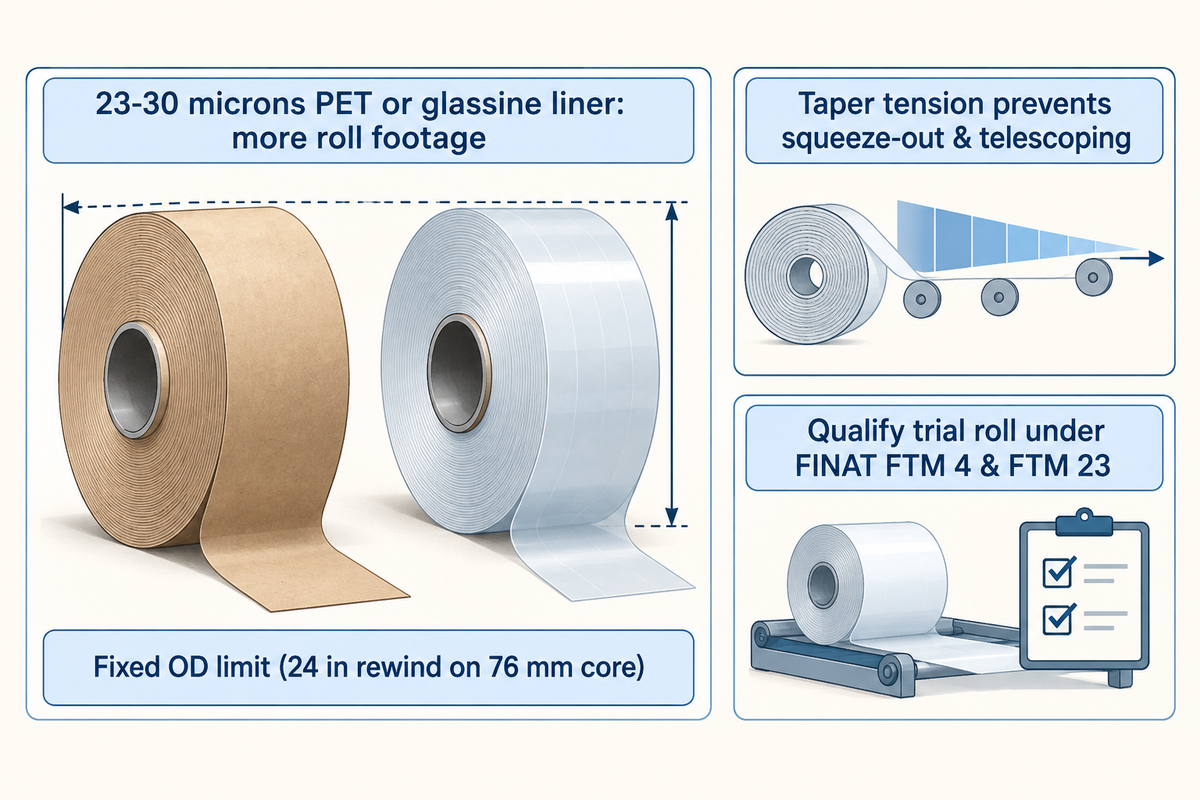
Super-calendered glassine and 23-30 microns PET or PP filmic liners narrow the operating window for slitter tension and peel plate setup. Surveys in FINAT Radar report conversions to thinner liners to increase roll footage and reduce waste.
Roll footage on a 76 mm core is inversely proportional to the total caliper of the three-layer composite (facestock, adhesive and liner). The relationship holds within fixed outer diameter limits, such as 24 in on Aztech’s BSR rewind, or 40 in on master unwinds. Thinner liners lower composite caliper and raise bottling line efficiency by extending run time between splices.
When rewinding 23 microns PET or thin glassine, excessive winding tension can compress inner wraps and promote adhesive squeeze-out, while poor web alignment can contribute to telescoping. Equipment manufacturers such as Kocher+Beck and Martin Automatic apply taper tension control of roll build to address these issues. Qualify one trial roll at full line speed under FINAT FTM 4 and FTM 23 checks before switching liners.
Frequently Asked Questions
What does “unwind direction” mean in the context of labels?
Unwind direction identifies which roll surface holds the labels (outside wound vs. inside wound) and which printed edge peels off first.
FINAT Section 2.8 unites the two coordinates to generate eight standard codes (#1 to #8). Co-packers and converters apply those codes with edge notes, and with the help of the codes, automatic applicators place every product label upright on the container.
Why does an unwind direction matter when ordering labels?
An automatic labeling machine’s configuration of unwind and web path determines the required roll orientation; machines with alternate threading paths can accommodate more than one winding orientation.
Ordering the wrong code can position the artwork upside down or sideways, or facestock and liner on the wrong sides of the web path. That error stops production for offline rewinding or reprinting.
What information does my label printer need from me?
Send five clear specifications: the #1 to #8 unwind code with leading-edge wording, either outside or inside winding, the core inner diameter, the maximum roll outer diameter, and the container travel relative to the head.
Include an annotated photo of an approved roll mounted on your applicator spindle. Visual roll proof prevents mirrored chart misunderstandings between converters and contract packagers.
Does label unwind direction matter for hand application?
No, operators turn labels applied by hand freely during placement, though outside #2 or #3 rolls simplify visual checks on benchtop dispensers.
How do I describe the coated side and winding orientation when ordering blank label stock?
Specify Face Out (printable facestock on the outer wrap) or Face In (release liner on the outer wrap), because unprinted laminate has no copy top or bottom.
Include slit width (such as Guanma’s 25 mm to 1,300 mm range) and core inner diameter (typically 76 mm / 3 in). Add maximum roll outer diameter, press threading path, high-visibility splice flags, and a marked roll-end diagram. Also confirm batch release testing under FINAT FTM 3 and FTM 4, and retain one approved control roll at incoming inspection.
About This Converting Handover Analysis
This guide connects Face-Out and Face-In unprinted laminate slitting with FINAT #1 to #8 label unwind charts, rewind core-wrap rules, and peel-plate dispensing geometry. Substrate ranges reflect published paper, film, and liner specifications from Guanma’s Thailand and Vietnam plants (with ISO 9001:2015 and ASTM D6252 listed on Guanma’s self-adhesive paper specifications). Reviewed by the Zhejiang Guanma Packaging Co., Ltd. technical team.
References & Sources
- FINAT Technical Handbook 11th Edition, Test Methods (FTM 1–4, FTM 23) & Section 2.8 Unwind Roll Chart FINAT (European Association for the Self-Adhesive Label Industry)
- Understanding the Basics of Label Application (Peel Tip Radius, Pull Angle & Rewind Options) Labels & Labeling / Label Academy
- Slitter-Rewinders: Inspection, Tension Profiles & Thin-Liner Converting Label & Narrow Web
- Label Unwind Direction, Roll Copy Position Definitions PrintWiki
- FINAT Radar, Self-Adhesive Labelstock Converter & Market Reports FINAT
- US Patent US4661189A, Method for Manufacturing and Rewinding Discrete Label Elements United States Patent and Trademark Office (via Google Patents)
- US Patent US8746313B2, Label Supply and Liner Take-Up Dispensing Assembly United States Patent and Trademark Office (via Google Patents)