Get in Touch with Guanma

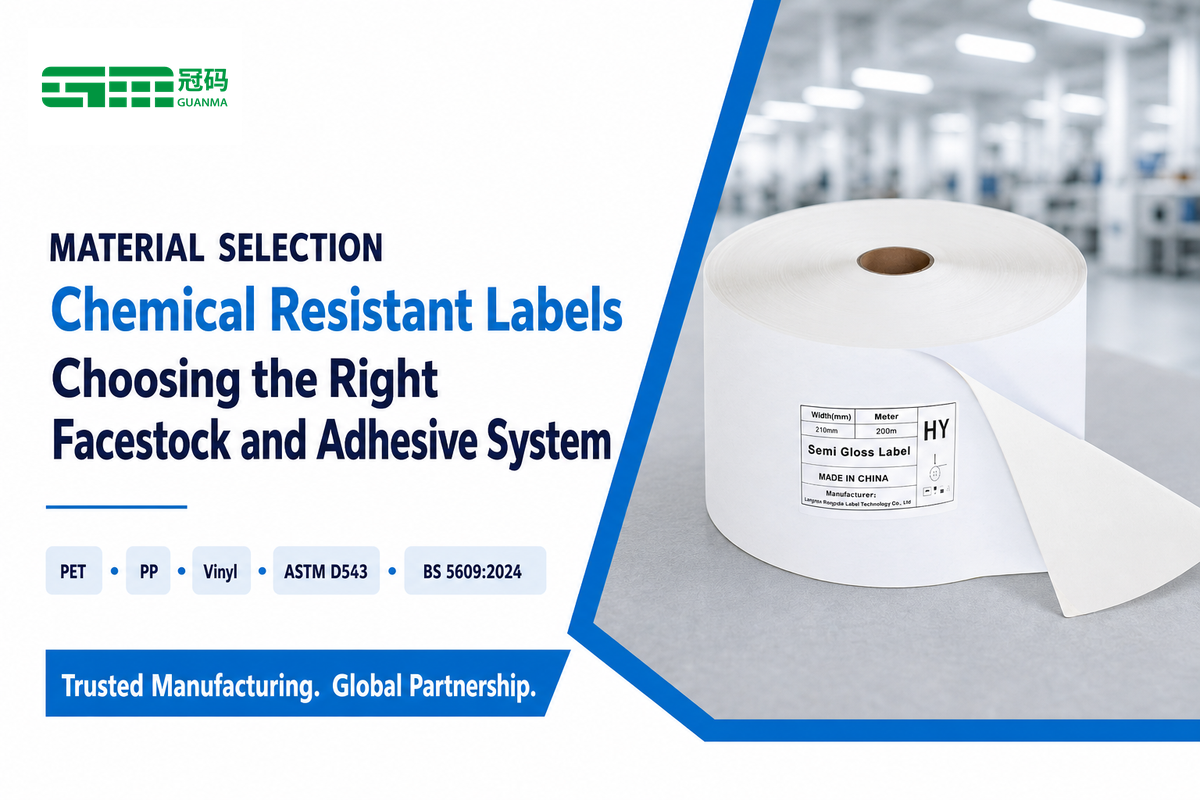
Chemical resistant labels are pressure-sensitive label constructions engineered so the facestock, adhesive, topcoat, and print method survive a specific chemical exposure together as one system, rather than a single “resistant” material working alone.
Quick Specs
| Common facestock families | PET (polyester), PP synthetic paper, top-coated paper, vinyl, polyimide (extreme-temp niche) |
| Highest-resistance adhesive class | solution acrylic (crosslinked network resists solvent swelling) |
| Governing test standard | ASTM D543-21 (Immersion Test / Mechanical Stress + Reagent Exposure) |
| Workplace vs shipping regime | GHS/OSHA HazCom (29 CFR 1910.1200) vs DOT/UN transport placarding |
| Marine durability standard | BS 5609:2024 — Section 2 (labelstock) and Section 3 (print) now certified independently |
| Print method for chemical exposure | thermal transfer with resin ribbon (fused image, not surface ink) |
| Old BS 5609:1986 retirement | 2030-12-31 |
Chemical resistant labels are only as good as the one chemical you’re checking them against — a label rated for MEK immersion might not hold up against sulfuric acid vapor, and a facestock that survives four hours in xylene may not survive a year of combined heat and oil exposure. The usual approach starts with a facestock name on the data sheet, but facestock is one of four variables — facestock, adhesive, topcoat, and print method — and all four need to be matched to the exposure together, or the label fails at whichever variable got left out.
chemical resistant labels are pressure-sensitive constructions designed to keep the facestock, adhesive, topcoat, and print method alive and doing their jobs together–not just a “chemical resistant” material, but a complete system where one weak link (not enough adhesive under a resistant facestock, not enough resistant ribbon under a resistor print method) causes the whole label to fail.
Key Points
- GHS workplace labels and DOT placards are two different regulatory regimes with different required elements–confusing the two is by far the most common early mistake buyers make.
- A polyester (PET) facestock in and of itself does nothing, chemically speaking–industry reporting indicates many standard polyester labels are for general longevity, not direct chemical attack, in the absence of a compatible adhesive and topcoat.
- BS 5609:2024 now indicates certification for labelstock material (Section 2) and printed-image durability (Section 3) independently– pre-2024-style bundled certificates no longer demonstrate both halves.
- One under-reported but no less real failure mode in the label is thermal mismatch between the facestock and the overlaminate.
- ASTM D543 breaks its own test method apart–immersion for containers, wipe/wet patch for splash exposure– and can thus show a difference between a “24-hour” claim and a “wipe tested” claim.
Searching for “chemical resistant labels” results primarily in personal-use and retail-oriented products, and it’s worth naming that split up front. Common autocomplete suggestions for the term make the intent obvious: chemical resistant labels printable, solvent and chemical resistant labels, custom chemical resistant labels, avery chemical resistant labels — printable labels sold as blank labels or pre-cut label sheets, template-driven products such as Avery’s UltraDuty GHS chemical labels or DYMO-compatible cartridges built for desktop label makers. Those solve a real but different problem: short-run, in-house printing for a single facility. This guide is written for the other side of that split — specifying labelstock material at a converter or industrial-supply level, where facestock, adhesive, and print method are chosen together as a system rather than printed one sheet at a time.
Why “Chemical Resistant” Is a Claim You Have to Verify, Not a Label You Can Trust
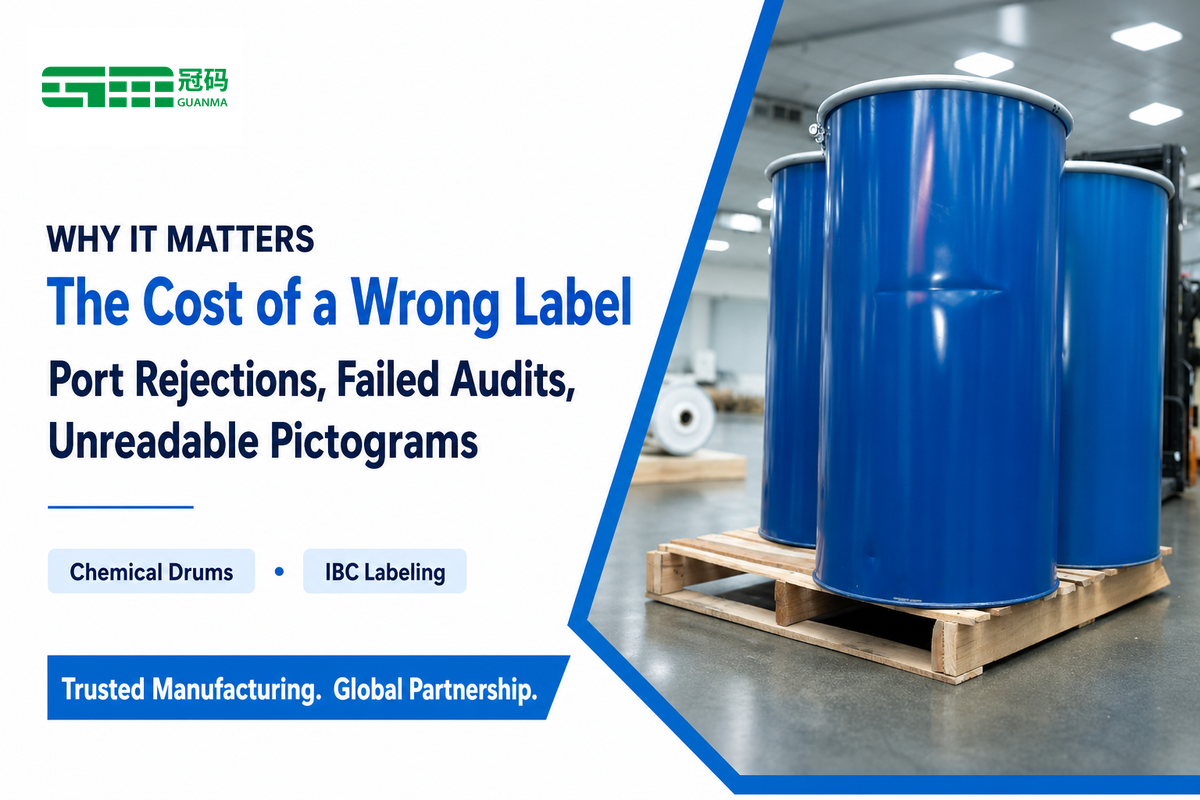
Quite a few label sellers throw around the phrase “chemical resistant,” but very few identify the chemical, the exposure duration, or the test method behind it. A label wipe-tested against ethanol and a label immersed for 90 days in saltwater are both marketed as “chemical resistant,” and specifying the wrong one carries real consequences: a rejected shipment, a faded hazard pictogram, or a barcode that fails to scan.
That mismatch’s price is almost never paid by the label supplier. It’s paid by the party that specified the label — the converter who must run a second job, the brand owner who has to explain a shipment turned back, or the plant safety officer who has to account for an unreadable hazard pictogram under OSHA HazCom inspection. This is why this guide begins with mechanisms and test methods, not a shopping list: the fastest way to prevent mismatch is to know what “resistant” means to what it’s tested against before you ever see a facestock number.
GHS Label, DOT Placard: What “Chemical Resistant” Actually Needs to Survive On
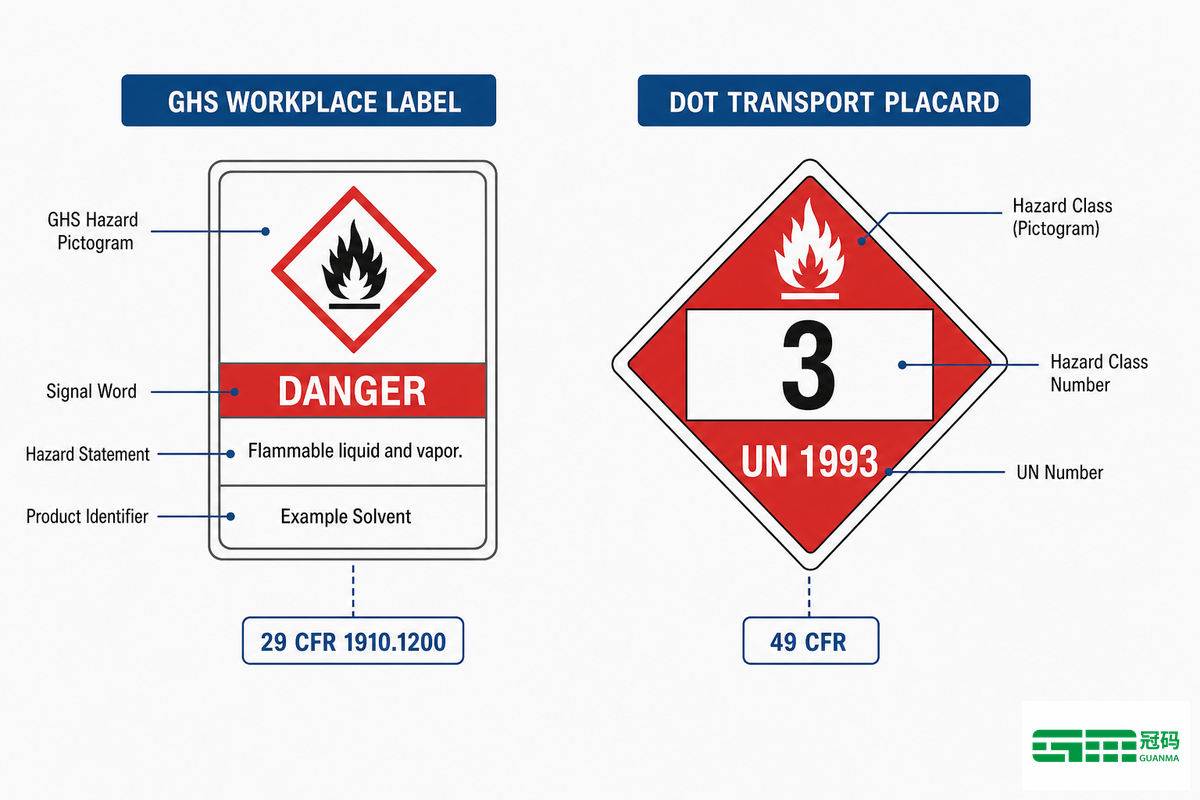
Ask five people what a “chemical resistant label” is for, and you’ll very likely find five different regulatory assumptions have been embedded. The two government regimes most often confused are workplace hazard communication and transport hazard placarding. These are two distinct requirements with two distinct label formats and a label engineered for one doesn’t inherently fulfill the other.
What Is OSHA Compliance?
OSHA’s Hazard Communication Standard, promulgated as 29 CFR 1910.1200, requires that any hazardous chemical in a US workplace must bear five specific label elements: a pictogram, a hazard statement, a signal word, a precautionary statement, and a product identifier. Appendix C to the standard dictates the precise pictogram and hazard statement required for each specific hazard class – this decision isn’t delegated to the label supplier. It’s a workplace requirement, not a shipping requirement; it’s how you label once inside your plant, not on the outside of your container once it’s leaving the building. Suppliers marketing GHS compliant labels are addressing this specific requirement — worth confirming before assuming a general “chemical resistant” product covers it.
| Dimension | GHS Workplace Label | DOT/UN Transport Placard |
|---|---|---|
| Governing regulation | 29 CFR 1910.1200 (OSHA HazCom) | 49 CFR (US DOT hazmat regulations, UN framework) |
| Trigger | Any hazardous chemical container in a workplace | Chemicals moving in interstate or international transport |
| Required content | Pictogram, hazard statement, signal word, precautionary statement, product identifier | UN hazard class diamond, UN number, proper shipping name (varies by mode) |
| Typical durability demand | Survives daily plant handling, wipe-downs, indoor storage | Survives loading, weathering, and often marine/overseas transit (BS 5609 territory) |
| Enforcing body | OSHA | DOT / Coast Guard for marine shipments |
In most industrial contexts, you’ll need both; it’s common for the same drum to require a GHS workplace label as it sits in a plant and then a DOT placard as it’s readied for transit. Here’s the take-home message: know which of these two needs you’re fulfilling before you begin comparing facestocks. A workplace-only construction may not be equipped to withstand months on an ocean vessel, and a marine-rated construction may be significantly over-engineered for a purely in-plant requirement.
The Chemistry of Label Failure: What’s Actually Happening at the Molecular Level
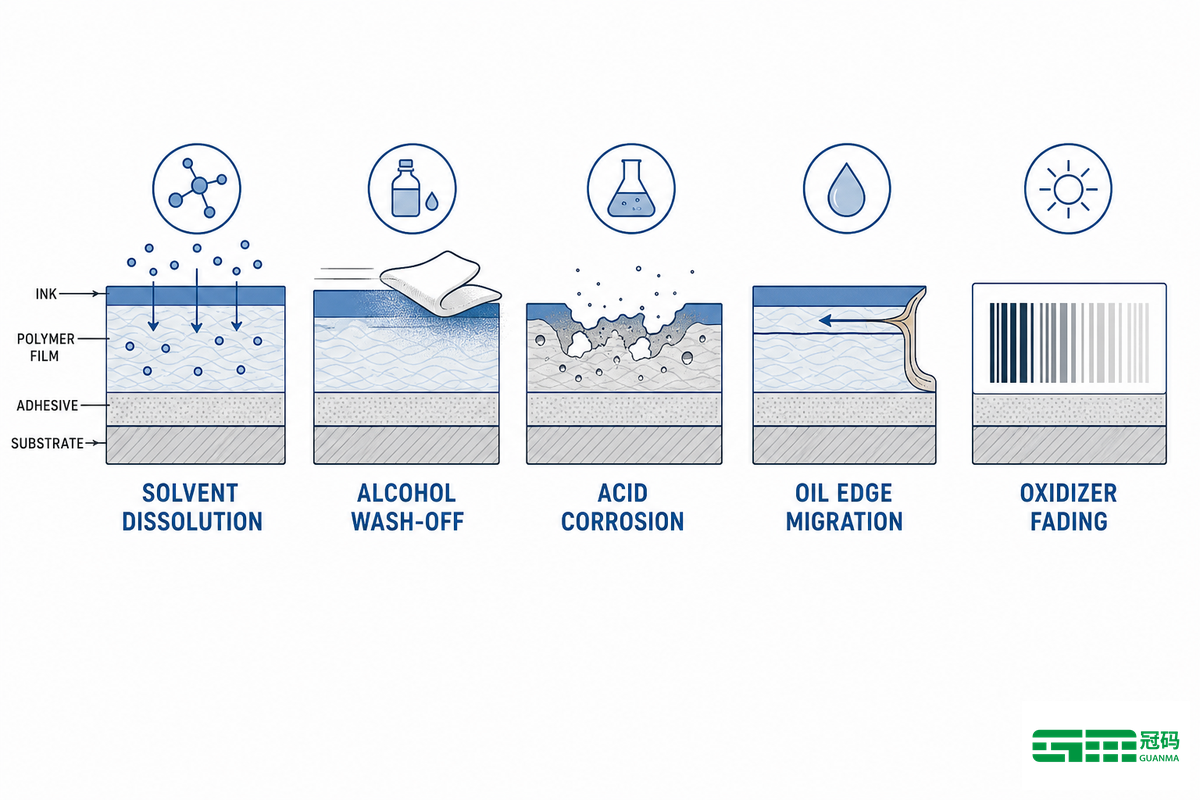
Labels don’t just succumb to the vague term “chemical exposure”; they succumb to one of five discrete and well-understood mechanisms, and each one demands a different protective strategy — not a singular, over-arching “more resistant” material solution.
Solvent dissolution. Certain organic solvents such as MEK, xylene, toluene, acetone and DMSO share similar chemical properties (solubility parameters) with many common label facestocks and adhesives. When a solvent’s molecular polarity is sufficiently similar to that of a polymer, its molecules migrate into the less ordered amorphous regions of the polymer rather than merely pooling on the surface. This “swelling” action (or plasticizing, to use technical terminology) breaks apart the polymer chains’ close packing, causing the facestock material to soften and lose integrity; this is the cause of ink smear and loss of facestock tensile strength.
Alcohol wash-off. Ethanol and isopropanol, commonly used in healthcare, pharmaceutical, and laboratory applications, are slow but effective disinfectants-far slower than solvent immersion, but just as effective over a period of days or weeks of repeat exposure. With each swipe, a small amount of poorly-adhered ink is dissolved, and the protective coating wear down just a tiny bit more. It’s an accumulation, not a one-off; that’s why a label can pass a single alcohol-wipe test but can then fail in the field weeks later under daily cleaning conditions that the single test never replicated.
Acid corrosion. Sulfuric, hydrochloric, and other strong acids break down a label’s facestock in two ways: they either directly attack the polymer chains of the facestock itself, or they cause hydrolysis, breaking down certain polymer chain components such as esters and amides. Even acid vapor, which can reach a label even when no liquid exposure occurs, is enough to cause a label to degrade, hence why acid-exposed labels must be rated to withstand vapor exposure, not just liquid splashes.
Oil edge migration. Unlike solvents, oil — lubricants, hydraulic fluid, brake fluid — doesn’t attack the facestock but rather permeates it from the label’s cut edges inwards between the adhesive and the underlying substrate. This process gradually degrades the bond strength of the adhesive, leading to the label lifting at the corners, and then peeling off entirely. Therefore, a label’s oil resistance relies on both the strength of the adhesive and the edge seal itself, more so than the facestock.
Oxidizer fading. Bleach and other peroxide-based cleaning products don’t destroy the facestock or the adhesive; instead, they attack and break down the dyes and pigments of the image on the facestock through a chemical oxidation process. For instance, a label with barcode information will lose contrast as the image fades, while pictorial warnings on hazard labels may also fade-both situations can lead to the label failing a barcode scan even while appearing okay visually.
One assumption worth correcting up front: polyester (PET) facestock alone does not guarantee chemical resistance. Industry reporting on GHS-compliance failures notes that many standard polyester labels are engineered for general industrial durability — abrasion, moisture, everyday handling — not for direct chemical contact, and fail compliance testing specifically because the adhesive and topcoat weren’t matched to the exposure. Marketing copy for solvent-resistant labels tends to advertise all five mechanisms as one blanket claim, but a genuinely capable construction has to defend against each mechanism individually: acid-resistant labels engineered only for corrosive splash exposure can still fail an oil-resistant test, and a weatherproof facestock built to resist tearing under outdoor UV exposure says nothing about its behavior under harsh solvents or harsh chemicals in continuous contact. A construction genuinely built for solvent resistant labels applications — sustained exposure to solvents, not a single wipe — has to be validated against that specific mechanism, not inferred from a general claim marketed broadly as “chemical and solvent resistant labels” on the datasheet.
5
Distinct chemical failure mechanisms
edge-in
Direction of oil/fluid adhesive attack
vapor-capable
Acid attack without direct liquid contact
One important point to get out of the way up front: just having a polyester (PET) facestock doesn’t automatically mean a label is resistant to chemicals. Numerous reports of GHS-compliant label failures mention that the polyester facestock in many conventional labels has been optimized for general industrial wear, such as scratch resistance and exposure to moisture and typical handling-not for the direct exposure to the types of chemicals a GHS-compliant label will encounter, because the adhesive and the topcoat aren’t properly matched to the specific chemical exposure. While the facestock’s chemistry determines the label’s maximum potential, the adhesive and topcoat realize that potential.
When marketing copy touts solvent resistance, it generally covers all five areas above under a broad claim of “resistance.” But to create a truly high-performance construction for such applications, each specific chemical mechanism must be defended. For example, an acid-resistant construction developed only to resist corrosive splashes may not also perform adequately under oil-based fluid contamination, and a facestock that can endure wear and tear in an outdoor UV environment doesn’t automatically mean it will hold up well to direct and prolonged chemical exposure. In other words, if you need a construction truly meant for prolonged solvent exposure, rather than a single wipedown, the datasheet’s “resistant” rating for some other substance can be no substitute for real-world validation against your particular chemical challenge.
The Facestock Field Guide: PET, PP, Vinyl, Polyimide, and Where Each One Actually Belongs
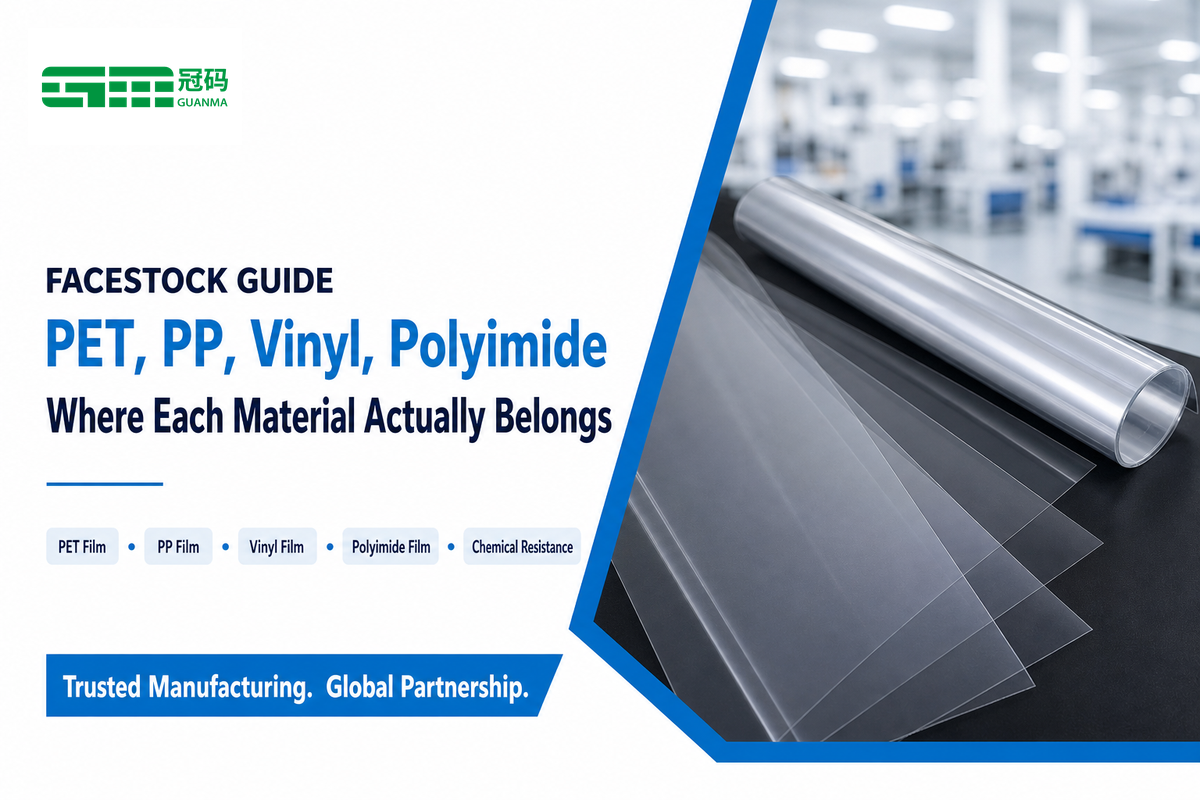
Most facestock comparisons only discuss the two or three materials that the particular supplier just happens to have on the shelf. But the true landscape is much larger — ongoing facestock-and-adhesive-combination patent activity confirms the field keeps evolving beyond any single catalog — and a thorough understanding of where each family genuinely fits, including families absent from a given vendor’s product list, makes it easier to recognize an agenda that prioritizes inventory over exposure.
| Facestock | Chemical Resistance Profile | Typical Fit |
|---|---|---|
| PET (polyester) | Broadest, tear-resistant defense against MEK, xylene, toluene, acetone, alcohols, and acids with the right adhesive | Chemical drums, lab vials, microscope slides, long-term outdoor |
| PP (polypropylene) synthetic paper | Good resistance to aqueous acids/bases, oils, aliphatic hydrocarbons; naturally waterproof | Drum and IBC labeling, lower cost at scale |
| Top-coated paper | Short-duration solvent contact and alcohol wipe only; not immersion-rated | Pharma secondary containers, cost-sensitive labeling |
| Vinyl / PVC film | Resists oils and moisture; conforms to curved surfaces; widely marketed for GHS labeling | Curved containers, GHS pictogram labels, general industrial ID |
| Polyimide film | Extreme temperature tolerance; specialty chemical resistance; higher cost | Electronics and PCB identification through solder/rework chemistry, not typical drum labeling |
📐 Laboratory, Histology, and Cold-Chain Labels — A Genuinely Different Exposure Profile
Lab labeling often comes across as just a smaller version of drum labeling, but the exposures there are of a different sort. Lab labeling applications specifically-and often “hot,” high-pH and even microwaved tissue-prep workflows in histology labs require more than mere xylene resistance; they also require tolerance for high temperatures, low temperatures, and high pressure in basic pH buffers, so a label tested for just immersion in xylene might fail under those conditions. Cold-chain storage adds yet another challenge; users have reported standard and even protected labels detaching from glass vials at -80°C.
When evaluating suppliers, users in lab environments inquire about matched reagent-resistant ribbon-not facestock-which we cover later in this document, but a standard label or a custom-built laminated construction designed to resist a single histological stain step can also be compromised by cryo storage or general chemical exposure on labware in a lab or manufacturing floor. One documented laboratory-grade construction has survived more than four hours of xylene immersion, a three-minute, full-power exposure to a 1,350-watt microwave oven, and a 24-hour period in a -65°C freezer-all without delamination or loss of printing-and a simple “xylene resistant” specification doesn’t even approach this level of multi-condition testing.
If you require PET-based film constructions for typical industrial chemical or drum labels, the PET adhesive film construction covers facestock, adhesive, and liner combination products in greater detail than this general overview, while the PET label material guide reviews PET’s own performance specifications in greater detail.
Adhesive Chemistry: Why Solution Acrylic Wins Under Chemical Exposure — and When It Doesn’t
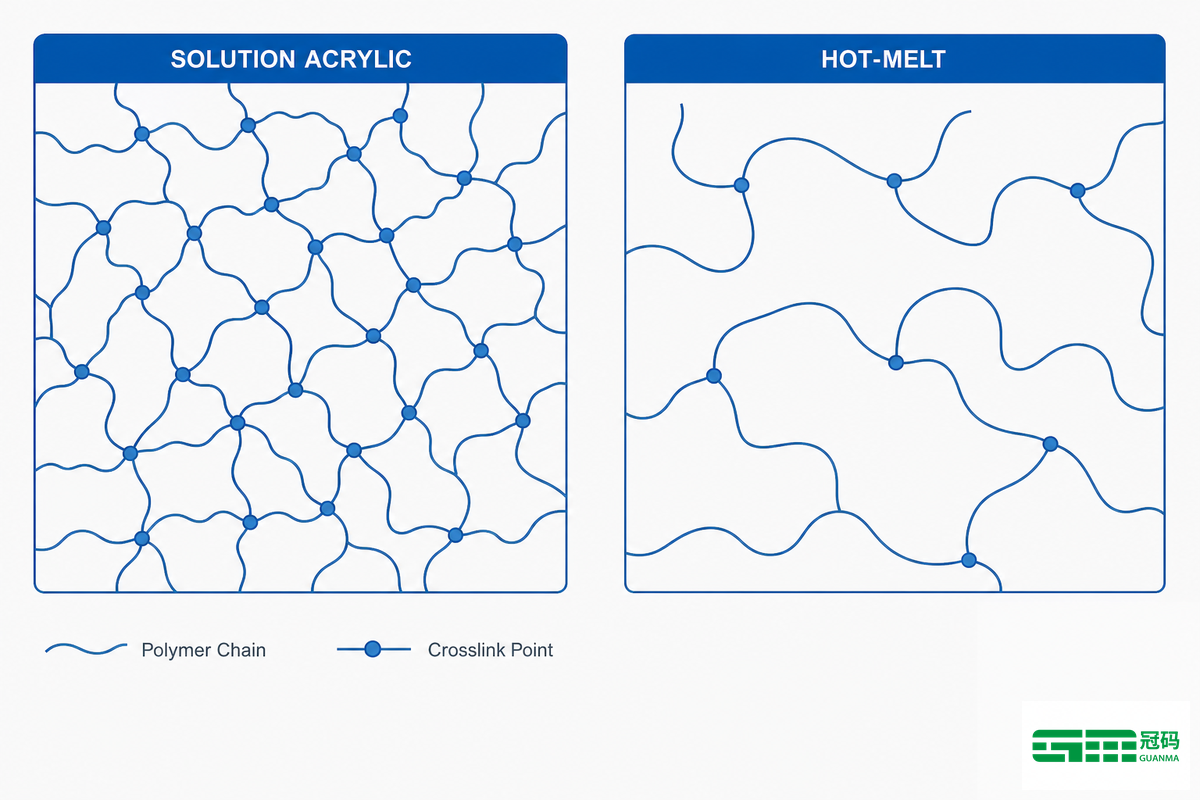
Facestock typically receives most of the attention in chemical-resistant labeling discussions, but the adhesive is doing much of the heavy lifting and is often the component that’s given less attention in the design stage.
Solution acrylic adhesives derive their solvent resistance primarily from the material’s degree of crosslink density. This means that when the adhesive is manufactured, the acrylic polymer molecules are chemically connected into a tighter network than the loosely connected structure of uncrosslinked acrylic.
This denser structure impedes the solvent diffusion that leads to swelling, because there’s no room between molecules for a solvent to infiltrate; the result is less or no swelling when a adhesive is exposed to a solvent. This fact help account for why solution acrylic has top-ranking chemical resistance properties and its ability to adhere strongly to low-energy surfaces.
Hot-melt adhesive’s take another formulation approach: thermoplastic rubber-and-resin blends with tackifiers and plasticizers that deliver great initial tack and performance on textured or rough surfaces, but the additives responsible for that tack are more liable to migration and softening due to solvent interaction. That explains why hot-melt’s limiting service temperature — typically around 140°F (60°C) — is lower than solution acrylics (which reliably perform on a much wider -40°F to +300°F service range when used in the correct construction). It truly is a tradeoff, not a quality gap. Water-based acrylic emulsions settle in the middle: they’re suitable for most general-purpose labeling chores and benefit from a lower formulation cost, but they don’t get quite as far up the resistance ceiling as solution acrylics because their emulsion-based crosslinking mechanism isn’t quite as dense.
Our own R &D work on aggressive-adhesion, high/low-temperature resistant inks and high/low-temperature resistant inks has confirmed a common pattern in the industry: in adhesive technology, resistance to chemicals is correlated with product cost, and selecting the highest resistance formulation by default — rather than matching it to the actual exposure — is a typical way to overspend on adhesive unnecessarily.
Adhesive performance turns out to be the space where that cost compromise applies most practically: a strong permanent adhesive formulated with solution acrylic chemistry for maximum chemical resistance costs more per foot than a general-purpose formulation, which is why selecting the correct adhesive class instead of defaulting to the strongest available still controls project budget without sacrificing performance in the field.
💡 Pro Tip
The same goes for the industry’s prevailing “greener chemistry” trend: a 2023-filed Avery Dennison patent (WO2023003546A1) proposes a recyclable olefin-based hot-melt pressure-sensitive adhesive that uses a fully hydrogenated polymer to deliver better chemical resistance in addition to UV resistance and non-swelling performance — maybe “recyclable” and “chemical resistant” are no longer being regarded as a tradeoff in current adhesive R&D.
How to Actually Test Chemical Resistance — and Verify Print Compatibility — Before You Commit to a Production Run
“Chemical resistant” claims are only as reliable as the test that substantiates them, and the key standard here is ASTM D543-21, Standard Practices for Evaluating the Resistance of Plastics to Chemical Reagents. Two different practices are recommended, and the one applicable depends on exactly how the label will be exposed:
- Practice A– Immersion Test: the sample is immersed in a chemical reagent for a specified period of time, then measured for changes in weight, dimensions, appearance, color, and strength. This practice apply for container or transfer-line applications, where the label is constantly exposed.
- Practice B– Mechanical stress + chemical reagent exposure: the sample is held in a specified amount of strain while in contact with a reagent, measuring environmental stress cracking specifically. If a label will be under both mechanical stress and chemical contact (as a curved or flexed container surface, for example) then this is the correct practice.
- Wet patch/wipe method ( splash exposure): for less than continuous splash or spill contact rather than immersion, the standard specifies either applying the reagent to the product or immersing the product in it — a substantially less demanding test than immersion.
- Ask what practice supported the assertion. It isn’t an apple-to-apple comparison when you’ve a “24-hour chemical resistant” assertion that was supported by a wipe method test and a “24-hour” assertion that was supported by a full immersion test when both are advertised exactly the same. Immersion testing data is almost always tracked at intervals like 24, 72 and 168 hours precisely so that different exposure lengths can be accurately compared.
That’s also the reason why the suitability for certain print method is addressed at the qualification, because chemically resistant substrate printed with the incorrect ribbon also represents failure. Thermal-transfer printing with a resin ribbon is generally the preferred print method in case of chemical-resistant labels because the resin melts and adheres onto the surface of the synthetic substrate during printing and thus becomes not an overlying ink as would happen with conventional dye-based ribbons or digital inkjet output, but fuses into the surface giving the necessary resistance to solvents and abrasion. With chemically resistant and printable substrate for printing laser and digital inkjet also can be applied but the substrate is always equipped with a top coating in order to be compatible with this ink chemistry and that’s also what does the job with laser and inkjet printing.
And this print method differentiation also impacts the label design and production planning on the front end. For those converting operations running pre-print production – pre-applied, fixed content printed onto blank labels or sheet labels before the roll ships – those operations usually use a flexographic or digital pre-print run. However, chemical labeling programs that need point-of-use, variable data added – be it lot numbers, sample ID, or batch codes – typically print those fields via an on-demand thermal-transfer printer.
However, this makes no difference on the back-end, chemistry wise – whatever ink or resin gets put onto the facestock at front end still has to endure the same type of chemical exposure as the facestock and adhesive were validated for.
Evidence from the field where professionals buy labels to apply in a challenging chemical environment proves this: on one thread of an on-line forum for lab personnel in histology labs, someone posed a question that read: ‘Does any supplier carry a matched ribbon-compatible with a label, that’s also chemical-resistant?’ It’s clear to see that skilled procurement specialists understand that a tag is only as good as its’ printing – once a supplier is selected.
Reading a Compliance Claim: BS 5609:2024, GHS, and OSHA HazCom Explained
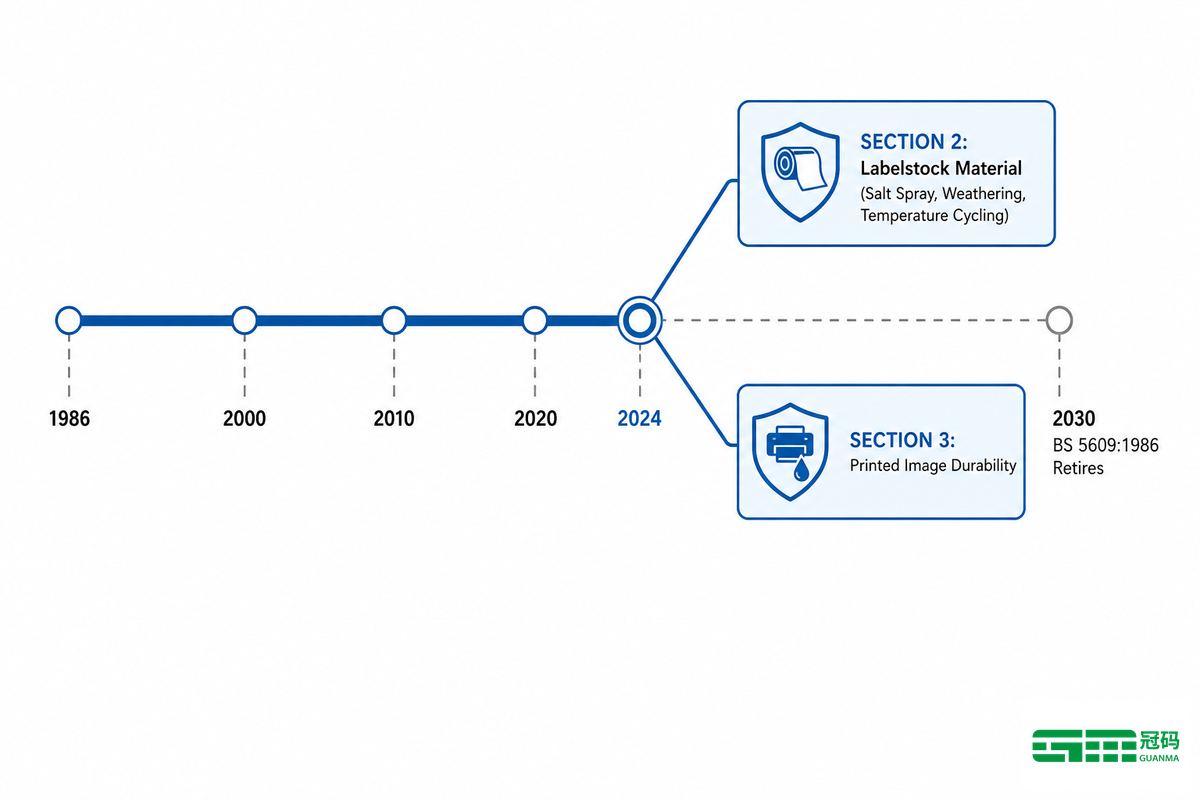
There are 3 types of regulations you hear about on a regular basis when dealing with chemical-resistant labeling, and understanding what each does – and doesn’t – certifying means that you can demand specific answers from your suppliers.
⚠️ Important — The Section 2 / Section 3 Split
BS 5609:2024, effective December 31, 2024, changed something that most buyers looking at chemical labels for marine shipping have not yet realized: Section 2 (marine-durability of the unprinted labelstock — salt spray, weathering, temperature cycling, abrasion, and a roughly 90-day saltwater submersion trial) and Section 3 (durability of the print image on that labelstock) are now certified independently, where previously Section 3 approval required an already-approved, bundled Section 2 test. A BS 5609 certificate from before the 2024 revision is therefore not proof of both sections on its own; ask your supplier for BS5609 Section 2 evidence directly if they’re making a marine-durability claim but can’t point to a current 2024-format Section 2 certification for the facestock. (Section 2 belongs to the facestock supplier; Section 3 belongs to the converter’s specific combination of printer and ribbon.)
GHS (Globally Harmonized System) is the UN-endorsed (Annex 7) labeling framework, containing 9 pictograms, hazard statements, and precautionary statements that form the underlying system for chemical safety labeling internationally. OSHA HazCom (29 CFR 1910.1200) is the US domestic regulation which enacts the principles of GHS for workplace labeling specifically-which is why GHS and OSHA HazCom are often used synonymously in the US, but one is the international principle and the other is the US law that applies it domestically.
BS 5609:1986, the older standard, isn’t being retired overnight – all labels certified and those still in the testing process under this version remain valid on existing certification, however the standard will be entirely phased out on 31st December 2030. Therefore if you’re planning a new labelstock program that’s intended to run beyond this date, you should be seeking labelstock which meets and can be supplied with the new BS 5609:2024 certification rather than opting for a product under the existing, expired version.
A Reader-Buildable Framework: The Questions to Ask Before You Approve a Chemical-Resistant Label Spec
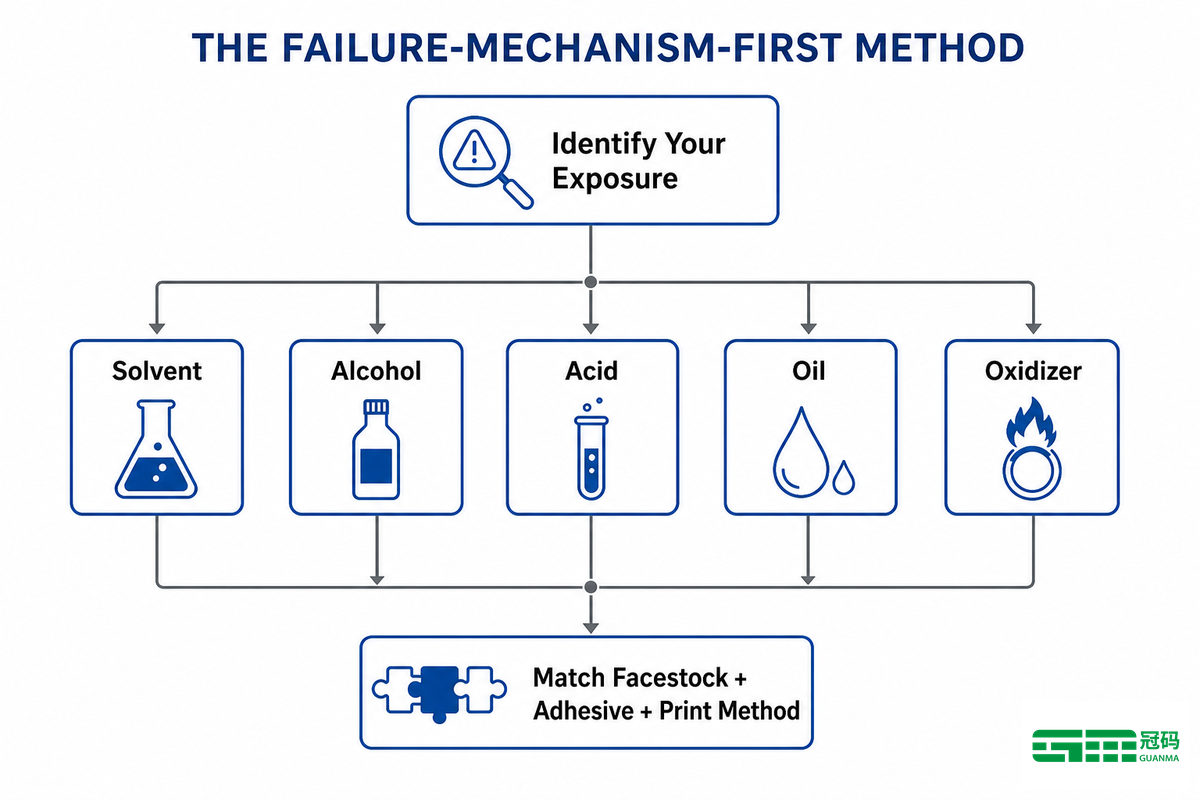
Most facestock decision tools are built around the “Which Material?” starting point, and work from that point outwards. The Failure-Mechanism-First Method is the opposite – start with the exact mechanism your label will fail in, and let that inform which combination of facestock, adhesive, and print method would work best.
The Failure-Mechanism-First Method — Questions to Ask Any Supplier
- Which of the 5 failure mechanisms will my exposure fit (solvent, alcohol, acid, oil, or oxidizer) and how (continuous contact or occasional splash)?
- Will my label be subject to GHS workplace labeling regulations, DOT shipping regulations, or both (at different stages in the supply chain)?
- Which ASTM D543 practice does the supplier reference for resistance to this mechanism (immersion, mechanical stress, or wipe/wet-patch) and is that the method that the label will experience?
- If I’m going to need BS 5609 certification for marine transit, will the supplier provide proof for Section 2, Section 3, or both and has it been certified to the current 2024 revision of BS 5609?
- Will the adhesive class match my environmental and exposure conditions (solution acrylic for maximum chemical resistance, hot-melt for low-temperature performance, water-based for cost-effectiveness)?
- Does the print method (ribbon, ink, and topcoat) that the converter is proposing have documented resistance to the specific chemical to which the facestock is certified (not just the facestock itself)?
- For lab, cold-chain, and histology labeling: has the proposed construction been tested to a complete protocol (heat, cold, microwave, buffer) and not just a single chemical to which it’s being marketed?
| Exposure Type | Facestock Class | Adhesive Class | Print Method |
|---|---|---|---|
| Solvent immersion (MEK, xylene, toluene) | PET | Solution acrylic | Thermal transfer, resin ribbon |
| Alcohol wipe-down (ethanol, isopropanol) | Top-coated paper or PET | Solution acrylic or acrylic emulsion | Thermal transfer or laser |
| Acid splash / vapor (H2SO4, HCl) | PET | Solution acrylic | Thermal transfer, resin ribbon |
| Oil / hydraulic fluid edge contact | PP synthetic paper | Hot-melt or solution acrylic | Thermal transfer |
| Bleach / oxidizer wipe-down | PP synthetic paper or PET | Solution acrylic | Thermal transfer, resin ribbon |
| Combined heat (>60°C) plus chemical | PET | Solution acrylic (rated for elevated temperature) | Thermal transfer, resin ribbon |
| Marine transit / BS 5609 territory | PP synthetic paper or PET | Solution acrylic | Thermal transfer, resin ribbon, over-laminate |
| Histology / lab bench (xylene + heat + microwave) | PET | Solution acrylic | Thermal transfer, matched resin ribbon |
| Cold-chain storage (down to -80°C) | PET (cold-rated construction) | Cold-temperature-rated permanent acrylic | Thermal transfer, cold-rated ribbon |
None of these questions requires taking one supplier’s proprietary recommendation on faith — they’re the same questions worth bringing to any quote, and they double as a checklist for evaluating whether a recommendation you’ve already received actually accounted for your real exposure profile.
“The initial conversation is not about cost — it’s about identifying the chemicals that will come into contact with the label, the container’s surface energy, and the printing unit on the converter’s line. Once those three are identified, the facestock and adhesive choice is almost always clear.”
— Guanma Engineering Team, Materials Discovery Process
Common Mistakes: Where Chemical-Resistant Label Specs Go Wrong in the Field
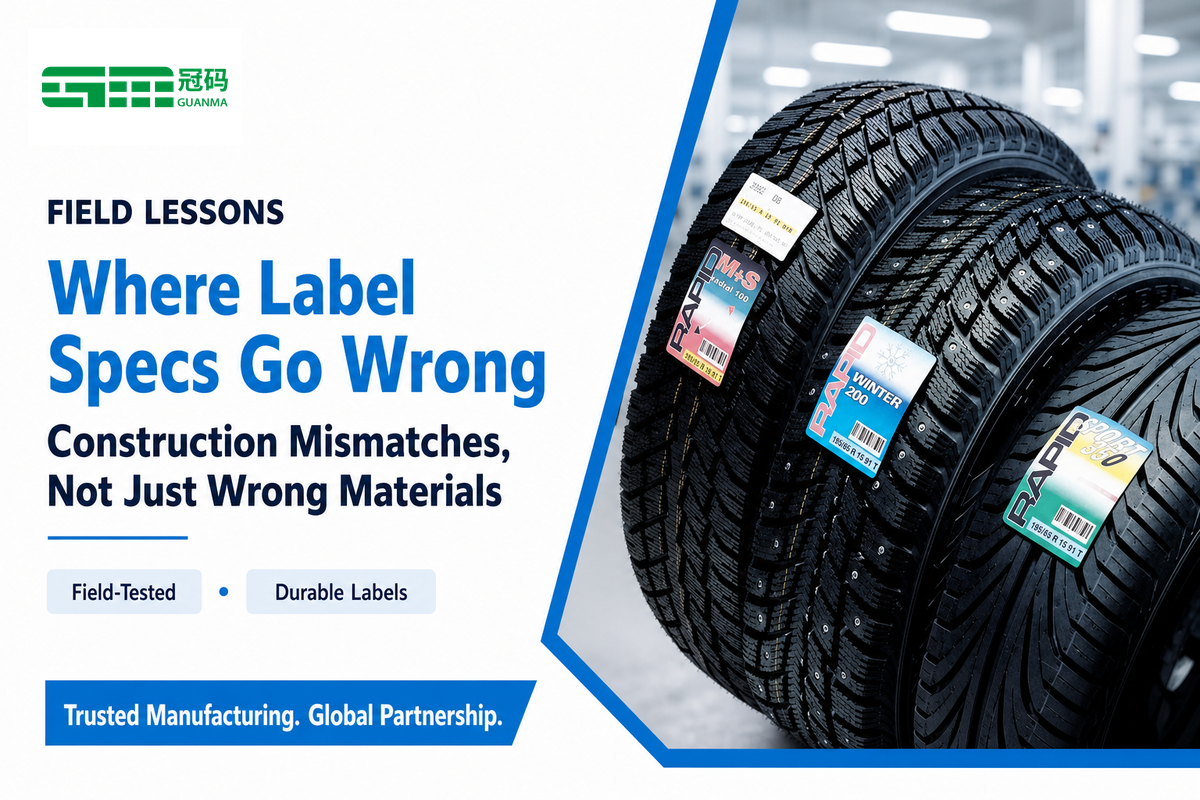
Documented field-failure patterns for chemical-resistant labels cluster around a handful of repeat mistakes — and the most instructive one isn’t about picking the wrong material at all. Worth a quick distinction here too: tamper resistant labels defend against unauthorized removal, not chemical attack, and mixing up the two goals produces a label optimized for the wrong failure mode entirely — a real mistake seen on chemical drum labels specced by whoever handled the last tamper-evident packaging project.
Industry reporting on lamination failures traces a common root cause to mismatched thermal expansion coefficients between the facestock and the overlaminate — a vinyl overlaminate applied over a PET facestock, for example, expanding and contracting at different rates through a temperature cycle until the two layers separate at the edges.
That’s a construction-compatibility problem, not a “picked the wrong facestock” problem, and it’s easy to miss because both the facestock and the laminate can individually pass their own chemical-resistance tests while still failing together as a laminated system.
Beyond that specific pattern, the field-failure categories that show up most often are consistent across reporting: labels peeling or lifting from surfaces, printed information fading or smudging under repeated exposure, barcodes becoming unreadable to scanners even when still visible to the eye, and adhesives breaking down specifically under combined heat-plus-chemical exposure rather than either factor alone.
That combined-exposure detail matter — a construction that passes a room-temperature chemical test can still fail once the same chemical is present at an elevated process temperature, because heat accelerates the same diffusion mechanism described earlier in this guide.
⚠️ Important
If you’re specifying an overlaminate for extra chemical protection, confirm the facestock and laminate are rated as a matched system, not just individually chemical-resistant on their own data sheets.
General durability considerations that apply across label types — not chemical-specific — are covered in more depth in Guanma’s durable and outdoor labels guide.
Industry Outlook: What BS 5609:2024 and Cleaner-Chemistry Adhesives Mean for Your Next Spec
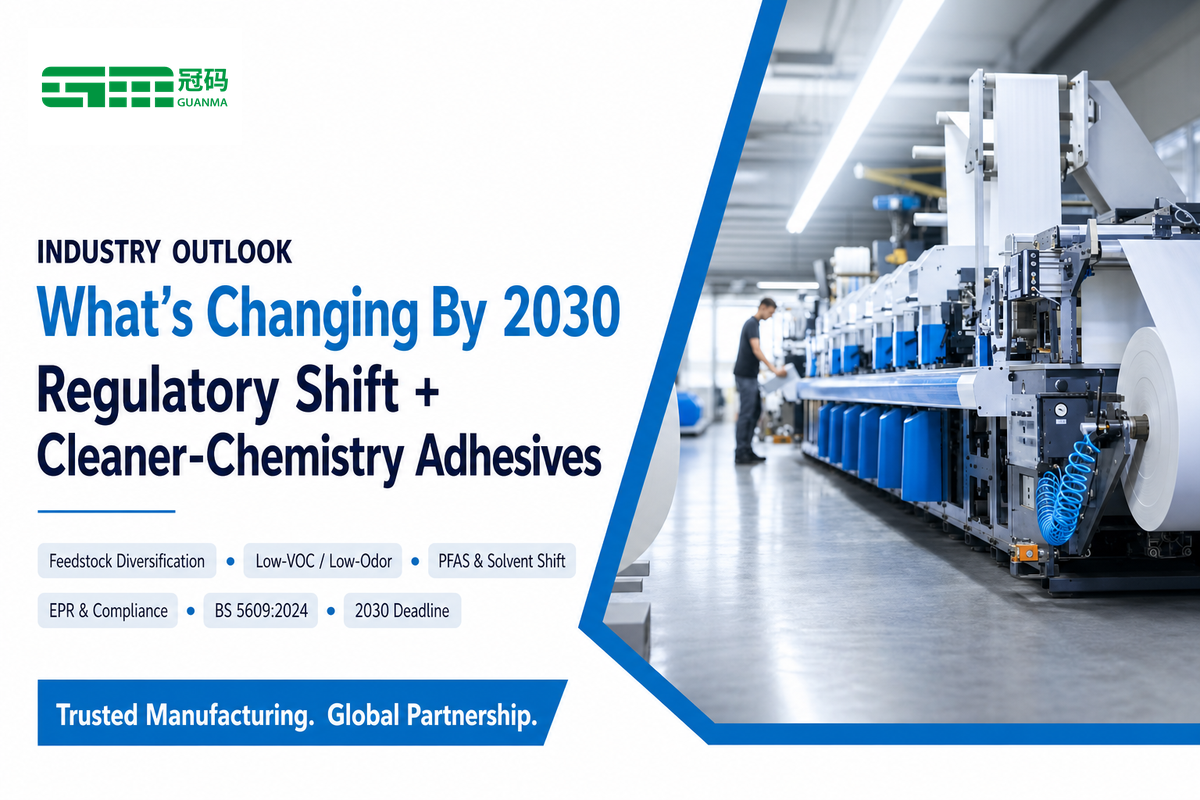
The clearest near-term change in this space isn’t a market-size number — it’s the regulatory transition already underway.
BS 5609:2024’s Section 2/Section 3 split means every marine-durability claim now needs to specify which half of the certification backs it, and the fact that BS 5609:1986 has a fixed 2030 retirement date means any labelstock program planned to run past that date should already be testing to the 2024 format rather than waiting for the older standard to expire mid-program. For buyers evaluating suppliers today, that’s an immediate, concrete question to add to a vendor qualification checklist — not a someday consideration.
Adhesive chemistry is also heading in a fascinating direction. An Avery Dennison-assigned patent application filed in 2023 proposes a recyclable, olefin-based hot-melt pressure-sensitive adhesive. It uses a fully hydrogenated polymer specifically to improve chemical and UV resistance while remaining non-swelling – meaning R&D efforts for this adhesive category now view “recyclable” and “chemical resistant” as attainable objectives instead of being at odds. In a related development on coating layer tech alone, a 2024 chemical-resistant coating for large-format labels has been launched, demonstrating improvements in facestock protection independent of the facestock selected.
Market size data are useful background against which to view these technology and regulatory shifts; they’re not what drive them. Global polyester labels market size was expected to reach nearly $2.8 billion in 2025, with metalized polyester expected to reach nearly 28% share in that segment in 2026, and the global pressure-sensitive labels market is expected to rise from nearly $108.66 billion in 2026 to over $170.75 billion by 2035. These numbers highlight growing demand for durable label materials, but they don’t change what a buyer needs to actually be asking their suppliers to provide in 2026 – that role falls to BS 5609:2024 certifications and the adhesive chemistry changes above.
What is OSHA HazCom compliance, and does it require a specific label material?
View Answer
OSHA HazCom (29 CFR 1910.1200) requires a hazardous chemical container in a U.S. workplace to feature a pictogram, hazard statement, signal word, precautionary statement, and product identifier, but it doesn’t prescribe the use of a particular label material for those containers. Those are content- and format-related. Whether a particular label should be used relates to whether that label can successfully withstand the specific chemical, temperature, and handling conditions to which it will be exposed and remain legible over the container’s service life. That is where facestock and adhesive choice actually come into play.
Are chemical-resistant labels automatically BS 5609 compliant?
View Answer
No. BS 5609 is a marine-durability test program. After its 2024 revision, it consists of two entirely separate certifications: Section 2 for the labelstock and Section 3 for the image printed onto the facestock. labels advertised as generally chemical-resistant have no inherent bearing on whether they pass the rigorous saltwater immersion, temperature cycling, and weather-exposure protocol in BS 5609 Sections 2 or 3. Request proof of certification, rather than relying on generalized claims of resistance.
What makes a label truly chemical-resistant, versus just “water-resistant”?
View Answer
Water resistance and chemical resistance test against different failure mechanisms. A label simply needs to remain resistant to water absorption and washing away of its surface image to be considered water resistant. However, chemical-resistant labels must withstand plasticization driven by a solvent, acid-driven corrosion or hydrolysis, permeation from an oil from the cut edge of the facestock and oxidative breakdown of pigment. Those chemical-breakdown factors don’t usually come into play when simply trying to withstand water; for example, many water-resistant materials would not stand up well to an acetone or MEK application despite both terms appearing to be variations of “resistance.”
What’s the difference between a GHS workplace label and a DOT hazmat shipping placard?
View Answer
GHS workplace labels are GHS Workplace ( OSHA HazCom, 29 CFR 1910.1200) and these have the responsibility for hazard communication of a hazard located in a building for that hazard found on a container within the building. They contain a pictogram, statement of hazard, statement of caution, product identifier, and precautionary statement. DOT/UN transport placards ( 49 CFR & UN) are used to communicate hazard class for a shipment travelling by land, rail, air or sea, using an entirely separate system of diamond shaped icons. A container in the building could bear a label while it is being used there, but then when that same drum is being loaded for shipping, it will carry a transport placard.
How long should a chemical-resistant label last in continuous exposure?
View Answer
It totally depends upon the type of testing performed. There’s no standard across the board industry timeframe.
Can chemical-resistant labels be printed with any printer?
View Answer
No, it’s often overlooked in the chemical-resistant label spec that you also have to consider your printing method in combination with the substrate’s chemical resistance. Thermal-transfer printing with a resin ribbon is the technique most typically referenced for chemical exposure, because the resin fuses to the facestock during printing (as opposed to simply resting on top as an ink is applied). That fusing is what offers solvent and abrasion resistance, both properties absent from dye-based ribbons and conventional ink jet output. You can use a laser printer or digital ink jet with chemically resistant facestock, but it is only feasible when the facestock is top-coated to receive the particular ink being used. Otherwise, the print itself will be the weakest link in an otherwise tough material. We know of customers purchasing for challenging conditions (e.g., a histology lab), and in specifying materials they’ll specifically ask, “Do you offer a matching resin ribbon to pair with the substrate?” instead of treating facestock and print separately.
Related Articles
- PET Label Material Guide — deeper durability data for the facestock family most used in chemical-drum and lab labeling
- Self-Adhesive Film Guide — how facestock films compare on the environment-before-aesthetics selection order
- PET vs BOPP Film Labels — head-to-head on the two most common film facestocks
- Durable & Outdoor Labels Guide — general durability factors beyond chemical-specific exposure
- CCK Release Paper Guide — the liner side of the construction discussed in this guide
The Team Behind This Report
We can laminate & coat PP, PET, and coated papers with a host of hot-melt, water-based and solvent-based acrylic adhesive systems from manufacturing facilities in both Thailand and Vietnam. The underlying framework of the failure mechanisms we describe in this document and the detailed explanation of our adhesive chemistry are based upon conversations our engineers will have with you before even putting together a price on a chemical-resistant construction-explaining our approach as identifying the likely exposure environment first, and then working backward from there toward both the substrate and the adhesive-rather than relying solely on a part number.
References & Sources
- 29 CFR 1910.1200 — Hazard Communication — Occupational Safety and Health Administration
- 1910.1200 App C — Allocation of Label Elements — Occupational Safety and Health Administration
- 29 CFR 1910.1200 — Codified Regulation Text — Electronic Code of Federal Regulations
- ASTM D543-21: Standard Practices for Evaluating the Resistance of Plastics to Chemical Reagents — ASTM International
- BS 5609: Understanding the 2024 Revisions — Smithers
- Marine Use Label Testing and Certificate Services (BS 5609) — UL Solutions
- WO2023003546A1: Recyclable Olefin-Based Hot-Melt Pressure Sensitive Adhesive Label — Avery Dennison Corp, WIPO/Google Patents
- Sihl Launches Chemical Resistant Coating for Large Labels — Label & Narrow Web
- Polyester Labels Market Report — Future Market Insights
- Pressure Sensitive Labels Market Size & Trends — Towards Packaging