Get in Touch with Guanma

Updated August 2026 · A method-interpretation guide for quality, engineering, and procurement teams
Label durability testing standards are controlled procedures for measuring one specified behavior, such as peel, shear, abrasion, chemical change, or weathering, under stated conditions. They don’t award a universal “durable” grade. Decision-grade evidence emerges only when the method, specimen, environment, acceptance limit, and end-use relationship are all recorded.
Short answer: A test method proves how a specified label construction behaved in that test. It does not, by itself, prove service life, certification, or performance on every substrate. FINAT says its methods do not themselves imply a performance specification; ASTM scopes repeatedly limit comparisons to the stated procedure and conditions.
- Most important: “Tested to ASTM” names a procedure, not an acceptance result.
- FINAT methods are especially useful for labelstock conversion and adhesive-system quality control.
- ASTM methods often answer narrower material questions, and each scope states what the result cannot establish.
- A buyer needs a declared pass/fail rule plus end-use validation before approving a label construction.
A Test Method Is Only the First Rung of the Proof Ladder
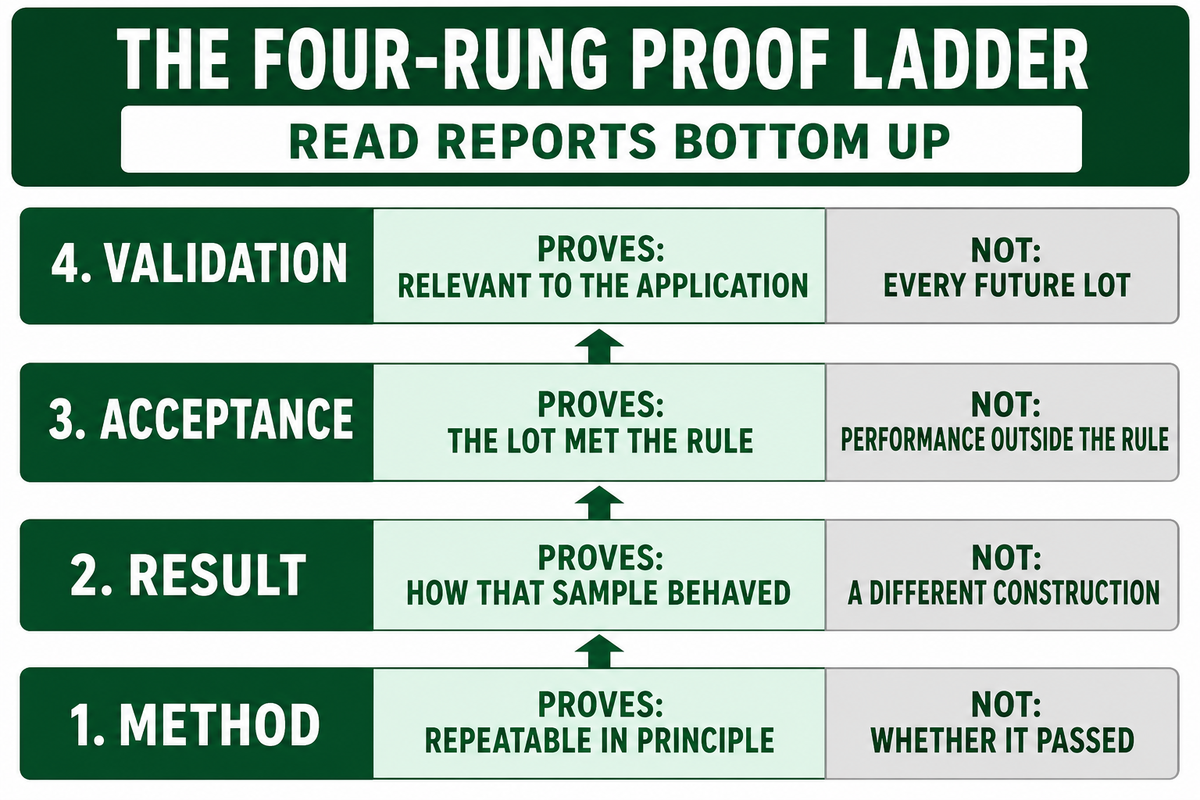
A label test method controls how a measurement is made, but it doesn’t decide whether the result is acceptable. Buyers need four separate layers: a named method, the measured result, a prewritten acceptance rule, and evidence that the laboratory condition represents the actual application. Removing any rung changes what the report can prove.
FINAT makes the distinction explicit on its Test Methods page: FINAT provides standardized methods, yet the methods and related information do not themselves imply a performance specification. Individual ASTM scopes take the same cautious approach. A result can be precise and still answer the wrong question.
| Rung | What must be recorded | What it proves | What it does not prove |
|---|---|---|---|
| 1. Method | Standard, procedure, apparatus, specimen geometry | The measurement was repeatable in principle | Whether the result passed |
| 2. Result | Value, units, variability, failure mode | How that sample behaved | Whether a different construction behaves the same |
| 3. Acceptance | Minimum, maximum, allowable change, sample rule | Whether the tested lot met the buyer’s rule | Long-term performance outside the rule |
| 4. Validation | Actual surface, printing, exposure, handling, and duration | The result is relevant to the defined application | Every future lot or a different use case |
Consider two suppliers reporting “ASTM peel.” Supplier A names the exact procedure, panel, dwell, conditioning, peel angle, rate, specimen width, mean, range, and failure mode. Supplier B reports only one value. Even if B’s number is higher, A has supplied more usable proof because the test can be reproduced and compared against a written requirement.
FINAT Test Methods: A Map for Labelstock and Print Performance
FINAT’s current 11th-edition collection lists 31 methods for self-adhesive label materials. Its coverage spans adhesive behavior, release, ageing, ultraviolet exposure, chemical change, and print-surface durability. Each method isolates a question; no method converts the full label construction into a universal service-life claim.
For quality planning, the useful approach is to group FINAT methods by failure mode. Peel and tack help characterize bond formation. Shear measures resistance to movement under load. Ink rub and scratch methods address print-surface damage. Chemical and ageing methods evaluate change after a controlled exposure. Those families shouldn’t be collapsed into one “durability score.”
| Method | Primary question | Useful output | Boundary |
|---|---|---|---|
| FTM 1 | 180° peel at 300 mm/min | Peel force under that geometry and rate | Not directly interchangeable with a 90° result |
| FTM 2 | 90° peel at 300 mm/min | Peel force with lower bending reversal | Angle still changes the mechanics |
| FTM 3 | Low-speed release | Liner release force at the stated speed | Does not predict high-speed converting by itself |
| FTM 4 | High-speed release | Release behavior under faster separation | Machine geometry and acceleration still matter |
| FTM 5 | Accelerated ageing | Change after a defined ageing exposure | No automatic conversion to field years |
| FTM 6 | Ultraviolet exposure | Change under the stated exposure | Outdoor climate is not reduced to one lamp cycle |
| FTM 8 | Shear resistance | Holding behavior under the method’s load | Not a substitute for peel or tack |
| FTM 9 | Loop tack | Initial grab under a loop geometry | Not long-term bond retention |
| FTM 16 / 17 | Chemical spot / immersion exposure | Visible or measured change after the named chemical contact | Reagent, concentration, duration, and temperature remain decisive |
| FTM 21 / 22 / 27 / 29 | Ink adhesion, rub, and scratch | Print-surface resistance under the named action | Does not prove adhesive hold or barcode scanning after every exposure |
Key takeaway
FINAT methods are a menu of controlled questions. Select the method from the failure mode you need to prevent; do not average unlike results into one label durability grade.
ASTM Methods Prove Narrower Material Behaviors
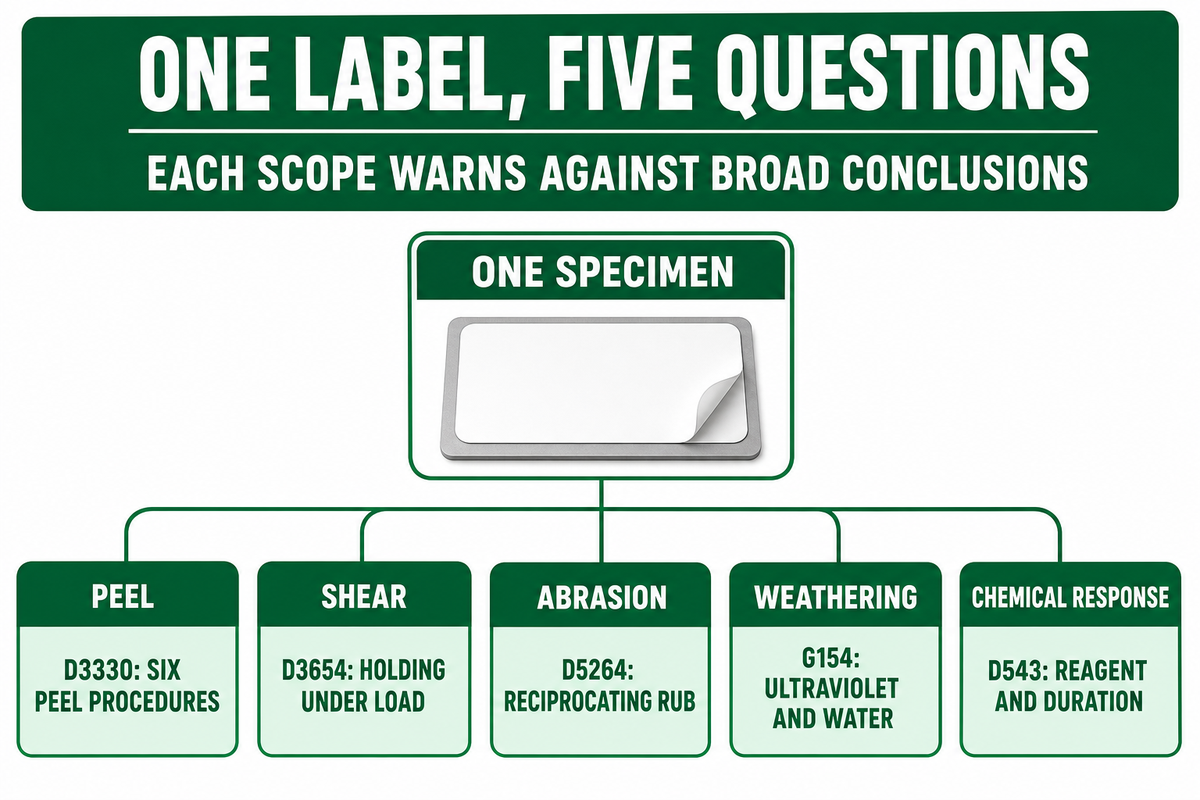
Separate ASTM procedures address peel, shear, abrasion, weathering, and chemical response, but their scopes repeatedly warn against broad conclusions. D3330/D3330M, for example, supports quality assurance and acceptance testing while stating that several procedures cannot universally compare tapes with different backings and adhesive rheology.
D3330/D3330M-04(2025) contains six peel procedures. D3654/D3654M-06(2024) measures holding under constant load parallel to the surface. Its scope also notes that results on standard steel may or may not relate to a different surface. A buyer comparing labelstocks therefore needs the actual application substrate, not only a steel-panel number.
For printed surfaces, ASTM D5264-98(2019) uses a reciprocating rub device to compare abrasion resistance. That method can rank print systems under the selected load and cycle count, but field damage also depends on handling, temperature, humidity, time, and contact material. Such a laboratory result is a controlled comparison, not a replica of every warehouse or transport route.
Weathering and chemical methods carry the same boundary. ASTM G154-23 is an ultraviolet and water exposure practice; the lamp, cycle, temperature, moisture, duration, and evaluation method must be reported. ASTM D543-21 makes reagent, concentration, stress, duration, temperature, and the measured property part of a chemical-resistance result.
Method controls the question. Acceptance criteria control pass or fail. End-use validation controls whether the answer is useful.
Why Two Peel Numbers May Not Be Comparable
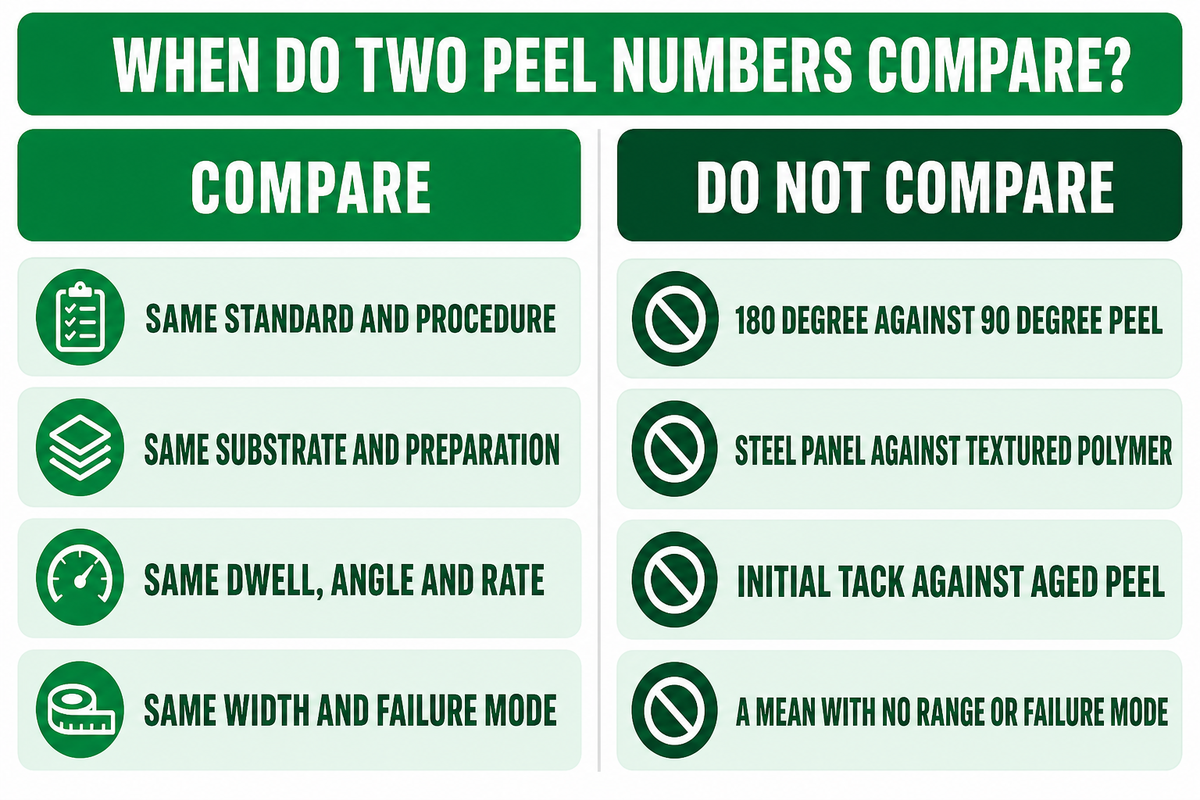
Peel adhesion isn’t a single material constant. Angle, rate, dwell, panel, conditioning, specimen width, backing stiffness, adhesive rheology, and failure mode all affect the measured force. Two values belong in the same comparison only when those conditions match or a validated conversion has been established.
This limitation is practical, not theoretical. D3330/D3330M says several of its procedures cannot compare tapes from different sources when backing stiffness and adhesive rheology differ. Its scope also says peel adhesion usually has no direct relationship to a functional requirement. ISO 29862:2024 provides another current method family for self-adhesive tape peel, but a standard number still does not erase specimen and procedure differences.
Compare
- Same standard and procedure
- Same substrate material and surface preparation
- Same dwell, conditioning, angle, and rate
- Same units, specimen width, and failure-mode reporting
Do not compare
- 180° peel against 90° peel as one ranking
- Steel-panel results against a textured polymer application
- Initial tack against aged peel or shear
- A single mean with no range or failure mode
Use a simple comparison rule: if the report can’t fill every field in one shared test-condition row, treat the values as separate observations. Don’t choose the higher number until the suppliers rerun a matched protocol.
The Method-Proof Matrix: Nine Questions Before You Accept a Claim
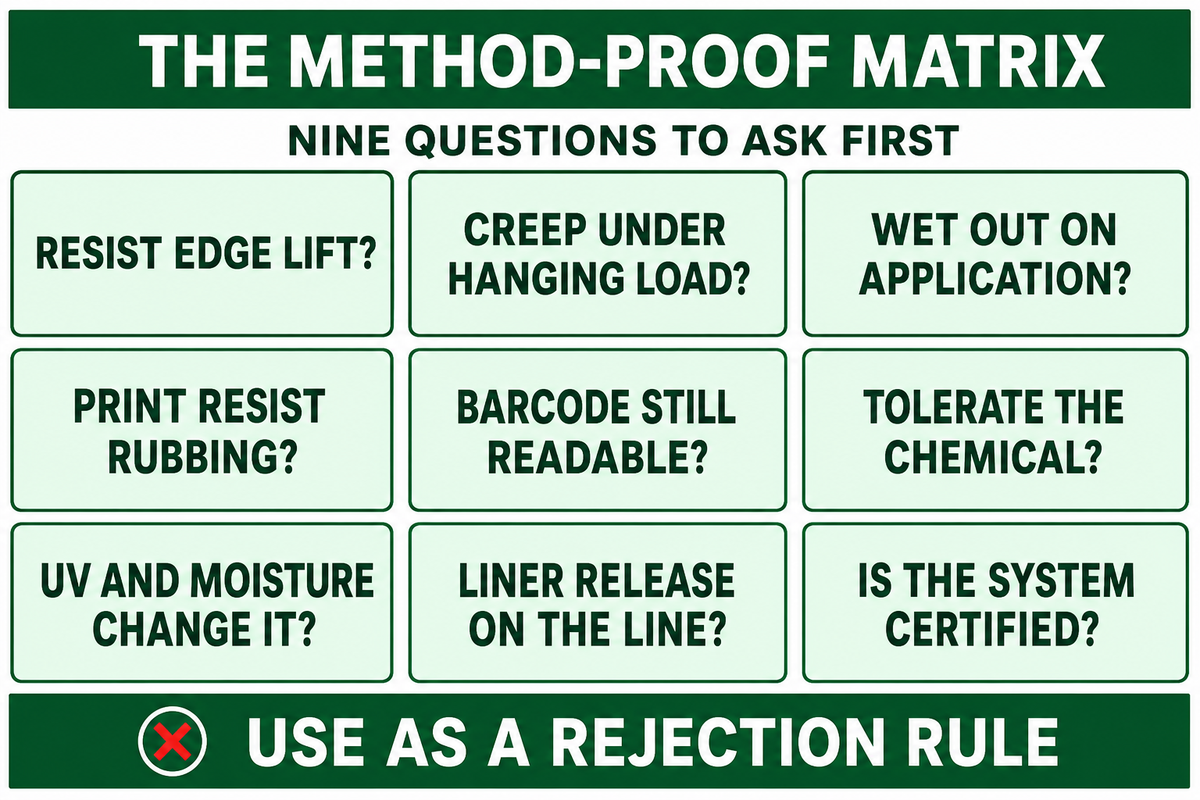
Our Method-Proof Matrix links the buyer’s failure concern to the narrow evidence needed. It prevents a common substitution error: using one convenient test to support a different property. Quality teams can use the last column as a report-rejection rule before comparing suppliers.
| Buyer question | Suitable method family | Evidence to retain | Reject the claim when |
|---|---|---|---|
| Will the label resist edge lift? | Peel plus end-use edge geometry | Force, angle, rate, dwell, panel, failure mode | Only “high adhesion” is reported |
| Will it creep under a hanging load? | Static shear / holding power | Load, bonded area, temperature, time or displacement | Peel is used as the only evidence |
| Will it wet out during application? | Loop tack plus application trial | Initial tack, application pressure, surface condition | Long-term durability is inferred from tack alone |
| Will the print resist repeated rubbing? | FTM ink rub or ASTM D5264-type abrasion | Rub material, load, cycles, visible change, scan result | “Abrasion resistant” has no conditions |
| Will a barcode remain readable? | Exposure plus barcode verification | Pre/post grade or scan rule, image, exposure record | Only visual ink damage is checked |
| Will the construction tolerate a chemical? | FTM chemical exposure or ASTM D543-type practice | Reagent, concentration, temperature, duration, stress, property change | The chemical is named but exposure is not |
| Will ultraviolet and moisture change it? | FTM 6 or ASTM G154-type exposure | Lamp, cycle, temperature, water, hours, property change | Hours are converted directly into outdoor years |
| Will the liner release on the converting line? | Low- and high-speed release plus line trial | Release force, speed, direction, liner, die-cut geometry | One low-speed value is applied to every machine |
| Is the label system certified? | Applicable certification program | Listed construction, scope, environment, authorization | A single material test is presented as certification |
Testing and certification aren’t synonyms, which is why the final row matters. UL’s marking and labeling program evaluates defined systems against established performance requirements. Running a peel, abrasion, or weathering method on one sample doesn’t create that certification.
Build a Decision-Grade Label Qualification Protocol
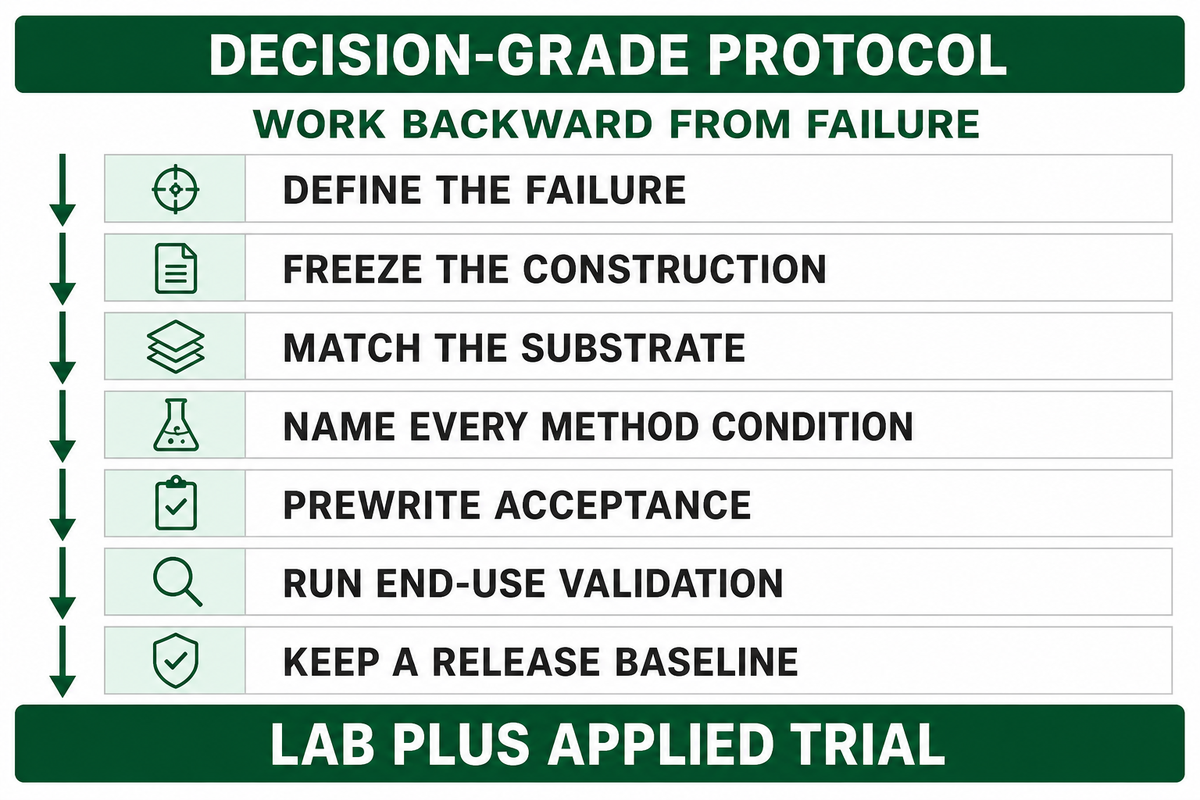
A decision-grade protocol starts with the failure mode and works backward to methods, acceptance criteria, and sample controls. The protocol should freeze the label construction and actual substrate before testing, then combine laboratory measurements with an application trial. This makes the result useful for supplier comparison and incoming quality control.
- Define the failure — state whether rejection means edge lift, adhesive residue, print loss, unreadable barcode, liner mis-release, chemical change, or another observed condition.
- Freeze the construction — record facestock, adhesive, coat, liner, ink, varnish or laminate, dimensions, print process, and lot identification.
- Match the substrate — use the actual material, finish, curvature, contamination state, and cleaning process whenever application relevance matters.
- Name every method condition — write procedure, geometry, equipment, conditioning, dwell, rate, load, temperature, humidity, reagent, and duration before samples arrive.
- Prewrite acceptance — define numerical limits where valid, allowable visual change, barcode rule, failure mode, sample count, and treatment of outliers.
- Run end-use validation — expose applied labels to the handling, cleaning, environment, and time sequence that the laboratory method is meant to represent.
- Keep a release baseline — approve the exact construction and retain the report, specimens, lot data, and agreed incoming-check method.
An illustrative protocol might pair matched-procedure peel and shear with abrasion, a defined chemical wipe, and barcode verification before and after exposure. The buyer would reject the sample if any prewritten condition fails, even if its peel value is the highest, because label performance is a system result, not a single-number contest.
No laboratory plan can simulate every real-world condition. A label that must withstand repeated handling, ultraviolet exposure, cleaning chemistry, and temperature change needs a focused laboratory sequence plus an applied-part trial. Regulatory compliance remains a separate documentation check; a durability result can support that file without replacing the applicable requirement or certification decision.
Use the 0–10 Report Completeness Score Before Comparing Results
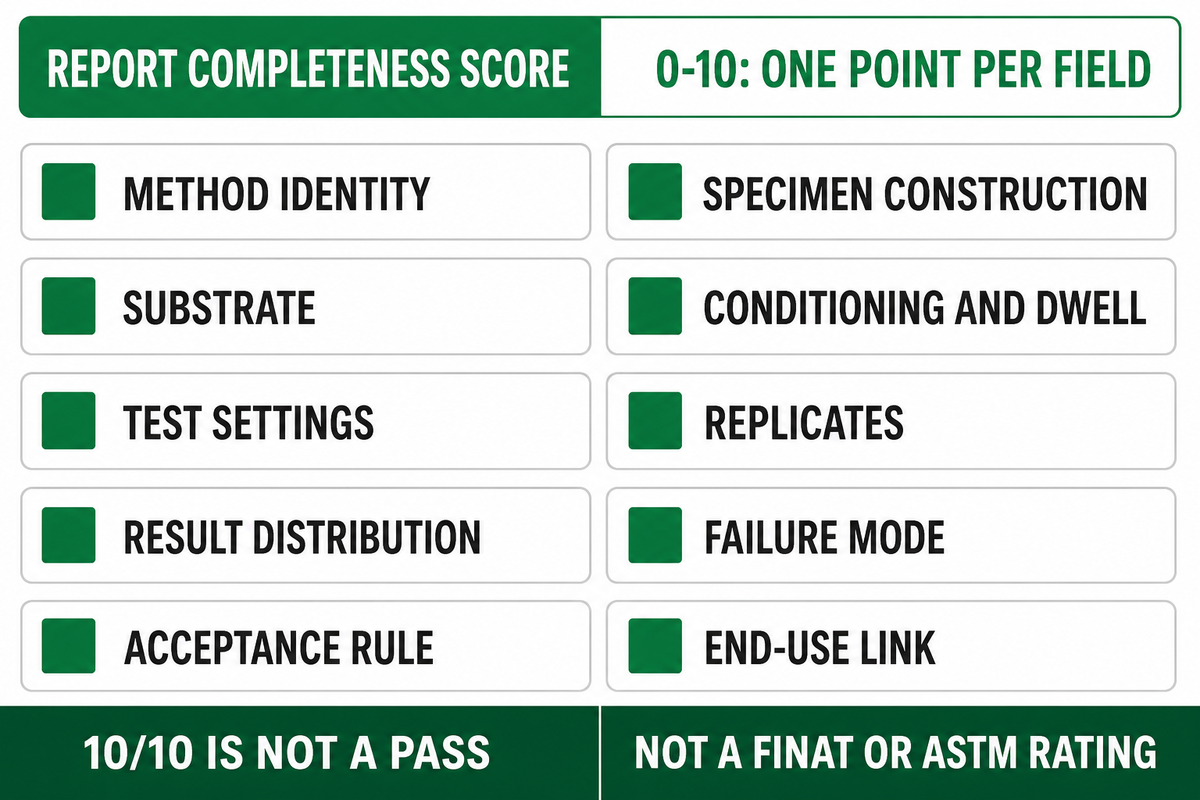
Guanma’s Report Completeness Score is an editorial procurement screen, not a FINAT or ASTM rating. Give one point for each of ten report fields. This score measures whether a result is interpretable and reproducible; it does not grade the label’s physical durability or replace a technical acceptance decision.
| Point | Required field | Minimum evidence | Why it changes the decision |
|---|---|---|---|
| 1 | Method identity | Standard, edition, procedure | Defines the measurement family |
| 1 | Specimen construction | Facestock, adhesive, liner, print, finish, lot | Prevents substitution between constructions |
| 1 | Substrate | Material, finish, preparation | Controls surface relevance |
| 1 | Conditioning and dwell | Temperature, humidity, time | Controls adhesive development and material state |
| 1 | Test settings | Angle, speed, load, cycles, reagent, or lamp cycle | Makes the result reproducible |
| 1 | Replicates | Sample count and specimen exclusions | Shows whether one value represents a set |
| 1 | Result distribution | Mean plus range or other agreed variability | Exposes unstable performance |
| 1 | Failure mode | Adhesive, cohesive, facestock, ink, substrate, or mixed | Explains what the number represents |
| 1 | Acceptance rule | Limit, change allowance, barcode or visual rule | Turns data into pass or fail |
| 1 | End-use link | Application trial or documented correlation | Connects the laboratory result to the buyer’s use |
Worked example: a supplier report identifies ASTM D3330 Procedure A, the label construction, steel panel, conditioning, peel settings, sample count, and mean value. It omits variability, failure mode, acceptance rule, and application correlation. This example scores 6/10: method identity (1) + construction (1) + substrate (1) + conditioning (1) + settings (1) + replicates (1) = 6. Procurement does not reject the report as “bad”; it holds the result out of supplier comparison until the four missing fields are supplied.
A score of 10/10 still doesn’t mean the label passed. It means the report contains the ten fields needed for interpretation. Pass or fail comes from the acceptance rule, while end-use confidence comes from the application evidence.
Put the Test Conditions Into the Label RFQ
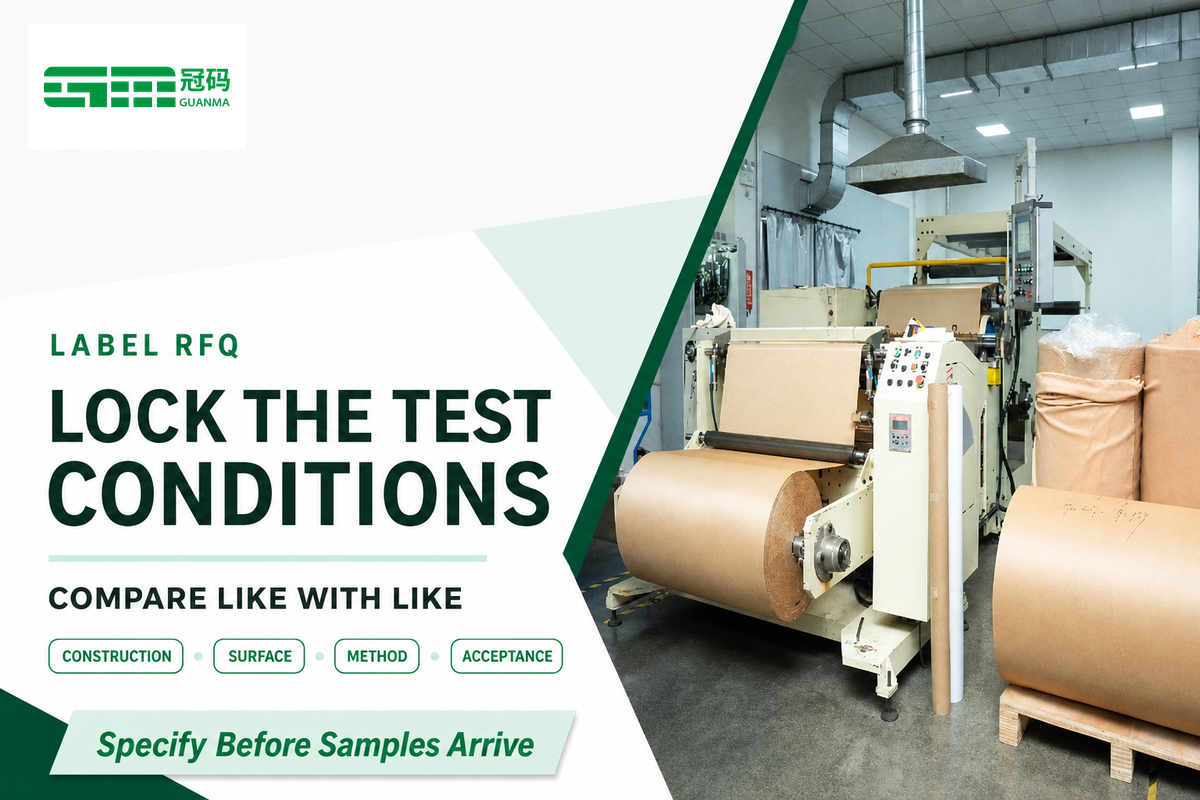
A label RFQ should ask suppliers to quote the same construction and test conditions. If one supplier chooses the substrate, dwell, peel angle, or chemical exposure independently, the resulting numbers describe different experiments. Copy the fields below into the sample request and leave numerical limits project-specific until engineering defines them.
RFQ checklist — copy these into your quote request:
| Parameter | Required entry | Why it matters | How to verify |
|---|---|---|---|
| Label construction | Facestock, adhesive, liner, print, coating or laminate, total thickness | Durability belongs to the complete construction | Approved specification and lot traceability |
| Application surface | Actual material, finish, shape, and cleaning method | Standard steel may not represent the end use | Controlled substrate coupons and applied-part trial |
| Peel requirement | Named FINAT, ASTM, or ISO method and exact procedure | Angle, rate, width, and dwell change the value | Full laboratory report with failure mode |
| Shear requirement | Load, bonded area, direction, temperature, time or displacement limit | Holding power answers a different question from peel | Matched method and retained specimens |
| Print and barcode | Rub material, load, cycles, post-test visual and scan rule | Legible text and barcode scannability can fail differently | Before/after images and recorded scan result |
| Chemical exposure | Reagent, concentration, temperature, contact method, duration, repetitions | A chemical name alone is not a test condition | Exposure log and defined property change |
| Weathering | Lamp, irradiance setting, cycle, temperature, water condition, duration | Accelerated hours do not equal universal field years | ASTM G154-type report plus outdoor correlation where claimed |
| Acceptance and change control | Limits, sample rule, failure mode, approved lot, notification triggers | Creates a repeatable release decision | Signed specification and incoming inspection record |
When a seller can’t provide every field, separate “not tested” from “failed.” Missing data is a qualification gap, not evidence of poor performance. Procurement can then decide whether to request a matched test, run an internal trial, narrow the claim, or choose a construction with stronger documentation.
When Not to Accept a Label Durability Claim
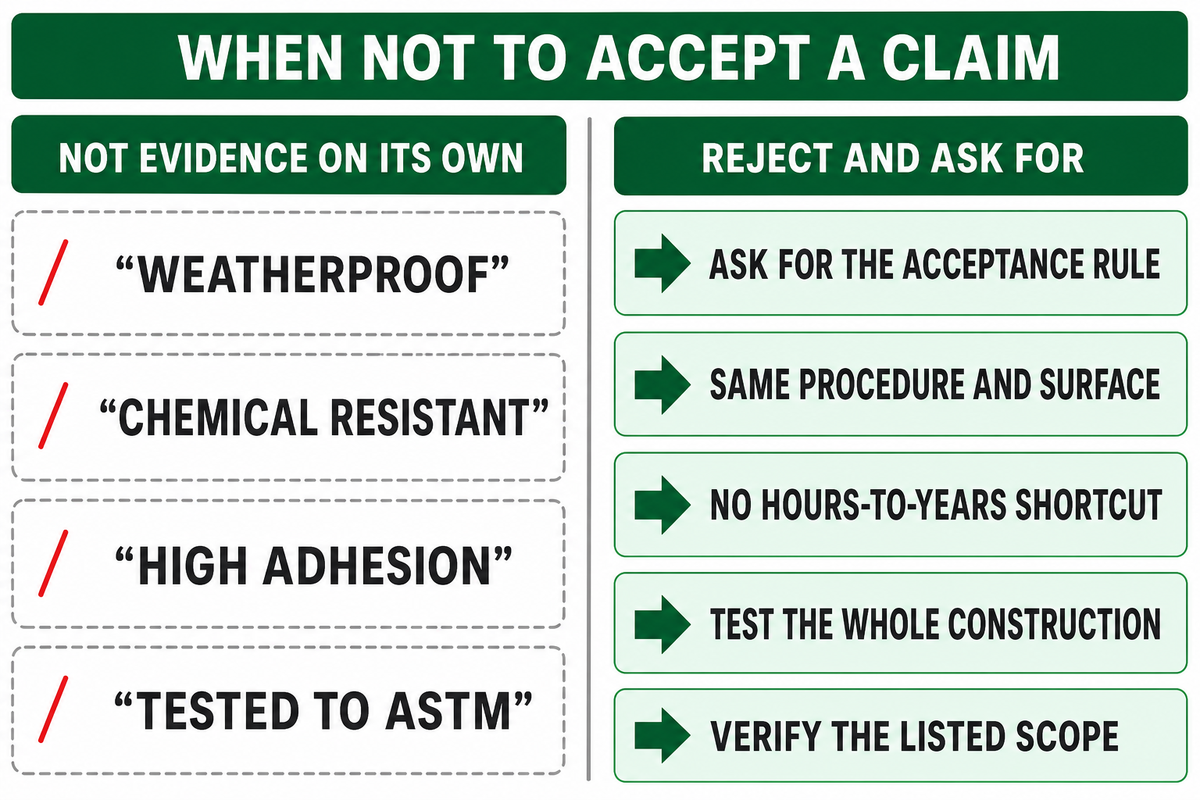
Do not accept a durability claim when the property, method, conditions, or acceptance rule is missing. Phrases such as “weatherproof,” “chemical resistant,” “high adhesion,” and “tested to ASTM” are starting points for questions. They are not self-contained evidence of performance in your environmental conditions.
- Reject method-only wording: ask for the result and acceptance criteria.
- Reject unmatched comparisons: ask suppliers to use the same procedure and application surface.
- Reject hours-to-years shortcuts: ask for a documented correlation to the specified outdoor use.
- Reject component substitution: a durable facestock doesn’t prove the ink, topcoat, adhesive, liner, and barcode remain intact together.
- Reject certification shorthand: confirm the listed construction, scope, environment, and authorization rather than assuming one passing test creates a certified system.
A buyer doesn’t need every possible durability test. The correct set is the smallest group that covers the credible failure modes, uses reproducible conditions, and connects to the actual application. That approach costs less and produces better evidence than ordering a broad menu of unrelated laboratory results.
Summary
FINAT and ASTM methods create repeatable measurements, not universal durability promises. FINAT provides a label-industry method collection across adhesive, release, ageing, chemical, and print behaviors. ASTM methods offer detailed procedures and unusually useful scope limitations. Read those limitations as part of the result.
For supplier approval, apply the Four-Rung Proof Ladder: method, result, acceptance, and validation. Use the Method-Proof Matrix to choose tests from actual failure modes, then use the 0–10 Report Completeness Score to identify missing report fields before comparing numbers. Final approval belongs to the complete label construction on the intended surface and in the stated service profile.
Frequently Asked Questions
What do label durability testing standards prove?
A standard method proves how a defined specimen behaved under its recorded procedure and conditions; field service life, certification, and performance on another surface need separate evidence.
It supports repeatable measurement when the construction, apparatus, conditioning, and settings match. The report can compare samples or support an acceptance decision if a limit was defined. Field service life, performance on another surface, a passing result without criteria, and certification all require separate evidence tied to the intended application and complete label construction.
Is FINAT testing the same as ASTM testing?
No. FINAT centers on self-adhesive label materials, while ASTM publishes broader material and exposure procedures; similarly named tests still require scope, specimen, and condition checks.
FINAT’s collection is closely aligned with self-adhesive label materials and converting. ASTM standards cover individual material and exposure questions across many industries. A peel, shear, abrasion, or weathering method may address a related property without using the same specimen or procedure. Compare scope, edition, geometry, conditioning, units, and stated limitations before placing values in one supplier table.
Does “tested to ASTM” mean a label passed?
No. “Tested to ASTM” identifies a procedure, but only a declared minimum, maximum, allowable change, or visual rule can turn the measurement into pass or fail.
Ask for the exact standard edition and procedure, specimen construction, substrate and preparation, conditioning, test settings, sample count, result distribution, failure mode, and acceptance criteria. Without a declared minimum, maximum, allowable change, or visual rule, the report contains measurements but no pass/fail decision for the buyer’s specified application and agreed sample release rule.
Can accelerated weathering hours be converted to outdoor years?
No universal conversion exists. Product-specific correlation is required for credible outdoor-year claims, using the same construction, defined failure endpoint, intended climate, orientation, mounting condition, and exposure sequence.
G154 describes ultraviolet and water exposure apparatus and practices, but it supplies no single hours-to-years factor. Lamp choice, cycle, temperature, moisture, geography, orientation, shade, pollution, and the property being measured can all change the relationship. A correlation also needs a defined failure endpoint: color change, adhesion loss, cracking, print damage, or another property. Report the exact laboratory exposure, show the measured change, and qualify any service-life statement unless the same construction has a documented field correlation under the intended climate and mounting condition.
Which test shows whether a barcode will remain legible?
Barcode readability needs the relevant exposure test followed by a defined verification or scan rule; visual ink inspection alone may not predict whether the code remains scannable.
An ink rub or abrasion test can show surface damage, but visual inspection alone may not predict scanning. Define the symbology, verification method or scan acceptance, location, before/after measurement, and exposure sequence. Assess adhesive hold separately because a readable barcode on a lifting label still fails the application.
How many tests should be included in a label qualification plan?
Use the smallest test set that covers the credible failure modes and intended service profile, then add an end-use trial wherever laboratory conditions cannot represent the application.
Begin with the application surface and cleaning process, then list each exposure in order. Add the handling frequency, load direction, temperature, ultraviolet or moisture exposure, chemical contact, print and barcode requirement, liner behavior, and removal condition that actually occur. Map each credible failure to one suitable method family, remove duplicate tests, and write acceptance criteria before samples arrive. Where two methods answer the same narrow question, choose the one that best matches supplier equipment and the buyer’s baseline. Finish with an end-use trial whenever the laboratory setup cannot represent curvature, contamination, repeated handling, edge geometry, mixed exposures, or the full service sequence.
Related Guanma Guides
References & Sources
- FINAT Test Methods, 11th Edition Index. FINAT.
- ASTM D3330/D3330M-04(2025), Peel Adhesion of Pressure-Sensitive Tape. ASTM International.
- ASTM D3654/D3654M-06(2024), Shear Adhesion of Pressure-Sensitive Tape. ASTM International.
- ASTM D5264-98(2019), Abrasion Resistance of Printed Materials. ASTM International.
- ASTM G154-23, Operating Fluorescent Ultraviolet (UV) Lamp Apparatus for Exposure of Materials. ASTM International.
- ASTM D543-21, Resistance of Plastics to Chemical Reagents. ASTM International.
- ISO 29862:2024, Self-Adhesive Tapes: Determination of Peel Adhesion Properties. International Organization for Standardization.
- Marking and Labeling Testing and Certification. UL Solutions.
Build a Testable Label Specification with Guanma
Send the label construction, application surface, service conditions, failure concerns, and acceptance needs. Guanma can help turn those inputs into a material and sample brief for review with your quality, engineering, and procurement teams.