Entre em Contato com Guanma

Atualizado em agosto de 2026 · Um guia de interpretação de métodos para equipes de qualidade, engenharia e compras
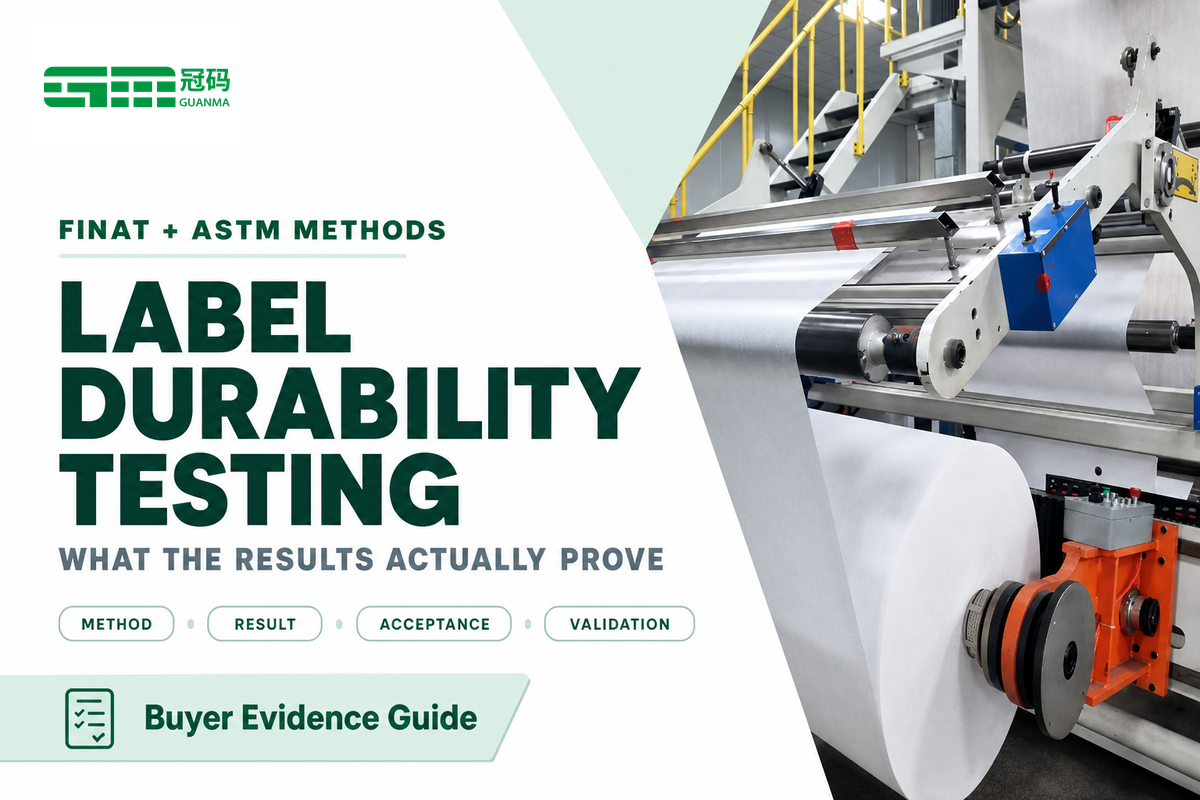
Padrões de teste de durabilidade de etiquetas são procedimentos controlados para medir um comportamento especificado, como descascamento, cisalhamento, abrasão, mudança química ou intemperismo, sob condições declaradas. Eles não concedem um grau de“ universal ”durável. Evidências de grau de decisão emergem apenas quando o método, amostra, ambiente, limite de aceitação e relação de uso final são todos registrados.
Resposta curta: Um método de teste prova como uma construção de etiqueta especificada se comportou nesse teste. Ele não prova, por si só, a vida útil, a certificação ou o desempenho em cada substrato. A FINAT afirma que seus métodos não implicam uma especificação de desempenho; Os escopos ASTM limitam repetidamente as comparações com o procedimento e as condições declarados.
- Mais importante: “Testado para ASTM” nomeia um procedimento, não um resultado de aceitação.
- Os métodos FINAT são especialmente úteis para conversão de etiquetas e controle de qualidade do sistema adesivo.
- Os métodos ASTM geralmente respondem a questões materiais mais restritas e cada escopo afirma o que o resultado não pode estabelecer.
- Um comprador precisa de uma regra de aprovação/reprovação declarada mais validação de uso final antes de aprovar a construção de uma etiqueta.
Um método de teste é apenas o primeiro degrau da escada de prova
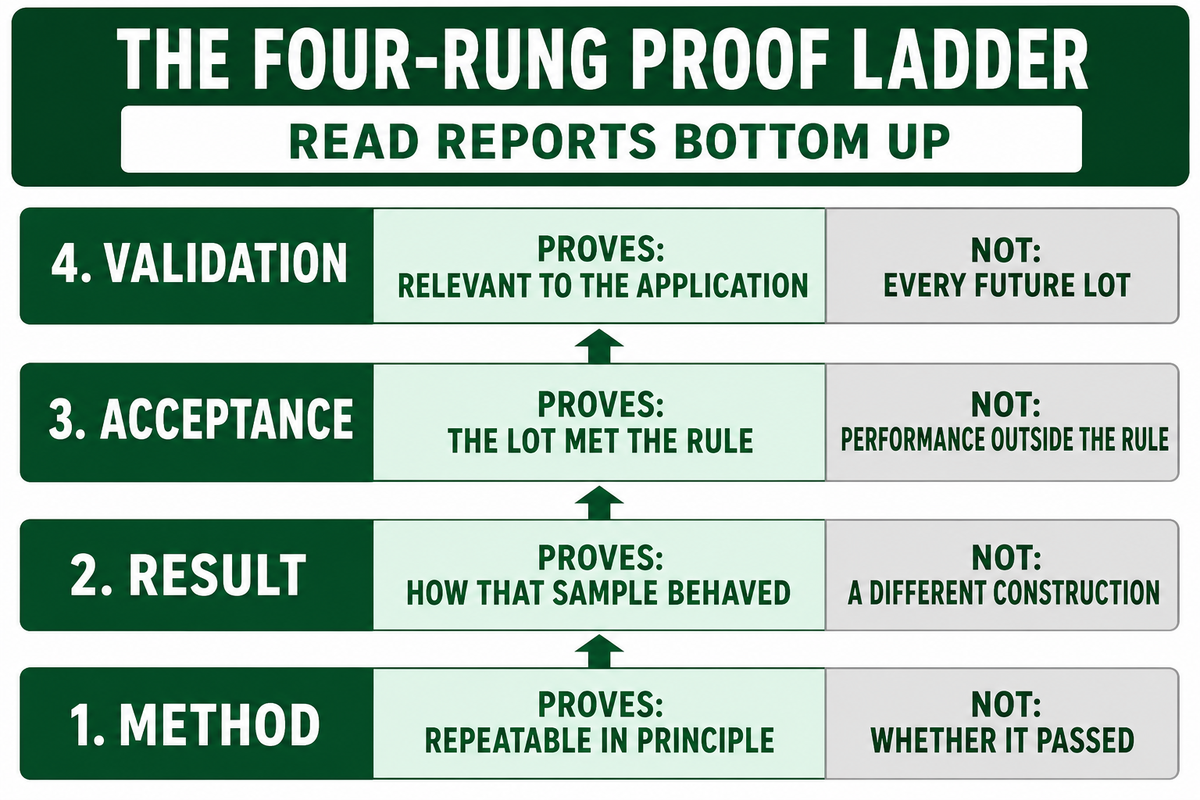
Um método de teste de rótulo controla como uma medição é feita, mas não decide se o resultado é aceitável. Os compradores precisam de quatro camadas separadas: um método nomeado, o resultado medido, uma regra de aceitação pré-escrita e evidências de que a condição do laboratório representa a aplicação real. Removendo qualquer degrau altera o que o relatório pode provar.
A FINAT torna a distinção explícita Métodos de teste página: FINAT fornece métodos padronizados, ainda os métodos e informações relacionadas não implicam em si uma especificação de desempenho. Escopos ASTM individuais tomam a mesma abordagem cautelosa. Um resultado pode ser preciso e ainda responder à pergunta errada.
| Rung | O que deve ser gravado | O que prova | O que não prova |
|---|---|---|---|
| 1. Método | Padrão, procedimento, aparelho, geometria do espécime | A medição era repetível em princípio | Se o resultado passou |
| 2. Resultado | Valor, unidades, variabilidade, modo de falha | Como aquela amostra se comportou | Se uma construção diferente se comporta da mesma forma |
| 3. Aceitação | Mínimo, máximo, alteração permitida, regra da amostra | Se o lote testado atendeu à regra do comprador | Desempenho a longo prazo fora da regra |
| 4. Validação | Superfície real, impressão, exposição, manuseio e duração | O resultado é relevante para a aplicação definida | Cada lote futuro ou um caso de uso diferente |
Considere dois fornecedores que relatam o peeling “ASTM.” O Fornecedor A nomeia o procedimento exato, painel, permanência, condicionamento, ângulo de descascamento, taxa, largura da amostra, média, alcance e modo de falha. O Fornecedor B relata apenas um valor. Mesmo que o número de B seja maior, A forneceu provas mais utilizáveis porque o teste pode ser reproduzido e comparado com um requisito escrito.
Métodos de teste FINAT: um mapa para desempenho de etiquetas e impressões
A atual coleção da FINAT, na 11ª edição, lista 31 métodos para materiais autoadesivos para rótulos. Sua cobertura abrange comportamento do adesivo, liberação, envelhecimento, exposição ultravioleta, alteração química e durabilidade da superfície de impressão. Cada método isola uma questão; nenhum método transforma toda a estrutura do rótulo em uma alegação universal de vida útil de operação.
Para o planejamento da qualidade, a abordagem útil é agrupar os métodos FINAT por modo de falha, Peel and tack ajudam a caracterizar a formação de ligação. O cisalhamento mede a resistência ao movimento sob carga. Os métodos de esfregar e arranhar a tinta abordam os danos na superfície de impressão. Os métodos químicos e de envelhecimento avaliam a mudança após uma exposição controlada. Essas famílias não devem ser colapsadas em uma pontuação de “durabilidade.”
| Método | Pergunta primária | Saída útil | Limite |
|---|---|---|---|
| FTM 1 | Descascamento de 180° a 300 mm/min | Força de descascamento sob essa geometria e taxa | Não é diretamente intercambiável com um resultado de 90° |
| FTM 2 | Descascamento de 90° a 300 mm/min | Força de descascamento com menor reversão de flexão | O ângulo ainda muda a mecânica |
| FTM 3 | Liberação em baixa velocidade | Força de liberação do liner na velocidade indicada | Não prevê conversão de alta velocidade por si só |
| FTM 4 | Liberação em alta velocidade | Comportamento de liberação sob separação mais rápida | A geometria e a aceleração da máquina ainda importam |
| FTM 5 | Envelhecimento acelerado | Alteração após uma exposição definida ao envelhecimento | Nenhuma conversão automática para anos de campo |
| FTM 6 | Exposição ultravioleta | Alteração sob a exposição declarada | O clima ao ar livre não é reduzido a um ciclo de lâmpada |
| FTM 8 | Resistência ao cisalhamento | Comportamento de retenção sob a carga do método | Não é um substituto para casca ou aderência |
| FTM 9 | Alça de laço | Pegada inicial sob uma geometria de loop | Não retenção de títulos de longo prazo |
| FTM 16/17 | Ponto químico/exposição de imersão | Alteração visível ou medida após o contato químico nomeado | Reagente, concentração, duração e temperatura permanecem decisivos |
| FTM 21/22/27/29 | Adesão da tinta, esfregue e arranhe | Resistência da impressão-superfície sob a ação nomeada | Não prova a retenção adesiva ou a leitura de código de barras após cada exposição |
Levantamento chave
Os métodos FINAT são um menu de perguntas controladas. Selecione o método no modo de falha que você precisa evitar; não calcule a média dos resultados diferentes em um grau de durabilidade da etiqueta.
Métodos ASTM comprovam comportamentos materiais mais restritos
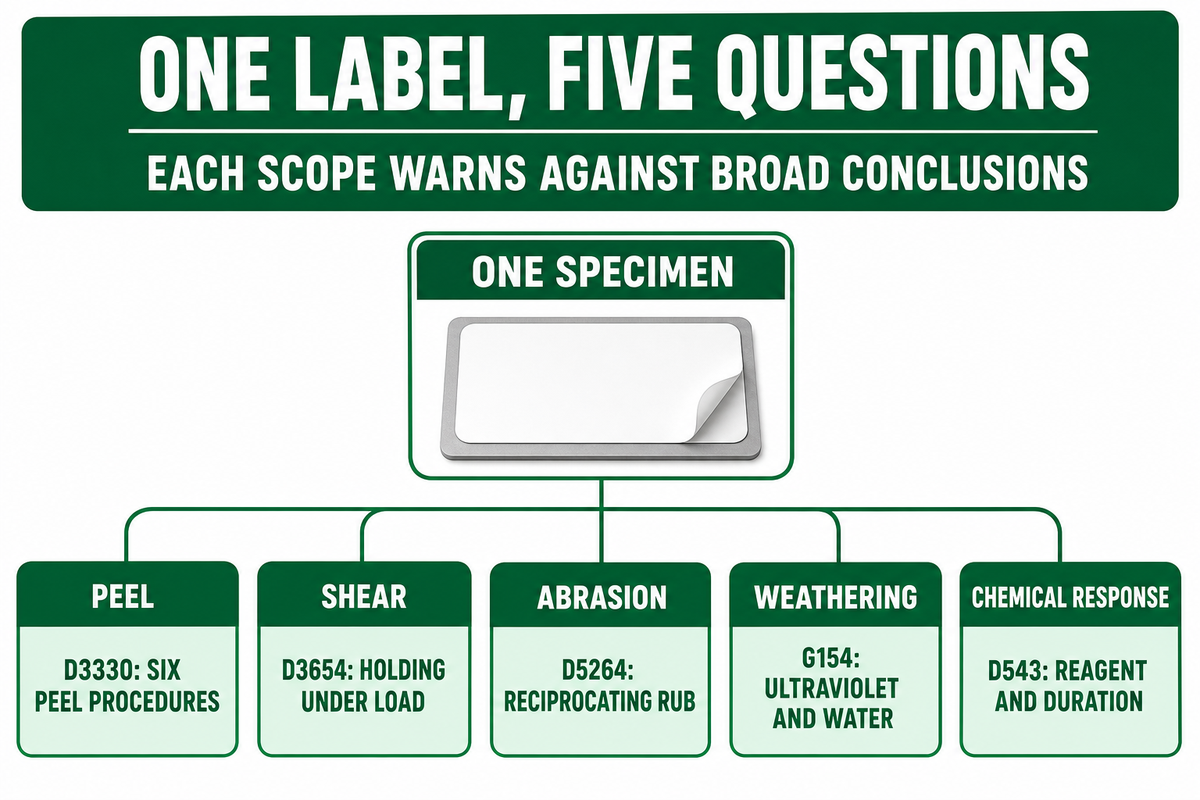
Procedimentos ASTM separados abordam descascamento, cisalhamento, abrasão, intemperismo e resposta química, mas seus escopos alertam repetidamente contra conclusões amplas D3330/D3330 M, por exemplo, suporta garantia de qualidade e testes de aceitação, ao mesmo tempo em que afirma que vários procedimentos não podem comparar universalmente fitas com diferentes suportes e reologia adesiva.
D3330/D3330M-04(2025) contém seis procedimentos de descascamento. D3654/D3654M-06(2024) medidas segurando sob carga constante paralela à superfície. Seu escopo também observa que os resultados em aço padrão podem ou não estar relacionados a uma superfície diferente. Um comprador comparando etiquetas, portanto, precisa do substrato de aplicação real, não apenas de um número de painel de aço.
Para superfícies impressas, ASTM D5264-98(2019) usa um dispositivo alternativo de fricção para comparar a resistência à abrasão. Esse método pode classificar os sistemas de impressão sob a contagem de carga e ciclo selecionada, mas o dano no campo também depende do manuseio, temperatura, umidade, tempo e material de contato. Tal resultado de laboratório é uma comparação controlada, não uma réplica de cada armazém ou rota de transporte.
Os métodos de intemperismo e químicos carregam o mesmo limite. ASTM G154-23 é uma prática de exposição a ultravioleta e água; a lâmpada, o ciclo, a temperatura, a umidade, a duração e o método de avaliação devem ser relatados. ASTM D543-21 torna o reagente, a concentração, o estresse, a duração, a temperatura e a propriedade medida parte de um resultado de resistência química.
Método controla a pergunta. Os critérios de aceitação controlam a passagem ou a falha. A validação do uso final controla se a resposta é útil.
Por que dois números de descascamento podem não ser comparáveis
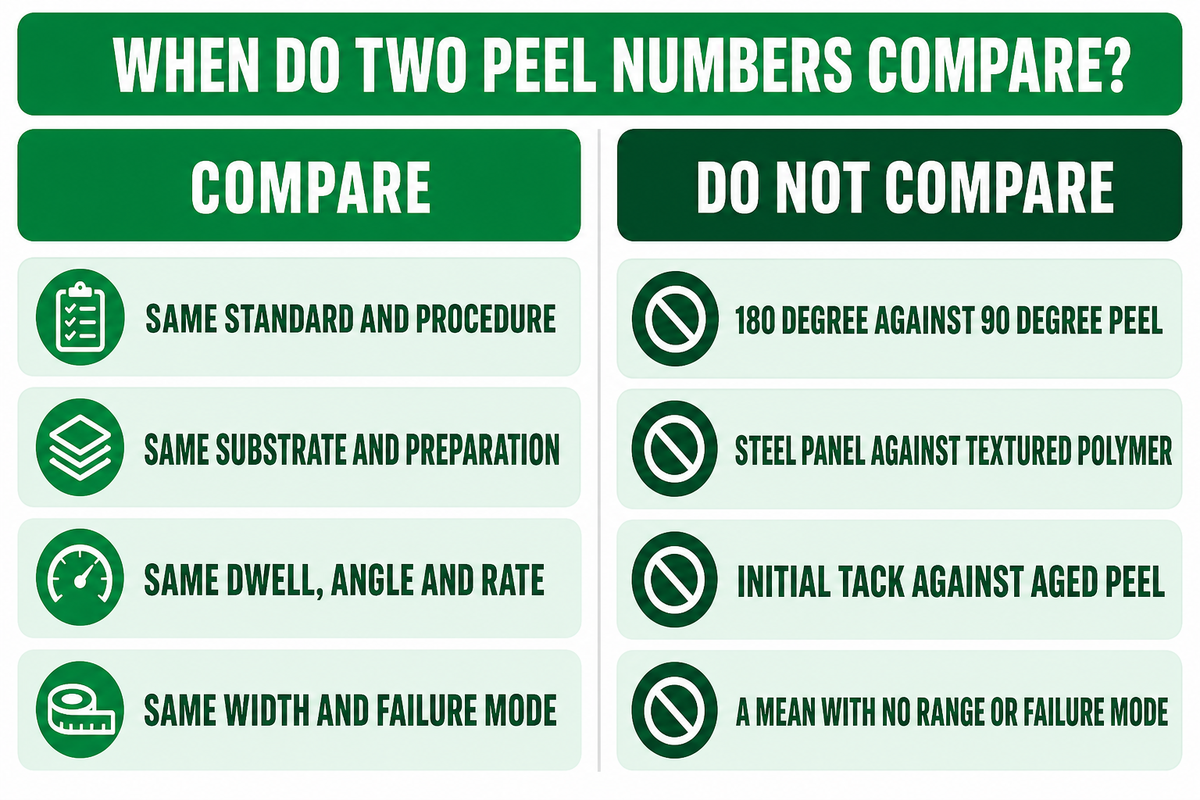
A adesão ao descascamento não é uma constante única do material. Ângulo, taxa, permanência, painel, condicionamento, largura da amostra, rigidez do suporte, reologia adesiva e modo de falha afetam a força medida. Dois valores pertencem à mesma comparação apenas quando essas condições correspondem ou uma conversão validada foi estabelecida.
Esta limitação é prática, não teórica. D3330/D3330 M diz que vários de seus procedimentos não podem comparar fitas de diferentes fontes quando a rigidez do suporte e a reologia adesiva diferem. Seu escopo também diz que a adesão ao descascamento geralmente não tem relação direta com um requisito funcional. ISO 29862:2024 fornece outra família de métodos atual para descascamento de fita autoadesiva, mas um número padrão ainda não apaga diferenças de amostra e procedimento.
Comparar
- Mesmo padrão e procedimento
- Mesmo material de substrato e preparação de superfície
- Mesma permanência, condicionamento, ângulo e taxa
- Mesmas unidades, largura da amostra e relatórios em modo de falha
Não compare
- Descasque de 180° contra descasque de 90° como uma classificação
- O painel de aço resulta contra uma aplicação de polímero texturizado
- Aderência inicial contra casca ou cisalhamento envelhecido
- Uma única média sem alcance ou modo de falha
Use uma regra de comparação simples: se o relatório não conseguir preencher todos os campos em uma linha compartilhada de condição de teste, trate os valores como observações separadas. Não escolha o número mais alto até que os fornecedores executem novamente um protocolo correspondente.
A matriz à prova de métodos: nove perguntas antes de aceitar uma reclamação
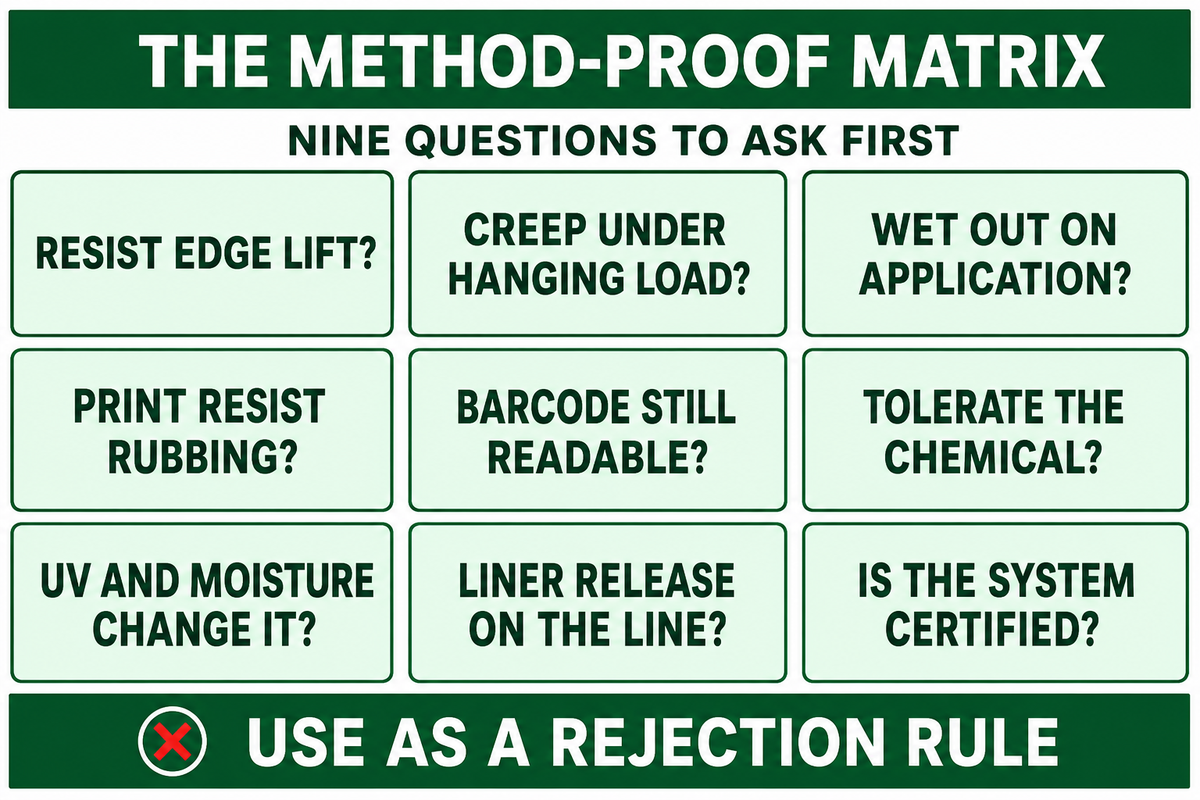
Nossa Matriz à Prova de Método vincula a preocupação de falha do comprador à evidência estreita necessária. Ela evita um erro de substituição comum: usar um teste conveniente para suportar uma propriedade diferente. Equipes de qualidade podem usar a última coluna como uma regra de relatório-rejeição antes de comparar fornecedores.
| Pergunta do comprador | Família de métodos adequada | Evidências a serem retidas | Rejeite a reclamação quando |
|---|---|---|---|
| A etiqueta resistirá ao levantamento da borda? | Geometria de borda de descascamento mais uso final | Força, ângulo, taxa, habitar, painel, modo de falha | Apenas “alta adesão” é relatada |
| Ele rastejará sob uma carga suspensa? | Cisalhamento estático/potência de retenção | Carga, área colada, temperatura, tempo ou deslocamento | Peel é usado como única evidência |
| Vai molhar durante a aplicação? | Loop tack mais teste de aplicação | Adiramento inicial, pressão de aplicação, condição da superfície | A durabilidade a longo prazo é inferida apenas pela aderência |
| A impressão resistirá a esfregar repetidamente? | Fricção de tinta FTM ou abrasão do tipo ASTM D5264 | Rub material, carga, ciclos, mudança visível, resultado da varredura | “Abrasão resistente” não tem condições |
| Um código de barras permanecerá legível? | Exposição mais verificação de código de barras | Pré/pós-grau ou regra de digitalização, imagem, registro de exposição | Apenas danos visuais à tinta são verificados |
| A construção tolerará um produto químico? | Exposição química FTM ou prática do tipo ASTM D543 | Reagente, concentração, temperatura, duração, tensão, mudança de propriedade | O produto químico é nomeado, mas a exposição não |
| O ultravioleta e a umidade mudarão isso? | Exposição tipo FTM 6 ou ASTM G154 | Lâmpada, ciclo, temperatura, água, horas, mudança de propriedade | As horas são convertidas diretamente em anos ao ar livre |
| O liner será lançado na linha de conversão? | Liberação de baixa e alta velocidade mais teste de linha | Força de liberação, velocidade, direção, liner, geometria de meio-corte | Um valor de baixa velocidade é aplicado a cada máquina |
| O sistema de etiquetas é certificado? | Programa de certificação aplicável | Construção listada, escopo, meio ambiente, autorização | Um único teste de material é apresentado como certificação |
Testes e certificação não são sinônimos, e é por isso que a linha final é importante. Programa de marcação e rotulagem da UL avalia sistemas definidos em relação aos requisitos de desempenho estabelecidos A execução de um método de descascamento, abrasão ou intemperismo em uma amostra não cria essa certificação.
Construa um protocolo de qualificação de rótulo de nível de decisão
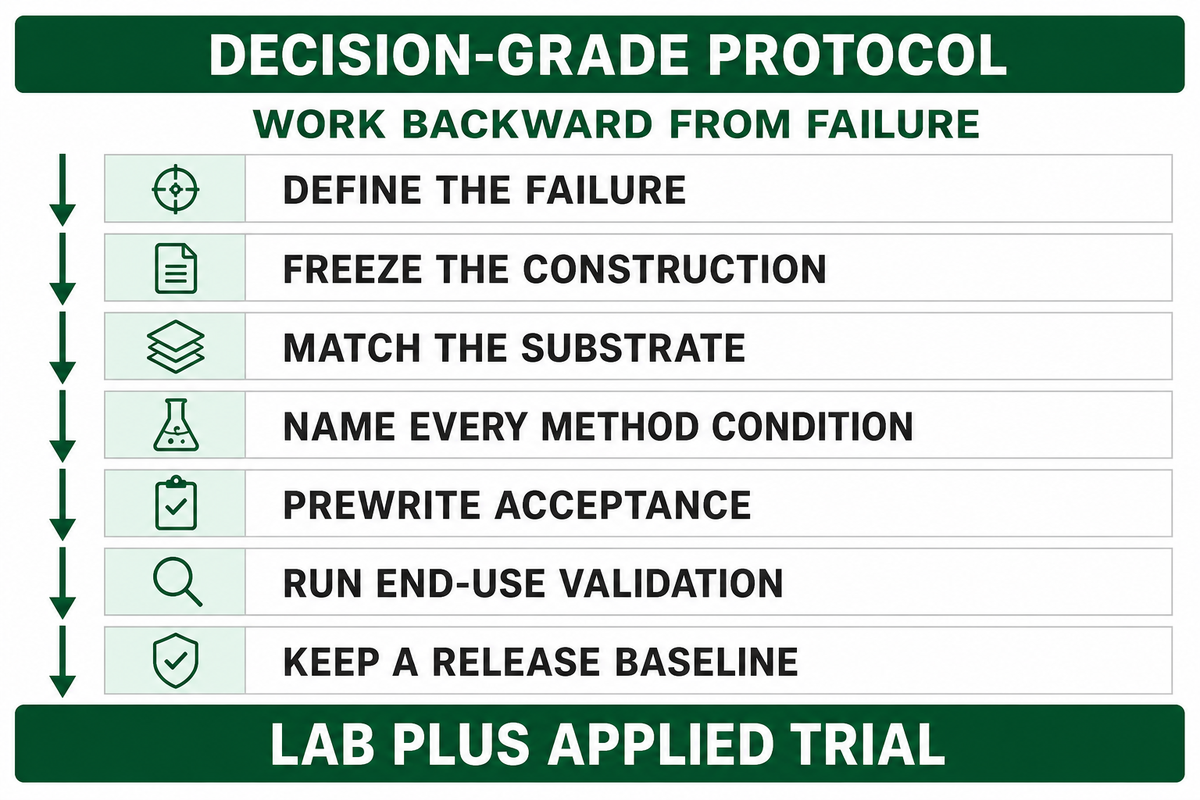
Um protocolo de grau de decisão começa com o modo de falha e funciona de volta para métodos, critérios de aceitação e controles de amostra. O protocolo deve congelar a construção do rótulo e o substrato real antes do teste e, em seguida, combinar medições laboratoriais com um teste de aplicação. Isso torna o resultado útil para comparação de fornecedores e controle de qualidade de entrada.
- Defina a falha — informe se rejeição significa levantamento das bordas, resíduo de adesivo, perda de impressão, código de barras ilegível, liberação incorreta do liner, alteração química ou outra condição observada.
- Congele a construção — registre frontal, adesivo, revestimento, liner, tinta, verniz ou laminado, dimensões, processo de impressão e identificação do lote.
- Combine o substrato 1000 o material real, o acabamento, a curvatura, o estado de contaminação, e o processo de limpeza sempre que a relevância da aplicação importa.
- Nomeie cada condição de método & write procedimento, geometria, equipamento, condicionamento, habitar, taxa, carga, temperatura, umidade, reagente, e duração antes das amostras chegam.
- Pré-escrever aceitação 1 define limites numéricos onde válido, permite alteração visual, regra de código de barras, modo de falha, contagem de amostras e tratamento de valores discrepantes.
- Execute a validação de uso final 100 rótulos aplicados ao manuseio, limpeza, ambiente e sequência de tempo que o método laboratorial pretende representar.
- Mantenha uma linha de base de liberação (a) a construção exata e retém o relatório, os dados do lote e o método de verificação de entrada acordado.
Um protocolo ilustrativo pode emparelhar descascamento e cisalhamento de procedimento combinado com abrasão, um lenço químico definido e verificação de código de barras antes e depois da exposição. O comprador rejeitaria a amostra se qualquer condição pré-escrita falhar, mesmo que seu valor de descascamento seja o mais alto, porque o desempenho do rótulo é um resultado do sistema, não um concurso de número único.
Nenhum plano de laboratório pode simular todas as condições do mundo real. Uma etiqueta que deve suportar manuseio repetido, exposição ultravioleta, química de limpeza e mudança de temperatura precisa de uma sequência de laboratório focada mais um teste de parte aplicada. A conformidade regulatória continua sendo uma verificação de documentação separada; um resultado de durabilidade pode suportar esse arquivo sem substituir o requisito aplicável ou a decisão de certificação.
Use a pontuação de completude do relatório de 0–10 antes de comparar resultados
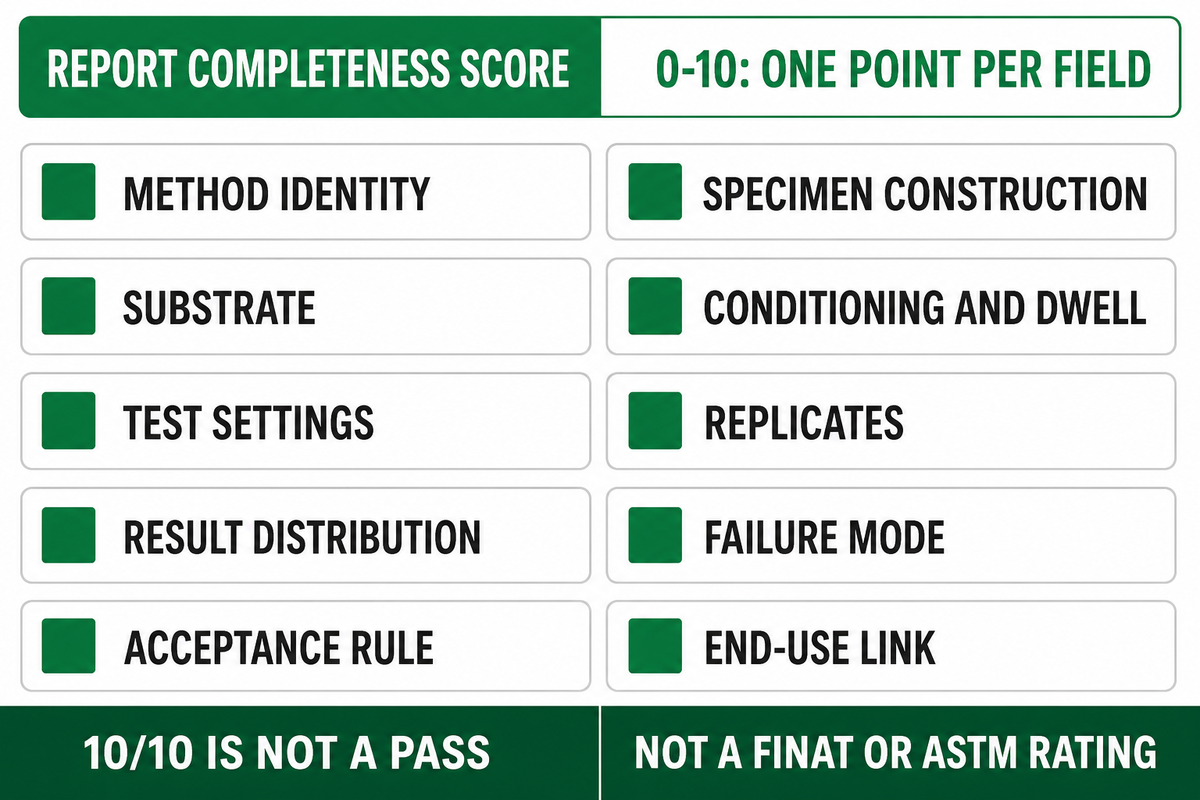
O Report Completeness Score da Guanma é uma tela de aquisição editorial, não uma classificação FINAT ou ASTM. Dê um ponto para cada um dos dez campos de relatório. Esta pontuação mede se um resultado é interpretável e reprodutível; ele não classifica a durabilidade física do rótulo ou substitui uma decisão de aceitação técnica.
| Ponto | Campo necessário | Evidência mínima | Por que isso muda a decisão |
|---|---|---|---|
| 1 | Identidade do método | Padrão, edição, procedimento | Define a família de medição |
| 1 | Construção de espécimes | Frontal, adesivo, liner, impressão, acabamento, lote | Impede a substituição entre construções |
| 1 | Substrato | Material, acabamento, preparação | Controla a relevância da superfície |
| 1 | Condicionamento e permanência | Temperatura, umidade, tempo | Controla o desenvolvimento adesivo e o estado do material |
| 1 | Configurações teste | Ângulo, velocidade, carga, ciclos, reagente ou ciclo da lâmpada | Torna o resultado reprodutível |
| 1 | Replica | Contagem de amostras e exclusões de amostras | Mostra se um valor representa um conjunto |
| 1 | Distribuição de resultados | Intervalo médio de mais ou outra variabilidade acordada | Expõe desempenho instável |
| 1 | Modo falha | Adesivo, coeso, facestock, tinta, substrato ou misturado | Explica o que o número representa |
| 1 | Regra aceitação | Limite, subsídio de alteração, código de barras ou regra visual | Transforma dados em pass ou fail |
| 1 | Link de uso final | Teste de aplicação ou correlação documentada | Conecta o resultado do laboratório ao uso do comprador |
Exemplo trabalhado: um relatório de fornecedor identifica ASTM D3330 Procedure A, a estrutura do rótulo, o painel de aço, o condicionamento, as configurações de descolamento, a quantidade de amostras e o valor médio. Ele omite variabilidade, modo de falha, regra de aceitação e correlação com a aplicação. Este exemplo recebe 6/10: identidade do método (1) + estrutura (1) + substrato (1) + condicionamento (1) + configurações (1) + réplicas (1) = 6. Compras não rejeita o relatório como “ruim”; mantém o resultado fora da comparação entre fornecedores até que os quatro campos ausentes sejam fornecidos.
Uma pontuação de 10/10 ainda não significa que o rótulo passou. Isso significa que o relatório contém os dez campos necessários para a interpretação. Pass ou fail vem da regra de aceitação, enquanto a confiança no uso final vem da evidência do aplicativo.
Coloque as condições de teste no rótulo RFQ
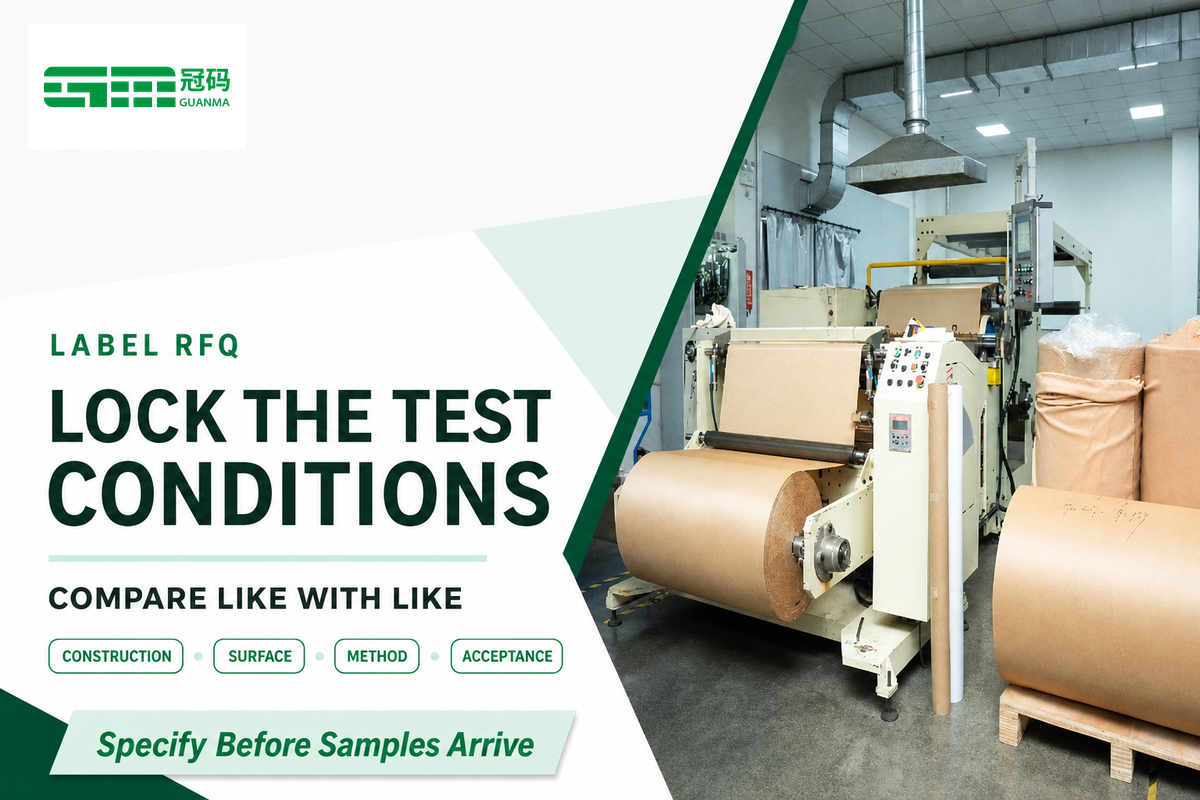
Uma RFQ de etiqueta deve pedir aos fornecedores que citem as mesmas condições de construção e teste. Se um fornecedor escolher o substrato, a permanência, o ângulo de descascamento ou a exposição química de forma independente, os números resultantes descrevem diferentes experimentos. Copie os campos abaixo na solicitação de amostra e deixe limites numéricos específicos do projeto até que a engenharia os defina.
Lista de verificação RFQ, copie-os em sua solicitação de orçamento:
| Parâmetro | Entrada necessária | Por que isso importa | Como verificar |
|---|---|---|---|
| Construção de etiquetas | Frontal, adesivo, liner, impressão, revestimento ou laminado, espessura total | A durabilidade pertence à construção completa | Especificação aprovada e rastreabilidade do lote |
| Superfície aplicação | Material real, acabamento, forma e método de limpeza | O aço padrão pode não representar o uso final | Cupons de substrato controlado e teste de peças aplicadas |
| Requisito de descascamento | Nomeado método FINAT, ASTM ou ISO e procedimento exato | Ângulo, taxa, largura e permanência alteram o valor | Relatório completo de laboratório com modo de falha |
| Requisito de cisalhamento | Carga, área colada, direção, temperatura, tempo ou limite de deslocamento | Manter o poder responde a uma pergunta diferente da casca | Método correspondente e amostras retidas |
| Imprimir e código de barras | Rub material, carga, ciclos, visual pós-teste e regra de varredura | A digitalização legível de texto e código de barras pode falhar de maneira diferente | Imagens antes/depois e resultado de digitalização gravado |
| Exposição química | Reagente, concentração, temperatura, método de contacto, duração, repetições | Um nome químico por si só não é uma condição de teste | Log de exposição e alteração de propriedade definida |
| Intemperismo | Lâmpada, ajuste da irradiância, ciclo, temperatura, condição da água, duração | Horas aceleradas não são iguais aos anos de campo universais | Relatório do tipo ASTM G154 mais correlação externa quando reivindicado |
| Aceitação e controle de mudança | Limites, regra da amostra, modo da falha, lote aprovado, disparadores da notificação | Cria uma decisão de liberação repetível | Especificação assinada e registro de inspeção de entrada |
Quando um vendedor não pode fornecer todos os campos, separado “not tested” de “failed.”. Dados ausentes são uma lacuna de qualificação, não evidências de mau desempenho A aquisição pode então decidir se deve solicitar um teste correspondente, executar um teste interno, restringir a reivindicação ou escolher uma construção com documentação mais forte.
Quando não aceitar uma reivindicação de durabilidade de etiqueta
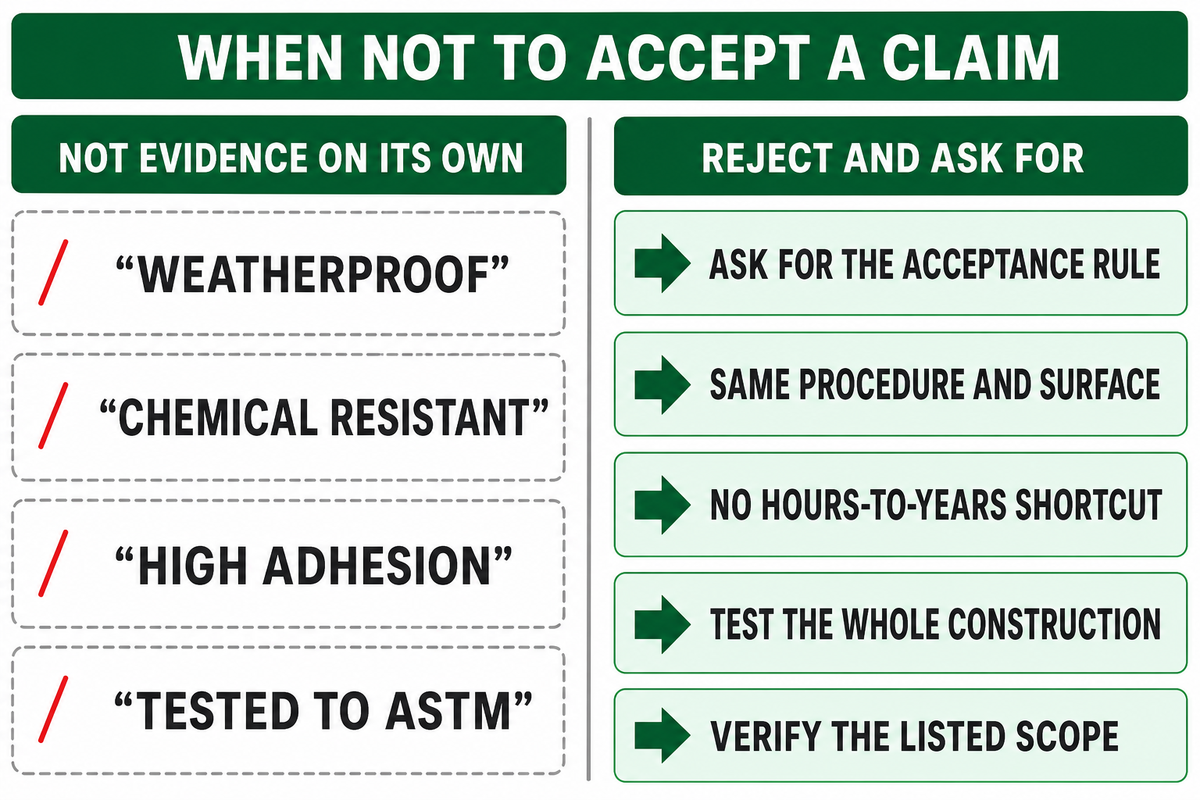
Não aceite uma reivindicação de durabilidade quando a propriedade, método, condições ou regra de aceitação estiver faltando. Frases como “weatherproof,” “chemical resistant,” “high adhesion,” e “tested to ASTM” são pontos de partida para perguntas. Não são evidências independentes de desempenho em suas condições ambientais.
- Rejeite a redação somente do método: peça o resultado e os critérios de aceitação.
- Rejeite comparações incomparáveis: peça aos fornecedores que utilizem o mesmo procedimento e superfície de aplicação.
- Rejeite atalhos de horas para anos: peça uma correlação documentada com o uso externo especificado.
- Rejeitar substituição de componentes: um frontal de alta durabilidade não comprova que a tinta, o revestimento superior, o adesivo, o liner e o código de barras permaneçam intactos em conjunto.
- Rejeite a abreviatura de certificação: confirme a construção, o escopo, o ambiente e a autorização listados, em vez de assumir que um teste aprovado cria um sistema certificado.
Um comprador não precisa de todos os testes de durabilidade possíveis. O conjunto correto é o menor grupo que cobre os modos de falha confiáveis, usa condições reprodutíveis e se conecta à aplicação real. Essa abordagem custa menos e produz melhores evidências do que encomendar um amplo menu de resultados laboratoriais não relacionados.
Resumo
Os métodos FINAT e ASTM criam medições repetíveis, não promessas de durabilidade universal. FINAT fornece uma coleção de métodos de etiqueta-indústria em comportamentos adesivos, de liberação, envelhecimento, químicos e de impressão. Os métodos ASTM oferecem procedimentos detalhados e limitações de escopo excepcionalmente úteis. Leia essas limitações como parte do resultado.
Para a aprovação de fornecedores, aplique a Escada de Evidências de Quatro Degraus: método, resultado, aceitação e validação. Use a Matriz Método-Evidência para escolher ensaios com base nos modos de falha reais e, em seguida, use a Pontuação de Completude do Relatório de 0–10 para identificar campos ausentes antes de comparar números. A aprovação final cabe à estrutura completa do rótulo na superfície pretendida e no perfil de operação declarado.
Perguntas frequentes
O que os padrões de teste de durabilidade da etiqueta provam
Um método padrão prova como um espécime definido se comportou sob seu procedimento e condições registrados; a vida útil, a certificação e o desempenho em campo em outra superfície precisam de evidências separadas.
Ele suporta medição repetível quando a construção, aparelho, condicionamento e configurações coincidem. O relatório pode comparar amostras ou apoiar uma decisão de aceitação se um limite foi definido. Vida útil de campo, desempenho em outra superfície, um resultado de passagem sem critérios, e certificação todos exigem evidências separadas vinculadas à aplicação pretendida e construção completa da etiqueta.
O teste FINAT é igual ao teste ASTM?
Não. FINAT concentra-se em materiais autoadesivos para rótulos, enquanto ASTM publica procedimentos mais amplos para materiais e exposição; ensaios com nomes semelhantes ainda exigem verificações de escopo, corpo de prova e condições.
A coleção da FINAT está estreitamente alinhada a materiais autoadesivos para rótulos e à conversão. As normas ASTM abrangem questões individuais de materiais e exposição em muitos setores. Um método de descolamento, cisalhamento, abrasão ou intemperismo pode abordar uma propriedade relacionada sem usar o mesmo corpo de prova ou procedimento. Compare escopo, edição, geometria, condicionamento, unidades e limitações declaradas antes de colocar valores em uma tabela de fornecedores.
“testado para ASTM” significa que um rótulo foi passado?
No. “Tested to ASTM” identifica um procedimento, mas apenas uma mudança mínima, máxima, permitida declarada ou regra visual pode transformar a medição em aprovação ou falha.
Peça a edição e o procedimento padrão exatos, a construção do espécime, o substrato e a preparação, o condicionamento, as configurações de teste, a contagem de amostras, a distribuição de resultados, o modo de falha e os critérios de aceitação. Sem uma alteração mínima, máxima, permitida ou visual declarada, o relatório contém medições, mas nenhuma decisão de aprovação/reprovação para a aplicação especificada do comprador e a regra de liberação da amostra acordada.
As horas de intemperismo acelerado podem ser convertidas em anos ao ar livre
Não existe conversão universal A correlação específica do produto é necessária para reivindicações credíveis do ano exterior, usando a mesma construção, ponto final de falha definido, clima pretendido, orientação, condição de montagem e sequência de exposição.
G154 descreve aparelhos e práticas de exposição ultravioleta e à água, mas não fornece um único fator horas a anos. A escolha da lâmpada, ciclo, temperatura, umidade, geografia, orientação, sombra, poluição e a propriedade que está sendo medida podem mudar a relação. Uma correlação também precisa de um ponto final de falha definido: mudança de cor, perda de adesão, rachaduras, danos na impressão ou outra propriedade. Relate a exposição exata do laboratório, mostre a mudança medida e qualifique qualquer declaração de vida útil, a menos que a mesma construção tenha uma correlação de campo documentada sob o clima pretendido e a condição de montagem.
Qual teste mostra se um código de barras permanecerá legível?
A legibilidade do código de barras precisa do teste de exposição relevante seguido por uma regra de verificação ou varredura definida; a inspeção visual da tinta por si só pode não prever se o código permanece digitalizável.
Um teste de fricção ou abrasão de tinta pode mostrar danos à superfície, mas a inspeção visual por si só pode não prever a digitalização. Defina a simbologia, o método de verificação ou a aceitação da digitalização, a localização, a medição antes/depois e a sequência de exposição. Avalie a retenção do adesivo separadamente porque um código de barras legível em uma etiqueta de elevação ainda falha na aplicação.
Quantos testes devem ser incluídos em um plano de qualificação de rótulos?
Use o menor conjunto de testes que cubra os modos de falha confiáveis e o perfil de serviço pretendido e, em seguida, adicione um teste de uso final sempre que as condições laboratoriais não puderem representar o aplicativo.
Comece pela superfície de aplicação e pelo processo de limpeza e, em seguida, liste cada exposição em ordem. Acrescente a frequência de manuseio, a direção da carga, a temperatura, a exposição ultravioleta ou à umidade, o contato químico, a exigência de impressão e código de barras, o comportamento do liner e a condição de remoção que realmente ocorrem. Mapeie cada falha plausível para uma família de métodos adequada, elimine ensaios duplicados e escreva os critérios de aceitação antes da chegada das amostras. Quando dois métodos responderem à mesma questão específica, escolha aquele que melhor corresponda ao equipamento do fornecedor e à base de comparação do comprador. Conclua com um ensaio de uso final sempre que a configuração de laboratório não puder representar curvatura, contaminação, manuseio repetido, geometria das bordas, exposições mistas ou toda a sequência de operação.
Guias Guanma relacionados
Referências e fontes
- Métodos de teste FINAT, índice da 11a edição. FINAT.
- ASTM D3330/D3330M-04(2025), adesão por descascamento de fita sensível à pressão. ASTM Internacional.
- ASTM D3654/D3654M-06(2024), adesão ao cisalhamento de fita sensível à pressão. ASTM Internacional.
- ASTM D5264-98(2019), Resistência à abrasão de materiais impressos. ASTM Internacional.
- ASTM G154-23, Aparelho de lâmpada fluorescente ultravioleta (UV) operacional para exposição de materiais. ASTM Internacional.
- ASTM D543-21, Resistência de Plásticos a Reagentes Químicos. ASTM Internacional.
- ISO 29862:2024, Fitas Autoadesivas: Determinação de Propriedades de Adesão ao Descascamento. Organização Internacional de Normalização.
- Teste e Certificação de Marcação e Rotulagem. Soluções UL.
Construa uma especificação de etiqueta testável com Guanma

Envie a construção da etiqueta, a superfície da aplicação, as condições de serviço, as preocupações com falhas e as necessidades de aceitação A Guanma pode ajudar a transformar essas entradas em um resumo de material e amostra para revisão com suas equipes de qualidade, engenharia e compras.