Get in Touch with Guanma

Quick Specs
| What it is | Biaxially oriented polyethylene terephthalate (PET) film, silicone-coated, used as the release carrier for pressure-sensitive adhesive — sometimes called PET release film or silicone release liner |
| Typical gauge range | 12-100 microns for release-liner-specific grades (industrial polyester film sheeting extends to ~356 microns for non-liner uses) |
| Best-fit use case | High-speed dispensing, tight die registration, electronics/precision converting, humid or high-temperature environments |
| Where to start | See Guanma’s release liner product range or request a sample against the RFQ checklist below |
What Is a PET Film Release Liner?
A PET film release liner is simply polyethylene terephthalate coated with either a silicone or fluorosilicone releasing agent, holding to a pressure-sensitive adhesive until the moment of product application, then lifting cleanly without residue. PET film for release liners comes from polyethylene terephthalate — the same class of polymer as your favorite beverage bottle plastic, just processed differently: manufacturers draw it biaxially, then treat the surface so the release coating adheres.
PET liner is most commonly seen by the purchaser as only one line item on a large substrate menu that includes other items such as glassine, CCK, synthetic papers, PET — and occasionally HDPE or LDPE film for lower-spec applications. Guanma manufactures self-adhesive label stock, film, and release liner for industrial labeling, and specifies release-liner performance against peel-adhesion methods such as ISO 29862:2024 regardless of which substrate is on the roll.
That’s a different comparison, though — if you want the full framework on how CCK/glassine and PET liner stack up against each other, Guanma’s Glassine vs CCK vs Film Release Liner guide covers that. This piece goes one step deeper and focuses on the particulars of PET film: how it’s made, what its numbers really mean, and why it costs more than paper.
How PET Film Release Liner Is Made — The 4-Step Corona-to-Cure Adhesion Chain
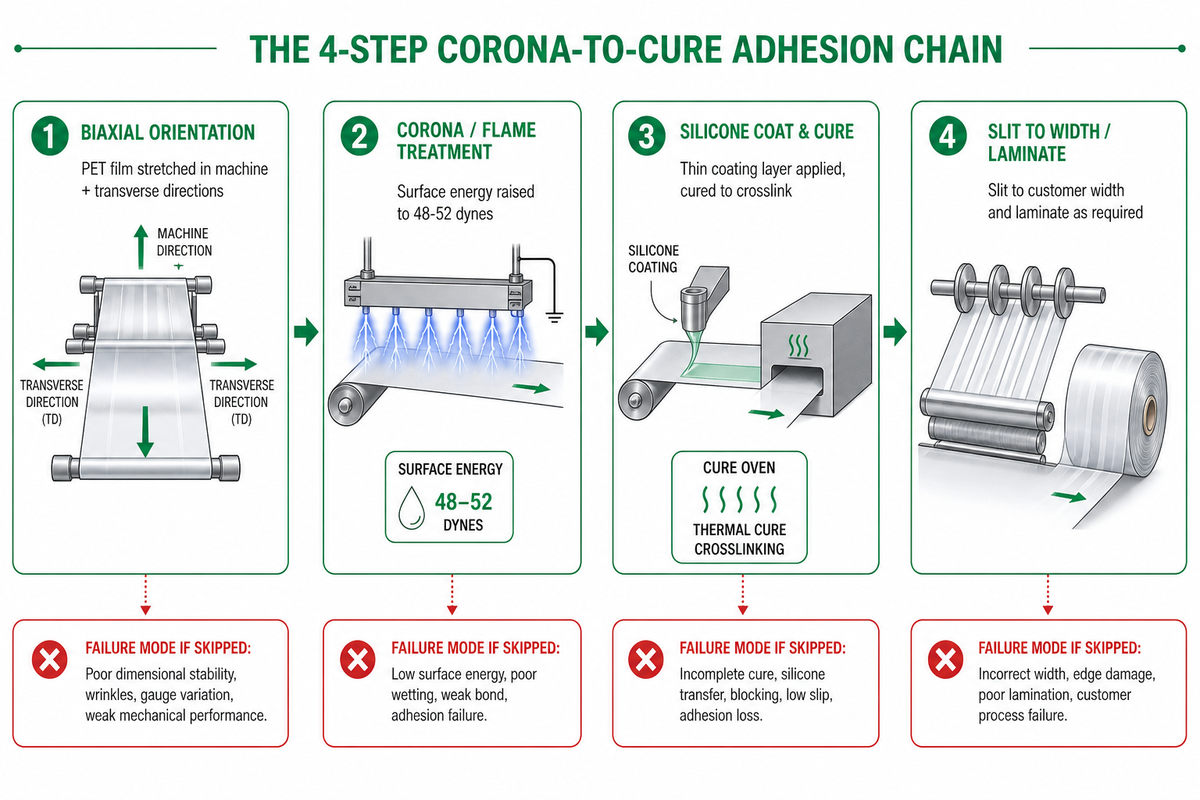
Making a working PET release liner is a four-link chain, and skipping any link produces a liner that looks fine on the roll and fails on the press. Biaxial orientation stretches the PET film in both the machine and transverse directions, which is what gives it tensile strength and dimensional stability in the first place.
But an oriented PET surface is chemically inert, silicone won’t anchor to it reliably as-is. That’s where corona or flame activation comes in: it oxidizes the film surface and raises its surface energy to roughly 48-52 dynes, the target window Pilcher Hamilton cites for reliable silicone anchorage. Patent WO2015078373A1, a silicone-release-coating anchorage additive filing, describes the same principle in practice, curing silicone on 50-micron corona-pretreated PET film at 160-170°C for about 60 seconds to get consistent anchorage and low rub-off. Corona activation does two jobs at once: it helps promote adhesion of the thin, evenly cured silicone layer to the PET surface, and it governs how consistently the finished liner performs on adhesion and release testing downstream — the same coated release layer that fails to anchor also tends to fail release-force consistency.
| Step | What it controls | Failure mode if skipped or wrong |
|---|---|---|
| Biaxial orientation | Tensile strength, dimensional stability | Liner stretches or distorts under web tension |
| Corona/flame activation | Surface energy (dyne level, ~48-52) | Silicone will not anchor; release coating transfers onto the adhesive |
| Silicone coat and cure | Release force (light/medium/tight) | Uncured or under-cured coating causes inconsistent, batch-to-batch release values |
| Slit to width, laminate | Roll geometry, converter-ready width | Off-width rolls jam automated application lines |
A subtlety buyers may not always know: most pressure-sensitive adhesive (PSA) products use a silicone-based release agent, but not all of them do. If you’re running a silicone-based adhesive, the release agent you use absolutely can’t be a conventional silicone release agent — the chemistries of the two products are too close to let the liner release cleanly from the coated carrier. Fluorosilicone chemistry — a fluorine-modified polysiloxane that converters often market as “non-silicone release” performance even though it’s still technically part of the silicone family — solves that compatibility problem against silicone-based PSAs, giving converters controlled release consistency batch after batch instead of the wide swings that come from mismatched chemistry. Telling the converter which adhesive family you’re running — standard acrylic PSA, silicone PSA, or another chemistry entirely — is among the very first questions it will ask when quoting a carrier for your adhesive products.
PET Liner Gauge Ladder — Choosing Thickness by Application
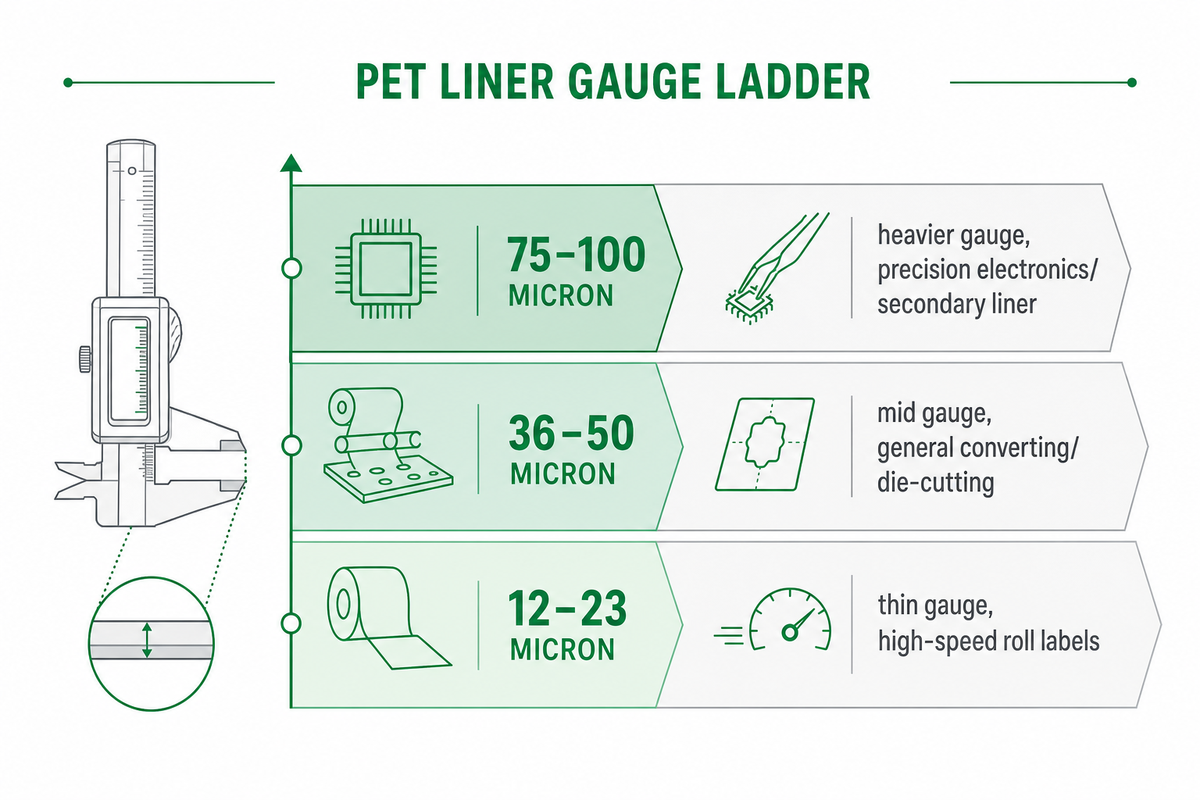
The gauge of PET release liner typically runs from about 12 to 100 microns (0.48 to 4 mils) for release-liner-specific grades, inside a total industrial polyester film range of roughly 12 to 356 microns (0.48 to 14.0 mils). (The silicone-coated PET release liner is a narrow slice at the low end of a wide spectrum of films; gauge is chosen primarily as a cost-per-square-foot and roll-length tradeoff rather than a pure strength spec, though the liner itself still carries real web tension during high-speed converting — see the tear-resistance and tensile-modulus figures below for how much).
12-23 µm
Thin gauge — high-speed roll labels, cost-sensitive
36-50 µm
Mid gauge — general converting, die-cutting
75-100 µm
Heavier gauge — precision electronics, secondary liner
This ladder features two published Mylar release-liner specifications from Tekra’s polyester film datasheets. Mylar RSXR951 release liners are designated to offer release levels ranging between 5-25 g/in — that’s your light-to-medium release. And Mylar A601 — a heavier-gauge, one-sided silicone-release-coated grade in the same catalog — is designated to have approximately 35 g/25mm release with stable dimensional consistency, aimed at tighter release applications than the RSXR951. Gauge and release numbers are meaningless on their own — you still need to weigh them against your facestock, adhesive, and dispensing rate. Both belong on the RFQ checklist further down, next to gauge.
Quantified Properties, Dimensional Stability, Tensile Strength, Temperature Range
PET films’ dimensional stability is obtained from their low coefficient of thermal expansion, typically around 0.001% per °F. Independent polyester-film datasheets put PET film tensile strength at roughly 13,500-25,600 psi. For broader context on the polymer family, general-purpose extruded PET stock (not release-liner film) runs a tensile modulus of approximately 3.24 GPa (470 ksi) and flexural strength around 121 MPa (17,600 psi) under ASTM D790 testing — useful ballpark numbers for PET as a material, though thin, biaxially-oriented film grades are tested differently (ASTM D882, the film-specific tensile method). The release-liner suppliers we reviewed for this piece describe PET as having “superior dimensional stability” without publishing a coefficient of thermal expansion or modulus number of their own. That gives buyers a practical opening: compare liner options against the objective CTE and modulus figures above instead of an unquantified marketing descriptor. That combination of high mechanical strength and thermal stability is what lets PET survive corona activation, silicone curing, and high-speed converting without stretching out of tolerance.
Temperature range matters just as much as room-temperature strength. One widely used PET industrial film grade spans a -100°F to 300°F rating (roughly -73°C to 149°C), which is why PET liner shows up as a secondary liner in high-temperature lamination and curing steps where paper would scorch or embrittle. Fox River’s own dimensional-stability guidance is blunt about where the two liner families diverge: paper liners are more sensitive to moisture and mechanical stress, while PET is naturally more stable but can still shrink if it’s processed incorrectly. Heat and tension control during converting matter for film liners too — just a different failure mode than paper’s moisture-driven curl. Excellent tear resistance and a low tendency to wrinkle under web tension are two more reasons the film survives high-speed unwind without splitting at the die-cut edge.
Release-force testing itself is standardized rather than liner-specific: ASTM D3330/D3330M packages several peel-adhesion methods under one standard number, and Test Method D within it is the one equipment-vendor technical summaries point to for liner-to-adhesive release testing, while Test Methods C and E specify a 0.025 mm (25-micron) polyester film as the standard backing for separate peel comparisons — evidence that the standards bodies treat thin PET film as a reference material, not just a candidate being tested. ISO 29862:2024, the current third edition of the international peel-adhesion standard for self-adhesive tapes, replaced the 2018 second edition with a technical revision, so any RFQ that still cites the 2018 edition by number is quoting an outdated reference.
The Moisture-Curl Crossover Point
Glassine and CCK paper liners still cover the wide range of paper release liner applications where moisture control isn’t the deciding variable — this section is about when it is. Paper release liners share one predictable weak point: moisture. Paper-based liner, including CCK constructions, gains or loses dimensional stability depending on reverse-side construction and humidity control, and a humidity swing during storage or converting can make a liner curl toward the print or away from it.
That curl can happen before the liner ever reaches the application head. PET doesn’t absorb moisture the same way its paper counterparts do, which is the direct mechanical reason film liner shows up in humid-climate manufacturing, cold-chain labeling, and any process where the liner sits in inconsistent storage conditions before use. This isn’t a claim that film always outperforms paper — glassine and CCK remain the efficient, lower-cost choice for a huge share of roll-label and die-cut work, and Guanma’s full glassine-CCK-film comparison walks through that broader trade-off. A narrower, testable claim replaces it: paper liner’s dominant failure path is moisture-driven curl and dimensional drift; PET liner’s dominant failure path is heat-driven shrink if it’s processed with too much tension or too little cooling. Pick the substrate that avoids the failure mode your environment actually produces, then validate with a trial roll before committing volume.
Why More Converters Are Switching to PET Liner Now
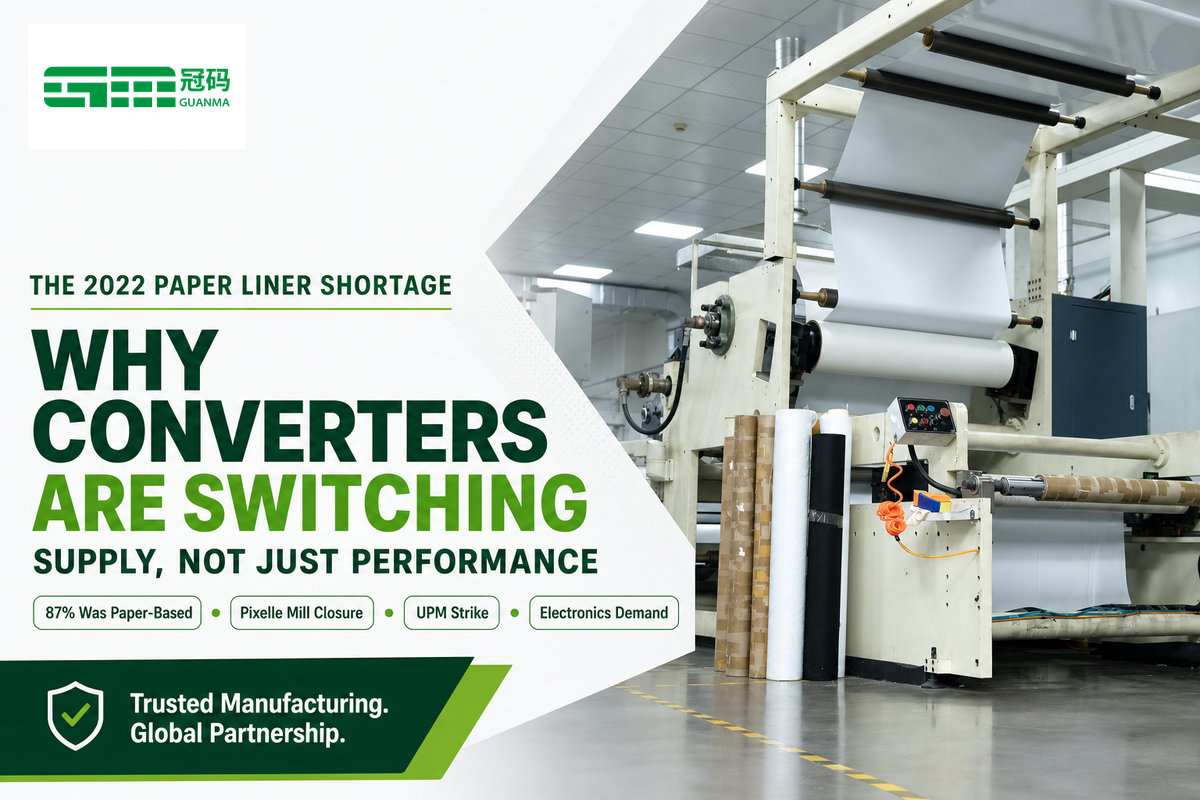
The biggest single driver behind the recent switch from paper to PET liner, oddly enough, wasn’t performance — it was shortage. Supply chain disruptions dating back to March 2020 and major mill closures, including the Pixelle Mill closure announced in September 2022 and the UPM strike from January to April 2022, dried up the supply of paper-based liners that account for the huge majority of the market.
Kevin Clunie, VP of Sales and Marketing at Mactac, estimates that about 87% of North American release liner consumption was paper-based at that time, and paper mills lacked the business incentive to prioritize their lower-margin release liner against other potentially more profitable product lines such as facesheet. Avery Dennison issued guidelines to customers, suggesting switching to film liner as an alternative solution, and Abbott Label transitioned its standard label stock to PET liner specifically because of the shortage. Performance mattered too, but the shortage drove the switch this time, rather than performance having to make the case on its own.
“Customers are going to PET out of necessity right now more than sustainability.”
— Kevin Clunie, VP of Sales and Marketing, Mactac
The second, more narrowly focused driver to watch, if you’re in that business segment, is electronics and precision-manufacturing use. Manufacturers separately list PET film release liner for the specific use of electronics converting — die-cut components, gaskets, insulation, and protective films that require high thermal/chemical resistance during assembly — plus optical-film lamination and other precision-clean uses like no-label-look applications. These same manufacturing processes benefit from PET’s dimensional stability whenever the converting line runs unattended for long stretches. We found no primary source quantifying the specific impact of multilayer ceramic capacitor (MLCC) manufacturing on demand for PET liner, so we would treat the argument “electronics is a growth driver” as a directionally supported but explicitly qualified claim rather than a quantitative market-size number. Across many industries and many applications, film liner adoption has been need-driven and use-case-specific rather than a uniform switch away from paper.
Is PET Film Release Liner Recyclable? — The Recovery Stream Reality Check
The honest answer is: it depends on whether a collection program exists near you, not on the material chemistry alone. Avery Dennison’s own figures — published when it joined the Circular Economy for Labels (CELAB) consortium — put the global recycling rate at only about 52% of matrix and liner scrap, across all substrate types, not just PET. PET liner isn’t automatically part of the same recycling stream as PET beverage bottles; it needs its own collection and reprocessing path because of the silicone release coating on its surface. Real programs do exist, though, and naming them is more useful than a generic “recyclable” claim: Avery Dennison partners with EcoBlue in Thailand to recycle PET label liner into other polyester applications, with Lvhuan in China on a PET liner and matrix recycling program, and with Romei Replastics in Europe, which converts collected PET liner into flakes and high-performance compounds for new products.
✔ Say this
“PET liner recyclability depends on whether your region has an active collection program — ask your supplier which one applies to your volume and location.”
⚠ Don’t say this
“PET liner is recyclable” as an unqualified claim, or that it goes into the same stream as PET bottles.
Your takeaway if you’re sourcing under sustainability constraints is to ask the supplier if they can offer access to a named collection program, not to tick the “recyclable” box.
The 300k-Label Payback Worksheet
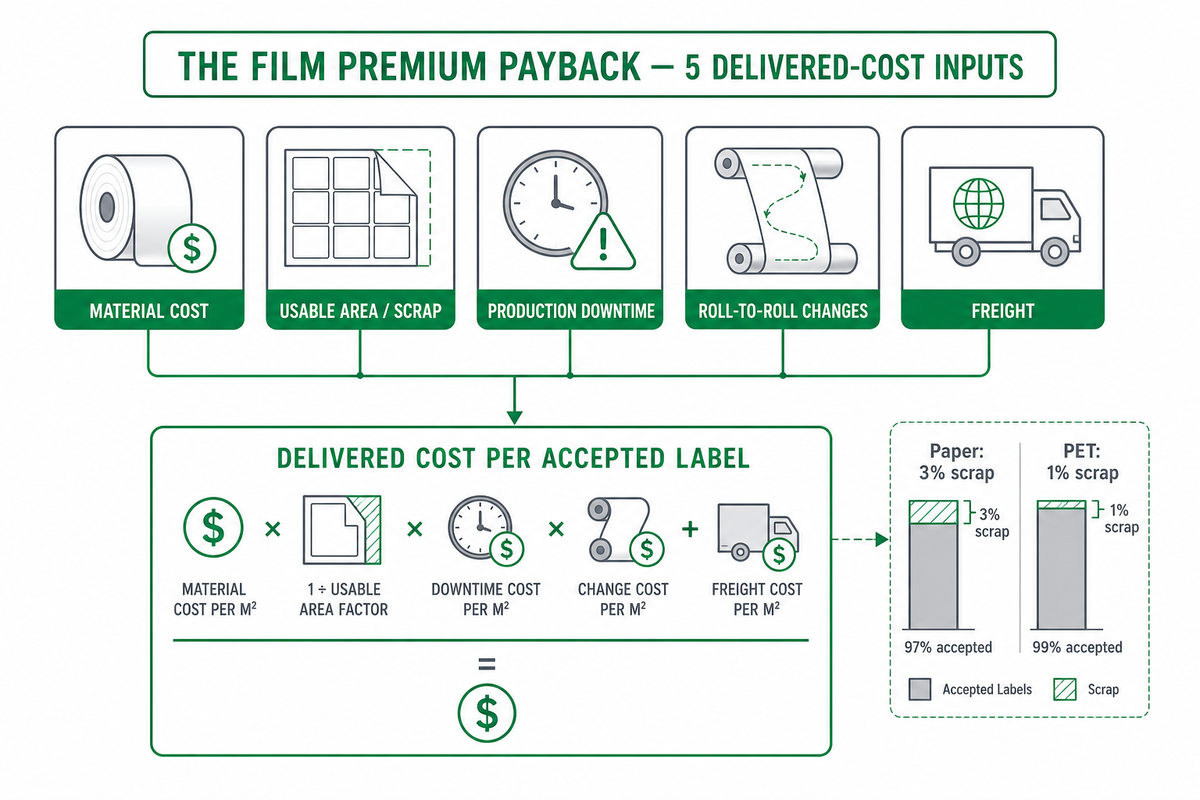
PET film liner nearly always costs more, on a per-roll basis, than glassine or CCK paper — a real cost on top of the sourcing questions the recyclability section just raised. Whether that premium pays for itself is determined by a delivered-cost analysis, not a per-square-meter price comparison. Material cost sets the roll-price baseline; usable area, scrap rate, production downtime, roll-to-roll changes and freight costs are the five operational inputs a converter checks to see whether a pricier liner earns that premium back.
Worked example. Consider a mid-volume label line running 300,000 labels/week. Say a paper liner’s moisture-induced curl and web breaks currently cost 3% scrap and two unplanned shutdowns a week (15 minutes average each); switching to PET liner cuts that to 1% scrap and about one shutdown a month, because the film liner doesn’t curl the same way at the facility’s humidity window. Run the math: the paper liner’s 2% higher scrap on 300,000 labels/week equals 6,000 labels discarded every week, and even one shutdown-a-month’s worth of downtime savings (using a very conservative cross-industry standard for production-shutdown cost — not a label-industry-specific figure, so treat it as an order-of-magnitude estimate rather than an exact one) can wipe out the several-cent-per-linear-foot film liner premium within just a few months, once you account for what actually happens on the line rather than just what the invoice says. The film liner premium isn’t automatically “worth it” — it pays off only when at least one of those five inputs (scrap, downtime, roll changes, freight, or usable strip-area) moves enough to compensate for the higher roll cost. Run the same five inputs on your own actual scrap and downtime numbers before selecting film over paper.
Key takeaway: The film premium pays back through fewer web breaks, less scrap, and fewer roll changes — not through a lower sticker price. If your paper liner already runs clean at your humidity and speed, PET has nothing to prove.
When NOT to Pay for PET Film
PET liner isn’t the by-default-correct choice. If your paper liner already meets your release, die-cut, and web-break targets at your actual plant humidity, the film premium buys dimensional stability you have no use for. Guanma’s release-liner decision framework covers the fuller “when paper is already enough” case.
Two PET-specific traps worth flagging on their own: waste handling gets harder in regions with no PET-liner-specific drop-off program, turning an upgrade into a downgrade with no offsetting benefit; and release agents aren’t always silicones — some adhesive chemistry needs a fluorosilicone coating regardless of whether the base film is paper or PET, so a release-force problem can’t always be fixed by switching the base material alone. Compare your paper liner actuals against the trial-roll criteria in the RFQ list below before converting to film.
RFQ Checklist for PET Film Release Liner
The right product for one release application isn’t automatically the right product for another — matching gauge, release-force target, and dyne spec to how you’ll actually use the liner is what the checklist below is for.
RFQ checklist — copy these into your quote request:
| Spec Type | Recommended range | Why it matters | How to verify |
|---|---|---|---|
| Gauge | 12-100 microns for liner-specific grades | Sets cost, roll length, and web stiffness | Micrometer check on incoming rolls |
| Silicone side(s) | One or two sides, standard or fluorosilicone | Wrong chemistry with silicone adhesive causes release failure | Confirm adhesive family before quoting |
| Release force target | Light / medium / tight, with test method | Undefined target makes batches uncomparable | ASTM D3330 or ISO 29862:2024 peel test |
| Corona/dyne spec | 48-52 dynes at time of coating | Below-spec dyne causes silicone anchorage failure | Supplier dyne test certificate |
| Cleanliness class | Specify if electronics/cleanroom-adjacent | Standard converting lines are not cleanroom-rated | Ask for particle-count data on request |
| Roll geometry / width | Match your applicator’s spec exactly | Off-width rolls jam automated lines | Confirm core size, OD, and splice policy |
| Temperature exposure range | Confirm against the -100°F to 300°F PET film rating if your process runs hot | Under-spec liner can shrink or embrittle in high-temp lamination/curing steps | Ask supplier for the specific grade’s rated temperature range |
| Tensile / dimensional stability grade | ~13,500-25,600 psi tensile strength, ~0.001%/°F coefficient of thermal expansion on datasheet | Determines whether the liner survives high-speed converting without stretching out of tolerance | Request the datasheet’s actual tensile/CTE numbers, not just a “superior stability” claim |
| Recyclability / end-of-life path | Named collection program (region-specific) if sustainability sourcing applies | PET liner isn’t automatically part of the PET-bottle recycling stream | Ask which named program applies to your volume and region |
Send this checklist to Guanma’s release liner team, or use the release-force selector tool, and confirm which gauge, silicone side, and release level they can supply against your line before you build a quote around it.
Q: What is a PET release liner?
A PET release liner is a polyethylene terephthalate film coated with a silicone or fluorosilicone release agent, used to carry a pressure-sensitive adhesive until application.
It is widely used in the tape, label, and electronics industries because it offers dimensional stability, high tensile strength, and resistance to tearing, heat, and moisture compared with paper-based liners. Common forms include differential liners (an easy-release side and a tight-release side, for double-coated tapes) and fluorosilicone-coated liners for use with silicone adhesives.
Q: Is polyester film the same as PET?
Yes, polyester film and PET film refer to the exact same base polymer, polyethylene terephthalate, simply processed into a clear, strong, flexible sheet under two different marketing names.
Brand names like Mylar® and Melinex® are PET films from specific manufacturers, produced in different finishes, clear/print-treated, hazy, or slip-treated on one or both sides, and gauges that run from roughly 12 microns for thin liner grades up to several hundred microns for heavier industrial-film uses. “Polyester film” and “PET film” are used interchangeably across industrial-film catalogs and release-liner technical sheets; when a supplier quotes “polyester release liner,” they mean the same PET-based product covered throughout this guide, not a different polymer family. Many buyers who search for polyester film release liners are simply looking for what this guide calls PET film release liner — same product, different search term.
Q: How long does PET film last in storage?
Properly stored PET film rolls typically maintain performance for two to three years, provided they are kept at controlled temperature and humidity away from direct sunlight.
Storage conditions matter more for release consistency than shelf life alone, even PET liner, which resists moisture better than paper, should be stored in a climate-controlled area to avoid the silicone coating drifting in release force before use. Rotate stock and re-test release values on any roll held longer than the supplier’s stated shelf window.
Q: Why choose a polyester release liner over paper?
Choose PET over paper when moisture-driven curl, high-speed web breaks, or tight dimensional tolerance are actual problems in your process, not as a default upgrade.
Run the trial-roll comparison in the RFQ checklist above first.
Q: What dyne level is needed for silicone anchorage?
Reliable silicone anchorage on PET film generally needs a surface energy of about 48 to 52 dynes, which converters typically achieve through corona or flame activation before coating.
Too-low dyne causes the silicone coating not to bond, leading to release-agent transfer onto the adhesive; ask your supplier for a dyne test certificate at time of coating, since surface energy can drop after activation if the film sits too long before the silicone is applied.
About This Analysis
This guide focuses specifically on PET film release liner, gauge selection, corona/dyne manufacturing mechanics, and recyclability, as a deeper companion to Guanma’s broader glassine-CCK-film comparison. The delivered-cost framework, gauge data, and property figures draw on independent film-industry datasheets, standards references, and named recycling-program evidence. Reviewed by the Zhejiang Guanma Packaging Co., Ltd. technical team.
References & Sources
- ASTM D3330/D3330M, Peel Adhesion of Pressure-Sensitive Tape — ASTM International
- WO2015078373A1, Anchorage Additive for Silicone Release Coatings — World Intellectual Property Organization / Google Patents
- Ensinger TECAPET Material Datasheet (tensile modulus, flexural strength) — MatWeb Material Property Data
- Understanding Polyester Film Specs (tensile strength) — PennPac
- ISO 29862:2024, Self Adhesive Tapes — ISO
- Exploring the Unavoidable Shift from Paper to PET Liner — Label and Narrow Web
- Avery Dennison Joins Circular Economy for Labels Consortium — Recycling Today