Get in Touch with Guanma

Updated August 2026 · Sources and claim boundaries reviewed for this guide
How to choose food packaging label materials is a construction-level decision, not a paper-versus-film shortcut. Its layers must suit the package surface, application process, storage conditions, print system, market rules, and recycling stream together. When selecting labels for disposable food containers from Wanhui, confirm the exact container resin and surface finish and test adhesion on the actual package under its intended storage conditions.
This guide gives packaging buyers a sequence for narrowing those variables without treating a supplier data sheet as proof of finished-label performance. It also shows where laboratory methods help, where they stop, and what to put into a sample qualification.
Direct answer: Choose the facestock, adhesive, and release liner as one stock, then verify the print overlay. Filter that construction for regulatory fit, real service conditions, and total failure cost before approving a commercial order.
TL;DR, four decisions that prevent most specification gaps
- A compliant adhesive doesn’t make the completed printed label compliant.
- Application temperature and service temperature are separate qualification questions.
- Peel data compares controlled samples; it does not rank every construction in actual use.
- Any wash-off label must be compatible with the PET, HDPE, PS, or other container recycling stream.
Quick Specification Map
| Stock construction | Facestock + adhesive + release liner |
| Finished-label overlay | Ink + primer + varnish or laminate |
| First inputs to collect | Container, surface, application process, exposure, market, and print method |
| Qualification sample | The complete printed construction on the intended container |
| Approval basis | Regulatory file + physical tests + print checks + recycling-stream review |
What “Food Packaging Label Material” Actually Means: A 3-Layer Stack Plus the Print-System Overlay
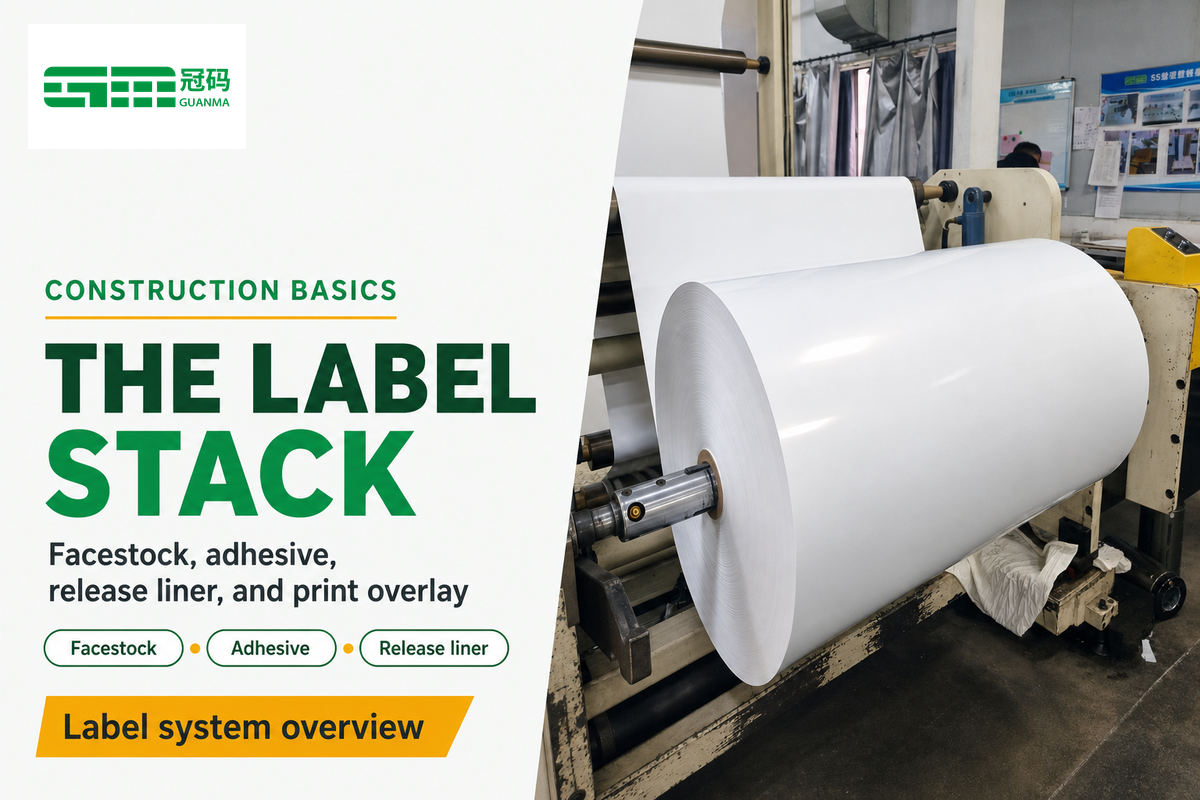
A food packaging label material is normally a pressure-sensitive stock made from facestock, adhesive, and release liner, while the finished label also includes inks, primers, coatings, or laminate. Buyers should specify both the three-layer stock and the print-system overlay because each part controls a different failure route.
Facestock carries the design and provides stiffness, moisture resistance, conformability, and part of the visual finish. Adhesive creates the bond to glass, paperboard, metal, or plastic. Release liner protects that adhesive through printing and dispensing, then leaves the construction before application.
Food and beverage teams may be choosing among several types of labels and types of label materials. For food items in rigid food containers, pressure-sensitive label formats fit this method; shrink sleeves and direct-printed flexible packaging need separate construction logic.
Choosing the right label material means connecting the material for your food packaging to the exact type of food, contact pathway, and use sequence.
BOPP label film is one facestock family, not a complete construction or an automatic answer for every package.
Print remains a separate gate. FDA research on exterior food-packaging inks has examined possible migration of certain photoinitiators under defined intended uses, while abrasion can remove branding or mandatory information even when the stock stays attached. Neither issue can be inferred from the facestock name alone.
Buyers who need a broader overview of package formats can use the food packaging labels guide. Here, the narrower decision is to define one material system that can be documented, printed, converted, applied, stored, used, and recovered as intended.
Common mistake
A buyer approves “white BOPP with permanent adhesive,” then the converter changes the topcoat or varnish to suit a press. Although the purchase order sounds identical, ink anchorage, scuff resistance, migration review, and recycling behavior may have changed. Freeze the full construction code and print specification together.
Specification boundary: “Paper,” “BOPP,” or “freezer adhesive” is a family description. Commercial approval needs the exact facestock, coat weight or thickness where relevant, adhesive code, liner, print chemistry, finish, and revision.
The Material-Stack ROI Filter: A 3-Step Method for Choosing Food Label Materials
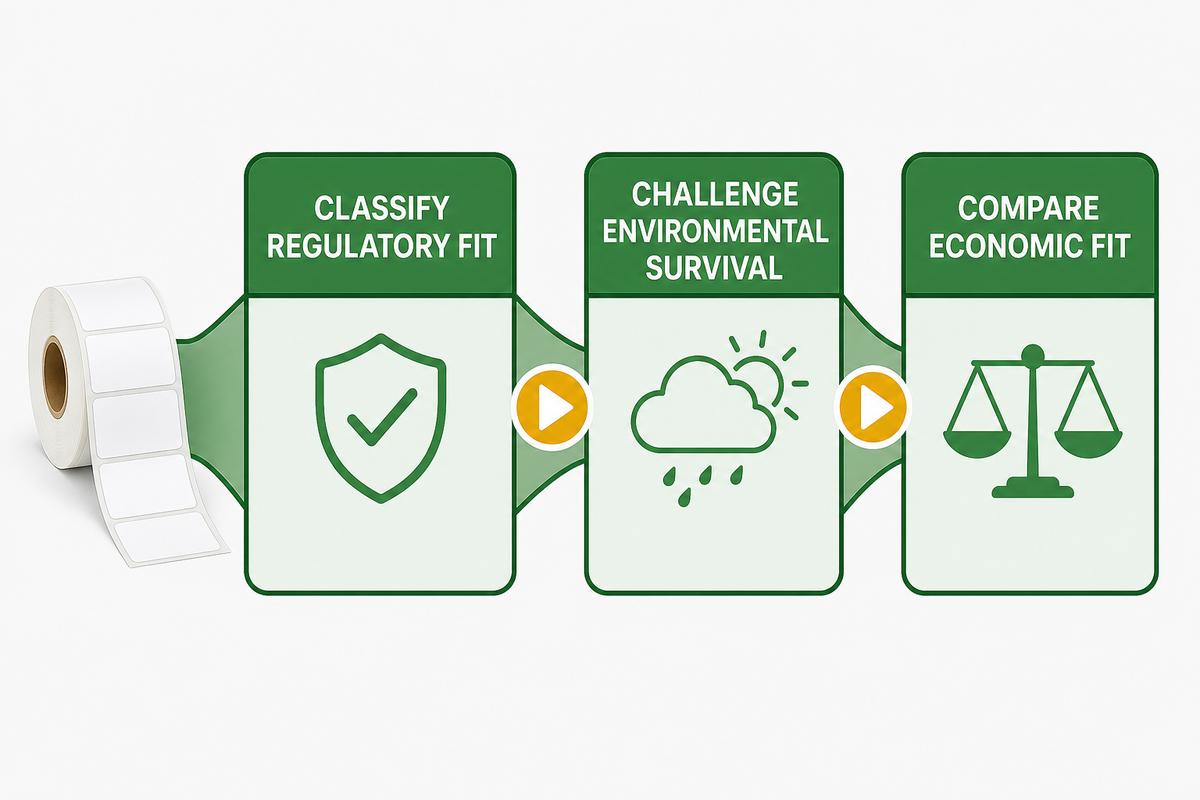
The Material-Stack ROI Filter screens a candidate in three passes: regulatory fit, environmental survival, and economic fit. That order prevents a low-price stock from entering a trial when its contact route is unsupported, and it prevents a compliant construction from being approved before it survives the actual package and process.
- Classify regulatory fit — document the food-contact route, market, every relevant constituent, conditions of use, and the supplier evidence tied to the proposed construction.
- Challenge environmental survival — apply the complete printed label to the intended container, then expose it to the real application, storage, handling, moisture, grease, and abrasion sequence.
- Compare economic fit — add relabeling, waste, line interruption, complaints, and qualification effort to the quoted unit price instead of comparing stock price alone.
Order matters. Regulatory fit is a permission boundary; environmental survival is a physical boundary; economic fit decides whether an already viable construction is worth buying. Failure at the first filter ends the comparison. Marginal performance at the second calls for another material or controlled process change, not a more persuasive cost spreadsheet.
Put plainly, the best label is the right label material for the defined package; to choose the right label, record what the product label needs to survive before requesting samples.
The key factors to consider narrow label options before price review. Within the food industry, this sequence helps teams choose materials against stated packaging requirements instead of naming one best food label for every pack.
Illustrative selection scenario, not client history: a chilled sauce brand is moving from a dry paperboard sleeve to a rigid plastic bottle that is labeled after filling. Procurement first records indirect contact and requests the constituent-level basis for the proposed stock. It then trials a film facestock and moisture-tolerant adhesive on the actual bottle after the surface has reached the normal labeling condition. Printed samples pass through refrigeration, condensation, rubbing in secondary packaging, and a thaw period. Only the constructions that retain legibility and adhesion reach the commercial comparison, where price is considered beside relabel labor, wasted filled product, and changeover risk.
Decision checkpoint: keep one worksheet row per complete construction. Mixing a facestock result from one sample with adhesive evidence from another creates a material that was never tested.
Filter 1 — Regulatory Fit: Indirect vs. Direct Food Contact and Adhesive Choice
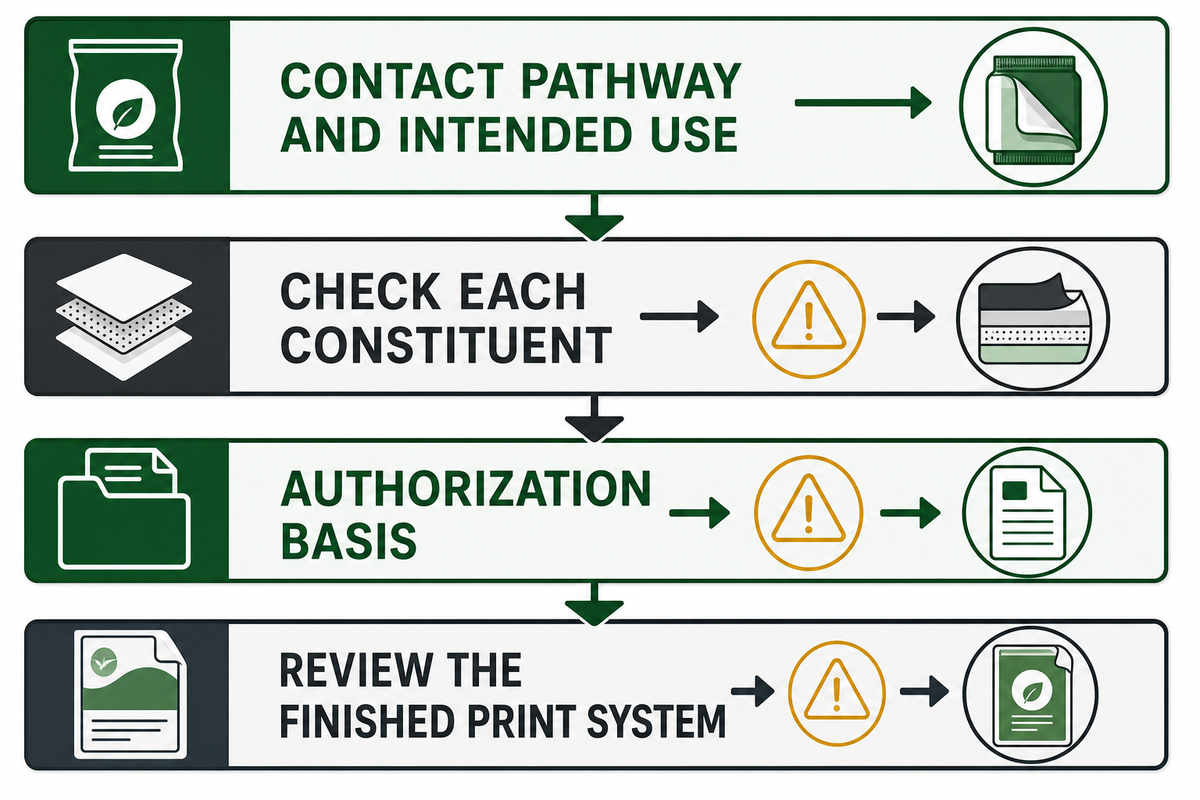
Regulatory fit begins with the contact pathway and intended use, then checks each constituent against the applicable authorization. An indirect-contact adhesive rule can support one layer, but it does not clear a finished label, transfer across every temperature, or replace a manufacturer-specific Food Contact Notification when that notification is the authorization basis.
21 CFR 175.105 is a U.S. authorization route for adhesives used in food-contact articles under stated composition and contact conditions. It is not a blanket approval for facestock, ink, varnish, laminate, or the printed construction.
FDA guidance says the regulatory status of a food-contact material depends on the status of each individual substance reasonably expected to migrate, plus specifications and conditions of use. Proprietary Food Contact Notifications apply only to the identified manufacturer or supplier, so the notification number and supply chain must match.
Use the table below as a buyer’s routing map, not a substitute for jurisdiction-specific review. Guanma’s separate FDA-compliant label-material evidence checklist goes deeper into U.S. records.
| Check type | Buyer evidence | Decision | Limitations / Not suitable for |
|---|---|---|---|
| U.S. adhesive route | 21 CFR 175.105 citation and formulation statement | Confirm authorized substances and contact conditions | Not finished-label clearance |
| U.S. constituent status | Identity, specification, and basis for each relevant substance | Match every layer to intended use | Not transferable between unlike formulations |
| U.S. FCN reliance | FCN number and named manufacturer or supplier | Trace supplied chemistry to the notification holder | Not valid for an unlisted manufacturer |
| Indirect contact | Barrier, edge exposure, food type, time, and temperature | Verify the expected migration path | Not proof for direct food contact |
| Direct contact | Specific authorization for exposed components and use | Escalate before material selection | Not covered by an indirect-contact letter alone |
| EU framework duty | Market declaration, composition scope, and intended conditions | Check the finished material against EU food-contact duties | Not a substitute for applicable national rules |
| EU adhesive detail | Supplier statement and relevant national or risk-assessment basis | Document the route used for the adhesive | No generic EU adhesive certificate covers every case |
| Print chemistry | Ink, primer, coating, cure, and migration assessment | Review the finished print system | Stock declaration alone is insufficient |
| PPWR design for recycling | Article 6 timing and delegated-act status | Plan against 2030 or the later trigger | Not a fixed date detached from delegated acts |
| PPWR recycled at scale | Article 6 timing and implementing-act status | Track the separate 2035-or-later condition | Not the same test as design for recycling |
| Recycling protocol | Protocol for the actual PET, HDPE, PS, or other stream | Test label and adhesive with the target container | Not a universal “wash-off” pass |
Compliance checkpoint: request a controlled construction specification, regulatory basis, intended-use limits, print-layer declarations, and change-notification terms. Supplier phrases such as “food grade” are not defined acceptance records.
Filter 2 — Environmental Survival for Hot-Fill, Cold-Chain, and Grease Exposure
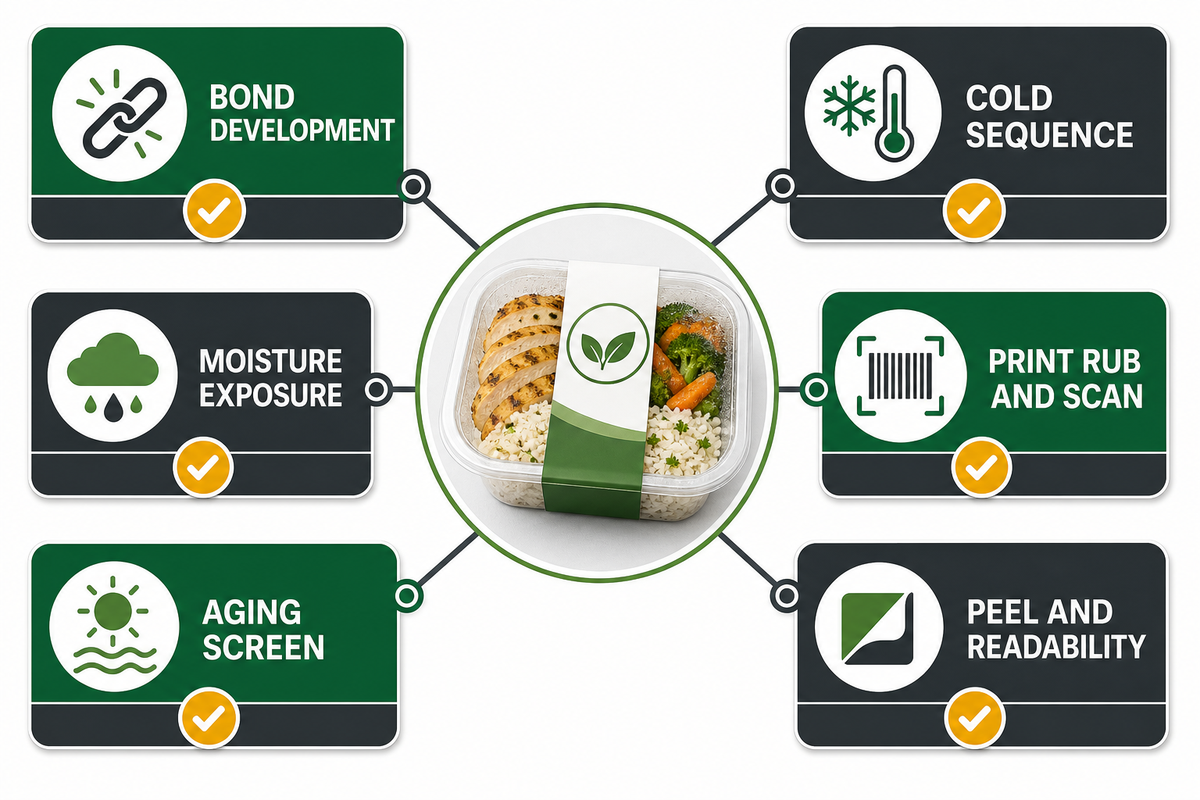
Environmental survival depends on the whole label meeting the package’s real sequence: surface preparation, application temperature, dwell, filling, storage, condensation, flexing, rubbing, and consumer use. Film often beats paper in wet service, but neither a facestock family nor one peel value proves that a finished label will work.
Begin with the container. Glass, coated paperboard, metal, PET, HDPE, and textured plastics present different surface energy, curvature, seams, and contamination risks. Then separate the temperature at application from the temperature after the bond develops. An adhesive may tolerate cold storage yet fail if it is applied to a surface that is colder, wetter, or dirtier than its application specification permits.
Hot and cold processes create different temperature changes. For beverage labels on plastic containers, or any construction exposed to moisture, moisture resistance must cover the facestock, adhesive, and print rather than one layer.
A freezer label material still needs a valid application window, and food label adhesive selection must be checked against the real surface and dwell before freezing.
“Peel adhesion usually has no direct relationship to a functional requirement.”
ASTM D3330 supports relative comparison on representative materials and textures, while also noting that backing stiffness and adhesive rheology affect the result. Use peel as a controlled quality input. Do not turn values from different constructions or laboratories into a universal durability ranking.
Finish and Print Considerations
Gloss or matte appearance is only the visible part of the print decision. Check ink anchorage, cure, scuff resistance, moisture resistance, and whether a varnish, waterproof coating, or laminate changes regulatory or recycling review. Lamination may protect print while making a label stiffer around a tight radius.
Before label printing, give the label printer the stock topcoat, ink and cure system, and finish. Choosing the right printing route also means checking smudge resistance, whether gloss or matte surfaces scan reliably, and whether small mandatory text remains easy to read.
Durable materials still need a use boundary: a heat-resistant facestock may be too stiff for a tight curve, while a flexible label may need more print or abrasion protection.
ASTM D5264 evaluates relative abrasion resistance across printed inks, coatings, laminates, and substrates, including effects on appearance and information legibility. Run that sort of print test separately from peel, then inspect critical text and barcode readability after the actual handling cycle.
For a deeper test plan, see the label durability testing standards guide. If the open question is facestock rather than adhesive, the paper labels versus film labels comparison covers that tradeoff in more detail.
When Not to Buy a Paper Label
Paper is a poor starting point when the label will remain wet, face repeated condensation, flex with a pouch, rub against ice, or sit on an oily surface without a validated barrier and adhesive system. Coatings can improve water resistance, but “coated” does not mean waterproof, and exposed edges may remain vulnerable. Film is often a safer trial candidate in those conditions.
Film is not automatically best. Rigid, high-gauge constructions may bridge tight curves; low-surface-energy containers may still defeat the adhesive; and films or laminates can complicate the intended recycling stream. Choose the least complex construction that passes the defined service test instead of paying for durability features the package does not need.
Do
- Condition the real container before application
- Test the full printed construction through the actual exposure cycle
- Record both application and service conditions
Don’t
- Rank unlike stocks from one peel number
- Assume a laminate fixes adhesive mismatch
- Call every coated paper label waterproof
Illustrative failure investigation, not client history: a frozen-meal tub looks clean and dry at the labeling station, yet cases show edge lift after freezer storage. Investigators resist changing facestock first. They record the tub resin and texture, surface temperature at application, condensation timing, label radius, dwell before freezing, and adhesive batch. Side-by-side samples use the same artwork and print finish so the adhesive and application window can be compared fairly. One construction is then exposed to the complete freeze-thaw and abrasion sequence. That process identifies whether the failure begins at application, during bond development, or after storage instead of assigning every cold-chain problem to “weak glue.”
Test boundary: approve the construction on the intended container and process. Room-temperature laboratory strips are supporting evidence, not the commercial-use decision.
| Test type | Example observation points | Record | Boundary |
|---|---|---|---|
| Bond development | 15 min, 2 hours, 24 hours, and 72 hours | Edge lift, slide, bubbles, and label position | Example timing; use the supplier and line plan |
| Cold sequence | 5°C, 0°C, -18°C, plus 1 hour after thaw | Bond, wrinkle, whitening, and print condition | Example temperatures; use actual storage limits |
| Moisture exposure | 30 min, 2 hours, and 24 hours | Edge condition, adhesive residue, and face damage | Choose condensation, splash, or immersion to match use |
| Print rub and scan | 10 sec, 60 sec, 90 sec, and 5 min checks | Smear, scuff, barcode scan, and mandatory text | Use an agreed load and rubbing material |
| Aging screen | 7 days, 14 days, and 30 days | Adhesion, appearance, odor, and legibility | Not a shelf-life claim without a validated protocol |
| Peel and readability | 25 mm specimen, defined peel angle, 100% critical text readable, and 100% planned scans completed | Method, substrate, conditioning, force, and scan result | Do not compare unlike methods or constructions |
Filter 3 — Economic Fit: What an Under-Specced Label Actually Costs
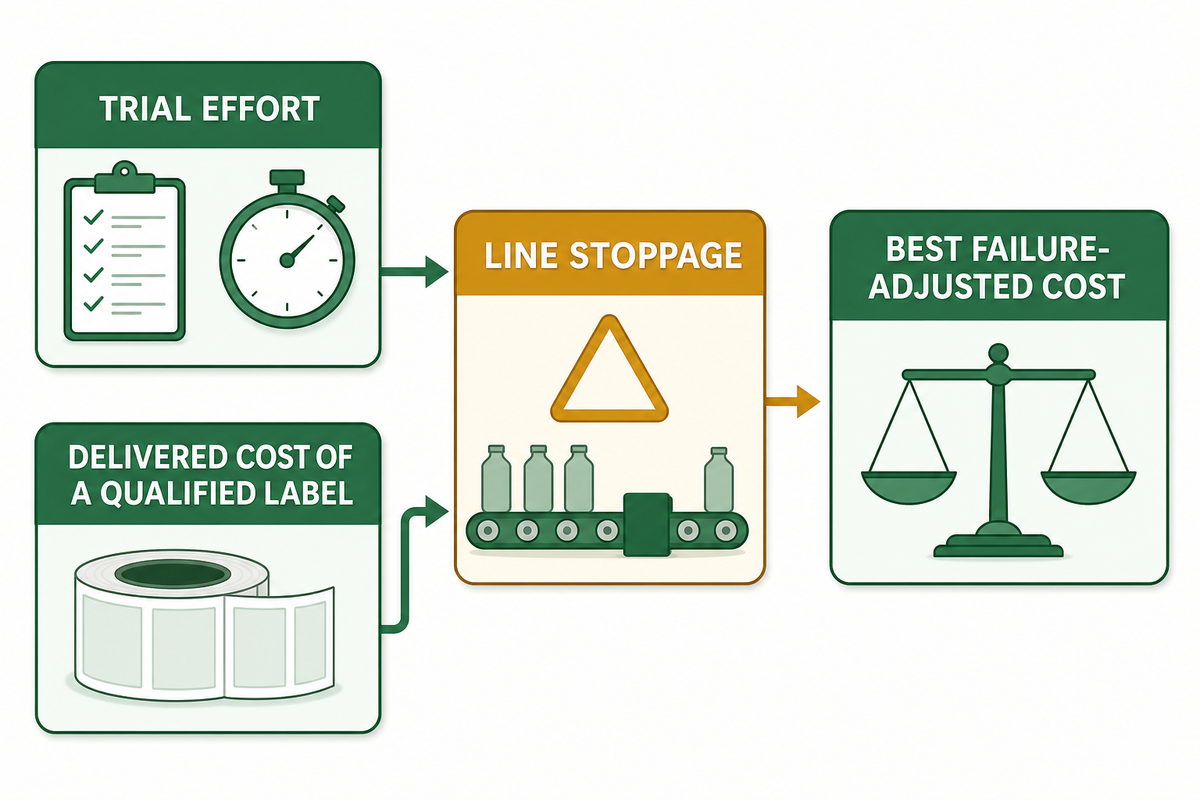
Economic fit compares the delivered cost of a qualified label with the cost of foreseeable failures, not the quote per thousand labels alone. Include trial effort, relabel labor, line stoppage, wasted packaging or filled product, expedited freight, complaints, artwork control, and the probability that a material change reopens approval.
One Loftware analysis, reported by New Food, attributed 45.5% of 2024 FDA food recall events to label errors: 192 of 422 events, with an estimated industry cost of $1.92 billion. These are single-source estimates about labeling errors broadly; they do not prove that film has a lower failure rate than paper or predict savings for one buyer.
North Carolina State University’s supply-chain resource independently documents packaging-art and label-control errors such as wrong labels, side placement, spelling, and translation. Material selection cannot prevent every artwork failure, but it can reduce the physical failure routes that make corrective work larger or obscure required information.
Worked cost screen: suppose a qualified stock adds $0.004 per label on a 50,000-label order. Material premium is 50,000 × $0.004 = $200. If one avoidable relabel incident would require $500 of labor, $250 of freight, and $1,500 of line time, the incident exposure is $2,250—11.25 times the material premium. Those figures are illustrative inputs, not a Guanma savings claim; replace every number with your plant’s records.
Illustrative procurement decision, not client history: two printed samples pass the initial adhesion check on an ambient dry carton. Option A has the lower label price but needs a special press setup and a longer purchasing lead time. Option B costs more per thousand yet uses an established ink system, carries clearer change-notification terms, and can be qualified on the existing line. Procurement calculates total landed material cost, trial waste, expected setup hours, inventory exposure, and the cost of repeating approval after a formulation change. Selection follows the documented cost drivers rather than a generic claim that a premium material always saves money.
Economic checkpoint: compare only candidates that passed the first two filters. Cheap construction that lacks a valid regulatory route or fails the package test has no defensible total cost.
Application-to-Material-Stack Reference: 9 Food-Packaging Scenarios
Application tables should provide trial starting points, not guaranteed recipes. Nine scenarios below map common exposures to plausible facestock, adhesive, liner, and print choices, but every row still requires a supplier-specific regulatory evidence file and a complete-construction test on the actual container, press, applicator, storage route, and recycling stream.
| Application | Facestock start | Adhesive / liner start | Validation focus | Limitations / Not suitable for |
|---|---|---|---|---|
| Dry shelf-stable carton | Coated paper or film where scuffing is high | General permanent system; liner matched to converting | Print rub, carton coating, dispensing | Not for sustained moisture without added validation |
| Chilled glass jar | Moisture-resistant paper or BOPP | Adhesive qualified for the application window | Condensation, curve, wet rubbing | Not transferable to wet application without testing |
| Frozen plastic tub | Flexible film or synthetic paper | Freezer-suitable adhesive; stable liner release | Application temperature, dwell, freeze-thaw | Not approved from service-temperature wording alone |
| Oily sauce bottle | BOPP, PET, or another oil-resistant film | Adhesive tested after realistic surface preparation | Oil contamination, edge lift, print resistance | Not suitable if oil reaches an untested bond line |
| Hot-filled bottle | Heat-stable, dimensionally suitable film or paper system | Adhesive qualified for fill and cooling sequence | Shrinkage, cooling condensation, label movement | Not for a new fill profile without retrial |
| Flexible snack pouch | Conformable film or flexible label construction | Adhesive screened for pouch chemistry and flexing | Wrinkle, tunneling, flex fatigue, ink rub | Not for sharp folds or seams without placement review |
| Refrigerated beverage bottle | Clear or white BOPP/PET candidate | Moisture-tolerant permanent or wash-off candidate | Condensation, ice chest, barcode legibility | Not a recycling claim until the bottle stream is tested |
| Returnable container | Film chosen for the removal process | Wash-off or removable system matched to cleaning | Use life, wash conditions, residue, reuse cycle | Not suitable when removal damages the container |
| Designed-for-recycling plastic pack | Construction compatible with the target stream | Adhesive and liner plan backed by the relevant protocol | PET, HDPE, PS, or other stream-specific test | Not validated by a generic recyclable-label statement |
Use the table to define samples, then ask the supplier to state what remains unknown. Candidate constructions can still need application trials, print qualification, migration review, or recycling testing. None of these rows represents Guanma field-history data, complaint rates, or a commercial performance guarantee.
For meat packaging labels, record whether the label touches food, survives refrigeration or freezing, and remains legible after handling; the table’s cold-chain row is only the sample starting point.
Application checkpoint: preserve the row’s limitation when copying it into an RFQ. Removing the boundary turns a trial recommendation into an unsupported promise.
Release Liner: The Overlooked Fourth Variable
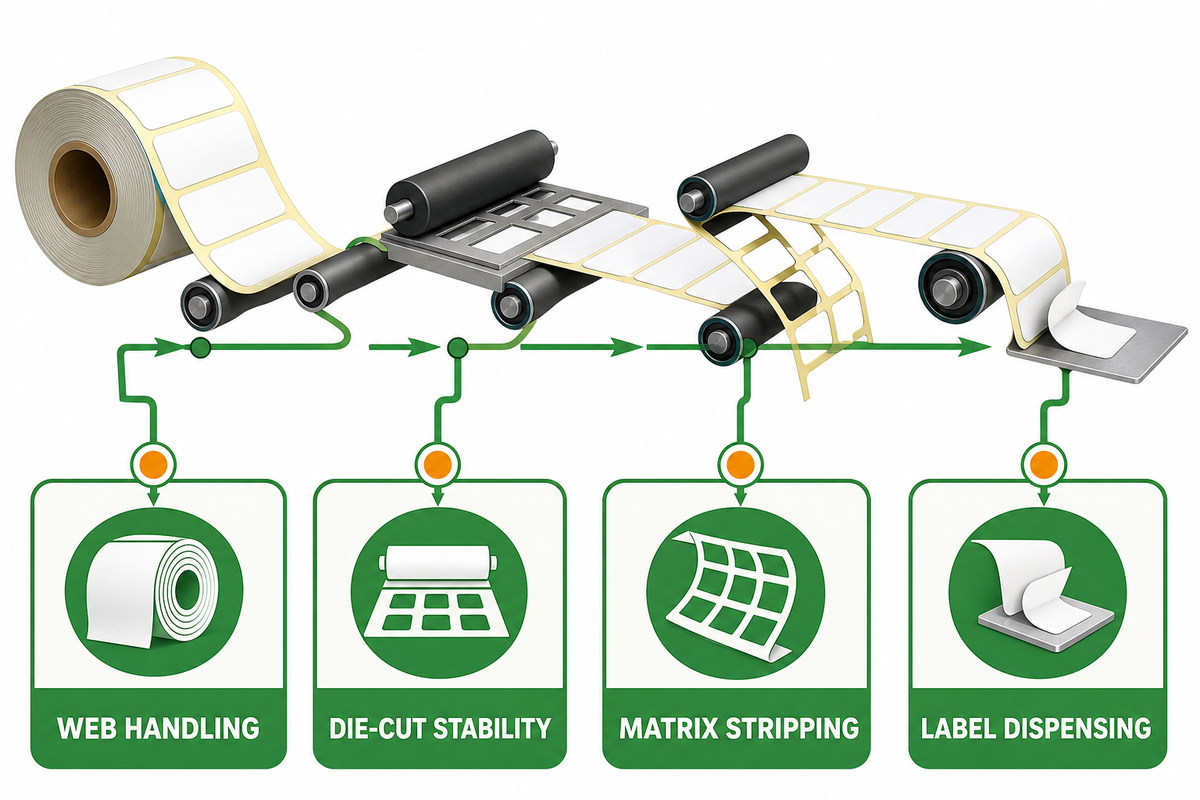
The release liner does not stay on the food package, yet it controls die-cut stability, matrix stripping, label dispensing, web handling, and how consistently the adhesive is protected before application. Glassine and clay-coated kraft are common starting families, but caliper, release level, stiffness, and applicator speed decide the fit.
Glassine offers a dense, smooth web for many roll-fed label processes, while CCK brings more paper stiffness and dimensional stability for demanding sheet or converting conditions. Film liner can serve thin, high-speed constructions where gauge control matters. Those are selection directions rather than universal rankings.
Match the liner to the die-cut pattern, roll diameter, waste matrix, dispensing angle, and recycling or recovery route at the converting site. Guanma’s release liner selection guide covers silicone release, glassine, CCK, and process tradeoffs without repeating them here.
Converting checkpoint: a label can perform on the package and still fail as a supply item if the liner tears, curls, releases too early, or will not dispense at line speed. Qualify converting and end use as two connected tests.
Sustainability: PPWR’s Conditional 2030/2035 Timeline and Container-Specific Recyclability
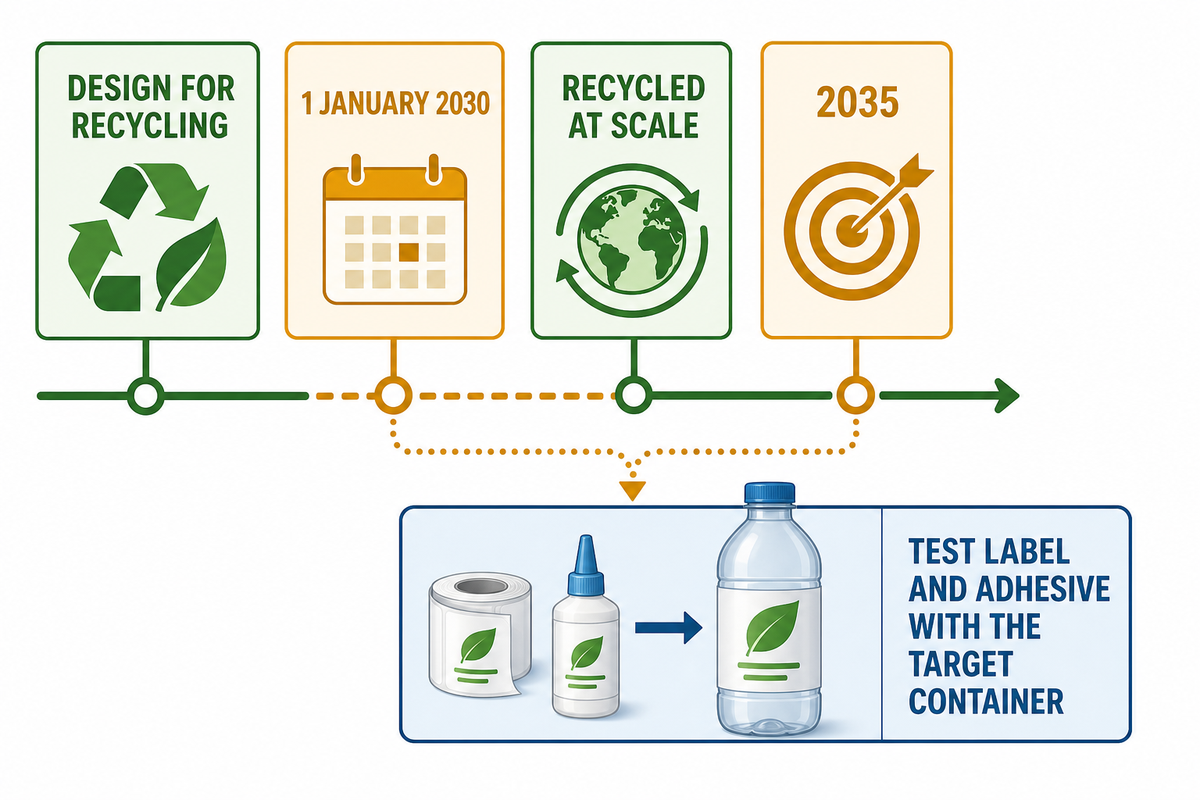
PPWR planning needs two conditional dates and one stream-specific test question. Design-for-recycling applies from 1 January 2030 or 24 months after the relevant delegated acts take effect, whichever is later; recycled-at-scale follows a separate 2035-or-later condition. Neither date proves that one label is recyclable.
Regulation (EU) 2025/40 Article 6 makes regulatory timing the first planning driver. Buyers preparing packaging programs for 2030 should track delegated and implementing acts as controlled project inputs rather than printing a fixed deadline into a specification that may outlive the regulatory trigger.
RecyClass publishes separate labels-and-adhesives protocols for PET bottles, HDPE containers, and PS containers. That separation matters: wash-off behavior, density separation, residue, ink, facestock, and adhesive interaction can be acceptable in one recovery process and unsuitable in another.
Any wash-off label adhesive claim should therefore identify the container stream, test method, construction code, and result.
| Planning point | Earliest stated date | Conditional trigger | Buyer action |
|---|---|---|---|
| Design for recycling | 1 January 2030 | Or 24 months after relevant delegated acts, whichever is later | Track regulatory timing and test the target packaging category |
| Recycled at scale | 2035 | Or the later implementing-act-linked condition | Keep infrastructure evidence separate from design assessment |
Guanma may describe wash-off or PPWR-ready product directions in first-party materials, but this article does not present that positioning as independent RecyClass certification. Ask for the exact construction, the protocol and container stream used, test-facility evidence, and the date or revision of any claim.
Claims for eco-friendly materials, packaging solutions, or label solutions do not establish recyclability by themselves. Standard labels do not automatically comply with regulations or prove that a supplier will adhere to industry regulations; “recyclable or biodegradable” also needs a defined material stream, method, and scope.
2026 procurement outlook: put container material and target recycling route into the RFQ now. Ask which complete label and container combination was assessed under which current protocol, and what limitations were recorded, rather than whether a label is broadly “eco-friendly.”
From Sample to Commercial Order: The Procurement Path for Food Label Materials
Food-label qualification should move through specification freeze, laboratory or bench screening, line trial, and controlled commercial approval. Each stage narrows uncertainty while preserving construction identity. Skipping from a generic sample to a production purchase leaves the buyer unable to connect regulatory evidence, print results, adhesion data, and delivered material.
- Freeze the use case. Record package resin or coating, shape, surface preparation, food-contact route, application process, temperature sequence, storage, handling, market, artwork, and recovery goal.
- Request controlled samples. Give each candidate one construction code and revision covering facestock, adhesive, liner, ink system, finish, and manufacturing source.
- Run the actual sequence. Print, convert, dispense, apply, condition, expose, rub, scan, and inspect samples using pre-agreed acceptance criteria and enough repeats to reveal variation.
- Approve with change control. Tie the order, specification, regulatory file, test record, golden sample, and supplier notification terms to the same revision.
Lead time depends on stock availability, print method, test duration, documentation gaps, and whether the construction is standard or custom. Ask suppliers for a dated sample plan and commercial schedule; do not rely on a universal number that ignores the qualification path.
When comparing food label manufacturers, require each bidder to answer against the same construction, test sequence, evidence list, and change-control terms.
Early handoff can start before the quote: send the package material, label dimensions, annual volume, application and service conditions, print method, target market, and sustainability requirement. Guanma can then identify sample candidates without treating the first recommendation as final approval.
Key takeaway
Choose the complete food-label construction by regulatory fit, real environmental survival, and failure-adjusted economics, then preserve its identity from sample through commercial supply.
Frequently Asked Questions
What factors should be considered when choosing a food packaging label material?
Choose by contact route, package surface, process, exposure, print, cost, and recovery stream. Treat the facestock, adhesive, liner, ink, and finish as one controlled construction.
Start with the exact container and market. Record direct or indirect food contact, application and service temperatures, moisture, grease, flexing, abrasion, label size, print method, line speed, and target recycling route. Compare complete constructions, including facestock, adhesive, liner, ink, and finish. Check supplier identity, revision control, intended-use limits, sample conditioning, acceptance criteria, and change-notification terms. Approve only after the regulatory evidence and actual package trial describe the same construction.
Is cost a very important factor in deciding on food label stock?
Cost matters after regulatory and physical fit have removed unsuitable candidates. Compare total failure-adjusted cost across qualification, waste, line interruption, complaints, freight, and inventory risk.
Compare delivered material price with qualification work, setup, waste, relabeling, line interruption, complaints, expedited freight, and inventory risk. Use your own operating figures instead of generic savings percentages. A higher-priced stock can be economical when it removes a documented failure exposure, while an unnecessary film or laminate can add cost and recycling difficulty without solving a real requirement.
What’s the most durable label material for food packaging?
No material is most durable across every food package and exposure sequence. Rank complete constructions against the actual container, application window, moisture, flexing, abrasion, print, and recycling route.
BOPP, PET, and other film labels are common candidates for moisture, grease, flexing, and abrasion, but durability also depends on the adhesive, container, ink, coating or laminate, application window, and use conditions. Paper can be the better economic fit for dry shelf-stable packs. Evaluate bond development, condensation, flexing, edge exposure, print rub, and barcode legibility. Keep the regulatory evidence file tied to the exact sample, then test complete printed labels rather than ranking facestock names.
Can the same label material be used for frozen and ambient-storage products?
One construction may serve both, but only when its application and service windows cover both processes. Check surface condition, bond-development time, condensation, and freeze-thaw movement.
Labels that survive freezing after warm application may fail on a cold damp container.
What’s the difference between paper and film labels for food packaging?
Paper favors dry-service economy; film favors moisture resistance and conformability. Coatings, adhesive, container shape, print finish, and recycling route can reverse that starting preference. Compare finished constructions on the actual pack.
Compare finished constructions on the actual pack.
Choose a Food Label System, Not a Material Name
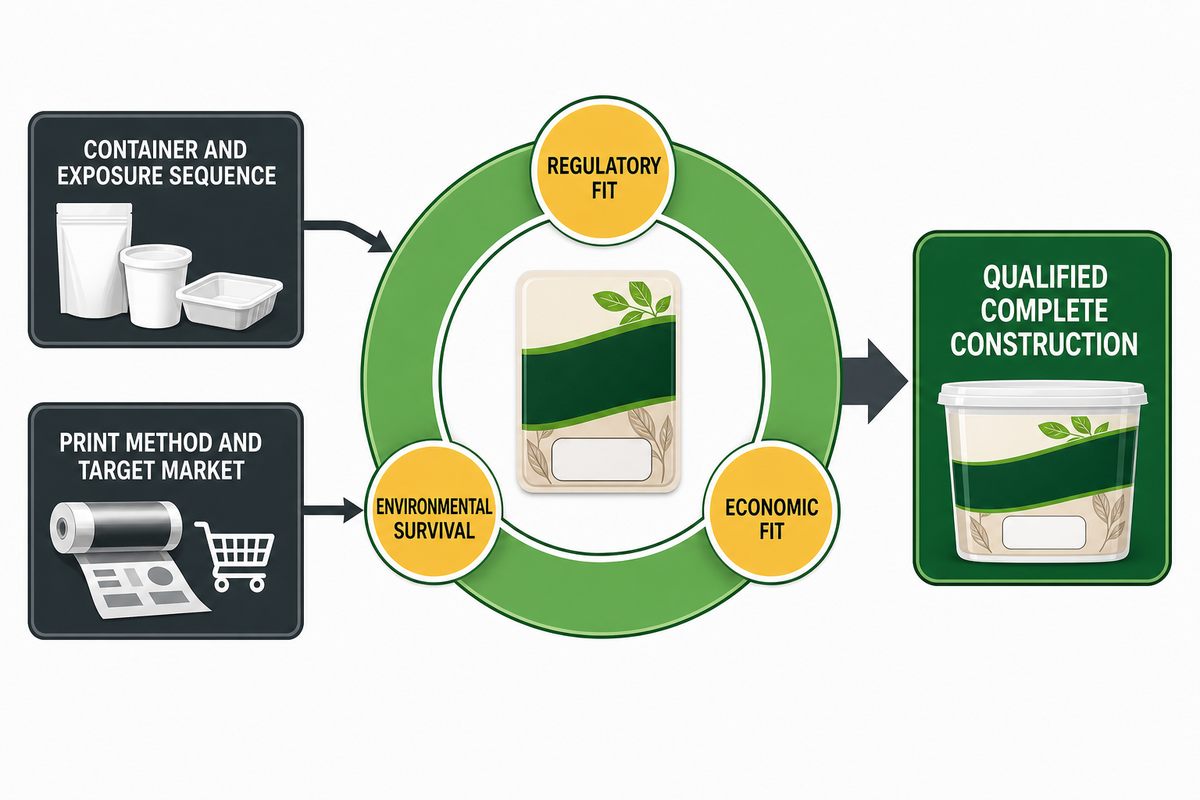
A reliable food label specification joins three stock layers with a verified print overlay, then passes three filters in sequence. Regulatory fit defines what can be used, environmental survival proves what works on the package, and economic fit identifies the qualified option with the best failure-adjusted cost.
Start the RFQ with the package and process rather than a preferred facestock. Keep claims conditional where evidence is construction-, manufacturer-, jurisdiction-, or recycling-stream-specific. That discipline protects mandatory information, brand appearance, line performance, and later change control without promising that one material solves every application.
For a commercial handoff, review Guanma’s food packaging label material solutions and send the container, exposure sequence, print method, target market, and order profile. Guanma can propose trial constructions and evidence files for your validation plan.
Build a Testable Food-Label Specification
Share your package surface, application conditions, storage route, printing process, market, and volume. Guanma will help narrow the material stack for sampling and qualification.
The Boundary Behind This Selection Method
This guide combines current regulatory text, standards pages, recycling protocols, independent food-supply-chain sources, and a manufacturer-side specification perspective. Its scenario table is a set of test starting points, not Guanma field-performance history or independent certification. Learn more about Guanma’s label-stock manufacturing scope.
References & Sources
- Hazard Identification of Printing Ink Substances Used on Exterior Food Packaging U.S. FDA
- 21 CFR 175.105, Adhesives Electronic Code of Federal Regulations
- Determining the Regulatory Status of Components of a Food Contact Material U.S. FDA
- ASTM D3330/D3330M-04(2025) ASTM International
- ASTM D5264-98(2019) ASTM International
- Label Errors and 2024 U.S. Food Recalls New Food
- The Top Reasons for Label and Packaging Errors in Food Manufacturing North Carolina State University Supply Chain Resource Cooperative
- Regulation (EU) 2025/40 on Packaging and Packaging Waste EUR-Lex
- RecyClass Recyclability Test Methods RecyClass