Get in Touch with Guanma

Updated July 2026
How to choose release liner means matching base material, release force, coating chemistry, dimensional stability, and end use to your manufacturing and application requirements—not simply selecting the lowest cost per square meter. Choosing the right release liner for your specific application requirements prevents line stops, web breaks, and residue on finished labels.
In short:
Determine the tack and application speed, match them to the release-force tier established by FINAT FTM 3 or ISO 29862 testing, then choose a paper or film carrier that will withstand end-use temperatures, humidity, and die-cutting stress. Verify the selection through a converting-line trial before specifying it.
Key points
- Release liner is a silicone-coated backing that protects the adhesive surface and regulates how easily the face stock separates.
- There are five key selection parameters and two main types of release liner: paper release liners and film liners.
- The FTM 3 test is a benchtop method performed at 300 mm/min. Line behavior at 200–300 m/min still must be verified with a trial.
- Hidden costs such as lead time, MOQ, local availability, and reject rate often outweigh a lower unit price.
- Use paper liners for high-speed roll labels; switch to film liners in high humidity, for long unwinds, or in abrasive converting environments.
The choice of release liner for your adhesive is important because the liner provides stability and support to the facestock, ensures smooth release from the adhesive, and maintains compatibility with various application speeds and environmental factors such as temperature and humidity. When comparing various materials, remember that the liner controls release properties and converting behavior alongside the facestock and adhesive.
Understanding release liners starts with their core job: the release coating on a paper or polyester film backing lets liners protect the adhesive until the adhesive product is applied.
What a Release Liner Actually Does
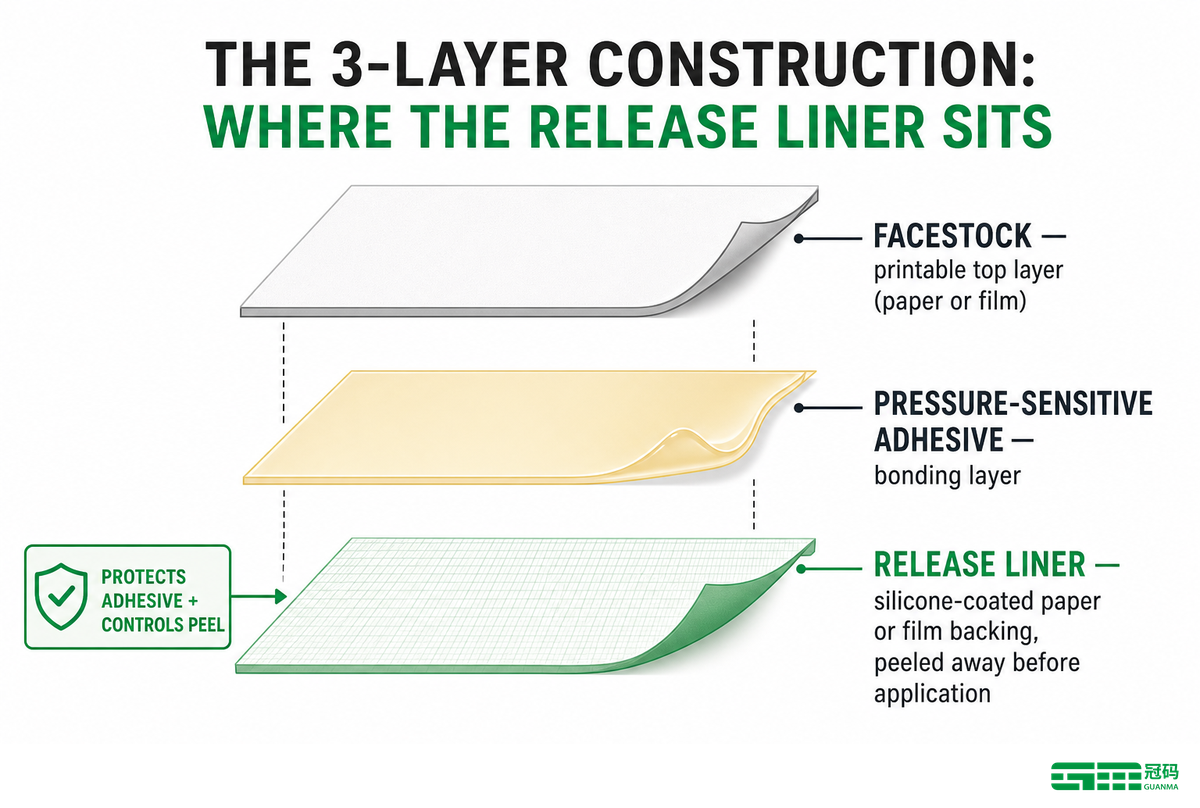
A release liner is a paper or polyester film backing coated with a release agent—most often silicone—that carries the pressure-sensitive adhesive until the label or tape is applied. It prevents contamination and oxidation, avoids premature bonding, and controls how easily the face stock separates during dispensing and die cutting.
Another function of the liner is to ensure dimensional stability. In the label manufacturing process, the facestock, adhesive, and backing are produced as an integrated unit under one quality system so the layers remain matched. In a high-speed continuous converting process, any stretching, shrinking, curling, or tearing can result in web breakage or registration loss.
Using a release liner is essential in any pressure-sensitive construction because the right specialized release coatings ensure proper release and clean separation from the adhesive. Paper-based liners and film-based liners deliver different release levels; the amount of force required depends on the specific release coating, adhesive tack, and peeling angle. When selecting the right release tier, converters compare these parameters to achieve consistent, excellent release at line speed. Choosing a release liner therefore means balancing substrate, coating, and end use rather than picking a stock grade.
Definitions of release behavior and test protocols are maintained by industry bodies such as FINAT and ASTM.
Five Parameters for the Right Type of Release Liner
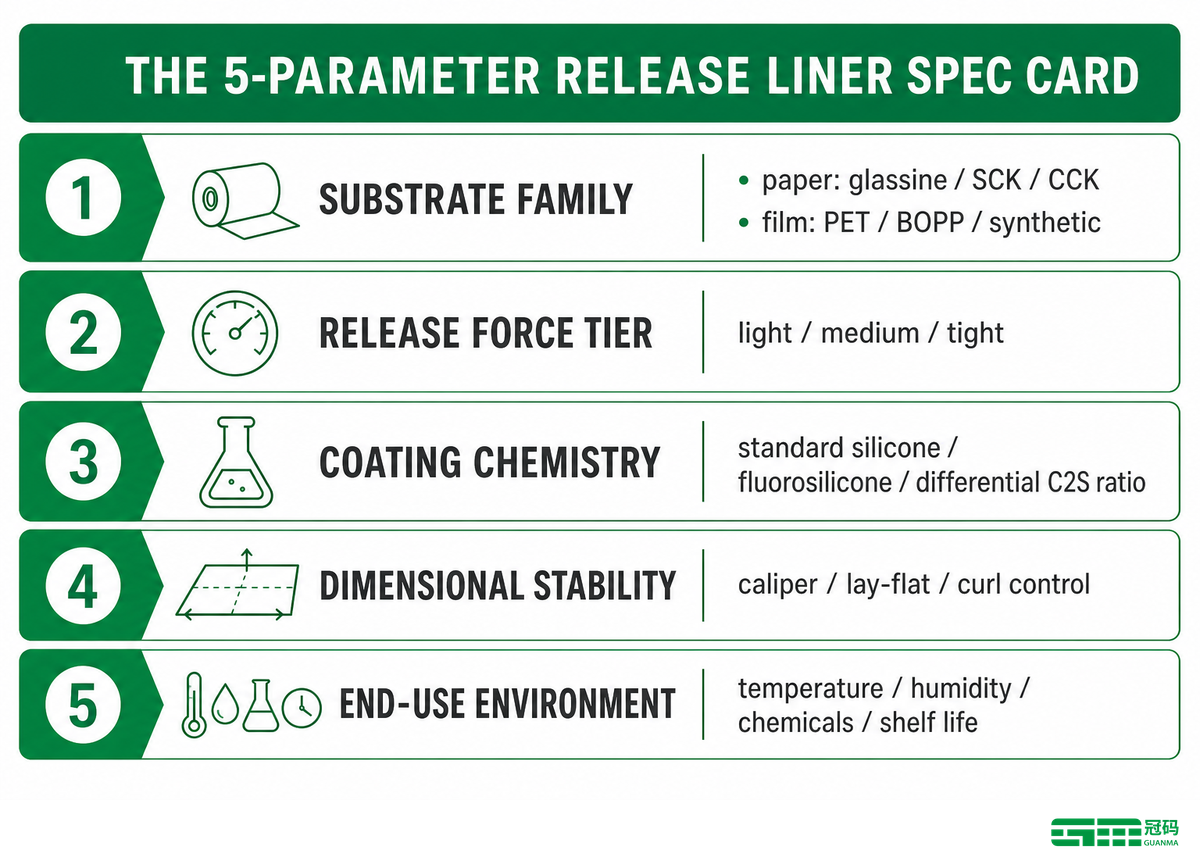
The selection can be narrowed to five parameters. Selecting a release liner starts with choosing the right type of release liner for the specific application—paper release or film release—then tuning release force, coating chemistry, dimensional stability, and end-use environment. Although these parameters don’t create a complete causal model (other variables, like layer thickness and chemistry, also affect peel behavior), they represent the standard decision points for converters and procurement teams.
5base-material families
3release-force tiers
180°peel angle per FTM 3 / ISO 29862
300mm/min test speed
- Base-material family – either paper-based (glassine, SCK, CCK or polycoated kraft) or film (PET, BOPP or synthetic paper).
- Release-force tier – the force range required to separate the facestock from the liner, designated as light, medium, or tight according to tack and application speed.
- Coating chemistry – whether a standard release layer, fluorosilicone (often used with silicone PSAs), or differential ratio is employed for double-coated tapes (C2S ratio).
- Dimensional stability – measures of liner caliper, how well it lays flat, and its tendency to curl. These aspects must be tightly controlled for effective die cutting.
- End-use environment – refers to conditions the finished label will experience, such as temperature, humidity, exposure to chemicals and the length of the shelf life.
In a 2⁴ factorial study of 16 PSA formulations, layer thickness and enhancer concentration had the largest effects on release-liner peel, with a significant interaction between the two factors. This illustrates why the five parameters are useful for initial selection but cannot replace a liner trial. The standardized 180-degree peel methods referenced above are published by ISO and ASTM.
Different Types of Release Liners: Paper vs Film
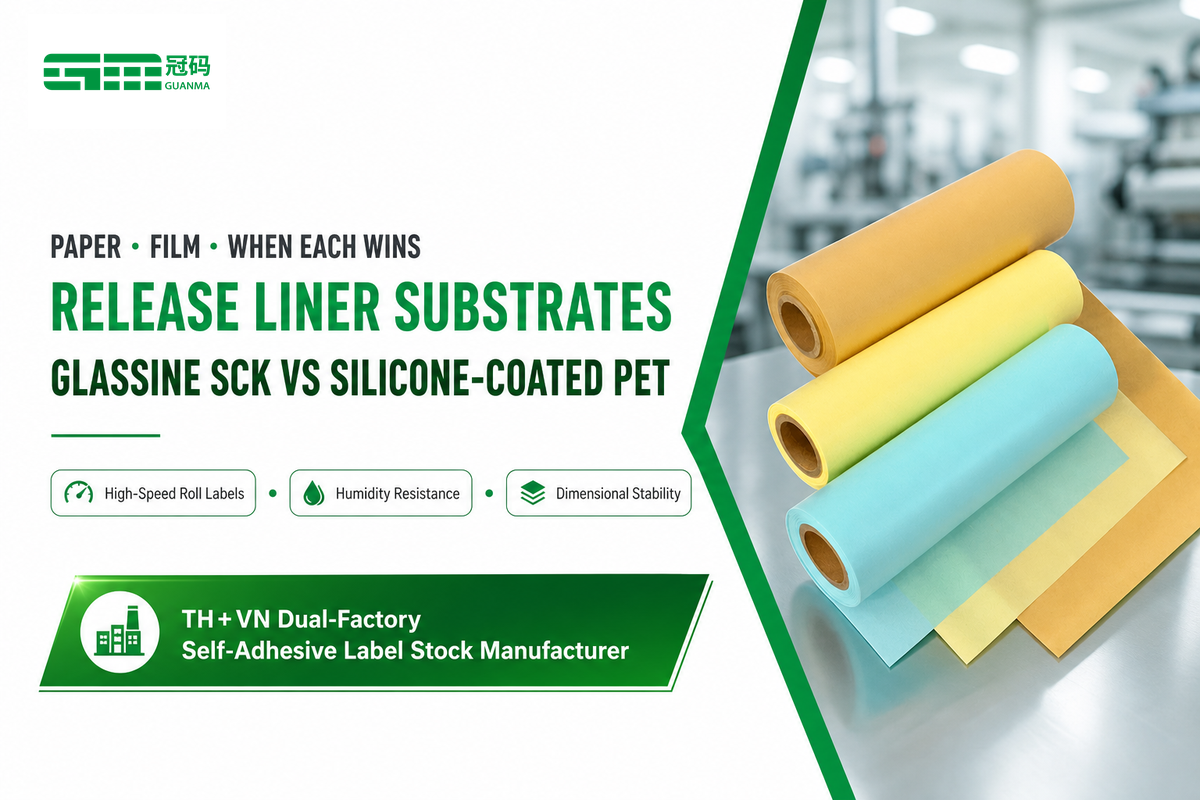
Among the different types of release liners, paper release liners remain the most widely used choice in high-speed roll-label converting because they combine machine-direction rigidity, a thin caliper, and clean die-cutting. Polyester film liners replace paper when higher durability, humidity resistance, very long unwinds, abrasive converting conditions, or tighter dimensional tolerances require them.
| Base material | Basis weight / caliper | Max service temp. | Best for |
|---|---|---|---|
| Glassine SCK | 35–120 gsm | up to 130 °C | High-speed roll labels, primary food/cosmetic labels |
| CCK | 60–135 gsm | up to 180 °C | High-temp lines, reverse-print, tire labels |
| Silicone-coated PET | 23–75 µm | up to 150 °C | Vehicle wraps, durable decals, humid environments |
| Release-coated BOPP | 20–80 µm | up to 110 °C | Clear cosmetic labels, tamper-evident closures |
| Synthetic paper (BOPP/HDPE) | 54–100 µm | up to 100 °C | Outdoor labels, chemical drums |
When film is the right choice: if the label will get wet, stretch on unwind, or be applied to a curved surface, specify a film release liner made from PET, BOPP, or polyethylene (PE). These film-based release liners hold their dimensions better than paper and offer higher moisture resistance. Film is also less likely to shed dust when die cut, which matters in clean rooms and electronics production.
When paper is enough: for flat, dry, high-speed dispensing, glassine SCK or CCK offer the stiffness and price point that roll label converters expect. CCK adds high-temperature resistance for vulcanization, tire, and reverse-print applications, making it the go-to paper release liner among release liners with high-temperature resistance. Substrate selection guidance is aligned with industry-standard release-liner references from FINAT.
| Type | Best application | Key property | When to choose |
|---|---|---|---|
| Glassine SCK | High-speed roll labels | Thin, stiff, low cost | Flat, dry, cost-sensitive runs |
| CCK | Tire, reverse-print, high-temp | Up to 180 °C resistance | Heat, curl risk, or humid conditions |
| Release-coated PET | Vehicle wraps, durable decals | High tensile strength | Long unwinds, curved surfaces, moisture |
| Release-coated BOPP | Clear cosmetic labels | Clarity, moisture barrier | Tamper-evident or no-label look |
| Synthetic paper (BOPP/HDPE) | Outdoor, chemical drums | Tear and chemical resistance | UV, chemicals, or abrasion exposure |
| Fluorosilicone liner | Silicone PSA tapes | Prevents release-layer lock-up | Bonding layer contains silicone |
| Differential release liner | Double-sided tapes | Different force on each side | C2S or transfer-PSA construction |
| Low-silicone paper liner | Food packaging labels | Reduced silicone loading | Indirect food-contact compliance |
| Linerless construction | High-volume flat-surface labels | No liner to discard | Sustainability and material reduction goals |
How Different Release Tiers Match PSA and Line Speed
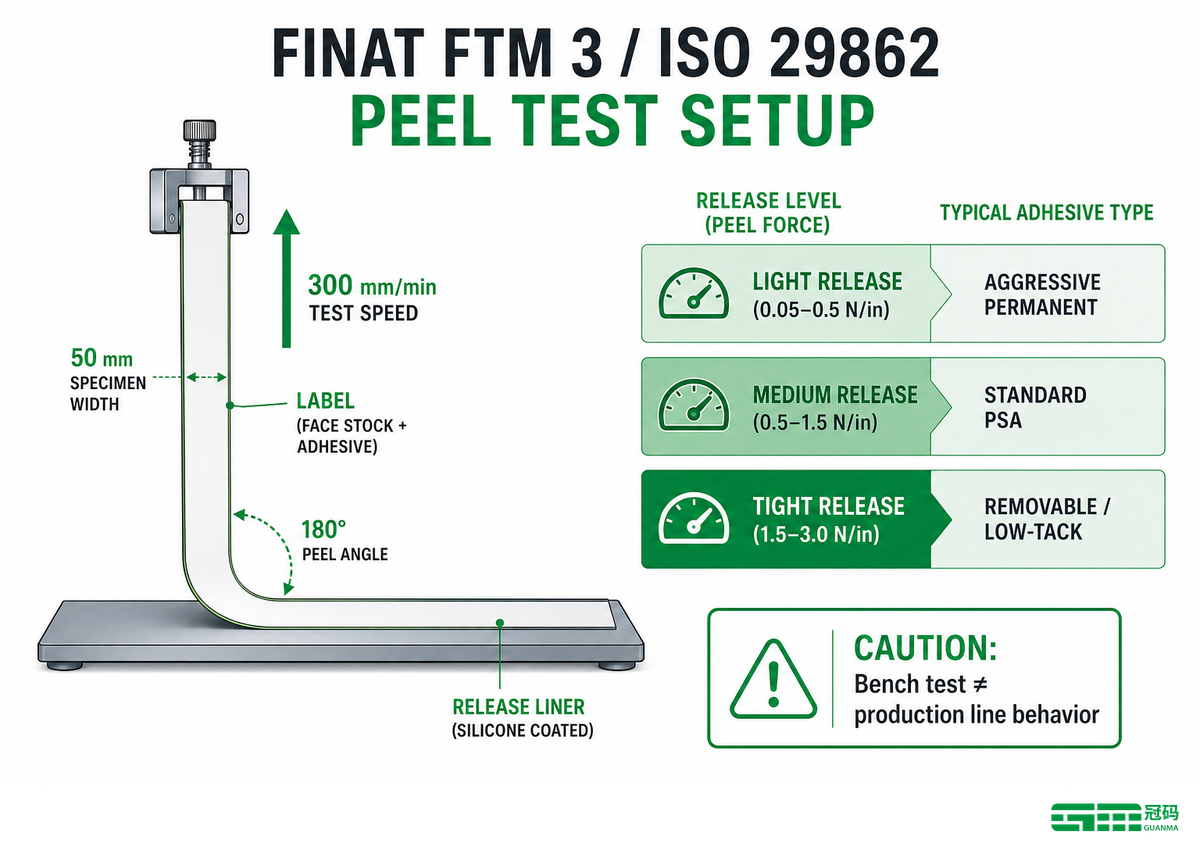
Release force describes how hard it is to pull the liner from the adhesive. Choosing release force starts with a controlled measurement: the FINAT FTM 3 method (FINAT test methods) measures low-speed release at 180 or 300 mm/min on a 50 mm specimen. ISO 29862:2024 and ASTM D3330/D3330M use related 180-degree peel methods. These tests can rank relative release levels, but they do not predict behavior at production speed or under different temperatures and humidity levels.
| Tier | FTM 3 range (N/in) | PSA match | Line-speed fit |
|---|---|---|---|
| Light | 0.05–0.5 | Aggressive permanent acrylic/rubber | High-speed auto-dispensing |
| Medium | 0.5–1.5 | Standard PSA | Moderate speed, general purpose |
| Tight | 1.5–3.0 | Removable or low-tack systems | Slow/manual application |
Differential release is used for double-sided tapes and some transfer PSAs. Typical coated-two-sides ratios are 2:1 or 3:1, meaning the two liner faces provide different release forces so one side separates first in the intended application sequence.
A common mistake is ordering a tight release “for safety.” Excessively tight release can contribute to web breaks and dispensing faults. A release that is too loose can allow labels to separate from the roll before application.
Selecting a Release Liner for Your Application
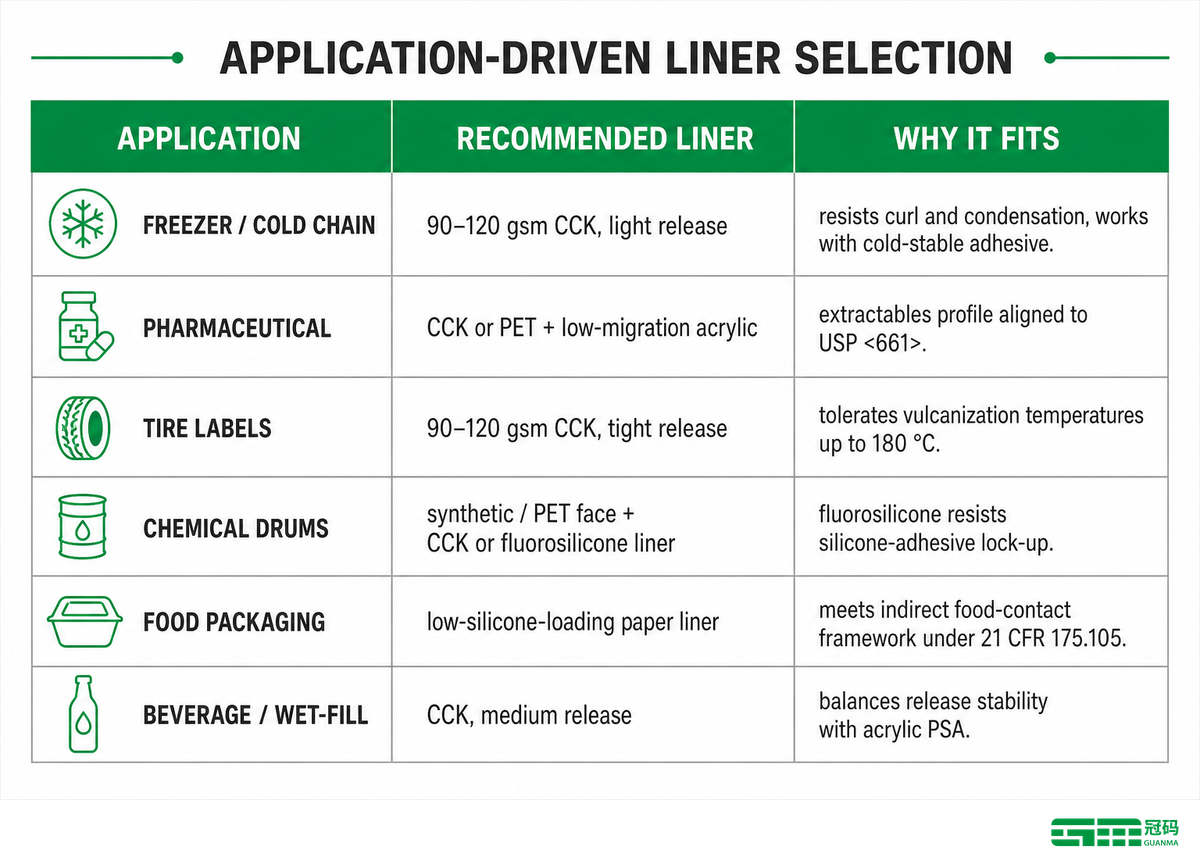
A given liner/PSA combination will perform differently in various environments and for each specific application. Run this four-question triage to narrow the candidates before requesting samples.
| Application | Recommended liner | Why it fits |
|---|---|---|
| Freezer / cold chain | 90–120 gsm CCK, light release | Heavier base resists curl and condensation; light release works with a cold-stable PSA |
| Pharmaceutical | CCK or PET + low-migration acrylic | Extractables profile aligned to USP <661>; component selection must still be verified in the final device |
| Tire labels | 90–120 gsm CCK, tight release | Tolerates vulcanization temperatures up to 180 °C |
| Chemical drums | Synthetic/PET face + CCK or fluorosilicone liner | Fluorosilicone prevents coating-to-PSA lock-up |
| Food packaging | Low-silicone-loading paper liner | Meets indirect food-contact framework under 21 CFR 175.105 |
| Beverage / wet-fill | CCK, medium release | Balances release stability with acrylic PSA |
For durable graphics in the automotive industry, a film liner can support solvent-resistant polyvinyl chloride facestock without losing dimensional stability. Across paper and film constructions, the cured silicone layer provides the non-stick surface that controls separation from the adhesive.
Regulatory Boundary: 21 CFR 175.105 covers adhesives for indirect food contact applications such as packaging and transport. For medical devices, while components can meet USP <661>, they don’t substitute the finished-label biocompatibility testing needed for the medical device itself.
Operational Factors: Line Speed, Die-Cutting, and Stability
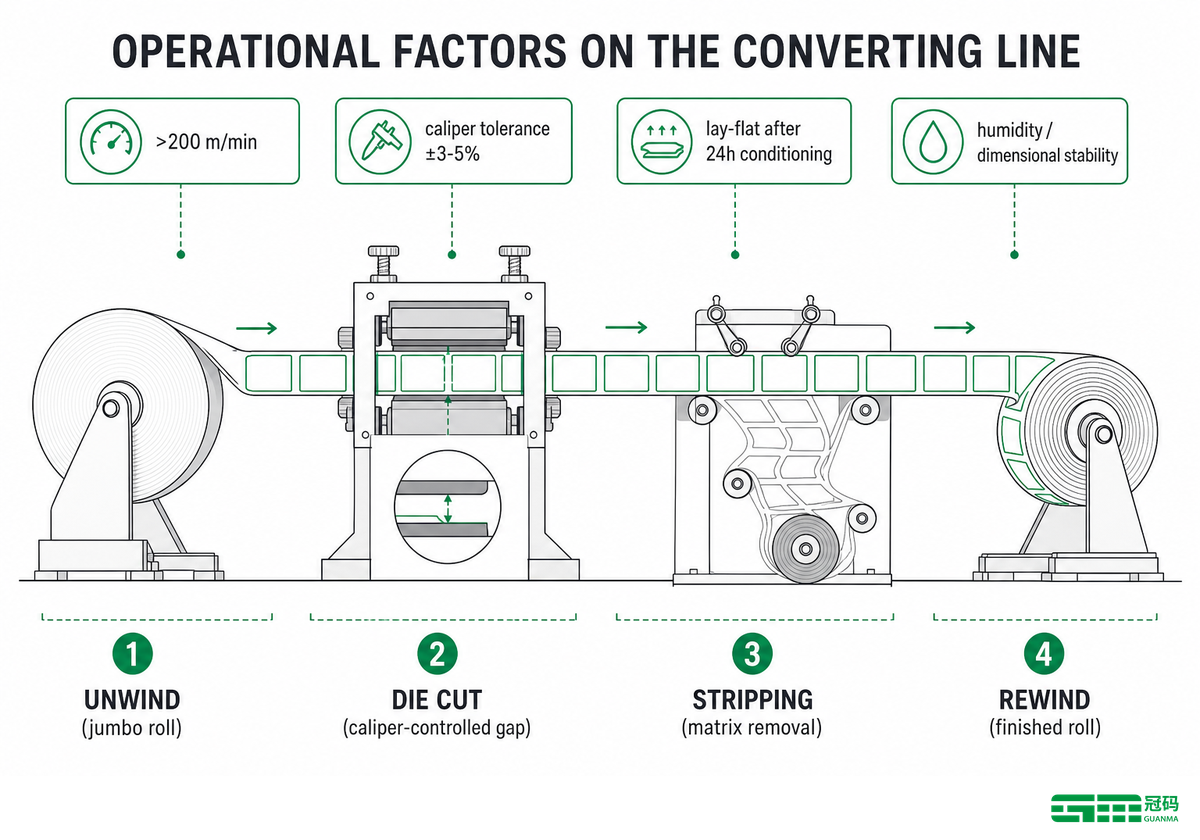
At speeds above 200 m/min, small changes in liner thickness or stiffness can create large converting problems. Paper liners that meet strict caliper tolerances work well with close-tolerance die-cutting. Film liners better resist long-unwind stress, high humidity, and harsh environments, and they are generally less prone to curl. A liner that shrinks after lamination can distort the facestock and cause puckering in composite constructions. Caliper and lay-flat measurement protocols follow industry-standard release-liner references from FINAT and ASTM.
“With aggressive adhesives you want an easy release. With removable/low-tack adhesives you might want a tight release. Getting the two wrong can quickly stop a line.”
Checklist before production:
- Confirm caliper tolerance across the roll and between lots.
- Measure lay-flat after 24-hour conditioning at plant humidity.
- Set your die cut to the liner caliper to avoid half cuts or pushing PSA through the die.
- Run a speed ladder during the application process (start 50 m/min and work up to speed, testing consistency at each increment).
Hidden Cost Drivers: Lead Time, MOQ, and Regional Stock
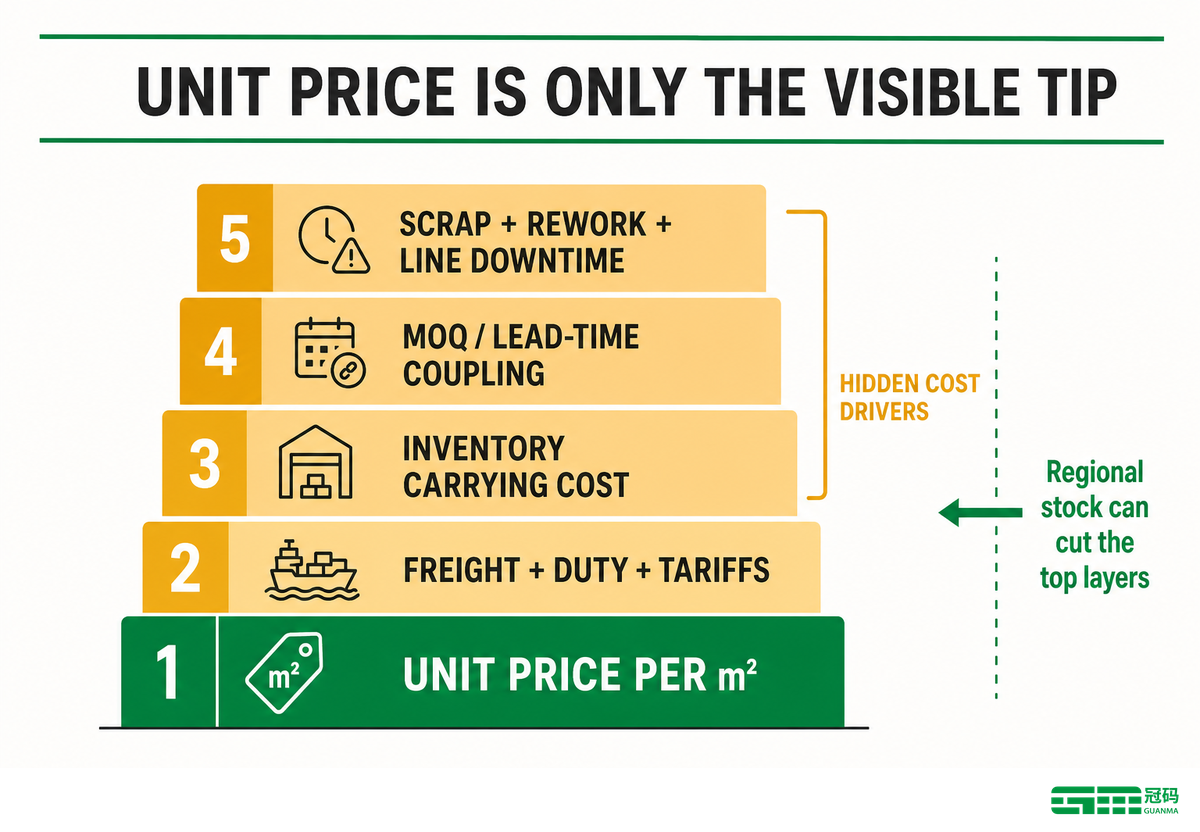
Unit price per m² is only the most visible cost of release liners. NIST supply-chain guidance notes that more than half of a manufacturer’s total spending occurs in the supply chain. Freight, tariffs, longer lead times, inventory carrying costs, and distant-supplier management therefore belong in the total-cost comparison. For make-to-order converters, minimum order quantity and lead time are also interconnected because a small, irregular order pool can lengthen the wait for production.
Unit-price thinking
- Compares sq-m quotes only
- Ignores scrap and rework from mismatched release
- Misses freight, duty, and carrying cost
- Treats lead time and MOQ as separate checkboxes
Total-cost thinking
- Includes rejection rate and line downtime
- Counts regional stock as inventory savings
- Balances offshore unit cost against logistics risk
- Recognizes MOQ and lead time are coupled
Reorders caused by delamination, incorrect release force, liner tearing, or web breaks add scrap, downtime, and repeat freight to the apparent material price. Compare suppliers on delivered cost per usable square meter and validate the release system on the actual converting line before approving a production lot.
Guanma coats and converts release liner at its Haiyan plant and holds regional stock in Thailand and Vietnam, which can shorten the standard four-to-six-week lead time for available specifications. Guanma also offers free samples for converter line trials before a production order.
Sustainability and Recycling Considerations
While paper-based silicone release liners are recyclable through de-inking, their silicone coating restricts use with typical paper recycling. Industry efforts such as the TLMI Liner Recycling Initiative (launched with Sustana Solutions in mid-2024 in the U.S.) aim to achieve closed-loop recycling for liners, joining established European and Asian initiatives such as RafCycle and AD Circular. Recycling compatibility research from the U.S. Forest Service underlines the importance of specialized de-inking streams for coated papers.
Do not treat recyclability as proof of biodegradation. Ask the supplier and recycler to document the disposal route for the exact liner construction used in your market.
According to Packaging Digest, Techlan’s Re-Liner process can save 670 kg of CO₂ per tonne of liner compared with virgin material, reduce waste, and divert spent liner from landfill. For customers requiring chain-of-custody documentation, Guanma offers FSC-certified paper liners and a low-silicone-loading option.
Linerless labels eliminate the release liner and can use 32 percent less material while fitting 50 percent more labels on a roll. They are not suitable for every job, particularly curved surfaces and precision die-cutting applications that rely on the liner for stability. Consider linerless construction mainly for high-volume, flat-surface work.
Selecting the Right Release: Common Mistakes
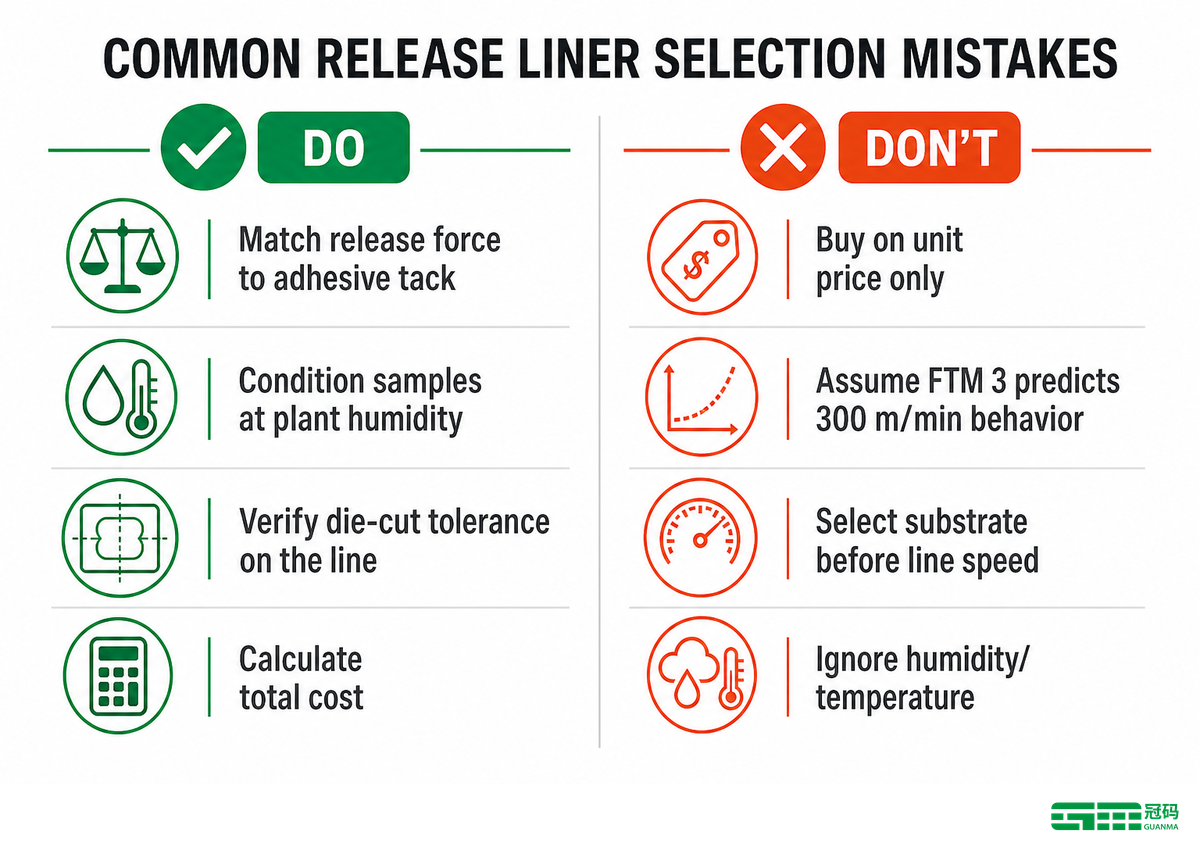
Most errors come from treating the liner as a commodity rather than a matched component. The following checklist is derived from field failures reported to converters and from standardized release-testing guidance published by FINAT and ASTM.
Do
- Match release force to tack before comparing base materials
- Condition samples at plant temperature and humidity before testing
- Verify die-cut tolerance on the actual converting line
- Ask for lot-to-lot caliper certificates on critical jobs
- Calculate total cost including freight, duty, and rejection risk
Don’t
- Buy on unit price without a release-force match
- Assume a bench FTM 3 result predicts 300 m/min behavior
- Select a base material before confirming line speed and die depth
- Ignore humidity and temperature in the end-use environment
- Treat regional stock as automatically cheaper than overseas supply
Choosing the Right Release Liner: A 4-Step Workflow
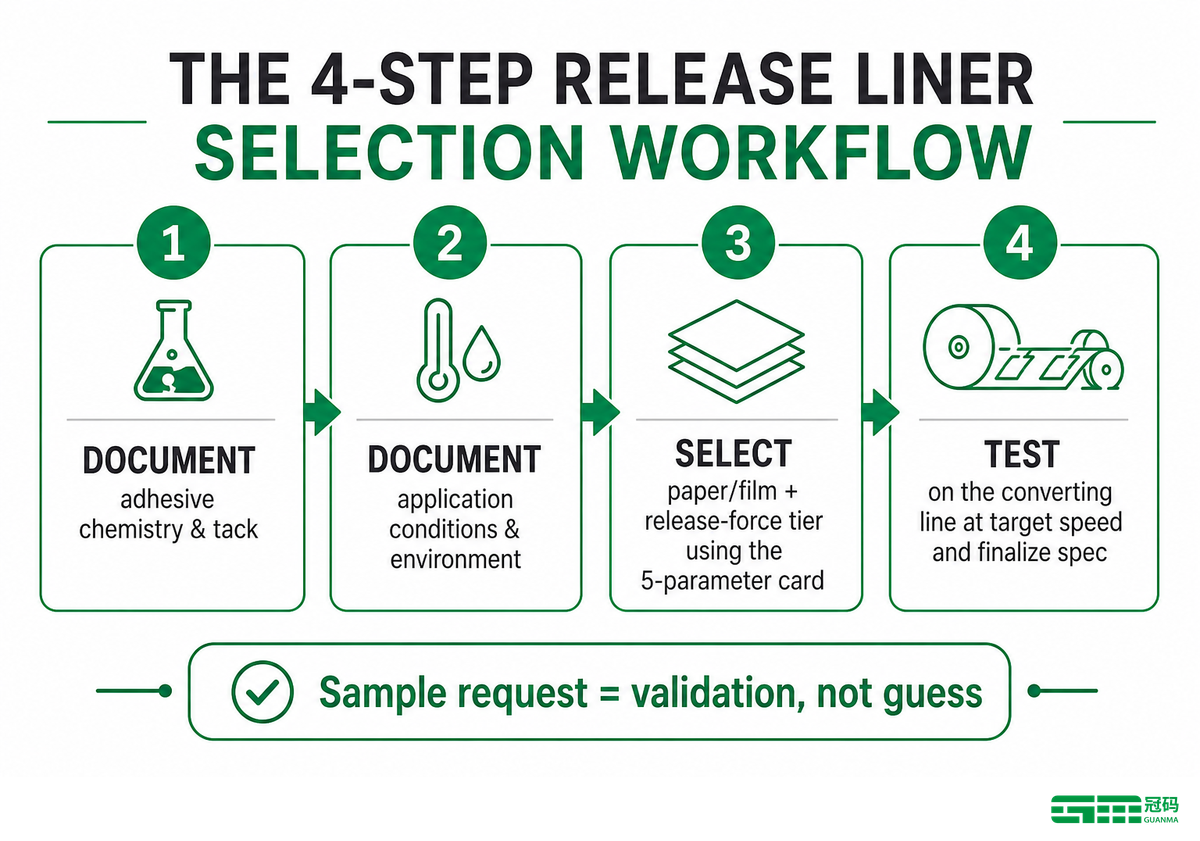
A repeatable workflow protects converters from the most expensive mistake: specifying a liner from the datasheet alone and then discovering web breaks or PSA transfer on the production line. Start by documenting adhesive chemistry and tack, then map the end-use temperature, humidity, and application speed. Use the five-parameter card and FINAT FTM 3 or ISO 29862 reports to narrow the candidates, and finish with a line trial that measures release-force variation across the roll before finalizing the specification.
- Document the bonding chemistry, tack level, and permanent, removable, or repositionable status.
- Document application conditions: end-use temperature, humidity, chemical exposure, and application speed.
- Select paper or film and choose a light, medium, or tight release-force tier using the five-parameter framework.
- Test on the converting line at target speed and measure release-force variation across the roll before finalizing the specification.
When Guanma customers follow this sequence, the sample request becomes a validation step rather than a guess: the supplier already knows the PSA, the environmental conditions, and the target line speed, so the recommended liner is far more likely to deliver reliable release on the first run.
Understanding Release Liners: What to Send Your Supplier
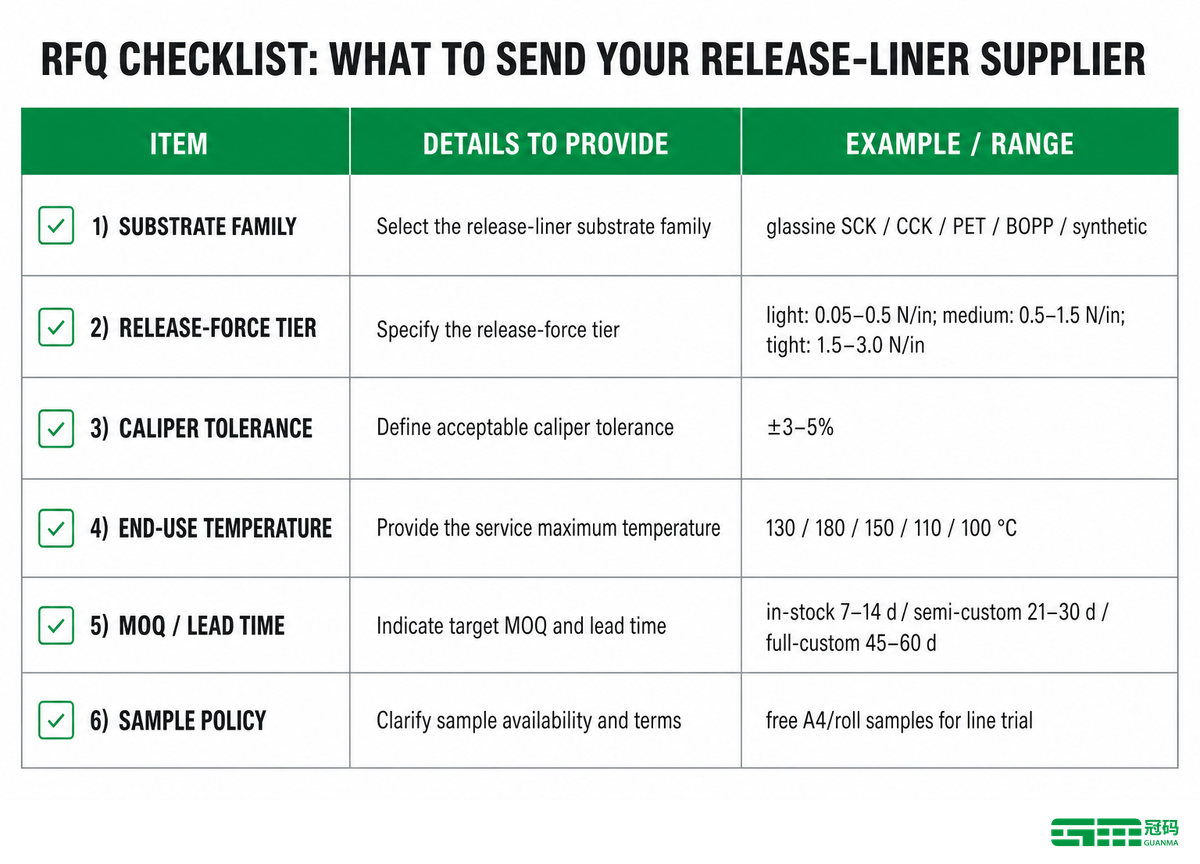
Send this table with your quote request to ensure comparable results. Specifying against FINAT FTM 3 or ISO 29862 reports gives every supplier the same measurement baseline.
| Parameter | Recommended range | Why it matters | How to verify |
|---|---|---|---|
| Base-material family | Glassine SCK / CCK / PET / BOPP / synthetic | Determines temperature, humidity, and dimensional limits | Compare with the application matrix |
| Release-force tier | Light 0.05–0.5 / Medium 0.5–1.5 / Tight 1.5–3.0 N/in | Must match PSA tack and line speed | FTM 3 or ISO 29862 report |
| Caliper tolerance | About ±3% to ±5%, supplier-confirmed; tighter for high-speed lines | Controls web-break and die-cut risk | Supplier certificate per lot |
| End-use temperature | Specify the actual minimum and maximum service temperature | Prevents bond failure or liner curl | Aged sample test |
| MOQ / lead time | In-stock 7–14 d / semi-custom 21–30 d / full-custom 45–60 d | Affects inventory and project timing | Written delivery commitment |
| Sample policy | A4 sheets or trial-roll samples, as available | Reduces specification risk before production | Request a sample COA |
Key takeaway
The correct release liner is the one that releases cleanly from your PSA at line speed, survives the end-use environment, and costs less over the full supply chain—not the one with the lowest square-meter price.
Frequently Asked Questions
These answers reflect common field questions; detailed test protocols are published by FINAT and ASTM.
What is the most common release liner for high-speed automatic labeling?
Glassine SCK is the standard starting point for high-speed roll-label converting because its thin caliper, machine-direction stiffness, and consistent release suit lines running above 200 m/min.
Glassine SCK dominates high-speed roll-label converting because it is thin, stiff in the machine direction, and releases predictably with standard permanent acrylic PSAs.
When should I choose CCK over glassine?
Choose 90–120 gsm CCK when heat, reverse printing, tire curing, or humidity demands greater dimensional stability than glassine can provide during converting and end use.
Choose CCK when the label will see higher temperatures (up to 180 °C), reverse printing, tire curing, or humid conditions where glassine might curl or lose dimensional stability.
How do I specify release force for my pressure-sensitive adhesive?
Specify release force with a FINAT FTM 3 or ISO 29862 report measured at 300 mm/min, match the tier to the PSA, then confirm it on your line.
Request a FINAT FTM 3 or ISO 29862 release-force report from your supplier. Then match aggressive permanent systems to a light release, standard PSA to a medium release, and removable or low-tack products to a tight release. Always confirm the final value on your converting line because bench tests do not predict production speed, temperature, or humidity behavior.
Are silicone release liners recyclable?
Release-coated paper liners can be recycled through specialized collection and de-inking programs, but most standard paper streams do not accept the treated material without preprocessing.
Paper-based liners are recyclable in specialized de-inking processes, but they are not accepted in most standard paper recycling streams. Programs such as TLMI Liner Recycling, RafCycle, and AD Circular collect and reprocess them.
Can I get release-liner samples before placing a production order?
Yes. Guanma offers free release-liner samples so converters can test release force, die-cutting, and dimensional stability on their own line before approving a production specification.
Guanma supplies free samples for converter line-trial validation so you can test release force, die-cutting, and dimensional stability on your actual equipment before committing to a production specification.
About This Decision Framework
This guide combines public FINAT, ISO, and ASTM test methods with Guanma’s published release-liner material range and sample program. Exact release force and operating limits still require validation with your PSA and converting line. Reviewed by the Zhejiang Guanma Packaging Co., Ltd. technical team.
Ready to Lock Your Release-Liner Spec?
Request a custom release-liner spec sheet and quote.
The right release liner is essential when line speed, release force, and the end-use environment must work together. Send us the PSA type, application speed, end-use temperature, and target paper or film, and we’ll provide a recommendation and samples for your line trials.
Alternatively, the Release Force Selector may assist you in choosing a release before ordering a quote. You can also benchmark requirements against FINAT or ISO 29862 test methods.
Related Articles
- Release Paper & Liner Product Range
- Self-Adhesive Paper Label Stock
- Freezer Labels Application Guide
- Pharmaceutical Labels
- What Is Facestock? The Outer Layer of Label Stock
References & Sources
- FINAT Test Methods FINAT
- ISO 29862:2024, Self-adhesive tapes peel adhesion from liner ISO
- ASTM D3330/D3330M-04(2025) Peel Adhesion ASTM International
- 21 CFR 175.105, Adhesives U.S. Electronic Code of Federal Regulations
- Factorial study of PSA formulations and release-liner peel PubMed
- Effect of release-liner materials on recycling USDA Forest Service Treesearch
- Repulpable Silicone Release Liner Paper Western Michigan University
- Release Liner Market Size Report Grand View Research
- Decoding Release Liners Converting Quarterly
- Release Liners Market & Sustainability Label & Narrow Web
- You Can Now Recycle Label Liner Packaging Digest
- Supply Chain U.S. National Institute of Standards and Technology