Get in Touch with Guanma

Quick Specs
| Common Units | Gauge, mil, micron (100 gauge = 1 mil = 25.4 micron) |
| Label / Release-Liner Band | 23-36 micron |
| PET Density | 1.33 g/cm³ (amorphous) to 1.38-1.40 g/cm³ (biaxially oriented) |
| Measurement Standard | ASTM D6988 (lab test method, not a commercial-spec standard) |
pet film thickness dictates much more than how a label feel between your fingers – it dictates stiffness, dispensing characteristics, cost-per-roll, and even how much light a clear window film will let through. Anyone who specifies “25 micron PET” without understanding what that number affects is making an assumption that’s hard to defend when their converting line jams or their quote comes back high.
pet film thickness is measured in gauge, mil, or micron – 100 gauge is equivalent to 1 mil, which is equivalent to 25.4 microns. Labels and release liners are typically 23-36 microns thick, whereas electronics film is under 1 micron and rigid sheet can be more than 500 microns. Stiffness, cost, and conversion method will determine the right gauge for the application.
Key Takeaways
- pet film density isn’t a single figure; it can range from approximately 1.33 g/cm (amorphous) to more than 1.38-1.45+ g/cm (oriented and filled grades), which will affect your roll weight calculations more than you might anticipate.
- The ASTM D6988 “standard” for measuring thickness explicitly does not apply to commercial classification or sample testing, it is solely a lab property-testing reference guide and not a procurement specification.
- Thickness isn’t a universal proxy for quality; light transmission is typically higher in lower-gauge clear pet film films and tensile strength is heavily influenced by biaxial orientation and not solely by thickness.
- 23-36 microns is the practical sweet spot for both label and release liner material. At the 25-, 36-, and 50-micron mark, a provider will likely balance yield and stiffness at different levels- not merely with bigger=better values.
- California’s SB 54 legislation will necessitate that the industry decrease the weight of its plastic packaging material by 10% by 2027, 20% by 2030 and 25% by 2032-an incentive to adopt lower gauges unrelated to price.
What PET Film Thickness Actually Means (Gauge, Mil, and Micron)
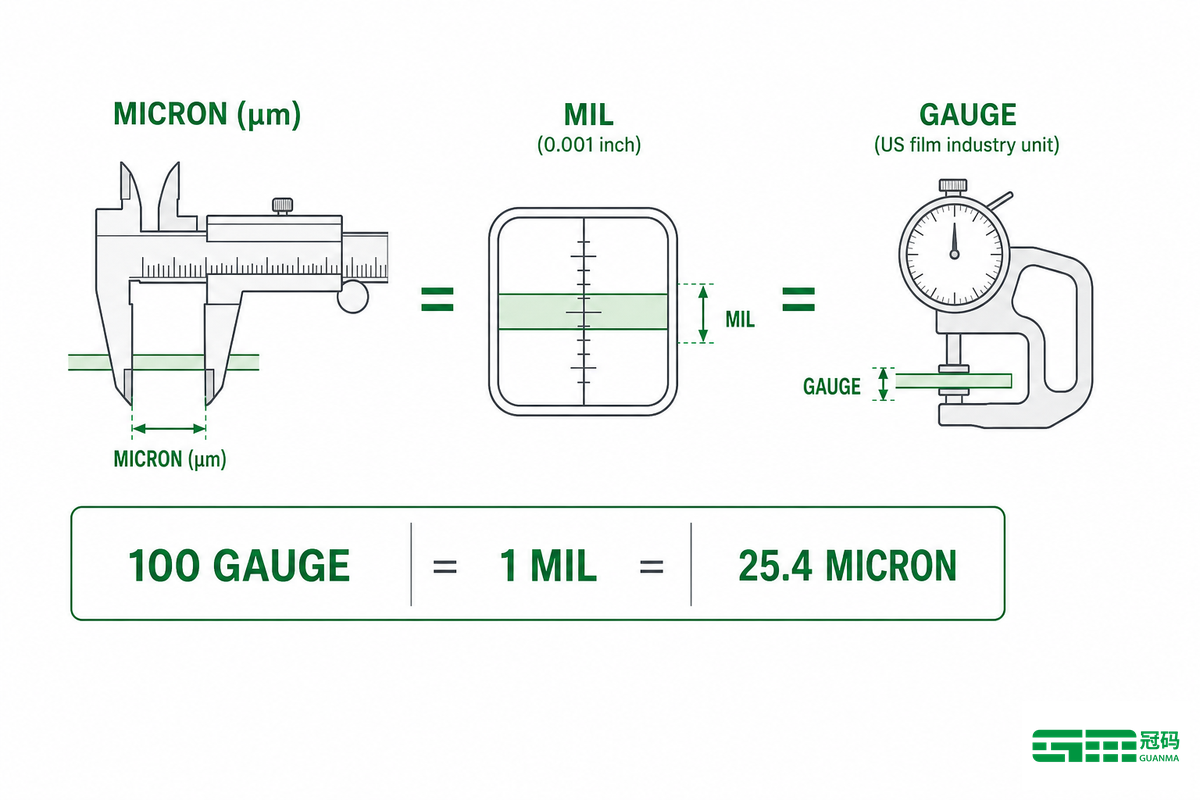
Whether they use gauge, mil, or microns to identify thickness, they’re measuring the same physical characteristic-the depth of the material. These terms may come from different scientific disciplines, but one can’t be used in lieu of another unless a conversion is made first. This holds whether you’re reviewing “pet film,” “polyester film,” or a brand name like Mylar, since polyester is the polymer family and PET is the resin almost all film-grade polyester uses.
All these terms represent the same underlying substance: polyethylene terephthalate. Mylar is a common trade name for biaxially oriented polyethylene terephthalate, the full name behind the acronym BOPET, sold in roll form as what the industry generically calls BOPET films. Verification of which term your supplier means before you compare quotes matters more than the label on the spec sheet.
| Unit | Definition | Common Region | Conversion |
|---|---|---|---|
| Micron (μm) | 1/1,000 of a millimeter | Global / metric | 1 micron = 0.0394 mil |
| Mil | 1/1,000 of an inch (0.001″) | United States | 1 mil = 25.4 microns |
| Gauge | ~0.01 mil per gauge unit | US film industry | 100 gauge = 1 mil = 25.4 microns |
Beyond thickness, you’ll want to know PET’s melting point, around 265°C, because it’s higher than that for most other processing temperatures in the print/lamination/dispensing industries, making PET ideal for hot melt and thermal-transfer processes that could degrade thinner-melting facestocks. Unlike mil or microns, there’s no standards organization to back gauge values; the standard gauge conversion to mil was established as a matter of industry practice, not a matter of law. Always verify the conversion factor your supplier uses to ensure you aren’t comparing apple and orange on your quotes.
💡 Pro Tip
For example, a 2-mil film is the equivalent of 200 gauge (2 x 100) and 50.8 microns (2 x 25.4). Choose one unit as your primary standard in your specification, and make it a point to convert all quotes to this standard for accurate comparisons.
ASTM D6988, the standard guide for determining plastic film thickness, is the reference lab method behind most micrometer-based measurements. Its scope is narrower than many buyers assume: the standard explicitly states it is intended for calculating test-result properties expressed in physical units, and is not meant to replace commercial thickness classification or quality-control sampling procedures. ASTM D8136, a newer method, extends measurement to continuous thickness profiling rather than single spot checks, which matters more for quality engineers auditing a full roll than for a buyer confirming a nominal spec on a purchase order.
How Thick Is a PET Sheet?
View Answer
There is no single answer, because “PET sheet” spans an enormous range depending on end use, from thin sheets to thick sheets. Ultra-thin electronics-grade film starts under 1 micron, standard packaging and label film runs 12-50 microns (including food packaging applications where barrier properties matter), and rigid PET sheet used for signage or thermoforming runs from 500 to 3,000 microns.
ASTM D883 draws the terminology line at 0.25 mm (250 microns): below that nominal thickness the material is generally called “film”; above it, “sheet.” When someone asks “how thick is pet film,” the honest answer is “it depends which application you mean” – see the application table below for specific bands.
Bottom line: gauge, mil, and micron are all convertible on a fixed ratio, but gauge is a convention, not a standard – and the ASTM standard behind most measurements is a lab method, not a commercial buying spec. One disambiguation worth making explicit: these conversions are specific to PET, not PVC-the two clear films get confused in casual spec sheets, but PVC’s different density and stiffness curve means a “36 micron” PVC film and a 36 micron PET film do not behave the same way on the same dispensing equipment.
Typical PET Film Thickness Ranges by Application

Typical pet film thickness runs from under 1 micron for electronics insulation to 350+ microns for rigid industrial sheet, with 23-36 microns the common band for labels and release liners. Your project’s right band, across these various thicknesses, depends on the balance between dimensional stability, stiffness, and how much material you can afford per unit area. PET film is widely used in flexible packaging across various industries beyond labels-food industry pouches and wraps lean on its excellent barrier properties as much as on its clarity.
| Application | Typical Thickness | Why This Band |
|---|---|---|
| Electronics, electrical insulation & capacitors | 0.7-15 micron | Minimum dielectric thickness at minimum weight/volume |
| Flexible packaging & wraps | 12-50 micron (48-200 gauge) | Balance of yield (m²/kg) and handling strength |
| Labels & release liners | 23-36 micron | Enough stiffness for dispensing without sacrificing yield |
| Industrial glazing & heavy protection | 100-350 micron | Impact and weather resistance over dimensional stability |
| Rigid sheet (signage, thermoforming) | 500-3,000 micron | Structural self-support, no longer classed as “film” per ASTM D883 |
These bands aren’t arbitrary. Biaxial orientation – stretching the film roughly 3 to 4 times in each direction during manufacturing – raises tensile strength substantially compared to unstretched PET, and the degree of orientation interacts with thickness to set the final stiffness-to-weight ratio.
A 2021 ASME study on biaxially oriented PET film modeled exactly this relationship between orientation, thickness, and fracture behavior – the kind of engineering-grade detail that explains why an electronics engineer and a label converter land on completely different gauge targets across this material’s versatile range of industrial applications, even though both are working with chemically the same polymer. If your application sits close to a boundary between two of these bands – for example, a large heavy-duty label that behaves more like light packaging – it’s worth reviewing our guide to PET label material durability for the broader materials picture beyond thickness alone.
Just to be crystal clear: there is no industry standard defining which gauge of thickness goes with which application. ASTM D8065, the film classification and identification standard most relevant to this question, specifically states it “is not intended for the selection of materials to be used in films”-that responsibility falls to a qualified plastics engineer, balancing performance, application, fabrication process, cost, and environment. What follows reflects common industry practice and the physics of materials, not an authoritative list of what belongs where, and this is precisely why it pays to get a qualification sample prior to placing a full production order.
Working rule of thumb: match the application to the “band” first, and then fine-tune within the band-specifying industrial-glazing thickness for a label or a label-quality film for industrial-glazing usually represents a misunderstanding or error.
25 vs 36 vs 50 Micron: Which Gauge for Which Job
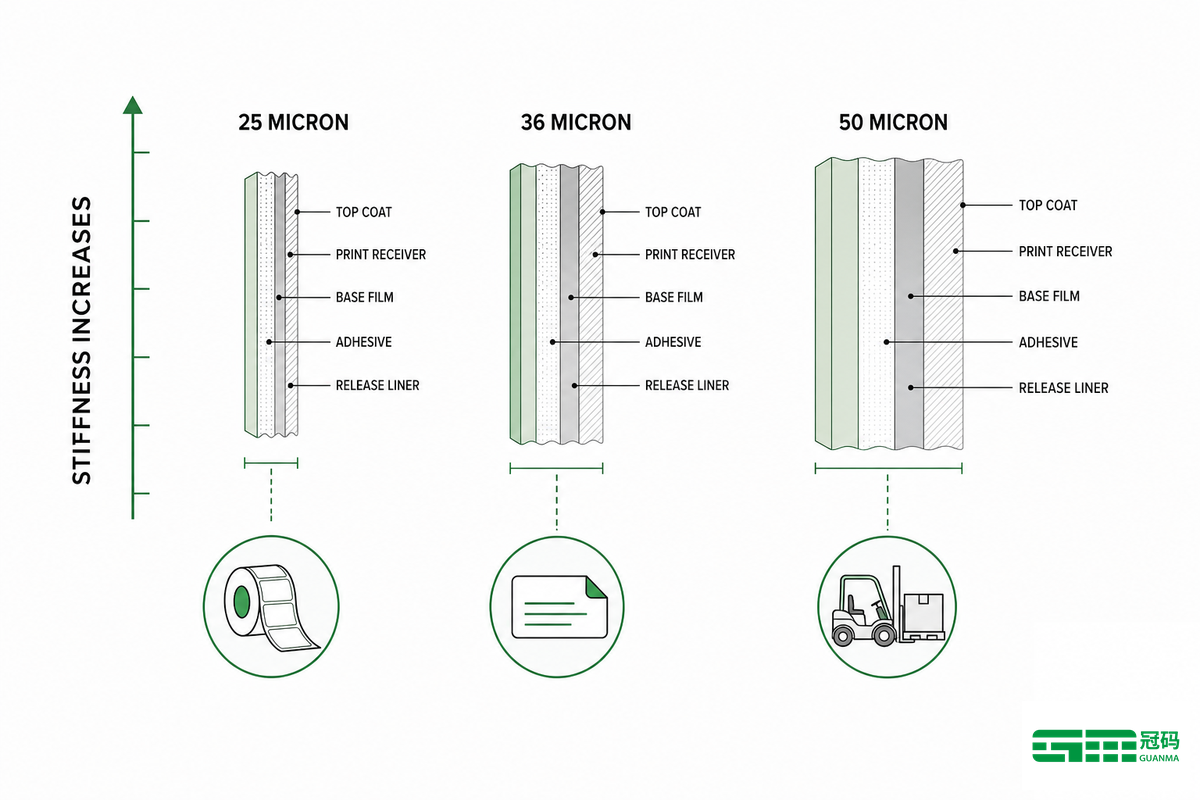
Selecting the best gauge within the label band involves weighing stiffness, dispensing efficiency, and cost, and that choice need to be dictated by the requirements of the application itself-not the availability of whatever a given supplier currently stocks. The “sweet spot” for label and release-liner specifications within the 23-36 micron band (and just above it) typically comes down to one of three common gauges: 25, 36, or 50 microns.
The Label Gauge Sweet Spot (23-36 Micron) is the band where PET remains thin enough for high-speed dispensing, yet sufficiently thick to prevent tearing during the application process-and the 25-, 36-, and 50-micron values represent the three key decision points on the stiffness-versus-yield curve that begins just outside of and straddles this sweet spot. We refer to the following chart as the 3-Gauge Decision Framework; it’s a one-stop shop to decide between these three most frequently requested gauges, without reinventing the wheel every time.
| Gauge | Typical Use Case | Relative Stiffness | Relative Cost Index | When to Adjust |
|---|---|---|---|---|
| 25 micron | High-speed dispensing, small-to-mid labels, cost-sensitive runs | Lower | 1.0× (baseline) | Size up if labels are large or dispensing is slow/manual |
| 36 micron | General-purpose labels, mid-size containers, standard release liners | Medium | ~1.4× | Size down if yield is the priority and labels are small |
| 50 micron | Large or heavy labels, harsh handling, premium/technical labels | Higher | ~2.0× | Size down unless durability or rigidity is a hard requirement |
The “stiffness” and “cost index” columns in the ranking table aren’t derived from an official industry document, but rather from the basic principles of engineering: Bending stiffness increases roughly with the cube of the thickness of the film-small increase in gauge yield disproportionately stiffer film. The “cost index” increases roughly linearly with gauge, as a given area of thicker film contains proportionally more polymer per unit area. We cover a worked example illustrating this concept in the Cost and Yield section, below. This decision framework should be used as a starting point. Always test actual dispensing and converting performance with a sample on your production equipment-an upgrade from 25 to 36 micron may have no effect on a manual, low-speed applicator, yet the same upgrade on an automatic applicator may cure a persistent mis-feed problem.
One characteristic that the foregoing decision framework does not reliably predict is the material’s tear resistance. According to the ASTM D1922 standard, there is no direct correlation between force of tearing and gauge of plastic film, nor is tear resistance an isotropic property; variability in tear performance within the same batch can vary by more than a factor of two (from about 5% to more than 50%). Therefore, gauge can provide a reasonable initial guideline for dispensing and stiffness, but specific test data for tear resistance is a necessity, rather than a guess derived from the gauge.
For label face materials and release liners, it may not make practical sense for us to stock just one gauge thickness and slit it to size because many buyers, when they can, simply reconcile the tradeoff between thickness and performance without over committing the cost of buying exclusively in one thickness for the entire line of product that we’re going to buy.
Summary: Choose the gauge that your dispensing hardware and label size needs, not the strongest. Every increase up the 25-36-50 micron scale has a true price increase with an undefined potential for job performance benefits in a situation where it was never needed.
Finish and Gauge: How Clear, White, and Metallized PET Change the Choice

How the final product perform at a given thickness, and thus the gauge you should choose for your specific application, also varies according to how it’s finished. Clear, white, metallized, and black PET all belong to the same family of optical films, but each pulls the stiffness-versus-yield tradeoff in a slightly different direction, which is part of why gauge selection has this much versatility across a facestock line.
✔ Clear PET Advantages
- Highest light transmission for a “no-label-look” appearance
- Best option when inspection windows or see-through branding matter
- A thinner gauge (25 micron) has greater light transmission than thicker clear gauges
⚠ Clear PET Limitations
- Highlights bubbles, marks and defects in liner & substrate more readily than non-transparent alternatives
- Print contrast is less than on white or metallized stock without a white ink underlay
✔ White / Metallized PET Advantages
- Hides substrate imperfections and adhesive lines
- High-contrast printing and barcode readability (white)
- Technical, premium, or decorative appearance for equipment and electronics labels (metallized)
⚠ White / Metallized PET Limitations
- No see-through/inspection-window option
- Opacity fillers such as titanium dioxide add a minimal increase in density as opposed to the clear film of equivalent thickness.
- Matte PET film (a fine surface texture added for glare reduction or a premium feel) behaves the same way under this same fillers-add-density rule as white or metallized stock.
Does Thickness Affect Light Transmission and Haze?
View Answer
Yes, on Clear pet film thickness affects transmission and haze and light scattering in much the same way any transparent film’s thickness would: light travels through a shorter path and less is absorbed or scattered. All other things being equal, thinner films typically will be clearer (have more light transmission) than thicker ones of the same grade. One of the reasons ‘thicker is better’ isn’t a useful maxim is because over-speccing an inspection panel or window film will often be poorer than one which is slightly thinner but correct for the job, as matters most for that film.
Orientation and manufacturing are also factors which will affect optical consistency, even between two films of the same gauge from different machines — a 2024 academic study on optical anisotropy in stretched PET film measured exactly this kind of orientation-driven optical variation using spectral methods.
The NET is as simple as pick your finish based on what the piece looks like/ does (transparent, opaque, technical) then double check if the gauge still work for your rigidity and budget in that finish. Don’t assume all gauges behave the same across all finishes.
Beyond the Facestock: Adhesive, Liner, and the Full Construction
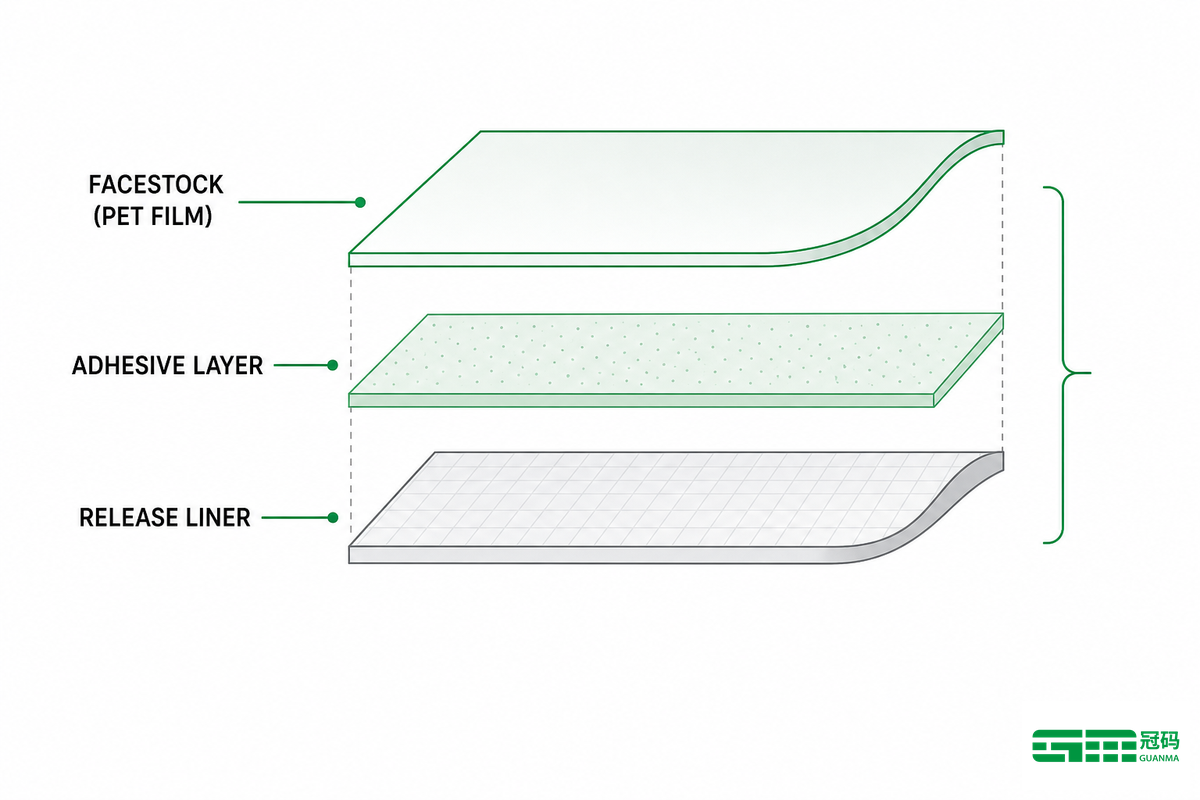
Most pressure sensitive PET labels are a laminate comprised of 3 layers, the facestock, adhesive and the release liner, and when changing the gauge of the facestock, the choice of the appropriate liner and adhesive should be reconsidered as much as the overall price of the label. Label-industry testing treats these as completely independent fields from facestock thickness alone: the 31 standard self-adhesive label tests developed by FINAT contain adhesion at 180 degrees and 90 degrees (peel strength) (300 mm/min, FTM 1 and 2) as well as tests at very low speeds (10mm/min to 300 mm/min, FTM 3) to 300m/min (FTM 4) for both peel and slip as well as Adhesive coat weight (FTM 12) which can’t solely be influenced by the facestock gauge.
📐 Engineering Note
If you’re using thin facestocks, the risk of telescoping and wrinkling in high speed matrix stripping and dispensing operations – on the same converting machinery a label plant already runs – may drive the converter to a harder-tack adhesive or a stiffer release liner (like CCK paper, as opposed to glassine) to maintain the integrity of the web as it goes through the press. The standard ASTM D3330 describes a peel method of testing that measures the force needed to peel the liner from the adhesive side of a construction at a given peel speed – this is an objective test to see whether a liner change has an effect, rather than simply assuming that a facestock gauge change automatically impacts release. Release impact can be seen even 10-15 microns of difference in facestock gauge and, as such, the facestock, liner, and adhesive should be specified as a group, not individually.
There is an exception: It isn’t always “facestock plus adhesive plus liner.” A linerless label design actually utilizes a siliconized version of the facestock as its own release liner. It’s an alternative construction altogether, with a different shape and a slower peel speed. You can remember that this construction method exists.
International peel strength test ISO 29862:2024 tests separate peel to steel, peel to backing, and liner-to-adhesive.
Guanma’s PET adhesive film products correlate the facestock gauge and the underlayment adhesive systems with our range of glassine, CCK or film release liners – our standard construct across our broader release liner range. Our in-house R&D and coating lines exist specifically to hold this gauge-adhesive-liner correlation steady across a production run, rather than treating each layer as a separate purchase decision on your brand’s PET film program. To get a more general perspective of facestock choice not specific to PET, view our self-adhesive film materials guide.
| Adhesive Type | Bond Character | Selection Condition | Target Application |
|---|---|---|---|
| Acrylic (permanent) | Durable bond, builds after application | Clean, higher-energy surfaces | Industrial ID, electronics, qualified outdoor labels |
| Water-based acrylic | Balanced coating/converting profile | Smooth packaging/label substrates | Consumer goods, general labeling |
| Hot-melt | High initial tack | Low-surface-energy surfaces, fast dispensing | Logistics, packaging, difficult containers |
| Rubber-based | Aggressive bond on rough/textured surfaces | Verify migration/compatibility | Industrial containers, textured plastics |
| Removable | Repositionable, clean-removal construction | Smooth surfaces after removal testing | Temporary ID, promotional labels |
| Freezer-grade | Permanent cold-service construction | Confirm service temp by product TDS | Cold-chain, frozen goods, lab logistics |
| Tire labeling | High initial tack on rubber | Test on exact rubber compound | Tire sidewall ID, process labels |
| High-temperature | Permanent bond, elevated-temperature service | Confirm construction by product TDS | Under-hood, equipment, heat-exposed ID |
| Oil-resistant | Maintains bond and chemical resistance during oil/solvent contact | Test against exact fluid, dwell, temperature | Chemical drums, lubricant containers, GHS labels |
“Buyers who send us a gauge number alone are only giving us one-third of the specification. Our engineering team at Guanma routinely re-qualifies the adhesive and liner alongside any facestock gauge change, because a customer’s dispensing equipment and label size determine the right construction more reliably than a generic gauge recommendation ever could.”
Working rule: Never spec the facestock gauge in isolation – double-check adhesive and liner together whenever you move more than roughly 10-15 microns from what you’re doing today.
Cost, Yield, and the Over-Spec Trap
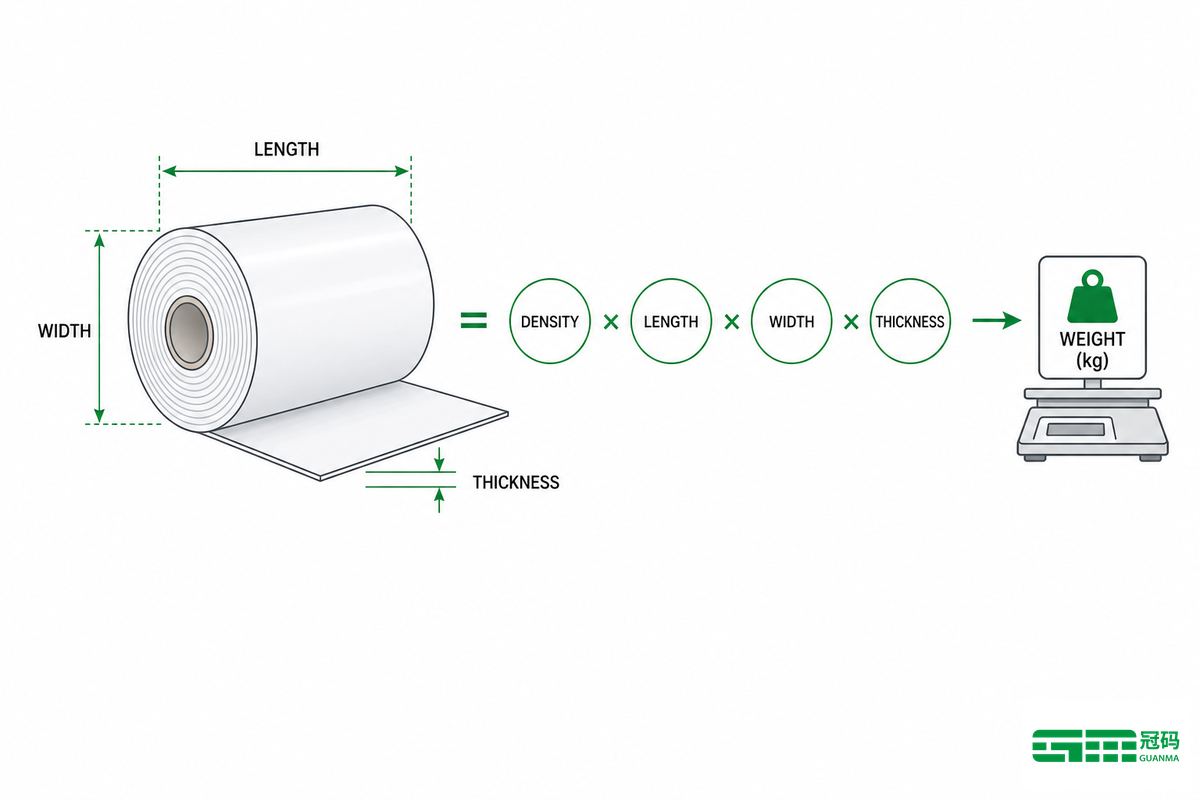
pet film density: convert any thickness, roll size into a weight; Once you can make that conversion yourself it’s easier to detect any sneaky inflated quote.
PET film density is a value that depends on several factors. Amorphous PET has a density of approximately 1.33 g/cm³; however, biaxially oriented (stretched) PET used in many label and packaging films has a density of around 1.38-1.40 g/cm³ because the degree of crystallinity is increased by orientation (stretching). Standard reference density lists give 1.370 g/cm³ for amorphous PET and as much as 1.455 g/cm³ for single-crystal PET; standard biaxially oriented films can fall anywhere in the 1.38-1.41 g/cm³ range, depending on process, additive levels and actual degree of crystallinity. Additives like opacifying fillers (e.g., white, matte) can add some density.
The Density-to-Weight Formula: A Worked Example
Weight (g) = Density (g/cm³) × Length (cm) × Width (cm) × Thickness (cm)
For example, let’s say you quote a 1,000-meter roll of 36-micron biaxially oriented PET label film with a width of 300 mm and a density of 1.40 g/cm³:
- Length: 1,000 m = 100,000 cm
- Width: 300 mm = 30 cm
- Thickness: 36 micron = 0.0036 cm
- Volume: 100,000 × 30 × 0.0036 = 10,800 cm³
- Weight: 1.40 g/cm³ × 10,800 cm³ = 15,120 g (or 15.1 kg)
Now compare that with 50 micron instead of 36, for the same length, width and density of 1.40 g/cm³. At 50 micron, the volume becomes 100,000 × 30 × 0.0050 = 15,000 cm³, so the weight is 1.40 g/cm³ × 15,000 cm³ = 21,000 g (or 21 kg) – about 39% more weight per roll than the 36 micron version, which corresponds to the ratio 50/36 = 1.39. If your application doesn’t require the added stiffness provided by 50 micron, the additional cost of this extra material for the life of the product may be completely unnecessary. It’s the reason why two suppliers quoting the same price “per kilogram” may offer very different total amounts of actual film per dollar. Comparing cost-per-square-meter using actual thickness and density will give you the more reliable answer.
A common, preventable mistake is treating an out-of-spec or inconsistent roll thickness (gauge) as a quality control issue to fix on the production floor instead of a specification issue to address upfront in the procurement stage. Out-of-spec film that’s too thick or variable can lead to jams on dispensing equipment and failures during the sealing and application process. Downtime and waste costs typically outweigh whatever savings that “cheaper” film seemed to offer in the first place.
Rule of thumb: before accepting an increase in film gauge, run the numbers yourself to convert it back to a weight increase-if it almost perfectly matches the thickness increase, you’re simply paying more for more material.
Industry Outlook: Why Buyers Are Trending Toward Thinner Gauges
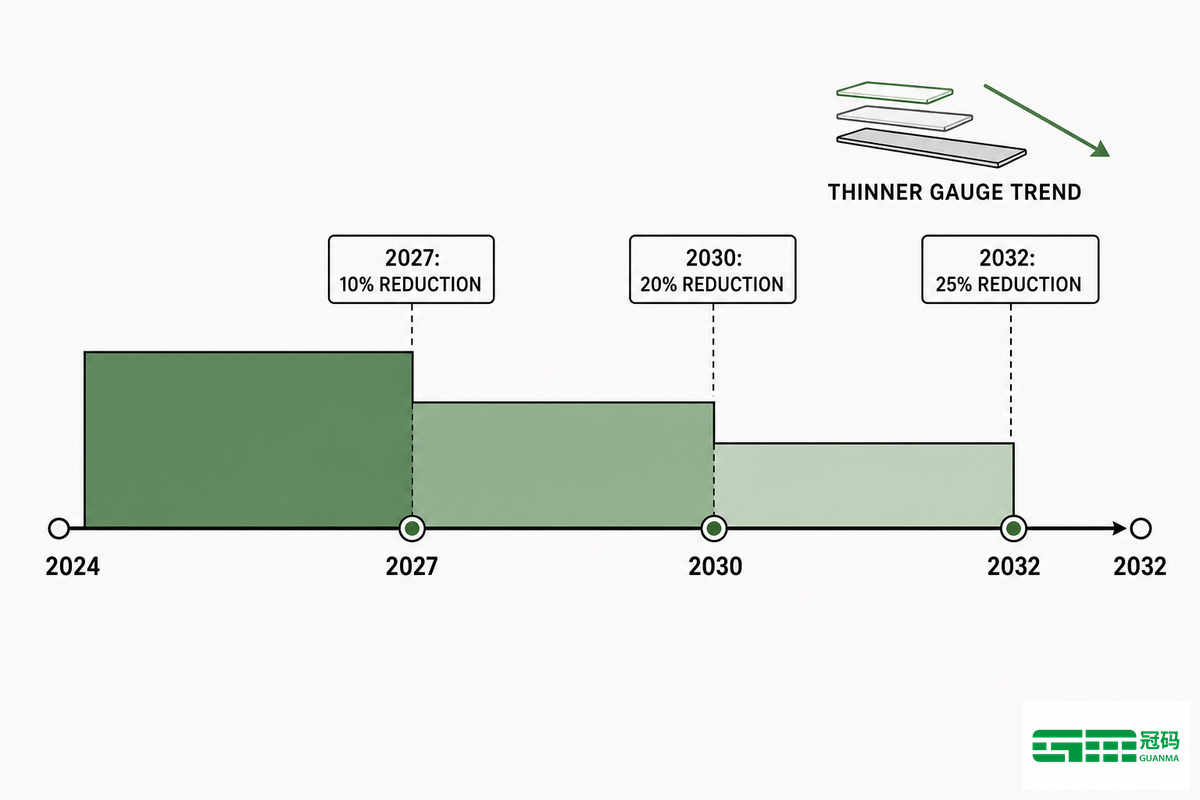
(Updated July 2026) California’s SB 54 is now driving a 10% reduction target by 2027, 20% by 2030 and 25% by 2032 in source reduction of plastic covered packaging material – a dated, binding, statutory target that’s applicable to plastic packaging and label components sold into California serving supply chains. It’s helpful to be specific on what the law mandates: SB 54 allows several options to meet its targets, including reusable/refillable packaging, elimination of a plastic component, right-sizing, concentration, a shift to bulk, a move to nonplastic materials and a recycled content credit-lightweighting (making the same thing using less plastic by thinning the gauge) is one accepted means, but not the only one. For a PET label component, using a lightweighting strategy is precisely where thinning gauge becomes a direct factor; it isn’t applicable to other compliance strategies like elimination or a non-plastic alternative. Any label program selling into California and targeting a lightweighting compliance path should allocate space for 2026-2027 spec review and qualification testing now before the first deadline is reached.
These efforts aren’t isolated. Trade press reports on other film types in closely related categories, like overlamination films for labels, have recently stated that “advances in film formulations have allowed manufacturers to supply even thinner” materials than the typical 1-2 mil film, providing a technical signal that thinning gauge is an actively developed engineering direction, not solely a response to compliance demands. Another widely reported, though not PET label specific, example: the switch to a machine direction oriented label film of a reduced thickness for a hair-care brand led to a reduction of 26-34% in multiple categories of environmental impact according to press coverage-a benefit that converter suppliers are now chasing in other film applications as well, even though that particular film chemistry differed from PET.
Context for size: The global polyethylene terephthalate films market was valued at $40.1 billion in 2025, and was expected to grow to $64.9 billion by 2033, giving some context of category growth but telling nothing about the gauge trend direction and therefore shouldn’t be the basis for forecasting any shift toward thinner film, which is explained by the forces described above.
Takeaway: For labels you plan on the books for 2026-2027, allocate budget time now to qualify a thinner gauge alternative, because both regulatory pressures and material innovations are pushing toward it and qualification can take longer than most brand and packaging buyers might realize.
Q: Is thicker PET film always better?
View Answer
No. While a thicker pet film film generally imparts higher stiffness and impact resistance, it also adds weight, cost of material, bulk of the roll and in the case of a clear film, decreases light transmission – the very opposite of what a typical inspection window or see-through label is designed to do. Gauge is one of many variables (along with finish, adhesive, liner and the actual dispensing or converting equipment), and the correct answer is one of the other variables. Treating thickness as simply a dial that should be cranked as high as possible to maximize “durability” is the single biggest mistake in gauge selection we see; it typically means paying for a property your application doesn’t need, while compromising another property (like transmission or yield) that it does.
Q: What thickness should I request for label sample or qualification testing?
View Answer
Begin with the gauge nearest your best estimate from the table above, and if your equipment or label size falls close to a boundary between gauges (for instance, you aren’t sure if your label should be called “standard” or “large/heavy-duty”), consider ordering a sample of one gauge above and below. When you receive them, test them for dispensability at your maximum speed, for printability and ink adhesion and for the behavior of the die-cut matrix. These should all be tested with the material on your actual dispensing or converting line, not hand-tested. When requesting samples, be sure to ask for the exact combination of finish and adhesive you intend to use, along with the supplier’s technical data for that construction, since gauge alone does not fully qualify a high-quality material’s performance.
Q: How long does PET film last in storage?
View Answer
Under ideal conditions, a pet film roll will remain at its optimal quality for about 2-3 years if kept in an area with consistent temperature and humidity, out of direct sunlight and away from any sources of contamination. Specifically for adhesive-coated PET labels, consult your adhesive supplier’s guidelines and certificates of analysis for shelf life. Typically, the pressure-sensitive adhesive layer is more likely to be the factor that limits the usable life of a roll than the PET facestock. Even if a roll is within the standard shelf-life period, if it has been exposed to excessive heat or humidity or to direct sunlight, it should be tested for adhesion and dimensional stability prior to use.
Q: What is the difference between gauge, mil, and micron?
View Answer
Both microns and mils are standard units of linear measure (a micron is one-millionth of a meter, and a mil is one-thousandth of an inch). Gauge is an industry convention, particular to the film industry, which is equivalent to 100 gauge per mil. See the conversion table earlier in this document for all ratios and an example.
Q: Can I order mixed gauges for sampling versus production runs?
View Answer
Yes, and that’s usually the best course of action. Ordering a small multi-gauge sample set gives you an opportunity to qualify the 2-3 closest gauges with respect to dispensing, printability and convertibility at a low cost, without having a full roll already in the plant that won’t work.
Q: Does thickness affect converting or die-cutting speed?
View Answer
Yes. Thicker gauges generally require more force for cutting and die-stripping, whereas thinner gauges usually die-cut and strip much more quickly, with less wear on the cutting tools and lower energy consumption at high speeds.
Why We Write This
The reason for the existence of this guide is the persistence of “pet film thickness” queries being asked in single gauge numbers without specifying application, finish or construction-and a single number can never answer a question with four variable factors. Our density and cost-yield data have been checked against a peer-reviewed publication rather than one supplier’s numbers, and where appropriate (the 25/36/50 micron stiffness rankings) we’ve flagged conclusions drawn from engineering logic rather than a single industry chart.
Selecting the right PET film thickness is ultimately a manufacturing question as much as a specification one, which is why we coat and laminate our own high-quality films in-house rather than reselling someone else’s roll stock. Reviewing by the Guanma Technical team.
References & Sources
- ASTM D6988-21: Standard Guide for Determination of Thickness of Plastic Film Test Specimens, ASTM International
- SB 54 Plastic Pollution Prevention and Packaging Producer Responsibility Act, Rulemaking, CalRecycle, State of California
- Polyethylene Terephthalate, Wikipedia
- US6284866: Amorphous and Crystalline PET Density Reference Values, US Patent and Trademark Office (Google Patents)
- Constitutive and Fracture Modeling of Biaxially Oriented PET Film, ASME Digital Collection
- ISO 15988: Biaxial Stretch PET Films Test Methods, United Testing Systems
- Optical Anisotropy of Polyethylene Terephthalate Films Characterized by Spectral Means, PMC / National Library of Medicine
- ASTM D8065/D8065M: Classification System for Plastic Films, ASTM International
- ASTM D1922: Standard Test Method for Propagation Tear Resistance of Plastic Film and Thin Sheeting, ASTM International
- FINAT Test Methods for Self-Adhesive Labels, FINAT (European Association for the Self-Adhesive Label Industry)
- ASTM D3330/D3330M: Standard Test Method for Peel Adhesion of Pressure-Sensitive Tape, ASTM International
- ISO 29862:2024: Self-Adhesive Tapes, Determination of Peel Adhesion Properties, International Organization for Standardization
- SB-54 Plastic Pollution Prevention and Packaging Producer Responsibility Act, Full Bill Text, California Legislative Information
- Self-Wound Overlamination, Label & Narrow Web
- Hair Care Maker Transitions to Thinner Labels, Packaging Digest
- Polyethylene Terephthalate Films Market Report, Grand View Research
Related Articles
- PET vs BOPP Labels, Full Material Comparison Guide
- Why PET Label Material Outperforms Paper and BOPP on Durability and Clarity
- Self-Adhesive Film for Labels: A Complete Materials Guide
- Paper or Film Labels? A Face Stock Guide for Beverage, Food, and Cosmetics
- PET Adhesive Film, Product Line and Specifications