Get in Touch with Guanma

Updated November 2026 · Technical Converting & Pre-Press Guide
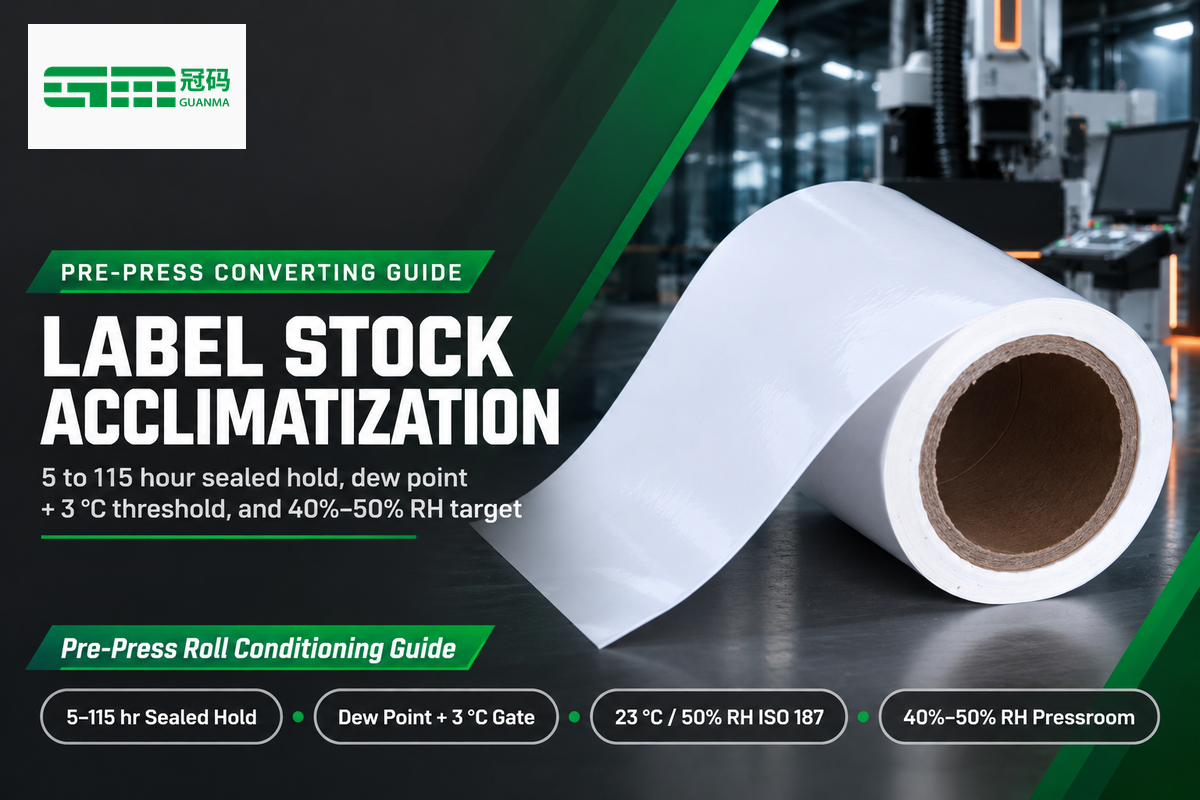
Label stock acclimatization is the short-term thermal and humidity stabilization window that stored or chilled pressure sensitive label rolls of any label material need before they go on press. Unopened cartons and pallets need 5 to 115 hours of sealed staging, from a 6 ft³ carton at a 10 °F gap to a 96 ft³ double skid at a 60 °F gap. Roll ends must warm at least 3 °C (5.4 °F) above the pressroom dew point before operators slit the protective vapor wrap. Rolls then sit within 2 to 3 °C of room air before full-speed printing.
Cutting bags early triggers surface sweat on cold slit edges, glassine liner wave, rotary die-strike, and barcode ribbon wrinkle. Multi-month warehouse shelf-life rotation and chronic press-tension curl follow separate shop rules. Pre-press conditioning protects the handoff from receiving dock to unwind shaft.
Quick Specs: Pressroom Roll Conditioning Benchmarks
| Reference Conditioning Standard | ISO 187:2022 & TAPPI T 402 laboratory atmosphere (23 °C reference) |
| Paper-Safe Indoor Humidity Band | 40%–50% relative humidity with daily cycling within ±5% RH |
| Earliest Safe Bag-Slit Threshold | Roll end ≥ ambient pressroom dew point + 3 °C (+5.4 °F) |
| Sealed Thermal Hold Window (6 to 96 ft³) | 5 to 54 hours (6 ft³ case) up to 15 to 115 hours (96 ft³ double skid) |
| Coated Paper Ream/Roll Barrier Patent Cap | WVTR ≤ 500 g/m²/day claimed for coated paper ream wrap (U.S. Patent US9358576B2); export label rolls use sealed PE inner bags with core plugs and stretch wrap for much lower vapor transmission |
| Partial-Roll Re-Bagging Window | Re-seal unused yardage in polyethylene bags right after press unload |
What Is Label Stock Acclimatization and Why Short-Term Pressroom Conditioning Protects Print Stability?
Conditioning label rolls to balance temperature with the printing room brings the rolls to a state where they are ready to be unloaded from the moisture barrier. Under Library of Congress cold-storage equilibration guidelines, chilled packages require closed vapor-proof warming to ambient temperature and relative humidity before materials are opened.
Visualize a can of soda on the counter in a hot shop. Humid air in the room hits the wall and condenses into droplets. Same with the bare paper rolls in a printing plant. The sticky beads of water form on the surface. Paper leaves paper-machine driers at 3% to 5% moisture content, as documented in Helen U. Kiely’s mill study on AIC Conservation OnLine. Sudden edge wetting swells outer fibers while the tightly wound interior stays dry and cold.
Rush-order schedulers often pull fresh skids straight off winter trailers onto narrow-web flexo presses. Even stock coated days earlier loses multi-color register as its core arrives much colder than the press room air. Warehouse crews should also pull the oldest lots first under First In, First Out (FIFO) rotation so rolls never age behind newer deliveries. For baseline grade selection before stock ships, see our complete self-adhesive paper facestock and adhesive selection guide.
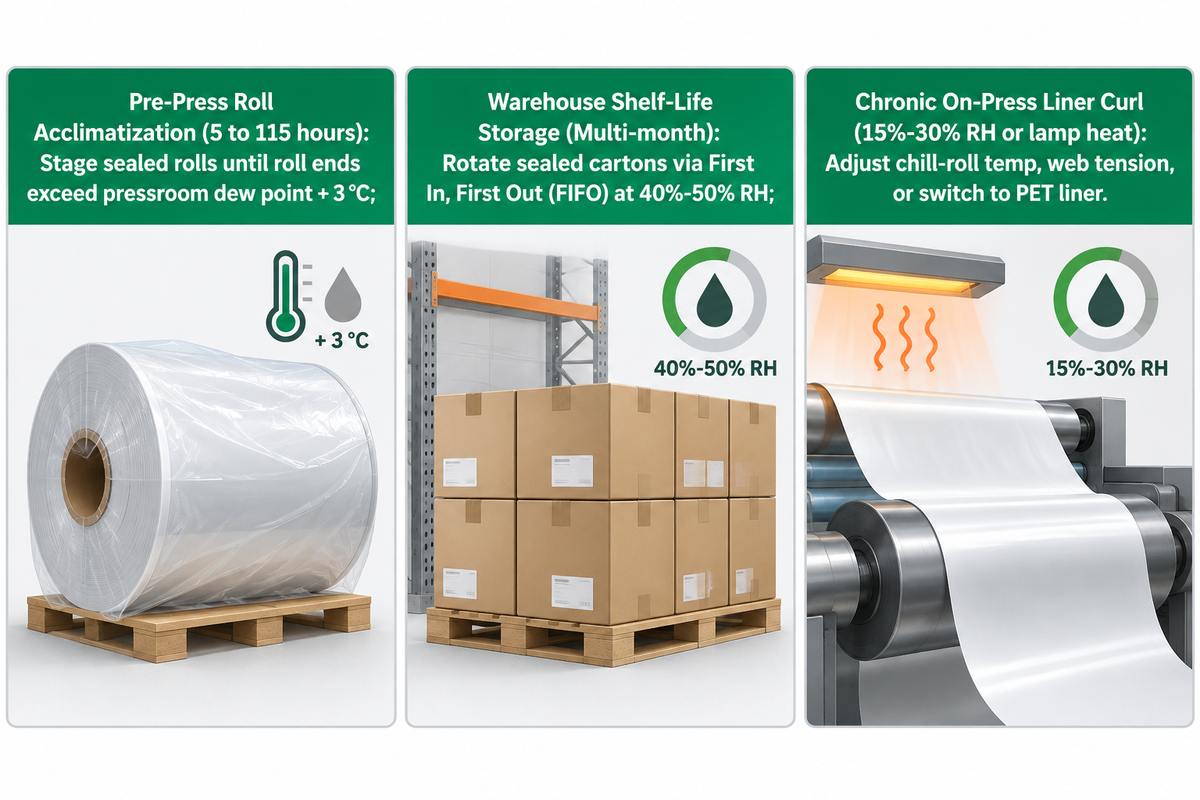
| Operational Control Stage | Time Horizon | Primary Physical Driver | Correct Floor Action |
|---|---|---|---|
| Pre-Press Roll Acclimatization | 5 to 115 hours pre-run | Transit-to-pressroom ΔT and dew-point shock | Stage sealed rolls until roll ends exceed pressroom dew point + 3 °C before unwrapping |
| Warehouse Shelf-Life Storage | Multi-month inventory | Long-term adhesive aging, ooze, and silicone drift | Rotate sealed cartons via First In, First Out (FIFO) at 40%–50% RH |
| Chronic On-Press Liner Curl | Continuous during converting | Curing lamp heat, high web tension, or 15%–30% RH dry air | Adjust chill-roll temp, web tension, or switch to PET liner |
What Is Label Stock and Why Does Temperature Shift Affect Stored Rolls?
Label stock is a three-layer pressure sensitive label laminate of a printable facestock, a tacky adhesive, and a silicone release liner. Paper fibers, polymer films, and viscoelastic adhesives expand and stiffen at unequal rates during changes in temperature. Abrupt thermal changes distort and reduce the tension of a wound roll before the web is printed.
Why Cold Label Rolls Must Stay Sealed Above the Pressroom Dew Point to Prevent Condensation
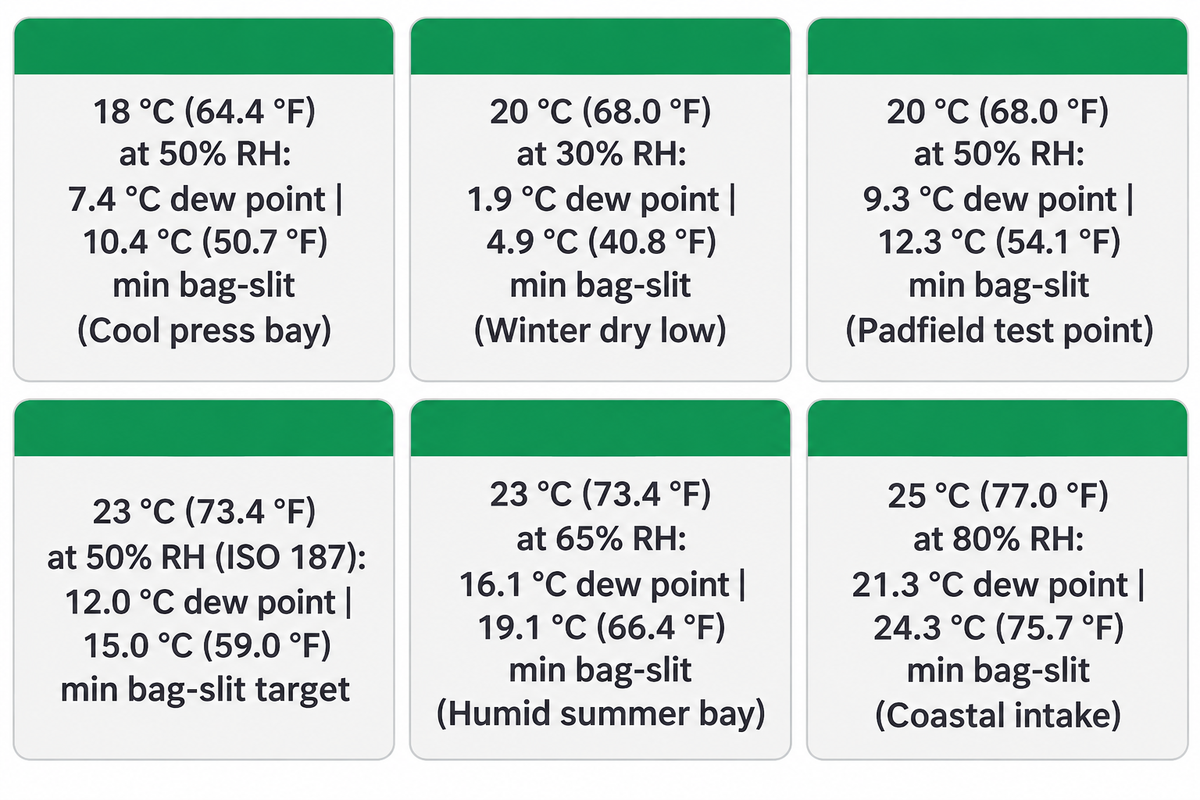
In a 23 °C pressroom at 50% relative humidity, the room dew point sits at 12.0 °C (53.6 °F). Cold rolls entering that bay must stay sealed inside intact polyethylene wrap until the roll end warms to at least 15.0 °C (59.0 °F). Slitting bags before the roll end clears this 3-Degree Dew-Point Unwrap Threshold condenses water onto slit edges.
The ASHRAE moist-air dew-point model at Lawrence Berkeley National Laboratory can model press room dew points from 0 °C to 93 °C. When beads of sweat form on a moisture-resistant polyethylene bag, the sealed film protects the paper roll inside. Conservation physicist Tim Padfield demonstrated on instrumented roll containers why internal temperature gradients must stay tight during warming:
“Until such a containment system is developed and tested, the reliable solution is to slow down both the cooling and the warming processes, so that there is never more than six degrees temperature variation anywhere in the mass of materials.”
Tim Padfield, Conservation Physics, Danish Film Institute Proceedings
Worked Dew-Point Release Example: Assumed inputs: a winter-delivered label pallet (24 ft³ / 0.68 m³ half-skid of 75 gsm semi-gloss paper) arrives at 1 °C (33.8 °F). Entering a 23 °C and 50% RH pressroom (12.0 °C dew point), the cold roll sweats immediately if unwrapped below 15.0 °C (59.0 °F). Crossing that +3.0 °C safety margin only stops liquid surface sweat on roll ends. Operators still let the sealed roll warm within 2 to 3 °C of room air before running at full speed.
| Pressroom Air Temp | Relative Humidity Tier | Calculated Dew Point | Min Bag-Slit Temp (+3 °C) | Shop-Floor Condition |
|---|---|---|---|---|
| 18 °C (64.4 °F) | 50% RH (cool storage limit) | 7.4 °C (45.3 °F) | 10.4 °C (50.7 °F) | Cool press bay baseline |
| 20 °C (68.0 °F) | 30% RH (winter dry low) | 1.9 °C (35.4 °F) | 4.9 °C (40.8 °F) | Low sweat risk; static risk rises |
| 20 °C (68.0 °F) | 40% RH (LOC lower target) | 6.0 °C (42.8 °F) | 9.0 °C (48.2 °F) | Moderate (winter box-truck intake) |
| 20 °C (68.0 °F) | 50% RH (Padfield test point) | 9.3 °C (48.7 °F) | 12.3 °C (54.1 °F) | Standard cool pressroom baseline |
| 20 °C (68.0 °F) | 60% RH (mold/curl ceiling) | 12.0 °C (53.6 °F) | 15.0 °C (59.0 °F) | Elevated (rainy-day dock intake) |
| 23 °C (73.4 °F) | 30% RH (dry heated bay) | 4.5 °C (40.1 °F) | 7.5 °C (45.5 °F) | Low sweat risk; tight-edge zone |
| 23 °C (73.4 °F) | 40% RH (controlled pressroom) | 8.7 °C (47.7 °F) | 11.7 °C (53.1 °F) | Moderate (chilled trailer freight) |
| 23 °C (73.4 °F) | 50% RH (ISO 187 midpoint) | 12.0 °C (53.6 °F) | 15.0 °C (59.0 °F) | Reference QA conditioning target |
| 23 °C (73.4 °F) | 65% RH (humid summer bay) | 16.1 °C (61.0 °F) | 19.1 °C (66.4 °F) | High (humid summer warehouse) |
| 25 °C (77.0 °F) | 50% RH (warm controlled bay) | 13.9 °C (57.0 °F) | 16.9 °C (62.4 °F) | Elevated (AC-to-press transfer) |
| 25 °C (77.0 °F) | 80% RH (unconditioned coastal) | 21.3 °C (70.3 °F) | 24.3 °C (75.7 °F) | Severe (reefer-to-humid plant) |
What Happens If Operators Unwrap Cold Label Stock Below the Pressroom Dew Point?
Unwrapping stock below the room dew point condenses water on exposed slit edges and outer wraps. Moist paper fibers swiftly absorb the condensate and swell faster than the dry roll center, locking in wavy edges. Surface sweat also interferes with ink and press tack.
How Many Hours Does Label Stock Acclimatization Take by Roll Volume and Temperature Gap?
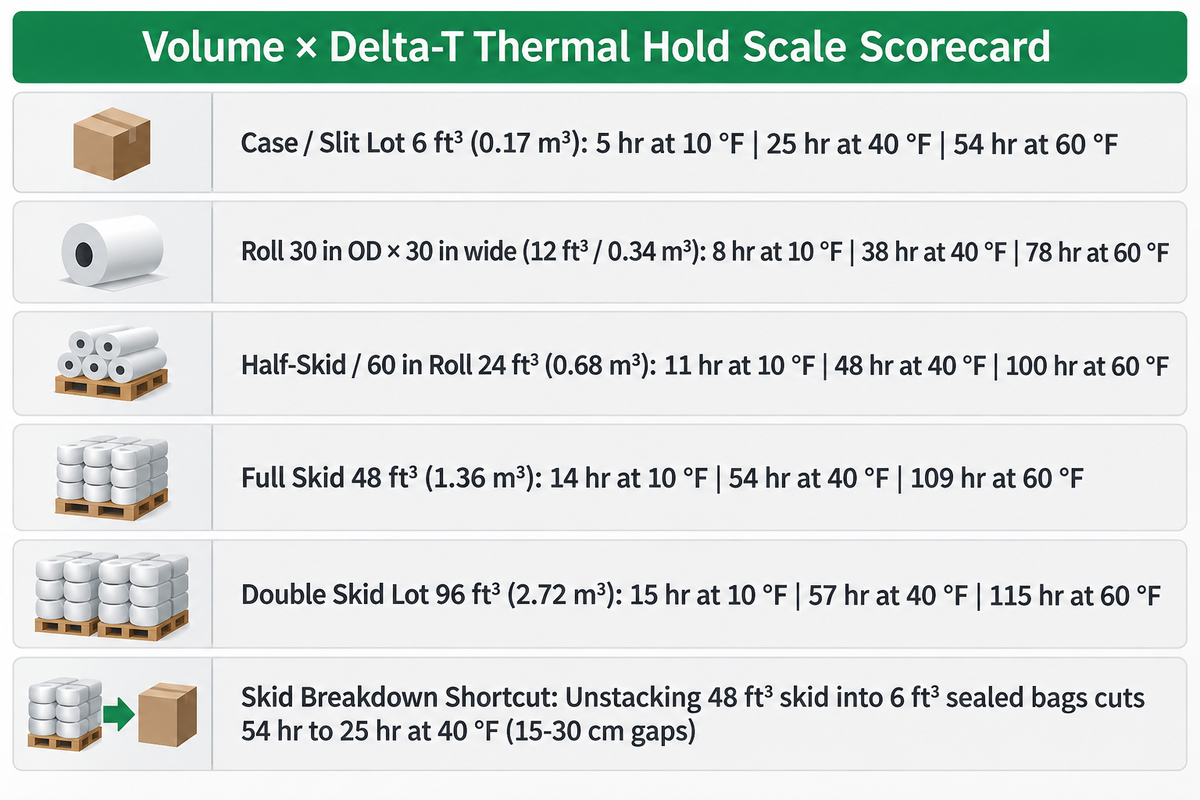
Published paper-mill equilibration charts in Printing Impressions span 6 °C to 33 °C (10 °F to 60 °F) temperature gaps. On our Volume×Delta-T Thermal Hold Scale, slit-roll and pallet hold hours run 5 to 54 hours for 6 cu ft (0.17 cu m), 8 to 78 hours for 12 cu ft (0.34 cu m), and 11 to 100 hours for 24 cu ft (0.68 cu m).
Tightly wound label reels trap thin layers of air between silicone-coated wraps that slow radial heat flow. Severe temperature changes between unheated freight trailers and heated press bays warm outer wraps long before the core. A 40 in OD × 64 in master reel holds winter cold far longer than a 40 in OD × 8 in narrow roll. Size hold schedules to the largest sealed unit that stays stacked or wrapped together during warming, not to a single inner roll. Use individual carton volume only when unstacking inner-bagged rolls onto spaced racks.
Worked Pallet Volume Example: Assumed inputs: a converter receives a shrink-wrapped pallet measuring 40 in × 48 in × 36 in high at 2 °C (35.6 °F) into a 73.4 °F pressroom. Multiplying 40 × 48 × 36 gives 69,120 in³, and dividing by 1,728 in³/ft³ yields 40.0 ft³ (1.13 m³). That pallet enters the 48 ft³ full-skid row across a 38 °F (~21 °C) gap, requiring 54 hours unopened. Published thermal conditioning tables assume intact vapor-tight wrappers in still room air. Double-stacked pallets or bare concrete floor contact slow core warming beyond chart hours.
| Roll / Skid Volume Format | 10 °F (5.6 °C) | 15 °F (8.3 °C) | 20 °F (11.1 °C) | 25 °F (13.9 °C) | 30 °F (16.7 °C) | 40 °F (22.2 °C) | 50 °F (27.8 °C) | 60 °F (33.3 °C) |
|---|---|---|---|---|---|---|---|---|
| Roll 30 in OD × 15 in wide | 5 hr | 9 hr | 12 hr | 15 hr | 18 hr | 25 hr | 35 hr | 54 hr |
| Roll 40 in OD × 8 in wide | 5 hr | 9 hr | 12 hr | 15 hr | 18 hr | 25 hr | 35 hr | 54 hr |
| Case / Slit Lot: 6 ft³ (0.17 m³) | 5 hr | 9 hr | 12 hr | 15 hr | 18 hr | 25 hr | 35 hr | 54 hr |
| Roll 30 in OD × 30 in wide (12 ft³ / 0.34 m³) | 8 hr | 14 hr | 18 hr | 22 hr | 27 hr | 38 hr | 51 hr | 78 hr |
| Roll 40 in OD × 16 in wide | 8 hr | 14 hr | 18 hr | 22 hr | 27 hr | 38 hr | 51 hr | 78 hr |
| Half-Skid / 60 in Roll: 24 ft³ (0.68 m³) | 11 hr | 18 hr | 23 hr | 28 hr | 35 hr | 48 hr | 67 hr | 100 hr |
| Roll 40 in OD × 64 in Master Reel | 14 hr | 19 hr | 26 hr | 32 hr | 38 hr | 54 hr | 75 hr | 109 hr |
| Full Skid: 48 ft³ (1.36 m³) | 14 hr | 19 hr | 26 hr | 32 hr | 38 hr | 54 hr | 75 hr | 109 hr |
| Double Skid Lot: 96 ft³ (2.72 m³) | 15 hr | 20 hr | 27 hr | 34 hr | 41 hr | 57 hr | 79 hr | 115 hr |
Source: Georgia-Pacific field technical conditioning schedule, as published in Printing Impressions.
When Can Breaking Down a Shrink-Wrapped Pallet Safely Shorten Label Roll Conditioning Time?
Unstacking a 48 ft³ full skid into 6 ft³ single cartons cuts a 54-hour winter hold down to 25 hours at a 40 °F (22.2 °C) gap. That shortcut works only when every carton carries its own sealed inner polyethylene bag. Cut only the outer pallet stretch wrap. Space sealed cartons 15 to 30 cm apart on off-floor racks while keeping inner vapor bags shut.
Target Pressroom Temperature and Humidity Windows Under ISO 187:2022 and TAPPI T 402
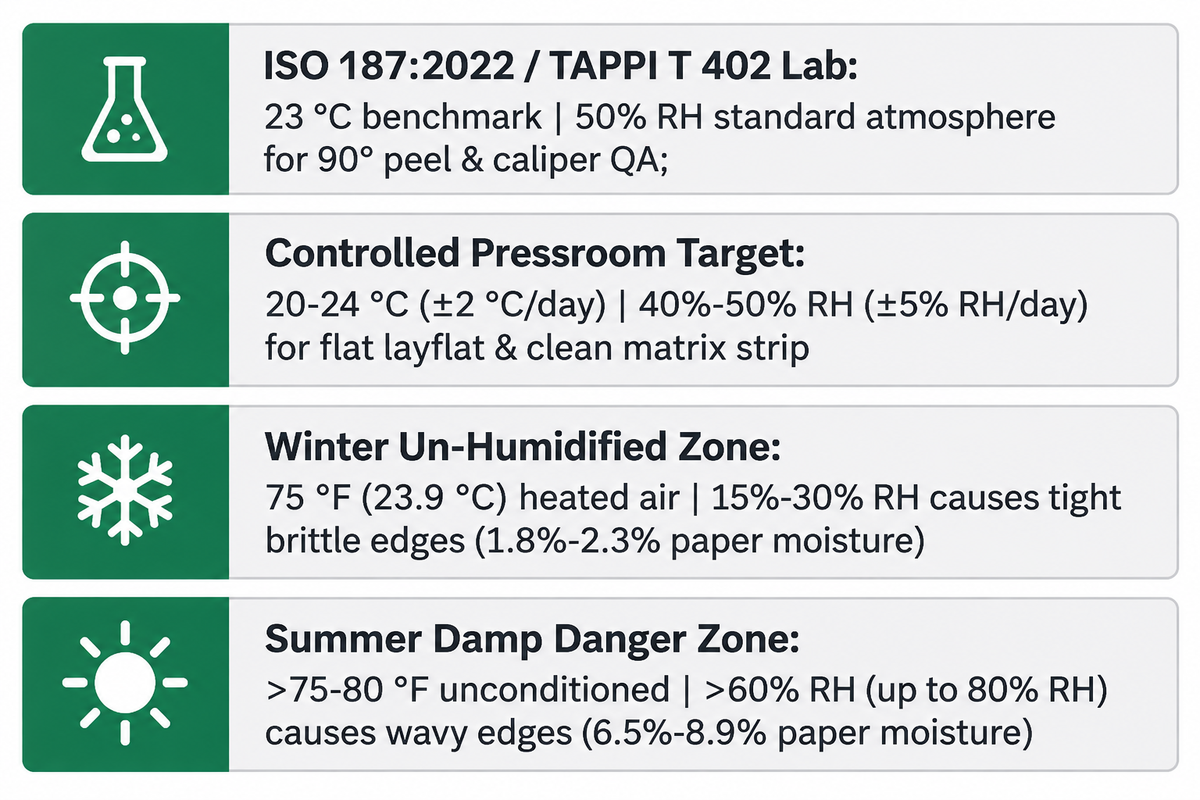
ISO 187:2022 and TAPPI T 402 set the 23 °C laboratory reference atmosphere for conditioning pulp, paper, and board. That edition replaced the withdrawn ISO 187:1990 standard in October 2022. On production floors, Library of Congress paper-housing guidelines recommend maintaining 40%–50% relative humidity with daily fluctuations capped at ±5% RH and ±2 °C.
Staying within ±5% RH while holding the daily pressroom swings helps avoid cross-grain expansion in supercalendered glassine release liner rolls for narrow-web converting. Mounting thermo-hygrometer probes next to the press unwinds instead of across the room helps better control relative humidity. Wall sensors miss localized dry air blasts from ceiling heaters and damp drafts near washup sinks.
Winter heating creates the sharpest indoor humidity drop. Helen U. Kiely’s psychrometric mill data on AIC Conservation OnLine tracks winter air entering at 40 °F (4.4 °C) and midpoint humidity. Heating that air indoors to 75 °F (23.9 °C) without steam humidification drops room moisture to 15% RH. At 15%–30% RH, dry air pulls bound water out of roll edges and builds static on unwind rollers. Above 60% RH, cellulose fibers swell and risk mold or soft die-strike.
| Control Environment | Temperature Reference | Relative Humidity Band | Operational Impact on Web |
|---|---|---|---|
| ISO 187:2022 / TAPPI T 402 Lab | 23 °C lab benchmark | 50% RH standard atmosphere | QA reference baseline for 90° peel and liner caliper tests |
| Controlled Pressroom Target | 20–24 °C (±2 °C/day) | 40%–50% RH (±5% RH/day) | Flat layflat, stable register, clean matrix stripping |
| Winter Un-Humidified Zone | 75 °F (23.9 °C) heated air | 15%–30% RH | Tight brittle edges (1.8%–2.3% paper moisture), static sparks |
| Summer Damp Danger Zone | >75–80 °F unconditioned | >60% RH (up to 80% RH coastal) | Wavy edges (6.5%–8.9% paper moisture), emulsion whitening |
Paper vs. BOPP Film vs. PET Release Liner Constructions: Conditioning Compatibility Across Label Materials
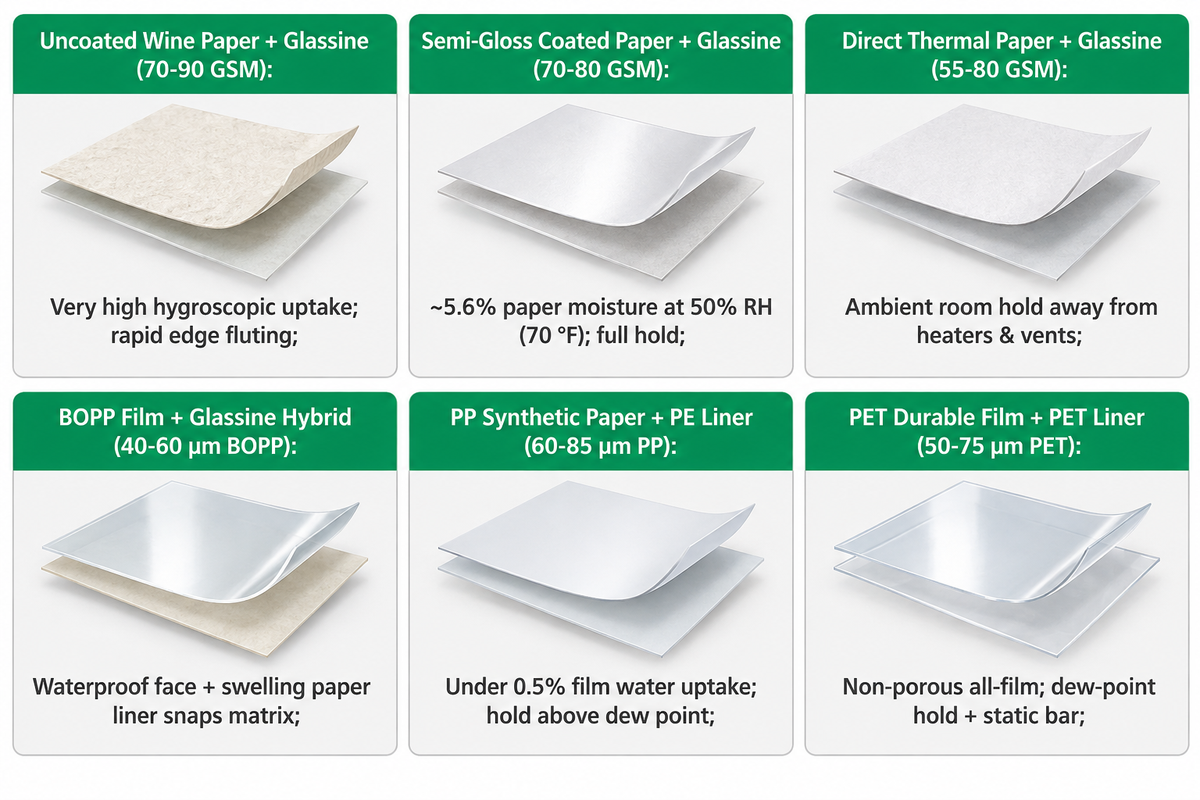
In Helen U. Kiely’s tests on AIC Conservation OnLine, paper holds 5.6% moisture at 70 °F and midpoint humidity. AIC conservation data show paper holding about 5.6% equilibrium moisture at 50% relative humidity (70 °F), so cellulose facestocks and glassine liners take on water readily, whereas polypropylene and polyester film materials absorb under 0.5% water. Hybrid film-on-glassine laminates still require full humidity conditioning, and all-film polyester labels that withstand washdown water in service still sweat when unwrapped cold.
Cellulose fibers expand far more across their diameter than along their length when dampened, creating machine-direction waves. Uncoated wine stocks rapidly absorb room vapors after unwrapping. Gloss and matte coated paper grades react slower at first, then lock in curl once dampness crosses the clay coat. The table below compares substrate pairings across custom-slit release liner backing rolls and biaxially oriented polypropylene facestock reels.
| Laminate Construction | Published Weight / Caliper | Hygroscopic Sensitivity | Primary Unacclimated Failure | Staging Requirement |
|---|---|---|---|---|
| Uncoated / Matte Wine Paper + Glassine | 70–90 GSM face | Very High (open porous fibers) | Rapid edge fluting and registration drift | Full thermal + strict 40%–50% RH hold |
| Semi-Gloss Coated Paper + Glassine | 70–80 GSM face | High (both layers cellulosic) | Wavy edges and flexo color misregister | Full Volume×Delta-T sealed hold |
| High-Gloss Cast-Coated Paper + Glassine | 80 GSM face | High (asymmetric coat stiffness) | Cross-grain curl after die-cutting | Full sealed hold; re-bag immediately |
| Kraft Paper + CCK Release Liner | 70–90 GSM face | High (clay-coated kraft backing) | Tight edges in 15%–30% RH winter rooms | Full sealed hold + pressroom humidification |
| Direct Thermal Paper + Glassine | 55–80 GSM face | High + heat-sensitive coating | Premature leuco-dye graying near heaters | Ambient room hold away from sunlight/vents |
| Thermal Transfer Paper + Glassine | 65–80 GSM face | High | Ribbon wrinkle and skipped barcode bars | Full sealed hold to pressroom temperature |
| BOPP Film + Glassine Liner (Hybrid) | 40–60 µm BOPP | Asymmetric (inert face / paper liner) | Curl toward dry side; waste matrix snaps | Full sealed hold (governed by glassine liner) |
| PP Synthetic Paper + PE-Coated Liner | 60–85 µm PP | Low water uptake / Moderate thermal | Surface micro-condensation ink de-wetting | Sealed hold above dew-point threshold |
| PET Durable Film + PET Liner (All-Film) | 50–75 µm PET | Non-porous plastic carrier and face | Ink pinholing on cold condensed film; static | Thermal dew-point hold + ionizing static bar |
Do BOPP Film Labels Still Need Pressroom Conditioning When Laminated to a Glassine Liner?
Yes. 40 – 60 µm BOPP film, which is waterproof, blocks moisture from the top, leaving the cellulose glassine backing to gain or lose humidity at the edges of the roll. Because the top film cannot expand with the swelling paper carrier, unconditioned BOPP-on-glassine webs tunnel, curl sharply, and snap waste matrix lanes.
How Adhesive Chemistry Responds to Cold Storage: Hot-Melt, Water-Based Acrylic, UV, and Freezer Grades
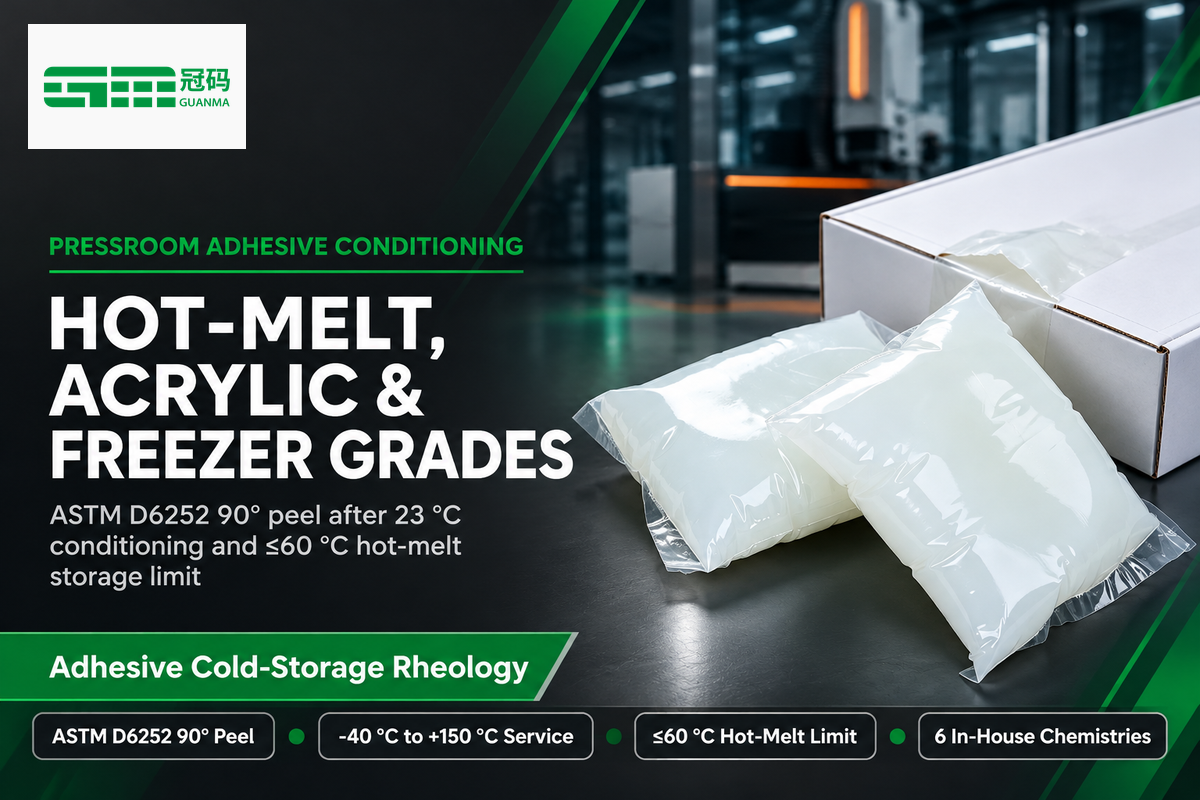
QA labs measure 90-degree peel adhesive strength after standard conditioning under ASTM D6252/D6252M-98(2025).
Buyers often confuse low-temperature service endurance (-40 °C to +150 °C on specialty acrylics) with pressroom converting conditions. Service ratings apply only after the bond between the label and container has wet out and dwelt. Converting cold-chain and freezer-grade self-adhesive label materials while rolls stay chilled increases adhesive modulus and causes the waste matrix to break at a higher rate, increasing waste and loss. This continues until the rolls warm to pressroom temperature. Match applicator room specs to the exact bottle or carton surface where the label will be applied.
Excessive heat on the opposite end also hurts adhesive performance. Staging rubber hot-melt rolls near ceiling heaters above 60 °C softens the coating applied to the liner and leaves sticky ooze residue on idler rollers. Zhejiang Guanma formulates six adhesive systems in-house: rubber, water-based emulsion acrylic, removable/ultra-removable acrylic, hot-melt, specialty acrylic (-40 °C to +150 °C), and solvent-free UV-cure acrylic. ASTM D6252/D6252M-98(2025) uses 90-degree peel testing for quality assurance acceptance. Scope 1.3 notes that a single peel reading cannot separate facestock variation from adhesive variation alone. Pair post-conditioning bench checks with standardized pressure-sensitive label qualification and peel testing protocols to measure 90-degree peel response after rolls reach pressroom thermal equilibrium and separate chilled adhesive lag from coat-weight drift.
Two-Phase Warehouse-to-Pressroom Staging: Resolving the “Unwrap vs. Keep Wrapped” Contradiction
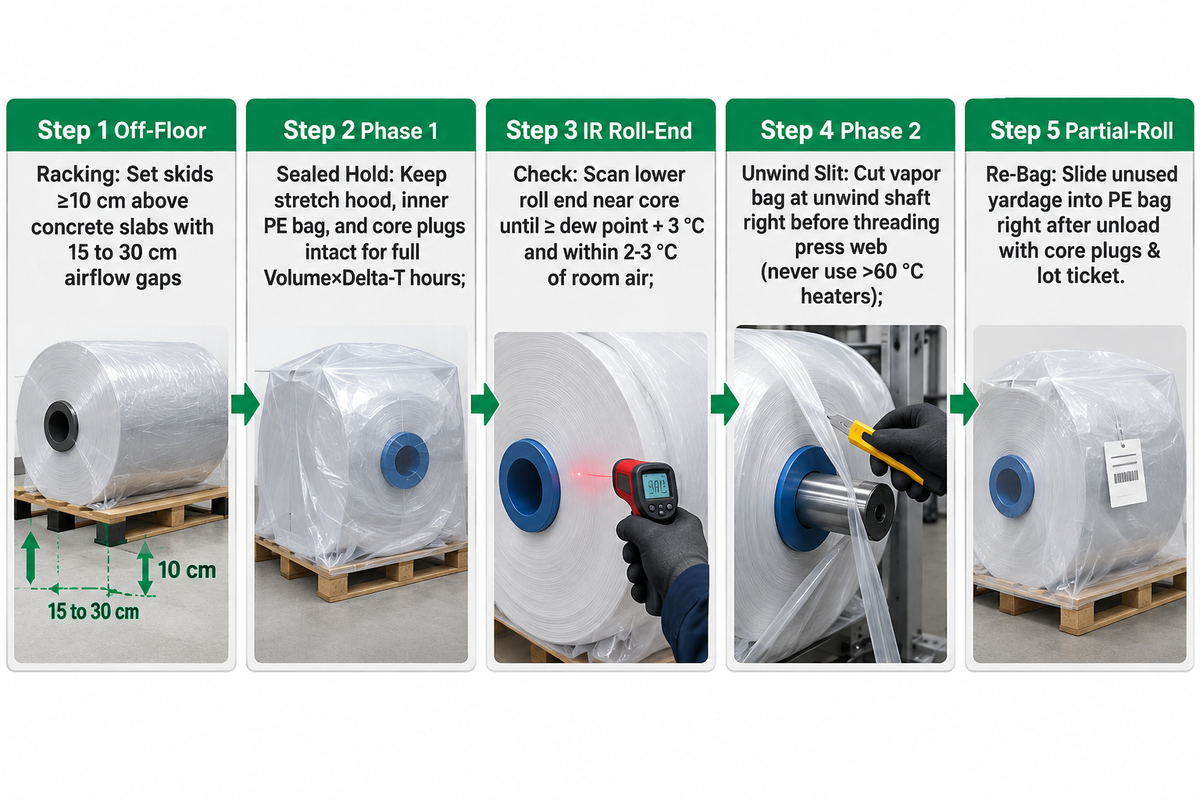
Supplier bulletins clash only when operators fuse warming and humidity matching. The 2-Phase Sealed-to-Press Staging Protocol keeps reels fully sealed during Phase 1 until the full Volume×Delta-T hold has elapsed and roll ends clear dew point + 3 °C. Operators then slit the vapor wrap at the unwind stand in Phase 2 once rolls sit within 2 to 3 °C of pressroom air.
Operators on r/CommercialPrinting say stock lying flat in a climate-controlled press bay curls rather quickly if left unwrapped in a dehumidified room. Improper staging beside open dock doors resets thermal recovery if outdoor gusts affect the skid. QA teams check bag equilibrium before unwrapping, using Padfield’s polyethylene-bag hygrometer method. An electronic sensor placed next to the roll stabilizes after 1 hour of constant room temperature.
- Raise incoming skids off floors — set pallets on racks or plastic skids at least 10 cm above concrete slabs with 15 to 30 cm airflow gaps.
- Hold Phase 1 sealed warming — keep the stretch hood, inner polyethylene bag, and core plugs intact for the full Volume×Delta-T hours.
- Check IR roll-end temperature — scan the lower roll end near the core with an infrared thermometer until it clears the dew-point threshold and nears room air.
- Run Phase 2 press-stand unwrap — slit the vapor bag at the unwind shaft right before threading the web to protect press functionality.
- Re-bag partial rolls promptly — slide unused yardage back into its polyethylene bag right after press unload, insert core plugs, and attach the lot ticket.
⚠️ Common Mistake: Forced Warming with Space Heaters
Don’t aim portable space heaters or hot-air blowers at cold pallets to speed up a print run. Forced heat can dry the exposed outer paper edges on a cold pallet. Forced heat dries exposed outer paper edges rapidly while the dense core stays cold, triggering hot-melt edge bleed above 60 °C and severe roll telescoping on unwind.
Press Defects Caused by Unacclimated Label Stock in Flexo, UV, Thermal Transfer, and Direct Thermal Printing
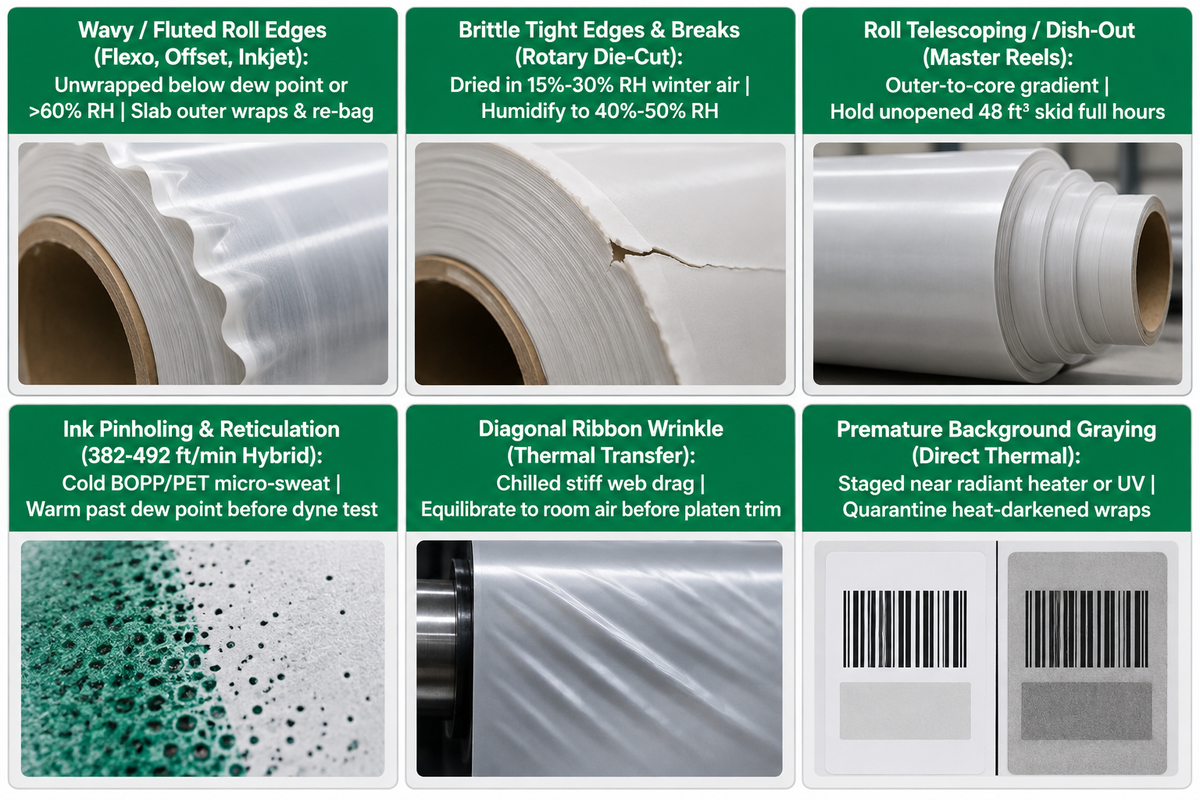
Six acute press defects trace directly to skipped or mishandled roll conditioning: wavy edges, tight edges, roll telescoping, ink pinholing, thermal transfer ribbon wrinkle, and direct thermal graying. Improper staging near heaters adds premature direct thermal graying. On 2026 hybrid inkjet and flexo lines reaching 382–492 ft/min in Labels & Labeling’s Loupe Americas 2026 preview, edge wave throws plates out of register within seconds.
Misreading micro-condensation ink pinholes by press crews leads to them thinking that low dyne treatment is the problem. Barcode operators similarly blame printheads when an unconditioned cold roll drags unevenly and wrinkles wax-resin ribbons. The majority of conditioning problems are toward the outer wraps and near the cold core. True mill coating defects repeat evenly throughout the wraps.
| Press / Printer Defect | Printing Applications Affected | Staging / Acclimatization Root Cause | Immediate Shop-Floor Triage |
|---|---|---|---|
| Wavy / Fluted Roll Edges | Flexo, Offset, Water Inkjet | Cold roll unwrapped below dew point or >60% RH room | Slab off damaged outer wraps; re-bag and finish warming |
| Brittle Tight Edges & Web Breaks | Rotary Die-Cutting, High-Speed Flexo | Unwrapped roll dried out in 15%–30% RH winter heated air | Humidify pressroom to 40%–50% RH; lower matrix strip angle |
| Roll Telescoping / Dish-Out | Wide Master Reels & Turret Rewinders | Steep outer-to-core thermal gradient relaxing wind tension | Hold unopened skids for the full conditioning hours shown for a 48 ft³ pallet on the hold table |
| Ink Pinholing & Reticulation | Narrow-Web Flexo & Hybrid Inkjet | Invisible micro-condensation film on cold BOPP/PET face | Warm roll past dew-point threshold before dyne pen retest |
| Diagonal Ribbon Wrinkle & Voids | Thermal Transfer Barcode Printers | Chilled stiff label web dragging unevenly under printhead | Equilibrate roll to room air before adjusting platen pressure |
| Premature Background Graying / Fade | Direct Thermal Printing | Roll staged near a radiant heater, hot vent, or UV exposure | Quarantine heat-darkened outer wraps; stage away from heat |
Sourcing Label Rolls for Cold-Chain or Humid Ocean Transit?
Request Guanma’s complimentary 12-combination sample pack, shipped in 5 business days, matched to your pressroom RH, print method, and container route.
Moisture-Barrier Packaging, Liner Upgrades, Cost Impact, and MOQ for Winter or Ocean-Shipped Label Rolls
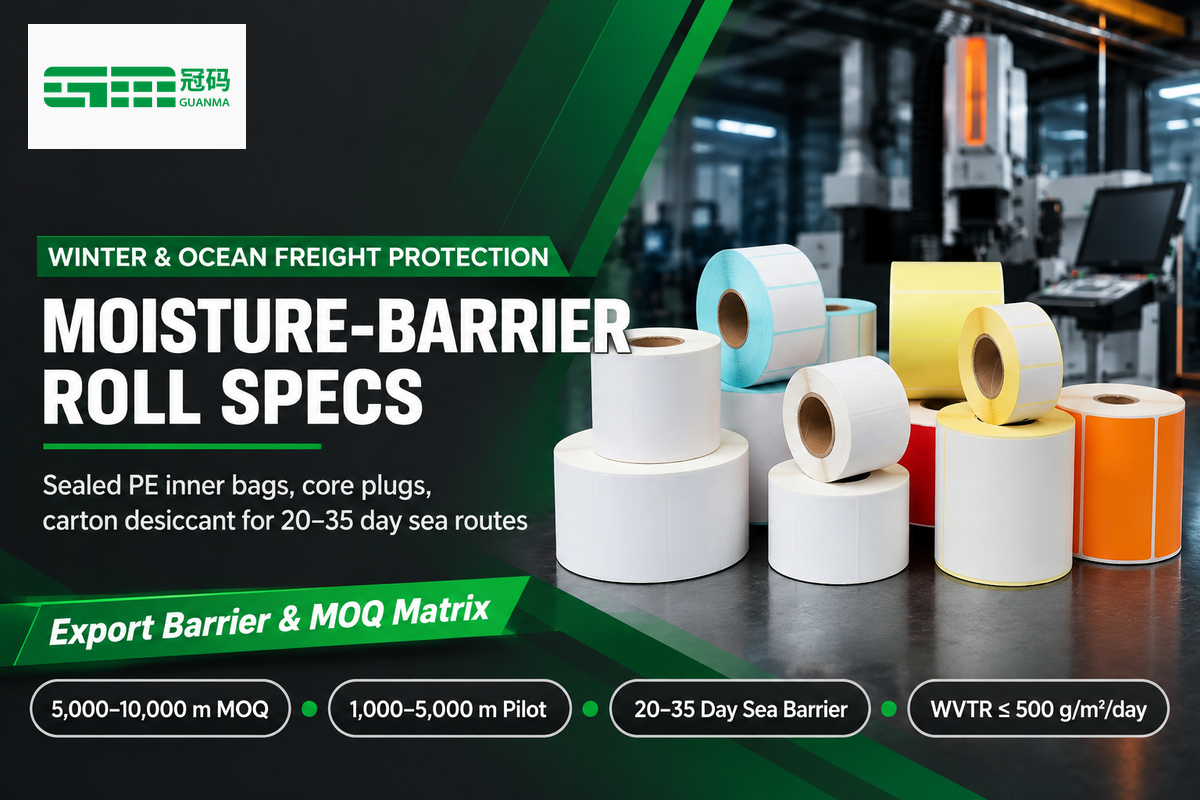
In Guanma’s self-adhesive paper specifications, standard combinations (70–80 gsm coated paper, water-based or hot-melt adhesive, and CCK or glassine liner) carry a 5,000–10,000 linear-meter MOQ. Rolls slit across 25–1,300 mm widths, and custom pilot runs start at 1,000–5,000 linear meters. Coated-paper ream wraps require a water vapor transmission rate (WVTR) of 500 g/m²/day or less at 90 °F and 80% RH in U.S. Patent US9358576B2. Sealed polyethylene film bags provide a much tighter barrier.
Ocean Freight Exposure & Cost-Tier Comparison: On Guanma’s shipping schedule, intercontinental sea freight to Europe, South America, or the Middle East spans 20 to 35 days inside steel containers. Sealing each slit reel inside an inner polyethylene bag with core plugs and carton desiccant stops transit moisture without a costly liner swap. This barrier allows customers to avoid paying for a liner upgrade that they don’t need. For a press room or bottling hall humidity that’s above 60% RH, use all-film polyester label stock for humid bottling lines or a PET release liner.
In Guanma’s pricing tier structure, coated paper with glassine or CCK liner forms the baseline cost tier, whereas BOPP/PET facestocks, cold-chain specialty adhesives, and PE or PET liners carry a specialty material premium. Exact delivered pricing is provided on your quote based on slit width (25-1,300 mm) and linear meter order volume. Choosing the right barrier tier below keeps dry indoor labeling applications on economical glassine while protecting durable label exports.
| Protection Tier | Packaging / Liner Specification | Target Transit Scenario | Commercial Cost Tier & MOQ Basis |
|---|---|---|---|
| Tier 1: Dust Stretch Wrap Only | Outer LLDPE stretch wrap on wood/plastic pallet | Local temperate box-truck delivery | Baseline packing; not vapor-tight for winter or sea |
| Tier 2: Sealed PE Inner Bag + Core Plugs | Individual sealed PE bag + end discs + core plugs + slip-sheet | Winter overland trailers & 5–10 day regional ASEAN sea freight | Standard export baseline; 5,000–10,000 m standard MOQ |
| Tier 3: Heat-Sealed Barrier Pouch + Desiccant | Heat-sealed foil/PE barrier bag + master-carton desiccant packs | 20–35 day intercontinental ocean freight across equator | Export barrier add-on; prevents container-rain edge wave |
| Tier 4: PE-Coated or PET Release Liner | Upgrade glassine/CCK baseline to PE-coated or PET film liner | High-humidity (>60% RH) pressrooms & wet beverage bottling | Premium liner tier; 1,000–5,000 m pilot trial available |
How to Store Unused Rolls and Specify Moisture-Protected Label Stock Reels with Your Manufacturer
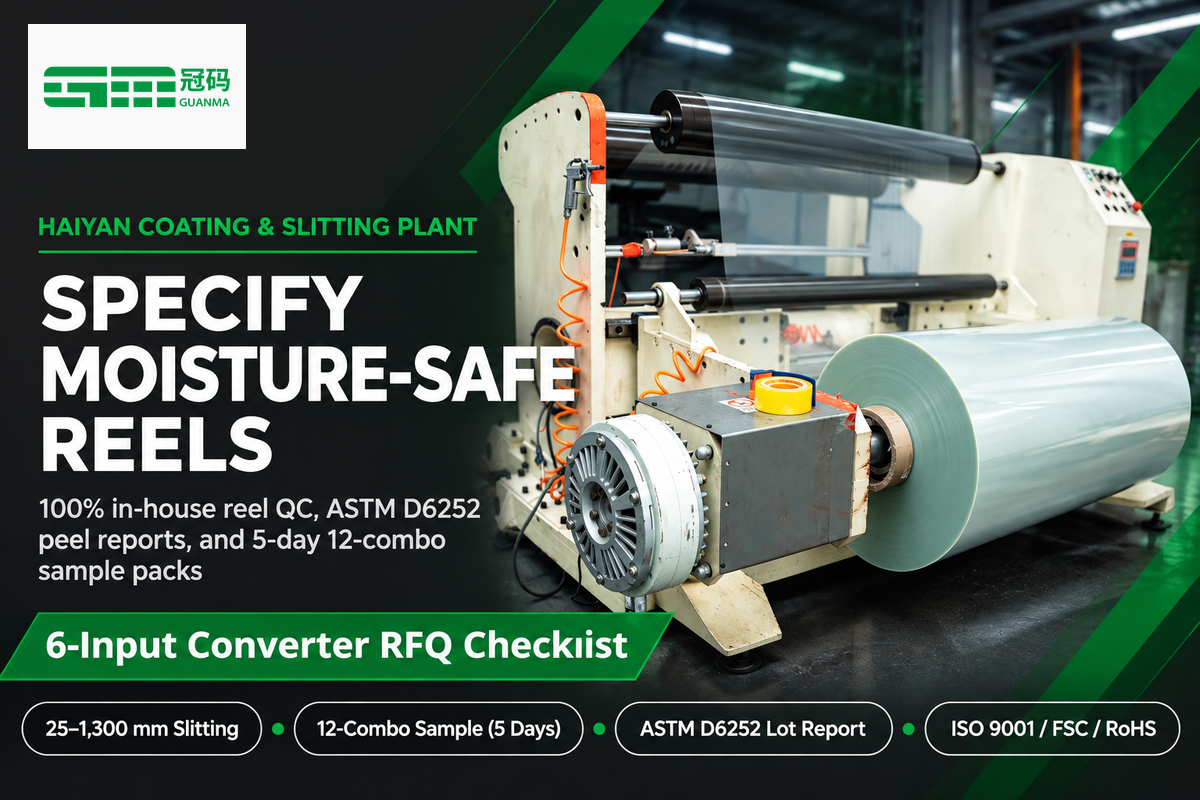
Protect partial rolls between press runs in sealed polyethylene vapor bags, and include six climate, dimension, and barrier inputs on every supplier quote request. Operating since 2010 with an integrated Haiyan, Zhejiang coating and slitting plant founded in 2019, Zhejiang Guanma Packaging Co., Ltd. inspects 100% of the reels in-house (Guanma Plant Profile).
Every shipment includes lot-matched ASTM D6252 peel test reports, plus documentation of Guanma’s ISO 9001:2015, FSC, and RoHS certifications. Printing Impressions recommends keeping the mill product name, grade code, and lot number attached to every staged skid and partial roll ticket. Printing Impressions’ pressroom workflow rules recommend lot tagging so supervisors can trace reel history in minutes. Review moisture-wrapped self-adhesive paper roll grades and copy the six-row converter table below into your inquiry so your supplier engineers the right label and barrier stack.
RFQ checklist — copy these into your quote request:
| Parameter | Recommended range | Why it matters | How to verify |
|---|---|---|---|
| Pressroom & Warehouse Temp / RH | 20–24 °C and 40%–50% RH (±5% RH/day) | Sets mill equilibrium target and dew-point unwrap threshold | Calibrated pressroom thermo-hygrometer log |
| Transit Route & Moisture Barrier | Sealed PE inner bag + core plugs (winter overland / 5–10 day regional sea); heat-sealed barrier pouch + carton desiccant (20–35 day ocean) | Blocks container rain and winter condensation during transit | Packing specification sheet & receiving dock bag check |
| Facestock & Finish Stack | 70–80 GSM coated paper, 55–80 GSM thermal, 40–60 µm BOPP, or 50–75 µm PET | Matches printability, gloss/matte finish, and durability to press type | 12-combination converter sample pack shipped in 5 business days |
| Adhesive Chemistry & Service Temp | Hot-melt (≤60 °C), emulsion acrylic, removable, or -40 °C to +150 °C acrylic | Aligns cold-chain adhesion strength and rotary die-cutting shear | Lot ASTM D6252 90° peel report after 23 °C conditioning |
| Release Liner Substrate | Glassine / CCK for 40%–50% RH rooms; PE or PET liner for >60% RH lines | Prevents release-force drift and matrix breaks on auto-applicators | High-speed rotary die-cut and dispensing trial |
| Roll Width, Volume & Order Tier | 25–1,300 mm slit width; 1,000–5,000 m pilot or 5,000–10,000 m standard MOQ | Determines skid cubic volume, staging hours, and slitting setup | Pre-shipment 100% reel QC ticket with grade & lot number |
How Should Partially Used Label Stock Rolls Be Stored and Protected Between Press Runs?
Fasten the loose outer tail with low-tack splicing tape and slide the partial reel into a sealed polyethylene vapor bag. Re-insert core plugs to prevent core crushing. Store bagged reels horizontally on core poles or upright on end discs inside a 40%–50% RH room with the product grade and lot ticket attached.
Key takeaway
Hold incoming label stock sealed for the full Volume×Delta-T schedule until infrared roll-end checks clear the dew-point threshold. Once reels approach pressroom air temperature, unwrap them at the unwind stand.
Qualify Moisture-Protected Self-Adhesive Reels for Your Pressroom
Send the temperature and humidity band from your pressroom, container surface, slit width (25-1,300 mm), and preferred ocean or winter transit route. Guanma’s Haiyan technical team will match the facestock, adhesive chemistry, liner, and export barrier wrap, with a 12-combination trial pack dispatched in 5 business days.
Frequently Asked Questions About Label Stock Acclimatization
Q: Can space heaters or hot air blowers be used to warm up cold label rolls faster before printing?
No. Directing space heaters or hot-air blowers at cold label rolls quickly ruins the outer wrap.
Exposed outer wraps are quickly dried by forced hot air. The inner core remains cold. That steep thermal gradient triggers wind-tension telescoping, hot-melt edge ooze above 60 °C, and brittle tight edges. Stage sealed pallets naturally in ambient pressroom air with 15 to 30 cm of clearance between skids.
Q: Does humidity affect sticker adhesive tack if label stock rolls get damp in warehouse storage?
Yes. Surface condensation or warehouse relative humidity above 60% reduces initial tack and causes water-based emulsion acrylics to absorb water and whiten.
Liquid sweat trapped on the adhesive blocks clean wet-out against the target container. Even if the tack returns after drying, the edges will still be permanently fluted. This can also cause release-force drift and jam automatic applicators.
Q: How does conditioning sheeted laser or inkjet label stock differ from conditioning narrow-web press rolls?
A4 and folio size self-adhesive laminates have exposed cut fibers on all four ream edges, which allows the fibers to quickly attract and catch moisture, resulting in faster warpage compared to wound press rolls.
Keep moisture-resistant ream wrappers sealed until your pressroom temperature balances with the stack, then load sheetfed offset feeders or hot laser fuser trays. Never leave exposed label sheets on a bindery table overnight.
Q: What is the standard conditioning atmosphere in ISO 187:2022 for paper label materials?
ISO 187:2022 sets the standard laboratory conditioning benchmark around 23 °C and midpoint relative humidity.
This was published in October 2022 and replaced the withdrawn ISO 187:1990 standard for pulp, paper and board testing.
Q: Why should palletized label rolls never sit directly on bare concrete warehouse floors or next to loading dock doors?
Bare concrete slabs are cold thermal sinks that can quickly chill lower roll layers. Rolls resting directly on the floor are also exposed to dampness and water leaks.
Rolls exposed to outdoor cold and humid drafts that are prevalent during loading reset your thermal hold clock. Lift reels at least 10 cm off concrete on racks or plastic pallets with a bottom vapor slip-sheet.
Q: Do direct thermal label rolls require tighter temperature limits during pressroom acclimatization?
Yes, keep direct thermal rolls in ambient room air away from heaters, hot vents, and direct sunlight.
Radiant heat or ceiling blowers prematurely darken heat-sensitive leuco-dye coatings before printing.
Q: How do you check whether a staged label roll has finished warming up without cutting open its protective vapor bag?
Measure the lower roll end face near the inner core through a single tight layer of polyethylene film using a non-contact infrared thermometer.
Compare the measured temperature against the dew-point chart on the thermo-hygrometer. Slit the protective bag only after the roll end clears ambient dew point + 3 °C; wait until it sits within 2 to 3 °C of pressroom air before running at full press speed.
References & Sources
- CDL.Psychrometrics Moist-Air Dew-Point & Wet-Bulb Specification Lawrence Berkeley National Laboratory
- Cold-Storage Equilibration and Relative Humidity Control Guidelines Library of Congress Preservation Directorate
- ISO 187:1990 Withdrawal & Replacement by ISO 187:2022 Standard Atmosphere for Conditioning Paper and Board International Organization for Standardization (ISO)
- ASTM D6252/D6252M-98(2025) Standard Test Method for Peel Adhesion of Pressure-Sensitive Label Stocks at a 90° Angle ASTM International
- The Effect of Moisture on Paper: Equilibrium Humidity & Dimensional Curl Conservation OnLine (Foundation for Advancement in Conservation)
- Condensation in Containers During Cooling and Warming Conservation Physics / Danish Film Institute Proceedings
- U.S. Patent US9358576B2: Packaging Material Having Moisture Barrier (WVTR ≤ 500 g/m²/day) United States Patent and Trademark Office via Google Patents
- Paper Training For Printers: Roll & Skid Acclimation Hours by Cubic Volume and Temperature Difference Printing Impressions
- Loupe Americas 2026 Narrow-Web Hybrid & Flexo Press Speed Benchmark Labels & Labeling
Engineering Basis for This Conditioning Guide
This guide pairs ASHRAE dew-point psychrometrics, published 6-to-96 ft³ roll conditioning charts, and ISO 187:2022 reference standards with production feedback across six self-adhesive chemistries at our Haiyan, Zhejiang plant. Every peel and release check reflects lot-tested export reels shipped in sealed vapor barriers. Reviewed by the Zhejiang Guanma Packaging Co., Ltd. technical team.