Get in Touch with Guanma

Pressure Sensitive Labels vs Glue-Applied Labels – Which Is Right for Your Product?

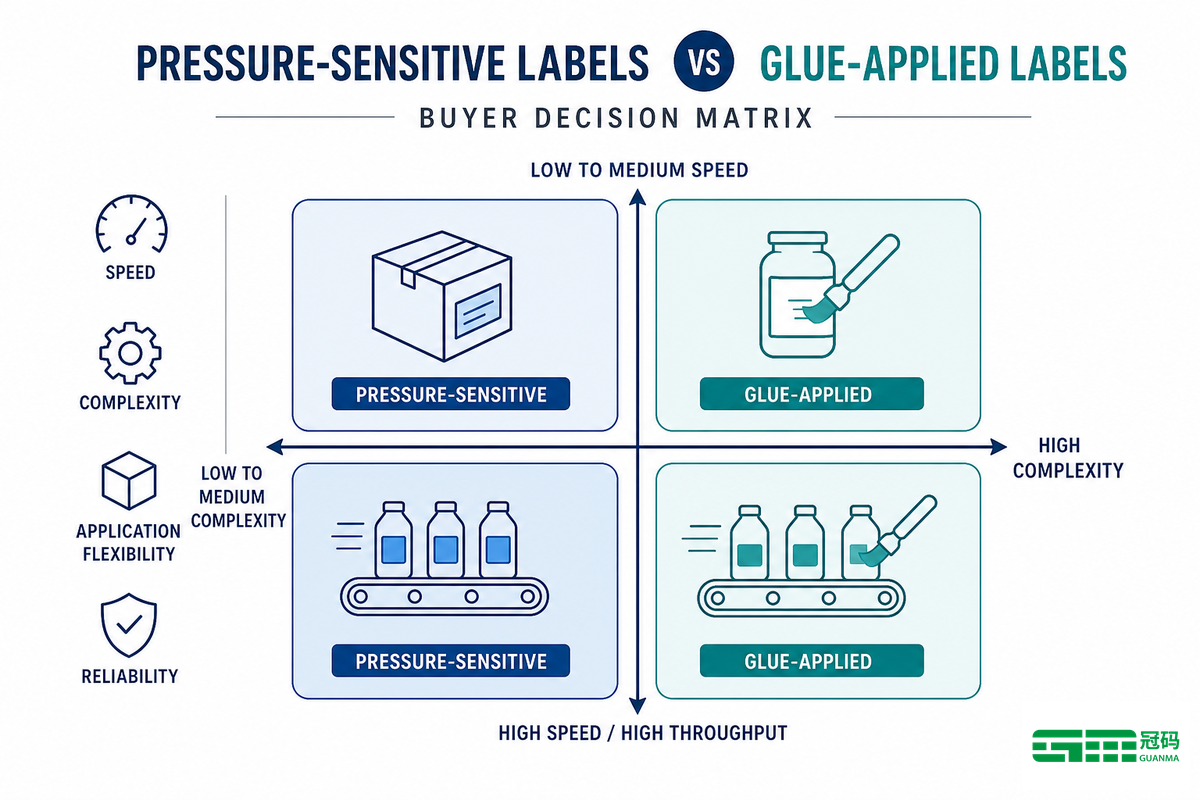
Label stock decision guide for product teams
Pressure Sensitive Labels vs Glue-Applied Labels – Which Is Right for Your Product? Pressure Sensitive Labels vs Glue-Applied Labels are competing label application systems with different adhesive timing, package fit, line setup, SKU changeover, compliance records and end-of-life risks. The answer can be either.
Reviewed by: Zhejiang Guanma Packaging Co., Ltd.
To answer in short: choose pressure sensitive labels for flexible substrates, quicker sample approval, shaped packages, short to mid-size runs, premium graphics, cold-chain resilience, and frequent SKU changes. Choose glue-applied labels when packages are rigid, mainly cylindrical, very high volume and already equipped for wet-glue labeling equipment.
One of the pitfalls is a pure price comparison on label roll costs alone. Any practical comparison needs to factor in good labels produced, waste during start-up, cleaning time, glue/liner management, risk of non-recyclability, test results and approval paperwork. That’s why this paper provides a 5-point scorecard and a cost-per-1,000-good-labels spreadsheet, rather than a simple, definitive ranking.
Guanma, a public company that operates under the Zhejiang Guanma Packaging Co., Ltd. banner, produces self-adhesive label stock for converters, printers, and brand owners-including, among others, PET label film, BOPP labels, synthetic paper, release paper, and several other adhesive systems. Here, publicly available Guanma information is presented; any plant-specific speed or cost information is offered in qualification.
| Spec checkpoint | Number to confirm | Why it matters |
|---|---|---|
| PET film option | 23 µm | Thin film can change stiffness and dispensing behavior. |
| PET film option | 50 µm | Upper PET range can support dimensional stability. |
| BOPP film option | 50 µm | Lower BOPP range affects roll handling. |
| BOPP film option | 80 µm | Thicker BOPP can change label stiffness. |
| Synthetic paper option | 90 g/m² | Basis weight affects durability and print feel. |
| Synthetic paper option | 120 g/m² | Higher basis weight can affect curves and dispensing. |
| Minimum order planning | 1 ton | Procurement needs sample-to-order timing. |
| Sea delivery planning | 7 days | Best-case logistics still needs schedule buffer. |
| Sea delivery planning | 14 days | Longer route timing can affect launch date. |
| RFQ response target | 48 hours | Sample approval speed affects SKU launch risk. |
| Short-run bottle example | 500 mL | Container size changes wrap and label panel fit. |
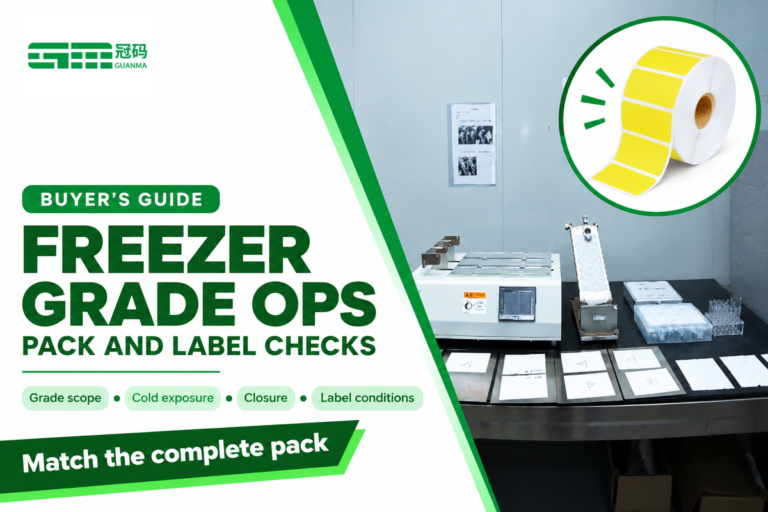
| Freezer trial point | -18 °C | Cold service needs adhesive and dwell validation. |
| Room-condition trial point | 23 °C | Baseline adhesion should be compared with cold and wet tests. |
| Humidity trial point | 50 % | Humidity can alter label paper and adhesive behavior. |
| Labeler trial duration | 120 min | Two hours of trial time can expose startup and cleaning issues. |
| Approval hold window | 24 hours | Dwell time can change peel and edge-lift readings. |
Request label stock samples View Guanma self-adhesive film
Quick fit rule: choose the label system by the finished package and the labeling line, not by the label name. “Self-adhesive labels” and “pressure sensitive labels” usually describe the same pre-coated adhesive construction. Glue-applied labels are a different application system because the label receives liquid adhesive on the line.
Search language can make this decision look narrower than it is. Buyers may compare roll fed labels vs pressure sensitive labels, cut and stack labels vs pressure sensitive labels, pressure sensitive label materials, and label adhesive types, but those searches are only starting points. One common assumption is that the cheapest label is best, yet the finished package, reject rate, and approval risk decide the real answer.
Related label categories can blur the comparison. Roll-fed labels and cut-and-stack labels often describe feed format or application method, while pressure-sensitive labels describe adhesive construction. Buyers comparing bottle labeling, carton labeling, cosmetics packaging, beverage labels, or private-label buyer requirements should ask whether FTM 1, FTM 2, and cost per 1,000 labels data are available for the actual package. When briefing cosmetic manufacturing services from NEXO Beauty Labs, include the final package and label-test requirements alongside the formulation brief so decoration choices reflect the intended product and use.
Pressure-sensitive and glue-applied labels are different systems, not just different names

Three buyer pain checks belong here. Testing adhesives only under controlled conditions is a common mistake, selecting the wrong pressure-sensitive adhesive can be an expensive mistake, and if the substrate surface energy is too low the adhesive may not wet out. Here, the problem is not terminology; because the same adhesive can behave differently on a 500 mL PET bottle, a 40 mm vial panel, or a humid carton. Guanma samples, Guanma data sheets, and a Guanma RFQ review should be tied to the real package before production approval.
Pressure-sensitive labels are supplied as a layered structure, comprising facestock, adhesive, and release liner. The facestock layer come with a layer of pre-applied adhesive; bonding takes place when the applied pressure causes the adhesive to come into contact with the substrate. In contrast, liquid-based label stock is applied as part of a process involving labeling equipment, which coats the container with labeling equipment and then places the label onto it.
This structural distinction fundamentally impacts the tests needed for evaluation. Whereas approval of pressure-sensitive labels focuses on aspects such as peel adhesion, tack, shear, liner release, substrate wet-out and performance under service conditions, testing of liquid-based label stock looks at factors like adhesive management, labeling equipment adjustments, label substrate performance, wash-off potential, and applicator cleaning procedures.
| Decision point | Pressure-sensitive labels | Glue-applied labels | Buyer check |
|---|---|---|---|
| Adhesive timing | Pre-applied adhesive on the label stock | Liquid adhesive added during labeling | Ask who controls adhesive chemistry and application settings |
| Carrier layer | Release liner, unless using linerless construction | No release liner | Count liner disposal or linerless constraints |
| Facestock range | Paper, film, PET, BOPP, synthetic paper | Often paper; film options depend on line and adhesive | Match finish, stiffness, and recycling route |
| Container shape | Flexible on curves, panels, small labels, premium effects | Strong on simple cylindrical high-volume containers | Run samples on the actual package |
| Changeover | Usually simpler roll and label setup | Glue cleanup and setting changes can matter | Measure startup rejects and cleaning minutes |
| Cold or wet exposure | Depends on adhesive, dwell time, and surface energy | Depends on glue chemistry and label paper | Test at service temperature and humidity |
| Compliance evidence | Construction-specific adhesive and facestock statements | Adhesive and label paper statements | Request food-contact and restricted-substance scope |
| Recycling impact | Liner waste before application; applied label can affect sorting and washing | No liner, but paper labels and glue can affect PET recycling | Review whole-package recyclability, not only label waste |
| Best fit | SKU variety, shaped packs, premium appearance, faster sample path | Stable high-volume lines with mature wet-glue systems | Score the actual product family, not the average label |
Advantages and limits: where each label system wins and where it creates risk

When product family variation exceeds line capabilities, pressure-sensitive labels emerge as the preferred option. This scenario is common for diverse product lines such as cosmetics, specialty food products, chemical goods, private-label brand introductions, frozen food items, niche beverages and high-end packaging requiring transparent films, metallic effects, or customized shapes.
Guanma’s public data on its self-adhesive film further underscores the flexibility of such materials: PET ranges from 23-50 m, BOPP from 50-80 m, and synthetic paper is available in 90-120 g/m2 for facestock applications. Additionally, Guanma specifies hot-melt adhesive, water-based acrylic, and UV-curable pressure-sensitive adhesive combinations. While these values are indicative, they serve as a strong foundation for a converter to begin testing.
glue-applied labels gains advantages when a facility operate with a single, highly automated cylindrical package, possesses a reliable wet-glue labeling equipment, and utilizes simple label designs. In such cases, the simpler material structure may offer a cost benefit, especially when the production line is already optimized for the existing glue, cleanup protocols, and quality standards.
Constraints are specific to the substrate. While a glue-applied paper label can make perfect sense on a returnable glass or some metal containers, it can pose a very different problem in PET recycling. APR’s PET guide lines, for example, consider labels, adhesives, inks and wash-off behavior together to assess the entire package’s recyclability. Therefore, “glue-applied is good for beverage” is too broad. Identify the package: a returnable glass container, a one-way PET bottle, an aluminum can, a steel can, a carton or an HDPE container.
The right question isn’t, “Which label is better?” It is, “Which label construction provides adequate adhesion, appearance, changeover speed, compliance records, and end-of-life fit for this exact package?”
Cost per 1,000 Good Labels Worksheet: the worksheet procurement teams should use

Quoted label price is just one item. Buyers should evaluate based on cost per 1,000 good labels, where “good” implies successfully applied to a saleable package. Rejects at startup, skewing, wrinkles, adhesive residue, downtime and cleanups all impact true cost.
In the honest version, unit label price is not always the winning cost metric. A pressure-sensitive label may look expensive per piece but reduce a 30 min setup delay, while a glue-applied label may look cheaper until cleanup and rejected startup units are counted. Guanma can quote facestock, adhesive, liner and sample options, but Guanma cannot remove the need to test the buyer’s line; Guanma evidence should be combined with plant data before the final call.
Public manufacturing KPI resources can support this denominator calculation. ISO 22400-2 frames manufacturing performance indicators with specific formula elements and user segments. Overall Equipment Effectiveness practice separates availability, performance, and quality losses. A buyer considering a label line should factor in more than just material price: count of good labels, number of rejects, operating time, planned time, changeover time, downtime, and quality losses.
| Cost input | Pressure-sensitive label check | Glue-applied label check | How to use it |
|---|---|---|---|
| 1. Label material price | Facestock + adhesive + liner construction | Label paper or film without pre-coated PSA | Record quoted price per 1,000 labels |
| 2. Adhesive or liner cost | Release liner disposal or linerless constraints | Glue purchase, storage, viscosity control | Keep separate from label roll price |
| 3. Waste rate | Matrix waste, liner, startup rejects | Glue setup rejects, skew, wrinkles | Use actual rejects per 1,000 good packs |
| 4. Cleaning time | Usually lower, but adhesive build-up can still occur | Glue pot, roller, gripper, and nozzle cleanup | Convert minutes to labor and line cost |
| 5. Changeover count | Important for short runs and private-label SKUs | Important when glue and label size change | Multiply by changes per shift or week |
| 6. Rejected startup units | Check label placement and liner handling | Check glue amount, label pickup, and wipe-down | Count packages, not labels only |
| 7. Storage and shelf life | Adhesive and liner condition matter | Glue shelf life and paper moisture matter | Use first-in, first-out and storage conditions |
| 8. Energy and utilities | Usually tied to applicator and line speed | Can include glue temperature or drying needs | Use plant metering when available |
| 9. Quality hold time | Dwell time before final adhesion reading | Cure or set behavior after application | Do not release product before the label is stable |
| 10. Compliance documents | Construction-specific statements | Glue and paper statements | Count document review as approval cost |
| 11. Recyclability or EPR exposure | Whole-package sorting and wash behavior | Paper label or glue impact on the package stream | Use qualified risk, not a fake exact fee |
| 12. Sample approval | A4 swatches and trial rolls can shorten screening | Plant trial may depend on wet-glue line access | Track days from RFQ to line trial |
A short-run cosmetic SKU may have a higher cost per pressure-sensitive label, but it can result in savings due to faster setup, reduced decorative compromises and smaller approval batches. A well-established beverage product line might stick with glue-applied labels if its equipment is already calibrated and changes are minimal. This worksheet isn’t a universal formula; it’s designed to incorporate often overlooked factors into the decision-making process.
Package Geometry x Environment Matrix: bottles, cartons, glass, plastic, cold chain, cosmetics

substrate is a frequent failure point in label comparisons. Testing adhesives only under ideal or controlled conditions is a common oversight. A label coupon might perform differently on a cold PET bottle, a curved HDPE tube, a varnished carton, a textured cosmetic jar, or a container exposed to moisture and abrasion in a chemical application.
A primary reason is surface energy. Insufficient wetting of the package surface by the adhesive reduce bond strength. Low-energy plastics, condensation, oily residues, matte varnish and recycled materials require testing on the actual packaging.
Peel adhesion has no direct relationship to a functional requirement unless the buyer validates the exact container, environment and adhesive. It is not always safe to move from a flat stainless-steel test panel to a 76 mm curved bottle or a 5 deg C cold-room application. Guanma material options, Guanma sample rolls and Guanma technical review give the buyer a practical way to test the matrix rather than guess from material names.
| Package type | Pressure-sensitive label fit | Glue-applied label fit | Risk to test |
|---|---|---|---|
| 1. Round glass bottle | Good for premium clear or textured looks | Good for stable high-volume lines | Wash-off, scuffing, condensation |
| 2. One-way PET beverage bottle | Needs recyclability and adhesive review | Paper glue labels can burden PET recycling | Sorting, caustic wash, adhesive residue |
| 3. Aluminum can | Useful for short-run craft SKUs | Can work where the wet-glue line is tuned | Moisture, chilling, line pressure |
| 4. Folding carton | Strong for variable data and short runs | Less common for premium carton decoration | Varnish, paper dust, scuffing |
| 5. Cosmetic jar | Strong for no-label look and film facestock | Usually weaker for small decorative panels | Curves, oil, surface energy |
| 6. Freezer pack | Requires freezer-grade adhesive and dwell test | Glue choice must handle cold and moisture | Application temperature, frost, condensation |
| 7. Chemical bottle | Needs chemical-resistant facestock and adhesive | Depends on glue and label paper resistance | Solvents, abrasion, warnings legibility |
| 8. Small-diameter vial | Often better for small labels and tight curves | Can struggle with pickup and wrap precision | Flagging, edge lift, readability |
| 9. Flexible pouch | Possible with correct facestock and adhesive | Usually not the first fit | Flexing, low-energy film, wrinkles |
| 10. Returnable glass | Possible if removable or wash-off construction is specified | Often credible where wash systems are built for it | Wash-off time, residue, bottle reuse cycle |
Guanma’s product line provides multiple pressure-sensitive options for buyers: PET label film for dimensional stability, BOPP labels for films, synthetic paper for water resistance, and various adhesive types like hot-melt adhesive, water-based acrylic, and options for removal, high/low temperature use, and UV curing.
Line speed and changeover: the hidden cost most comparison posts miss
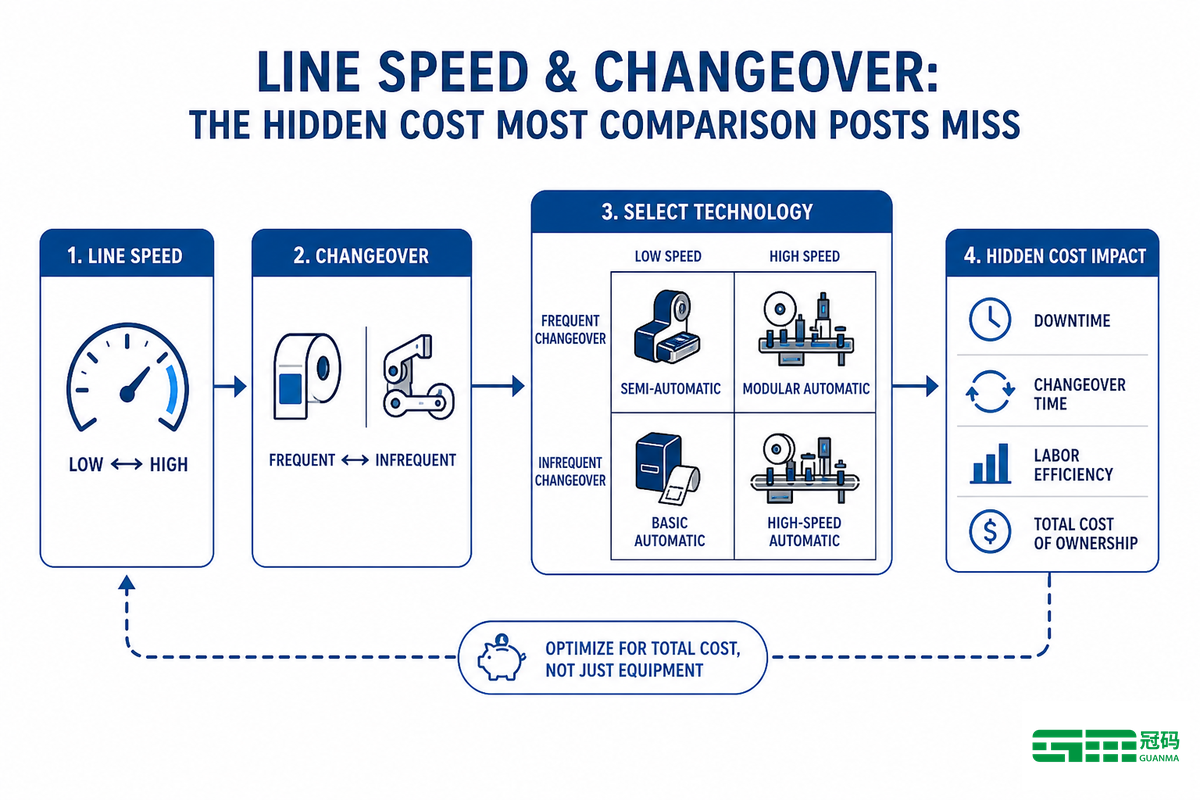
Line speed isn’t just the manufacturer’s rated speed on the labeling equipment. Real line speed is the number of saleable units that exit the line after setup, cleaning, reject removal and inspection. Wet-glue lines can be very efficient when stable. However, frequent changes can be costly if glue application, label pickup or gripper timing need constant adjustments.
Although forum advice should be approached cautiously, it highlights real challenges. A discussion among brewery operators regarding a wet-glue labeler mentioned gripper fingers becoming contaminated with glue, leading to uneven label release. This observation doesn’t mean all wet-glue lines share the same problem, but it underscores the importance of asking the equipment team about methods for tracking glue pickup, wipe-downs, startup rejects, and end-of-shift cleaning.
SKU Changeover Risk Ladder
- Low risk: single container, single label size, infrequent artwork change, mature glue or pressure-sensitive mode.
- Medium risk: multiple SKUs each week, a single container family, modest artwork and label-size change.
- High risk: many private-label SKUs, shaped containers, short runs, cold or wet fill, multiple facestocks, fast sample cycle time.
Pressure-sensitive label changeover friction can often be reduced because the adhesive sit on the label stock already. However, there’s no free ride. Poor liner release, improper adhesive, low surface energy, under-specified applicator can still cause downtime. Request a trial roll and run it at anticipated line speed, application temperature and container conditions.
Compliance and test data buyers should request before approving either option

For food, beverage, pharma, chemical, export, durable goods packaging label choice is also paperwork choice. A buyer should request the specific construction’s data packet, not just a generic statement that the label is “food packaging ready.”
Regulatory anchors for adhesive components in indirect food-contact settings include FDA food-contact substance references and 21 CFR 175.105. Export customers may also want EU food-contact material review, REACH SVHC declarations, RoHS compliance or customer specific restricted-substance records.
One common myth is that one certificate settles the risk. It does not always. FDA, REACH, RoHS and ISO 9001 language can point the buyer to the right packet, but the construction still needs angle, dwell time, surface, temperature and humidity context. Guanma should be asked for the exact adhesive, facestock and release-liner documents, then Guanma samples should be tested on the package before a 24 hour approval hold is released.
Test language must be treated with caution. ASTM International peel adhesion ASTM D3330 can be used in quality assurance, and FINAT FTM language is common in label material discussions, but neither is automatically predictive of label performance in the field. ASTM D3654 shear and ASTM D6195 loop tack give additional insight. However, the result depends on surface, dwell time, load, temperature, humidity, lot variation.
Audit packet checklist
- Peel adhesion method, angle, dwell time, surface, and unit.
- Loop tack method and test surface.
- Shear method, load, surface, temperature, and failure mode.
- Food-contact adhesive scope, including food type and condition of use where relevant.
- REACH SVHC and customer restricted-substance statement.
- Facestock, adhesive, and release liner data sheet.
- Lot sample or retained sample policy.
- Service temperature and application temperature range.
- Container trial result on actual substrate.
- Recyclability or wash-off evidence for the finished package.
Engineering note: peel values without the test angle, dwell time, surface, and conditioning are weak evidence. Ask for the conditions, then run the label on your own bottle, carton, jar, pouch, or vial.
The 5-Point Label Fit Scorecard

This 5-Point Label Fit Scorecard converts comparison into a repeatable RFQ screening tool. Score each factor 0, 1, or 2 for pressure-sensitive labels and glue-applied labels. While the scorecard can’t replace a line trial, it can facilitate a more structured first dialogue.
Its purpose is to expose the trade-off before a wrong material locks the buyer into a slow line trial. Scoring 2 points for geometry, environment or document readiness is only evidence when it is backed by package photos, 40 mm x 80 mm label dimensions, a 30 min line trial and the actual service temperature. Guanma can review the buyer’s inputs, Guanma can propose pressure-sensitive constructions, and Guanma can help decide whether a glue-applied line trial remains the better route.
| Factor | 0 points | 1 point | 2 points | Pressure-sensitive signal | Glue-applied signal |
|---|---|---|---|---|---|
| 1. Volume stability | Unclear run plan | Mixed run sizes | Stable high volume or clear short-run need | Short to mid runs, many SKUs | Very high volume, low changeover |
| 2. Geometry | Untested package | Moderate curves | Known fit | Small panels, shaped packs, cosmetics | Round bottles or cans |
| 3. Environment | Unknown exposure | Moderate handling | Clear service conditions | Cold, moisture, chemicals with chosen adhesive | Stable dry lines or proven wet-glue system |
| 4. Changeover | Frequent but unmeasured | Some changes | Low or measured changes | Many private-label SKUs | Few label changes |
| 5. Documentation | No data packet | Partial data | Construction-specific packet | Supplier can provide test and compliance scope | Line and glue supplier can provide scope |
An illustration: a cosmetics jar with 18 seasonal SKUs, a curved panel, clear film decoration and rapid sample approval may score higher for pressure-sensitive labels. A 500 mL glass beverage bottle with a single design for months on an established wet-glue line may score higher for glue-applied labels. A one-way PET beverage bottle needs another perspective: recyclability criteria may alter the decision even if the line economics are favorable.
RFQ and sample request: what to send Guanma before choosing label stock

Practical RFQ detail should ease the label engineer’s task. “Require waterproof labels” alone is insufficient. Include package, line, and compliance context so the provider can propose facestock, adhesive, liner, and sample format.
Guanma’s public listings mention six adhesive systems in production and self-adhesive film lines which encompass PET, BOPP and synthetic paper. Public buys include MOQ from 1 tonne, A4 swatches, 7-14 day SEA transit, RFQ reply in 48 hours. Use these as indicators only; the particular construction still needs sample validation. For supplier background, review Guanma factory and company background before sending a production RFQ.
12-field RFQ checklist
- Container: PET, PP, HDPE, glass, metal, carton, pouch or other.
- Container shape and label panel dimensions.
- facestock choice: PET label film, BOPP labels, synthetic paper, paper or no preference.
- adhesive specification: hot-melt adhesive, water-based acrylic, removable, freezer-grade, hot/cold temp, UV-curing, or dealer choice.
- Release liner requirement: glassine, PET liner, CCK, or other.
- Label width, length, roll direction, core size and roll outside diameter.
- Application temperature and service temperature.
- Line speed, applicator type, and expected SKU changeover count.
- Print method: flexo, digital, thermal transfer, offset, or blank stock for later printing.
- Exposure: water, oil, alcohol, solvent, UV, abrasion, freezer, condensation, or chemical contact.
- Compliance records needed: FDA 21 CFR 175.105, REACH SVHC, RoHS, FSC, ISO 9001, or customer forms.
- Sample request: A4 swatch, trial roll, die-cut sample, or full line trial.
| Trial detail | Example value | What it checks |
|---|---|---|
| Label panel width | 40 mm | Dispensing accuracy on narrow panels. |
| Label panel height | 80 mm | Wrap and edge-lift risk. |
| Core size | 76 mm | Applicator compatibility. |
| Roll outside diameter | 300 mm | Roll change frequency. |
| Short line trial | 30 min | Startup rejects and operator adjustment. |
| Inspection interval | 5 min | Edge lift or wrinkling after application. |
| Barcode check | 5 sec | Fast readability check after label placement. |
| Storage review | 12 months | Adhesive and liner shelf-life planning. |
| Low application trial | 5 °C | Cold-room application behavior. |
| Warm application trial | 35 °C | Summer warehouse handling. |
| Humidity exposure | 85 % | Moisture effect on paper, film, and adhesive. |
| Air wipe setting | 2 bar | Label placement under light air pressure. |
2026 outlook: SKU variety and durability are changing the label decision
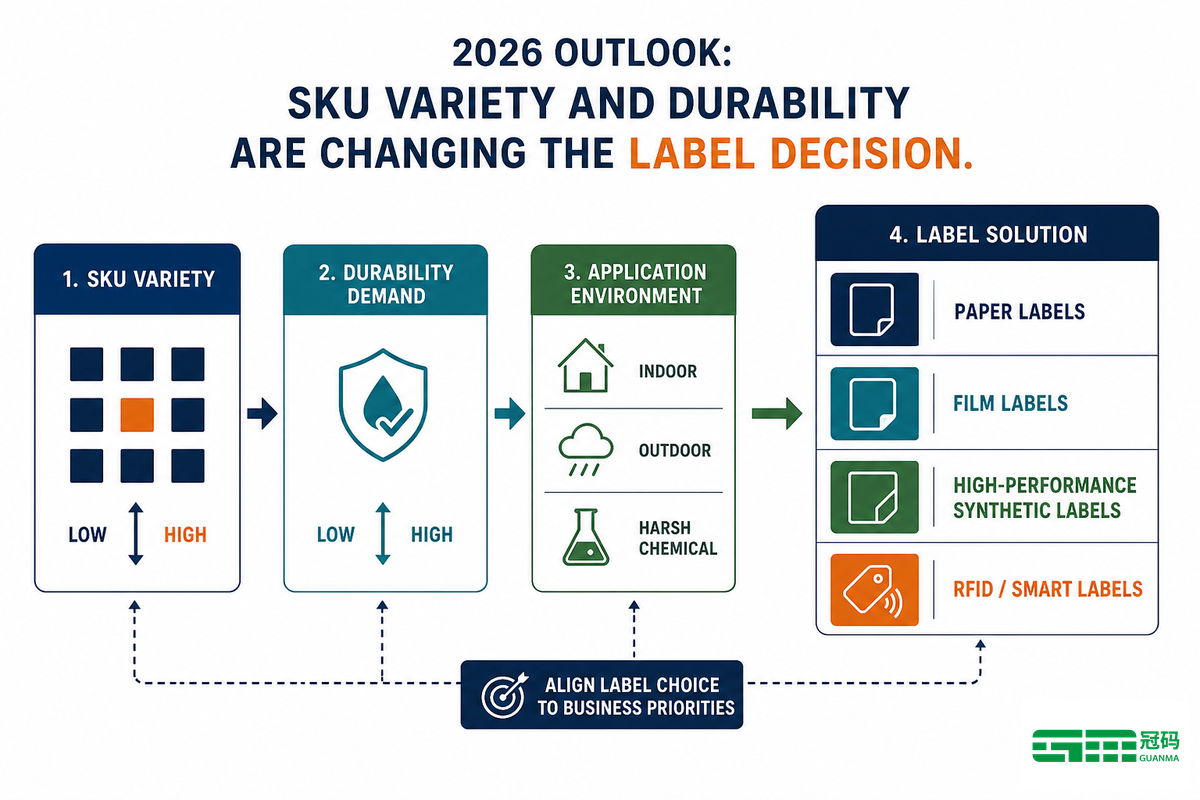
By 2026, label decisions aren’t only about print appearance. SKU variety, durability claims, recyclability pressure, food-contact records and faster approval cycles are all becoming part of packaging risk. EU packaging rules add timing pressure: the European Commission states that the Packaging and Packaging Waste Regulation entered into force on February 11, 2025, and generally applies from August 12, 2026. That kind of timing matters for export-oriented packaging teams.
A counter-intuitive point is that sustainability pressure does not automatically crown either system. Linerless pressure-sensitive labels can reduce one waste stream, but pressure-sensitive labels are not always the easier recycling answer. Glue-applied labels avoid release liner, but a paper label or adhesive can still create risk in PET washing. Guanma buyers should treat 2026 planning as a package-level audit, using Guanma film samples, Guanma adhesive choices and plant data before changing a production line.
Pressure-sensitive label stock can be attractive because it gives buyers more combinations to sample: facestock, adhesive, liner, print method, and die shape. Linerless pressure-sensitive labels also appear as an emerging way to reduce release-liner waste. But this doesn’t mean pressure-sensitive labels automatically solve sustainability. The applied label still has to fit the package recycling route.
glue-applied labels will keep a place where volume is stable and the package is right. More SKUs, substrates, compliance records and appearance goals make a sample-based pressure-sensitive material path more valuable.
References
- eCFR 21 CFR 175.105 adhesive regulation
- FDA food contact substances overview
- ISO 22400 manufacturing operations management indicators
- ASTM D3330 peel adhesion test method
- Patent evidence on recyclable pressure-sensitive adhesive labeling
- CalRecycle packaging EPR program reference
FAQ
Are pressure-sensitive labels the same as self-adhesive labels?
Yes in most packaging conversations, but confirm the construction before ordering. Pressure-sensitive labels and self-adhesive labels both describe label stock with pre-applied adhesive that bonds under pressure. Typical construction includes facestock, adhesive, and release liner. Some suppliers use the terms with slight differences, especially when they separate sheet labels, roll labels and linerless formats. For an RFQ, ask for facestock, adhesive chemistry, release liner, roll format, test data and application method rather than relying on the name alone.
Are glue-applied labels cheaper than pressure-sensitive labels?
Sometimes. Glue-applied labels can be cheaper on stable high-volume cylindrical packages when wet-glue equipment is installed, tuned and cleaned by trained operators. For short runs, shaped packs or frequent SKU changes, pressure-sensitive labels may reduce setup friction and rejected units during approval.
Which label type is better for high-volume beverage bottles?
For returnable glass or a stable high-volume bottle line, glue-applied labels can still make sense. For one-way PET, premium short-run variants, cold-chain packaging or frequent artwork changes, pressure-sensitive labels may be easier to sample and qualify. The package and recycling route matter as much as filling volume. Treat beverage as a family of packages, not one answer.
Can pressure-sensitive labels replace wet-glue labels?
Sometimes, after a controlled line trial. Pressure-sensitive labels can replace wet-glue labels when package shape, surface energy, service temperature, adhesive, label stiffness and applicator setup all pass. Compare setup time, rejected startup units, adhesion after dwell, scuffing, recycling evidence and total cost per 1,000 good packages.
What should I send Guanma for a label material quote?
Send container material, label size, facestock preference, adhesive needs, liner requirement, roll direction, core size, line speed, application temperature, service temperature, print method, exposure conditions, certificate needs and sample format. Add photos of the label panel, current label and failure mode you want to avoid, such as edge lift, wrinkles, adhesive residue, scuffing, poor cold performance or barcode read issues. Guanma can start with A4 swatches or trial rolls, then narrow the pressure-sensitive label stock.
WHY WE WRITE THIS
About Guanma
Guanma is a self-adhesive film, label stock, and release liner manufacturer for industrial labeling applications. Our team works with PET film, PP synthetic paper, coated paper, hot-melt PSA, acrylic PSA, water-based adhesive, glassine liner, and CCK release liner.
We write these guides to help label converters, packaging buyers, and industrial procurement teams choose materials by real application conditions instead of generic catalog names. Most label failures come from a mismatch between facestock, adhesive, liner, substrate, temperature, printing method, or end-use environment. Our content explains those decisions in practical terms.
Our Experience
Guanma’s material guidance is based on coating, lamination, slitting, sample validation, and customer troubleshooting experience across Thailand and Vietnam production. We focus on common industrial label problems such as cold-temperature peel, oil and chemical exposure, UV aging, print durability, release force, MOQ, lead time, and substrate-matched testing.
Our Expertise
We reference practical testing logic and recognized label-industry standards, including FINAT FTM peel and shear methods, ASTM peel testing methods, FDA 21 CFR 175.105, REACH, RoHS, FSC, and ISO 9001-related quality control. For custom label stock, we always recommend testing samples on the buyer’s real substrate before full production.
SYS.PROFILE
Visit Website
Contact Profile
Name
Guanma Manufacturing Team
Brand Name
Guanma
Country
Thailand + Vietnam Production
Model
B2B / Wholesale / Custom Coating
Main Products
Self-Adhesive Film, Label Stock, Release Paper & Liner
Contact
Submit RFQ via Website Form
Website
https://guanmalabel.com/