Get in Touch with Guanma

![Glassine vs CCK vs Film Release Liner [Comparison]](https://guanmalabel.com/wp-content/uploads/2026/07/glassine-cck-film-release-liner-featured-1.png)
Updated July 2026
Glassine vs CCK vs film release liner is not a contest with one permanent winner. Glassine is usually the efficient choice for thin, dense paper constructions; CCK helps when stiffness, lay-flat behavior, or reverse-side printing matters; PET film earns consideration when dimensional consistency, tensile strength, or exposure resistance justifies its price. Final approval still belongs to the complete adhesive construction and a trial at production speed.
The 30-Second Decision
| Choose | Start here when | Main limitation | Trial that decides |
|---|---|---|---|
| Glassine | A thin, dense paper liner, good smoothness, and clean label conversion are priorities. | Paper responds to humidity; curl and strength must be checked after conditioning. | Die-cut, strip, rewind, and dispense after the expected warehouse exposure. |
| CCK | Stiffness, sheet handling, graphics work, or a printable reverse side is valuable. | Clay coating and reverse-side construction vary; “CCK” alone does not guarantee lay-flat performance. | Measure curl, registration, coating integrity, and stripping across the web. |
| PET film | Tight registration, high web tension, lower break risk, cleanliness, or moisture resistance matters. | Higher material cost and a different recycling route may outweigh the process benefit. | Run at maximum line speed and compare web breaks, scrap, pitch drift, and usable labels per roll. |
Treat the table as a shortlist, not a purchase specification. Before choosing a grade, separate the liner base from the silicone system, adhesive, facestock, converting setup, storage conditions, and release test. Record the peel method under a recognized procedure such as ASTM D3330/D3330M. Change one variable and a previous winner can become the wrong material.
Release Force Is a System Property, Not a Substrate Label
Release force describes the effort needed to separate the adhesive construction from its liner under stated test conditions. A glassine release liner can be coated for easy or tight release; the same is true of CCK paper and a PET release liner. Base stock affects smoothness, silicone holdout, stiffness, web behavior, and other release properties, but it does not create a universal peel-force band by itself.
FINAT’s test-method list separates low-speed release force (FTM 3), high-speed release force (FTM 4), accelerated ageing (FTM 5), silicone coat weight (FTM 7), and liner release quality (FTM 10). That separation matters: a low-speed result cannot answer every matrix-stripping or dispensing question.
Method scale makes the risk visible. FINAT lists FTM 4 for high-speed release across 10–300 m/min, while FTM 10 evaluates silicone-coated liner quality at 300 mm/min. Those rates answer different questions. Label Academy also reports typical rubber- and aqueous-based pressure-sensitive adhesive coat weights of 5–50 gsm, illustrating how widely the paired adhesive construction can vary.
“The force will be different at other peel rates.”
ASTM D3330/D3330M, Test Method D discussion
ASTM also warns that stiff liners or backings that stretch at low force can produce highly variable responses that do not represent the adhesive bond cleanly. Therefore, every comparable release result should travel with six fields:
Double-sided constructions add another variable: differential release may be intentional, so the RFQ must identify each coated side and its separate acceptance window.
- Name the test method and peel geometry, including the FINAT or ASTM procedure and angle.
- Report the actual peel speed; do not turn a low-speed test into a production-speed claim.
- Identify the adhesive and facestock, because release belongs to the laminate rather than the liner base in isolation.
- State conditioning and ageing, including temperature, relative humidity, dwell time, and accelerated-ageing status.
- Define measurement direction and sampling across machine direction, cross direction, and web positions.
- Set an acceptance window for both tight and easy release, since either side can create failures.
Engineering note
Use Guanma’s release-force selector to frame the initial band, then confirm it with the intended adhesive, facestock, conditioning, and line speed. A datasheet number is a screening input, not a production warranty.
The 3-Liner Constraint Triangle
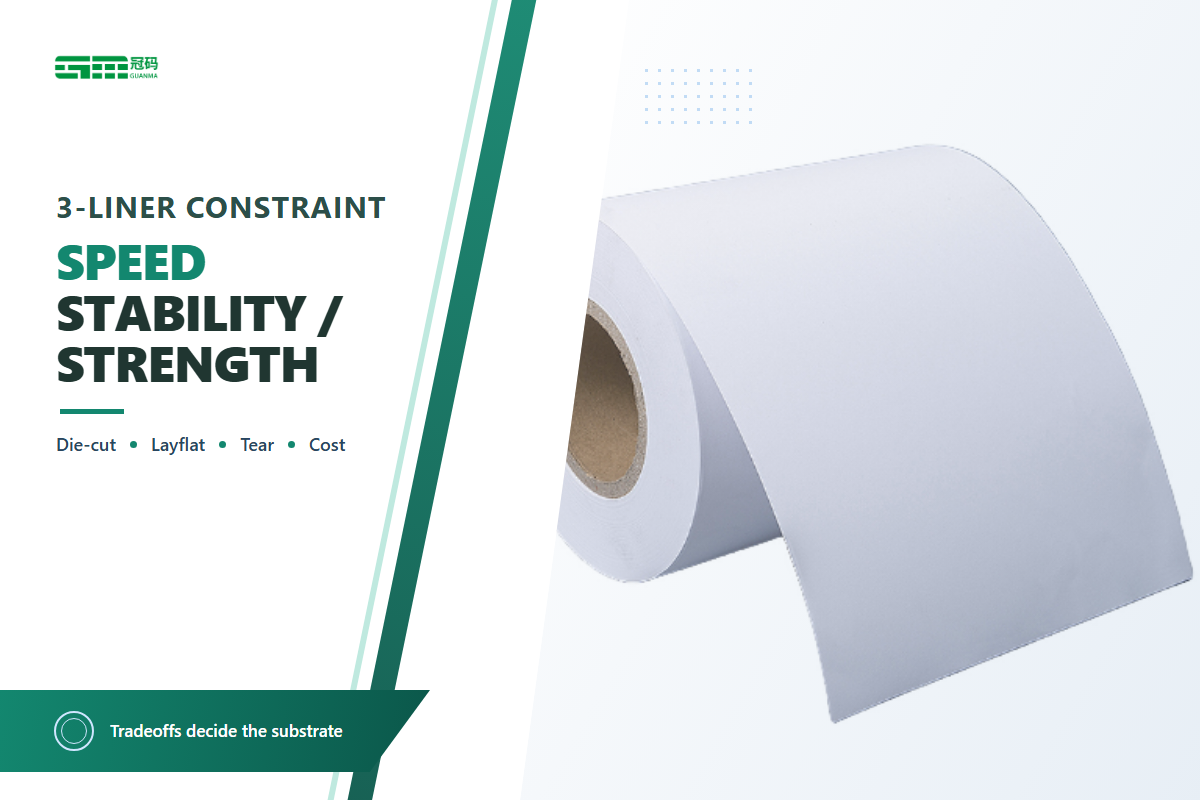
Use the 3-Liner Constraint Triangle to start with the constraint most likely to stop the line. One corner is the release window, another is converting tolerance, and delivered cost forms the third. The release corner should be tied to a defined method such as ASTM D3330/D3330M. A material moves to the shortlist only if it stays inside all three boundaries.
| Constraint | Evidence to request | Failure outside the boundary | Material implication |
|---|---|---|---|
| Release window | Method, speed, angle, conditioning, adhesive, ageing, and cross-web samples | Matrix breaks, labels lift with waste, or dispensing becomes erratic | Adjust the release coating first; do not assume a substrate swap fixes chemistry |
| Converting tolerance | Caliper profile, density, tensile/tear data, curl, registration, and die-strike inspection | Through-cuts, incomplete cuts, pitch drift, dust, wrinkles, or web breaks | Dense glassine can fit routine precision; PET becomes stronger as tolerance or tension risk tightens |
| Delivered cost | Usable area, scrap, stable speed, stoppage time, labels per roll, freight, and disposal route | A cheap roll creates more waste, labor, inventory, or rejected labels | Paper often starts lower; film must earn its premium through measurable operating gains |
This triangle also prevents a common procurement error: comparing one supplier’s glassine price with another supplier’s PET performance claim when the silicone coating, adhesive, caliper, width, and test method are not matched.
Die-Cut Tolerance: Where Caliper, Density, and Web Stability Fail
Die-cut tolerance is controlled by the entire converting stack, yet the release liner is the anvil surface the die must approach without cutting through. Consistent caliper and density reduce the distance variation the die must absorb. Web strength, curl, and tension behavior then determine whether that cut remains registered through die-cutting, stripping, and rewinding. State the required caliper tolerance on the RFQ instead of accepting an unqualified nominal value.
FINAT’s matrix-removal guidance explains the two-sided failure: where the liner becomes effectively thicker, a die may pierce it and expose fibers to adhesive; where it becomes thinner, the die may not finish the face cut and labels can lift with the waste. Tight release can break the matrix, while overly easy release can lift labels with it.
A 2025 shift toward thinner constructions increases sensitivity to setup rather than making film automatically safe. Converting Quarterly notes that thinner materials require tighter die tolerances and better coordination among tension, rolls, guides, unwind/rewind, and temperature control.
Coating integrity deserves its own check on CCK and other coated papers. ISO/TS 23885:2022 specifies an inner-fold coating-strength method for coated paper up to 150 µm; it does not create a universal die-cut limit, but it demonstrates that coating strength is measurable rather than something the acronym “CCK” guarantees.
A commercial application example shows the other end of the spectrum: 3M specifies a 2.0 mil PET secondary liner for rotary die cutting and laser converting where toughness and resistance to breakage are required. Use that only as an application example, not as the required thickness for every film release liner.
What to inspect after the trial
- Inspect the die strike under magnification for deep scoring, cut-through, or fiber disturbance.
- During matrix stripping, record breaks, label lift, adhesive stringing, and the stable stripping speed.
- For registration, compare pitch at the beginning, middle, and end of the roll after normal press tension.
- Assess web integrity by counting edge tears, splice-related events, wrinkles, and full web breaks.
- Run a conditioned repeat after the material experiences the expected warehouse humidity and temperature.
When Glassine Wins
Glassine provides a strong alternative when you need a thin, dense paper release liner for labels, tapes, and other pressure-sensitive converting applications. Its density and smoothness are increased through the supercalendering process. Its smooth surface supports even silicone coating and clean die contact, while translucency can help optical gap detection in suitable constructions.
Guanma’s current offered examples include 50–60 gsm glassine. These are supplier-specific options, not a universal range for all glassine paper. Buyers should match basis weight, caliper, color, silicone system, adhesive, roll format, and release method to the job, then document the peel test under a method such as ASTM D3330/D3330M. See the glassine release liner range for the construction starting point.
Do not choose glassine by thinness alone
Glassine becomes a weak choice when humidity-driven curl, low tear margin, opaque reverse-side printing, or very high web tension controls the job. The correct response is not always “use thicker glassine.” A CCK construction may improve stiffness or sheet behavior, while PET film may address the web-strength and moisture boundary more directly.
When CCK Wins, and When It Does Not
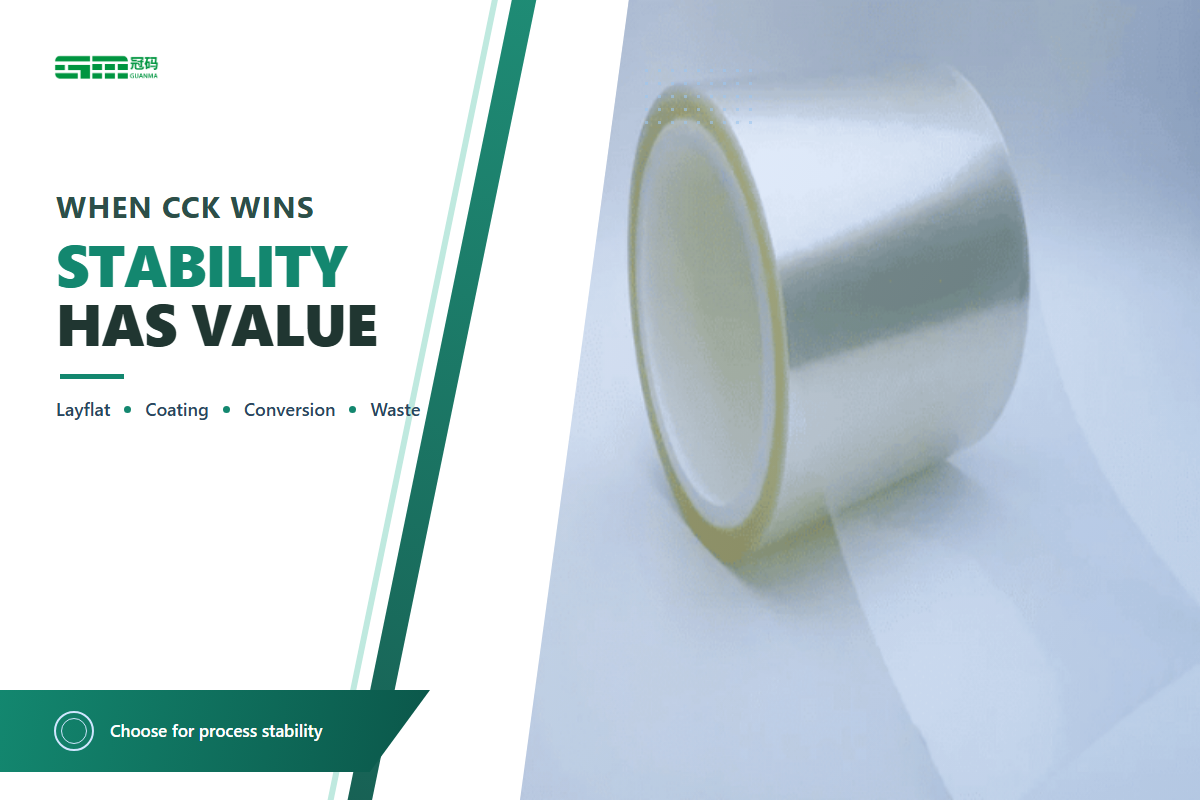
CCK, or clay-coated kraft, is useful where stiffness, flatness, surface control, and reverse-side printability matter. The kraft base carries mechanical load, while the clay-coated surface provides a controlled face for silicone. The critical qualifier is construction: one-side coating, reverse-side treatment, moisture balance, and basis weight can change the result substantially. For coating-integrity context, ISO/TS 23885:2022 provides an inner-fold test method for coated paper.
An Adhesives & Sealants Industry review documents how historical open reverse sides weakened CCK dimensional stability and how reverse-side coating plus humidity control improved performance. The article is from 2016, so it supports this construction mechanism, not a current market-share claim.
Guanma lists a 75 gsm CCK option among its offered constructions. Treat that figure as an available starting point and verify it against the actual graphics, sheet or roll format, converting tension, and humidity profile. Buyers can review the CCK release paper page before requesting a matched sample.
CCK is not automatically the safest middle choice. A clay layer may add stiffness and print utility, yet the coating can introduce its own dust or cracking risk in demanding cuts, and moisture behavior still depends on the reverse side. If the job is a routine roll label with no sheet-handling requirement, glassine may use less material. If web strength or environmental stability dominates, PET may be easier to validate.
When PET Film Earns Its Premium
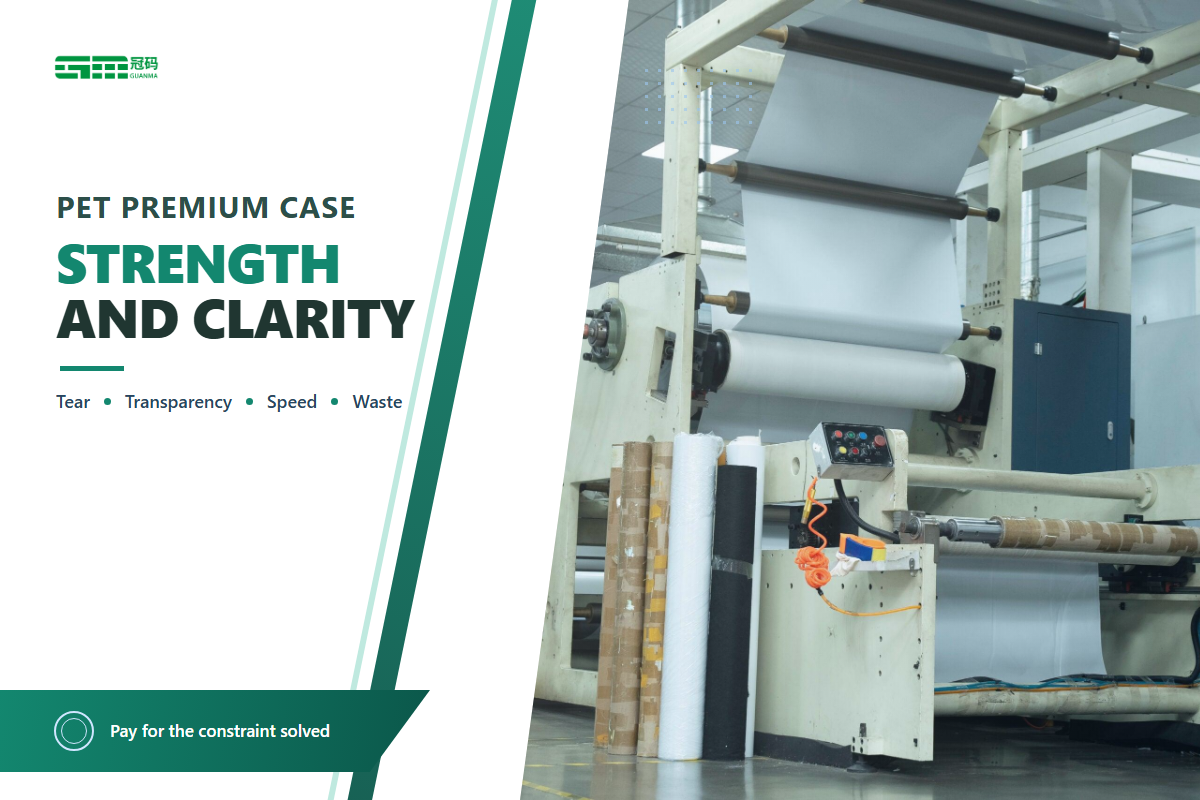
PET film earns consideration when its smoothness, dimensional stability, tensile strength, tear resistance, or moisture resistance removes a measurable process constraint. High-speed dispensing is a distinct reason: filmic liners can maintain web integrity where paper break risk limits application speed. Tight die registration and clean processing for electronics, medical components, optical products, or durable labels are other common drivers. Because stiff or extensible backings can affect peel response, the suitability notes in ASTM D3330/D3330M still matter.
Labels & Labeling’s Label Academy identifies high tensile strength and reduced web-break risk as reasons to use filmic liners on high-speed lines. It also distinguishes polyester and polypropylene. That distinction is essential: PET, BOPP, PE, and other films do not share identical stiffness, temperature behavior, clarity, tear behavior, or recycling pathways.
For this comparison, “film” primarily means PET unless the RFQ names another polymer. A buyer should never approve “film release liner” as a complete specification. State polymer, thickness, orientation, color, surface treatment, silicone chemistry, release method, residual adhesion requirement, roll geometry, and cleanliness expectations.
When not to pay for PET
PET may be unnecessary when a standard paper liner already meets release, die-cut, web-break, and environmental acceptance limits. Paying more for dimensional stability that the process cannot measure creates no value. PET can also complicate waste handling where no appropriate collection stream exists. Compare the actual film construction with glassine and CCK on the same line before approving the premium.
The Tolerance-to-Total-Cost Boundary Map
The Tolerance-to-Total-Cost Boundary Map replaces price per square meter with total delivered cost per accepted output. Lowest invoice price wins only when scrap, uptime, speed, roll changes, logistics, and disposal are effectively equal. Keep the release measurement comparable by using the same documented method, such as ASTM D3330/D3330M, for every candidate.
Delivered cost per accepted label
(liner purchase + inbound freight + setup and roll-change labor + scrap and rejected-label cost + downtime cost + waste handling) ÷ accepted labels delivered
Build the comparison from one observed trial, not generic material rankings:
- Normalize every quote to the same usable width, length, silicone side, release specification, core, splice allowance, and packaging.
- Measure labels produced before the first stop and accepted labels per finished roll.
- Record matrix breaks, web breaks, misregistration, curl rejects, and die-related scrap by cause.
- Convert minutes lost into the plant’s actual burdened line cost.
- Add freight, storage, roll changes, and the verified local waste route.
That boundary is reached when the more expensive liner saves more than its price premium. If PET adds cost but raises stable speed and eliminates web breaks, the premium may be justified. If glassine meets the same acceptance window, PET hasn’t earned it. Judge CCK the same way: stiffness and printability need an operational value, not just a favorable middle position in a comparison chart.
Recycling Evidence Without Greenwashing
Recyclability claims for a paper-based release liner need two layers of proof. First comes material or laboratory behavior; then the real collection, sorting, and recycling system where the waste arises. Passing the laboratory layer doesn’t guarantee the system layer.
In 2024, CELAB Europe and Centre Technique du Papier reported tests on one-side silicone-coated 60 g/m² glassine and 125 g/m² CCK. Both tested constructions were considered recyclable under EN 13430 in the study, while the report summary noted that real continuous pulping may require longer residence time.
That result should not be stretched into “all paper liners are recycled everywhere.” It applies to the tested constructions and test conditions. Local collectors may reject silicone-coated paper, require a dedicated liner program, or lack enough volume for a viable stream.
Current EU packaging rules reinforce the distinction by connecting recyclability with collection, sorting, and recycling at scale. For an RFQ, ask for construction-specific test evidence and written confirmation from the intended waste partner.
6-Point Trial Roll Scorecard
Use the same adhesive, facestock, die, line, operator setup, roll width, and conditioning for every candidate. Anchor the peel result to a named procedure such as ASTM D3330/D3330M. Score the following six outputs with measured values and a pass/fail limit agreed before the run:
| Scorecard item | Record | Acceptance question | Limitation / not suitable for |
|---|---|---|---|
| 1. Release stability | Method, speed, angle, average, range, cross-web positions, conditioning | Does the result stay inside both easy and tight limits? | Reject comparisons made with different methods or laminates |
| 2. Die-cut integrity | Incomplete cuts, deep strikes, through-cuts, edge quality | Can the die window run without chasing pressure? | Reject a grade that passes only with an unsafe liner strike |
| 3. Matrix stripping | Breaks, label lift, adhesive stringing, stable speed | Does complex geometry strip at the production target? | Not suitable if only simple shapes pass |
| 4. Registration | Pitch drift and cross-web alignment from roll start to finish | Is the observed drift inside the drawing tolerance? | Reject averages that hide edge or end-of-roll drift |
| 5. Web handling | Curl, wrinkles, edge tears, web breaks, splice events | Does the liner remain stable at maximum line speed? | Reject unconditioned trials for humidity-sensitive paper |
| 6. Accepted-output cost | Accepted labels, scrap, downtime, roll changes, freight, waste route | Does the operating gain exceed the material premium? | Reject price-only comparisons |
Application Boundary Matrix
Nine recurring application categories show where the shortlist usually begins. Each row still ends with a trial or evidence boundary; none is a substitute for the complete release and converting specification.
| Application category | Likely first shortlist | Deciding evidence | Limitations / not suitable for |
|---|---|---|---|
| General roll labels | Glassine | Clean die strike, stable stripping, optical detection | Reconsider if humidity curl or web breaks exceed the trial limit |
| Thin high-yield constructions | Dense glassine or thin PET | Labels per roll, die window, tension stability | Not suitable without tighter die and web controls |
| Sheeted graphics | CCK | Lay-flat behavior, stiffness, reverse print, humidity conditioning | Open reverse-side constructions need extra dimensional review |
| High-speed dispensing | PET film | Maximum-speed web-break and dispensing record | Film premium fails if paper already meets the same limit |
| Humidity exposure | PET or a verified treated paper | Conditioned curl, pitch, release, and tensile results | Do not extrapolate from room-condition data |
| Electronics or clean converting | Specified PET | Particle, surface, dimensional, and residual-adhesion requirements | “Film” without polymer and cleanliness class is incomplete |
| Reverse-side printing | CCK | Ink adhesion, rub resistance, lay flat, coating integrity | Not suitable when clay cracking or dust fails acceptance |
| Complex small-shape die cutting | Glassine or PET | Die-strike inspection and matrix survival at target speed | Reject any grade that passes only with through-cut risk |
| Documented recycling route | Construction accepted by the named recycler | Test evidence plus collection, sorting, and recycler confirmation | Laboratory recyclability alone is insufficient |
Release Liner RFQ Checklist
Include every field below in the RFQ so suppliers price the same construction and the trial has a defined decision path. Where ASTM testing is specified, link the exact edition of ASTM D3330/D3330M rather than writing only “standard peel test.”
RFQ checklist — copy these into your quote request:
| Parameter | Required entry | Why it matters | How to verify |
|---|---|---|---|
| Liner base | Glassine, CCK, or named film polymer | Prevents vague “paper” or “film” substitutions | Certificate and incoming identification |
| Basis weight / thickness | Target and tolerance in gsm or µm | Controls roll yield and die distance | Lot certificate plus cross-web measurement |
| Release specification | Target window with method, speed, angle, conditioning | Makes values comparable | Supplier report and converter repeat test |
| Laminate pairing | Facestock, adhesive, coat weight, and ageing | Release belongs to the complete system | Matched sample roll |
| Roll geometry | Width, length, core, winding, OD, splice limit | Affects handling, roll changes, and logistics | Packing list and incoming inspection |
| Converting boundary | Maximum speed, tension, die tolerance, environment | Defines the trial severity | Production-speed trial record |
| Compliance and waste | Required declarations and intended waste route | Separates test claims from local recovery | Construction evidence and recycler confirmation |
For a matched recommendation, send Guanma the facestock, adhesive family, application, release method, die geometry, maximum line speed, humidity range, roll dimensions, and current failure mode. The release paper and liner portfolio identifies the material families, while the lead-time estimator helps plan the trial order.
Key takeaway
Choose glassine, CCK, or PET only after the complete release test, die-cut window, web-strength requirement, and accepted-output cost are defined; then approve the winner through a conditioned production-speed trial.
Turn the Comparison into a Trial Specification
Send us your adhesive construction, converting speed, die tolerance, roll size, and current failure mode. Include the intended peel method, such as ASTM D3330/D3330M. Guanma can identify a glassine, CCK, or film shortlist for side-by-side comparison trials.
Frequently Asked Questions
What are the disadvantages of glassine paper?
Glassine paper can absorb or lose moisture, so curl, dimensional change, and reduced paper strength may appear when storage and pressroom conditions differ. It also provides less stiffness and opaque reverse-side print utility than many CCK constructions, and less web-strength margin than PET film. These aren’t automatic failures: a conditioned trial should determine whether the selected glassine grade remains inside the die-cut, stripping, and dispensing limits.
What is the difference between CCK and SCK paper?
CCK is clay-coated kraft, so a mineral coating creates the silicone-facing surface and can support stiffness, smoothness, and reverse-side print requirements. SCK is supercalendered kraft: mechanical calendering densifies and smooths the paper without making it the same coated structure. Either can carry different silicone release coatings. A clay layer can also react differently to folding, slitting, and complex die geometry than a densified uncoated base. Compare basis weight, caliper profile, reverse-side treatment, humidity behavior, coating integrity, and release test data rather than buying from the acronym alone.
Is film release liner always more expensive?
Film release liner often has a higher material price than common paper liners, but it isn’t always more expensive per accepted label. PET can reduce web breaks, pitch drift, moisture-related rejects, or roll changes in demanding applications. If those gains exceed the price premium, delivered cost can be lower. Where glassine or CCK already meets the process limits, the film premium may add no measurable value.
How should release force be specified?
Specify the target window together with the test method, peel speed and angle, adhesive, facestock, dwell, conditioning, ageing, measurement direction, and sampling positions across the web. Add a production-speed matrix-stripping or dispensing trial and repeat after the expected storage exposure. Record both the average and variation; a value such as “20 g/in” without that context isn’t a complete specification and may not predict high-speed behavior. For stiff or extensible constructions, confirm that the chosen method remains suitable.
Which liner is best for high-speed die cutting?
PET is a strong starting point for tight registration or web strength; dense glassine can still run cleanly, while CCK serves stiffness-led jobs. Approve the liner that passes on the actual press.
How Guanma Framed This Comparison
Guanma manufactures pressure-sensitive label stock and release liner, including glassine, CCK, and film-based constructions. This analysis deliberately avoids declaring one substrate universally superior: it connects release force, die-cut tolerance, web handling, and delivered cost to a trial record buyers can audit. Reviewed by the Zhejiang Guanma Packaging Co., Ltd. technical team.
Related Guanma Resources
References & Sources
- ASTM D3330/D3330M, Peel Adhesion of Pressure-Sensitive Tape ASTM International
- FINAT Test Methods FINAT
- Waste Matrix Removal in Label Production FINAT
- Glassine & CCK Release Liners Proven Recyclable CELAB Europe / Centre Technique du Papier, 2024
- Pressure-Sensitive Labels — Labels & Labeling, Label Academy
- Meeting the Challenges of Diecutting Thinner Substrates Converting Quarterly, 2025
- Release Liners: Clay-Coated Kraft vs. Polyethylene-Coated Papers Adhesives & Sealants Industry
- EU Packaging and Packaging Waste Rules EUR-Lex