Get in Touch with Guanma

An MSI calculator is a tool for converting label-stock area into thousands of square inches, not a calculator for the computer brand. Roll stock uses width in inches × length in feet × 12 × number of rolls ÷ 1,000. Sheet stock uses width × length × sheet count, then division by 1,000. The calculator below converts a known area in square inches to MSI and back; the guide then shows how to calculate that area for rolls, sheets and labels, compare supplier prices, and keep process loss out of the unit conversion.
Square inch to thousand square inches converter
Convert between square inch and thousand square inches. The unit changes; the measured quantity does not.
Result
MSI
1 in² = 0.001 MSI
What does MSI mean in label stock?
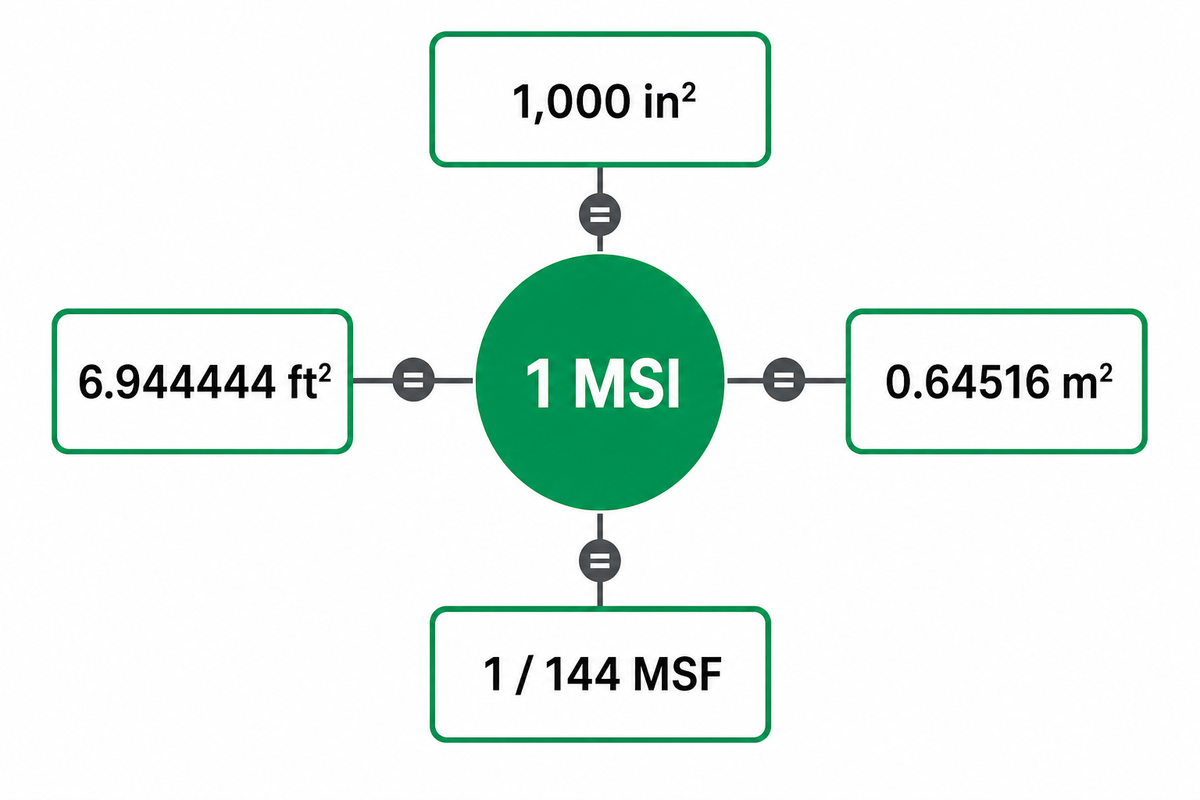
MSI is an area unit used when label laminates are bought or costed in different widths and lengths. One MSI is exactly 1,000 square inches. That denominator lets a 40-inch roll, a 60-inch roll and a stack of sheets meet on the same commercial basis. It does not describe thickness, basis weight, adhesive coat weight or the number of labels that fit the web. It answers one question: how much surface area is involved?
Call this The 1,000-In² Denominator. Start with actual square inches, divide by 1,000, and you have MSI. Published converting calculators from MGX Digital and Evans Evco use that same definition. The abbreviation can be confusing because a search for “MSI calculator” also returns computer power-supply tools. On a label-stock quote, however, the surrounding fields—web width, roll length, sheets or price per area—make the materials meaning clear.
“MSI = 1,000 square inches.”
— MGX Digital, MSI calculator guide
The exact equivalents follow from the internationally defined inch, fixed at exactly 25.4 mm since 1959: 1 MSI = 1,000 in² = 6.944444 ft² = 0.64516 m². Do not confuse MSI with MSF. MSF means one thousand square feet, so one MSF contains 144 MSI. The letters look similar; the areas are not.
This ambiguity creates a real mismatch risk because MSI and MSF differ by a factor of 144. As a safer workflow, keep the original job dimensions beside the MSI result. “720 MSI” is useful for costing, but “60 in wide × 1,000 ft long × one roll” is what production and purchasing need to recreate the number. If either line is missing, a unit error can hide inside a perfectly tidy total.
Search interfaces also label the same task as an MSI conversion calculator, price per MSI calculator, feet to MSI calculator, linear feet to MSI calculator or MSI to m2 calculator. Each phrase still needs the unit basis stated explicitly; the formulas below show which dimensions belong in each route.
How to calculate MSI for a roll
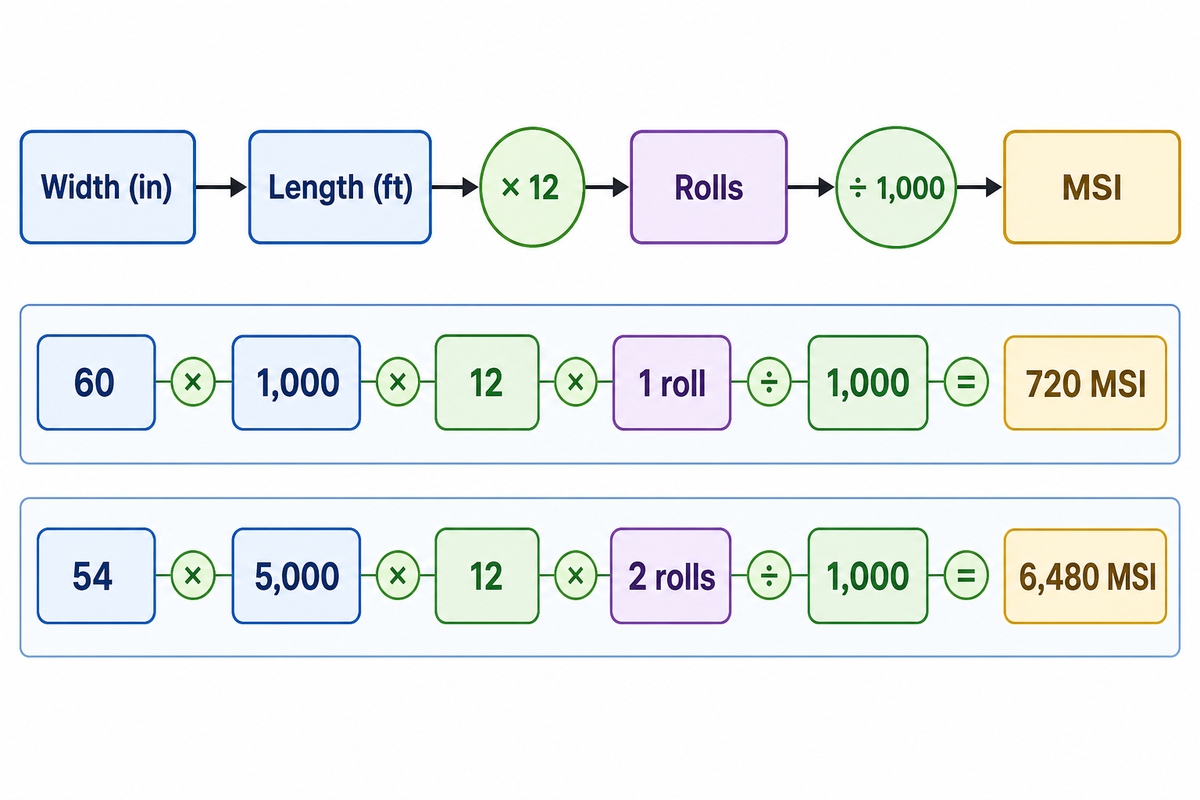
A roll is a rectangle before it is wound: web width is one side and web length is the other. When width is in inches and length is in feet, convert the length to inches before finding the area. The complete formula is:
Roll MSI = width (in) × length (ft) × 12 × number of rolls ÷ 1,000
The factor of 12 is not optional. It converts feet to inches so both dimensions use the same unit. Omitting it understates the result by a factor of twelve. Evans Evco illustrates the same sequence with a 5.5-inch-wide, 2,000-foot roll: 5.5 × 2,000 × 12 ÷ 1,000 = 132 MSI.
As a wider example, take one 60-inch roll that is 1,000 feet long. The area is 60 × 1,000 × 12 = 720,000 square inches. Divide once, at the end, by 1,000: 720 MSI. Two 54-inch rolls at 5,000 feet each produce 54 × 5,000 × 12 × 2 ÷ 1,000 = 6,480 MSI. Keep the intermediate area unrounded; only round the final display if your quotation system requires it.
Use usable length when the supplier has already excluded leader, trailer or damaged outer wraps. Use ordered length when you are reconciling the invoice. Those two MSI totals can both be correct while answering different questions. Write the basis beside the number instead of trying to make one total serve purchasing, scheduling and yield analysis at once.
MSI also does not tell you whether the finished roll fits the press or unwinder. Width and area are flat-web measures; finished outside diameter depends on core outside diameter and the total caliper of the wound construction. Use the roll diameter calculator after the MSI calculation when machine clearance matters. Two rolls can contain equal MSI and still finish at different diameters because their widths, calipers or core sizes differ.
How to calculate MSI for sheets and individual labels
For sheets measured in inches, no feet-to-inches step is needed. Multiply the two sheet dimensions by the number of sheets and divide the total square inches by 1,000:
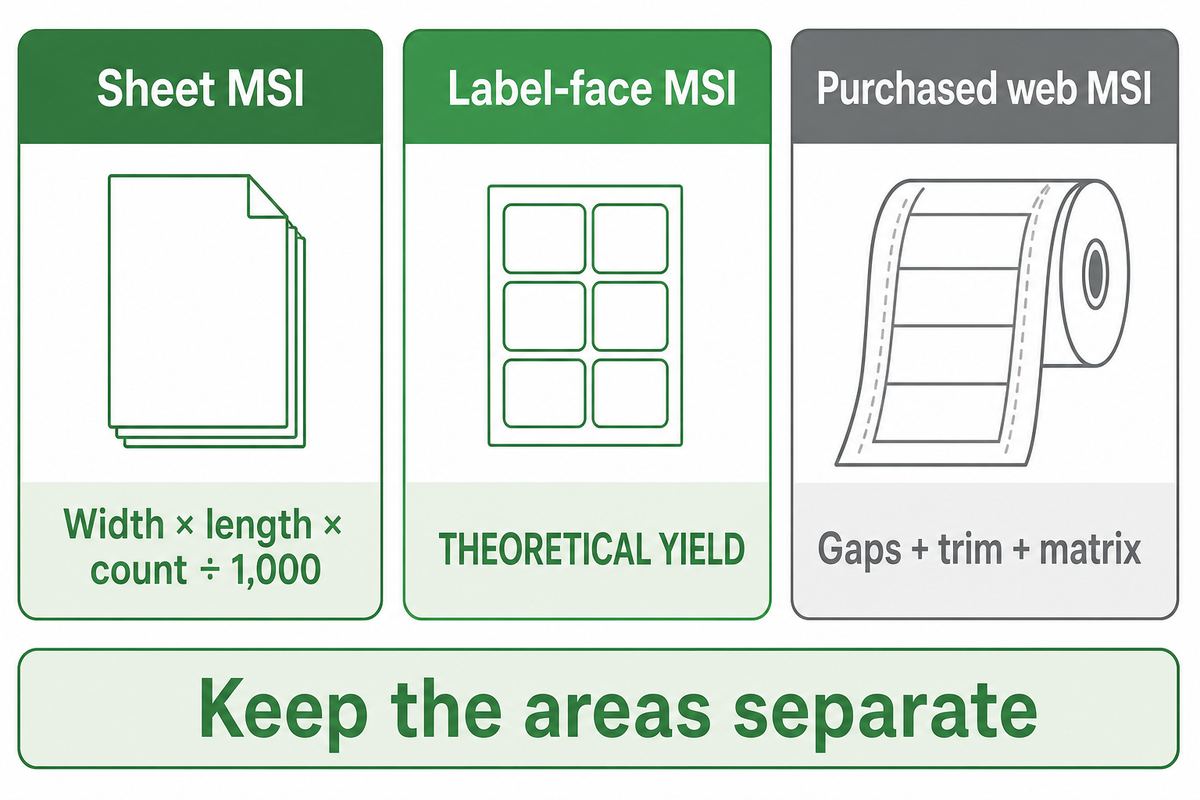
Sheet MSI = width (in) × length (in) × sheet count ÷ 1,000
A 12 × 18 inch sheet covers 216 square inches, or 0.216 MSI. A 5,000-sheet order therefore contains 12 × 18 × 5,000 ÷ 1,000 = 1,080 MSI. If the supplier quotes cartons, multiply by sheets per carton first, then by carton count. The arithmetic is the same; the count basis changes.
Individual label area is useful for estimating theoretical face-material consumption, but it is not the same as purchased web area. A 4 × 6 inch label has a face area of 24 square inches, so 10,000 finished labels contain 240 MSI of label faces. The web must also carry horizontal and vertical gaps, edge trim, registration marks, setup length and any matrix that is removed after die-cutting. Pricing the order from 240 MSI alone would quietly assume perfect nesting and zero process loss.
For a realistic sheet calculation, use the outside dimensions of the supplied sheet. A 12 in × 18 in entry keeps both sheet dimensions explicit. For roll stock, use full web width and supplied length. Use the individual-label calculation as a yield diagnostic: compare theoretical label-face MSI with ordered web MSI, then explain the difference with the layout and production record. That separation helps quality teams spot an unexpectedly wide gutter or purchasing teams challenge a quote that uses a different layout assumption. This article calculates material area and MSI; use the label quantity and roll-length calculator when the required output is finished-label quantity or roll length.
Keeping those areas separate also protects material selection. A pressure-sensitive label stock includes facestock, adhesive and release liner; the area is shared, but their functions are different. If the terms are unfamiliar, the facestock guide explains the printable top layer and how it relates to the complete laminate.
Convert MSI to square feet, square metres and MSF
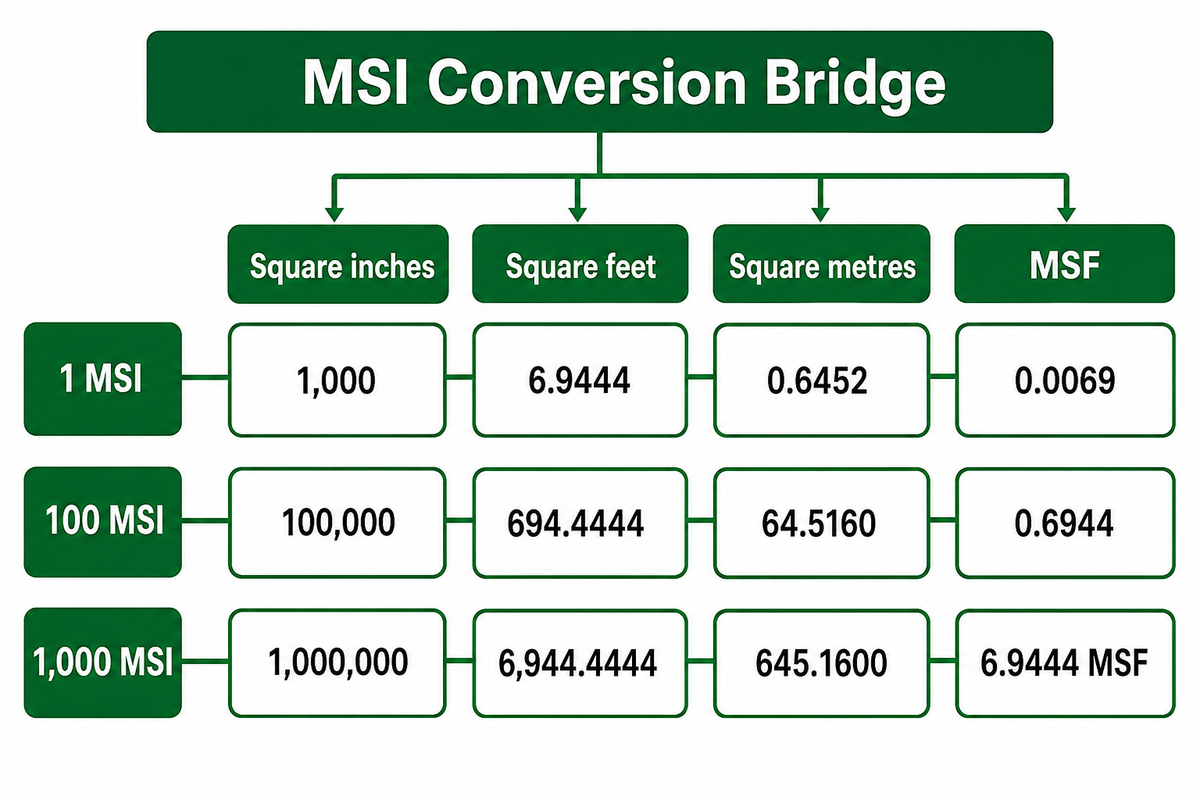
A supplier may quote MSI while a plant layout uses square feet and a European purchasing system stores square metres. A unit mismatch here can distort a price comparison by 144 times. The conversion should be mechanical, not estimated. The 10-row MSI Conversion Bridge keeps the exact area together in four common units.
Use square feet = MSI × 1,000 ÷ 144; square metres = MSI × 0.64516; and MSF = MSI ÷ 144. NIST Handbook 133 (2026), Appendix E, lists 1 square foot as 144 square inches and 1 square inch as 0.006944444 square feet. The metre result follows from the exact 25.4 mm inch definition. The MSF relationship is independently shown by Case Paper’s paper-industry calculator.
| MSI area class | Square inches | Square feet | Square metres | MSF |
|---|---|---|---|---|
| 1 | 1,000 | 6.9444 | 0.6452 | 0.0069 |
| 5 | 5,000 | 34.7222 | 3.2258 | 0.0347 |
| 10 | 10,000 | 69.4444 | 6.4516 | 0.0694 |
| 25 | 25,000 | 173.6111 | 16.1290 | 0.1736 |
| 50 | 50,000 | 347.2222 | 32.2580 | 0.3472 |
| 100 | 100,000 | 694.4444 | 64.5160 | 0.6944 |
| 250 | 250,000 | 1,736.1111 | 161.2900 | 1.7361 |
| 500 | 500,000 | 3,472.2222 | 322.5800 | 3.4722 |
| 1,000 | 1,000,000 | 6,944.4444 | 645.1600 | 6.9444 |
| 2,500 | 2,500,000 | 17,361.1111 | 1,612.9000 | 17.3611 |
These are area equivalents, not purchasing recommendations. If a system stores more decimal places, let it do so. A four-decimal display is readable for planning, but the underlying factor should stay exact through the calculation. That matters when a small unit price is multiplied across a large annual area.
Compare quotes with price per MSI
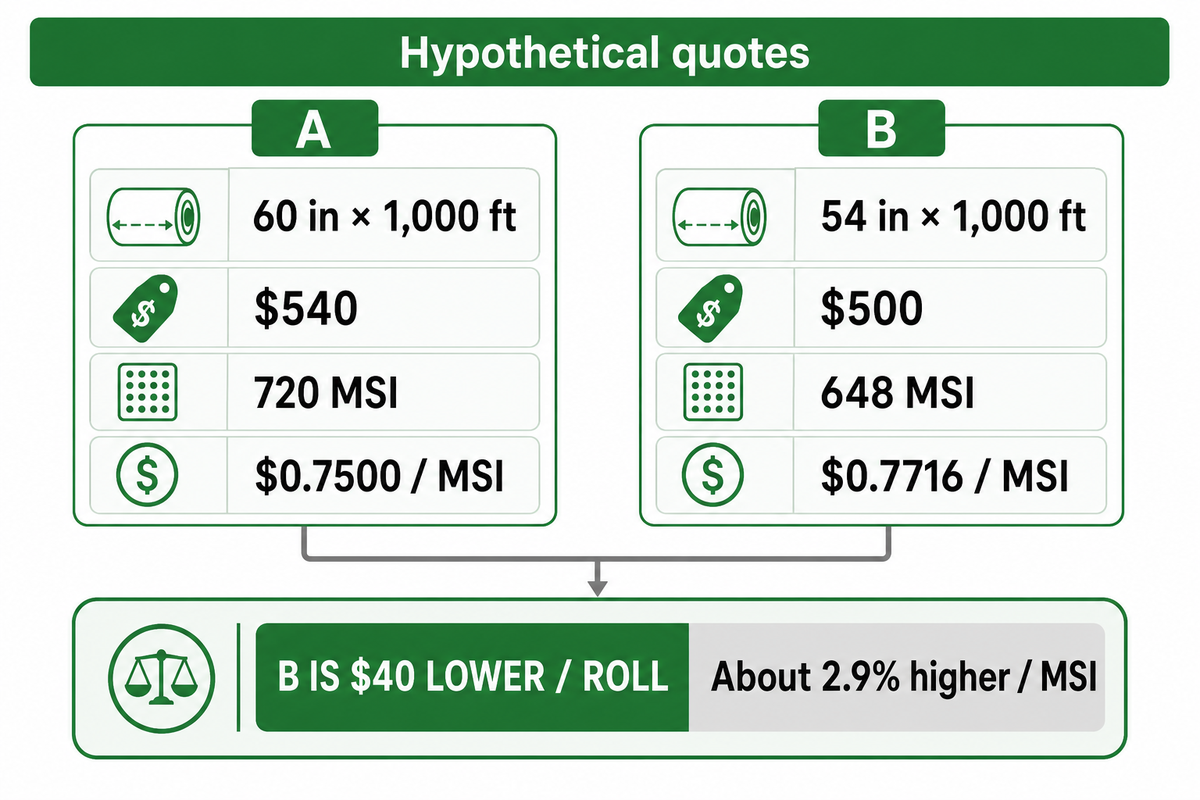
A lower roll price is not necessarily a lower material price. Roll widths and lengths often differ, so compare them only after dividing price by area. Because the NIST-defined inch fixes the area conversion, the arithmetic basis stays stable across suppliers. The Quote Normalization Bridge has two lines:
Price per MSI = roll price ÷ roll MSI
Comparable material cost = required MSI × price per MSI
Consider two hypothetical quotations. Quote A is a 60-inch × 1,000-foot roll at $540. It contains 720 MSI, so its price is $0.7500 per MSI. Quote B is a 54-inch × 1,000-foot roll at $500. It contains 648 MSI, so its price is $0.7716 per MSI. Quote B is $40 cheaper per roll but about 2.9% more expensive by area.
| Quote | Roll specification | Roll price | Roll MSI | Price/MSI |
|---|---|---|---|---|
| A | 60 in × 1,000 ft | $540 | 720 | $0.7500 |
| B | 54 in × 1,000 ft | $500 | 648 | $0.7716 |
That comparison is deliberately limited. Price per MSI says nothing about whether the narrower web produces fewer lanes, more trim, slower throughput or a different adhesive and liner construction. Procurement can use it to normalize the material line; production must still check the layout; quality must confirm the constructions are functionally equivalent. A cheap square inch that creates another roll change or more matrix is not a cheap finished label.
Never mix price bases. A price “per MSI” may refer to ordered area, shipped area or a seller’s standard sheet conversion. Ask whether freight, setup, slitting and waste are included. The examples above are arithmetic only, not market-price claims and not an indication of any supplier’s actual quote.
Ordered area is not usable area
Label converting creates edge trim and matrix waste, and a production run can also include setup material, splices and rejected output. FINAT’s CELAB material separates matrix generated by the label printer from liner generated later by the end user, so those streams should remain distinct in a usable-area record. None of those losses changes what an MSI is. They change how much of the ordered MSI becomes saleable product. Publishing one “typical waste percentage” would hide differences in label shape, gap, web width, die layout, press setup and actual operating history.
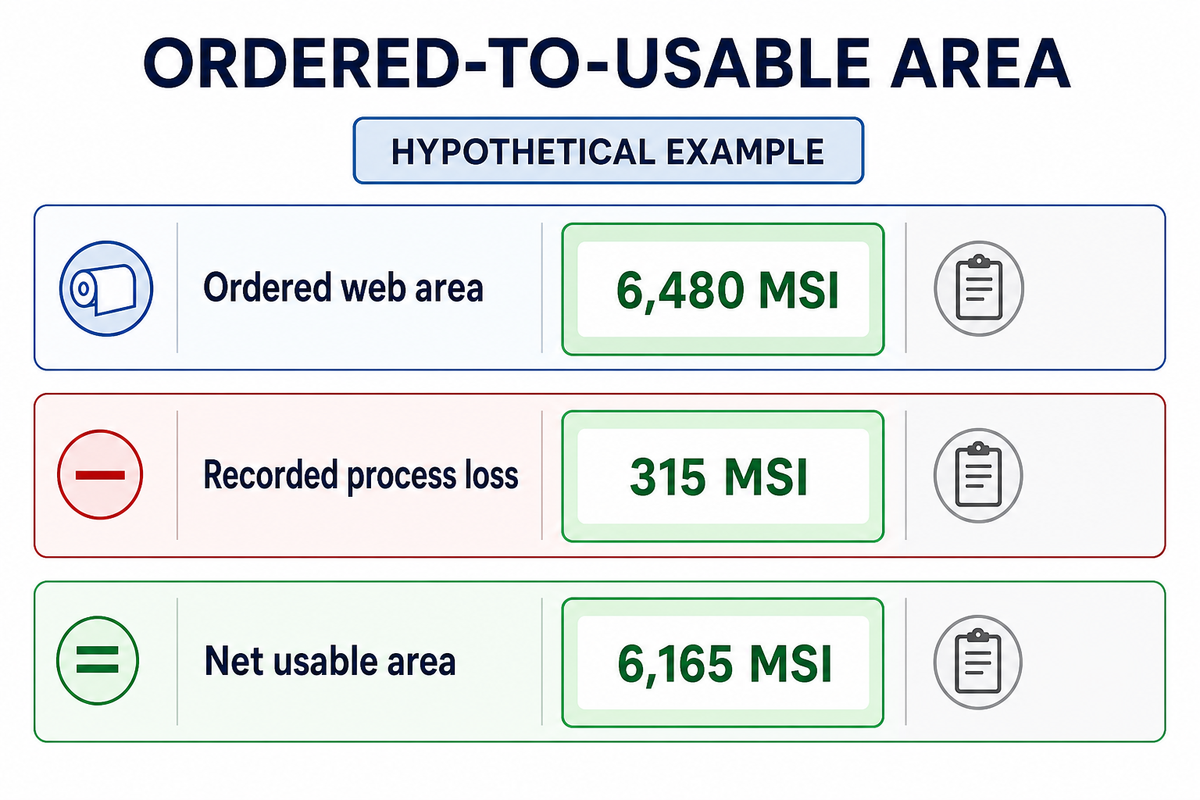
Use the Ordered-to-Usable Area Reconciliation to keep three numbers separate: ordered area, recorded process loss and net usable area. For example, suppose purchasing orders 6,480 MSI. The converter’s job record—not a generic benchmark—shows 315 MSI across edge trim, matrix, setup, splices and rejects. Net usable area is therefore 6,165 MSI. Realized material cost per usable MSI is total material cost divided by 6,165, not by 6,480.
| Ledger line | MSI | Evidence owner | Use |
|---|---|---|---|
| Ordered web area | 6,480 | Purchase order / supplier | Invoice reconciliation |
| Recorded process loss | 315 | Converter job record | Yield analysis |
| Net usable area | 6,165 | Calculated difference | Realized cost |
In this example, the numbers are hypothetical; the ledger design is the reusable part. Finance sees the cost basis, the plant manager sees where loss occurred, quality sees rejects separately from planned trim, and purchasing sees whether suppliers were compared on the same shipped-area basis. When the next job runs, replace 315 with measured data instead of carrying it forward as a percentage.
The supplier handoff that prevents unit mistakes
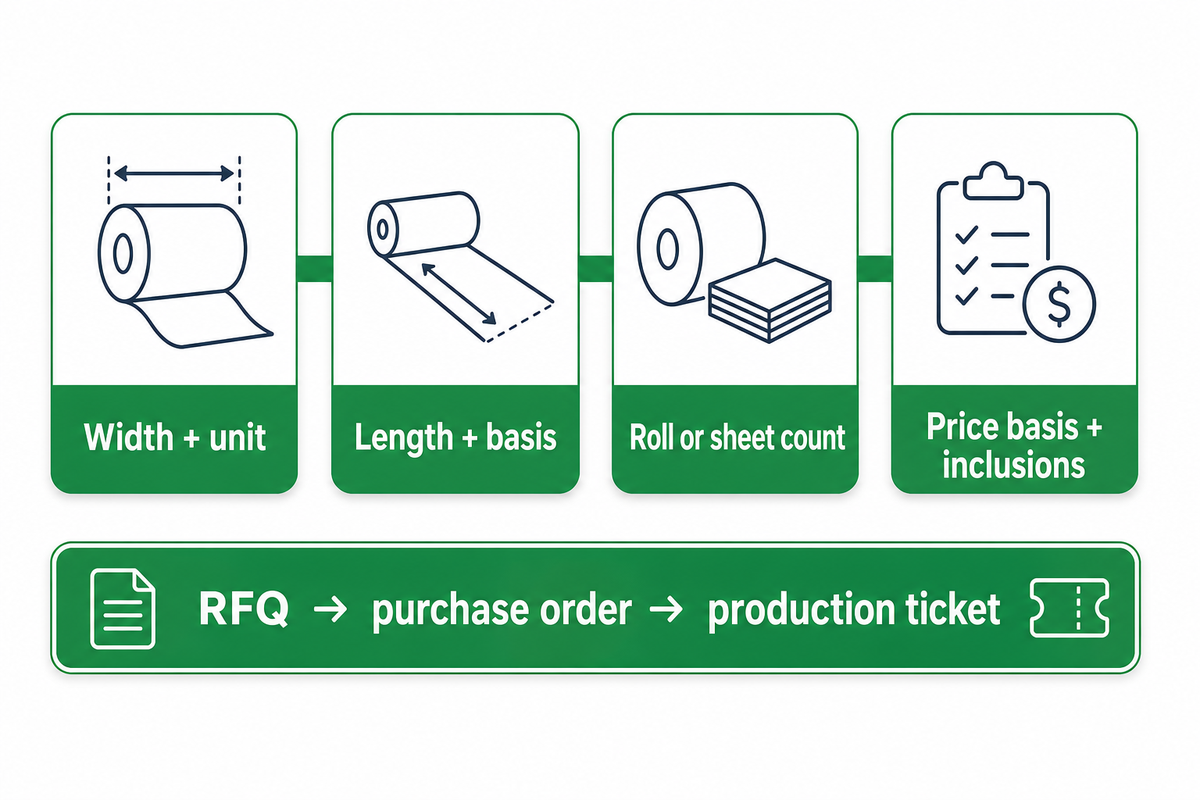
A reliable MSI result is easy to reproduce from a four-line handoff. Put these fields on the request for quotation, purchase order and production ticket:
- Web or sheet width, with unit. Write “54 in,” not “54.”
- Usable length or sheet length, with unit. State whether roll length includes leader and trailer.
- Roll or sheet quantity. Keep it beside the dimensions used in the calculation.
- Price and loss basis. Say whether the quote is per roll, per MSI or per finished piece and who accounts for trim, setup and rejects.
That handoff prevents three common failures: treating feet as inches, comparing different roll areas by roll price, and presenting ordered area as saleable yield. It also gives the supplier enough context to flag a web width that does not fit the planned layout.
Area is only one layer of the specification. Confirm the printable surface, adhesive and liner as a complete construction. Review the available self-adhesive paper constructions, then use the release liner selection guide to keep liner variables with the area calculation. Finally, check finished roll diameter, core outside diameter and total caliper against the unwind limit. These checks answer different questions, so no single calculator replaces the handoff.
If you send Guanma a sample or specification for review, include the same four fields plus the application surface, service conditions, printing process and winding direction. The result is a conversation about one defined material requirement, not a price comparison built on mismatched units. You can start through the contact page.
MSI Quote Sign-Off Protocol
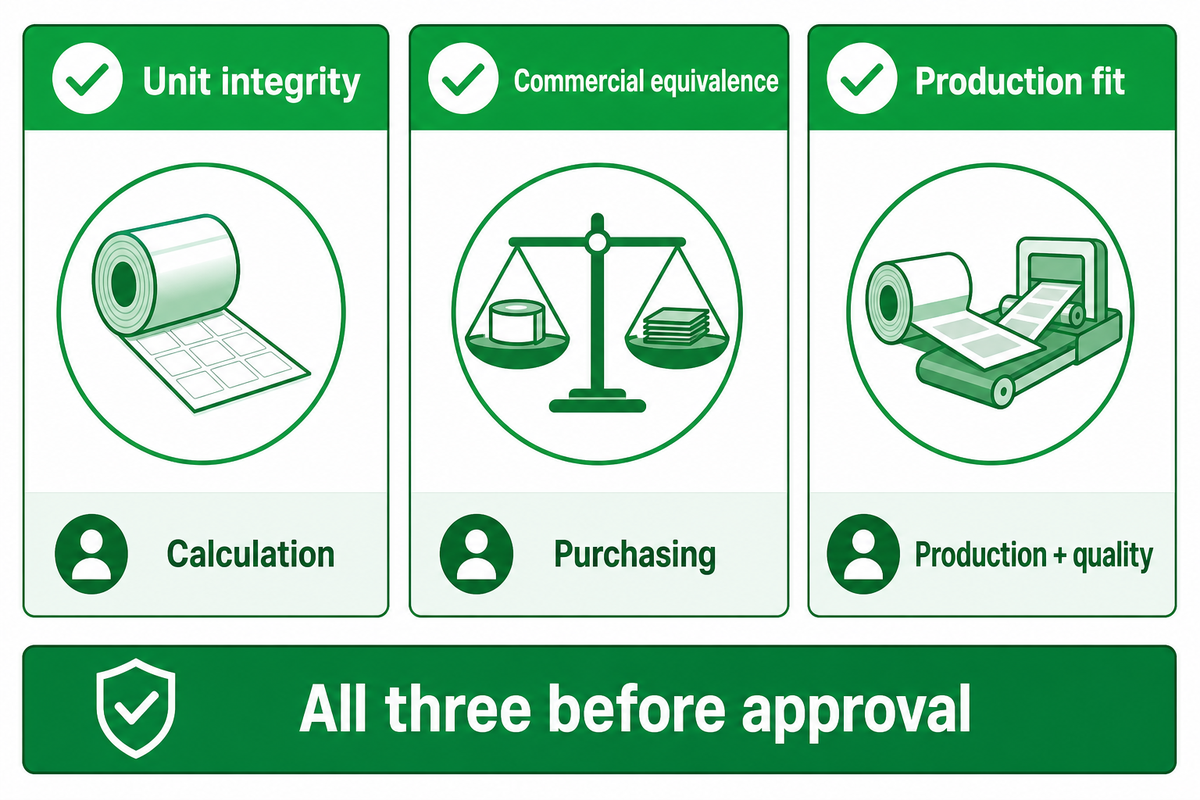
Before a buyer approves a project, run the MSI number through three checks: unit integrity, commercial equivalence and production fit. This sign-off protocol catches errors that a conversion calculator cannot see because they sit outside the arithmetic. It is particularly useful in the printing industry, where a packaging-material quote can move between roll, sheet, area and finished-piece bases in the same email thread.
Check 1: unit integrity. Rebuild the MSI from the written dimensions. Confirm that width is in inches, convert roll length from feet with the factor 12, and multiply by the actual roll count. For sheets, confirm whether the quoted count is per carton or total. Then convert the result back to square inches. If the reverse result does not reproduce width × length × quantity, stop: the project does not yet have a trustworthy area basis.
Check 2: commercial equivalence. Put each supplier quotation on the same price-per-MSI basis, but also list what the price includes. Two rows are not equivalent if one includes slitting and freight while the other is ex-works material only. Nor are two constructions equivalent because their dimensions match: facestock, adhesive, liner, caliper and release performance still belong on the comparison sheet. Finance owns the normalized arithmetic; purchasing owns the inclusion check.
Check 3: production fit. Ask the converter to place the proposed web width into the actual lane plan. Confirm edge trim, gutter, repeat length and winding direction. Use measured process history to plan setup and loss rather than importing the hypothetical ledger example from this article. Finally, calculate finished roll diameter from the chosen core and complete laminate caliper so the roll clears the unwind. Production owns this check, with quality confirming that any substitution preserves the approved construction.
Imagine Quote A wins the price-per-MSI comparison by 2%, but its web produces four lanes while Quote B produces five. The apparently cheaper area may require more press time, more roll changes and more ordered stock for the same finished quantity. Conversely, a wider roll that uses the press efficiently may exceed the current unwind diameter or lifting limit. Neither outcome makes the MSI calculation wrong. It shows why an area unit is the beginning of a decision record rather than the decision itself.
Keep the three approvals on one page: the calculation owner initials the dimensions and result; purchasing confirms the price basis and inclusions; production confirms layout and equipment fit. If a revision changes width, length, roll count or material construction, rerun the relevant check instead of editing only the total. That creates a simple audit trail and prevents an old MSI result from following a new specification into the purchase order.
Frequently asked questions
How do you calculate MSI?
Calculate total square inches and divide by 1,000. For roll stock measured in inches wide and feet long, use width × length × 12 × number of rolls ÷ 1,000. For sheets measured entirely in inches, use width × length × sheet count ÷ 1,000. Keep the original dimensions beside the answer and round only the final result. If you already know the area in square inches, enter it in the calculator at the top of this page. On a purchase order, also write whether the result represents ordered or usable area and whether the price basis includes slitting, freight or process loss.
What is 1 MSI?
One MSI is exactly 1,000 square inches of surface area. It is equivalent to 6.944444 square feet or 0.64516 square metres. For scale, 10 MSI is 10,000 in², 69.4444 ft² or 6.4516 m², while 500 MSI is 500,000 in², 3,472.2222 ft² or 322.58 m². A 60 in × 1,000 ft roll contains 720 MSI because its length first becomes 12,000 in. MSI measures area only; it does not specify material thickness, weight, composition or finished-label quantity.
What is the difference between MSI and MSF?
MSI means one thousand square inches. MSF means one thousand square feet. Because every square foot contains 144 square inches, one MSF equals 144 MSI. Convert MSI to MSF by dividing by 144; convert MSF to MSI by multiplying by 144. Always write the unit in full on a quote because the abbreviations are easy to transpose.
How do I calculate price per MSI?
First calculate the area of the roll or sheet order in MSI. Then divide its material price by that MSI total. A $540 roll containing 720 MSI costs $0.75 per MSI. Use that normalized number only when the compared constructions and commercial inclusions are equivalent. Freight, setup, slitting, liner choice and process yield can change delivered cost without changing the area unit.
Does MSI include printing waste?
No. MSI is simply an area measurement. Ordered MSI may include material that later becomes edge trim, matrix, setup stock, splice loss or rejects. Record those losses separately and calculate net usable MSI from the converter’s actual job data rather than a universal percentage.
Can I convert MSI to square metres?
Yes. Multiply MSI by 0.64516 to obtain square metres. For example, 100 MSI equals 64.516 m². The factor follows from the exact definition of one inch as 25.4 millimetres, so it is a unit conversion rather than an industry estimate.
References & Sources
- NIST, SI Units – Length — exact inch definition used for the metric-area derivation. https://www.nist.gov/pml/owm/si-units-length
- NIST, Guide to the SI, Appendix B.9 — square-inch to square-metre conversion factor. https://www.nist.gov/pml/special-publication-811/nist-guide-si-appendix-b-conversion-factors/nist-guide-si-appendix-b9
- NIST, Handbook 133 (2026), Appendix E — authoritative square-inch and square-foot conversion table. https://www.nist.gov/document/2026-hb-133-appendix-e
- MGX Digital, MSI, Feet and Sheets Calculator — industry definition plus roll and sheet calculation methods. https://mgxdigital.com/blog/msi-feet-and-sheets/
- Evans Evco, MSI Calculator — roll calculation method and worked example. https://evansevco.com/resource-center/msi-calculator/
- Case Paper, MSI/MSF Calculator — MSI definition and MSI-to-MSF relationship. https://casepaper.com/resources/paper-price-calculators/calculators-msi-msf/
- Lundberg Tech, Label Converting Matrix Removal — process context for matrix and trim waste. https://lundbergtech.com/your-process/label-converting-matrix-removal/
- FINAT / CELAB, Circular Economy for Self-Adhesive Label Materials — industry distinction between matrix generated by label printers and liner generated by end users. https://www.finat.com/documents/700/celab-presentation-final.pdf
All supplier prices and process-loss figures in the examples are hypothetical. Replace them with the values from your quotation and production record.