Get in Touch with Guanma

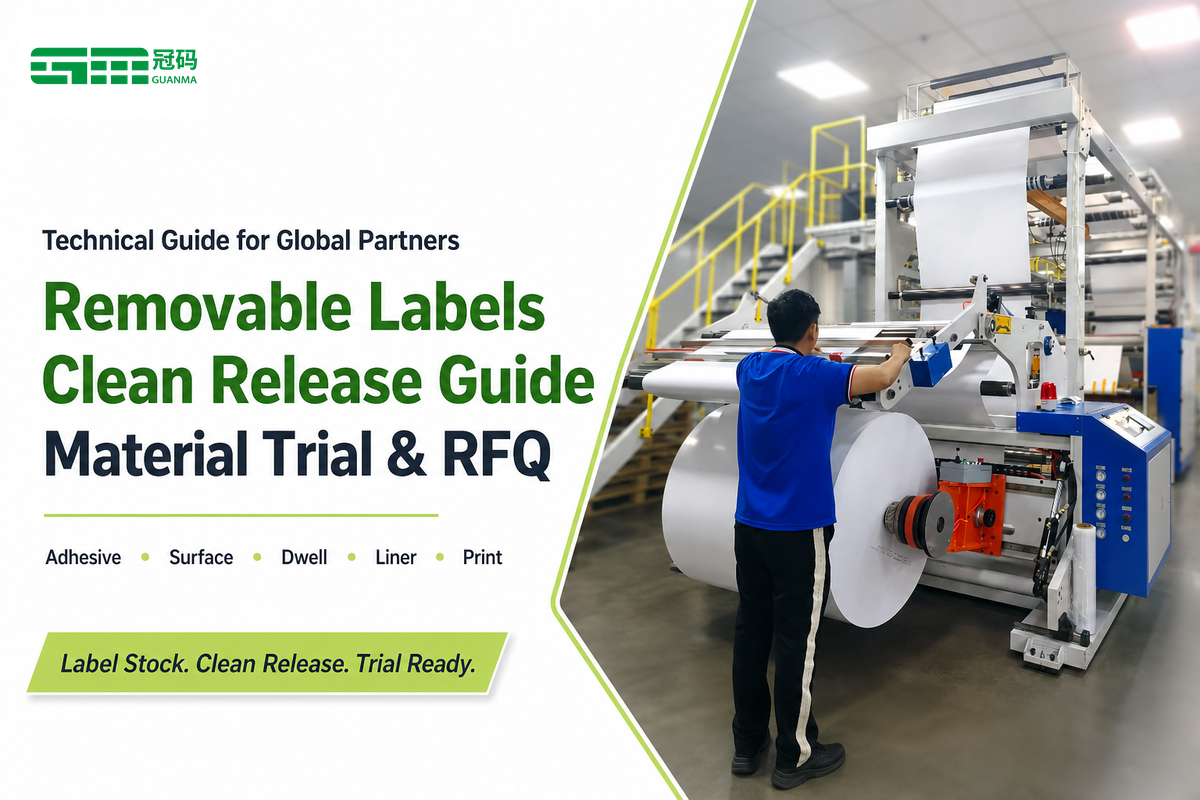
Removable labels are pressure-sensitive label constructions intended for a defined use period and a specified removal event.
Updated July 2026
Quick Specs
| Primary use | Temporary identification, promotions, inventory cycles, and reusable-container workflows |
| Decision tool | 7-Field Clean-Removal Trial Card |
| Key variables | Substrate, surface condition, dwell, temperature, removal action, print requirement, acceptance criterion |
| Scope boundary | Not a guide for safety-critical, hazardous-chemical, mandatory regulatory-mark, or food-contact adhesive compliance decisions |
Removable Labels aren’t simply low-tack stickers. In a B2B setting, they’re pressure-sensitive label constructions selected to hold through a defined handling period and then release under stated conditions. Ask instead: “Does this exact construction remove acceptably from this substrate, after this dwell time, in this environment, using this removal action?”
Direct answer: Removable labels are pressure-sensitive labels designed for temporary use and a controlled removal event. Clean release is substrate-, dwell-, and environment-dependent, so it must be validated on the actual package or surface before commercial use.
Key takeaways
- “Removable” is a target use condition, not a residue-free guarantee for every surface.
- Peel-force tests are measurement tools; they don’t certify that a label is removable or compliant.
- Clean hand removal, recyclability, barcode readability, and food-contact approval are separate performance questions.
- This complete trial brief gives procurement, QA, and the material supplier the same definition of success.
What Are Removable Labels, and What Does Clean Removal Actually Mean?
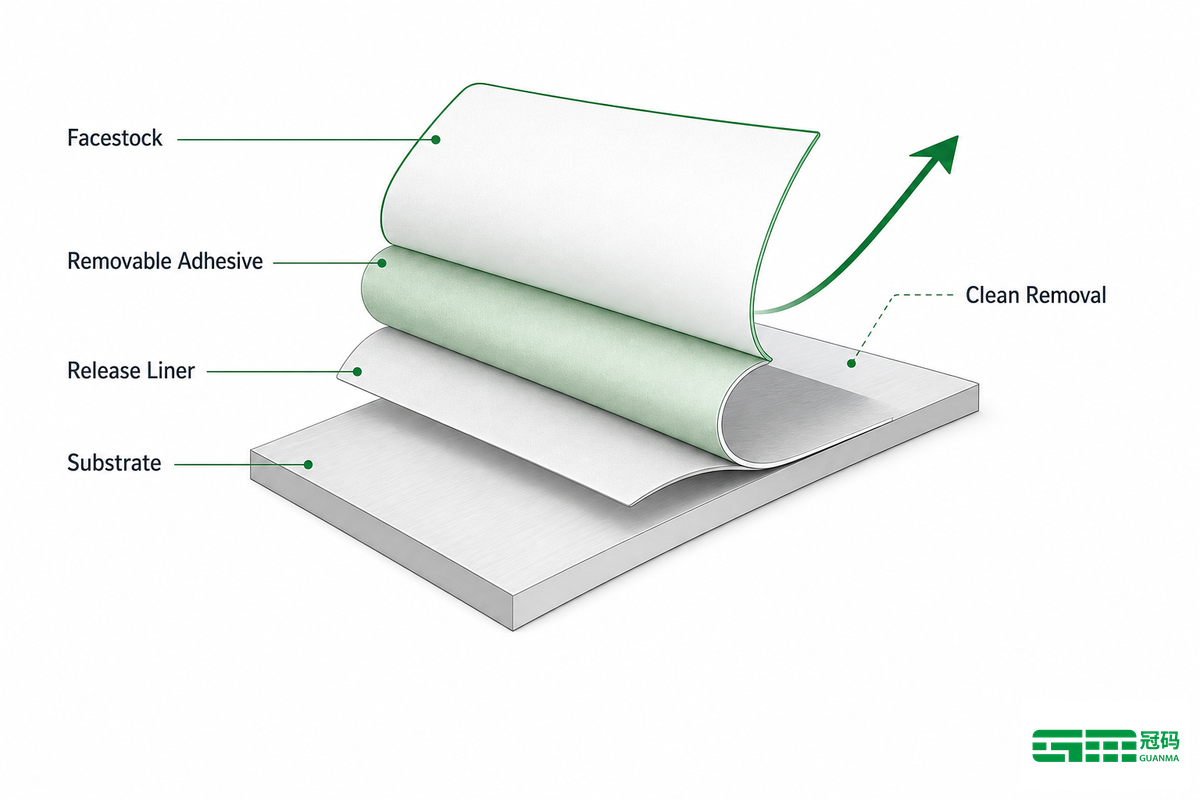
For a packaging production application, the risk is approving a label from a generic description because surface behavior changes the result. With Guanma, the actual substrate and a sample brief can frame the material trial; 20-minute and 24-hour observations make the handling window explicit rather than assumed.
A removable label is a label construction with a pressure-sensitive adhesive intended to maintain useful adhesion for a planned period, then peel away with an acceptable result on a specified surface. “Clean” normally means no unacceptable adhesive transfer, surface marking, or damage under the agreed test conditions; it doesn’t mean the same result will occur on every plastic, coating, paperboard, or glass container.
NIST’s peel-test research is a useful reminder that pressure-sensitive adhesive behavior changes with variables such as surface energy, roughness, temperature, and peel rate. That’s why a generic label description is only the starting point. Buyers needing temporary pricing labels on glass may need a different construction from buyers identifying polyethylene totes, coated cartons, or matte-painted equipment. If the team is still deciding between pressure-sensitive and wet-glue formats, compare the label-system choices before treating removability as an adhesive-only issue: pressure-sensitive labels versus glue-applied labels.
What are removable labels used for?
Typical uses include promotional pricing, short inventory cycles, temporary product labeling, reusable containers, file or asset identification, and placement labels that should disappear after a process step. They’re a poor default when the label must remain legible for the full life of a hazardous product, a regulated mark, or a long-service identification task. In those cases, retention requirements come before clean release.
💡 Buyer test: Ask for the required label life and the required removal event in the same sentence. If either answer is vague, the material brief is not ready.
The Clean-Release Equation: Adhesive, Surface, Dwell, Temperature, and Removal Action
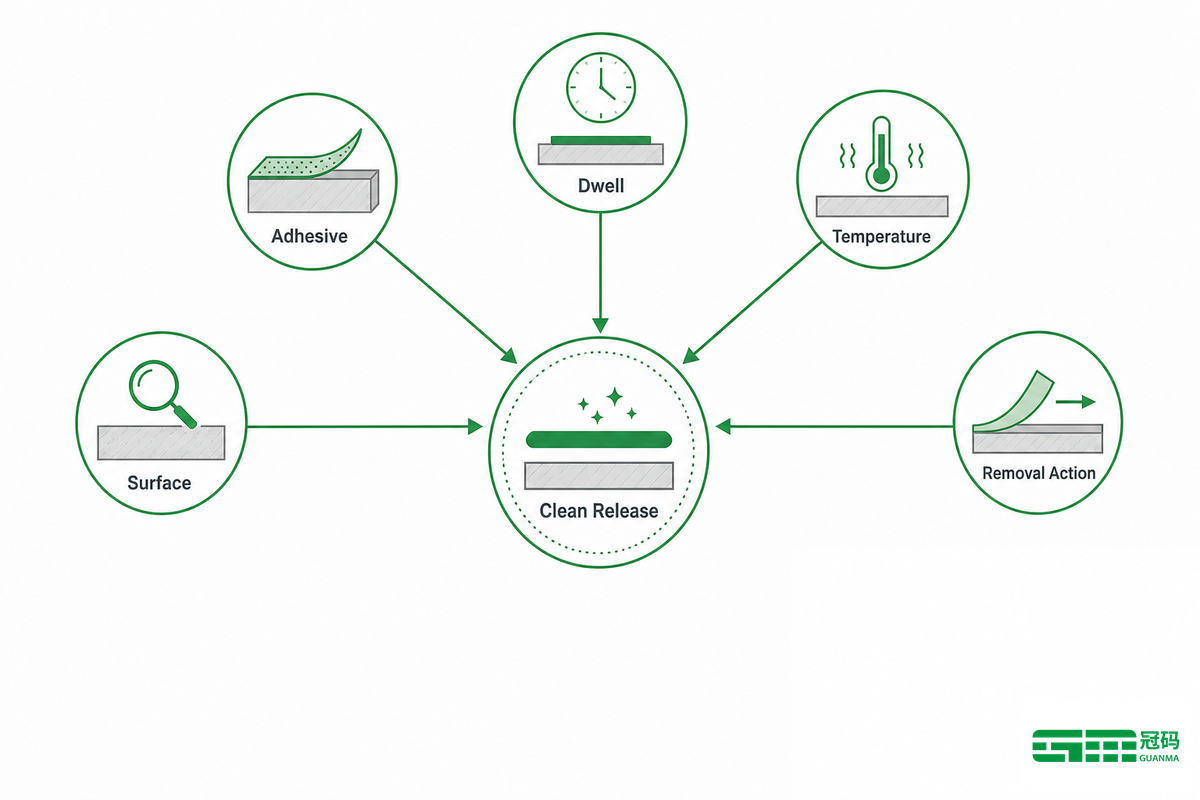
In a production application, residue risk and edge-lift risk are linked because the surface, dwell, and removal action interact. With Guanma, those conditions can be translated into a material sample brief, with 20-minute and 24-hour checkpoints used to expose a short-test mistake before a purchasing decision.
Clean release is the combined result of adhesive chemistry, substrate surface, dwell time, temperature and moisture exposure, and the way the label is removed. Changing one term can change the outcome even when the printed label look identical.
One common specification error is to request a “removable adhesive” without defining the surface or the removal condition. Different glass bottles, powder-coated panels, and low-surface-energy PP containers don’t present the same wet-out and peel behavior. Surface oils, cleaners, dust, texture, heat, cold storage, and extended dwell can all change the balance between adhesive cohesion and adhesion to the substrate.
| Variable | What to record | Risk if omitted |
|---|---|---|
| Adhesive | Requested behavior and application purpose | A general-purpose grade is tested for the wrong job |
| Substrate | Material, coating, texture, and contamination state | Trial result cannot be transferred to the production surface |
| Dwell | Target removal window and maximum hold period | A short test hides long-hold residue risk |
| Environment | Application and storage temperature, humidity, cleaners, handling | Lab result does not represent the field condition |
| Removal action | Peel direction, speed, operator or automated removal | Different removal action gives a different result |
Key takeaway: Treat “removable” as a conditional performance request, not as an adhesive category that answers every risk by itself.
Run the 5-Surface Check Before Choosing a Removable Label
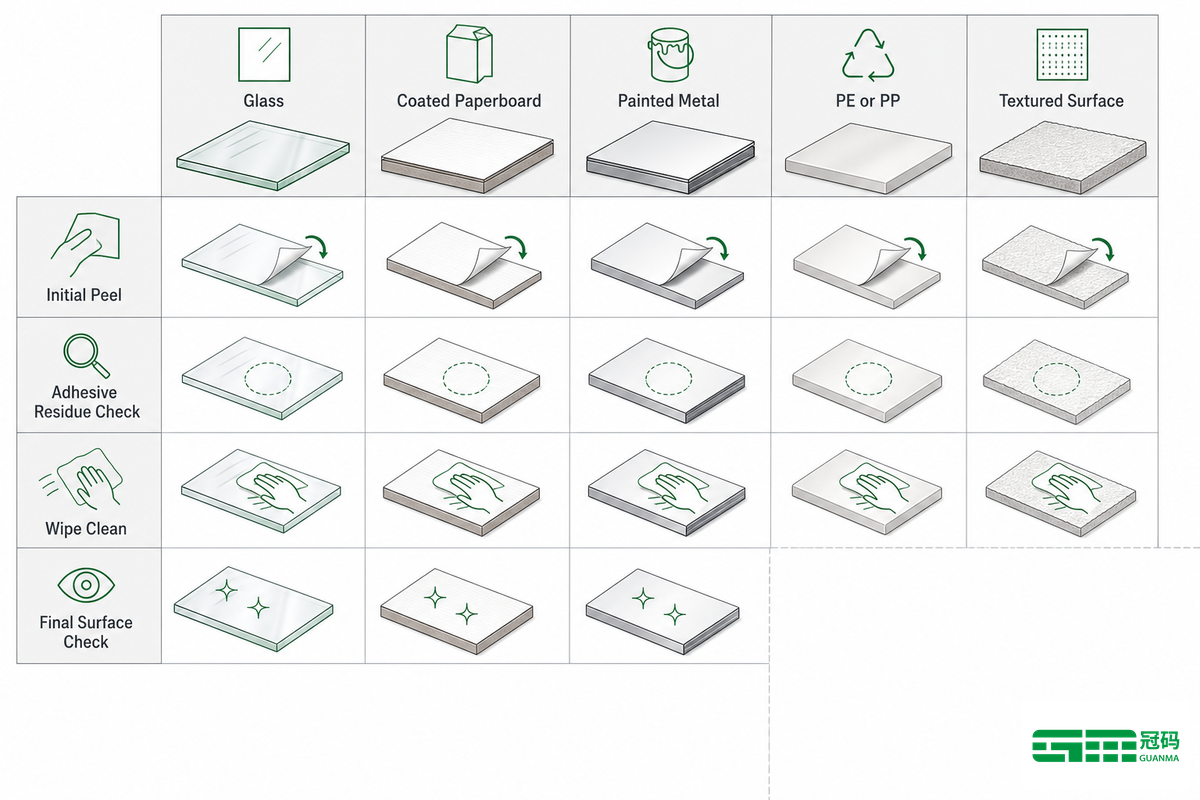
For a multi-surface production application, the risk is treating glass, coated paperboard, and PP as one job because the same artwork is used. With Guanma, sample panels can be compared across the 20-minute and 24-hour observations, so a surface-specific failure is visible before conversion.
The substrate is part of the label specification. Before choosing a removable label, classify the actual surface, its coating or texture, its cleanliness, the temperature at application, and the condition after the intended dwell period.
| Surface family | First question | Trial focus |
|---|---|---|
| Glass | Is the bottle clean, coated, chilled, or repeatedly washed? | Residue, label curl, and container reuse |
| Coated paperboard | Will removal disturb fibers or the print coating? | Fiber lift and visible marking |
| Painted metal | Which paint system and cleaning process are present? | Paint change, residue, and handling exposure |
| PE or PP plastic | Is it a low-surface-energy or textured grade? | Edge lift, repositioning need, and removal result |
| Textured or irregular surfaces | Can the adhesive contact the surface consistently? | Contact uniformity and localized transfer |
A composite example illustrates the point. One contract packer may use the same artwork on a glass bottle and a PP cap. Although the graphics look consistent, the substrate and cleaning history are different. Rather than treating the two as one label job, QA should give each surface its own panel in the trial record and approve the results separately.
Removable vs. Repositionable vs. Permanent: Choose by the Job, Not the Word on the Datasheet
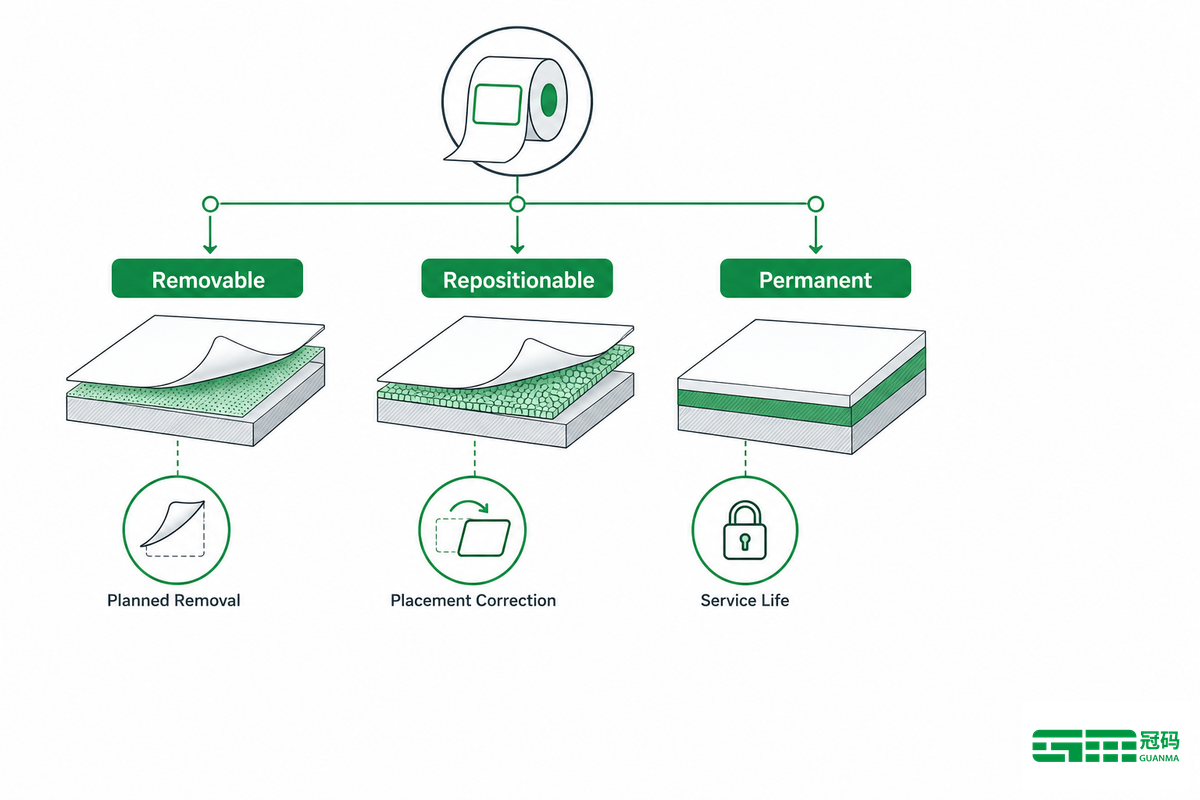
Production teams face a selection risk when a placement-correction application is described as a removal-after-use application. With Guanma, the handling sequence can be reviewed because a 20-minute placement observation and a 24-hour removal observation answer different material questions.
A removable label targets a planned clean-removal event after use; a repositionable label support placement correction during application; a permanent label prioritizes retained identification. They shouldn’t be treated as interchangeable descriptions.
✔ When removable is a fit
A promotion ends, a container enters a reuse loop, or temporary identification must be removed under a stated condition.
⚠ When it is not
The label must remain through its service life, carries a required safety or regulatory function, or needs a separate food-contact or traceability review.
For example, a plant may need a repositionable placement label so an operator can correct alignment before final application. That’s different from a temporary inventory label removed at the end of a count cycle. First ask about open placement time; then ask about the removal result after dwell.
Key takeaway: Define the handling sequence before comparing adhesive names. That sequence decides whether you need repositioning, planned removal, or long-term retention.
Selecting a Removable Adhesive by Temperature, Dwell Time, and Removal Condition
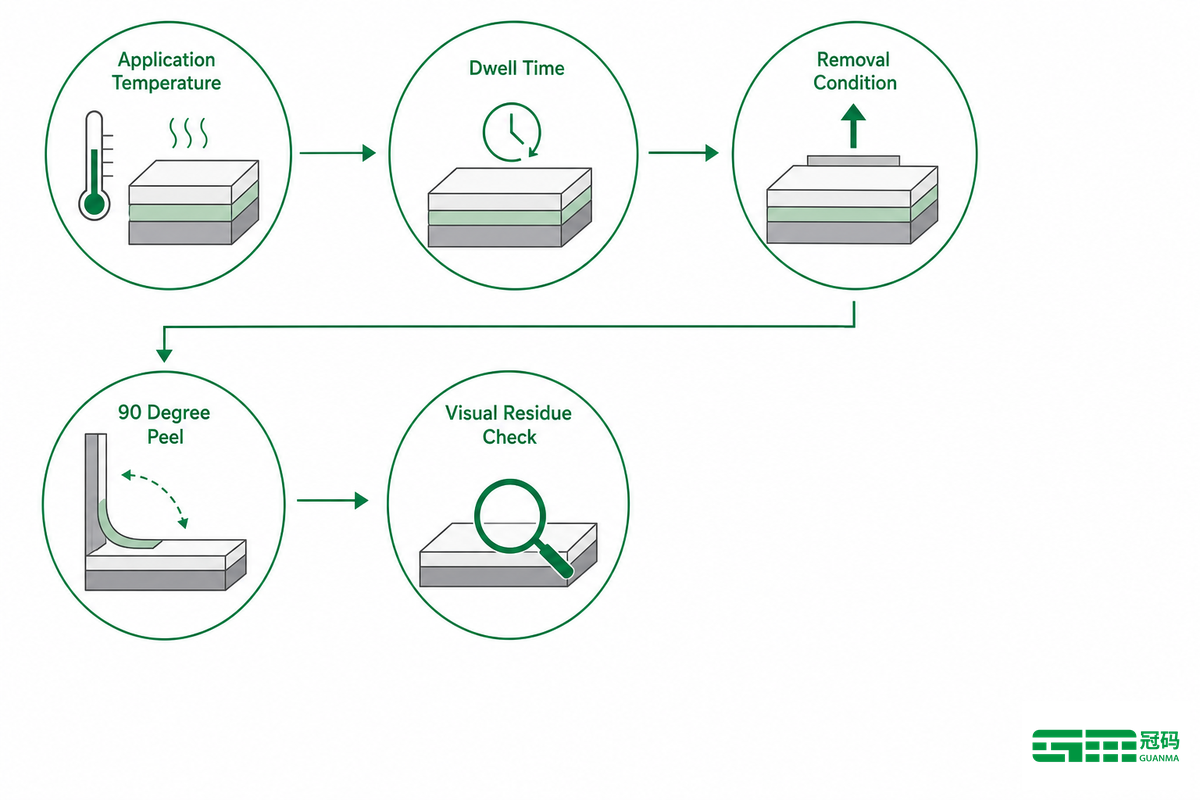
In a warehouse or plant application, the risk is using one peel result as a universal answer because temperature and dwell can change the bond. With Guanma, a material sample can be arranged around the actual condition, with 20-minute and 24-hour checks that reveal whether the stated removal window is realistic.
A removable adhesive brief should state where the label is applied, how long it stays, what it encounters, and what acceptable removal looks like. Peel-force alone doesn’t establish clean removal.
ASTM D6252 is useful because it frames 90-degree peel adhesion as a quality-assurance measurement for pressure-sensitive label stocks. It can compare bond behavior and support repeatable testing, including on representative substrates. It does not define a universal removable-versus-permanent threshold, and it does not replace a visible residue inspection.
📐 Engineering Note
Use a stated peel geometry for comparison, then add the real substrate, dwell, conditioning, and visual acceptance check. ASTM D6252 describes a 90° peel measurement for pressure-sensitive label stocks; it measures adhesion force, not a clean-release certificate.
Consider a second composite scenario: a warehouse wants temporary equipment identification after maintenance. After an inspection window, the label may be removed, but the area may be wiped with a cleaner and handled by gloved operators. The material brief should therefore name the cleaned substrate, inspection window, removal method, and whether any residue is acceptable, not merely ask for a “low-tack” label.
Facestock, Release Liner, and Printing: The Construction Choices Behind a Usable Removable Label
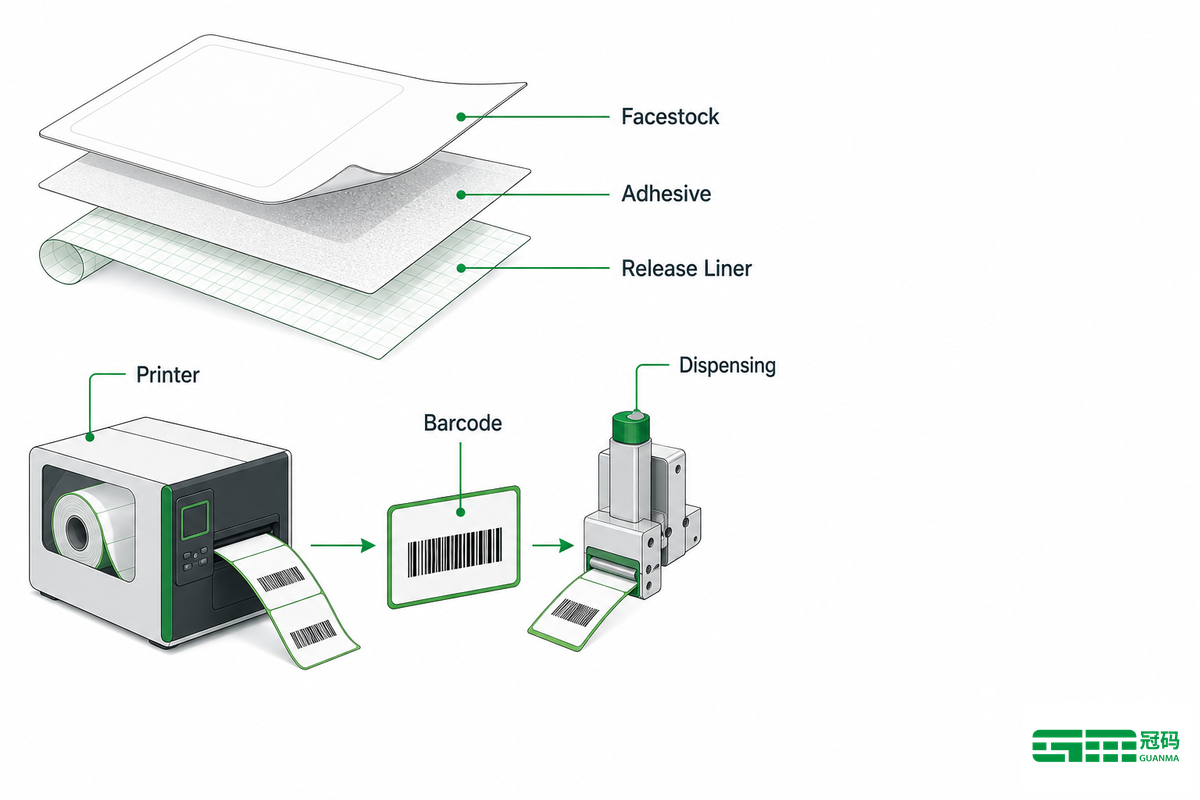
For a converting and printing application, the risk is approving clean removal while a liner, facestock, or barcode requirement fails later. With Guanma, the material sample can align with the printer and dispensing route because 20-minute and 24-hour checks do not replace print or scan verification.
A usable removable label is a construction, not an adhesive alone. Facestock, adhesive, release liner, coating, printer technology, ink system, and any barcode requirement must be checked together.
Facestock changes handling, opacity, print appearance, stiffness, and environmental fit. Release liner affects conversion and dispensing. Print and coating choices affect rub resistance, image quality, and scanner readability. These are independent axes from clean removal: a label may peel cleanly yet fail a barcode verification, or print well while being unsuitable for the intended substrate.
Can removable labels be printed with inkjet or laser printers?
Some removable constructions can suit inkjet or laser printing, but compatibility is construction-specific. Identify the printer technology, heat path, ink or toner system, label size and shape, application method, and any barcode or variable-data need. Include blank-stock requirements and final brand approval. Use the actual print and scan test; clean peeling alone does not prove print quality.
For a broader construction primer, see Guanma’s guide to label facestock selection, then keep the removable-label trial focused on the actual surface and removal event.
The 7-Field Clean-Removal Trial Card
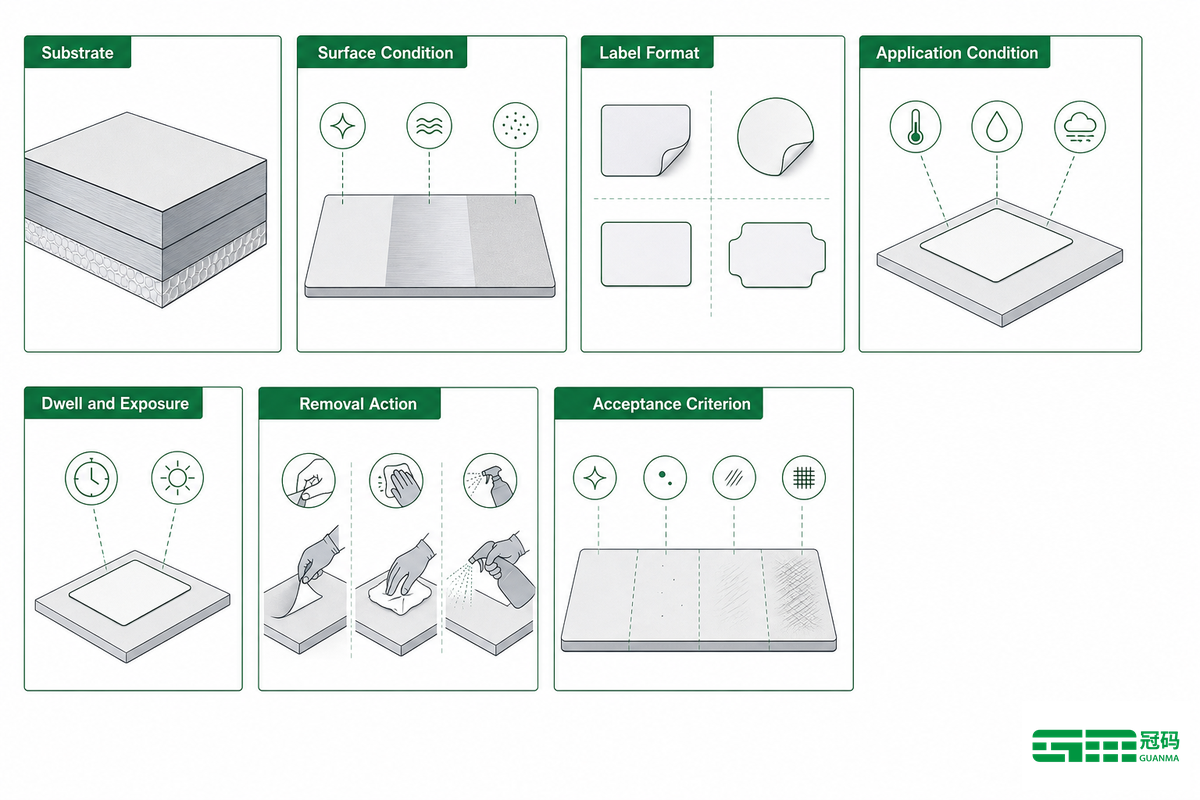
For a procurement application, the hidden risk is an incomplete request because each supplier then tests a different condition. Guanma can use the completed trial card to prepare a comparable material sample, while QA owns the pass/fail decision.
This 7-Field Clean-Removal Trial Card turns a vague sample request into a reproducible validation brief. It gives procurement, QA, and the material supplier one shared definition of the substrate, exposure, removal action, and pass/fail observation.
| Field | What the buyer supplies | Who uses it |
|---|---|---|
| 1. Substrate | Actual material, coating, texture, and an untreated sample where possible | QA and materials team |
| 2. Surface condition | Cleaner, oil, moisture, handling, or contamination conditions | Plant and QA |
| 3. Label format | Facestock preference, size, shape, artwork, print method, barcode need | Procurement and converting |
| 4. Application condition | Application temperature, pressure, line method, and target surface | Plant and QA |
| 5. Dwell and exposure | Planned hold period, storage, humidity, cleaning, abrasion, or handling | QA |
| 6. Removal action | Peel direction, operator action, speed description, or removal equipment | Plant |
| 7. Acceptance criterion | What counts as pass: residue, marking, edge lift, print/scanning result, or required retest | QA and procurement |
“The useful sample is the one that recreates the buyer’s surface and handling condition, not the one that looks best on a generic panel.”
Guanma can combine PET, PP synthetic paper, or coated-paper facestocks with hot-melt, water-based, or acrylic adhesive systems and different liners. Liner selection also affects the release behavior of the construction, so review the available release paper and liner options. That flexibility is valuable only when the trial card describes the application precisely enough to reproduce.
How to Test for Residue, Edge Lift, and Adhesive Transfer Without Fooling Yourself
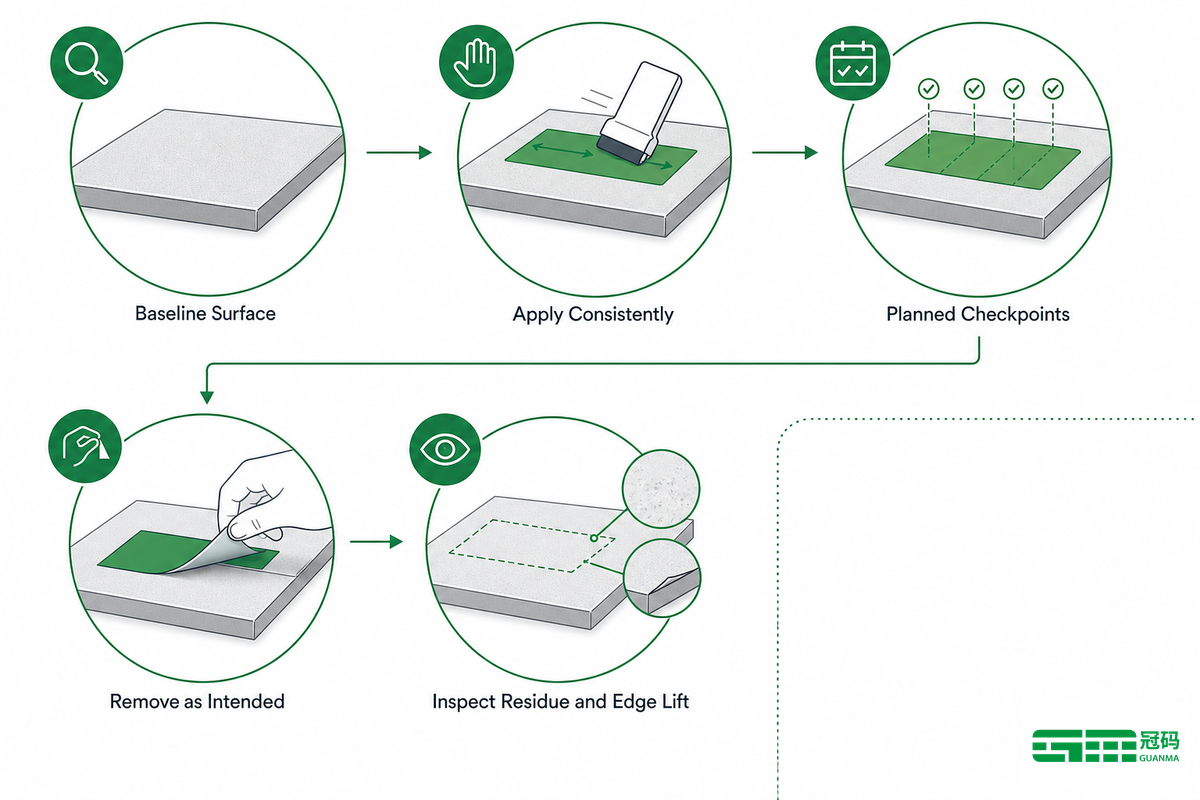
In a real production application, inconsistent removal is a risk because one operator can hide a failure that another exposes. Guanma can supply the material sample, while the buyer records the substrate, exposure, and removal action for a repeatable QA comparison.
A meaningful removable-label test compares defined samples under defined conditions, then checks both adhesion during use and the condition of the surface after removal. One quick peel from a convenient panel isn’t a reliable purchasing result.
- Start with a baseline: photograph or record the untreated substrate and surface condition.
- Apply consistently: keep application approach and pressure description consistent across samples.
- Use planned checkpoints: plan an early observation and a later scheduled observation; the exact schedule should match the use case.
- Remove as intended: record the action rather than letting each operator invent a different peel method.
- Inspect both outcomes: check edge lift before removal and residue, transfer, marking, print condition, and scanning requirement after removal.
ASTM conditioning guidance is also useful as a limitation: controlled conditions improve comparison, but they do not duplicate every field environment. If the actual application includes cleaning chemicals, refrigeration, outdoor exposure, or unusual handling, write that into the sample plan rather than assuming a standard panel answers it.
Where a laboratory method is part of the trial, record its geometry and rate instead of writing only “peel test.” FINAT identifies FTM 1 as 180° at 300 mm/min and FTM 2 as 90° at 300 mm/min; it also lists FTM 4 across 10–300 m/min and FTM 10 at 300 mm/min. In the supplier handoff, copy the applicable FTM 1 geometry of 180°, its 300 mm/min rate, or the FTM 2 geometry of 90° exactly as used. These are method conditions, not universal clean-release thresholds. FINAT Test Methods
| Test type | Condition to record | Source context | What it does not prove |
|---|---|---|---|
| Peel geometry | 180° | FINAT FTM 1 | Residue-free removal on every surface |
| Peel rate | 300 mm/min | FINAT FTM 1 | Field handling speed |
| Peel geometry | 90° | FINAT FTM 2 | A universal adhesive class |
| Peel rate | 300 mm/min | FINAT FTM 2 | Printer or barcode suitability |
| Release-speed range | 10–300 m/min | FINAT FTM 4 | The buyer’s dispensing result |
| Liner-release rate | 300 mm/min | FINAT FTM 10 | Label-to-substrate clean removal |
| Tape peel method | 180° | ASTM D3330 Test Method A | A complete label qualification |
| Tape peel method | 90° | ASTM D3330 Test Method F | A field-use guarantee |
| Label-stock peel | 90° | ASTM D6252 | A clean-release certificate |
| Buyer acceptance | Project-specific | Trial card and QA sign-off | A transferable result without the real substrate |
When Removable Is the Wrong Requirement
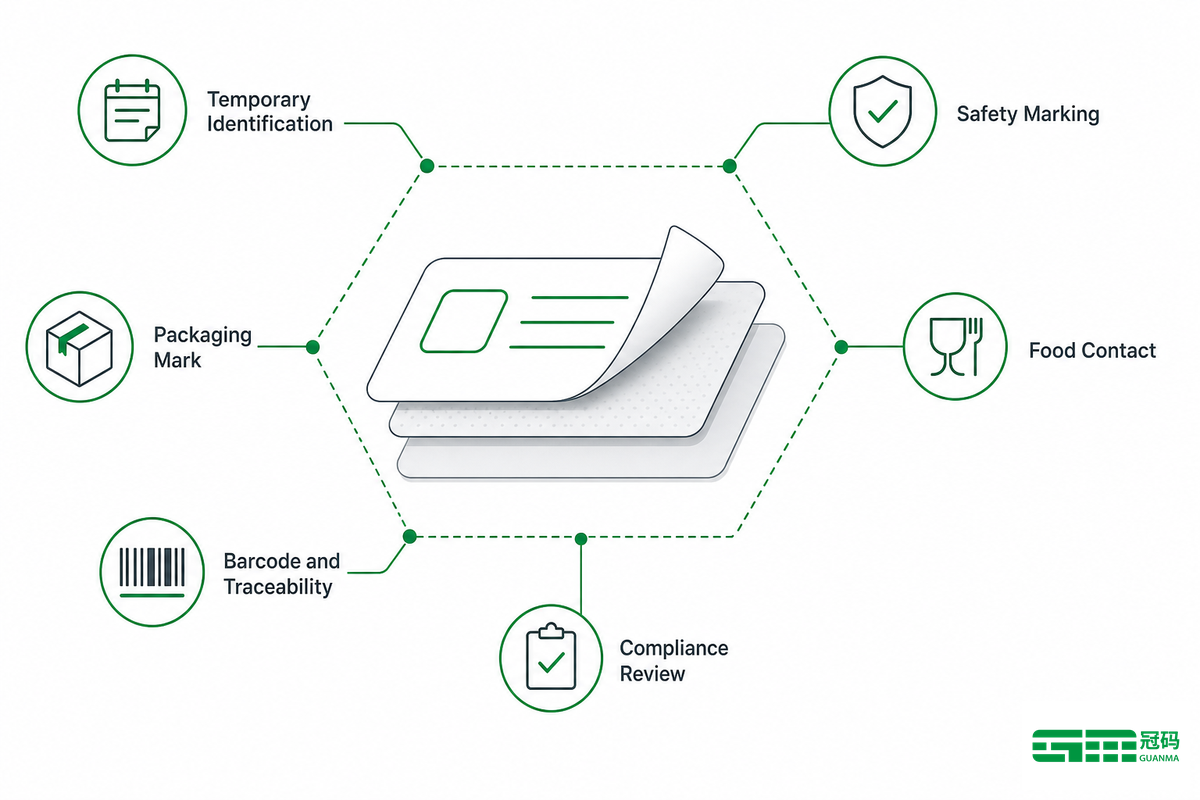
For safety, regulatory, or traceability applications, the risk is specifying planned removal where retained legibility is the governing requirement. Guanma can discuss material options after the responsible compliance owner defines the applicable requirement and validation route. For packaging-specific context, review the official EU packaging regulation text alongside the rules for the actual market.
Don’t use a temporary-label selection guide as the decision rule for safety-critical, hazardous-chemical, mandatory regulatory-mark, or food-contact adhesive compliance applications. Those cases require their own retention, legibility, material-safety, and regulatory review.
| Use case | Why this guide is insufficient | Next owner |
|---|---|---|
| Safety-critical or hazardous-product marking | Retention and legibility may control the decision | Safety and regulatory team |
| Mandatory packaging marks | Jurisdiction-specific packaging rules can govern marking and attachment | Packaging compliance owner |
| Food-contact or indirect-contact packaging | Adhesive-substance and migration questions are separate from peel behavior | Regulatory and food-packaging specialist |
| Barcode, traceability, or machine-readable data | Read quality and durability need their own verification | QA and data/operations owner |
This boundary increase, rather than weakens, the value of a removable-label guide. It tells a buyer when a material trial is the right next step and when a different compliance path must lead.
When a Standard Label Is Not Enough: Preparing a Custom Material Request
For an industrial application, the commercial risk is comparing named materials rather than comparable trial conditions. Guanma can prepare a custom material discussion when procurement supplies the actual substrate, converting route, QA acceptance definition, expected trial quantity, and the person responsible for sign-off.
Ask for a custom label construction when the substrate, removal window, exposure, printing process, or acceptance criterion can’t be represented by an off-the-shelf label description. Send the completed trial card, actual substrate where possible, a written pass/fail definition, expected trial quantity, and the relevant converter format—not just artwork and size.
For an industrial request, include the actual surface, sample panels if available, label format, printer or press, line condition, dwell, removal method, and visible pass/fail definition. For ordering, identify the trial quantity, converter format, and the person who signs off the result. This also create a cleaner conversation between procurement and QA: procurement can compare offers against the same trial brief instead of comparing only material names.
Guanma supplies material combinations built from PET, PP synthetic paper, and coated paper with hot-melt, water-based, and acrylic adhesive options, plus liner choices. Once the trial card is complete, review Guanma’s substrate-matched removable-label material options for the commercial sample discussion.
You may also compare the adhesive families through Guanma’s hot-melt, water-based, and acrylic adhesive guide and use this label-stock buying guide to organize the upstream material questions before finalizing the brief.
The 2026 Packaging Constraint: Clean Removal Is Not the Same as Recyclability
For a packaging application, the risk is treating a clean hand peel as proof of an end-of-life outcome. Guanma can support the material-selection discussion, while the package owner keeps recyclability and reuse validation as a separate workstream. The current EU packaging framework provides the regulatory background, not a material-performance claim.
Clean removal describes what happens when a person peels a label from a surface. Recyclability describes how the full package, label construction, inks, adhesives, and recovery process behave in a defined recycling stream. One outcome doesn’t prove the other.
Regulation (EU) 2025/40 is a current packaging-and-packaging-waste framework that makes packaging lifecycle questions harder to ignore. It should prompt a better buyer question: “What happens to the package system after use?” It doesn’t, by itself, establish that a particular removable adhesive is recyclable, wash-off, or appropriate for every packaging mark.
Consider a third composite scenario: a refillable glass container. Clean hand peeling may help a reuse workflow, but the full decision still includes label coverage, facestock, ink, adhesive, washing route, and the package owner’s validation method. Procurement should keep the clean-removal test and end-of-life review as separate workstreams, then bring them together only when both have evidence.
💡 2026 action: Add one end-of-life question to every removable-label request: “Which recovery or reuse route must this package support, and who owns that validation?”
Frequently Asked Questions
For a buyer application, the fastest way to reduce material-selection risk is to send Guanma the actual surface, use condition, and written pass/fail requirement before requesting samples.
What are removable labels?
View Answer
Removable labels are pressure-sensitive labels designed to remain useful for a defined period and then be removed under stated conditions. They are common in temporary pricing, inventory, promotions, reusable-container workflows, and short-term identification. They are not a universal promise of residue-free removal: substrate, surface condition, dwell, temperature, moisture, and peel action can all change the result. A material trial on the real surface is the reliable next step.
Are removable labels the same as repositionable labels?
View Answer
No. A removable label is selected for a planned clean-removal event after use. A repositionable label is selected when placement may need correction during application. Their handling sequence, intended dwell, initial bond development, and acceptance criteria can differ. Describe whether the label must be moved during placement, removed at the end of a process, or retained for service life before selecting a construction.
Will removable labels come off every surface without residue?
View Answer
No. Glass, paperboard, painted metal, PE or PP plastic, and textured substrates can behave differently. Surface contamination, a long dwell period, heat, cold, humidity, cleaners, and the removal action can also change residue or surface-marking risk. The safest approach is a controlled material trial that uses the actual substrate and records the required removal condition and acceptance criterion.
Can removable labels be printed with inkjet or laser printers?
View Answer
Some constructions can suit inkjet or laser equipment, but the answer depends on facestock, coating, adhesive, printer path, heat, ink or toner system, and application purpose. Add the actual printer technology and whether barcode or variable-data verification is needed to the sample request. A clean peel result should not be used as evidence of print or scan quality.
What should be included in a custom removable-label request?
View Answer
Send the actual substrate, surface condition, dwell window, print process, conversion format, and a written pass/fail removal definition.
Our Perspective
This guide is written for buyers who need a repeatable way to specify removable adhesive behavior, facestock, release liner, and a clean-release trial. Guanma develops self-adhesive label-stock combinations for industrial applications; the company facts in this article are limited to its supplied material range and customization capability, not to unverified universal performance claims. Reviewed by the Guanma technical team.
Related Articles
- Pressure-sensitive labels versus glue-applied labels, understand the application system before selecting a construction.
- Self-adhesive film label materials, review film-facing options for industrial labels.
- Self-adhesive paper materials, compare paper-facing options for short-term labels.
- Release-paper liner guide, see why liner selection affects converting and dispensing.
- Label-stock buying guide, prepare a broader material request.
- Thermal-paper guide, consider print technology in label selection.
References & Sources
- Peel Test Revisited Using Novel High Throughput Methods, National Institute of Standards and Technology.
- Application of Combinatorial Methods for the Testing of Adhesives, National Institute of Standards and Technology.
- ASTM D6252/D6252M, ASTM International.
- ASTM D4332, ASTM International.
- FINAT Test Methods, FINAT.
- Regulation (EU) 2025/40 on packaging and packaging waste, European Union EUR-Lex.