Get in Touch with Guanma

Updated November 2026, Industrial Label Converting & Substrate Engineering Guide
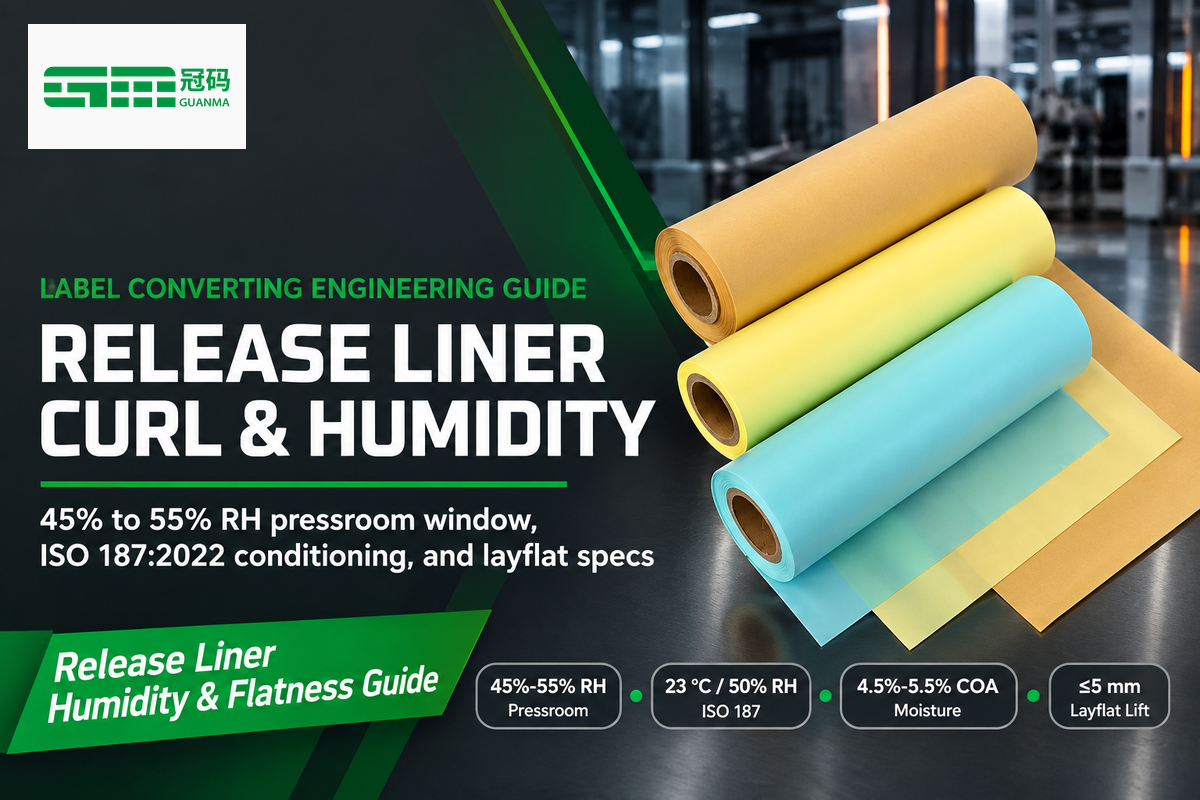
Controlling release liner curl humidity starts by keeping pressroom air within a 45% to 55% relative humidity window (per Avery Dennison storage guidelines) at 20 °C to 24 °C (68 °F to 75 °F). Paper release liners reach moisture balance at 23 °C and 50% relative humidity under ISO 187:2022 paper conditioning standards. When shop humidity climbs past the 60% RH upper limit set by Monadnock Paper Mills, exposed cellulose fibers absorb water vapor and swell laterally. The printed facestock blocks moisture on top, so the expanding paper backing curls toward the print.
When winter heating drops ambient humidity below the 35% relative humidity lower limit defined by Monadnock Paper Mills, the exposed paper backing loses water, shrinks, and pulls the laminate back toward the release liner. This guide addresses pre-dispensing web flatness, cockling, edge wave, and stability in rotary converting for both paper and film liners. Supercalendered glassine, clay-coated kraft (CCK), poly-coated kraft (PCK), and PET film release liner are compared. Post-application label edge lift on small bottles involves adhesive mandrel hold under FINAT FTM 24, not liner humidity.
Quick Specs: Pressroom Humidity & Release Liner Stability Targets
| Converting Parameter | Target Specification / Threshold | Governing Standard / Industry Source |
|---|---|---|
| Standard Testing Atmosphere | 23 ± 1 °C and 50 ± 2% relative humidity (after 24 h at 10%–35% RH) | ISO 187:2022 (Edition 3) & ASTM D685-26 |
| Practical Pressroom Operating Window | 45% to 55% RH at 60 °F to 77 °F (15 °C to 25 °C; ideal 72 °F / 22 °C) | Avery Dennison Storage Guide & FINAT Section 2.5 |
| Mill Liability Outer RH Bounds | Below 35% RH (back curl / tight edges) or above 60% RH (face curl / wavy edges) | Monadnock Paper Mills Conditioning Bulletin |
| Outgoing COA Liner Moisture Window | 4.5% to 5.5% moisture by weight; ≤5 mm layflat curl lift | Zhejiang Guanma Packaging Co., Ltd. COA Benchmark |
| 40# SCK Paper Liner Caliper Tolerance | 0.0024 inches ± 10% (0.0022 to 0.0026 inches / 56 µm to 66 µm) | Wilson Manufacturing TechTalk #20 |
| Humidity-Immune Film Liner Gauges | 23 µm and 30 µm PET film (<0.5% moisture pickup; 10–300 m/min FTM 4) | Mondi Release Liner Specifications & FINAT FTM 4 |
What Causes Release Liner Curl in Changing Pressroom Humidity?
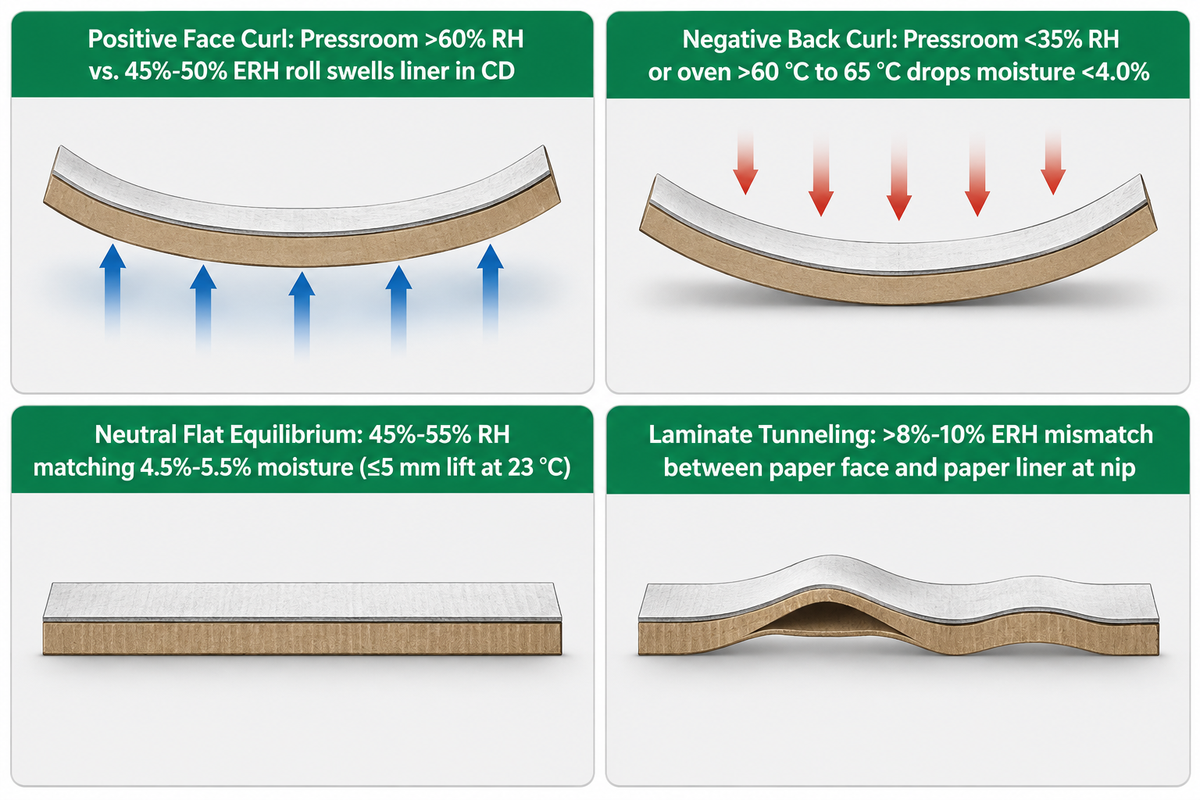
Paper release liners stay flat in a practical 45% to 55% pressroom relative humidity operating window around the ISO 187:2022 standard conditioning atmosphere (23 ± 1 °C and 50 ± 2% relative humidity). High humidity swells exposed cellulose fibers so the web curls toward the print, whereas dry air shrinks the backing toward the liner.
What Causes Release Liner Curl in Changing Pressroom Humidity?
Differential moisture expansion between the exposed cellulose backing and sealed facestock causes the laminate to bend when ambient humidity shifts. A pressure-sensitive label laminate is like a bimetallic thermostat strip. The top layer is a printed film or coated paper, and the bottom layer is cellulose backing, sealed with a protective adhesive. Because paper is hygroscopic, it exchanges water vapor with the room when ambient humidity shifts. Therefore, any difference between room humidity and the equilibrium relative humidity of the roll bends the sheet.
Why Does a Paper Release Liner Curl Toward the Printed Facestock When Pressroom Humidity Rises?
A paper release liner curves inward (toward the printed facestock) in high humidity because the backside, which is exposed, absorbs water vapor. The cellulose backing, which is laterally restrained by the adhesive-sealed facestock, expands. This causes a bending of the web edges into a positive trough within 15 to 30 minutes.
Moisture expansion during conversion of polymer film facestocks is 0.00% while exposed paper release liners absorb or lose water, which is what causes liner curl. In sign and digital markets, polyvinyl chloride vinyl film manufacturers generally pick paper release liners for heat stability and low cost. However, paper liners can easily gain or lose moisture when shop humidity shifts between winter and summer. Changes in humidity can cause paper liners to grow or contract across the web width. When exposed to high humidity, some liners can grow and curl toward the print. Conversely, when the liner loses moisture in dry air, the backing contracts and causes the liner to curl backward.
Silicone and adhesive coating curing ovens can dry the liner during the thermal curing process. In USPTO Patent US9212299B2 on coated release liner substrates, solventless silicone coatings cure for 30 seconds at 150 °C, before going over post-dryer jet steamers. Tom Ray, Technical Director at Channeled Resources Group, notes a key physical limit of cellulose. Once a paper release liner undergoes severe thermal over-drying and re-wetting, viscoelastic hysteresis blocks full dimensional recovery at 50% RH. Heavy solvent inks, according to Color-Logic technical data, contain 70% or more solvent, which upon evaporation shrinks and pulls the print upward. Printed roll to roll labels are destined for converting, where they’re reviewed according to supercalendered glassine release liner specifications. Converters must match roll moisture level to pressroom air before slitting.
| Curl Vector & Mode | Ambient RH vs. Liner ERH | Cellulose Fiber Response | Sheet / Web Geometry |
|---|---|---|---|
| Positive Face Curl (Curl Toward Print) | Pressroom >60% RH vs. 45%–50% ERH roll | Exposed liner backside absorbs water vapor and swells in CD | Outer edges lift upward toward the printed facestock like a trough |
| Negative Back Curl (Curl Toward Liner) | Pressroom <35% RH or UV/hot-air oven >60 °C to 65 °C | Liner loses moisture below 4.0% weight fraction and contracts | Sheet arches backward toward the reverse side of the release liner |
| Neutral Flat Equilibrium | Pressroom 45%–55% RH matching 4.5%–5.5% liner moisture | Zero net vapor transfer between ambient air and cellulose core | ≤5 mm layflat curl lift under ISO 187:2022 conditioning at 23 °C |
| Laminate Tunneling (Cross-Web Ridges) | >8%–10% ERH mismatch between paper face and paper liner at nip | Facestock and liner expand or contract at different post-nip rates | Hollow worm-like delaminated tunnels running across the web |
How to Diagnose Moisture Curl vs. Mechanical Tension and Roll-Set Curl on an Unstable Web
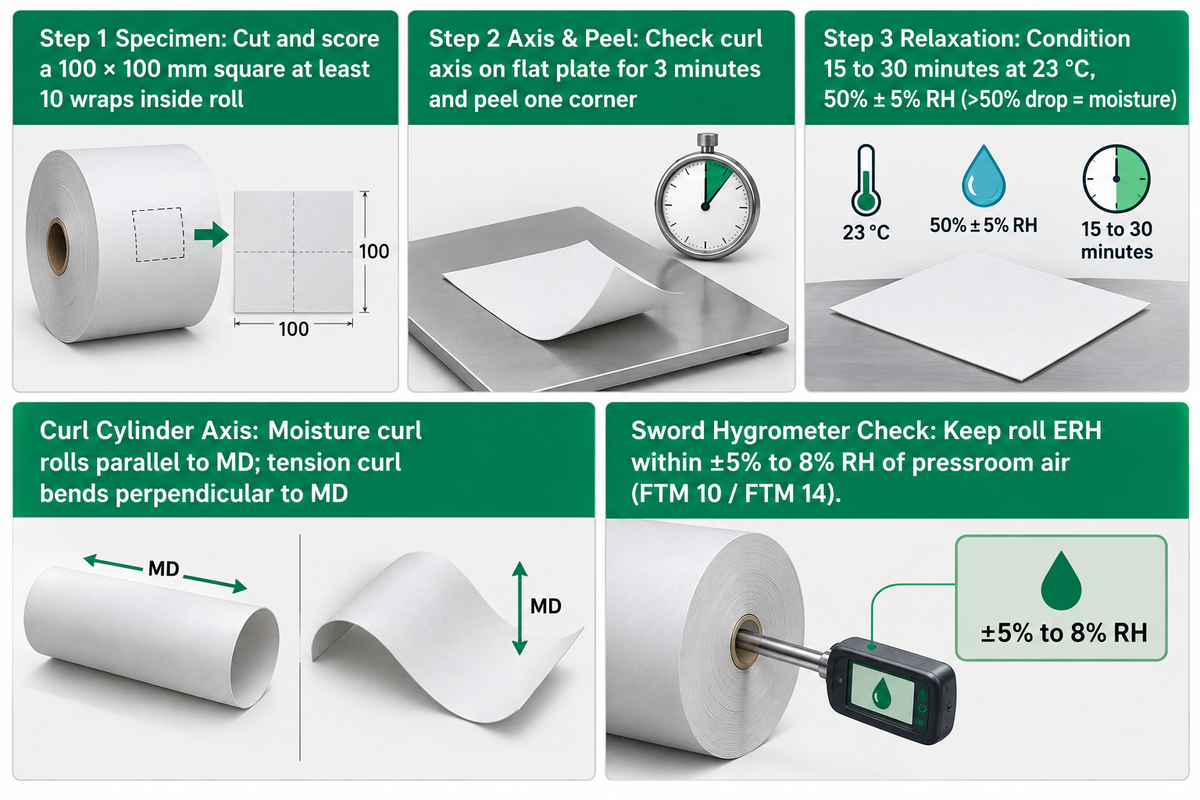
Separate humidity curl from mechanical tension curl in 15 to 30 minutes using a 100 × 100 mm cut square under TAPPI T 466 and ISO 11556 principles. Peel the facestock from the release liner at 50% relative humidity. Moisture curl rolls parallel to web travel and relaxes, whereas tension curl bends across the web.
Per ASTM D685-26 Section 1.1, paper’s physical properties and its moisture curl behavior at 50% relative humidity also depend on whether the web approaches 50% relative humidity from a wetter or drier state.
Press operators often misdiagnose mechanical lamination curl as a room humidity problem. Wasting two hours tweaking unwind brakes or swapping liner rolls without checking the curl axis adds avoidable scrap. On the Signs101 converting forum, operators note that high laminator nip pressure stretches vinyl films and squeezes the adhesive. Stretched overlaminate films pull back after die-cutting and bend the sheet around the cross-direction axis regardless of room humidity.
How Do You Tell Humidity Curl Apart from Mechanical Lamination Curl on the Press Floor?
You can tell humidity curl apart from mechanical lamination curl by checking the cylinder axis and peeling a sample apart. Hygroscopic moisture curl forms a tube parallel to web travel, because paper swells in the cross direction. Mechanical lamination curl bends perpendicular to web travel and stays curved after peeling.
The 3-Step Diagonal-Cut Curl Test for Press-Floor Triage
Before you reject a roll or change the die pressure, run the 3-Step Diagonal-Cut Curl Test on the press delivery table:
- Cut and score a 100 × 100 mm square specimen — take a flat sample at least 10 wraps inside the outer roll diameter. Mark the machine direction (MD) arrow on the liner back and score a shallow diagonal X-cut through the facestock.
- Identify the primary curl axis and peel one quadrant — place the square on a flat gauge plate for 3 minutes. Check if the edges roll parallel to the MD arrow (CD moisture swell) or across the MD arrow (web tension), then peel one corner.
- Condition for 15 to 30 minutes at 50% RH and check relaxation — set the separated liner and square in a 23 °C, 50% ± 5% RH zone. If curl height drops by over 50% within 30 minutes, room humidity imbalance is the root cause.
When checking a roll with a sword hygrometer, keep roll equilibrium relative humidity within ±5% to 8% RH of pressroom air. According to the FINAT Technical Handbook FTM 10 and FTM 14 test methods, labs evaluate dimensional stability and 300 mm/min release force after standard conditioning. Pre-conditioning removes the artifact of tension so that moisture expansion can be measured cleanly.
| Diagnostic Dimension | Hygroscopic Moisture Absorption Curl | Mechanical Lamination Tension Curl | Inner-Core Roll-Set Curl | UV / Dryer Thermal Dehydration Curl |
|---|---|---|---|---|
| Curl Cylinder Axis | Parallel to MD (driven by CD fiber expansion) | Perpendicular to MD (driven by MD web stretch) | Perpendicular to MD (follows roll winding radius) | Parallel to MD (CD liner shrinkage away from print) |
| Curl Direction | Toward printed facestock (positive curl) | Toward stretched film layer (usually toward face) | Toward inner winding direction of the core | Toward release liner backside (negative curl) |
| Separated Bare Liner Behavior | Bare paper liner exhibits strong CD curvature | Bare paper liner lies flat; peeled film curls | Both layers retain mild MD arc near core | Bare paper liner arches toward uncoated backside |
| 15–30 Min at 50% RH Response | Relaxes by >50% unless hysteresis crease set occurred | Zero change; elastic film stress is humidity-independent | Minimal change; requires reverse decurler bar bend | Partial recovery only due to ASTM D685 hysteresis |
| Roll Location Concentration | Worst on outer wraps and exposed roll edges | Uniform across entire roll or matches nip speed spikes | Final 50 to 100 meters adjacent to 76 mm core | Appears immediately downstream of UV lamps or drying tunnel |
Machine-Direction vs. Cross-Direction Curl: Why Cellulose Fiber Orientation Controls Web Buckling
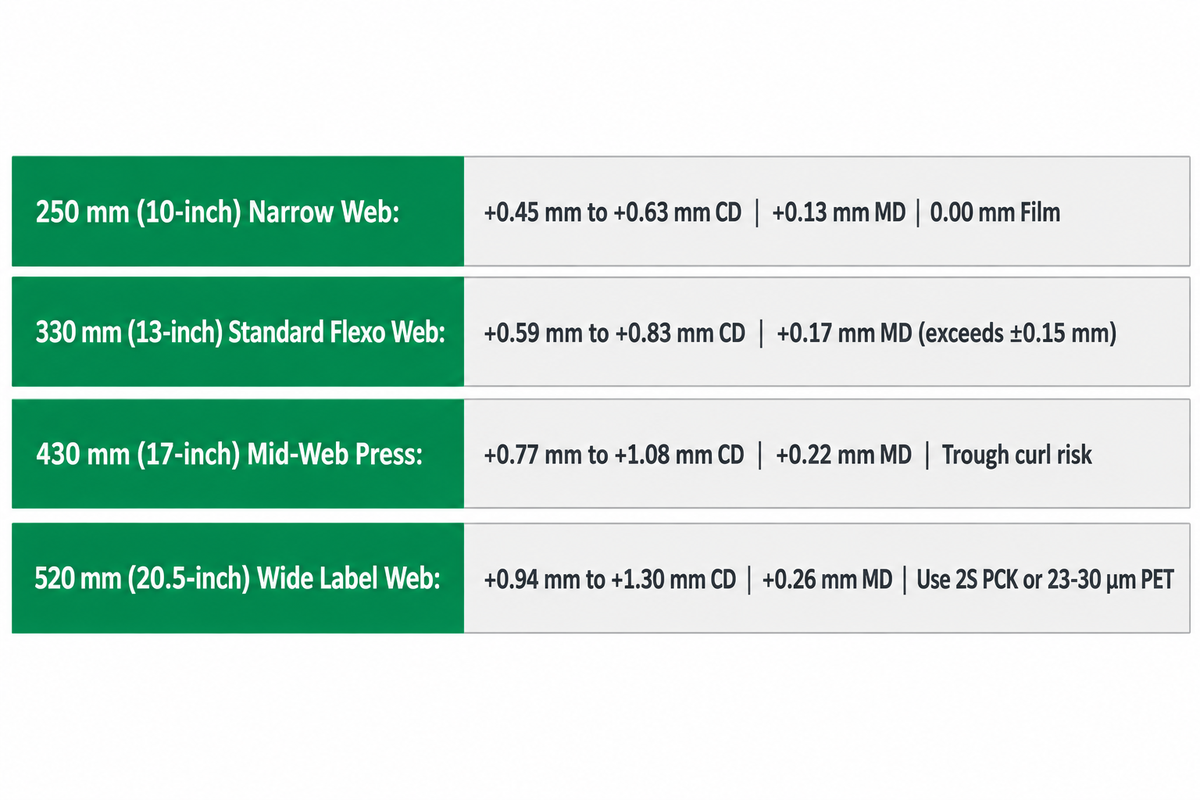
Cellulose fibers in supercalendered paper release liners swell 3 to 5 times more in the cross direction than in the machine direction. A 30% relative humidity jump (from 35% to 65% RH) produces 0.18% to 0.25% CD expansion versus 0.05% MD expansion. Across a 330 mm (13-inch) glassine web, that 0.18% to 0.25% CD expansion produces +0.59 to +0.83 mm of liner width growth versus 0.00 mm on BOPP film.
A Fourdrinier paper machine aligns 70-80% of the wood pulp fibers parallel to the moving wire by means of hydrodynamic shear. Think of a cellulose fiber as a wooden dowel. When a wooden dowel absorbs water, the diameter swells and the length barely changes. Because fiber diameters face across the web width, moisture absorption makes the release liner grow mainly in the cross direction (CD). That lateral swelling is why Tom Ray at Channeled Resources Group has said that moisture curl rolls up like a tube from side to side.
Operators sometimes confuse curl labels because press manuals name curl by cylinder axis (MD-axis), whereas paper engineers name the expanding fiber axis (CD). State both direction and face clearly on shop tickets: CD moisture expansion causing edges to curl toward the print face. The FINAT Technical Handbook 11th Edition includes 31 test methods, led by FINAT FTM 14 for dimensional stability. Before running FTM 14, ISO 187:2022 and ASTM D685-26 require preconditioning paper samples for 24 hours at 10% to 35% RH and 20 °C to 40 °C. That dry-side preconditioning eliminates hysteresis bias before 50% RH testing.
📐 Worked Calculation (1): Cross-Direction (CD) Hygroscopic Width Growth on a 330 mm Narrow-Web Press
Assumed inputs: Suppose a narrow-web flexo press runs a 330 mm (13-inch) wide laminate. The stock pairs a 50 µm BOPP film facestock (0.00% moisture expansion) with a 53 µm (60 gsm) supercalendered glassine release liner. Pressroom humidity rises from 35% to 65% RH during an afternoon storm. Paper moisture content rises by about 1.5% to 2.0% across that 30% RH jump, pushing the liner above its standard 4.5% to 5.5% equilibrium moisture content at 23 °C and 50% RH (the standard climate benchmark examined in conditioning equilibrium studies). Assume a supercalendered glassine CD expansion coefficient of 0.18% to 0.25% and an MD coefficient of 0.05% across that 35% to 65% RH jump.
Calculation: Cross-direction liner width growth ΔWCD = 330 mm × (0.0018 to 0.0025) = +0.59 to +0.83 mm across the 330 mm web. The BOPP facestock expands by 330 mm × 0.0000 = 0.00 mm. Over a 330 mm span in the machine direction, liner growth ΔLMD = 330 mm × 0.0005 = +0.165 mm. On these inputs, the +0.59 to +0.83 mm CD liner growth bows the outer web edges upward and shifts outer-lane rotary die registration beyond ±0.15 mm tolerances. This calculation models unrestrained flat sheet expansion; it isn’t a direct prediction of slitting camber inside a tightly wound roll core.
| Press Web Width | Glassine Liner CD Expansion (0.18%–0.25%) | Glassine Liner MD Expansion (~0.05%) | BOPP / PET Film Facestock Expansion | Resulting Multi-Lane Die Registration Risk |
|---|---|---|---|---|
| 250 mm (10-inch) Narrow Web | +0.45 mm to +0.63 mm | +0.13 mm | 0.00 mm | Outer lanes drift 0.22–0.31 mm from center datum |
| 330 mm (13-inch) Standard Flexo Web | +0.59 mm to +0.83 mm | +0.17 mm | 0.00 mm | Exceeds ±0.15 mm rotary kiss-cut registration tolerance |
| 430 mm (17-inch) Mid-Web Press | +0.77 mm to +1.08 mm | +0.22 mm | 0.00 mm | Severe side-to-side trough curl and edge matrix breaks |
| 520 mm (20.5-inch) Wide Label Web | +0.94 mm to +1.30 mm | +0.26 mm | 0.00 mm | Requires 2S PCK or 23–30 µm PET liner in unconditioned shops |
How Unstable Release Liner Curl Triggers Die-Strike Drift, Matrix Breaks, and Dispensing Jams
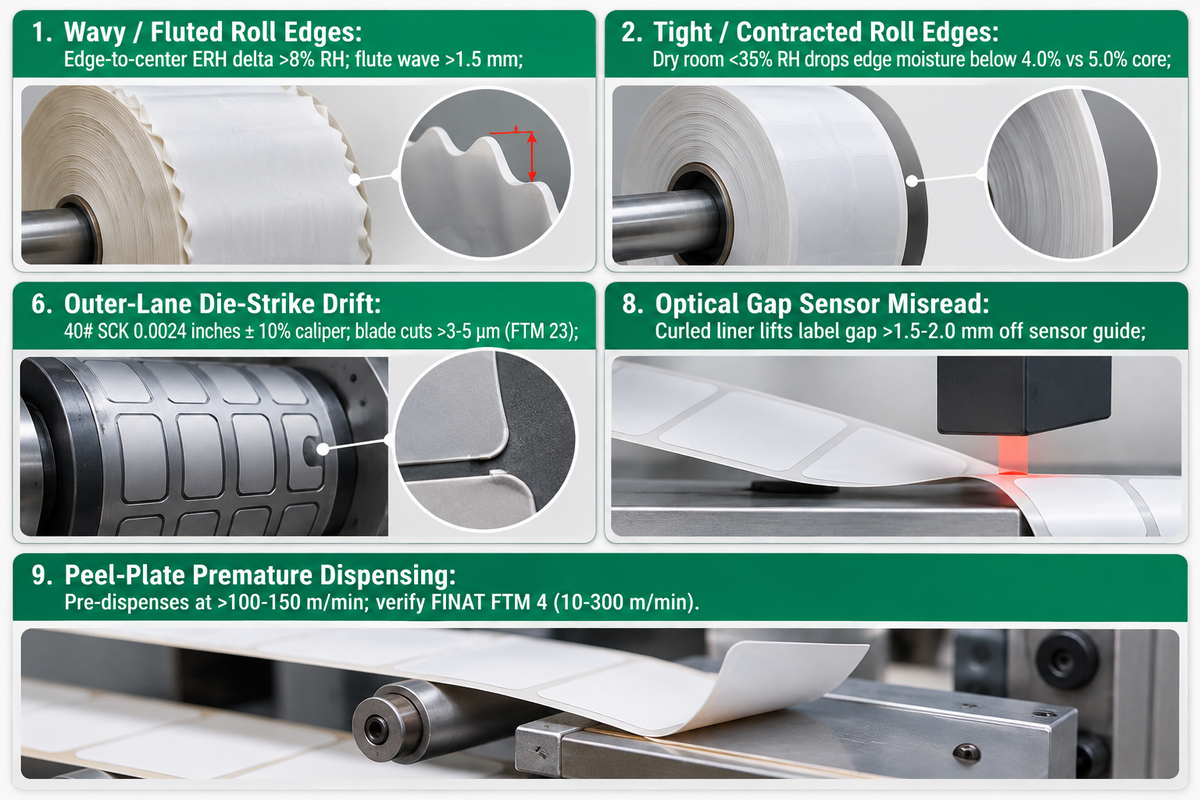
A 40# SCK paper release liner has a nominal caliper of 0.0024 inches with a 10% tolerance (0.0022 to 0.0026 inches, or 56 to 66 µm per Wilson Manufacturing TechTalk #20). When humidity waves lift the web above 1.5 to 2.0 mm, rotary dies crush the raised ridges and snap the waste matrix.
FINAT’s 11th Edition Technical Handbook defines 31 standardized test methods built over 35 years for global self-adhesive label converters.
When a roll of paper absorbs humidity at the ends, the outer 25 to 50 mm of the roll grows longer than the center of the roll. This causes the edge of the roll to take on a wavy appearance. Dry winter air causes the opposite effect and shrinks the edges of a roll relative to the core. This creates cockled edges with a baggy center of the roll. Both effects distort flatness and disrupt high speed dispensing at 10 to 300 m/min under FINAT FTM 4.
In Wilson Manufacturing TechTalk #20, it’s shown that paper basis weight doesn’t control liner thickness. For example, a 40# SCK liner is 0.0022 to 0.0026 inches around its nominal caliper of 0.0024 inches. A heavier 90# paper liner ranges from 0.0062 to 0.0076 inches around a nominal caliper of 0.0069 inches. In the case of an unstripped label on a cockled web, operators usually adjust the rotary die pressure. That deep impression triggers die strike under FINAT FTM 23a (paper) and FTM 23b (filmic paper), snapping the liner at the peel plate.
⚠️ Common Mistake: Cranking Rotary Die Pressure to Compensate for a Wavy Release Liner
Adding rotary die bolster pressure is not a solution to crushing the silicone layer to support kiss-cutting through a supercalendered glassine liner. Typical automatic applicators running 150 to 300 m/min require a light and uniform impression on the liner. Crushing 5 to 10 µm into raised moisture flutes cuts through the 0.8 to 1.5 g/m² silicone layer and drops liner tensile strength by 30% to 50%.
The 9-Row Web Curl Symptom-to-Root-Cause Triage Table
Moisture defects cause adhesive symptoms, and the 9-Row Web Curl Symptom-to-Root-Cause Triage Table below helps isolate them. Additionally, check adhesive symptoms on our interactive label failure-mode matcher tool.
| # & Press / Applicator Symptom | Moisture Gradient / Mechanical Root Cause | Critical Threshold / Measurement | Immediate Press-Side or Material Fix |
|---|---|---|---|
| 1. Wavy / Fluted Roll Edges | Unwrapped roll edges absorb humid pressroom air or dew-point condensation | Edge-to-center ERH delta >8% RH; edge flute wave height >1.5 mm | Keep cold rolls sealed in PE wrap until core clears dew point; widen edge trim by 3–5 mm |
| 2. Tight / Contracted Roll Edges | Unwrapped roll edges lose moisture in dry heated pressroom (<35% RH) | Edge moisture drops below 4.0% while core stays at 5.0% | Humidify pressroom to 45%–55% RH; bag partial rolls including both roll ends within 15 min |
| 3. Full-Web Positive Face Curl | Paper liner absorbs ambient moisture across full width against film/ink face | CD width growth of +0.59 to +0.83 mm per 330 mm web width | Thread reverse-bend decurler bar (12–25 mm bar diameter) or upgrade to 2S PCK / PET liner |
| 4. Full-Web Negative Back Curl | UV curing lamps or hot-air dryers dehydrate exposed paper liner backside | Liner backside temperature >60 °C (up to 65 °C+) without chill-roll cooling; >0.5% moisture loss | Hold UV chill-roll water at 18 °C to 22 °C (64 °F to 72 °F) and reduce lamp standby power |
| 5. Center Bagginess / Cockling | Non-uniform moisture distribution across web width or tight-edge compression | Out-of-plane blister pockets >1.0 mm across center lanes | Condition wrapped roll 24–48 h at 23 °C / 50% RH; reduce rewind taper tension by 15%–25% |
| 6. Outer-Lane Die-Strike Drift | CD liner swelling + paper caliper swing (0.0024 inches ± 10% on 40# SCK) | Die blade cuts >3–5 µm deep into silicone layer on outer lanes | Verify die strike with FINAT FTM 23 stain test; switch critical jobs to 23 or 30 µm PET liner |
| 7. Waste-Matrix Stripping Snap | Deep die-strike score lines or curled label edge catching stripping roller | Inconsistent kiss-cut depth across wavy web edges | Lower stripping angle closer to web plane and balance anvil clearance rather than adding pressure |
| 8. Optical Gap Sensor Misread | Curled liner lifts label gap >1.5–2.0 mm off sensor guide or PET transparency shift | Web flutter >1.5 mm at optical transmittance fork | Add spring hold-down shoe before sensor fork; switch to ultrasonic/capacitive sensor for PET |
| 9. Peel-Plate Premature Dispensing | Positive face curl or dryer dehydration loosens label leading edge before peel tip | Label pre-dispenses in transport chute at speeds >100–150 m/min | Verify high-speed release under FINAT FTM 4 (10–300 m/min) and match liner stiffness to label |
Glassine vs. Clay-Coated Kraft (CCK) vs. Poly-Coated Kraft (PCK) vs. PET Film Release Liners
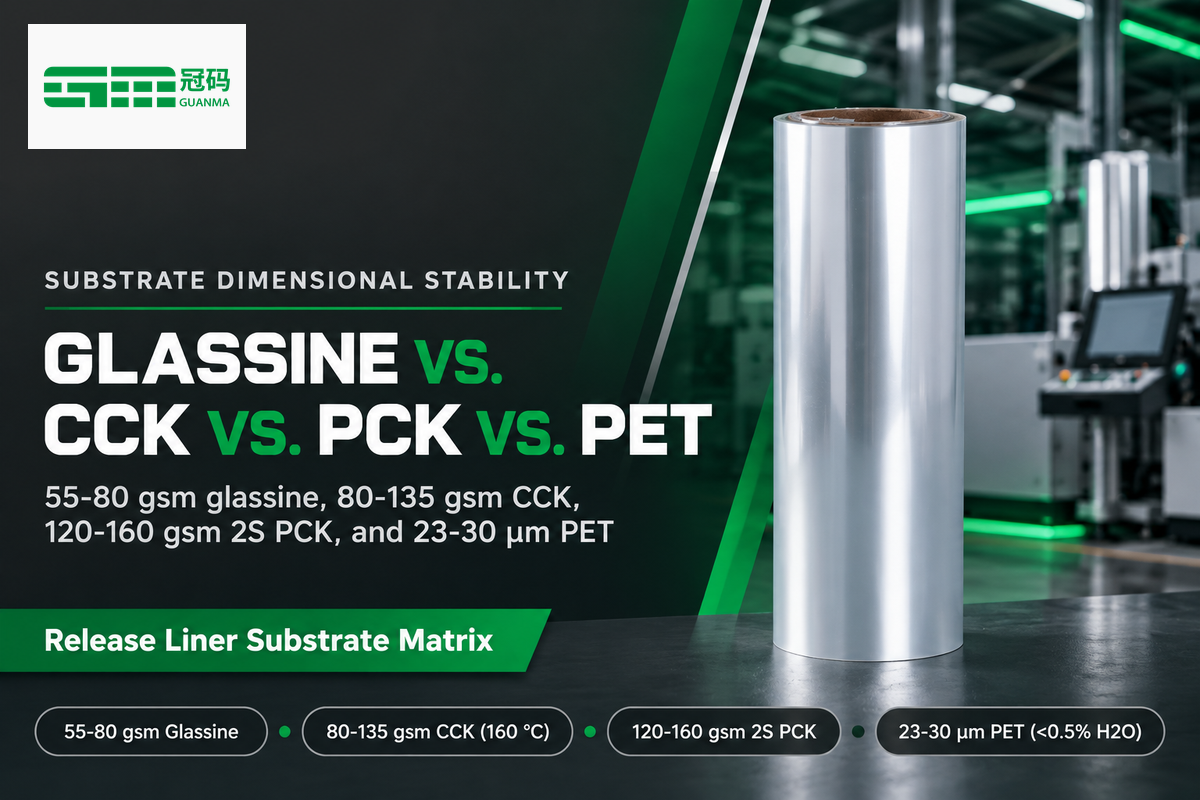
Supercalendered glassine (55 to 80 gsm, 49 to 66 µm per Mondi specifications) serves climate-controlled roll converting, while clay-coated kraft (CCK, 80 to 135 gsm) delivers cut-sheet layflat stability. Double-sided poly-coated kraft (2S PCK, 120 to 160 gsm, or 90 to 160 gsm across 1S and 2S PCK grades) blocks humidity above 60% RH, while 23 to 30 µm PET film provides 100% humidity immunity.
How Do Glassine, CCK, PCK, and PET Release Liners Compare in Humidity Resistance and Layflat Stability?
PET film liner (23 or 30 µm) absorbs less than 0.5% water and completely removes humidity curl. Double-sided poly-coated kraft (2S PCK with polyethylene barriers on both sides) blocks water vapor on paper webs up to 100 °C to 110 °C. Uncoated glassine (55 to 80 gsm) and single side CCK (80 to 135 gsm) support conditioned press rooms.
Choosing the right liner material balances vapor barrier protection against oven heat limits and optical sensors. According to Label & Narrow Web’s March 2025 release liner report, pressure-sensitive labelstock represents 46% of global liner volume. In North America, supercalendered kraft (SCK) and glassine hold 39% share, CCK holds 16%, and PCK holds 9%. Other papers account for 9%, while film liners represent 27% (14% PET, 8% PE, and 4% PP). In graphic films cited from the AWA study in our clay-coated kraft (CCK) release paper structure and caliper selection guide, CCK represents 44% globally and 77% in Europe. In the United States, PE-coated kraft leads at 49% (with CCK at 40%) because legacy US CCK had an open backside.
When printers face wide seasonal humidity swings, a polycoated release liner bridges paper and synthetic film. Extruding a 12 to 25 gsm synthetic resin polyethylene barrier onto kraft gives you the advantages of a plastic liner. You also keep the stiffness and clean die-cutting of a cost-competitive paper liner. The polyolefin coating increases the resistance of the liner to moisture absorption during storage. It also helps by improving the overall dimensional stability and layflatness of wide sheets. However, single-sided poly-coated kraft (1S PCK) leaves the reverse cellulose side open to ambient water vapor, and polyethylene barrier layers on 1S/2S PCK soften above 100 °C to 110 °C in high-temperature drying ovens. For humid sheeted graphics under 100 °C, converters specify 2S PCK or custom CCK release paper rolls for layflat sheet and graphic converting. For wet bottling halls above 150 m/min, plastic film liners such as thin PET grades frequently used for label stock stop moisture curl.
The 9-Row Release Liner Humidity Stability Matrix
Compare all nine commercial grades in the 9-Row Release Liner Humidity Stability Matrix below to pick the right release liner for your application:
| Release Liner Grade | Basis Weight / Gauge | Nominal Caliper (µm / mil) | Humidity Curl Resistance | Max Oven / Dryer Limit | Sensor & Dispensing Profile | Primary Converting Application |
|---|---|---|---|---|---|---|
| 1. Standard Supercalendered Glassine | 55–62 gsm | 49–55 µm (2.0–2.2 mil) | Low (requires 45%–55% RH pressroom) | 150 °C (dehydrates without chill roll) | Standard optical gap sensor; up to 150 m/min | High-volume barcode, logistics, and prime roll labels |
| 2. 80 gsm Heavy Glassine / 40# SCK | 65–80 gsm (40# SCK) | 56–66 µm (2.2–2.6 mil) | Low-Moderate (higher bending stiffness) | 150 °C (0.0024 inches ± 10% caliper band) | Optical gap sensor; 100–200 m/min rotary die-cut | Wide-web roll labels and multi-lane rotary kiss-cutting |
| 3. 90 gsm Clay-Coated Kraft (CCK) | 80–95 gsm | 82–95 µm (3.2–3.7 mil) | Moderate (clay top seal; open kraft back) | 160 °C (high heat dimensional stability) | Opaque optical/reflective sensor; sheet & roll | A4 laser/inkjet sheet labels and moderate-RH roll graphics |
| 4. 120–135 gsm Graphic CCK | 120–135 gsm (90# liner) | 125–190 µm (4.9–7.6 mil) | Moderate-High (high beam stiffness; EN 13430 recyclable) | 160 °C (withstands screen/solvent drying) | Flatbed / sheet feeder; manual or slow dispenser | Wide-format screen printing, vinyl signage, and cut decals |
| 5. Single-Sided Poly-Coated Kraft (1S PCK) | 90–120 gsm (+12–25 gsm PE) | 95–130 µm (3.7–5.1 mil) | Moderate (PE under silicone; raw kraft back still breathes) | 100 °C–110 °C (PE softening ceiling) | Opaque optical sensor; medium-speed roll/sheet | Industrial tapes and controlled-climate graphic sheets |
| 6. Double-Sided Poly-Coated Kraft (2S PCK) | 120–160 gsm (12–25 gsm PE × 2) | 130–175 µm (5.1–6.9 mil) | Very High (both faces sealed against water vapor) | 100 °C–110 °C (PE blister limit in hot ovens) | Sheet-fed and wide-format digital; ≤5 mm curl lift | Unconditioned humid pressrooms and export graphic sheets |
| 7. 23 µm Thin PET Film Liner | ~32 gsm equivalent | 23 µm ± 3% (0.9 mil) | 100% Immune (<0.5% water absorption) | 120 °C–140 °C (chill-roll tension control required) | Ultrasonic/capacitive sensor; 200–300 m/min FTM 4 | High-speed beverage bottling and +33% long-footage rolls |
| 8. 30 µm Standard PET Film Liner | ~42 gsm equivalent | 30 µm ± 3% (1.2 mil) | 100% Immune (<0.5% water absorption) | 130 °C–150 °C (tight rotary anvil clearance) | Ultrasonic or black-mark sensor; 150–300 m/min | Clear-on-clear BOPP/PET labels, pharma, and wet filling lines |
| 9. 36–50 µm Heavy PET Film Liner | ~50–70 gsm equivalent | 36–50 µm (1.4–2.0 mil) | 100% Immune (rigid synthetic layflat plane) | 140 °C–150 °C (zero hygroscopic shrinkage) | Precision rotary die-cut & electronic punch | Automotive die-cuts, electronics, and medical device converters |
Why Asymmetric Label Lamination (Film Facestock on Paper Liner) Multiplies Humidity Curl
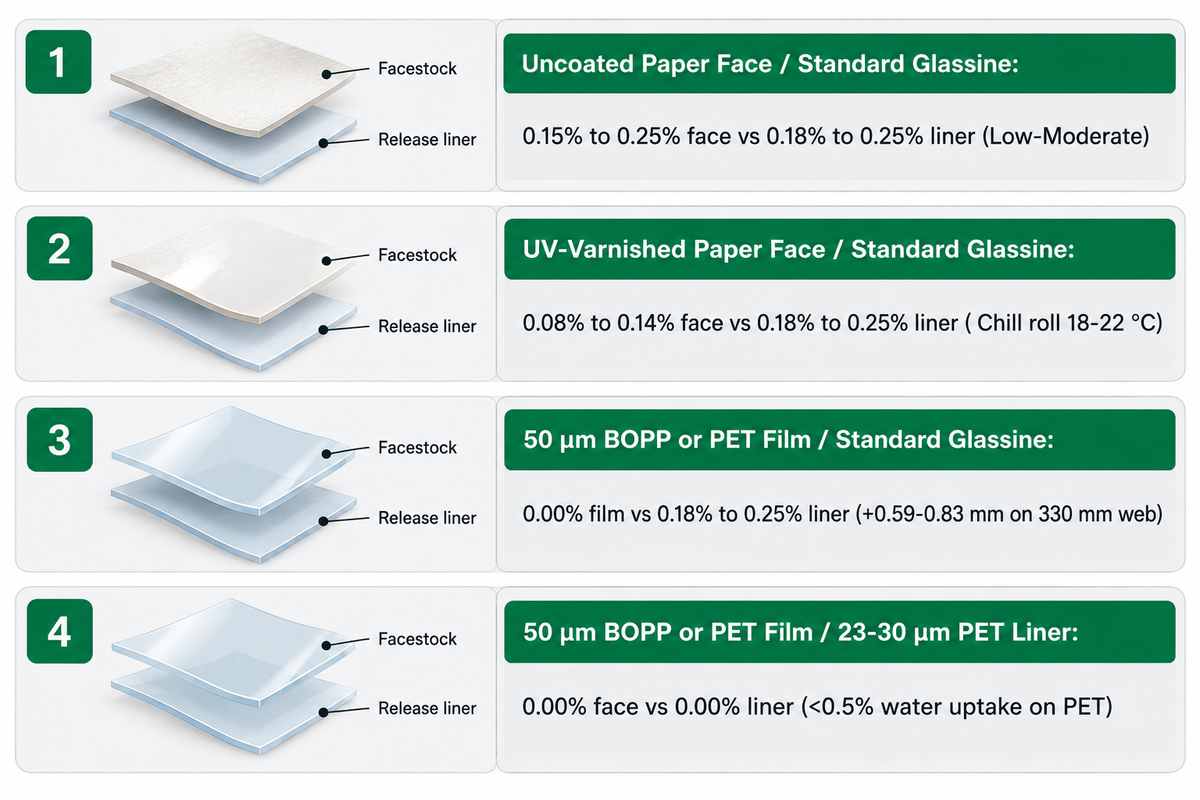
Laminating a non-hygroscopic BOPP or PET film facestock (0.00% moisture expansion) onto a standard glassine release liner (0.18% to 0.25% CD expansion) creates a 100% differential mismatch. Stiffer 50 to 60 µm film facestocks act as a rigid fulcrum that amplifies positive face curl rather than holding the paper flat.
Most customers expect a thick 60 µm BOPP or 50 µm polyester facestock to hold a light paper liner flat. In an all-paper construction (like an 80 gsm uncoated paper laminated to standard glassine) both layers are cellulose fibers. At 45% to 65% RH room humidity, both the paper face and liner swell in the cross direction, and this shared expansion balances the bending torque.
You can laminate (BOPP self-adhesive label film constructions) or (dimensionally stable PET self-adhesive film materials) to uncoated paper. The polymer top sheet will block the diffusion of water vapor, and the expansion in the width direction. Therefore, all expansion of the cellulose fibers in the backing will convert to bending stress in the adhesive layer. Processing conditions such as oven temperature and nip pressure can also affect the dimensional stability of the liner. Drying the aqueous emulsion adhesive at 90 °C to 110 °C will remove the water from the cellulose backing. Low-speed FINAT FTM 3 release testing (at a 180° peel angle and 300 mm/min across a 0.8 to 1.5 g/m² XRF silicone coat weight) only reflects slow storage handling. Use FINAT FTM 4 high-speed release testing (10 to 300 m/min) rather than low-speed FTM 3 to evaluate dispensing stability on lines running at 150 m/min.
| Laminate Construction | Facestock CD Hygroexpansivity | Release Liner CD Hygroexpansivity | Net Differential Mismatch | Recommended Humid-Climate Upgrade |
|---|---|---|---|---|
| 1. Uncoated Paper Face / Standard Glassine Liner | 0.15% to 0.25% (breathes through face) | 0.18% to 0.25% (breathes through back) | Low-Moderate (both layers expand in CD) | Maintain 45%–55% RH pressroom; standard PE roll wrap |
| 2. UV-Varnished Paper Face / Standard Glassine Liner | 0.08% to 0.14% (varnish slows face uptake) | 0.18% to 0.25% (rapid back uptake) | High transient face curl during first 2–4 hours | Keep chill roll at 18–22 °C; upgrade to 80 gsm glassine or CCK |
| 3. 50 µm BOPP or PET Film / Standard Glassine Liner | 0.00% (impermeable polymer film) | 0.18% to 0.25% (+0.59–0.83 mm on 330 mm web) | Maximum bimetallic bending stress (100% mismatch) | Specify 4.5%–5.5% COA moisture or upgrade liner to 2S PCK / PET |
| 4. 50 µm BOPP or PET Film / 23–30 µm PET Liner | 0.00% (dimensionally stable film) | 0.00% (<0.5% water uptake on PET) | Zero hygroscopic differential across dry and humid air | Symmetric film-on-film gold standard for wet bottling & tropics |
Pressroom Relative Humidity Targets and Roll Conditioning Times Under ISO 187 and ASTM D685
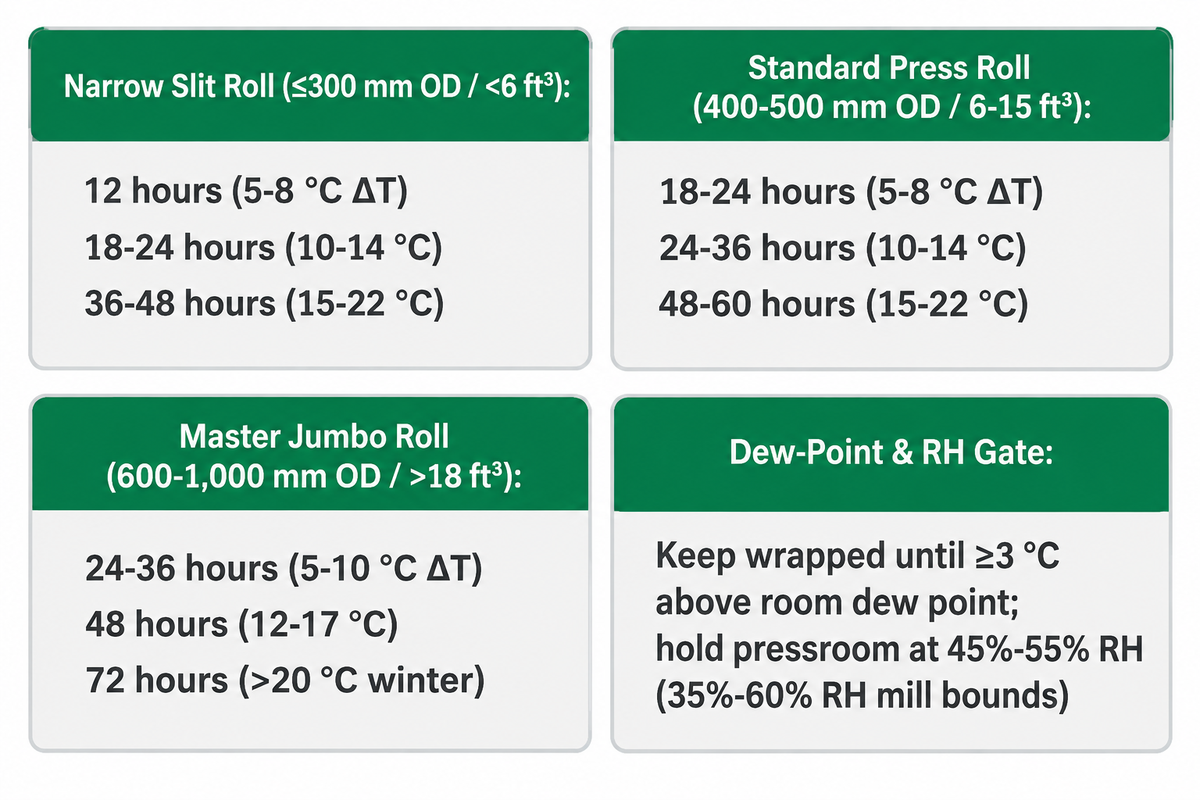
Under ISO 187:2022 and Avery Dennison storage guidelines (60 °F to 77 °F), label rolls need 12 to 72 hours of sealed thermal conditioning before unwrapping. Standard press rolls require 24 to 48 hours of unopened staging. Monadnock Paper Mills disclaims curl liability below 35% RH or above 60% RH.
What Pressroom Relative Humidity Range and Conditioning Time Keep Glassine and CCK Liners Flat?
Condition incoming glassine or CCK rolls for 12 to 72 hours depending on roll diameter and temperature delta (typically 24 to 48 hours for standard press rolls) inside their sealed moisture-barrier wrapper until roll temperature clears the room dew point by at least 3 °C to 4 °C and approaches room air. Before slitting the wrapper inside a 20 °C to 24 °C pressroom, confirm with an infrared thermometer that the roll surface clears the room dew point by at least 3 °C.
A common shop-floor disagreement is whether rolls should be unwrapped upon delivery to the pressroom. Sheeted stock was racked face to face so the release liner could match room humidity overnight. Unwrapping a cold master roll that has been delivered from a winter transit will ruin the roll. Neenah Paper and Monadnock Paper Mills state that conditioning means leaving the rolls unopened in a moisture-barrier wrapper until the roll temperature balances.
Why does unwrapping a cold roll ruin flatness? When a 10 °C roll enters a 23 °C room at 55% RH, the room dew point is roughly 13.5 °C. Slitting the polyethylene bag exposes the cold 10 °C paper edges to warm humid room air. Liquid water condenses onto the roll edges within minutes and swells the outer wraps into wavy flutes. Operators on Reddit’s r/CommercialPrinting forum report a similar delay in humid shops. Once unwrapped rolls absorb moisture at 75 °F, lowering the AC to 69 °F takes two weeks to dry tight roll cores. We resolve this unwrap-versus-keep-wrapped contradiction by separating Phase 1 sealed thermal equilibration above the pressroom dew point (12 to 72 hours unopened) from Phase 2 moisture equilibration under ISO 187:2022 and ASTM D685-26, while pairing CELAB Europe and CTP EN 13430 recyclability rules for 60g glassine and 125g CCK versus PCK and PET liners.
The 9-Row Pressroom Conditioning and Storage Schedule
Post the 9-Row Pressroom Conditioning and Storage Schedule at your receiving dock. The hold times combine Neenah Paper’s unopened tables, Monadnock Paper Mills’s cubic-volume rules (Length × Width × Height in inches divided by 1,728), and ISO 187:2022 / ASTM D685-26 rules:
| Roll Outer Diameter / Pallet Volume | Arrival Temperature Delta (ΔT below Pressroom) | Minimum Unopened Wrapped Hold Time | Dew-Point Clearance Gate (23 °C / 50% RH Room) | Pre-Press Verification Action |
|---|---|---|---|---|
| 1. Narrow Slit Roll (≤300 mm OD / <6 ft³) | 5 °C to 8 °C (9 °F to 15 °F) | 12 hours sealed in PE wrap | Roll core & surface balanced at 20–23 °C (≥3 °C above dew point) | IR thermometer check on roll end face before slitting bag |
| 2. Narrow Slit Roll (≤300 mm OD / <6 ft³) | 10 °C to 14 °C (18 °F to 25 °F) | 18 to 24 hours sealed in PE wrap | Roll surface ≥18 °C (≥3 °C above dew point); zero bag fogging | IR thermometer check + sword hygrometer ±5% RH match |
| 3. Narrow Slit Roll (≤300 mm OD / <6 ft³) | 15 °C to 22 °C (27 °F to 40 °F) | 36 to 48 hours sealed in PE wrap | Roll core & end face within ±2 °C of 22–23 °C room | Run 3-Step Diagonal-Cut Curl Test on outer sample wrap |
| 4. Standard Press Roll (400–500 mm OD / 6–15 ft³) | 5 °C to 8 °C (9 °F to 15 °F) | 18 to 24 hours sealed in PE wrap | Roll surface ≥19 °C (≥3 °C above dew point) across core & edge | Keep roll elevated on pallet off cold concrete slab |
| 5. Standard Press Roll (400–500 mm OD / 6–15 ft³) | 10 °C to 14 °C (18 °F to 25 °F) | 24 to 36 hours sealed in PE wrap | Roll surface ≥19 °C; room held at 45%–55% RH | Verify sword hygrometer ERH delta ≤8% RH before unwind |
| 6. Standard Press Roll (400–500 mm OD / 6–15 ft³) | 15 °C to 22 °C (27 °F to 40 °F) | 48 to 60 hours sealed in PE wrap | Core and outer edge balanced at 20 °C to 24 °C | Discard outer 3–5 sacrificial wraps if transit seal tore |
| 7. Master Jumbo Roll / Skid (600–1,000 mm OD / >18 ft³) | 5 °C to 10 °C (9 °F to 18 °F) | 24 to 36 hours sealed in PE wrap | Roll end face ≥19 °C (≥3 °C above dew point); core plug dry | Stage away from exterior loading doors and unit heaters |
| 8. Master Jumbo Roll / Skid (600–1,000 mm OD / >18 ft³) | 12 °C to 17 °C (22 °F to 30 °F) | 48 hours sealed in PE wrap | Roll end face ≥20 °C; room within 35%–60% RH mill bounds | Check sheet layflat lift ≤5 mm on first cut sheet |
| 9. Master Jumbo Roll / Winter Transit (>1,000 mm OD / >30 ft³) | >20 °C (>36 °F winter freight delta) | 72 hours sealed in PE wrap | Full thermal balance at 20 °C to 24 °C (68 °F to 75 °F) | Mandatory sword hygrometer check + re-bag partial rolls in <15 min |
Press-Side Mitigations for Curled Release Liners: UV Chill Rolls, Decurler Bars, and Re-Wrapping
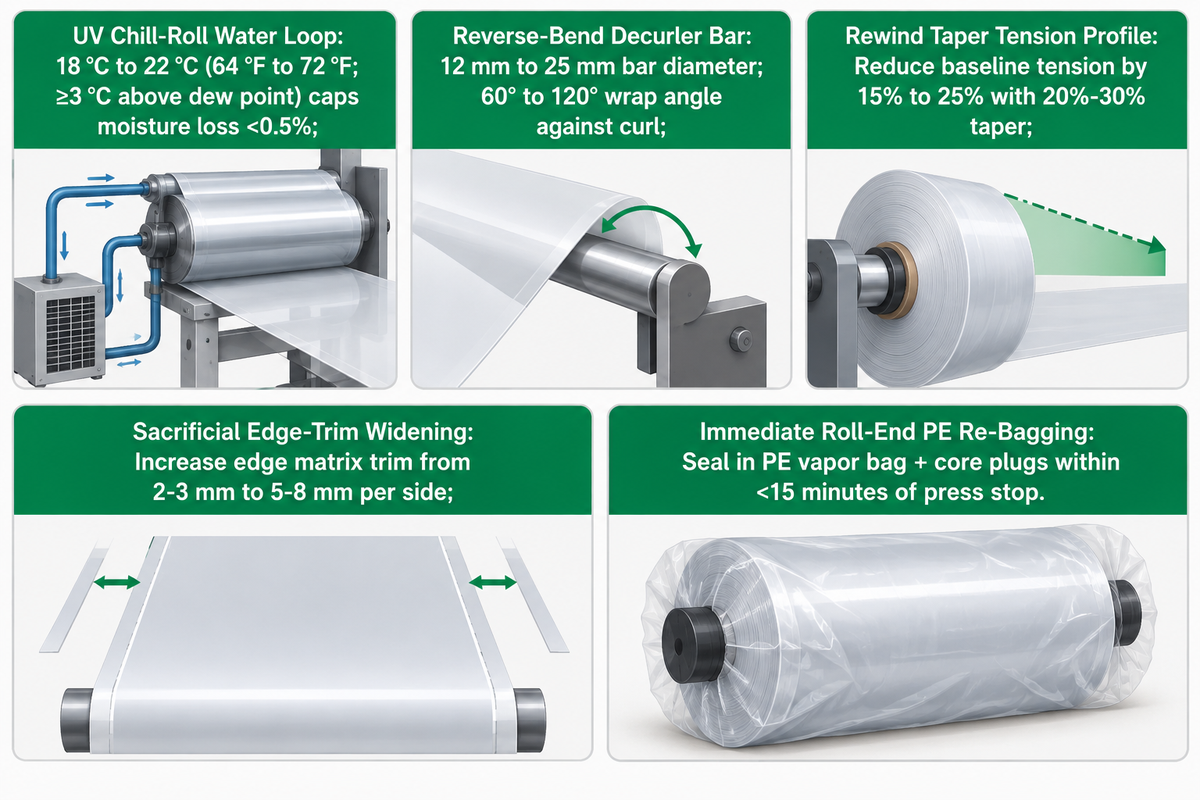
When a paper release liner curls mid-run, hold UV chill-roll water at 18 °C to 22 °C (64 °F to 72 °F). Route the web over a 12 to 25 mm reverse-bend decurler bar and cut rewind taper tension by 15% to 25%. Seal partial rolls in plastic wrap across both ends within 15 minutes.
Radiant heat from curing lamps during multi-color UV flexo or UV inkjet printing processes warms the web. Exposure to heat can result in the liner losing moisture. That water loss can result in the liner shrinking and pulling edges toward the backing. Thermal liner shrinking causing poor layflat or sheet curl is more pronounced at slow press speeds with light glassine. In USPTO Patent US9212299B2, silicone coat weights are measured per 3,000 ft² ream by XRF after curing 30 s at 150 °C. X-ray fluorescence (XRF) is then performed to determine the weight. Coaters run the web through cooling stations and jet steamers to replenish moisture. On a printing press without steam units, chilled impression drums under each UV lamp protect liner moisture.
⚠️ Common Mistake: Over-Tensioning Unwind and Rewind Brakes to Pull a Wavy Web Flat
Do not increase unwind brake tension to pull a humidity-wavy paper liner flat across the press idlers. Damp cellulose edges yield at lower tension than dry center fibers. Pulling them tight stretches the outer edges plastically, and locks in camber, which is most pronounced at the slitting.
Amcor’s technical guidelines recommend full roll-end protection when partial rolls are removed from the press during a shift change. Covering all ends of the roll with a plastic wrap blocks water vapor and protects the paper from moisture. Leaving a roll of glassine uncovered over a humid weekend causes moisture to penetrate the roll 10 to 20 mm on both sides.
| Press-Side Control Lever | Target Operating Setpoint | Physical Mechanism on Release Liner | Defect Prevented |
|---|---|---|---|
| 1. UV Chill-Roll Water Loop | 18 °C to 22 °C (64 °F to 72 °F; ≥3 °C above room dew point) | Caps paper liner moisture loss below 0.5% per UV pass without drum condensation | Post-UV negative back curl and brittle glassine matrix breaks |
| 2. Reverse-Bend Decurler Bar | 12 mm to 25 mm bar diameter; 60° to 120° wrap angle against curl | Applies controlled reverse flexural yield prior to rotary die station or sheeter | Core-set MD curl near 76 mm core and mild positive face curl |
| 3. Rewind Taper Tension Profile | Reduce baseline tension by 15% to 25% with 20%–30% taper | Prevents radial pressure from trapping moisture swell or squeezing acrylic adhesive | Roll telescoping, adhesive ooze, and plastic edge stretching |
| 4. Sacrificial Edge-Trim Widening | Increase edge matrix trim from 2–3 mm to 5–8 mm per side | Removes the outer roll-end moisture absorption zone from active label lanes | Outer-lane waste-matrix snaps on slightly wavy master rolls |
| 5. Immediate Roll-End PE Re-Bagging | Seal in PE vapor bag + core plugs within <15 minutes of press stop | Seals exposed roll end faces where ambient water vapor enters paper rolls | Between-shift wavy edges and weekend cockling on partial rolls |
Cost, MOQ, and Total Laminate Impact of Upgrading from 60 gsm Glassine to PCK or PET Release Liners
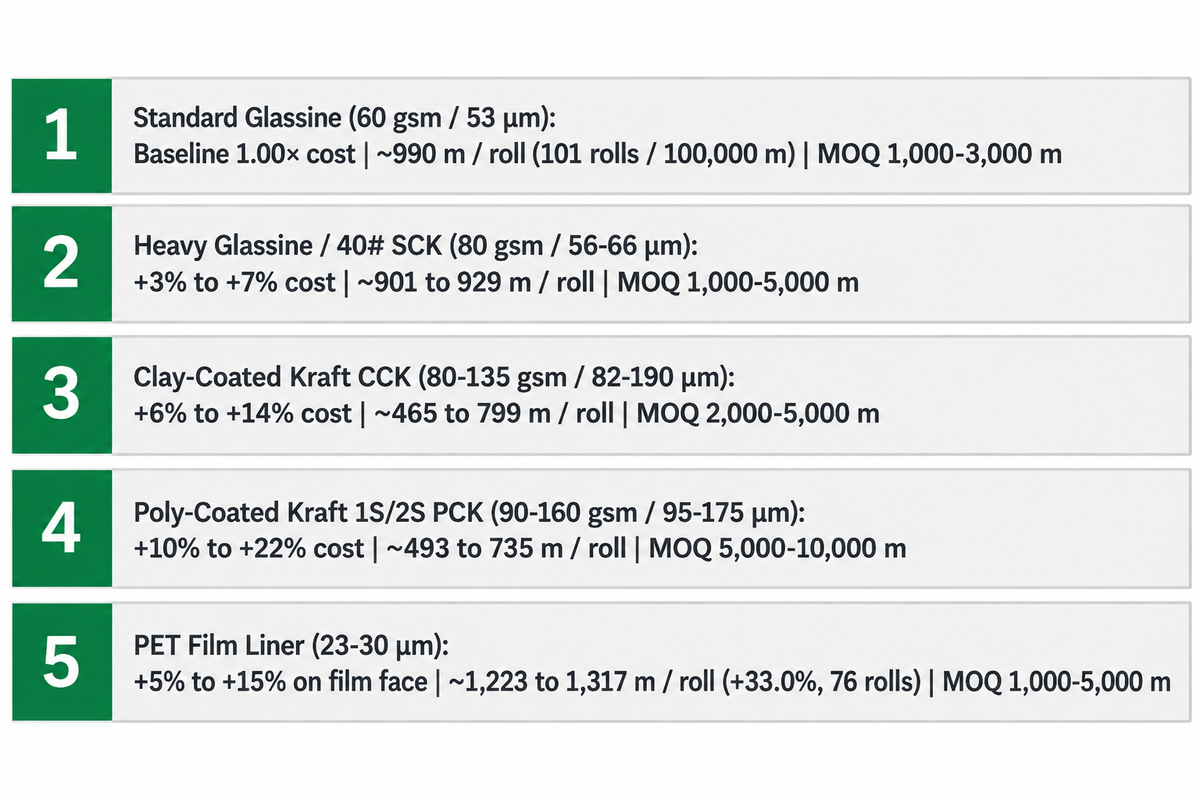
The release liner represents 15% to 25% of total pressure-sensitive laminate cost. Upgrading from 60 gsm glassine to 1S/2S PCK or thin PET film adds +5% to +15% to finished film label stock on thin PET (+10% to +25% on paper facestocks and PCK grades). Our two worked calculations compare (1) a 330 mm 60 gsm glassine web during a 35% to 65% RH jump (+0.59 to +0.83 mm CD growth vs. 0.00 mm on BOPP) and (2) a 400 mm OD roll where a 23 µm PET liner holds ~1,317 linear meters versus ~990 linear meters on 53 µm glassine (+33.0% footage, cutting 100,000 m roll changes from 101 to 76).
How Much Does Upgrading from 60 gsm Glassine to PCK or PET Liner Add to Finished Label Stock Cost?
Upgrading from standard glassine to a thin PET release liner raises total finished label stock cost by 5% to 15% on film laminates. On economy paper laminates, net cost rises by 10% to 25%. Thinner PET liners cut roll changeovers by 25%.
Buyers often hesitate when a raw liner quote prices PCK or PET film 30% to 60% above standard glassine. Looking at raw liner prices alone misses two converting facts covered in our pressure-sensitive label stock procurement and cost breakdown guide. First, the release liner makes up only 15% to 25% of finished laminate cost alongside facestock and adhesive. Second, replacing standard glassine with thin PET trims total laminate caliper by 30 µm. That thinner gauge packs 33% more labels onto every 400 mm roll and stops FINAT FTM 23 die-strike scrap. It also stabilizes 300 mm/min peel performance under FINAT FTM 1 (180°) and FTM 2 (90°).
📐 Worked Calculation (2): 400 mm Outer-Diameter Roll Linear Capacity & Changeover Reduction (53 µm Glassine vs. 23 µm PET)
Assumed inputs: Suppose a converter runs a 50 µm BOPP facestock with 18 µm of acrylic adhesive (68 µm combined face + adhesive). Rolls wind on a 76 mm (3-inch) inner-diameter core with an 86 mm outside diameter (Dc = 86 mm) to a 400 mm outer diameter (Do = 400 mm). Option A uses a 53 µm (60 gsm) glassine liner (total caliper t1 = 68 + 53 = 121 µm = 0.121 mm). Option B uses a 23 µm PET liner (total caliper t2 = 68 + 23 = 91 µm = 0.091 mm). Apply the annular roll length formula L = π × (Do2 − Dc2) ÷ (4 × t × 1,000).
Calculation: Cross-sectional area factor = 3.1416 × (160,000 − 7,396) ÷ 4 = 119,855 mm2. For Option A (53 µm glassine, t1 = 0.121 mm): L1 = 119,855 ÷ 121 = 990.5 linear meters per roll (~990 linear meters). For Option B (23 µm PET liner, t2 = 0.091 mm): L2 = 119,855 ÷ 91 = 1,317.1 linear meters per roll (~1,317 linear meters, or +33.0% footage). Across a 100,000 m labeling campaign, Option A requires 101 rolls while Option B requires 76 rolls (cutting roll changes from 101 to 76 and saving 25 roll splices). On these inputs, 23 µm PET at a fixed 400 mm roll diameter yields 1,317.1 linear meters (+33.0% over 53 µm glassine) and saves 25 roll splices.
| Release Liner Grade | Nominal Caliper & Share | Net Finished Laminate Cost Delta | 400 mm OD Roll Length (w/ 68 µm Face+Adhesive) | Typical Trial & Production MOQ |
|---|---|---|---|---|
| 1. Standard Supercalendered Glassine (60 gsm) | 53 µm (39% NA liner share w/ SCK) | Baseline (1.00× finished laminate) | ~990 linear meters / roll (101 rolls per 100,000 m) | 1,000 to 3,000 linear meters (stock master width) |
| 2. 80 gsm Heavy Glassine / 40# SCK | 56–66 µm (0.0024 in. ± 10% caliper) | +3% to +7% finished laminate cost | ~901 to 929 linear meters / roll (−7% to −9% length) | 1,000 to 5,000 linear meters (standard stock grade) |
| 3. 80–135 gsm Clay-Coated Kraft (CCK) | 82–190 µm (16% NA share; 77% EU graphics) | +6% to +14% finished laminate cost | ~465 to 799 linear meters / roll (stiff sheet/roll base) | 2,000 to 5,000 linear meters (stock or custom slit) |
| 4. 90–160 gsm Poly-Coated Kraft (1S / 2S PCK) | 95–175 µm (12–25 gsm PE barrier; 49% US graphics) | +10% to +22% finished laminate cost | ~493 to 735 linear meters / roll (maximum sheet layflat) | 5,000 to 10,000 linear meters (custom PE extrusion/lamination) |
| 5. 23–30 µm PET Film Release Liner | 23 µm or 30 µm (14% NA PET liner share) | +5% to +15% on film face (+10%–25% on paper face) | ~1,223 to 1,317 linear meters / roll (+23.5% to +33.0% length) | 1,000–5,000 m (stock BOPP/PET) or 5,000–10,000 m (custom swap) |
How to Specify Humidity-Stable Release Liner Constructions and Qualification Trials with Your Supplier
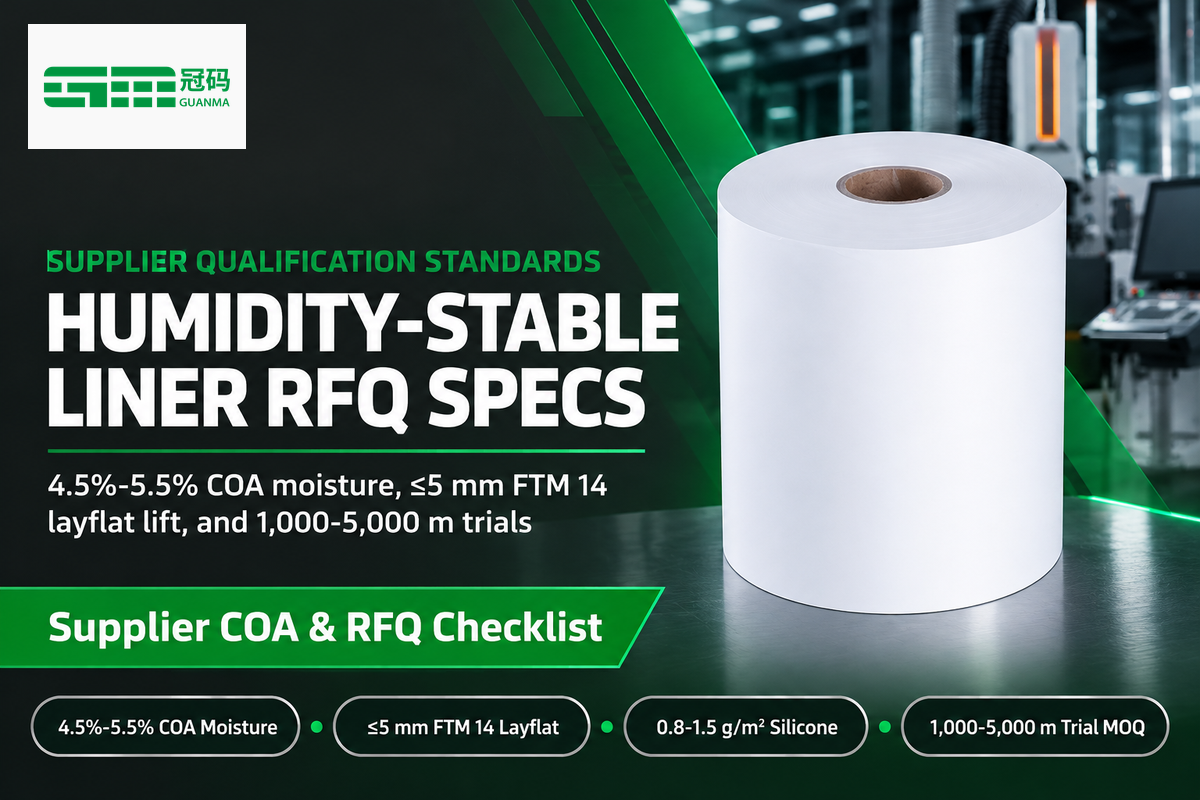
Specify an outgoing Certificate of Analysis (COA) liner moisture window of 4.5% to 5.5% by weight. Require a maximum FINAT FTM 14 layflat curl lift of ≤5 mm at 23 °C and 50% RH under ISO 187:2022. Add 12 to 25 gsm polyethylene barriers per side on 2S PCK and sealed PE roll-end vapor bags for sea freight.
In 2025 and 2026, buyers must also weigh humidity stability against European and North American liner recycling rules. A joint CELAB Europe and Centre Technique du Papier (CTP) recyclability study tested one-side silicone-coated 60g Glassine and 125g Clay Coated Kraft (CCK). Both paper grades proved recyclable under EN 13430 repulping protocols. Poly-coated kraft (PCK) and PET film liners have polymer layers and need to be collected via a specific liner take-back program, rather than the standard paper recycling stream. When end users demand EN 13430 paper repulping, pair 120–135 gsm CCK or 80 gsm glassine with heat-sealed PE roll-end bags.
When qualifying vendors, identify commercial release-liner base coaters (i.e. Mondi, Loparex, Ahlstrom, and Fox River Associates) from integrated pressure-sensitive label stock laminators. Base coaters provide a silicone release coating to jumbo liner reels, and integrated laminators (i.e. Avery Dennison, UPM Raflatac, Herma and Zhejiang Guanma Packaging Co. Ltd.) provide the complete facestock, adhesive, and liner laminate. At Guanma, we laminate paper, BOPP, and PET facestocks with release liner grades for converting and application trials. Our custom constructions span 55–80 gsm glassine, 80–135 gsm CCK, 1S/2S PCK, and 23–50 µm PET film liners. Every export lot undergoes FINAT FTM 25 water-based stain testing for silicone coverage and ships in double-end PE vapor wrapping.
Copy the 7-parameter specification table below, into your purchase order or trial roll inquiry, to lock-in flatness tolerances.
RFQ checklist — copy these into your quote request:
| Parameter | Recommended range | Why it matters | How to verify |
|---|---|---|---|
| 1. Outgoing Liner Moisture Content | 4.5% to 5.5% by weight (matched to 45%–55% pressroom RH) | Prevents immediate positive face curl or negative back curl upon unwrapping | Lot Certificate of Analysis (COA) + incoming sword hygrometer ERH check (≤8% RH delta) |
| 2. Sheet / Web Layflat Curl Lift | ≤5 mm maximum edge lift at 23 ± 1 °C and 50 ± 2% RH | Keeps web below the 1.5–2.0 mm optical gap sensor and sheet-feeder jam threshold | ISO 187:2022 & ASTM D685-26 conditioning + FINAT FTM 14 / 3-Step Diagonal-Cut Curl Test |
| 3. Release Liner Caliper Tolerance | ±10% max on paper (0.0024 inches ± 10% on 40# SCK) | Prevents outer-lane rotary die-strike crushing and high-speed matrix stripping breaks | Cross-web micrometer profile + FINAT FTM 23a/b die-strike stain inspection |
| 4. PCK Barrier Symmetry & Coat Weight | 12 to 25 gsm LDPE per side; specify 2S PCK for unconditioned humid shops | 1S PCK leaves raw kraft backside exposed to humidity; 2S PCK seals both faces up to 100–110 °C | Supplier tds cross-section spec + 24 h 65% RH humidity chamber layflat exposure |
| 5. Silicone Coat Weight & High-Speed Release | 0.8 to 1.5 g/m² silicone by XRF; stable release across 10 to 300 m/min | Prevents silicone transfer, dry-out micro-cracking, and peel-plate pre-dispensing | FINAT FTM 7 XRF coat weight, FTM 25 stain coverage test, and FTM 4 high-speed release |
| 6. Transit & Sea-Freight Vapor Packaging | Heat-sealed PE bag around full roll + both roll ends + core plugs + desiccant | Blocks maritime humidity and dew-point edge condensation before 12–72 h thermal hold | Incoming dock inspection of sealed roll-end barrier prior to unopened staging |
| 7. Trial Roll MOQ & Recycling Stream | 1,000–5,000 m stock trial (5,000–10,000 m custom); EN 13430 for 60g glassine/125g CCK | Validates rotary die anvil clearance and optical/ultrasonic sensors before bulk commitment | On-press 1,000 m qualification run + CELAB Europe / EN 13430 repulping declaration |
If the trial rolls pass the 7-point inspection, enforce the unopened pressroom conditioning schedule, on every delivery pallet.
Key takeaway
Eliminate release liner curl humidity defects by keeping incoming rolls wrapped for 12 to 72 hours until thermally balanced. Specify double-sided PCK or PET film liners when pressroom air stays humid.
Request Humidity-Stable Release Liner Sample Rolls & Technical COA Consultation
Wavy roll edges, post-UV back curl or asymmetric BOPP/curl may be resolved with custom-matched paper and film laminates, provided by Zhejiang Guanma Packaging Co., Ltd, in trial rolls of 1,000 to 5,000 linear meters, with COA moisture verification and sealed sea-freight vapor shipping.
Frequently Asked Questions About Release Liner Curl and Humidity
Q: Does high humidity permanently ruin curled paper release liner rolls, or can they be recovered?
Mild cross-direction edge wave or uniform face curl may be resolved by re-wrapping the roll and conditioning it for 24 to 48 hours at 23 °C and 50% relative humidity.
Moisture absorption can cause paper materials covered by ASTM D685-26 to wind tight, telescope, or cockle. Viscoelastic hysteresis prevents full recovery, and operators must slab off the outer wraps before running the roll.
Q: Why does my label stock curl away from the printed face after passing through UV curing lamps?
Radiant heat from UV curing lamps removes moisture from the paper liner, shrinking cellulose fibers.
When liner moisture drops below 4.0% while the cured ink or film facestock stays fixed, negative back curl appears immediately. Hold UV chill-roll cooling water at 18 °C to 22 °C (64 °F to 72 °F) to cap moisture loss.
Q: Is clay-coated kraft (CCK) or poly-coated kraft (PCK) better for sheeted labels in humid pressrooms?
2S PCK is better for unconditioned humid press rooms while CCK is better for conditioned shops (Monadnock and Avery).
Standard CCK (80 to 135 gsm) has a high stiffness and resistance to 160 °C, but the uncoated kraft side of the board still breathes. 2S PCK has barrier layers on both sides.
Q: What is the ideal pressroom humidity for converting glassine release liners?
Maintain a practical pressroom operating range of 45% to 55% RH at 20 °C to 24 °C, centered around the ISO 187:2022 standard conditioning atmosphere of 23 ± 1 °C and 50 ± 2% RH, to keep glassine liners flat.
Q: Why should cold label stock rolls never be unwrapped immediately upon entering a warm pressroom?
Rolls of cold labels are wrapped to protect the label stock from condensing moisture. If the rolls of labels are removed from their wraps before the core of the rolls is warmed above the press room’s dew point, moist air will condense on the edges of the rolls.
The edges of the label rolls quickly absorb the moisture in the air and become fluted. A moisture gradient can lead to cross-web tension variations, FINAT FTM 23 die-strike drift, and matrix breaks.
Q: Does switching from a paper release liner to a PET film liner require press sensor changes?
Yes; transparent 23 µm and 30 µm PET film liners reduce optical contrast, requiring ultrasonic, capacitive, or reflective black-mark applicator gap sensors.
Q: Can poly-coated kraft (PCK) and silicone glassine release liners be recycled in standard paper streams?
One-side silicone-coated 60g glassine and 125g clay-coated kraft (CCK) release liners are recyclable under EN 13430 per CELAB Europe and CTP, whereas poly-coated kraft (PCK) is not.
Because PCK contains extruded polyethylene barriers and PET liners are 100% polyester film, both require dedicated release-liner take-back collection programs rather than standard paper repulping mills.
Engineering Perspective Behind This Converting Guide
This troubleshooting guide combines ISO 187:2022 and ASTM D685-26 (Paper Conditioning Standards) and FINAT FTM 4, FTM 14, FTM 23 and FTM 25 test methods. It includes converting production data on papermaking, barrier coated kraft, and polyester film release liners. We built the 330 mm web CD expansion model and 400 mm roll-capacity calculations to help converters stop moisture curl and die-strike scrap. Reviewed by the Technical Department of Zhejiang Guanma Packaging Co. Ltd.
References & Sources
- ISO 187:2022, Paper, Board and Pulps: Standard Atmosphere for Conditioning and Testing (Edition 3) Swedish Institute for Standards (SIS) / International Organization for Standardization
- US Patent US9212299B2, Coated Release Liner Substrate and Post-Curing Jet Steamer Conditioning United States Patent and Trademark Office (USPTO)
- ASTM D685-26, Standard Practice for Conditioning Paper and Paper Products for Testing ASTM International
- FINAT Technical Handbook (11th Edition): Test Methods FTM 1, FTM 4, FTM 10, FTM 14, FTM 23, and FTM 25 FINAT (European Association for the Self-Adhesive Label Industry)
- Standard Climate Conditioning Equilibrium (23 °C and 50% Relative Humidity) and Moisture Absorption Kinetics National Center for Biotechnology Information (NCBI PubMed Central)
- Release Liners: North American & Global Pressure-Sensitive Substrate Market Report (March 2025) Label & Narrow Web
- CELAB Europe & CTP Study on EN 13430 Recyclability of 60g Glassine and 125g CCK Silicone Release Liners CELAB Europe (Toward A Circular Economy for Labels) & Centre Technique du Papier