Get in Touch with Guanma

GSM to Ounce Converter for Fabric and Label Materials

Area-weight conversion guide for label-material specifications
This GSM to ounce converter is a bidirectional area-weight tool: divide GSM by 33.9057474748823 for oz/yd², or multiply oz/yd² by the same factor for GSM. It keeps “ounce” scoped to ounce per square yard, not a plain ounce or an ounce per linear yard.
Gram per square metre to ounce per square yard converter
Convert in either direction, then keep the measured component and original unit in your material handoff.
Result
oz/yd²
200 g/m² = 5.8987 oz/yd²
This tool converts area weight only: GSM and oz/yd². It does not convert plain ounces, linear-yard weight, thickness, or material performance.
33.905747GSM in 1 oz/yd²
5.89870oz/yd² in 200 GSM
11.79741oz/yd² in 400 GSM
What does “ounce” mean in a GSM converter?
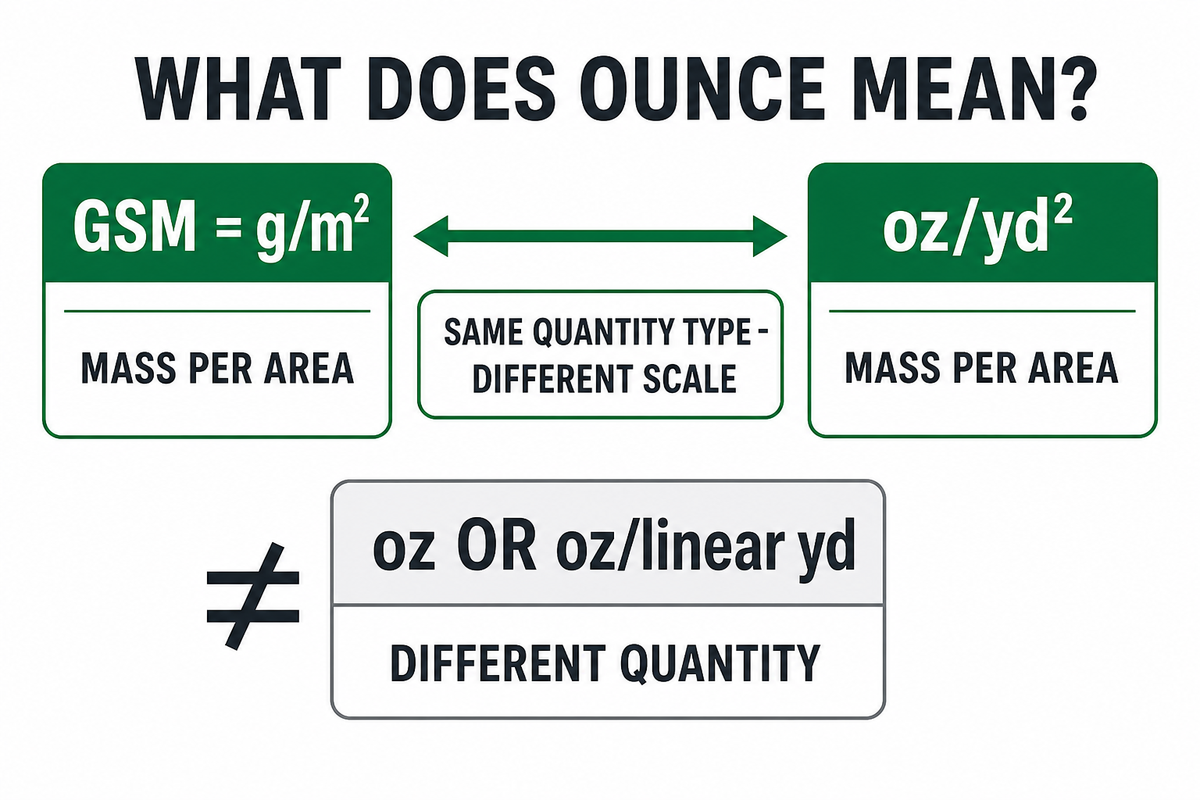
GSM means grams per square metre, so it describes mass over an area. Its matching US customary expression is ounces per square yard, written oz/yd². Both units answer the same question: how much does a fixed area of material weigh?
Plain ounces do not include an area denominator. Neither does “ounces per linear yard,” because a linear yard states length but not width. Entering one of those quantities into an area-weight converter creates a category error even if the arithmetic appears tidy.
NIST Special Publication 811, Appendix B.8 lists the avoirdupois ounce separately from ounce per square yard. That distinction is the converter’s first input check: use it only when the source specification is GSM or oz/yd².
Compatible area-weight units
- g/m² or GSM
- oz/yd²
- A value tied to a stated material component
Different quantities
- oz with no area denominator
- oz per linear yard without width
- caliper, mil or micrometre thickness
How do you convert GSM to oz/yd²?
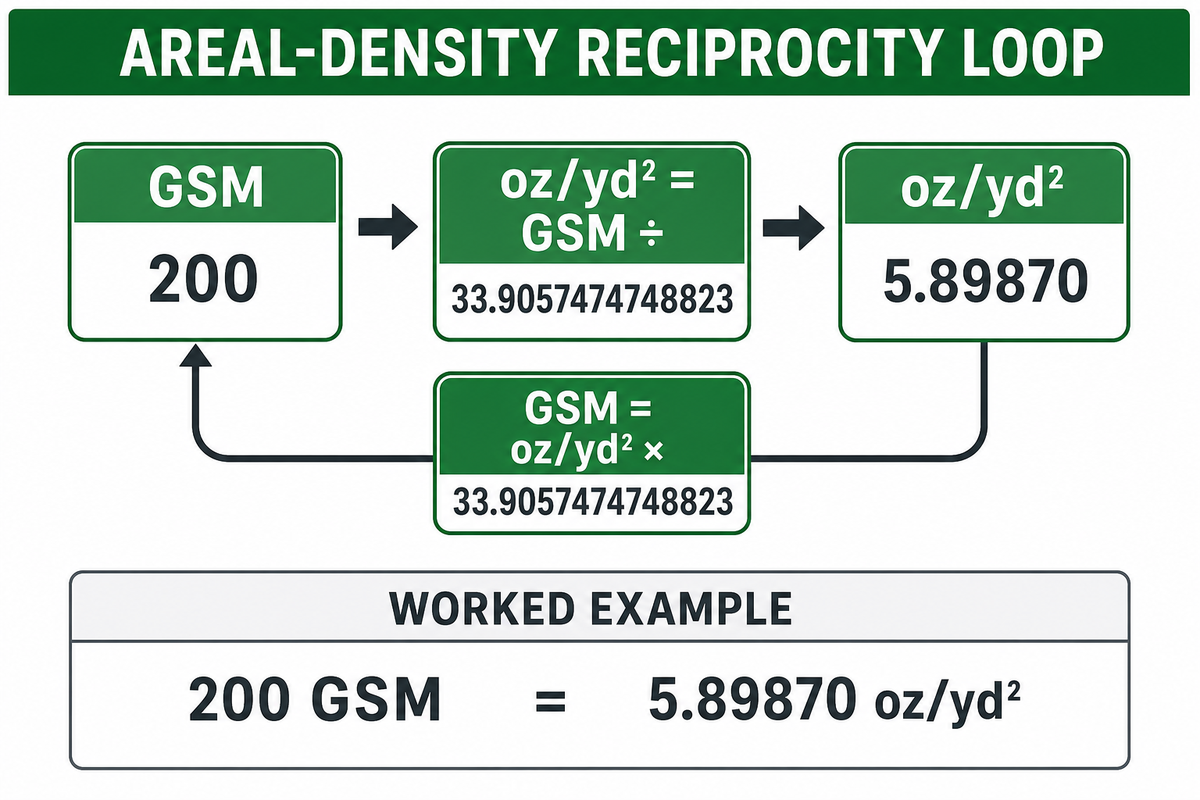
To convert GSM to oz/yd², use oz/yd² = GSM ÷ 33.9057474748823. Reverse the calculation with GSM = oz/yd² × 33.9057474748823. Keep the full factor throughout the calculation, preserve the original source unit, and round only the displayed answer.
With the unit boundary established, a buyer comparing a supplier’s 200 GSM specification with 5.89870 oz/yd² should treat a missing square-yard denominator as a mismatch risk. Because NIST defines the mass and area factors separately, retain the source value and unit. That lets a factory reviewer audit rounding on a 54-inch production web instead of guessing whether “oz” means area weight or total mass.
This factor follows from two fixed quantities. One avoirdupois ounce is 28.349523125 grams, and one square yard is 0.83612736 square metres. Dividing the mass by the area gives 33.9057474748823 grams per square metre—also written grams per square meter in US English—for one ounce per square yard. NIST Handbook 44, Appendix C independently records the square-yard area used in that calculation, and the current NIST Handbook 44 index identifies the active edition.
The Areal-Density Reciprocity Loop prevents forward and reverse answers from drifting apart. For 200 GSM, the calculation is 200 ÷ 33.9057474748823 = 5.898704936… oz/yd², displayed here as 5.89870. Running that unrounded result in reverse returns 200 GSM.
Keep the denominator visible. Even a correct number labelled only “oz” no longer tells the receiving team what area was measured.
GSM-to-oz/yd² reference table
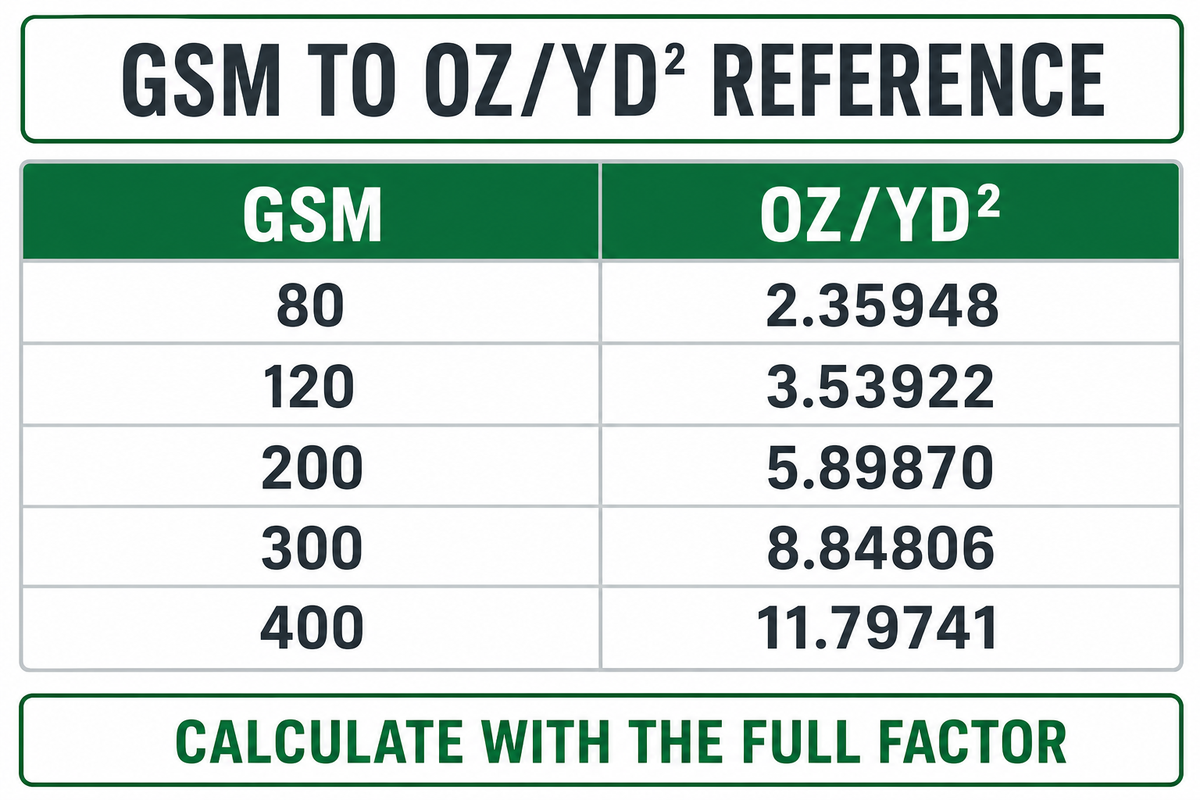
These values are calculation references, not recommended material weights. Every row comes from the same factor used by the calculator. Five decimal places are shown so buyers can audit the arithmetic without implying that a production measurement has five-decimal precision.
| GSM | oz/yd² |
|---|---|
| 50 | 1.47468 |
| 80 | 2.35948 |
| 100 | 2.94935 |
| 120 | 3.53922 |
| 150 | 4.42403 |
| 180 | 5.30883 |
| 200 | 5.89870 |
| 250 | 7.37338 |
| 300 | 8.84806 |
| 350 | 10.32273 |
| 400 | 11.79741 |
| 500 | 14.74676 |
For a reverse check, 1 oz/yd² equals 33.90575 GSM when displayed to five decimals; 3 oz/yd² equals 101.71724 GSM; 5 oz/yd² equals 169.52874 GSM; and 10 oz/yd² equals 339.05747 GSM. Rounded table values may return a tiny display difference. Internally, the calculator avoids compounding that difference by using the full factor.
Using fabric supplier values
A fabric weight converter is useful when a textile supplier quotes GSM while a buyer’s comparison sheet uses oz/yd². Copy the fabric value exactly, confirm that it describes weight per area, and record the converted unit in full. Polyester fabric, woven fabric and coated fabric can all carry area-weight specifications, but their shared unit does not make the materials interchangeable. Treat each fabric entry as a unit translation only. The second fabric-weight check belongs in the material specification: confirm the named fabric or component before comparing the numbers.
A fabric weight calculator may label the reverse direction “oz to GSM,” while a downloadable conversion chart may call the same operation fabric weight conversion. Regardless of the interface, the conversion formula and conversion table must preserve the square-area denominator. The metric side describes grams on one square meter; the US customary side describes ounces on a square yard of fabric. These are two measurement systems for the same quantity, not two fabric weight classes.
When comparing fabric from international suppliers, identify the source unit before ordering fabric. A listing for denim, apparel fabric or upholstery may use an imperial measurement, while another international fabric listing uses GSM. Textile professionals can convert fabric values to compare the weight of a fabric, but the number does not decide construction. Lower GSM does not automatically mean breathable, and a denser fabric is not proven stronger merely because it is denser. The weight of the fabric remains one specification field.
Yardage creates a separate question. One yard states length; it does not state how many square yards are present until width is known. Likewise, one square meter of fabric describes an area, while square meters to square yards is an area conversion rather than an area-weight conversion. The exact yard is 0.9144 metre, but that length fact alone cannot produce roll mass. In the textile industry, accurate conversion means keeping unit identity, area and material identity attached throughout the comparison. This is the practical foundation for understanding fabric weights without turning a unit result into an international standard for product performance.
Do not use this table for paper basis-weight conversions such as text, bond, cover or index pounds. Those units depend on a grade’s basis-sheet size and ream convention. Use the paper weight conversion guide when the source specification is in paper pounds rather than oz/yd².
Why fabric width and linear yards are different calculations
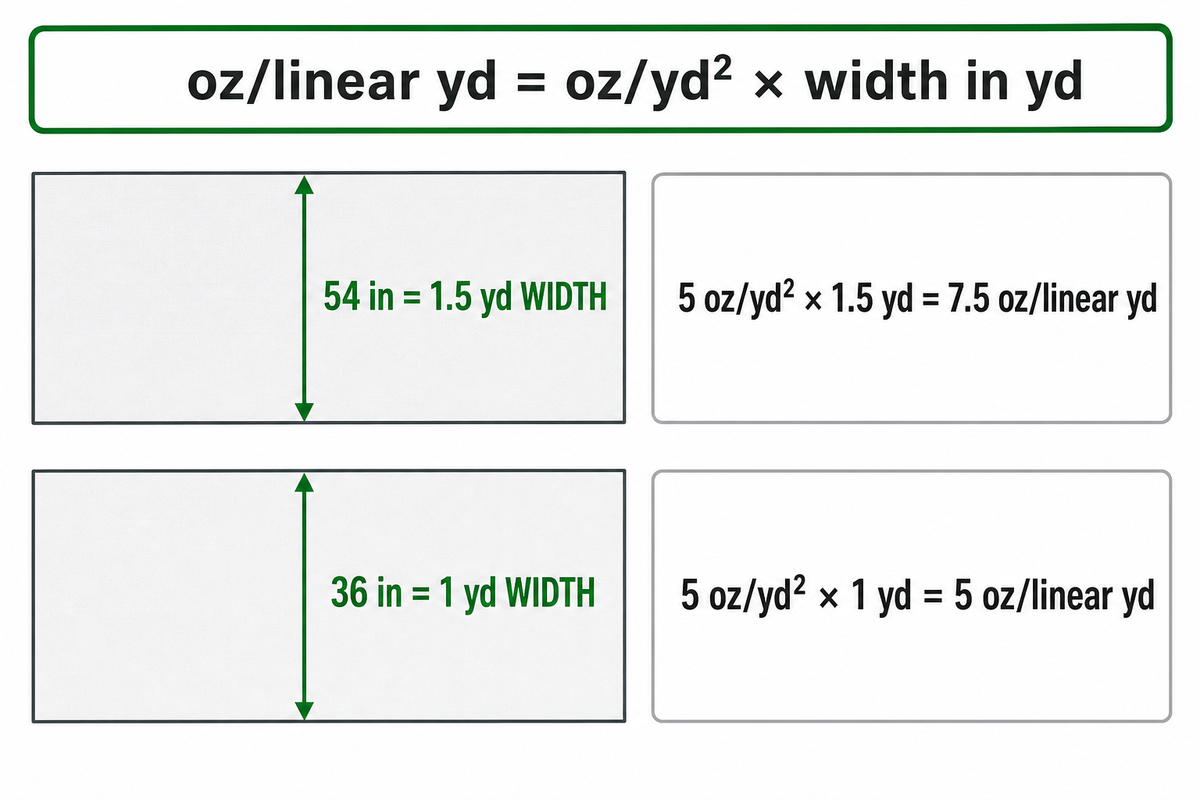
After the area-weight table, keep the next quantity distinct: oz/yd² is mass per area, while oz per linear yard is mass per length. To move from the first quantity to the second, the material width must be known in yards. The dimensional relationship is:
After using the area table, a buyer or supplier still needs width before converting a 5 oz/yd² specification on a 54-inch web. Treating those figures as interchangeable creates a mismatch risk because it can misstate a factory’s production-roll mass. The application needs both width and area weight. A commercial fabric-weight reference flags the same area-versus-linear-yard distinction.
ounces per linear yard = oz/yd² × width in yards
For example, material rated at 5 oz/yd² and 54 inches wide has a width of 1.5 yards. One linear yard therefore covers 1.5 square yards and weighs 7.5 ounces. The same area weight on a 36-inch-wide web covers one square yard per linear yard and weighs 5 ounces. The GSM-to-ounce converter can’t choose between those answers because width is absent from a GSM value.
The same boundary matters for label stock and fabric rolls. Changing roll width alters the area carried by each running metre or yard, even when the fabric weight per square yard stays unchanged. Use the MSI calculator when the next task is area-based planning, and retain roll width and length as separate inputs.
Does higher GSM mean thicker or better material?
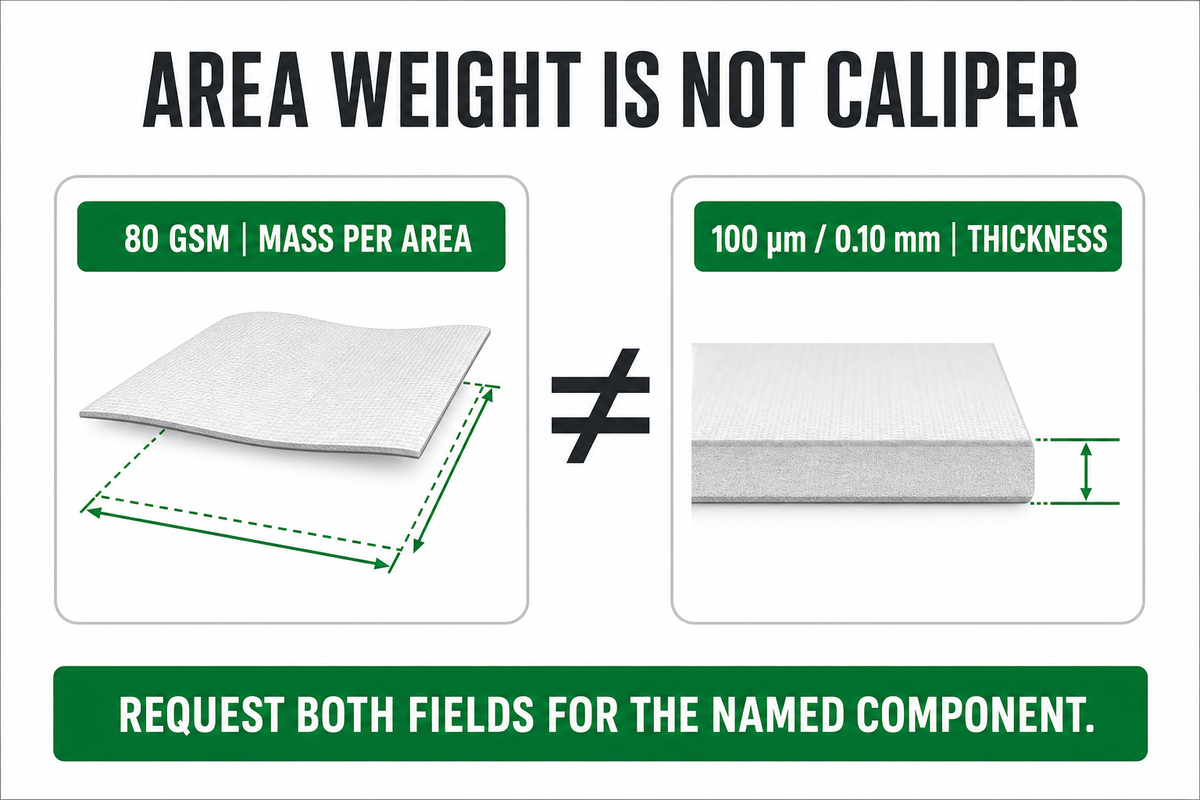
A GSM conversion cannot establish thickness or performance. GSM records mass per area; caliper records thickness. Suppliers may list both fields, but converting one area-weight unit into another does not create the missing caliper measurement. Government textile training material likewise separates fabric weight from thickness and quality.
This boundary matters when a buyer compares a supplier’s 80 GSM facestock with a 100 µm, or 0.10 mm, caliper entry for a production application. Treating them as interchangeable creates a mismatch risk because density and structure differ. A factory reviewer should ask for the named component and measurement method.
Label Academy’s substrate-specification guidance treats grammage, caliper and adhesive as separate entries. Bharat Skills textile training material also warns that weight does not by itself state fabric thickness or quality. That is the safe boundary for this calculator: the output can restate area mass, but it cannot establish material thickness, adhesive selection, print response or finished-label performance.
Mass-versus-Caliper Boundary: if a purchasing decision depends on thickness, request a caliper value for the named component or construction. If it depends on application performance, request the relevant material specification and test basis. Do not translate a higher GSM number into “thicker,” “stronger” or “better” without those separate facts.
This distinction also prevents an incorrect unit bridge. GSM cannot be converted directly to mil or micrometres unless a material-specific relationship between area mass and thickness is independently known. The calculator therefore offers only GSM and oz/yd².
How to use the result in a label-material specification
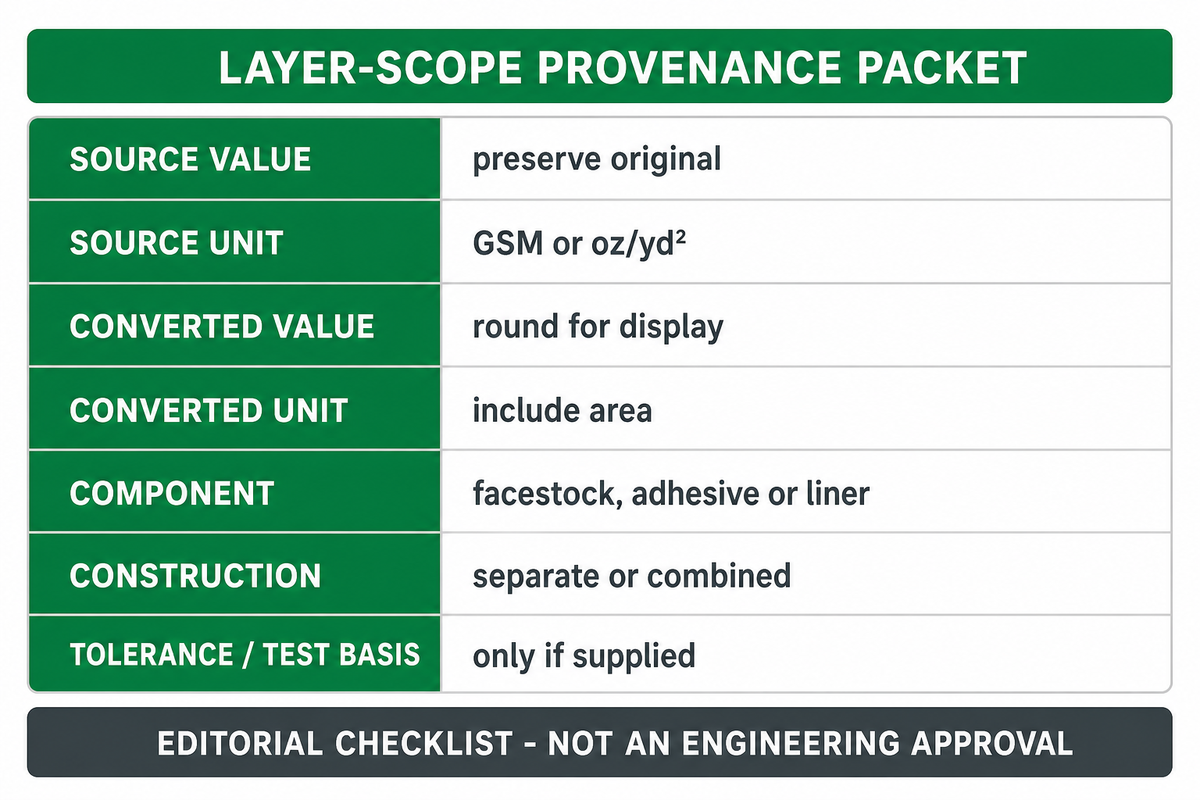
Area-weight conversion is useful only when the receiving team can tell what was measured. Self-adhesive constructions may include a facestock, adhesive and release liner. One GSM value could refer to one component or to a combined sample. The number alone does not identify its owner.
With thickness kept separate from area weight, the converted value can travel safely into a supplier comparison. The practical safeguard is traceability: every number stays beside its original unit, component and measurement context.
This article suggests a Layer-Scope Provenance Packet with seven entries. It is an editorial checklist for clearer inquiries, not a proprietary Guanma method or an engineering approval standard:
- Source value — preserve the supplier or drawing value before conversion.
- Source unit — state GSM or oz/yd² explicitly.
- Converted value — include the calculator result at a practical display precision.
- Converted unit — write oz/yd² or GSM, including the area denominator.
- Component measured — identify facestock, adhesive, liner or complete construction.
- Construction context — name the material family and whether layers are separate or combined.
- Tolerance or test basis — include it when the source provides one; do not invent a value.
For example, a concise handoff might read: “Facestock area weight: 80 GSM, equivalent to 2.35948 oz/yd² for unit comparison; caliper and adhesive specification supplied separately.” That wording preserves the measured component and prevents the converted number from being mistaken for the entire label construction.
Guanma groups relevant materials under self-adhesive paper, self-adhesive film and release paper liner. Those pages provide the routing context for an inquiry; they do not turn the converter output into a material recommendation.
What the converter cannot determine
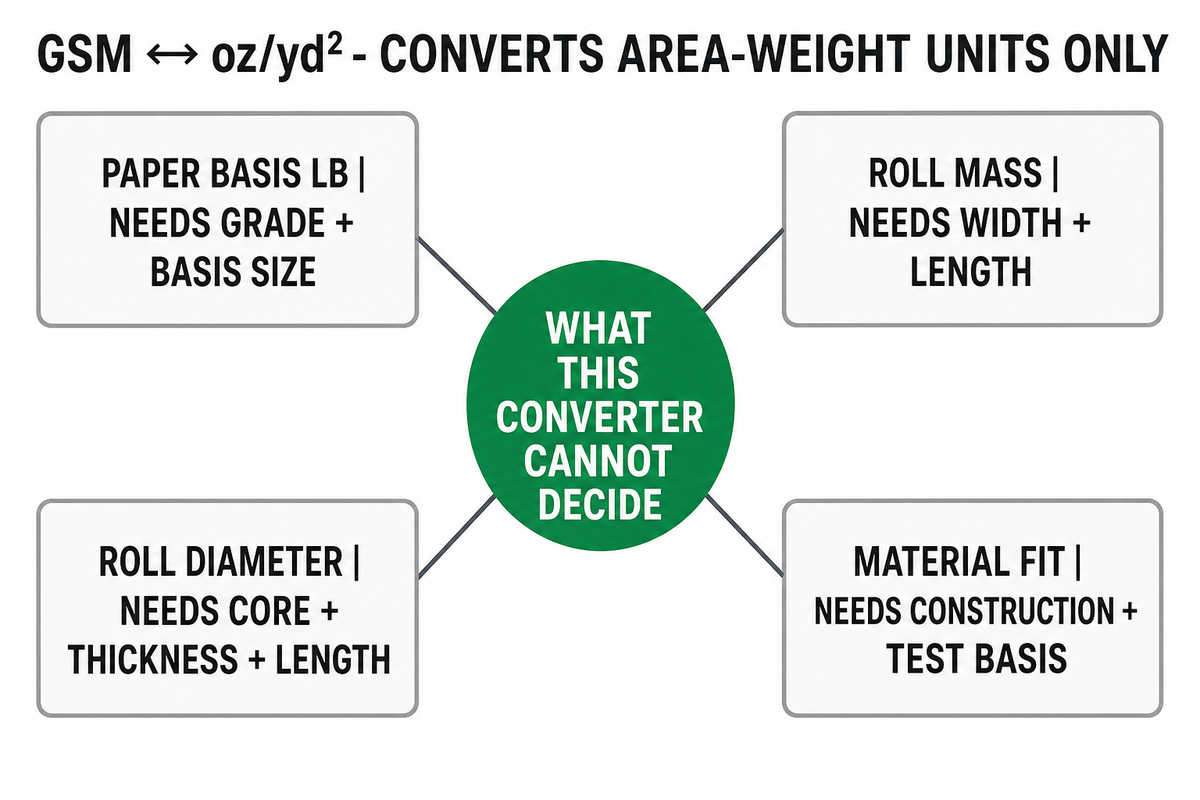
The converter does not determine paper grade, basis-weight pounds, total roll mass, roll diameter, caliper, adhesive selection, printability or application fit. Each question needs additional inputs, a named material component, or a separate specification before a buyer can use the result for procurement.
That limit avoids a common buyer mistake. A supplier request that treats 60 lb paper as 60 GSM creates a mismatch risk because the pound value belongs to a grade-specific basis-sheet convention. A factory or procurement reviewer should resolve the paper grade before carrying the number into an RFQ.
Paper pounds are especially easy to confuse with oz/yd². The figure “60 lb paper” is tied to a basis size and sheet count, so it is not a direct synonym for a fixed GSM value across grades. Roll-mass calculations additionally need web width and length. Roll-diameter calculations need the wound construction’s thickness, core diameter and length.
Decision boundary
Use this calculator only to translate one area-weight expression into the other. Keep component identity, caliper, construction and application requirements in separate fields.
When those fields are ready, send Guanma the material inquiry with both the source and converted area-weight values. That gives the supplier a traceable unit handoff without suggesting that arithmetic alone verifies suitability.
Frequently asked questions
What does GSM mean?
GSM means grams per square metre, a measure of material mass over a stated area rather than total sample weight, material thickness, or product performance.
Material rated at 200 GSM has a nominal area mass of 200 grams for each square metre. The value does not state total sample mass unless area is known, and it does not state thickness. In a US customary fabric weight specification, the comparable unit is ounces per square yard rather than a plain ounce.
What is 200 GSM in oz/yd²?
Two hundred GSM equals about 5.89870 oz/yd².
Divide 200 by 33.9057474748823 to obtain 5.898704936… oz/yd², then round only the displayed result. The answer is ounces per square yard, not the total ounces in a roll or sheet. Keep 200 GSM beside the converted value when it is the source specification. If a supplier lists several layers, confirm which layer the 200 GSM value describes before comparing materials.
What is 400 GSM in oz/yd²?
Four hundred GSM equals about 11.79741 oz/yd².
The calculation is 400 divided by 33.9057474748823. The higher area weight does not, by itself, prove a particular caliper or performance level. Compare thickness and other material fields separately if they affect the purchasing decision. Also retain the original 400 GSM specification so a reviewer can trace the conversion and its rounding.
How do I convert oz/yd² back to GSM?
Multiply oz/yd² by 33.9057474748823.
For example, 5 oz/yd² × 33.9057474748823 = 169.528737… GSM, displayed as 169.52874 GSM. Use the full factor during calculation and round at the end. A value labelled only “5 oz” is insufficient because it does not establish the square-yard denominator.
Is oz/yd² the same as ounces per linear yard?
No. Ounces per square yard measures mass over an area, while ounces per linear yard measures mass over a length and therefore also depends on material width.
To obtain ounces per linear yard, multiply oz/yd² by the web width expressed in yards. A 54-inch web is 1.5 yards wide, so 5 oz/yd² becomes 7.5 ounces per linear yard. Without width, the linear-yard result cannot be calculated.
Is GSM the same as material thickness?
No. GSM measures mass per area, while caliper measures thickness; one field cannot be converted into the other without a documented, material-specific relationship and measurement basis.
Specifications may list both fields, but unit conversion does not turn one into the other. Request caliper separately when thickness matters.
Can I convert paper pounds to GSM with this tool?
Not safely. Paper basis weight in pounds depends on the paper grade’s basis-sheet size and ream convention, which this direct area-weight converter does not know.
Use a grade-aware paper weight reference instead. This calculator handles only the direct area-weight relationship between grams per square metre and avoirdupois ounces per square yard. Paper pounds can refer to different basis-sheet sizes and ream conventions, so equal pound figures across grades do not guarantee equal GSM. The tool also does not know the paper grade, roll width, web length, caliper or full construction. Preserve the original pound specification, identify the grade, and use the paper-weight guide before carrying any converted figure into a supplier comparison.
References & Sources
- NIST Special Publication 811, Appendix B.8 — Conversion Factors
- NIST Handbook 44, Appendix C — General Tables of Units of Measurement
- NIST — Current Handbook 44 Edition
- Label Academy — Design and Origination
- Bharat Skills — Textile Training Material
- Fabric Formula — Fabric Weight Reference
Method note: all displayed conversion examples use one factor derived from the NIST ounce and square-yard relationships. Values are rounded only for display and aren’t material recommendations.
WHY WE WRITE THIS
About Guanma
Guanma is a self-adhesive film, label stock, and release liner manufacturer for industrial labeling applications. Our team works with PET film, PP synthetic paper, coated paper, hot-melt PSA, acrylic PSA, water-based adhesive, glassine liner, and CCK release liner.
We write these guides to help label converters, packaging buyers, and industrial procurement teams choose materials by real application conditions instead of generic catalog names. Most label failures come from a mismatch between facestock, adhesive, liner, substrate, temperature, printing method, or end-use environment. Our content explains those decisions in practical terms.
Our Experience
Guanma’s material guidance is based on coating, lamination, slitting, sample validation, and customer troubleshooting experience across Thailand and Vietnam production. We focus on common industrial label problems such as cold-temperature peel, oil and chemical exposure, UV aging, print durability, release force, MOQ, lead time, and substrate-matched testing.
Our Expertise
We reference practical testing logic and recognized label-industry standards, including FINAT FTM peel and shear methods, ASTM peel testing methods, FDA 21 CFR 175.105, REACH, RoHS, FSC, and ISO 9001-related quality control. For custom label stock, we always recommend testing samples on the buyer’s real substrate before full production.
SYS.PROFILE
Visit Website
Contact Profile
Name
Guanma Manufacturing Team
Brand Name
Guanma
Country
Thailand + Vietnam Production
Model
B2B / Wholesale / Custom Coating
Main Products
Self-Adhesive Film, Label Stock, Release Paper & Liner
Contact
Submit RFQ via Website Form
Website
https://guanmalabel.com/