Get in Touch with Guanma

Fl oz to mL is a liquid-volume conversion: multiply US fluid ounces by 29.57353. The calculator uses the underlying US customary definition and displays up to four decimal places. British Imperial fluid ounces are smaller, at about 28.41306 mL each, so select the denomination before you copy a result into packaging artwork.
US fluid ounce to millilitre converter
Convert between US fluid ounce and millilitre. The unit changes; the measured quantity does not.
Result
mL
1 fl oz (US) = 29.5735 mL
US and Imperial fluid ounces use different definitions. At 8 fl oz, the US result is 236.59 mL and the Imperial result is 227.30 mL—an exact-value difference of 9.28 mL. Confirm the denomination before copying a result into label artwork; this calculator does not determine fill tolerances.
Use this fl oz to mL calculator by entering a number, choosing US fluid ounces or milliliters, and selecting Swap to reverse the conversion. If your question is “how many mL in an oz,” confirm that the source is a fluid ounce, not a mass ounce; mass-to-volume calculations also require density.
This online conversion calculator is a fluid ounces to milliliters converter for volume units used in the United States and, with the Imperial selection, the United Kingdom. It can convert fluid ounces to milliliters and run vice versa after you select Swap. It can also convert ounces to milliliters only when “ounces” means fluid ounces. Because the US customary and Imperial system are distinct measurement systems, a pint or Imperial gallon must retain its source denomination.
The calculator relates fluid ounces and milliliters; it does not infer cubic container dimensions, tube geometry or cosmetic-package fill. One US fluid ounce is 29.5735 milliliters when rounded to four decimals, while 30 milliliters is the separate nutrition-label household convention discussed below. The NIST SI volume guidance explains the liter-based metric context for milliliters.
29.57353 mLNIST table factor for 1 US fl oz
28.41306 mLabout 1 Imperial fl oz
3.924%denomination gap versus the US value
How do you convert fl oz to mL?
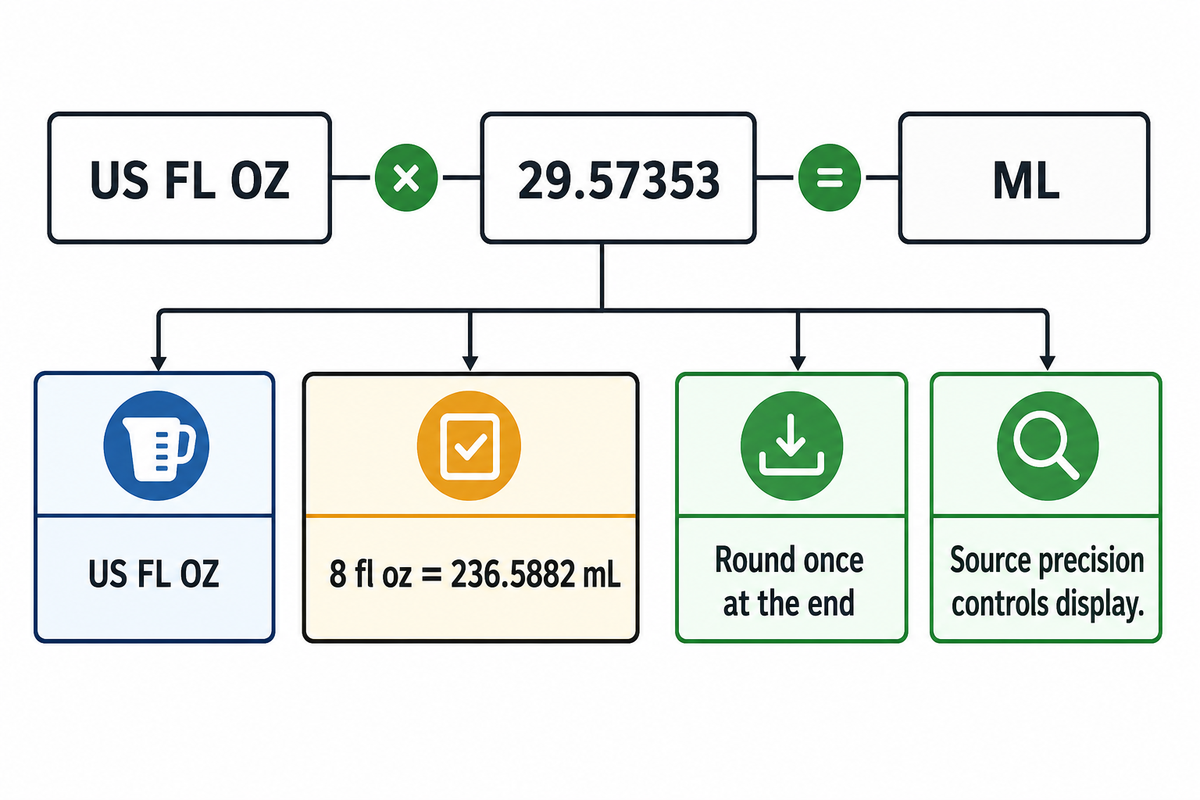
With a US fluid ounce, the working formula is mL = fl oz × 29.57353. The National Institute of Standards and Technology publishes 0.02957353 liter as the table equivalent for one US fluid ounce. Multiplying by 1,000 changes liters to milliliters.
Fluid-ounce measures are units of volume, not units of mass. The US fluid ounce belongs to the US customary system, while a milliliter is one thousandth of a liter in the metric system. That is why this volume conversion needs no ingredient or product density. By contrast, converting an ordinary weight ounce to milliliters would be impossible without knowing whether the material is water, oil, syrup or something else.
As a worked check, 8 × 29.5735295625 gives 236.5882365 mL, displayed by this page as 236.5882 mL. This result is included in the calculator’s regression test cases. When preparing a label-facing value, you may use 236.6 mL or another appropriate display precision, but do not round the factor to 30 before multiplying a larger pack size.
“Rounding should be the last step of the conversion process and should be performed only once.”
NIST Handbook 44, 2026 Appendix C
There’s a second limit: more digits don’t create a more accurate measurement. NIST’s SI conversion guidance says the displayed precision of a converted value should be consistent with the possible rounding error in the original value. Nominal “8 fl oz” capacity and a laboratory fill measurement recorded to several decimal places don’t justify the same output precision.
Think of the calculator result as a working value with a traceable formula. If the source says 8 oz as a nominal size, 236.5882 mL is useful for checking the arithmetic, while 236.6 mL may be the clearer comparison. If the source measurement is only reliable to 1%, publishing six decimal places would disguise the uncertainty rather than reduce it. The practical risk is an artwork mismatch because a nominal capacity can be copied into the wrong unit field and approved as if it were a measured fill.
Is 1 fl oz equal to 30 mL?
The answer depends on the context. Dimensionally, one US fluid ounce is about 29.57353 mL. However, 21 CFR 101.9(b)(5)(viii) defines 1 fl oz as 30 mL for nutrition-labeling household measures. That regulatory convention isn’t the mathematical identity of the unit, and it isn’t a blanket rule for every net-quantity declaration. Record which context you’re working in before choosing the displayed number. This is why a packaging record should name dimensional, nutrition or net-quantity use before copying the displayed number.
US vs Imperial fluid ounces: use the Fluid-Ounce Market-Unit Stamp
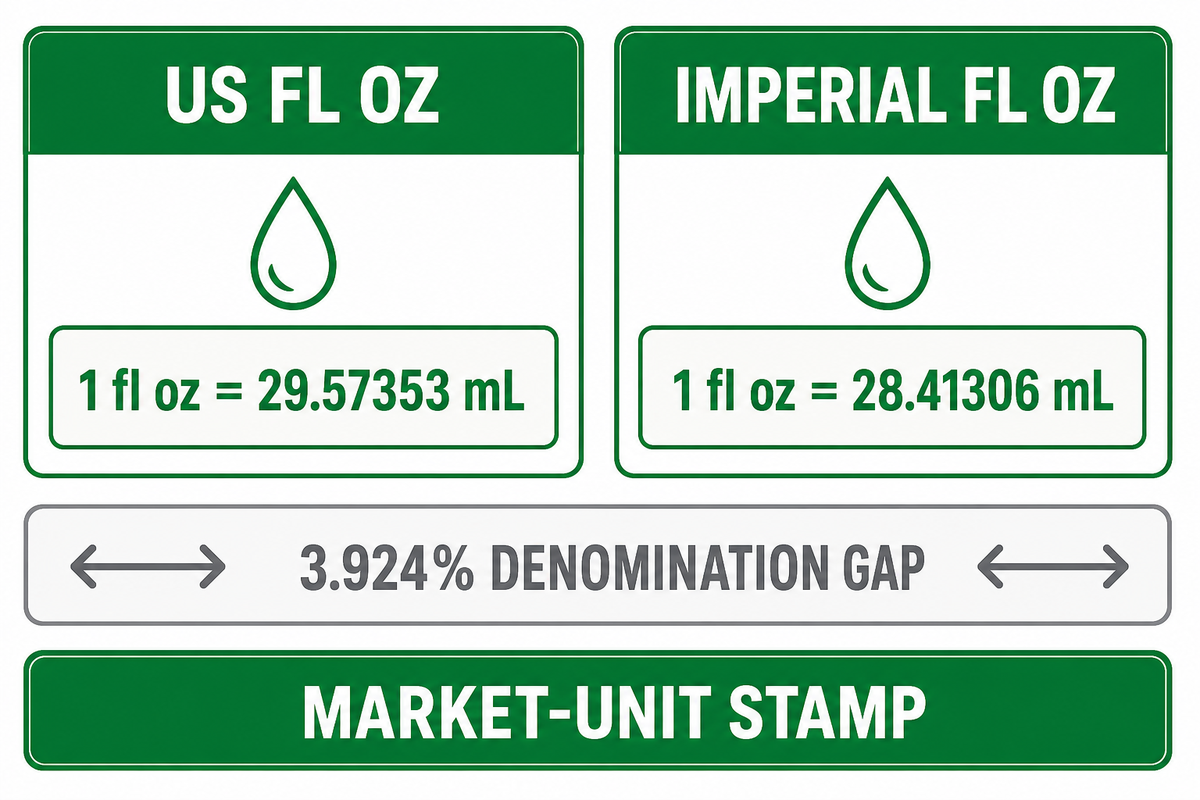
The letters “fl oz” do not identify one universal volume. The NIST Handbook 44 conversion table distinguishes US customary and British Imperial fluid ounces because they have different definitions. Using the wrong one changes the result by about 3.924% relative to the US value. That is the 3.924% Denomination Gap.
At 8 fl oz, the US result is 236.5882 mL, while the Imperial result is 227.3045 mL. The difference is about 9.2837 mL. Both calculations can be arithmetically correct; only one can match the unit system intended by the specification.
Add a simple Market-Unit Stamp: identify the target market, write “US fl oz” or “Imperial fl oz” in the source field, and only then run the calculation. If imported artwork says only “fl oz,” treat the denomination as unresolved rather than guessing from the container shape or the language on the proof.
This matters most when one design is adapted for several markets. Replacing the language and leaving the unit basis untouched can carry a US fluid ounce into an Imperial calculation. At 16 oz, the gap between the two denominations is about 18.5675 mL. At 32 oz, it is about 37.1350 mL. The percentage stays near 3.924%, but the absolute difference grows with pack size.
Do
- Name the target market and denomination.
- Retain the original capacity beside the calculated value.
- Choose display precision after the context is known.
Don’t
- Assume every “fl oz” means the US unit.
- Replace 29.57353 with 30 before multiplying.
- Treat calculator output as artwork approval.
12-size fl oz to mL conversion table
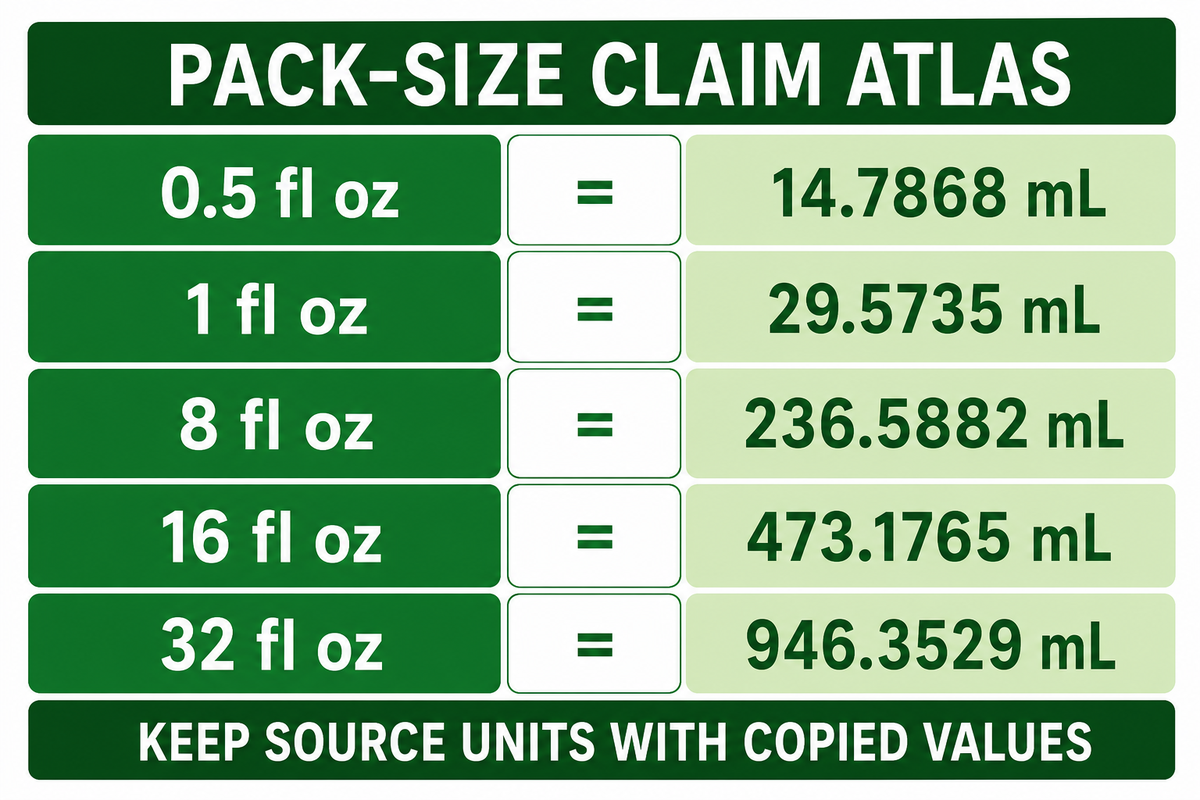
The Pack-Size Claim Atlas below keeps calculated values separate from familiar retail size neighbors. The forward rows use the same US fluid-ounce definition documented in the NIST Handbook 44 conversion table. Values are shown to four decimal places for checking, not as a claim that every package is filled or measured to that precision.
| Size category: US fl oz | Calculated mL | Reading note |
|---|---|---|
| 0.5 | 14.7868 | Half fluid ounce |
| 1 | 29.5735 | About 30 mL dimensionally |
| 1.5 | 44.3603 | About 44.4 mL |
| 2 | 59.1471 | About 59.1 mL |
| 4 | 118.2941 | Not exactly 120 mL |
| 6 | 177.4412 | About 177.4 mL |
| 8 | 236.5882 | Not exactly 250 mL |
| 10 | 295.7353 | About 295.7 mL |
| 12 | 354.8824 | About 354.9 mL |
| 16 | 473.1765 | Not exactly 500 mL |
| 20 | 591.4706 | About 591.5 mL |
| 32 | 946.3529 | One US quart |
Read the crosswalk as 0.5 oz, 1 oz, 1.5 oz, 2 oz, 4 oz, 6 oz, 8 oz, 10 oz, 12 oz, 16 oz, 20 oz and 32 oz. Writing units beside copied values prevents a spreadsheet or artwork mismatch because a bare number cannot become detached from its column. Common checks such as 8 ounce to mL, 16 fl oz to mL and 100 fl oz to mL use the US factor; UK fl oz to mL requires the Imperial denomination instead.
A conversion table is a reference, not a replacement for the source specification. If the container supplier specifies 250 mL nominal capacity, keep 250 mL as the source value. Don’t relabel it as exactly 8 fl oz; 250 mL converts to about 8.4535 US fl oz.
Is 16 fl oz 500 mL?
No, not as a dimensional conversion. Sixteen US fluid ounces equals about 473.1765 mL. A 500 mL capacity converts to about 16.9070 US fl oz. The two sizes may sit near each other in a product range, but they shouldn’t be presented as exact equivalents in an engineering field or controlled artwork record.
Convert mL back to fl oz on the same page
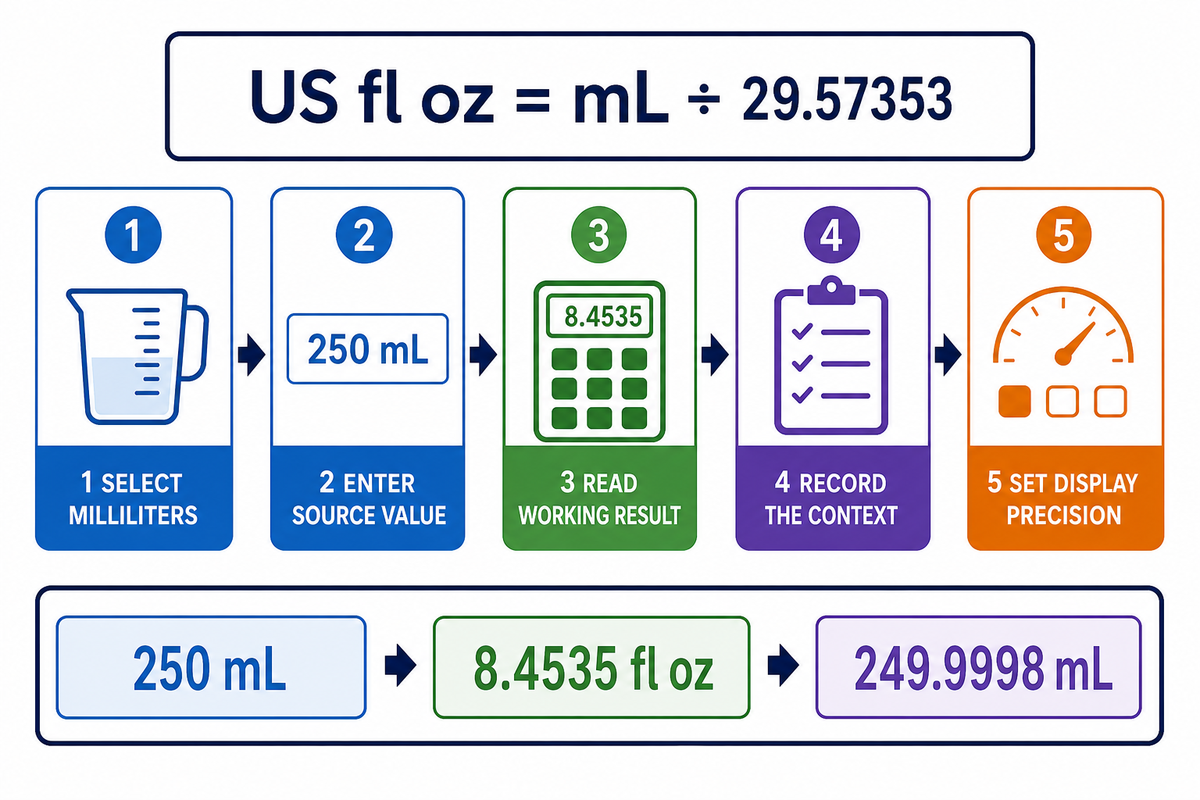
In the reverse direction, use US fl oz = mL ÷ 29.57353, reversing the US factor in the NIST Handbook 44 conversion table. You can use the Swap button in the calculator instead of opening a separate conversion page or maintaining a second spreadsheet.
- Select milliliters — make mL the source unit and US fl oz the result unit.
- Enter the source value — use the nominal or measured value exactly as provided.
- Read the working result — 250 mL returns 8.4535 US fl oz.
- Record the context — state whether the number is capacity, measured fill, nutrition serving measure or net quantity.
- Set display precision — keep the source value and use only the digits the intended record can support.
The reverse checks are useful for catching a flipped formula. Thirty milliliters is about 1.0144 US fl oz by dimensional conversion, 250 mL is about 8.4535 US fl oz, and 750 mL is about 25.3605 US fl oz. If a spreadsheet returns 7,393 or 22,180 for those examples, it multiplied when it should have divided. That mismatch creates a review risk because the wrong operator can survive into an artwork proof or supplier spreadsheet.
A second check is round-trip consistency. Convert 250 mL to 8.4535 US fl oz, then reuse that displayed result and the calculator returns approximately 250 mL (249.9998 mL at four decimal places). A small final difference can come from displaying only four decimal places; a large difference points to the wrong denomination, a flipped formula or premature rounding.
What the conversion means for US packaged-food label copy
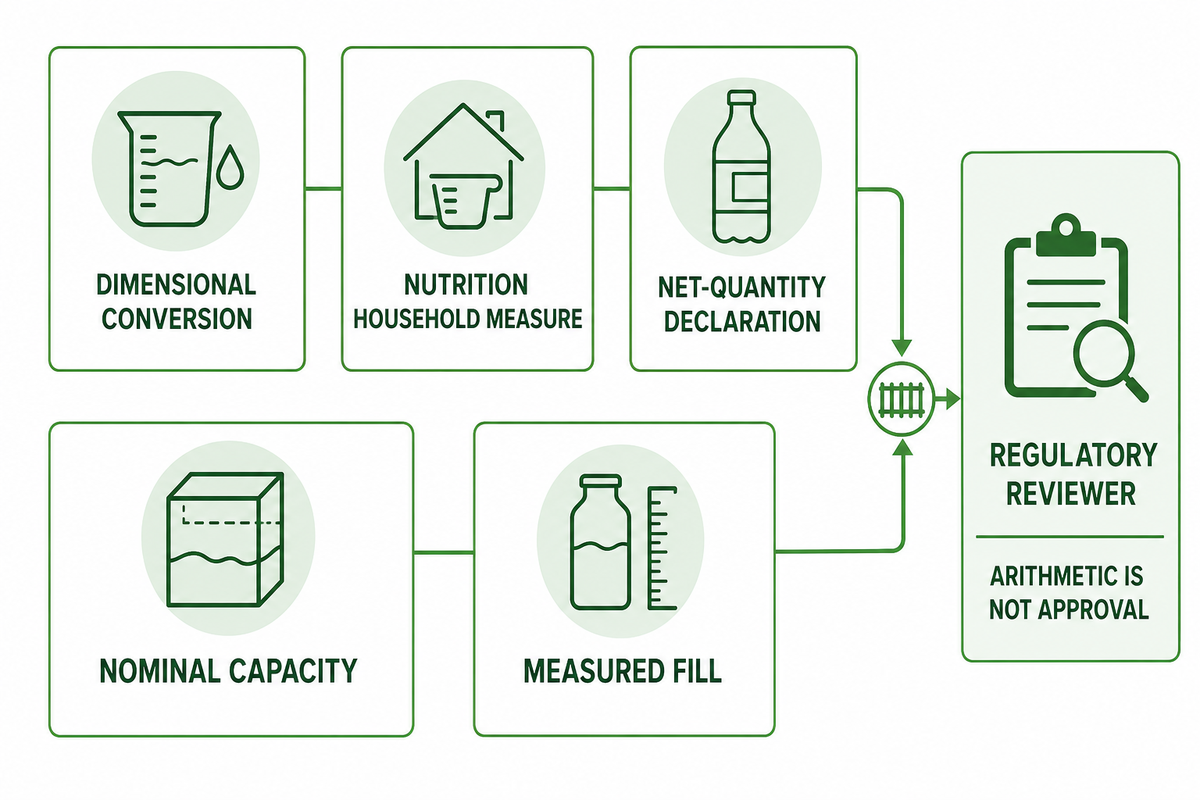
Unit arithmetic and regulatory copy are related, but they are not the same decision. In US packaged food, 21 CFR 101.7 governs the net-quantity statement. It addresses liquid declarations in fluid measure and allows an additional accurate metric statement within the rule’s scope.
Nutrition serving measures sit in a separate section. As noted above, 21 CFR 101.9(b)(5)(viii) defines one fluid ounce as 30 mL for nutrition-labeling purposes. That doesn’t erase the dimensional factor, and the dimensional factor doesn’t override the nutrition convention. A third field, the actual measured fill, may carry its own measurement method and uncertainty.
Keep three contexts separate in the job record: dimensional conversion, nutrition household measure, and net-quantity declaration. Also separate nominal container capacity from measured fill. Bottles and pouches do not all trigger the same labeling basis: solids, semisolids, viscous products, frozen products and refrigerated products can involve provisions that this liquid-volume converter does not resolve.
This page provides arithmetic and a handoff structure, not legal advice. It does not approve typography, placement, exemptions, tolerances or a particular product’s artwork. Route the final copy to the responsible regulatory reviewer for the target market.
A practical review sequence is to ask four questions. Is the product within the rule being cited? Is the field a nutrition serving measure or a net-quantity statement? Does the source value describe nominal capacity or measured fill? Does the displayed number imply precision the measurement cannot support? The compliance risk is a context mismatch because 29.57353 mL and the nutrition convention of 30 mL answer different questions. If any answer is unclear, the conversion should remain a draft calculation rather than final label copy.
Capacity does not choose the label material
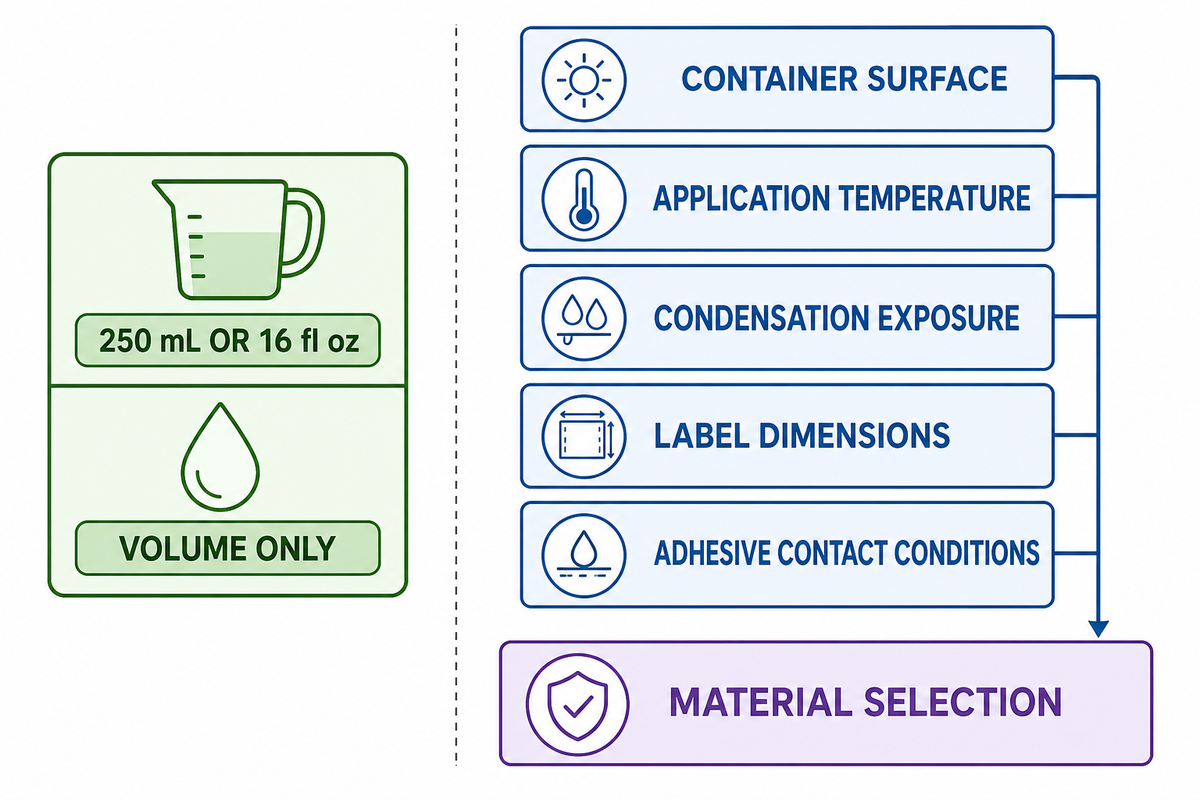
A 250 mL or 16 fl oz result tells you volume. It doesn’t identify the container surface, application temperature, condensation exposure, ice-bucket service, label dimensions, printing process or adhesive contact conditions. Those are separate material-selection inputs. A material mismatch creates rework risk because the same capacity can be used on a dry carton, a refrigerated bottle or an ice-bucket application.
On a beverage project, use the converted capacity as one field in a wider brief and review the beverage-label material requirements. Food products should be routed through the food-packaging label construction page. If facestock and adhesive are still unresolved, the facestock and adhesive selector asks the material questions the volume conversion cannot answer.
If the application class itself is unresolved, use Guanma’s application quick match before choosing a facestock-and-adhesive path.
Capacity is also independent of how the finished labels are supplied. After the artwork dimensions and construction are known, use the finished-roll diameter calculator to check the wound roll against handling or machine limits.
Use the Artwork Capacity Release Record before artwork approval
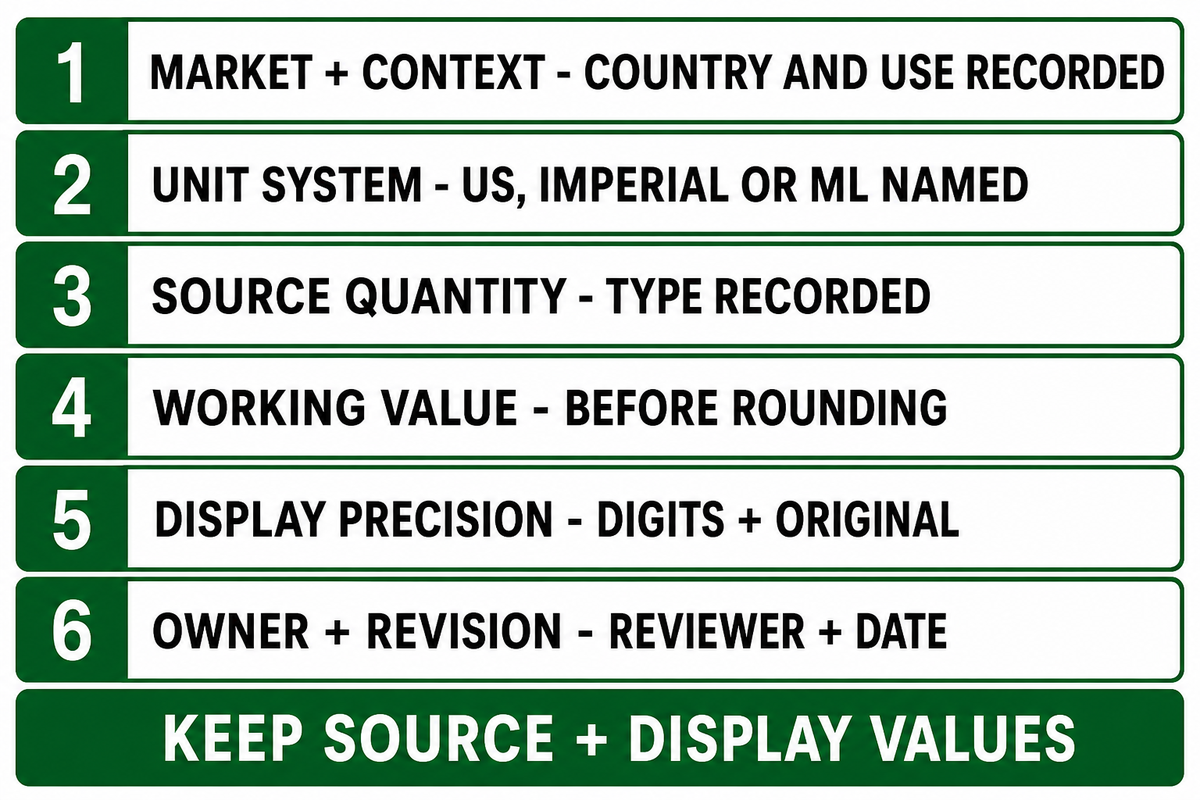
The Artwork Capacity Release Record gives procurement, quality assurance and artwork teams one shared record. It is an editorial control framework derived from the denomination and context risks above, not a regulation or a proprietary standard.
| Field | What to record | Approval question |
|---|---|---|
| 1. Market and context | Country plus dimensional, nutrition or net-quantity use | Which rule or specification controls? |
| 2. Unit system | US fl oz, Imperial fl oz or mL | Is the denomination explicit? |
| 3. Source quantity | Nominal capacity, declared quantity or measured fill | What was actually measured or specified? |
| 4. Working value | Calculated result before display rounding | Can the calculation be reproduced? |
| 5. Display precision | Approved label-facing digits and original value | Does the display imply unsupported accuracy? |
| 6. Owner and revision | Artwork revision, reviewer and date | Who signs off the final context? |
Do not overwrite the source quantity with the rounded display. Keeping both values lets another reviewer reproduce the conversion and understand why a familiar retail neighbor was not used as an exact equivalent. The same record can travel with the artwork proof and the request for quotation.
One handoff might record: United States / net-quantity review; US customary fluid ounce; nominal 16 oz source capacity; 473.1765 mL working value; proposed display decided by the regulatory owner; artwork revision B approved by the named reviewer on the recorded date. That entry doesn’t decide the legal wording. It makes every decision and assumption visible to the person who does.
Key takeaway
Lock the fluid-ounce denomination and label context before calculating: a correct number can still be the wrong number for the artwork field.
Additional application context is available in the beverage and wine label guide. When the six fields are complete, you can send the capacity release record with your label inquiry.
Frequently asked questions
How many mL is one US fluid ounce?
The NIST table factor is 29.57353 mL per US fluid ounce. The calculator uses the underlying definition and shows 29.5735 mL to four decimal places. Keep the source denomination and measurement precision with any copied result so another reviewer can reproduce it.
Is 1 fl oz equal to 30 mL?
Dimensionally, it is about 29.57353 mL. For FDA nutrition-labeling household measures, 21 CFR 101.9(b)(5)(viii) defines 1 fl oz as 30 mL. State the context rather than treating one number as universal, and do not transfer the nutrition convention to every net-quantity field.
What is the difference between UK and US fluid ounces?
A US fluid ounce is about 29.57353 mL, while an Imperial fluid ounce is about 28.41306 mL. The Imperial unit is approximately 3.924% smaller relative to the US value. Name the target market before calculating so a correct formula is not applied to the wrong denomination.
Is 16 fl oz exactly 500 mL?
No. Sixteen US fluid ounces is about 473.1765 mL. Five hundred milliliters is about 16.9070 US fluid ounces. The values are close retail neighbors, but they are not exact equivalents and should remain clearly separate in specifications and controlled artwork.
How do I convert 250 mL to fluid ounces?
Divide 250 by 29.57353. The result is about 8.4535 US fluid ounces. Use the calculator’s Swap button to run the reverse conversion, then always retain 250 mL as the source value instead of replacing it with a rounded fluid-ounce neighbor.
Can I use this result as label compliance approval?
No. The tool checks volume arithmetic. It does not determine the applicable rule, approve artwork, verify fill, set tolerance or select a label material. A responsible regulatory reviewer must confirm the target market, product context, display precision and final label copy.
References & Sources
- NIST Handbook 44, 2026 Appendix C US customary and British unit tables plus conversion-rounding guidance.
- NIST Guide to the SI, Appendix B conversion-factor notation and guidance on precision for converted values.
- NIST SI Units: Volume liter-based metric volume units and conversion context.
- 21 CFR 101.7 current US packaged-food net-quantity rule.
- 21 CFR 101.9 current US nutrition-labeling rule, including the household-measure convention in paragraph (b)(5)(viii).