Get in Touch with Guanma

Choosing Tire Label Material for Heat, Oil, and DOT/TIN Labeling Risk

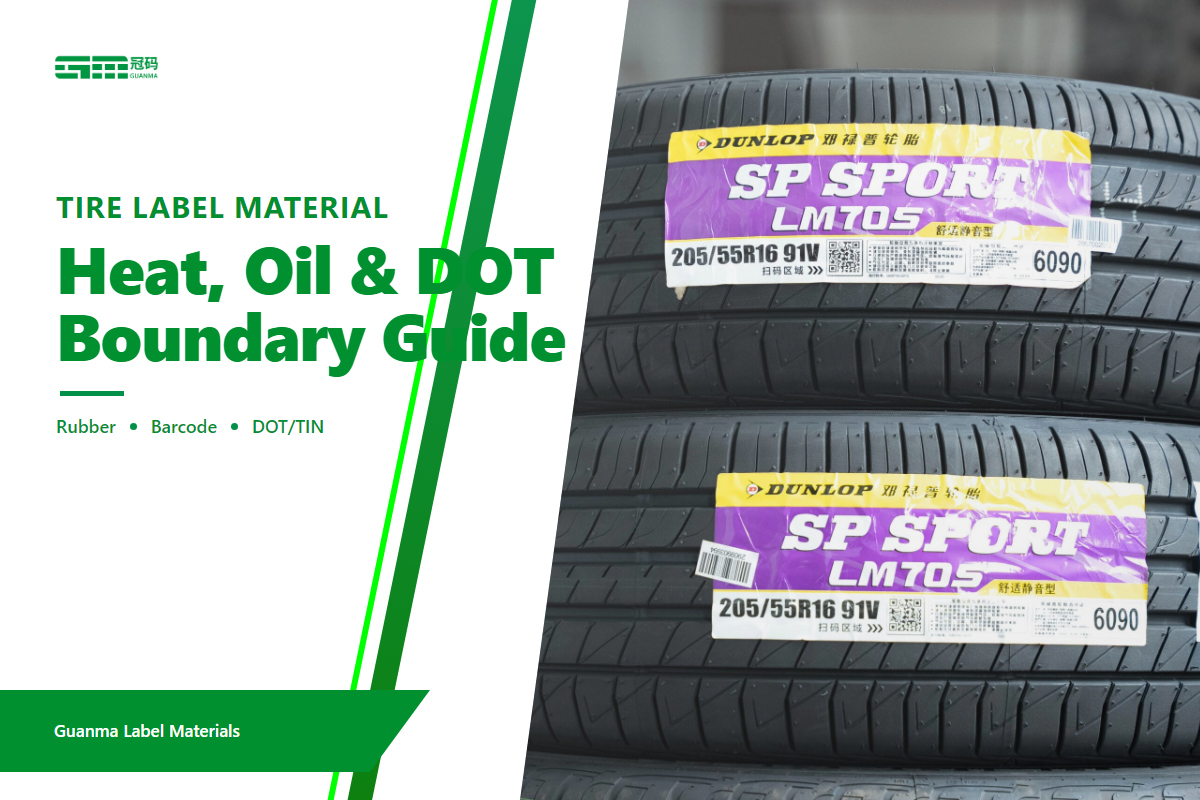
How to choose tire label material is the process of matching the tire surface, label job, print data, and compliance role before naming a stock. For buyers, a tire label can be a retail information carrier, a barcode record, or a compliance-data support item. It may need to grip rough rubber, carry barcode data, stay clean through storage, and avoid language that overstates DOT or UTQG compliance.
This guide separates the material decision from the regulatory decision. Label stock can help keep information attached and readable, but it does not make a tire DOT certified, set a UTQG grade, or replace the tire manufacturer’s marking duties.
Quick tip: choose tire label material by label type, then test the facestock, adhesive, liner, print method, and handling path together on the actual tire surface.
Quick Answer: Choose by Surface, Print Data, and Compliance Role
Buyers should define the tire surface and the label task before asking for PET, PP, BOPP, coated paper, or a stronger adhesive. For automotive programs, label requirements should be written as a test brief, not a material nickname. Rubber tread, sidewall curves, oil or mold-release residue, barcode density, and required tire information all change the right starting point.
Procurement risk rises when one stock name is approved before the sample path is known, because a 24 hr dwell result on a clean tread does not predict 48 hr stacked storage, oily handling, or barcode scan checks. Guanma sample discussions should name the tire surface, RFQ use case, print precision data, and pass/fail test record in the same brief.
Use this first pass before comparing materials:
- Surface: tread, sidewall, bead area, green tire, or finished retail tire.
- Data: retail copy, barcode, QR code, serial data, RFID workflow, or energy-label information.
- Exposure: heat, oil, wax, outdoor storage, stacking, scuffing, or short-term display.
- Compliance role: DOT/TIN support, UTQG tread label information, EU tyre-label data, or internal inventory tracking.
The important shift is simple: do not ask, “Which material is best?” Ask, “Which material can hold this data on this tire through this process, without creating a false compliance claim?”
First Separate the Tire Label Type
Label type controls the test environment. Post-cure retail tread labels, warehouse barcode labels, pre-cure or vulcanized process labels, and EU tyre energy labels can all sit under the phrase “tire label”, but they do not face the same surface, heat, or removal conditions.
| Label type | Main material risk | What to verify |
|---|---|---|
| Retail tread label | Rough tread, removal, residue, display quality | Lift, peel behavior, print clarity, residue after removal |
| Barcode or QR logistics label | Scan contrast after stacking and handling | Ribbon match, coating, scuffing, scan distance |
| Pre-cure or vulcanized process label | Heat, pressure, and process compatibility | Separate high-temperature process evidence and line trials |
| Compliance-data support label | Overstating what the label material can do | Official DOT/TIN, UTQG, or EU scope wording |
What is the difference between a pre-cure vulcanized tire label and post-cure tire energy labels?
A pre-cure or vulcanized tire label belongs to the manufacturing process and may need heat resistance, pressure tolerance, and rubber-processing checks around the vulcanization process. Post-cure tire energy labels or retail labels are applied to finished tires and judged more by adhesion, removal, smudge risk, print clarity, and the accuracy of the displayed information. Mixing these two jobs is a common source of poor specifications.
Choose the Facestock: PET, PP Synthetic Paper, BOPP, or Coated Paper
Facestock is the printable face of the label. Guanma’s tire-label material context includes PET, PP synthetic paper, BOPP, and coated paper as practical starting points, but those names are not final approvals. The same facestock can behave differently after coating, adhesive pairing, liner selection, and printing.
For a Guanma sample request, the mistake to avoid is approving PET or PP by name alone. A 30 min print-and-rub check, a 24 hr dwell check, and a 48 hr stacking check can expose stiffness, curl, residue, smudge marks, or barcode failure before a buyer locks the production order.
| Facestock | Best starting use | Limit to test |
|---|---|---|
| PET | Durable barcode, QR, or premium tread labels | Stiffness on curved surfaces and removal behavior |
| PP synthetic paper | Retail tread labels needing good print and water resistance | Adhesion on rough or oily rubber |
| BOPP | Shorter-term display or promotional labels | Edge lift and scuffing during stacking |
| Coated paper | Cost-sensitive, short-term retail information | Moisture, abrasion, and barcode durability |
If your choice is between PET and BOPP for a film label, use a separate PET vs BOPP film comparison to check stiffness, clarity, and cost before the tire-specific adhesive test.
Choose Adhesive for Rough, Oily, or Low-Energy Rubber
Adhesive selection is not a race to the strongest tack. After the facestock choice narrows the printable surface, initial tack matters only when the tire surface condition is known; high initial tack cannot overcome oil or mold-release residue by itself. Tire tread can be rough, curved, dusty, oily, waxy, or affected by mold-release residue. A heavier adhesive can improve contact in some cases, but it can also raise edge ooze, residue, slitting, and printer-cleanup risk.
ASTM D3330/D3330M-04(2025) is useful as peel-adhesion test-method vocabulary for pressure-sensitive tape, but its own metadata warns against treating peel values as direct proof of functional performance. For tire labels, the useful lesson is to test on the actual tire, not to copy a lab-sheet number.
| Condition | Adhesive question | Test before order |
|---|---|---|
| Rough tread | Can the adhesive wet enough contact points? | 24-hour lift check after hand or machine application |
| Oil, wax, or mold release | Does the surface need cleaning, different adhesive, or both? | Same-surface A/B sample test with residue noted |
| Barcode tread label | Will tack or ooze affect print and scan quality? | Print, stack, rub, and scan after storage |
Can mold release agents prevent tire labels from adhering?
Yes. Mold-release residue can reduce contact between adhesive and rubber, especially on textured tread. The practical response is not to guess from a datasheet. Test the chosen facestock, adhesive, liner, and print method on the same tire surface and handling path that production will use.
Heat, Oil, and Surface Risk: What to Test Before Ordering
Heat resistance, temperature resistance, and oil exposure should be treated as sample-validation tasks. A material that looks clean in a sample book can lift, curl, smear, or leave residue after stacking, transport, or outdoor storage. This is why the test plan should include the full label construction, not only the face material.
Record each sample as a construction, not as a loose material name. The useful record includes facestock, adhesive family, coat-weight target, liner, print method, ribbon or ink, application pressure, dwell time, and the tire surface condition. If one of those inputs changes, the old sample result should be treated as a guide, not a release for production.
- Lift: check edges and corners after application, storage, and stacking.
- Ooze: inspect roll edges, die-cut edges, printer path, and liner release.
- Residue: remove retail labels from sample tires and record adhesive transfer.
- Barcode contrast: print real code density and scan after rub and handling.
- Curl: test roll memory, tire curvature, and label size together.
- Exposure: include oil, wax, temperature, humidity, and storage time if those conditions are real.
For broader durability planning, keep tire-specific testing separate from general durable label test methods. General methods help define the lab language; the tire surface still decides the sample result.
DOT/TIN and UTQG: What Label Material Can and Cannot Do
DOT/TIN and UTQG rules define tire information duties. They do not create a generic “DOT-compliant label material” category. In U.S. Department of Transportation context, 49 CFR 574.5 covers tire identification marking, and NHTSA explains the DOT Tire Identification Number as a safety and recall tool.
UTQG needs careful wording. Under 49 CFR 575.104, treadwear, traction, and temperature grades are tire-performance information. Label material does not set those grades. For applicable tread-attached UTQG labels, though, material, adhesive, print, and layout choices have a limited physical role: the label must not be easily removable, and the grade entries must remain indelible and rule-bound in placement and content.
Compliance note: Overclaiming is the real risk here, because 49 CFR tire-identification and UTQG rules govern tire information duties rather than certifying a universal label material. Guanma treats this as a wording-control and sample-validation problem: keep DOT/TIN, UTQG, and EU tyre-label language in separate specification lines.
| Claim | Safe wording |
|---|---|
| “This label stock is DOT certified.” | Avoid. Say the material supports readable tire information and must be tested against the intended label role. |
| “The label material determines UTQG.” | Avoid. UTQG grades come from tire-performance information, not the stock. |
| “Material has no role at all.” | Too broad. For applicable tread labels, attachment, indelible print, and layout still matter. |
Printing and Barcode Readability: Thermal Transfer, QR, and RFID
Machine-readable tire labels depend on print-system precision as much as the stock. Dense barcodes, QR codes, serial data, RFID workflows, thermal transfer printing, and other printing methods need the facestock, coating, ribbon or ink, printer heat, handling, and scan distance tested as one path.
NHTSA’s Electronic Tire Identification Study discusses QR codes, Data Matrix codes, and electronic identification as tire-information technologies. That supports a trend, not a current blanket requirement that every tire label stock carry QR or RFID. EU tyre labels have their own QR and EPREL context, which should not be mixed with U.S. DOT/TIN wording.
Barcode failure is a production problem, not only a printing problem, because the same code can scan after printing and then fail after 30 min scuffing or 48 hr stacked storage. For Guanma sample testing, record printer model, ribbon, code size, scan distance, and tire handling path before approving a barcode or RFID workflow label.
Do I need a special thermal transfer ribbon for tire barcode labels?
You may need a matched ribbon, coating, and facestock combination if the label carries barcode, QR, serial, or retail data through stacking and handling. Test the real printer, substrate, code size, and scan distance. A ribbon that prints sharply on one film may smear or scratch on another.
Liner and Converting Decisions That Prevent Edge Ooze
Liner choice and converting quality affect whether tire labels run cleanly through printers and applicators. ASTM D5375/D5375M-98(2019) and FINAT test-method evidence point to a connected set of variables: liner release, adhesive coat weight, die strike, subsequent adhesion, storage, and roll handling.
The key boundary is that no public source found gives one universal edge-ooze limit for tire labels. ASTM D5375 supports release-liner adherence and uniformity testing for pressure-sensitive label stock, but it also notes that backing, siliconized liner, release coating, adhesive, and coat weight can all affect the result. FINAT lists related release, coat-weight, die-strike, ink-adhesion, and handling methods, while stating that methods alone do not imply performance specifications.
Production rule: specify liner release, die strike, adhesive coat weight, roll storage, and print-path checks together. Do not approve a tire-label construction from adhesive tack alone.
If release liner selection is a separate purchasing decision, compare release liner options before final die-cut and roll-width choices.
The Four-Zone Tire Label Risk Map
This Four Zone Tire Label Risk Map can be used to support the purchasing decisions by presenting the risk of making one material choice for four different types of tire label job.
4-Zone Tire Label Risk Map Checklist
The checkpoints below are RFQ fields to record, not universal pass limits. Use them to compare sample constructions under the same tire, handling, print, and storage conditions.
| Category | Starting material path | Record in the sample test | Main limit |
|---|---|---|---|
| 1. Retail tread label | PP synthetic paper, PET, BOPP, or coated paper | 24 hr dwell, 48 hr stacked storage, and 7 days retention if your quality plan uses those checkpoints | Test lift, residue, print clarity, and removal |
| 2. Oil-exposed tread label | PP or PET with rubber-compatible adhesive | 24 hr dwell, 48 hr residue check, and the exact cleaning method | More tack cannot replace surface preparation evidence |
| 3. Removable retail label | BOPP, coated paper, or removable adhesive construction | 24 hr dwell and 7 days removal behavior on the real tire surface | Residue target matters as much as holding power |
| 4. Durable barcode or QR label | PET or PP with matched thermal-transfer coating | 48 hr storage, 30 min scuff check, and scan result after handling | Readable data is the success condition, not facestock name |
| 5. Serialized or RFID workflow label | PET or PP construction matched to printer and reader path | 24 hr handling check, 48 hr storage check, and before/after scan status | Keep traceability data separate from compliance claims |
| 6. Curved sidewall label | Conformable film or paper with matched adhesive | 30 min edge check and 24 hr retest on the same sidewall radius | Flat-panel sample results do not prove curve performance |
| 7. Pre-cure or vulcanized process label | Separate high-temperature construction route | Actual process temperature in °C and dwell time in min from the tire plant record | Do not validate from retail tread-label evidence |
| 8. UTQG tread-label support | Material that supports attachment and readability | 100% grade-entry readability review after application | No material-level DOT or UTQG grade claim |
| 9. DOT/TIN production support | Material and print path that keep identification data readable | 49 CFR 574.5 wording-control review plus a 100% sample-label text check | The label supports data handling; it is not a DOT certificate |
| 10. EU tyre energy or QR label | Stock matched to QR-code printing and regional presentation needs | 100% QR scan check on retained samples after 24 hr storage | Do not mix EU EPREL wording with U.S. DOT/TIN wording |
The companion Heat-Oil-DOT Boundary Matrix is the final filter: heat changes construction route, oil changes adhesive testing, and DOT/TIN or UTQG changes wording discipline. Passing one filter does not mean passing the other two.
Sample Validation and RFQ Checklist Before Production
RFQs become test briefs when detail guides the supplier to match material, adhesive, liner, and print system for the specific tire label job. Missing detail is a risk because a sample with 24 hr dwell, 48 hr storage, and barcode-scan evidence can still fail if the production tire surface, printer, or certification wording changes.
Tire Label Sample Validation Log
| validation record | evidence source | measured value to write down | decision use |
|---|---|---|---|
| 1. Dwell check | Plant sample | 24 hr on actual tread | Confirms first adhesion risk |
| 2. Stacked storage | Warehouse sample | 48 hr under tire stacking load | Shows edge lift or curl after pressure |
| 3. Scuff check | Handling sample | 30 minutes of rub and scan review | Separates print wear from adhesive failure |
| 4. Heat exposure | Process sample | Actual tire-plant temperature in °C | Separates pre-cure labels from retail labels |
| 5. Removal review | Retail sample | 7 days removal and residue check | Confirms removable adhesive limit |
| 6. QR scan | EU or traceability sample | 100% QR scan after 24 hr storage | Confirms machine-readable data remains usable |
| 7. UTQG wording | 49 CFR 575.104 review | 100% grade-entry text review | Prevents material-level grade claims |
| 8. DOT/TIN wording | 49 CFR 574.5 review | 100% label-text review before order | Prevents stock from being sold as certification |
| 9. Liner release | ASTM D5375 and FINAT reference | Release and die-strike notes per roll | Links liner behavior to printer cleanliness |
Static RFQ checklist for tire label samples
- Tire type, size range, tread or sidewall placement, and surface condition.
- Label type: retail tread, barcode, QR, RFID workflow, pre-cure process, or compliance-data support.
- Facestock candidates: PET, PP synthetic paper, BOPP, coated paper, or another specified film.
- Adhesive target: rough rubber, oily rubber, removable retail use, permanent tracking, or residue-sensitive removal.
- Print method, ribbon or ink, barcode density, QR size, and scan distance.
- Liner, roll width, core size, die-cut tolerance, and applicator or printer model.
- Storage time, heat, humidity, stacking, outdoor exposure, and transport route.
- Target market and wording scope for DOT/TIN, UTQG, EU tyre label, or internal traceability.
Review label solutions only after sample conditions are fixed. After the checklist is ready, review Guanma’s tire label material solutions page for sample and material paths. Use that page as the commercial handoff; keep this article as the decision guide.
Trend: Machine-Readable Tire Information Raises the Bar for Label Stock
Machine-readable tire information is moving material selection toward higher print and data-density discipline. The European Commission tyre page ties EU tyre labels to EPREL and QR-code access, while U.S. NHTSA research discusses electronic tire identification technologies such as QR, Data Matrix, and RFID.
Buyers should treat this trend as a verification risk, because adding QR, Data Matrix, or RFID language without the right jurisdiction can create confusion in the RFQ. Guanma’s practical check is to separate EU EPREL access, U.S. DOT/TIN identification, and internal factory traceability before any material sample is approved.
The action for buyers is not to demand every technology in every label. It is to define the jurisdiction, data density, scan method, and life of the label before approving stock. EU EPREL context, U.S. DOT/TIN context, and internal factory traceability should stay in separate specification lines.
FAQ About Tire Label Material
Which facestock works best for tire tread labels?
PET and PP paper are strong starting points when a tire tread label must stay readable through stacking, handling, and barcode scanning. BOPP can fit lighter promotional labels, while coated paper belongs in shorter-term or cost-sensitive jobs. The final choice still depends on the tire surface, print method, removal target, and sample result. If the same SKU moves through retail display, warehouse stacking, and later inventory scanning, treat that path as one test package instead of three separate material conversations.
What adhesive is used for tire labels on rubber surfaces?
Tire labels often need a rubber-compatible pressure-sensitive adhesive, hot-melt adhesive, or another tire-labeling adhesive matched to rough rubber. If the surface has oil, wax, mold-release residue, or low-energy behavior, test the adhesive on the real tire. More adhesive is not always cleaner because it can raise ooze and residue risk.
How do DOT/TIN requirements affect tire label material choice?
DOT/TIN rules affect tire identification information and tire marking duties, but they do not turn pressure-sensitive stock into a compliance certificate. Material choice should support readable information, barcode or QR workflows, and traceability, while official obligations remain tied to the tire and the applicable rule.
Can mold release agents prevent tire labels from adhering?
Yes. Mold-release residue can reduce adhesive contact on rough tread or treated rubber. Test the chosen construction on the same real tire surface and handling path used in production or distribution, then record lift, residue, print condition, and removal behavior.
Do I need a special thermal transfer ribbon for tire barcode labels?
You may need a matched ribbon, coating, and facestock combination, especially when the label carries barcode, QR, or serial data through stacking and handling. Test the real printer, substrate, code size, and scan distance before production, then repeat the scan after storage.
Are EU tyre labels and U.S. DOT tire labels the same thing?
No. EU tyre labels include energy-labeling information and EPREL-linked QR access for tyres sold under EU scope. U.S. DOT/TIN rules relate to tire identification and federal standards context. A global program should separate jurisdiction, required information, and material validation before ordering.
References & Sources
- eCFR 49 CFR 574.5, Tire Identification Number requirements
- eCFR 49 CFR 575.104, Uniform Tire Quality Grading Standards
- NHTSA TireWise tire safety and tire label guidance
- NHTSA interpretation 12632wkm on UTQG tread-label conditions
- ASTM D3330/D3330M-04(2025), peel adhesion of pressure-sensitive tape
- ASTM D5375/D5375M-98(2019), liner removal at high speeds from pressure-sensitive label stock
- FINAT Test Methods, 11th edition reference list
- European Commission tyre product information and EPREL context
- NHTSA Electronic Tire Identification Study
WHY WE WRITE THIS
About Guanma
Guanma is a self-adhesive film, label stock, and release liner manufacturer for industrial labeling applications. Our team works with PET film, PP synthetic paper, coated paper, hot-melt PSA, acrylic PSA, water-based adhesive, glassine liner, and CCK release liner.
We write these guides to help label converters, packaging buyers, and industrial procurement teams choose materials by real application conditions instead of generic catalog names. Most label failures come from a mismatch between facestock, adhesive, liner, substrate, temperature, printing method, or end-use environment. Our content explains those decisions in practical terms.
Our Experience
Guanma’s material guidance is based on coating, lamination, slitting, sample validation, and customer troubleshooting experience across Thailand and Vietnam production. We focus on common industrial label problems such as cold-temperature peel, oil and chemical exposure, UV aging, print durability, release force, MOQ, lead time, and substrate-matched testing.
Our Expertise
We reference practical testing logic and recognized label-industry standards, including FINAT FTM peel and shear methods, ASTM peel testing methods, FDA 21 CFR 175.105, REACH, RoHS, FSC, and ISO 9001-related quality control. For custom label stock, we always recommend testing samples on the buyer’s real substrate before full production.
SYS.PROFILE
Visit Website
Contact Profile
Name
Guanma Manufacturing Team
Brand Name
Guanma
Country
Thailand + Vietnam Production
Model
B2B / Wholesale / Custom Coating
Main Products
Self-Adhesive Film, Label Stock, Release Paper & Liner
Contact
Submit RFQ via Website Form
Website
https://guanmalabel.com/