Get in Touch with Guanma

Updated July 2026 · Engineering and procurement guide
Reviewed by the Zhejiang Guanma Packaging Co., Ltd. technical team
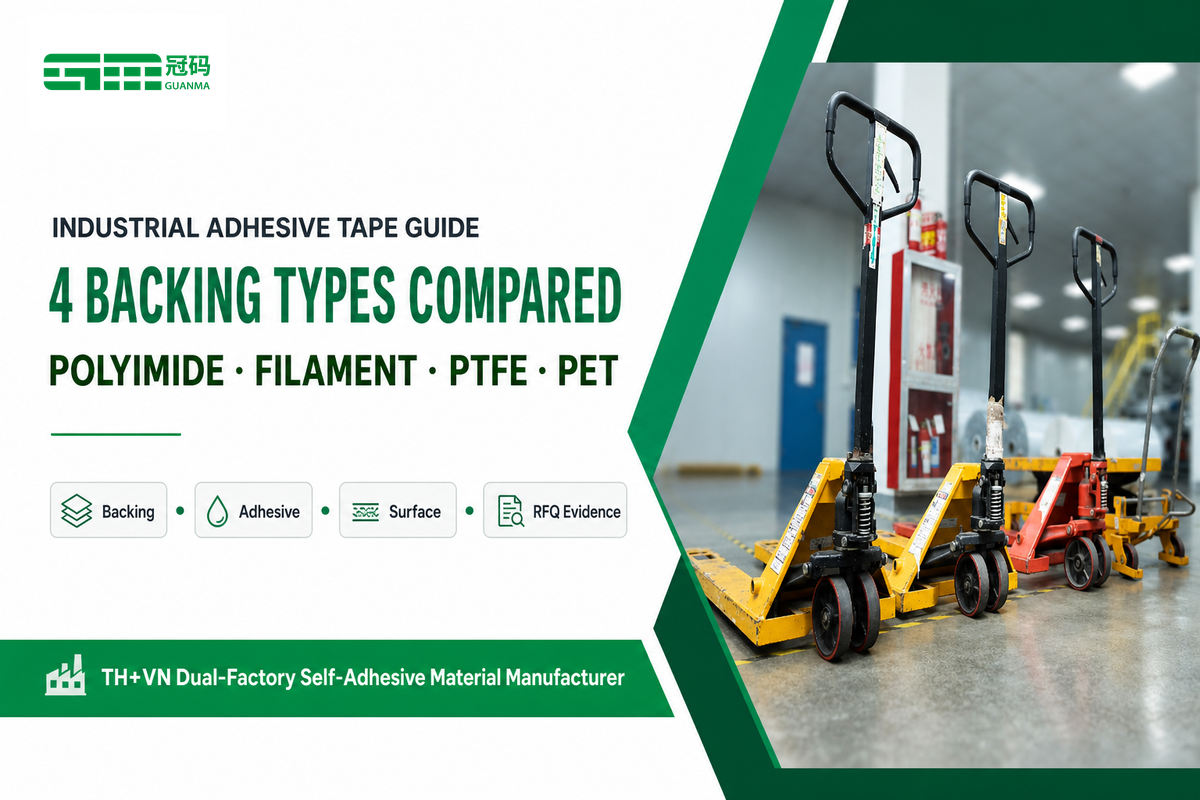
Industrial adhesive tape is not specified by its backing name alone. Polyimide, filament, adhesive-backed PTFE, and PET tapes address different challenges, but whether a specific grade is the right fit is determined by its adhesive, primer, reinforcement, liner, substrate, application method, load, temperature cycle, and removal requirements.
Direct answer: Test polyimide first for qualified thermal or electrical masking, filament tape for directional reinforcement, adhesive-backed PTFE for release or low-friction surfaces, and PET for thin dimensional stability. Then qualify the complete construction on the actual part. Do not rank unlike tapes by one peel, tensile, dielectric, or temperature headline.
TL;DR: Identify the failure you absolutely must avoid. What’s the real surface, the temperature range, the operational environment, the load, and under what conditions will you need to remove the attachment? Select a backing family only once you understand those boundaries. Request method-qualified test data and approve a sample lot prior to ordering production.
What Is Industrial Adhesive Tape?
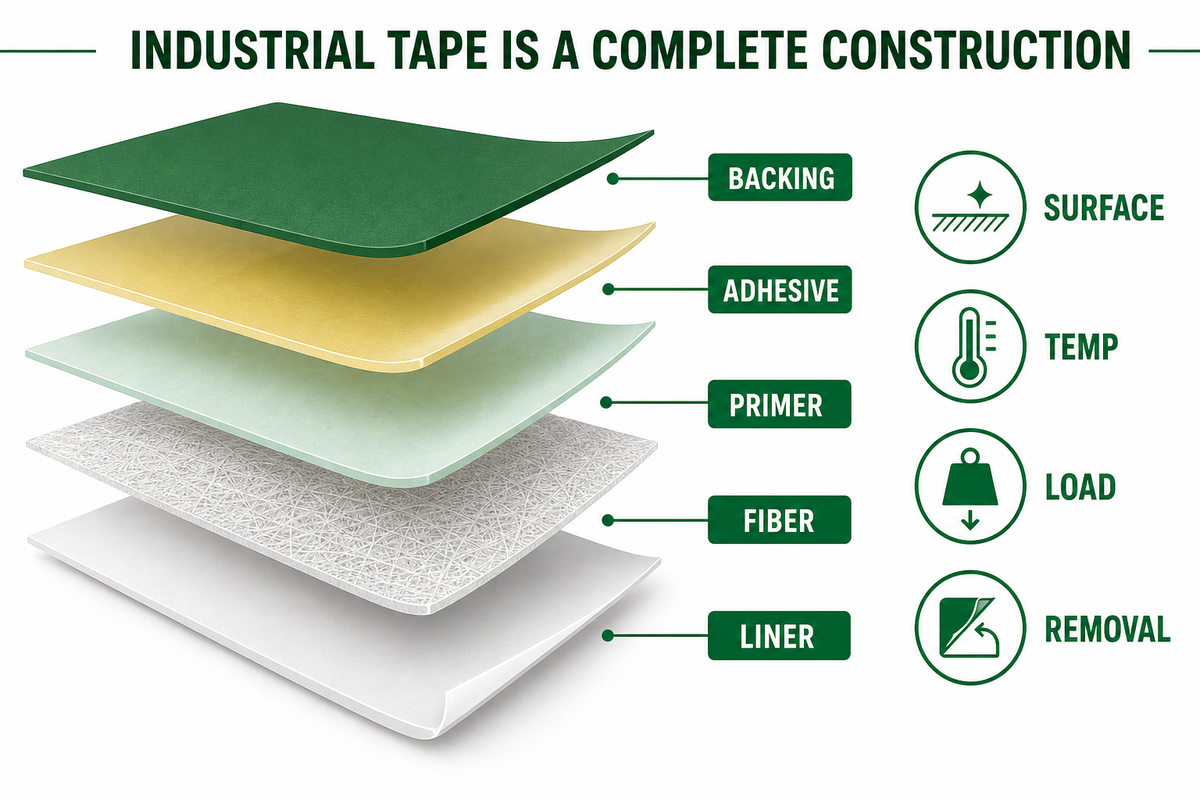
Industrial adhesive tape is an engineered, controlled material construction used to mask, insulate, reinforce, splice, bundle, shield, reduce friction, or secure parts. In a single-coated pressure-sensitive adhesive (PSA) tape, the backing supports an adhesive layer. Primer may anchor the adhesive to that backing, while reinforcement adds directional strength. A release liner protects the adhesive and helps control die cutting, dispensing, or application.
Pressure-sensitive tapes form a bond through contact, pressure, and adequate wet-out. They differ from a liquid structural adhesive, which mixes, cures, and undergoes a reaction within the bond line. This distinction becomes significant when a joint must remain structurally sound as a permanent attachment. Tapes can be strong; however, “industrial strength” is a meaningless designation for comparison or testing. Likewise, “heavy duty” and “strong adhesive” don’t replace a method, surface, dwell, load, or failure criterion.
This document doesn’t cover or compare foam tapes, duct tape, foil tape, adhesive transfer tapes or acrylic-foam mounting methods such as VHB-style items. Those are completely different areas of tape technology focused on carrier, sealing, conformability, anchoring power and structural fastening. By exclusion, they don’t pose the same challenges and can’t be substituted for a similar construction using polyimide, filament, PTFE or PET.
Single-coated tape also differs from double-sided or double-coated tape. In a double coated tape, the carrier material is coated on both sides; acrylic adhesive choice, substrate, and shear load then shape the attachment. This guide stays with single-coated polyimide, filament, PTFE, and PET families rather than mounting tape systems.
Qualification rule: Material family starts the shortlist; only the named construction and a matched test method can approve the tape.
The ISO 29862 peel-adhesion scope, together with ASTM D3330/D3330M-04(2025), shows why a numerical value needs context. ASTM provides six peel procedures for different tape constructions and interfaces and identifies them as quality-assurance tools rather than direct functional requirements. Backing stiffness and adhesive rheology affect the stressed area, so one peel result cannot rank dissimilar tapes by itself.
Catalog searches for brands like 3M, tesa, or Scotch can help buyers discover constructions, but a brand query cannot replace a method-matched comparison. Searches for 3M tapes, 3M VHB, 3M VHB tapes, or 3M™ VHB™ tapes commonly surface acrylic foam tapes, which are a separate construction from the four families compared here. A fastener, a vinyl or PVC backing, and using adhesive to attach automotive trim each create different load, removal, and substrate questions; do not treat those formats as interchangeable merely because they appear beside industrial tape in a catalog.
Specify the tape construction with layer details: backing type & thickness, reinforcement type, primer application, adhesive family & coat type, overall thickness, liner type, and dimensions. Detail application & test surface, conditioning, required dwell time, ambient conditions and success criteria. That specification can then be replicated, sampled and audited. “High temp yellow tape” can’t.
Polyimide, Filament, PTFE, and PET at a Glance
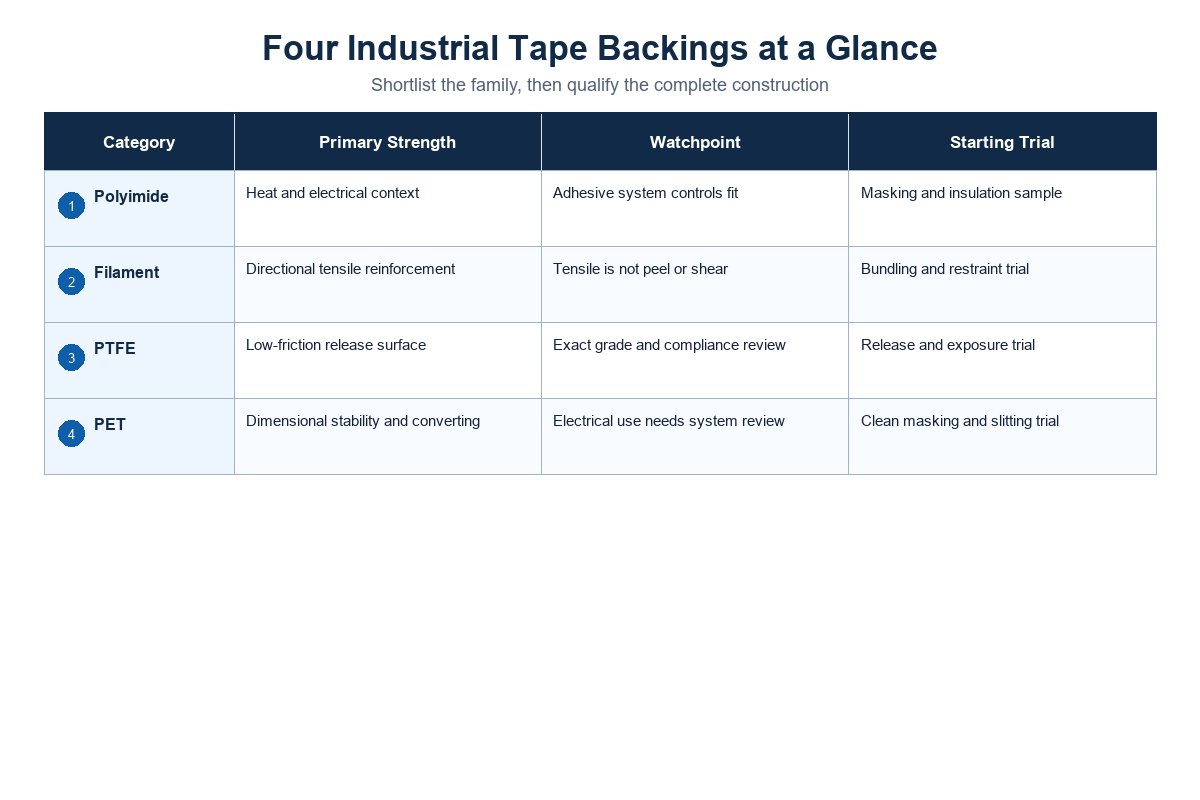
The Failure-First Tape Selector helps you reverse-engineer from failure, starting with what could cause rejection: electrical disintegration, masking contamination, a bundle falling apart, a web sticking to hot surface, drifting dimensions, substrate degradation, or liner malfunction. Start with the tape family that addresses the foremost failure mechanism, not the one that simply boasts impressive values.
| Tape family | Test it first when | Construction variables | Useful checks | Limitations / Not suitable for |
|---|---|---|---|---|
| Polyimide | Thermal cycling, solder masking, or electrical use is the first constraint | Film thickness, acrylic or silicone adhesive, primer, liner | Thermal cycle, residue, dielectric and adhesion after aging | Film temperature alone does not rate the finished tape |
| Filament | Directional reinforcement or bundle retention is the first constraint | Fiber direction, cross weave, backing, adhesive, edge quality | Breaking strength, elongation, shear hold, peel, cut propagation | High tensile strength is not high adhesion or surface safety |
| Adhesive-backed PTFE | Release, low friction, wear surface, or chemical exposure is first | Extruded or skived film, coated fabric, treated surface, adhesive, seam | Wear, edge lift, creep, chemical exposure, hot-surface cycle | Not interchangeable with non-adhesive thread-seal tape |
| PET | Thin dimensional stability, converting, splicing, or masking is first | Film thickness, primer, adhesive, liner, slit and die-cut quality | Dimensional change, edge lift, removal, dielectric end-use review | A PET component is not automatically live-part insulation |
Use the table below as a shortlist, not a final selection. All tape families consist of multiple formulations. Two tapes of identical backing can differ significantly due to their choice of silicone versus acrylic adhesive, or because primer, total thickness, liner and processing procedures differ. When peel data is part of the comparison, keep the panel, angle, speed, dwell, and procedure aligned with the official ASTM D3330/D3330M-04(2025) scope instead of ranking unmatched supplier numbers.
Polyimide Tape: Heat and Electrical Insulation Without the Shortcut
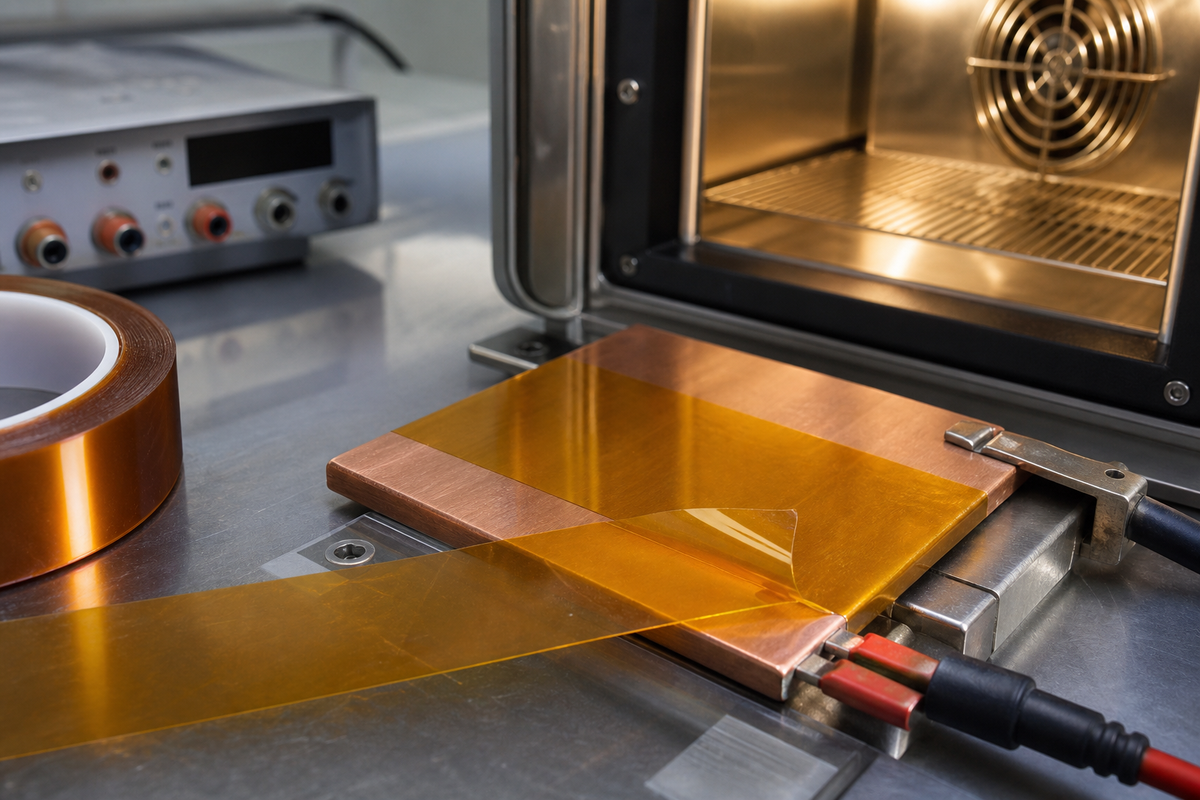
Polyimide film is the natural first choice for high-temperature masking, electrical insulation, soldering and reflow processes, and thermal cycling. But the useful phrase is first candidate. Only the complete tape must survive the temperature profile, time at temperature, surface condition, electrical duty, and removal requirement.
The official IEC 60454-3-7 page describes four polyimide-film pressure-sensitive tape types for electrical purposes. It distinguishes constructions using crosslinked acrylic and thermosetting silicone adhesives and specifies thickness and thermal-index ranges for that electrical standard. Those four types are not a universal taxonomy for every industrial polyimide tape.
Adhesive choice changes the service window. Silicone systems may be selected for demanding thermal exposure or difficult release requirements; an acrylic system may offer a different balance of initial tack, aging, cost, residue, and processing. The answer must come from the named grade data sheet and a trial. Copying the film’s thermal property into a finished-tape specification ignores the layer most likely to soften, creep, leave residue, or lose adhesion.
For masking, reproduce the complete heating and cooling cycle. Apply the tape with a defined pressure, include the actual dwell before heating, and inspect edge lift during exposure. After cooling, remove at a defined angle and speed. Record adhesive transfer, staining, torn backing, substrate damage, and whether the tape removes in one piece. For electrical use, require the intended certification or end-product evaluation; don’t treat color or film identity as proof.
Filament Tape: Tensile Reinforcement Is Not Bond Strength
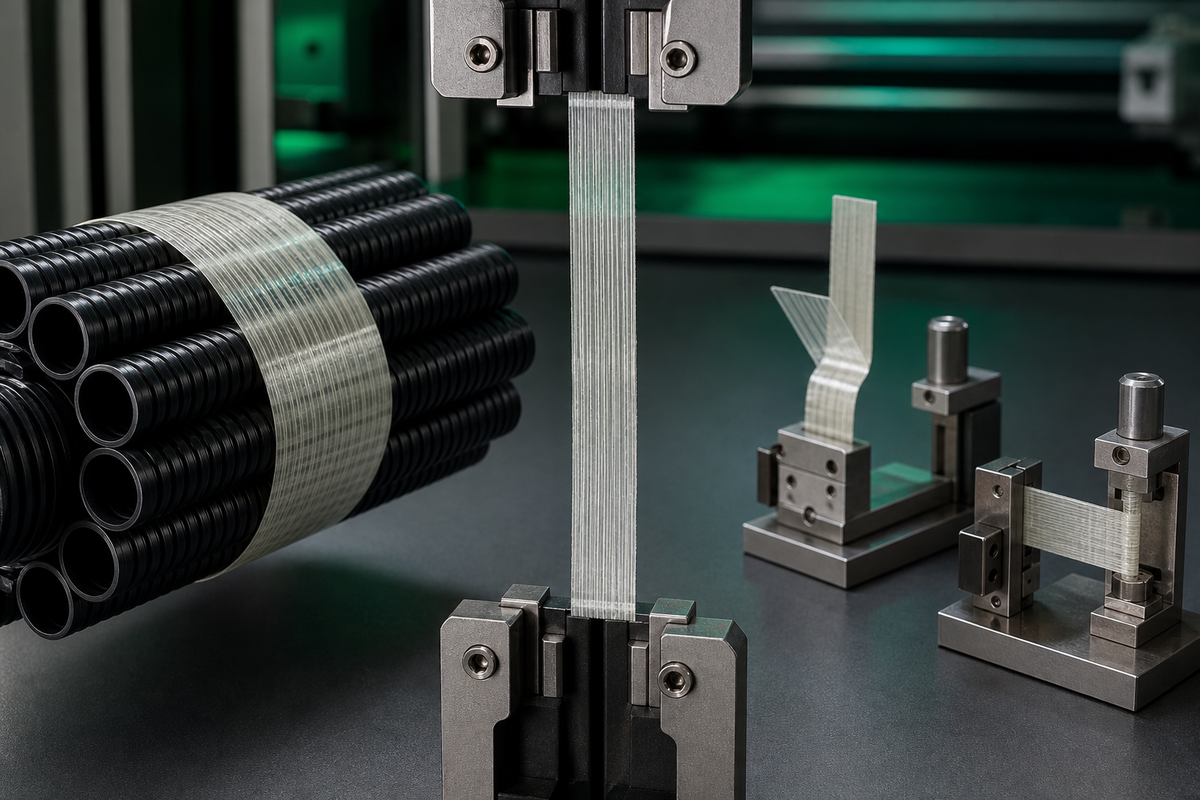
Filament tape places glass or other high-strength fibers into a tape construction. Unidirectional reinforcement concentrates strength along the machine direction. Cross-weave reinforcement adds a second direction. The right layout depends on whether the job is bundling, pallet stabilization, temporary restraint, tabbing, appliance handling, or another validated load case.
Three measurements answer different questions. ASTM D3759/D3759M-05(2025) covers breaking strength and elongation, including high-strength filament-reinforced backings. ASTM D3654/D3654M-06(2024) measures holding under constant load parallel to the bonded surface and includes filament-tape procedures. ASTM D3330 addresses peel. Holding strength and a strong backing still don’t guarantee adhesion to a dusty carton or safe removal from a sensitive finish.
Fiber direction and edge condition deserve their own checks. A nick can start a tear or split. A stiff reinforced construction may bridge over texture rather than wet out. High bundle tension may cut or mark a soft substrate. A tape that holds a steel test panel doesn’t automatically hold the actual board, paint, plastic, or release-coated surface.
State the applied direction, load, duration, temperature, width, overlap, and whether the tape is removed. If a failure could injure someone or release a critical load, the tape shouldn’t be treated as an unengineered substitute for a rated restraint.
Adhesive-Backed PTFE Tape: Low Friction, Release, and Chemical Exposure
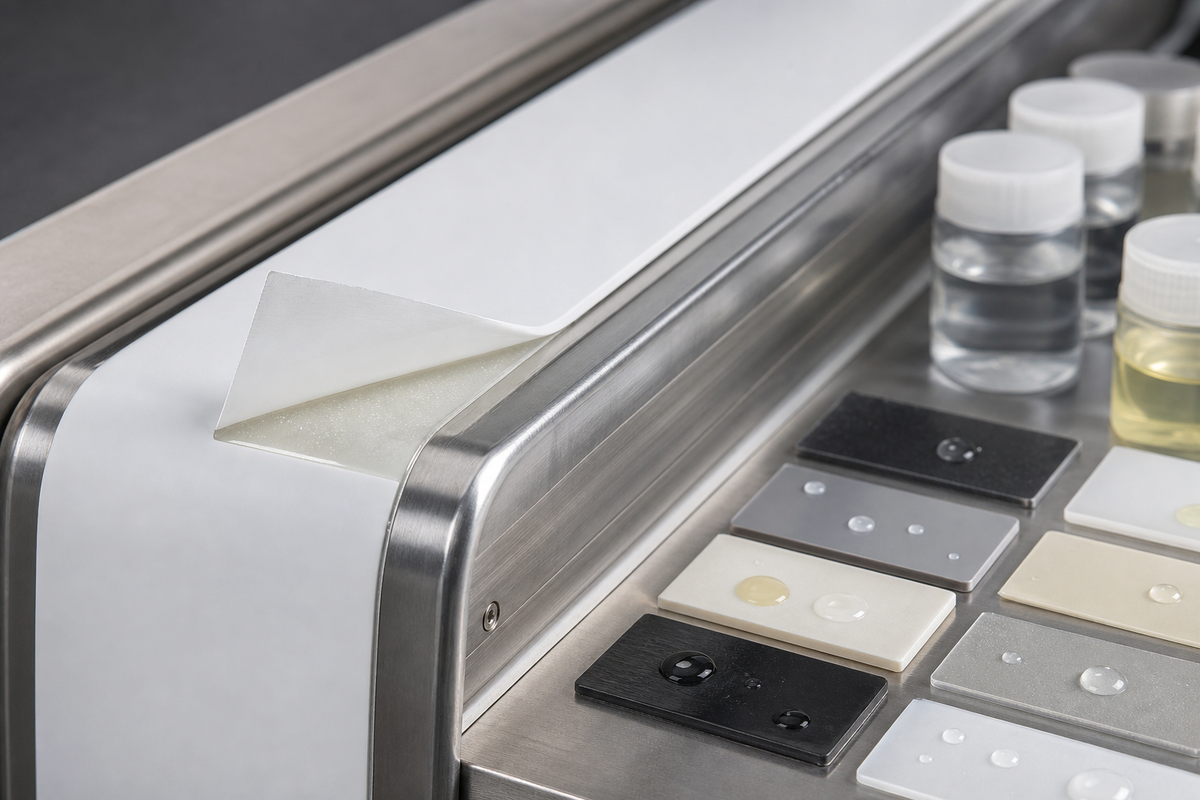
This section concerns pressure-sensitive tape made with a PTFE film or PTFE-coated fabric backing. It isn’t plumbing thread-seal tape, which is a non-adhesive material wrapped around threaded joints. The products may share the letters PTFE, but they don’t share construction, standards, installation, or acceptance tests.
Adhesive-backed PTFE tape is considered for heat-seal bars, chutes, rollers, guide surfaces, release surfaces, low-friction wear strips, and chemical-exposure shielding. The backing supplies the low-friction and release properties, while the adhesive anchors it to the machine surface.
This is a controlled mismatch: the outward face is difficult to bond to, while the inside is treated and coated in a way that allows the adhesive to anchor there.
Specify the backing type (film or coated fabric), manufacturing method, total thickness, surface treatment, adhesive chemistry, liner, width, and seam design. Install and test the edges, not just the flat center. Service life often ends with edge failure, adhesive squeeze-out, cold flow, creep, wrinkles, seam damage, or trapped contamination.
PTFE can also trigger compliance screening in some markets. Minnesota’s 2025 PFAS prohibitions apply to specified product categories and include defined exemptions. The U.S.
EPA maintains a separate federal PFAS risk-management page. Neither source issues one universal ruling for every PTFE tape. Obtain an exact-grade declaration for the destination jurisdiction and end use, and seek qualified compliance advice when the legal obligation is unclear.
PET Tape: Dimensional Stability and Clean Converting
When a job needs a thin, dimensionally stable film for splicing, die-cut parts, masking, holding, or an electrical component application, PET tape is a sensible first candidate. Its smooth film can support precise converting, but that performance belongs to a particular construction, not to every polyester tape.
Primer and adhesive determine whether a coated PET backing stays resistant to heat, humidity, chemicals, and handling. Liner choice affects die-cut depth, dispensing, kiss cutting, matrix stripping, part placement, and design flexibility. A thin stable film may also be less conformable than expected on a compound curve, which can create bridging or edge lift across a textured area. Electronics applications can add copper, coated metal, or sensitive plastic interfaces that need their own compatibility check.
The UL Solutions tape certification overview places PET tape in a miscellaneous recognized-component category. UL explains that this category isn’t intended for electrical insulation in contact with live parts without additional suitable insulation. That boundary matters: “PET tape” describes a material family, not an approved electrical end use.
Guanma’s public PET adhesive film page provides adjacent film and pressure-sensitive converting context. Label facestock and industrial tape aren’t interchangeable, so request the precise industrial tape construction, its production method, the relevant film data, and sample evidence.
The Service-Window Tape Map: Surface x Temperature x Load x Removal
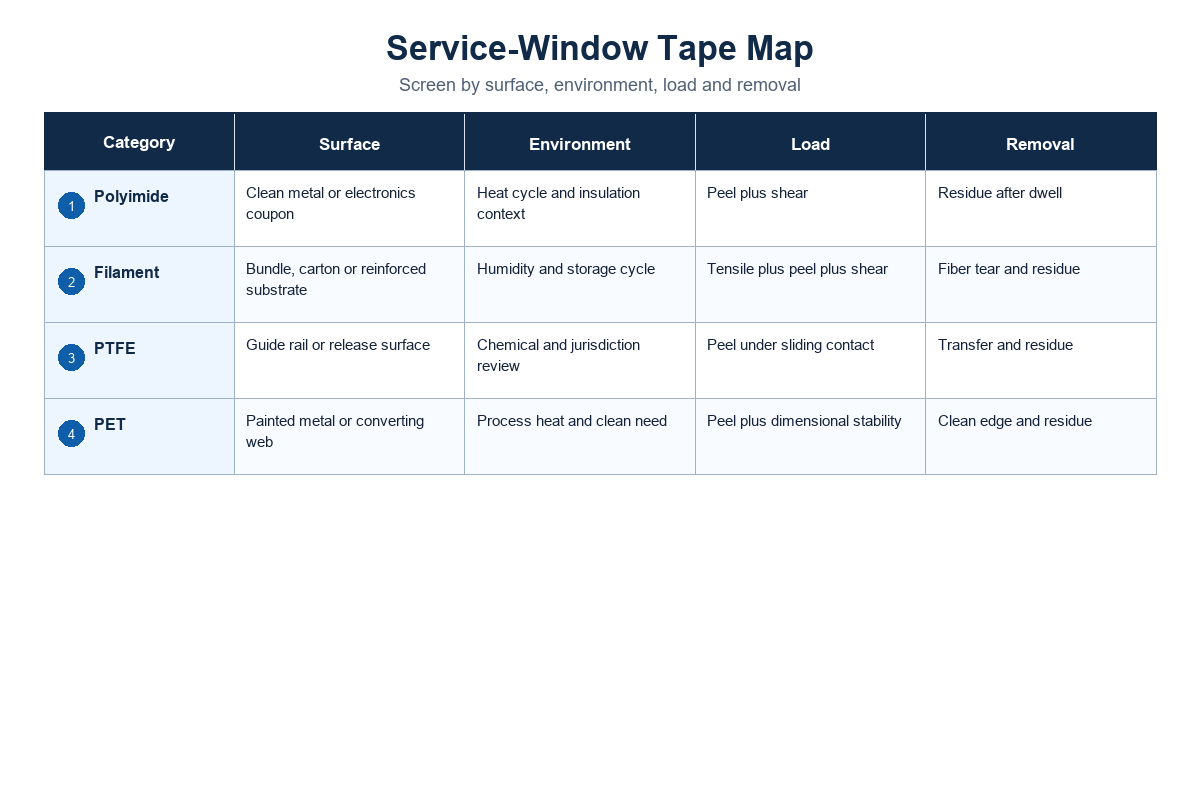
The Service-Window Tape Map narrows down the choice to four gates. A tape stays on the shortlist only if it can clear all four gates for the job required.
- Surface: record the substrate, finish, roughness, cleanliness, coating, plastic grade, and any release agent. Polypropylene, polyethylene, silicone, powder coat, painted metal, bare metal, glass, and engineering plastics can produce different wet-out and removal behavior.
- Temperature: separate application temperature from service temperature. Include the heating and cooling rate, peak, continuous or intermittent exposure, dwell, humidity, and chemical contact. Add UV exposure and outdoor aging when durability or weatherproof performance is claimed. A tape may apply poorly in a cold factory even if it performs later at a higher service temperature.
- Load: define peel, shear, cleavage, impact, vibration, tensile direction, and duration. The same tape can resist one direction and fail another.
- Removal: decide whether the bond is permanent, repositionable, cleanly removable, or residue-sensitive. State the removal time, temperature, angle, speed, and permitted surface change.
NIST researchers measured pressure-sensitive adhesive peel across a temperature gradient and observed a transition between cohesive and interfacial failure. The practical lesson is that temperature can change both the force and where the construction fails. Record the failure mode alongside the number.
Do
- Define the actual substrate and finish
- Separate application and service temperature
- Name load direction, duration, and test method
- Record residue, damage, and failure mode
Don’t
- Buy by backing color or family nickname
- Copy a film rating onto the finished tape
- Compare unlike peel tests as one ranking
- Approve production from a clean steel coupon alone
12-Condition Tape Qualification Worksheet
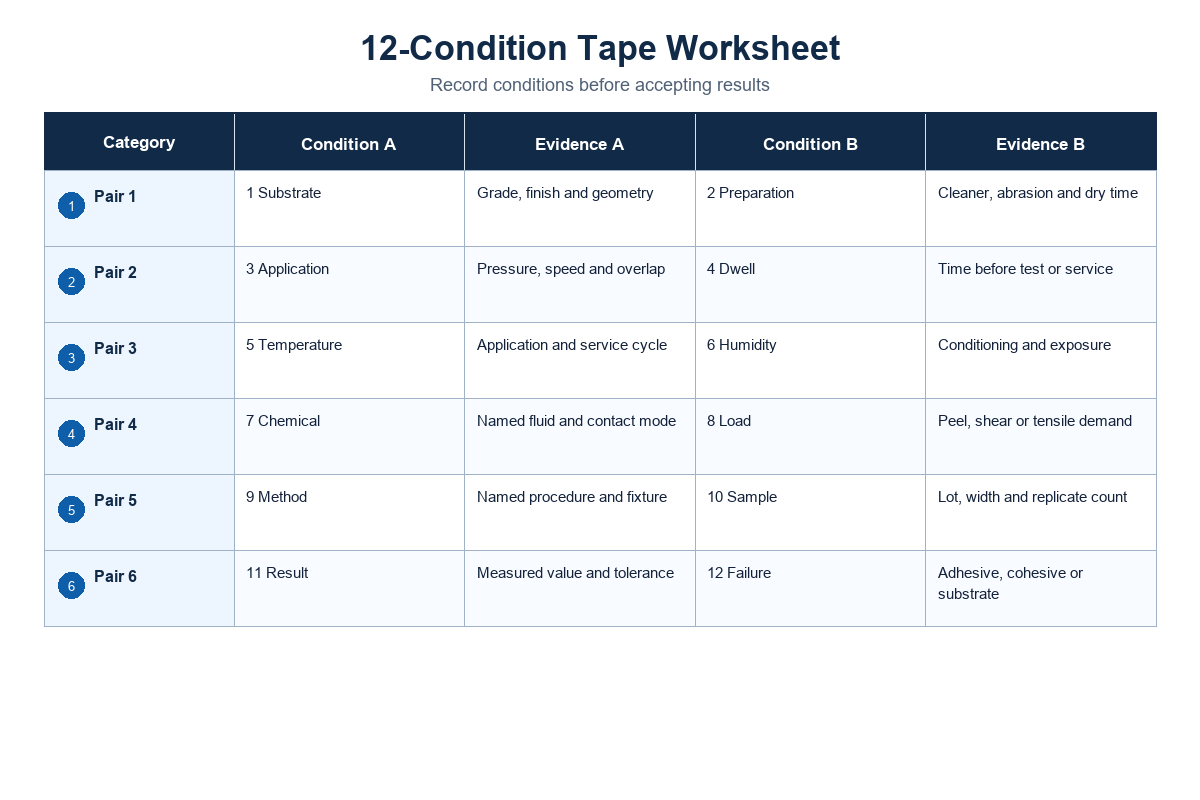
Use the worksheet below to expose where a promising data sheet may fail on the real part. Replace every generic entry with the actual substrate, preparation, load, environment, and rejection rule. The PSTC test-method resource includes independent methods for peel, shear holding, tensile, elongation, thickness, and water-related properties, while ASTM D3330/D3330M-04(2025) supplies the current official peel-procedure scope. No single set covers every tape construction.
| Condition | First screening question | Likely failure | Sample test | Record | Limitations / Not suitable for |
|---|---|---|---|---|---|
| Stainless steel | Is the finish comparable to the method panel? | Misleading benchmark | Matched peel and shear | Finish, dwell, force, mode | Does not represent plastic or coated parts |
| Aluminum | Bare, anodized, oily, or conversion-coated? | Contamination or oxide variability | Prepared-panel peel and aging | Preparation and residue | One aluminum finish cannot represent all |
| Glass | Must the tape remove without haze? | Residue or brittle removal | Aged removal cycle | Haze, residue, breakage | Clean peel does not prove high shear |
| Painted metal | What paint, cure, age, and gloss? | Paint pull or staining | Removal after service exposure | Coating damage and residue | Do not generalize between paint systems |
| Powder coat | Is the texture peak or valley controlling contact? | Bridging and edge lift | Applied-area and edge test | Contact, lift, shear time | Steel-panel data may overstate wet-out |
| ABS | Any molded-in release or cleaner sensitivity? | Poor wet-out or stress marking | Conditioned adhesion and removal | Plastic grade and surface change | One ABS formulation is not universal |
| Polycarbonate | Will cleaner, adhesive, or stress cause damage? | Crazing or residue | Small-area aging screen | Visual damage and bond | Confirm chemical compatibility first |
| Polypropylene | Is the surface treated or modified? | Low initial wet-out | Actual-part peel after defined dwell | Treatment and dwell curve | Metal-panel values are not transferable |
| Polyethylene | Which density, additives, and surface age? | Edge lift and adhesive release | Lot-matched surface test | Grade, age, peel, mode | No universal plastic adhesion assumption |
| Silicone rubber | Is a specialty adhesive required? | Immediate release or migration | Compatibility and aging test | Initial and aged failure | General-purpose tape may be unsuitable |
| Temperature cycle | What peak, duration, ramp, and cycles? | Creep, residue, shrinkage, lift | Full profile on actual part | Cycle and post-cycle result | Backing rating alone is insufficient |
| Clean removal aging | When and at what temperature is removal? | Transfer, tearing, staining, damage | Timed removal at fixed angle and speed | Residue area and substrate change | Initial clean peel does not prove aged removal |
Engineering owns the load case. Quality fixes preparation and method.
Production controls application. Procurement requires every supplier to answer the same fields. This division prevents a low purchase price from hiding a test mismatch.
Copy This Industrial Tape RFQ and Sample-Lot Protocol
A comparable request for quotation describes the construction and the acceptance method. You can copy the grouped checklist below into a supplier inquiry. “Recommended range” deliberately avoids invented universal limits; enter the range approved by your engineering team. For peel requirements, cite the exact procedure from ASTM D3330/D3330M-04(2025) rather than asking suppliers for an unqualified adhesion number.
RFQ checklist — copy these into your quote request:
| Parameter | Recommended range | Why it matters | How to verify |
|---|---|---|---|
| Backing and reinforcement | Project-specific material; thickness in µm or mil | Controls stiffness, strength, friction, and converting | Grade data sheet and incoming thickness check |
| Adhesive and primer | Named chemistry and coat; total thickness in µm or mil | Controls wet-out, shear, aging, residue, and service window | Supplier declaration plus sample test |
| Peel adhesion | Project minimum in N/25 mm or oz/in under one named method | Values are not comparable without surface, angle, rate, and dwell | Method, panel, conditioning, dwell, and failure mode |
| Shear and tensile | Project load in N; time in min or h; direction stated | Holding power and backing strength answer different questions | Matched shear and breaking-strength methods |
| Temperature and environment | Application and service range in °C; duration and cycles | Cold application, peak heat, humidity, and chemicals can change failure | Full service-profile trial on actual parts |
| Removal and surface protection | Removal age in h or days; fixed angle and speed | Residue and substrate damage can reject an otherwise strong tape | Aged removal inspection with recorded mode |
| Liner and converted format | Width tolerance in mm; roll length in m; core in mm or in | Affects die cutting, unwind, dispensing, and placement | Approved drawing, roll inspection, and line trial |
| Compliance and lot release | Exact destination and end-use documents; sample size defined | Material-family names do not prove regulatory or end-use suitability | Current declarations, certificates, lot traceability, and acceptance report |
For adjacent pressure-sensitive converting decisions, Guanma’s release paper and liner options and label stock buying guide explain why liner and facestock details belong in the handoff. If your sourcing project also needs a broader commercial assortment for comparison, review RiverTape’s industrial tape resource.
Treat any catalog as a discovery source; approve only the exact grade that passes your protocol.
Run the sample-lot protocol in order:
- Freeze the method — define substrate lot, preparation, application tool, pressure, dwell, environment, load, removal, and rejection criteria before samples arrive.
- Condition the samples — store tapes and substrates under the chosen method and record lot numbers and timestamps.
- Apply consistently — use the defined roller, passes, pressure, overlap, edge geometry, and operator sequence.
- Run service exposure — reproduce temperature, humidity, chemicals, vibration, load direction, and duration.
- Measure and inspect — record peel, shear, tensile, residue, damage, edge lift, and the exact failure interface.
- Release the lot — approve only when results meet the prewritten rule; retain the report as the baseline for incoming quality.
Common Failure Modes
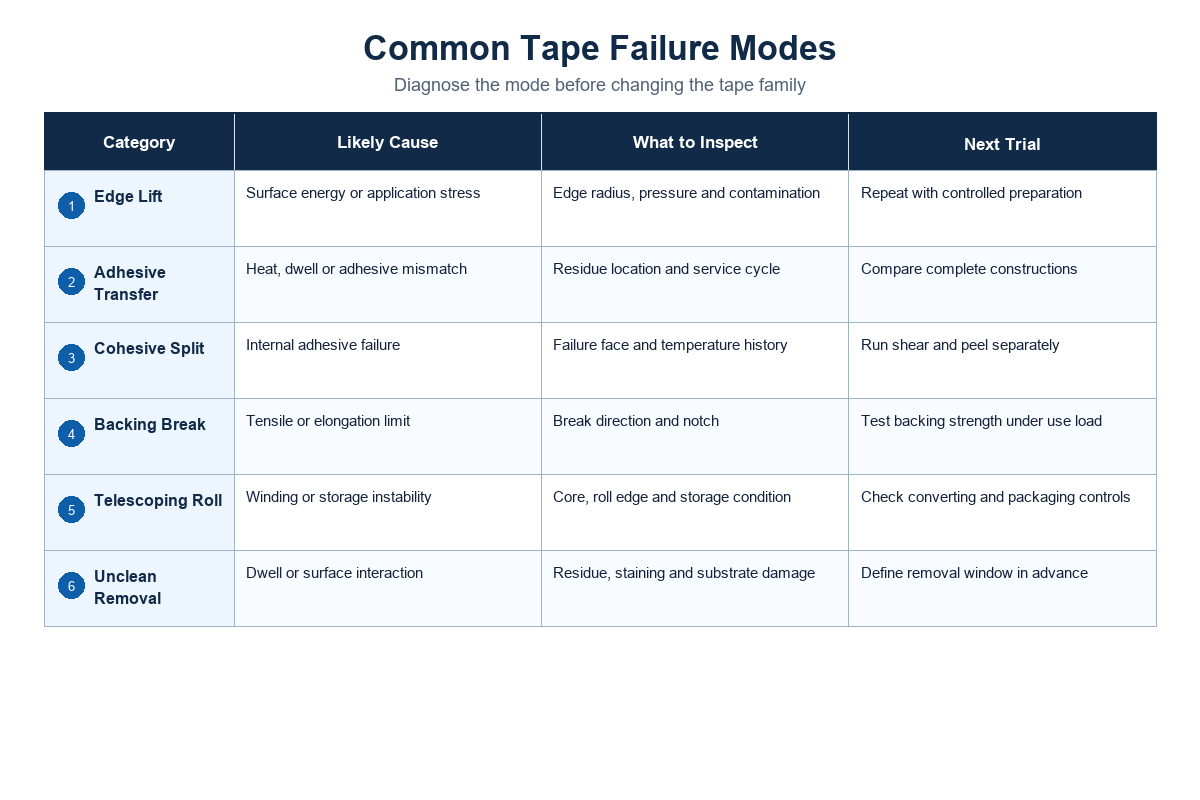
Poor wet-out: the adhesive touches only the high points of a textured or contaminated surface.
Increase cleanliness and controlled application pressure before assuming that a stronger backing will help.
Edge lift: stiffness, curvature, contamination, tension, cut quality, or a short dwell can start an edge failure.
Inspect the installed geometry rather than only the center of a flat panel.
Cohesive creep: the adhesive deforms under sustained shear or temperature.
A peel value at room temperature may not reveal this failure. Add a load-and-time test in the service direction.
Adhesive transfer or residue: aging, heat, chemical exposure, over-dwell, or incompatibility can leave adhesive on the part. Define clean removal after the full exposure, not immediately after application.
Backing split or cut propagation: reinforced tapes can be sensitive to nicks, fibers can split, and thin films can tear during removal. Include edge quality and one-piece removal in acceptance.
Substrate damage: a tape can “pass” adhesion while pulling paint, marking plastic, lifting a coating, or leaving haze. Record the surface after removal as a separate pass/fail result.
False comparison: two data sheets may use different panels, widths, angles, speeds, dwell times, units, or failure modes. Normalize the method before comparing numbers. If normalization is impossible, treat the values as separate supplier descriptions and rely on a common sample test. The NIST temperature-gradient peel study is a useful reminder to record whether failure is cohesive or interfacial, not only the measured force.
Summary
Polyimide, filament, adhesive-backed PTFE, and PET are useful starting families, not finished purchase specifications. Polyimide serves qualified thermal and electrical work.
Filament supplies directional reinforcement. Adhesive-backed PTFE creates release and low-friction surfaces. PET offers thin dimensional stability and converting utility.
In every case, adhesive, surface, application, load, environment, removal, and test method decide the outcome.
Key takeaway
Choose the backing family by the failure you must prevent, then approve the complete tape construction with one controlled service-window and sample-lot protocol.
Frequently Asked Questions
What is industrial adhesive tape used for?
Answer
Industrial adhesive tape is used for masking, electrical insulation, reinforcement, bundling, splicing, surface protection, low-friction lining, die-cut parts, and temporary or permanent holding. Those uses don’t define one interchangeable product. A masking tape may need clean removal after heat, while a reinforcement tape may need directional tensile strength and shear hold. Identify the failure that matters, then specify the backing, adhesive, liner, surface, application, environment, load, and removal condition.
Which industrial tape is best for high temperature?
Answer
No backing family is universally best. Polyimide or adhesive-backed PTFE may be logical first candidates, but a backing temperature headline doesn’t rate the complete tape. Adhesive chemistry, primer, exposure duration, heating and cooling cycle, surface, load, and removal rule can become the real limit. Compare named grades under the same method, reproduce the full temperature profile on the actual part, and inspect edge lift, creep, residue, and substrate damage after cooling.
Is filament tape stronger than ordinary tape?
Answer
Filament reinforcement can increase breaking strength in the fiber direction, but “stronger” is incomplete. It doesn’t automatically increase peel adhesion, shear holding, conformability, puncture resistance, or safe removal. A reinforced backing can still bridge over texture, lift from contamination, split at a damaged edge, or mark a soft surface. Compare tensile, peel, and shear separately under matched methods and include the installed load direction and duration.
Is adhesive-backed PTFE tape the same as thread-seal tape?
Answer
No. Adhesive-backed PTFE tape is pressure-sensitive and installed on a surface; thread-seal tape is non-adhesive and wrapped around threaded joints. Their installation, standards, and qualification variables differ.
Can PET tape be used as electrical insulation?
Answer
A specific PET tape may be evaluated for an electrical component use, but the PET backing name alone isn’t approval. Confirm the adhesive, total construction, recognition category, voltage and temperature conditions, contact with live parts, and end-product evaluation. A miscellaneous recognized PET tape component may still require additional suitable insulation in the finished equipment.
What should be included in an industrial tape RFQ?
Answer
State the backing and reinforcement, adhesive and primer, total thickness, liner, dimensions, tolerance, roll format, actual substrate, preparation, application pressure, dwell, service environment, load direction and duration, peel or shear method, removal requirement, compliance documents, sample size, traceability, and acceptance rule. Ask each supplier to quote the same construction fields and test conditions; otherwise, apparently similar numbers may describe different panels, conditioning, widths, angles, speeds, or failure modes.
About This Tape Selection Framework
Guanma’s public manufacturing scope centers on self-adhesive film and label stock, pressure-sensitive coating, PET/BOPP film facestock, release liners, and label solutions by application. That adjacent converting experience informs the RFQ and liner questions in this guide; it isn’t a claim that Guanma manufactures every polyimide, filament, PTFE, or PET industrial tape discussed here.
References & Sources
- ISO 29862, Peel Adhesion Properties of Self-Adhesive Tapes International Organization for Standardization
- ASTM D3330/D3330M-04(2025) — Peel Adhesion ASTM International
- ASTM D3654/D3654M-06(2024) — Shear Adhesion ASTM International
- ASTM D3759/D3759M-05(2025) — Breaking Strength and Elongation ASTM International
- High Throughput Measurement of Peel of a Pressure Sensitive Adhesive National Institute of Standards and Technology
- PSTC Test Methods Pressure Sensitive Tape Council
- IEC 60454-3-7, Polyimide Film Tapes for Electrical Purposes International Electrotechnical Commission
- Insulating Tape Testing and Certification UL Solutions
- 2025 PFAS Prohibitions Minnesota Pollution Control Agency
- PFAS Risk Management under TSCA U.S. Environmental Protection Agency
Need a Comparable Tape or Adhesive-Material RFQ?
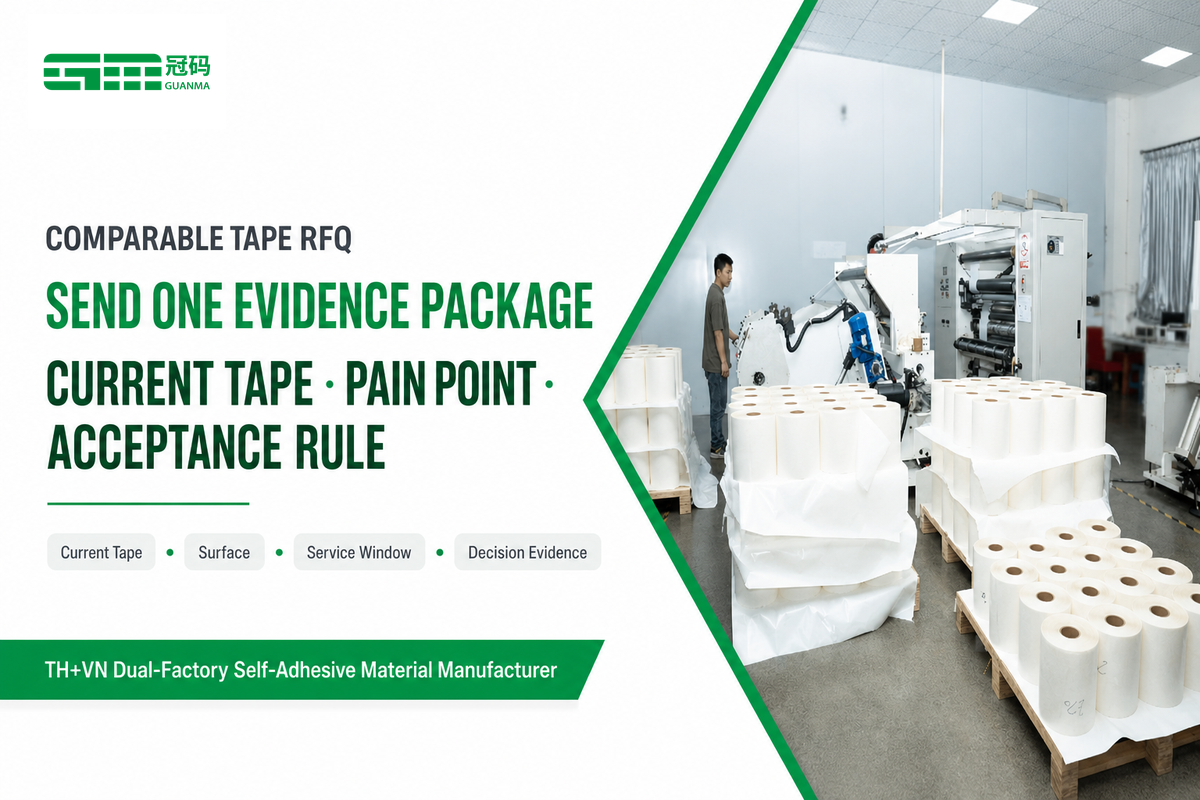
Send the substrate, service window, load, removal condition, converted format, and acceptance method. If peel is an acceptance criterion, include the applicable ASTM D3330/D3330M-04(2025) procedure. Guanma can review the adjacent pressure-sensitive film, label-stock, liner, coating, and converting requirements within its verified scope.