Get in Touch with Guanma

Labels for textured surfaces stay bonded only when soft, thick pressure-sensitive adhesive flows into surface valleys and builds real contact area. Standard permanent label stock peels from rough plastic or powder-coated metal because thin adhesive sits only on microscopic peaks. Start rough-substrate trials with a heavy-coat adhesive construction, such as the 48–53 µm (1.9–2.1 mil) acrylic layer listed on Flexcon’s DPM PCRTS rough-surface stock, paired with a conformable film rather than stiff paper.
Instron’s ASTM D3330 guide: Normal lab peel testing involves polished stainless steel panels with 50 ± 25 nm of roughness. Industrial powder coatings, molded HDPE bins, and raw cartons are much rougher than polished steel, so smooth-panel peel numbers cannot predict real on-substrate peel or shear retention without testing actual parts. This guide reviews adhesive wet-out science, coat-weight sizing, rubber vs. acrylic chemistry, application pressure, and a 48-hour bench trial protocol before bulk ordering.
Why Standard Labels Peel on Textured Surfaces: Contact Area and Wet-Out
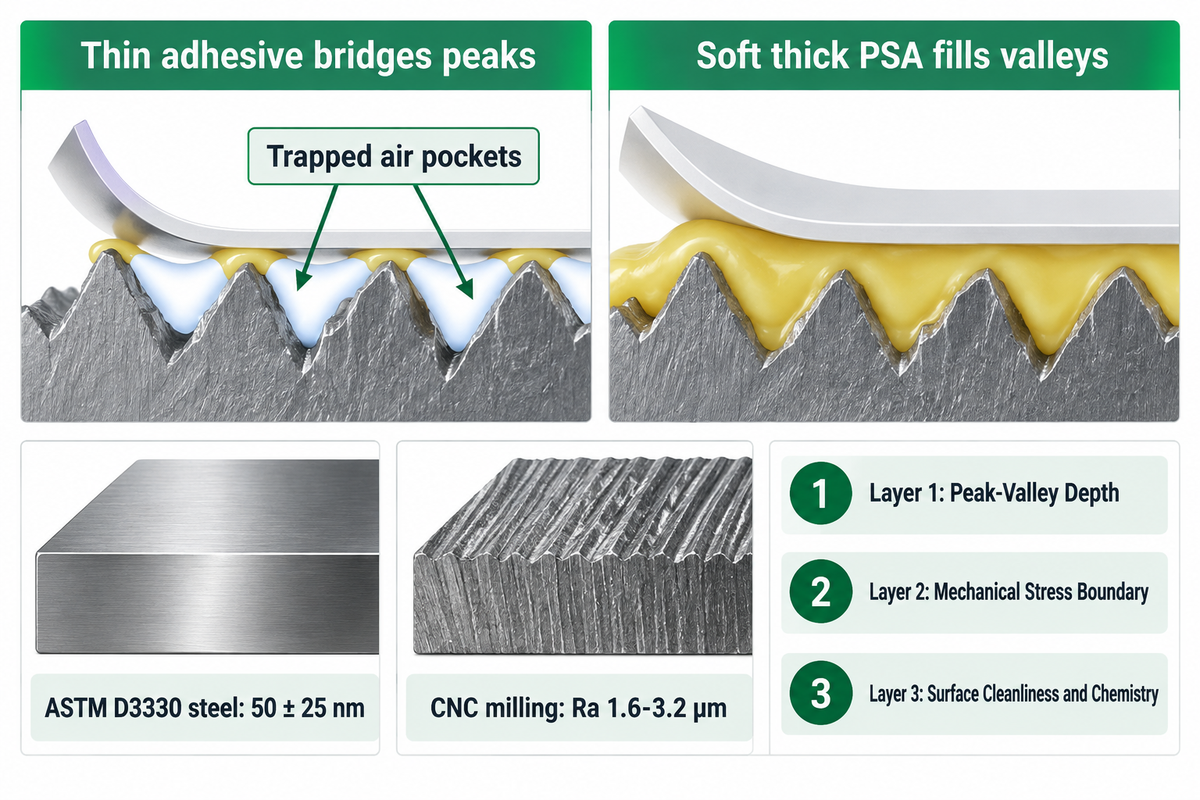
Standard labels peel on textured surfaces because microscopic peaks hold a thin adhesive layer above the valleys, leaving air pockets that cut true contact area. When bond area drops, normal handling or thermal shifts lift edges fast. It occurs again across textured plastic crates, gritted metal housings and unvarnished cardboard boxes.
Compare standard laboratory panels with real factory surfaces. Instron’s technical guide to ASTM D3330/D3330M-04(2025) lists a 302 or 304 stainless steel panel polished to 50 ± 25 nm (0.05 µm) surface roughness. By contrast, PREMSA’s surface finish reference places standard CNC milling and turning at Ra 1.6–3.2 µm (63–125 µin). Powder-coated panels, sandblasted castings, and textured HDPE containers have even deeper peak-to-valley profiles.
Roughness also interacts with substrate chemistry rather than acting in isolation. A 2025 peer-reviewed study in Polymers modeled adhesive wetting area on HDPE and showed it depends jointly on surface energy, viscosity, and temperature. Published datasheet comparisons reflect that chemistry shift. Flexcon’s DPM PCRTS rough-surface stock reports 72-hour peel of 104 oz/in (1,144 N/m) on stainless steel versus 22 oz/in (242 N/m) on polypropylene. That drop comes from the lower surface energy of polypropylene rather than from texture, and ASTM D3330 also allows representative production panels to be tested in place of the stainless steel panel.
Buyers also confuse two separate product lines when browsing for a textured label. Industrial teams need high-tack adhesive labels engineered to grab an irregular, rough texture on hardware or bins. Retail packaging teams often order decorative textured paper or specialty textured label paper for use on smooth glass.
Common choices include bright white cotton paper, embossed watercolor paper, and textured sticker stock. These stocks add a tactile finish to a wine bottle, skincare jar, candle vessel, or gourmet food box for boutique retail appeal. Ordering decorative stock with a thin general-purpose adhesive for a rough HDPE crate risks immediate edge lift.
To get good separation of root causes before sampling do The 3-Layer Roughness Fit Check:
- Layer 1 (Peak-Valley Depth): Measure or inspect whether texture valleys exceed standard adhesive thickness. ISO 21920-2:2021 defines linear roughness parameters (Ra, Rz). ISO 25178-2:2021 defines 3D areal parameters (Sa, Sz) helpful for non-directional coatings like textured powder paint.
- Layer 2 (Mechanical Stress Boundary): Isolate flat roughness from other failure drivers. Small-diameter curved bottles face elastic lift covered in our guide to label flagging on small-diameter curved containers rather than flat roughness loss. Flexible squeeze walls involve squeezable bottle label film recovery, while tire casings require specialized tire label materials for vulcanized rubber.
- Layer 3 (Surface Cleanliness and Chemistry): Check whether low-surface-energy polyolefin resin, dust, or mold-release residue is inhibiting wet-out alongside the physical valleys.
This guide focuses strictly on contact loss driven by rough and textured surfaces rather than curvature flagging, repeated squeeze flexing, or heavy oil contamination. Buyers requesting generic permanent stock without running this three-layer filter often mistake decorative brand packaging stock for industrial high-tack material.
What is the difference between textured and uncoated paper labels?
The difference is surface finish: uncoated paper lacks a surface coating and can be smooth or naturally rough, whereas textured paper labels are embossed or felt-marked during papermaking to create linen or laid grooves. Adhesion on rough industrial parts depends on the adhesive coat weight and chemistry beneath either paper stock, not on the decorative face finish.
Adhesive Coat Weight and Conformable Facestock for Textured Substrates
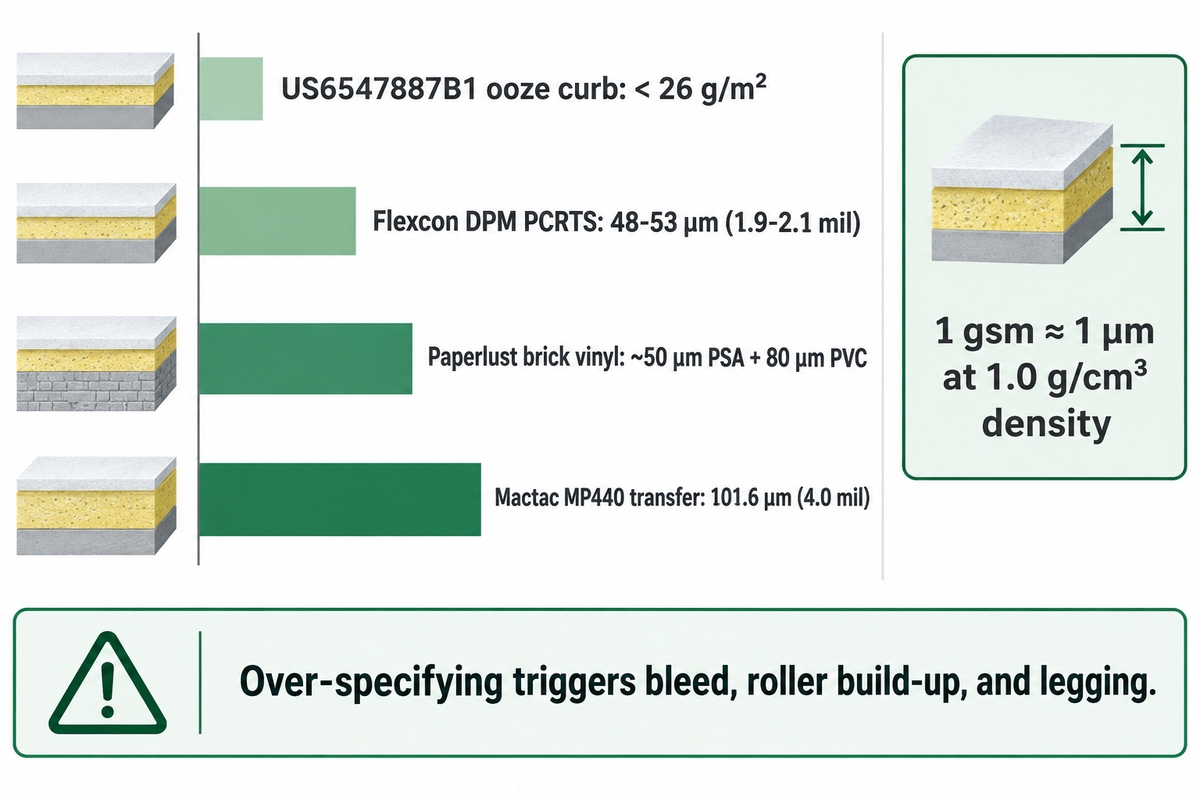
Effective rough-surface constructions pair a heavy dry adhesive layer (such as the ~50 µm PSA layer on Paperlust’s brick-and-concrete vinyl or Flexcon’s rough-surface acrylic grade) with a soft, conformable facestock. Thick adhesive fills the valleys, while a compliant film bends into surface contour without pulling corners back out. Without both halves working together, the label bridges across high points and lifts.
Dry coat weight in grams per square meter (gsm) converts approximately to dry adhesive thickness when solid pressure-sensitive adhesive density is near 1.0 g/cm³. Under that stated 1.0 g/cm³ reference assumption, 1 gsm equals about 1 µm, or 0.0394 mil (since 1 mil equals 25.4 µm). Actual caliper shifts with tackifier, polymer, and filler density.
Published vendor datasheets anchor these thickness tiers. Flexcon’s DPM PCRTS rough-surface stock uses a 2.0 mil (51 µm) clear PET film and 1.9–2.1 mil (48–53 µm ± 3 µm) permanent acrylic adhesive. It rides on a 3.1 mil (79 µm) bleached kraft liner. Paperlust’s brick-and-concrete high-tack vinyl pairs an 80 µm matte white PVC vinyl film with roughly 50 µm of adhesive (130 µm total). For extreme industrial textures, Mactac’s MP440 unsupported permanent acrylic transfer adhesive reaches 4.0 mil (101.6 µm). On the converting limit side, U.S. Patent US6547887B1 describes a multilayer construction using a preferred coat weight below about 26 g/m² specifically to curb edge ooze.
| Substrate Texture Tier | Adhesive Coat Tier (gsm Equiv.) | Published or Reference Thickness | Recommended Facestock | Published Reference / Converting Guard |
|---|---|---|---|---|
| Smooth Polished Steel / Glass | Standard thin coat (< 26 gsm) | < 26 µm (< 1.02 mil) | Standard BOPP, PET, or coated paper | ASTM D3330 baseline (50 ± 25 nm steel); clean die-cut |
| Fine Matte Paint / Frosted Glass | Low-ooze tier (< 26 gsm) | < 26 µm (< 1.02 mil) | Flexible BOPP or wet-strength paper | US6547887B1 uses coat weight below 26 g/m² in one multilayer construction to curb ooze |
| Lightly Stippled ABS / Matte Plastic | Medium-heavy coat (sizing estimate) | ~30–40 µm (~1.2–1.6 mil, estimate) | Conformable PE or soft vinyl | Requires sharp rotary dies to curb matrix legging |
| Corrugated Cartons / Kraft Board | Aggressive paper stock tier | 3.4 mil face / 7.5 mil total (OnlineLabels AT) | Uncoated matte paper or kraft paper | OnlineLabels Aggressive White Matte paper (-20 °F min app; dry indoor use) |
| Textured Powder-Coated Metal | Heavy-coat acrylic (Flexcon / 3M tier) | 48–53 µm (1.9–2.1 mil, Flexcon PCRTS) | Soft white vinyl (3M 7051) or flexible 2.0 mil PET | 3M Label Material 7051 (Adhesive 350) and Flexcon DPM PCRTS rated for painted metal |
| Molded HDPE / PP Industrial Totes | Heavy-coat LSE acrylic (Flexcon tier) | 48–53 µm (1.9–2.1 mil, Flexcon PCRTS) | Conformable PE, PP, or calendered vinyl | Flexcon DPM PCRTS lists 48–53 µm acrylic; 22 oz/in (242 N/m) 72 hr peel on PP |
| Raw Wood / Rough Lumber Crates | Heavy-coat PSA (sizing estimate) | ~50 µm+ (~2.0 mil+, estimate) | Conformable vinyl or tear-resistant polyolefin | Check chilled roll storage to control edge bleed |
| Painted Concrete / Brick Masonry | ~50 gsm equiv. (Paperlust brick vinyl) | ~50 µm PSA (80 µm PVC + ~50 µm PSA = 130 µm total) | 80 µm soft matte white PVC vinyl | Paperlust brick-and-concrete vinyl published construction |
| Sandblasted Cast Metal / Heavy Grit | Ultra-heavy transfer tier (Mactac MP440) | 101.6 µm (4.0 mil, Mactac MP440) | Conformable label film laminated to heavy transfer PSA | Mactac MP440 unsupported permanent acrylic transfer adhesive listed at 4.0 mil |
Facestock stiffness affects the permanency of the adhesion of the label. Soft PVC vinyl materials and lightweight polyethylene can be compressed by rollers and conform to surface contours. Rigid polyester (PET), thick glossy overlaminates, and heavy label paper in linen or kraft paper grades all store elastic memory.
Using a thick protective overlaminate over a 2 mil film increases bending stiffness and can pull corners out of shallow valleys. Consult our self-adhesive film facestock selection guide for a good balance of print durability and conformability.
Over-specifying heavy coat weight results in a host of real narrow-web press converting failures. As Wausau Coated Products’ technical glossary documents, excessive cold flow causes adhesive bleed (edge ooze), adhesive build-up on rollers, and legging (adhesive stringing during matrix stripping). Tight roll rewind tension squeezes soft adhesive past the label edges in warm warehouses, fusing adjacent layers together.
Will vinyl stick to a textured surface?
Yes. Yes, conformable vinyl paired with a heavy-coat high-tack permanent adhesive is a reliable starting point on moderate industrial textures when applied with firm wipe-down pressure. Thin general-purpose sign vinyl often bridges across deeper peaks under light contact.
Soft calendered or cast vinyl conforms better to uneven surfaces so the adhesive wets into valleys for long-lasting durability.
Rubber Hot-Melt vs. Solvent and Emulsion Acrylic Adhesives on Rough Plastic
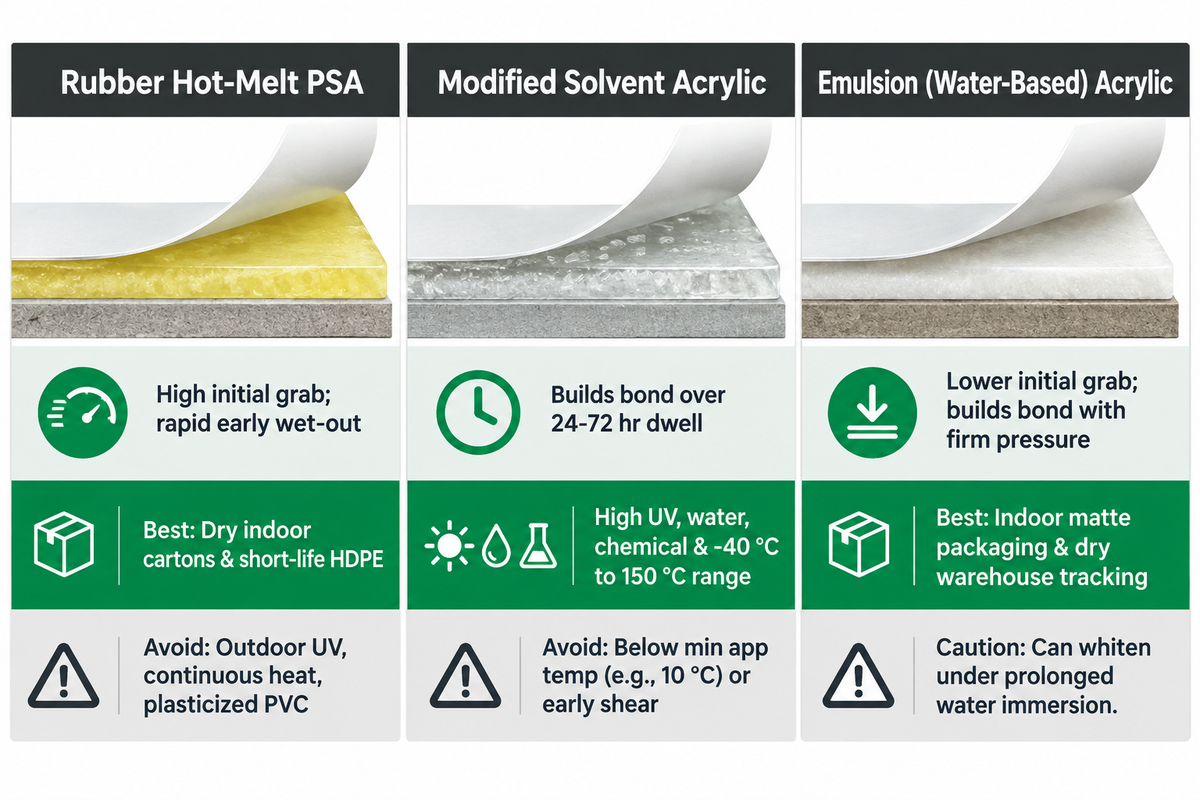
Choose rubber-based hot-melt adhesive for immediate high tack on dry, indoor textured plastic or cardboard. Choose modified solvent acrylic for outdoor UV exposure, heat, and chemical contact. Emulsion (water-based) acrylic offers a lower-cost middle tier for indoor moderate textures when dwell build is acceptable.
Adhesive chemistry governs how fast a viscoelastic layer wets into surface valleys and how well it resists heat and UV aging. Rubber hot-melt PSAs are designed with enough aggressiveness at the outset for strong initial tack, and for quick initial wet-out when exposed to light pressure. Many modified acrylic PSAs build ultimate bond strength across longer dwell windows—FINAT FTM 1 measures 20-minute to 24-hour dwell, while Flexcon evaluates DPM PCRTS after multi-day room-temperature dwell.
Industry guidance republished by the Adhesive and Sealant Council (Engineered Materials, Inc.) dictates this physical requirement directly:
“Firm adhesives or very thin adhesives may not wet into the surface of a material, failing to form a secure bond if one or more of the substrates has a rough or uneven surface. Instead, such surfaces require PSA tapes with a thicker layer of soft, viscoelastic adhesives that flow into the smallest valleys of a surface.”
Temperature and polymer structure also shift real-world peel resistance. In the 2025 Polymers study on HDPE, peel strength across all five tested acrylic PSA groups declined as temperature rose across the tested elevated range. Commercial specifications confirm wide service differences across chemistries. Flexcon’s DPM PCRTS permanent acrylic stock operates from -40 °F to 302 °F (-40 °C to 150 °C) with a 50 °F (10 °C) minimum application temperature. It rates at 100 hours shear under ASTM D3654 Method A (4 lb / 1 sq in) and 1,520 g tack under ASTM D2979. OnlineLabels’ aggressive all-temperature white matte paper lists a -20 °F minimum application temperature and -65 °F to +200 °F service range for dry packaging.
| Adhesive Chemistry | Initial Wet-Out & Dwell | Heat, UV & Moisture Profile | Best Textured Fit | Limitations / When Not to Use |
|---|---|---|---|---|
| Rubber Hot-Melt PSA | High initial grab; rapid early wet-out under light contact | Lower heat and UV resistance; oxidizes outdoors | Dry indoor corrugated boxes, short-life molded HDPE bins, cold-room packaging | Do not use in direct outdoor UV, continuous heat above manufacturer limits, or near plasticizer-rich PVC where softening causes shear creep and edge bleed. |
| Modified Solvent Acrylic | Moderate initial tack; builds bond over 24–72 hr dwell (Flexcon tests at 72 hr) | High UV, water, chemical, and extreme temperatures (Flexcon PCRTS: -40 °C to 150 °C) | Outdoor powder-coated metal, textured LSE plastic equipment, washdown assets | Do not apply below minimum application temperature (e.g., 10 °C on Flexcon PCRTS) or subject to immediate shear stress before dwell build completes. |
| Emulsion (Water-Based) Acrylic | Lower initial grab than hot-melt rubber; builds bond with dwell and firm pressure | Good indoor aging; conventional surfactant-bearing grades can whiten under prolonged water immersion | Indoor matte packaging, lightly textured containers, dry warehouse tracking | Verify wet-adhesion ratings before specifying standard emulsion grades for submerged containers, washdown bays, or coarse unprimed HDPE. |
For example, if a hot-melt rubber is chosen on the basis of an aggressive hand-feel office sample, field failures will likely occur in the warm transit or outdoor yard environment. When evaluating a permanent adhesive for rough plastic that sees sun or heat, allow the datasheet’s full dwell period before comparing modified solvent acrylic against rubber. An aggressive grab right out of the gun isn’t a good long-term indicator of heat or outdoor hold.
Are aggressive adhesive labels the same as waterproof labels?
No. No, aggressive adhesive labels focus on higher bond strength to rough or uneven surfaces, while waterproof labels focus on moisture-resistant film facestocks and water-tolerant adhesives.
As OnlineLabels explicitly notes on its aggressive white matte paper specification, an uncoated paper label with strong adhesive still absorbs water, wrinkles, and lifts in wet outdoor conditions.
Matching Label Printing and Adhesive Labels to Industrial Textured Surfaces
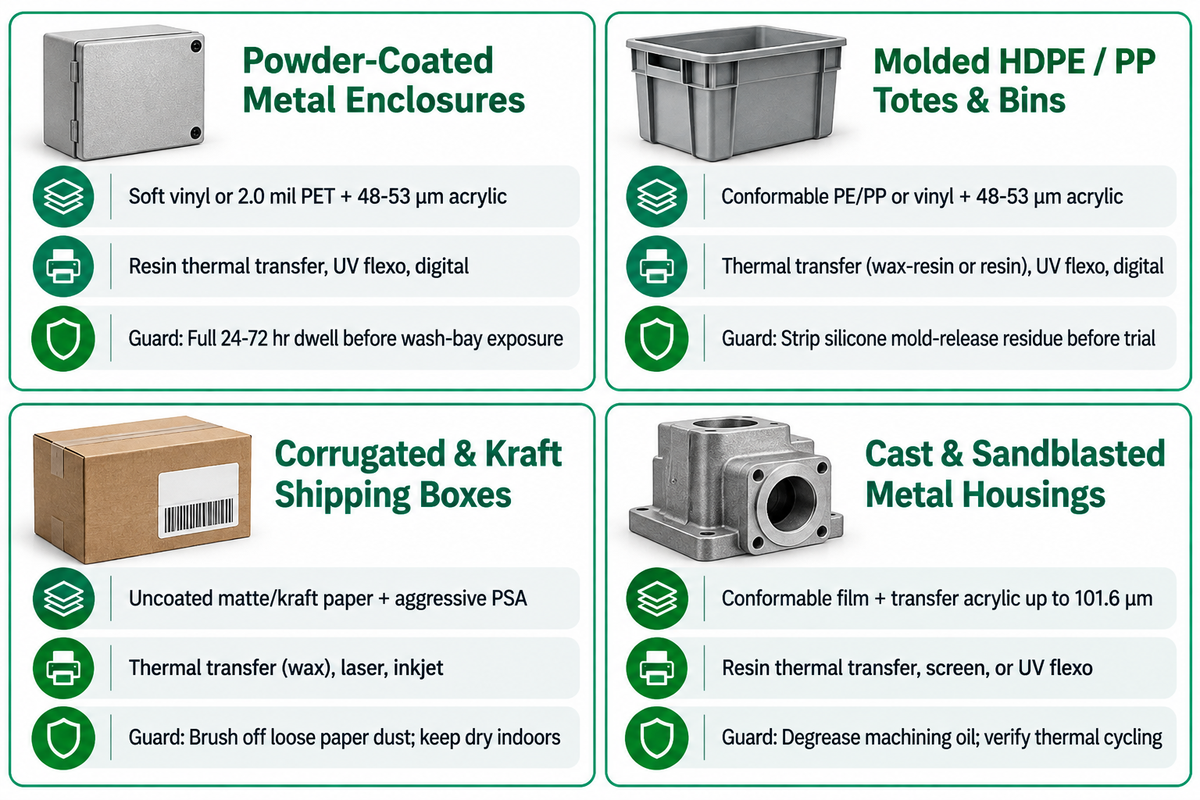
Reliable label performance requires matching three variables together: substrate texture family, adhesive-facestock stack, and label printing method. A resin thermal transfer ribbon produces sharp barcodes on 2 mil PET but transfers unevenly with voids on rough uncoated paper. A desktop inkjet printer needs an inkjet-receptive topcoat (matte or gloss).
Similarly, an adhesive qualified on clean powder-coated metal often clogs with loose dust on corrugated board.
Two common field failures emerge in shop-floor experience. In powder-coat washdown bays, conventional paper or thin-coat stickers detach from textured enclosures within micro-gaps when moisture infiltrates. In molded polyolefin production, trace silicone mold-release agents and coarse grain make rigid stocks pop loose.
Commercial printers report improving adhesion by cleaning residual release agents and switching to malleable plastic films paired with aggressive permanent adhesives.
| Substrate Family | Surface Condition | Recommended Construction | Compatible Print Method | Primary Failure Guard |
|---|---|---|---|---|
| Powder-Coated Metal Enclosures | Orange-peel or fine grit; moderate-to-low surface energy | Soft vinyl (3M 7051) or 2.0 mil PET + 48–53 µm modified acrylic (Flexcon PCRTS tier) | Thermal transfer (resin ribbon), UV flexo, digital | Allow full dwell (24–72 hr per datasheet) before damp wash-bay exposure |
| Molded HDPE / PP Totes & Bins | Grainy mold texture + low surface energy polyolefin | Conformable PE/PP or vinyl + 48–53 µm high-tack acrylic (Flexcon PCRTS tier) | Thermal transfer (wax-resin or resin), UV flexo, digital | Strip mold-release residue with a compatible silicone remover before trial |
| Corrugated & Kraft Shipping Boxes | Fibrous, porous flutes with loose paper dust | Uncoated matte paper or kraft + aggressive rubber hot-melt or all-temperature paper PSA (OnlineLabels AT tier) | Thermal transfer (wax), laser, inkjet (direct thermal needs thermal-coated paper) | Brush off surface fiber dust; keep dry indoors |
| Raw Wood & Industrial Crates | Deep grain grooves, splinters, sawdust | Conformable vinyl or tear-resistant film + heavy-coat PSA (~50 µm+ estimate) | Thermal transfer, UV digital, flexo | Air-blow sawdust; verify wood moisture is below saturation |
| Painted Concrete & Brick Walls | Deep pores, masonry grit, outdoor weather | 80 µm soft PVC vinyl + ~50 µm high-tack PSA (Paperlust brick tier) | Solvent or UV digital inkjet with matte finish | Avoid stiff gloss overlaminates; roll firmly into pores |
| Cast & Sandblasted Metal Housings | Sharp metallic peaks, thermal cycling | Conformable film laminated to heavy transfer acrylic up to 101.6 µm / 4.0 mil (Mactac MP440 tier) | Resin thermal transfer, screen, or UV flexo | Degrease machining oil; test thermal cycle stability |
| Woven Industrial Fabric & Bags | Open weave threads with high flex | Dedicated soft film + heavy-coat fabric PSA | Thermal transfer or flexo | Use self-adhesive label film for woven fabrics to resist flex lift |
| Frosted & Embossed Glass Bottles | Micro-etched matte glass + chill condensation | Wet-strength textured stock or matte BOPP + wet-tack acrylic | Digital or flexo printing with protective varnish | Test ice-bucket immersion; protect uncoated edges |
| Matte Ceramic Candle & Skincare Jars | Lightly gritty stoneware or frosted retail jar | Textured film or matte finish labels + medium-heavy acrylic (~30–40 µm estimate) | Digital inkjet, laser, or UV flexo | Check warm-jar wax oil migration and shelf aesthetics |
When outdoor weather, chemical wipes, or abrasion join surface roughness, consult our durable and outdoor label material specifications alongside this matrix. On consumer product packaging such as skincare jars, gourmet food tins, wine labels, or custom print candle labels, a facestock with waterproof protection keeps graphics sharp on lightly grained matte finishes without losing visual impact. Artisan brands targeting a rustic shelf style still need moisture-resistant facestocks whenever a shopper handles chilled or damp containers.
Are textured labels durable for product packaging?
Synthetic textured film labels with a water-resistant permanent acrylic adhesive and a matched print topcoat or overlaminate offer excellent waterproof and abrasion resistance for industrial and retail product packaging. Choose coated wet-strength stock or matte synthetic vinyl when textured packaging faces condensation, handling friction, or chemical wipes.
Application Pressure, Temperature, and Dwell Time: Turning Contact into Bond
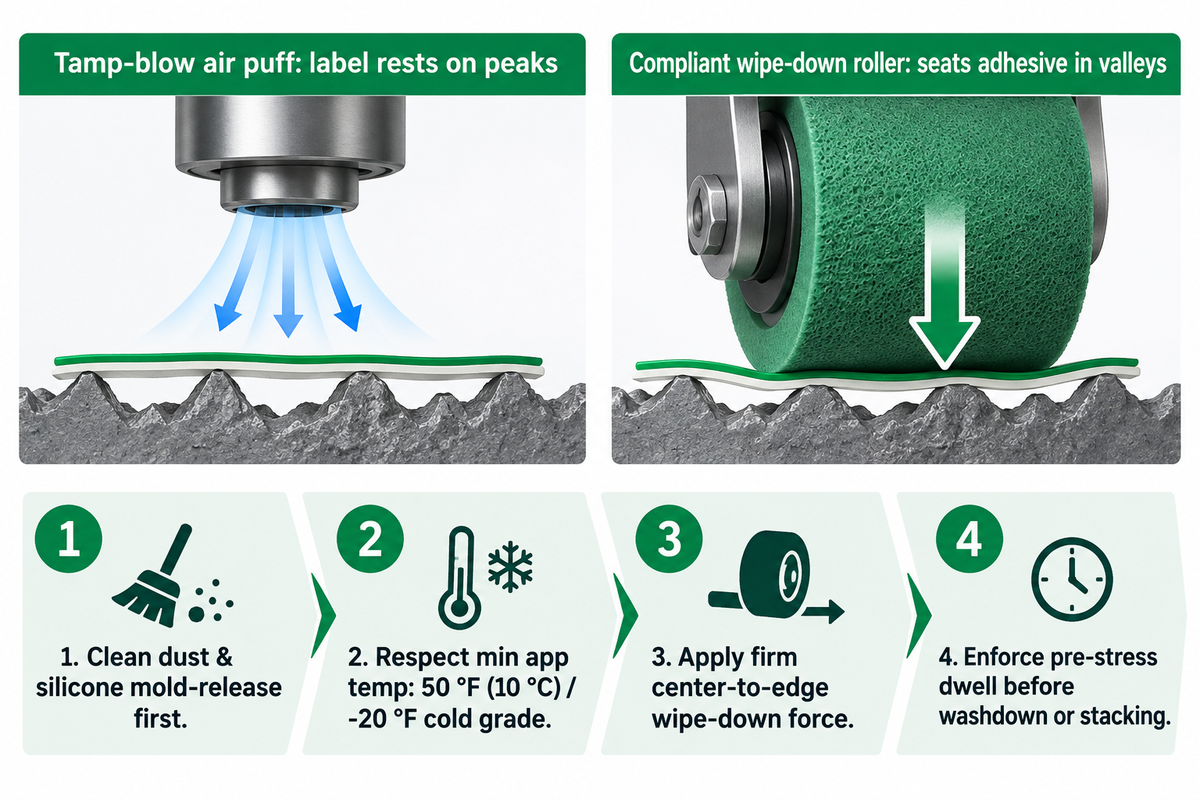
Even the right high-tack label fails on a rough surface under light air-blow contact, cold application, or early handling stress. Pressure forces viscoelastic adhesive into valleys, warmth keeps the polymer fluid enough to flow, and dwell time converts initial tack into permanent bond.
Laboratory standards highlight how tightly controlled application pressure is. Instron’s ASTM D3330 procedure uses a mechanical or hand-operated roller to apply uniform pressure across the 24 mm specimen. A Pressure Sensitive Tape Council technical review contrasts PSTC 1 (<1 min dwell at 12 in/min) against FINAT FTM 1 (20 min to 24 hr dwell at 300 mm/min). On real packaging lines, Quadrel’s pressure-sensitive guide notes that contact pressure directly governs bonding success.
Automated tamp-blow applicators often trigger unexpected line failures after successful hand trials. A hand-rubbed lab sample receives firm thumb or squeegee pressure for several seconds, seating the adhesive deep into valleys. On the production line, a tamp-blow head fires a brief puff of air that leaves the label resting on high peaks.
Switching to a compliant wipe-down sponge roller or soft rubber brush head improves valley wet-out on textured bins and panels.
Follow four shop-floor controls before releasing a batch:
- Clean hidden contamination first: air-blow loose sawdust or carton fibers, and clean molded plastics with a compatible degreasing or silicone-release remover (plain IPA alone doesn’t reliably strip silicone mold-release agents). If machining oil remains on metal parts, refer to adhesive selection for oily and contaminated surfaces instead of relying on coat weight alone.
- Respect minimum application temperature: cold surfaces stiffen pressure-sensitive adhesives before they can wet out. Flexcon’s DPM PCRTS acrylic requires at least 50 °F (10 °C) at application despite surviving -40 °C in service. Sub-freezing rooms need a cold-temperature grade such as OnlineLabels’ -20 °F rated stock.
- Apply firm, even wipe-down force: Wipe from the center to the edges using a soft rubber roller or a compliant wipe-down brush. This action pushes trapped air out of texture valleys, even on slightly curved surfaces.
- Enforce a pre-stress dwell window: keep labeled parts away from washdown bays, extreme temperatures, and abrasive stacking during initial dwell. Modified acrylics continue building wet-out into micro-valleys throughout the datasheet dwell window before reaching ultimate peel strength.
How to Design a Textured-Surface Label Trial Before Bulk Ordering
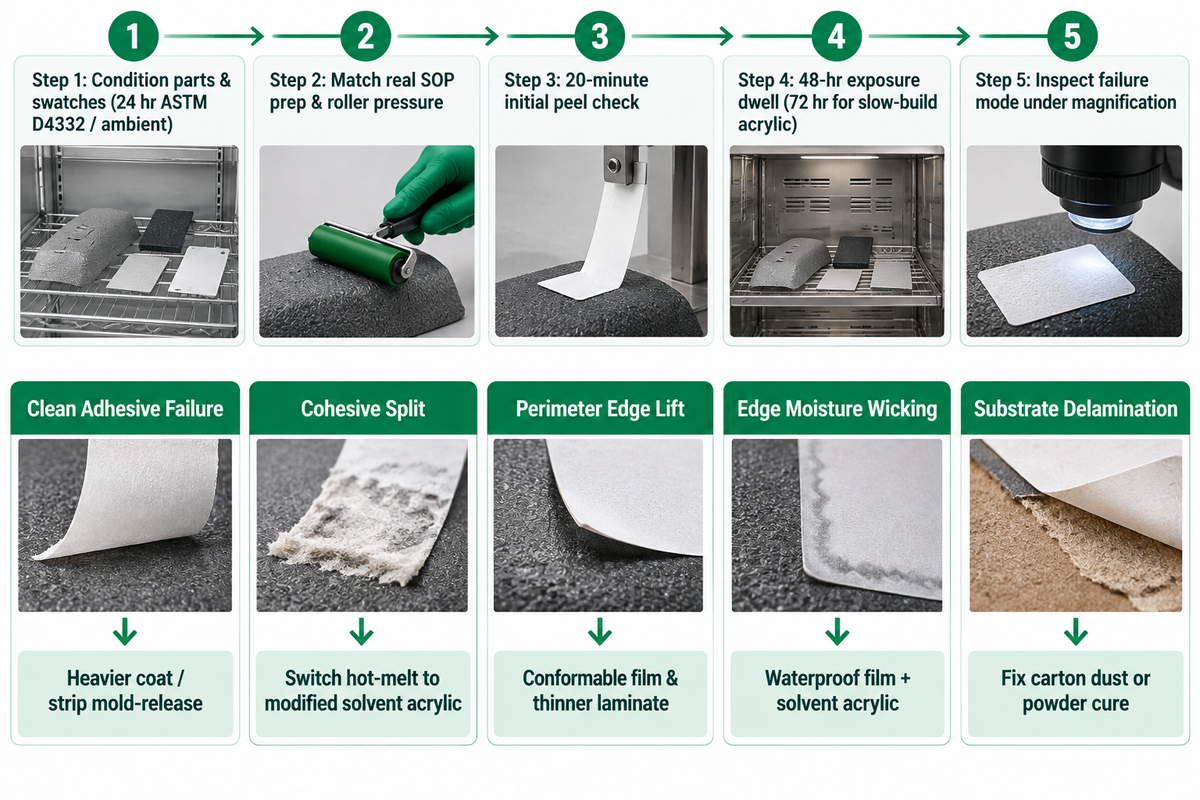
Screen rough-surface label candidates on actual production parts using a controlled 48-hour bench protocol instead of signing off from smooth stainless-steel datasheet numbers. Increase the slow-build acrylic checks to 72 hours and include long-term aging or washdown tests prior to bulk release.
Standard test methods define both the procedure and its interpretation limits. ASTM D3330/D3330M-04(2025) covers six test methods (Method A for 180° single-coated peel and Method F for 90° peel, while Methods B–E address backing, double-coated, liner, and transfer constructions). Instron’s test-equipment overview of ASTM D3330 lists a 5.0 ± 0.2 mm/s (300 mm/min) peel rate, discarding the first 25 mm and averaging the next 50 mm. ASTM D3330 permits substituting representative textured production panels for steel, while cautioning that backing stiffness and adhesive rheology affect cross-manufacturer comparisons and that peel adhesion alone does not directly predict field performance. Pair your peel checks with our FINAT and ASTM label durability test standards overview.
Run a 48-hour wet-out bench test as an initial screening procedure on three to five actual textured production parts per candidate stock:
- Condition parts and labels: equilibrate both textured parts and candidate label swatches at plant ambient temperature (or ASTM D4332 lab conditioning for at least 24 hours per Instron’s ASTM D3330 guide) and record actual surface temperature.
- Same-line prep and pressure: Clean half the parts with your shop’s actual SOP (leave the other half uncleaned if operators skip wiping). Apply specimens with the real applicator head or a repeatable soft roller rather than hard thumb rubbing.
- The 20-minute initial peel test uses a peel or corner-lift check after a 20-minute dwell, matching FINAT FTM 1’s early dwell checkpoint, to assess whether labels survive immediate handling and stacking.
- Run dwell plus exposure checks: After the first dwell, expose half of the specimens to humidity, washdown spray or heat through hour 48. Extend acrylic checks to 72 hours where specified by the datasheet, measuring peel resistance and edge lift.
- Inspect failure mode under magnification: classify what stayed on the substrate before declaring a winner.
| Observed Failure Mode | Visual Evidence on Substrate | Primary Root Cause | Corrective Specification Change |
|---|---|---|---|
| Clean Adhesive Failure | Zero adhesive left in valleys; bumpy pattern only on peak tips | Coat weight too thin, cold application, or mold-release film | Step up to a heavier-coat or softer PSA, verify application temperature, and strip mold-release contamination |
| Cohesive Split | Adhesive residue remains on both label back and textured part | Adhesive softened by heat, solvent, or low internal shear | Move from rubber hot-melt to modified solvent acrylic |
| Perimeter Edge Lift | Center holds well, corners curl within 24 hours | Stiff facestock or thick overlaminate overcoming edge tack | Switch to conformable vinyl/PE and thinner varnish or laminate |
| Edge Moisture Wicking | Darkened paper edge or adhesive whitening after spray | Paper facestock or water-sensitive emulsion acrylic | Specify waterproof film facestock + modified solvent acrylic PSA |
| Substrate Delamination | Cardboard fibers or loose paint flakes stick to adhesive | Weak top layer on carton or poorly cured powder coat | Improve substrate curing/dust removal before changing PSA |
Check regulatory compliance boundaries during trial design rather than after bulk purchase. Under ANSI/UL 969, UL divides label recognition into four categories: PGDQ2 (finished printed labels), PGJI2 (user-printable materials), PGIM2 (in-mold labels), and PGGU2 (component materials such as unprinted stocks, overlaminates, adhesives, and inks for converters, including Flexcon’s PGGU2.MH10170). Raw PGGU2 component recognition does not automatically carry over to a finished printed label. Finished UL acceptance covers the exact substrate, temperature rating, exposure conditions, and ink or ribbon combination.
Similarly, adhesives on U.S. food-packaging labels fall under FDA 21 CFR § 175.105, which lists permitted adhesive substances and functional-barrier rules. Chemical drums shipped by sea may require BS 5609 certification, which tests both seawater immersion adhesion and print durability. After a construction passes both short-term screening and required long-term aging or washdown checks, lock lot-to-lot incoming release controls using our label stock incoming inspection checklist.
Custom High-Tack Roll Labels: Cost Drivers, Minimum Orders, and Sample Lead Times
Sticker Swan lists custom high-tack vinyl labels from $109.00 per 100 pieces as of November 2026. Narrow-web custom roll converters and raw master-roll coaters quote per job by web width, adhesive mass, and cutting setup.
Sticker Swan lists 100 custom laminated high-tack industrial vinyl labels (2″ × 2″) starting at $109.00 ($1.09 each). Quantity tiers cover 100, 250, 500, and 1,000 pieces, with 2–4 business days standard production. OnlineLabels lists blank aggressive white matte paper 8.5″ × 11″ sheets from $9.39 per 10 sheets ($0.94 each, down to $0.11 each at volume) with no minimum order.
Multi-SKU custom label printing setup costs are dictated by press architecture. According to a Domino Digital Printing specialist writing for the Flexographic Technical Association (FTA), jobs sharing a common die across multiple SKUs require separate plate changes and makereadies on flexo-only presses. Digital-only presses can print without plates but die-cutting is an independent finishing process either on- or off-line on a coupled inline finishing station.
And a flexo/digital hybrid press runs all SKUs on one makeready, while delivering heavy static spot colors or a brand logo on the flexo station reduces digital ink.
| Sourcing Tier | Published Price Benchmark / Quote Mode | Primary Cost Drivers | Typical Order Unit | Sample & Production Lead Time |
|---|---|---|---|---|
| Online Short-Run Digital Printers | Listed Nov 2026: Sticker Swan $109.00/100 pcs (2″×2″ vinyl); OnlineLabels $9.39/10 blank sheets | Per-piece digital ink, fixed material menu, shipping speed | 10 blank sheets to 1,000 custom textured labels | 2–4 business days standard production (Sticker Swan list) |
| Narrow-Web Custom Roll Converters | Requires quote (depends on stock, cutting step, press route, artwork) | Adhesive coat mass, conformable film, die tooling, plates, setup waste, rewinding | Finished die-cut rolls on 3″ cores for applicators | Requires quote; budget separate swatch + 48–72 hr trial window |
| Raw Master-Roll Label-Stock Coaters | Requires quote (priced per square meter / slit master roll) | Custom coat-weight tolerance, adhesive chemistry, liner grade, master width (e.g., 60 in) | Master jumbo or slit unprinted rolls for converters | Requires quote; hand swatches first, then press-trial roll |
Four physical factors raise high-tack roll prices above general-purpose label stock. First, rough-surface grades are much heavier in adhesive coat mass than standard smooth-surface grades. Second, conformable vinyl and specialty polyolefin films are more expensive than paper.
Third, heavy-coat rough-surface stocks pair with heavier release liners, such as the 50 lb bleached kraft release liner for Flexcon’s DPM PCRTS, to help the web stay flat during die-cutting. Fourth, presses run at a slower speed to minimize the build-up of adhesive on rollers. Approving artwork and material specifications before sales-order entry cuts production lead times cleanly.
How to Evaluate Industrial Label Stock Manufacturers for Textured Surfaces
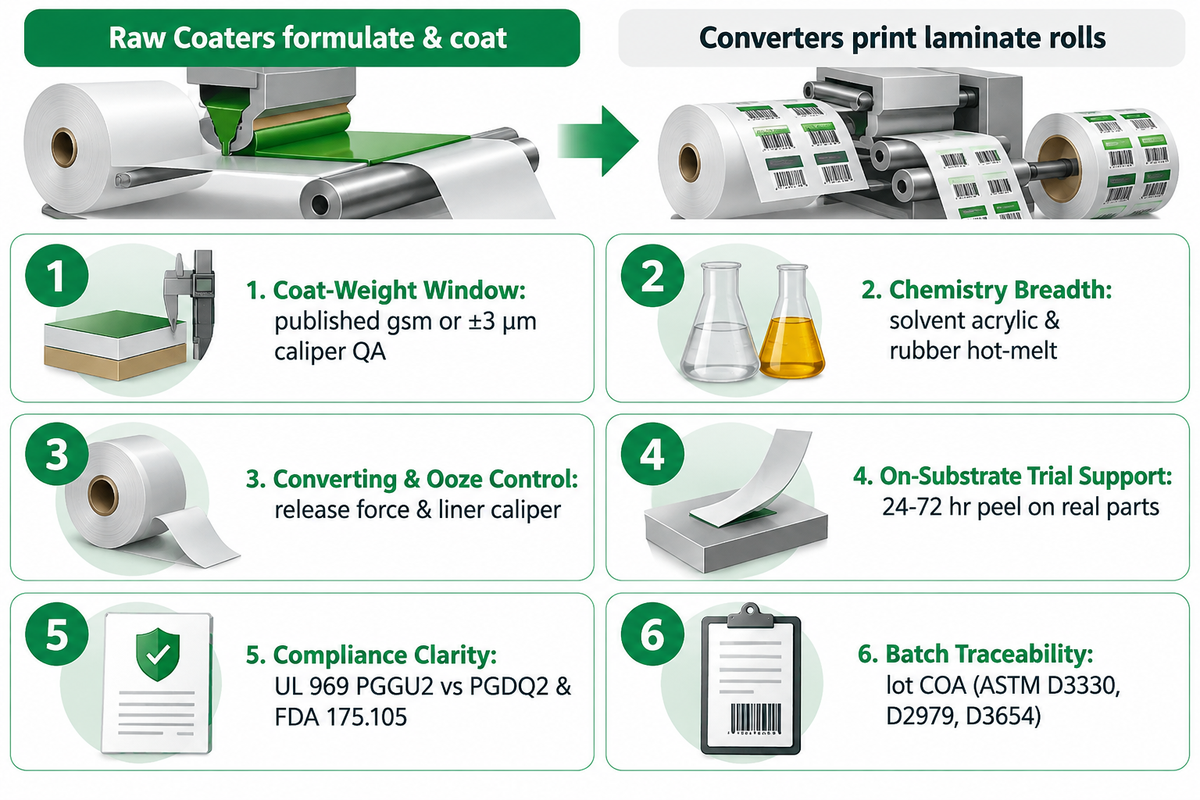
Separate raw pressure-sensitive label-stock coaters from finished-label converters before sending an inquiry. Print-only converters purchase laminate rolls from coaters and cannot modify adhesive coat weight or release liner chemistry in-house, so a heavier adhesive coat for your textured substrate must be sourced through the coater. Raw coaters formulate, coat and slit the laminate stack.
Published industrial product lines set a clear technical baseline. Global coaters maintain dedicated rough-surface grades including 3M Label Material 7051 (soft white vinyl with Adhesive 350) and Flexcon DPM PCRTS (2.0 mil PET with heavy-coat acrylic, UL 969 PGGU2.MH10170). Other documented industrial lines include Mactac Lintec Low Ooze durable stocks and Mactac MP440 transfer acrylic. You can also review Guanma’s pressure-sensitive film constructions for batch qualification when sourcing industrial film stocks.
Evaluate candidate manufacturers across six auditable checkpoints in the table below: dry coat-weight tolerance, chemistry breadth, die-cut ooze control, on-substrate trial support, UL 969 / FDA compliance clarity, and lot-level COA traceability.
| Audit Dimension | What to Ask the Manufacturer | Pass / Qualification Indicator |
|---|---|---|
| 1. Coat-Weight Window | What dry adhesive coat-weight or caliper tolerance can you hold on heavy-coat runs? | Published dry adhesive coat-weight tolerance in gsm, or an adhesive-layer caliper tolerance (e.g., ±3 µm) with the density used for conversion, plus cross-web coating QA |
| 2. Chemistry Breadth | Do you offer both modified solvent acrylic and rubber hot-melt options? | Ability to match chemistry to UV/heat exposure rather than pushing one glue |
| 3. Converting & Ooze Control | How does this heavy-coat stock behave during rotary die-cutting and stripping? | Documented release-force range, low-ooze formulation, and liner caliper spec |
| 4. On-Substrate Trial Support | Will you test swatches on our actual textured part before quoting a roll? | Willingness to run 24–72 hr peel and edge-lift checks on shipped parts |
| 5. Compliance Boundary Clarity | Is UL 969 recognition at raw component (PGGU2) or printed label (PGDQ2) level? | Transparent UL file numbers, substrate ratings, and FDA 21 CFR 175.105 letters |
| 6. Batch Traceability | Does each shipment carry a lot COA with peel, tack, and shear measurements? | Lot-traceable COA reporting peel adhesion per ASTM D3330 / FINAT FTM 1, tack per ASTM D2979, shear per ASTM D3654, and storage shelf-life rules |
A supplier that answers all six checkpoints with measured tolerances instead of generic “heavy duty” marketing claims protects your production line from batch-to-batch peel drift.
2026 Tactile Packaging Shift and Your Textured-Surface Label RFQ Checklist
Two opposing forces are reshaping textured-surface label specifications in 2026: rising tactile packaging finishes on one side, and stricter European recyclability and chemical-label rules on the other. Brands want containers that combine tactile grip with shelf distinction, yet heavier permanent adhesives can clash with packaging-unit recycling guidelines.
On the design side, beverage and cosmetics brands increasingly pair embossed glass, matte stoneware, and uncoated kraft sleeves to create a stronger tactile experience. Some packaging lines include a luxury textured label with metallic foil over a coloured background. Others pair a high-end gloss varnish with deeply grained stock to achieve an elegant look on retail shelves. Meanwhile, industrial containers add molded surface grain for grip and scuff masking. As Beontag’s January 2026 labeling trends analysis notes, embossed and textured exteriors force pressure-sensitive adhesive formulators to balance higher flow into valleys against cohesive strength and press convertibility. For teams characterizing non-directional embossed or cast textures before issuing an RFQ, Digital Surf notes that ISO 25178-2 (revised in December 2021) defines areal surface texture parameters replacing the 2012 edition.
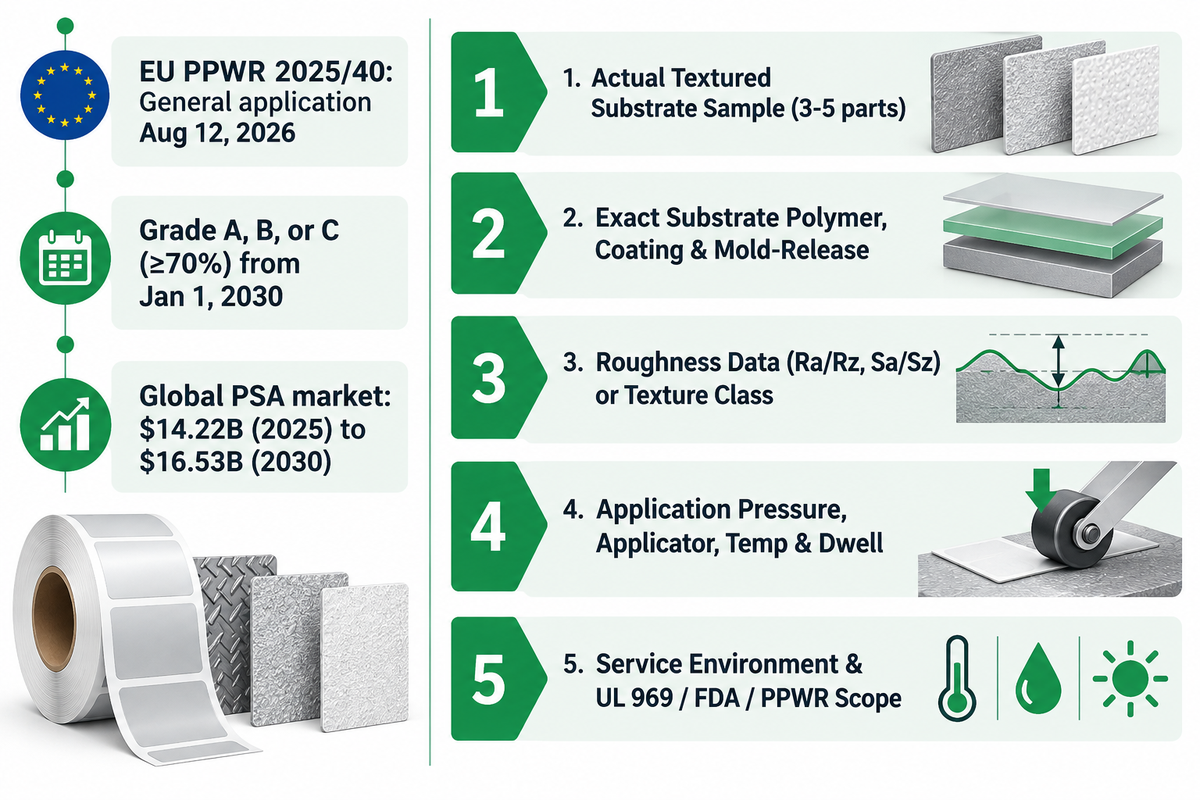
On the regulatory side, the European Union Packaging and Packaging Waste Regulation, Regulation (EU) 2025/40 (PPWR), took effect on February 11, 2025. General application begins August 12, 2026. Under Article 6(3), market access requires recyclability performance grades A, B, or C (with Grade C at ≥70% by weight). That mandate applies from January 1, 2030 or 24 months after the relevant delegated acts enter into force, whichever is later. Avery Dennison’s EU PPWR regulatory guidance notes that Annex II evaluates recyclability at the full packaging-unit level across label coverage, material, adhesive separation, and residue. Heavy-coat adhesive remains usable, but because Annex II grades adhesive separation and residue, teams selling eco-friendly or recyclable packaging must plan Design-for-Recycling validation early. Patent filings such as WO2023003546A1 reflect active work on recyclable olefin hot-melt PSAs engineered for rough cardboard. In parallel, chemical shippers face U.S. OSHA HCS label updates (May 19, 2026 for substances and November 19, 2027 for mixtures, per Packaura). EU Regulation 2024/2865 label sizing rules start January 1, 2027 (per ALIT Technologies). Against this backdrop, Adhesives & Sealants Industry (ASI) projects the global PSA market to expand from $14.22 billion in 2025 to $16.53 billion by 2030 (3.0% CAGR).
An incomplete RFQ wastes weeks on mismatched samples, whether you source industrial textured stock or premium paper with premium finishes and a white textured look and feel. All five items below should be part of your first request for quote:
Textured-Surface Label RFQ Specification Checklist (5 Mandatory Inputs)
- Actual Textured Substrate Sample: Ship 3–5 representative production parts instead of smooth test plaques. This will allow your vendor to run a 48-hour wet-out check on the real surface grain.
- Substrate Polymer or Coating: Name the exact base material (textured HDPE, polypropylene, powder-coated steel, corrugated kraft, or frosted glass). List any known mold-release agent.
- Roughness Description or Profile Data: Include Ra / Rz or Sa / Sz measurements, if applicable. Otherwise describe the texture class (fine matte, orange-peel powder coat, molded stipple, raw wood, masonry) and attach close-up photos.
- Application Pressure & Applicator Type: State hand squeegee, wipe-down sponge roller, automated tamp-blow head. Be sure to state plant application temp and dwell time before handling.
- Service Environment & Compliance Scope: List service temperature range, outdoor UV, washdown moisture, chemical wipes, and printer type. Note any UL 969 (PGDQ2/PGJI2), BS 5609, FDA 21 CFR 175.105, or EU PPWR targets.
Time to get a rough-substrate film or adhesive construction qualified without the trial-and-error hold-ups?
Submit your substrate sample and specification for a trial recommendation to our pressure-sensitive film constructions for batch qualification page. An engineering representative will review your setup requirements and recommend a coating weight, facestock conformability and liner release.
About This Technical Analysis
This guide draws on ASTM D3330/D3330M-04(2025) and FINAT FTM 1 test mechanics, peer-reviewed PSA wetting research, and published rough-surface datasheets. It also covers European and U.S. regulatory schedules to help packaging engineers specify high-tack constructions on textured substrates. Quoted retail prices reflect November 2026 online listings, and sizing conversions state explicit solid-density assumptions.
Reviewed by the technical team at Zhejiang Guanma Packaging Co., Ltd.
Frequently Asked Questions About Labels for Textured Surfaces
Q: What is the difference between labels for textured surfaces and textured stickers?
Labels for textured surfaces use heavier, high-tack adhesive coats (for example, 48–53 µm on Flexcon’s DPM PCRTS rough-surface stock) and conformable facestocks to wet out into rough industrial substrates like molded HDPE or powder-coated metal.
On the other hand, textured stickers or textured paper labels go for embossing, linen or kraft facestocks for a textured retail experience on smooth glass or bottles, where the thin standard adhesives are easily lifted on rougher exteriors.
Q: Can aggressive high-tack labels be used on curved textured containers?
Yes, this depends on what you intend to stick. Yes, provided you pair the high-tack adhesive with a soft film that can conform to the product, such as cast vinyl or polyethylene, rather than stiff polyester or heavy paper.
Curvature adds steady elastic recovery force on top of reduced contact area from roughness. Small-diameter curved parts must pass perimeter edge flagging checks after a full 24 to 48-hour dwell period.
Q: What is the minimum order quantity for custom textured-surface roll labels?
Retail examples of published order sizes are Sticker Swan’s 100-piece starting tier for custom high-tack vinyl labels and Online Labels’ 10-sheet price tier with no minimum. Narrow-web roll converters and raw label-stock coaters quote minimums per job by web width and setup.
Machine-dispensed custom rolls require press setup and a cutting step, so converters quote minimum runs based on roll setup and cutting costs rather than retail sheet counts.
Q: Can permanent high-tack labels be removed cleanly from textured plastic?
No, permanent high-tack adhesives flow deep into surface valleys and leave residue or tear during removal. If clean removability matters, specify a dedicated high-coat removable grade and verify peel behavior on your exact textured substrate.
Q: Are textured paper labels waterproof, or do rough outdoor surfaces require film?
Uncoated textured paper labels are not waterproof because moisture wicks into paper fibers, causing wrinkling, staining, and edge lift even with aggressive adhesive.
Wet-strength paper with a protective varnish resists brief condensation on chilled bottles. However, rough outdoor containers, chemical drums, and washdown equipment require waterproof film facestocks like conformable vinyl, BOPP, or polyester.
Q: Are high-tack labels on textured plastic containers recyclable?
Not reliably: heavy-coat permanent high-tack adhesives resist standard wash-off separation, so specify a certified wash-off grade when packaging recyclability is required, recognizing that rough substrates reduce wash-off adhesion margin.
Q: Should I choose adhesive paper or film labels when the surface is both rough and exposed to moisture?
Opt for conformable film over adhesive paper if the rough substrate will also be exposed to moisture, humidity variations, or chemical wipes.
Paper facestocks absorb water along die-cut edges and lose tensile strength quickly. Soft vinyl or polyethylene films block liquid ingress and flex more easily into uneven valleys with lower spring-back force than stiff films, though curved parts still require edge-lift testing. Reserve coated or uncoated paper for dry indoor cartons, shipping boxes, or short-lived warehouse labels where cost matters more than wet durability.
References & Sources
- ASTM D3330/D3330M-04(2025) Standard Test Method for Peel Adhesion of Pressure-Sensitive Tape American National Standards Institute (ANSI) / ASTM International
- Wetting Area, Surface Energy, and Viscosity Effects on Acrylic Pressure-Sensitive Adhesives (Polymers, 2025) National Library of Medicine / National Institutes of Health (PMC)
- U.S. Patent US6547887B1, Multilayer Pressure-Sensitive Adhesive Label Construction with Reduced Ooze United States Patent and Trademark Office (via Google Patents)
- Pressure Sensitive Adhesive (PSA) Tape Selection Considerations Adhesive and Sealant Council (ASC)
- Factors of Peel Adhesion (FINAT FTM 1 vs. PSTC 1 Test Parameters) Pressure Sensitive Tape Council (PSTC)
- Compliance Guidelines for Marking and Labeling Systems (ANSI/UL 969) UL Solutions (Underwriters Laboratories)
- Title 21 CFR § 175.105, Adhesives (Indirect Food-Contact Components) U.S. Electronic Code of Federal Regulations (eCFR)
- The Evolution of Flexographic/Digital Hybrid Presses Flexographic Technical Association (FTA)
- Regulation (EU) 2025/40 on Packaging and Packaging Waste (PPWR) Official Journal of the European Union (EUR-Lex)
- WIPO Patent WO2023003546A1, Recyclable Olefin Hot-Melt PSA Label for Rough Surfaces World Intellectual Property Organization (via Google Patents)
- Trends and Opportunities in Pressure-Sensitive Adhesives: Sustainability, Innovation, and Market Growth Adhesives & Sealants Industry (ASI)