Get in Touch with Guanma

Updated October 2026
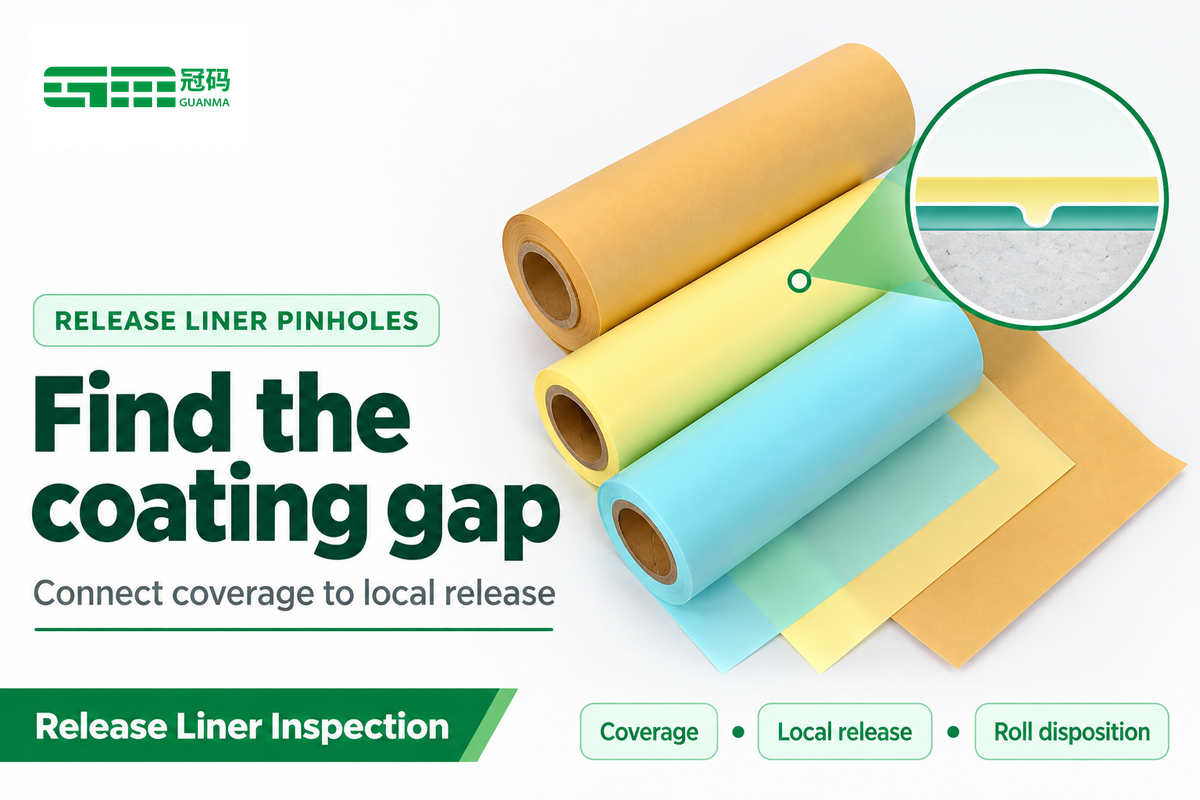
Release liner pinholes are gaps in the release coating that allow adhesive to touch the substrate. On paper liners, those areas may resist peeling and lift fiber. Those can be found by examining continuity of the coating and then checking release locally on an untouched sample. Choose the coverage method for the liner substrate before examining results.
Before you laminate a suspect roll
- Identify the interface — distinguish a coating gap from a hole through the carrier.
- Select the coverage method — match it to glassine, clay-coated paper or film.
- Retain a paired specimen — keep the neighboring piece untreated for release testing.
- Contain suspect stock — hold material while its affected extent or functional risk remains unresolved.
Quick Specs: test selection
Coverage: FTM 25 evaluates coated paper with a water-based stain.
Coating mass: FTM 7 uses energy-dispersive X-ray fluorescence.
Functional release: compare the intended laminate under recorded peel and conditioning conditions.
Why pinholes create stuck spots
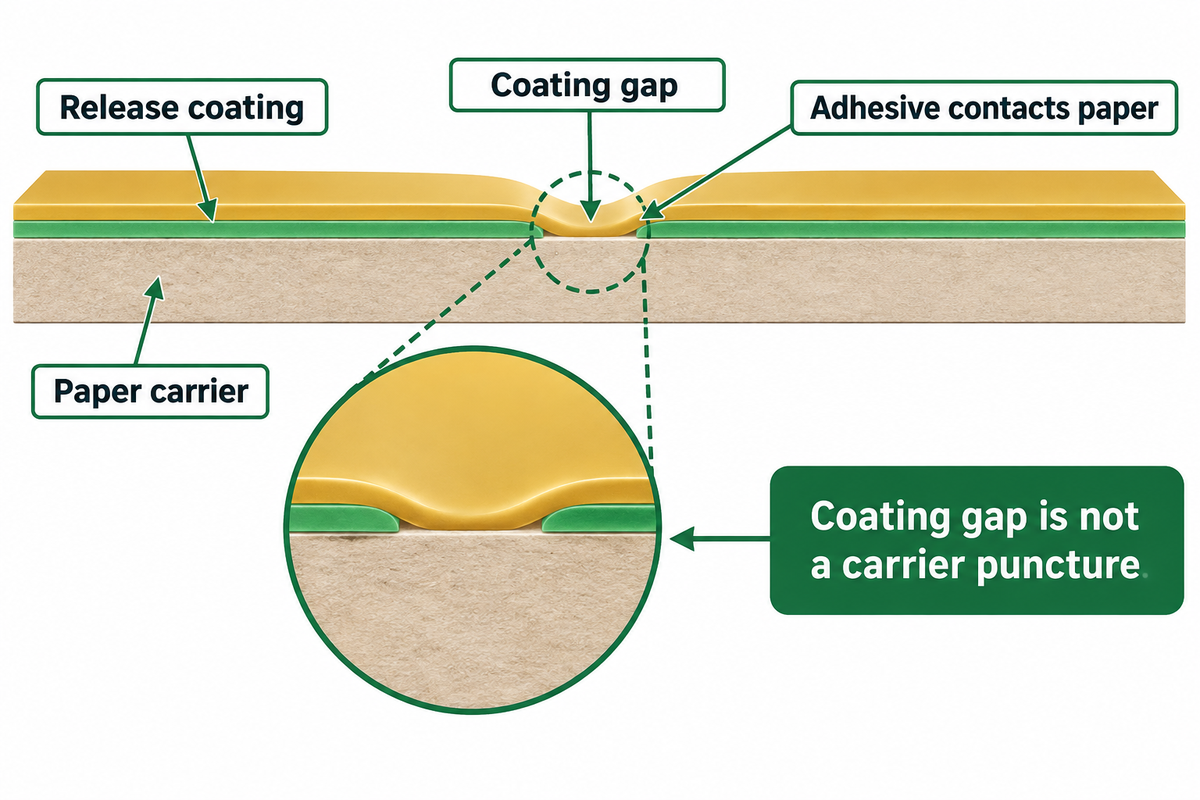
A pinhole in a coating leaves a small patch of the carrier exposed, much like a small opening in a protective sheet. Adhesive coming into contact with that exposure may adhere to paper rather than release from silicone. It can lead to a sharp tug, transfer of adhesive, or fiber pickup. The surrounding release coating may function normally.
The Label Academy chapter on silicone release liners separates coating coverage from silicone cure. Coverage is concerned with whether the coating is present. Cure is whether the silicone has fully crosslinked. Inadequate cure can cause changing release behavior and migration, which can affect adhesive tack or printing, even if the coating appears to be continuous.
Start with the retained full laminate to identify which interface failed. Fibers on the adhesive may indicate contact with the paper or failure of the paper surface. A visible tear in the backing may indicate a physical defect. Neither observation identifies a coating-process cause by itself; it’s a good practice to retain label roll samples and the roll label (especially for purchase disputes) before trimming away the area of concern.
What is release liner on tape?
A release liner is the liner or removable backing that protects the pressure sensitive adhesive. Many liners consist of paper or film carrying a silicone release layer; compare the carrier families in Guanma’s release paper and liner range. Double sided tape can come in contact with liner on both sides, so the two surfaces can have different release behavior. The liner is removed when the tape is applied.
Distinguish the temporary carrier from the tape or label backing that remains in the final product. Document the liner material separately from the PET label material. When reporting a failure, name the carrier, the release-coated side and the adhesive that’s in contact with it. A photograph of the face alone leaves the supplier guessing about the failure interface.
Locate coating skips before a full lamination run
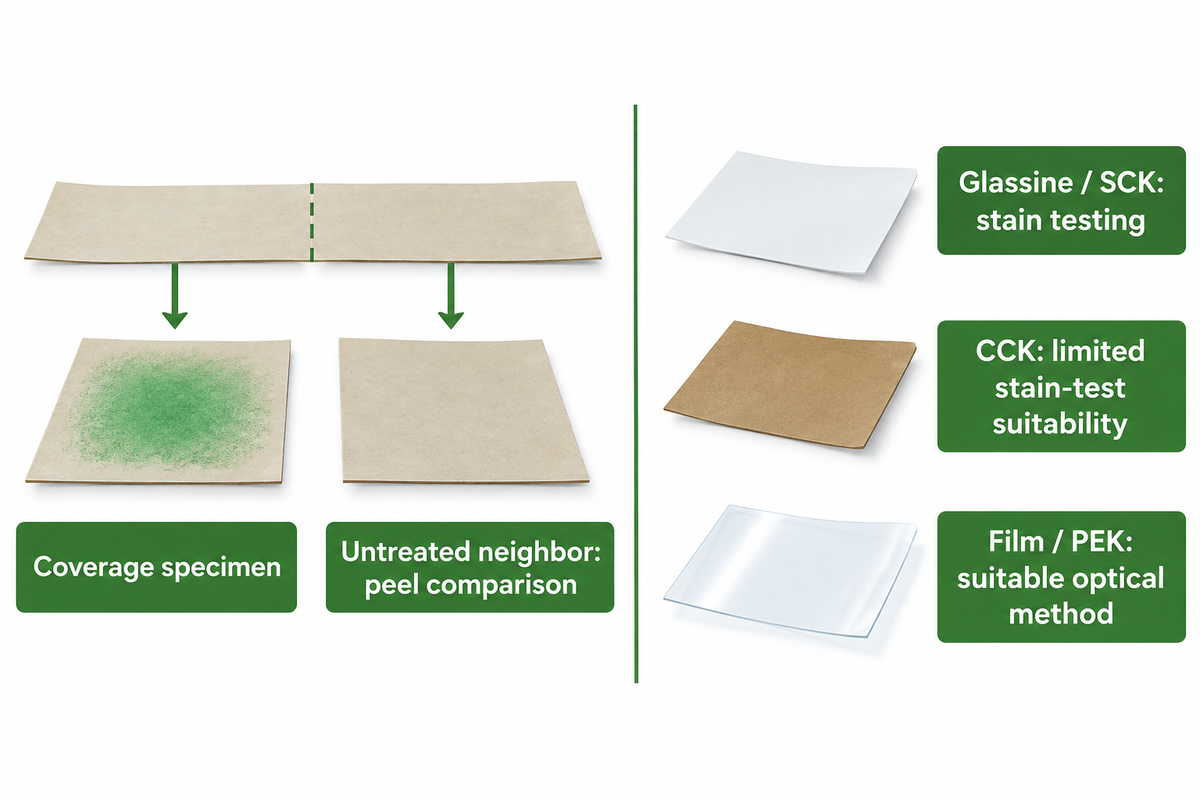
For glassine and supercalendered kraft paper, a good stain can show the exposed paper between the silicone covered areas. Film and polyethylene covered kraft need a different approach. Pair the coverage observation with an untreated neighboring specimen so the stain itself does not become a variable in the release test.
FINAT lists FTM 25 for evaluating silicone coverage on coated papers with a water-based stain. Its public index describes the method rather than the detailed lab procedure. Use your approved lab procedure, and household dyes or an improvised soak time aren’t an appropriate means to evaluate purchased materials.
The Label Academy guidance states that stain tests are useful on glassine and SCK, of limited use on CCK, and not useful on filmic substrates or PEK. Specialist polarized-light methods exist for the latter two. A clear-looking film after a paper stain test should therefore send the investigation toward a suitable optical method, rather than straight to production release.
Mark roll identity, machine direction, coated side and position before cutting adjacent specimens. Keep one for coverage testing and the other untouched for lamination and peel comparison. Include known defective and satisfactory material so that the laboratory can establish what it detects reliably and whether different operators arrive at the same result.
| Observation | Next check | Decision supported |
|---|---|---|
| Isolated stain on glassine | Repeat with controls; compare the adjacent untouched area | Investigate a local coverage gap |
| Diffuse stain on CCK | Check substrate response and method suitability | Resolve the test before judging the roll |
| No stain response on film | Use a validated film-suitable optical method | Avoid a false clearance |
| Paper fibers on adhesive | Compare coverage and the actual failure surface | Separate paper failure from clean release |
| Physical hole through carrier | Inspect damage through the full thickness | Contain a carrier-integrity defect |
| Repeated marks across the width | Map cross-web position and repeat spacing | Give the coater a testable process hypothesis |
| Release changes after storage | Compare retained laminate under matched conditions | Investigate aging, cure and compatibility |
| Good average peel with sharp peaks | Retain the force trace and correlate locations | Investigate local variation |
| Reduced tack after liner contact | Request the appropriate adhesive-strength and cure investigation | Check contamination or interaction |
| Unknown affected roll length | Hold material while the inspection scope is agreed | Prevent an unsupported sort-and-release decision |
Consider a quality technician investigating an acrylic label laminate that tears fibers during a hand peel. The supplier’s coat-weight certificate is within the purchase specification; however, the complaint is only on a narrow strip. She documents the cross-web position, retains the full laminate and cuts neighboring coverage and functional specimens from identified material. A stain on one of the specimens and a release peak on the other support a local investigation. She next asks the supplier to determine how far the affected strip extends along the roll. The next best decision is to contain the affected area. Approving the remaining roll from a clean sample elsewhere would leave the affected strip unresolved.
A supplier saying “zero visible defects” should define the inspection conditions and the size of the defect that the method can reliably detect. Agree on roll sampling or full inspection coverage apart from this local diagnostic check. NIST explains acceptance sampling as a decision about a lot’s acceptability; keep the agreed lot acceptance plan apart from local diagnostic pieces.
Coat weight vs coverage vs local release: the 3-Lens Coverage Check
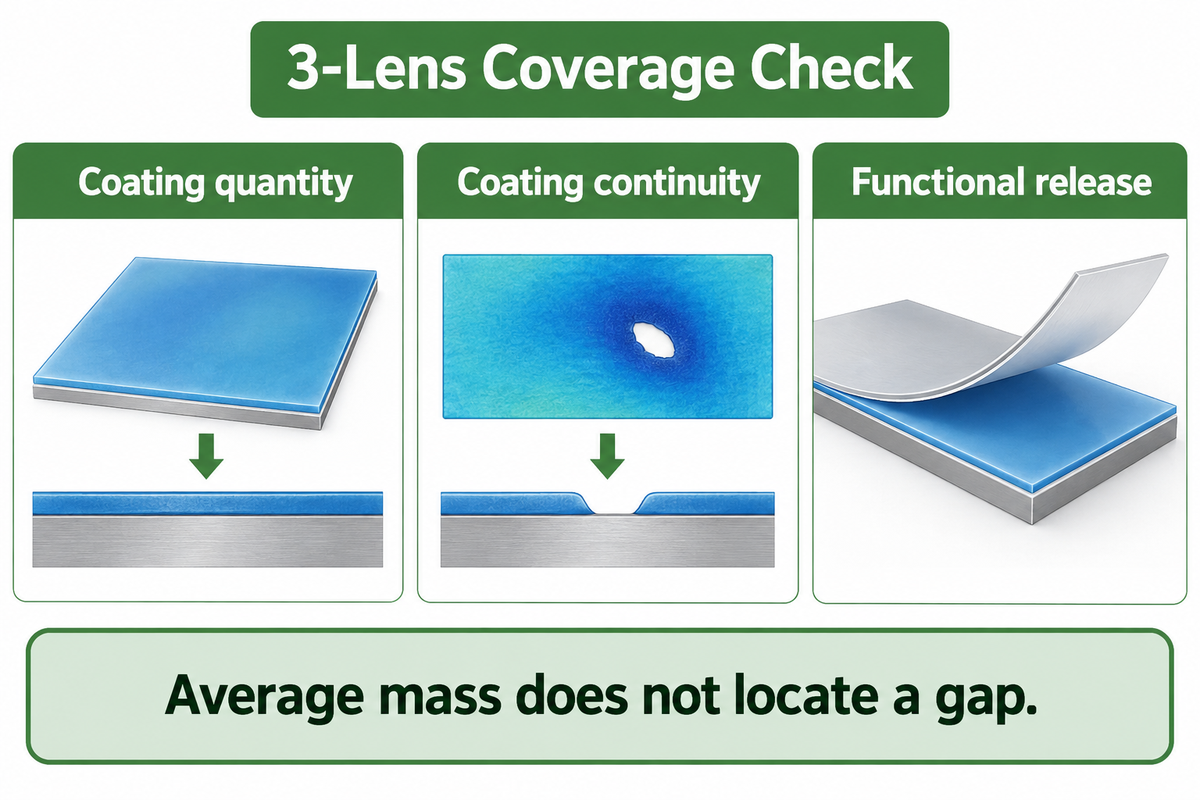
The 3-Lens Coverage Check uses coating quantity, coating continuity and functional release to choose the next test. Coating weight describes amount; coverage locates gaps; and peel testing measures separation in the intended laminate. Compare the three observations before reaching any test conclusions.
FINAT distinguishes FTM 7, silicone coat weight by energy-dispersive X-ray fluorescence, from FTM 25 coverage testing. A mass-per-area result averages its measuring region. Coverage can be inspected in various ways: at a single spot, at a set of positions, or as an in-line profile; record which was used, and match the reported positions to the region being assessed.
As a deliberately simplified arithmetic example, suppose 99% of an area carries 1.00 g/m² and 1% carries none. The area average is 0.99 g/m². That slight change in the average conceals the location of the uncovered portion. These examples illustrate averaging; they’re neither a product specification nor an acceptable defect level.
Release measurements include the adhesive, facestock, conditioning, peel angle and peel speed. FINAT’s index describes high-speed FTM 4 measurements over 10–300 m/min and low-speed FTM 10 at 300 mm/min. Those are different test regimes, not interchangeable acceptance values. Record the test conditions along with the measurement to allow a supplier to duplicate the result.
“The stain test measures the area not covered by silicone”
Haraga’s study covers paper holdout and sizing. Its abstract relates image analysis to coverage assessment; it doesn’t provide a universal threshold for incoming inspection. That distinction enables a lab to report the observed uncovered area rather than turning a measurement into a purchase limit.
When requesting a quote comparison, ask both suppliers to provide the same measurement conditions. A cheaper roll of film, although accompanied by an average coat weight, hasn’t yet answered the local release question. Make observations of coverage, and perform a matched laminate trial before assessing the value of a tighter looking certificate.
Read the defect pattern before changing the coating
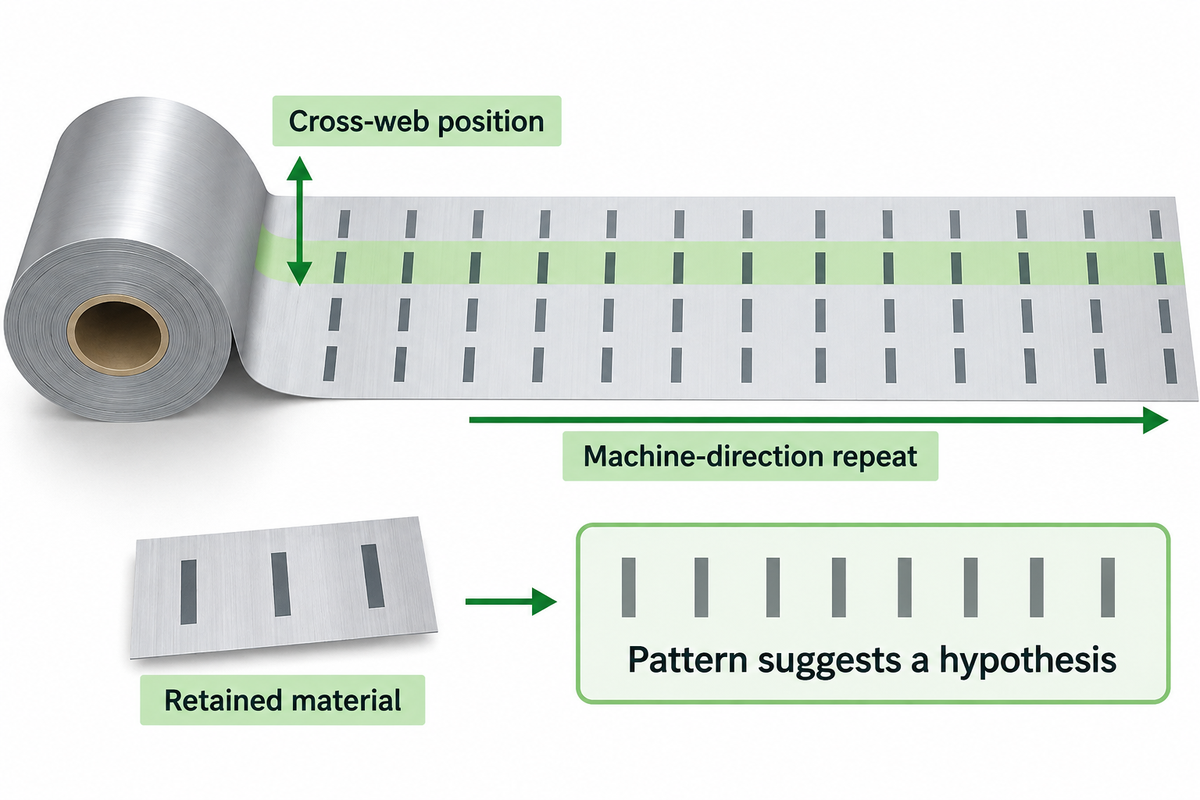
Use defect position and repetition to determine the next testing strategy. Repeated defects along the same position of the web (cross-web) or at the same interval along the length of the roll (machine-direction) or after storage may point the supplier to different process checks. Treat each as a hypothesis, and test against the retained materials, rather than increasing the coat weight or adjusting the cure cycles.
ASTM D5375/D5375M-98(2019), liner removal at high speeds, identifies several construction variables affecting the measured force. These include the type of backing, release coating, and adhesive weight. Although the test evaluates uniformity of liner adhesion, it cannot isolate the cause of nonuniformity.
Imagine a converter switches from a paper label face to a stiffer film face while keeping the same liner grade. The operator observes a different peel trace and requests more silicone on the next order. Before changing the coating, the quality team compares retained stock under the same test setup and checks whether face stiffness affects bending in the peel test. They also evaluate coverage of the suspect area. If coverage is satisfactory, increasing the amount of silicone would change a process variable without resolving the construction question. The procurement team can then request a controlled trial whereby only one variable is changed to evaluate the effectiveness of the revised construction.
Give the coater a simple position map showing roll number and unwind direction. Include if the issue occurs during hand peeling, dispensing, or both. If the supplier proposes a process adjustment, agree which repeatable observation and functional test will show that it worked before placing the follow-on order.
Decide whether to hold, sort or replace the roll
Hold a suspect roll while the defect is unresolved. Sorting becomes an option when the defect can be located reliably, unacceptable material can be separated, and the retained material meets the requirements. Replace material when defects escape reliable segregation or when expected costs of sorting and delivering the good material exceed the cost of replacement.
Agree on unacceptable outcomes in the completed process. These include (among others) fiber pickup, label damage, adhesive transfer, and unreliable/inconsistent dispensing. Agree the laboratory test conditions, inspected area or sampling, and disposition authority. FINAT states that its methods don’t imply a material performance specification. The purchaser and supplier need to define acceptance criteria for the construction.
For narrow-web converting, a mapped defective lane may justify a slit-width adjustment. This adjustment would change usable web width and may also affect the anticipated yield for the job. The buyer should request a written rework offer from the supplier to define the material, identify it and accept the retained portion, rather than consider a reduced invoice as compensation for an unmeasured production risk.
When does sorting cost less than replacement?
Sorting costs less than the alternate route when the total incremental sorting cost is below the replacement cost for the same quantity of accepted output. Consider total incremental cost. Where there’s a difference, consider conversion and yield, material loss, handling, inspection, and the combination of waste, delay and downtime. Deduct a supplier credit once, and consider only cost differentials. Exclude costs which are shared by the two routes. Don’t consider already-paid material a second time.
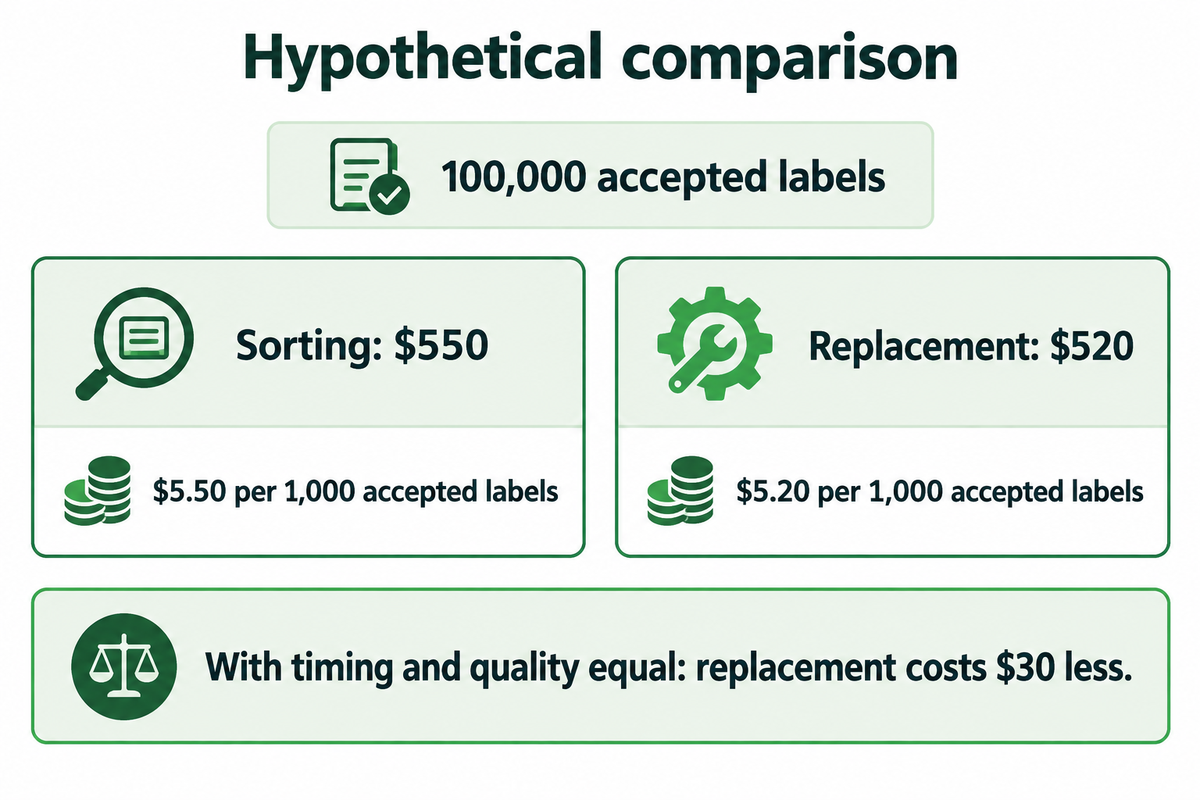
For a hypothetical order requiring 100,000 accepted labels, assume sorting the suspect stock would add $180 for inspection, $120 for usable replacement stock after the agreed credit and $250 for extra setup and handling. The incremental total is $550, or $5.50 per 1,000 accepted labels. Suppose replacing the stock would add $420 for material after credit, $60 freight and $40 handling: $520, or $5.20 per 1,000 accepted labels. With timing and quality assumed equal, replacement costs $30 less. These are example inputs, not industry prices. A real delay cost could change the decision; compare it explicitly instead of hiding it inside a material-price discount.
Finance can compare both quotes for the same output denominator. If an adhesive qualification run is required for the replacement as well and it’s incremental, it should be added to the comparison. If sorting can’t sufficiently identify the defect, stop the cost comparison at that condition. Low theoretical cost for inspection doesn’t make the remaining stock usable.
Specify a trial roll for your label construction
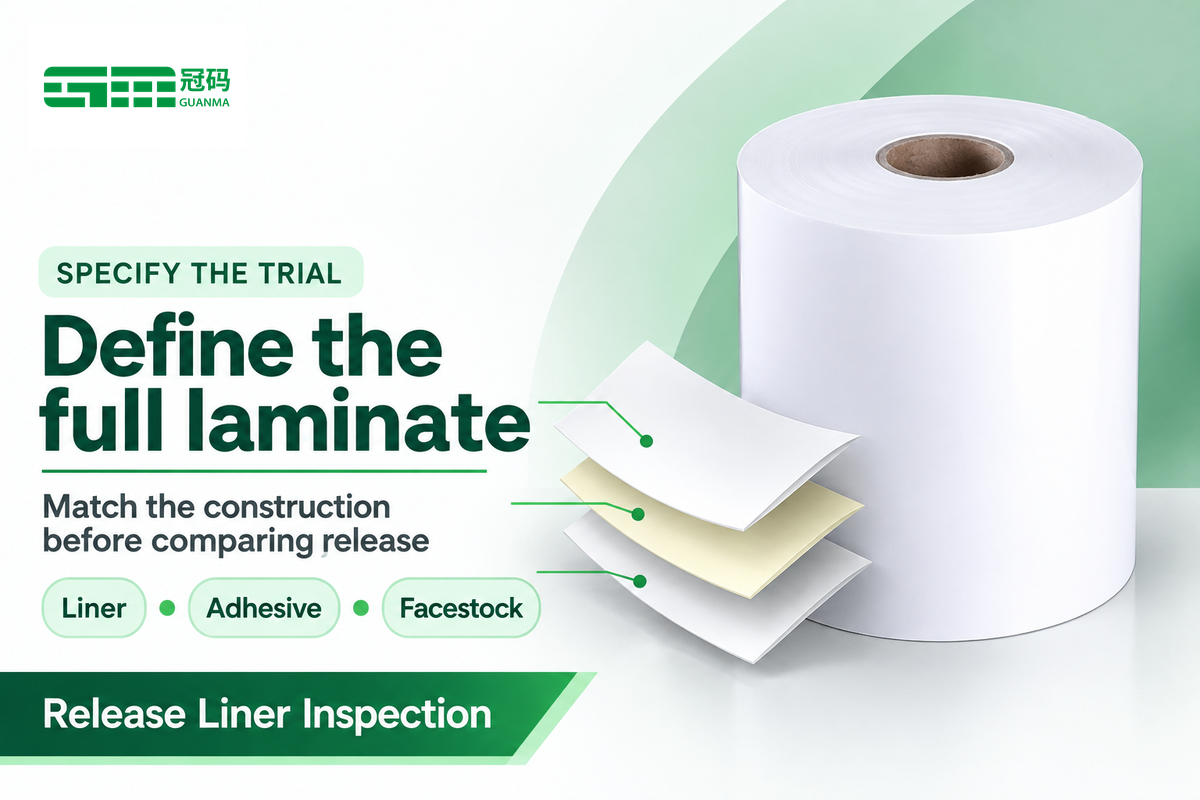
Indicate the type of liner, adhesive-contact side and intended laminate before requesting a trial. Guanma provides both glassine release liners and clay coated kraft release paper. Choose the substrate consistent with its converting requirements and test method and evaluate the release behavior with the adhesive that will be run.
A trial request should allow the supplier to reproduce both the construction and the complaint. Use the form below with photographs and retained samples. Fields in the form are a purchasing worksheet, not a prescribed sampling plan; width, length and acceptance limits belong in the agreed quotation.
| Record field | What to provide | Why the supplier needs it |
|---|---|---|
| Carrier family | Glassine/SCK, CCK, PEK or film; grade and thickness in µm or mass in g/m² | Select a suitable coverage method |
| Release surface | Adhesive-contact side; single- or double-sided construction | Test the correct interface |
| Adhesive | Chemistry, grade and coat weight in g/m² where available | Reproduce the intended laminate |
| Facestock | Material and thickness in µm | Account for bending and stiffness |
| Roll traceability | Batch, roll number, retained-sample identity | Connect observations to stock |
| Defect position | Cross-web distance in mm and along-roll position in m | Map affected material |
| Coverage specimen | Method, controls, image scale and observed result | Interpret the coverage observation |
| Functional specimen | Adjacent untreated piece; method, angle, speed in mm/min or m/min | Compare local release under matched conditions |
| Conditioning | Temperature in °C, humidity in % RH and time in h | Reproduce aging and storage exposure |
| Trial and disposition | Required width in mm, length in m, acceptance agreement and responsible contact | Quote a trial that can support a decision |
Key takeaway
Specify the full laminate, test coating continuity with a suitable method, and connect the local result to an agreed roll-disposition plan.
Use the glassine grade selector or CCK variant selector to narrow the substrate request. Send the completed record when discussing a trial with Guanma, so the comparison starts with a defined construction and a clear acceptance question.
Frequently asked questions
What is silicone paper?
It is paper with a silicone coating that helps an adhesive separate from its surface.
In label converting, the term often refers to release-coated paper used beneath a pressure-sensitive adhesive. The paper supplies support, while the silicone layer controls the contact surface. Glassine and clay-coated kraft are different carrier choices. Identify the paper grade and the coated side when ordering; the general name alone leaves coating coverage, cure and release conditions unspecified.
Can release liner pinholes be repaired?
For an incoming suspect roll, hold it and discuss controlled rework or replacement with the supplier.
Applying a local coating patch on the converting floor introduces another surface, cure condition and thickness variation into the laminate. A supplier may be able to propose a controlled rework route, but its suitability must be established for the affected construction. Preserve representative material and traceability before cutting or discarding it, and agree how any reworked stock will be identified and accepted.
Does a higher silicone coat weight prevent pinholes?
It may change coverage, but coat weight alone does not resolve whether local gaps remain.
Coverage also depends on the carrier surface and the coating process. A mass measurement combines the coating within its measuring area, so it can conceal local variation. Compare coverage observations and matched release behavior before changing a specification. If the defect instead concerns cure, adhesive interaction or physical damage to the carrier, increasing coating mass may leave the complaint unresolved.
Can I test a film liner with the same dye as paper?
Use a method validated for the film construction.
The Label Academy guidance directs film and PEK assessment toward suitable optical methods. Confirm the chosen instrument can distinguish the coating from its particular carrier.
How many pinholes are acceptable?
Use the acceptance agreement for the particular laminate and application.
The reviewed public FINAT method descriptions don’t set a universal pinhole allowance. Agree the defect definition, detection method, inspection or sampling basis and functional release requirement with the supplier. Record the inspected area, detectable defect size and application consequence alongside the count. An isolated flaw in a critical dispensing lane can have a different effect from the same count outside the converted width. Use actual failure observations to set the acceptance question, then apply the agreed inspection basis consistently to both retained and replacement material.
Should I test the stained sample for peel force?
Keep a neighboring, untreated specimen for the functional comparison.
Staining changes the specimen’s exposure history and can add another variable to the adhesive interface. Identify the paired locations and document their limits: neighboring pieces help compare a local region, but they aren’t the same physical spot. Use your laboratory’s approved procedure for subsequent conditioning and lamination.
References & Sources
- Labels & Labeling, Label Academy: Silicone Release liner Technology – technical training chapter.
- FINAT: Test Methods – public method index and performance specification disclaimer.
- NIST: What is Acceptance Sampling? – general principles of disposition of a lot.
- Western Michigan University: Rudolf Haraga, Assessing Silicone Holdout for Release Papers (2001) – thesis abstract.
- ASTM D5375/D5375M-98 (2019) – publicly available scope on the American National Standards Institute website.