Get in Touch with Guanma

Updated October 2026
Avery Dennison provides examples of label stock shelf lives of one year from manufacture and two years from shipment under the specified storage conditions. Label stock shelf life refers to the period that unused material is expected to remain suitable. For an older roll, consider the exact product sheet, date basis, storage history, and performance on the intended job to assess its suitability.
Assess aged stock against its exact construction, starting date and storage conditions. A good-looking roll or a passing peel trial alone can’t clear an aged lot for production.
Before the next production run
- Receiving a roll doesn’t necessarily restart its shelf-life clock.
- Use the supplier’s conditions for that construction, including packaging and conditioning instructions.
- Define sampling and acceptance rules before testing an aged lot.
- Order for the quantity you can consume within its confirmed usable period.
Label stock shelf life is not applied label life
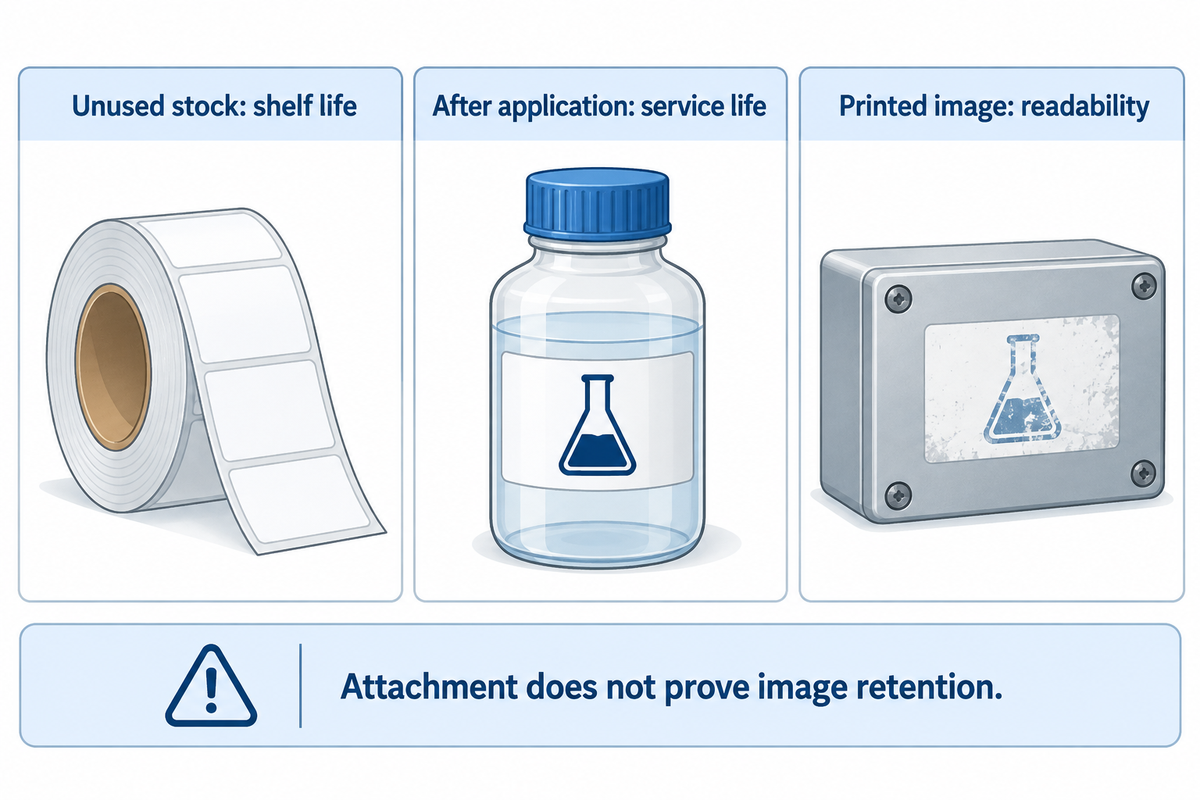
The shelf life of labels refers to unused stock prior to printing or application. The service life of a label is the time that a label remains fit for its purpose after application. A barcode can fade even while its label remains attached. Keep these requirements separate when arranging for production and selecting replacement material. The Library of Congress label specification illustrates the distinction: section 3.5 covers usable shelf life before application, while section 2.5 addresses bond strength after application and accelerated aging. Those requirements apply to its specified library labels.
A pressure-sensitive construction combines a facestock, adhesive and release liner. Its general durability depends on more than the visible surface. Adhesive performance can change while the facestock still looks clean. A durable film face doesn’t establish how long the unused adhesive system remains suitable, or if the liner releases cleanly on your applicator.
Consider a beverage packer with unused rolls from a previous promotion. The warehouse team observes clean outer wraps and suggests using them for a chilled bottle run. The production engineer needs other answers: what adhesive construction was supplied, whether the rolls stayed within storage limits, and whether the label will reliably stay fixed on the intended bottle. Printed appearance doesn’t answer any of those questions by itself. In order to manage the remaining life of your labels, match the roll ID to its original specification and test it against the planned application. If, for example, the construction is incorrect, use the broader guide to select the complete label construction.
Which shelf-life specification applies to this roll?

The applicable specification is the one for the exact facestock, adhesive and liner combination supplied. Match its product code and revision to the lot record. Then identify the starting event: manufacture, shipment or delivery. Using the wrong beginning event can make old stock appear younger than the supplier’s instructions allow.
Do Avery Dennison label stocks expire?
Avery Dennison label stocks bear storage limitations, so use the duration and starting date assigned to the code of the purchased construction. Avery Dennison’s industrial material sheets illustrate differences in both dates and durations.
| Avery Dennison construction | Stated period and starting date | Storage conditions |
|---|---|---|
| F02900: Artisan rPLUS FSC / rS2030MB / PET30N; sheet updated April 2024 | One year from manufacture (F02900 sheet) | 20–25 °C; 40–50% relative humidity |
| LW3208: Uncoated Paper 60 / S2045N / BG40 Y NI; sheet marked ©2019 | Two years from shipment (LW3208 sheet) | 20–25 °C; 40–50% relative humidity |
For optimal performance, these sheets anchor the period to defined conditions. Typical conditions in a warehouse may differ from the stated band. LW3208 uses a permanent hotmelt adhesive, so adhesive family alone can’t justify a blanket shelf life of one year. The older sheet’s copyright date isn’t a verified revision date. Obtain current purchasing terms for that code rather than extending the example to other products.
The 2016 label procurement specification by the Library of Congress uses a different starting point, i.e., the original delivery date. Its one-year requirement applies to labels for general book-page use, not to all industrial stock. This illustrates the reason for recording the starting event in the purchase record.
Place the stated use by date in the system alongside the lot’s starting date. Keep warranties in a separate field. Differences between paper and film label materials may assist in making a selection; however, don’t use this to check a product’s expiration date.
Label storage: temperature, humidity and packaging
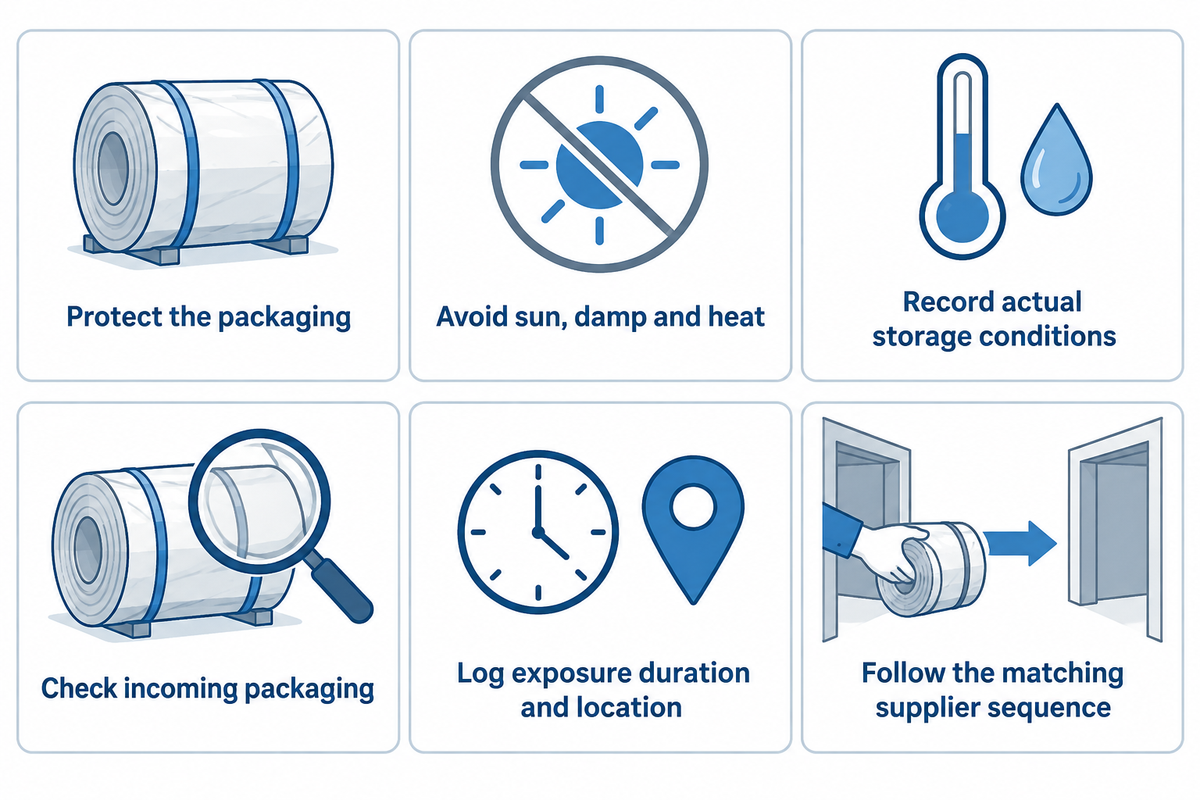
Store label rolls in protected packaging, away from direct sunlight, damp floors and heat sources, within the supplier’s temperature range. HERMA’s guidance specifies dark, dry storage in the original packaging at 20–25 °C and 40–50% relative humidity. Record the conditions where the rolls are kept; a room thermostat doesn’t describe all storage locations. Check incoming packaging as well as warehouse conditions. Section 4.2 of the Library of Congress label specification requires containers that deliver its labels dry and undamaged. Record wet or damaged packaging at receipt so that a later storage log does not hide an earlier exposure.
How does humidity affect label storage?
Exposure to high humidity may cause changes in moisture-sensitive parts of the construction and contribute to curl or poor handling. The result depends on the facestock and liner, as well as exposure. Track humidity levels and any fluctuation outside the specified band. A climate-controlled room helps only if the conditions recorded in it are the same as those required for the stock to be maintained.
Proper storage includes the supplier’s conditioning sequence. Follow that sequence to store labels correctly before converting. HERMA suggests acclimatizing materials when the storage and processing climates are different and then unpacking just prior to conversion. Avery Dennison’s North American storage bulletin describes unwrapping raw stock and conditioning it in the pressroom for 24–48 hours. These instructions address various material handling scenarios. Use the procedure aligned to your supply rather than consolidating fragmented procedures into a new rule.
Do
- Keep the roll identification with opened stock.
- Log exposure events with duration and location.
- Protect partly used rolls as instructed.
Don’t
- Reset the date when repacking a roll.
- Assume cooling reverses previous damage.
- Mix unidentified remnants into released stock.
What batch record is needed before inspecting aged stock?
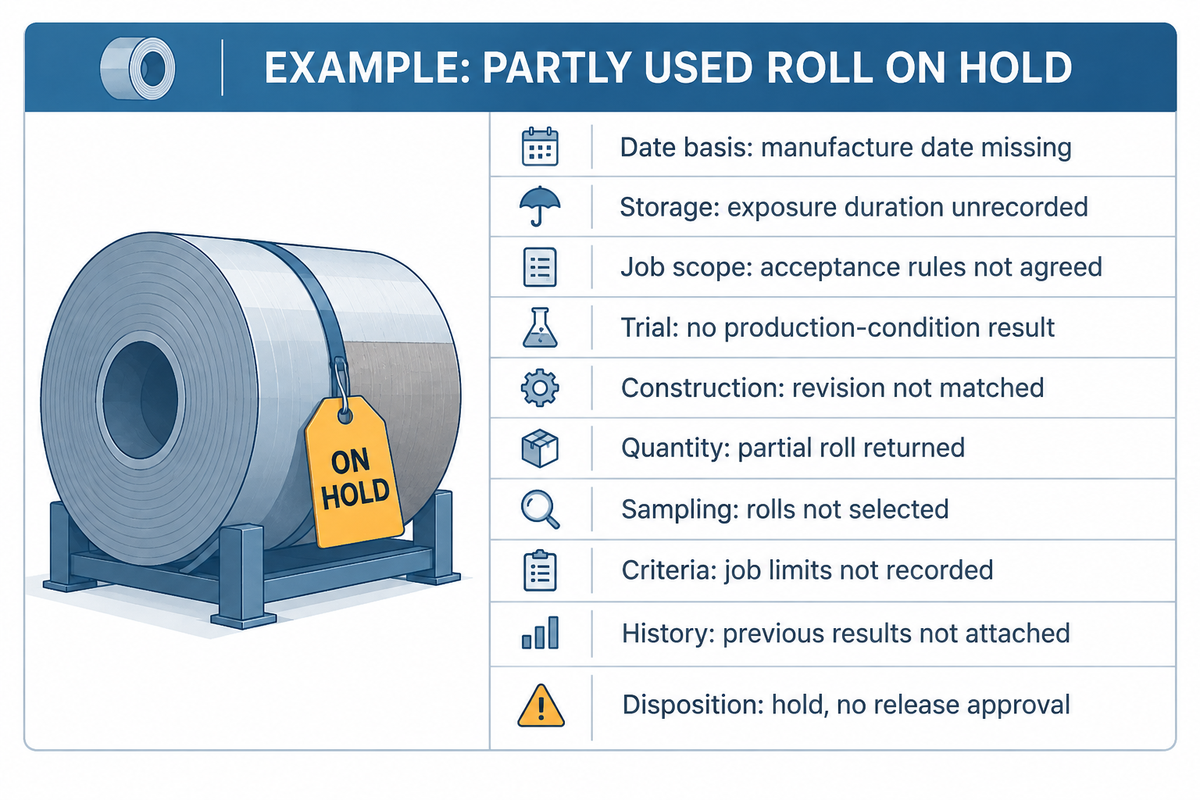
For repeatable label performance, a batch record connects each roll to its specification and storage history, and identifies the production job. A batch record helps procurement fill date gaps, warehouse personnel identify the affected locations and quality personnel define the test scope. Labels & Labeling’s inventory management recommendations advise retaining supplier roll identifiers and monitoring validity dates from the original shipping record.
3-Evidence Stock Release
3-Evidence Stock Release combines the date basis, recorded storage history and intended job trial to make a lot release decision.
Find differences between lots and their storage histories. Rolls stored beside a loading door may have a different history from other rolls. Describe sampling units to be tested and how they’ll be selected. Give acceptance rules. NIST’s acceptance-sampling guidance treats a sampling plan as both a selection scheme and a decision rule. Passing a convenient outer-wrap sample doesn’t mean lot acceptance.
| Evidence category / record field | Example entry | Owner and next action |
|---|---|---|
| Date basis | Receipt date known; manufacture date missing | Procurement: retrieve the lot’s specified starting date |
| Storage history | Opened wrap; warehouse location known; exposure duration unrecorded | Warehouse: identify the gap and affected rolls |
| Job and sampling scope | Repeat carton job; sample selection and acceptance rules not yet agreed | Quality: define the lot, sampling plan and failure limits |
| Trial result | No production-condition trial recorded | Production: test the nominated rolls on the specified job |
| Construction | Supplier code present; revision not matched | Procurement: attach the applicable product sheet |
| Remaining quantity | Partial roll returned from production | Warehouse: record measured remaining quantity under the original ID |
| Sampling units | Rolls and locations not yet selected | Quality: define the units and selection procedure before sampling |
| Acceptance criteria | No job-specific limits recorded | Quality and production: agree release, adhesion and print criteria |
| Failure history | Previous trial results not attached | Quality: retain every failure beside subsequent results |
| Disposition | Hold; no release approval | Quality: retain failures and document the final decision |
Keep the remaining quantity with the original roll ID after each partial use. This gives the planner usable on-hand inventory figures and preserves the age of each remnant. A receiving sticker on a new outer wrap shouldn’t be used to represent the manufacture date.
How should label adhesive, liner and print performance be assessed?
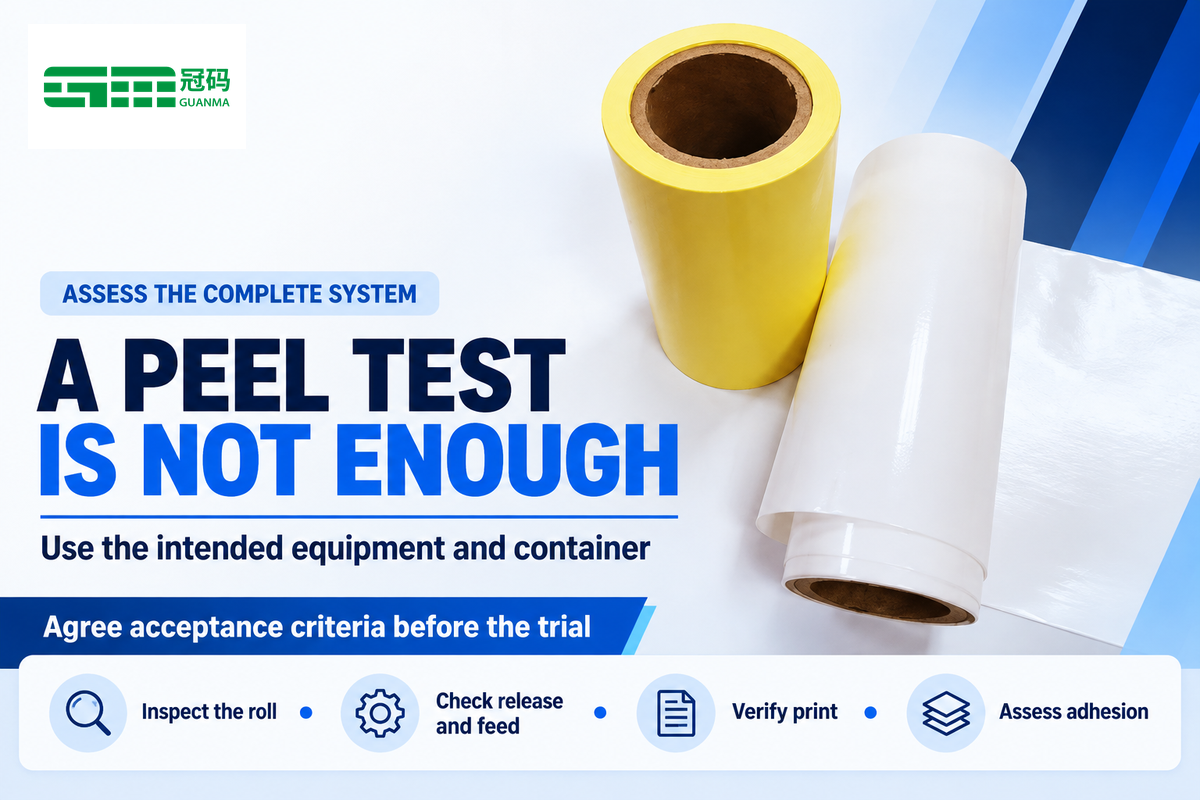
For stored label stock, evaluate the entire system. This includes inspecting the roll, checking release through the intended equipment, printing the required information and assessing adhesion on the intended container. Establish acceptance criteria and test to determine the results. A peel test doesn’t by itself explain a feeding problem, or provide the remaining life of a label material.
“do not in themselves imply any specification of performance relating to the materials under test.”
Use ASTM D6252/D6252M-98(2025) for agreed 90-degree peel adhesion testing of label stocks, with comparison criteria specific to the label adhesive system. Construction differences affect test results and the method cannot isolate the cause of nonuniformity.
- Inspect the selected rolls. Record curl, edge damage, contamination, adhesive ooze and packaging condition.
- Run the specified conversion or application trial. Observe release, feeding, printing and attachment on the intended substrate.
- Assess the planned exposures. Check the agreed dwell, temperature and service conditions before recording results.
- Apply the acceptance rule. Retain passing and failing results together for the lot decision.
Compare affected lots and conditions of equipment before completely attributing printer jams to age. In a historical FlexoExchange discussion, a label transferred to the backing and jammed a printer, despite the operator’s attempts at air conditioning and winding more loosely. Another participant asked if all of the stock was affected, or only one type of stock. When considering mechanical adjustments and roll appearance, treat room conditions as separate observations. For a removable construction, test the required removal behaviour and residue limits as well as the initial attachment.
Use the intended printing system and the customer’s required barcode verification and grading criteria. When image retention is critical, compare direct thermal and thermal transfer printing. Per GS1 India, what’s readable on one local scanner may not be readable on other scanners.
Test the conditions the label must withstand, including chemical exposure or a freezing temperature, if relevant. A room temperature test doesn’t answer the requirements of a freezer test. Use the process pertaining to the equipment and application to qualify labels for freezer applications.
Release, retest or reject the stored lot
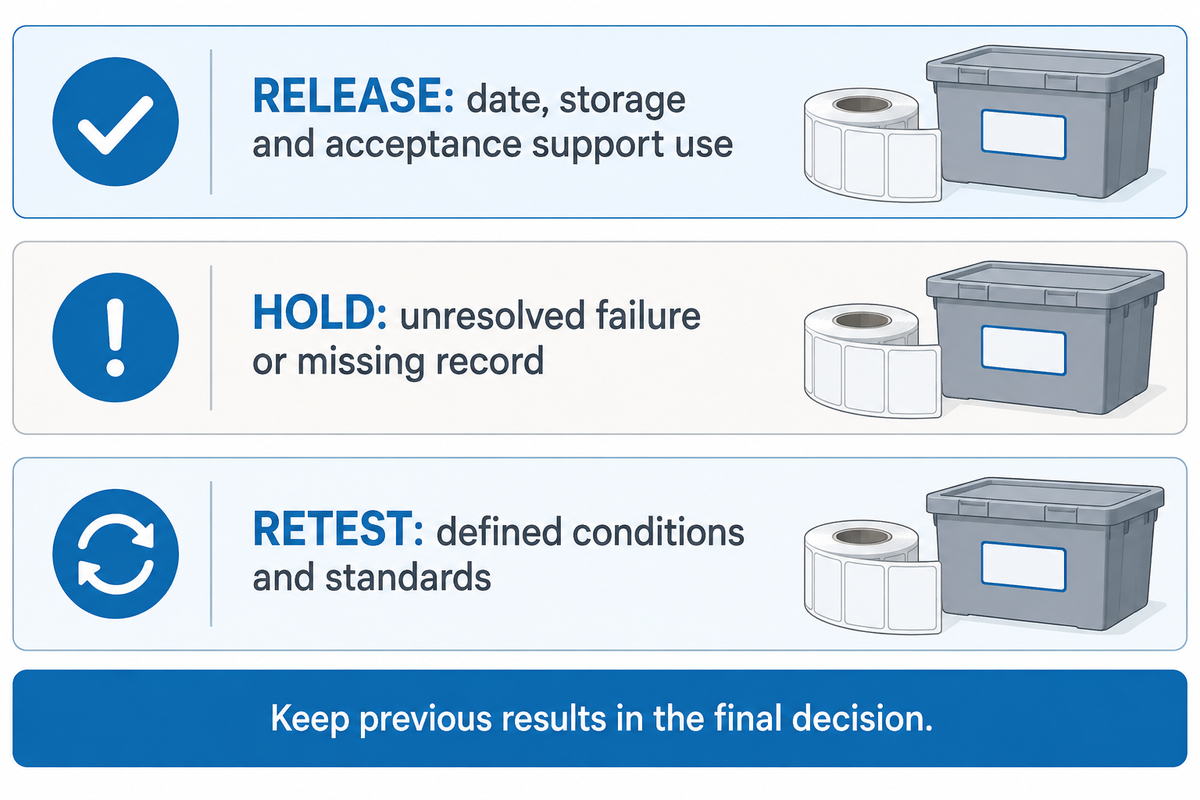
Release a lot only when the applicable date limit, storage assessment, and agreed acceptance process validate its use for the intended purpose. Keep the lot on hold until the reason for the failure and/or missing record is resolved. Retesting should be based on defined conditions and standards. In a NIST double-sampling plan, an inconclusive first sample can lead to a second, but the final decision combines both results. Repeated sampling until a ‘pass’ is obtained would conceal the true reason for failure.
Storage tips can’t reverse material that has begun to degrade. A supplier-approved inspection beyond a stated period is a separate decision to ordinary stock rotation. Proper handling can protect material within its conditions, but can’t assure extended lifespan. Request a written disposition tied to the construction, lot, application, and the period of remaining consumption. If replacement is required, record the outcome to prevent the same roll from returning to production.
Consider a packer facing a scheduled dispatch, with one roll passing adhesion checks while the other shows release trouble. Production wants to keep the line running; finance doesn’t want to be stuck with scrap. Quality assurance determines if the rolls belong to one consistent lot. A second test is only warranted if its selection and interpretation follow the agreed plan. The manager can reserve replacement stock while that work proceeds. This separates the material decision from the supply decision, thus preventing a deadline from becoming an undocumented release criterion.
Order against remaining shelf life
Buy only what you can consume, after considering delivery and scheduling. Subtract existing stock only if it remains usable until its planned consumption date. The lowest unit price per roll can result in the largest write-off, if a lot can’t be released, or demand slows. Put the required remaining life at delivery in the purchase terms. As a procurement example, GSA’s shelf-life guidance explains that specifying a maximum age on delivery helps preserve the customer’s usable period. Its guidance concerns government purchases; agree the applicable requirement with your label supplier.
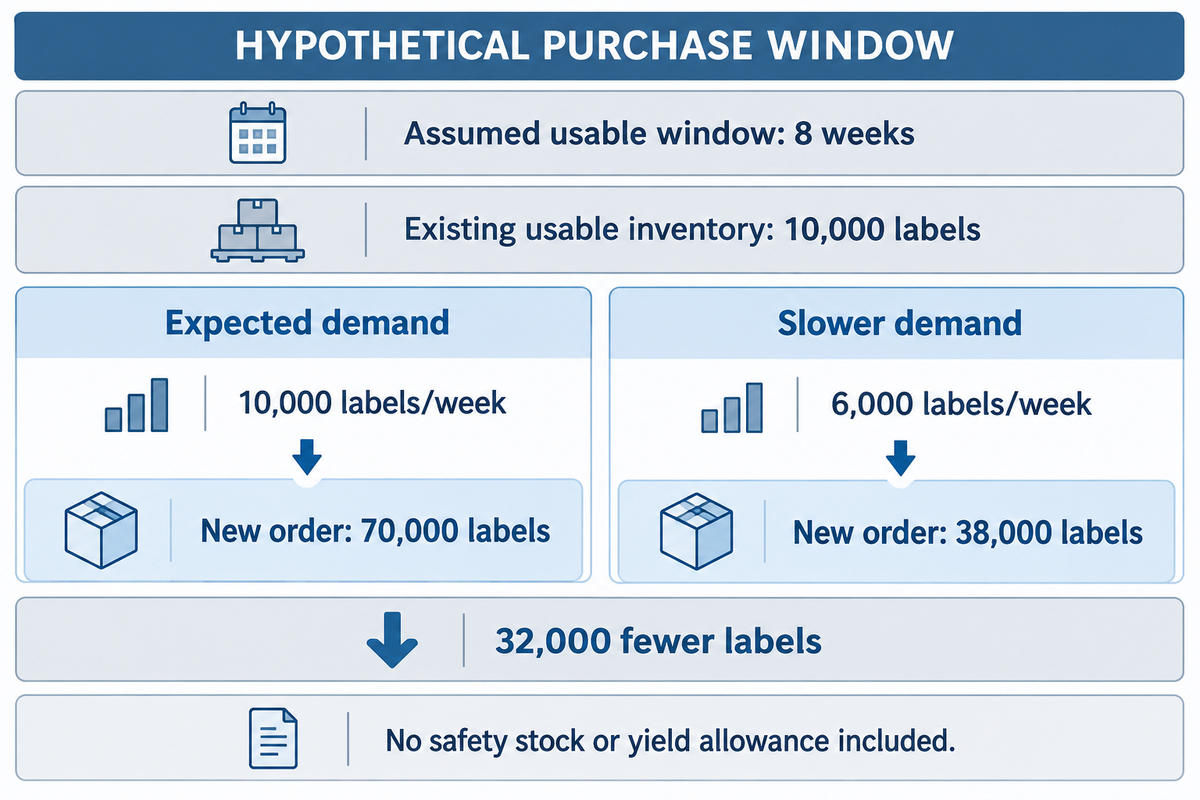
Assumed inputs: the supplier has confirmed eight usable weeks after the new stock arrives. Existing inventory contributes 10,000 usable labels within that window. Expected consumption is 10,000 labels per week; a slower-demand case uses 6,000. These are hypothetical planning quantities, with no additional safety stock or yield allowance.
| Input or calculation | Expected demand | Slower demand |
|---|---|---|
| Confirmed usable window after arrival | 8 weeks | 8 weeks |
| Forecast weekly consumption | 10,000 labels/week | 6,000 labels/week |
| Existing stock usable by consumption date | 10,000 labels | 10,000 labels |
| Gross consumption calculation | 8 × 10,000 | 8 × 6,000 |
| Gross consumption result | 80,000 labels | 48,000 labels |
| Deduction for existing usable inventory | 10,000 labels | 10,000 labels |
| New order calculation | 80,000 − 10,000 | 48,000 − 10,000 |
| New quantity for this assumed window | 70,000 labels | 38,000 labels |
| Difference from expected-demand purchase | Baseline purchase | 32,000 fewer labels |
The slower-demand case uses 32,000 fewer labels within the assumed usable window. Procurement can discuss smaller releases or staged deliveries, with each delivery’s dates confirmed. Finance should evaluate those terms versus the cost of the unusable stock, inspection time and potential production interruption.
Prior to ordering, provide Guanma the construction requirement, container surface, print system, application temperature and expected consumption schedule. Include the existing roll code and date record (if applicable) to match older material. Use paper-based label stock options for application trials to initiate the material discussion. Agree the supplied product’s storage instructions and date basis in the purchase documentation.
Frequently asked questions
Is shelf life an expiration date?
The supplier’s wording determines what action the date requires.
A stated shelf life normally assumes particular storage conditions and a defined starting date. An expiry or retest date tells you when a specific action is due. Identify whether the date is a firm use limit, a warranty boundary or a trigger for further evaluation. Record that distinction before releasing an older lot, rather than treating every date as interchangeable.
What should I do if my storage area exceeds the recommended temperature or humidity levels?
Identify affected lots and hold them while the deviation is assessed.
Assess affected rolls using the recorded temperature or humidity, duration, packaging condition and location, even after the room returns to its normal setting. Compare these details with the applicable supplier specification to agree the inspection or testing needed for the intended job. Keep the assessment and all resulting test records with the lot record.
Can I store different types of labels together?
Yes, when their documented storage and handling requirements are compatible.
Keep each construction and lot clearly identified, protect opened packaging, and separate material that’s on hold from material approved for use. Paper, film, removable adhesive and thermal stock can have different expiry dates even when they occupy the same warehouse shelf. Check each lot’s own record when issuing stock, and preserve the original identification on partly used rolls.
Can direct sunlight affect stored labels?
Yes. Keep unused material protected from direct sunlight.
Assess an exposed roll using its packaging condition, exposure history and the supplier’s instructions for that construction, even after moving it into shade.
How long do thermal printed labels last?
Image life depends on the thermal material, print system and exposure.
Assess printed-image life using image-retention information for the exact construction and readability tests under the intended conditions. Evaluate unused-roll shelf life and aged-adhesive suitability separately; a legible fresh print shows current readability only.
How often should I inspect my stored labels?
Use supplier instructions, inventory age and storage risk to set the interval.
Check after receiving or a recorded excursion, and again before releasing aged stock. These inspection best practices help identify deterioration; they don’t extend the supplier’s stated limit.
Use batch records and order calculations for planning only; they’re examples, not Guanma test results or shelf life guarantees. Our examples use public material specifications.
References & Sources
- Pressure-sensitive adhesive labels specification, 2016, section 3.5, Library of Congress.
- Managing self-adhesive materials inventory, Labels & Labeling.
- Lot acceptance sampling plans, National Institute of Standards and Technology.
- FINAT Test Methods, FINAT.
- D6252/D6252M-98(2025): Peel Adhesion of Pressure-Sensitive Label Stocks, ASTM International.
- Barcode verification, GS1 India.