Get in Touch with Guanma

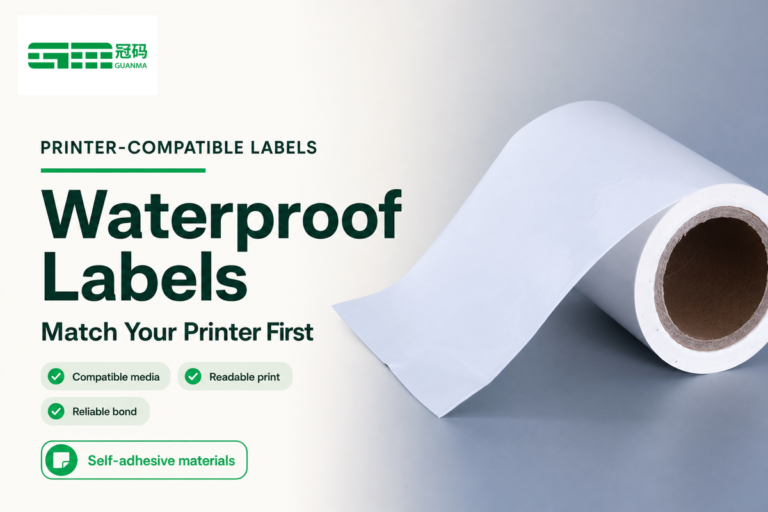
When determining what’s the best durable waterproof label material for label printing companies, PET would be a good option for a print-compatible construction for durable identification. Then, you’d want to look at BOPP, vinyl, or synthetic paper and determine what would work best for the package and exposure. The winning choice is the construction that passes the job’s printed-sample checks at an acceptable cost.
Updated October 2026
Waterproof label material should be selected as a print-and-adhesive construction. PET and BOPP can be used for many durable ID jobs and packaging, respectively. Conformable films can work for flexing surfaces. Approve the actual printed label on its intended container.
Quick selection facts
- Decision unit: The decision unit is the facestock, printing surface, ink or ribbon, adhesive, and converting liner.
- First approval: First approval is the printed sample on the intended container with agreed exposure and reading conditions.
- Cost denominator: accepted labels after inspection, rather than purchased rolls alone.
- Evidence boundary: a polymer name or a waterproof claim does not establish a service-life or certification rating.
Key takeaways
- The film can remain intact while the ink smears, the adhesive delaminates, or the barcode stops reading.
- Some qualified coatings can cover multiple printing processes. Approve the grade instead of requiring a different polymer for each printing process.
- A laminate protects a print surface, but the adhesive has to also match the conditions of the container and application.
- Compare material options after sample approval using the same quantity, inspection rules and cost scope.
Which waterproof label material should a printing company choose?
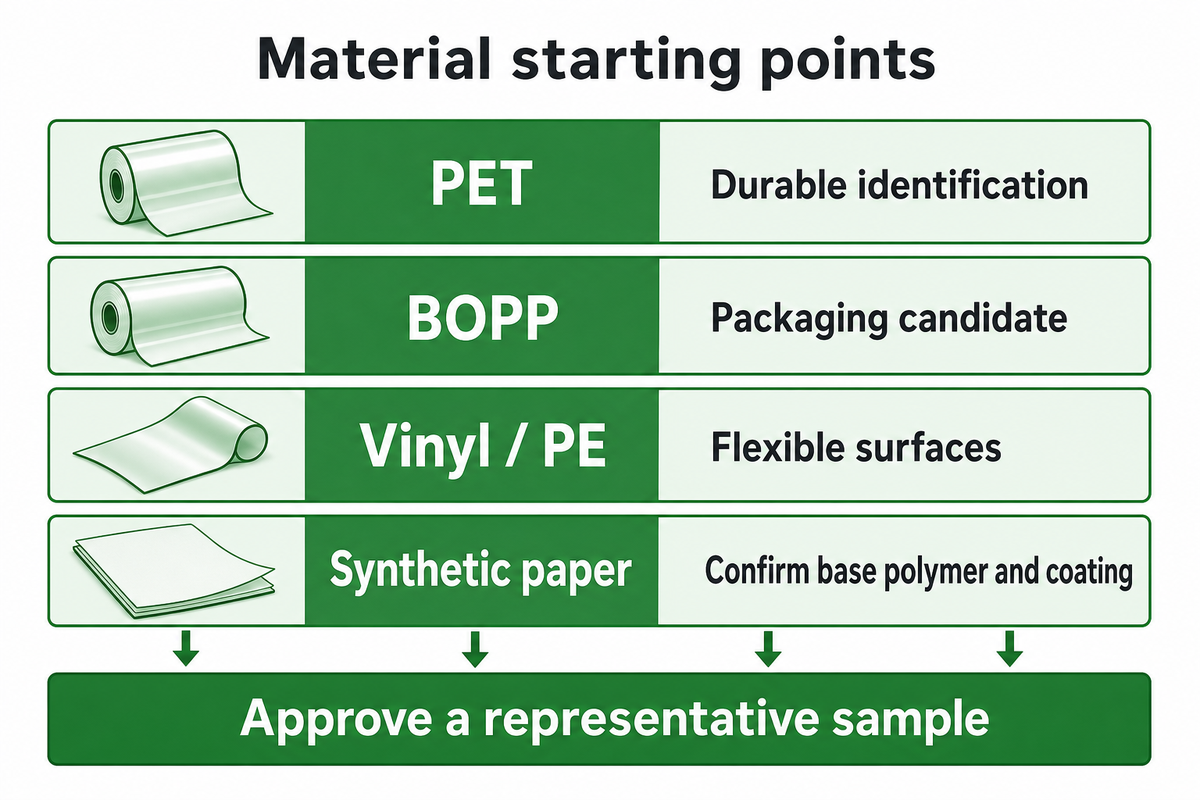
PET is a good choice for identification of durable assets; BOPP is a packaging-film candidate, and vinyl or PE suits flexible surfaces. Synthetic paper has a plastic substrate and can present an image like paper. Choose the grade that matches the printing method, actual substrate and required exposure, then approve a representative sample.
There are a number of unanswered questions due to the lack of information of the term waterproof. Does the film resist water? Does the printed image maintain legibility after rubbing? Does the permanent adhesive remain attached to the bottle? Can the machine read the code? An intact film can carry an ink smudge that hides essential information. Durable labels need a definition of success that includes the information they carry.
GS1’s retail 2D barcode guidance treats material, shape and reading conditions as related decisions. The note on material mentions durability of polyester and its relative rigidity. Polypropylene resists water, but has a limit under more severe exposure conditions. These are first level considerations, not absolute transferable ratings for every coating and adhesive.
What Makes a Label Durable?
A durable label keeps its required information readable and stays attached through its specified use. Facestock provides strength and rigidity, the printing surface carries the image, and adhesive connects the label to the package. The service environment and conditions of use determine weakness in the label. A release liner is used for production and application, and is removed prior to service.
For a wet-use job, approve image fastness and adhesion separately. The Library of Congress’s 2016 thermal-transfer label procurement specification illustrates that separation through distinct print-fastness, bond and abrasion requirements. Its limits were written for collection-storage containers; they aren’t a general commercial waterproof grade.
A purchaser of a ‘long-lasting’ label should stipulate the period and conditions rather than specify a material ranking. A 500 mL bottle on a chilled shelf and an equipment asset tag wiped with cleaner need different evidence. Procurement can shortlist the right materials only when QA has stated how each label must endure.
PET, BOPP, vinyl and synthetic paper: where each fits
PET, BOPP, vinyl and synthetic papers offer various possibilities for wet-use printing. Among these, PET may be a better choice for durable identification; BOPP labels are common packaging candidates, including transparent finishes. PE and Vinyl may also be candidates for applications where package deformation is difficult for a rigid film to follow. Synthetic paper needs to identify its base polymer and printable coating to be evaluated fairly.
PET: PET may be shortlisted for asset tags and other durable identification applications where shape retention and image durability are critical. Extreme conditions must be described as exposures, not used as a substitute for a specification. A heat-resistant requirement still needs a construction-level temperature rating, including adhesive and print. Calling the facestock thermoplastic doesn’t define the finished label’s limitations. Guanma’s PET adhesive film options let a buyer discuss those construction variables together.
BOPP: consider it for rigid packaging, white labels or a clear BOPP “no-label” appearance. Polypropylene resists water as a film, but the coating, ink and bond need approval. Clear labels offer a transparent appearance when the printed artwork and container suit that design. High gloss gives a different shelf appearance than a matte finish, and can change scanner reflections. Don’t consider clear and white constructions as the same thing.
Synthetic paper: the name describes a presentation and product family, not one universal recipe. Guanma’s BOPP synthetic-paper range currently lists 54, 75 and 100 µm options. These are supplier’s offerings. Get the coating, adhesive and thickness tolerance before accepting a spec or comparing quotes.
Is vinyl waterproof for labels?
Vinyl film is a good wet-use candidate, but vinyl labels are only as good as their printed construction and adhesives. Printable vinyls require a print receptive surface compatible with the ink or toner being applied. For outdoor applications, water resistance alone does not establish resistance to UV fading, abrasion or repeated flexing. Approve the endpoints on the surface of interest.
Consider a hypothetical squeeze-bottle order with a narrow, curved label panel. The art looks great on the flat proof, but the proof doesn’t show what happens when the bottle flexes. Compare a conformable film with the proposed PET construction on the filled package. Is the label still readable after repeated handling, with creasing and edge movement on record? Choose the sample which meets the customer’s requirement, not the film with the strongest description.
The introductory guide to label materials explains the broad material categories. A production order goes further: An order, however, specifies the complete construction, approved print settings and a retained sample. A 75 µm synthetic film and a film of similar gauge aren’t equivalent merely because of their thickness.
Match the coating to your printer and ink
Always match the stock’s receptive surface to the appropriate press, ink or ribbon prior to water resistance testing. Multiple processes may use the same base film, and a qualified coating may cover a few or many named processes. Verify compatibility for the chosen grade instead of assuming it from PET or BOPP.
Press teams make labels with a defined process, so a press room needs the printer model and ink chemistry, not just “digital.” Laser printer stock must withstand the fuser and the feed path as a complete sheet construction. Inkjet printers require a surface appropriate to their liquid ink systems. Thermal transfer pairs a receptive face with a suitable ribbon. UV ink adhesion is also dependent on the approved surface and curing conditions.
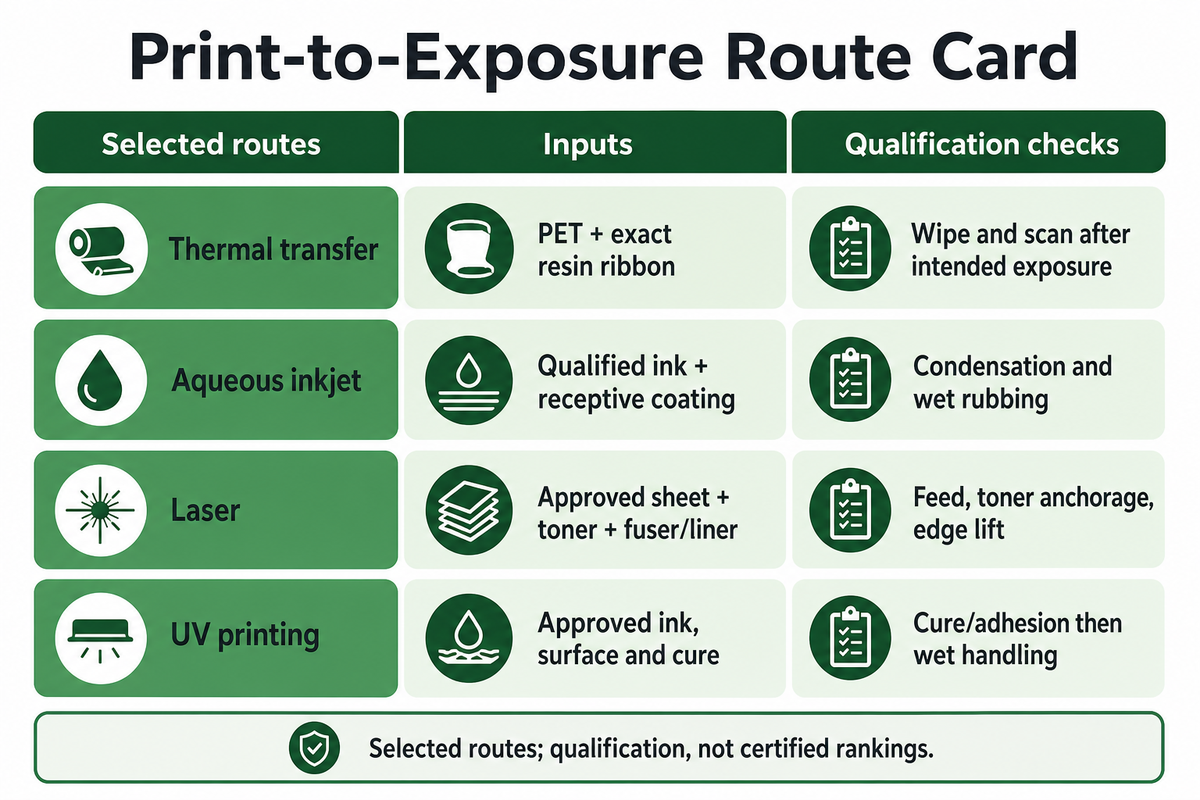
Print-to-Exposure Route Card
Print-to-Exposure Route Card pairs a printing system to a stock treatment and sample checks, and the person who approves the job.
Rows describe routes to qualification, not certified material rankings. A press lead can request stock. QA can define the challenge, and procurement can maintain the construction quoted.
| Printing job | Material starting point | Print pairing to confirm | Approval check and owner |
|---|---|---|---|
| Thermal transfer, equipment asset tags | Print-receptive PET shortlist | Exact resin ribbon, print energy and image adhesion | Wipe and scan after intended cleaner exposure; QA owns limit |
| Thermal transfer, wet logistics label | Coated PP or PET grade | Ribbon chemistry, face coating and applicator release | Check wet print plus container bond; press lead records settings |
| Aqueous pigment inkjet, beverage bottle | Inkjet-receptive BOPP or synthetic stock | Specified pigment ink and receptive coating | Condensation and wet rubbing on full-colour artwork; QA |
| Aqueous dye inkjet, product label | Supplier-qualified inkjet coating | Actual dye ink; no substitution by family name | Test black and colour after water contact; QA |
| Laser, sheet-fed durable label | Laser-approved polyester sheets | Toner, fuser-safe adhesive/liner and media setting | Feed trial, toner anchorage and edge lift; press lead |
| UV inkjet, short-run packaging | UV-compatible film or synthetic paper | Ink set, surface treatment and curing conditions | Cure/adhesion test followed by wet handling; press lead + QA |
| UV flexo, clear bottle decoration | Treated clear BOPP or other approved film | Ink system, treatment and protective finish | White-ink opacity, wet bond and scanner glare; QA |
| Squeezable bottle or curved decal | Conformable-film shortlist, including vinyl/PE | Bend radius, film recovery and adhesive on actual pack | Repeated flexing and edge inspection; packaging + QA |
| Direct thermal, short-life variable data | Purpose-qualified direct thermal stock | Imaging chemistry and expected heat/light/liquid exposure | Image and scan after exposure; procurement confirms useful life |
Can I Print Waterproof Labels Using an Inkjet Printer?
You can print wet-use labels with an inkjet printer if stock and ink are qualified together. Use inkjet-receptive film or synthetic paper specified for the ink system. A water-resistant face doesn’t make an unqualified ink deposit durable. Check drying, image adhesion and wet rubbing on the artwork and container that will enter production.
Pigment versus dye is input to be documented, not a complete purchasing decision. Test black text, heavy colour coverage and small barcode modules separately. “Best” quality settings can deposit more ink than a coating can handle; use the stock and printer suppliers’ approved settings rather than assuming the highest setting is the safest.
Imagine a small business asking a converter to make waterproof stickers for bath products. The brief states a glossy decal and a desktop color printer, but doesn’t specify ink type. Before quoting lamination, request the machine, ink and container. A sample can separate poor anchorage from adhesive failure. Adding a protective finish, without specifying the cause of the problem, can preserve a defective process, and make later changes expensive.
For label sheets include the approved media setting and sheet format. State the winding direction and the applicator’s requirements for rolls. A trial of 30 labels should use the intended black text and barcode, not a low-coverage logo alone. Logo alone is poor-coverage artwork for approving the intended production job.
Adhesive and laminate: why water-resistant film still fails
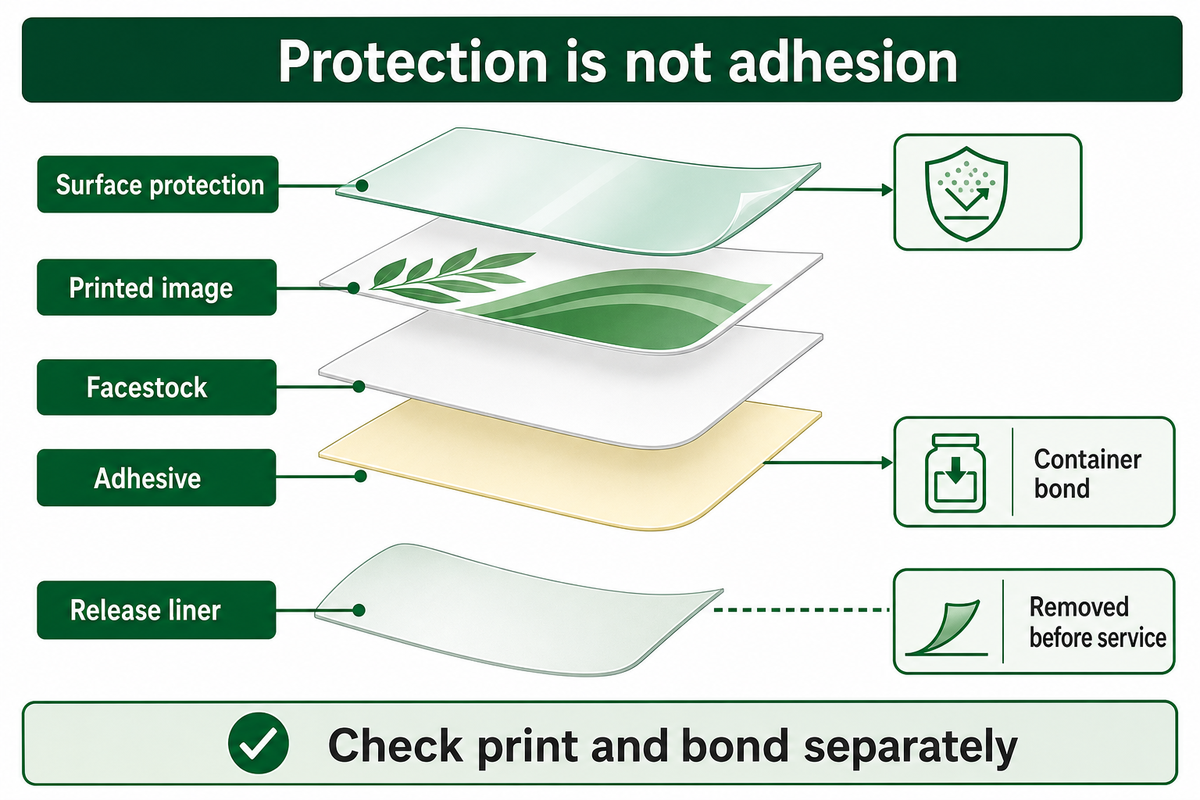
Water resistant films still can lift and lose their image. Surface protection and adhesion perform different functions. The adhesive must match the package, application temperature and service exposure. A laminate can protect the printed surface from environmental conditions and mechanical damage, but it doesn’t mean that the adhesive is adequate. Failures can occur in different layers of the label construction, which should be diagnosed prior to changing stock.
Requests for a strong adhesive require a surface and an endpoint. Different conditions exist for tack and bond, and contact conditions also differ. Smooth glass and a textured container present different contact conditions. Initial tack is also different from bond after dwell. A removable adhesive may be correct for reusable packaging, while permanent adhesive may be needed for retained identification. Only testing can verify performance. For labels that resist wet handling, record the surface and challenge used to support that claim.
The printed construction is also important. A 2020 study of water-based acrylic label adhesives evaluated specific formulations and multilayer labels. They reported the results of a trade-off of tack, peel and shear for the various formulations and labels and support the testing of the complete job, but don’t prove a universal water-based acrylic adhesive.
What does lamination resolve? Different sorts of proof are required for various types of issues. If you apply a clear laminate, retain its grade and thickness in the approval record. Added gloss may help protect ink and change the way light interacts with the film. GS1’s printing guidance identifies surface sheen as a potential reading problem, so repeat functional barcode checks after changing the finish.
Paper labels and paper stocks should also not be grouped together. Some surface protected constructions may behave differently from unprotected office paper. A request to use waterproof paper needs a product description along with a printed sample. “Made from durable materials” says very little about the actual bond, print quality or exposure limit.
A proposed chilled bottle label may pass a dry rub test, but later lifts at its lower edge after condensation forms. The adhesive test is still an open question. Check application conditions, surface contamination, curvature and bond dwell first. A 24-hour dwell test establishes a basis for comparison and isn’t a prescribed cure time for all cases.
Approve the printed sample on the real container
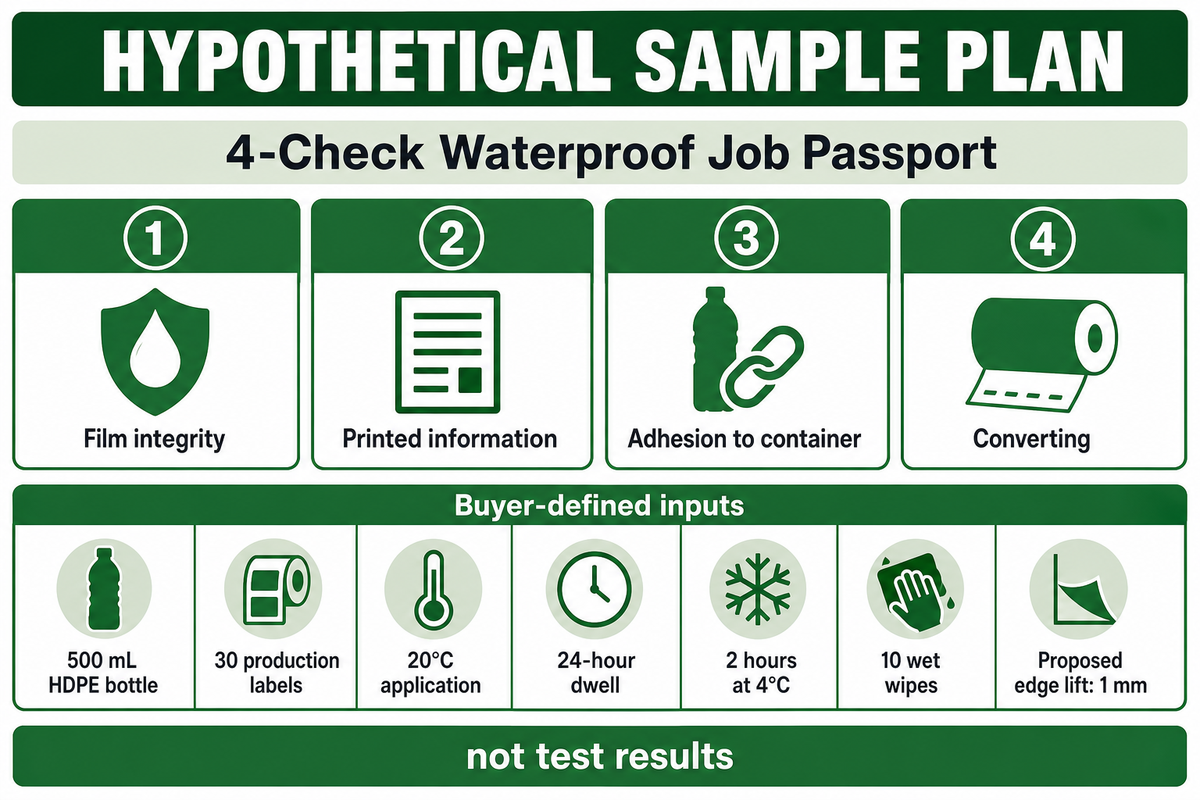
Based on agreed exposure and approved criteria for image, bond, and handling, waterproof materials may be approved on the actual container. Record the print system and construction before the trial. Separate barcode functionality from visual print condition, and identify any application-specific qualification requirements. Sample passes don’t indicate an unlimited use or a broad application.
4-Check Waterproof Job Passport
4-Check Waterproof Job Passport identifies separate approvals for film integrity, printed information, adhesion to container and converting.
Name owners. The press lead controls settings, QA controls the challenge and evidence, and procurement holds the construction revision so that a reorder doesn’t silently substitute a different coating or adhesive.
“Variations in the label stock facestock and adhesive can affect the response”
ASTM D6252 describes a 90° peel method and associates measurements with acceptance criteria. ASTM D5264-98(2019) compares abrasion of printed materials under lab conditions. Neither name provides one waterproof pass value. Use the appropriate procedure with the chosen substrate and limits; the sample’s facestock can impact how a peel result should be interpreted.
The following filled planning example is for a hypothetical chilled bottle job. Quantities and limits are exemplary values and not test results, recommended universal defaults, or Guanma assurances. Adjust them as per service conditions of the buyer and instructions of the supplier, prior to initiating the trial.
| Record field | Illustrative proposed input | Evidence or criterion to agree | Owner |
|---|---|---|---|
| Package | 500 mL HDPE bottle; curved label panel | Use the production bottle, not a steel substitute | Procurement supplies surface and filling details |
| Print job | 30 labels with production black text, colour and barcode | Same press, ink/ribbon, artwork and finish | Press lead locks the job record |
| Application | 20°C on clean, dry bottles | Actual application temperature and surface preparation | Operator records application conditions |
| Bond dwell | 24 hours before challenge | Supplier-recommended dwell for the chosen adhesive | QA approves the schedule |
| Cold/wet exposure | 2 hours at 4°C, then condensation handling | Exposure matches the proposed chilled distribution scenario | QA defines liquid, temperature and duration |
| Image challenge | 10 wet wipes using the agreed water-only wipe | No smear affecting required text; photograph before/after | QA sets the rubric before the trial |
| Bond endpoint | Proposed maximum edge lift 1 mm | Measure edges before/after; agree any allowed exception | Buyer signs the limit; no universal tolerance |
| Reading endpoint | Read all 30 labels wet and dry on target equipment | Required scan/verification criteria, lighting and orientation | QA and barcode-system owner agree the method |
| Release record | One construction revision; all four checks signed | Attach results, retained samples and any use-specific listing | Procurement releases only the approved construction |
Define water exposure precisely. A splash, condensation, immersion and a hot detergent wash are different challenges. The Library of Congress’s historical container-label specification, for instance, has a 48 hour distilled water test on a paper support, as well as separate tests for adhesion and printing. That procurement example shows why the liquid, support and observation matter; its 48 hours is not a commercial bottle-label requirement.
Functional approvals require their own records. Check the reading equipment and the agreed method of verification under representative wet and dry conditions. A bar code that scans once at a convenient angle hasn’t necessarily passed a required print quality grade. GS1 identifies variables in retail 2D reading as including: droplets, frost, product shape and sheen. Agree on the correct criterion with the owner of the barcode system.
Regulated jobs need a separate scope check. U.S. hazardous-material transport label rules address durability under expected transportation conditions. The public UL 969 marking-system scope ties evaluation to specified systems, surfaces and end-product requirements. Ordinary wet-rub approval doesn’t establish those qualifications, and no Guanma certification is asserted here.
Retain approved artwork, construction revisions and exposure record together. For the hypothetical 30-label sample, a buyer-defined 1 mm edge-lift limit means nothing until the measurement method and exceptions are agreed. Release purchase orders against a job record signed by the buyer, not a film description copied from the first quotation.
Compare cost per 1,000 accepted labels
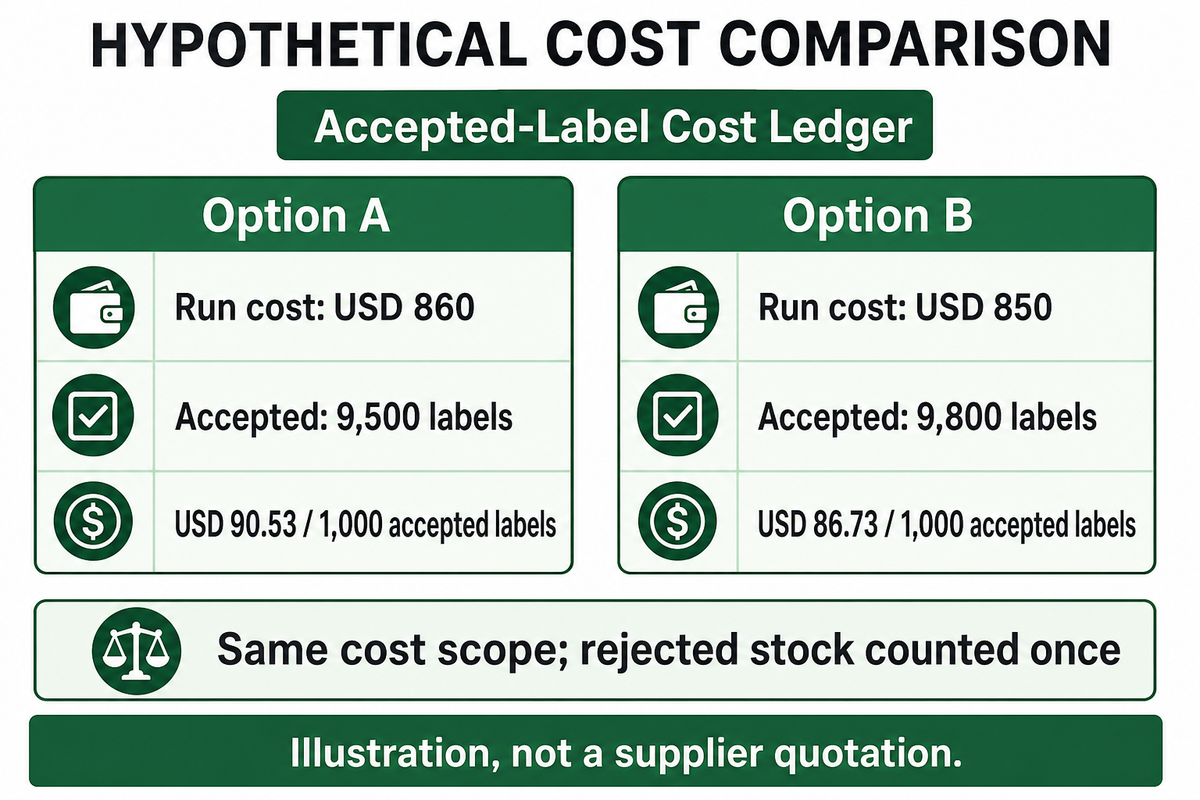
Compare total costs for qualified options and divide by the total quantity acceptable to the buyer. Multiply by 1,000 to get the cost per thousand accepted labels in dollars. For each alternative, include the same categories of costs (stock, printing, converting, inspection, and rework). Keep customer return exposure separate, unless measured and consistent. This hypothetical example is an illustration of basic arithmetic rather than a Guanma quotation or benchmarking of an industry reject-rate.
ASQ’s cost-of-quality framework distinguishes prevention and appraisal from internal failures such as scrap or rework, and external failures such as returns and complaints. It helps define what to count. ISO 14051’s public material-flow accounting summary connects physical material flows with associated costs, but does not prescribe this label formula or certify the example.
Accepted-Label Cost Ledger
The Label Cost Ledger compares the same run-cost categories against accepted outputs, and rejected stock is counted once. Rework is shown separately.
Take two sample-qualified constructions for the same hypothetical 10,000-position order. Option A has cheaper stock, but the illustrative run requires more additional rework. In both cases, all stock, including material later rejected, is shown. Rejected material isn’t shown a second time.
| Same cost scope | Hypothetical option A | Hypothetical option B |
|---|---|---|
| Label positions started | 10,000 labels | 10,000 labels |
| Stock, including eventual rejects | USD 500 | USD 560 |
| Ink or ribbon | USD 100 | USD 110 |
| Press and converting time | USD 120 | USD 120 |
| Inspection and sample work | USD 40 | USD 40 |
| Additional rework labor/cost | USD 100 | USD 20 |
| Total comparable run cost | USD 860 | USD 850 |
| Accepted output after inspection | 9,500 labels | 9,800 labels |
| Cost per 1,000 accepted labels | USD 90.53 | USD 86.73 |
The arithmetic is USD 860 ÷ 9,500 × 1,000 = USD 90.53 for A, and USD 850 ÷ 9,800 × 1,000 = USD 86.73 for B. In the example given, the higher price for B’s stock is compensated for by lower additional rework and more accepted labels. This follows from the given case. It doesn’t prove that BOPP, PET, or any supplier is always cheaper.
A finance reviewer can also calculate a break-even ceiling. If B still delivers 9,800 accepted labels, its comparable total cost can rise to about USD 887.16 before reaching A’s cost per accepted label: USD 860 × 9,800 ÷ 9,500. An unmeasured future failure allowance shouldn’t be inserted simply to make an option look attractive.
Actual small businesses may allocate setup differently from a long production run. When comparing quotes, keep the same accounting boundary, and separate a one-time qualification expense from recurring order costs if this affects the decision. This ledger excludes customer returns, transport, taxes and financing; add relevant items consistently. It’s a run cost comparison, not a complete profitability model.
Procurement should reject a price-only comparison if one quote includes 10,000 accepted labels and the other includes 10,000 printed positions with rejects billed. QA supplies the accepted count, production supplies run costs, and finance verifies the scope. Defining these may matter more than a small variation in film purchase price.
Send a quote-ready specification to Guanma
Send complete printing and application briefs to Guanma for each order, rather than requesting waterproof stock separately. Ordering stickers and labels should retain one approved stock revision for constructions, when both use the same construction. The brief should include the facestock finish and gauge, print process, ink/ribbon, adhesive need, liner and converting format. The container, application and exposure conditions, sample criteria and order quantity should also be provided. This allows potential constructions to be compared against the same criteria.
Guanma’s BOPP film construction options and PET offering are useful starting points for custom labels. Request the selected product’s technical data sheet and thickness tolerance. The public BOPP page presents different gauge descriptions across its summary and finish table, so a general range shouldn’t replace a product-specific quote.
A printing brief for 10,000 labels should include the label size in millimeters, the roll width, core size and winding direction, as well as the finish and approved print route. Converters should include matrix stripping and liner release. When many label formats are included in an order, confirm which formats were included in the feed and dispense trial. The liner can affect the behavior of the press and dispenser, even though it doesn’t remain on the label.
Describe whether the labels get wet after application or must be applied to a damp or cold surface. Those are different adhesive requests. Discuss a permanent or removable bond, appearance, useful life, and regulated use. A stock described as ideal for industrial also needs a specified surface and test scope. Request evidence pertinent to that construction, instead of copying tests and approvals of another manufacturer.
Send the print system, container and sample criteria via Guanma’s sample and specification enquiry for review of the proposed construction prior to approving production. The Guanma company profile states the primary focus of the company is the supply of self-adhesive material; this article doesn’t claim unpublished plant trials or customer reject-rate data.
Material changes to watch in your next qualification run
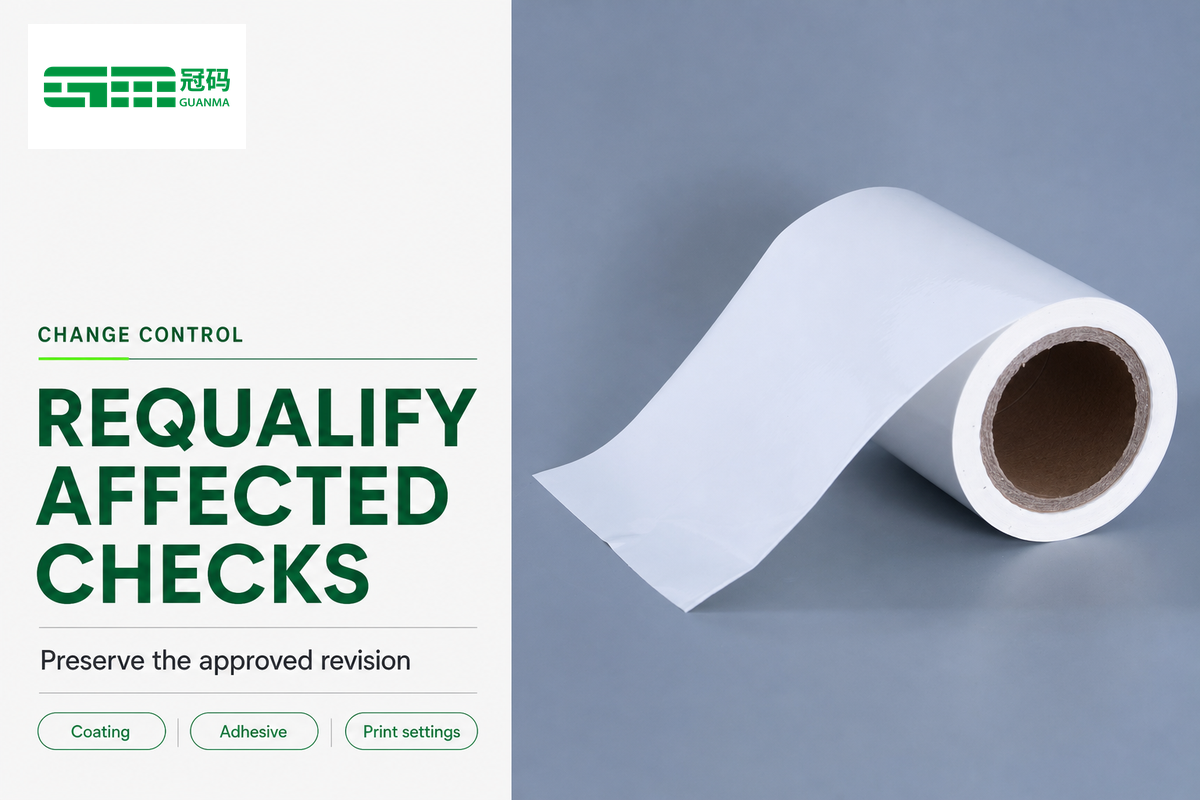
For a change in material to take effect, the approvals affected by that change should also be revalidated, even if the polymer family doesn’t change. A new receptive coating can alter print anchorage, and a thinner film can change converting. A new adhesive can change the end-use or recycling behavior. Retain a revision to a construction so that an approved sample continues to describe the ordered stock.
Labels & Labeling’s Labelexpo Europe 2025 materials coverage reports specific developments in recycled-content materials, release liners, wash-off adhesives and surface treatments. If a supplier modifies its product, it doesn’t mean that a new film withstands harsh conditions. The article doesn’t prove that Guanma supplies an equivalent product.
Recycled content and recyclability answer different questions. RecyClass’s revised PET-bottle label and adhesive evaluation addresses label separation, residue and PET-flake behavior in its process. A material that resists water during use isn’t automatically compatible with a particular recycling stream. Obtain evidence for the labeled package and intended collection route.
A permanent-to-wash-off change of adhesive shows the required tension. The label still needs to endure its specified wet use. Removal during a subsequent process may be required. Specify both environments rather than treat removability as poor durability. A 54 µm grade shouldn’t be inherently approved by a 75 µm construction, unless the print, conversion and use conditions are assessed as well.
Just as artifacts and software require management of versions, the same holds true for standards. The active editions of the ASTM standards for this analysis are D6252/D6252M-98(2025) and D5264-98(2019). A later reapproval year does not necessarily indicate a change to the procedure. Retain the edition referred to and agreed-upon acceptance criteria with the sample record. Without an established primary year-to-year demand series, a forecast of market growth will not warrant the recommendation for this case.
The next purchase should preserve traceability: stock revision, print settings, approved ink or ribbon and the signed exposure record. If any input changes, QA identifies which checks to repeat and procurement holds that revision. A documented change review is more useful than an unsupported claim that all new waterproof materials are better.
Frequently Asked Questions (FAQs)
Are waterproof labels dishwasher safe?
A waterproof claim alone doesn’t establish dishwasher suitability. Repeated washing adds hot water, detergent, rubbing and drying cycles to the bond and printed image. Specify the container, wash program, cycle count and acceptance conditions, then test the complete label. A laminated sticker may remain readable while its edges lift. Use a supplier’s construction-specific dishwasher evidence when that’s part of the job.
Does water resistance mean chemical resistance?
Water resistance doesn’t establish performance in cleaners, oils or solvents. Each exposure can challenge the image, topcoat or adhesive differently, especially when followed by rubbing. Name the liquid and concentration, contact time, temperature and wipe action before approving a sample. A label that survives water contact may still lose essential text under a cleaner. Qualify the chemicals used in the intended service, not a generic “chemical-resistant” description.
Can I use an inkjet label in a laser printer?
Use a stock approved for the actual laser system. An inkjet-receptive face alone doesn’t establish fuser, adhesive, liner or feed-path compatibility. Some products are qualified for both processes, so check the exact grade rather than imposing an automatic ban on dual-purpose stock. Run the recommended label-media setting and a feed/toner-anchorage trial before production. Never assume that every waterproof film is laser safe.
Do waterproof labels resist UV fading outdoors?
Outdoor use adds UV exposure and weathering to wet handling. Test the specified print and protection system against the expected environment, and retain the supplier’s exposure conditions. Scratch-resistant or weatherproof wording doesn’t identify a service life. When a barcode is essential, assess reading after exposure as well as colour change. A protective coating should be qualified with the underlying ink and adhesive.
How long do waterproof labels last on bottles?
The useful life depends on the complete construction, bottle surface and defined service. A shelf label facing occasional condensation is a different job from a reusable bottle undergoing repeated washing. Give the supplier the intended duration, filling and storage conditions, then approve a representative sample. Claims that labels last longer need a stated comparison and conditions. There’s no defensible universal number of months for every PET or BOPP bottle label.
Is high gloss the best finish for refrigerated products?
High gloss can suit the desired shelf appearance, but approval must include wet print, adhesive behavior and barcode reading. Condensation and reflections can affect a label that looks attractive when dry. Compare the proposed high-gloss and matte constructions on the same bottle with the actual artwork. The best options are those that meet appearance and functional criteria together.
Which ribbon should I use for thermal-transfer film labels?
Use the ribbon recommended for the selected print-receptive stock and required exposure, then qualify it on your equipment. Record ribbon grade, print energy, speed and artwork. A resin recommendation for one polyester product isn’t a universal rating for another film or coating. Test wet rubbing and the intended cleaner if those are required. Long-lasting labels need the approved ribbon and settings preserved on reorders.
Are synthetic waterproof labels recyclable?
A plastic facestock doesn’t guarantee that the labeled package is recyclable. The film, adhesive, ink, protective layer, container and available collection process all affect the assessment. Recycled content doesn’t mean that the finished construction is in the stream that’s desired.
Start with the package and market. A PET bottle and a PP container may need different kinds of separation and processing evidence. Specify the assessment method and scope of any approval pertaining to the adhesive and printed construction. RecyClass’s PET-bottle protocol is one specific evaluation route; it is not a global certificate for every synthetic label.
Keep end-use performance separate. A label may need to remain attached in an ice bucket yet separate under a recycler’s wash process. Those conditions can be compatible when the construction is designed and tested for both. Changing to a recyclable or wash-off proposal should reopen the affected sample checks. Neither an untested environmental claim nor a water-resistant film description should replace package-specific evidence.
Choose a construction you can approve and reorder
Share your printing, ink or ribbon, container and exposure conditions, and the evidence from sample checks. Guanma can discuss stocking options for your printing job and sample evidence prior to production.
How this material selection was prepared
This comparison employs public material descriptions and visible scopes of standards, scholarly works and industry guides reviewed in October 2026. The sample plan and USD ledger are clearly marked hypothetical examples. No private Guanma trial results, product certifications, lifetime guarantees or actual prices were supplied. Supplier offerings remain subject to the selected construction’s technical data and sample approval.
References & Sources
- ASTM D6252/D6252M-98(2025): public peel-adhesion scope and acceptance criteria
- ASTM D5264-98(2019): public printed-material abrasion scope
- Library of Congress 700-713–16: historical collection-container procurement specification
- Márquez, Alarcia and Velasco (2020): water-based acrylic adhesive study
- GS1: retail 2D barcode printing, scanning and verification guidance
- ASQ: cost-of-quality framework
- ISO 14051:2011: public material-flow cost-accounting abstract, confirmed 2025
- RecyClass: revised PET-bottle labels and adhesives evaluation scope
- Labels & Labeling: Labelexpo Europe 2025 material developments
- 49 CFR 172.407: U.S. hazardous-material transport label requirements
- UL 969 Ed. 6–2025: public marking-system scope
Related material and application pages
For a construction intended for outdoor service, review durable outdoor label requirements with the actual print, adhesive and exposure brief. A material description alone shouldn’t determine the label’s approved use.