Get in Touch with Guanma

Paper Weight Conversion Calculator Guide: GSM, LB and Basis Weight

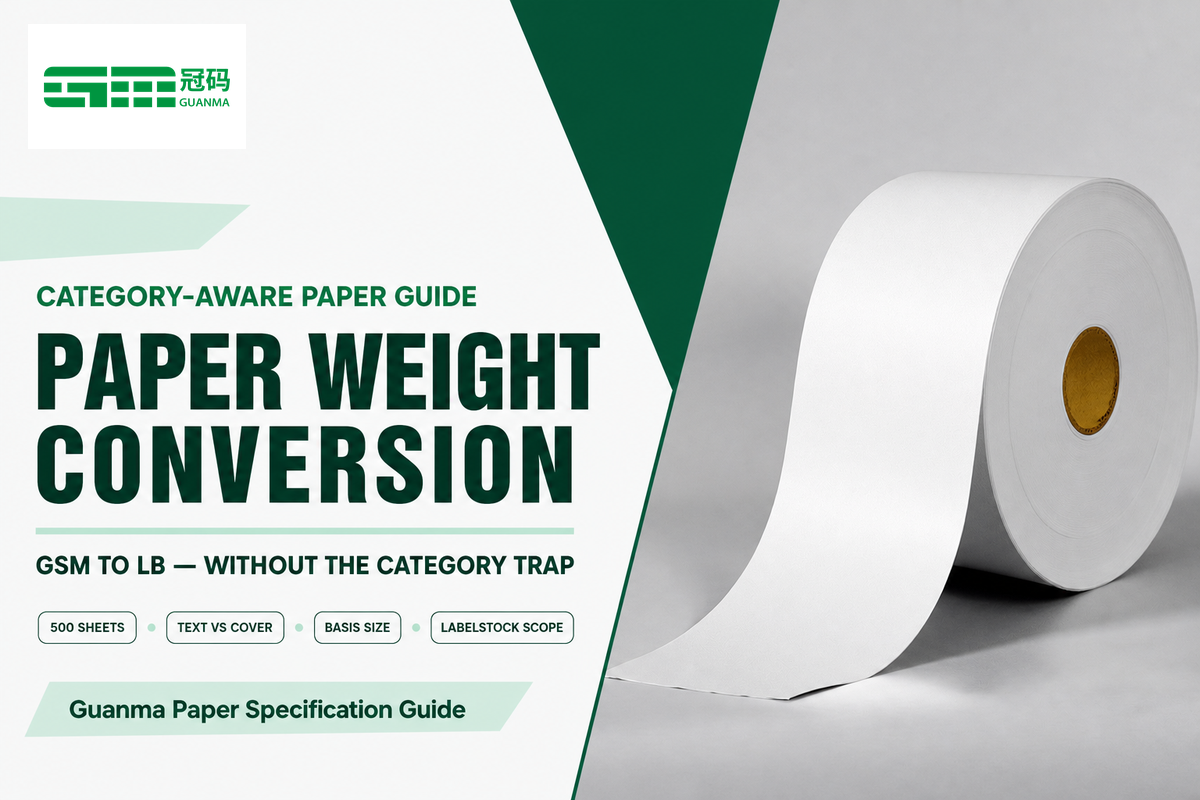
Category-aware paper conversion guide for print and label specifications
Paper pounds don’t convert to GSM with one universal factor. A paper weight conversion calculator is safe only when it first requires the paper category, such as text, cover or index, or its basic sheet size. US basis weight is the mass of 500 basic-size sheets, while GSM is mass per square metre. Once the category is fixed, use the matching factor or the auditable formula below.
500 sheetsthe ream basis behind US paper pounds
80 lb textabout 118 GSM
80 lb coverabout 216 GSM
In this guide, we call this the Basis-Value Collision Check: two papers can both be marked 80 lb yet differ by almost 98 GSM because the categories use different basic sheet areas. The phrase is a teaching label, not an industry standard or a Guanma proprietary method. Converters that ask only for “lb” can’t know which answer is intended. The safe input is a qualified value such as 80 lb text or 80 lb cover.
Why paper lb and GSM are not the same measurement
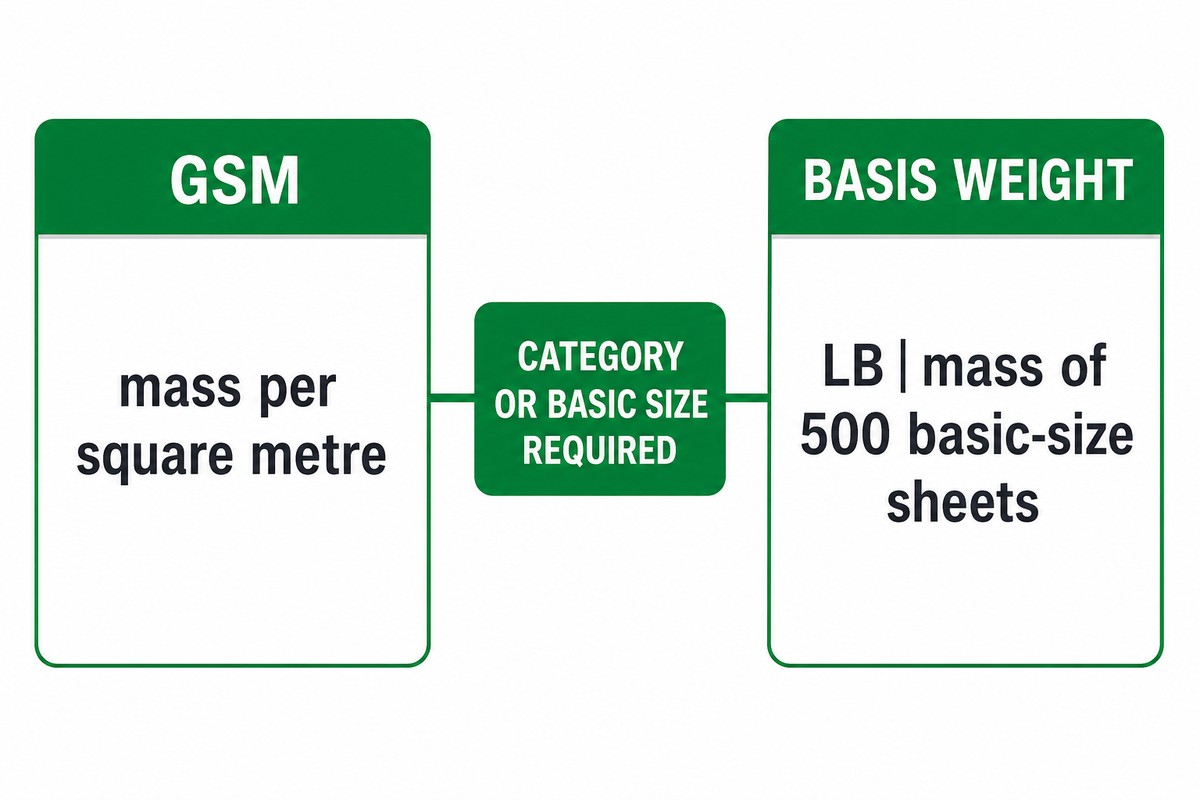
GSM, or grams per square meter (square metre), measures mass per area directly. Paper rated at 120 GSM has a nominal mass of 120 grams for every square metre, regardless of the sheet format used to sell it. Grammage is the technical name for that mass-per-area property.
US basis weight works differently. It states how many pounds a ream of 500 sheets would weigh at a category-specific basic size. Text paper commonly uses a 25 × 38 inch basic sheet. Cover commonly uses 20 × 26 inches. Bond or writing paper commonly uses 17 × 22 inches. The basic sheet is a calculation convention; it isn’t necessarily the cut sheet in the package.
In this guide, Ream-Area Mass Proof is a teaching label for why a bare pound value is incomplete, not the name of an external standard. “80 lb” identifies a ream mass but omits the area over which that mass was measured. Name the category or basic dimensions before comparing it with GSM.
For a buyer or supplier, the risk is a category mismatch hidden behind the same 80 lb label. The exact NIST mass-unit relationships can’t resolve that ambiguity because the missing input is the paper’s basis area, not the pound-to-gram constant.
“A paper pound value isn’t a conversion input until its category is attached.”
Is GSM the same as lb paper weight?
No. GSM is mass per square metre. Paper pounds are the mass of 500 basic-size sheets in a named category. Both describe paper weight, but they use different reference areas. Conversion becomes determinate only after the US basis area is supplied.
The category-specific basis weight lb-to-GSM formula
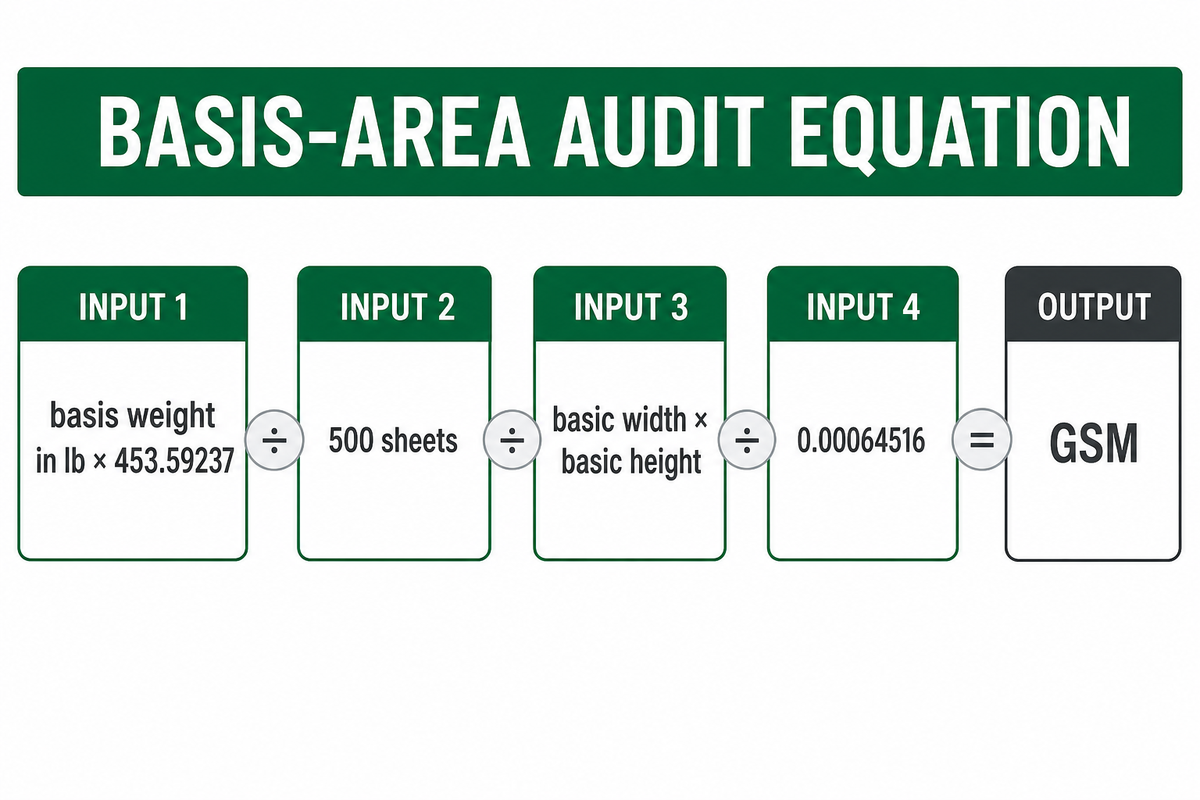
Calculate it by using the basis weight and the category’s basic sheet dimensions:
GSM = basis weight in lb × 453.59237 ÷ (500 × basic width in inches × basic height in inches × 0.00064516)
The constants are exact unit relationships: one pound equals 453.59237 grams, and one square inch equals 0.00064516 square metre. The result is still normally presented as an approximate commercial equivalence because published paper weights are nominal specifications, not measurements of every individual sheet.
NIST supplies the exact length-unit foundation, while the named paper category supplies the basis area. Keeping both inputs prevents a buyer’s calculation mistake and gives a supplier a reproducible verification record.
Worked example: 80 lb text paper
Text paper uses a 25 × 38 inch basic sheet. Its 500-sheet basis area is 500 × 25 × 38 × 0.00064516 = 306.451 square metres. The ream mass is 80 × 453.59237 = 36,287.3896 grams. Divide mass by area: 36,287.3896 ÷ 306.451 = about 118.41 GSM.
Worked example: 80 lb cover paper
Cover uses a 20 × 26 inch basic sheet. Its basis area is 167.7416 square metres. The same 36,287.3896-gram ream mass divided by this smaller area equals about 216.33 GSM. The pound number stayed the same, but the basic area changed, so the grammage changed by about 82.7%.
Keep the paper category, basic size, factor and rounded result together in the purchasing record. This guide calls that reproducible calculation record the Basis-Area Audit Equation; the phrase isn’t an external standard or a Guanma proprietary method.
Paper Class Conversion Ledger
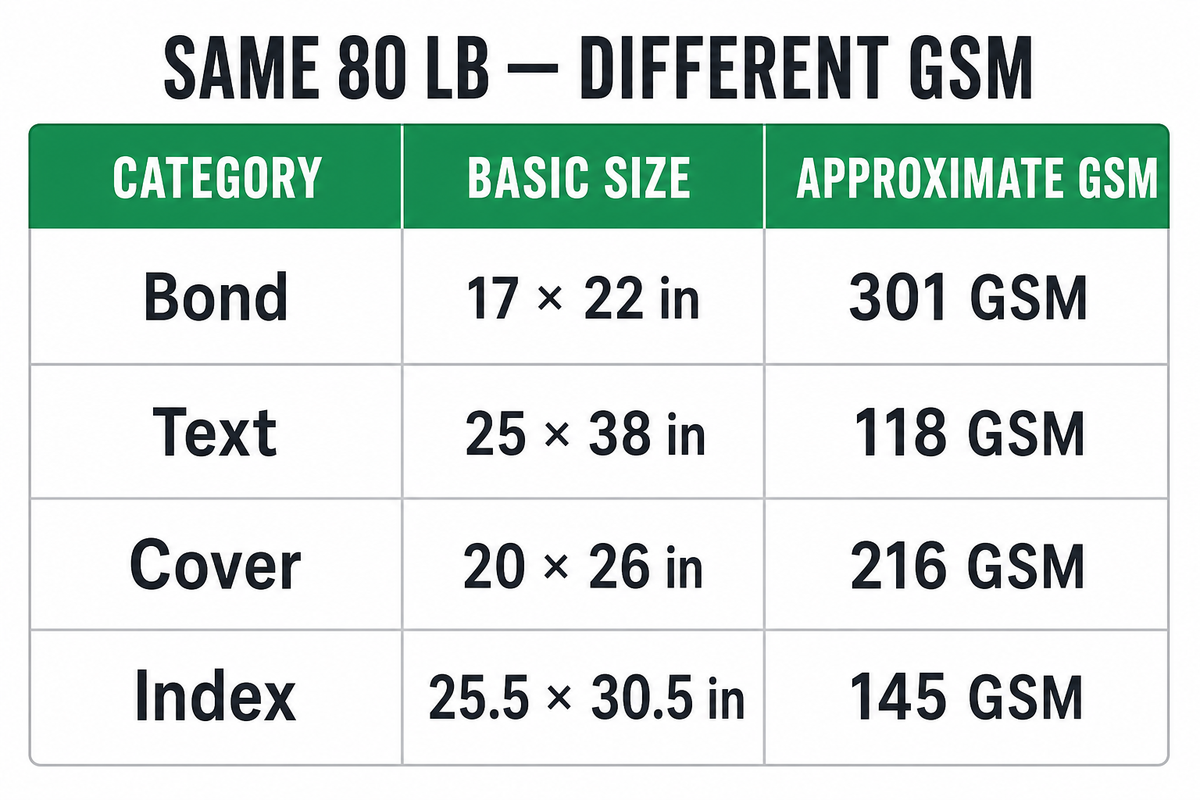
Select a row only when its category matches the source specification. Each factor below is calculated from the formula above with the exact NIST inch-to-metre relationship. The examples are approximate conversions, not promises that a merchant stocks every listed combination.
| Paper category | Basic size | GSM per lb | 20 lb | 50 lb | 60 lb | 70 lb | 80 lb | 100 lb |
|---|---|---|---|---|---|---|---|---|
| Bond / writing | 17 × 22 in | 3.760 | 75 | 188 | 226 | 263 | 301 | 376 |
| Text / book / offset | 25 × 38 in | 1.480 | 30 | 74 | 89 | 104 | 118 | 148 |
| Cover | 20 × 26 in | 2.704 | 54 | 135 | 162 | 189 | 216 | 270 |
| Index | 25.5 × 30.5 in | 1.808 | 36 | 90 | 108 | 127 | 145 | 181 |
| Bristol | 22.5 × 28.5 in | 2.193 | 44 | 110 | 132 | 153 | 175 | 219 |
| Tag | 24 × 36 in | 1.627 | 33 | 81 | 98 | 114 | 130 | 163 |
This guide calls the table the Paper Class Conversion Ledger because every result stays attached to its row; the name isn’t an industry standard. For purchasing in North America, this conversion chart keeps the paper class visible beside every approximate result. For example, multiplying 60 by the text factor gives about 89 GSM, while multiplying 60 by the cover factor gives about 162 GSM. Copying only the result or factor and dropping the row label recreates the original ambiguity. The same rule applies when a North American catalog uses “cardstock” as a general description: determine whether its stated basis belongs to cover, index or another named family before using a paper weight calculator.
When a Guanma material inquiry includes a catalog conversion, attach the row name and source datasheet. That prevents a supplier comparison from turning a correct number into the wrong paper-category decision.
| Input category | Information present | Safe handling |
|---|---|---|
| lb text | category and basis weight | use the 25 × 38 inch text row |
| lb cover | category and basis weight | use the 20 × 26 inch cover row |
| lb bond | category and basis weight | use the 17 × 22 inch bond row |
| lb index | category and basis weight | use the 25.5 × 30.5 inch index row |
| lb bristol | category and basis weight | use the 22.5 × 28.5 inch bristol row |
| lb tag | category and basis weight | use the 24 × 36 inch tag row |
| cardstock | general family only | request its cover, index or other declared basis |
| GSM only | mass per area | retain GSM or select a named US paper category |
| thickness only | caliper | do not infer GSM without grade-specific mass data |
Published merchant charts may differ slightly because they round factors, group paper families or list nominal grades. If a supplier provides a measured GSM value for the exact stock, use that declared product specification instead of reverse-engineering it from a catalog pound label.
When two sources disagree, compare their category labels and basic sizes before comparing the rounded numbers. Factors calculated from 25 × 38 inch text stock can’t validate a 20 × 26 inch cover entry. Record the source date as well: a product datasheet can change while the unit equation remains fixed. This small audit trail turns a convenient chart lookup into a repeatable purchasing check.
How to convert GSM back to pounds
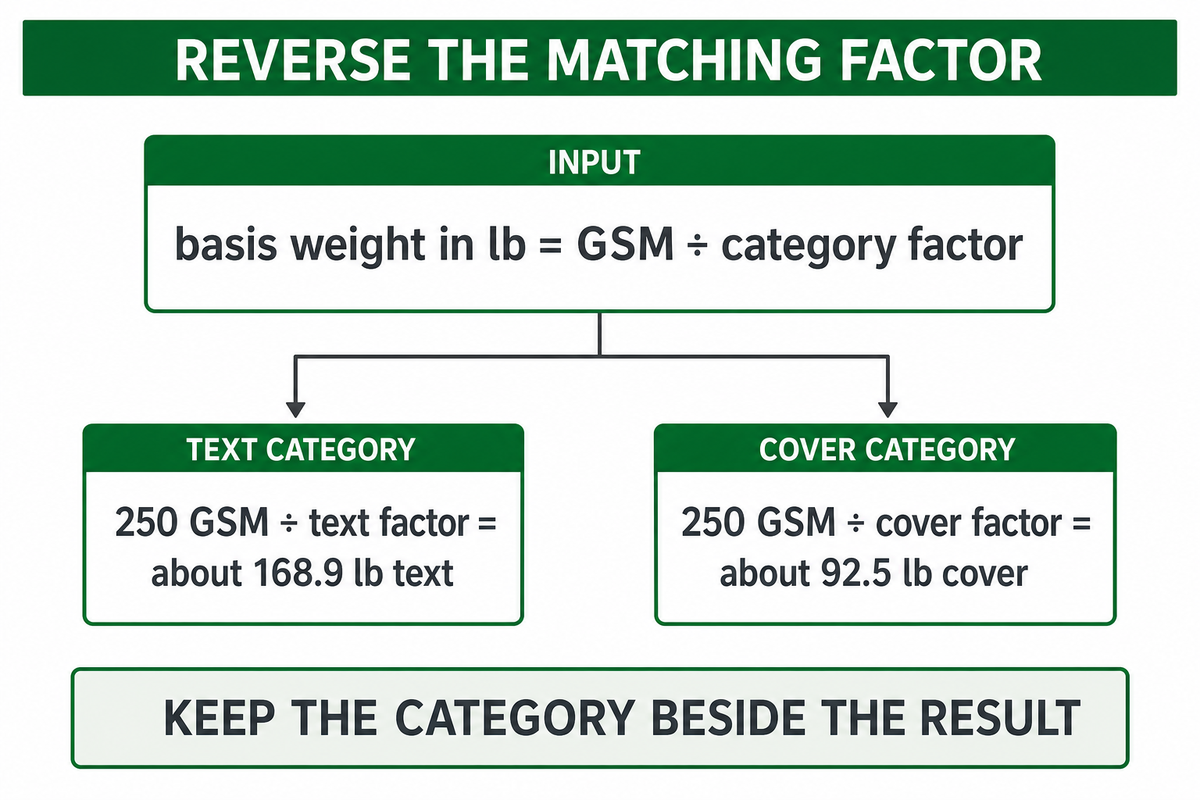
Reverse the matching row’s factor; the operation keeps the same exact NIST mass-unit basis and the same category-specific paper area:
Basis weight in lb = GSM ÷ category-specific GSM-per-lb factor
For 250 GSM text paper, calculate 250 ÷ 1.480146 = about 168.9 lb text. For 250 GSM cover, calculate 250 ÷ 2.704114 = about 92.5 lb cover. Both estimates refer to the same grammage, but they use different US basis conventions.
What is 250 GSM in lbs?
There’s no single unqualified answer. It’s about 169 lb in the text-paper convention, about 92 lb in the cover convention, about 138 lb in the index convention and about 114 lb in the bristol convention. State the category beside the answer and label the number approximate.
If the category is unknown, report 250 GSM as 250 GSM and request the paper family or basic sheet dimensions. Guessing a row creates false precision and can make two buyers believe they approved the same stock when they didn’t.
The risk is an unqualified pound estimate that survives into a purchase order. Buyers should keep “text,” “cover” or the other selected basis beside every reverse-converted value so the supplier can verify the same convention.
Why GSM cannot be converted directly to paper thickness
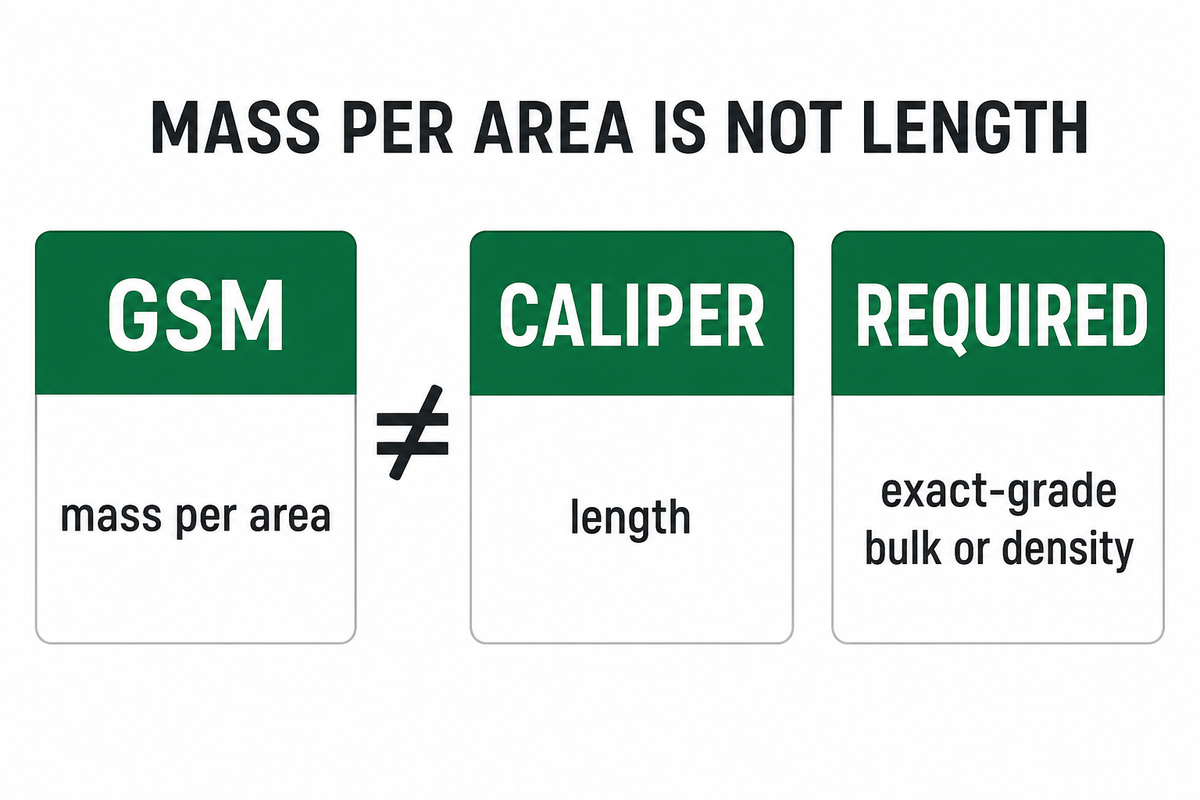
GSM measures mass per area; thickness is a length. NIST Special Publication 811 provides SI quantity and unit guidance, but it cannot turn a mass-per-area value into a universal caliper. Direct GSM-to-mm, point or mil conversion needs an additional material property, usually bulk or density, and it must describe the exact grade. Fiber mix, refining, coating, calendering, moisture and compression can change caliper without changing the nominal grammage.
Two 120 GSM sheets can therefore have different thickness, stiffness, opacity and folding behavior. Heavier paper may be thicker within one controlled product family, but the relationship shouldn’t be transferred to another grade without data.
Does heavier paper always mean thicker paper?
No. Higher GSM means more mass per unit area, not necessarily greater caliper. Ask for the measured thickness of the exact grade and the test condition used. Keep grammage, caliper, stiffness and bulk as separate specification fields. That thickness request remains separate from weight conversion.
Use the conversion for
- comparing qualified text, cover or index basis weights
- checking whether two catalogs describe similar grammage
- creating a traceable purchasing estimate
Do not use it for
- predicting caliper from GSM alone
- selecting stiffness or print performance
- treating a full laminate as facestock-only paper
Which labelstock construction was weighed?
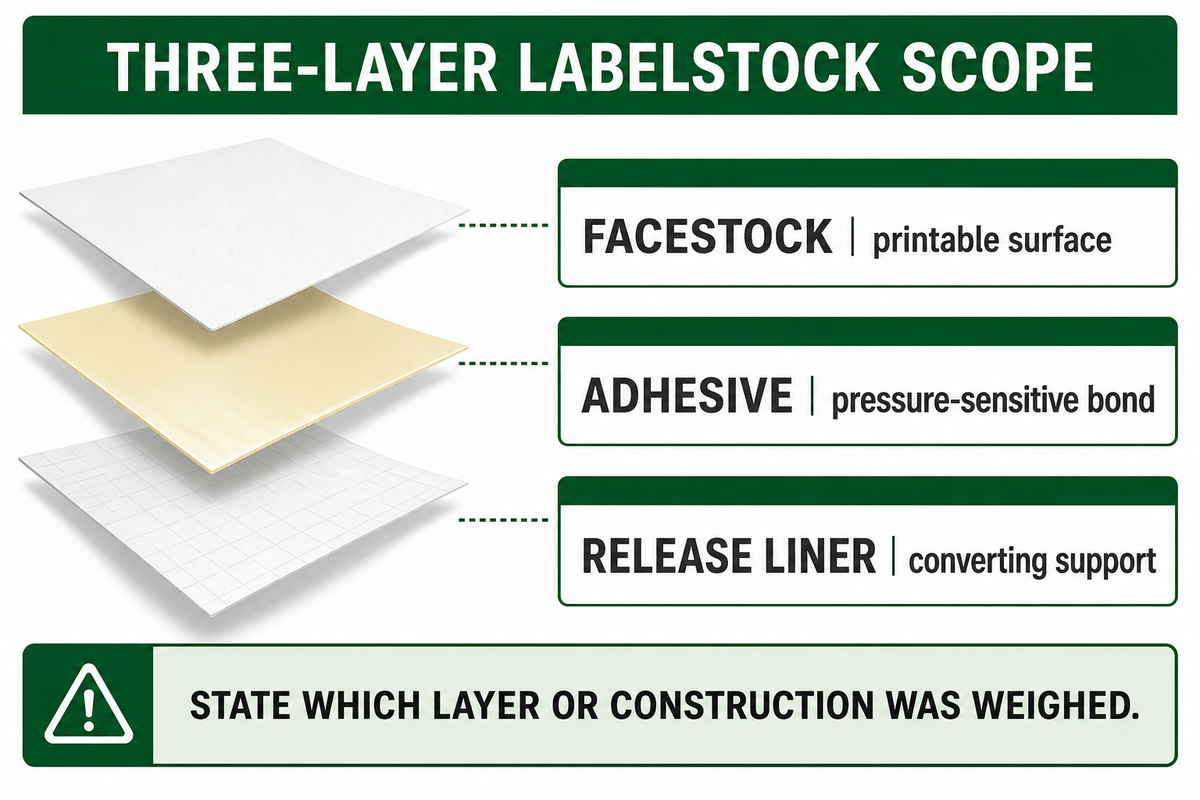
In Guanma’s self-adhesive paper terminology, one construction combines three functional layers: the printable facestock, pressure-sensitive adhesive and release liner. The NIST SI unit framework keeps mass-per-area separate from length, but it doesn’t identify which labelstock layer was weighed. Other suppliers may define or document constructions differently, so the exact product datasheet remains controlling.
This guide uses Facestock-or-Laminate Scope Check as a teaching label for that measurement boundary, not as an industry standard or a Guanma proprietary method. Quoted GSM may refer to facestock only, liner only or the complete laminate. Those values aren’t interchangeable. An 80 GSM facestock can’t be compared directly with a 160 GSM finished construction unless both specifications define what was weighed.
Use Guanma’s paper-construction layer descriptions to check whether a specification covers the facestock, pressure-sensitive adhesive or release liner. That first-party description establishes Guanma’s product terminology; it doesn’t supply universal layer weights. Request the datasheet for the exact construction rather than subtracting assumed adhesive or liner values.
For buyers, the mismatch risk comes from comparing a facestock-only number with a finished-laminate number. Guanma’s three-layer definition provides the scope check; the exact supplier datasheet must still identify which layer or construction was measured.
The seven-field paper specification handoff
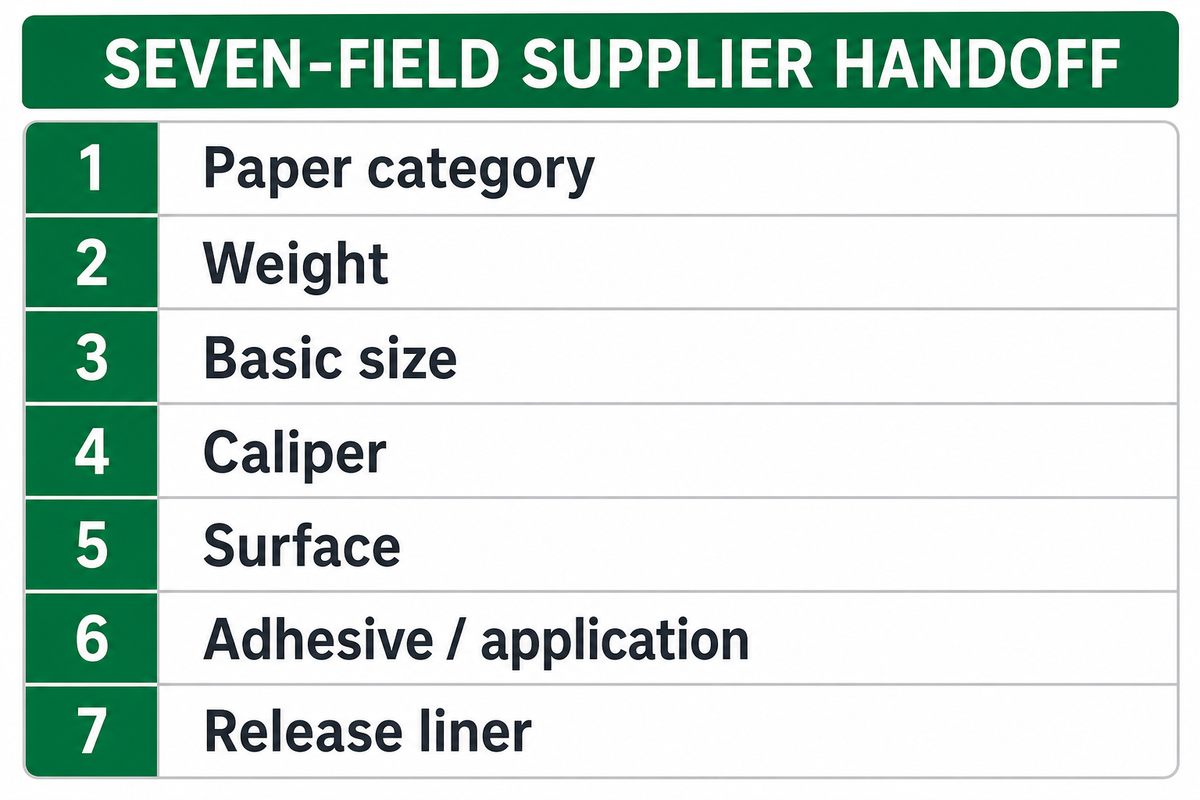
The converted number is a checkpoint, not a complete material specification. Keep the mass-per-area value, following the NIST SI unit framework, separate from caliper and construction scope, then send these fields together so a supplier can compare like with like:
| Field | What to record | Why it matters |
|---|---|---|
| 1. Paper category | text, cover, bond, index, bristol, tag or supplier grade | selects the correct US basis area |
| 2. Weight | declared GSM and/or category-qualified basis lb | keeps the conversion auditable |
| 3. Basic size | width × height used for the US basis convention | allows the formula to be reproduced |
| 4. Caliper | measured or datasheet thickness with unit | prevents GSM from standing in for thickness |
| 5. Surface | coating, finish, print method and appearance requirement | separates weight from print surface |
| 6. Adhesive/application | container surface, temperature and service conditions | connects the facestock to actual use |
| 7. Release liner | liner type, thickness or converting requirement | defines the full pressure-sensitive construction |
For a coated paper example, compare the semi-gloss construction datasheet by its complete specifications, not color or basis weight alone. When purchasing is based on roll area, separate roll-area costing from basis-weight conversion; area doesn’t resolve paper-category conversion.
After the seven fields are stable, send a seven-field paper specification for a material discussion. The conversion checks arithmetic. It doesn’t certify printability, adhesive fit, dispensing performance or finished-label suitability.
Use Guanma’s application hub to match the completed specification to an end-use family before requesting a material match.
Omitting category or caliper creates a mismatch risk even when the converted 80 lb or GSM number is correct. A complete handoff keeps the buyer’s decision tied to the supplier’s exact construction.
Frequently asked questions
How do I convert paper weights from GSM to LBS?
Choose the paper category first, then divide GSM by that category’s GSM-per-lb factor. For example, divide by about 1.480 for text paper or 2.704 for cover. If you know the basic sheet dimensions, invert the full formula. Always write the result as “lb text,” “lb cover” or another qualified category.
What is 80 lb paper in GSM?
The GSM value depends on the paper category. Using the standard basic sizes in this guide, 80 lb text is about 118 GSM, 80 lb cover is about 216 GSM, 80 lb bond is about 301 GSM and 80 lb index is about 145 GSM. Catalog entries that say only “80 lb” lack the information needed for one GSM answer.
How much do 500 sheets of 8.5 × 11 paper weigh?
You need the sheet GSM or a category-qualified basis weight. With GSM, calculate sheet area in square metres, multiply by GSM and then multiply by 500. An 8.5 × 11 inch sheet has an area of about 0.06032 square metre. At 75 GSM, 500 sheets have a theoretical paper mass of about 2.26 kilograms, excluding packaging and normal manufacturing variation.
Is GSM the same as paper thickness?
No. GSM is mass per area; caliper is a length. Papers with the same GSM can have different caliper because fiber structure, coating and compression differ. Use the exact grade’s measured caliper or datasheet rather than inferring thickness from weight.
Which is heavier, 20 lb or 24 lb paper?
Within the same paper category and basis size, 24 lb has a higher basis weight than 20 lb. Across different categories, compare calculated GSM or supplier-declared grammage instead of the pound numbers alone, because the underlying basis areas may differ.
Which paper weight is best for labels?
There’s no universal best weight. Selection depends on print method, dispensing, container shape, stiffness needs, moisture, temperature, adhesive and liner construction. Conformable labels for curved containers and rigid promotional labels can require different facestock behavior even when their GSM numbers look similar. Start with application conditions and the exact construction datasheet, confirm facestock caliper and print surface, then use weight conversion only to reconcile units. Record the trial against the quoted construction. Prototype testing should make the final application decision.
References & Sources
These sources separate exact NIST unit definitions from category-specific paper conventions and Guanma’s own construction terminology. That ownership boundary reduces the risk of treating a supplier claim as an independent standard or carrying an ambiguous basis weight into a buyer’s specification.
- National Institute of Standards and Technology, SI mass-unit relationships
- National Institute of Standards and Technology, SI length-unit relationships
- National Institute of Standards and Technology, Handbook 44 exact pound-to-gram relationship
- National Institute of Standards and Technology, SI units overview
- Neenah Paper, paper basis-weight explanation: https://www.neenahpaper.com/resources/paper-101/basis-weights
- Solo Printing, paper-weight conversion factors: https://www.soloprinting.com/resources/paper-weight-conversions/
- Guanma, self-adhesive paper construction: https://guanmalabel.com/self-adhesive-paper/
WHY WE WRITE THIS
About Guanma
Guanma is a self-adhesive film, label stock, and release liner manufacturer for industrial labeling applications. Our team works with PET film, PP synthetic paper, coated paper, hot-melt PSA, acrylic PSA, water-based adhesive, glassine liner, and CCK release liner.
We write these guides to help label converters, packaging buyers, and industrial procurement teams choose materials by real application conditions instead of generic catalog names. Most label failures come from a mismatch between facestock, adhesive, liner, substrate, temperature, printing method, or end-use environment. Our content explains those decisions in practical terms.
Our Experience
Guanma’s material guidance is based on coating, lamination, slitting, sample validation, and customer troubleshooting experience across Thailand and Vietnam production. We focus on common industrial label problems such as cold-temperature peel, oil and chemical exposure, UV aging, print durability, release force, MOQ, lead time, and substrate-matched testing.
Our Expertise
We reference practical testing logic and recognized label-industry standards, including FINAT FTM peel and shear methods, ASTM peel testing methods, FDA 21 CFR 175.105, REACH, RoHS, FSC, and ISO 9001-related quality control. For custom label stock, we always recommend testing samples on the buyer’s real substrate before full production.
SYS.PROFILE
Visit Website
Contact Profile
Name
Guanma Manufacturing Team
Brand Name
Guanma
Country
Thailand + Vietnam Production
Model
B2B / Wholesale / Custom Coating
Main Products
Self-Adhesive Film, Label Stock, Release Paper & Liner
Contact
Submit RFQ via Website Form
Website
https://guanmalabel.com/