Get in Touch with Guanma

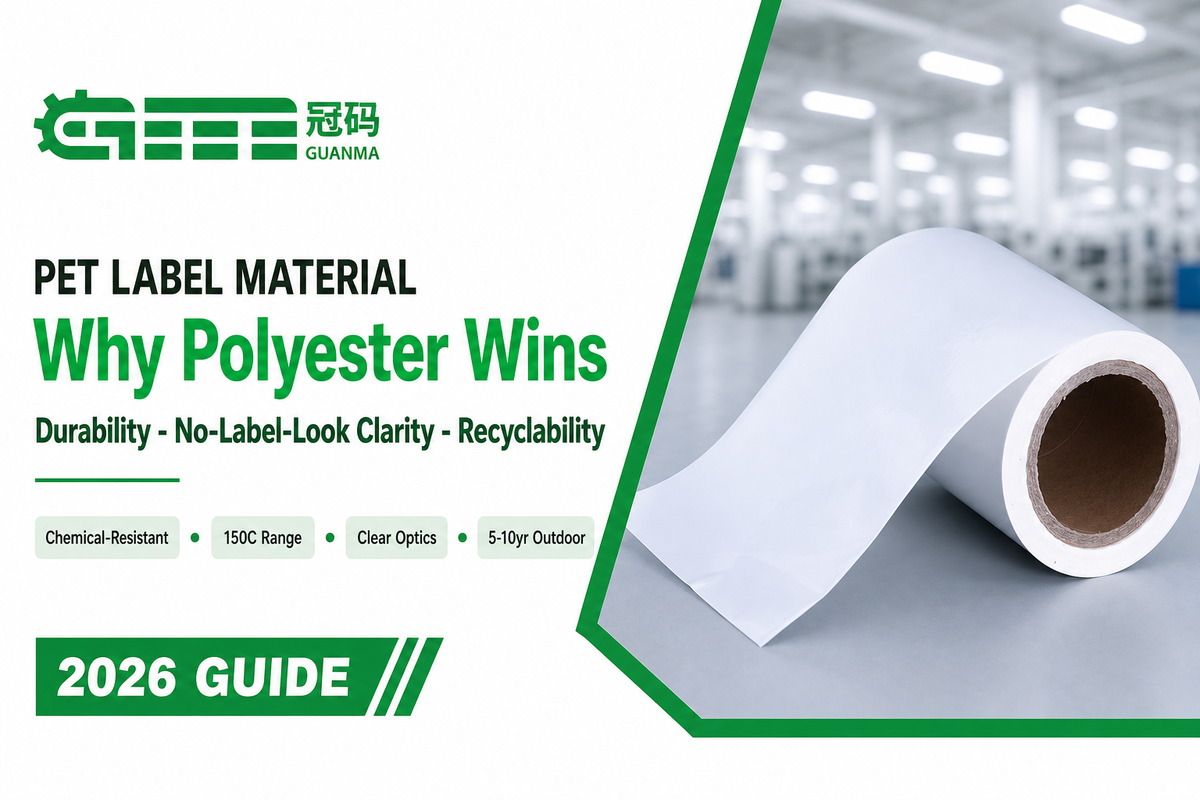
PET label material is a biaxially oriented polyester film facestock that converters spec when paper or vinyl can’t survive the job. The specs below summarize what the rest of this guide backs up with sources.
Quick Specs
| Facestock polymer | PET (polyethylene terephthalate), biaxially oriented film |
| Gauge / thickness range | 0.5 mil to 10 mil |
| Tensile strength (typical) | up to ~550 MPa, construction-dependent |
| Service temperature (short-term, no load) | -70°C to 150°C (vendor-datasheet consensus, see caveats below) |
| Density | 1.35-1.40 g/cm³ |
| Common adhesive pairings | hot-melt acrylic, water-based acrylic, UV-curable acrylic |
| Typical duty life (outdoor/asset tag) | often specified 5-10 years |
| PET-on-PET-bottle recyclability | RecyClass non-compatible unless wash-off adhesive is used |
PET label material is a polyester film facestock built for jobs that paper or vinyl can’t survive: chemical drums, outdoor equipment tags, freezer cartons, or a bottle you want to look like it has no label at all. Since PET facestocks come at a real cost premium over paper and BOPP, the decision to spec PET over its cheaper alternatives must be justified by real data, not just a catchy descriptive term. You need numbers proving what your labels need to survive, not an adjective.
polyester (PET) label material is a biaxially oriented film facestock that has good chemical resistance and an extended, yet temporary, temperature range, and the visual clarity to make clear-on-clear label look good without any of the visible label effect. You’ll pay a higher price for it over other materials, like BOPP and paper, but there’s value in what this material can do that justifies the higher cost.
Key Points
- Is it good for a PET bottle just because they share the same polymer name? It can be if you design your label so the adhesive comes off in the PET wash stage of a recycling facility (according to the RecyClass rating of similar-density PET on PET, these non-wash-off versions are considered non-recyclable).
- While PET has a higher refractive index than BOPP (1.57 vs 1.49) making it more clear, it needs to remain in its amorphous state. This means that the heat from its service environment shouldn’t cause crystallization which makes PET more cloudy.
- It’s worth knowing up front that in the world of label search and marketing terms, the words “PET” (the polymer) and “pet” (the animal) often collide. If you’re briefed a writer, be careful with your phrasing, lest they end up writing about dog biscuits and not chemical drum labels!
- A vendor who touts 150°C as the service temperature is talking about a very brief, load-free burst of activity, not the material functioning in an environment close to its glass transition point (approximately 67°C – 81°C, depending on the specific grade).
- QR-coded PET label is actually a lower-cost alternative to a laser-etched, anodized-aluminum asset tag for indoor, and less demanding, outdoor use.
What Is PET Label Material? (And Why “PET” Isn’t “Pet”)
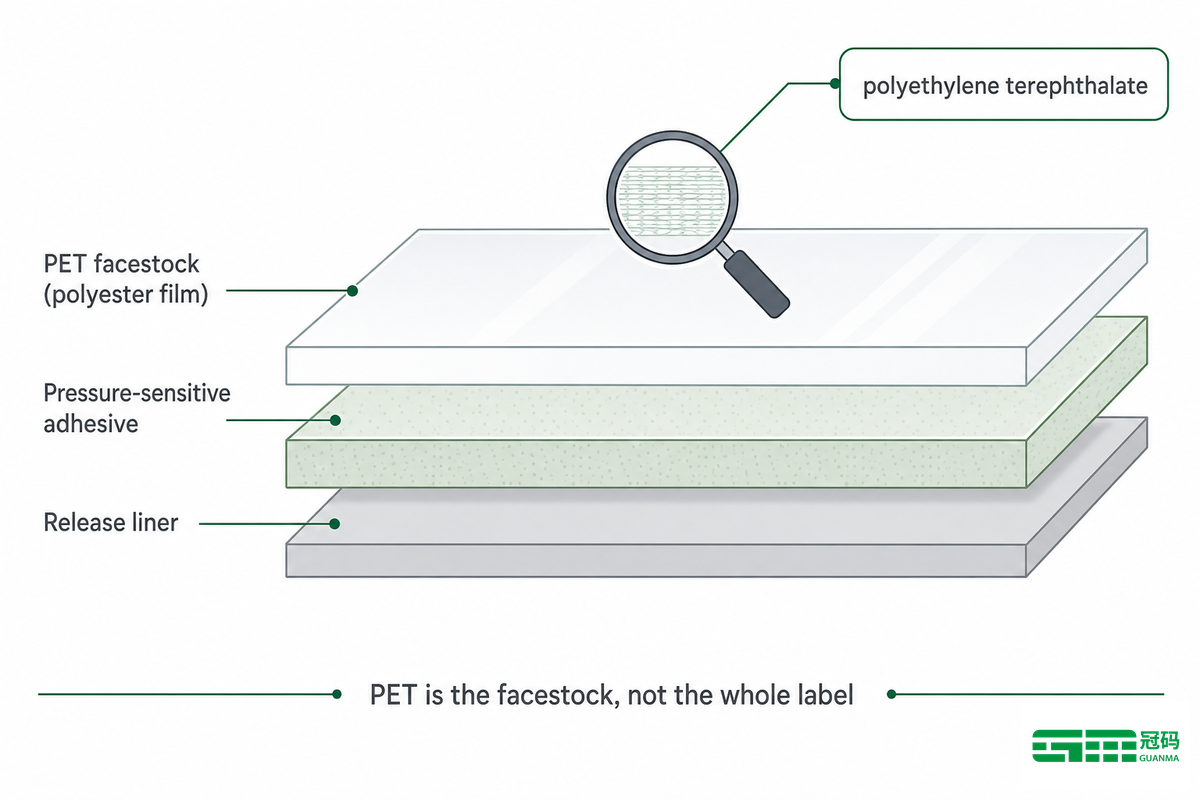
PET label material refers to polyethylene terephthalate, a thermoplastic polyester resin extruded into thin film. As a label facestock, it’s coated with an adhesive and bonded to a release liner — three basic construction layers shared by any label, regardless of which polymer sits on top. It’s the same base polymer studied in peer-reviewed UV-aging research covered later in this guide.
Buyers comparing types of plastic often lump every clear film into one bucket, but PET, BOPP, and PVC behave differently enough that a comparison to PET matters at the material-selection stage, not just at the pricing stage. PET is one of the more common plastic resins used across packaging and labeling, but “common” does not mean interchangeable with every other plastic film on a spec sheet.
Guanma engineers each of those three layers in-house, because a facestock, adhesive, and liner sourced from three different mills rarely bonds as precisely as a stack built and tested together — we cover that construction in detail later in this guide.
Call this The PET/Pet Search Trap — it’s easy to get caught here. The words “PET” (polymer) and “pet” (animal) cross in the most common search engines, as well as many of the AI and other search tools we use these days. Type “PET label material” into Google’s search box, for example, and it’s not unusual to get predictions for dog house pet doors or even address labels for pet owners right along with the film-related predictions. It’s a real consideration for marketers who need their brand and products to reach consumers rather than confuse them. One overseas copywriting mistake we’ve seen more than once: a brief for “PET label material” comes back with dog-and-cat stock photography because the writer never saw the word “polyester” anywhere in the request — an expensive, avoidable mix-up if a supplier is writing its own marketing materials or briefing copywriters who work in a second language.
Is PET the Same as PE?
View Answer
No. PET and PE are not even in the same polymer family. PET is a polyester polymer, while polyethylene (PE) is a polyolefin. PE (a.k.a. polyethylene) has some similar characteristics as polyester, but as a materials science point of view, the performance of PE versus polyester (including rigidity, temperature tolerance, dimensional stability and clarity) is quite different. Some suppliers lump PE and polyester together as simply “plastic film” in their materials guide. If they do, that’s not helping you decide the appropriate material for your labels need; it’s an oversimplification to get to the simplest material choice in their inventory.
How Durable Are PET (Polyester) Labels, Really? Chemical, UV, and Abrasion Data
PET label material is durable because its biaxially oriented polyester structure resists tearing, chemical exposure, and temperature swings better than paper or vinyl — but durability claims often get reduced to an adjective (“extreme,” “hardwearing,” “rugged”) with no number attached anywhere in the spec sheet. Here’s the actual data behind those adjectives, starting with temperature range.
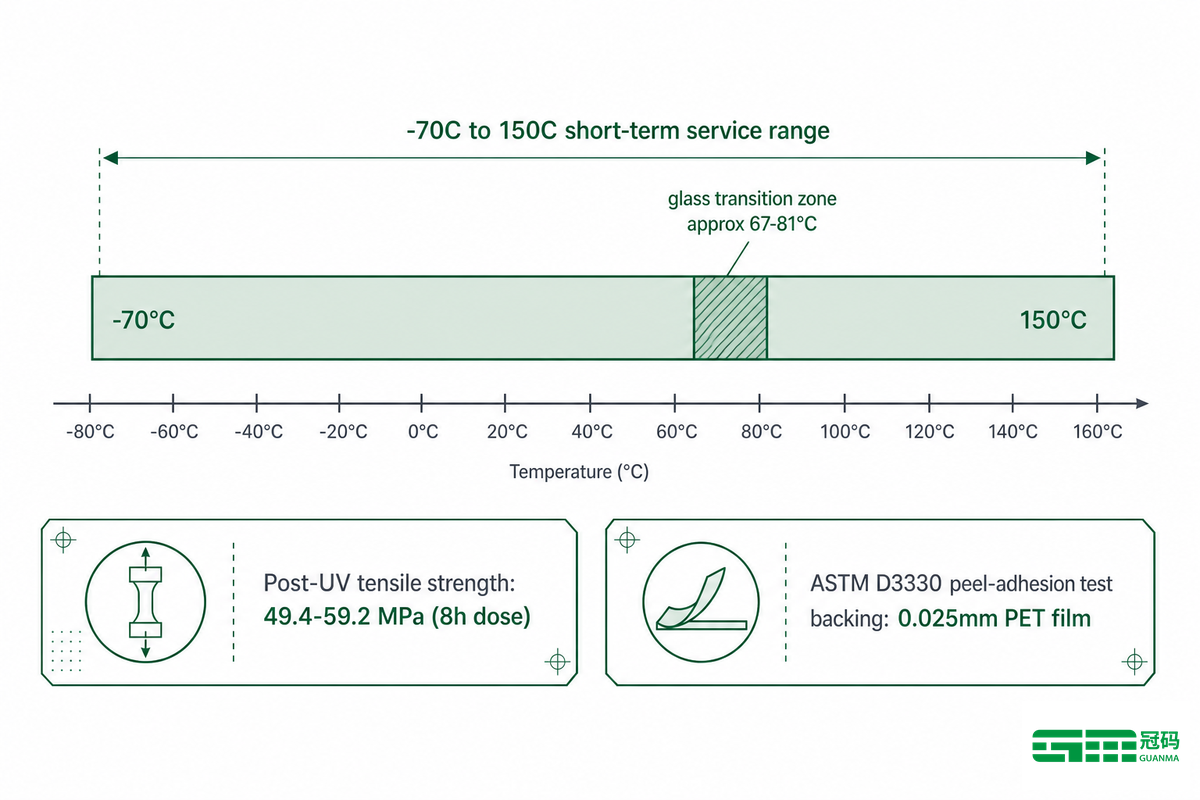
Temperature range. The three most common technical data points converge to define a range of -70°C to 150°C service — a spread wide enough to count as extreme temperatures by most industrial standards — as “general-use PET film,” which, to the uninitiated, sounds good for virtually any application. But that figure represents a brief, unencumbered thermal exposure; PET has a glass transition temperature, when the plastic transitions from a rigid, solid state to a soft, yielding material, of around 67°C to 81°C, which falls on the lower side. Label-grade PET film, however, does perform higher due to its being biaxially oriented, making it somewhat strain-crystallized.
In many applications, that raises its functional service temperature. One vendor has even specified its product in the range of 100°C to 120°C, falling nicely between those references. Bottom line: that “150°C” is great for a quick pass through an oven, or for some limited time at 150°C without load, but not a go-ahead to subject it to constant physical pressure at those temperatures.
UV and weathering. In an independently published accelerated testing study of A-PET film, scientists subjected film to 8 hours of exposure to UV radiation at a dosage rate of 2.45 W/m², measuring its resulting tensile strength. They found that the material’s tensile strength leveled off at about 49.4 MPa for virgin PET and 59.2 MPa for a 50% recycled version (actually stronger, in that case) after the exposure.
However, brittle fracture onset-when the film can break in the initial stages of strain testing-was observed much sooner in the recycled material (1 hour) than in the virgin (4 hours). That’s something for buyers to consider when you hear the refrain that “recycled means weaker”; it might not for tensile strength, but it did for fracture onset in this instance.
Chemical and abrasion resistance. Product datasheets generally list PET film as being chemically resistant, as well as resistant to hydrolysis. We’ve had industry experts in label also corroborate its tear and puncture resistance across temperature ranges. In adhesion testing-using methods defined by ASTM D3330-PET film actually functions as a standard-backing film; two of the six peel adhesion tests in that specification rely on a 0.025 mm PET film for test backing material.
It’s integral to the specification’s definition.
Beyond peel-adhesion testing, buyers ask us for plain-language resistance to chemicals data: PET film’s moisture resistance holds up because the polymer itself doesn’t absorb water the way paper does, so contact with water alone rarely degrades the facestock the way it degrades an uncoated paper stock. That combination of durability and moisture performance is why PET keeps showing up in wash-down and outdoor specs where a paper label would fail within days.
-70°C to 150°C
Short-term service range
49.4-59.2 MPa
Post-UV tensile strength (8h dose)
0.025mm
PET film thickness used inside ASTM D3330 itself
But real-world problems do occur-rarely stemming solely from the facestock film.
One of our customers mentioned in a discussion forum a waterproof label product where the adhesive had delaminated after it was placed in ice and water (and they had done some of the usual preparatory steps, but hadn’t sanded the surface). This highlights that cold/wet environments strain the bond of the adhesive to the substrate more than the film, and PET film durability specs don’t directly translate to the whole label system.
Overall, however, the combination of PET film’s high-temperature dimensional stability, initial tear and puncture resistance and clear optics (hot or cold) is difficult to match in other label facestocks, especially when it serves as an overlaminating film.
— reported from technical materials guidance by Dave Constantine, Technical Service Manager, FLEXcon (via Label & Narrow Web)
Vendors marketing PET film for harsh conditions typically point to two variables: how well it can withstand extreme swings in temperature, and how much cumulative UV light exposure it can take before tensile strength drops. Both are legitimate durability levers, but as the data above shows, high durability claims should always come with a number attached, not just the phrase “durable materials” on a spec sheet.
Why PET Delivers the “No-Label-Look” Clarity Effect
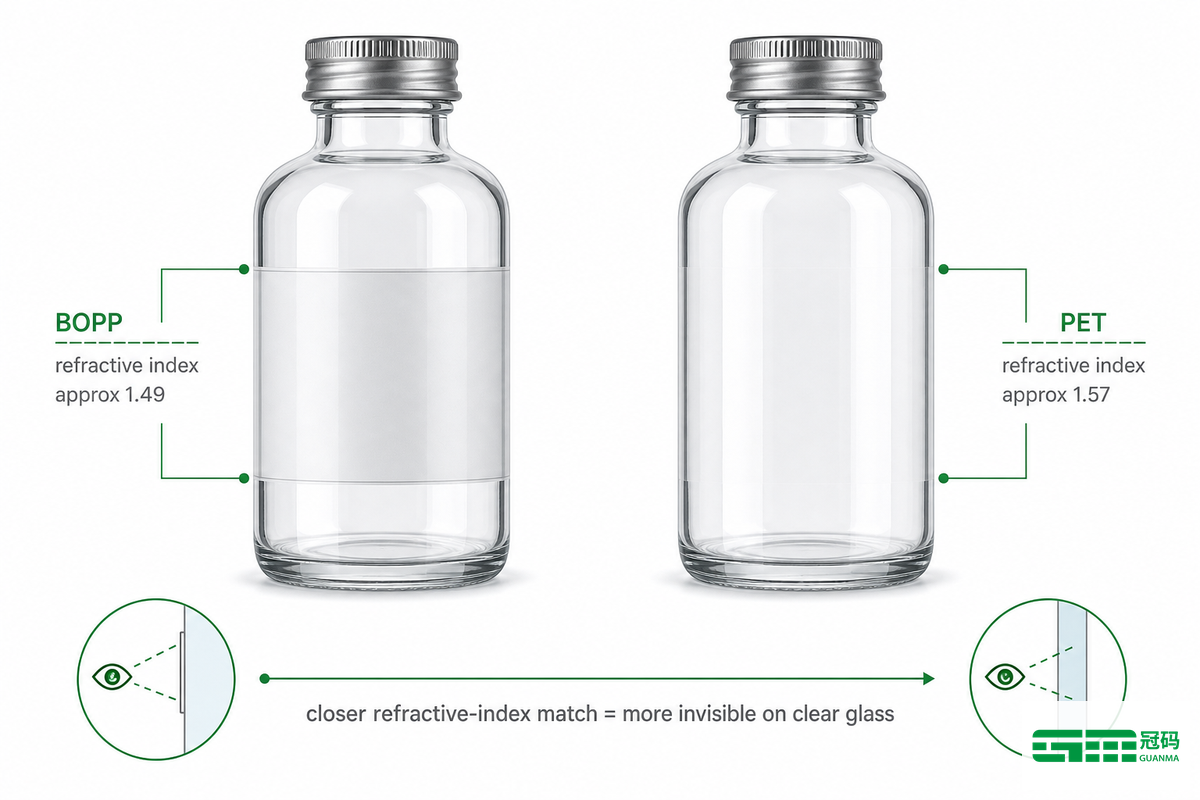
PET delivers the “no-label-look” clarity effect because its refractive index (~1.57) sits closer to glass and rigid clear plastics than BOPP’s (~1.49), so a clear PET label blends into a clear container instead of reading as a separate layer. Both films typically exceed 90% light transmission, but the closer refractive-index match is what makes PET read as more invisible on a clear substrate at equivalent clarity.
What Does “No-Label-Look” Actually Mean?
“No-label-look” means a clear facestock on a clear container such that the label edges and background disappear, and only the printed graphic remains visible — as if the artwork were printed directly onto the glass or plastic rather than applied as a separate label. It’s a real optical effect, not just marketing language.
The caveat: as published materials-science research on this same polymer family notes, polymers don’t necessarily stay amorphous and clear once processed. The same polymer that starts out a crystal-clear film can become semi-crystalline and opaque if the temperature reaches the glass transition point or if the material encounters certain solvents. This is why any “no-label-look” spec requires the assumption of standard processing and chemistry; the label shouldn’t encounter conditions that can induce crystallization.
Comparing Face Stocks: PET vs BOPP vs PVC vs PP vs Paper
Facestock comparison articles almost universally claim PET is “more durable” and BOPP (biaxially oriented polypropylene) is “more economical.” But what do those claims mean in the numbers, illustrated below in The 5-Material Face Stock Index?
The 5-Material Face Stock Index
| Property | PET | BOPP | PVC (vinyl) | Paper |
|---|---|---|---|---|
| Density | 1.35-1.40 g/cm³ | 0.90-0.91 g/cm³ | ~1.2-1.4 g/cm³ | varies by stock |
| Melting point | 250-260°C | 160-170°C | ~100-260°C (grade-dependent) | chars/burns, no melt point |
| Typical facestock thickness | 0.5-10 mil | 2-4 mil | 4-8 mil | 2-4 mil |
| Service temperature (short-term) | -70°C to 150°C | ~-10°C to 100-110°C | -10°C to 90°C | indoor-dry range only |
| Optical clarity / no-label-look | Strongest (refractive index ~1.57) | Good (refractive index ~1.49) | Good, softer/more flexible | Opaque |
| Relative cost | Highest of the four films | Lowest of the four films | Mid, flexibility premium | Lowest overall |
| Chemical/solvent resistance | Strong | Moderate | Moderate-strong | Weak unless laminated |
| Conformability to curved surfaces | Low (stiffest of the four films) | Moderate | High | Low, tears on deep curves |
| Recyclability on a PET container | Non-compatible unless wash-off adhesive used (density matches bottle) | Compatible (density <1 g/cm³, separates by float-sink) | Non-compatible (density >1 g/cm³) | Compatible with fiber-based repulping, not PET float-sink |
One number that warrants a more specific warning than the averages commonly quoted is the tensile strength. There’s conflicting data in secondary sources on which is stronger, PET or BOPP. One comparison, sourced from the Flexible Packaging Association, lists PET’s tensile strength at 40-60% higher than BOPP’s — though a recent facestock-construction patent lists PET alongside HDPE, LDPE, and PP as interchangeable facestock options for a given release system, underscoring that the choice is rarely about one property in isolation; another facestock guide, from a converter, cites PET as lower tensile than BOPP and less rigid. Although the Flexible Packaging Association mention carries weight as a third-party, the claim is still secondary, so it’s best to ask your material supplier for the datasheet value when tensile strength is a primary concern. That said, most sources agree on this: PET offers greater rigidity and dimensional stability than BOPP, so PET is superior for holding registration in high-speed printing applications (one cited source states ~0.075mm) while BOPP’s flexibility makes it better suited for squeeze bottles and contoured shapes.
The simplest way to frame the selection decision is with The Clarity-to-Cost Curve. As optical clarity and temperature resistance improve, so does the cost. Thus, the actual question isn’t “which is best” but “which clarity and temperature range do we really need?” For a deeper head-to-head breakdown of cost payback and environment-by-environment verdicts between just these two films, see our dedicated PET vs BOPP labels comparison guide.
Outdoor Labels: Is PET or PVC Better?
In general, PET provides better high temperature resistance (-70°C to 150°C) and rigidity than PVC (-10°C to 90°C). PVC provides better conformability for applications that involve curves or textured surfaces, whereas PET is preferred for rigid, flat or high-temperature applications such as vehicle graphics and industrial nameplates. There’s no single best material, but the geometry and temperature conditions of your specific application should drive your choice.
Paper deserves its own callout among the different types of label facestock in the table above. Standard paper labels are made of paper — often kraft paper or a coated paper stock — and paper labels are versatile enough to cover the majority of indoor, short-life, ambient-condition applications where clarity and chemical resistance don’t matter. Paper is also generally less expensive than film facestocks like PET or BOPP, which is exactly why it remains one of the most common label materials in retail and light-industrial use.
The tradeoff: paper doesn’t hold up on irregular surfaces with tight curves or repeated flexing the way a film facestock does, and it offers none of the chemical or moisture resistance PET provides. Choosing the right label material — and specifically choosing the right label between paper and film — comes down to matching the substrate and exposure to the facestock, not picking whichever choice for labeling looks cheapest on the price sheet.
✔ PET Advantages
- Widest short-term service temperature range of the common facestocks
- Highest optical clarity and refractive-index match for no-label-look packaging
- Best dimensional stability for high-speed, tight-registration printing
- Strong chemical and solvent resistance for industrial/chemical labeling
⚠ PET Limitations
- Highest cost among the common film facestocks
- Less conformable than BOPP or PVC on flexible/squeezable substrates.
- If adhered to a PET container, the PET face on a label makes recycling difficult unless the adhesive is wash-off compatible (see “Outlook”).
- Heat near glass transition point, or some solvents, may compromise film clarity.
Matching PET Label Material to Your Application
PET’s chemistry and thermal stability make it the obvious choice for circuit-board labels, industrial barcode and asset tags (often combined with resin-based, not wax, thermal-transfer ribbons for solvent resistance), and electrical component labels, where the label must endure industrial and manufacturing processes, as well as the product’s life span.
Beyond those five deep-dive applications linked below, PET label material covers a wide variety of applications: outdoor signage and equipment nameplates designed to withstand sun, rain, and repeated handling; product identification and packaging materials for food and beverage packaging where moisture and refrigeration are constant; and general indoor applications where a film facestock simply outlasts paper. Because PET accepts various printing methods — flexo, digital, and resin thermal-transfer alike — the same facestock can move between all of these use cases without a construction change.
For applications where Guanma already publishes a dedicated deep-dive, this guide funnels there rather than duplicating that depth: chemical-resistant labels for drum and container labeling, freezer labels for cold-chain packaging, tire labels for high-heat rubber-adhesion applications, cable and wire labels for wraparound identification, and beverage and wine labels for the clear, no-label-look use case described above.
Finish and Print-Method Options Across the PET Line
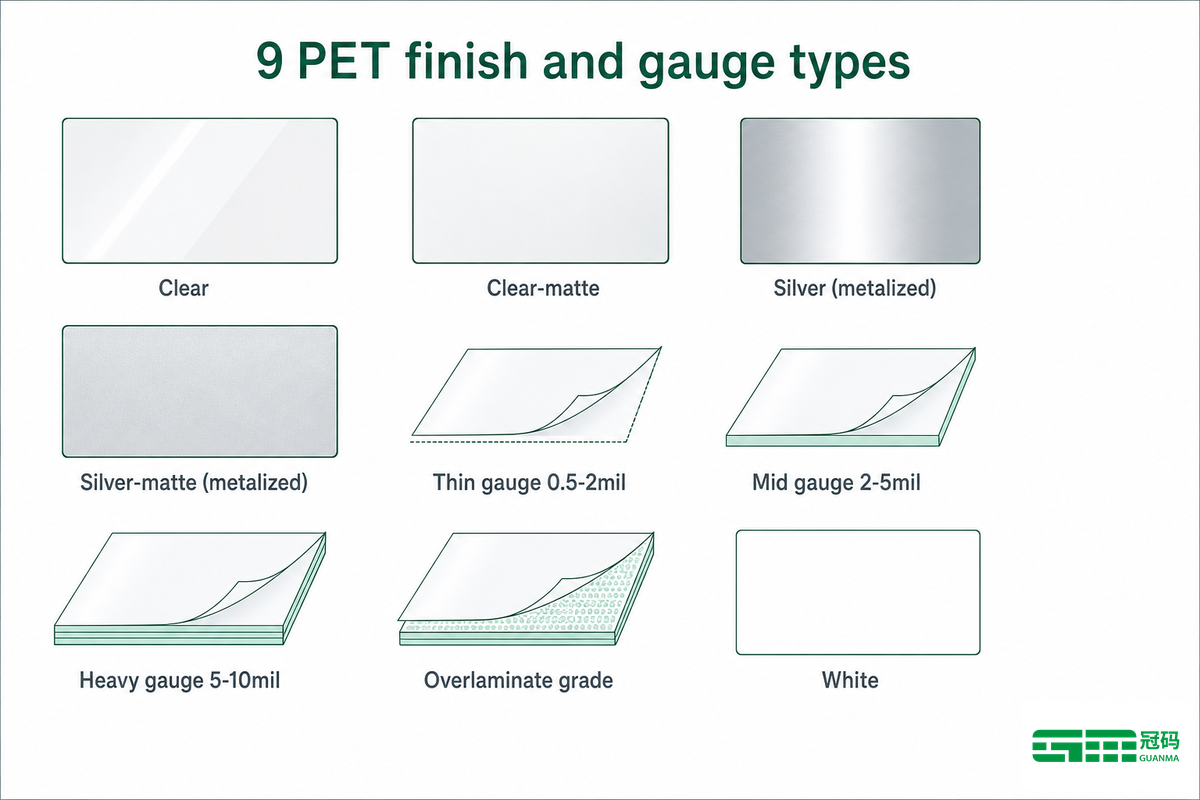
Call it The PET Finish Spectrum: thickness can range from 0.5 mil to 10 mil, with clear, clear-matte, white, silver and silver-matte finishes available, the metallic finishes are actual metalizing, not an ink coating. For print-friendly application, we generally recommend using resin, not wax, thermal-transfer ribbons which cost slightly more than wax-based, but will significantly resist scratch and solvent, keeping barcodes and text legible even after abrasion. Face moisture from condensation or wash-down can also smear a wax-printed barcode long before it affects a resin-printed one.
| Finish Type | Optical Property | Typical Use |
|---|---|---|
| Clear | High transparency | No-label-look packaging |
| Clear-matte | Reduced glare, still see-through | Anti-glare product labels |
| White | Opaque, high print contrast | Standard product labeling |
| Silver (metalized) | Reflective, via vacuum-deposited aluminum | Premium/brand labels, nameplates |
| Silver-matte (metalized) | Muted metallic | Industrial nameplates |
| Thin gauge (0.5-2 mil) | Flexible, lower material cost | High-volume flexible packaging |
| Mid gauge (2-5 mil) | Balanced stiffness/cost | General industrial labeling |
| Heavy gauge (5-10 mil) | Maximum rigidity/durability | Asset tags, equipment nameplates |
| Overlaminate grade | Optimized for print protection + clarity retention | Protective overlaminate over printed labels |
If lower cost or a different substrate is desired for less demanding applications, the BOPP label film option provides some of the key benefits of PET for less money.
Inside a PET Label Roll: Facestock, Adhesive, and Liner Construction
📐 Engineering Note
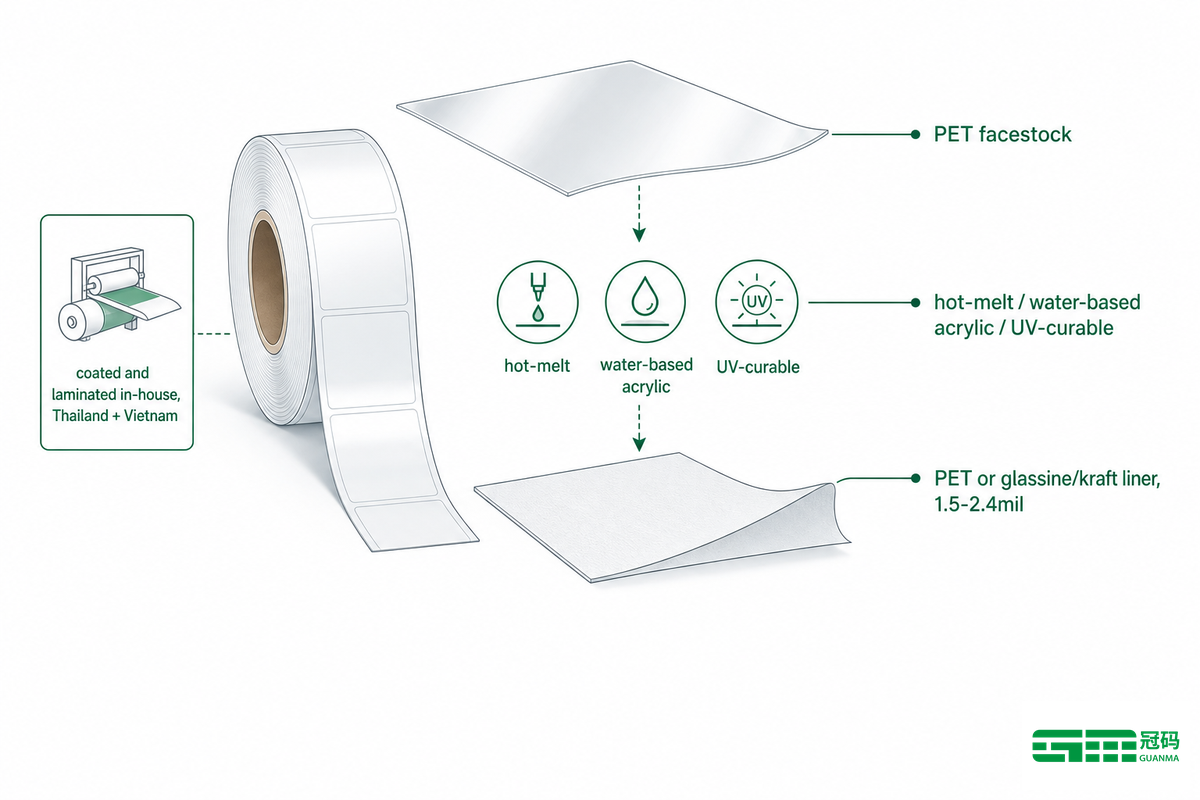
Our standard PET label is a 3-ply construction consisting of a PET face, the adhesives in the middle, and a release liner. This three-layer construct-available with hot-melt, water-based acrylic, or UV-curable adhesive (including our industrial adhesive, permanent adhesive, and a removable version) and a PET or glassine/kraft release liner (in 1.5-2.4mil range)-is manufactured entirely in-house in our Thai and Vietnamese factories. We can tailor this stack of facestock, adhesive and liner to match the requirements of your chemical exposure, temperature, or clarity.
Guanma engineers that stack together rather than sourcing facestock, adhesive, and liner from three separate mills, because a mismatched adhesive-liner pairing is one of the more expensive mistakes we see in the field: a chemical-drum customer once specified a standard permanent adhesive for a solvent-heavy application, and the label lifted within weeks of installation. Matching adhesive chemistry to the actual exposure — not just picking a facestock — is what more than 10 years of in-house coating and laminating experience is built around.
Adhesive labels only perform as well as the label adhesive chosen for the job: our hot-melt systems deliver strong adhesive tack for one-time permanent installs, while our water-based and UV-curable acrylics — including a removable acrylic option — give converters a genuine permanent or removable choice rather than forcing every job onto the same chemistry. Excellent adhesion on a test panel means little if the adhesive was picked for the wrong surface energy or temperature range, which is why durable polyester labels start with an adhesive conversation, not just a facestock choice. Guanma’s polyester labels ship with the adhesive-liner pairing already matched to the customer’s stated exposure, rather than a generic default.
Most of the construction innovation in the near term isn’t in the PET facestock itself but in the liner and adhesive technology. For instance, one patent shows a non-silicone release liner with a microstructured surface (regular pyramid features ~10-80 µm at the base, 25-150 µm high) in lieu of a traditional silicone-coated release liner as a way to simplify construction and improve material use. Another patent by a collaborative academic/industrial group offers a recyclable PET-based liner with a stimuli-responsive tie layer: in testing, the liner’s water contact angle drops from about 108° to 66° after a caustic wash step (similar to the bottle recycling process) to demonstrate a coating that strips cleanly from the PET base without contaminating it – a construction attribute of direct relevance to the recyclability discussion that follows.
Asset Tags and Equipment ID: An Underused Fit for PET Labels
A QR-coded PET label is often the low-cost option to identify indoor equipment or light-outdoor use where an anodized-aluminum asset tag may seem more appropriate-but doesn’t need to be-as the former is easily scanned with any smart phone, and withstands the rigors of normal indoor use, cleaning, and wear. Anodized aluminum holds up best under the real industrial-outdoor conditions for which it earns its higher price (e.g., weather resistance and the extreme durability associated with decades-old industrial and military anodized-aluminum tags). But it’s also often overkill for a vast array of equipment that lives indoor and rarely, if ever, encounters such harsh exposure and will likely be decommissioned long before an anodized tag would fail (while having the potential to survive multiple lives).
This is a comparison that the majority of label-industry articles fail to mention, even though such asset identification applications are precisely where most of the complex compliance coding associated with pressure-sensitive labeling finds itself (typically referring to codes like UL969, MIL-STD-202, CSA C22.2, although such references should never be taken at face value and users should inquire further into test methods and criteria). Government equipment-marking specifications add another layer worth knowing: MIL-STD-130, the U.S. Department of Defense’s identification-marking standard, defines item-marking criteria and machine-readable data content for government property — a useful benchmark for how rigorous asset-ID marking can get, even for buyers who will never touch a DoD contract.
Many asset-ID programs also specify tamper-evident constructions — a label that fractures or leaves a void pattern if peeled — to flag unauthorized removal, plus RoHS-compliant adhesive and ink chemistry to keep the label legal for electronics and industrial equipment sold into regulated markets.
💡 Pro Tip
match your label’s application exposure to your labeling material – an indoor computer, for instance, hardly warrants an anodized-aluminum tag, while an outdoor transformer nameplate cannot use a basic PET label and is far better off with an appropriately rated adhesive and a durable finish.
Outlook for PET Label Material: Recyclability Rules Are Changing What “Durable” Means
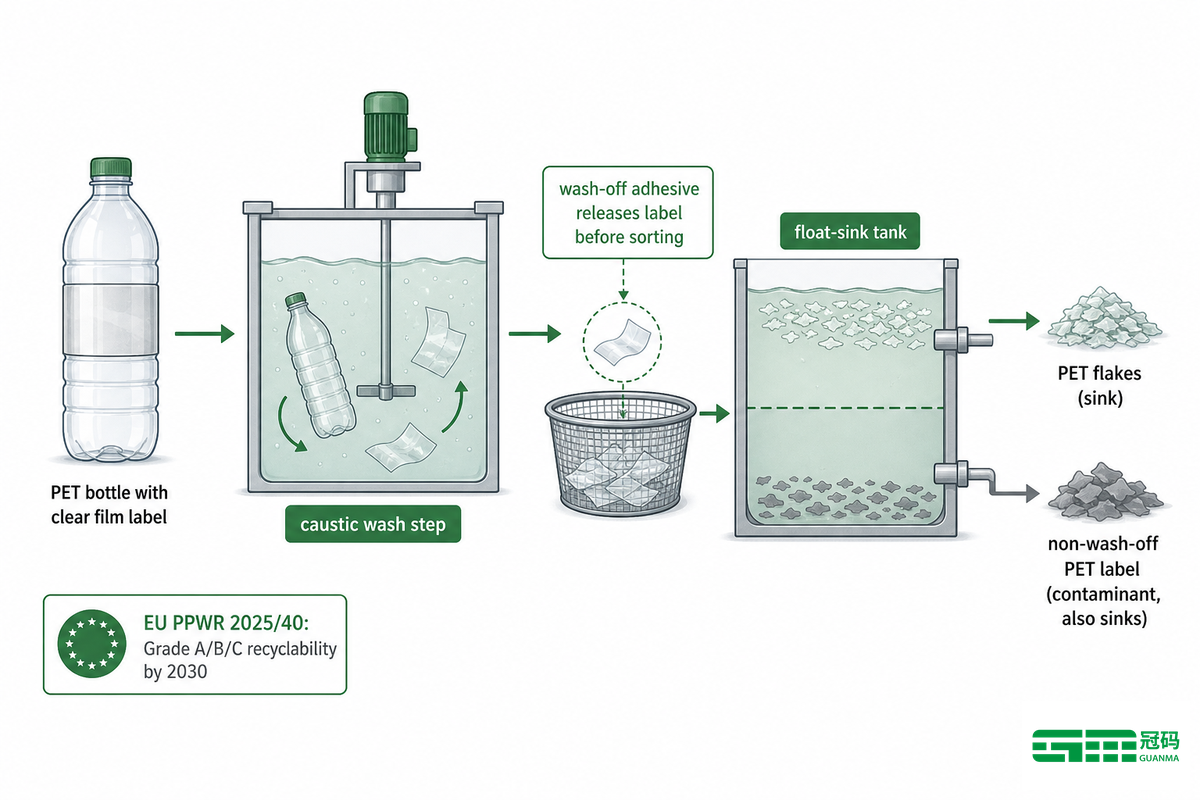
2025 will prove a year where regulations begin to redefine what’s considered “durable” and “sustainable” in both PET label material and their construction counterparts, as the EU’s Packaging and Packaging Waste Regulation (Regulation (EU) 2025/40), now in force, mandates by 2030 that packaging sold into EU markets be designed for recycling at scale, graded A (95 percent or more recyclable), B (80 percent or more), or C (70 percent or more) — anything below Grade C won’t be legally sellable in the EU from 2030 onward. By 2030, all PET packaging sold in the EU will also have to contain at least 30 percent recycled material, increasing to 50 percent by 2040 (with components comprising less than five percent of total package weight – like pressure-sensitive labels, typically labels – being exempt from the recycled content mandate).
This is the point most buyers, who hear “PET is recyclable” and think that solves the sustainability problem of a PET label, don’t realize: It doesn’t. Industry guidelines for recyclability of clear PET bottles describe facestock labels with densities greater than 1 g/cm³, a group that includes the 1.35-1.40 g/cm³ density of PET itself, as well as materials like PVC and PETG, as “non-compatible” with standard PET bottle recycling. It’s easy to see once someone explains it: PET bottle recycling relies on a float-sink process where sorted materials are separated based on density; a PET-density label wouldn’t be sorted out of the PET-density bottle but could instead ride along into the recycled PET flake, reducing the purity of the recycled material. That’s precisely the contamination issue wash-off adhesive systems (also known by brand names like CleanFlake) were developed to solve: they enable the label to be released from the bottle during the caustic wash step in the recycling process, before any density-sorting occurs, rather than relying on a density difference to pull it apart. It’s estimated that as many as 560 million PET bottles were discarded each year because of incompatible label materials, prior to the widespread adoption of wash-off adhesive systems, according to label-industry trade publications.
So what does that mean when you’re making a purchase decision in 2026-2027? If your PET-labeled product comes in a PET package and anyone on your supply chain comes into contact with the EU market, “PET label” and “recyclable label” aren’t the same thing, and a supplier unable to discuss wash-off adhesive compatibility or a relevant recycling test method (the most referenced one here’s FINAT FTM 26, which is a wash-off compatibility test for label systems on both glass and PET streams) isn’t giving you the full story. Although the deadline is 2030, the delegated acts that will define the precise design-for-recyclability criteria for packages sold in the EU aren’t expected until January 2028. That means the time to design your package and choose the right label is now. The total global label market is expected to grow from about $47 billion in 2025 to nearly $64 billion in 2031, with PET-based label film noted as one of the fastest-growing segments within the market. These market numbers are context only.
Related Articles
- Self-Adhesive Film Guide — how PET fits alongside other film facestocks in the broader materials-selection picture
- BOPP Label Film Guide — the lower-cost film alternative to PET
- Durable Labels: What Actually Makes a Label Last — durability factors across facestock and adhesive families, not PET-specific
- CCK Release Paper Guide — the liner side of the construction discussed in this guide
- Label Stock Buying Guide — a broader procurement-focused view of label stock selection
Q: Is PET label material food-safe?
View Answer
For food-contact applications, only certain grades of PET and specific adhesive systems qualify. As is true with most materials and chemicals, not all types of PET are suitable for food-contact packaging or processing. Food-contact buyers using label materials that come into contact with food-whether directly or indirectly-must ask for the specific food-contact approval certification (for example, a U.S. FDA or equivalent regional certification) from the supplier for the exact combination of label material facestock and adhesive technology they are purchasing. Don’t assume it will be OK because some PET is approved.
Q: How is PET label material recycled?
View Answer
PET film alone is recyclable through standard PET streams. When used as a label on a PET bottle, however, it only recycles cleanly if the adhesive is designed to separate out during the wash step, prior to the float-sink density-based sorting: because a PET-density label will not float/sink apart from a PET-density bottle in density alone. (There are systems for washing out adhesive, see “Outlook,” and industry standard FINAT FTM 26 tests this property).
Q: Do PET labels cost more than paper labels?
View Answer
On a per-unit basis, the facestock is generally more expensive than paper, and buying based purely on price can miss the total-cost picture. In fact, several industrial-label manufacturers have found that trying to save per-label by buying on price only when a chemical or moisture resistant facestock like paper labels is required actually shifts costs into re-labeling, downtime, and warranty returns that exceed the initial savings. You have to look at the cost for the intended use and exposure.
Q: Can PET labels handle direct sunlight for years?
View Answer
The facestock, usually. Multi-year outdoor use often stresses the adhesive and printing before it stresses the PET film itself.
Q: What’s the difference between PET and BOPP labels?
View Answer
The main difference is density (1.35-1.40 g/cm³ for PET versus 0.90-0.91 g/cm³ for BOPP). PET also has a significantly higher melting point (250-260 °C versus 160-170 °C) and offers superior print clarity on clear bottles because it has a higher refractive index (~1.57 versus ~1.49). However, BOPP is more flexible, more affordable, and more suitable for squeezable and curved bottles. Refer to the full comparison chart earlier in this guide.
Q: Is PET label material waterproof?
View Answer
The PET film itself resists water. A claim of being waterproof, however, implies that the adhesive and the liner system will hold up to the same environment. I recently read an industry forum posting about a weatherproof label failing when exposed to a cycling of water and ice, which indicates it was a adhesive- and construction problem rather than solely a facestock problem. Inquire about the overall rating of the construction rather than the facestock polymer.
Why We Write This
As we coat and laminate PET, BOPP, and synthetic-paper facestocks against water-based acrylic, UV-curable, and hot-melt adhesive systems at our Thai and Vietnamese facilities, many of the same construction questions that our customers ask are contained within this guide. Likewise, the recycling details covered in the Outlook section come from discussions we’re having with our converters who supply products for the European Union.
References & Sources
- Degradation of Mechanical Properties of A-PET Films after UV Aging — Polymers journal, PubMed Central (National Institutes of Health)
- ASTM D3330 Standard Test Method for Peel Adhesion of Pressure-Sensitive Tape — American National Standards Institute
- Packaging and Packaging Waste Regulation (EU) 2025/40 — European Commission
- Design for Recycling Guidelines: Transparent Clear & Light-Blue PET Bottles — RecyClass
- New EU Packaging and Packaging Waste Regulation: Highlights and Challenges Ahead — Kelley Drye & Warren LLP
- Pressure-Sensitive Labels: Facestock Materials — Label Academy, Labels & Labeling
- Identifying the Best Film for Your Label Application — Label & Narrow Web
- US20240352286A1: Layered Constructions with Removable Layers — Boise State University, USPTO/Google Patents
- WO2025074306A1: Adhesive Article with Patterned Microstructure Release — Avery Dennison Corp, WIPO/Google Patents
- Pressure-Sensitive Labels Compatible with PET Recycling Process — PackWorld
- MIL-STD-130: Identification Marking of U.S. Military Property — U.S. Department of Defense, DLA ASSIST-QuickSearch