Get in Touch with Guanma

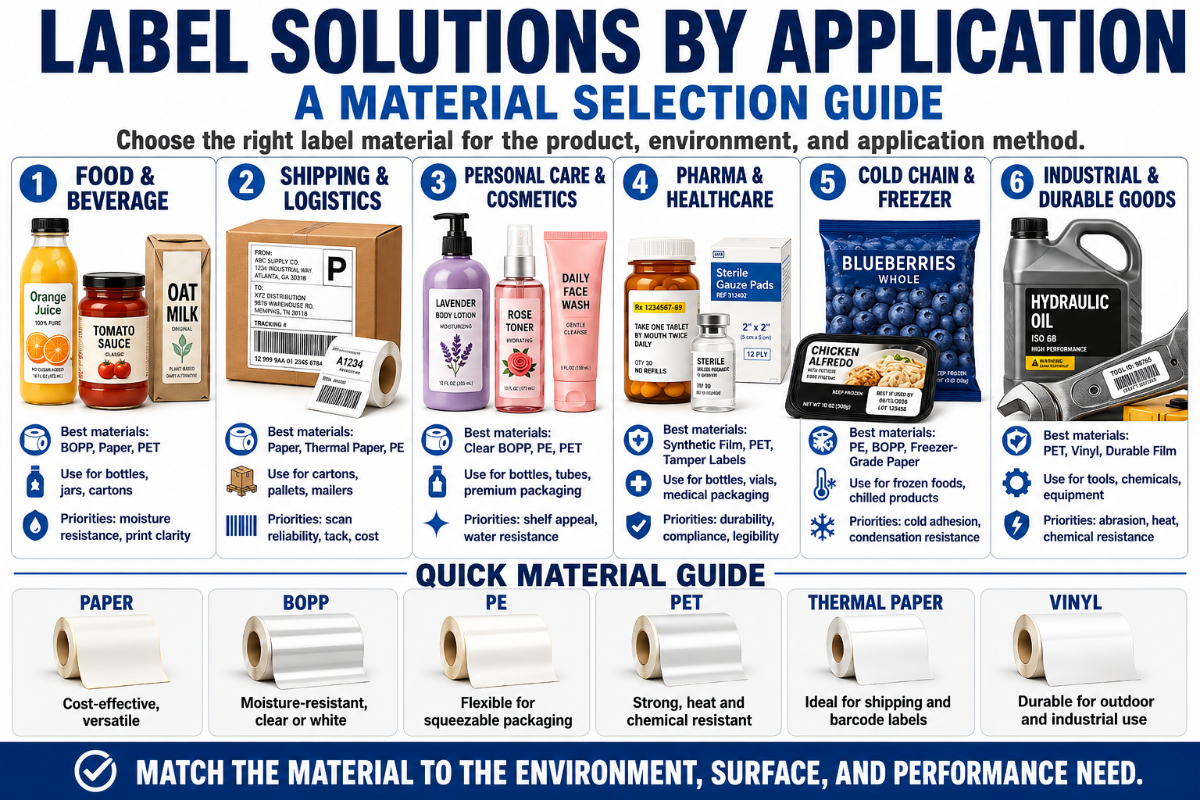
Choose Label Solutions by Application. It’s 3 ingredients- facestock, adhesive and release liner- that must meet the unique surface, environment, press and regulatory demands of your product. When it’s the perfect fit, it will hold to a freezer, a chemical drum or the face of a tire; fail, and it will peel. This guide explains a proven method to match it all, by where the label has to do its job.
It’s designed to work as a shopping list for our application-specific label solutions — that page shows what we supply; this guide tells you which is best for the job. Whether it’s ordering product labeling for your online shop or applying a label to a container that might get sprayed down in a chemical plant, the logic applies.
Quick Specs: The Label Selection Snapshot
| Decision layers | Facestock + adhesive + release liner (decide in that order) |
| 4 inputs that drive the choice | Surface · Environment · Print method · Regulation |
| Freezer-grade adhesive | Applies down to roughly −15°F surface; services to about −65°F |
| Chemical drum (ocean freight) | GHS + BS5609 (3-month seawater immersion) |
| No.1 field failure trigger | Surface contamination & low-energy/cold surfaces — not adhesive quality |
The Three Layers Behind Every Label Solution
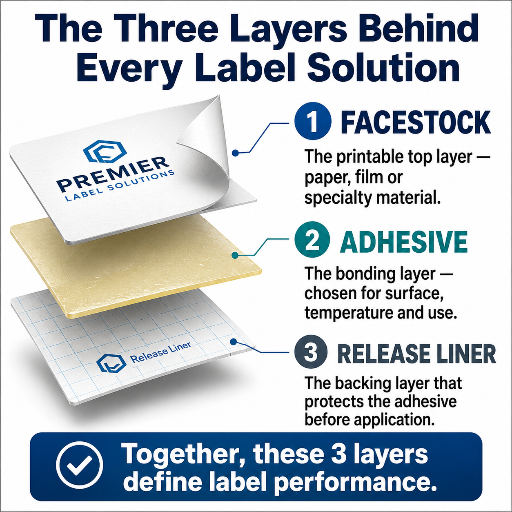
Every application label has three, equally important, components. If even one isn’t for the job, the application fails. Think of the material selection in this order – first face, then adhesive, then liner – because each step narrows your choice for the next.
- Facestock — the printable top layer; coated paper, synthetic (PP or PET), or BOPP. It dictates appearance, tear and chemical resistance, and temperature tolerance.
- Adhesive — permanent, removable, freezer-grade, or high-tack. It determines whether the label adheres to your surface, at your temperature.
- Release liner — paper or film such as PET. It decides whether your applicator dispenses smoothly and accurately. Too many buyers forget the liner until labels jam.
These three elements – the base face (facestock), underlay (adhesive) and backing material – haven’t changed in decades as, if you go way back, label material patents have described exactly this facestock-adhesive-liner construction. However, what changes from job to job is the combination. A beverage label may be printed on a smooth, coated paper face with adhesive backing that’s permanent on a glassine liner. Alternatively, the same sticker components, applied to a plastic bottle, might be made from plastic in the place of coated paper, with specialized freezer-grade adhesive backing, all delivered to you on an equally plastic liner for improved performance in cold storage and transportation.
Ultimately, what we mean is that you are making three selections in order rather than “a label” that, through our simple questionnaire below, results in selection and quotation of one specific and correct construction based on the four answers below.
The 4-Question Label-Matching Framework
Nine out of 10 mis-spec’d labels occur due to skipping at least one of the below questions in order. Give the same sticker material a try against these questions, and the answer appears. We’ve named it the 4-Question Label-Matching Framework, and we run it on every application-specific material we quote.
The 4 Questions (answer in order)
- Surface.What surface is the labels being applied to? The surface of smooth glass and PET film have much less affinity for adhesive than low-surface-energy substrates like an oily plastic drum, a rough, powder-coated panel or round plastic packaging. This requires high tack, low surface energy (LSE) specific or aggressive adhesive options.
- Environment.What will the labels and substrate face after the labels are applied? High temperatures, fluctuations in temps, UV light, abrasion or the introduction of oils and chemicals can disqualify some faces and adhesive options.
- Print method. Thermal transfer, direct thermal, digital, or inkjet? The facestock and topcoat must match the press, or the print rubs off or won’t scan.
- Regulation. Does a standard define the label? Chemical, food-contact, pharmaceutical, marine, and recyclability rules can override your material preference entirely (covered in the by-industry section).
That order matters: regulation can veto a “better-performing” material (a film overlaminate that boosts durability may undermine a recyclability claim), so it sits last as a gate, not first as an afterthought. Work surface environment print regulation, and you rarely reach the quote stage with the wrong stock.
Self-adhesive face stock options exist for every branch of this tree.
Facestock by Application: Paper vs PP vs PET
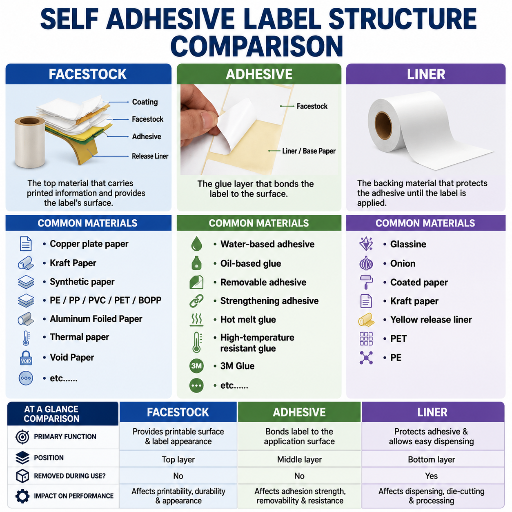
Facestock is the first fork. Paper still holds the largest share of the self-adhesive label market – roughly 63.7% in 2025 – because most labels live indoors, on clean surfaces, for a short life.
Films (PP, PET, BOPP) grow fastest where paper physically can’t survive: cold-chain, chemical, and outdoor uses.
What are the main label material families?
There are four practical facestock families, and matching them to use case is most of the battle. Coated paper covers everyday indoor labeling; PP synthetic paper adds moisture and tear resistance for squeeze bottles and washdown zones; PET handles heat, chemicals, and asset tags that must last years; BOPP is the workhorse film for beverage and personal-care containers that see condensation. For personal-care projects, private label cosmetics from NEXO Beauty Labs can be considered at the product-development stage, with formula and pack compatibility assessed separately from facestock selection.
| Facestock | Best for | Moisture / temp | Relative cost |
|---|---|---|---|
| Coated paper | Indoor, dry, short-life, high-volume | Low / ambient | $ (lowest) |
| PP synthetic paper | Squeeze bottles, washdown, removable | Good / moderate | $$ |
| PET | Chemical, asset tags, high heat, track & trace | Excellent / high | $$$ |
| BOPP film | Beverage, cosmetics, condensation, peel/reseal | Excellent / moderate | $$ |
Industry material guides describe synthetic papers and films as resistant to water, chemicals, and tearing while tolerating extreme temperatures – which is why they dominate chemical-container and medical labeling. Material-science facestock patents document film blends — for example LLDPE with cyclic-olefin copolymer — engineered for that flexibility-and-stiffness balance. But “more durable” is not the same as “right,” which is the most expensive mistake in this whole guide – see the contrarian note below.
⚠️ Contrarian: film is often over-specified
For controlled indoor environments, coated paper – sometimes with a thin overlaminate against incidental moisture – does the job at a fraction of film’s cost.
Buyers default to film “to be safe” and pay a premium for durability the application never demands. One caveat now matters more than it used to: if you make a recyclability claim, an overlaminate or film component can undercut it (see the 2026 shifts section), so weigh durability against claim language before defaulting either way.
Adhesive by Application: Permanent, Removable, Freezer-Grade & High-Tack
Adhesive choice is where most “the label fell off” complaints actually live.
The single most useful concept here is that an adhesive has two temperatures, not one – and confusing them causes labels to never bond in the first place.
📐 Engineering Note: minimum application temperature ≠ service temperature
Minimum application temperature is the coldest the surface can be at the moment of application and still let the adhesive wet out and grab. Service temperature is the range the label survives after it has bonded and cured (typically 24 hours).
A freezer-grade hot-melt is commonly specified to apply at around −15°F yet service down to roughly −65°F; an all-temperature acrylic applies down to about −29°C. Apply a freezer label to a frosted surface below its application minimum and it will fail no matter how cold-rated its service range is.
| Adhesive class | Use it when | Watch out for |
|---|---|---|
| Permanent acrylic | Long life, UV/chemical exposure, outdoor | Hard to reposition; slower initial tack |
| Removable | Promotions, returnable assets, temporary ID | Can lift early on textured/cold surfaces |
| Freezer-grade (hot-melt or acrylic) | Cold-chain, frozen food, applied in the cold | Respect the application-temp minimum |
| High-tack / LSE | HDPE/PP drums, powder coat, recycled corrugate | Often permanent only; verify on your substrate |
How well a label sticks isn’t an opinion, it’s a test: ASTM D3330 defines peel testing for pressure-sensitive stock on a standard stainless-steel panel with 300mm/minute peel speed after 24 hours’ conditioning. If your supplier offers a peel number, ask which method A through F-as well as the substrate-they used. Numbers only compare against the same standard.
Durable & Harsh-Environment Labels: Abrasion, UV, Moisture & Chemicals
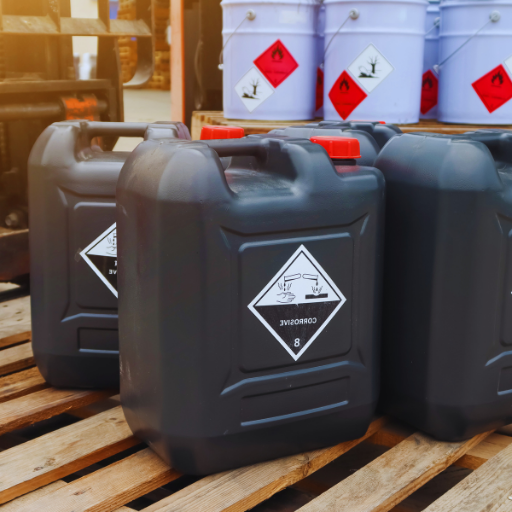
“Durable labels” covers a lot of ground. A label that resists UV rays may wash off in solvent; one that withstands chemical splashes could abrasion away on a tumbling part. First, know your threat, then know your build.
✔ When film + acrylic + topcoat earns its cost
- Outdoor / UV exposure for years
- Chemical drums, solvents, oils
- Washdown, immersion, condensation
- Abrasion from handling or tumbling
⚠ Where “durable” is over-built
- Indoor cartons handled once
- Short-life promotional SKUs
- Dry storage with no UV or moisture
Labels on chemical containers that travel the sea can’t have durability as an option, they have to be able to prove it. The IMDG Code dictates dangerous-goods labels must be “legible” after 3 months in seawater. It specifically points to BS5609, which breaks into three parts that test the base stock (Part 2) and printing (Part 3) against saltwater, UV, and abrasion.
There’s a limit to what a face alone can do: safety and equipment labels get evaluated against final-application standards, not facestock-only criteria. UL 969 evaluates not just the label but the full system of adhesive, substrate, surface, and exposure for its intended use — so a tough facestock approved for one product is not automatically approved on another.
Consider a drum of industrial solvent shipped from Rotterdam to Houston. To shave a few cents per unit, the producer specified a coated-paper GHS label. Three weeks into the ocean leg, salt spray and condensation had pulped the label edges; on arrival the hazard pictogram was illegible and the container was held at the dock. A PET facestock with an aggressive acrylic adhesive and a protective topcoat — a BS5609-rated build — would have added a small premium and cleared customs without a second look. The reprint, the demurrage, and the re-inspection cost many times what the upgrade ever would.
Labels by Industry: Tire, Cable, Pharmaceutical, Food, Beverage & Chemical
This is where “application-specific” labeling gets really precise. Typically each industry throws in one or two rules that shape the label more than the material – often a regulatory requirement, a machine identifier, or a specialized testing method. Find your category, then apply a material designed for its standard.
| Application | Typical construction | The defining rule |
|---|---|---|
| Tire | PE/PP film + high-tack, heat-tolerant adhesive | NHTSA UTQG grades (treadwear/traction/temperature) |
| Cable & wire | Self-laminating PET/vinyl, flexible | Wraps small diameters; legible after handling |
| Pharmaceutical | Paper/film + permanent; tamper-evident option | Machine-readable ID: FDA UDI / drug barcode, GS1, NDC |
| Food packaging | Paper/BOPP + food-safe adhesive | FDA 21 CFR 175.105 (indirect) vs 175.125 (direct PSA) |
| Beverage & wine | BOPP / wet-strength paper + condensation-rated adhesive | Ice-bucket immersion, no edge curl |
| Chemical (drum/IBC) | PET/PP + aggressive acrylic + topcoat | OSHA GHS pictograms; BS5609 if ocean-freighted |
Two regulatory differences frequently surprise buyers: First, two-tier food contact: food items are divided, based on whether the label’s adhesive will likely make direct contact with food (21 CFR 175.125) or not (21 CFR 175.105) which are fundamentally different regulatory frameworks. Second, the hazard communication standard is nonnegotiable: you can’t get a chemical container past the dock and to customers without its labeling compliant with global (GHS) standards in terms of pictograms, signal words, and statements of hazard. The challenge for pharma and device labeling is often twofold-durability is only one, identification is the other. Medical supply chain will increasingly look for compliant FDA UDI, GS1 data carriers, and NDC identification.
Print-Method Compatibility: Thermal Transfer, Direct Thermal, Digital & Inkjet
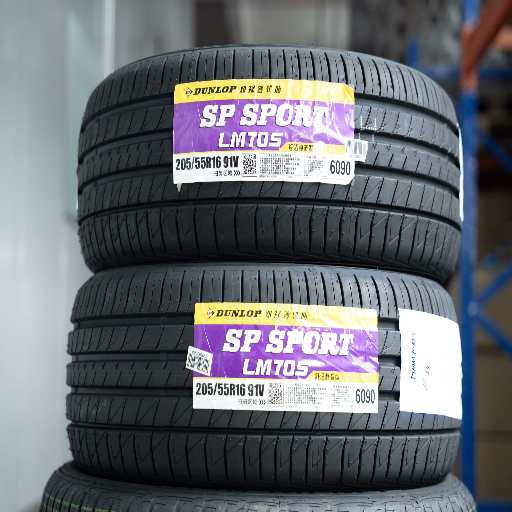
A great facestock and an adhesive to match will do no good if the label won’t print or if the printing can’t be machine read. The method you plan to use to print the labels may well constrain your selection as much as environmental factors do.
Do I need a topcoat for thermal transfer printing?
Usually yes. Printing via direct thermal or thermal transfer melts image to the label, and that image requires topcoat or a receptive face to adhere it firmly; print rubs off and does not scan without a good anchoring base. Direct thermal printing (DT) uses no ribbon (heat-sensitive paper) and is reserved for shorter-lifespan labels, because the image fades with heat and light. Choosing ribbons can also matter, for best compatibility wax can be used with most papers, a wax/resin blend is suitable with higher resistance papers/films and 100% resin offers best resistance to rubbing and harsh chemicals on all films.
Print quality isn’t a wish it’s measured and graded as per ISO/IEC 15415 (2D) and 15416 (linear), and where the grade loss comes from. GS1 notes that on typical systems running at 45 m/min producing ISO grade 3-4 2D codes, print resolution comes into play depending on whether the codes are small or dense — with 203, 300, or 600 dpi being common choices. If you are scanning on receipt or under regulation, specify your intended grade, don’t just ask for “a barcode”.
Specialty Constructions: Removable, Linerless, Shrink Sleeve & Tamper-Evident
Beyond the standard three-layer construction, four specialty constructions tackle specific application problems — reach for these when a standard label can’t do the job, not by default.
| Construction | Solves | Trade-off |
|---|---|---|
| Removable | Clean removal, returnable assets | Weaker long-term hold |
| Linerless | More labels per roll, lighter freight | Needs compatible applicator |
| Shrink sleeve | 360° graphics on contoured containers | Separate process; recycling considerations |
| Tamper-evident / anti-counterfeit | Security, brand protection | Higher unit cost |
There is a clear logistics argument for linerless: because the release liner is gone, the roll holds significantly more labels per metre and weighs less, and industry figures put the saving at 15-30% lower transport cost on high-volume lines. Its one drawback is applicator fitment — linerless application needs a compatible dispensing unit, so confirm your line can accommodate it. Construction patents for ultra-thin polyethylene pressure-sensitive labels show how liner-light and thin-film formats are engineered.
6 Application-Matching Mistakes That Trigger Reprints
Across the tickets we are asked to investigate over time, the same avoidable application failures recur — and it often starts with putting the label in the wrong place. Six causes send labels back to the printer, most with little or nothing to do with the adhesive itself.
- Dirty or oily surfaces. Surface cleanliness ranks as a leading field-reported cause of label failure — dust or grease from bare-hand handling stops the adhesive wetting out properly. (One honest caveat: that contamination outranks other causes is reported from the field, not yet settled by controlled study, so treat a clean, dry surface as the lowest-cost reliability upgrade rather than a proven single root cause.)
- Putting paper in thefreezerIt picks up condensation and loses integrity so deteriorates. Unless cold-chain requires film.
- Standard adhesive on low-energy or powder-coated surfaces. A wet-paint adhesive on a powder-coated container simply won’t stick — high-gloss powder offers no traction to grip, and a textured powder coat lets the adhesive meet only the peaks. Reactive pressure-sensitive adhesive formulations are engineered specifically for these low-energy surfaces.
- Applying below the minimum application temperature. A cold-rated service range does not mean you can apply it cold. At surface temps below about 40°F, allow extra dwell time for curved and textured surfaces.
- A mismatch between label face and container. A wrinkled face, tearing sticker, or curling label is usually not a bad adhesive — it is a facestock incompatible with the container surface and dispenser.
- Ignoring the regulation until after printing. An unrecognized GHS element, an overlaminate that voids a recyclability claim, or an unreadable barcode grade forces a reprint even when the material “performed.”
We are in the process of investigating some tickets, “I think the adhesive has failed!”, the reality is almost all cases investigated that point to adhesives actually result from problems at application-usually either surface contamination, temperature or mechanical issues – the cheapest, simplest route to high- reliability is for labels to be put onto a clean, dry surface .
Where Label Materials Are Heading: 2026 Selection Shifts
There are three forces which will change the way we consider the selection of label solutions for a specific application – and two of these have nothing to do with fashion, two of these are regulations.
“Recyclable” is quickly evolving from an option to a must. On February 11, 2025, the new EU Packaging and Packaging Waste Regulation (PPWR) came into force with a goal of all EU-market packaging being “recyclable” by 2030 (which is to come into force with a phase-in beginning on 12 August 2026), and in the United States, “recyclable” is considered deceptive in the FTC Green Guides if it has components like a film overlaminate or a non-compatible adhesive which “substantially reduce the ability of the product, packaging, or service to be reused, refilled, recycled, or disposed of in an environmentally sound way. In effect, your label material impacts your package claim – wash off label adhesives, for example, and mono-material constructions will go from nice-to-have to require.
And films continue to erode total, and cold-chain durable share. Plastic films are the biggest new growth area, and they are increasingly replacing paper in the cold-chain durable application where moisture and chemical resistance can come only with film facestocks. Hot-melt and water-based acrylic adhesives are emerging as the leading growth forms in this industry.
While linerless is slowly eating into the high-volume categories and it is one of the best-growing categories out there right now because of the 15-30% freight saving due to taking out backing liner, for any of you planning a launch on a new product in 2026: determine your recyclability claim up front, validate the adhesive in that,validate any overlaminate to support,and then start looking at how durable it is – because you’ll find in many cases, it’s the recyclability claim that hurts you.
Frequently Asked Questions
How do I choose the right label material for my application?
View Answer
Answer these questions ( in order): it adheres to, what conditions must it stand up to, how are you printing it, what standard does it need to comply with?
Four inputs get us part-way down, down through your facestock, your adhesive and your liner. Surface and environment settle most cases, but the governing standard can dictate the construction before you even start — so confirm the regulation first.
What is the difference between paper and film (PP/PET) labels?
View Answer
Because of its low price and use for indoor, dry, short-life, Paper continues to lead the market. Because it repels moisture, chemicals, temperature and tears film (PP, PET, BOPP) takes out freezer cold chain chemical, outdoor and life-of-product uses. Because it does not resist condensation and doesn’t provide adequate thermal stability, paper is a poor choice for freezers and always provides poor freezer labeling even with special laminates.
Which label adhesive works in a freezer or cold-chain?
View Answer
Work with a freezer grade adhesive (either hot-melt or all-temperature acrylic) making sure not to violate the adhesive’s minimum apply temperature- the surface must be above a certain temperature when applied, although the label can service at a much colder temperature once applied. Most freezer-grade hot-melts apply around −15°F and continue to service down to roughly −65°F once bonded. Pair it with a film facestock, never paper.
What labels survive chemical and outdoor exposure?
View Answer
Any film facestock, PET or PP. Any type of permanent acrylic adhesive. Any kind of topcoat, protective.
For chemical drums, supplied for shipment via ship the labels need to be BS5609 marine-immersion resistant.
Are pressure-sensitive labels recyclable?
View Answer
It depends on what is constructed. A mono-material label with a wash-off adhesive will help keep it recyclable, while others-some films, overlaminates, aggressive adhesives, etc-will prevent it. Under EU PPWR and FTC Green Guides, a recyclability claim need to be substantiated against the complete item including the substrate so ensure it is suitable before making the claim.
What is the minimum order for custom label material?
View Answer
depends on your face stock and adhesive combo, stocked material is produced faster and for lower minimums that 100 percent custom product for an application that needs the high end.
Do durable labels cost much more than paper labels?
View Answer
Film and durable label material will typically have a higher per-part cost than coated paper, but your actual costs when looking at the whole are often higher for paper such as that related to reprint, recall, or peeling compliance label, that cost significantly more than paper up charge. invest in durability where there is need and resist over designing with film when a coated paper product will fulfill your requirement.
Need a material matched to your application?
What is the surface, environment, print technology, or any applicable regulation; share those parameters with us and our experts can properly recommend the right combination of face stock, liner and adhesive for your application.
About This Guide
Guanma manufactures all forms of pressure-sensitive labels and all-in-one facility includes lamination and R& D capabilities to produce and recommend appropriate facestock, liner and adhesive combinations for tire, cable, freezer, food and beverage, pharmaceutical, and chemical industries based on each industries unique performance needs. Standards (ASTM D3330, BS5609, FDA 21 CFR 175.105/175.125, OSHA GHS, ISO/IEC 15416/15415 and the new EU PPWR regulation) reference to these standards is taken from the sources indicated. Temperature examples provided in table 2 reflect standard ranges and it’s advisable to refer to specific supplier datasheets for precise details for each product in your product line.
References & Sources
- 21 CFR 175.105 — Adhesives (Indirect Food Additives) — U.S. Electronic Code of Federal Regulations
- Hazard Communication Standard (GHS labels & pictograms) — U.S. Occupational Safety and Health Administration
- Uniform Tire Quality Grading (treadwear, traction, temperature) — U.S. National Highway Traffic Safety Administration
- Packaging and Packaging Waste Regulation (PPWR) — European Commission
- Green Guides (environmental marketing claims) — U.S. Federal Trade Commission
- ASTM D3330 — Peel Adhesion of Pressure-Sensitive Tape — ASTM International
- ISO/IEC 15416 — Linear Barcode Print Quality — International Organization for Standardization
- ISO/IEC 15415 — 2D Barcode Print Quality — International Organization for Standardization
- GS1 2D in Retail Guideline — GS1