Get in Touch with Guanma

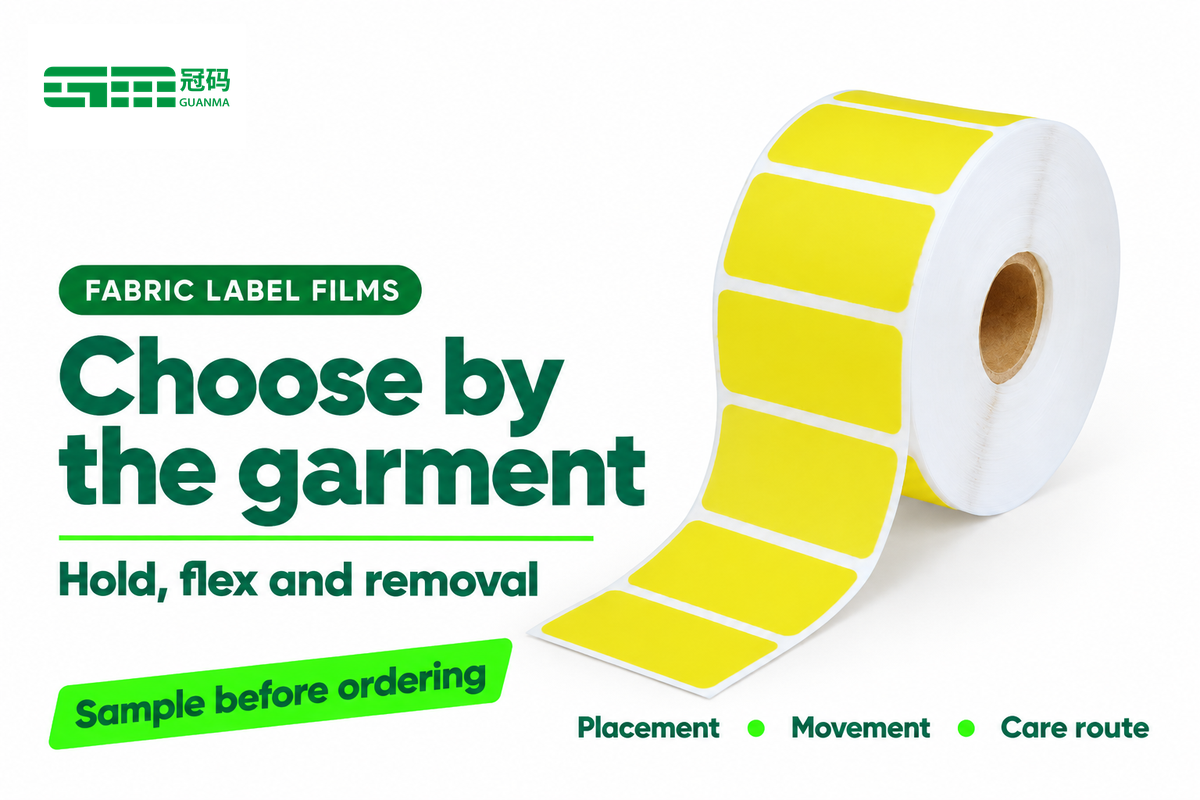
The most stable self-adhesive label film for fabrics is a construction matched to the garment and its use. For self‑adhesive clothing label films, consider PET when dimensional stability is the priority. When only temporary identification of a garment is necessary, choose a textile-approved removable adhesive; for washable clothing labels, choose a construction approved for the exact fabric or care-tag placement.
Selection essentials
- Temporary garment stickers and washable identification labels need different specifications.
- Film stiffness, adhesive grip and print durability are separate properties.
- A label designed for a care tag should be evaluated on that tag.
- Clean removal belongs in the acceptance criteria when the garment must remain unmarked.
The most stable self-adhesive label film for fabrics combines suitable film stiffness, an application-matched adhesive and durable print. Select by placement, expected movement and removal or laundry conditions.
Updated October 2026
Fabric labels: what does stable actually mean?
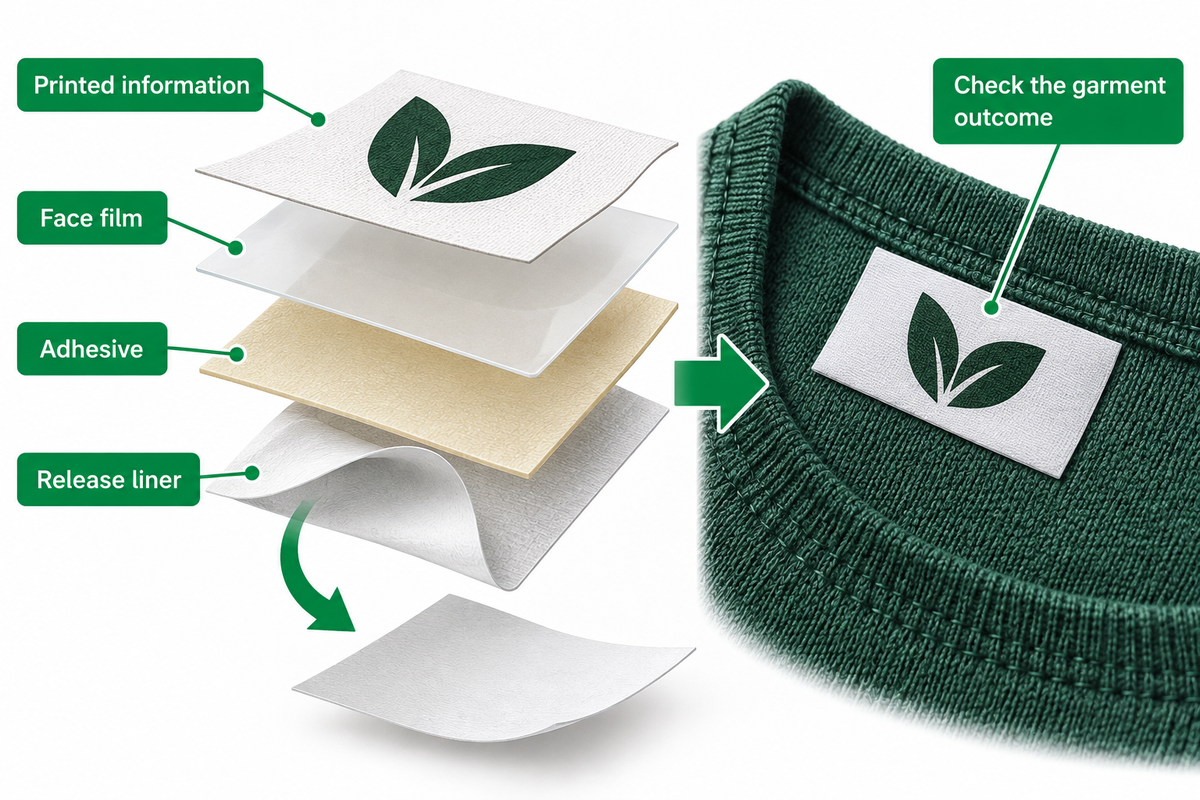
A self‑adhesive label film remains readable and attached for its intended use and removes cleanly when it’s needed to be removed. That definition includes the film, adhesive and print. A stiff film label can remain stable while edges lift from a moving garment; a softer film label can conform to the garment but can stretch.
Think of a label as a sign attached to a moving surface. For self‑adhesive label films, the face needs to keep its lettering intact while its attachment tolerates the surface beneath it. A smooth care-tag, knit and woven shirt present different contact conditions. Consider material for your self-adhesive label application, including the weave, placement and the surface finish.
The Label Academy explanation of self-adhesive laminates separates the face material, adhesive and release liner. Guanma’s guide to pressure-sensitive film construction outlines the broader material families. When deciding between label films for garments, include the finished print and outcome of removal in the decision.
Before comparing samples, choose acceptance observations: edge lift, wrinkling, adhesive transfer, fabric marking and legibility. A specialty self‑adhesive label that leaves a shadow on the garment fails a clean-removal brief even if the film is intact.
Temporary garment stickers or washable clothing labels?
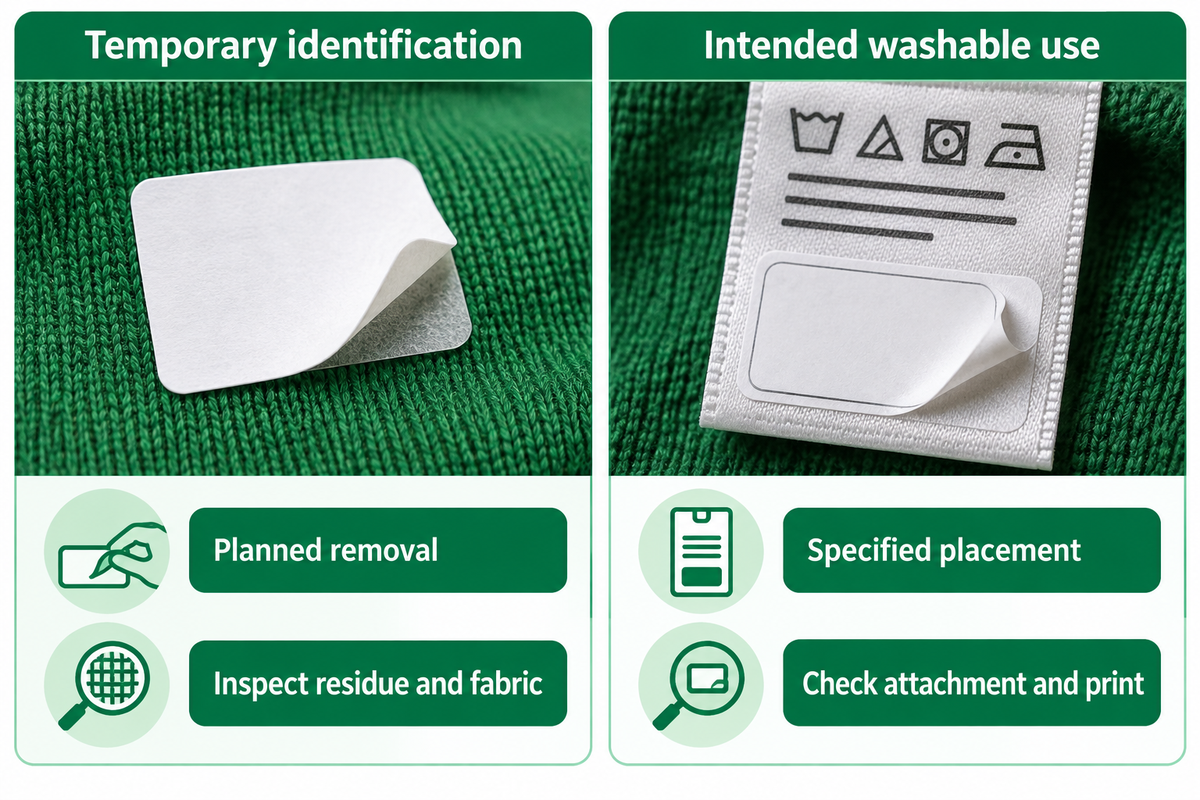
Avery states their acetate-silk fabric stickers allow up to 48 hours of temporary clothing use and aren’t machine washable. This is a temporary ID route. Washable stick‑on clothing labels require a different use brief, including the intended attachment surface, and the complete washing and drying conditions.
Temporary garment identification
- Remove at the planned sale or handling stage.
- Evaluate residue and fabric appearance.
- Keep the label out of laundry unless its instructions allow it.
Washable identification
- Use the specified fabric or care-tag placement.
- Evaluate attachment and print after the intended care route.
- Preserve the garment’s existing care information.
Do Avery labels stick to fabric?
Avery’s acetate-silk fabric sticker is an example of a removable garment sticker for temporary clothing use, although it isn’t a plastic film. Use the instructions for the exact Avery product, as other Avery products or normal office labels have different applications.
Example: A garment brand needs size stickers on cotton shirts during packing and at retail. The buyer first defines when staff will remove them. Sample size stickers are put on the finished shirts, including their final fabric finish, and remain for that handling period. The operator then inspects both the peeled label and the shirt under consistent lighting. A sticker that rips and leaves adhesive behind creates a problem for the sales person at the counter. A washable name label construction would address a different issue if the brief requires easy removal before the customer wears the shirt.
PET, PP, PE and vinyl label films compared
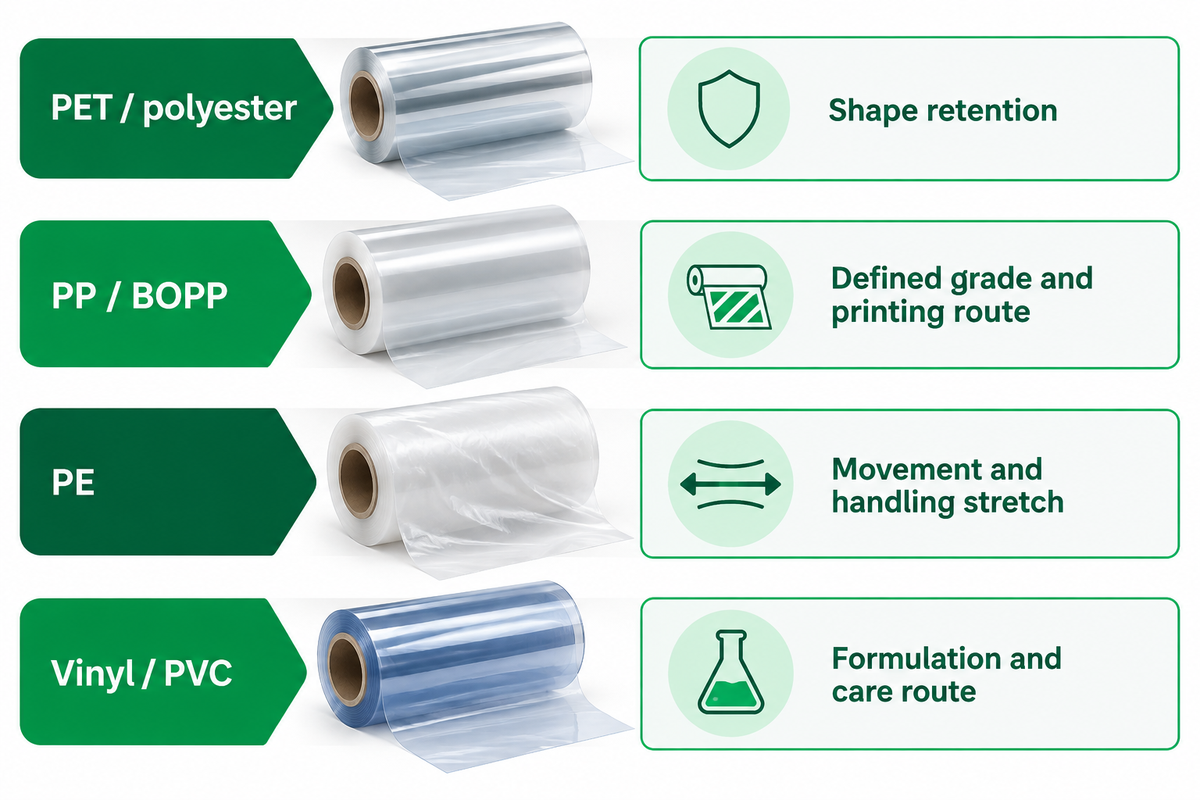
PET is usually a good starting point if the label needs to maintain its dimensions during printing and subsequent processing. PE, PP and vinyl candidates should be shortlisted based on their defined grade, thickness and flexibility. When dealing with a moving textile, adhesive contact and the bending behavior of the final label should be taken into account.
According to a 2012 study of printing substrates by Lee and Yoo, the tested BOPP film crept faster than the tested PET film under the studied temperatures and loads. The work focused on roll-to-roll printing substrates. As such, it’s a reason to consider PET for dimensional control while adhesion for garments still needs a separate test.
| Candidate | Useful selection focus | Decision before ordering |
|---|---|---|
| PET / polyester | Shape retention during printing and handling | Compare the specified PET grade and thickness, then check edge lift on the intended garment. |
| PP / BOPP | A defined polypropylene construction and printing route | Treat oriented BOPP and other PP grades as distinct candidates; compare finished samples under the same conditions. |
| PE | A specified polyethylene grade that fits the required movement | Evaluate handling stretch, print registration and removal on the actual placement. |
| Vinyl / PVC | A formulation with the required flexibility | For washable vinyl label films, evaluate the adhesive and print through the intended care route; formulation alone leaves those outcomes unresolved. |
A 2021 experimental study of plasticized PVC showed tensile properties of specimens depended on the formulation. Formulation plays an important role within a polymer family. For comparisons of stiffness, ASTM D882-26a requires specimens of identical dimensions and controlled test conditions.
What are the best materials for stick-on clothing labels?
The best self-adhesive construction for a temporary sticker combines garment hold with clean removal. For self-adhesive clothing identification requiring repeated laundering, use a washable construction approved for the given placement. PET is a good choice for a shortlist constrained by dimensional stability. More conformable candidates should be considered when the main challenge is movement of the garment. Consider the complete clothing label materials before choosing the roll.
Guanma’s PET film stock options provide a material-family starting point for that discussion. Keep the fabric, label size, and removal requirement with the inquiry.
Removable adhesive: hold without marking the garment
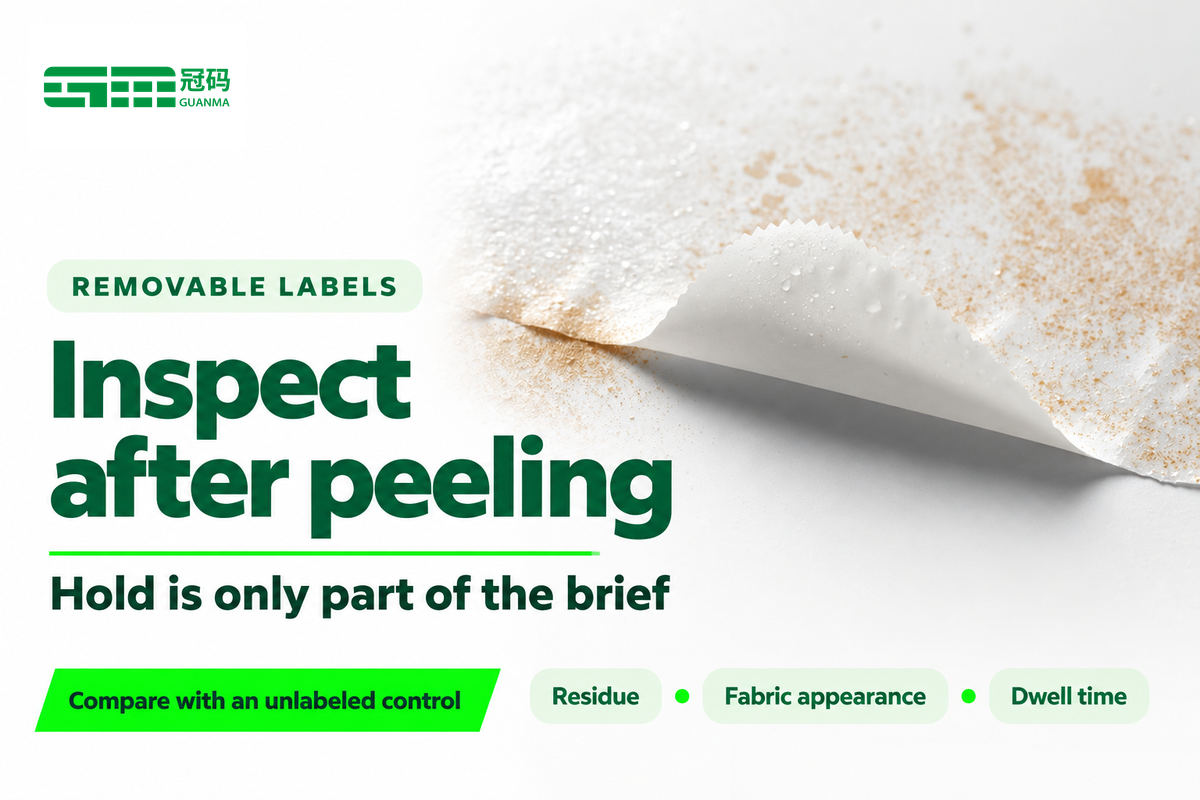
Choose removable adhesive based on its hold and the outcome of its removal from the fabric. A label is required to endure the required handling without transferring adhesive or marking the fabric at removal. Consider the longest intended dwell time as well as initial sticker application, since the removal point is also part of its intended use.
Initial tack describes the early bond when the sticker is first applied. Peel describes separation under a defined test, while cohesion describes the internal strength of the adhesive. Making the adhesive stronger can lead to an uncomfortable tradeoff, where staff is required to remove the sticker cleanly. The film and adhesive also need to peel from the fabric in one piece.
Guanma provides removable label constructions using PET film, BOPP synthetic paper or coated paper, with removable adhesive and a release liner. Instead of transferring successful package application to apparel, begin with the intended fabric.
Record finished fabric color and surface treatment alongside adhesive performance. Maintain a matching, unlabeled reference sample next to the test garment. A change in sheen and color is easier to detect this way. Keep sample rolls as directed and record their age before comparing them. Keep the label clear of seams when the approved placement is a flat fabric area.
Wash durability requires the complete label system
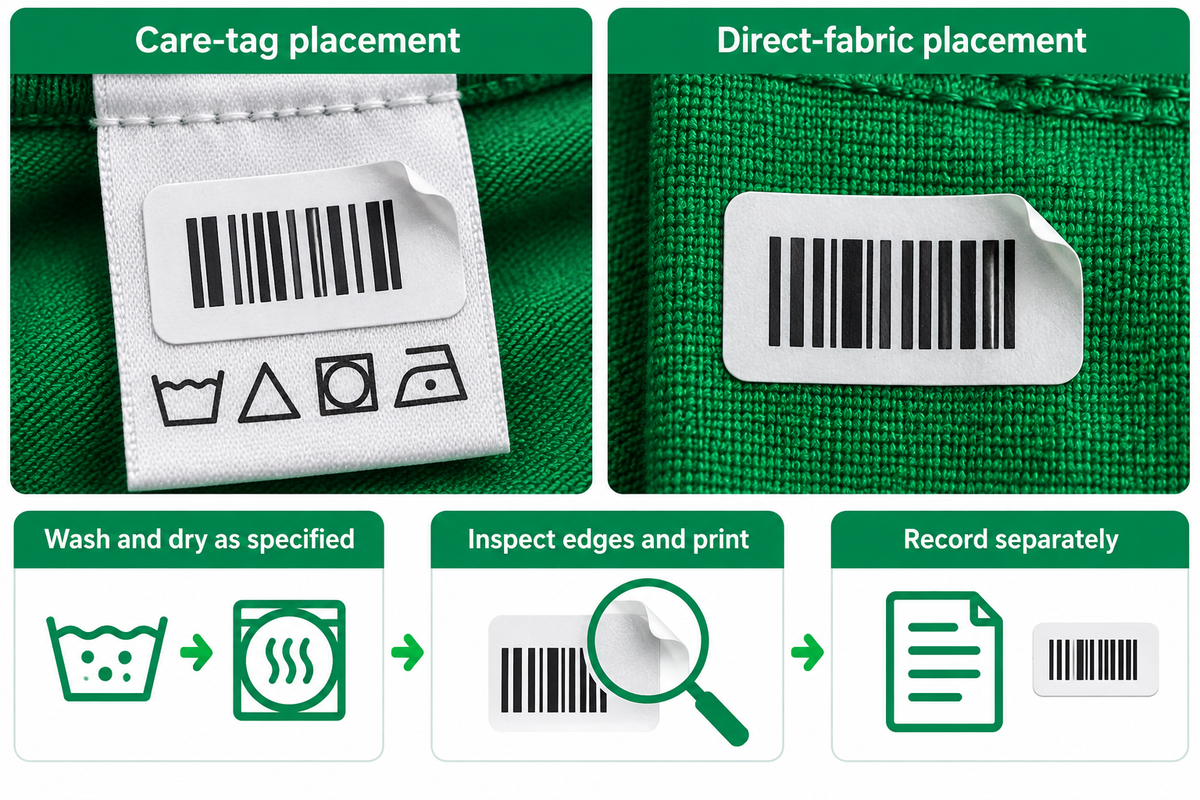
Wash durability requires the adhesive bond and printed information to withstand the intended care process. A durable film, with a readable print, still fails if it comes off; an attached label still fails if its text is unreadable.
Name Bubbles directs its press-and-stick clothing labels onto the care tag or brand imprint. Keep existing care labels readable and attached if a separate identification sticker is added. Name Bubbles also states that its product shouldn’t be applied directly to fabric. Therefore, any result obtained by placing the product on a care-tag area belongs to that placement, regardless of the rest of the garment.
ISO 6330:2021 specifies domestic washing and drying procedures for textile testing. Sample reports describe the procedure, type of detergent, route of drying, the location of application and the number of cycles performed. Separate exposure requirements for professional cleaning and spot treatment when the garment will encounter them.
Example: A uniform supplier needs printed identification that remains legible after the customer launders the garment. One sample is applied to the care tag and another is applied directly to the fabric. These samples are recorded as different constructions and placements. The evaluator checks the printed image after it’s dried, then examines the edges and attachment surface. If the care tag sample survives but the fabric sample lifts off, then the evaluator distinguishes the results by placement instead of assuming the same label suits both surfaces.
Print and application choices that prevent label failures
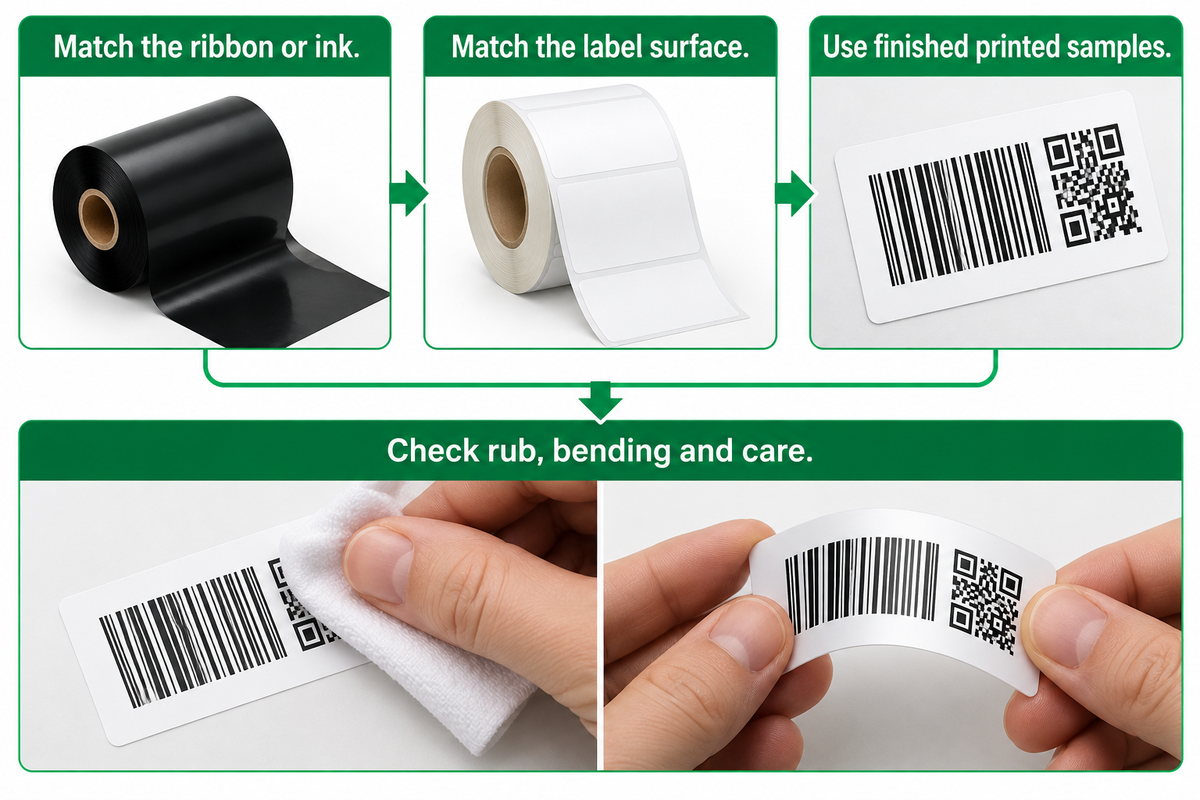
Align the printing process to the label surface before performing the adhesion test. For thermal transfer, a compatible ribbon is necessary; inkjet, eco‑solvent and UV processes need suitable label surfaces and process settings. A clean print at the press is the beginning of durability assessment.
A topcoat can help ink adhesion, but isn’t necessary for all constructions. Electronic Imaging Materials states this in its layer-to-layer guidance. Treat inkjet‑optimized films as a printing specification and assume not all self-adhesive films accept the same ink.
The converter should assess printed samples rather than blank stock. Issues with rub resistance, bending and care exposure can be found during evaluation. Liner release and dispensing can also present problems such as distorted label shapes or contaminated adhesive. All of these can happen at any stage during the processing of the garment up to the point of packing.
When assessing printing label information, artwork size and placement should be consistent across all samples. Blank name stickers can be used for the first adhesive screen, but the final screen should be done with the finished custom branding. Records for printable name stickers should include the printer, ink or ribbon and any protective layer and the material code.
Sample tests before ordering fabric label rolls
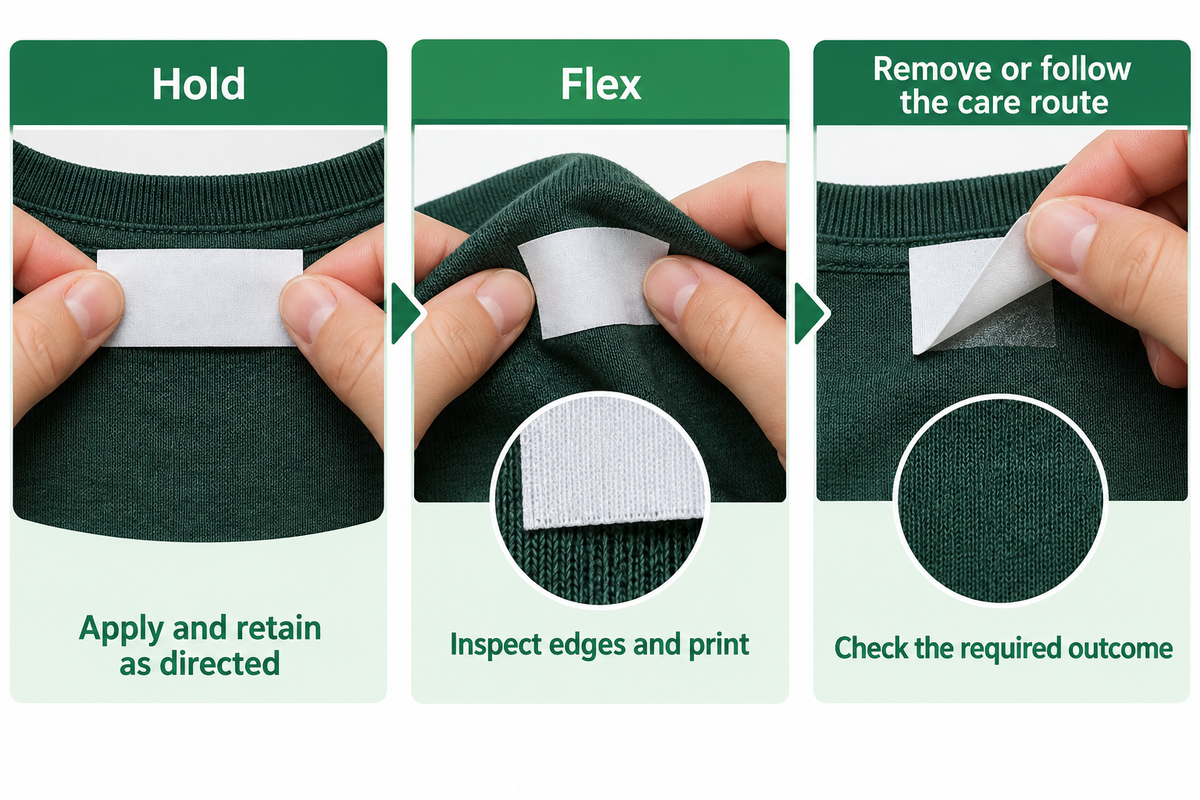
A Hold-Flex-Remove Trial should be conducted on the intended garment to check retention, movement and removal before selecting a label construction.
Hold, Flex, Remove Trial
Hold-Flex-Remove Trial is a garment-sample screening sequence for checking retention, movement and removal prior to selecting a construction for the label.
- Hold on the intended placement. Apply each candidate according to its directions and retain it through the planned handling and dwell.
- Flex through the intended movement. Bend or stretch the garment as its use requires and inspect the label edges and print.
- Remove or complete the care route. Inspect residue and fabric appearance for removable labels, or attachment and legibility after the specified care exposure.
For quality control, ASTM D6252/D6252M-98(2025) addresses label-stock peel at a 90° angle and adhesion uniformity within or between rolls and production lots. It also enables the use of representative substrates and links test data with accepted criteria. Stiff or readily stretched backings can make the method inappropriate; the evaluator should then select a different method.
“there is usually no direct relationship between peel adhesion and any functional requirement.”
How to judge the quality of self-adhesive labels?
Compare candidate samples to the required finished-label outcomes. Do samples reliably attach to the fabric? Do samples detach as required? Can candidates withstand the intended conditions for normal use? Can samples print legibly? Can samples be read? Use consistent sample conditions so differences may be traced. A peel measurement controls a defined construction; the garment screen reveals failures that the force value alone doesn’t describe.
| Observation | What to separate | Next action |
|---|---|---|
| Edges lift during movement | Placement versus film stiffness | Compare a more conformable candidate on the same placement. |
| Label shifts during handling | Initial application versus later bond | Check application instructions and handling before changing the stock. |
| Adhesive remains after peeling | Adhesive transfer versus film tearing | Reject for a clean-removal brief and evaluate a different construction. |
| Fabric changes sheen or color | Residue versus fabric appearance | Compare with the unlabeled control and reject visible marking. |
| Film stretches while dispensing | Liner release versus handling tension | Check the dispensing setup and the specified stock. |
| Print rubs away | Print system versus adhesive bond | Evaluate the matched ink or ribbon and surface treatment. |
| Label wrinkles | Garment movement versus application | Repeat on the intended placement with consistent application. |
| Label detaches in laundry | Care route versus attachment location | Separate care-tag and direct-fabric results. |
| Results vary between rolls | Material lot versus test conditions | Retain material codes and repeat the agreed quality-control method. |
Example: A brand compares two removable candidates on its finished knit fabric. Candidate A stays flat, but leaves noticeable residue at removal. Candidate B stays attached through planned handling and leaves the control area visually unchanged. The clean-removal brief rejects candidate A and retains B for a larger production trial. If B later lifts off after a finish change, that fabric becomes a new sample condition. The decision record indicates the failure, position and the material code, so a new variable is defined for the next trial.
Supplier evidence and the cost of a failed garment label
See how the cost of properly applied labels compares to the cost of relabeling and garment rejection. A lower price per roll loses its appeal if the labels damage saleable garments or if a print failure results in repeat work. Try to keep costs related to inspections and testing separate from costs related to defects to keep the comparison clear.
The American Society for Quality cost framework differentiates internal failures from external. For a garment label program, determine where a failure is detected and who corrects it. Use your own production records for quantities and labor costs.
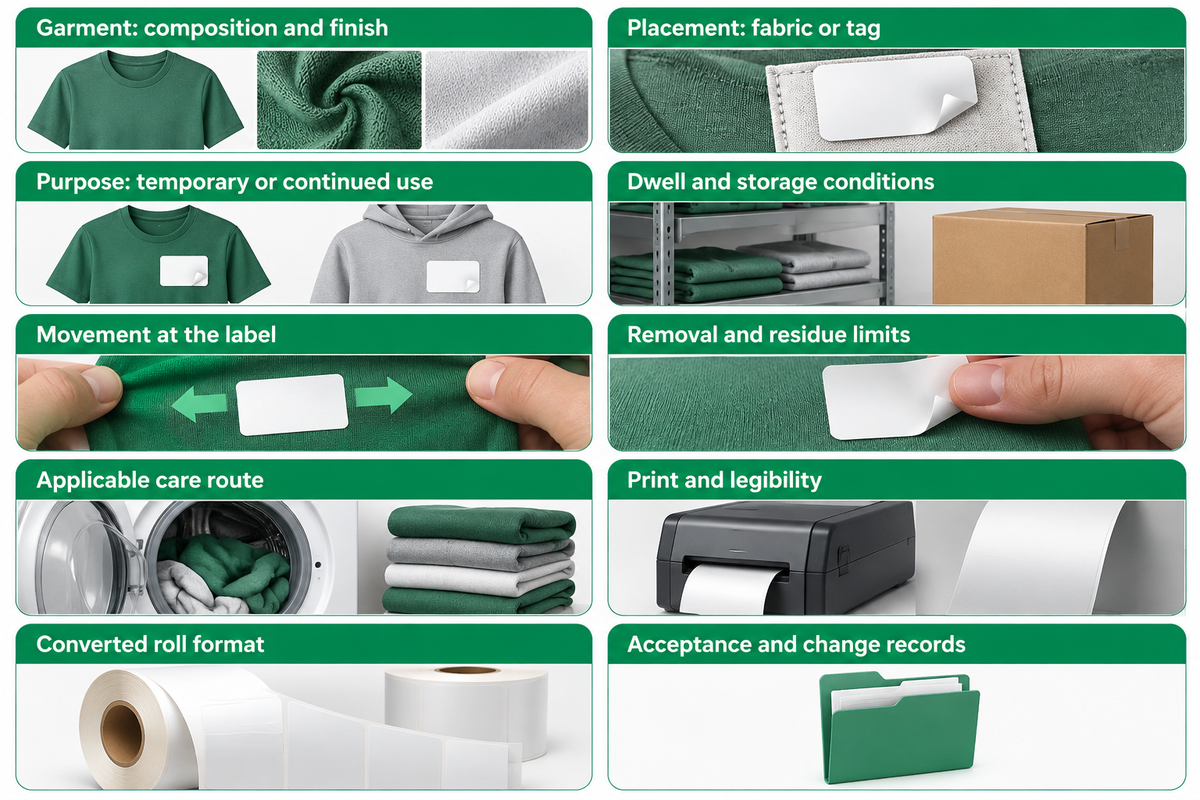
Include the following sample brief with your inquiry. In a label film manufacturer comparison, determine who’s the stock supplier and who’s the converter that prints and cuts the film. A finished label brand supplies the completed identification product. Assign responsibility for printing, garment evaluation and repeat order checks. Technical support should cover that and the material code.
| Field | What to provide |
|---|---|
| Garment | Fabric composition, weave or knit, color and production finish. |
| Placement | Direct fabric, care tag or specified brand imprint; include a photo. |
| Purpose | Temporary display, packing identification or continued-use identification. |
| Dwell and storage | Longest intended attachment period and expected roll-storage conditions. |
| Movement | The bending or stretch the garment encounters at the label position. |
| Removal | Required removal point and unacceptable residue or visible fabric change. |
| Care route | Washing, drying, professional cleaning and spot-treatment exposures that apply. |
| Artwork, printer, ink or ribbon, protective layer and legibility requirement. | |
| Converted format | Label dimensions, roll format, liner and dispensing setup. |
| Acceptance | Agreed failures, sample record, checks per batch and change-notification requirements. |
The enquiry should provide construction details, test conditions, and written after‑sales warranties for the quoted product. Technical guidance should identify a material code and a matching print process. Assess advanced adhesive label stocks in accordance with the same requirements as other candidates. “Strict QC” will be useful once the supplier identifies the checks and records the results. For the next enquiry, please review the Guanma self-adhesive film range and include the completed brief.
Fabric label questions
What is an adhesive sticker?
A pressure-sensitive label combines a face material with an adhesive that bonds when pressed onto the intended surface.
The face carries the printed information, while the adhesive bonds it to the intended surface. A release liner protects the adhesive before application. Film, paper and specialty stocks serve different uses. For a stick-on label used on a garment, select the construction for the fabric or tag where it will be placed, including the required removal outcome.
What are the strongest adhesive stickers available?
There is no useful universal strongest-sticker choice for garments.
Higher peel force can help one application and make another harder to remove. Compare the same test method and substrate, then check the garment outcome. A temporary apparel label needs enough hold for handling together with clean removal. Continued-use identification needs attachment and readable print through its intended care process. Neither brief is answered by maximum adhesion alone.
What should you pay attention to when storing self-adhesive labels?
Follow the storage conditions and shelf life specified for the exact stock.
Keep the material identification and purchase or manufacturing information with each roll. Protect labels from contamination and conditions outside their instructions. Record sample age when comparing constructions, because a newly received roll and older stock are different trial conditions. Bring material into the specified application conditions before use and keep the liner intact until dispensing.
Is a waterproof film label also washable?
No. Waterproof and washable describe different exposure requirements.
Laundry adds detergent, movement and a drying stage to water exposure. The adhesive, print and placement must suit that complete route. Evaluate the finished label under the intended care conditions, including whether it’s attached to a smooth care tag or directly to fabric.
What is the specific difference between direct thermal and thermal transfer?
Direct thermal printing marks a heat-sensitive surface; thermal transfer uses a ribbon.
For thermal transfer, the printer transfers material from the ribbon onto a compatible label surface. The ribbon and stock must work together. Direct thermal stock uses its own heat-sensitive coating instead. Choose the print system for the required information life and exposure, then evaluate the finished printed label. A successful adhesive trial with blank stock leaves print durability unresolved, especially where the label will be rubbed or repeatedly laundered.
Can one sample qualify every fabric color and finish?
No. Keep each relevant fabric and finish combination in the qualification plan.
A sample represents the surface and placement on which it was evaluated. Record color, treatment and garment construction. When production changes one of those conditions, use the retained result as a comparison and check the changed combination before extending approval.
What are the best criteria for choosing clothing label manufacturers?
Choose by the specified construction, application fit and ability to support repeat orders.
A useful material manufacturer comparison starts with the same garment brief for each supplier. Compare the intended placement, removal result, print process and care exposure before comparing price. Keep the trial material code with the results, identify who converts the stock and agree how changes will be communicated. Suppliers that specialize in specialty adhesive stocks may serve a different part of the process from a brand selling finished kids’ labels; assign the required work accordingly.
Request a fabric label sample from Guanma
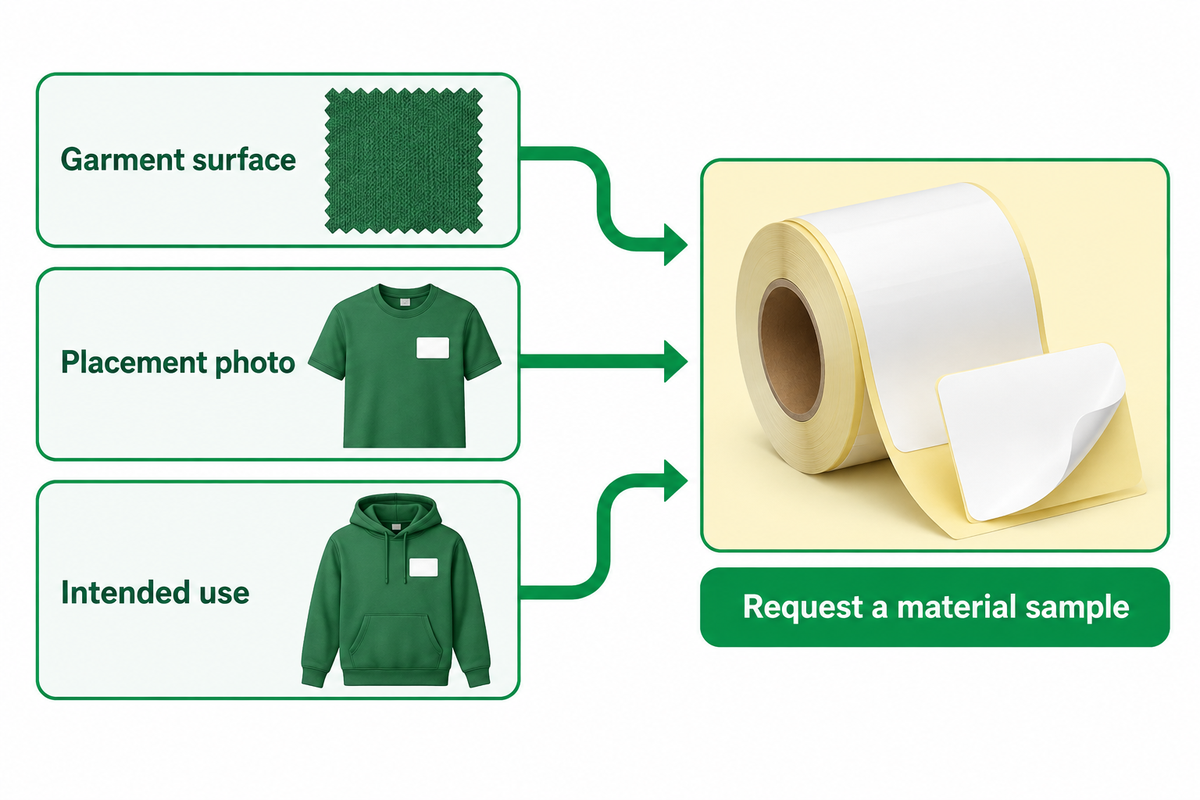
Guanma provides self-adhesive film and paper for printers, converters and brand owners. Send your sample request along with information about the surface of the garment, placement and intended use. Our team can discuss label solutions and converting requirements using the same brief that will guide your evaluation.
Learn about Guanma or send your fabric label brief with photos of the application area.
Start with the garment and the use conditions.Request a Label Material Sample
Garment scenarios provide sample decisions that a buyer can repeat. Examples specific to products follow their published instructions. The proposed screening sequence is different from laboratory testing under a named standard.
References & Sources
- Self-adhesive laminate constructions, Labels & Labeling, Label Academy.
- Comparative dimensional stability of PET and BOPP printing substrates, Lee and Yoo, Journal of Industrial and Engineering Chemistry, 2012.
- Biobased Plasticizers from Tartaric Acid, Zhu and coauthors, 2021.
- ASTM D882-26a: Tensile Properties of Thin Plastic Sheeting, ASTM International.
- ISO 6330:2021: Domestic washing and drying procedures for textile testing, International Organization for Standardization.
- ASTM D6252/D6252M-98(2025): Label-stock peel adhesion, ASTM International.
- ASTM D3330/D3330M-04(2025): Pressure-sensitive tape peel adhesion, ASTM International.
- Cost of Quality, American Society for Quality.