Get in Touch with Guanma

Gram to Oz Calculator: Grams to Ounces

Bidirectional total-mass conversion for sample and packaging worksheets
One ordinary avoirdupois ounce equals exactly 28.349523125 grams. A gram to oz calculator is a mass conversion tool: divide grams by 28.349523125 to get ounces, or multiply ounces by that factor to get grams. It works in both directions and keeps the result in ordinary ounces of mass—not fluid ounces, troy ounces, or ounces per square yard.
Gram to ounce (avoirdupois) converter
Convert between gram and ounce (avoirdupois). The unit changes; the measured quantity does not.
Result
oz
1 g = 0.035274 oz
This converter uses the ordinary avoirdupois ounce: 1 oz = 28.349523125 g. A fluid ounce measures volume; a troy ounce and oz/yd² are different units.
28.349523125 gin 1 ordinary ounce
1.058219 ozin 30 grams
3.527396 ozin 100 grams
Which ounce does this grams-to-ounces calculator use?
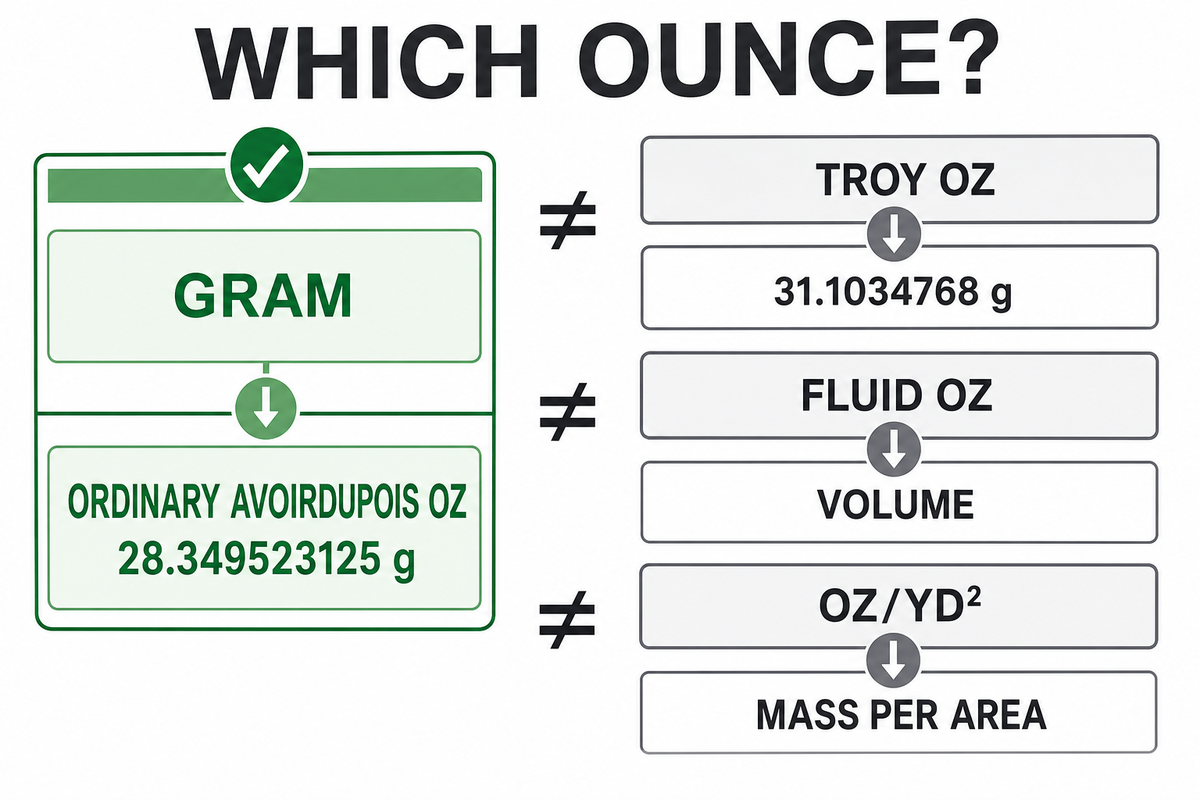
Here, oz means the ordinary avoirdupois ounce used for everyday mass in the U.S. customary system. The word “ounce” can also name other quantities, so the unit must be settled before any conversion. The Four Ounce Meanings Triage keeps the arithmetic attached to the right measurement:
Use this calculator
- Gram (g): metric unit of mass
- Ordinary ounce (oz): 28.349523125 g
- Total sample or component mass
Use another quantity
- Fluid ounce (fl oz): volume
- Troy ounce (oz t): 31.1034768 g
- Ounce per square yard (oz/yd²): areal density
The practical risk is unit ambiguity. If a supplier worksheet says only “2 oz,” the value can be mistaken for troy mass, liquid volume, or area weight; on a 1 kg sample record, that mismatch can propagate into the purchase order. Treat the ounce label as part of the measurement, not decoration.
NIST Handbook 44, Appendix C places liquid volume and mass in separate tables. It records 28.349523125 grams for one avoirdupois ounce and 31.1034768 grams for one troy ounce. In the same appendix, a U.S. fluid ounce appears in the liquid-volume table instead, so grams cannot be converted to fluid ounces unless the material’s density is also known. For volume-only conversions, use Guanma’s fl oz to mL converter.
The same guard applies to label and textile specifications. The symbol oz/yd² includes an area denominator and measures mass per area. If that is the source unit, use Guanma’s GSM and oz/yd² area-weight converter. Even a correct plain-ounce result cannot substitute for an area-weight value.
How to convert grams to ounces, and back
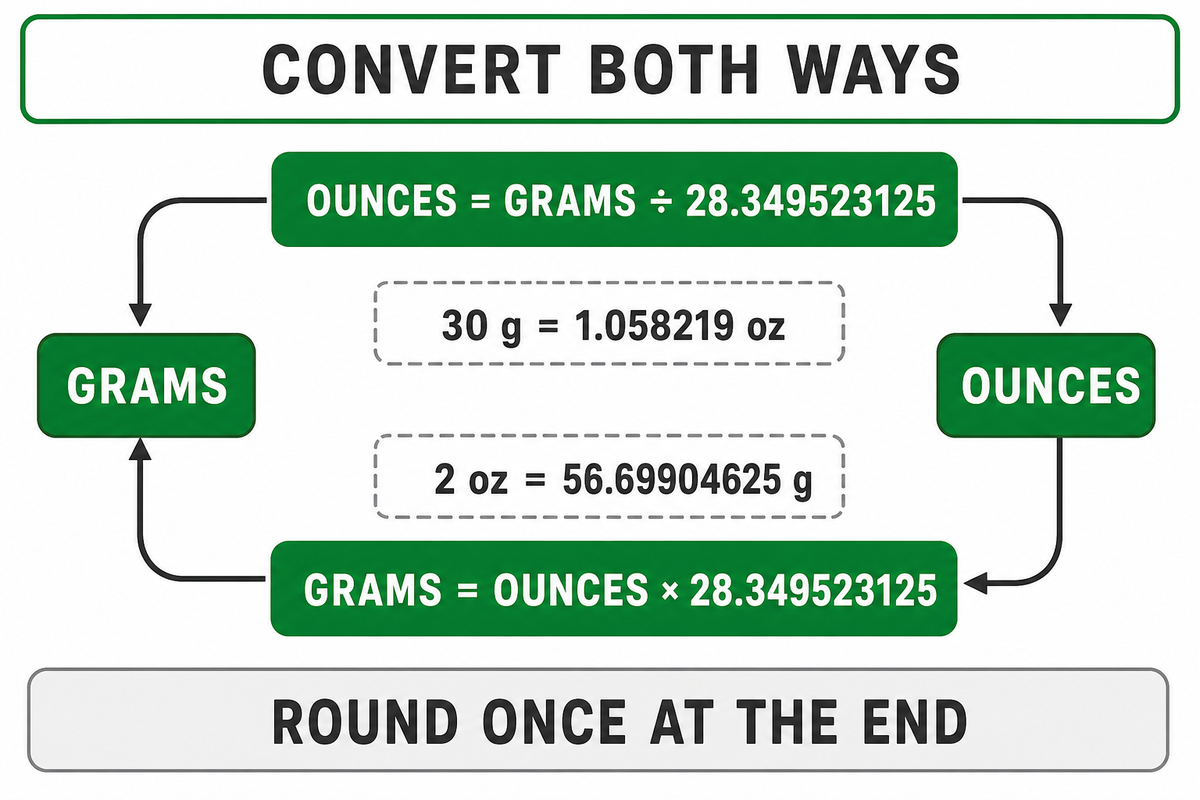
The forward formula is ounces = grams ÷ 28.349523125. For 30 grams, 30 ÷ 28.349523125 = 1.058218858… ounces. For 100 grams, the result is 3.527396195… ounces. Neither value should be rounded to a whole ounce when the source measurement is intended to distinguish smaller differences.
The reverse formula is grams = ounces × 28.349523125. Two ounces equal 56.69904625 grams, and four ounces equal 113.3980925 grams. Both directions use the same factor, which makes a reverse check straightforward.
Rounding before the calculation is a common mistake. For example, replacing 28.349523125 with 28 for repeated entries creates a systematic mismatch; the risk grows across a 1 kg batch worksheet. Retaining the NIST factor keeps the conversion reversible and lets a production or supplier record be checked in either direction.
Scale-Resolution Rounding Rule: the calculator may display six decimal places for auditability, but the converted value cannot be more certain than the original measurement. Reading 30 g to the nearest gram does not become a laboratory-grade result merely because the calculator shows extra digits.
Keep the original reading beside the converted value. In a worksheet, write something like “30 g measured; 1.058219 oz calculated,” then preserve the scale resolution separately. This avoids replacing an observation with a rounded derivative.
Unit-system context for a g to oz conversion
This conversion calculator links two systems of measurement. The gram belongs to the metric system. In the International System of Units (SI), the kilogram is the base unit of mass, and 1 gram is one thousandth of a kilogram. That means 1 kg equals 1,000 g. The ordinary ounce and the pound, written lb or lbs, are U.S. customary units. Related British units share some mass relationships, while the two systems differ in other measurement contexts.
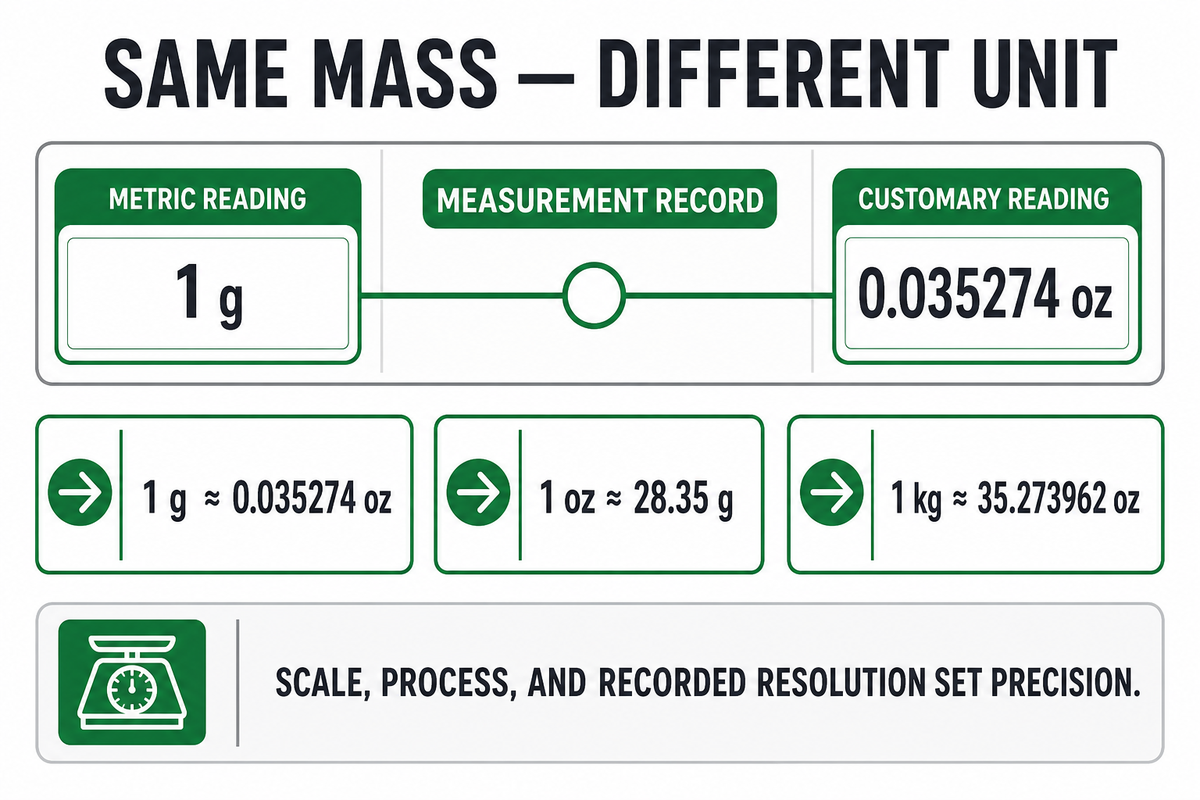
For a quick g to oz check, 1 gram is equivalent to about 0.035274 oz, while 1 oz is about 28.35 grams when rounded for a short reference. When converting grams, this tool keeps the full registered factor internally, so the displayed result is accurate to the selected decimal limit without claiming greater measurement accuracy than the source reading. A weight conversion calculator can standardize the unit on a worksheet, but it cannot repair an inaccurate scale value.
People also convert grams and ounces when they cook, record a food portion, or copy ingredients in grams into a recipe that uses customary units. The same arithmetic applies to a label sample, package component, or ingredient because these are all total-mass values. It does not apply to a fluid volume. It also does not replace troy-ounce conventions for precious metals, where the ounce has a different mass. The kilogram—not the gram—is the SI fundamental unit of mass; this distinction matters in standards language even though grams are often the more convenient working unit.
The confusion to avoid is treating “metric” and “customary” as competing accuracy grades. A 1 kg reading and its 35.273962 oz equivalent carry the same source uncertainty. NIST supplies the unit relationship; the scale, production method, and recorded resolution determine how much precision the measurement can support.
Compact gram-to-ounce conversion table
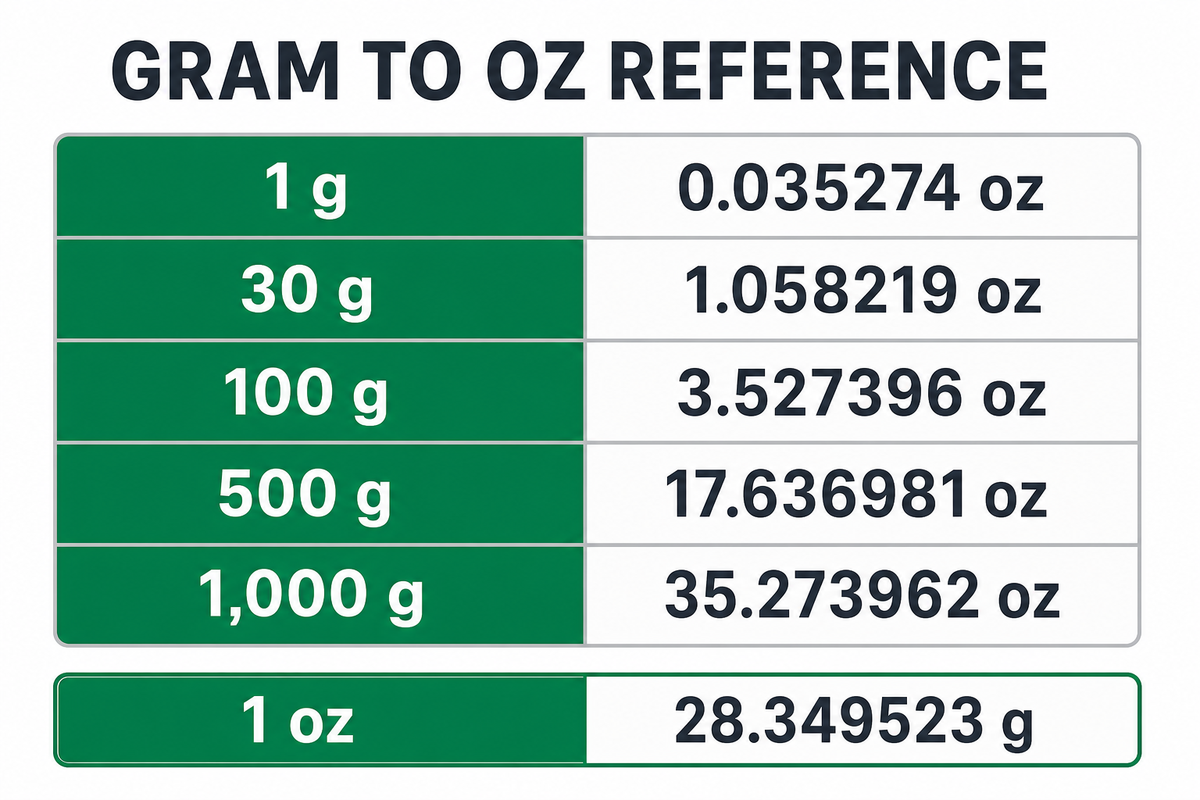
These rows are deterministic outputs from the same conversion factor. They are reference checks, not measurement tolerances or recommended package weights.
The table reduces lookup delay, but copying a rounded row into a repeated production calculation is a mistake. For a 1 kg sample or a supplier comparison, use the calculator’s full NIST factor because the table is a display aid, not a new measurement standard.
| Grams | Ounces |
|---|---|
| 1 g | 0.035274 oz |
| 5 g | 0.176370 oz |
| 10 g | 0.352740 oz |
| 20 g | 0.705479 oz |
| 30 g | 1.058219 oz |
| 50 g | 1.763698 oz |
| 100 g | 3.527396 oz |
| 250 g | 8.818490 oz |
| 500 g | 17.636981 oz |
| 1,000 g | 35.273962 oz |
| Ounces | Grams |
|---|---|
| 0.5 oz | 14.174762 g |
| 1 oz | 28.349523 g |
| 2 oz | 56.699046 g |
| 4 oz | 113.398093 g |
| 8 oz | 226.796185 g |
Use the interactive converter when the value is not listed. If a reverse calculation from a displayed table cell differs in the last decimal place, that is a rounding effect. The calculator internally uses the saved factor and rounds just what it displays.
Total grams are not GSM or oz/yd²
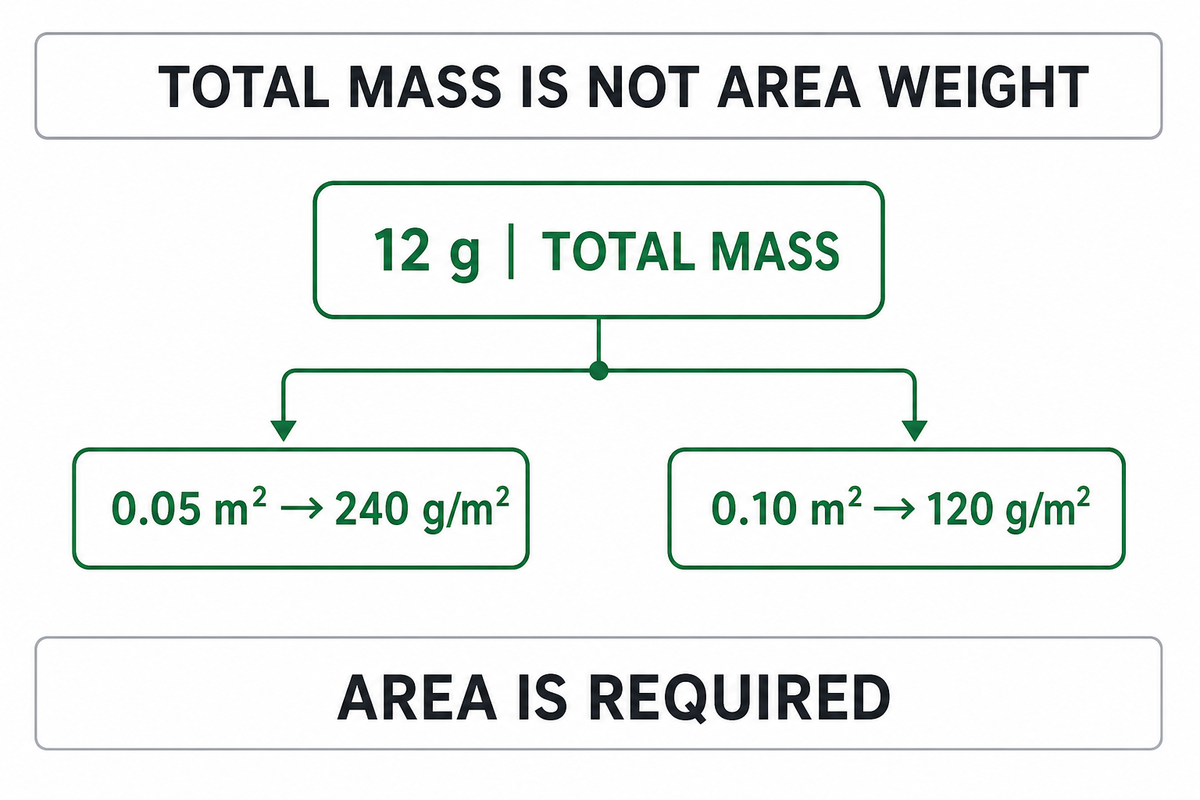
A weighed specimen has a total mass. GSM, written g/m², describes mass per area. The quantities become related only when the specimen’s area is known. Apply the Known-Area Prerequisite: never turn a gram reading into GSM by changing the unit label.
Suppose a rectangular sample weighs 12 g. That reading alone cannot reveal its GSM. A 0.05 m² sample would equal 240 g/m², while a 0.10 m² sample of the same total mass would equal 120 g/m². Width and length—or another verified area measurement—must enter the calculation.
This is more than a naming preference. The confusion can misrepresent a supplier specification because two samples can share the same 12 g total while one is twice the other in GSM (240 versus 120 g/m²) when their areas differ as above. Keep total mass, verified area, and area weight in separate fields so a production or purchase-order record does not hide the missing input.
The same separation protects nearby label calculations. Paper basis weight in pounds depends on paper category and basic sheet size; it belongs in the paper basis-weight conversion by grade. Roll diameter needs thickness, core diameter, and length. A gram-to-ounce conversion supplies none of those missing inputs.
For label material comparisons, first decide whether the source describes the whole sample, a square-area basis, a paper ream convention, or a roll geometry field. Then use the calculator that owns that quantity. Keeping these pages separate is more useful than forcing every “weight” query into one formula.
How to record a label-sample mass
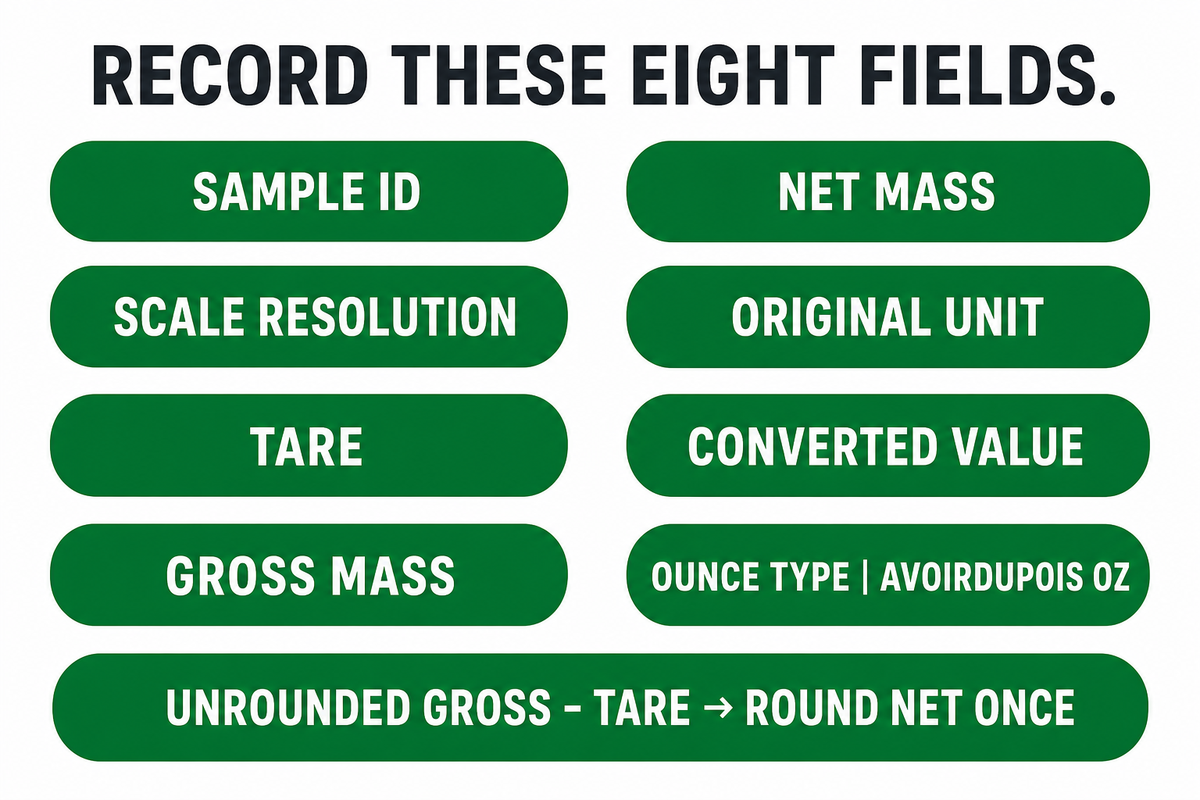
A physical sample may include a facestock, adhesive, release liner, protective bag, core, or carrier. If the purpose is to compare only the specimen, subtract the container or fixture mass before conversion. When the instrument permits it, derive net mass from the unrounded gross and tare readings, then round the net result once to the agreed resolution; subtracting two already rounded display values can add uncertainty. Record the observation before changing units.
This article’s suggested Eight-Field Sample Mass Trace keeps eight fields together. It is an editorial handoff format, not a proprietary Guanma test method or a replacement for a customer-approved inspection plan:
The main risk is subtracting a rounded tare from a rounded gross value and then implying laboratory precision. On a 1 kg capacity scale, the displayed resolution and the verified accuracy are separate questions. NIST explains that distinction; the card preserves the readings so a supplier, production operator, or inspector can see what was measured and what was calculated.
- Sample ID — connect the reading to the actual specimen or packaging component.
- Scale resolution — state the smallest displayed increment.
- Tare — record the empty container or fixture mass when used.
- Gross mass — record specimen plus tare before subtraction.
- Net mass — calculate gross minus tare and identify it as the conversion input.
- Original unit — preserve g or oz exactly as observed.
- Converted value — show the calculator output at a sensible precision.
- Ounce type — write “avoirdupois oz” when ambiguity is possible.
Mass is only one component in a material request. Guanma’s self-adhesive paper materials and self-adhesive film materials include individual facestock, adhesive, liner, width, and application choices. Using a converted sample mass can’t imply those decisions, much less guarantee performance.
When the reading belongs in a supplier inquiry, keep the source and converted values side by side and send your label-stock specification with the component identity and construction context. If a formal tolerance or test basis is required, use the value supplied by the applicable drawing, standard, or agreed procedure; do not infer it from this converter.
Frequently asked questions
Is 30 g equal to 1 oz?
No. Thirty grams equals approximately 1.058219 ordinary ounces. One ordinary ounce is exactly 28.349523125 grams, thus 30 g is about 1.650477 g more than 1 oz. If your source scale displays only whole grams, make “30 g” the measurement and treat the ounce value as a calculated conversion.
Is 100 g equal to 4 oz?
No. One hundred grams equals approximately 3.527396 ordinary ounces. Four ounces equal 113.3980925 grams. The difference is large enough that rounding 100 g to 4 oz would misstate the mass; use the calculated result or keep the original gram value beside it.
How many grams are in one ounce?
One ordinary avoirdupois ounce contains exactly 28.349523125 grams. That is the ounce used by this calculator. A troy ounce contains 31.1034768 grams, while a fluid ounce measures volume. Name the ounce type whenever the context could be ambiguous, and preserve the original mass unit in the record.
How do I convert ounces to grams?
Multiply ordinary ounces by 28.349523125. For example, 2 oz × 28.349523125 = 56.69904625 g. The calculator’s unit selector also performs this reverse conversion, so there is no need for a separate ounces-to-grams page. Keep the original ounce reading beside the calculated gram value for traceability.
Can grams be converted to fluid ounces?
Not from mass alone. Grams measure mass, while fluid ounces measure volume. A conversion requires the material’s density at the relevant conditions. Water-based shortcuts should not be reused for adhesives, coatings, inks, oils, or other materials unless their density is actually known.
How many decimal places should I use?
Six decimals help check the factor, but operational records should follow the measured resolution and preserve the original value and unit. If the scale reports whole grams, save that observation even when the calculator displays more digits. For a purchase order or inspection form, round the converted value once at the end and document the rule. Keep that precision consistent across related supplier records.
Method note: The calculator uses the mass relationship in NIST Handbook 44, Appendix C. Reference rows are derived from that factor. Guanma-specific sample fields in this article are suggested documentation aids, not proprietary measurements or guaranteed acceptance criteria.
References & Sources
- NIST Handbook 44, 2026, Appendix C exact ordinary- and troy-ounce mass factors and the separate liquid-volume table.
- NIST Handbook 44 current edition confirms the applicable current edition.
- NIST SI Units: Mass kilogram and gram relationships.
- NIST approximate U.S. customary and metric conversions short-form factor and rounding context.
- NIST weighing and scales FAQs resolution, accuracy, tare, gross and net-mass guidance.
WHY WE WRITE THIS
About Guanma
Guanma is a self-adhesive film, label stock, and release liner manufacturer for industrial labeling applications. Our team works with PET film, PP synthetic paper, coated paper, hot-melt PSA, acrylic PSA, water-based adhesive, glassine liner, and CCK release liner.
We write these guides to help label converters, packaging buyers, and industrial procurement teams choose materials by real application conditions instead of generic catalog names. Most label failures come from a mismatch between facestock, adhesive, liner, substrate, temperature, printing method, or end-use environment. Our content explains those decisions in practical terms.
Our Experience
Guanma’s material guidance is based on coating, lamination, slitting, sample validation, and customer troubleshooting experience across Thailand and Vietnam production. We focus on common industrial label problems such as cold-temperature peel, oil and chemical exposure, UV aging, print durability, release force, MOQ, lead time, and substrate-matched testing.
Our Expertise
We reference practical testing logic and recognized label-industry standards, including FINAT FTM peel and shear methods, ASTM peel testing methods, FDA 21 CFR 175.105, REACH, RoHS, FSC, and ISO 9001-related quality control. For custom label stock, we always recommend testing samples on the buyer’s real substrate before full production.
SYS.PROFILE
Visit Website
Contact Profile
Name
Guanma Manufacturing Team
Brand Name
Guanma
Country
Thailand + Vietnam Production
Model
B2B / Wholesale / Custom Coating
Main Products
Self-Adhesive Film, Label Stock, Release Paper & Liner
Contact
Submit RFQ via Website Form
Website
https://guanmalabel.com/