Get in Touch with Guanma

This chemical resistant overlaminate for labels is a clear protective top-film applied over printed label graphics when the print layer, barcode, hazard text, or edge bond needs more protection than the facestock and topcoat can provide alone. It can help with solvent splash, repeated wipe-down, abrasion, UV, oils, and handling, but it is not a shortcut around testing the full label construction.
Decision rule: specify an overlaminate only after you know the chemical, contact mode, surface, print method, and failure mode. Top-film protects the label stack; it does not make an unknown construction chemical-proof.
Quick answer
Use a protective overlaminate when the label must preserve printed data through splash exposure, frequent cleaning, abrasion, outdoor weather, barcode scanning, or edge contact with oils and solvents. For controlled short wipe exposure, a compatible topcoat or varnish may be enough. Selection should follow the actual exposure on the actual container.
When a Chemical-Resistant Label Still Needs a Top-Film
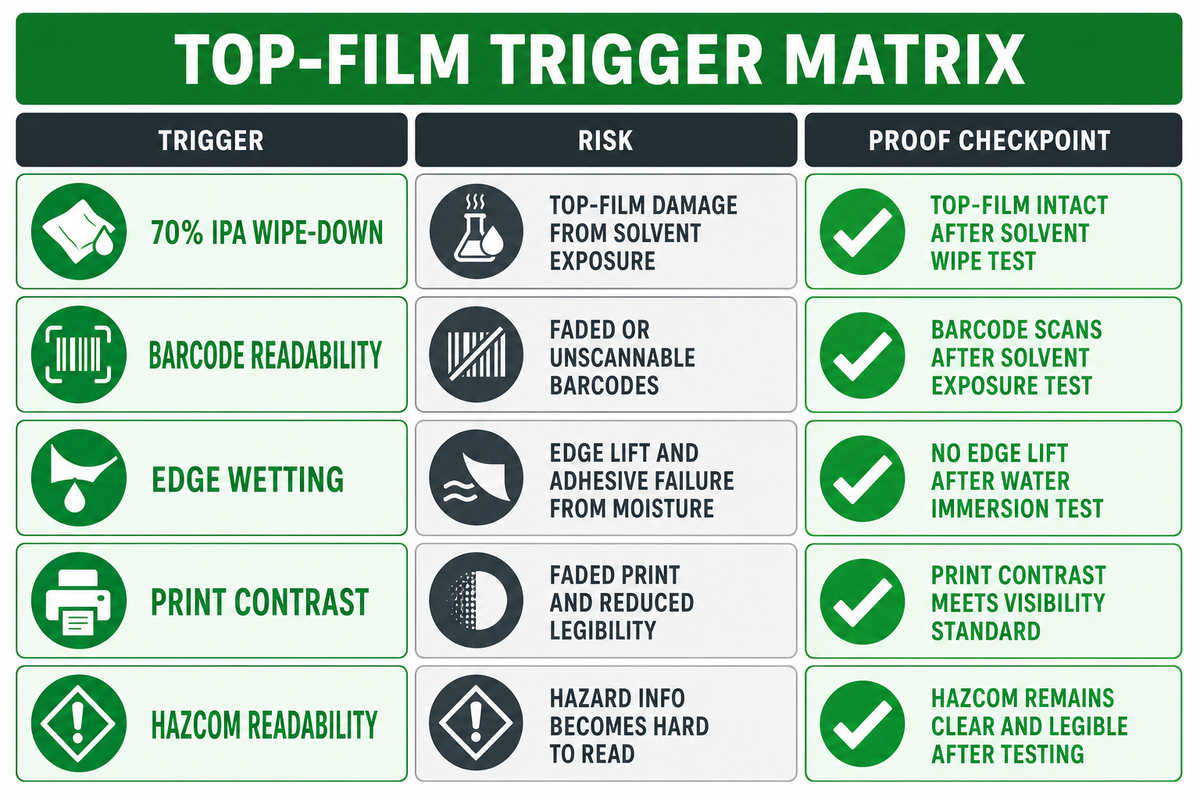
Chemical-resistant label stock still needs a top-film when the likely failure is not the facestock itself, but the printed image, barcode contrast, topcoat, adhesive edge, or handling surface. PET, PP, vinyl, and specialty films can all be useful, yet a resistant facestock with exposed ink can still smear or lose scannability.
This is the first point buyers often miss. Many teams attach the word “chemical-resistant” to a label material, but a working label is a stack: facestock, adhesive, topcoat or overlaminate, print method, ink or ribbon, liner, and application surface. If one layer fails, the label function can fail even while the other layers look intact.
That is why a protective top-film is most useful when the exposed print layer is the weak point. Repeated alcohol wiping may slowly reduce print contrast. Solvent splash may soften a coating. Abrasion during shipping can reduce legibility. Oil can creep from the cut edge toward the adhesive bond. Clear overlaminate puts a sacrificial barrier over the print and, if selected correctly, helps the printed information stay readable longer.
Treat the top-film decision as a failure-mode control, not a style upgrade. For a hazard label, the reason may be preserving signal words and pictograms after 70% IPA wipe-down. For an equipment label, the reason may be barcode readability after 90 days of oily handling. For a chemical drum label, the reason may be edge wetting after splash and dry cycles. Those are three different approval questions, even if all three labels use a clear polyester overlaminate.
Use the Top-Film Trigger Matrix below to separate print failure, chemical splash, wipe exposure, outdoor abrasion, and edge-lift risk before adding film by default.
| If the label risk is… | Top-film trigger | Evidence to request |
|---|---|---|
| Printed barcode smears or loses contrast | Yes, especially with solvent or repeated cleaning contact. | Print method, ribbon/ink type, barcode scan target, wipe or abrasion result. |
| Chemical splash reaches label surface | Usually yes, if the print must remain readable after splash and dry cycles. | Chemical name, concentration, dwell time, rinse/dry cycle, post-test readability. |
| Occasional alcohol wipe only | Maybe. Topcoat can be sufficient if test evidence supports it. | Wipe count, solvent, pressure, print inspection, adhesion after cleaning. |
| Outdoor UV plus handling abrasion | Often yes, because the overlaminate protects both image and surface. | Outdoor rating, abrasion evidence, UV/weather exposure, adhesive surface match. |
| Adhesive lifts from the edge | Only if edge ingress and laminate bond are addressed together. | Peel adhesion comparison, mandrel/curved-surface test, edge wetting exposure. |
For broader material options, Guanma’s chemical-resistant label materials for industrial applications page is the right commercial handoff. This article stays narrower: when to add a protective top-film over that construction.
Use the Solvent-to-Seal Exposure Ladder
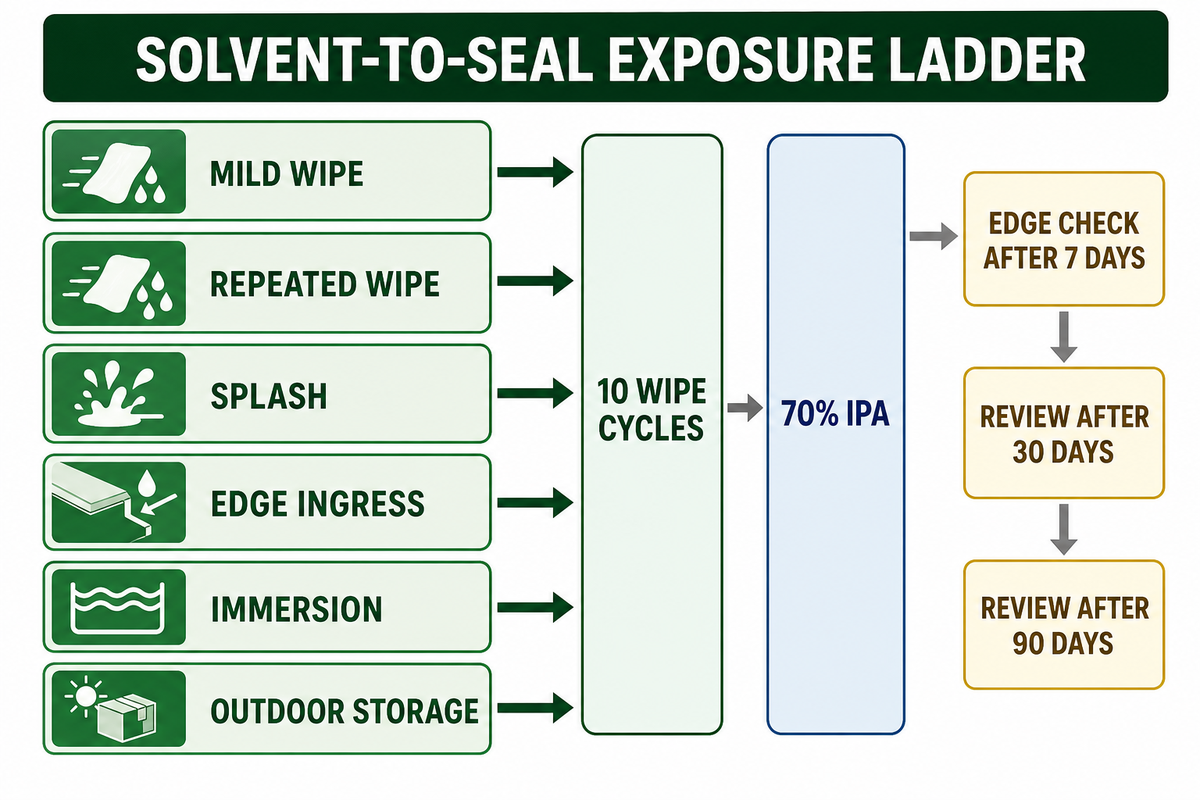
Solvent-to-Seal Exposure Ladder separates a mild wipe from full immersion and from edge ingress. Those are not interchangeable conditions. ASTM D543’s public scope language supports the basic discipline: chemical-resistance interpretation depends on reagent, concentration, time, stress, temperature, and similarity to end use.
Use the ladder before you compare PET, PP, vinyl, polycarbonate, or specialty overlaminate films. Labels that pass one alcohol wipe can still fail after daily disinfecting. Short-splash samples can still lift after oil works into the cut edge. Immersion samples can still lose barcode scan reliability if the printed image or overlaminate surface gets abraded.
Build the ladder from the user’s real exposure, then add a narrow test window. Lab labels may need 10 wipe cycles with 70% IPA and inspection after 24 hours. Maintenance tags may need oil contact, detergent wipe-down, and an edge check after 7 days. Drum labels moving through outdoor storage may need splash, rain, abrasion, and a review after 30 days or 90 days. Timing stays application-specific, but writing it down prevents a vague “chemical resistant” claim from standing in for evidence.
| Exposure rung | Common scenario | Top-film implication |
|---|---|---|
| Dry handling | Warehouse, cartons, indoor equipment labels. | Topcoat may be enough unless scuffing is severe. |
| Repeated wipe | IPA, ethanol, mild cleaning, lab or medical-adjacent workflows. | Test topcoat first; add overlaminate if image contrast or coating wear is weak. |
| Splash and dry cycle | Chemical filling, drum handling, maintenance fluids, cleaning agents. | Overlaminate is usually a stronger starting point. |
| Edge contact | Oils, hydraulic fluids, degreasers, rough handling, curved containers. | Overlaminate helps only if edge design and adhesive choice also fit. |
| Immersion or marine exposure | Seawater, dangerous-goods labels, long wet contact, harsh storage. | Require formal condition-specific evidence, such as relevant BS 5609 or chemical-resistance testing. |
Compare PET, PP, Vinyl, Polycarbonate, and Specialty Films
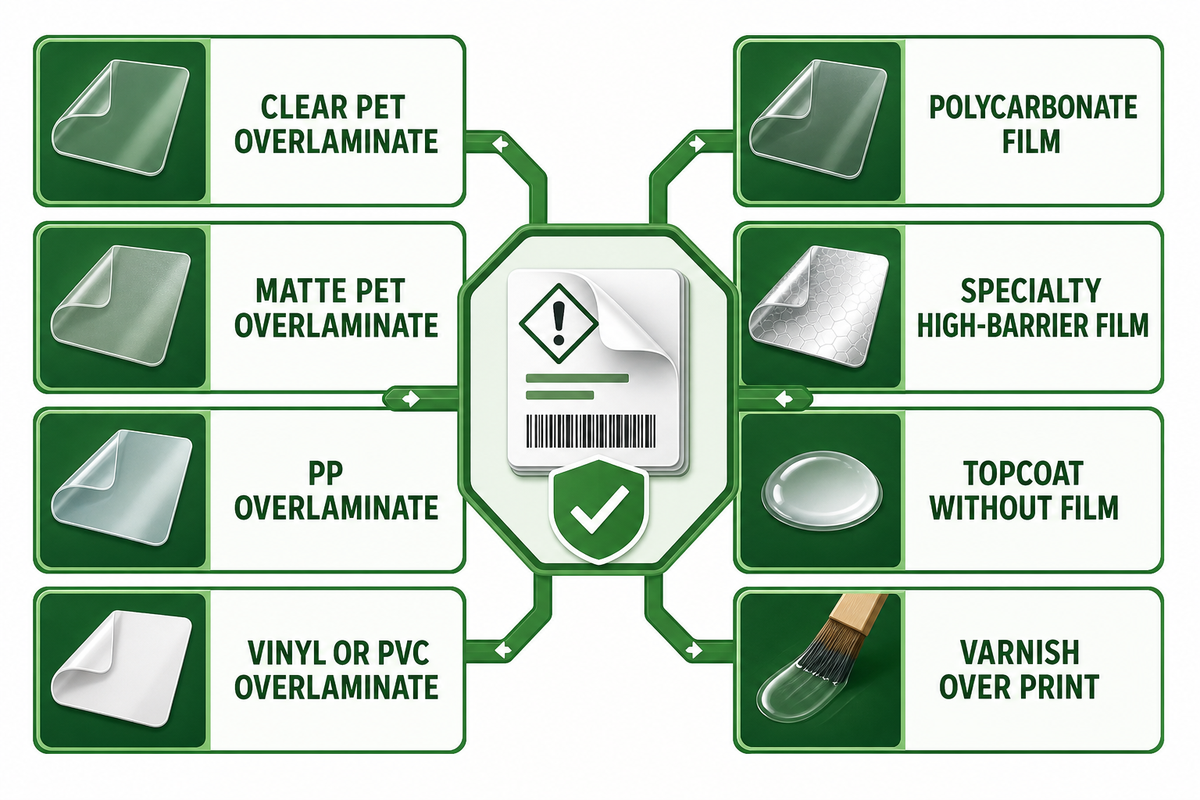
Do not select an overlaminate film by the material name alone. PET, PP, vinyl, polycarbonate, and specialty films bring different strengths in clarity, stiffness, conformability, abrasion resistance, chemical resistance, outdoor performance, and cost. The right choice depends on what the top-film must protect and how it bonds to the label face.
PET polyester overlaminate is a common starting point for industrial labels because it offers a stable, clear, durable barrier over printed graphics. It is often a good fit for barcode labels, chemical drum labels, equipment labels, and outdoor identification. Tradeoff: stiffness and edge behavior must be checked on curved or squeezable containers.
PP overlaminate can be useful when moisture, oils, and cost matter, but it should not be assumed to match PET in every solvent or heat condition. Vinyl can conform well to curved surfaces and safety-label applications, but chemical and temperature compatibility still need to be verified. Polycarbonate and specialty films can serve demanding graphic or abrasion conditions, yet they may be unnecessary for routine chemical wipe exposure.
Material comparison shortcut
If the label is flat, high-value, barcode-heavy, and exposed to solvent splash or abrasion, start with PET overlaminate. If the container is curved or squeezable, test conformability and edge lift before approving the film. If the exposure is only mild wipe-down, test topcoat or varnish before adding cost and stiffness.
| Material or construction zone | Where it often fits | Approval check |
|---|---|---|
| Clear PET overlaminate | Barcode-heavy industrial labels, chemical splash, durable product ID. | Check clarity, scan contrast, and edge bond after 24 hours. |
| Matte PET overlaminate | Labels where glare reduction matters more than maximum gloss. | Confirm 1D and 2D barcode scanning under plant lighting. |
| PP overlaminate | Moisture, oils, and cost-sensitive programs with moderate service demands. | Retest after 48 hours if alcohol, oil, or detergent is present. |
| Vinyl or PVC overlaminate | Curved panels, safety labels, and shapes that need more conformability. | Check shrink, edge lift, and print movement after 72 hours. |
| Polycarbonate film | Graphic overlays and high-abrasion control panels. | Verify stiffness, adhesive wet-out, and appearance after 30 days. |
| Specialty high-barrier film | Aggressive solvents, harsh outdoor storage, or long-service assets. | Ask for reagent-specific data, not only a broad 12 months durability claim. |
| Topcoat without film | Controlled indoor wipe exposure and lower-cost short-run labels. | Use the same ink or ribbon and repeat the wipe test after 7 days. |
| Varnish over print | Moderate scuff protection where a separate film is too stiff. | Compare gloss, rub resistance, and chemical wipe results side by side. |
| Resin thermal-transfer print | Variable data labels that still need a protective film in harsh use. | Test the exact ribbon, print density, and barcode grade before release. |
| Acrylic adhesive and edge design | Chemical labels on drums, bottles, panels, and coated metal. | Check peel comparison on the real surface after 180 days if long storage is expected. |
When a supplier lists a transparent polyester film, clear polyester, Polypropylene overlaminate, or vinyl/PVC construction, ask how the lamination was checked after printing. Thickness may be discussed in mil, but the mil number is only one clue; adhesive coated side, print receptivity, surface energy, and edge seal often decide whether the label survives chemical contact. Good documentation should name the material stack, sample lot, test method, inspection timing, and the boundary of any technical or compliance statement.
Durable label programs in automotive, electronics, signage, and outdoor packaging should also account for sunlight, heat, cleaning fluids, and other environmental factors. Stability and long-term durability depend on the whole pressure-sensitive construction, not only the visible film. Safety regulations may define information that must stay readable, while the converter still has to prove that the final label protects that information in use.
This material comparison should sit on top of the facestock decision, not replace it. Guanma’s related self-adhesive label film basics can help teams separate facestock selection from the separate top-film decision.
Watch the Edge-Lift Failure Window
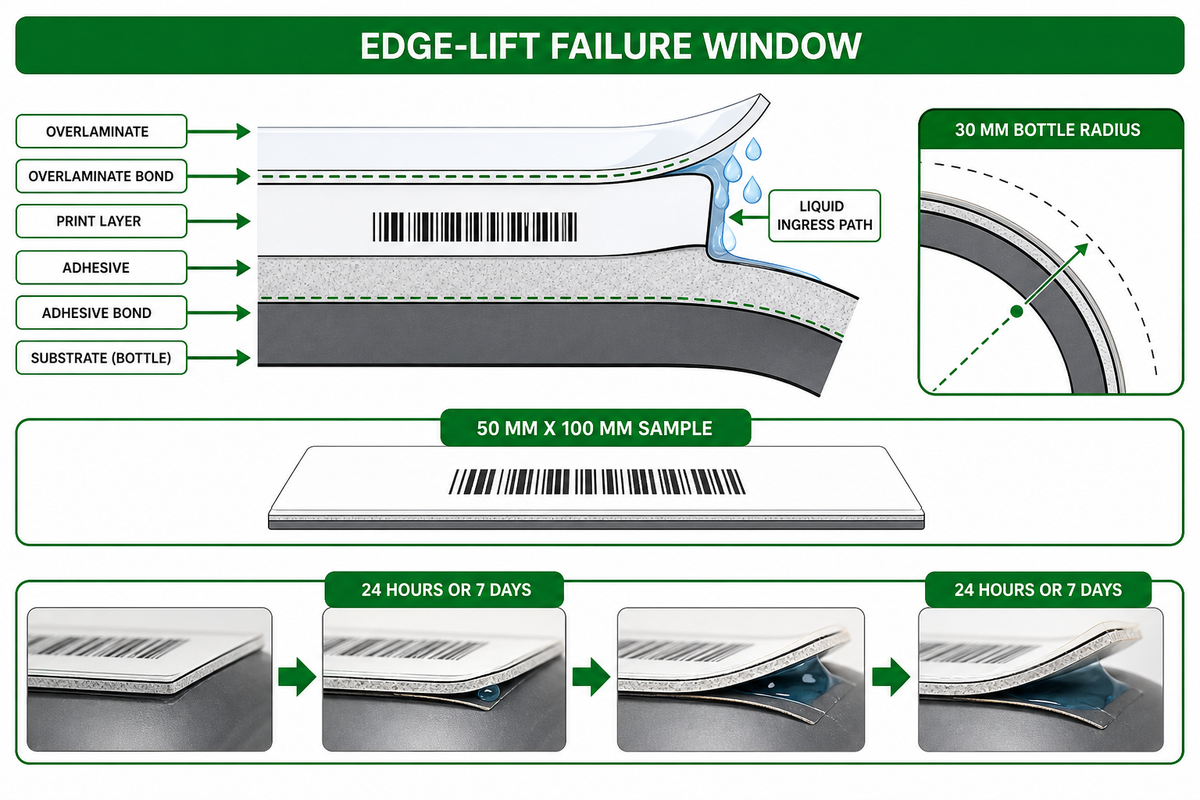
Edge-Lift Failure Window is the time between a label looking acceptable after application and the moment a chemical, oil, heat, or curve starts opening the edge. Many label failures do not begin in the middle of the print. They begin at the perimeter, where liquid can reach the adhesive and where the overlaminate edge can become a stress point.
Peel adhesion evidence is useful here, but it should not be turned into a universal survival number. ASTM D3330/D3330M is a pressure-sensitive tape peel adhesion method; it supports controlled comparison on representative surfaces. It does not prove that every label construction will survive every chemical, every radius, and every temperature cycle.
For a top-film specification, the edge question has four parts: does the base label adhesive bond to the real container, does the overlaminate bond to the print/facestock, does the edge resist liquid ingress, and does the combined stack stay flat on curved or textured surfaces? Skipping any one of those checks can make the top-film look good in a flat sample book and fail in production.
Edge-lift review should include both timing and geometry. Flat 50 mm x 100 mm samples can hide stress that appears on a 30 mm bottle radius, a ribbed drum, or a powder-coated housing. Ask the supplier to photograph the edge before exposure, after the first chemical contact, after drying, and again after a handling interval such as 24 hours or 7 days. Keep failed samples. They make small bubbles, tunneling, and adhesive whitening visible before the label is approved.
- Ask for sample testing on the real container surface, not only on stainless steel or glass panels.
- Check application temperature and service temperature separately.
- Inspect the cut edge after wipe, splash, and dry cycles.
- Test the final printed label, not just blank facestock and blank laminate.
Protect Print, Barcode, and HazCom Readability
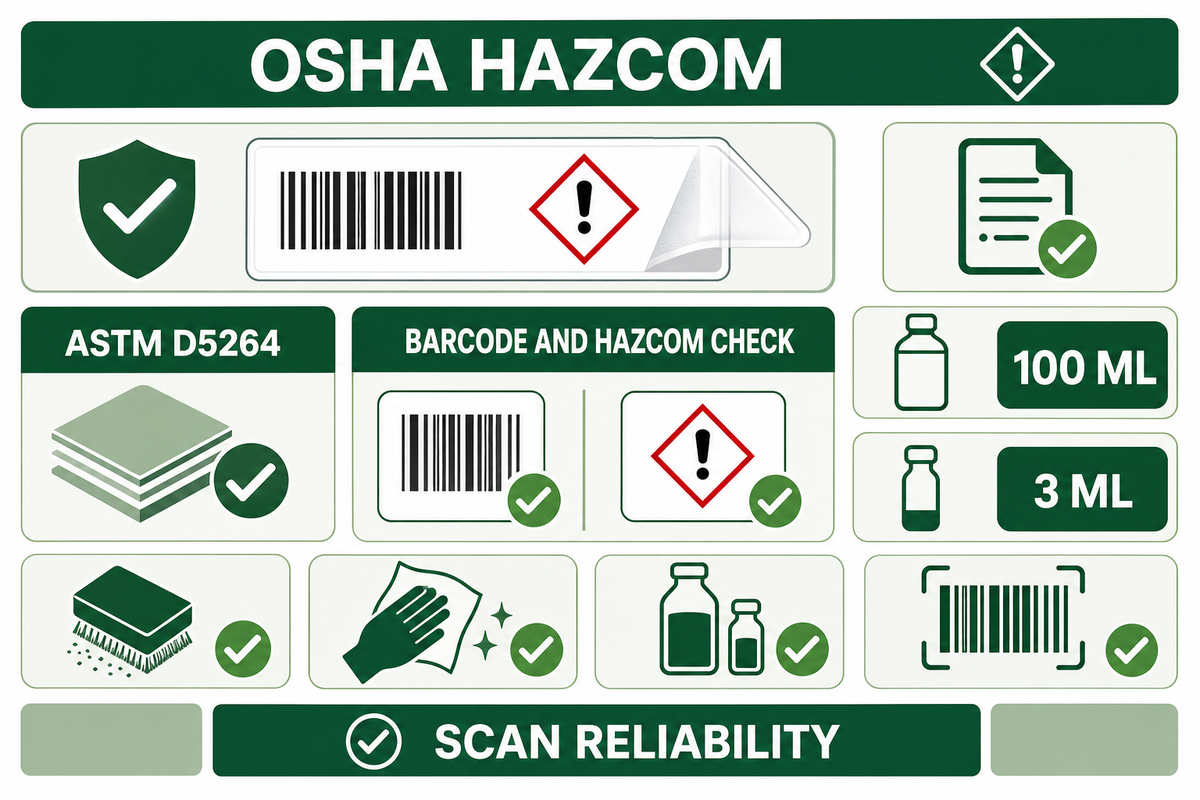
The practical job of a chemical-resistant overlaminate is to keep information readable. For U.S. hazardous-chemical contexts, OSHA HazCom defines required label information and workplace warning expectations. Material selection supports that readability; it is not the regulation itself.
This distinction matters. Label copy can contain the correct signal word, pictogram, hazard statement, precautionary statement, and product identifier, yet still fail operationally if solvent exposure makes the barcode unreadable or if abrasion removes key text. Conversely, a strong overlaminate does not fix a missing hazard element or an incorrect SDS-driven label decision.
Abrasion evidence belongs in the same discussion. ASTM D5264’s public scope covers abrasion resistance of printed materials and explicitly includes labels, inks, coatings, laminates, and substrates. For buyers, the lesson is simple: if the label will be shipped, handled, wiped, or scanned repeatedly, ask how the final printed construction was evaluated after abrasion and chemical exposure.
For U.S. workplace labeling, OSHA’s HazCom rule also has special small-container provisions, including 100 mL and 3 mL thresholds. Those thresholds do not tell you which laminate to buy. They remind the buyer that label size, text density, durability, and readability are tied together. If a small vial label must carry dense safety information, the overlaminate choice should protect the text without causing glare, curling, or scanner failure.
Do not compress this into a catalog checkbox. Labels that carry dense warning language on small curved containers, use thermal-transfer barcodes, see weekly solvent cleaning, and spend part of their life outdoors are asking the facestock, adhesive, print system, overlaminate, and application process to behave as one tested construction, so a single material name is never enough.
Barcode and HazCom check
For critical labels, inspect three things after exposure: human-readable text, pictograms or warning graphics, and barcode scan performance. Labels that still look “mostly fine” can still be unacceptable if scanning fails or required warning text is no longer legible.
Request a 6-Point Overlaminate Evidence Pack
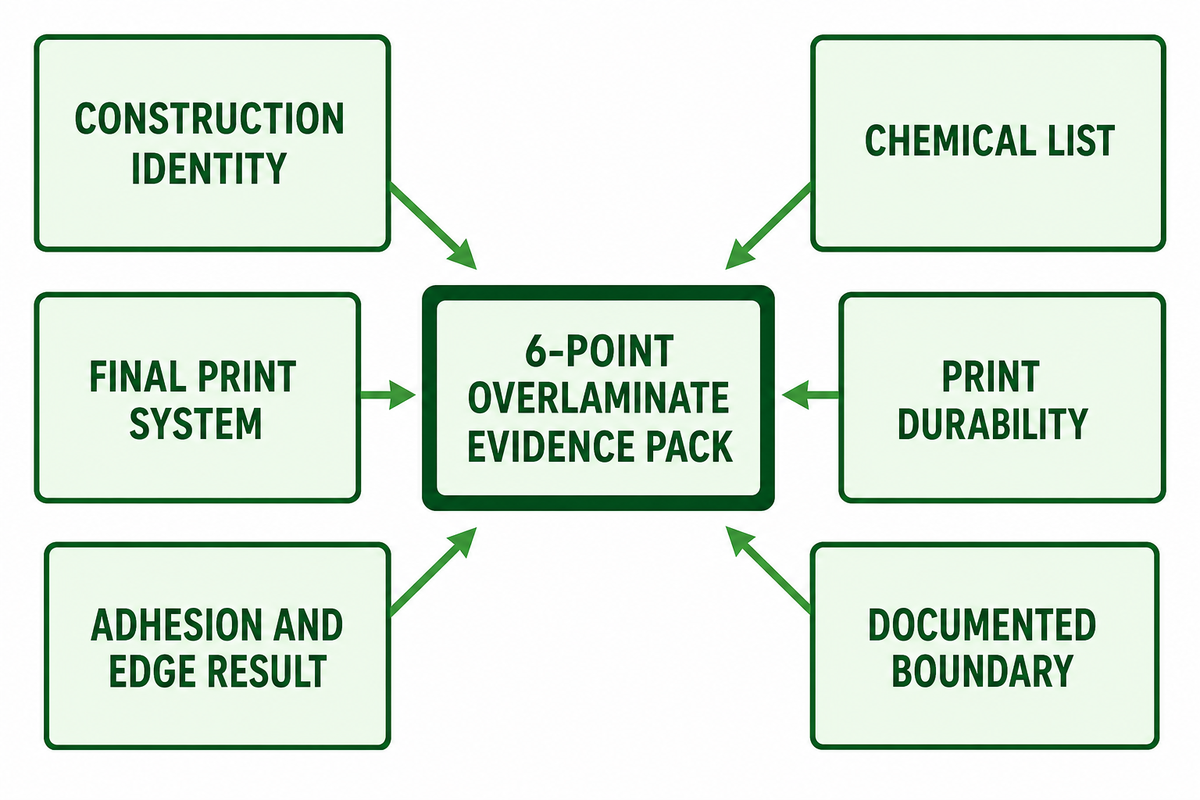
Before you approve a chemical-resistant label with a protective top-film, ask for a 6-Point Overlaminate Evidence Pack. This keeps the conversation specific and prevents a supplier from answering an engineering question with a broad “chemical resistant” phrase.
| Evidence item | Why it matters | Question to ask |
|---|---|---|
| 1. Chemical list | Resistance changes by reagent and concentration. | Which exact chemicals and concentrations were tested? |
| 2. Contact mode | Wipe, splash, vapor, edge contact, and immersion are different exposures. | Was the test a wipe, splash, immersion, or another method? |
| 3. Final print system | Top-film protects the actual ink or ribbon, not an abstract label. | Was the same print method, ribbon, ink, and barcode density used? |
| 4. Adhesion and edge result | Edge lift can defeat a good top-film. | What happened at the edge after chemical contact and drying? |
| 5. Abrasion/readability result | Labels must remain readable after handling and scuffing. | Was legibility or barcode scanning checked after abrasion? |
| 6. Standards boundary | UL, ASTM, OSHA, and BS 5609 each answer different questions. | Which standard, certificate, or internal method applies, and to which layer? |
UL’s public marking and labeling program material is useful here because it treats label stocks, laminating adhesives, overlaminates, inks, adhesion, legibility, defacement resistance, and environmental exposure as system-level issues. That does not mean every label has UL recognition. It means the evidence should describe the complete system, not a single material layer.
Use a short approval worksheet beside the 6-Point Overlaminate Evidence Pack. List the chemical name, concentration, dwell time, wipe pressure, exposure temperature, inspection time, and pass/fail definition. For example, a buyer might ask for 10 wipe cycles with 70% IPA, a 10% bleach cleaner check, a 5% caustic cleaner review, inspection at 25 °C, and a second inspection after 48 hours. These numbers are not universal pass criteria; they are placeholders for a controlled request that the supplier can confirm, revise, or reject.
Keep the rejected sample. Suppliers can then compare the same artwork, barcode density, facestock, adhesive, and overlaminate film under wipe, splash, abrasion, and edge-contact conditions without arguing from memory, and the purchasing team can see whether the failure was print smear, laminate haze, adhesive whitening, curling, or loss of scan contrast.
Decide Whether Topcoat, Varnish, or Overlaminate Fits
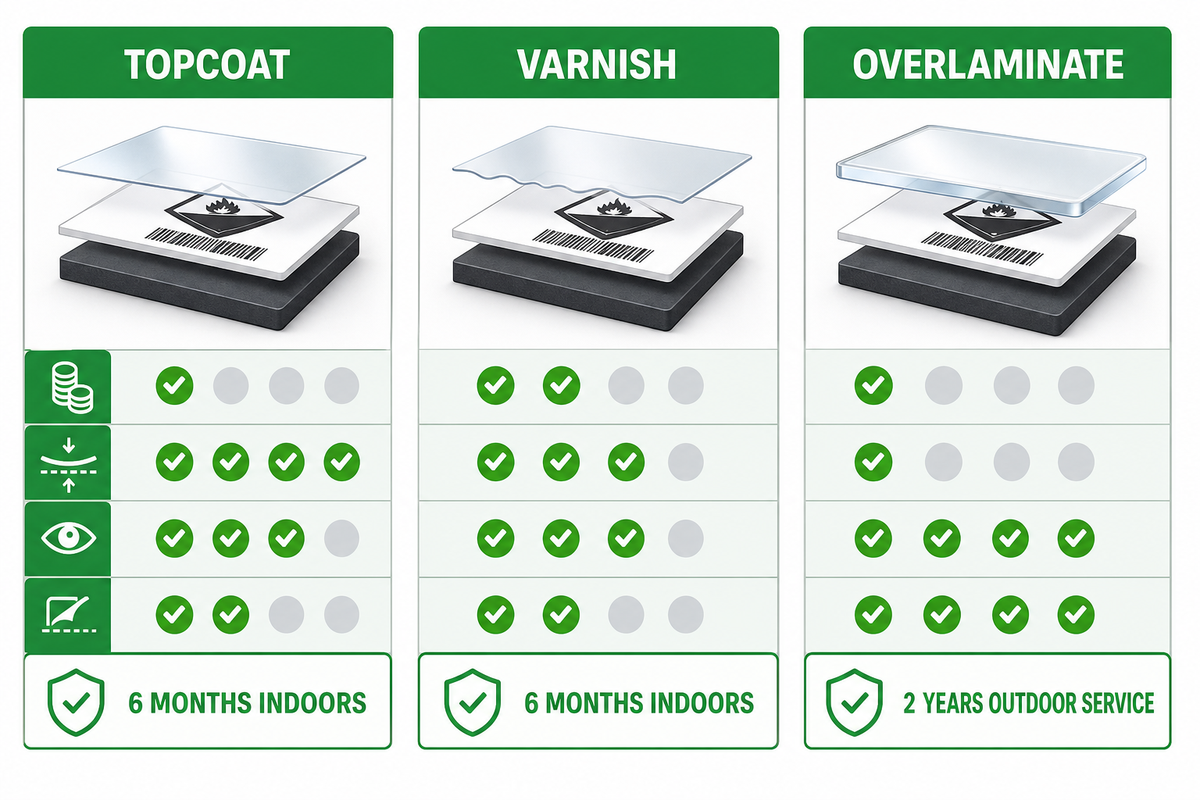
Topcoat, varnish, and overlaminate are not interchangeable. Topcoat is usually part of the facestock or print-receptive surface. Varnish is a coating added over print. Overlaminate is a separate film layer. Each can protect print, but they change cost, thickness, stiffness, clarity, and edge behavior in different ways.
Counterintuitive rule: overlaminate is not always the premium answer. If the label only sees controlled alcohol wipe-down and the tested topcoat holds barcode contrast, adding film may add cost and stiffness without meaningful benefit. If the label sees solvent splash, repeated abrasion, outdoor weather, chemical drum handling, or high-value safety information, the separate top-film becomes much easier to justify.
RFQs should also separate “nice to have” protection from mandatory function. If the label only needs a clean look for 6 months indoors, varnish may be enough. If the label must remain readable through 2 years of outdoor service, forklift abrasion, chemical splash, and repeated cleaning, the safer conversation starts with overlaminate plus adhesive and print-system validation. Film cost is easier to judge after the failure cost is visible.
| Protection option | Best fit | Watch-out |
|---|---|---|
| Topcoat | Mild wipe, print receptivity, controlled indoor labels. | May wear down under repeated solvent or abrasive contact. |
| Varnish | Moderate print protection, cost-sensitive programs, lower thickness. | Can be less durable than film under harsh chemical and abrasion exposure. |
| Overlaminate | Solvent splash, abrasion, UV, barcode labels, warning labels, long-service use. | Adds thickness and stiffness; edge lift and film compatibility must be tested. |
Turn the Decision into an RFQ
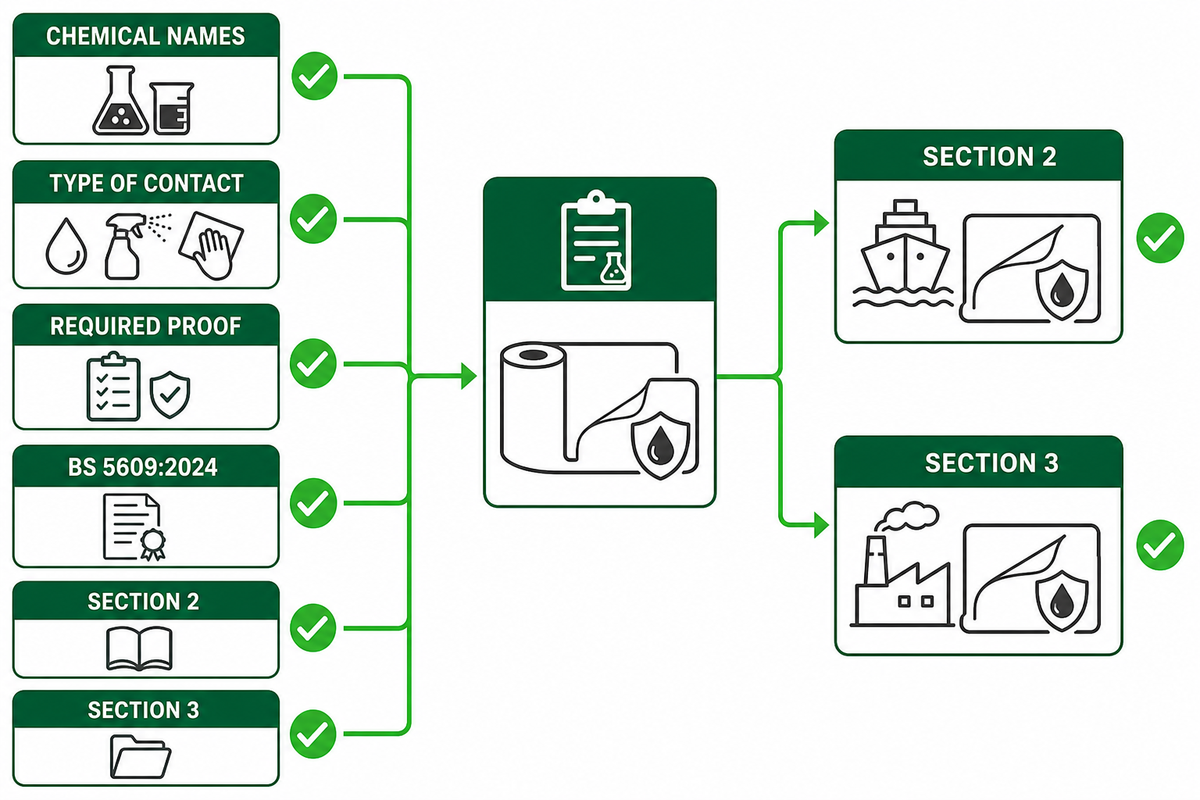
RFQ language for a chemical-resistant overlaminate label should be short, specific, and evidence-led. It should tell the converter what the label touches, what the label must keep doing, and what proof is needed before production. Without that, suppliers are forced to guess, and most guesses start from what is already in stock.
For Guanma, the practical buyer conversation usually includes facestock options such as PET, PP synthetic paper, and top-coated paper; adhesive choices such as solution acrylic, hot-melt, or water-based emulsion; and print methods such as thermal transfer with resin ribbon. Zhejiang Guanma Packaging Co., Ltd. has more than 15 years of label manufacturing experience and supports custom labels across many industrial applications, but final approval still depends on buyer-supplied chemicals, surfaces, and validation targets.
For exact quoting, send the container material, label size, artwork, expected chemical list, service environment, and approval target in the same message. If the label must follow BS 5609:2024 for marine transport, say whether you need Section 2 labelstock performance, Section 3 printed-label durability, or both. If the label is for in-plant hazard communication, include the SDS-driven text, pictograms, barcode type, and any small-container constraint before samples are made.
RFQ starter text
We need a chemical-resistant label with protective overlaminate for [chemical name/concentration], [wipe/splash/immersion/edge contact], on [container material and surface], with [print method/barcode requirement], used at [temperature range] for [service duration]. Please recommend facestock, adhesive, overlaminate film, print system, and sample validation evidence.
If the label is for marine dangerous-goods use, add the BS 5609 question separately. Public UL material describes BS 5609:2024 as separating Section 2 labelstock/adhesive performance from Section 3 print durability. That is a useful boundary: a labelstock statement and a printed-label durability statement are not the same evidence.
FAQ
Can I use a chemical resistant overlay film on existing labels?
Sometimes, but only after testing adhesion to the existing print and surface. Overlay film can protect printed information, but it can also trap contamination, lift at the edge, or fail to bond to certain inks. Test the final stack before relabeling production inventory, especially if the old label has dust, oil, varnish, or unknown thermal-transfer ribbon on the face.
How thick should my chemical resistant barrier material be?
Thickness should follow the exposure and application surface, not a fixed rule. Thicker films can improve surface protection, but they can also reduce conformability on small-radius bottles, flexible tubes, or curved housings. Ask for a film recommendation tied to chemical contact, abrasion, bend radius, service temperature, label size, and edge behavior. For prototypes, compare at least one thinner and one thicker construction on the real container rather than approving a sample from a flat swatch card.
What do overlaminates do?
Overlaminates add a clear protective film over printed label graphics. They can help resist abrasion, moisture, oils, chemical splash, UV, and repeated handling. Their main job is to preserve print, barcode, and warning readability while working with the adhesive and facestock below, so they should be judged as part of the full label stack.
What is the difference between a chemical resistant laminate film and an overlay film?
In label buying, the terms often overlap. Both usually mean a clear protective top-film applied over print. The important question is not the name, but the tested construction: facestock, adhesive, print, topcoat or varnish, overlaminate film, and application surface. Ask the supplier to state whether the evidence covers the final printed label or only a blank material sample. That one detail often explains why a label looks acceptable in a catalog but behaves differently after solvent contact, abrasion, or 50 °C storage.
Will a protective chemical resistant film yellow over time?
It depends on film chemistry, UV exposure, chemicals, heat, and service life. Request aging or outdoor-exposure evidence when appearance, color coding, or barcode contrast matters.