Get in Touch with Guanma

Quick Specs: PET vs BOPP at a Glance
| Density | BOPP ~0.90-0.91 g/cm³ | PET ~1.38-1.39 g/cm³ |
| Tensile modulus | BOPET (PET film) roughly 2x BOPP’s modulus — PET is the stiffer film, not BOPP |
| Continuous-use temperature | BOPP ~100-110°C | PET ~150-175°C |
| Relative cost | BOPP lower | PET commands a premium |
| Surface energy (labeling difficulty) | PP-based (BOPP) 29-31 dynes/cm, harder to bond | PET 43-47 dynes/cm, easier to bond |
| Best fit | BOPP: room-temperature consumer goods | PET: heat, chemical, or long-term outdoor exposure |
Here’s the short version before the full breakdown.
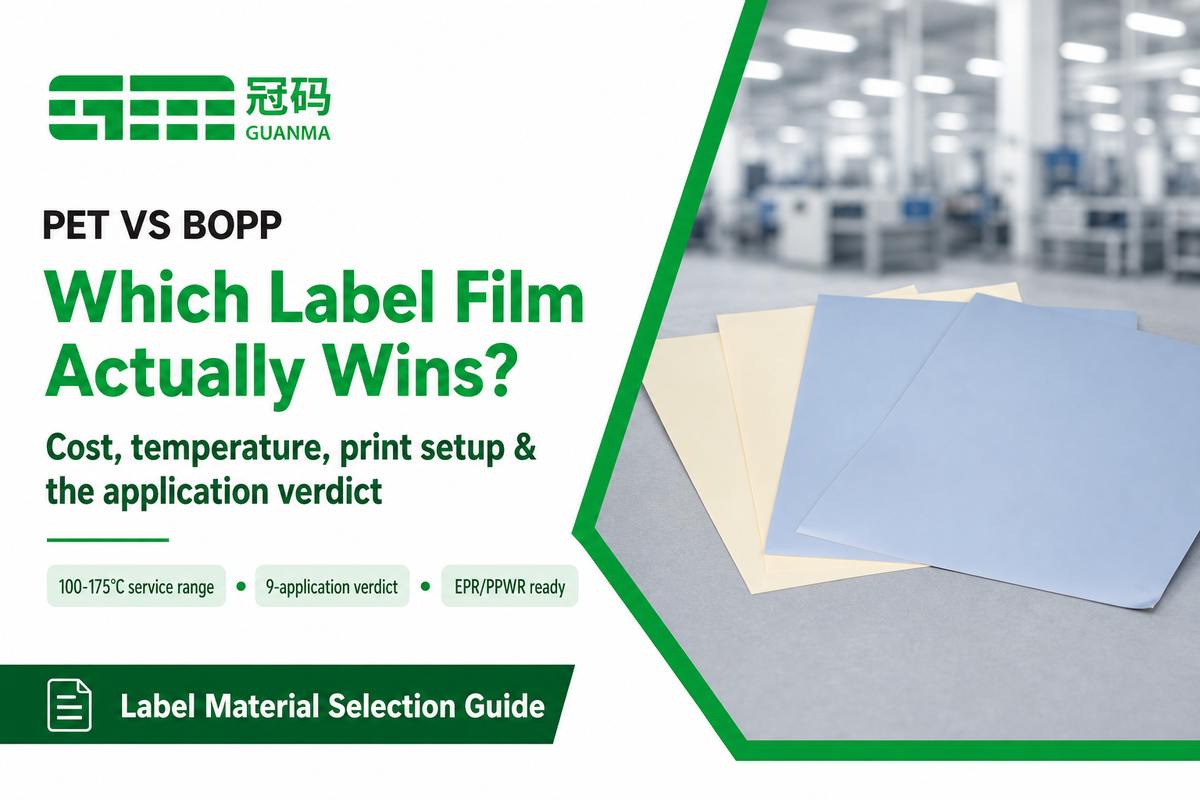
PET vs BOPP labels is the comparison between two plastic film facestocks used on product labels, and most buying guides list specs without answering the real question: what does this label need to survive? PET (polyethylene terephthalate) film and BOPP (biaxially oriented polypropylene) film, two types of plastic, make up the vast majority of product labels you’ll find on store shelves today. Simply choosing between these based on cost is often what quietly transforms a specification for your label into a re-labeling project down the line. Instead of repeating spec sheets or offering five choices, this is a definitive head-to-head guide for someone who’s already ruled out paper and vinyl and wants to know which film actually prevails.
One scope note before the comparison starts: this guide compares the facestock film itself — the PET or BOPP layer the print sits on. A finished label’s real-world performance also depends on the adhesive, ink, coating, and corona/plasma surface treatment paired with that facestock, which is why the Print Quality and Converting and Cost Crossover sections below flag adhesive- and treatment-specific factors separately rather than folding them into the facestock verdict.
What Actually Separates PET and BOPP at the Material Level

PET is a polyester film and BOPP is a biaxially oriented polypropylene film — two different polymer families, and that single difference dictates every trade-off in this guide. PET’s polyester base gives it a significantly higher melting point and tensile modulus, whereas BOPP’s polypropylene base gives it lower density (more label area per kilogram of resin) and lower cost per unit weight.
The name itself tells you how BOPP is made: BOPP stands for the process, stretching polypropylene film in two directions on a tenter frame rather than one. Both PET and BOPP are different families of polymer that have been stretched into thin sheets for labeling and are ready for adhesive application, and it’s exactly that biaxial stretching that gives both films their high tensile strength and strength and durability relative to an unstretched (cast) polypropylene or polyester sheet — produced by stretching the film in the machine and transverse directions simultaneously, the polymer chains align and lock in a way that a single-direction cast film never achieves.
Data provides more detail than typically found in most guides. For instance, comparing 20-micron BOPP to 12-micron BOPET (PET film), material science charts report a density of 0.91 g/cm³ for BOPP versus 1.393 g/cm³ for PET. More important for designers, who might want either a stiff or conformable label stock, the E-modulus for PET is approximately double that for BOPP in both machine and transverse directions (4400 N/mm² in machine direction vs. 2000 N/mm²; 5200 N/mm² in transverse direction vs. 3500 N/mm²). Independent material properties data corroborates PET as the stiffer film with a higher modulus; it’s worth noting, especially since one current BOPP vs. PET buying guide incorrectly claims BOPP has a higher stiffness than PET without providing supporting evidence.
Guanma manufactures both types of films every day at its facilities in Thailand and Vietnam. This practical difference is visible during production before it even appears on the data sheet. PET film is handled in a stiffer, more precise manner as it cuts to die lines with greater accuracy. BOPP’s lower modulus, on the other hand, is precisely what allows it to conform to curved surfaces such as bottles, avoiding corners peeling up and surfaces wrinkling like a stiffer material might on the same contour. To explore the wide range of finishes BOPP is available in (clear, white, gloss, matte, metallic) plus its excellent barrier properties against moisture and oxygen, and corona treatment processes, consult Guanma’s dedicated BOPP label film guide. To learn about construction options including food-contact and chemical-resistance, check the PET adhesive film product page. For a deeper, PET-only deep dive covering durability data, the no-label-look clarity effect, finish options, and recyclability rules, see our PET label material guide.
What Is the Difference Between BOPP and PET?
At a fundamental level, they’re just different types of plastic and the associated properties result from that difference. BOPP film is cheaper, lighter and specified for use to about 100 to 110°C continuously. PET film is denser and more expensive, but handles higher operating temperatures (150-175°C continuously) and has a significantly higher tensile modulus.
That’s why PET is the go-to whenever higher strength, durability, or long-term dimensional stability matter more than cost. While both bond to most standard pressure-sensitive adhesives, BOPP’s lower surface energy means it needs more care with PSA formulation and corona treatment to bond well, whereas PET often wets and bonds to most adhesives readily.
The Real Deciding Factor, Where Will This Label Actually Live?

The majority of PET vs BOPP comparisons pretty much end at PET is tougher/BOPP is less expensive, leaving you to guess where the border between the two actually lies. It lies at temperature, not vinyl-adjacent behavior — temperature does the heavy lifting in this decision, nothing else comes close.
Based on vendor specs, BOPP melts at 160-170°C with continuous operating temperature capped at just 100-110°C, while PET melts at 250-260°C with sustained operation anywhere from 150°C to 175°C depending on film type/crystallinity — a 50-65°C differential that dictates more labeling choices than anything else. That BOPP figure lines up with the polymer chemistry on record: a USPTO-published BOPP label film patent puts commercial isotactic polypropylene’s melting point at 160-166°C, just under the 171°C of a theoretically perfect isotactic polymer.
Use this as a decision tree, not a checklist:
- If label experiences sustained heat above ~100°C (eg engine components, autoclaved or retorted packaging, some heavy-duty drums etc) the PET will still maintain performance long after the BOPP starts to sag.
- And should your label have an application that requires the heat-seal process, or lamination as it happens on the converting line, bear in mind that a BOPP will heat seal somewhere between 120°C-140°C and will require 0.5-1.0 sec of dwell, while a PET would require between 180-210°C and longer dwell time to reach the same seal strength – a significant consideration for throughput speed on the press-line, regardless of what you’re doing to the finished label afterwards.
- if the product is frozen/chilled (drink/dairy/frozen food), both films perform well in the cold, it’s normally the adhesive that will fail in this situation rather than the facestock below 0°C.
- If cost is your biggest hurdle, and your application is at or below ambient temperatures (e.g., consumer packaged goods, cosmetics, and basic retail goods), then BOPP is almost always the answer. In fact, BOPP is what the material choice in most purchasing guidelines assumes if you leave it unspecified.
- BOPP’s higher flex gives better conforming capability on squeeze-container surfaces and in container corners and contours that have a tight radius; the stiffness of PET can produce corner-lifting at these tighter radii.
Which Is Better, PET or PP?
Framed as BOPP or PET, it’s not a “better/worse” call. PET takes the heat, thermal stability, and tensile modulus, while PP-based BOPP takes the value, the density advantage, and conforms nicely to irregular shapes. If the application sees heat over about 100°C regularly, go with PET; otherwise, go with PP/BOPP.
Those are the key differences that actually decide most PET products vs BOPP products purchasing questions, and for outdoor use specifically, temperature and UV exposure — not price — are what should drive the choice of right material.
That 100°C line traces to a structural root cause, not an arbitrary one: polypropylene’s crystalline melting range sits well below polyester’s, because PET’s aromatic ring backbone resists chain slippage at elevated temperature in a way BOPP’s simpler polypropylene chain doesn’t. That’s precisely why Guanma qualifies BOPP constructions against a documented 100-110°C continuous-use ceiling before a spec is approved, rather than relying on a generic “heat resistant” claim — a construction that hasn’t been qualified against the actual service temperature is the single most common reason a working label spec fails months after launch.
Cost Crossover, When BOPP’s Price Advantage Stops Mattering

BOPP is less costly per square meter and for the vast majority of room-temperature consumer-facing applications that’s the end of the conversation. But the price comparison that most buyers are performing is an incomplete one, as it compares face stock prices, not prices of failure. We call this the PET Premium Payback Line – the threshold at which a single relabeling event or compliance failure cost more than the PET premium over a full production run would have totaled.
This risk is much broader in scope than most label buyers imagine. The Sedgwick brand-protection Recall Index reported 506 FDA food recalls in 2023-a five-year high for the sector-with volumes of recalled units up 132.8% year over year and undeclared allergens-which can frequently be linked back to a labeling error-continuing as the top cause of food recalls for all quarters of the year. (A separate PIRG analysis of combined FDA+USDA food-and-beverage recall events counted 313 for the same year — different agencies and event-counting methodologies produce different totals, so treat the exact figure as directional rather than a single universal number, while the underlying trend — allergen-driven labeling failures rising — holds across both counts.) Lockton’s risk-management analysis of that same Sedgwick data describes this risk category as systematic labeling quality failure rather than a rare event.
📐 Engineering Note
Not only does changing face stock potentially represent an entirely new line-item expense, but it may also trigger a re-qualification process on the press. BOPP’s relatively lower surface energy (29-31 dynes/cm) sits close to the low end of what’s workable for proper ink and adhesive wetting; thus, a changeover to BOPP from a PET film may necessitate recalibrating corona treatment levels and adhesive coat weight prior to the first production run – in addition to renegotiating roll pricing. Incorporate those qualification time and effort factors into your “PET premium” comparison, not merely the cost per square meter of each film.
So, the practical guidance is this: for applications anywhere in the vicinity of a regulated high-consequence industry (e.g., food-grade, GHS/chemical, pharmaceutical or products for which a legibility or adhesion failure could result in a product recall rather than just a customer service call), the “total cost of failure” calculation should be performed prior to defaulting to the cheaper material. For most low-risk room-temperature consumer applications, the cost benefit of BOPP holds all the way through. However, for products closer to the regulated end of this spectrum, the PET premium is frequently less than the cost of a single product relabel.
Print Quality and Converting, Does the Material Change Your Press Setup?

Why yes, yes it’s – and there’s a measurable reason for it, not anecdotal evidence. Surface energy determines whether inks and adhesives achieve adequate wetting and reliable bonding; at 29-31 dynes/cm, PP-based films like BOPP fall into the “very high labeling difficulty” range per a major surface energy reference, while PET at 43-47 dynes/cm is classified as “low difficulty” in the same reference.
That’s why BOPP often requires a proper balance of corona treatment and adhesive, while PET may perform acceptably “off the roll.” Once that adhesion foundation is right, both films are capable of excellent printability with strong visual appeal across flexo, digital, and thermal-transfer processes — fine text, small barcode elements, and process-color graphics all reproduce reliably on either facestock when the corona treatment level is properly matched to the ink system.
Coat weight and cure time are other relevant considerations here. Many PSA adhesives will only achieve partial bond strength at the point of application; final “ultimate” adhesion isn’t usually achieved until approximately 24-48 hours later, so it’s important to factor this into any QA testing process that’s initiated during new facestock qualification-especially if your peel tests are performed within 20 minutes of application!
When a spec sheet provides a peel-adhesion number, it should be supported by a documented test method, not just descriptors such as “excellent” or “good.” Two common standards that do the job: FINAT FTM1, summarized by testing-equipment supplier Mecmesin, measures 180° peel adhesion on 25mm-wide strips at 300mm/min, tested 20 minutes and 24 hours after application (the latter considered ultimate adhesion), expressed in newtons per 25mm of width. Be sure to compare your spec requirements against the full details of FINAT’s published Test Methods manual. ASTM D3330/D3330M (currently the -04(2025) reapproved edition — the 2018 reapproval was superseded, so confirm you’re citing the active edition when it hits a purchase spec), as summarized by testing laboratory Adhesives Research, comprises six tests (A-F) for different label and tape structures using 25mm wide samples, on a polished stainless-steel surface, conditioned for 24 hours at 23°C/50% relative humidity, and the same 300mm/min peel rate. By way of general reference: low-tack tapes will likely yield 1-3 N/25mm, general purpose adhesion 3-5 N/25mm, and high-performance permanent acrylics may exceed 15 N/25mm. That scale will help evaluate the significance of any peel adhesion numbers provided.
Guanma uses both of its facestocks across a wide array of flexographic, digital, and thermal-transfer converting equipment. For a buyer seeking to substitute one facestock for another, the practical implication is to request the FINAT FTM1 or ASTM D3330 peel number associated with the specific film construction you’re purchasing, rather than simply accepting claims of “excellent adhesion,” and to test it at 24 hours after application, rather than rely on the 20-minute value. A high-quality construction is one where the supplier can readily provide that specific number, not one with a lot of marketing puff.
“The biggest converting mistake we see is a customer switching facestocks without re-testing corona treatment level first. BOPP’s low surface energy means a coat weight and dyne level tuned for PET will underperform on BOPP — it isn’t a defect in either film, it’s a qualification step that got skipped.”
Application-by-Application Verdict

This represents a direct, per-application comparison rather than a table you’d have to assemble yourself. Each product’s recommendation and the reasoning behind it are presented, rather than a checkmark. Both films cover a genuinely wide variety of applications for BOPP labels and PET labels alike — from personal care products and industries such as food and beverage to industrial drums — and the packaging needs and packaging requirements that actually decide the film aren’t cosmetic, they’re moisture resistance, heat resistance, and oil resistance, in that rough order of how often they eliminate one film outright. Listing “durability and resistance” as a requirement without naming which resistance — moisture, heat, or chemical — hasn’t actually specified anything a converter can qualify against; resistance to moisture alone rules out almost nothing between these two films, since both are broadly suitable for packaging in humid or refrigerated conditions.
The 5-Environment Material Verdict
This covers nine distinct application types, ordered according to the same decision logic presented in the prior section-service temperature, container configuration, and regulatory impact.
| Application Type | Verdict | Why |
|---|---|---|
| Beverage / room-temp retail | BOPP | Room-temperature service, cost-sensitive, conforms well to curved bottles |
| Cosmetics / squeeze tubes | BOPP | Lower modulus conforms to squeeze-bottle contours without corner-lift |
| Chemical / GHS drum labels | PET (case-dependent) | Higher chemical/solvent resistance and regulatory-consequence exposure justify the premium; verify against the specific chemical exposure |
| Automotive / under-hood / electronics | PET | Sustained heat above BOPP’s ~100-110°C continuous-use ceiling rules BOPP out directly |
| Outdoor / multi-year durable goods | PET | Higher dimensional stability and mechanical stiffness over long service life; UV-stabilized BOPP with lamination is a viable alternative — see the myth-check below |
| Food packaging (ambient, non-retort) | BOPP | Room-temperature service; needs both the resin (21 CFR 177.1520) and adhesive (21 CFR 175.105) food-contact clearances — see caveat below |
| Personal care / lotion & pump bottles | BOPP | Same room-temperature, curved-container logic as cosmetics squeeze tubes |
| Retail apparel / hang tags | BOPP | Cost-sensitive, room-temperature, short-to-medium shelf life — no heat or chemical exposure to justify the PET premium |
| Pharmaceutical / OTC packaging | PET | Regulatory-consequence exposure mirrors the chemical-drum case, and storage/transport can involve elevated temperatures PET’s higher continuous-use ceiling tolerates more safely |
There’s one caveat that applies across every single product and application described above, and it’s the mistake buyers most commonly get wrong: food-contact compliance is not a single checkbox on the finished label — it’s two separate FDA clearances that both have to hold. The facestock resin itself is regulated under 21 CFR Part 177 (177.1630 for PET polymers, 177.1520 for olefin/polypropylene polymers including BOPP), while the adhesive that bonds it to the package is regulated separately under 21 CFR 175.105. A supplier who only confirms one half — a “food-grade adhesive” without a matching Part 177 resin declaration, or vice versa — hasn’t actually delivered a compliant label. Asking for both compliance declarations in writing, not just assuming the pairing works because one half is food-grade, is the step that actually protects a buyer from a compliance failure at audit time.
The “BOPP Is Indoor-Only” Myth

One often repeated rule of thumb states that BOPP is an indoor-only film with a one-year maximum lifespan outdoors-a statement you’ll encounter even on syndicated comparison articles on the topic. This rule of thumb is wrong: real-world data contradicts it, since multiple label manufacturers report a six-month-to-two-year lifespan for BOPP outdoors depending on conditions, well past the “indoor-only” framing.
Multiple label suppliers list real outdoor or chemical exposure values for BOPP. For example, one manufacturer states BOPP is “water-resistant with a typical lifespan of 6 months to 2 years”, not waterproof and not strictly time-boxed to one year. One other vendor describes BOPP as “resistant to water, oils, chemicals, and UV rays”, positioning it for products that see heavy handling or tough conditions. Another label company reports BOPP performing reliably “under frequent handling, refrigeration, or outdoor exposure”.
A necessary disclosure on all three of these reports: All are from label vendors not independent ASTM/ISO UV-weathering lab reports, so view that 6 month to 2 year window with caution as it’s indicative not guaranteed. Guanma’s view mirrors this sensitivity not the dichotomy: Their BOPP, with UV stabilization and the option for a protective laminating layer, takes actual outdoor life beyond “1 year, indoors only” and into its own reality, though again, “extend” is not “match” to PET’s multi-year outdoor rating, and any genuinely multi-year outdoor application not relying on lamination still lands squarely with PET based on the flowchart above.
Recyclability, Does the Material Choice Actually Change the Sustainability Story?

A label’s environmental impact is neither an inherent trait of a facestock nor one that’s in the bag — it’s a function of whether or not a label “goes” with the bottle to which it’s adhered. And this isn’t marketing fluff, it’s literally how things are supposed to work: the Association of Plastic Recyclers’ PET Design Guidance requires label and adhesive constructions to meet specific crystalline-melt-point, color, and compatibility parameters to remain compatible with virgin PET reprocessing.
That requirement is backed by an EPA-authored, peer-reviewed 2022 review of plastic film recycling using measured data from Roosen et al.: postconsumer PET streams carry an average halogen contamination of 303 ppm, of which a measurable portion comes from labeling systems — not a future threat, an ongoing challenge already measured.
Government recycling programs are beginning to tackle it as an actual design feature, not as something to bolt on later. An Oregon DEQ Recycling Modernization Act technical workgroup record, for instance, calls out “detrimental labels” as a currently identified technical barrier to the recyclability of PET thermoform packaging, a phrase it has carried forward in its state-government record after taking comments from industry stakeholders. In a related report, a national lab identified a level of PVC contamination of just 50 parts per million to render a batch of PET resin useless in the recycling wash line – that’s PVC specific but highlights just how vulnerable PET recycling is to unwanted inputs.
In practical terms: a PET label on a PET bottle is the cleanest mono-material match for that container’s recycling stream. A BOPP label on a PET bottle isn’t inherently a dealbreaker – depends on adhesive chemistry, ink load and label cleanly detaching in the caustic wash – but it’s not the clean match that PET-on-PET is. A BOPP label on a PP or PE container is the mono-material match on the container’s end of the packaging ecosystem. Don’t view the facestock decision and the container material decision separately, and instead treat the two as a single packaging system problem.
It’s easy to make one mistake here, and it isn’t picking the wrong facestock outright — it’s picking a facestock in isolation from the container it will ship on, because the recycling-stream risk only shows up downstream, after the packaging is already committed. A brand that specs a BOPP label onto a clear PET bottle late in development, without checking it against the container material first, can end up with a hidden compliance gap that surfaces only when an EPR eco-modulation audit or a customer sustainability questionnaire asks for proof of mono-material construction. Because Guanma coats and laminates both PET and BOPP facestocks in-house across its Thailand and Vietnam lines, buyers can request a mono-material PET-on-PET or BOPP-on-PP construction review before the label spec is finalized, rather than discovering the mismatch after the first production run ships.
Industry Outlook, Where PET-vs-BOPP Selection Is Heading

The single clearest force likely reshaping this equation over the next few years isn’t a market-growth statistic – it’s the rise of Extended Producer Responsibility (EPR) regulation, and it’s either already here or coming fast. The EU’s Packaging and Packaging Waste Regulation (Regulation (EU) 2025/40, “PPWR”) took effect Feb. 11, 2025, and will become broadly applicable to all EU member states by August 12, 2026 – when companies will have to actually meet its requirements — mandating “economically viable” recyclability for all packaging by 2030 and increasing producers’ registration and fee obligations under EPR schemes. In the US, seven states (California, Colorado, Maine, Maryland, Minnesota, Oregon, and Washington) have adopted their own packaging EPR laws (a count independently confirmed across multiple 2025-2026 legal trackers, up from just five a couple of years ago), with more legislation coming down the pipeline; in California, the “truth in labeling” law (SB 343) restricts what can carry the recycling symbol on products packaged and sold in the state from and after its Oct. 4, 2026, effective date.
That’s a direct, bottom-line factor impacting facestock selection, not a general background trend. Under Oregon’s EPR law, for instance, eco-modulation fees are structured so white and colored PET are subject to higher rates than mono-material clear PET – so, in effect, that clean match described above now carries a specific compliance-cost penalty, not merely a preference for sustainability. For a brand putting product in a PET bottle, that’s a compelling reason, independent of the other cost/durability considerations discussed earlier in this Guide, to specifically pursue PET on PET labels.
Buyers who wait until the deadline is close face one risk: a facestock re-qualification isn’t a same-week change. Because switching a running SKU from BOPP to mono-material PET involves re-testing corona treatment, adhesive coat weight, and print calibration on the new construction (see the Print Quality and Converting section above), a brand that starts that process in mid-2026, right as SB 343 and the EU’s PPWR application date land in the same year, is competing with every other converter’s customers for the same qualification bandwidth. Guanma’s coating and laminating lines run both facestocks daily specifically so a construction review and sample run can happen well ahead of a compliance deadline rather than during it.
Estimates of the size of the broader BOPP and label-films market vary widely among market-research firms ($23 billion-$33 billion for 2025-2026 baselines, based on different calculation methodologies) – mentioned here only for broad context, not as a specific market size estimate.
Your action item in a 2026-2027 RFQ: If your company packs products in PET bottles (in any part of your portfolio), ask label suppliers about the availability of mono-material PET on PET construction and its specific eco-modulation cost implications in the context of current EPR regulations – not just the cost per 1,000 labels.
FAQ
The frequently asked questions below cover the follow-up decisions buyers most often raise once the PET-vs-BOPP call itself is settled.
What is the difference between BOPP and PET?
View Answer
BOPP (biaxially oriented polypropylene) and PET (polyethylene terephthalate) are two different plastic film families used as label facestock. BOPP is lower-cost, lower-density, and rated for continuous use up to roughly 100-110°C. PET is denser, commands a price premium, but carries a materially higher tensile modulus and a continuous-use rating up to roughly 150-175°C. In practice: BOPP suits room-temperature consumer goods where cost matters most, while PET suits applications facing sustained heat, chemical exposure, or long-term outdoor durability.
What are the 4 types of labels?
View Answer
Label facestock is commonly grouped into paper, BOPP, PET, and vinyl (PVC) — four material families covering the large majority of pressure-sensitive label applications, sold as either roll labels for automatic application or sheet labels for hand-applied short runs. A standard paper label is the default choice for short-life, low-cost, indoor product labeling, while a textured paper option trades some of that cost advantage for premium shelf appeal. Vinyl stickers and clear labels come up when a product needs the “no label” look or genuinely extreme outdoor durability — but vinyl carries a chlorine-related recycling penalty that a straight vinyl-and-BOPP comparison usually resolves in BOPP’s favor once recyclability enters the decision. This guide focuses specifically on the PET-vs-BOPP comparison — the harder of the different types of label material decisions, since paper-vs-BOPP and the difference between vinyl and BOPP are usually settled by cost and outdoor-durability alone — because it’s the choice most buyers face once they’ve already ruled out paper (indoor, short-life, low-cost) and vinyl (extreme outdoor durability, chlorine-related recycling penalty) and are down to finding the right label material between two very similar-looking films. For the full five-facestock comparison including paper and vinyl, see Guanma’s general label stock buying guide.
Is PET more expensive than BOPP?
View Answer
Yes, PET carries a real price premium over BOPP per square meter, driven by its higher density and more demanding processing requirements. Whether that premium is worth paying depends on service conditions and failure risk, not material cost alone — a room-temperature, low-consequence application rarely justifies it, while a regulated or high-recall-risk one often does. See the Cost Crossover section above for the full reasoning.
Can I switch from BOPP to PET without requalifying my printer?
View Answer
Not reliably. PET’s higher surface energy (43-47 dynes/cm vs. BOPP’s 29-31 dynes/cm) generally means it bonds ink and adhesive more easily, but coat weights, cure/dwell times, and corona treatment levels calibrated for one facestock don’t automatically transfer to the other. Re-verify peel adhesion (FINAT FTM1 or ASTM D3330, at both 20 minutes and 24 hours) on the new construction before committing to a full production run.
Is BOPP really limited to indoor use?
View Answer
No — that’s an oversimplification, and it’s one of the more persistent myths in this comparison. Multiple label manufacturers independently report BOPP handling real outdoor exposure: one gives a typical outdoor service life of 6 months to 2 years depending on conditions, another describes resistance to water, oils, chemicals, and UV rays, and a third reports reliable performance under frequent handling, refrigeration, or outdoor exposure. UV-stabilized BOPP grades, optionally paired with a protective lamination layer, extend real outdoor service life well past the “one year, indoors only” version of the rule of thumb. That said, treat the specific service-life figures as directional rather than certified lab data, since they come from label-vendor sources rather than independent ASTM/ISO UV-weathering tests — and BOPP still isn’t a match for PET’s multi-year outdoor rating in the most extreme, unlaminated exposure cases. “Indoor-only” is simply not an accurate blanket rule.
Which material is better for a beverage label vs a chemical drum label?
View Answer
For a beverage label at room temperature, BOPP is the standard choice — it’s cost-efficient and conforms well to bottle curves. For a chemical drum label, the calculus shifts toward PET (or a construction verified against the specific chemical exposure) because of the higher regulatory and safety consequence of a labeling failure, plus PET’s stronger chemical resistance profile at elevated temperatures. Always verify against the exact chemical and temperature exposure rather than defaulting on category alone.
Why We Write This
Guanma is a self-adhesive label stock manufacturer with coating, laminating, R&D, and sales capability. Our main products are PET, PP synthetic paper, and coated paper facestocks combined with hot-melt, water-based, and acrylic adhesives, produced at our plants in Thailand and Vietnam.
Our coating and laminating lines coat and laminate both PET and BOPP facestocks on a daily basis. Because of that, this article reflects our dual-material production experience, not a single-material supplier’s view. Where a statement is our own operational description rather than outside-source information, we’ve written it that way. Where we found a widely repeated claim that the data didn’t support (such as BOPP’s stiffness and outdoor durability), we said so directly.
Reviewed by the technical team of Guanma.
References & Sources
- Film Properties of Common Biaxially Oriented FilmsScienceDirect Topics (engineering reference)
- U.S. Product Recalls Surge 11% in 2023 to Hit Seven-Year HighSedgwick (2024 State of the Nation Recall Index)
- Product Recall: Mitigating Against Labelling and Packaging ErrorsLockton (citing Sedgwick US Recall Index)
- Labeling Low Surface Energy PlasticsBeontag
- Sticking Power: The Science of Choosing the Right Label AdhesiveKDV Label
- FINAT FTM1, Peel Adhesion (180°) Test MethodMecmesin
- ASTM D3330 Peel Adhesion Testing for Pressure Sensitive TapesAdhesives Research
- Recycling Compatibility of PET Packaging (peer-reviewed, EPA-authored)PMC / National Institutes of Health
- Recycling Modernization Act Technical Workgroup ResponsesOregon Department of Environmental Quality
- Plastics Recycling Contamination ReportIdaho National Laboratory (DOE/EPA)
- Packaging Waste, Regulation (EU) 2025/40European Commission, Directorate-General for Environment
- Seven States and Counting: The 2025 Guide to EPR Packaging ComplianceProskauer Rose LLP
- SB 343: Accurate Recycling LabelsCalRecycle (California Department of Resources Recycling and Recovery)
- Extended Producer Responsibility (EPR) LawsBrook & Whittle
- Polypropylene (BOPP) Labels, Everything You Need to KnowSmith Corona
- What Are BOPP Labels?Avery
- Top 5 Reasons to Choose BOPP LabelsInTouch Labels
- US12404401B2, Printable BOPP Label Film ConstructionUSPTO / Google Patents
- US20140069587A1, PET Bottle Label Recycling CompatibilityUSPTO / Google Patents
- BOPP vs. PET FilmSynponh
- 21 CFR 177.1630, Polyethylene Phthalate PolymersElectronic Code of Federal Regulations
- 21 CFR 177.1520, Olefin PolymersElectronic Code of Federal Regulations
Related Articles
- PET Label Material: Why Does It Win on Durability & Clarity?the full PET-specific deep dive on durability data, clarity, finishes, and recyclability
- BOPP Label Film: Types, Specs & How to Choosethe full BOPP-specific deep dive on finishes, corona treatment, and applications
- Label Stock Buying Guidethe general 5-facestock procurement guide, including MOQ, lead time, and RFQ template
- PET Adhesive FilmGuanma’s PET facestock product specifications
- BOPP Label FilmGuanma’s BOPP facestock product specifications
- Self-Adhesive Label FilmPET, BOPP & synthetic paper facestocks overview