Get in Touch with Guanma

![CCK Release Paper: Clay-Coated Kraft Liner Guide [2026]](https://guanmalabel.com/wp-content/uploads/2026/07/cck-release-paper-featured.png)
Updated July 2026 · A materials-side guide for plant engineers, converters, and procurement.
CCK release paper is a clay-coated kraft release liner: a kraft-paper base sealed on one side with a fine clay (kaolin) layer and then a silicone coating, so a pressure-sensitive adhesive peels away cleanly at a controlled release force. That three-part construction – kraft, clay, silicone – is why one CCK grade dispenses smoothly on a high-speed converting line while another drifts mid-reel. This guide explains the mechanism, how to read a release-force spec, how to choose basis weight, and how to diagnose the faults that stop a line.
CCK Release Paper at a Glance
| Base material | Kraft paper + clay (kaolin) coat + silicone |
| Basis weight | 45–160 g/m² (ISO 536) |
| Thickness | 47–130 µm (ISO 534) |
| Release force | 10–200 g/in (FINAT FTM 3, low speed) |
| Operating range | −40 to 200 °C (composite cure window) |
| Market position | ≈44% of label release liners worldwide (AWA study) |
What Is CCK Release Paper?
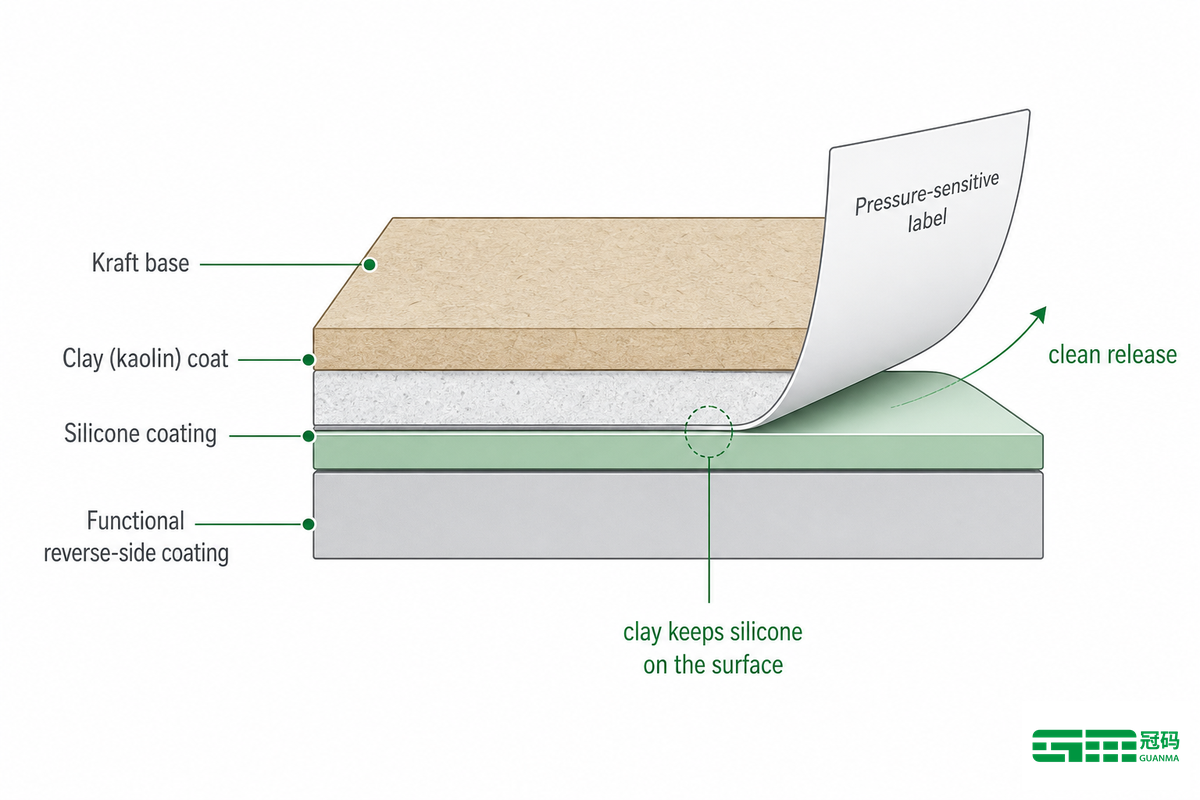
CCK (clay-coated kraft) release paper is a kraft-paper liner coated on one side with a fine clay layer and then silicone, so that a pressure-sensitive adhesive releases cleanly and at a predictable force. The clay seals the porous kraft surface so the silicone stays on top of the fibres instead of soaking in – and that single detail is what keeps release force uniform roll to roll.
To understand why the clay matters, picture the alternative. Bare kraft paper is porous. Coat it with silicone and the silicone wicks into the fibre network unevenly, so the amount left on the surface – the part that actually controls how the adhesive lets go – varies along the reel. Release force then changes as you run. The clay (kaolin) coat gives the silicone a smooth, closed surface to sit on. As the Pressure Sensitive Tape Council notes, a clay-coated kraft surface is “closed” and “allows less silicone,” which is both a cost lever and a consistency lever.
A finished CCK liner is a stack of four functional layers:
- 1. Kraft base – supplies strength, stiffness, and tear resistance for high-speed dispensing.
- 2. Clay coat – the kaolin barrier that holds silicone on the surface (silicone holdout).
- 3. Silicone coating – the low-surface-energy release layer the adhesive peels from.
- 4. Functional reverse-side coating (optional) – a back coat that improves lay-flat, dimensional stability, and printability.
That last layer isn’t a detail. The move from an open (uncoated) reverse side to a functional reverse-side coating is exactly what turned CCK from a compromise liner into a die-cutting workhorse. If you want the broader family context first, see our primer on how a release liner works before you go deeper on clay-coated kraft.
💡 Key takeaway
A clay coat is the reason a CCK liner holds release force. Judge a CCK grade by its clay coat and reverse-side treatment first – not by the silicone alone. Buyers also search for the same material as silicone coated kraft paper or silicone coated release paper, and weigh CCK release paper uses and price against film liners.
CCK vs PCK, Glassine, SCK & PET: Which Release Liner Wins When
CCK differs from PCK in one place that decides everything: the release surface is mineral clay, not extruded polyethylene. That makes CCK stiffer, more heat-stable, and paper-recyclable, while PCK (PE-coated kraft) lays flatter and resists moisture better. Neither is “best” – the winner depends on your climate, your die-cutting precision, and your recycling obligation.
The contrarian aspect you won’t find on most product pages: CCK isn’t automatically #1. According to the most cited industry figures, clay-coated kraft represents about 44% of the release-liner market, PE-coated kraft is 40%, and glassine plus SCK total near 12% with film liner the remaining 3% (AWA “Pressure-Sensitive Graphic Films” study, through Adhesives Magazine). But the worldwide number hides an important market distinction: In Europe, CCK has about 77% market share, while in the US, PE-coated kraft dominates at approximately 49%, with CCK coming in at 40%. That’s due to historical context-US CCK grades were conventionally shipped with an open reverse side, which was detrimental to dimensional stability. As a result, US converters favored PCK.
| Property | CCK | PCK (PE-coated) | Glassine | SCK | PET film |
|---|---|---|---|---|---|
| Release surface | Clay + silicone | PE + silicone | Densified paper + silicone | Supercalendered + silicone | Polyester + silicone |
| Die-cut precision | Good; can crack in complex cuts | Good | Excellent (dense, clean edges) | Very good | Excellent (thin, stable) |
| Moisture / lay-flat | Good (reverse-coated); weaker if open reverse | Excellent barrier | Moderate | Moderate | Excellent |
| Heat resistance | To ~200 °C (laser, composite cure) | Limited (PE softens) | Good | Good | Excellent |
| Recyclability | High (paper stream) | Lower (PE separation) | High (paper) | High (paper) | Low (PET stream) |
| Best fit | Labels, tape, composite, pharma | Humid climates, laminates | Fine die-cut, medical, electronics | Cost-sensitive mid-range | High-temp, electronics, ultra-thin |
Sources: AWA study in trade press; FINAT test methods; generally accepted industry specifications.
Think of this table as a guide to decision-making, not a scoreboard. Opt for CCK for paper recyclability, resistance to heat, and consistent printability on the reverse for standard label and tape converting applications. Choose glassine if precision die cutting and visual transparency are key; the densified surface of glassine provides cleaner cuts than CCK, which can experience cracking in its coating when subjected to very fine and detailed die cuts. SCK serves as a cost-effective balance, PCK is the go-to for stable lay-flat performance in high humidity and composite lamination, and PET is best when the process is primarily governed by high temperature or exceptionally thin material gauges. If the decision rests between CCK and a paper-based alternative, refer to our comparative guide on glassine release liner for in-depth information on the latter; the glassine release liner grades page lists product specifications.
Before honing in on CCK, consider this broader perspective of the landscape. The nine liner types detailed below are organized according to base material and release class-a classification process routinely employed by converters when narrowing down carrier options.
| Liner type | Base material | Release class | Best-fit use | Recyclable |
|---|---|---|---|---|
| CCK | Clay-coated kraft | Light–High (10–200 g/in) | Labels, tape, composite, pharma | Yes (paper) |
| PCK | PE-coated kraft | Light–Medium | Humid climates, laminates | Limited (PE) |
| SCK | Supercalendered kraft | Light–Medium | Cost-balanced mid-range | Yes (paper) |
| Glassine | Densified paper | Light–Medium | Fine die-cut, medical, electronics | Yes (paper) |
| Kraft (uncoated) | Kraft paper | Variable | Low-cost industrial tape | Yes (paper) |
| PET film | Polyester | Light–High | High-temp, electronics, ultra-thin | Low (PET) |
| MG paper | Machine-glazed kraft | Light | Light tapes, bakery release | Yes (paper) |
| MFK paper | Machine-finished kraft | Medium | General industrial liners | Yes (paper) |
| Non-silicone / linerless | Coated or linerless | Specialty | Linerless labels, specialty | Varies |
The EU–US split, and how CCK improved
The label market has long been dominated by two paper-based release liner options — clay coated kraft paper and PE-coated kraft — and the AWA global market study is the reference most of the industry quotes for the split. Yet the reason Europe CCK reaches about 77% while US converters historically leaned on PCK sits in paper production history, not marketing. For years, US clay-coated papers shipped with an open reverse side; European mills moved to coat the reverse too, so today CCK grades are mainly coated on both faces.
That functional reverse side coating — a CCK paper with a functional reverse side — is what let manufacturers improve the dimensional stability of the base. Over the years, mills refined CCK paper to improve the dimensional response to humidity, and in many jobs PE carriers were replaced with dimensionally stable CCK papers. The result: for most converting, CCK paper alone is an efficient, good release liner solution, and it is only in high-humidity extremes that PE-coated paper remains the premier option. CCK and PE grades can also be combined into a hybrid when a job needs both a paper face and a plastic moisture barrier.
The siliconizing properties of the CCK coating matter as much as the base. Because the properties of the CCK coating give a CCK coating with a strong, closed clay surface, the silicone sits on top of the coated paper rather than soaking in — the side coating does the releasing, not the fibre. That, plus the fact these clay-coated papers recycle in the paper stream, is why CCK papers offer improved sustainability over plastic grades and why so many converters now specify these grades as release liner of choice. Using this more advantageous release construction is, increasingly, the default across the wider release liner market.
How to Read a CCK Release-Force Spec (FINAT FTM 3)
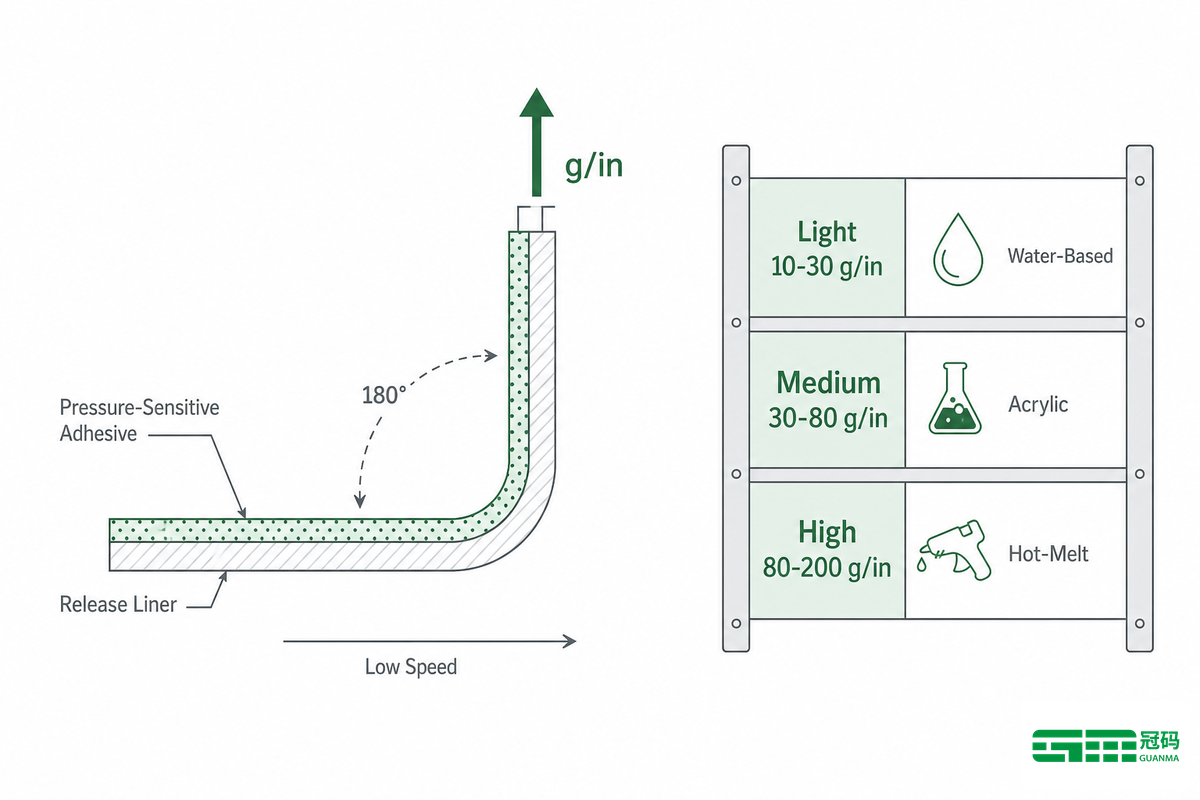
A release-force value only means something once you know the test speed behind it. The release force figures presented in most CCK datasheets are provided in grams per inch (g/in), determined through FINAT test method FTM 3. This method measures liner release from the adhesive at low speed and a 180° peel angle. This value primarily indicates liner performance during storage and slow handling-it doesn’t necessarily reflect behavior on a fast-moving dispensing line at 150 m/min.
Categorize release-force values into three practical ranges, and align the appropriate range with your adhesive and line speed:
| Release band | FTM 3 (g/in) | Adhesive fit | Typical use |
|---|---|---|---|
| Light | 10–30 | Water-based, removable | High-speed dispensing, peel-and-stick |
| Medium | 30–80 | Acrylic emulsion, UV-curable | Label converting, tape carriers |
| High | 80–200 | Hot-melt rubber, aggressive permanent | Industrial and automotive labels |
Here’s where confusion often arises. FTM 3 is a slow-speed test, and typically, release force increases with increasing peel speed. This means a product listed with a low-speed release force of 20 g/in may unexpectedly pop or break web when used at higher speeds on an accelerated line.
📐 Engineering Note — worked example
Suppose you’re dispensing water-based acrylic labels at high speed on a 150 m/min machine. Aim for the light band (15-25 g/in), but request release values at high-speed not the low-speed FTM3 numbers. If a supplier’s FTM3 = 20 g/in, and he can’t produce a high speed figure, use 20 g/in as a floor value, not a ceiling, and qualify a trial roll prior to purchase. A liner that tests 20 g/in slow but 55 g/in fast will likely lift labels from the web on your line.
One methodical way to reach a target band is using our release force selector; and once you’re ready to match numbers to a real grade, the CCK release paper specifications list the full tested ranges.
Choosing Basis Weight and Caliper for Labels, Tape, and Composites
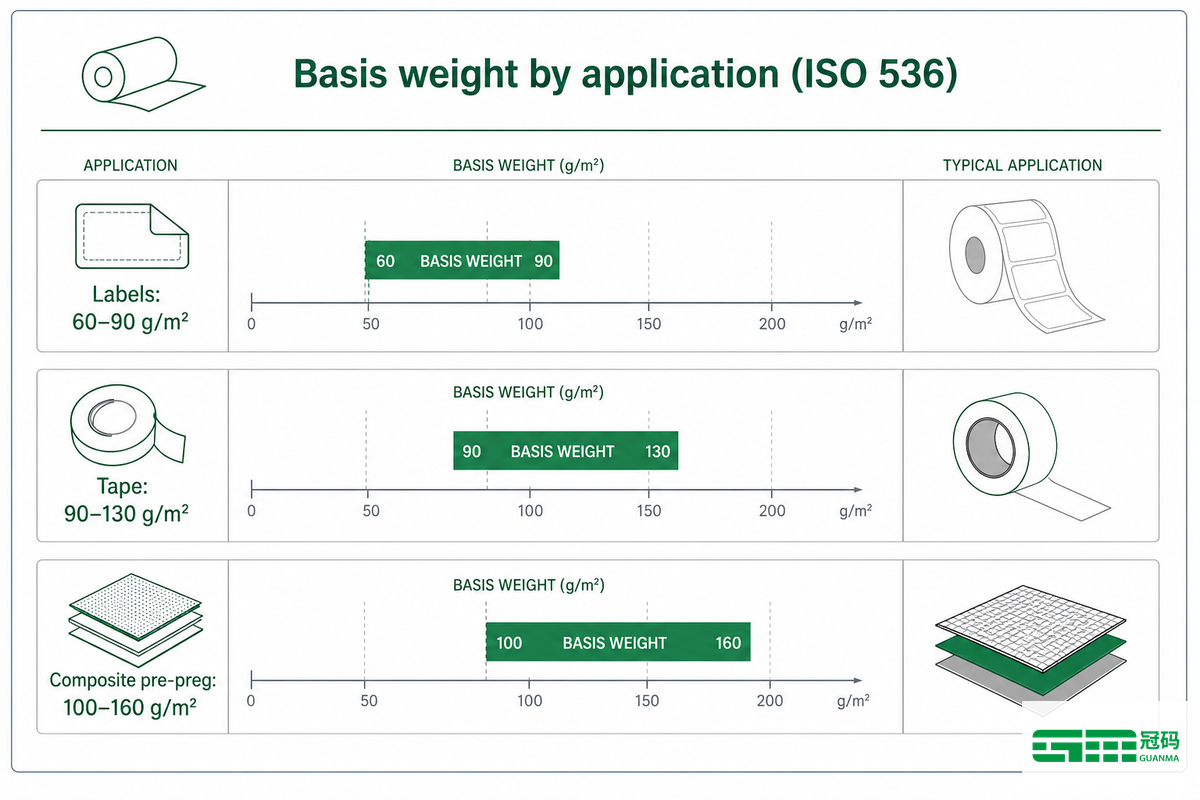
Choose basis weight by application, not preference, lighter for labels, heavier for tape and composite cure. The kraft base of a CCK paper carries the mechanical load of die-cutting and dispensing, so caliper decides whether a die cuts cleanly to the liner without cutting through it, and whether the web stays flat under humidity.
| Application | Basis weight | Why |
|---|---|---|
| Self-adhesive labels | 60–90 g/m² (78 typical) | Enough stiffness for clean die-cut; low bulk for high-speed dispensing |
| Tape / double-sided release paper carriers | 90–130 g/m² | Heavier web resists distortion under aggressive adhesives |
| Composite pre-preg liners | 100–160 g/m² | Dimensional stability holds through 180–200 °C autoclave cure |
Two basic rules of thumb help select basis weights fairly. First, the softer the liner, the greater the potential for the die to deform the web – an obvious die-cutting challenge identified in label-tech lit. Second, greater weight doesn’t mean better: the added caliper also raises costs, and adds stiffness that will counteract the needs of tight-radius wrap labels. If you’re still developing your total construction, facestock, adhesive and liner, start with our label stock selection guide, and for cold-chain jobs cross-check the liner against our freezer label materials notes.
Silicone Coating Chemistry: Solvent-Based, Solvent-Free, and Water-Based
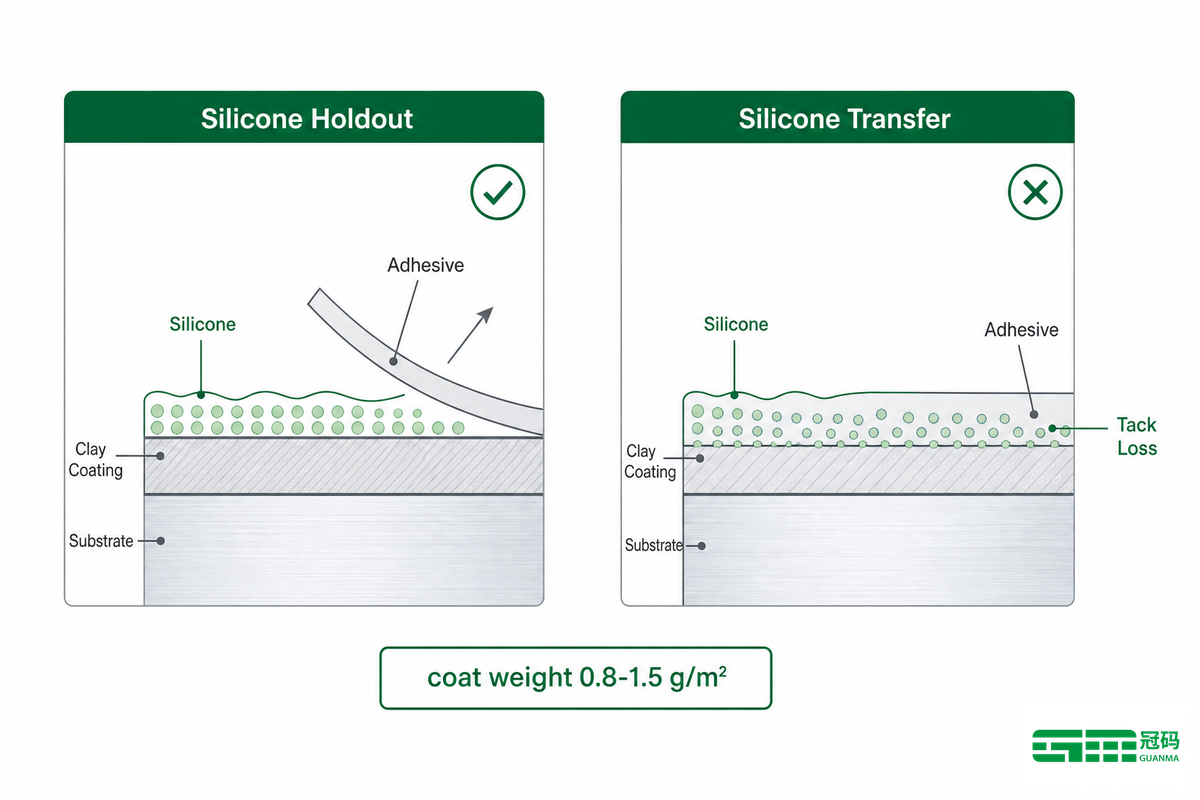
The silicone chemistry sets the VOC profile, the cure behaviour, and how well the coating stays put, its “holdout.” Most CCK is made in one of three chemistries, and each pairs best with a specific adhesive and compliance target.
Solvent-based
Lowest conversion cost, broadest adhesive compatibility, fastest cure. The workhorse of the product line.
Solvent-free
Closest to zero VOC. Essential for REACH and emission control and where solvent contamination of the adhesive is a concern (hot melt rubber and acrylic emulsion systems).
Water-based
A “green” solution for the majority of water-based adhesives (PSA and acrylic emulsions).
Two silicone concepts explain most failures. Silicone holdout is the coating staying where it should – on the clay-coated surface. Silicone transfer is the opposite: the silicone migrates onto the adhesive and kills its tack. Holdout is what you pay the clay coat for; transfer is what makes a liner fail. Silicone coat weight is around 0.8 to 1.5 g/m², measured by X-ray fluorescence. For a food-packaging converter, that usually means specifying solvent-free silicone to hold migration below the food-contact limit; for a high-speed label line, it means demanding a documented coat-weight window on every lot. The release-coating chemistry itself is well characterised in the patent record — see, for example, USPTO patent US6806339B2 on silicone release-coating compositions.
“We isolated 18 silicone-polymer-ratio combinations against the FINAT FTM 3 markers before we settled on our CCK release-force specification. Every batch of the final formulation then produced the same release-force range, whether it ran in Bangkok or Vietnam. Release-force repeatability is a procurement choice, not a marketing claim.”
A supplier’s most practical signal to demand is batch-to-batch consistency expressed as a coefficient of variation. Guanma’s coating lines, for example, bring release-force variation on the reel to below 2%, by sampling FINAT FTM 3 at reel start/middle/end on every slit.
Troubleshooting CCK Release Paper: 6 Converting-Line Faults
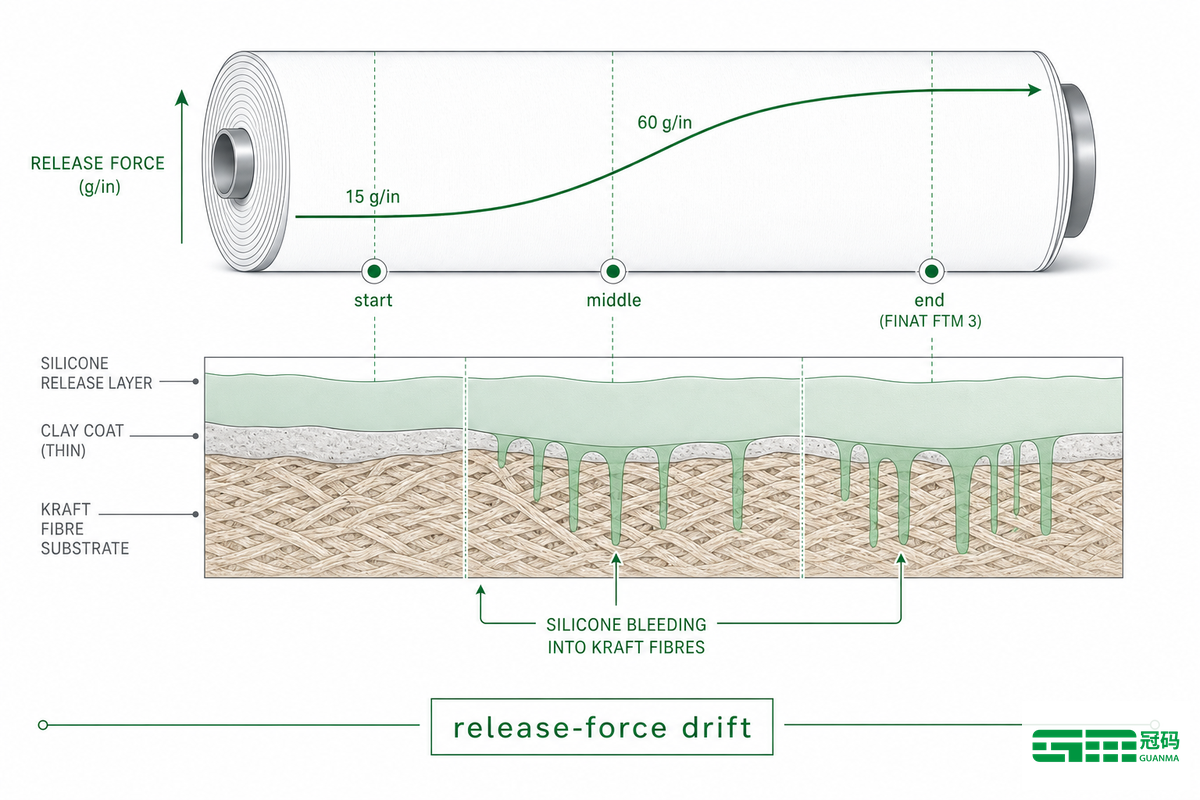
The most common CCK converting fault is release-force drift mid-reel, caused by silicone bleeding into the kraft where the clay coat is thin or uneven, confirmed by FINAT FTM 3 sampling at reel start, middle, and end. Most line stoppages trace back to one of six root causes. Use the table below as a diagnostic map: match the symptom, then attack the cause, not the symptom.
| Fault | Symptom on the line | Root cause | Corrective action |
|---|---|---|---|
| Release drift | Force jumps mid-reel (e.g. 15→60 g/in) | Silicone bleed into kraft; thin/uneven clay coat | Demand FTM 3 start/mid/end sampling; specify solvent-free holdout |
| Silicone transfer | Labels lose tack; adhesion failure | Poor cure or migration onto the adhesive | Verify cure; test adhesive tack after dwell; check coat weight |
| Die-cut registration | Cuts drift out of register in humidity | Dimensional swelling of the kraft base | Use reverse-coated CCK; acclimate stock; check ISO 5630 data |
| Curl / poor lay-flat | Web curls, feeds unevenly | Moisture imbalance; open reverse side | Specify functional reverse-side coating; control storage humidity |
| Static at dispensing | Labels cling, misfeed at high speed | Low humidity + fast peel builds static | Add static control; verify high-speed release band |
| Coating crack / mottle | Pinholes or cracks in fine die-cuts | Clay coat cracks under complex cutting | Switch to glassine or SCK for the finest cuts |
A field example fleshes the first row. A converter loads a 50,000 m roll, and peels its first 8,000 m without trouble; on the third reel the release force shoots from about 15 g/in to 60 g/in. Nothing changed; the silicone had bled into the kraft where the clay coat was thin. The solution is upstream in the coating, not downstream in the machine: a closed clay layer and start/middle/end release sampling on every slit. How a clay coat holds silicone under die pressure is documented material science — see patent WO2005052082A1 on structured paper release liners. You’ll meet this limitation again and again: the finest, most elaborate die-cuts sometimes belong on glassine, not CCK.
Reading a CCK Spec Sheet: Standards and What to Verify
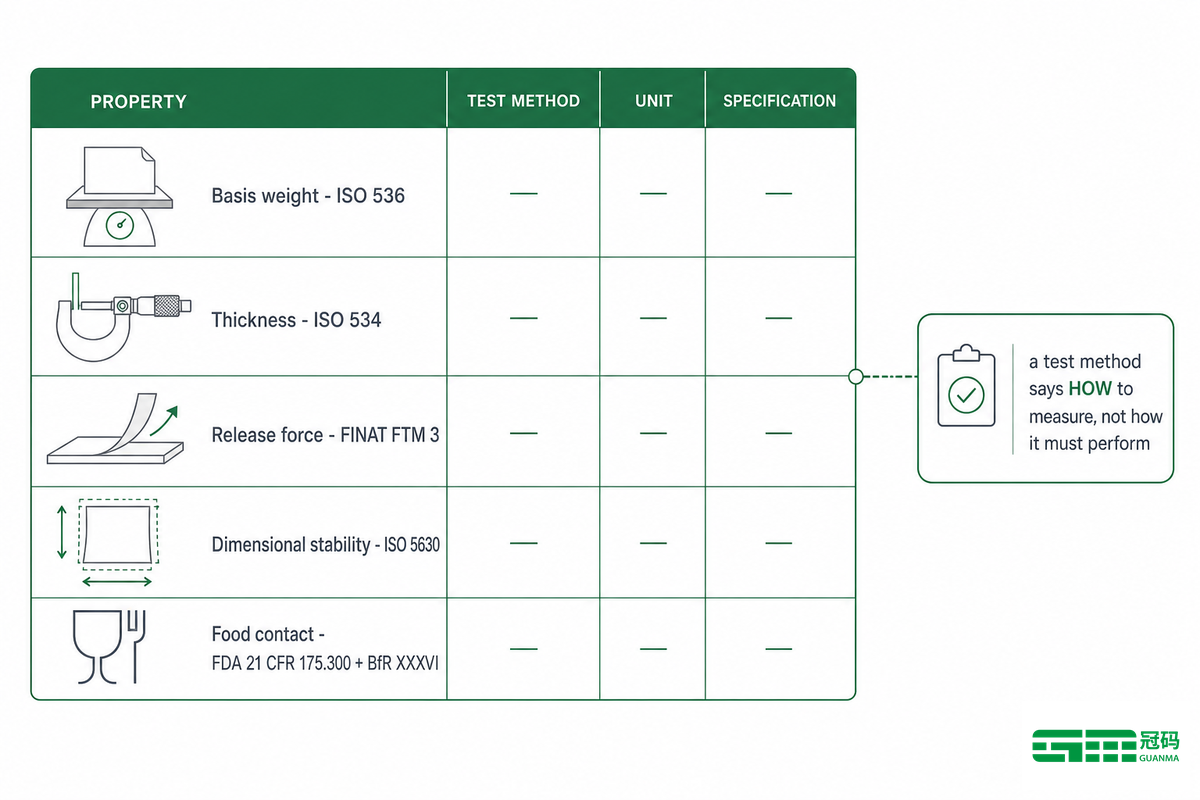
A test method tells the lab how to measure the liner, not how the liner must perform for you. Your own qualification file holds the performance spec. Know which standard governs which property; learn to read a CCK datasheet instead of trusting a badge.
- FINAT FTM 3 / FTM 2 — release force (low-speed 180° peel) and peel adhesion (90°). The core release measurements.
- ISO 536/ISO 534 – basis weight and thickness. The baseline dimension.
- ISO 5630/ ISO 8791 – dimensional stability in humidity and surface smoothness (Bekk).
- FDA 21 CFR 175.300 + BfR XXXVI – food-contact scope for the silicone/resinous coating layer.
Food-contact references are the ones most often answered incorrectly. The silicone-resinous coating is regulated by FDA 21 CFR 175.300 — the standard for polymeric and resinous coatings — not by 21 CFR 175.105, which relates to adhesives. Both can appear on a self-adhesive construction, but they control the respective layers. “175.300 compliant” describes the scope of the resinous coating, not blanket food approval. For regulated pharmaceutical/food work, confirm grade; see our pharmaceutical label materials page for full documentation. When you solicit a datasheet, request lot-level release force data and standard revision names, a CCK release paper spec sheet should name them.
Are CCK Liners Recyclable? The Sustainability Picture
Yes, CCK release paper is recyclable through standard paper streams, because the silicone is stripped during pulping and the kraft fibre re-enters the mix. That paper recyclability is CCK’s main sustainability strength versus PE coated and PET liners where the plastic barrier complicates separation. Paper-based CCK grades which are FSC and PEFC certified then also provide verified chain of custody.
One honest caveat: technically recyclable doesn’t equate to recycled. The release liner is the label industry’s hidden waste stream – much used liner continues to end up in landfill because the collection and de-siliconisation infrastructure is so limited. Liner-recycling take back schemes exist but they depend on the converter having the volume and logistics to participate.
If sustainability is on the agenda treat end of life of your liners as a sourcing question, not an add-on, and ask what end-of-life pathway the supplier actually supports. Other material considerations sit in our release paper and liner options overview.
Industry Outlook: Where Release-Liner Materials Are Heading (2026)
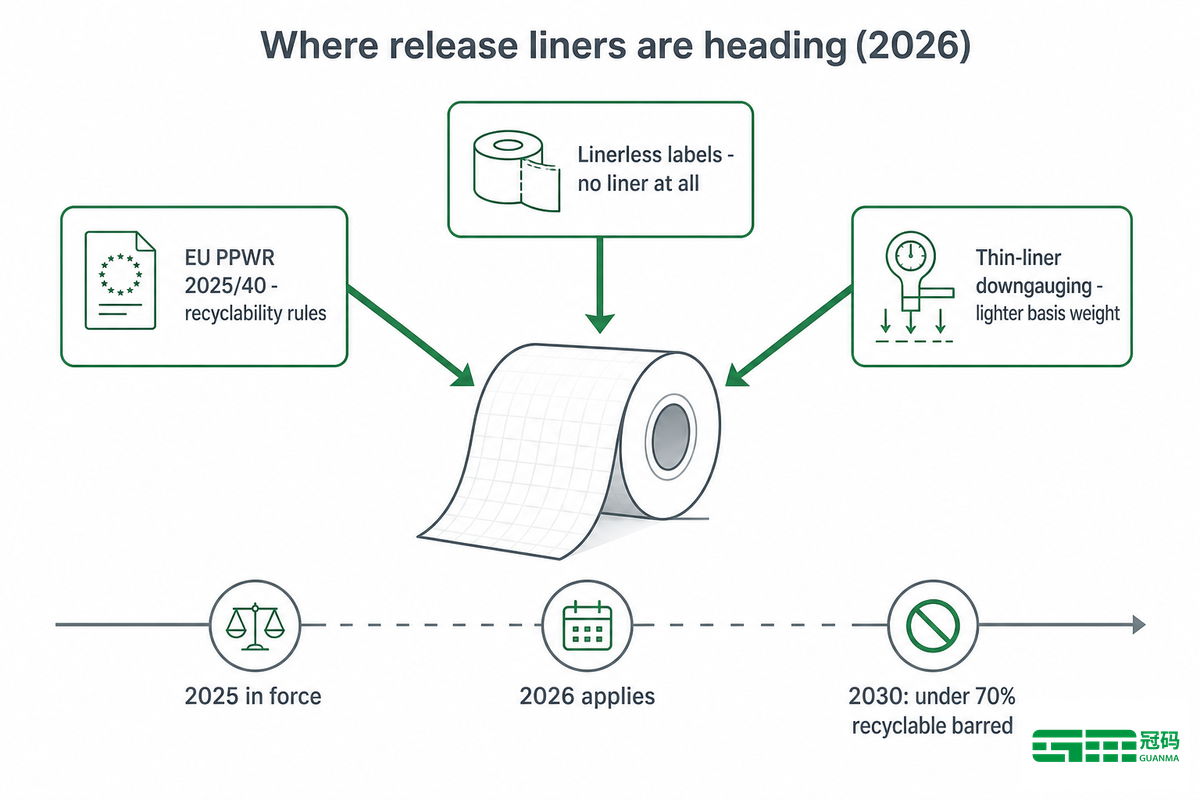
Regulation, not raw demand, is the force reshaping when a converter still specs paper CCK versus migrates away from it. The risk is concrete: a converter that misjudges the shift can be left holding non-compliant liner stock when the 70% recyclability cut-off lands in 2030, or paying to re-qualify a substitute liner against a deadline.
The EU’s Packaging and Packaging Waste Regulation (PPWR) 2025/40 became law on February 11 2025 and takes effect on August 12 2026; packaging won’t be allowed on the market if less than 70% recyclability is met from 2030. Paper-based CCK gets favourable consideration under this legislation. However the pressure to adapt is accelerating two forces which undermine demand for paper-liners; linerless label technology on very high-speed applications, and thin-liner downgauging – reduced basis weight in order to reduce per label cost and carbon.
Evidence of direction can be found in recent patents, e.g., a 2024 supercalendered-kraft release-liner patent utilizing recycled fibre content points towards lighter, more recyclable paper, not plastic-centric constructions. Market data on liner volumes – order-of-magnitude – points to a mid-single digit growth range for release-liners overall. A concrete action for 2026: before your next liner contract, audit your highest-volume SKUs for downgauge and linerless exposure, and ask whether each one still needs the liner weight it currently carries. A high-volume beverage-label converter, for instance, may drop the liner entirely on its top SKU with a linerless system, while a pharma converter keeps paper CCK for its documented compliance trail — the same regulation pushing two plants in opposite directions.
Frequently Asked Questions
Q: What is CCK release paper?
View Answer
CCK release paper is a clay-coated kraft release liner. The Kraft paper substrate is coated first with a thin kaolin clay barrier and then with silicone which allows the adhesive to be cleanly stripped off at a controlled level of release. The kaolin clay is designed to seal the kraft fibres preventing the silicone migrating into the fibre and so maintain consistent release properties between batches.
Q: What is the difference between CCK and PCK paper?
View Answer
Both are kraft-based release liners but they differ on their release surface. CCK uses a mineral clay layer under the silicone, whereas PCK (PE-coated kraft) relies on an extruded PE coating. The former is generally stiffer, more resistant to heat and easier to recycle in the paper loop, whereas the latter lays flat and better resists moisture, the reason why it is preferred in humid climates and on the US market.
On the most referenced AWA statistics, CCK and PCK respectively hold 44% and 40% of the release-liner market.
Q: What is the difference between CCK and SCK paper?
View Answer
The release surface of CCK (clay-coated kraft) is a clay coating; the release surface of SCK (supercalendered kraft) is derived from heavy calendering that compresses the paper structure itself without a coating. Because the SCK surface is compressed rather than coated, it often gives more uniform silicone coverage and better die-cutting stability than CCK, while costing less than glassine. CCK, in turn, offers better printability and heat resistance. SCK is frequently chosen as the balanced, cost-sensitive middle option between CCK and glassine.
Q: What basis weight of CCK release paper should I use?
View Answer
Match the basis weight to the application: about 60–90 g/m² (78 g/m² typical) for self-adhesive labels, 90–130 g/m² for tape and double-sided release paper carriers, and 100–160 g/m² for composite pre-preg liners that must survive a 180–200 °C cure.
Q: Is CCK release paper food-contact safe?
View Answer
Food-contact grades are available when using a low-migration silicone compliant to FDA 21 CFR 175.300 (the resinous and polymeric coatings rule) and BfR Recommendation XXXVI for silicones. Take note of the subject of those regulations: they regulate the silicone coating layer for indirect contact – not a universal food approval of the entire construct. Ask for grade-specific documents and migration data when working with regulated pharma or food applications.
Q: Is CCK release paper recyclable?
View Answer
Yes — the kraft base goes into standard paper streams for recycling, and the silicone separates off at the pulping stage. In practice, though, a lot of used liner still ends up in landfill where collection infrastructure is thin.
Q: Can CCK release paper be used for carbon-fibre composite curing?
View Answer
Yes. Heavier CCK grades — typically 100–160 g/m² with a solvent-free low-migration silicone — are designed to withstand the 180–200 °C window used to cure carbon-fibre and TPU pre-preg. The higher basis weight holds dimensional stability under cure pressure, while low-migration silicone keeps the uncured resin clean.
Check the cure temp, cycle and resin type with your supplier to ensure that your chosen grade suits your processing needs.
Match a CCK grade to your line
Send your adhesive, line speed, and release-force goal to our application engineers, who will propose the ideal CCK grade for you, and we’ll provide a trial roll for line qualification.
About This Analysis
This guide draws on published release-liner test methods (FINAT FTM 3), the AWA market study as reported by industry trade press, EU and US regulatory sources, and Guanma’s own coating-line records from its Thailand and Vietnam factories, including release-force repeatability below 2% variation across 18 silicone-ratio trials. Where data is directional or industry-sourced, we say so. Reviewed by the Guanma technical team.
References & Sources
- 21 CFR Part 175, Adhesives and Components of Coatings (175.300) — U.S. Electronic Code of Federal Regulations
- Packaging and Packaging Waste Regulation (EU) 2025/40 — European Commission
- FINAT Test Methods (FTM 3 release force, FTM 2 peel adhesion) — FINAT
- Release liner selection guidance — Pressure Sensitive Tape Council (PSTC)
- Release liner comparison: CCK vs. PCK paper (AWA market data) — Label & Narrow Web
- Release Liners: Clay-Coated Kraft vs. Polyethylene-Coated Papers — Adhesives & Sealants Industry
- US20240287741A1, SCK paper for release liner (2024) — USPTO via Google Patents