Ponte en contacto con Guanma

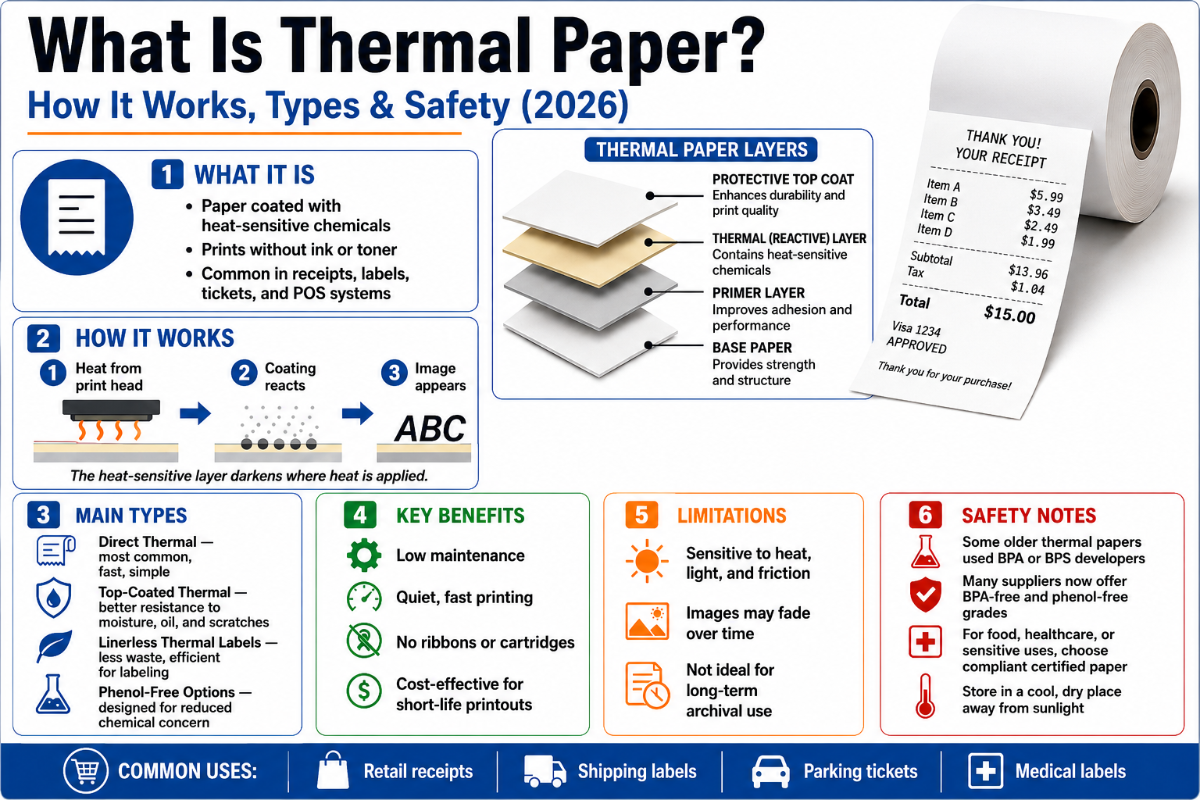
El papel térmico es un tipo de papel que se utiliza en ciertos tipos de impresoras y que se vuelve negro en respuesta a las altas temperaturas en lugar de usar tinta. Se utiliza en la mayoría de las cajas registradoras, etiquetas de máquinas expendedoras y billetes con los que interactúa. Sin embargo, el “papel térmico” es uno de los tipos de papel más tergiversados de la industria del etiquetado. La gente piensa que todo el papel térmico es igual, que la impresión es permanente y que “libre de BPA” es sinónimo de seguridad. Desafortunadamente, este no es siempre el caso. Esta guía intenta aclarar cómo funciona el papel térmico, la construcción del papel, las diferencias entre la transferencia térmica directa y térmica, la longevidad de las imágenes, la seguridad de las etiquetas y la dirección de toda la categoría como resultado de las regulaciones que entrarán en vigor en 2026.
Papel térmico de un vistazo
| Qué es | Papel con una capa termosensible que se oscurece bajo un cabezal de impresión térmica, sin tinta, tóner ni cartucho |
| Reacción de imágenes | Un tinte leuco y un revelador de color reaccionan bajo el calor para formar una marca visible (generalmente negra) |
| Capas centrales | Papel base · precapa · capa termoactiva · capa superior protectora (opcional) |
| Dos métodos de impresión | Térmico directo (sin ribbon) y transferencia térmica (usa un ribbon) |
| Peso típico | Comúnmente 48-80 gsm «más liviano (~48-55 gsm) para recibos, más pesado (~70-80 gsm) para boletos y registros médicos; Las bandas varían según el molino y el grado |
| Imagen vida | ~6 meses a 10 años; la mayoría del papel de calidad POS tiene una duración de 5 a 7 años si se almacena bien |
| Opciones de seguridad | Sin BPA, sin BPS y sin fenol (el nivel más seguro) |
¿qué es el papel térmico? (Y cómo se imprime sin tinta)
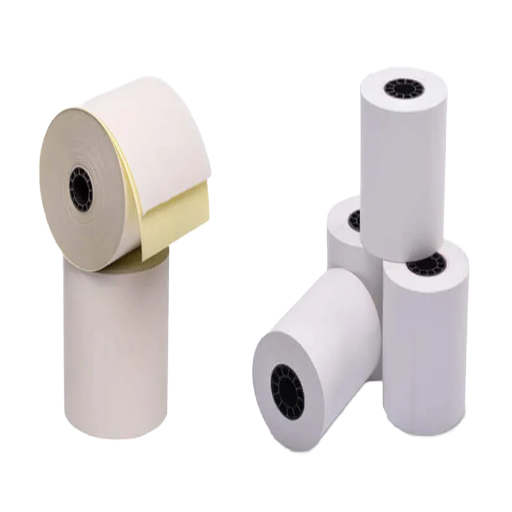
el papel térmico es un tipo de papel especial recubierto que tiene una capa química reactiva que altera el color del papel cuando la impresión del elemento calefactor de la impresora entra en contacto con él. Es similar a lo que verías vendido como papel de impresora térmica, o simplemente papel de impresora para máquinas receptoras, pero se diferencia mucho del papel de impresora estándar. En una impresión térmica directa no se utiliza tinta, tóner ni cintas. La imagen es producida por el papel. Esta distinción específica explica mucho sobre el producto: aclara por qué las impresoras térmicas son más silenciosas que las tradicionales, por qué los recibos tienen una sensación elegante y por qué la impresión tiende a desvanecerse con el tiempo.
Dentro de las impresoras térmicas hay filas de pequeños elementos calefactores que tocan el papel en movimiento. Cuando se activa cada elemento, el recubrimiento cruza el umbral de temperatura para su activación, provocando un proceso químico que vuelve el punto negro. Esto crea texto y códigos de barras a miles de puntos por segundo. El único consumible en este proceso es el papel, porque la reacción química está integrada en el revestimiento, un material de grabación sensible al calor cuya composición se detalla en patentes de materiales de registro térmico.
¿Cuál es la diferencia entre papel térmico y papel normal?
El papel normal (unido) solo imprimirá una imagen si se deposita tinta, tóner o una cinta que contenga pigmento. Este no es el caso del papel térmico, que tiene una química de formación de imágenes incorporada en el recubrimiento y, por lo tanto, no requiere un suministro de tinta para funcionar en una impresora. Cuando se coloca papel bond simple en una impresora térmica directa, quedará en blanco. Sin embargo, si se coloca papel térmico en una inyección de tinta, la tinta se mancha el revestimiento resbaladizo. Por eso también un recibo térmico se siente más suave que una letra impresa: esa suavidad es el revestimiento.
💡 La prueba de las uñas
¿No está seguro de si una hoja es térmica? Raspe una uña o el borde de una moneda sobre ella. El papel térmico produce una línea oscura por el calor de fricción. El papel común no deja marca. Esta es una prueba rápida de campo antes de cargar un rollo o bobina desconocido.
Conclusión clave: el papel térmico contiene una química térmicamente reactiva que le permite imprimir sin tinta. Sin embargo, ese mismo recubrimiento es el que luego responde al calor, la luz y los aceites durante el almacenamiento.
Papel térmico interior: la anatomía del revestimiento de cuatro capas
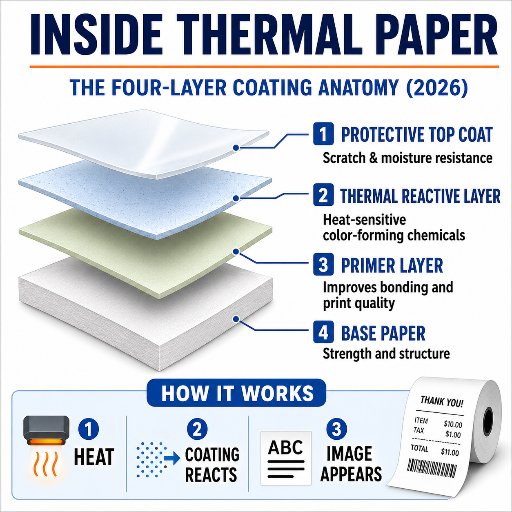
La mayoría de las guías sólo llegan hasta “tiene un revestimiento”. En realidad, el papel térmico de calidad es una construcción de múltiples capas de ingeniería, y cada capa determina cómo se imprime el papel y cuánto tiempo vivirá la imagen. Esto es lo que llamamos el Anatomía del recubrimiento térmico de cuatro capas. Saber que esta es la diferencia entre comprar sobre precio y comprar sobre rendimiento.
| Capa | Qué es | Por qué es importante |
|---|---|---|
| 1. Papel base | Sustrato de pulpa de madera, ~48-80 gsm | Establece la rigidez, la resistencia al desgarro y cómo se alimenta el rollo |
| 2. Precapa | Capa base aislante (a menudo arcilla, látex, cargas calcinadas) | Aísla y suaviza para que el calor permanezca en la capa activa “mejor imagen con menos energía |
| 3. Capa térmica activa | Normalmente unos pocos g/m²: colorante leuco + revelador de color + sensibilizador + aglutinante | La imagen misma; la química del desarrollador decide la oscuridad y la seguridad |
| 4. Abrigo protector (opcional) | ~1-1 g/m² capa transparente | Protectores contra agua, aceite, alcohol, plastificantes y desgaste de cabezales de impresión |
La química de la capa 3 es el corazón de ella. A temperatura ambiente, el tinte leuco y el revelador se separan, bloqueados por un aglutinante sólido. Cuando el cabezal de impresión calienta un punto más allá del umbral de fusión del recubrimiento, el revelador se funde, contacta con el tinte y fuerza una reacción de formación de color: el tinte acepta un protón y se vuelve negro. La reacción es rápida y local porque sólo el punto calentado se funde, por eso la impresión térmica es rápida y no necesita secado, y también por qué un tablero caliente puede oscurecerse o borrar un recibo completo más tarde.
A referencia técnica del papel térmico documenta dos capas opcionales que algunos grados añaden: una capa posterior para controlar la curvatura o alabeo y la estática, y la capa protectora superior que lo sella todo. Esa capa superior es el mayor determinante de la vida útil —lo que conduce a la compensación que cubrimos en la sección de grados.
Conclusión clave: la calidad de impresión vive en la capa previa y activa; La vida útil vive en la capa superior. Un rollo de gama baja generalmente se salta la capa superior.
Transferencia térmica directa versus transferencia térmica: dos formas de imprimir con calor
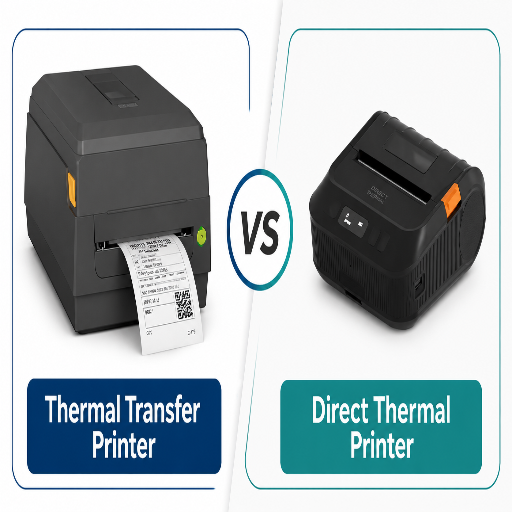
Ambos métodos utilizan un cabezal de impresión calentado pero colocan el color en lugares muy diferentes.
Con la térmica directa, el cabezal aplica calor directamente al papel estucado y el papel se colorea “sin cinta, porque el papel es la fuente del color. Por eso se llama ”térmica directa”: no se transfiere ningún pigmento separado. La transferencia térmica utiliza en su lugar una cinta de cera o resina. El medio térmico directo “el papel estucado que se colorea a sí mismo “es un material de grabación patentado; patentes de materiales de grabación sensibles al calor documente la química del desarrollador detrás de esto.
Aquí, el cabezal de impresión en realidad se imprime en la cinta, que luego transfiere la tinta (como pigmento líquido/fundido) a su material facial. Eso significa que su material facial puede ser papel normal, sintético e incluso superficies impresas. Como se trata de una guía de “aprender cómo”, no de “¿qué diablos es esto?”, hay más información sobre cada proceso y las categorías específicas de grado Guanma para nuestras líneas de papel térmico autoadhesivo de transferencia térmica directa y térmica disponibles en enlaces separados.
| Dimensión | Térmico directo (DT) | Transferencia Térmica (TT) |
|---|---|---|
| Fuente de la imagen | El papel estucado se oscurece | La cinta derrite el pigmento sobre el material frontal |
| ¿se necesita cinta? | No | Sí (cera/resina-cera/resina) |
| Imagen vida | Meses a unos pocos años; se desvanece con el calor/la luz | Años a décadas; mucho más estable |
| Mejor para | Recibos, etiquetas de envío, billetes de corta duración | Etiquetas de activos, etiquetas de batería/químicas, códigos de barras de archivo |
| Costo corriente | Inferior (solo papel) | Superior (papel + cinta) |
¿es mejor la transferencia térmica directa o térmica para las etiquetas de envío?
Para la gran mayoría de las entregas de envío, DT tiene que ser suficiente. Su etiqueta de envío solo necesita sobrevivir al viaje de unos pocos días a varias semanas en tránsito y se evita el costo de la cinta, mientras que los mecanismos de la impresora siguen siendo más simples, livianos y menos propensos a fallar que los sistemas TT.
Pero cuando su etiqueta necesita ser mucho más resistente que su impresora, cuando la etiqueta es la variable clave en su éxito a largo plazo, entonces elegirá la transferencia térmica. Este es el caso cuando: Una etiqueta de tambor está sujeta a calor y productos químicos, o Las etiquetas de inventario del almacén utilizadas durante años deben seguir siendo legibles, o Un envío en cadena de frío debe soportar los rigores de repetidos lavados. Una regla de oro: hacer coincidir el método de impresión con el tiempo y la dureza que debe durar la etiqueta “cuanto más larga y dura sea, más TT « no será la impresora que posee.
Conclusiones clave: DT es barato y simple pero desechable; TT es más caro pero perdura; Los requisitos de vida dictan sus elecciones, no el hábito ni el hardware actual.
Tipos y grados de papel térmico (económico, con revestimiento superior, premium)
“El ”papel térmico” denota toda una categoría de productos.
Para el papel térmico directo, los productos se dividen en aproximadamente tres niveles de sensibilidad y rendimiento, y lo principal que separa las buenas notas del resto es una simple capa: esa capa superior de la sección de anatomía, lo que llamamos la compensación de capa superior.
| Grado | Abrigo | Resiste | Uso típico |
|---|---|---|---|
| Economía (sin recubrimiento) | Ninguno | Poco; manchas de aceite/agua | Recibos POS de corta duración |
| Revestimiento superior | ~1-12 g/m² | Agua, aceite, alcohol, abrasión, plastificantes | Envío y etiquetas de productos |
| Premium/especialidad | Química más pesada + sintonizada | Temperaturas del congelador, archivo largo, manejo duro | Etiquetas duraderas, de cadena de frío y sanitarias |
Lo que separa las buenas calificaciones de impresión de las malas son dos números.
El primer número es una medición de sensibilidad estática: el número que representa la temperatura cuando el recubrimiento es sensible al calor por primera vez y comienza a cambiar. El segundo es la sensibilidad dinámica: qué tan rápido y con qué energía el recubrimiento se filtra a velocidad lineal. Imágenes de papel bien combinadas limpiamente con menor energía de cabeza, lo que significa códigos de barras más nítidos y mayor vida útil del cabezal de impresión, porque la misma capa superior que protege la imagen también protege el cabezal de la abrasión.
Ayuda para la decisión: adaptar un grado al trabajo
- La exposición al aceite/grasa o al alcohol (servicio de alimentos, laboratorios químicos) requiere un producto con recubrimiento superior, ya que la impresión puede untarse sobre una capa desprotegida.
- Congelador o cadena de frío → a térmica directa premium con clasificación en frío además de un adhesivo para temperatura fría; Los medios térmicos directos libres de fenol resistentes a la decoloración de esta clase están cubiertos por recientes Patentes de la USPTO.
- Luz solar, calor o un archivo de varios años → dar un paso al frente transferencia térmica; ningún grado térmico directo es genuinamente archivístico.
- Recibos minoristas de alta velocidad donde las reglas de costos → capa superior económica o ligera es aceptable.
Conclusión clave: para compras de capa superior, pague cuando la etiqueta tenga humedad, aceite o tiempo, y omita solo para recibos que sean realmente de corta duración.
Dónde se utiliza papel térmico: recibos, etiquetas, boletos y cadena de frío
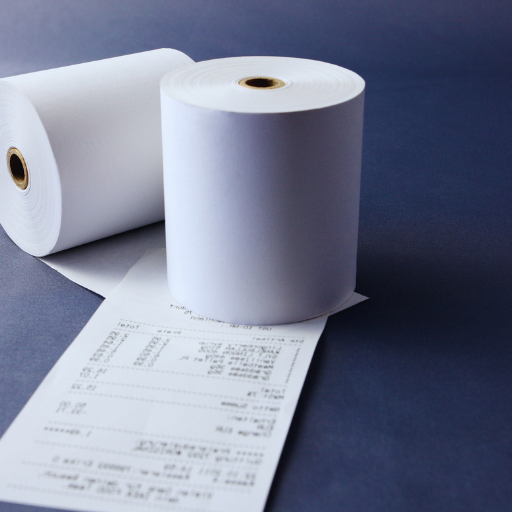
el papel térmico está presente donde se priorizan los requisitos de velocidad, bajo costo y ausencia de suministro de tinta sobre la permanencia. Cada aplicación exige algo diferente al papel. Por lo tanto, la pregunta inteligente no es “qué rollo o bobina es mejor”, sino “cuáles de las propiedades necesita este trabajo.”
- POS y recibos — alta velocidad, bajo costo, corta duración. Para la mayoría de las empresas, un rollo de papel térmico económico de 48–55 gsm, papel térmico simple para recibos, es la norma; aquí la calidad de impresión del papel para recibos y la confiabilidad de alimentación importan más que la vida de archivo.
- Etiquetas de envío y logística « Los códigos de barras deben leerse por primera vez incluso después de un tránsito brusco, por lo que una culata térmica directa con revestimiento superior mantiene al mínimo los daños por desgaste y agua.
- •Boletos y pulseras-70-80 GSM resistencia al desgarro para pasar puertas con uso diurno normal
- Etiquetas de cadena de frío y congelador – El papel necesita imágenes en la línea; el adhesivo debe mantenerse a temperaturas bajo cero. El más difícil de estos desafíos combinados es conseguir que un adhesivo se mantenga a esas temperaturas gélidas.
- Healthcare « stock más pesado para discos y pulseras, además de resistencia de capa superior al desinfectante para manos y guantes.
Reuniendo estas exigencias, así se corresponden las aplicaciones habituales con un grado, un gramaje y el riesgo que realmente determina la especificación: una referencia rápida para ajustar el papel térmico a la aplicación (valores típicos; los grados exactos varían según el proveedor):
| Categoría de aplicación | Clase de grado | Peso (gsm) | Abrigo | Imagen vida | Riesgo que impulsa la especificación |
|---|---|---|---|---|---|
| recibo de POS | Economía DT | 48–55 | No | 1-3 ani | Calor/luz desvanecida |
| Boleto de tarjeta de crédito | Economía DT | 48 | No | 1-3 ani | Plastificante (billetera) |
| Etiqueta de envío/logística | Dt con recubrimiento superior | 60–80 | Sí | 1-3 ani | Resoplido, humedad en tránsito |
| Etiqueta de activo de almacén | Transferencia térmica | 70–80 | Cinta | 5-10+ ani | Abrasión a lo largo de años |
| Etiqueta de cadena de frío/congelador | Dt frío premium | 70–80 | Sí | 2-5 ani | Agarre adhesivo por debajo de 0°C |
| Entrada para evento/tránsito | Dt con recubrimiento superior | 70–80 | Sí | <1 año | Desgarrando puertas |
| Pulsera sanitaria | Dt premium | 80+ | Sí | Días-semanas | Desinfectante y aceites para manos |
| Impresión médica/laboratorio | Dt premium | 70–80 | Sí | 5-7 ani | Ligeros, disolventes |
| Lotería/talón de aparcamiento | Economía DT | 48–55 | No | Meses | Calor en los vehículos |
| Etiqueta de envasado de alimentos | Dt sin fenol | 60–80 | Sí | Por uso | Migración de desarrolladores hacia los alimentos |
Un ejemplo podría ser un empacador de alimentos que pide un ‘rollo estándar de grado para recibos’ para imprimir sobre cajas. Esas etiquetas imprimen bien a temperatura ambiente; pero cuando la carga entra en el congelador de choque, el adhesivo se desprende y, a la mañana siguiente, una tarima de cajas ha perdido sus códigos de barras —una reimpresión evitable que un material apto para frío más el adhesivo correcto habría prevenido. Elegir el frontal es solo la mitad de la batalla; el adhesivo y el liner de liberación la completan —por eso el material térmico normalmente se pide como sistema.
Querría considerar la selección para cada uso específico «por medio de nuestra guía de uso de material por trabajo -gnor, así como el lado del portador del stock « cómo liner de liberación hace su trabajo. Guanma los suministra según lo diseñado existencias de papel de etiqueta térmica coincidente precisamente con la aplicación.
Relacionar el uso con la propiedad que exige —velocidad, resistencia al roce, resistencia al desgarro o agarre en frío— y luego especificar el frontal, el adhesivo y el liner.
¿cuánto dura el papel térmico? Desvanecimiento y almacenamiento de imágenes
Una impresión térmica no es permanente. La vida útil de la imagen oscila entre seis meses y diez años, y la mayoría del papel térmico de calidad POS contiene una imagen legible durante 5 a 7 años si se almacena bien «pero mal almacenado, el mismo recibo puede borrarse en semanas. Esa variación no es aleatoria; se reduce a un pequeño conjunto de enemigos que agrupamos como Tríada de desvanecimiento de plastificante heat-Light-Light.
| Factor de desvanecimiento | Lo que hace | Qué rápido |
|---|---|---|
| Calor | Empuja toda la hoja hacia su temperatura de activación, puede oscurecerla o atenuarla | Tablero de instrumentos de un automóvil en verano: días |
| Luz (UV/LED fuerte) | Descompone el tinte y el revelador | Alféizar soleado: semanas a meses |
| Plastificantes | Las fundas de PVC y las carteras de vinilo separan el revelador y borran la imagen | En carpeta de vinilo: meses |
| Aceites y solventes | La crema de manos, el aceite alimentario y los aerosoles de limpieza reaccionan con el recubrimiento | Variable; acelera otros factores |
| Contacto adhesivo | El disolvente de la cinta reacciona con la capa activa | Grabado sobre impresión: unas semanas |
La otra cosa que necesita cuidado: el revestimiento en sí es más sensible de lo que imaginas. Mantenga el papel térmico y los recibos impresos frescos «por debajo de 25°C (77°F) si puede « lejos de la luz solar directa y de la iluminación brillante y constante del taller e, idealmente, en una habitación con una humedad relativa entre 30 y 50%. Incluso antes de imprimirlo, el calor y la humedad dañan el revestimiento; Por eso los convertidores de etiquetas mantienen los rollos maestros encerrados en una habitación con clima controlado. Nunca pegue un recibo térmico directamente en un libro de contabilidad; Nunca lo deslice en una funda de PVC; ambas son formas seguras de perder sus registros.
¿cómo se evita que un recibo térmico se desvanezca?
Todo lo que necesite conservar durante más de unas pocas semanas “registros fiscales, garantías, reclamaciones de reembolso « debe escanearse o fotocopiarse el día que lo reciba y luego guardarse en un cajón fresco y oscuro, lejos del vinilo, la cinta adhesiva y el calor. Los archivos nacionales llegan a la misma conclusión: orientación del Archivos Nacionales de Australia sobre la gestión de registros en papel térmico trata una copia en papel estable como un registro confiable a largo plazo, no como el original térmico.
Resumen: Son el calor, la luz y los plásticos, no los años, los que realmente destruyen las imágenes térmicas; Controle el almacenamiento y escanee todo lo que pueda necesitar para durar.
¿es seguro el papel térmico? BPA, BPS, sin fenol y reciclado
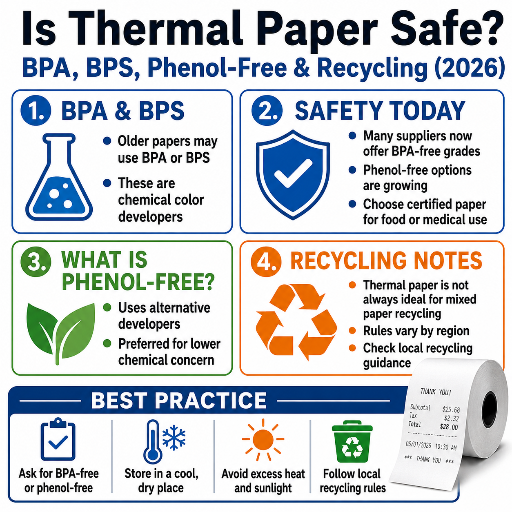
¿Por qué la cuestión de la salud es más grave de lo que suponíamos durante tantos años? Eso se remonta específicamente al revelador de color, el tipo utilizado en esa capa activa termosensible del papel. Durante mucho tiempo, el revelador más simple y más utilizado en papel fue el bisfenol A (BPA). Los reveladores de BPA son preocupantes porque el producto químico no se adhiere completamente al papel en sí; descansa sobre la superficie, desde donde puede ser absorbido por la piel.
Si bien la cantidad transferida en contacto aislado es pequeña, la exposición se vuelve significativa en el trabajo: un estudio de biomonitoreo ocupacional de cajeros minoristas encontró una mediana de BPA total urinario de 3,54 µg/L en los controles versus 8,92 µg/L en los cajeros que manejan los recibos durante todos los turnos. La ingesta dérmica modelada es de aproximadamente 17,5 ng/día para la población general, pero aproximadamente 1300 ng/día para los trabajadores ocupacionalmente expuestos, y la absorción dérmica permanece en circulación por más tiempo que el BPA dietético. Ese nivel de preocupación es precisamente la razón por la que la UE restringió el BPA en papel térmico en primer lugar.
⚠️ La idea errónea que importa: “libre de BPA” no es lo mismo que “seguro”
Para evitar restricciones, algunos fabricantes han optado por reemplazar el BPA con su pariente cercano, el bisfenol S (BPS), una sustancia química que, según estudios, conlleva problemas de salud similares que alteran el sistema endocrino, en una forma de lamentable sustitución. Los estudios todavía detectan un bisfenol en una gran parte de los ingresos estadounidenses (la mayoría de las veces de minoristas locales y regionales), incluso cuando muchas cadenas nacionales se han trasladado a desarrolladores que no son bisfenol. Una etiqueta que dice “libre de BPA” puede estar llena de BPS. Sólo una etiqueta resuelve la cuestión: “libre de fenol”, no simplemente “libre de BPA”
| Clase de desarrollador | Ejemplo | Estado |
|---|---|---|
| BPA | Bisfenol A | Restringido (Estados de la UE, China, EE. UU.) |
| BPS | Bisfenol S | “Lamentable sustitución” “preocupaciones similares |
| Sin fenol | Pergafast 201 (una sulfonilurea), tipos de ácido ascórbico, Blue4est (sin colorantes) | Sin bisfenol; el nivel más seguro |
Encontrar un “almuerzo gratis” perfecto puede ser imposible, pero no del todo fuera de su alcance: una revisión de la EPA de EE.UU Asociación de elección más segura se evaluaron 19 desarrolladores de colores alternativos y se descubrió que todos tienen alguna compensación. Aun así, desarrolladores libres de fenol como desarrolladores de color no fenólicos cubiertos por patentes recientes elimine por completo la cuestión del bisfenol mientras resiste bien los aceites y plastificantes.
¿Es seguro tocar papel térmico y puedes reciclarlo?
Gestionar algún recibo ocasional probablemente no sea una preocupación importante para la mayoría; las exposiciones relevantes son crónicas y ocupacionales (p. ej., cajeros), por lo que estas personas (y cualquier persona embarazada o que los manipule constantemente) deben lavarse bien las manos, y la mejor práctica es comprar material sin fenol. Incluso el reciclaje es complicado: no recicle papel estándar junto con papel térmico. Esos reveladores de bisfenol pueden acabar en la corriente de papel reciclado (se ha detectado BPA en productos de papel reciclado, como el papel higiénico) y en algunos municipios se tratan como contaminantes inaceptables, aunque siguen siendo escasos los datos sobre su comportamiento específico en las corrientes de residuos de EE. UU. Una vía de exposición del consumidor que recibe menos atención es que muchos papeles térmicos se usan directamente en envases de alimentos frescos, y esa aplicación directa permite que los químicos reveladores migren al alimento, sin pasar por la piel.
Resumen: “Sin fenol”, no “Sin BPA”, es la señal que desea ver, y si bien muchos artículos comerciales con desarrolladores sin fenol están bien para incluirlos en su reciclaje habitual, aún es mucho mejor que envíe papel térmico directamente a la basura, especialmente porque ” sin fenol” y “sin BPA” no son intercambiables cuando se hace referencia a desarrolladores de impresión activados por calor.
El cambio sin fenol: reglas del papel térmico en 2026 y más allá
Todo el mercado de materiales sensibles al calor está migrando en la misma dirección y 2026 es nuestro punto de inflexión proyectado. La transición es una que seguimos como BPA → BPS → Cronología de migración sin fenol « tres oleadas de reformulación impulsadas por una regulación más estricta.
| Cuando | Jurisdicción | Regla |
|---|---|---|
| 2 ianuarie 2020 | Unión Europea | REACH restringe el BPA en papel térmico a 0,02% o más en peso |
| Continuo | California | La Proposición 65 enumera BPA y BPS « legales para vender, pero se debe publicar una advertencia |
| 2024–2025 | China | La norma GB/T 28210-2024 refuerza los límites de BPA del papel térmico, en términos generales en sintonía con la restricción de la UE |
| 1 ianuarie 2026 | Washington (Estados Unidos) | Prohibición de ser el primero en el país todo bisfenoles (BPA y BPS) en recibos, entradas y etiquetas |
La regla de Washington es la de observar: el estado prohibió el BPS, el sustituto del BPA, no sólo el BPA en sí, cerrando la lamentable laguna jurídica de sustitución y empujando a los libres de fenol hacia el estándar de facto. Connecticut, Nueva York, Minnesota y Vermont también están avanzando en esta línea. (El alcance puede ser estrecho o amplio: la regulación de Washington tiene algunas excepciones, y para Europa actualmente es un límite de concentración en BPA en lugar de una prohibición total de los bisfenoles) Mientras tanto, en el lado de la tecnología, los desarrolladores libres de fenol « definido y enviado por los principales fabricantes de termodirección « ahora abarca la química de sulfonilurea (Pergafast 201), los tipos de ácido ascórbico (vitamina C) e incluso los sistemas físicos sin colorantes. La reformulación tiende a agregar solo un aumento porcentual moderado en el costo “es común un bajo dígito de uno a dos dígitos, pero elimina el riesgo de cumplimiento en todas las jurisdicciones de EE. UU. y en muchas fuera de ella.
“Resulta que los papeles más resistentes tanto al aceite como a los plastificantes también son los más receptivos a estas formulaciones más nuevas, tienen una impresión más intensa y son de alta durabilidad, por lo que la ausencia de fenol rara vez compromete el rendimiento.”
Si está adquiriendo material térmico para 2026, la medida práctica es cualificar ahora un grado sin fenol, en vez de hacerlo después de que una fecha límite lo fuerce. Como fabricante de papel recubierto y material para etiquetas que realiza recubrimiento y laminación en Tailandia y Vietnam, nuestro equipo trata los reveladores sin fenol y la durabilidad del recubrimiento superior como una sola especificación, no dos — el mismo estándar que un comprador debe exigir a cualquier proveedor. Cualificar pronto una opción sin fenol le mantiene conforme a medida que más estados de EE. UU. siguen a Washington y se mantiene la restricción de la UE.
Resumen: la ausencia de fenol se está convirtiendo en el mínimo, no en la opción premium —la norma que todos los papeles térmicos terminarán cumpliendo. Califique un grado sin fenol antes de la prohibición de Washington del January 1, 2026 y estará cubierto prácticamente en todas partes.
Preguntas frecuentes sobre papel térmico
¿Para qué se utiliza el papel térmico?
Ver respuesta
El papel térmico se utiliza en cualquier lugar con cuestiones de impresión rápidas y sin tinta: recibos de puntos de venta y tarjetas de crédito, etiquetas de envío y logística, boletos para eventos y tránsito, talones de estacionamiento, recibos de lotería, impresiones médicas y de laboratorio, y cajas de cartón de cadena de frío. Etiquetas. Domina estos trabajos porque una impresora térmica no necesita tinta, tóner o cinta, sólo papel estucado, lo que mantiene bajos los costos de hardware y funcionamiento.
¿cuáles son las desventajas del papel térmico?
Ver respuesta
Tres inconvenientes principales. En primer lugar, la imagen no es permanente: las impresiones térmicas directas se desvanecen con calor, luz, aceites y plastificantes, por lo que son deficientes para registros a largo plazo. En segundo lugar, el revelador de color ha sido históricamente un bisfenol (BPA o BPS) que plantea problemas de manipulación, seguridad y reciclaje. En tercer lugar, el papel térmico no se puede reciclar con papel normal porque contamina la corriente reciclada. Los grados libres de fenol resuelven la preocupación química, pero no la impermanencia de la térmica directa.
¿Se puede utilizar papel normal en una impresora térmica?
Ver respuesta
No, no en una impresora térmica directa. Las impresoras térmicas directas no tienen tinta ni cinta y dependen completamente del revestimiento termosensible del papel, por lo que el papel normal queda en blanco. Una impresora de transferencia térmica es la excepción: debido a que funde el pigmento de una cinta, puede imprimir en material liso o sintético. Si su impresora no utiliza cinta, necesita papel térmico auténtico.
¿Cómo se puede saber si el papel es térmico?
Ver respuesta
Rascarlo. Arrastre firmemente una uña o el borde de una moneda por la superficie. El papel térmico deja una marca de fricción oscura, el papel normal no.
¿El papel térmico caduca o tiene vida útil?
Ver respuesta
El papel térmico sin imprimir tiene una vida útil práctica de alrededor de dos o tres años cuando se almacena frío, oscuro y seco (por debajo de ~25°C, 30-50% de humedad). No “caduca” en una fecha fija, pero el recubrimiento pierde sensibilidad lentamente y el calor o la humedad disminuyen, por lo que rote el material y almacene los rollos de los pisos de concreto y lejos de las fuentes de calor.
¿qué es el papel térmico libre de fenol?
Ver respuesta
El papel térmico sin fenol utiliza un revelador de color que no contiene BPA, BPS ni ningún otro bisfenol/fenol, por ejemplo, desarrolladores de sulfonilurea como Pergafast 201, tipos de ácido ascórbico o sistemas físicos sin colorantes. Es la única categoría que elude por completo las cuestiones regulatorias y de seguridad del bisfenol, y es lo que la regla de Washington de 2026 exige efectivamente.
¿abastecerse de material térmico libre de fenol?
Guanma recubre y lamina papel térmico autoadhesivo según especificación en Thailand y Vietnam —el frontal, el adhesivo y el liner se adaptan a su aplicación y se construyen sin fenol para el cumplimiento normativo de 2026.
Por qué escribimos esta guía
La mayoría de las explicaciones sobre el papel térmico se detienen en “reacciona al calor”. Escribimos esto porque las preguntas que realmente determinan una compra —cuánto dura la imagen, si BPA-free significa seguro y qué implican las prohibiciones de bisfenoles de 2026— quedan sin respuesta, o las respuestas rara vez se respaldan con datos reales. Las especificaciones y la química aquí indicadas reflejan la evaluación que realiza un fabricante de papel estucado al valorar un grado térmico, utilizando cifras obtenidas de fuentes gubernamentales, académicas y de normas (consulte las referencias a continuación).
Referencias y fuentes
- Asociación para evaluar alternativas al bisfenol A en papel térmico — Agencia de Protección Ambiental de EE. UU.
- Reglamento (UE) 2016/2235 de la Comisión « Restricción de BPA en papel térmico (REACH Anexo XVII) « EUR-Lex
- Productos más seguros para Washington “bisfenoles en papel térmico «Departamentul de Ecologie al Statului Washington
- BPA y BPS en Papel Térmico — Agencia de Control de la Contaminación de Minnesota
- Exposición Ocupacional de los Cajeros al Bisfenol A vía Papel Térmico « Biblioteca Nacional de Medicina de EE. UU. (PMC)
- BPA y sus análogos en papeles térmicos: presencia y exposición dérmica (2025) « RSC Ciencias Ambientales: Avances
- US20210060994A1 « Material de grabación sensible al calor con reveladores de color no fenólicos « USPTO / Patentes de Google
- Papel térmico « Wikipedia
Artículos relacionados
- ¿Qué es un liner de liberación? — fuerza de liberación, cara de silicona y tipos de liner
- Soluciones de etiquetas por aplicación « haciendo coincidir el material de la etiqueta con el trabajo
- Papel Térmico Autoadhesivo « Grados y especificaciones de Guanma
- Película autoadhesiva y material para etiquetas « descripción general del material sensible a la presión
- Guanma — fabricante de materiales autoadhesivos para etiquetas (TH + VN)