Get in Touch with Guanma

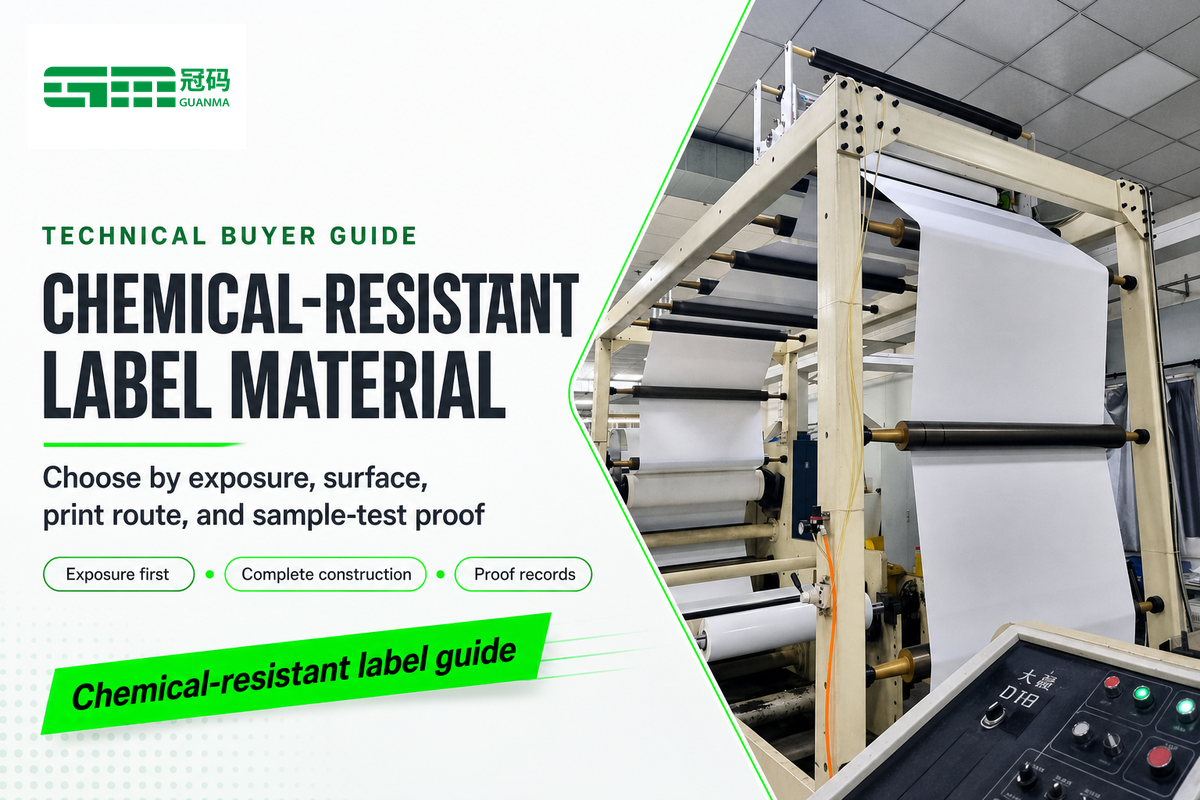
How to choose chemical resistant label material is a material-selection process that starts by defining chemical exposure before naming the facestock. A label that works for a weekly alcohol wipe may fail under xylene immersion, oil-edge contact, acid vapor, or a heated caustic wash. The right label material is the construction that keeps the facestock, adhesive, topcoat, and print legible on your real container for the required service life.
Decision rule: Treat every chemical-resistant label as a tested construction, not as a facestock claim standing alone.
Selection rule
Do not ask, “Which material is most chemical resistant?” Ask, “Which material can survive this chemical, on this surface, for this contact time, with this print method, and with written test evidence?” That shift prevents most wrong material choices.
Quick Answer: Choose by Exposure, Surface, and Proof
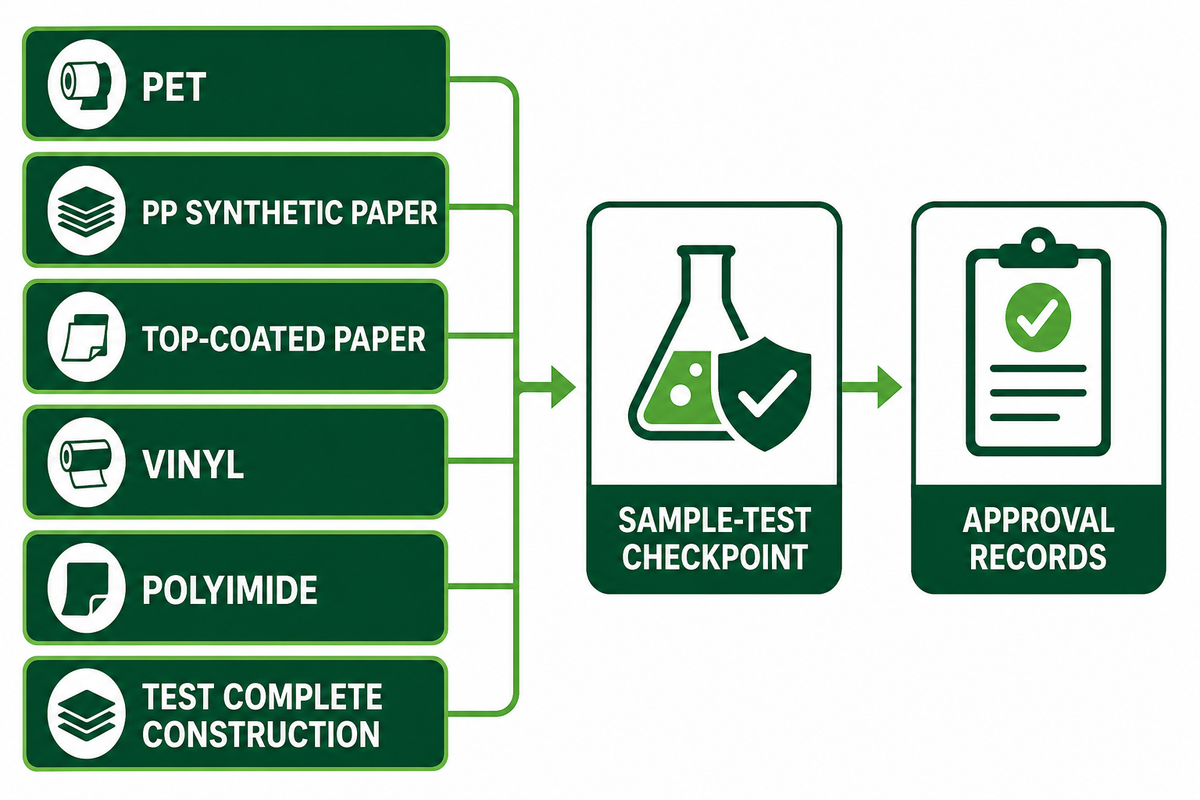
Start with PET or PP synthetic paper for most industrial chemical-resistant label jobs. Consider top-coated paper only for controlled short-duration wipe or secondary-container work, use vinyl where conformability matters, and reserve polyimide for high-heat specialty workflows. Then test the whole construction, including adhesive and print, against the actual chemical exposure.
Keep that answer conditional. PET often has the broadest industrial label fit, but a PET facestock with the wrong adhesive or weak ink is still a bad chemical-resistant label. PP can be a cost-effective label stock for oils, moisture, drum, and IBC applications, but it is not a universal substitute for solvent resistance. Top-coated paper can be sensible for alcohol wipes and secondary containers, but it should not be treated as an immersion material.
| Decision input | Why it changes the material | What to document |
|---|---|---|
| Chemical family | Solvents, alcohols, acids, bases, oils, and oxidizers attack different layers of a label construction. | Chemical name, concentration, SDS, and known mixtures. |
| Contact mode | A wipe, splash, vapor, edge contact, and full immersion are not equivalent tests. | Wipe cycles, splash frequency, immersion duration, vapor exposure, and drying time. |
| Container surface | HDPE, PP, glass, painted metal, aluminum, stainless steel, and coated drums present different adhesion risks. | Real container sample, surface photos, surface treatment, texture, and curvature. |
| Temperature and dwell | Heat can accelerate adhesive softening, edge lift, swelling, or print degradation. | Application temperature, service temperature, storage duration, and peak exposure. |
| Print requirement | A chemically resistant facestock fails if the barcode, hazard text, or pictogram smears. | Printer type, ribbon or ink, barcode grade target, topcoat, and laminate plan. |
Write the Stop/Go Exposure Brief Before Comparing Materials
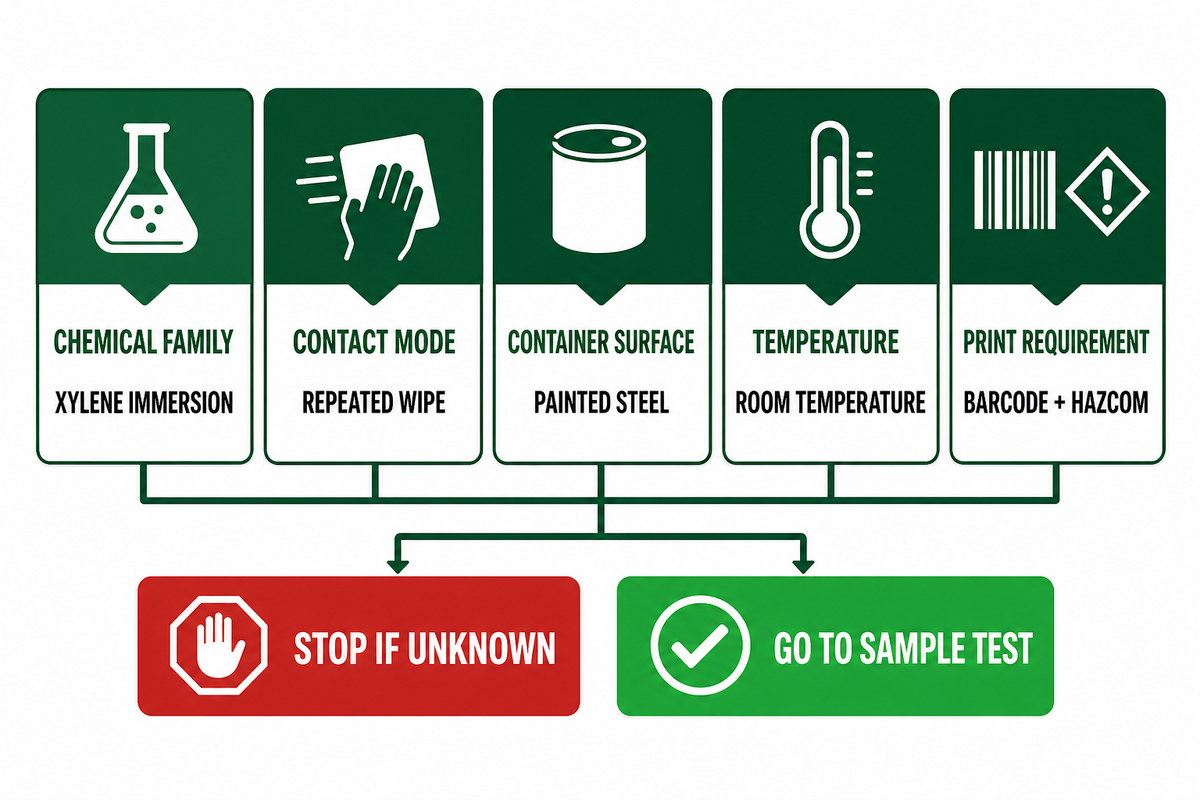
A good chemical label specification starts as a short exposure brief. This is not filler paperwork. It is the filter that tells you whether a material name is even worth sampling. If the exposure is unknown, stop the decision until the buyer can provide the chemical list, contact pattern, and surface details.
A useful brief has three columns: what the label will touch, what the label must keep doing, and how failure will be judged. For example, “20 percent sulfuric acid splash at room temperature on painted steel for occasional handling” is a different job from “xylene immersion on a lab slide label” or “IPA wipe-down on a secondary chemical bottle twice per shift.”
Stop/Go Exposure Brief
- Stop if the buyer cannot identify: name of the chemical family, the surface, and the mode of contact.
- Stop if the request specifies only “chemical proof” or “GHS label” but not how chemical contact will occur (wipe, splash, dip etc.).
- Go if the test will sufficiently replicate the wipe, splash, vapor contact, dip immersion or edge contact conditions expected in service.
- Go if the buyer agrees sample test data trumps generic datasheet claims.
This brief also keeps compliance language honest. OSHA HazCom tells chemical manufacturers, importers, distributors, and employers what hazard communication information belongs on labels and safety data sheets. It does not select a PET, PP, vinyl, paper, adhesive, or laminate construction for a supplier. Material selection is an engineering validation task.
For the broader failure mechanisms and compliance vocabulary, Guanma’s existing chemical-resistant labels guide covers the general landscape. This article stays narrower: how to choose the right label construction before sample approval.
This is also the safest way to choose the right label for industrial environments where a label design can degrade even if the facestock still looks durable enough to withstand normal handling. For harsh chemicals, the final print also has to remain legible after the chosen wipe, splash, or immersion test.
Shortlist Facestock by Chemical Family and Contact Mode
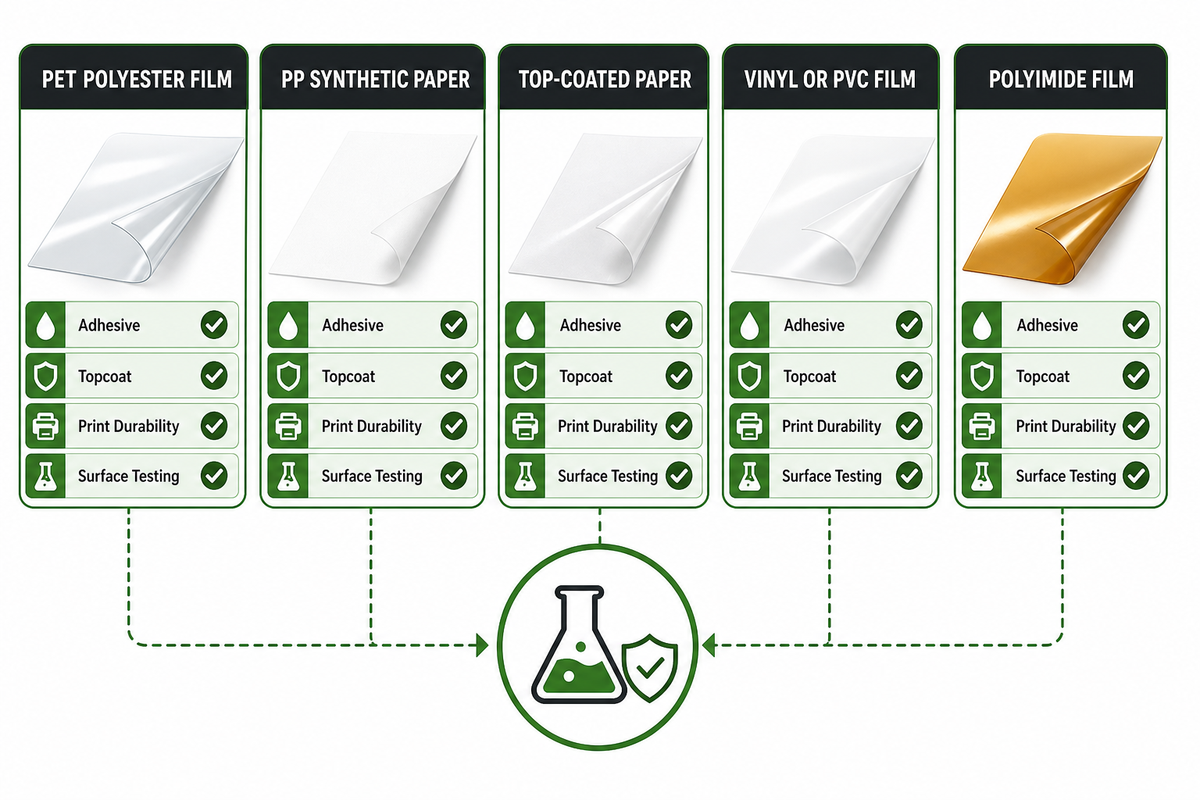
Facestock is the printable surface, but it should not be chosen alone. Use it to create a shortlist, then qualify it with adhesive, topcoat, print, and surface testing. The table below is a starting map for industrial buyers who need durable label materials for harsh chemicals, not a substitute for lab or line validation.
| Facestock | Best starting fit | Limit to verify |
|---|---|---|
| PET polyester film | Solvent-resistant labels, chemical drum labels, lab labels, barcode labels, outdoor equipment labels, and long-service industrial label jobs. | Adhesive swelling, topcoat compatibility, overlaminate edge lift, and heat-plus-chemical exposure. |
| PP synthetic paper | Moisture, oils, moderate acids/bases, IBC or drum labels, and lower-density roll programs. | Aggressive solvent exposure, dimensional stability at heat, and print/topcoat match. |
| Top-coated paper | Short-duration alcohol wipe-down, secondary container labels, controlled indoor use, and cost-sensitive labeling. | Immersion, repeated solvent splash, edge wetting, abrasion, and long chemical contact. |
| Vinyl or PVC film | Curved surfaces, flexible equipment labels, safety labels, and labels for harsh environments where conformability matters. | Specific solvent compatibility, temperature, plasticizer migration, and regulatory preference for halogen-free materials where applicable. |
| Polyimide film | High-heat electronics, PCB processing, and narrow specialty workflows with chemical and thermal stress. | Cost, stiffness, adhesive choice, and whether high-temperature evidence is actually needed. |
Usually, the right material is the one that eliminates the weakest layer first. If barcode legibility is the risk, facestock strength alone will not fix it. If the label lifts from HDPE, the adhesive and surface energy matter more than another micron of film thickness. If chemical attack starts at the cut edge, overlaminate coverage and edge exposure matter. Guanma’s PET adhesive film and synthetic paper pages are useful material-family references after the exposure screen is clear.
Guanma’s chemical-resistant label material options page is the commercial handoff for PET, PP synthetic paper, top-coated paper, solution acrylic, hot-melt, and water-based adhesive combinations. Use it after you have the exposure brief, so the sample request is specific enough to test.
Match Adhesive to Surface Energy, Temperature, and Dwell Time
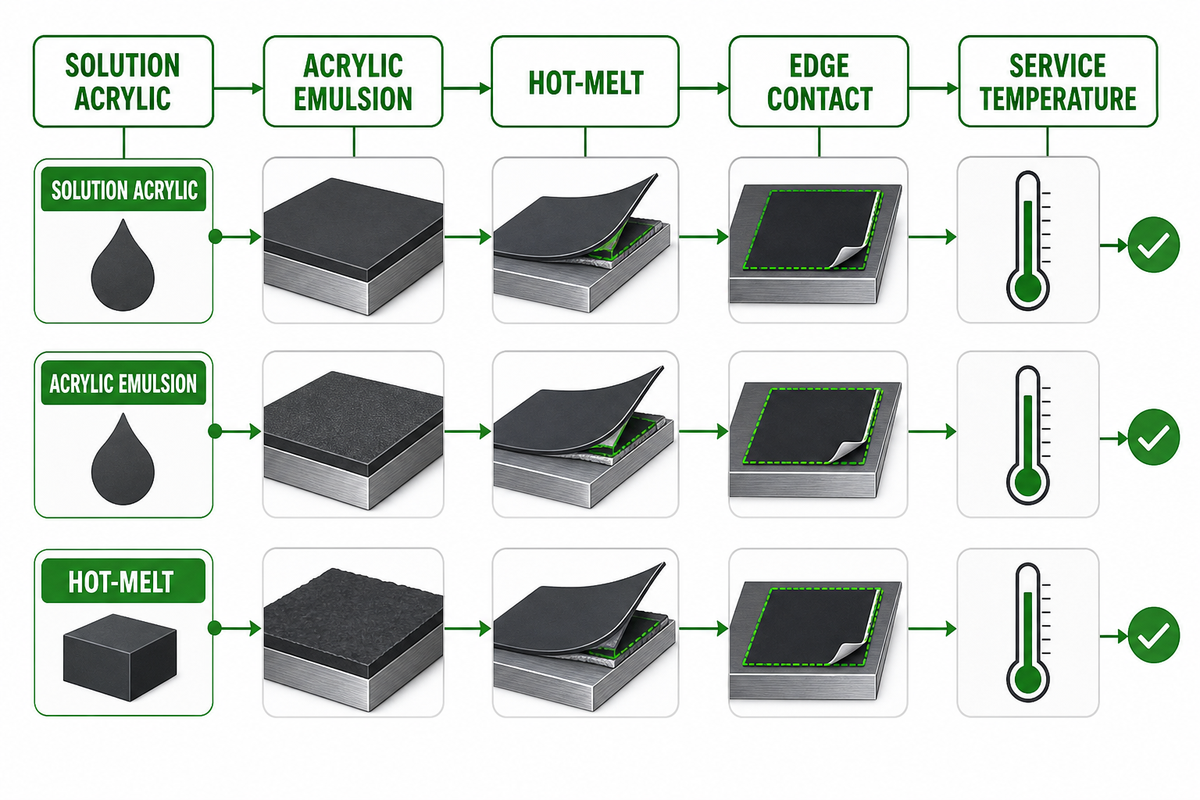
Adhesive is often where a chemical-resistant label fails quietly. Buyers can specify PET, approve the print, and still see the label peel because the adhesive was not built for the container surface, chemical edge contact, or service temperature. For industrial chemical labeling, the adhesive is not a secondary detail. It is the bond that decides whether the warning, barcode, or product identifier remains attached.
Solution acrylic is often the first class to evaluate for harsh solvents, UV, heat, and long-term chemical exposure. Acrylic emulsion can work for moderate conditions, cleaner indoor applications, and cost-sensitive secondary containers. Hot-melt adhesive can help where high initial tack, textured surfaces, or cold application matters, but treat it as a candidate, not a blanket chemical-resistance answer.
| Adhesive question | Why it matters | Evidence to request |
|---|---|---|
| Will the container be HDPE, PP, glass, metal, or painted steel? | Low-energy plastics and coated surfaces often need a different adhesive strategy than glass or metal. | Peel or adhesion result on the actual substrate, not only stainless steel test panels. |
| Will the chemical touch the edge? | Oil and solvent edge contact can undermine adhesion even when the facestock remains intact. | Edge-contact sample test after realistic dwell and drying. |
| What is the application and service temperature? | A label applied cold and exposed hot faces different adhesive stress than a room-temperature label. | Temperature-conditioned adhesion or line trial record. |
| How long must the label stay readable and attached? | Initial tack does not prove long-dwell resistance under chemical exposure. | Short test plus aged sample, or a staged approval window for production. |
Protect Print With Topcoat, Laminate, and Resin Ribbon
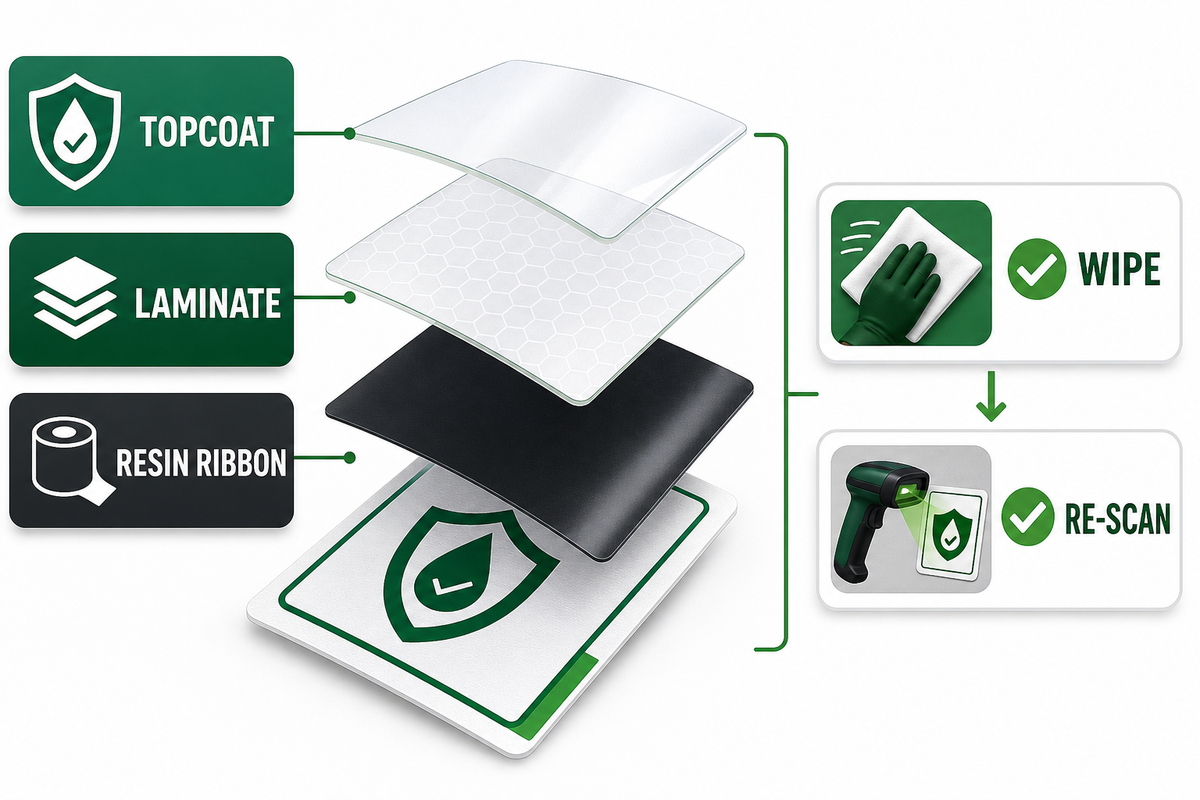
A chemical-resistant facestock does not automatically protect the printed information. Hazard statements, product identifiers, batch codes, QR codes, and barcode labels can fail by smear, contrast loss, abrasion, or topcoat breakdown while the label still looks attached. If the user needs the label to remain legible, the print system must be part of the material choice.
Thermal-transfer printing with a matched resin ribbon is a common starting point for solvent-resistant labels and durable label materials because the printed image is designed for harder service than ordinary wax ribbon or unprotected ink. Digital inkjet, laser, and flexographic print can also work when the facestock has a compatible coating and the supplier validates the ink/topcoat system against the exposure.
Print approval test
Do not approve only by visual appearance after printing. Wipe, splash, rub, scan, and re-scan the printed sample after the same chemical and temperature exposure expected in use.
An overlaminate can be part of a solution, but it is not a panacea. Unequal expansion and softening of facestock, laminate and adhesive can cause the label to curl, wrinkle, or delaminate at the edge. Treat the laminate as another element of a specified and proven construction rather than a patch over something faulty.
Use Standards as Evidence Filters, Not Marketing Badges
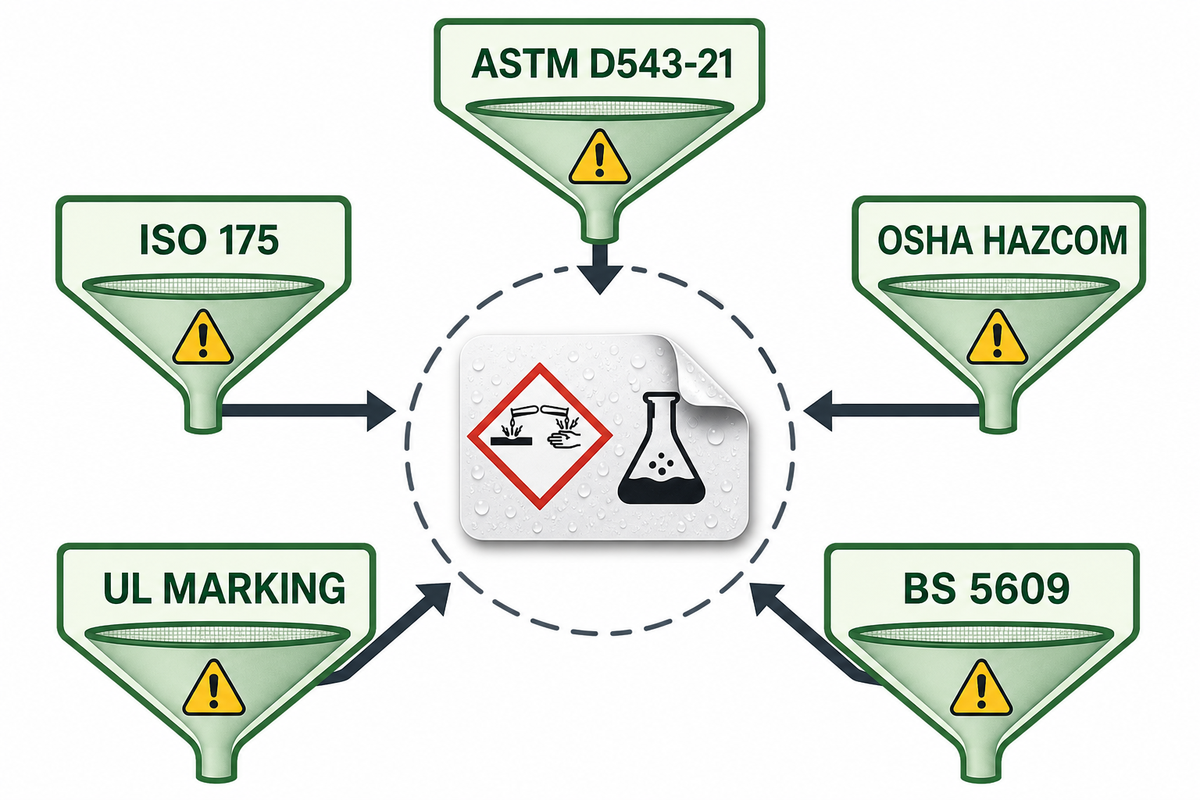
Standards make the conversation more disciplined. They do not remove the need to match the actual chemical environment. ASTM D543-21 covers practices for evaluating plastics against chemical reagents and emphasizes that the test conditions need to resemble the end use if the result is going to predict service performance. It also separates immersion and wipe/wet-patch style exposure, which is exactly the difference many label specifications ignore.
ISO 175 is another useful boundary for plastic materials because it addresses the effects of immersion in liquid chemicals on plastic specimens. That does not mean ISO 175 is a finished pressure-sensitive label approval. It is a method reference that helps buyers understand what kind of immersion evidence is being discussed.
OSHA HazCom is a different category. OSHA’s Hazard Communication Standard and Appendix C define label elements, pictograms, signal words, hazard statements, precautionary statements, and related responsibilities for hazardous chemicals. They do not say that a specific PET, PP, vinyl, or paper stock is automatically compliant. If a label material fails and the required information becomes unreadable or detached, that is a practical compliance risk, but the material choice still has to be validated separately.
UL’s Marking and Labeling Systems Program is relevant when a product needs durable safety-related marking. UL describes evaluation for permanency with environmental conditioning that may include high humidity, water, elevated temperature, sunlight, or chemical agents, followed by review for adhesion, legibility, defacement resistance, and physical change. The useful buyer question is not just “UL 969?” but “for which surface, temperature, ink, and exposure conditions was this label found acceptable?”
BS 5609 is relevant when labels are used to identify dangerous and hazardous goods shipped by marine transport. The 2024 edition is especially relevant as Section 2 relates to face stock and adhesive adhesion performance on surfaces like aluminum and HDPE and Section 3 relates to print durability. Choosing a Section 2 ready label stock is not selecting a printed label that has been fully validated in a converter’s exact print system.
Run a Sample Test That Mirrors Real Contact
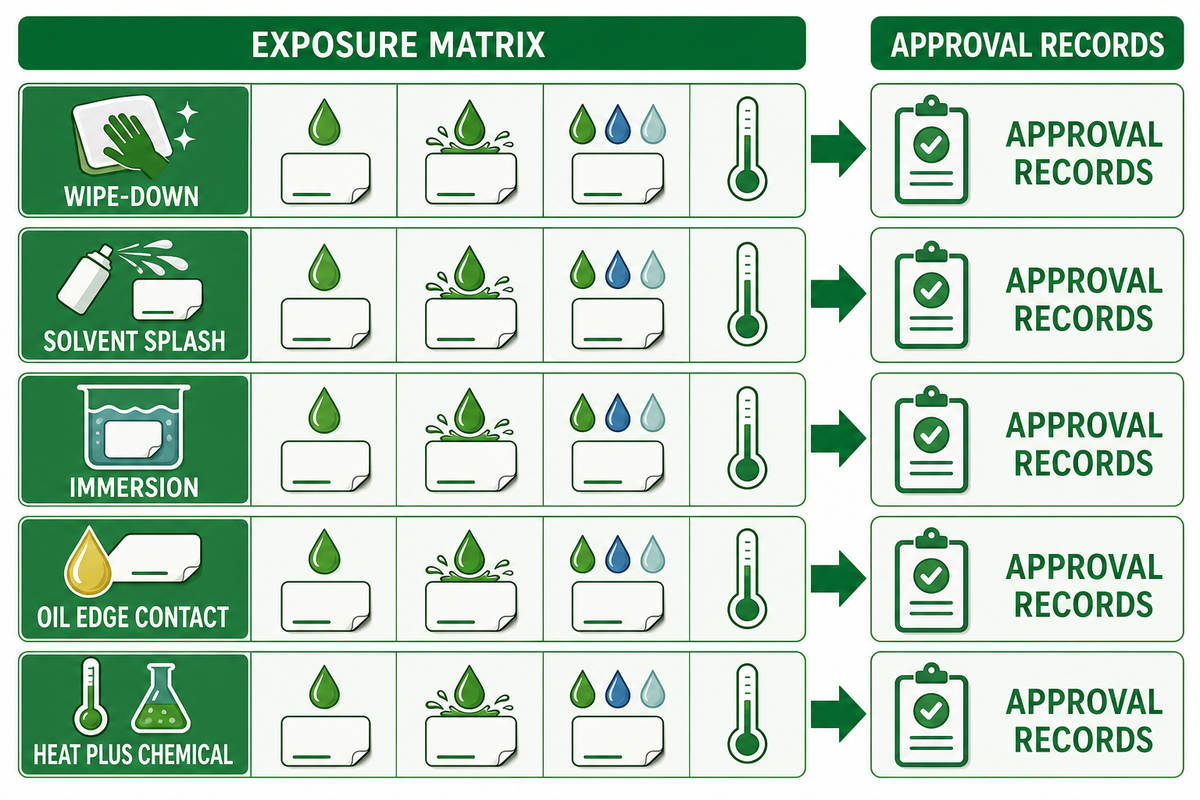
Sample testing needs to be small and relevant, and documented. The buyer does not need a perfect laboratory testing regime to avoid an inappropriate label choice, but the test must be close enough to the reality of use to show the likely failure mode.
| Exposure type | Test approach | Pass/fail observation |
|---|---|---|
| Alcohol wipe-down | Repeat IPA or ethanol wipes using the expected cloth, pressure, and number of cycles. | Print smear, barcode grade, coating haze, edge lift, adhesive residue. |
| Solvent splash | Apply measured solvent, allow air-dry, repeat for the expected handling pattern. | Facestock softening, ink movement, topcoat swelling, adhesion loss. |
| Continuous immersion | Immerse samples for a defined period and inspect after recovery and drying. | Dimensional change, delamination, adhesive failure, unreadable print. |
| Oil edge contact | Expose label edges to lubricant or hydraulic fluid over the expected dwell time. | Corner lift, edge bleed, adhesive softening, reduced peel force. |
| Heat plus chemical | Condition samples at service temperature before, during, or after chemical exposure. | Curling, shrinkage, adhesive creep, topcoat cracking, print loss. |
Use the table below as a practical test-setting template. It is not a universal certificate; it is a way to turn vague “chemical resistant” language into repeatable approval records.
| Material type | Sample exposure setting | Record before approval |
|---|---|---|
| PET with resin ribbon | IPA wipe for 30 sec, repeat after 24 hr recovery at 23 °C. | Barcode scan, text smear, edge lift, and photo after drying. |
| PET with overlaminate | Xylene wet patch for 5 min, then 24 hr dry recovery. | Laminate curl, topcoat haze, print contrast, and adhesive edge attack. |
| PP synthetic paper | Oil edge contact for 7 days on 50 mm x 100 mm labels. | Corner lift, edge bleed, residue, and peel trend after 1 day and 7 days. |
| Top-coated paper | Ethanol wipe for 10 sec per pass and 10 min rest between passes. | Coating haze, ink movement, paper swelling, and readable hazard text. |
| Vinyl film | Curved container trial at 0 °C application and 48 hr dwell. | Wrinkle, flagging, cold tack, and edge lift on the smallest radius. |
| Polyimide film | Heat condition at 150 °C for 2 hr before chemical wipe. | Adhesive creep, shrinkage, print readability, and surface staining. |
| BS 5609 candidate stock | Marine-path review with 90 days exposure evidence and 7 days conditioning at 60 °C where required. | Whether evidence covers Section 2 stock, Section 3 print, surface, ink, and converter process. |
| Drum label construction | Outdoor UV plus chemical splash after 30 days storage and 24 hr drying. | Color fade, barcode contrast, adhesion around ribs, and visible warning text. |
| Lab vial label | Solvent immersion for 2 hr on 10 mm curved vials, then 24 hr recovery. | Readability at small size, wrap hold, adhesive ooze, and label movement. |
For a narrow verification lot, test at least 20 labels across 3 exposure sets at 23 °C, keep a 24 hr recovery window, use the real 50 mm x 100 mm label size, and record the result within 10 min of final inspection.
A useful sample test provides proof, not just a yes/no answer. Keep the photos, chemicals, environment, time-stamped image, base material, material lay-up and the final decision. That archive is what protects that same label failure from happening again in the next SKU, plant or region.
Build the 4-Record Approval Pack
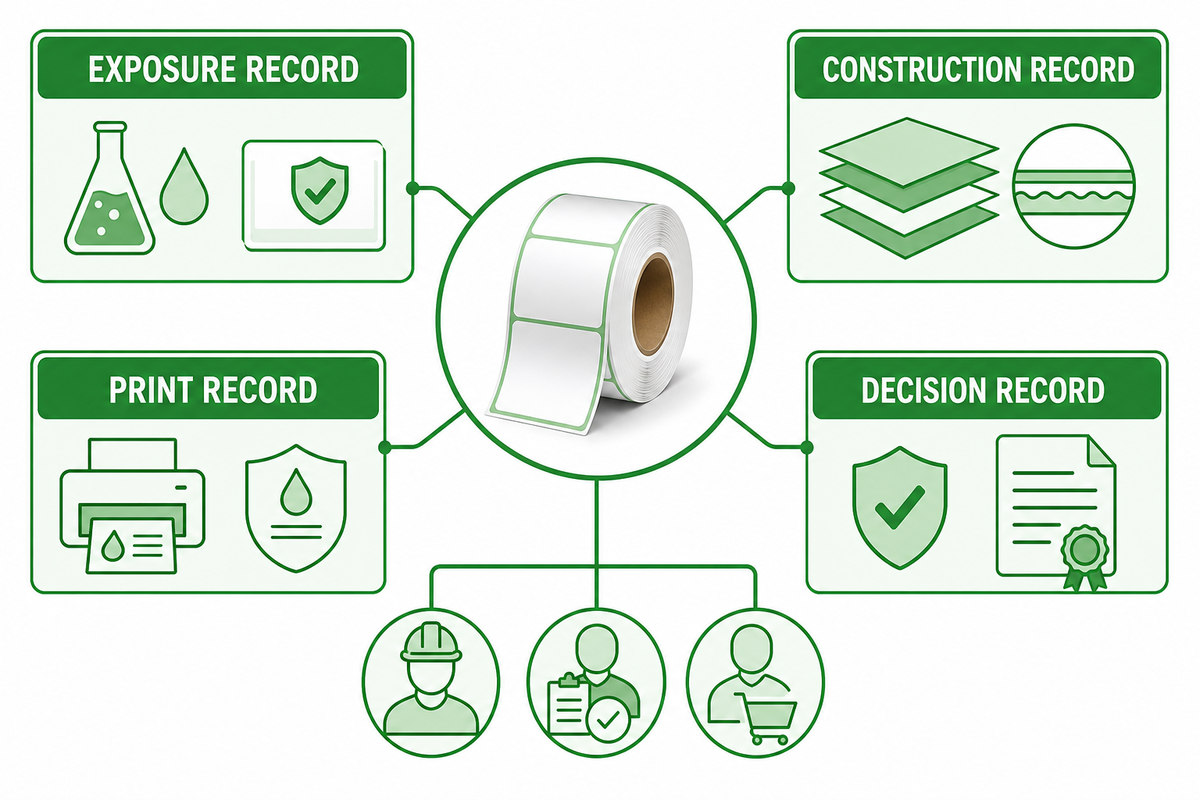
For procurement, the most useful information gain is not another list of label material types. It is a repeatable approval pack that lets engineering, quality, and purchasing talk about the same label construction. Use four records.
1. Exposure record
Chemical, concentration, SDS, contact mode, rub/wipe cycles, immersion time, temperature and lifespan.
2. Construction record
Facestock, adhesive, topcoat, overlaminate, liner, roll format and application surface.
3. Print record
Printer, ribbon, ink, barcode size, color, pictogram(s), scan result, rub/wipe result, laminate status.
4. Decision record
Pass/fail criteria, dated photo, approver, limitations, next test date, production release conditions.
This approval pack preserves the material choice when the label job progresses from trial to production. It also enables a supplier to specify an appropriate material and adhesive system without guessing from a general request.
Material Selection Matrix: Starting Points and Required Proof
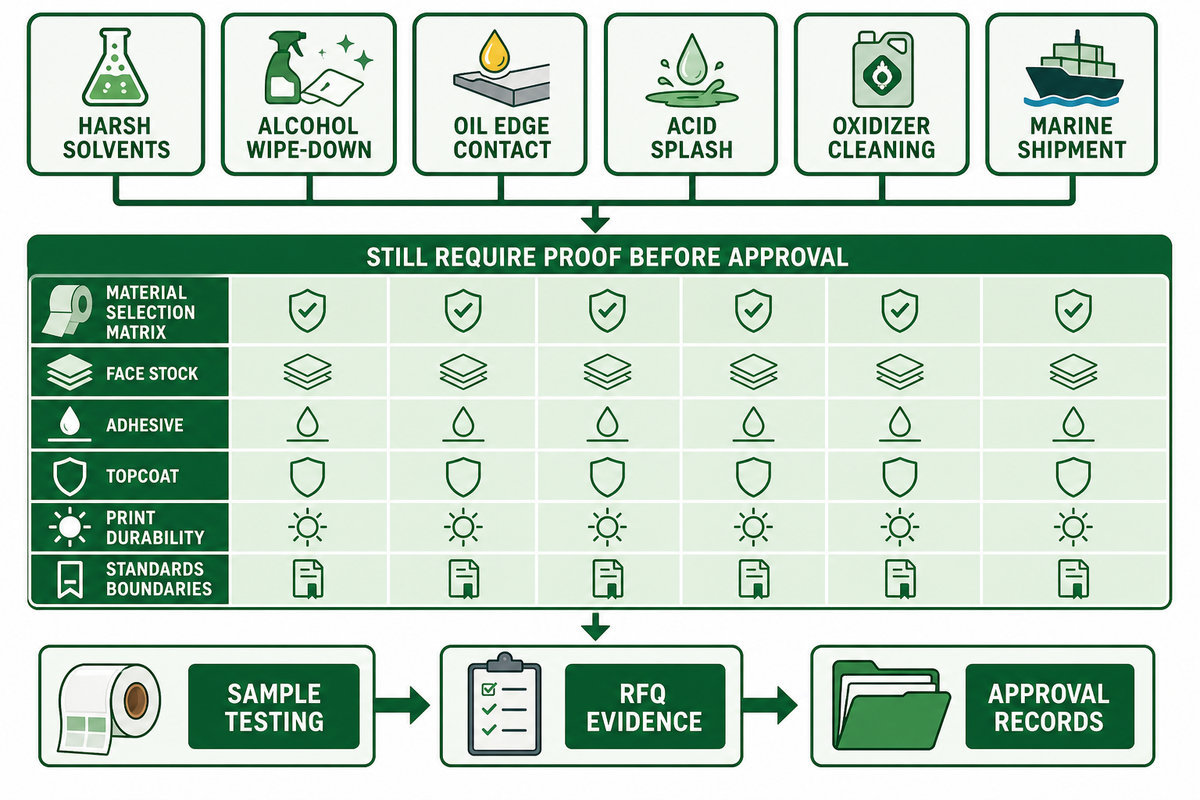
Use this matrix to choose the first samples. Do not treat it as final approval. A material can pass in one plant and fail in another when the container surface, temperature, or print method changes.
| Application condition | First material shortlist | Required proof before approval |
|---|---|---|
| Xylene, toluene, MEK, acetone, or other harsh solvents | PET with solution acrylic adhesive, protected print, optional overlaminate. | Solvent exposure test on real surface, print rub/scan after exposure, edge lift check. |
| Alcohol wipe-down in lab or healthcare environments | Top-coated paper for controlled secondary containers, PP or PET for stronger durability. | Repeated wipe test, barcode readability, coating haze and smudge check. |
| Oil, lubricant, hydraulic fluid, or brake fluid edge contact | PP synthetic paper or PET with adhesive selected for edge-contact resistance. | Dwell test with exposed edges, corner-lift inspection, adhesion check. |
| Acid or corrosive splash | PET with compatible adhesive and topcoat or laminate; avoid generic paper unless exposure is clearly limited. | Splash and vapor simulation, print retention, facestock appearance, adhesive bond. |
| Bleach, peroxide, oxidizer cleaning | PP or PET with print system tested for contrast and color retention. | Repeated cleaning cycles, pictogram contrast, barcode scan, topcoat condition. |
| Marine shipment or BS 5609 territory | PET or PP label stock with Section 2 evidence path plus validated print system for Section 3. | Separate labelstock and printed-label evidence; confirm surface, print, and certificate scope. |
What to Send Guanma for a Clean RFQ
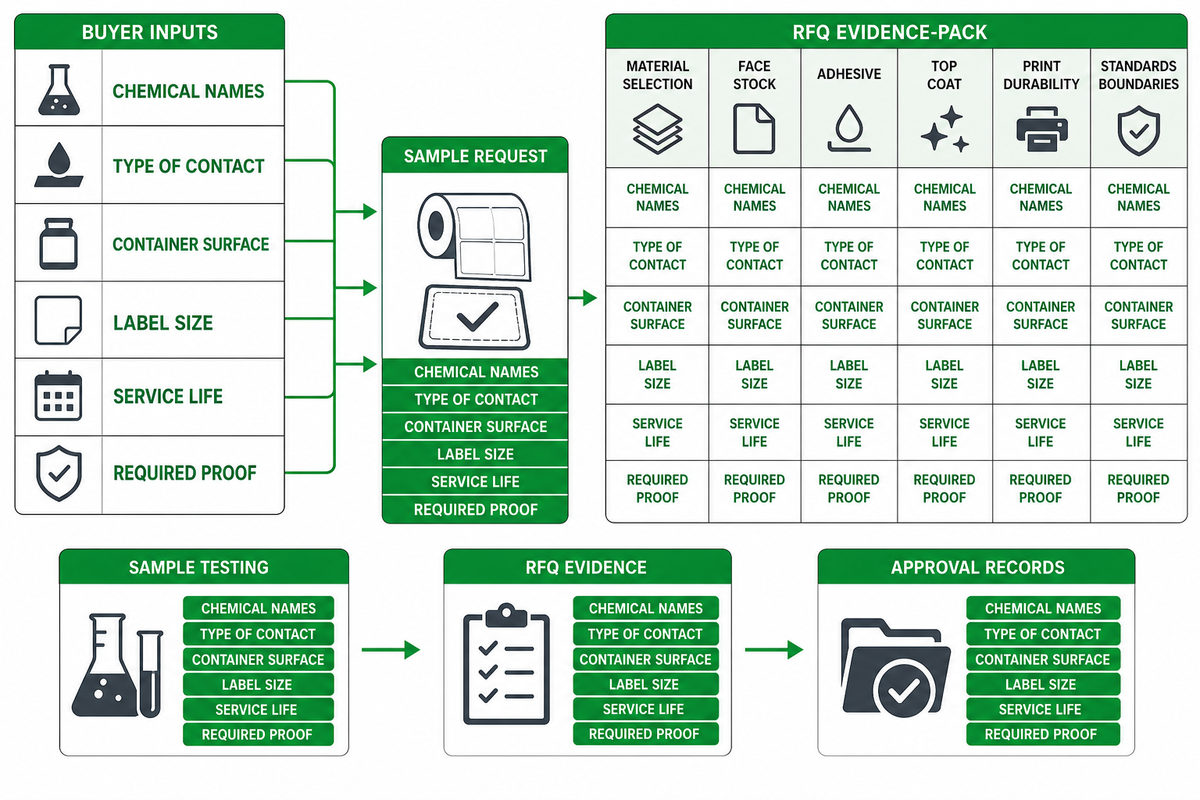
A clean RFQ makes the first sample round useful. Guanma’s brand page requests customers describe face stock, substrate, line speed, and environment before choosing samples. For chemical resistant labels, include the exact chemical exposure and print requirement along with that baseline information; the print method and ribbon matcher is the better handoff when the print route is still unsettled.
RFQ evidence pack
- Chemical names, concentrations, and SDS if available.
- Type of contact: wipe, splash, vapor, edge exposure, immersion, or combined heat exposure.
- Container surface: HDPE, PP, glass, aluminum, stainless steel, painted steel, or coated drum.
- Label size, roll width, liner, printing method, barcode or QR code requirement, and color needs.
- Service life, storage route, outdoor/UV exposure, cleaning routine, and shipping mode.
- Required proof: internal sample report, UL 969 recognition context, BS 5609 Section 2/3 path, or customer-specific test plan.
This is where buyers can also protect themselves on cost. A buyer simply requesting “durable labels” may get an overbuilt construction. If the customer provides the exposure record, the supplier can often get by with a narrower material that passes the actual test without buying unnecessary layers.
Common Wrong Turns That Make Labels Fail
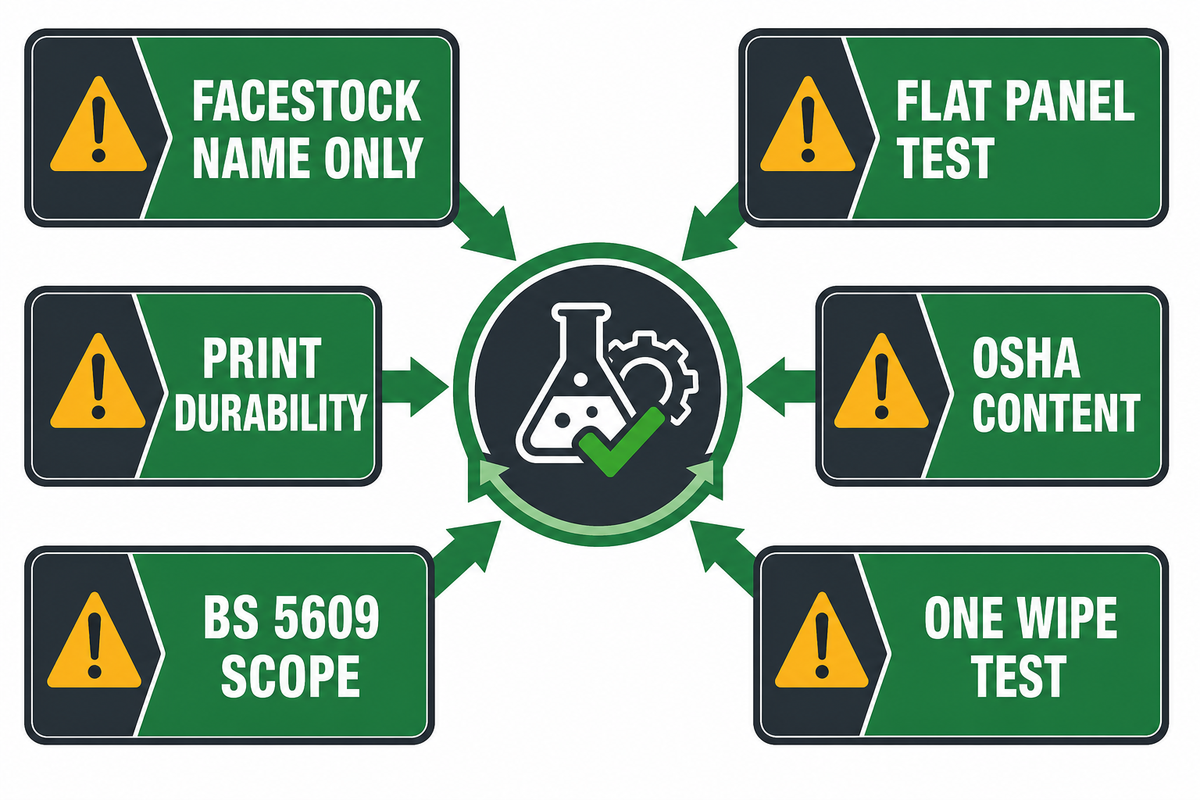
- Choosing by facestock name only. PET, PP, vinyl, and paper are families, not complete label constructions.
- Testing a flat panel when the real surface is curved or textured. Container shape influences edge lift and adhesive stress.
- Ignoring print durability. A label may stay attached when the barcode or hazard information fades.
- Confusing OSHA content demands with material certification. HazCom label elements and pressure-sensitive label construction are two separate decisions.
- Reading BS 5609 as one indivisible claim. Evidence for label stock and evidence for printed label have different scopes.
- Using one wipe test for continuous immersion. ASTM and ISO method boundaries are in place because modes of exposure are materially different.
FAQ
What is the most durable label material for chemicals?
PET polyester film is often the strongest first shortlist for chemical-resistant label material, especially with a compatible adhesive and protected print system. But “most durable” depends on the chemical, concentration, temperature, contact time, and container surface. PP, vinyl, top-coated paper, or polyimide can be right in narrower conditions. The sample test decides which one survives.
What are the OSHA requirements for chemical labels?
OSHA HazCom requires hazardous chemical labels to communicate required elements such as product identifier, signal word, hazard statement, pictogram, and precautionary statement according to the classified hazard. OSHA does not prescribe one label material. The material must be chosen so those required elements remain attached and legible under real workplace conditions. In practice, separate content compliance from material durability: first confirm the required label information with the SDS and hazard classification process, then approve the facestock, adhesive, topcoat, print, and laminate against the chemical exposure that can make that information unreadable.
Are chemical-resistant labels automatically BS 5609 compliant?
No. BS 5609 is a marine-use durability standard. Section 2 concerns label stock performance, including facestock and adhesive, while Section 3 concerns printed label durability. A general chemical-resistant label claim does not prove either section unless the tested product, surface, print system, and certificate scope match. Ask which section and surface were tested.
Can chemical-resistant labels be printed with any printer?
No. The print method is part of the label construction. Thermal transfer with a compatible resin ribbon is a common starting point for harsh solvents and industrial applications. Inkjet, laser, or flexographic systems need compatible coatings and exposure testing, especially when barcode or hazard-label readability is required.
How long should a chemical-resistant label last in continuous exposure?
There is no universal duration. Continuous exposure should be defined by the project: hours, days, weeks, months, or shipping route. The label should be tested for that duration or released with a documented limitation and follow-up validation plan. For a shipment label, the evidence window can be the route and storage period; for a process label, it can be the cleaning cycle or container reuse cycle.
What is the difference between solvent-resistant labels and chemical-resistant labels?
Solvent-resistant labels are built for solvents such as xylene, toluene, MEK, acetone, or alcohols. Chemical-resistant labels is a broader category that can include solvents, acids, bases, oils, oxidizers, cleaning agents, and mixed exposures. The broader term is less useful unless the actual chemical list is known.
Does overlaminate make any label chemical resistant?
No. Overlaminate can protect print and slow exposure, but it cannot fix a facestock, adhesive, or surface mismatch. It should be tested as part of the complete label construction, including the edges, because many chemical failures begin where liquid can reach the adhesive layer.
References & Sources
- ASTM D543-21: Standard Practices for Evaluating the Resistance of Plastics to Chemical Reagents
- ISO 175:2010: Plastics – Methods of test for effects of immersion in liquid chemicals
- OSHA 29 CFR 1910.1200: Hazard Communication
- OSHA Appendix C: Allocation of Label Elements
- UL Solutions: Marking and Labeling Systems Program
- UL Solutions: Marine Use Label Testing and Certificate Services (BS 5609)
- Smithers: Marine Immersion Label Testing, BS 5609
- Guanma About Us