Get in Touch with Guanma

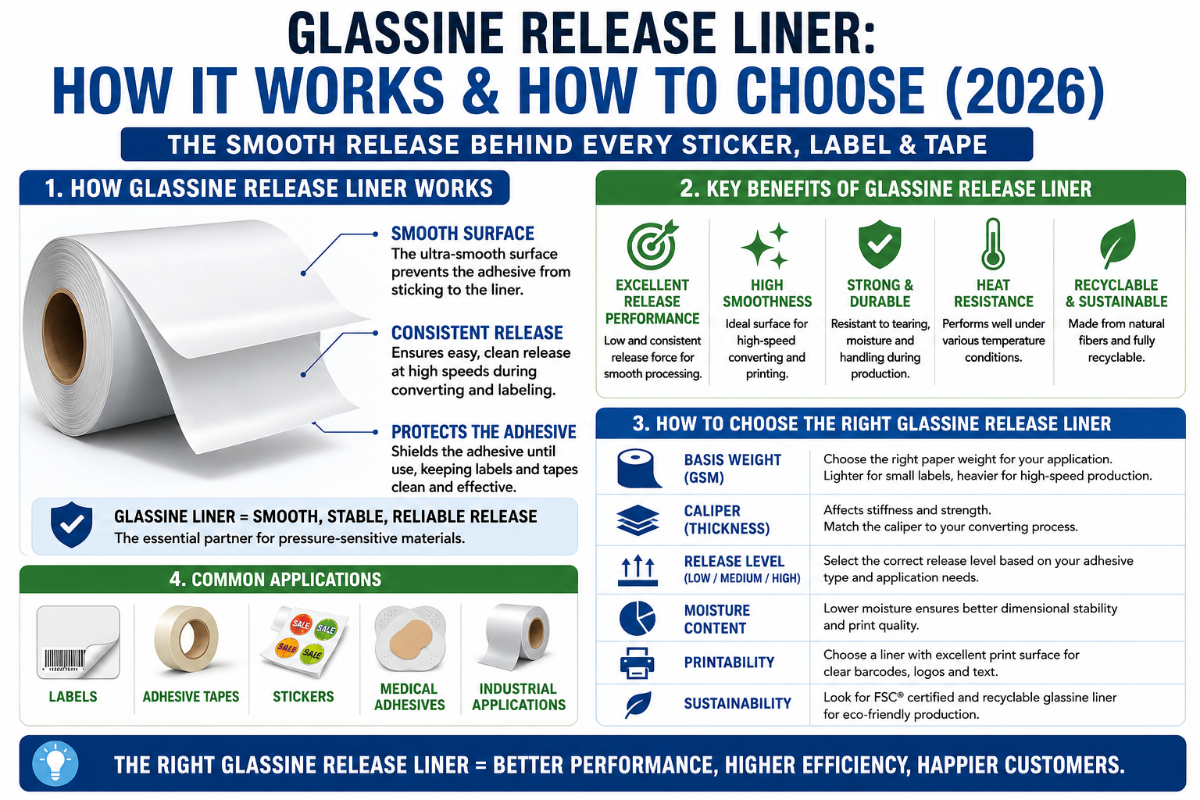
A glassine release liner is the smooth, semi-translucent carrier that holds a pressure-sensitive label or tape until the moment you peel it off. It looks like a humble backing sheet, yet the choice between glassine and the alternatives decides whether your labels die-cut cleanly, dispense at line speed, and survive a humid warehouse. This guide explains how the material actually works, how to read its spec sheet, and when it is the right call – written from a materials standpoint rather than a sales pitch. If you already know glassine is what you need and want grades, pricing, and lead times, see our glassine release liner product page instead.
Quick Specs — Industry-Typical Reference (not a single product spec)
| Substrate | Super-calendered, filler-free chemical-pulp paper (glassine) |
| Basis weight | ~50–80 g/m² standard (specialty 35–120 g/m²) |
| Caliper | ~35–75 µm |
| Release coating | Silicone (solventless / solvent / emulsion cure); coat weight ~1 g/m² |
| Release force | ~5–30 g/inch (peel-rate dependent) |
| Transparency | High / translucent — aids web sensing and registration |
| Common uses | PS labels, tapes, medical adhesives, graphic arts |
What a Glassine Release Liner Actually Is (and Isn’t)
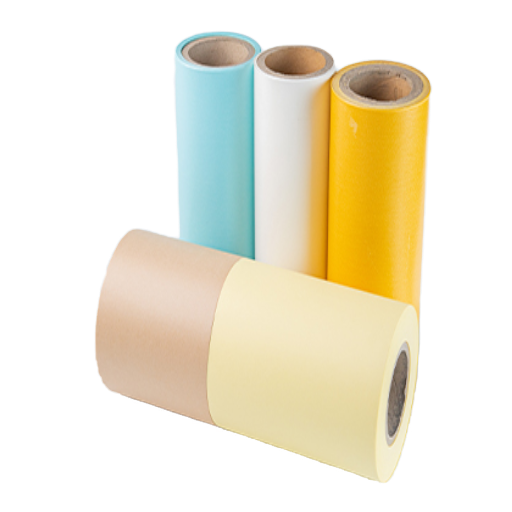
Glassine is a dense, smooth, semi-translucent paper made from refined virgin chemical pulp and finished by super-calendering – repeated pressing between hot, polished rolls (the glassine-making route is detailed in patents such as US 9,587,355). That compaction gives it a closed, low-porosity surface and a density in the range of 1,040–1,120 kg/m³. A glassine release liner is that base paper — typically 50–80 g/m² and 35–75 µm thick — after it has been coated with a thin (about 1 µm) layer of cured silicone, giving a non-stick surface so an adhesive can be laminated to it and later peel away cleanly. As a substrate for release liners, glassine pairs that non-stick surface with enough strength to run on a press.
Terminology trips people up here, so it is worth being precise. “glassine” names the base substrate; “silicone paper” describes the same sheet after coating; and neither is the same as kitchen wax paper or baking parchment, which are not engineered for controlled, repeatable release of pressure-sensitive adhesives. Getting this distinction right saves a lot of confusion when reading datasheets.
What is glassine release paper?
Glassine release paper is a super-calendered glassine sheet coated with silicone on one or both sides so that a pressure-sensitive adhesive sticks lightly, stays put during converting and storage, and then releases at a predictable force. Because the surface is so smooth and translucent, it is favored where clean die-cutting and optical web inspection matter – labels, tapes, and medical adhesives. Translucency also lets converters use see-through sensors to track the web through a press.
How the Release Effect Is Engineered: Super-Calendering and Silicone Cure
Two processes do the real work. First, super-calendering (the supercalendered finish) closes the paper surface so it absorbs very little silicone – dense papers like glassine are used specifically to minimize the amount of silicone needed to reach the target release. A more open paper would soak up coating and waste it. Second, a liquid silicone system is applied and cured — solventless systems typically cure at roughly 120–150°C and can run at line speeds of 600 m/min or more — into a low-surface-energy film roughly one micron (about 1 g/m²) thick. That film is what the adhesive cannot grip strongly, so it lets go — the easy release and reliable release behaviour that defines good release performance in real production.
Silicone is applied through one of three chemistries: solventless (the modern default, cured with heat and a platinum catalyst), solvent-based, or water-borne emulsion. A base paper has to be chemically compatible with the silicone so the coating anchors instead of rubbing off; glassine is typically finished with polyvinyl alcohol (PVA), which gives better long-term silicone anchorage than the starch finish used on super-calendered kraft paper. Recent coating development pushes cure at higher line speeds with lower catalyst loadings and lower oven temperatures, per patents such as USPTO US 9,212,299.
📐 Engineering Note
Release force isn’t a single number-it’s peel rate dependent and is measured under specified conditions by tests such as FINAT FTM 3, 4 and 10, or ASTM D3330 peel-adhesion procedures. A liner specified as “10-15 g/inch” behaves this way only at the test speed; pull faster, and release force goes up. Just as critical is silicone transfer: when engineers talk about silicone migration, they explain that mobile silicone will gradually transfer onto the adhesive over time, contaminating the adhesive. ASTM and TAPPI tests also look at surface energy and transfer to account for this phenomenon.
Reading a Glassine Liner Spec Sheet: GSM, Caliper, Release Force and Transparency

Most glassine liner datasheets list the same handful of numbers. Knowing what each one controls — and what it trades off — lets you compare any supplier’s grade on its merits. Two qualities sit behind all of them: the paper’s dimensional stability (it must not shift under die-cutting pressure or registration will drift) and the consistency of its silicone coating.
| Parameter | Typical range | What it controls / trade-off |
|---|---|---|
| Basis weight | 40–80 g/m² | Stiffness and tensile strength. Lighter saves freight but curls more easily. |
| Caliper | 35–75 µm (about 1.4–3.0 mil) | Must be tightly consistent — caliper variation causes die-cutting and matrix-stripping problems. |
| Release force | 5–30 g/inch (roughly 2–12 N/m) | Too low and labels lift prematurely; too high and dispensing jams. Match to adhesive. |
| Silicone coat weight | ~0.8–1.8 g/m² | Enough for a fully closed film; more silicone is cost without benefit on dense glassine. |
| Transparency | High (translucent) | Higher light transmission helps optical sensors; exact values vary by grade and should be confirmed on the datasheet. |
| Coating sides | S1S or S2S | One side for standard labels; two sides for transfer tapes and differential-release builds. |
What is a glassine liner?
In shop talk, a “glassine liner” is just the siliconized paper release liner on a roll of self-adhesive stock, there to control the release of adhesives until use. In fact, when you choose one, you are actually choosing four separate factors: the weight of the paper stock, its silicone treatment and coat weight, the intended pull-force off against your adhesive, and whether it’s single-sided (S1S) or double-sided (S2S) coating. To see how those choices map to real grades, our glassine grade selector lays them out side by side.
Glassine vs CCK, SCK and PET Film: An Objective Liner Scorecard
Glassine is one of four substrate families you will weigh, and the honest comparison includes where glassine loses, not just where it wins. This Glassine-vs-Kraft-vs-Film Liner Scorecard summarizes the practical trade-offs converters actually feel on press, from cost-effective everyday liners to high-performance film for demanding work.
| Property by liner type | Glassine | SCK kraft | CCK (clay-coated) | PET film |
|---|---|---|---|---|
| Transparency | High (translucent) | Low (opaque) | Low (opaque) | Clear |
| Surface smoothness | Very high | High | High (coated) | Very high |
| High-speed die-cut precision | Good at moderate speed | Good, stable | Less consistent (coating can crack) | Excellent |
| Moisture / lay-flat | Prone to curl in humidity | Better stiffness | Moderate; more slitting dust | Unaffected |
| Temperature tolerance | Limited (~80°C) | Limited (~80°C) | Limited (~90°C) | High (150°C+) |
| Paper-stream recyclability | Yes (EN 13430) | Yes | Yes | No (plastic stream) |
| Surface finish | PVA | Starch | Clay coat | None |
| Relative cost | Higher | Lower (US standard) | Moderate | Highest |
| Best fit | Optical inspection, fine die-cut, medical | High-volume general labels | Heavy/multilayer die-cut | High-temp, electronics, automotive |
SCK is standard for the U.S., or it can be said, that it’s standard for NA. On the other hand, glassine liner is considered standard in Europe. In contrast, to SCK and PCK, the coating found in CCK produces more waste after the slitting operation and can crack in complex die-cutting, so it is reserved for heavier work. See our CCK release paper page for that family, or the full release liner range.
Matching Liner to Application: Labels, Tapes, Medical and Graphic Arts
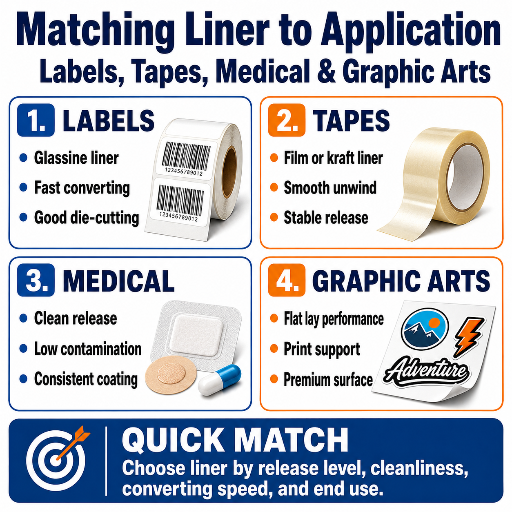
Each job presents an opportunity for liner performance on a given press, so the first step in identifying an optimum liner is reverse-engineering these needs to paper specifications.
- ✔Pressure-sensitive labels: need consistent release at dispensing speed and clean die-cutting; glassine’s smoothness and translucency suit optical web inspection in roll-to-roll applications and high-speed manufacturing processes.
- ✔Industrial and double-sided tapes: often use double-side (S2S) siliconized liners with differential release so the tape unwinds and transfers correctly.
- ✔Medical adhesives: transdermal patches, wound dressings, electrodes and wearables rely on cleanliness and repeatable release. These are compliance-sensitive — see the note below.
- ✔Graphic arts: the smooth surface enables flawless die-cutting of vinyl graphics and decals; lightweight die-cut parts suit glassine, while multilayer or heavy-duty work — or jobs needing extra moisture resistance — may need PCK or film.
A visual scenario: a printer for pharmaceutical labels running at a high-speed press prefers glassine for its compact caliper, knowing it can maintain clean die-stripping without tearing under continuous run for hours; in the same shop, a manufacturer of freezer labels finds curl a more pressing concern as relative humidity ebbs and flows in the print room. Whatever the best performing liner, it is the one matched to the press operation and ambient climate, not the one boasting the single strongest attribute. Our food-packaging labels guide goes deeper on that application.
⚠️ Important: food and medical use is compliance-driven
“Food-Safe” isn’t intrinsic to the liner material. Label or tape construction eligibility for contact with food requires review of each element likely to migrate, while U.S. rules such as 21 CFR 175.125 apply only under prescribed conditions. For any food or medical application, treat concerns of regulatory compliance as pertaining to the entire [adhesive] system and obtain written clearance for the actual construction in use.
Having experienced firsthand bringing facestocks, adhesives and liners together under one roof as a label stock converter, we recognize that liner choice often falls not because of inherent flaws in the liner itself but in its combination with the adhesive. A liner that strips cleanly from an adhesive-friendly removable acrylic might adhere too strongly to a harsh hot-melt – which is why we evaluate liners in tandem with actual adhesives.
The Glassine Paradox: Why a “Better” Liner Gets Rejected
Consider this seemingly paradoxical phenomenon prior to specifying your materials. Based on a majority of physical qualities – including significantly lower caliper, smoother surfaces, and enhanced transparency – glassine often holds a clear technical advantage. Despite this, many manufacturers in the North American market avoid it altogether. We call this the Glassine Paradox: a commercially-driven issue rooted in practical considerations rather than technical deficiencies.
“Our primary obstacle is invariably, ‘I’ll have to replace all my equipment.’ For a label converter, machinery upgrades and modifications to accommodate glassine represent a considerable endeavor measured in many months, even years, and can easily run into the millions; therefore, when SCK performs as well as it does, why bother paying a premium for glassine?”
Supporting this paradox are several factors: Commentary within the converting industry estimates that glassine costs approximately 20% more per unit than SCK; North American production of glassine is relatively low – Ahlstrom-Munksj is among the handful of manufacturers producing it regionally and within the industry is estimated to produce roughly 70,000 tons per annum of combined glassine and SCK, and for converters transitioning from SCK, polyester film is more commonly selected than glassine. None of these points discredit glassine as a material, but they high light that “best in theory” doesn’t always equate to “best for your operational environment.”
What are the disadvantages of glassine paper?
The fundamental physical drawbacks of Glassine lie in its construction. While denser, glassine is more flexible and pliable. When the humidity level shifts, its increased susceptibility to dimensional instability leads to curling problems and hinders smooth rewinding and flatness on press. As a paper substrate, it’s inherently less resilient to moisture and tearing than PET, and performs best at modest speeds compared to higher operating velocities. It also carries the highest cost of the three main paper choices due to the additional moistening and re-calendering its manufacture requires — unlike SCK, whose lower-cost process is the subject of patents such as US 12,473,693. While these concessions might be acceptable for many applications, for a label converter like high-speed dealing with conditions involving fluctuating humidity or high heat, these compromises could become problematic.
The 4-Lever Method for Choosing a Glassine Liner
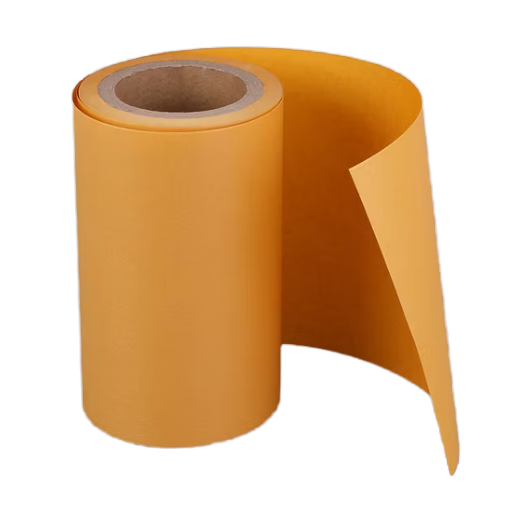
Choosing the appropriate release liner across different release liner applications is easier if, rather than memorizing grades, you decide with four levers. Set each one against your job and the right spec falls out.
The 4-Lever Liner Selection Method
- Release force versus adhesive aggressiveness. Match release to the adhesive: light release for removable acrylics, firmer for aggressive hot-melts. Mismatched release is the most common dispensing failure.
- Dispensing and line speed. Faster lines raise the effective peel force; if you run high-speed automatic applicators, bias toward a more stable liner or validate at speed.
- Die-cut precision and matrix strip. Fine, intricate cuts need tight, consistent caliper; if matrix breaks are slowing the line, caliper consistency is usually the culprit.
- Environment: moisture and temperature. Humid plants and cold chains punish curl-prone paper; high-temperature cure or use may push you to film instead.
Work the four levers in order and you will know your basis weight, coat configuration, and target release before you ever look at a price. To turn that into an actual grade, our release-force selector matches release values to adhesive types, and the glassine release liner page lists the grades themselves.
Sustainability: Can Glassine Liners Be Recycled?
The honest answer is “yes, with conditions.” A study by CELAB-Europe and CTP concluded that both glassine- and CCK-based silicone release liners are recyclable according to the EN13430 standard, with no detriment to mixed-paper recycling under appropriate conditions. That refutes the common belief that silicone-coated paper is automatically landfill-only.
Yet the caveat is real. Recyclability as a classification is not the same as clean recovery on any given line. The U.S. Forest Products Laboratory has reported that residual release-liner particles can reduce recycled-paper strength and print quality; screening and cleaning remove those particles efficiently while flotation does not, and continuous pulpers may need longer residence time to disintegrate the liner. In practice, recovery depends on the mill’s equipment and on collection logistics – the gap the industry’s CELAB initiative is working to close, with a stated goal of recycling or reusing more than 75% of used liner and matrix in Europe. Newer constructions also help: repulpable liner designs (for example WO 2018/057451) and double-side siliconized grades that stay paper-recyclable are reaching the market.
Glassine’s Place in the Release Liner Market (and Where It’s Headed)
Glassine is still the workhorse. Industry analyses generally place glassine and other super-calendered papers near 36-38% of release-liner substrates by area – on the order of 20,000 million square meters – with glassine plus super-calendered kraft together accounting for roughly half of all label-industry liner. Market-research firms value the broader release-liner market near USD 17 billion in 2025, projected toward USD 25 billion by 2031 at roughly 6% CAGR, with Asia-Pacific the largest region at roughly 42% share and the fastest growth near 7% CAGR (estimates vary by firm and by how the market is scoped).
Three forces are changing this picture. Paper liners are being re-engineered for higher fiber strength to hold ground (see coated-substrate patents such as US 9,212,299), but filmic liners (BO-PET, BOPP) are gaining where sections cure or run above the temperature paper can take — electronics, automotive, battery tapes and prepreg composites — and film already represents about 25% of the North American liner market (PET ~14%, PE ~8%, PP ~4%). Brand owners are asking for lower-grammage liners to reduce freight emissions, which reduces paper tonnage even as area demand increases. And linerless labels, which completely omit the liner, are small but rapidly increasing in logistics and quick-service restaurants. Practically, for sourcing: if you are securing a multi-year liner supply, consider the tightening of paper-recyclability regulations (the EU’s PPWR will guide label requirements by 2030) versus the temperature and dimensional specifications that push certain applications to film.
Frequently Asked Questions

Q: Can I use parchment paper instead of a glassine release liner?
View Answer
No, not for pressure-sensitive work. Baking parchment is a silicone-treated paper made for non-stick cooking, not for the controlled, repeatable release of an adhesive at a defined force. A glassine release liner is engineered with a specific silicone coat weight and cure so the adhesive peels predictably and the liner survives converting, die-cutting and dispensing. Parchment will not give you that consistency.
Q: Is a glassine release liner the same as silicone paper?
View Answer
They describe the same product at different stages. “Glassine” is the base substrate — the super-calendered paper. “Silicone paper” or “silicone release paper” describes that sheet once it has been coated with cured silicone. So a glassine release liner is a type of silicone release paper; the term simply tells you the base paper is glassine rather than kraft or film.
Q: What GSM is a typical glassine release liner?
View Answer
Most standard grades fall between 50 and 80 g/m², with specialty grades spanning roughly 35 to 120 g/m². Basis weight controls stiffness and tensile strength: heavier liners resist curl and dispense more reliably, while lighter liners cut freight cost and emissions but are more curl-prone. Correct weight depends on your press, applicator and storage environment.
Q: Is a glassine release liner recyclable?
View Answer
Yes — glassine liners are classified as recyclable under EN 13430, though clean recovery depends on the mill’s process and on collection logistics rather than the material alone.
Q: What’s the difference between glassine and CCK or SCK liner?
View Answer
All three are paper liners, but they are made and finished differently. Glassine is super-calendered and PVA-finished, giving high transparency and a very smooth, dense surface favored for fine die-cutting and optical inspection. SCK (super-calendered kraft) is starch-finished, stiffer and lower-cost — the US volume standard. CCK (clay-coated kraft) uses a clay coating for smoothness but produces more slitting dust and can crack in complex die-cutting, so it suits heavier, multilayer work. Glassine generally costs the most of the three because of the extra remoistening and recalendering steps.
Q: Does glassine work for high-speed label dispensing?
View Answer
It can, within limits. Glassine dispenses well at moderate speeds and its smoothness helps clean die-cutting, but at the highest line speeds its lower stiffness and curl sensitivity can cause web-handling issues, and effective release force rises with peel rate. For very high-speed automatic application, validate the specific grade at your real line speed, or consider a film liner if conditions are demanding.
Spec your glassine release liner with confidence
Share your adhesive, application, and line speed, and our materials team will recommend a grade — or do the calcs yourself with our selectors.
About This Guide
This guide has been written and reviewed by Guanma’s materials engineering team. As a self-adhesive label-stock manufacturer that plates and laminates facestocks, adhesives and glassine and kraft liners in our Thailand and Vietnam operations, we test release-liner behavior against real adhesives rather than in isolation — which is why this guide evaluates glassine’s trade-offs more honestly than the others.
References & Sources
- CELAB-Europe × CTP — Recyclability of Silicone Release Liners (EN 13430) — CELAB-Europe
- Release Liner & Matrix Recycling Initiative — FINAT
- Effect of Release-Liner Residuals on Recycled Paper — USDA Forest Products Laboratory
- 21 CFR Part 175 — Adhesives & Components of Coatings (175.125) — U.S. eCFR / FDA
- Repulpable Silicone Release Liner Paper (WO 2018/057451) — USPTO / Google Patents
- Silicone Release Liner Technology (Label Academy) — Labels & Labeling
Related Articles
- Self-Adhesive Paper: A 2026 Guide — how facestock, adhesive and liner combine
- Waterproof Labels: Materials & How They Work
- Freezer Labels Explained — liner curl and cold-chain considerations
- Wine Label Materials Guide
- Self-Adhesive Film Materials — filmic facestocks and liners