Get in Touch with Guanma

Updated August 2026 · U.S. food-contact scope · Buyer-side verification guide
FDA compliant label materials for food packaging are not identified by one logo, resin name, or supplier sentence. Defensible selection links every relevant substance in the finished label to an applicable U.S. regulatory basis, the intended contact path, conditions of use, and a controlled construction revision. Physical performance on the real package then needs its own evidence. For labels applied to foodservice containers from Wanhui, assess the specific label construction and package use separately; the container supplier listing does not establish regulatory compliance for the label.
This guide is for packaging buyers who already know the broad material options and now need to verify the construction. For a general comparison of paper and film choices, begin with Guanma’s overview of label formats and use cases; the workflow below starts where a shortlist becomes a compliance file.
Short answer
Specify the complete printed label, classify how any substance could reach food, verify the applicable authorization route and use limitations, then qualify adhesion, abrasion, condensation, print durability, and handling on the actual package. That component statement can support the file; it can’t automatically cover the finished construction.
What FDA-Compliant Means for a Finished Label Construction
For a food-packaging label, “FDA compliant” should mean that the substances reasonably expected to migrate are lawful for the identified use and that the construction is made under the applicable general provisions. It should not imply that the U.S. Food and Drug Administration issued a blanket approval certificate for every facestock, adhesive, ink, coating, and package combination.
21 CFR 174.5 supplies the general frame for indirect food additives. Authorized uses still remain subject to good manufacturing practice, suitable purity, other applicable provisions of the Federal Food, Drug, and Cosmetic Act, and the requirement not to make food unfit through an odor or taste. Authorization for indirect use also does not imply permission to use the same substance as a direct food additive.
Use the 4-Step Contact-Path Evidence Ladder
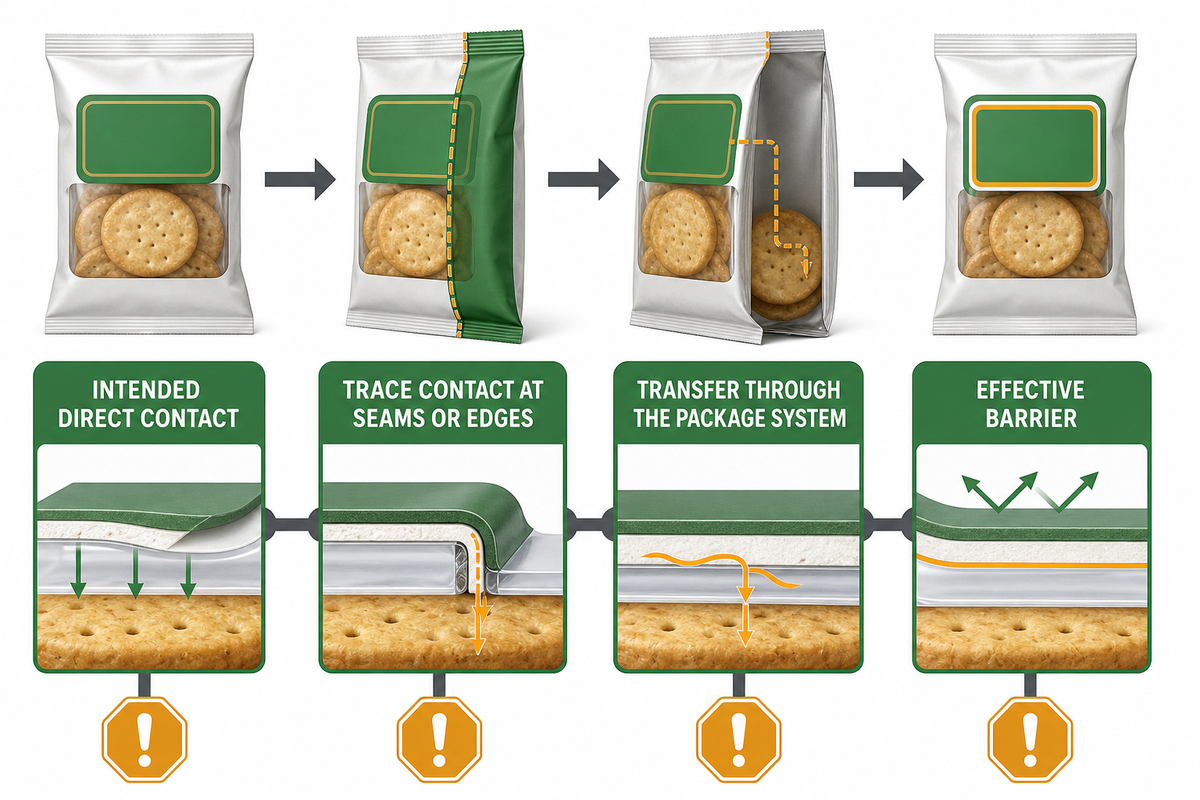
The first purchasing question isn’t “Which label material is approved?” It’s “By what realistic route could a substance in this construction reach food?” That answer determines which evidence deserves attention and prevents an exterior label from being treated as automatically irrelevant.
| Path | Example question | Evidence focus | Decision boundary |
|---|---|---|---|
| 1. Intended direct contact | Can the labeled surface or adhesive intentionally touch food? | Specific lawful basis and conditions for that direct contact | Do not infer permission from an indirect-use citation |
| 2. Trace contact at seams or edges | Could adhesive squeeze-out, a cut edge, or label placement create contact? | Geometry, application quantity, placement, and the exact regulatory limitation | Flat drawings may miss the production contact path |
| 3. Transfer through the package system | Can a substance move by migration, set-off, penetration, or another route? | Package layers, food type, time, temperature, storage, and transfer evidence | “Exterior” is a location, not a complete exposure assessment |
| 4. Effective barrier | Does a verified barrier prevent the relevant substance from reaching food? | Barrier identity, integrity, converting process, and intended conditions | Barrier assumptions must match the sold package |
This ladder separates material safety from consumer-facing food labeling, even though searches for “FDA compliant food packaging labels” often mix the two. Labeling requirements for Nutrition Facts, allergens, identity statements, and net quantity concern what the finished food label says; this article concerns the packaging materials underneath that artwork. Both reviews contribute to food safety, but neither substitutes for the other.
This scope split matters to food manufacturers and the wider food industry, including food and beverage brands. A Nutrition Facts label, allergen statement, and other food label requirements belong to consumer-facing FDA labeling; the FDA Food Labeling Guide summarizes many requirements for food labeling, while legal requirements for food labeling can also draw on statutes and regulations beyond material authorization. Questions about FDA labeling requirements, nutrition labeling, labels for food, or foods sold in the U.S. therefore need their own review and cannot prove that plastic label materials are safe for food contact.
Check Adhesive Authorization Under 21 CFR 175.105
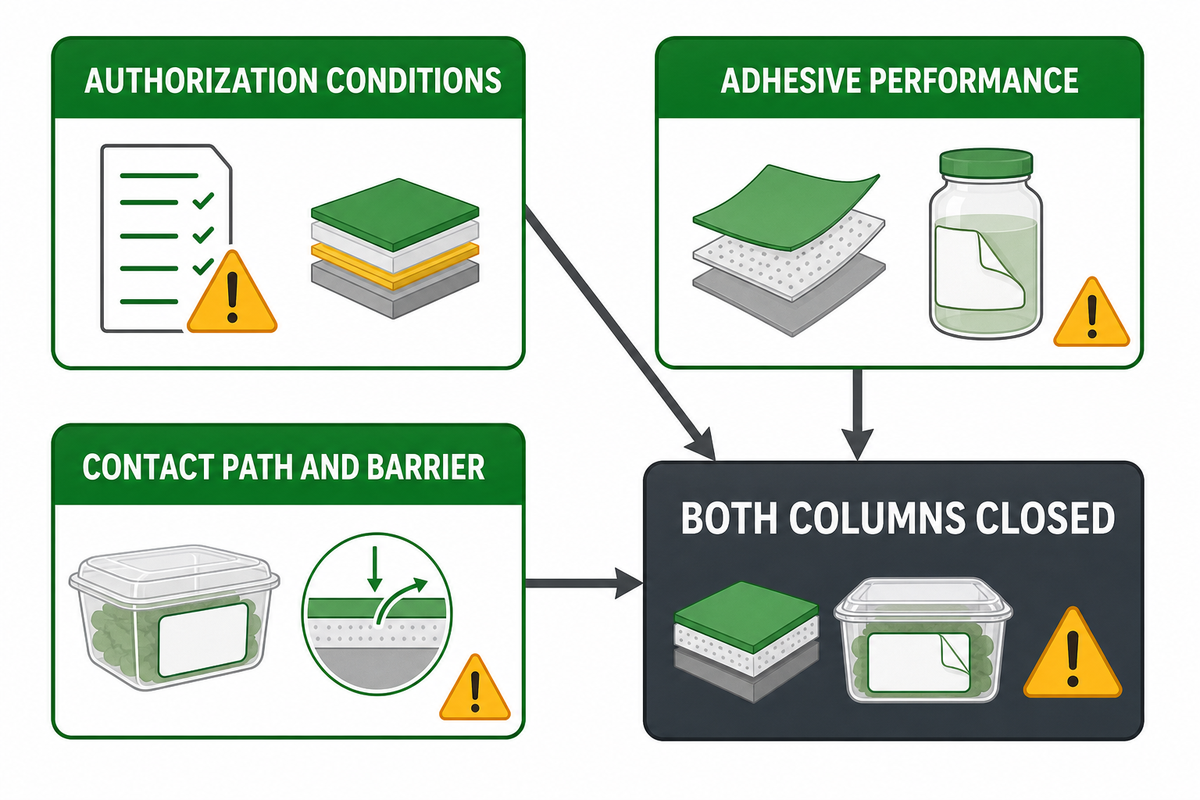
With the contact path classified, an adhesive citation is useful only when the buyer reads its conditions and limitations. Section 175.105 isn’t an unrestricted direct-food-contact approval, and it doesn’t prove that a pressure-sensitive label will remain attached, legible, and intact through the intended converting, filling, storage, and distribution cycle.
The current text of 21 CFR 175.105 addresses adhesives used as components of articles intended for food packaging, transporting, or holding. It specifies permitted substance bases and bounded use conditions, including uses behind a functional barrier and stated trace-contact conditions. Read the section together with §174.5 rather than quoting its number alone.
Common mistake
Suppose a supplier writes “adhesive complies with 21 CFR 175.105,” while the buyer never records the adhesive product code, coating weight, contact route, package barrier, food type, or service conditions. That citation may be real, yet the file still can’t show that the cited scope matches the delivered label.
Ask the adhesive supplier or label converter to identify the material, applicable paragraph or authorization basis, limitations, manufacturing site or notifier when relevant, and the construction revision covered by the statement. If the supplier relies on a barrier, the buyer should also identify the barrier layer and confirm that slitting, die-cutting, seams, folds, or label placement don’t defeat the assumed separation.
Adhesive compliance and adhesive performance remain separate decision axes. Even a lawful substance may fail on a cold, wet, textured, oily, curved, or low-surface-energy package; a high-peel construction may still lack the right regulatory evidence for the intended contact path. Procurement needs both columns closed.
Trace the Applicable Authorization Route and Supplier-Specific FCNs
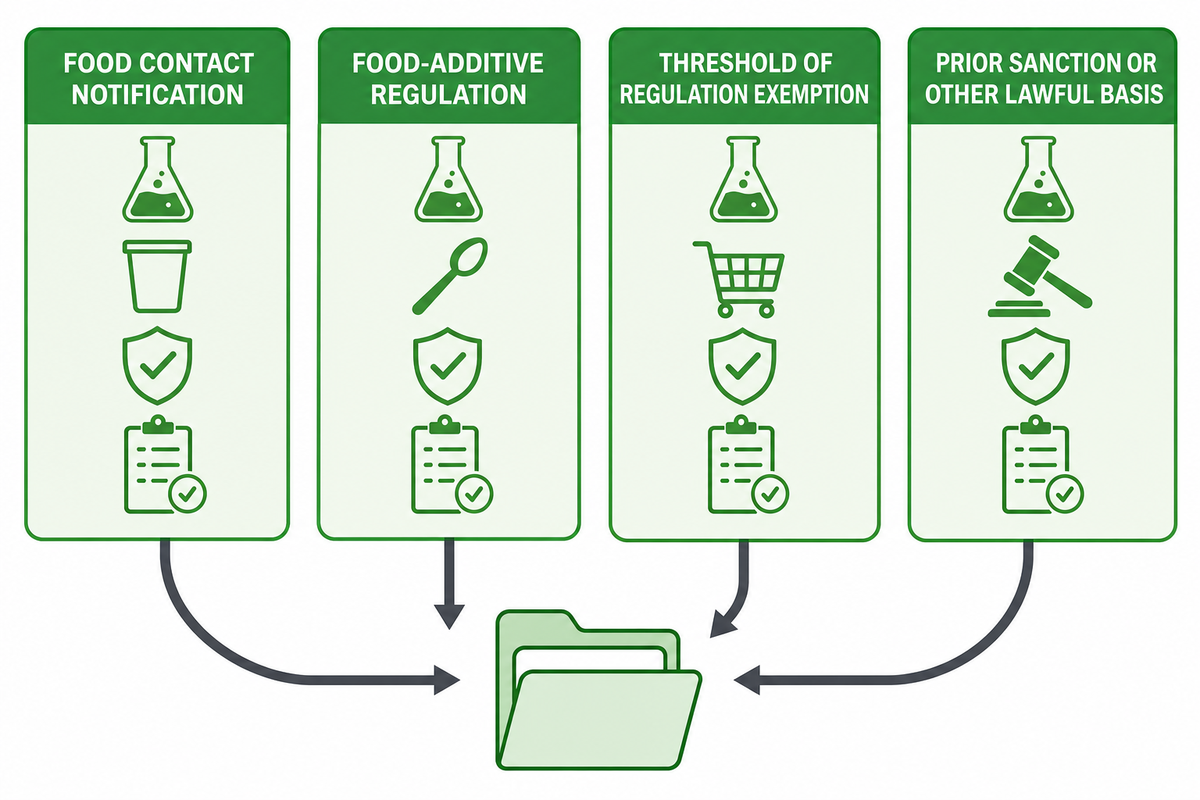
Food-contact substances can reach lawful status through different routes, and those routes do not share identical reliance rules. A Food Contact Notification is company-, substance-, and intended-use-specific, while the FDA states that a Threshold of Regulation exemption may be used by any manufacturer or supplier for the specified uses and conditions. A food-additive regulation has its own scope and limitations.
FDA’s authorization-route overview explains this distinction and also describes the migration and exposure information considered during an FCN safety review. Correctly scoped, that evidence supports migration safety without automatically proving every finished-label application property.
Package-material review follows a different set of federal regulations and packaging regulations. Federal sources such as the Code of Federal Regulations, FDA regulations, FDA rules, and FDA’s guidelines distinguish substances added to food from food contact materials and other materials intended for direct or indirect food contact; contact substances are classified by their identity, intended use, and exposure route. Evidence changes when a component can come into contact with food directly or indirectly, creates indirect contact, has direct contact with food, or is applied directly to food, so “approved for food” or “generally recognized as safe” cannot be borrowed as an all-purpose label claim; likewise, a basis for use in food is not automatically a basis for an indirect-contact label component.
| Route | Buyer must match | Reliance check | Do not assume |
|---|---|---|---|
| Food Contact Notification | Notifier or manufacturer, substance, specifications, intended use, limitations, and effective status | Supplied party and use must fit the effective notification | Another company’s FCN covers every supplier |
| Food-additive regulation | Substance identity, regulated use, specifications, and stated restrictions | Actual formulation and use fit the regulation | Quoting a section number certifies the finished label |
| Threshold of Regulation exemption | Exempted substance, specified use, conditions, and any restrictions | Reliance must match the FDA-described exemption | Every route is manufacturer-specific like an FCN |
| Prior sanction or other lawful basis | Identity, historical or legal basis, and exact scope | Suppliers should explain why the basis applies | Generic guarantees disclose the underlying route |
When an FCN is cited, search the FDA’s inventory of effective Food Contact Notifications. Match the listed notifier or manufacturer, substance, intended use, limitations, and specifications to the supplier declaration. Record the date of the check because effective status can change.
Practical takeaway from Peter Coneski, Ph.D., and Natalie Rainer: define the substance identity, intended use, target market, food types, temperature, and contact duration before selecting a regulatory data package.
Build a Five-Component Construction-to-Evidence Trace Matrix
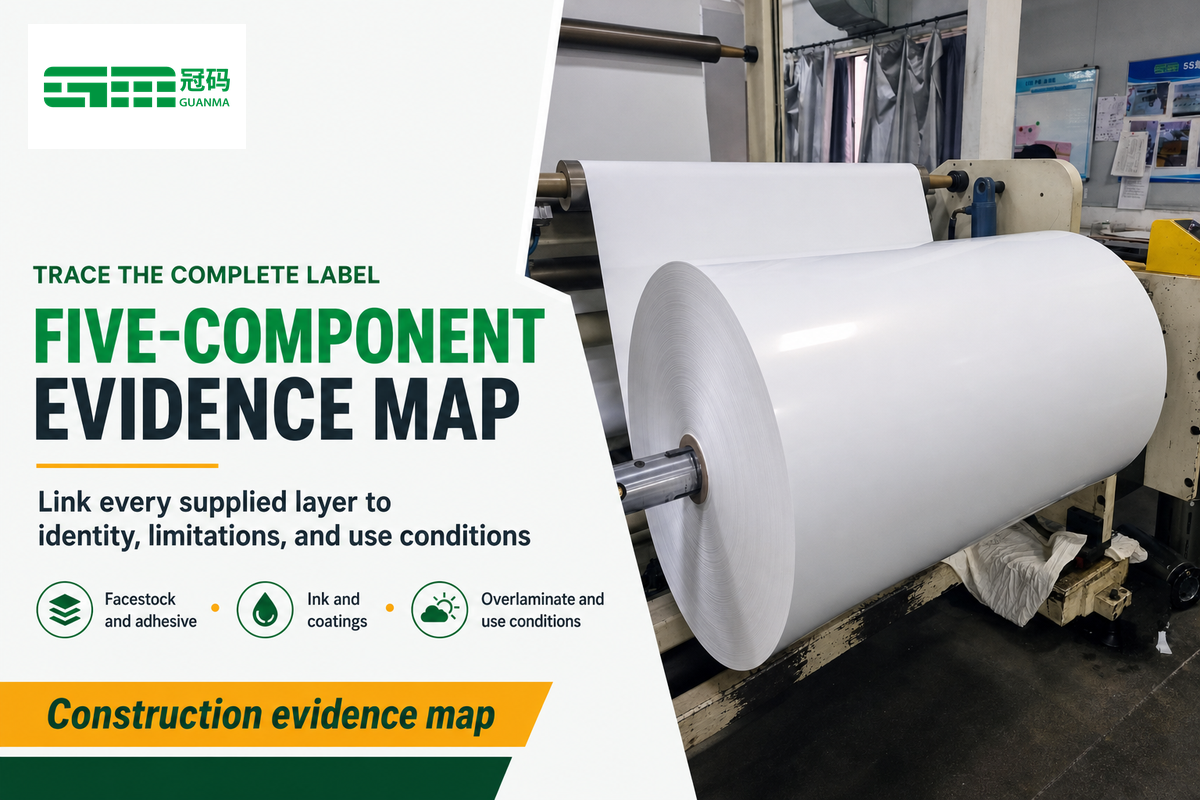
After the lawful route is identified, each finished pressure-sensitive label is a system, not a single “material.” Our Five-Component Authorization Map starts with facestock, adhesive, printing ink, coating or varnish, and overlaminate. Depending on the product, primers, tie layers, colorants, additives, and process aids may also require review because FDA asks about substances expected to migrate, not only layers visible in a sales name.
For facestock tradeoffs before evidence mapping, Guanma’s facestock tradeoff analysis supplies material-selection context. From there, the trace matrix moves from a material family to the exact supplied construction and its documents.
The FDA’s component regulatory-status guidance directs users to establish the identity, specifications, limitations, and lawful basis of each substance expected to migrate. That makes a layer-by-layer trace more defensible than a certificate whose product name cannot be matched to the purchase specification.
For a selected type of food, food packaging must satisfy the applicable packaging requirements, food safety regulations, and relevant regulations and industry standards. Packaging must comply with the specific guidelines and use limitations that apply; labels must also stay properly labeled and functional under the buyer’s protocol, while inks and adhesives must comply with food contact conditions documented for each component. These requirements for food packaging materials apply whether a converter proposes paper, flexible packaging, or other packaging solutions, because food applications need construction-specific evidence across the supply chain.
| Row | Material / construction item | Controlled identity | Evidence to link | Use-condition field | Limitation / stop point |
|---|---|---|---|---|---|
| 1 | Facestock | Polymer or paper grade and supplier code | Composition statement and applicable regulatory basis | Food, barrier, time, and temperature | Generic “paper” or “film” descriptions are not traceable |
| 2 | Adhesive | Product code, chemistry, and coating specification | §175.105 or other applicable route with limitations | Contact path, quantity, barrier, and placement | Indirect-use language cannot prove unrestricted direct contact |
| 3 | Ink system | Ink series, colorants, additives, and cure system | Supplier statement plus migration or exposure basis when relevant | Print side, cure, winding, stacking, and storage | Exterior placement alone does not close every transfer route |
| 4 | Varnish or coating | Product and applied-process revision | Composition, cure, and intended-use statement | Coverage, cure energy, heat, moisture, and abrasion | Construction changes can alter both migration and print performance |
| 5 | Overlaminate | Film, adhesive, and supplier revision | Each relevant component’s lawful basis | Edge exposure, sealing, temperature, and flexing | The laminate cannot be treated as one unnamed layer |
| 6 | Primer or tie layer | Coating identity and application process | Supplier composition and relevant limitations | Coverage, cure, and position in the stack | Hidden layers still matter if migration is reasonably expected |
| 7 | Finished construction code | One bill-of-materials revision | Cross-reference to rows 1–6 | Intended package and market | Documents for different revisions cannot be pooled silently |
| 8 | Regulatory status check | Route, citation, notifier, or exemption reference | Current official record and supplier explanation | Date checked and intended-use match | Stale or unmatched references require escalation |
| 9 | Migration-safety basis | Tested or modelled article and revision | Method, conditions, result, assumptions, and conclusion | Food or simulant, contact, time, temperature, and ratio | Tests on a different construction may not transfer |
| 10 | Application qualification | Printed sample and package revision | Approved protocol, observations, acceptance criteria, and disposition | Application, dwell, storage, handling, and distribution | Regulatory evidence does not establish physical fitness |
This matrix is an editorial procurement framework, not an FDA form. Its value is traceability: a reviewer can move from a purchased construction to the evidence for each layer, see which assumptions remain open, and identify the exact change that would trigger reassessment.
Verify Regulatory Migration Safety and Finished-Package Performance
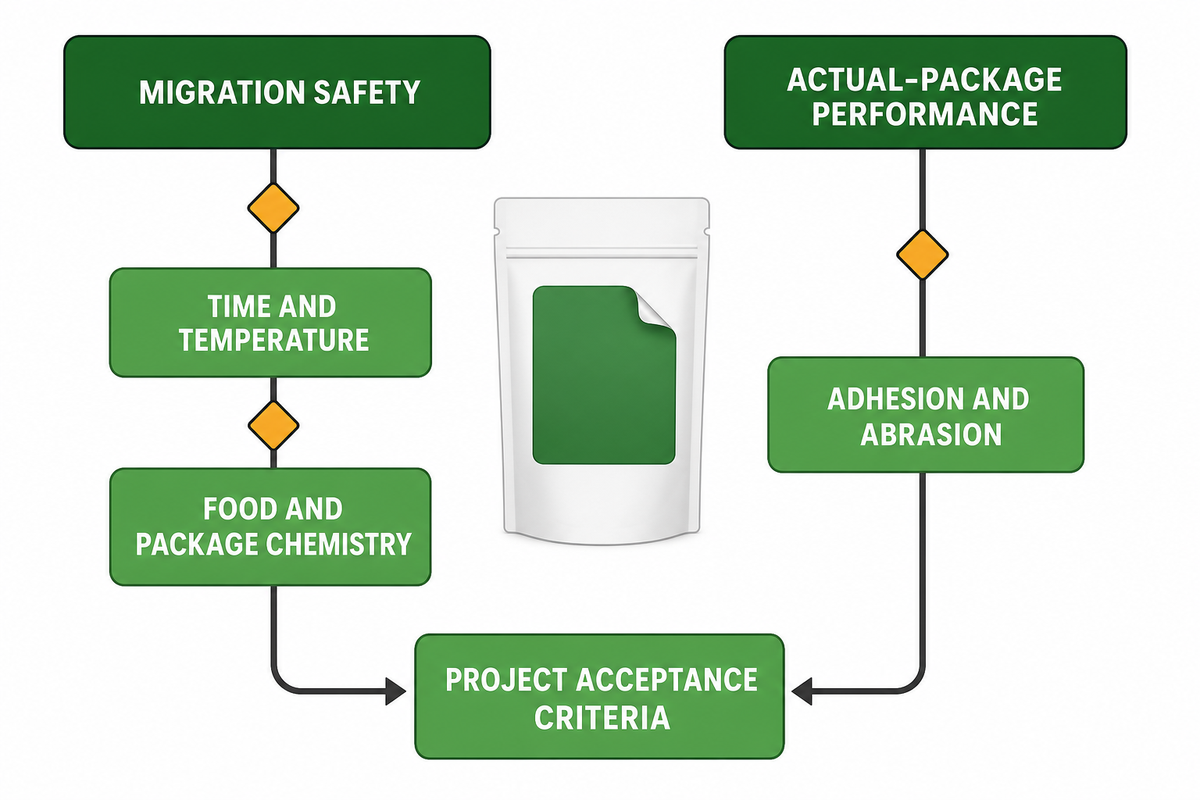
With the component trace in place, regulatory migration-safety review and application qualification answer related but different questions. Regulatory review asks whether exposure from the identified substance and use is safe and lawful; application qualification asks whether the printed label remains functional on the actual package. Buyers shouldn’t erase either column by pointing to the other.
Published in 2024, a peer-reviewed review of chemical migration from food packaging explains why transfer depends on variables such as time, temperature, food and package chemistry, simulants, contact conditions, set-off, and condensation. These variables support a condition-specific assessment; they don’t supply one universal U.S. pass value for every label.
USDA hosts an adhesive-migration research record that specifically includes pressure-sensitive labels attached to food-contact films. That scope is a useful reminder that the package system, not merely the adhesive trade name, defines the evidence question.
Practitioner reality check
In a 25-reply IFSQN food-packaging discussion, practitioners debate whether compliant raw materials are enough and describe testing, modelling, or a documented combined assessment of board, ink, varnish, glue, and other components. That thread reflects non-U.S. certification practice, so it is used here only to show the real component-to-construction handoff, not to establish an FDA testing requirement.
| Field | Record before testing | Observe or measure | Limitation / not suitable for |
|---|---|---|---|
| Package substrate | Material grade, texture, treatment, and supplier | Adhesion consistency and surface interaction | Results do not transfer automatically to another resin or coating |
| Application temperature | Actual package and label temperature in °C or °F | Wet-out, lift, edge behavior, and placement | Room-temperature application data cannot prove cold application |
| Service temperature | Minimum and maximum °C or °F plus exposure time | Adhesion, facestock change, and print integrity | A brief excursion does not prove continuous-service fitness |
| Dwell before evaluation | Minutes or hours after application | Initial tack versus developed bond | Comparisons fail when dwell is not controlled |
| Moisture and condensation | Relative humidity, wetting route, and cycle duration | Whitening, curl, edge lift, adhesive movement, and legibility | Dry-lab results do not represent a condensing cold chain |
| Geometry | Diameter, curve, panel, seam, and edge distance in mm or in | Flagging, tunnelling, wrinkles, and edge exposure | Flat-panel tests cannot prove small-diameter performance |
| Peel comparison | ASTM D3330 procedure, 180° or 90° geometry, substrate, and conditioning | Relative peel force and failure mode | The method does not create a universal functional threshold |
| Abrasion comparison | ASTM D5264 procedure, cycles, load, conditioning, and acceptance rule | Ink, coating, barcode, and text degradation | An unnamed “rub test” is not reproducible |
| Printing and cure | Ink series, color, cure settings, coating, and press revision | Set-off, smearing, odor, transfer, and durability | Blank-stock evidence cannot cover a changed print system |
| Distribution simulation | Duration in days, stacking, vibration, handling, and storage sequence | Label position, readability, damage, and package interaction | One static sample cannot represent the full route |
ASTM D3330/D3330M-04(2025) supports relative peel testing on representative materials but warns that the result may not provide design or functional information. ASTM D5264-98(2019) provides a controlled abrasion-comparison practice for printed materials, including labels and packaging. Name the procedure and project acceptance criteria instead of inventing a universal pass number.
Illustrative data-entry format, not a qualification protocol
A refrigerated project record might state 4°C application, 24 hours dwell, 7 days at 2°C, an 8-hour condensation transition at 23°C and 90% relative humidity, a 90° peel geometry, a 25 mm specimen width, and 50 abrasion cycles. Another project might state 23°C application, 72 hours dwell, 14 days at −18°C, two 8-hour thaw periods at 23°C, a 180° peel geometry, a 25 mm specimen width, followed by 48 hours at 10°C and 75% relative humidity.
For a warm-process example, the record could instead state 23°C application, a 60°C package exposure lasting 30 minutes, 7 days at 38°C and 60% relative humidity, plus 100 abrasion cycles. Every value in these three examples is intentionally hypothetical and demonstrates record syntax only; replace it with project-defined conditions and acceptance criteria supported by qualified reviewers.
What are the best labels for refrigerated food products?
There’s no single best refrigerated-food label. Match the construction to application temperature, moisture and condensation, container resin or coating, curvature, dwell time, storage range, abrasion, and print process. Film facestock may resist moisture better than unprotected paper, while the adhesive still has to wet the actual surface and develop adequate bond under the defined cold-chain sequence.
Start with representative containers and a controlled protocol, then compare failure modes rather than one headline peel value. Guanma’s freezer labels guide covers the performance-selection branch; the compliance file must still be verified separately.
Reject Unsupported FDA Claims: A Red-Flag Grid
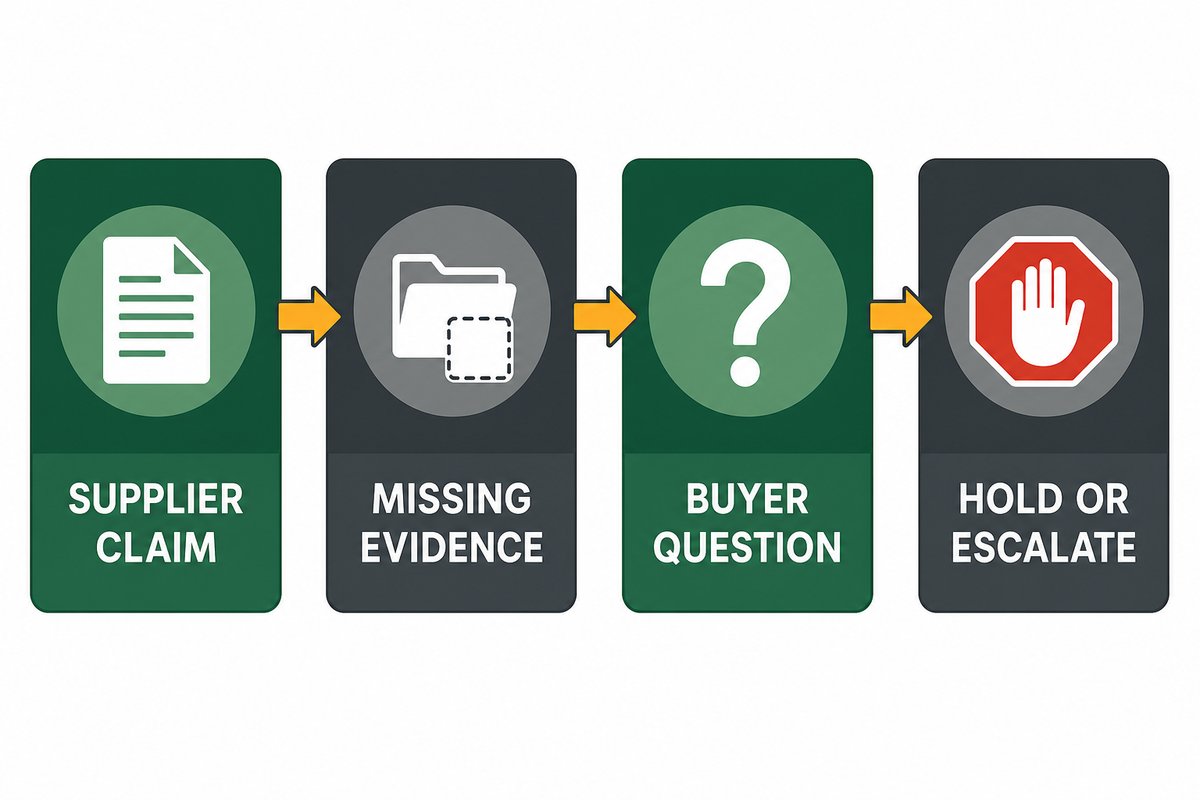
After regulatory and performance evidence are separated, the Claim-to-Document Red-Flag Grid converts vague supplier language into a bounded follow-up. It is an editorial buyer tool, not an FDA checklist, and each legal conclusion still depends on the actual substance, route, intended use, and current official record.
Exterior printing deserves a bounded check. FDA researchers report that, for some intended uses, photoinitiators in ultraviolet-cured inks on exterior food packaging may migrate to food. That finding does not condemn every exterior ink or prove a specific mechanism in every package; it does show why “printed on the outside” is not a complete evidence statement.
| Supplier claim | Missing evidence | Buyer question | Stop / escalate outcome |
|---|---|---|---|
| “FDA approved label” | No route, substance, use, or limitation | Which lawful basis applies to which construction? | Hold the claim until scope is documented |
| “Covered by FCN ####” | Notifier, manufacturer, substance, and intended-use match | Does the effective inventory record match this supplier and use? | Reject an unmatched FCN reference |
| “All FDA routes are supplier-specific” | Route distinction | Is this an FCN, regulation, Threshold of Regulation exemption, or another basis? | Correct the reliance rule before approval |
| “§175.105 allows food contact” | Applicable condition and limitation | Which paragraph fits the actual contact path? | Do not infer unrestricted direct contact |
| “Authorized, therefore fully compliant” | §174.5 GMP, purity, food-fitness, and other applicable duties | How are general provisions addressed? | Escalate an authorization-only file |
| “Blank stock is compliant” | Ink, coating, cure, overlaminate, and finished revision | What changed after the blank material was qualified? | Reopen review for the printed construction |
| “Exterior ink cannot migrate” | Intended-use and transfer assessment | What evidence excludes relevant migration or transfer for this package? | Require a bounded explanation, not a universal statement |
| “Passed ASTM testing” | Procedure, substrate, conditioning, result, and acceptance criteria | Which method variant and project threshold were used? | Treat an unnamed pass as non-reproducible |
| “Certificate on file” | Document revision, product code, date, and current status | Does it cover the supplied lot and current construction? | Quarantine a revision mismatch |
| “Equivalent replacement” | Formal change assessment | Which composition, site, process, performance, or authorization fields changed? | Do not approve by trade-name similarity |

Turn the Evidence into a Buyer Specification
A compliance file becomes operational only when the purchase specification freezes the verified construction and tells both parties what requires notification. Controlled specifications should identify the product revision, every layer, intended market and contact path, package substrate, relevant process conditions, evidence references, application protocol, acceptance criteria, and approval owners.
Change control must include regulatory status. A January 2025 FDA update identified 35 PFAS-related FCNs that were no longer effective for stated grease-proofing uses, while a March 2024 FDA constituent update reports that the agency had issued a final rule revising procedures and reasons for determining when an FCN is no longer effective. These bounded agency updates do not describe every label, but they show why an undated authorization check is inadequate.
RFQ-ready evidence request
- Name the finished label product code, bill-of-materials revision, manufacturing site, and controlled drawing.
- List facestock, adhesive, ink, coating or varnish, overlaminate, primers, and other relevant additives by supplier reference.
- State the target market, food type, intended contact path, package barrier, contact duration, and temperature conditions.
- Identify the regulatory route for each substance expected to migrate, including limitations and supplier-specific fields where applicable.
- Provide the current supplier declaration, guaranty, specification, and supporting migration-safety basis tied to the named construction.
- Describe testing or modelling assumptions, sample identity, food or simulant, time, temperature, ratio, method, result, and conclusion.
- Supply the actual-package validation protocol for adhesion, condensation, abrasion, print durability, geometry, handling, and distribution.
- Define project acceptance criteria before testing and record every deviation and disposition.
- Require written notice before a formulation, raw-material supplier, site, process, print system, construction, or regulatory-basis change.
- Name the document owner, approval owner, review date, and next recheck trigger.
Send the supplier the real use case rather than a request for “food grade labels.” Include the package resin or coating, surface treatment, label dimensions in mm or in, application temperature in °C or °F, service range, condensation sequence, storage duration in days, and any seam or edge proximity. Specific inputs give the supplier a chance to select the right evidence instead of returning a generic letter.
FDA provides inventories and other source records, and FDA maintains status pages that help buyers check whether an authorization remains effective. These tools support best practices and help ensure safety, but they do not make every product described as food grade, every set of packaging labels, or every FDA food packaging claim equivalent. A supplier can be a technical partner, yet the buyer still needs evidence that the proposed construction complies with the applicable legal requirements.
If the application family itself is still uncertain, Guanma’s application quick-match tool can organize the initial use case. Its output is a shortlist, not regulatory evidence or a substitute for the construction-level checks above.
After the evidence route and package conditions are defined, review Guanma’s construction-specific sample and RFQ options as the commercial handoff. Candidate constructions should still be sampled and qualified against the buyer’s controlled protocol before release.
A safer purchasing sentence
“Please propose a construction for the stated package and conditions, identify the regulatory basis and limitations for each relevant component, list the documents available for review, and flag any evidence gap before sampling.”
Frequently Asked Questions
What makes a food-packaging label material FDA compliant?
Compliance depends on the substance, authorization route, intended use, contact path, use conditions, and complete construction—not on a generic material name or one supplier certificate.
A buyer should identify substances expected to migrate, match each to an applicable lawful basis and limitations, confirm the contact path and conditions of use, and retain a controlled link to the supplied construction. General duties under 21 CFR 174.5 still apply. Finished-package physical performance requires separate validation on representative production samples.
Does the FDA approve finished food labels or label materials?
FDA does not issue one universal approval for every finished food label; a generic “FDA approved label” claim usually hides the substance, route, intended use, and scope that buyers need to verify.
FDA food-contact rules and authorization mechanisms apply to substances and specified uses, not as one universal certificate for every printed label. Ask whether the basis is a regulation, an effective Food Contact Notification, a Threshold of Regulation exemption, or another route, then match its conditions to the exact supplier and construction.
Does a label adhesive need its own FDA evidence?
Yes. The adhesive’s exact identity, lawful basis, limitations, contact path, use conditions, and construction revision should be traceable, because a section number alone does not establish finished-label compliance or performance.
A supplier may rely on 21 CFR 175.105 or another applicable route, but a citation alone is incomplete. Verify the actual adhesive product, contact path, functional barrier or trace-contact condition, intended food-package use, and construction revision. Do not infer unrestricted direct-contact permission or physical label performance from that citation alone.
Is migration testing always required for a food-packaging label?
No. The need for migration testing depends on the substance, authorization route, existing evidence, exposure path, food type, barrier, contact time, and temperature; physical package performance still needs separate qualification.
The appropriate evidence can depend on substance identity, lawful basis, exposure route, barrier, food type, contact time, temperature, and existing data or modelling. A qualified food-contact specialist should determine the necessary assessment for the intended use. Physical adhesion and print qualification remain separate even when migration safety is supported.
Can exterior label ink migrate into food?
Yes, for some systems and intended uses. Exterior placement can reduce certain contact scenarios, but it does not prove zero migration; buyers should assess the actual ink, cure, package layers, transfer routes, time, and temperature.
FDA research reports that some photoinitiators in exterior ultraviolet-cured printing inks may migrate for some intended uses. Evaluate the actual ink series, colorants, cure process, coating, package layers, winding or stacking, storage sequence, food type, time, and temperature. Confirm which transfer routes the evidence addresses, identify assumptions that depend on a barrier, and retain the finished construction revision with the assessment. Do not generalize the finding to every ink, claim that exterior printing is inherently unsafe, or assign a set-off, penetration, or gas-phase mechanism without source-specific evidence.
What documents should a label supplier provide?
Request a construction-linked package, not a fixed certificate count.
Useful records may include the controlled finished-construction specification; facestock, adhesive, ink, coating, primer, and overlaminate identities; component declarations; the applicable authorization route and limitations; an effective FCN match where relevant; migration-safety test or modelling support; and the actual-package application protocol and result. The file should also identify its revision, owner, approval date, intended contact path, food and temperature conditions, open limitations, and change-notification commitment. Ask the supplier to mark unavailable or non-applicable items explicitly, because silence does not show whether an item was assessed. The required package depends on the product, route, intended use, evidence already available, and buyer quality system; this list is a procurement framework rather than an FDA-mandated bundle.
Transparency note
This guide synthesizes current U.S. regulatory text, FDA guidance and research, peer-reviewed migration literature, ASTM method scopes, and one clearly bounded practitioner discussion. The named ladders, maps, matrices, grids, and RFQ checklist are editorial buyer frameworks; they are not FDA forms, Guanma certifications, or substitutes for product-specific legal and technical review.
References & Sources
- 21 CFR 174.5, General provisions applicable to indirect food additives
- 21 CFR 175.105, Adhesives
- FDA, Understanding How the FDA Regulates Substances That Come into Contact with Food
- FDA, Inventory of Effective Food Contact Substance Notifications
- FDA, Determining the Regulatory Status of Components of a Food Contact Material
- FDA Science Forum, Exterior food-packaging ink migration research
- USDA National Agricultural Library, Chemical migration from adhesives used in food-contact applications
- Peer-reviewed review, Chemical migration from food packaging
- ASTM D3330/D3330M-04(2025) — Peel adhesion of pressure-sensitive tape
- ASTM D5264-98(2019) — Abrasion resistance of printed materials
- FDA, 2024 final rule on Food Contact Notification effectiveness
- FDA, 2025 determination concerning 35 PFAS-related FCNs
- Packaging Digest, Food-contact strategy guidance from Peter Coneski, Ph.D., and Natalie Rainer