Get in Touch with Guanma

Reviewed by the Guanma technical team · Updated July 2026.
Quick Specs: Self-Adhesive Label Film
| Construction | Facestock + pressure-sensitive adhesive + release liner (3 layers) |
| Facestock polymers | PET, BOPP/PP, PE, PVC (+ synthetic paper) |
| Thickness range | 12 µm (thin PET) to 120 µm (thick PP/PE) |
| Adhesive chemistries | Hot-melt, water-based acrylic, UV-curable |
| Service window | −40 °C to +150 °C depending on adhesive |
| Peel test methods | FINAT FTM 1 (180°) / FTM 2 (90°); ASTM D3330 — reported in N/25mm. |
Self adhesive film is the polymer facestock holding most labels in the world you interact with every day – clear cling wrap on a shampoo bottle, rigid front plate of a hand-soap pump, freezer label tough enough to ride a cold chain. This guide targets converters, brand owners, and packaging engineers tasked with selecting the right film, not just sourcing another roll. Learn how the material is built, how each polymer performs, why bonds hold or fail, and how to decipher a datasheet without guessing.
Self-adhesive film is a pressure-sensitive label facestock – a thin polymer film (PET, BOPP, PP, PVC) coated on its top surface with an adhesive and adhered to a release liner. It sticks using pressure only, no heat, water, or solvent required. Choice is determined by service environment and substrate, not looks.
Key Points
- Contrary to a common assumption, you can’t fix a peeling label with a stronger adhesive; you need a surface-energy match, and it is not always the glue.
- Corona treatment on a film dissipates during storage; what worked last month may not bond this week.
- A polymer film isn’t inherently better than paper – the application determines which performs best.
- Film thicknesses run from 12 µm (thin PET) to 120 µm (thick PP/PE).
- From 12 August 2026, the EU PPWR pushes mono-material film and wash-off adhesives for recyclability.
What Self-Adhesive Film Actually Is (and What It Isn’t)
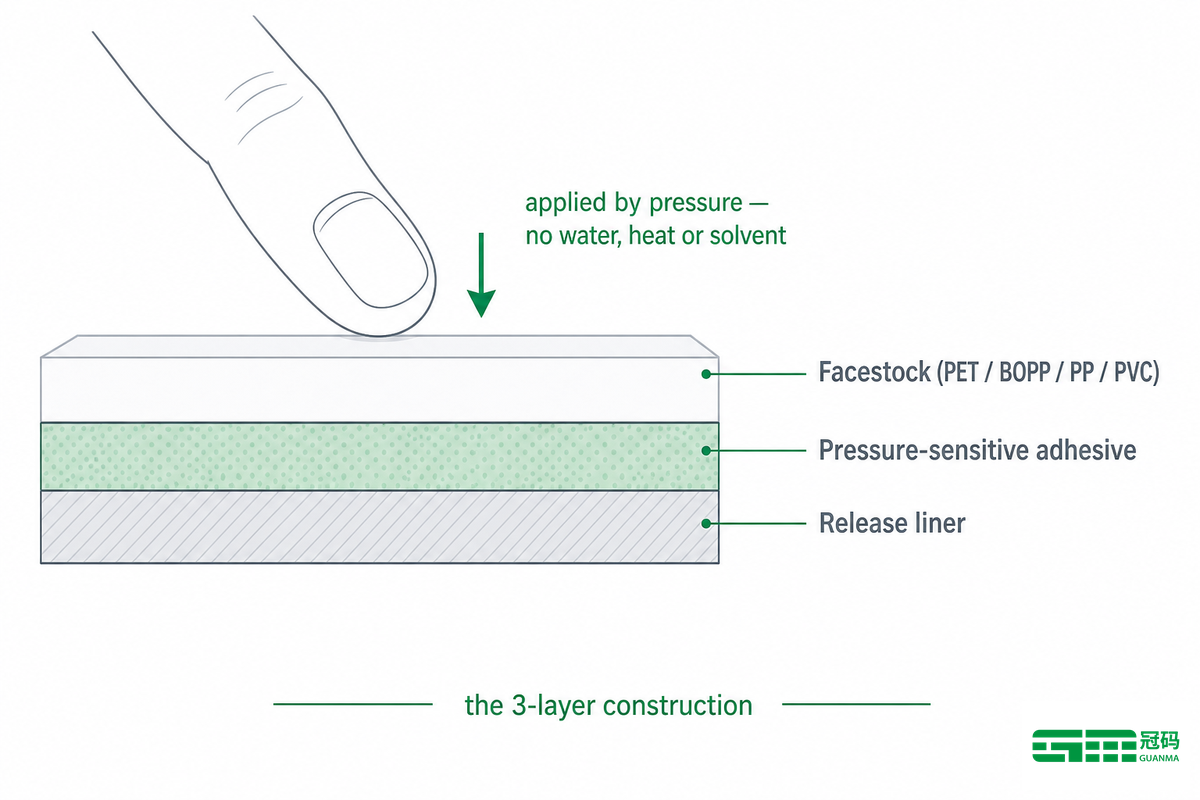
A self-adhesive label film is composed of three layers: a polymer film on the top (facestock), a pressure-sensitive adhesive on the back, and a release liner protecting the adhesive from damage until it’s used. The label sticks to the surface by finger or roller pressure; no water, solvent, or heat is involved.
The filmic face itself has a top “print” skin, a middle “core” skin, and a bottom “adhesive skin.” If all three skins are transparent, the film is clear. Toning the core with titanium dioxide produces opaque white.
⚠️ This guide is about label film — not décor film
A search for “self adhesive film” is often misleading because it blends two different product types. This guide addresses self-adhesive film as the label facestock material used in industrial and commercial labeling. It does not cover self-adhesive décor film, window tint, countertop laminate, or craft cutting vinyl – those are decorative, surface-application consumer films with different construction and adhesives.
Takeaway: treat self-adhesive film as a composite material stack. Every decision concerning durability, clarity, removability, and recyclability traces back to selecting the right facestock polymer and the correct adhesive.
Types of Self-Adhesive Film: The Facestock Families
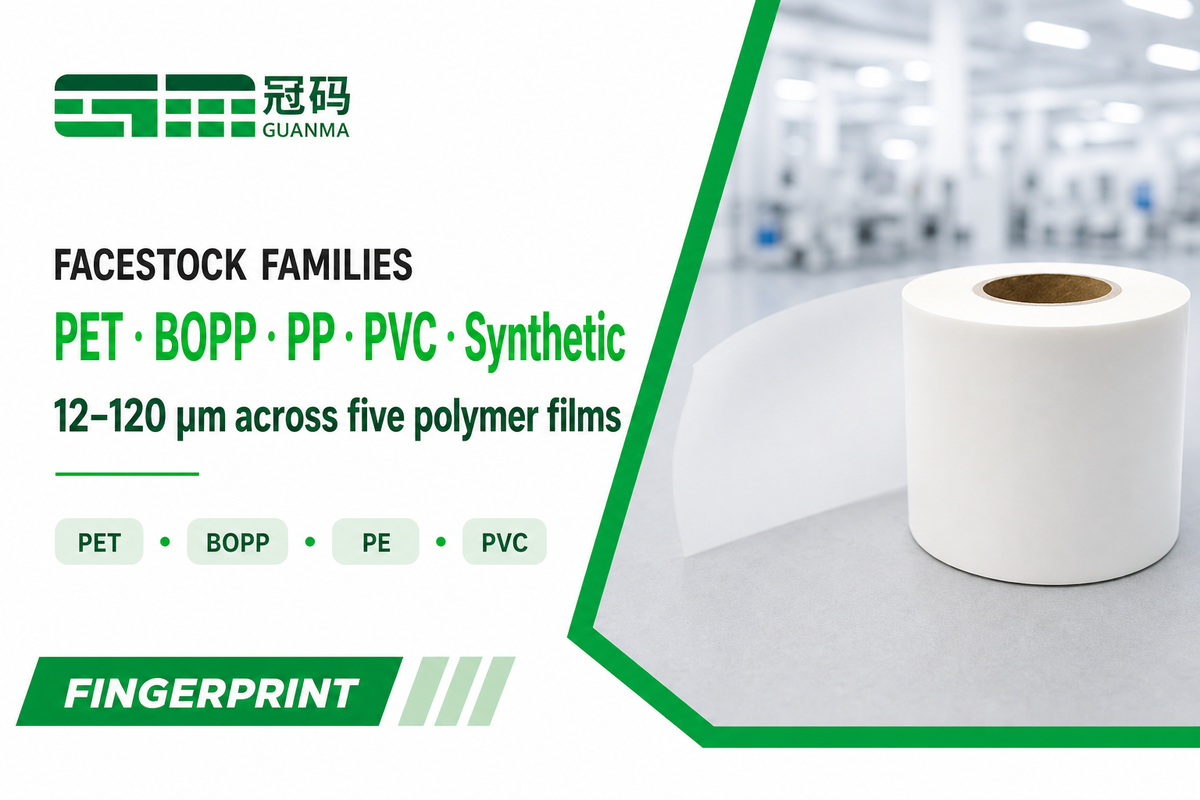
Four major polymer families and a synthetic-paper hybrid comprise the bulk of self-adhesive label film options. Each possesses a distinct signature with measured differences in thickness, clarity, heat tolerance, and recyclable designation. Below is the Film Facestock Fingerprint — a comparison of the most commonly used variations specified by converters.
| Facestock type | Typical thickness | Defining trait | Best-fit service | Recycling stream |
|---|---|---|---|---|
| PET, clear | 12–50 µm | Highest durability + clarity | Industrial ID, automotive, no-label look | PET reclaim (wash-off) |
| PET, matte / white | 23–50 µm | Heat + chemical resistance; flame-retard grades | Cable labeling, rating plates | PET reclaim |
| BOPP, clear | 50–60 µm | Rigid, glossy, cost-balanced | Beverage + glass bottles | Polyolefin (PP/HDPE) |
| BOPP, cavitated white | 50–80 µm | Air-filled core, pearlescent | Personal care, food | Polyolefin |
| BOPP, metallized silver | 50–80 µm | Mirror gloss without foil stamping | Premium beverage, cosmetics | Polyolefin (complex) |
| Thick BOPP | 100–120 µm | High opacity, ice-bucket performance | Wine + spirits | Polyolefin |
| PE, standard | 80–85 µm | Flexible, conformable | Home + personal care | Polyolefin |
| PE / PP co-extrusion | 50–65 µm | Semi-conformable, squeezable | Tubes (shampoo, sauces) | Polyolefin |
| PVC | 50–100 µm | Highly conformable, outdoor + UV | Auto wraps, drum, farm | Complex (REACH SVHC) |
| Synthetic paper (BOPP-based) | 90–120 g/m² | Tear + water resistant, matte print | Logistics tags, outdoor warning | Polyolefin |
Thickness ranges are derived from Labels & Labeling Label Academy film facestock data.
Two rules of thumb distinguish the families. Rigid container, clarity, gloss points to BOPP label film or PET film; squeezable or curved container points to conformable PE. PET is the durability leader – polyester is available as thin as 12 µm yet withstands extreme temperature, abrasion, and chemicals, which is why it wins engine-bay and cable applications. For the full BOPP deep-dive, see our BOPP label film guide.
PVC self-adhesive film — sometimes sold as adhesive vinyl or vinyl films — and polyethylene both sit at the conformable end, while PET and BOPP hold the rigid end; that spread shows how different materials serve one label family, yet a rigid PET plate and a flexible PE decal can share the same adhesive class.
What is self-adhesive film used for?
Self-adhesive film is used as the printable facestock for product labels – beverage and food containers, cosmetics, industrial equipment identification, cold-chain logistics tags, and durable outdoor labels. It’s the label material a converter prints and die-cuts, then a brand applies to a package. It isn’t the décor, window, or craft vinyl sold for home projects, even though search engines list both under the same phrase.
Every labelstock, whatever the types of self-adhesive labels involved, is built the same way — facestocks on top, adhesion in the middle, liner beneath — whether it is printed by inkjet, thermal transfer, or flexo and then converted by die-cutting.
The Adhesive Layer: Hot-Melt, Water-Based Acrylic & UV-Curable
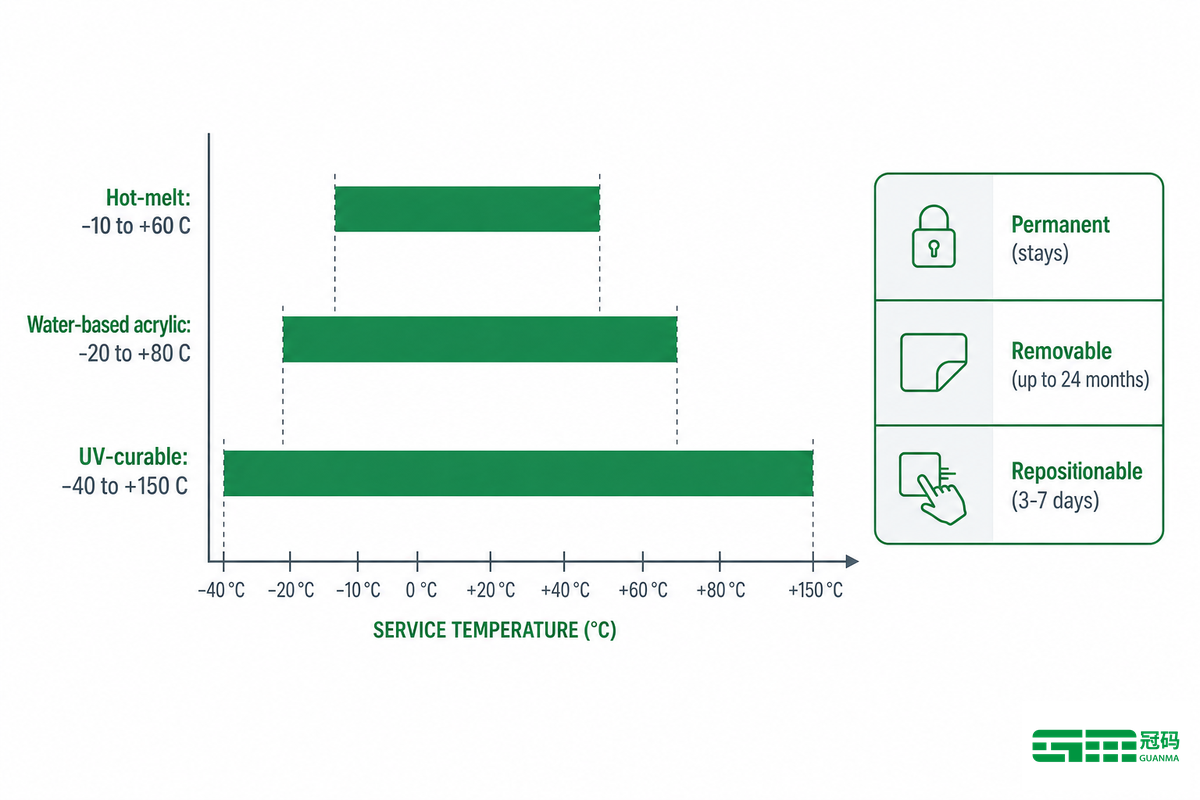
A facestock gets the attention, but the adhesive under it decides the service window, the substrates it will bond to, and how cleanly it releases. Three pressure-sensitive chemistries cover most self-adhesive film.
| PSA chemistry | Service temperature | Min. substrate energy | Typical use |
|---|---|---|---|
| Hot-melt (rubber) | −10 to +60 °C | ~31 mN/m | Room-temp beverage, indoor logistics |
| Water-based acrylic | −20 to +80 °C | ~30 mN/m | General-purpose, humid, food-contact |
| UV-curable | −40 to +150 °C | ~28 mN/m | Automotive, high-temp electronics, outdoor |
Acrylics are the quiet workhorse: research from the Pressure Sensitive Tape Council shows acrylic adhesives generate a strong spreading force over polyolefins without added wetting agents, which is why water-based acrylic is the default for tricky PP and PE containers. Each chemistry is also offered in three removability tiers, and specifying the wrong tier is a common procurement error. For food-contact labels the adhesive itself is regulated — FDA 21 CFR 175.105 governs adhesive components for indirect food contact, and 175.125 covers direct food-contact use — so specify a food-grade adhesive wherever the label may touch food.
- Permanent – engineered to stay; forcing removal usually leaves residue. Case coding, primary product identification, regulatory labels.
- Removable – clean release for up to 24 months. Promotional overlays, deposit labels, seasonal SKUs.
- Repositionable – a 3 to 7 day window to lift and re-apply. Retail price labels, shelf markers.
These PSA labels run the gamut from barcode and shipping labels to eco-solvent-printed graphics, and each pairing behaves differently once it meets a real substrate.
Can self-adhesive film labels be removed without residue?
Removable-grade self-adhesive film peels cleanly for a defined window – typically up to 24 months for removable adhesives and 3 to 7 days for repositionable grades. Permanent adhesives are engineered to stay in place; forcing them off usually leaves residue through cohesive or priming failure. If clean removal matters, specify the removability tier on the request for quote rather than assuming any label peels cleanly. Pair the tier with a compatible glassine release liner for predictable dispensing.
Why Film Labels Stick, and Why They Lift (Surface Energy)
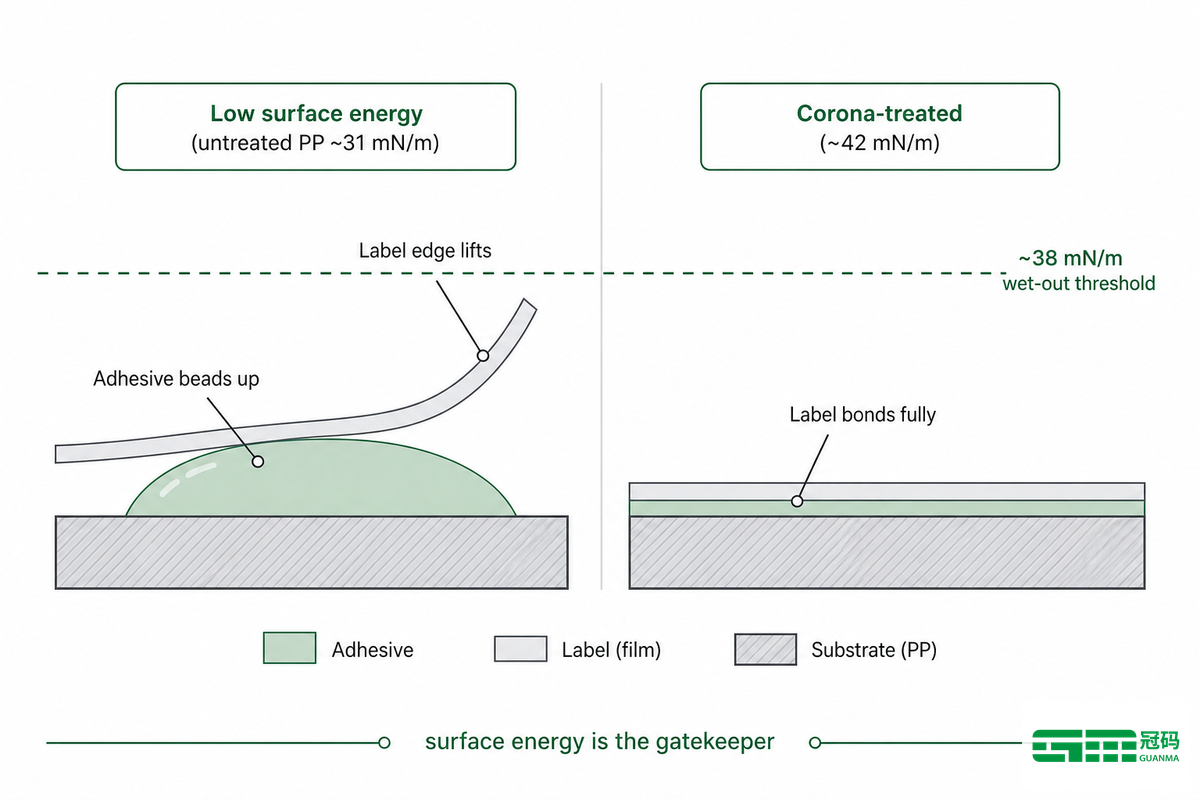
Here’s the single most useful idea in this guide: surface energy – not adhesive strength – is the gatekeeper that decides whether a film label stays on. A pressure-sensitive adhesive must flow across, or “wet out”, the substrate. Wet-out only happens when the substrate’s surface energy is high enough. As a working rule, the substrate should sit roughly 7 to 10 dyne/cm above the surface tension of the adhesive for a reliable bond.
| Substrate | Untreated (mN/m) | Corona-treated (mN/m) | Recommended adhesive |
|---|---|---|---|
| Polypropylene (PP) | 29–32 | 38–42 | Hot-melt / acrylic |
| HDPE | 31 | 38–44 | High-tack hot-melt / acrylic |
| LDPE (squeeze bottles) | 30–31 | 38–42 | Conformable PE + acrylic |
| PET (polyester) | 41 | 44–48 | Water-based acrylic |
| PVC | 39 | 42–45 | Acrylic / UV-curable |
| ABS | 35–42 | — | Acrylic |
| Aluminum | 35–45 | varies | UV-curable / acrylic |
| Stainless steel | ~45 | — | Acrylic / UV-curable |
| Coated cardboard | ~45 | — | Hot-melt |
| Glass | 73 | none needed | Any (high-energy) |
📐 Engineering Note — corona math you can run
Untreated HDPE sits near 31 mN/m, below the ~38 mN/m most standard PSAs need to wet out. Corona treatment raises a polyolefin surface by roughly 10–12 mN/m: 31 + 11 ≈ 42 mN/m, which clears the threshold. Run the same arithmetic on your own substrate, measure the dyne level, add the corona uplift, and confirm it lands 7–10 dyne/cm above your adhesive’s surface tension before you commit to a spec.
This gives rise to two field realities. First, corona loses strength over time — that is, the surface energy returns toward baseline over several weeks (“hydrophobic recovery”) – so a film that printed well right out of corona could under-bond sitting in the warehouse. Scientific studies on corona-treated PE, PP and PET document the surface-energy contribution to adhesion, and converters almost always supplement corona with an in-line treater on the press in-feed.
Second, when a label lifts, reaching for a stickier adhesive is usually the wrong move.
“If more of something is a good thing, even more must be better, but more is not always better. Too many adhesion-promoting groups create a weak boundary layer.”
The point: Don’t touch the adhesive until you know what’s on the surface of the substrate. Most “The label won’t stick” issues have to do with the “wet-out” not working, and not the glue itself. Surface energy is the first gate, not the only one — peel strength also tracks the adhesive’s rheology, the peel angle and speed, temperature, and humidity, which is why a datasheet lists a service window and a test method rather than a single stickiness number.
Film vs Paper Labels: When Film Wins
No one substrate is inherently “better” than another; application needs guide whether paper or film is best suited for a project. Film will be the choice in a harsh environment, or when crystal clarity is required; paper will win the day when economy and printable properties are of highest importance. This dual card sets out the trade-off.
✔ Where film wins
- Moisture, condensation, and washdown
- Chemicals, oils, and abrasion
- Low temperature and cold chain
- Clear “no-label” look on glass or PET
- Tear resistance + high-speed application
- Chemical-resistant and resistant to moisture
- A broad range of applications and strong material versatility vs uncoated paper
⚠ Where paper is enough
- Lower material cost per label
- Dry, indoor, short-life use
- Wider facestock and finish variety
- Porous surface for water-based ink
- Natural, recyclable brand aesthetics
Even Film isn’t perfect: It lacks the stiffness of paper, is more expensive, has poorer heat resistance than you might expect, and relies on a fossil-based resource. Paper absorbs water, tears more readily, and can crease in humid environments. You’ll find the paper side of the decision in our self-adhesive paper guide, and which facestocks suit variable-information labels in our thermal transfer versus direct thermal printing guide.
Is self-adhesive film better than paper for labels?
Self-adhesive film is not automatically better than paper — the service environment decides. Film wins where moisture, chemicals, abrasion, very low temperatures, or a “no-label” clean look matter; paper comes out on top when the environment demands a lower price point, broader facestock options, or porous-friendly presses. Match the material to the conditions, not the marketing.
However, selecting the right material for your application will prove more effective than blindly specifying film because it “seems more durable” — and it usually proves less expensive too.
6 Common Film-Label Failure Signatures and What Each One Tells You
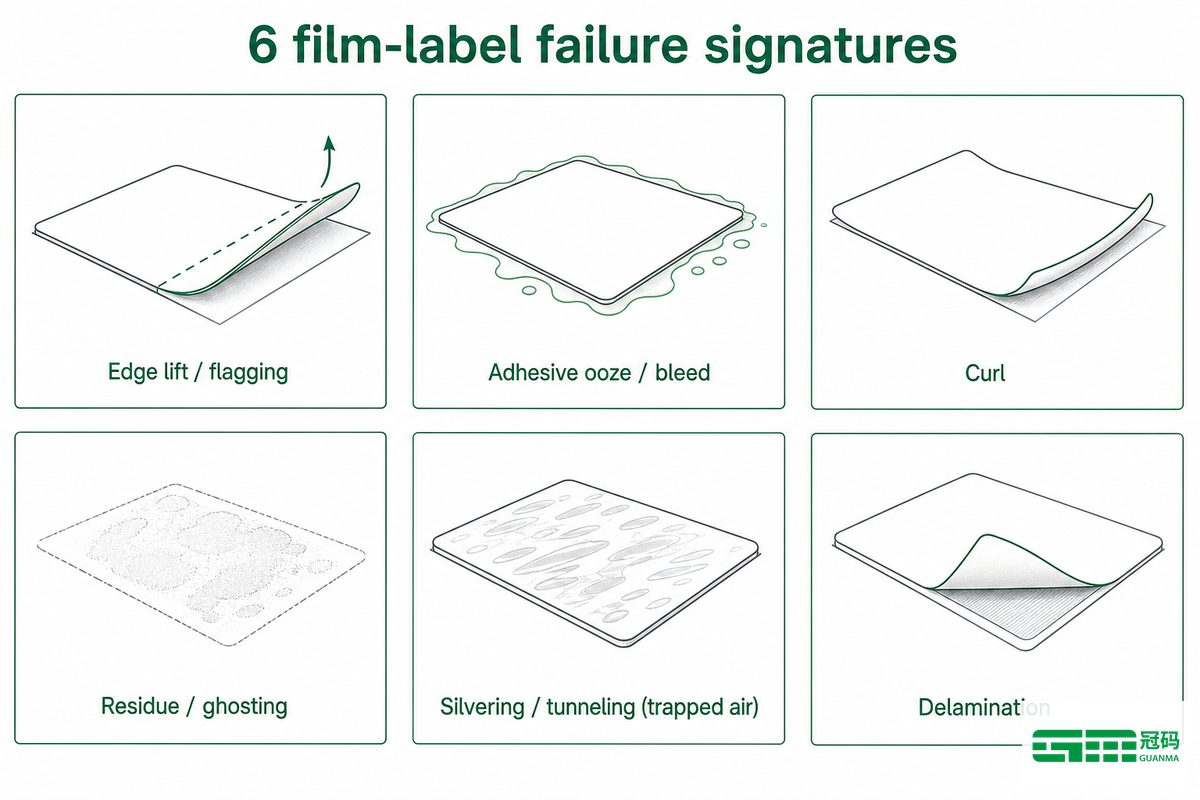
There are very few field failures that don’t have some tell-tale mark indicating the root cause. Printing and converting companies complain of the same group of problem-like events time after time – a delaminating sticker, an encapsulating film that blisters, a smeared deposit of residue. Use this matrix to go from problem to cause on all 6 Film-label Failure Signatures.
| Signature | What it looks like | Most likely root cause | Fix |
|---|---|---|---|
| Edge lift / flagging | Corners peel; labels stand up on curves | Surface-energy mismatch; too-stiff film on a tight radius | Corona/verify dyne level; switch to conformable PE; leave edge margin on glass |
| Adhesive ooze / bleed | Sticky halo outside the die-cut edge | Heat + humidity; adhesive too soft; roll wound too tight | Firmer adhesive; cooler storage; relax rewind tension |
| Curl | Label bows off the liner or substrate | Dimensional instability; moisture (worse on paper) | Choose a dimensionally stable film (PET/BOPP); condition stock |
| Residue / ghosting | Adhesive left behind after removal | Cohesive or priming failure; wrong removability tier | Specify removable-grade PSA matched to service life |
| Silvering / tunneling | Trapped-air bubbles under clear film | Poor wet-out; low-energy substrate; fast application | Raise substrate energy; slow the applicator; add squeegee pressure |
| Delamination | Print skin or laminate separates | Poor ink anchorage; missing corona/topcoat | Topcoat or re-corona before print; verify ink-anchorage tape test |
A worked example ties three signatures together. A bottler running clear BOPP on cold, wet glass sees edge lift after filling. Instinct says “stronger glue”, but the glass is high-energy (73 mN/m) – energy isn’t the problem. Condensation at the bond line and a stiff film on a curved surface are the real causes, so the fix is a moisture-tolerant acrylic plus an edge margin, exactly as label-lifting-on-glass is handled in the field. Clean removal is its own materials problem — removable adhesives patented for recyclable substrates are engineered to release without the residue that signals cohesive failure.
Reading the signature first, rather than swapping adhesion chemistry at random, is what separates a quick fix from a repeat failure — and it keeps any downstream lamination step from hiding the real cause.
Clear & Specialty Film: The No-Label Look and Beyond
The “no-label look” – type that appears to float on glass – is the marquee reason brands choose film. It needs three things: an all-clear layer stack, a high-clarity facestock (thin PP or PET), and enough surface treatment for good printability so the ink anchors. A clear film with poor print anchorage delaminates; a matte or cavitated-white BOPP trades some clarity for a softer, premium feel. Beyond clarity, specialty grades add real function:
- Metallized silver film delivers a mirror gloss without the cost of foil stamping – placed on the print skin for high gloss, or the adhesive skin for a moderate look.
- Tamper-evident film fractures or shows a void pattern when lifted – used for security seals and warranty labels.
- Overlaminate – thin PP (20–40 µm) doubles as a scratch-protection layer over printed labels on glass bottles.
Clear film pairs naturally with a transparent construction on the liner side too; for the material bridge between film and paper, our synthetic paper facestock page shows where a matte, tear-resistant option fits.
These specialty grades share a common logic: a protective layer or extra top layer, tamper-evident security, or conformable films are cost-effective additions that keep print legible and formats consistent across a run.
How to Read a Film Datasheet and Choose the Right Construction
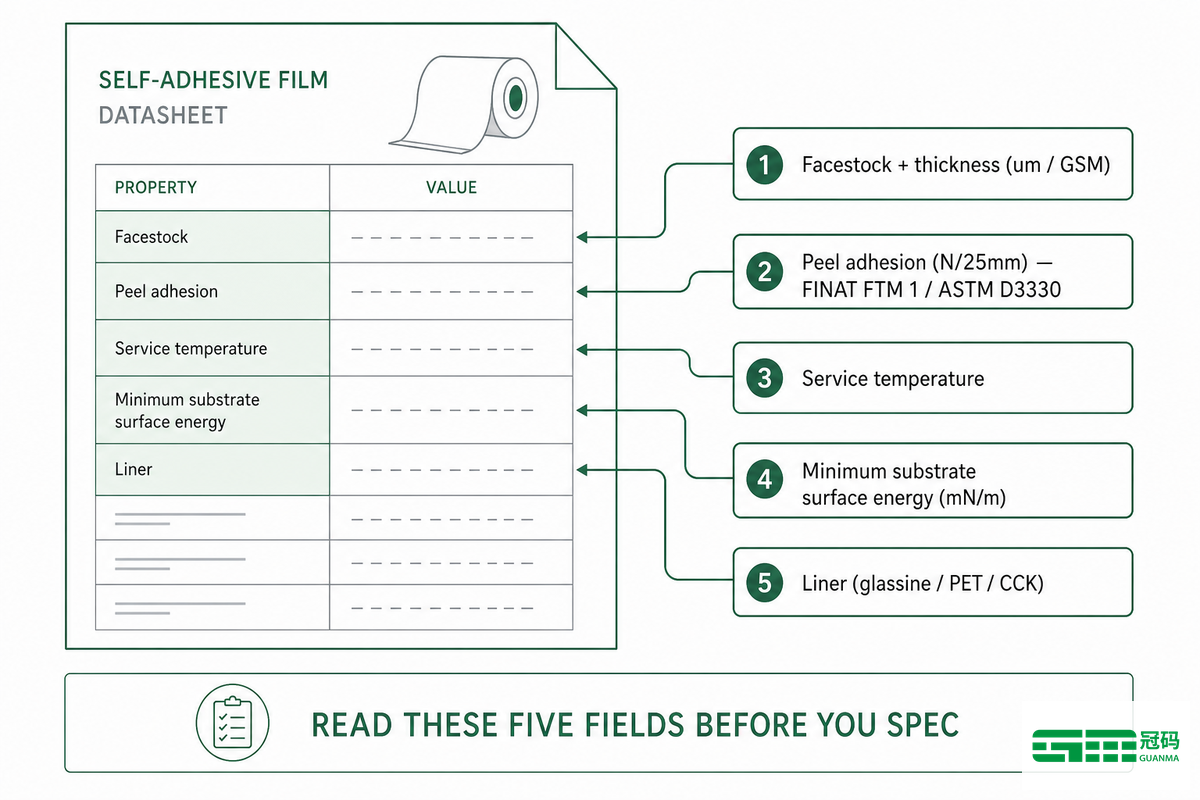
A supplier datasheet answers every question above – if you know which line to read. The glossary below decodes the fields that decide a bond, and the framework after it sequences the decision.
Datasheet fields that decide a bond
- Facestock + thickness (µm or GSM) – polymer family and gauge; sets rigidity and durability.
- Peel adhesion (N/25mm) – measured by FINAT FTM 1 at 180° or FTM 2 at 90°, both at 300 mm/min, reported after 20 minutes and 24 hours dwell; ASTM D3330 is the equivalent tape/label method.
- Service temperature and minimum application temperature – the range the bond survives, and the coldest it can be applied.
- Minimum substrate surface energy – the dyne floor below which the adhesive won’t wet out.
- Liner – glassine, PET, or clay-coated kraft; sets dispensing speed and die-cutting.
With those fields in hand, run the decision in one order – the Environment-Before-Aesthetics Selection Order. Consumer buyers start with looks; professionals start with the environment, because a beautiful label that lifts is a failed label.
💡 The Environment-Before-Aesthetics Selection Order
1) Service environment → temperature, moisture, chemicals. 2) Substrate → measure the surface energy. 3) Adhesive → pick the chemistry and removability tier that clears the dyne floor. 4) Facestock → choose the polymer family for durability and shape. 5) Finish → clear, white, matte, or metallic, last. Reverse this order and you’re designing for a photo, not for a bond.
One caution when comparing datasheets: a peel-adhesion figure compares one construction against named substrates under a fixed method — it does not reliably rank one supplier’s film against another’s, because backing stiffness and adhesive rheology change the stressed area, a limitation ASTM D3330 itself states. Compare like-for-like, and confirm on your own substrate.
To rapidly transition from framework to shortlist, our interactive material stack configurator pairs your chosen facestock, adhesive and liner with your application. When you’re ready to evaluate spec sheets against a live supplier, check our self-adhesive label film page, which lists the PET, BOPP, and synthetic-paper stocks that Guanma coats in Thailand and Vietnam.
Read those fields the same way on every printer and press, and the result is consistent quality on a high-speed line, cleaner die-cutting, and the traceability that regulated buyers increasingly want.
What’s Changing: Mono-Material and Recyclable Film (2026 Outlook)
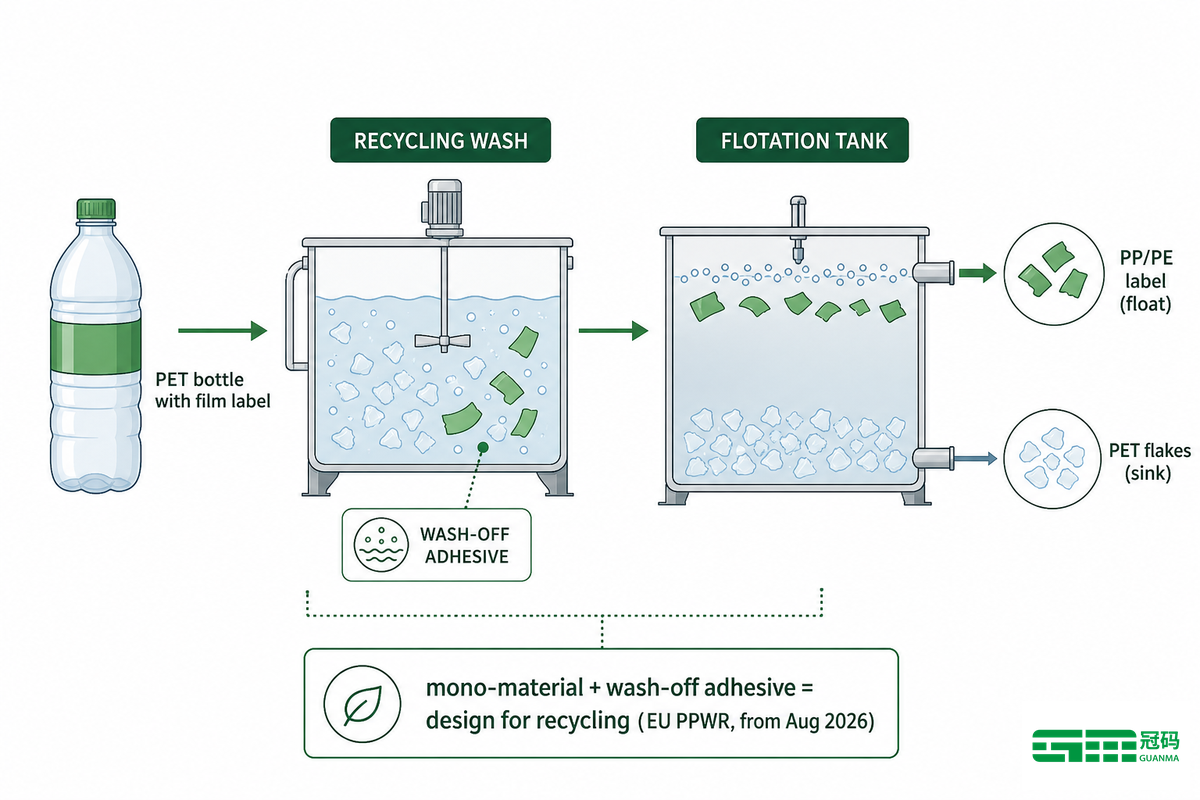
Regulation, not a new polymer, is the greatest force shaping film selection in 2026.
The EU Packaging and Packaging Waste Regulation (PPWR 2025/40) took effect on February 11, 2025 and generally applies from August 12, 2026, making design-for-recycling a legal requirement for packaging placed on the EU market.
Treat that date as when the framework starts, not a single cliff: specific obligations phase in afterward — recyclability performance grades tighten toward the end of the decade, and produce-label compostability rules arrive in 2028. This elevates two “nice-to-have” concepts into purchase criteria for label buyers.
The first is mono-material design, whereby a label made from a polyolefin film on a polyolefin container recycles cleanly, but a mixed-material label could contaminate the waste stream. The second is the wash-off adhesive, which becomes deactivated during the recycling wash so that a PP label can be separated from PET flakes in a floatation tank. Wash-off adhesives represent an active patent field — with recent applications for wash-off labels employing wash-sensitive hot-melt adhesive, and removable acrylic emulsions for washable film — so the material science is evolving beyond marketing hype.
While market projections forecast increased volumes for wash-off and mono-material materials, the true signal is regulatory, with a fixed deadline. To provide context, PET liners with 30 percent post-consumer content are estimated to reduce greenhouse gas emissions by about 14 percent, water use by up to 5 percent and energy consumption by up to 11 percent. For label buyers: Ensure that the facestock/adhesive combination on any SKU that will be shipped into the EU after August 2026 has been verified against a design-for-recycling protocol prior to locking the specification. Retrofitting to meet compliance is considerably more expensive than selecting at the design stage.
Need a self-adhesive film matched to your substrate and environment?
Send us your container samples and our applications team will issue an adhesive recommendation complete with surface-energy data.
Expect the shift toward washable, recyclable constructions with recycled content to reach high-volume and high-end lines alike, so building recyclability into the spec today protects the label — and the brand — tomorrow.
Frequently Asked Questions
What is the difference between self-adhesive film and self-adhesive paper labels?
View Answer
Both are pressure-sensitive constructions — facestock, adhesive, and liner — but they use a different facestock. Self-adhesive film uses a polymer (PET, BOPP, PP, or PVC) top layer to guard against moisture, chemicals, tear, and temperature, which can be formulated for complete clarity for a no-label appearance.
Self-adhesive paper uses a cellulose facestock that provides greater affordability and can be easily printed on porosity-friendly equipment but is susceptible to moisture damage and is prone to tearing. Film is chosen for hostile environments and premium clarity; paper is chosen for dry, indoor, cost-sensitive labels.
How do I choose the right self-adhesive film for my product?
View Answer
Work environment-first. Start with the service environment temperature, moisture, chemicals, expected lifetime. Then identify the substrate and its surface energy because that sets the dyne floor the adhesive must clear. Then select the adhesive chemistry hot-melt, water-based acrylic, UV-curable, and the removability tier. Choose the facestock polymer for durability and container shape, and then, finally, select the finish clear, white, matte, or metallic. Request an A4 swatch of the constructions shortlisted and then use on your actual container before proceeding to large scale production.
Can self-adhesive film labels be removed without leaving residue?
View Answer
Yes, if you specify a removable-grade adhesive. Guanma and most stock suppliers supply three tiers: permanent (intended to remain, and likely to leave residue if forced off), removable (clean release for up to 24 months), and repositionable (a 3 to 7 day lift-and-reapply window). Residue after removal usually indicates either a permanent adhesive was used where you needed it to be removable or cohesive failure from an over-aged label. State the removability tier and expected service life on your request for quote so the supplier can match the adhesive to your application.
What thickness of self-adhesive film do I need?
View Answer
It is application dependent. Thin PP or PET films (20–40 µm) are suited for small items and overlaminates; standard BOPP (50–60 µm) is suited for rigid bottles; thick (100–120 µm) is suited for wine bottles and drums.
Is self-adhesive film waterproof and chemical-resistant?
View Answer
Polymer facestocks are inherently water resistant and PETs in particular stand up to chemicals, oils, and abrasion. But “waterproof” is a system property: the bond only remains intact if the adhesive is matched to the substrate and the label edges are sealed. For immersion or aggressive chemicals, pair a durable PET or PVC facestock with a UV-curable or high performance acrylic adhesive and validate with a soak or chemical-wipe test on your container.
How should self-adhesive film be stored before converting?
View Answer
Store rolls flat or upright in a cool, dry place, away from direct heat, and use within the shelf-life window of the supplier. Aim for about 15–25 °C and moderate humidity, keep the rolls in their original pack until use, and avoid stacking heavy loads that deform the core. Two storage effects matter most: corona treatment on the facestock wears off, so long storage can result in poor wet-out and ink anchorage; and heat and a tight rewind can cause adhesive ooze past the die-cut edge. Rotate stocks first in first out and condition the rolls to the pressroom temperature before running. A label that under-bonds straight out of storage is usually a corona-decay problem, not a bad adhesive batch — condition and re-test before blaming the material.
Is self-adhesive film recyclable?
View Answer
It can be and more and more have to be. Recyclability depends on matching the label to the container: a polyolefin (PP/PE) film on a polyolefin container will re-cycle together while a PET film on a PET bottle needs a wash-off adhesive so the label splits during recycling. From August 2026, the EU PPWR makes design-for-recycling a must for EU market packaging. Specify mono-material constructions and wash-off adhesives when recyclability is a goal and verify the combination against a recognized design-for-recycling protocol.
About This Guide
Guanma coats and laminates self-adhesive label film, PET, BOPP, and synthetic paper facestocks paired with hot-melt, water-based, and UV adhesives, at facilities in Thailand and Vietnam. We wrote this because most “self adhesive film” guides skip the numbers that decide a bond: surface energy, facestock gauge, and removability tier. The figures here are compiled from label-industry technical references and standards; your results will vary by substrate, line speed, and environment, so test a swatch on your own container before scaling. Reviewed by the Guanma technical team.
References & Sources
- Packaging and Packaging Waste Regulation (PPWR 2025/40) — European Commission
- Adhesion Science, Chapter 5: Strong Adhesion — Royal Society of Chemistry
- Surface Energy Contribution to Acrylic PSA Adhesion and Contact Aging — U.S. DOE (OSTI)
- Characterization of the Surface Properties of Two Pressure-Sensitive Adhesives — Johns Hopkins University
- Enhanced Wetting and Adhesive Properties by Atmospheric Plasma — U.S. National Library of Medicine (PMC)
- Influence of Surface Interactions on PSA Performance (2023) — Pressure Sensitive Tape Council
- FINAT FTM 1, Peel Adhesion (180°) at 300 mm/min (N/25mm) — FINAT test method
- Label Academy: Self-Adhesive Labels, Filmic Face Labels — Labels & Labeling
- Wash-Off Label with Wash-Sensitive PSA (EP3161086A1) — Google Patents